

- Industry Size (2026)
- USD 465.5 Mn
- Forecast (2036)
- USD 1654.6 Mn
- CAGR (2026 to 2036)
- 13.5%
Orthopedic Surgery Headset Market Forecast and Outlook 2026 to 2036
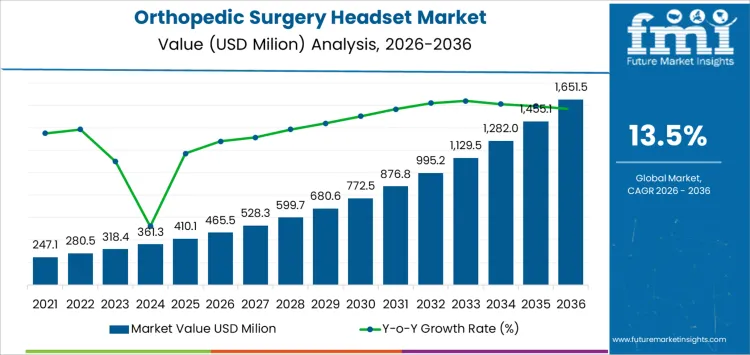
The orthopedic surgery headset market is expected to grow from USD 465.5 million in 2026 to USD 1,654.6 million by 2036, reflecting a compound annual growth rate (CAGR) of 13.5%. Orthopedic surgery headsets, which offer augmented reality (AR) and mixed reality (MR) solutions, are transforming surgical procedures by providing surgeons with enhanced visualization, real-time data overlays, and patient-specific imaging during operations. These headsets improve precision, reduce errors, and enhance the overall surgical experience by allowing for greater accuracy in complex orthopedic procedures.
The market's growth is driven by the increasing adoption of minimally invasive surgeries, advancements in AR and MR technologies, and the rising demand for precision in orthopedic surgery. As healthcare providers focus on improving patient outcomes and reducing recovery times, orthopedic surgery headsets are becoming an integral part of the surgical workflow. The market will also benefit from rising healthcare expenditure and the growing focus on improving the efficiency and safety of surgical procedures.
Quick Stats for Orthopedic Surgery Headset Market
- Orthopedic Surgery Headset Market Value (2026): USD 465.5 million
- Orthopedic Surgery Headset Market Forecast Value (2036): USD 1,654.6 million
- Orthopedic Surgery Headset Market Global Forecast CAGR (2026–2036): 13.50%
- Top Technology by Share in Orthopedic Surgery Headset Market: AR Headsets (surgical overlay) (48%)
- Key Growth Regions in Orthopedic Surgery Headset Market: China, USA, UK, Germany, Japan
- Top Players in Orthopedic Surgery Headset Market: Stryker, Zimmer Biomet, Smith+Nephew, DePuy Synthes (J&J), Medtronic, Augmedics, Microsoft (HoloLens ecosystem), Magic Leap, Epson (Moverio), Surgical Theater
What is the Growth Forecast for the Orthopedic Surgery Headset Market through 2036?
The half-decade weighted growth analysis for the orthopedic surgery headset market indicates consistent growth over the forecast period, with a significant acceleration towards the latter years. Starting at USD 465.5 million in 2026, the market grows to USD 528.7 million in 2027 and USD 600.4 million in 2028, reflecting gradual adoption as healthcare institutions begin to integrate these advanced technologies into their surgical practices.
From 2028 to 2030, the market continues to expand, reaching USD 681.7 million in 2029 and USD 773.8 million in 2030. This period marks a stronger push toward the adoption of orthopedic surgery headsets, as more surgical centers and hospitals recognize the value of these technologies in improving precision and enhancing surgical outcomes. Between 2030 and 2035, the market sees further acceleration, reaching USD 878.4 million in 2031, USD 996 million in 2032, and USD 1,128.5 million in 2033.
By 2035, the market is projected to reach USD 1,277.9 million, with the final value of USD 1,654.6 million expected by 2036. The half-decade weighted growth analysis shows that the market experiences steady growth, with acceleration driven by increased adoption, technological advancements, and the expansion of healthcare facilities integrating augmented and mixed reality tools for orthopedic surgeries. The steady, robust growth in the latter part of the forecast period indicates that orthopedic surgery headsets will become increasingly mainstream as the technology matures and proves its effectiveness in enhancing surgical precision.
Orthopedic Surgery Headset Market Key Takeaways
| Metric | Value |
|---|---|
| Industry Sales Value (2026) | USD 465.5 million |
| Industry Forecast Value (2036) | USD 1,654.6 million |
| Industry Forecast CAGR (2026-2036) | 13.5% |
What Is Driving the Demand for the Orthopedic Surgery Headset Market Globally?
The global demand for orthopedic surgery headsets is driven by a growing emphasis on improving intraoperative communication, precision, and workflow efficiency in operating rooms. These headsets enable surgeons, assistants, nurses, and anaesthesia teams to communicate clearly without shouting or leaving the sterile field, which reduces distractions and enhances focus during complex orthopedic procedures. Minimally invasive and robotic assisted orthopedic surgeries, which require precise team coordination, have increased reliance on hands free communication solutions. Rising volumes of orthopedic surgeries due to aging populations, higher incidence of musculoskeletal conditions such as osteoarthritis and fractures, and expanding access to surgical care in emerging markets support adoption. Integration with surgical navigation systems, imaging displays, and OR audio systems further enhances the value of headsets by consolidating communication and visual guidance in one workflow. Demand is also influenced by hospital investment in advanced technologies to improve patient outcomes and operating room efficiency.
Future demand for orthopedic surgery headsets is expected to grow as healthcare systems continue modernising surgical suites with digital communication tools. Advances in headset design such as improved noise cancellation, ergonomic comfort for long procedures, and wireless connectivity will make these devices more attractive to surgical teams. Integration with surgical video feeds, augmented reality overlays, and real time translation features could expand usability across diverse clinical settings and multinational teams. As surgical teams prioritise safety and quality, technology that enhances precise, clear communication will be increasingly valued. Wider adoption in outpatient surgical centres and ambulatory care settings may also support market growth. Regulatory and hospital procurement frameworks that recognise the benefits of reducing miscommunication and enhancing efficiency will influence uptake, especially where cost benefit performance can be demonstrated. Overall, continued emphasis on team coordination, procedural accuracy, and OR digitalisation is expected to sustain expansion of the orthopedic surgery headset market globally.
What Are the Key Segments in Orthopedic Surgery Headset Market?
The orthopedic surgery headset market is segmented by technology and orthopedic procedure. AR headsets (surgical overlay) lead the technology segment with 48% of the market share, offering enhanced real-time surgical guidance. Joint replacement (hip/knee/shoulder) dominates the orthopedic procedure segment with 44%, reflecting the widespread adoption of advanced technology in these high-demand surgeries. The market is growing as the demand for precision in orthopedic surgeries increases, driving the adoption of headset technologies that improve surgical planning, navigation, and training.
Which Technology Drives Orthopedic Surgery Headset Market Demand Globally?
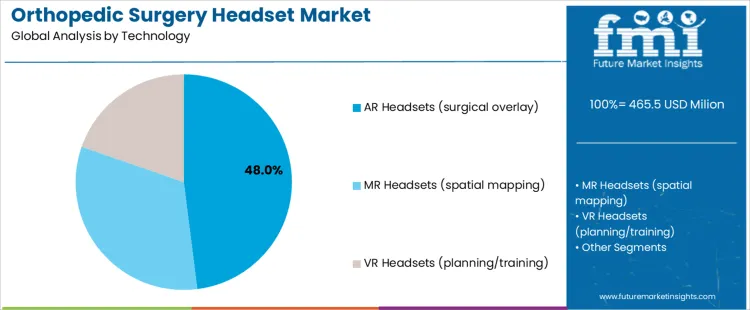
AR headsets (surgical overlay) account for 48% of the market share. Augmented Reality (AR) headsets offer real-time overlays of critical surgical data, such as anatomical structures, measurements, and positioning guides, directly onto the surgeon’s view during an operation. This real-time guidance enhances precision, reduces errors, and improves the overall efficiency of orthopedic procedures. AR headsets are particularly beneficial in complex surgeries such as joint replacements and spine procedures, where precise navigation is crucial. The growing trend toward minimally invasive surgery and the increasing demand for precision and improved surgical outcomes are driving the demand for AR headsets in the orthopedic surgery field. With advancements in AR technology and the increasing availability of cost-effective solutions, AR headsets are expected to continue leading the orthopedic surgery headset market.
Which Orthopedic Procedure Drives Orthopedic Surgery Headset Market Demand Globally?
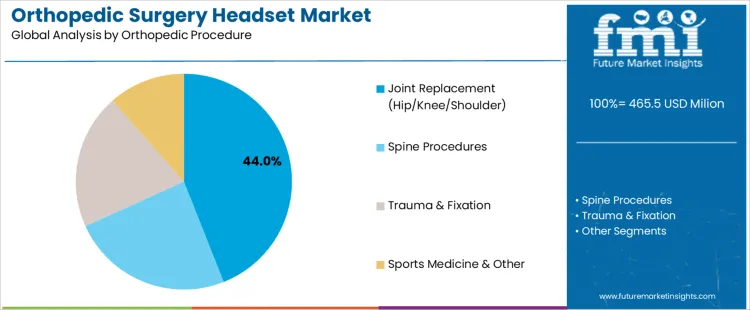
Joint replacement (hip/knee/shoulder) leads the orthopedic procedure segment with 44% of the market share. Joint replacement surgeries, particularly for the hip, knee, and shoulder, are among the most commonly performed orthopedic procedures, with increasing numbers of patients requiring these interventions due to aging populations and rising rates of musculoskeletal disorders. The demand for improved surgical precision and better post-operative outcomes in joint replacement procedures has driven the adoption of advanced technologies such as orthopedic surgery headsets. These headsets enable surgeons to visualize patient-specific anatomy and guide the placement of prosthetic components with enhanced accuracy. As joint replacement surgeries become more common and technology continues to evolve, the use of headsets in these procedures is expected to rise, making joint replacement the leading orthopedic procedure driving market demand. Other procedures, such as spine surgeries, trauma fixation, and sports medicine, also contribute to the market but remain secondary in terms of demand.
What is the Key Dynamics of the Global Orthopedic Surgery Headset Market?
The global orthopedic surgery headset market is growing as surgical teams adopt advanced head mounted technologies that improve precision, visualization and communication in orthopedic procedures. These headsets are used for enhanced imaging, hands free access to patient data, real time guidance and intraoperative collaboration with remote specialists. Rising demand reflects expansion of orthopedic surgeries, focus on minimally invasive techniques and investment in digital operating room capabilities. Growth is seen in hospitals, ambulatory surgical centres and training facilities seeking to enhance surgical workflow and clinical outcomes with modern wearable tools.
What are the Key Drivers for the Global Orthopedic Surgery Headset Market?
Increasing volume of orthopedic procedures such as joint replacements, fracture repairs and spine surgeries drives demand for tools that support surgeon performance and workflow efficiency. Healthcare providers seek technology that offers clear visualization of surgical fields, access to patient imaging and procedure data without interrupting sterility. Adoption of augmented reality and integrated imaging enhances decision support during complex cases. Growth of surgical education and remote proctoring encourages use of headsets that enable real time guidance and collaboration. Investment in digital operating rooms and emphasis on reducing procedure time and errors also influence purchase decisions.
What are the Restraints for the Global Orthopedic Surgery Headset Market?
One restraint is the cost of acquiring, integrating and maintaining advanced headset technology, which can be substantial for smaller hospitals and surgical centres. Challenges in interoperability with existing operating room systems and medical records may require investment in IT infrastructure and staff training. Clinician comfort and ergonomic suitability for long procedures may affect adoption if devices are perceived as heavy or distracting. Skepticism may arise if clinical evidence supporting improved outcomes is limited or if reimbursement for related workflows is unclear. Data security and adherence to clinical governance for connected devices can complicate deployment across regions.
What is the Key Trends in the Global Orthopedic Surgery Headset Market?
A key trend is integration of artificial intelligence and 3D imaging that provides context aware overlays, step guidance and anatomical annotation during surgery. Vendors are designing headsets that connect to hospital systems, imaging suites and telecollaboration networks to support remote expert consultation and training. Lightweight, ergonomic models are being developed to enhance comfort during long procedures. Focus on modular platforms that support multiple specialties within the same infrastructure encourages broader adoption. Emphasis on user interface simplicity and touchless interactions aligns with surgical workflow needs and supports wider uptake by clinical teams globally.
What is the Country-Wise Outlook for the Orthopedic Surgery Headset Market?
The Orthopedic Surgery Headset market is expanding as advanced technologies, such as augmented reality (AR) and virtual reality (VR), are increasingly integrated into surgical procedures. These headsets offer real-time visualization of patient data, allowing surgeons to make more informed decisions during orthopedic surgeries. The market is growing in countries like China, the USA, and the UK, where the adoption of innovative surgical technologies is on the rise. In Germany and Japan, well-established healthcare systems and a strong focus on precision medicine are contributing to the growth of this market. As the demand for minimally invasive surgeries and improved surgical outcomes continues to rise, the orthopedic surgery headset market is expected to expand globally.
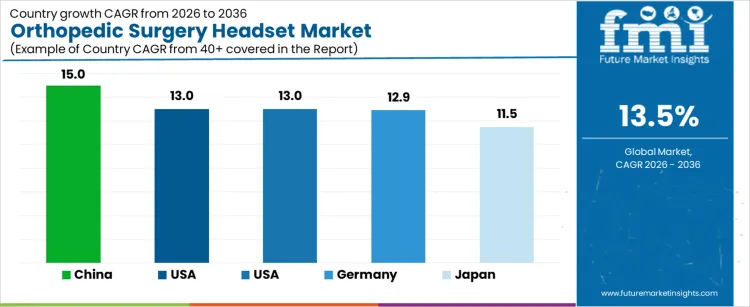
| Country | CAGR (2026 to 2036) |
|---|---|
| China | 15% |
| USA | 13% |
| UK | 13% |
| Germany | 12.9% |
| Japan | 11.5% |
What is Driving the Growth of the Orthopedic Surgery Headset Market in China?
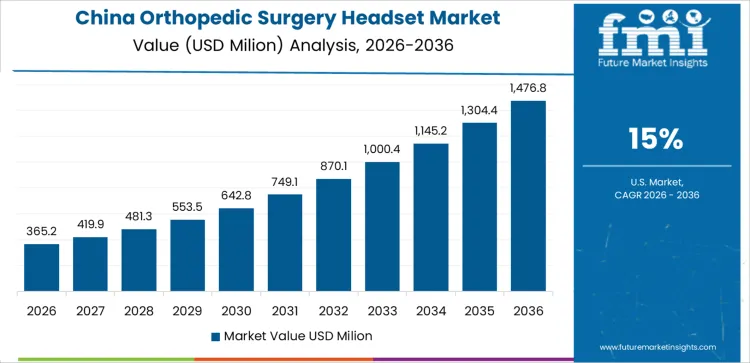
China’s Orthopedic Surgery Headset market is projected to grow at a CAGR of 15%. The growing demand for advanced surgical technologies, coupled with an increasing focus on improving the quality of healthcare, is driving the adoption of orthopedic surgery headsets. These headsets provide surgeons with real-time data and 3D visualizations, enhancing precision during surgery and improving patient outcomes. As China’s healthcare sector continues to modernize, with significant investments in medical technology and infrastructure, the demand for innovative surgical tools like orthopedic surgery headsets is expected to rise. Furthermore, the rising prevalence of musculoskeletal conditions and the increasing number of orthopedic surgeries are contributing to the market's growth in China.
What is Contributing to the Growth of the Orthopedic Surgery Headset Market in the USA?
The USA’s Orthopedic Surgery Headset market is expected to grow at a CAGR of 13%. The increasing adoption of augmented reality (AR) and virtual reality (VR) technologies in the medical field, particularly in orthopedic surgeries, is driving market growth. These headsets enhance surgical precision by providing 3D visualizations of the patient’s anatomy, enabling surgeons to perform procedures with greater accuracy. The USA’s advanced healthcare system, combined with rising demand for minimally invasive surgeries and better patient outcomes, is contributing to the growth of the orthopedic surgery headset market. As more healthcare providers in the USA integrate these technologies into their practices, the demand for orthopedic surgery headsets is expected to increase steadily.
What is Driving the Orthopedic Surgery Headset Market Growth in the UK?
The UK’s Orthopedic Surgery Headset market is projected to grow at a CAGR of 13%. As the healthcare sector in the UK increasingly adopts digital and augmented reality technologies, the demand for orthopedic surgery headsets is rising. These headsets allow surgeons to visualize complex anatomical structures in real time, enhancing the accuracy of surgeries and improving patient outcomes. The UK’s strong focus on advancing medical technologies, alongside a growing emphasis on precision medicine and minimally invasive surgeries, is supporting the adoption of AR/VR-based surgical tools. As the healthcare system continues to modernize and incorporate advanced technologies, the orthopedic surgery headset market in the UK is expected to grow steadily.
What is Influencing the Growth of the Orthopedic Surgery Headset Market in Germany?
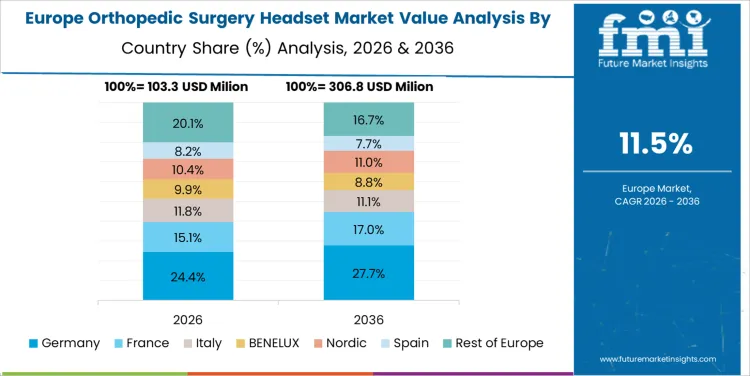
Germany’s Orthopedic Surgery Headset market is expected to grow at a CAGR of 12.9%. The country’s well-established healthcare infrastructure, along with its strong emphasis on technological innovation in the medical field, is driving the adoption of orthopedic surgery headsets. These headsets provide surgeons with enhanced visualization of the surgical area, improving both precision and efficiency during complex orthopedic procedures. Germany’s growing focus on minimizing surgical risks and improving patient outcomes, combined with increasing demand for advanced surgical tools, is contributing to the market’s growth. As digital health technologies continue to evolve, Germany is expected to see continued expansion in the use of orthopedic surgery headsets.
What is Contributing to the Growth of the Orthopedic Surgery Headset Market in Japan?
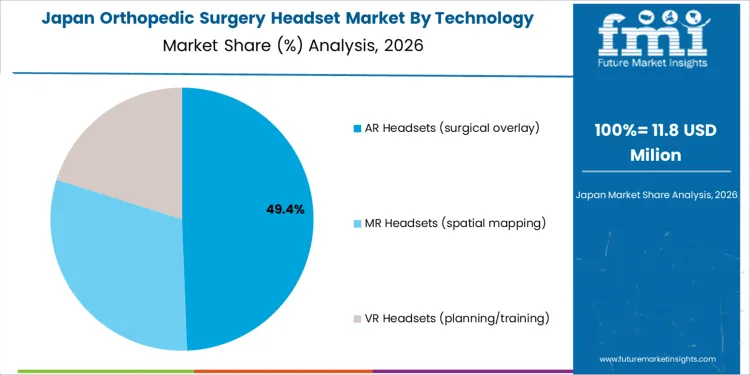
Japan’s Orthopedic Surgery Headset market is projected to grow at a CAGR of 11.5%. Japan’s aging population and the increasing prevalence of orthopedic conditions, such as osteoarthritis and musculoskeletal disorders, are driving the demand for advanced surgical technologies. Orthopedic surgery headsets, which offer real-time 3D visualizations and enhanced surgical precision, are becoming increasingly popular in Japan’s healthcare system. With a focus on improving surgical outcomes and patient safety, Japan’s healthcare facilities are increasingly integrating augmented reality and virtual reality technologies into their practices. As the adoption of digital health solutions continues to grow, the market for orthopedic surgery headsets in Japan is expected to expand in the coming years.
What is the Competitive Landscape for the Orthopedic Surgery Headset Market?
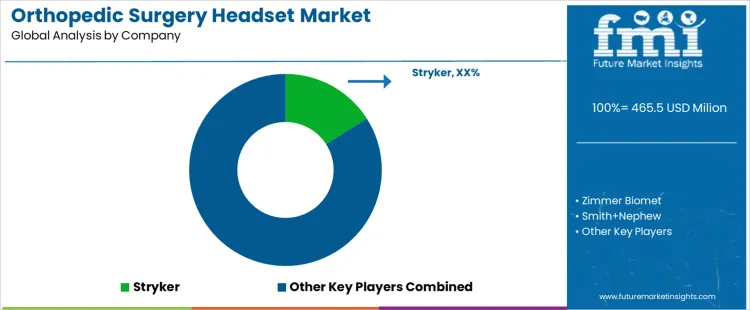
The Orthopedic Surgery Headset Market is rapidly evolving, with companies integrating augmented reality (AR) and mixed reality (MR) technologies to enhance surgical precision and outcomes. Stryker leads the market with its advanced surgical headsets, offering cutting-edge AR systems that provide real-time, 3D visualization to assist orthopedic surgeons in complex procedures. The company’s focus on user-friendly interfaces and integration into surgical workflows has helped solidify its market leadership. Zimmer Biomet, Smith+Nephew, and DePuy Synthes (J&J) also play significant roles, with their AR headset offerings designed to improve surgical planning, precision, and recovery. These companies provide integrated systems that enhance the surgeon's ability to view patient anatomy in real-time during procedures, improving decision-making and outcomes.
Medtronic, Augmedics, and Microsoft (HoloLens ecosystem) further contribute to the competitive landscape, each offering unique solutions in orthopedic surgery. Medtronic focuses on incorporating AR with surgical robotics for minimally invasive procedures, while Augmedics specializes in its Xvision AR headset, which overlays 3D imaging onto the surgeon's field of view. Microsoft’s HoloLens ecosystem plays a key role in providing immersive, mixed reality solutions that support a range of surgical specialties, including orthopedics. Magic Leap, Epson (Moverio), and Surgical Theater also add competition by offering advanced AR/MR headsets that enable enhanced visualization during orthopedic surgeries. These companies compete on the basis of technological advancements, headset functionality, and their ability to improve surgical accuracy, patient outcomes, and efficiency in orthopedic surgery.
Key Players of the Orthopedic Surgery Headset Market
- Stryker
- Zimmer Biomet
- Smith+Nephew
- DePuy Synthes (J&J)
- Medtronic
- Augmedics
- Microsoft (HoloLens ecosystem)
- Magic Leap
- Epson (Moverio)
- Surgical Theater
Scope of the Report
| Items | Values |
|---|---|
| Quantitative Units (2026) | USD Million |
| Technology | AR Headsets (surgical overlay), MR Headsets (spatial mapping), VR Headsets (planning/training) |
| Orthopedic Procedure | Joint Replacement (Hip/Knee/Shoulder), Spine Procedures, Trauma & Fixation, Sports Medicine & Other |
| Value Chain Position | Navigation/Visualization Software Bundles, Headset Hardware (medical-grade), Accessories & Sterile Interfaces |
| End User | Hospitals, Ambulatory Surgery Centers, Training/Simulation Centers, Other Users |
| Companies | Stryker, Zimmer Biomet, Smith+Nephew, DePuy Synthes (J&J), Medtronic, Augmedics, Microsoft (HoloLens ecosystem), Magic Leap, Epson (Moverio), Surgical Theater |
| Regions Covered | North America, Latin America, Western Europe, Eastern Europe, South Asia and Pacific, East Asia, Middle East & Africa |
| Countries Covered | United States, Canada, Mexico, Brazil, Argentina, Germany, France, United Kingdom, Italy, Spain, Netherlands, China, India, Japan, South Korea, ANZ, GCC Countries, South Africa |
| Additional Attributes | Dollar by sales by technology, orthopedic procedure, value chain position, end-user, and region. Includes market trends in orthopedic surgery headsets, focusing on AR, MR, and VR technologies for joint replacement, spine procedures, trauma & fixation, and sports medicine. Highlights the role of navigation software, medical-grade hardware, and accessories in improving surgery accuracy, training, and planning. Focus on cost-effectiveness, regulatory compliance, market share, and competitive positioning of key companies in the orthopedic headset space. |
Orthopedic Surgery Headset Market Segmentation
Technology
- AR Headsets (surgical overlay)
- MR Headsets (spatial mapping)
- VR Headsets (planning/training)
Orthopedic Procedure
- Joint Replacement (Hip/Knee/Shoulder)
- Spine Procedures
- Trauma & Fixation
- Sports Medicine & Other
Value Chain Position
- Navigation/Visualization Software Bundles
- Headset Hardware (medical-grade)
- Accessories & Sterile Interfaces
End User
- Hospitals
- Ambulatory Surgery Centers
- Training/Simulation Centers
- Other Users
Region
- Asia Pacific
- China
- Japan
- South Korea
- India
- Australia & New Zealand
- ASEAN
- Rest of Asia Pacific
- Europe
- Germany
- United Kingdom
- France
- Italy
- Spain
- Nordic
- BENELUX
- Rest of Europe
- North America
- United States
- Canada
- Mexico
- Latin America
- Brazil
- Chile
- Rest of Latin America
- Middle East & Africa
- Kingdom of Saudi Arabia
- Other GCC Countries
- Turkey
- South Africa
- Other African Union
- Rest of Middle East & Africa
Frequently Asked Questions
How big is the orthopedic surgery headset market in 2026?
The global orthopedic surgery headset market is estimated to be valued at USD 465.5 milion in 2026.
What will be the size of orthopedic surgery headset market in 2036?
The market size for the orthopedic surgery headset market is projected to reach USD 1,651.5 milion by 2036.
How much will be the orthopedic surgery headset market growth between 2026 and 2036?
The orthopedic surgery headset market is expected to grow at a 13.5% CAGR between 2026 and 2036.
What are the key product types in the orthopedic surgery headset market?
The key product types in orthopedic surgery headset market are ar headsets (surgical overlay), mr headsets (spatial mapping) and vr headsets (planning/training).
Which orthopedic procedure segment to contribute significant share in the orthopedic surgery headset market in 2026?
In terms of orthopedic procedure, joint replacement (hip/knee/shoulder) segment to command 44.0% share in the orthopedic surgery headset market in 2026.
Preview the report firsthand - request a free sample
Get SampleGet the brochure for pricing and purchase details.
Get PDFTable of Content
- Executive Summary
- Global Market Outlook
- Demand-side Trends
- Supply-side Trends
- Technology Roadmap Analysis
- Analysis and Recommendations
- Market Overview
- Market Coverage / Taxonomy
- Market Definition / Scope / Limitations
- Market Background
- Market Dynamics
- Drivers
- Restraints
- Opportunity
- Trends
- Scenario Forecast
- Demand in Optimistic Scenario
- Demand in Likely Scenario
- Demand in Conservative Scenario
- Opportunity Map Analysis
- Product Life Cycle Analysis
- Supply Chain Analysis
- Investment Feasibility Matrix
- Value Chain Analysis
- PESTLE and Porter’s Analysis
- Regulatory Landscape
- Regional Parent Market Outlook
- Production and Consumption Statistics
- Import and Export Statistics
- Market Dynamics
- Global Market Analysis 2021 to 2025 and Forecast, 2026 to 2036
- Historical Market Size Value (USD Million) Analysis, 2021 to 2025
- Current and Future Market Size Value (USD Million) Projections, 2026 to 2036
- Y-o-Y Growth Trend Analysis
- Absolute $ Opportunity Analysis
- Global Market Pricing Analysis 2021 to 2025 and Forecast 2026 to 2036
- Global Market Analysis 2021 to 2025 and Forecast 2026 to 2036, By Technology
- Introduction / Key Findings
- Historical Market Size Value (USD Million) Analysis By Technology , 2021 to 2025
- Current and Future Market Size Value (USD Million) Analysis and Forecast By Technology , 2026 to 2036
- AR Headsets (surgical overlay)
- MR Headsets (spatial mapping)
- VR Headsets (planning/training)
- Y-o-Y Growth Trend Analysis By Technology , 2021 to 2025
- Absolute $ Opportunity Analysis By Technology , 2026 to 2036
- Global Market Analysis 2021 to 2025 and Forecast 2026 to 2036, By Orthopedic Procedure
- Introduction / Key Findings
- Historical Market Size Value (USD Million) Analysis By Orthopedic Procedure, 2021 to 2025
- Current and Future Market Size Value (USD Million) Analysis and Forecast By Orthopedic Procedure, 2026 to 2036
- Joint Replacement (Hip/Knee/Shoulder)
- Spine Procedures
- Trauma & Fixation
- Sports Medicine & Other
- Y-o-Y Growth Trend Analysis By Orthopedic Procedure, 2021 to 2025
- Absolute $ Opportunity Analysis By Orthopedic Procedure, 2026 to 2036
- Global Market Analysis 2021 to 2025 and Forecast 2026 to 2036, By Value Chain Position
- Introduction / Key Findings
- Historical Market Size Value (USD Million) Analysis By Value Chain Position, 2021 to 2025
- Current and Future Market Size Value (USD Million) Analysis and Forecast By Value Chain Position, 2026 to 2036
- Navigation/Visualization Software Bundles
- Headset Hardware (medical-grade)
- Accessories & Sterile Interfaces
- Y-o-Y Growth Trend Analysis By Value Chain Position, 2021 to 2025
- Absolute $ Opportunity Analysis By Value Chain Position, 2026 to 2036
- Global Market Analysis 2021 to 2025 and Forecast 2026 to 2036, By End User
- Introduction / Key Findings
- Historical Market Size Value (USD Million) Analysis By End User, 2021 to 2025
- Current and Future Market Size Value (USD Million) Analysis and Forecast By End User, 2026 to 2036
- Hospitals
- Ambulatory Surgery Centers
- Training/Simulation Centers
- Other Users
- Y-o-Y Growth Trend Analysis By End User, 2021 to 2025
- Absolute $ Opportunity Analysis By End User, 2026 to 2036
- Global Market Analysis 2021 to 2025 and Forecast 2026 to 2036, By Region
- Introduction
- Historical Market Size Value (USD Million) Analysis By Region, 2021 to 2025
- Current Market Size Value (USD Million) Analysis and Forecast By Region, 2026 to 2036
- North America
- Latin America
- Western Europe
- Eastern Europe
- East Asia
- South Asia and Pacific
- Middle East & Africa
- Market Attractiveness Analysis By Region
- North America Market Analysis 2021 to 2025 and Forecast 2026 to 2036, By Country
- Historical Market Size Value (USD Million) Trend Analysis By Market Taxonomy, 2021 to 2025
- Market Size Value (USD Million) Forecast By Market Taxonomy, 2026 to 2036
- By Country
- USA
- Canada
- Mexico
- By Technology
- By Orthopedic Procedure
- By Value Chain Position
- By End User
- By Country
- Market Attractiveness Analysis
- By Country
- By Technology
- By Orthopedic Procedure
- By Value Chain Position
- By End User
- Key Takeaways
- Latin America Market Analysis 2021 to 2025 and Forecast 2026 to 2036, By Country
- Historical Market Size Value (USD Million) Trend Analysis By Market Taxonomy, 2021 to 2025
- Market Size Value (USD Million) Forecast By Market Taxonomy, 2026 to 2036
- By Country
- Brazil
- Chile
- Rest of Latin America
- By Technology
- By Orthopedic Procedure
- By Value Chain Position
- By End User
- By Country
- Market Attractiveness Analysis
- By Country
- By Technology
- By Orthopedic Procedure
- By Value Chain Position
- By End User
- Key Takeaways
- Western Europe Market Analysis 2021 to 2025 and Forecast 2026 to 2036, By Country
- Historical Market Size Value (USD Million) Trend Analysis By Market Taxonomy, 2021 to 2025
- Market Size Value (USD Million) Forecast By Market Taxonomy, 2026 to 2036
- By Country
- Germany
- UK
- Italy
- Spain
- France
- Nordic
- BENELUX
- Rest of Western Europe
- By Technology
- By Orthopedic Procedure
- By Value Chain Position
- By End User
- By Country
- Market Attractiveness Analysis
- By Country
- By Technology
- By Orthopedic Procedure
- By Value Chain Position
- By End User
- Key Takeaways
- Eastern Europe Market Analysis 2021 to 2025 and Forecast 2026 to 2036, By Country
- Historical Market Size Value (USD Million) Trend Analysis By Market Taxonomy, 2021 to 2025
- Market Size Value (USD Million) Forecast By Market Taxonomy, 2026 to 2036
- By Country
- Russia
- Poland
- Hungary
- Balkan & Baltic
- Rest of Eastern Europe
- By Technology
- By Orthopedic Procedure
- By Value Chain Position
- By End User
- By Country
- Market Attractiveness Analysis
- By Country
- By Technology
- By Orthopedic Procedure
- By Value Chain Position
- By End User
- Key Takeaways
- East Asia Market Analysis 2021 to 2025 and Forecast 2026 to 2036, By Country
- Historical Market Size Value (USD Million) Trend Analysis By Market Taxonomy, 2021 to 2025
- Market Size Value (USD Million) Forecast By Market Taxonomy, 2026 to 2036
- By Country
- China
- Japan
- South Korea
- By Technology
- By Orthopedic Procedure
- By Value Chain Position
- By End User
- By Country
- Market Attractiveness Analysis
- By Country
- By Technology
- By Orthopedic Procedure
- By Value Chain Position
- By End User
- Key Takeaways
- South Asia and Pacific Market Analysis 2021 to 2025 and Forecast 2026 to 2036, By Country
- Historical Market Size Value (USD Million) Trend Analysis By Market Taxonomy, 2021 to 2025
- Market Size Value (USD Million) Forecast By Market Taxonomy, 2026 to 2036
- By Country
- India
- ASEAN
- Australia & New Zealand
- Rest of South Asia and Pacific
- By Technology
- By Orthopedic Procedure
- By Value Chain Position
- By End User
- By Country
- Market Attractiveness Analysis
- By Country
- By Technology
- By Orthopedic Procedure
- By Value Chain Position
- By End User
- Key Takeaways
- Middle East & Africa Market Analysis 2021 to 2025 and Forecast 2026 to 2036, By Country
- Historical Market Size Value (USD Million) Trend Analysis By Market Taxonomy, 2021 to 2025
- Market Size Value (USD Million) Forecast By Market Taxonomy, 2026 to 2036
- By Country
- Kingdom of Saudi Arabia
- Other GCC Countries
- Turkiye
- South Africa
- Other African Union
- Rest of Middle East & Africa
- By Technology
- By Orthopedic Procedure
- By Value Chain Position
- By End User
- By Country
- Market Attractiveness Analysis
- By Country
- By Technology
- By Orthopedic Procedure
- By Value Chain Position
- By End User
- Key Takeaways
- Key Countries Market Analysis
- USA
- Pricing Analysis
- Market Share Analysis, 2025
- By Technology
- By Orthopedic Procedure
- By Value Chain Position
- By End User
- Canada
- Pricing Analysis
- Market Share Analysis, 2025
- By Technology
- By Orthopedic Procedure
- By Value Chain Position
- By End User
- Mexico
- Pricing Analysis
- Market Share Analysis, 2025
- By Technology
- By Orthopedic Procedure
- By Value Chain Position
- By End User
- Brazil
- Pricing Analysis
- Market Share Analysis, 2025
- By Technology
- By Orthopedic Procedure
- By Value Chain Position
- By End User
- Chile
- Pricing Analysis
- Market Share Analysis, 2025
- By Technology
- By Orthopedic Procedure
- By Value Chain Position
- By End User
- Germany
- Pricing Analysis
- Market Share Analysis, 2025
- By Technology
- By Orthopedic Procedure
- By Value Chain Position
- By End User
- UK
- Pricing Analysis
- Market Share Analysis, 2025
- By Technology
- By Orthopedic Procedure
- By Value Chain Position
- By End User
- Italy
- Pricing Analysis
- Market Share Analysis, 2025
- By Technology
- By Orthopedic Procedure
- By Value Chain Position
- By End User
- Spain
- Pricing Analysis
- Market Share Analysis, 2025
- By Technology
- By Orthopedic Procedure
- By Value Chain Position
- By End User
- France
- Pricing Analysis
- Market Share Analysis, 2025
- By Technology
- By Orthopedic Procedure
- By Value Chain Position
- By End User
- India
- Pricing Analysis
- Market Share Analysis, 2025
- By Technology
- By Orthopedic Procedure
- By Value Chain Position
- By End User
- ASEAN
- Pricing Analysis
- Market Share Analysis, 2025
- By Technology
- By Orthopedic Procedure
- By Value Chain Position
- By End User
- Australia & New Zealand
- Pricing Analysis
- Market Share Analysis, 2025
- By Technology
- By Orthopedic Procedure
- By Value Chain Position
- By End User
- China
- Pricing Analysis
- Market Share Analysis, 2025
- By Technology
- By Orthopedic Procedure
- By Value Chain Position
- By End User
- Japan
- Pricing Analysis
- Market Share Analysis, 2025
- By Technology
- By Orthopedic Procedure
- By Value Chain Position
- By End User
- South Korea
- Pricing Analysis
- Market Share Analysis, 2025
- By Technology
- By Orthopedic Procedure
- By Value Chain Position
- By End User
- Russia
- Pricing Analysis
- Market Share Analysis, 2025
- By Technology
- By Orthopedic Procedure
- By Value Chain Position
- By End User
- Poland
- Pricing Analysis
- Market Share Analysis, 2025
- By Technology
- By Orthopedic Procedure
- By Value Chain Position
- By End User
- Hungary
- Pricing Analysis
- Market Share Analysis, 2025
- By Technology
- By Orthopedic Procedure
- By Value Chain Position
- By End User
- Kingdom of Saudi Arabia
- Pricing Analysis
- Market Share Analysis, 2025
- By Technology
- By Orthopedic Procedure
- By Value Chain Position
- By End User
- Turkiye
- Pricing Analysis
- Market Share Analysis, 2025
- By Technology
- By Orthopedic Procedure
- By Value Chain Position
- By End User
- South Africa
- Pricing Analysis
- Market Share Analysis, 2025
- By Technology
- By Orthopedic Procedure
- By Value Chain Position
- By End User
- USA
- Market Structure Analysis
- Competition Dashboard
- Competition Benchmarking
- Market Share Analysis of Top Players
- By Regional
- By Technology
- By Orthopedic Procedure
- By Value Chain Position
- By End User
- Competition Analysis
- Competition Deep Dive
- Stryker
- Overview
- Product Portfolio
- Profitability by Market Segments (Product/Age /Sales Channel/Region)
- Sales Footprint
- Strategy Overview
- Marketing Strategy
- Product Strategy
- Channel Strategy
- Zimmer Biomet
- Smith+Nephew
- DePuy Synthes (J&J)
- Medtronic
- Augmedics
- Microsoft (HoloLens ecosystem)
- Magic Leap
- Epson (Moverio)
- Surgical Theater
- Stryker
- Competition Deep Dive
- Assumptions & Acronyms Used
- Research Methodology


