

- Industry Size (2026)
- USD 2.9 Bn
- Forecast (2036)
- USD 5.6 Bn
- CAGR (2026 to 2036)
- 6.7%
Demand for Vision Care in South Korea Forecast and Outlook 2026 to 2036
The demand for vision care in South Korea is expected to reach USD 5.6 billion by 2036, growing at a CAGR of 6.7% from USD 2.9 billion in 2026. While the market shows promising upside, its growth comes with execution risks that require careful navigation. Adoption friction is evident in both consumer behavior and regulatory hurdles, as new technologies or treatments may face slow uptake due to established preferences and the cautious nature of healthcare decision-makers. The industry's sensitivity to economic conditions presents a risk, as spending on non-essential healthcare products may fluctuate with broader economic cycles. Despite these challenges, the market's overall trajectory remains positive, driven by an increasing awareness of vision health. Businesses must manage risks effectively, balancing innovation with consumer trust, while ensuring that pricing strategies remain aligned with potential economic shifts. Success will depend on precise execution and adaptability to evolving market conditions.
Quick Stats for the Demand for Vision Care in South Korea
- Vision Care in South Korea Value (2026): USD 2.9 billion
- Vision Care in South Korea Forecast Value (2036): USD 5.6 billion
- Vision Care in South Korea Forecast CAGR (2026 to 2036): 6.7%
- Vision Care in South Korea Leading Segment: Spectacle Lenses (55%)
- Key Growth Regions of Vision Care in South Korea: Jeju (leading CAGR ~8.1%)
- Top Players of Vision Care in South Korea: Bausch and Lomb, LUXOTTICA GROUP, Essilor, ZEISS International
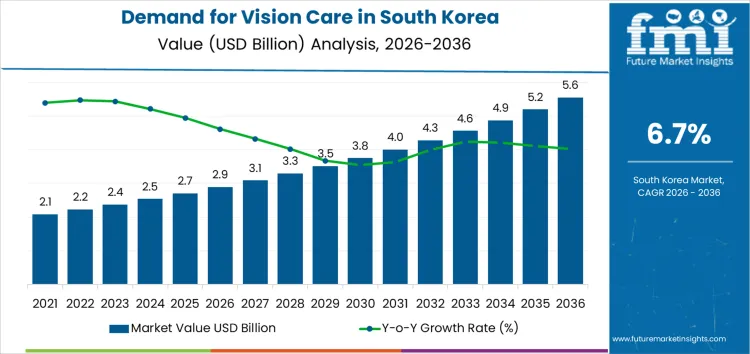
What is the Growth Forecast for the Vision Care Market in South Korea through 2036?
The vision care industry in South Korea is expected to expand steadily through the forecast period, supported by rising eye-health awareness and increasing demand for both corrective and preventive solutions. Greater screen exposure from smartphones, gaming, and digital work culture is contributing to higher incidence of eye strain, dryness, and refractive issues, driving consistent demand for spectacles, contact lenses, eye drops, and routine optometry services. At the same time, consumers are becoming more proactive about regular eye checkups and premium vision correction options.
In the later years of the forecast period, growth is expected to strengthen further as the aging population increases the need for long-term vision management, including cataract-related care, presbyopia solutions, and advanced ophthalmic services. The market is also benefiting from expanding access to specialized eye clinics, innovation in lens materials, and higher acceptance of aesthetic and lifestyle-focused products such as colored lenses. Overall, South Korea’s vision care segment will continue gaining momentum as demand rises across both functional healthcare needs and premium consumer-driven offerings.
Key Takeaways for Demand for Vision Care in South Korea
| Metric | Value |
|---|---|
| Industry Sales Value (2026) | USD 2.9 billion |
| Industry Forecast Value (2036) | USD 5.6 billion |
| Industry Forecast CAGR (2026 to 2036) | 6.7% |
Why is the Demand for Vision Care Growing in South Korea?
The demand for vision care in South Korea has been rising due to both demographic changes and evolving lifestyle habits. A significant factor contributing to this growth is the high prevalence of refractive errors such as myopia and astigmatism, particularly among younger populations who are spending long hours on digital screens for work, education, and entertainment. This has led to an increased demand for corrective products like spectacles and contact lenses. In addition to these common issues, South Korea's aging population is driving the need for treatments related to age related eye conditions such as cataracts and presbyopia, further expanding the market for vision care products. Over the counter solutions such as lubricating eye drops and nutritional supplements aimed at improving eye health are also becoming more popular, offering accessible relief for common vision problems. Retailers, optometrists, and optical product manufacturers are responding by offering a range of products, from prescription eyewear to over the counter care solutions.
Looking ahead, demand for vision care in South Korea is projected to continue growing as both medical advancements and changing consumer preferences shape the market. The development of more comfortable and effective lenses, along with innovations in diagnostics and digital health technologies, is expected to drive further adoption of vision care products. Moreover, the growing trend of e commerce and tele optometry services offers consumers greater convenience in accessing both products and professional care. Manufacturers and suppliers who focus on personalized vision care, such as blue light blocking lenses or multifocal designs, will likely find new opportunities in catering to the needs of both younger and older consumers. Adapting to these evolving demands while complying with local regulations will be crucial for companies aiming to succeed in the South Korean vision care market.
What Are the Key Segments in Demand for Vision Care in South Korea?
The demand for vision care products in South Korea is segmented by product type and distribution channel. Key product types include spectacle lenses, contact lenses, and cleaning & disinfecting solutions, with spectacle lenses holding the largest share at 55%. Distribution channels for these products include optometry stores, hospitals, ophthalmic clinics, e-commerce platforms, and retail hypermarkets or superstores, with optometry stores leading the market at 40%. As vision-related issues grow with aging populations and digital device usage, demand for these products continues to rise.
How Does Product Type Influence Demand for Vision Care in South Korea?
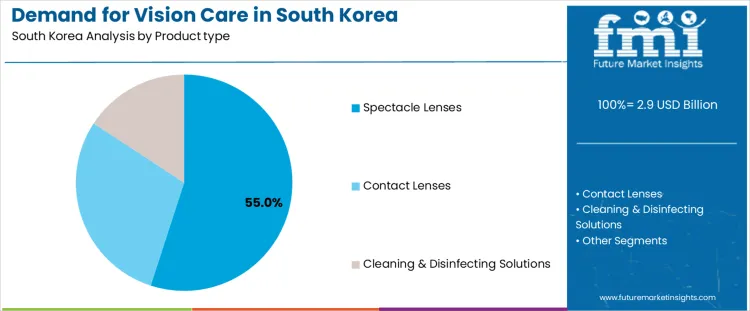
The demand for vision care products in South Korea is primarily driven by spectacle lenses, which account for 55% of the market share. Spectacle lenses remain the most common solution for vision correction due to their affordability, ease of use, and broad availability. With a growing number of individuals requiring corrective lenses for myopia, hyperopia, and presbyopia, spectacle lenses are seen as the go-to solution for vision care. The rise in screen time and digital device usage has also contributed to increased demand, as more people seek lenses that provide comfort and protection from digital eye strain. Contact lenses, while a smaller segment, continue to grow in popularity due to their convenience and aesthetic appeal.
Many consumers prefer contact lenses for their unobtrusiveness and ability to provide a natural appearance without the limitations of glasses. In addition, contact lenses are increasingly being used for specialty purposes, such as in the correction of astigmatism or for those who require lenses for active lifestyles or sports. Cleaning and disinfecting solutions are essential products for maintaining the hygiene and longevity of contact lenses, contributing to their ongoing demand in the market. These solutions are important for ensuring that contact lenses are safe to use and free from harmful bacteria, a growing concern as hygiene practices are emphasized in the wake of health crises like the COVID-19 pandemic.
What Is the Demand for Vision Care Products by Distribution Channel in South Korea?
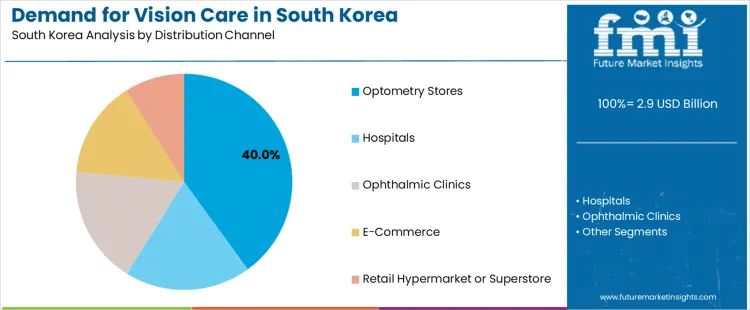
In South Korea, the distribution channel for vision care products is dominated by optometry stores, which account for 40% of the market. Optometry stores serve as the primary retail channel for spectacle lenses and contact lenses, as consumers seek professional advice and fitting services from licensed optometrists. These stores offer a wide variety of products and allow consumers to try on lenses and glasses, ensuring a personalized fit and tailored recommendations. Hospitals also contribute to the demand, particularly for individuals requiring prescription lenses or contact lenses for medical purposes. Ophthalmic clinics play a significant role in providing specialized care, particularly for those with more complex eye conditions.
These clinics offer vision care products alongside treatments and surgeries, making them a key distribution channel for customers seeking comprehensive eye care. E-commerce platforms are growing in importance as online shopping continues to rise in popularity. Consumers are increasingly purchasing spectacle lenses, contact lenses, and cleaning solutions through online stores due to the convenience and often lower prices. Retail hypermarkets and superstores also contribute to the market, providing convenient access to vision care products at competitive prices. With an increasingly digital consumer base, e-commerce and retail hypermarkets are expected to continue gaining share, while optometry stores and clinics remain vital for more personalized services and professional care.
What are the Key Dynamics in the Demand for Vision Care in South Korea?
Demand for vision care in South Korea is shaped by demographic factors, healthcare utilization patterns, and evolving lifestyle influences on eye health. Aging of the population increases prevalence of presbyopia, cataracts, and age related macular degeneration, driving consumption of corrective eyewear, diagnostics, and treatment services. High digital device usage across age groups contributes to visual fatigue and refractive error concerns, prompting regular eye examinations and preventive solutions. Ophthalmology clinics, optical retailers, and e commerce channels serve as primary points of purchase for prescription glasses, contact lenses, and vision supplements. Regulatory requirements for medical devices and professional service standards influence product offerings, pricing structures, and supplier market entry strategies.
What are the Drivers of Demand for Vision Care in South Korea?
A principal driver is increased awareness of eye health, supported by public health messaging and routine health checkups that include vision screening. The growth of a middle class with greater disposable income enables spending on premium eyewear and advanced optical services. Smartphone and screen time prevalence contributes to demand for blue light filtering lenses and ergonomic vision solutions. Expansion of retail optical chains and online platforms enhances access to vision care products with customization and home trial services. Insurers and employers promoting preventive care also encourage regular eye exams, which sustains demand for professional vision testing and corrective product sales.
What are the Restraints on Demand for Vision Care in South Korea?
Restraints include price sensitivity among certain consumer segments, particularly for premium lens coatings, designer frames, and advanced contact lenses. Out of pocket costs for eye care services can deter routine examinations, especially among younger populations who underestimate long term risks of uncorrected vision issues. Regulatory complexity for medical device classification and approval may slow introduction of innovative vision technologies or delay reimbursement coverage for some diagnostic tools. Competition from low cost, imported eyewear products can compress margins for domestic manufacturers and optical retailers, requiring strategic pricing and differentiation efforts. Supply chain disruptions affecting lens and frame components can also constrain inventory availability.
What Key Trends Affect Demand for Vision Care in South Korea?
One significant trend is integration of digital tools for vision assessment, virtual try on experiences, and tele optometry services, which enhance consumer engagement and broaden geographic reach for eye care providers. Personalization in eyewear, including custom lens prescriptions and fit for purpose solutions such as sports or occupational lenses, is gaining traction. Growth in preventive eye health products, such as supplements targeting macular health and dry eye relief, reflects consumer interest in holistic vision care. Retail channels are evolving with omnichannel strategies that combine in store expertise with online convenience. Collaborations between optical brands and healthcare professionals on education campaigns about early detection and vision preservation further shape market demand.
What is the Regional Demand Outlook for Vision Care in South Korea?
The demand for vision care products in South Korea is increasing across various regions, reflecting the country’s growing focus on eye health, aging population, and rising awareness of vision-related issues. South Gyeongsang, with a CAGR of 7.1%, demonstrates strong demand, driven by the region's healthcare infrastructure and the increasing prevalence of vision problems due to aging. North Jeolla, with a growth rate of 5.4%, shows moderate demand, influenced by a rising trend of eye care awareness and growing healthcare access. South Jeolla, with a projected CAGR of 6.4%, is seeing steady demand growth, attributed to its expanding healthcare services and population health management. Jeju, with the highest growth rate of 8.1%, is a rapidly developing market for vision care products, driven by the increasing demand from both the local population and tourists prioritizing eye health during wellness-focused visits. These regional trends reflect significant opportunities for suppliers in the vision care market.
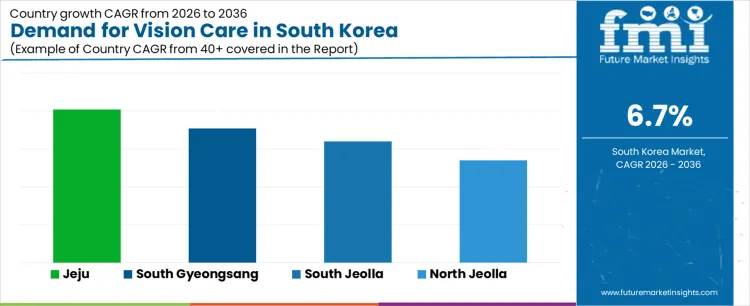
| Region | CAGR (2026 to 2036) |
|---|---|
| South Gyeongsang | 7.1% |
| North Jeolla | 5.4% |
| South Jeolla | 6.4% |
| Jeju | 8.1% |
How Can Manufacturers Capitalize on the Growth in South Gyeongsang’s Vision Care Market?
South Gyeongsang, with a CAGR of 7.1%, represents a promising market for vision care products. The region's well-developed healthcare infrastructure, coupled with a growing aging population, drives demand for a variety of eye care solutions, from prescription eyewear to vision correction devices. Manufacturers should focus on providing innovative products such as high-quality prescription lenses, contact lenses, and advanced vision care devices that meet the specific needs of South Gyeongsang’s diverse demographic. Companies could expand their market share by partnering with local healthcare providers and clinics, offering tailored solutions for both general consumers and patients with specific vision-related conditions. As the region continues to prioritize health services, the demand for vision care products is expected to rise, creating a favorable environment for suppliers.
What Drives Demand for Vision Care Products in North Jeolla?
North Jeolla, with a projected CAGR of 5.4%, presents a moderate growth opportunity for vision care suppliers. The region's increasing access to healthcare services and growing consumer awareness about eye health contribute to the rising demand for vision care products. North Jeolla’s market, while not as large as South Gyeongsang, is seeing an upward trend in demand due to the region's expanding healthcare infrastructure and its focus on improving population health. Manufacturers should target North Jeolla by offering affordable yet effective vision care solutions, particularly focusing on preventive care and the rising interest in lifestyle-related eye health products. As the region continues to enhance healthcare offerings, the demand for quality vision care products will likely grow, providing steady opportunities for businesses in this sector.
What is the Market Outlook for Vision Care Products in South Jeolla?
South Jeolla, with a CAGR of 6.4%, is witnessing steady growth in demand for vision care products. The region's expanding healthcare services and population health management strategies are driving an increased interest in eye care solutions. As residents of South Jeolla become more health-conscious and aware of the importance of vision health, there is a growing demand for preventive vision care products, including eyeglasses, contact lenses, and eye health supplements. Manufacturers looking to penetrate this market should focus on promoting early diagnosis, offering preventive care products, and ensuring easy access to high-quality eyewear and vision correction solutions. As South Jeolla continues to develop its healthcare infrastructure, the demand for vision care is expected to rise steadily.
Why is Jeju a Key Region for Vision Care Products?
Jeju, with the highest projected CAGR of 8.1%, is emerging as a key market for vision care products. The region's growing emphasis on wellness tourism, coupled with an increasing focus on preventive health, has significantly contributed to the demand for vision care solutions. Both residents and tourists are increasingly prioritizing eye health, particularly in the context of Jeju's wellness-oriented lifestyle. Manufacturers targeting Jeju should consider offering products that cater to the wellness tourism market, such as portable vision care devices and UV protection eyewear. The region’s focus on holistic health, combined with a growing local population and a steady influx of visitors, positions Jeju as a rapidly expanding market for vision care products. The expected growth in Jeju presents a strong opportunity for suppliers to provide tailored vision care solutions that align with the region’s health-conscious trends.
What is the Competitive Landscape for Vision Care Demand in South Korea?
Demand for vision care products in South Korea is expanding as demographic shifts and lifestyle factors increase the need for corrective and protective eyewear. High prevalence of myopia, extensive screen use, and growing public awareness of eye health have driven purchases of prescription glasses, contact lenses, and lens treatments. Procurement activity by optical retailers, eye care clinics, and corporate wellness programmes reflects requirements for products with precise optical performance, durability, and fit consistency. Institutional buyers and retail chains prioritise suppliers that provide documented quality assurance, reliable delivery schedules, and support for lens customization services.
Regulatory compliance and adherence to local health standards are key evaluation criteria for vision care suppliers entering or expanding in the market. Demand also spans preventative care segments, where protective eyewear and specialised coatings are specified in workplace safety programmes and leisure activity contexts. Distribution strategies increasingly include omnichannel approaches, with e commerce platforms complementing traditional brick and mortar optical stores to broaden consumer access.
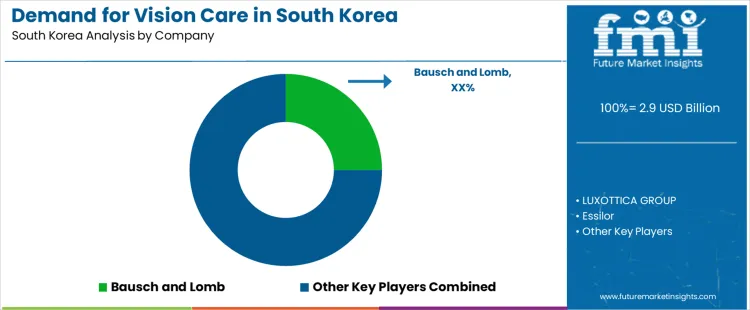
Competition among leading vision care suppliers in South Korea is defined by product breadth, technical specifications, and value added services tailored to market needs. Bausch and Lomb is recognised as a leading supplier, with product brochures detailing optical materials, lens design parameters, and clinical performance data that assist optical retailers and eye care professionals in product selection. LUXOTTICA GROUP materials present branded frame collections and integrated prescription options, with specification sheets on frame geometry, material properties, and fit adjustments relevant to retail partners and consumer touchpoints.
Essilor documentation focuses on advanced lens technologies, including anti reflective and blue light filtering treatments, with technical data on transmission rates and optical clarity that inform clinical recommendations. ZEISS International brochures highlight precision optics solutions and measurement tools, with detailed performance metrics and instrument compatibility information for practices that emphasise diagnostic and fitting accuracy. Brochure content from these companies typically includes lens specifications, material compositions, coating options, and fitting guidelines that help South Korean opticians, clinics, and eyewear retailers evaluate offerings against quality and performance benchmarks.
Key Players of the Demand for Vision Care in South Korea
- Bausch and Lomb
- LUXOTTICA GROUP
- Essilor
- ZEISS International
Scope of the Report
| Items | Values |
|---|---|
| Quantitative Units (2026) | USD Billion |
| Product Type | Spectacle Lenses, Contact Lenses, Cleaning & Disinfecting Solutions |
| Distribution Channel | Hospitals, Ophthalmic Clinics, Optometry Stores, E-Commerce, Retail Hypermarket/Superstore |
| Companies | Bausch and Lomb, LUXOTTICA GROUP, Essilor, ZEISS International |
| Region Covered | South Korea |
| Provinces Covered | South Gyeongsang, North Jeolla, South Jeolla, Jeju |
| Additional Attributes | Dollar sales by product type and distribution channel. Demand is driven by increased screen exposure, rising myopia rates, and expanding adoption of premium corrective lenses, with e-commerce and optometry stores becoming major retail pathways for vision care products. |
Key Segments of Demand for Vision Care in South Korea
Product Type
- Spectacle Lenses
- Contact Lenses
- Cleaning & Disinfecting Solutions
- Other
Distribution Channel
- Hospitals
- Ophthalmic Clinics
- Optometry Stores
- E-Commerce
- Retail Hypermarket/Superstore
- Other
Provinces
- South Gyeongsang
- North Jeolla
- South Jeolla
- Jeju
Bibliography
- Korea Disease Control and Prevention Agency. (2025). National vision and eye health survey 2024–2025. Government of the Republic of Korea.
- Ministry of Health and Welfare. (2025). Comprehensive plan for eye health management and myopia prevention. Government of the Republic of Korea.
- World Health Organization. (2024). World report on vision: Implementation progress and regional health strategies for East Asia. WHO.
Frequently Asked Questions
How big is the demand for vision care in south korea in 2026?
The demand for vision care in south korea is estimated to be valued at USD 2.9 billion in 2026.
What will be the size of vision care in south korea in 2036?
The market size for the vision care in south korea is projected to reach USD 5.6 billion by 2036.
How much will be the demand for vision care in south korea growth between 2026 and 2036?
The demand for vision care in south korea is expected to grow at a 6.7% CAGR between 2026 and 2036.
What are the key product types in the vision care in south korea?
The key product types in vision care in south korea are spectacle lenses, contact lenses and cleaning & disinfecting solutions.
Which distribution channel segment is expected to contribute significant share in the vision care in south korea in 2026?
In terms of distribution channel, optometry stores segment is expected to command 40.0% share in the vision care in south korea in 2026.
Preview the report firsthand - request a free sample
Get SampleGet the brochure for pricing and purchase details.
Get PDFTable of Content
- Executive Summary
- South Korea Market Outlook
- Demand-side Trends
- Supply-side Trends
- Technology Roadmap Analysis
- Analysis and Recommendations
- Market Overview
- Market Coverage / Taxonomy
- Market Definition / Scope / Limitations
- Market Background
- Market Dynamics
- Drivers
- Restraints
- Opportunity
- Trends
- Scenario Forecast
- Demand in Optimistic Scenario
- Demand in Likely Scenario
- Demand in Conservative Scenario
- Opportunity Map Analysis
- Product Life Cycle Analysis
- Supply Chain Analysis
- Investment Feasibility Matrix
- Value Chain Analysis
- PESTLE and Porter’s Analysis
- Regulatory Landscape
- Regional Parent Market Outlook
- Production and Consumption Statistics
- Import and Export Statistics
- Market Dynamics
- South Korea Market Analysis 2021 to 2025 and Forecast, 2026 to 2036
- Historical Market Size Value (USD Million) Analysis, 2021 to 2025
- Current and Future Market Size Value (USD Million) Projections, 2026 to 2036
- Y-o-Y Growth Trend Analysis
- Absolute $ Opportunity Analysis
- South Korea Market Pricing Analysis 2021 to 2025 and Forecast 2026 to 2036
- South Korea Market Analysis 2021 to 2025 and Forecast 2026 to 2036, By Product type
- Introduction / Key Findings
- Historical Market Size Value (USD Million) Analysis By Product type, 2021 to 2025
- Current and Future Market Size Value (USD Million) Analysis and Forecast By Product type, 2026 to 2036
- Spectacle Lenses
- Contact Lenses
- Cleaning & Disinfecting Solutions
- Spectacle Lenses
- Y-o-Y Growth Trend Analysis By Product type, 2021 to 2025
- Absolute $ Opportunity Analysis By Product type, 2026 to 2036
- South Korea Market Analysis 2021 to 2025 and Forecast 2026 to 2036, By Distribution Channel
- Introduction / Key Findings
- Historical Market Size Value (USD Million) Analysis By Distribution Channel, 2021 to 2025
- Current and Future Market Size Value (USD Million) Analysis and Forecast By Distribution Channel, 2026 to 2036
- Optometry Stores
- Hospitals
- Ophthalmic Clinics
- E-Commerce
- Retail Hypermarket or Superstore
- Optometry Stores
- Y-o-Y Growth Trend Analysis By Distribution Channel, 2021 to 2025
- Absolute $ Opportunity Analysis By Distribution Channel, 2026 to 2036
- Market Structure Analysis
- Competition Dashboard
- Competition Benchmarking
- Market Share Analysis of Top Players
- By Regional
- By Product type
- By Distribution Channel
- Competition Analysis
- Competition Deep Dive
- Bausch and Lomb
- Overview
- Product Portfolio
- Profitability by Market Segments (Product/Age /Sales Channel/Region)
- Sales Footprint
- Strategy Overview
- Marketing Strategy
- Product Strategy
- Channel Strategy
- LUXOTTICA GROUP
- Essilor
- ZEISS International
- Bausch and Lomb
- Competition Deep Dive
- Assumptions & Acronyms Used
- Research Methodology


