

- Industry Size (2026)
- USD 10.6 Bn
- Forecast (2036)
- USD 21.7 Bn
- CAGR (2026 to 2036)
- 7.5%
Demand for Vision Care in United Kingdom Forecast and Outlook 2026 to 2036
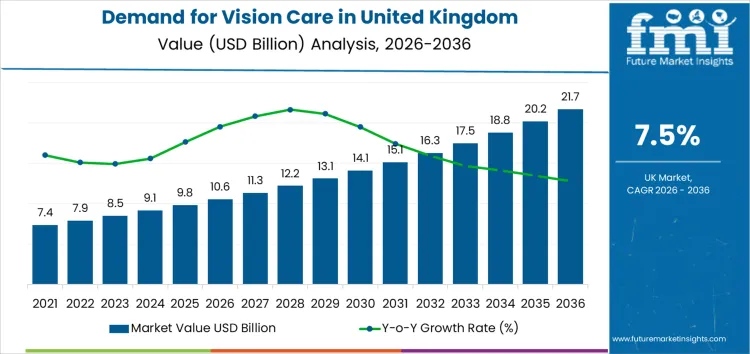
The vision care market in the United Kingdom is projected to expand from USD 10.6 billion in 2026 to USD 21.7 billion by 2036, reflecting a CAGR of 7.5%. These figures signal sustained purchasing intent across both corrective and preventive eye care, rather than short cycle demand spikes. Buying behavior suggests longer replacement cycles paired with higher average spend per patient, indicating deliberate rather than impulsive decisions. Supplier confidence is reinforced by predictable demand anchored in demographic shifts and routine care requirements. Capital allocation toward clinical capacity and retail networks reflects expectations of durable cash flows. Contractual relationships with insurers, healthcare providers, and retail chains point to long-term commitment across the value chain. Investment patterns imply confidence in service continuity and pricing stability rather than reliance on volume acceleration. Taken together, the data points to a market shaped by repeat utilization, structured procurement, and steady supplier planning horizons, offering clarity on risk exposure and operating visibility through 2036.
Quick Stats for the Demand for Vision Care in United Kingdom
- Vision Care in United Kingdom Value (2026): USD 10.6 billion
- Vision Care in United Kingdom Forecast Value (2036): USD 21.7 billion
- Vision Care in United Kingdom Forecast CAGR (2026 to 2036): 7.5%
- Vision Care in United Kingdom Leading Segment: Spectacle Lenses (45% share)
- Key Growth Regions of Vision Care in United Kingdom: England
- Top Players of Vision Care in United Kingdom: Bausch and Lomb, LUXOTTICA GROUP, Essilor, ZEISS International
What is the Growth Forecast for Vision Care in United Kingdom through 2036?
The demand for vision care in the United Kingdom is projected to rise from USD 10.6 billion in 2026 to USD 21.7 billion by 2036, reflecting a compound annual growth rate (CAGR) of 7.5%. Between 2026 and 2031, the industry will experience steady growth, with values increasing from USD 10.6 billion to USD 15.1 billion. From 2031 to 2036, growth will continue, reaching USD 21.7 billion by the end of the forecast period.
The peak-to-trough analysis indicates that the industry will maintain a steady growth trajectory throughout the forecast period, with consistent increases in demand. While the early part of the forecast period (2026-2031) will see steady growth, the industry is expected to experience a more pronounced peak in demand during the second half of the forecast period (2031-2036), as advancements in vision care technologies, rising consumer awareness, and an aging population contribute to an accelerated increase in market value. The industry's peak will be driven by greater adoption of advanced vision correction options and expanding access to eye care services.
Key Takeaways for Demand for Vision Care in United Kingdom
| Metric | Value |
|---|---|
| Industry Sales Value (2026) | USD 10.6 billion |
| Industry Forecast Value (2036) | USD 21.7 billion |
| Industry Forecast CAGR (2026 to 2036) | 7.5% |
Why is Demand for Vision Care in United Kingdom Growing?
Demand for vision care in the United Kingdom has expanded as demographic shifts and evolving healthcare practices increased utilisation of eye health services and products. Historically, vision care centred on corrective lenses and routine eye examinations delivered through optometry practices. An ageing population in the UK drove higher prevalence of presbyopia, cataracts, and other age related visual conditions, which sustained baseline demand for spectacles, contact lenses, and clinical interventions. Concurrent increases in screen time across work and education amplified incidence of digital eye strain, prompting more frequent eye tests and corrective prescriptions. Retail eyewear chains, independent opticians, and optical laboratories responded with expanded portfolios that included anti reflective coatings, blue light filtering lenses, and tailor made prescriptions. Supply chain partners and manufacturers invested in lens technologies and fittings that improved comfort and performance, which supported incremental uptake across age groups. Distribution channels adapted with online and in store hybrid models that improved access to vision care products and services, reinforcing demand patterns observed over recent years.
Looking ahead, demand for vision care in the United Kingdom is expected to continue rising as healthcare behaviours and product innovations evolve. Expansion of preventive eye health programmes and earlier diagnosis of conditions such as myopia in younger populations will influence service utilisation. Manufacturers of optics and ophthalmic devices will need to prioritise innovation in lens materials, adaptive optics, and digital integration features that meet expectations for comfort, durability, and lifestyle alignment. Retailers and supply partners will benefit from strategies that integrate tele optometry, flexible ordering, and personalised fittings, addressing consumer preference for convenience without compromising clinical accuracy. Healthcare providers and commercial buyers will assess solutions based on clinical outcomes, cost effectiveness, and integration with broader patient care pathways. Continued emphasis on comprehensive eye health, coupled with advances in diagnostic and corrective technologies, positions the vision care segment as a sustained area of growth for UK companies and suppliers.
What Are the Key Segments in the Demand for Vision Care in the United Kingdom?
Demand for vision care in the United Kingdom is driven by product type and distribution channel. Spectacle lenses lead the product type segment with 45%, while optometry stores dominate the distribution channel segment with 35%. Other product types such as contact lenses, cleaning & disinfecting solutions, and various distribution channels, including hospitals, ophthalmic clinics, e-commerce, and retail hypermarkets, also contribute to the industry. These trends highlight the diverse consumer needs for vision care solutions across different channels and product offerings.
Which is the Dominant Product Type Segment of Vision Care Sector in the United Kingdom?
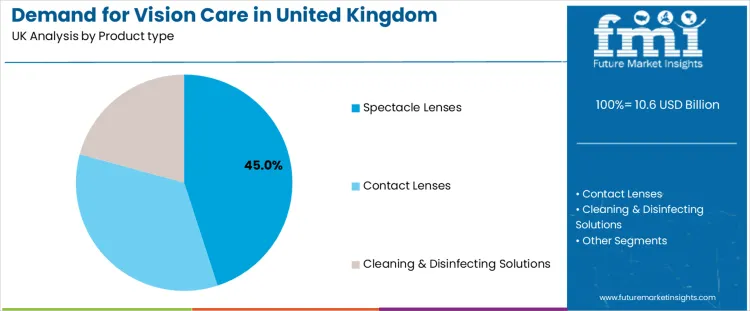
The product type segment for vision care in the United Kingdom is led by spectacle lenses, which account for 45% of the industry share. Spectacle lenses are the most widely used vision correction product, as they cater to a broad spectrum of consumers, ranging from those needing basic vision correction to individuals with more complex prescriptions. The growing prevalence of vision problems, particularly among the aging population, has contributed to the sustained demand for spectacle lenses. As consumer preferences shift toward more stylish and functional eyewear, the industry for spectacle lenses is also seeing increased demand for lenses with specialized coatings, such as anti-glare, blue light protection, and scratch resistance.
Contact lenses follow as another important product type, offering an alternative to spectacles for consumers who prefer a more discreet, convenient option. The demand for contact lenses is driven by factors such as ease of use, cosmetic appeal, and the rise of sports and active lifestyles. The contact lens market continues to expand, with innovations in comfort and extended wear lenses appealing to a broader demographic. Cleaning and disinfecting solutions, although a smaller segment, are crucial for the maintenance and hygiene of contact lenses, ensuring their safety and long-term use. As consumer awareness grows regarding the importance of eye health and hygiene, the demand for effective cleaning solutions is expected to rise. Each product type serves distinct needs, with spectacle lenses continuing to dominate due to their wider application and general acceptance.
Which is the Leading Distribution Channel Segment of Vision Care Industry in the United Kingdom?
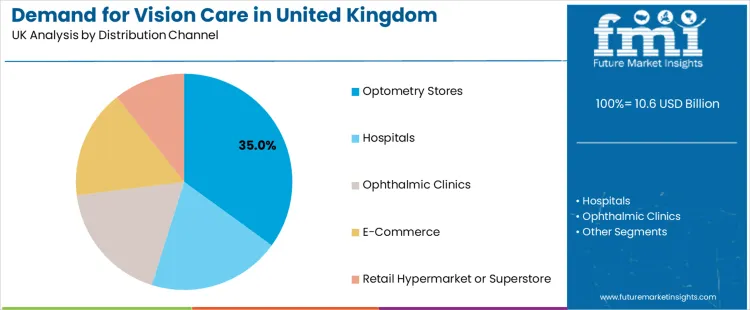
The distribution channel segment for vision care in the United Kingdom is led by optometry stores, which capture 35% of the industry share. Optometry stores serve as the primary point of purchase for eyewear, offering consumers personalized consultations and eye exams. These stores provide a wide range of spectacle lenses, contact lenses, and related products, allowing customers to try on eyewear, receive prescription services, and get professional recommendations. The demand for optometry stores remains strong as consumers increasingly seek professional guidance and customized solutions for their vision care needs. Hospitals and ophthalmic clinics represent significant distribution channels for vision care products, particularly for individuals requiring more specialized or medical-grade lenses and services. These healthcare facilities cater to patients with more complex vision issues or those requiring post-operative care following eye surgeries.
Ophthalmic clinics, in particular, are also growing in popularity due to their focus on comprehensive eye health and specialized treatments. E-commerce is an increasingly important distribution channel, offering consumers the convenience of ordering eyewear and vision care products from the comfort of their homes. The growing trend of online shopping, combined with competitive pricing and convenient delivery options, has driven the rise of e-commerce in the vision care market. Retail hypermarkets and superstores, while representing a smaller segment, continue to provide affordable, mass-market options for vision care products, especially for basic eyewear needs and over-the-counter cleaning solutions. As the industry for vision care products continues to evolve, multiple distribution channels will work in tandem to provide consumers with greater access and convenience, making eye care solutions more accessible across various platforms.
What is Propelling the Demand for Vision Care in the United Kingdom?
Demand for vision care in the United Kingdom encompasses products and services including corrective eyewear (glasses, contact lenses), diagnostic and therapeutic services, and vision health supplements. Consumption patterns are shaped by ageing demographics, increased screen time from remote work, and routine eye examinations by optometrists. Retail and online channels both contribute, with patients, employers, and insurers procuring products and services. Preventive eye health awareness and periodic public health initiatives affect frequency of eye tests. Volume demand also reflects regulatory requirements for vision screening in drivers and workplace safety programmes.
What are the Key Drivers for Vision Care Demand in the United Kingdom?
Several factors drive demand for vision care in the United Kingdom. Ageing population cohorts exhibit higher prevalence of refractive errors and age related conditions such as presbyopia and cataracts, sustaining long term need for corrective solutions. Rising screen exposure across work and leisure increases reports of digital eye strain and symptomatic vision concerns, prompting diagnostic consultations and product adoption. Employer sponsored eye care benefits and national health guidance on regular eye examinations reinforce routine uptake. Improvements in optical retail services, expanded product portfolios, and competitive pricing further support accessibility and consumer willingness to procure vision care solutions.
What are the Restraints on Vision Care Demand in the United Kingdom?
Despite underlying need, vision care demand in the United Kingdom faces several restraints. Cost considerations, particularly for premium eyewear, advanced contact lenses, and out of pocket diagnostic services, can suppress consumption among price sensitive segments. Waiting times for public sector eye care appointments may divert patients to alternative eye health resources or delay necessary intervention. Variability in private insurance coverage and benefit design influences consumer behaviour, particularly for preventive services. Misperceptions about the necessity of regular eye examinations among younger populations can delay diagnosis. Supply chain constraints affecting specialised lenses or frame availability can also temper short term procurement.
What are the Key Trends in Vision Care Demand in the United Kingdom?
Key trends shaping vision care demand in the United Kingdom include accelerated adoption of digital and remote optometry services, including online refraction and telehealth consultations, which expand access and convenience. Growth in premium, fashion oriented eyewear and customised lens technologies, such as blue light filtering and progressive prescriptions, reflect consumer preferences for multifunctional products. Increased interest in myopia management, particularly among younger populations, is driving demand for specialised lenses and monitoring services. Retail clinic integration and omnichannel purchase models that combine in store expertise with online fulfilment are gaining traction. Preventive health awareness and partnerships between vision care providers and employers are also contributing to sustained demand.
What is the Country-Wise Demand Outlook for Vision Care in the United Kingdom?
The demand for vision care in the United Kingdom shows notable regional variation, with England leading the industry. This demand is primarily driven by an aging population, an increase in vision-related health issues, and a growing awareness of the importance of eye health. England’s larger population and healthcare infrastructure contribute significantly to its dominance in the industry, but Scotland, Wales, and Northern Ireland also show strong demand driven by similar demographic trends. The increasing prevalence of eye conditions like presbyopia, myopia, and age-related macular degeneration is raising the demand for vision care solutions, such as corrective eyewear, eye exams, and surgical treatments. As consumers increasingly prioritize eye health and seek proactive solutions, the vision care market across the UK is expected to grow, with England remaining the largest market, while other regions continue to show steady growth.
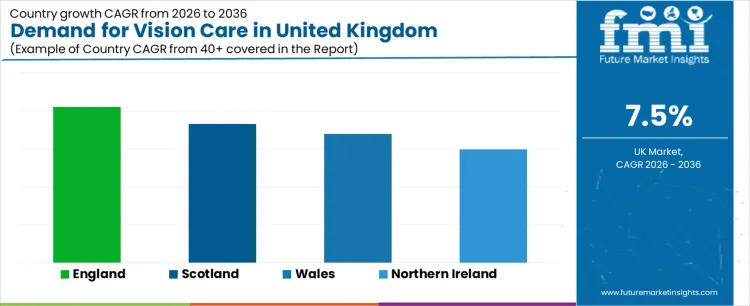
| Country | CAGR (2026 to 2036) |
|---|---|
| England | 8.2% |
| Scotland | 7.3% |
| Wales | 6.8% |
| Northern Ireland | 6.0% |
What is Driving the Demand for Vision Care in England?
The demand for vision care in England is projected to grow at a CAGR of 8.2% from 2026 to 2036. England’s large population, aging demographic, and widespread awareness of eye health are the primary drivers of this demand. As more people experience age-related vision problems, such as presbyopia and cataracts, the need for corrective eyewear and medical interventions is increasing. Additionally, the rise in digital device usage is contributing to an increase in eye strain and vision issues, which further fuels the demand for vision care solutions like eyeglasses, contact lenses, and eye drops. England’s extensive healthcare infrastructure, including opticians, hospitals, and private clinics, is making it easier for consumers to access eye care services, contributing to steady growth in the industry. With an increasing focus on preventative care and the availability of advanced treatments, the vision care market in England is expected to continue expanding.
How is the Demand for Vision Care Performing in Scotland?
In Scotland, the demand for vision care is expected to grow at a CAGR of 7.3% from 2026 to 2036. As in England, the primary driver of this demand is the aging population and the increasing incidence of age-related vision conditions. With more people in Scotland experiencing vision impairments, the demand for corrective eyewear and eye health services is rising. The growing awareness of the importance of regular eye check-ups and early intervention in preventing eye diseases is also contributing to market growth. Additionally, Scotland’s increasing focus on preventative healthcare and improved access to vision care services is further supporting the demand. With more consumers seeking solutions to maintain good vision and enhance their quality of life, the industry for vision care in Scotland is expected to experience steady growth over the next decade.
What Are the Growth Drivers for Vision Care in Wales?
The demand for vision care in Wales is projected to grow at a CAGR of 6.8% through 2036. Like other regions, the key drivers for this demand include the aging population, increasing prevalence of vision problems, and growing awareness of eye health. In Wales, there is also a growing demand for solutions to manage digital eye strain, particularly with the rise in remote work and increased screen time. As more consumers seek early detection and treatment for vision-related issues, the demand for comprehensive eye care, including regular eye exams, corrective eyewear, and surgical treatments, is on the rise. Additionally, the increasing availability of affordable eye care services, along with advancements in eye health treatments, is driving the growth of the vision care market in Wales. As consumer awareness of the importance of eye care continues to grow, the demand for vision care products and services is expected to increase steadily.
What is the Outlook for Vision Care Demand in Northern Ireland?
Northern Ireland’s demand for vision care is expected to grow at a CAGR of 6.0% from 2026 to 2036. While Northern Ireland represents the smallest market in the United Kingdom, the demand is increasing steadily, driven by an aging population and rising awareness of the importance of eye health. The demand for vision care services, including routine eye exams and treatments for conditions like cataracts and glaucoma, is expected to grow as more individuals seek solutions for age-related vision impairments. Additionally, the increasing use of digital devices is contributing to the rise in eye strain and related vision issues, further fueling demand for eye care products. The growing availability of affordable and accessible vision care services through public and private healthcare providers in Northern Ireland is expected to support continued growth in the industry.
What is the Competitive Landscape for Vision Care in the United Kingdom?
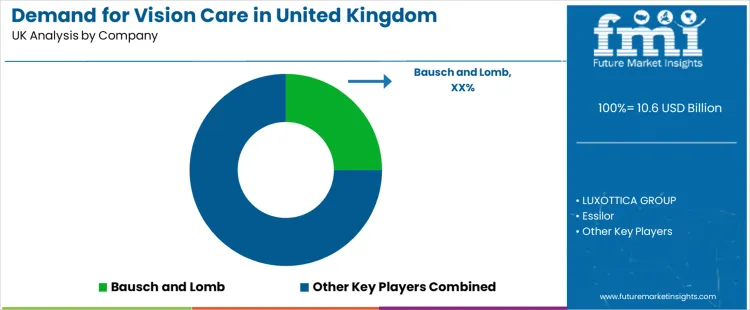
Demand for vision care in the United Kingdom is supported by routine eye examinations, an aging population with presbyopia, and consumer demand for both corrective and lifestyle eyewear solutions. Procurement and category planning teams in optical retail and healthcare services review product specifications, documented lens performance data, and clinical validation results when selecting suppliers. Bausch and Lomb is positioned as a leading supplier with documented product brochures that outline lens materials, coatings, and measured visual acuity improvements. These brochures include documented performance metrics such as scratch resistance values, UV protection levels, and documented compatibility with prescription ranges used by optometrists and dispensers during specification alignment. Retail buyers reference these details to match corrective solutions with consumer needs and practice standards.
Luxottica Group competes with an extensive portfolio of branded frames and integrated lens systems documented for material composition, documented durability test results, and documented design ergonomics. Procurement professionals in retail chains examine these technical materials to ensure fit quality, serviceability, and documented warranty terms. Essilor supplies documented lens technologies focused on progressive optics, blue light filtering, and customised prescription solutions. Product literature from Essilor includes documented measurements of optical performance and recommended use cases, which are reviewed by optical labs and practice managers in the United Kingdom when aligning system capabilities with patient prescriptions. ZEISS International offers vision care solutions with technical documentation outlining documented surface technologies, documented anti reflective performance, and documented calibration procedures. Buyers compare documented performance values and documented supply terms during tender and category reviews. Lead times, documented after sales support structures, and documented training resources for opticians also influence selection decisions. Competitive activity in the UK vision care segment is grounded in measurable technical specifications and documented product support commitments that assist optical retailers, healthcare providers, and procurement teams in aligning supplier offerings with clinical requirements and consumer expectations.
Key Players of the Demand for Vision Care in United Kingdom
- Bausch and Lomb
- LUXOTTICA GROUP
- Essilor
- ZEISS International
Scope of the Report
| Items | Values |
|---|---|
| Quantitative Units (2026) | USD Billion |
| Product Type | Spectacle Lenses, Contact Lenses, Cleaning & Disinfecting Solutions |
| Distribution Channel | Hospitals, Ophthalmic Clinics, Optometry Stores, E-Commerce, Retail Hypermarket/Superstore |
| Companies | Bausch and Lomb, LUXOTTICA GROUP, Essilor, ZEISS International |
| Regions Covered | United Kingdom |
| Countries Covered | England, Scotland, Wales, Northern Ireland |
| Additional Attributes | Dollar by sales by product type, distribution channel, and region. Includes market trends towards innovation in vision care, online retail growth, and the role of vision care products in healthcare. |
Key Segments of Demand for Vision Care in United Kingdom
Product Type:
- Spectacle Lenses
- Contact Lenses
- Cleaning & Disinfecting Solutions
Distribution Channel:
- Hospitals
- Ophthalmic Clinics
- Optometry Stores
- E-Commerce
- Retail Hypermarket/Superstore
Countries:
- England
- Scotland
- Wales
- Northern Ireland
Bibliography
- Department of Health and Social Care. (2024). Primary eye care services and population health needs in England. UK Government.
- National Health Service England. (2024). Ophthalmology activity statistics and eye care services. NHS England.
- Office for National Statistics. (2024). Vision impairment and ageing population trends in the United Kingdom. ONS.
- National Institute for Health and Care Excellence. (2024). Eye care services and management of refractive error and ocular conditions. NICE.
- World Health Organization. (2024). World report on vision. World Health Organization.
Frequently Asked Questions
How big is the demand for vision care in united kingdom in 2026?
The demand for vision care in united kingdom is estimated to be valued at USD 10.6 billion in 2026.
What will be the size of vision care in united kingdom in 2036?
The market size for the vision care in united kingdom is projected to reach USD 21.7 billion by 2036.
How much will be the demand for vision care in united kingdom growth between 2026 and 2036?
The demand for vision care in united kingdom is expected to grow at a 7.5% CAGR between 2026 and 2036.
What are the key product types in the vision care in united kingdom?
The key product types in vision care in united kingdom are spectacle lenses, contact lenses and cleaning & disinfecting solutions.
Which distribution channel segment is expected to contribute significant share in the vision care in united kingdom in 2026?
In terms of distribution channel, optometry stores segment is expected to command 35.0% share in the vision care in united kingdom in 2026.
Preview the report firsthand - request a free sample
Get SampleGet the brochure for pricing and purchase details.
Get PDFTable of Content
- Executive Summary
- UK Market Outlook
- Demand-side Trends
- Supply-side Trends
- Technology Roadmap Analysis
- Analysis and Recommendations
- Market Overview
- Market Coverage / Taxonomy
- Market Definition / Scope / Limitations
- Market Background
- Market Dynamics
- Drivers
- Restraints
- Opportunity
- Trends
- Scenario Forecast
- Demand in Optimistic Scenario
- Demand in Likely Scenario
- Demand in Conservative Scenario
- Opportunity Map Analysis
- Product Life Cycle Analysis
- Supply Chain Analysis
- Investment Feasibility Matrix
- Value Chain Analysis
- PESTLE and Porter’s Analysis
- Regulatory Landscape
- Regional Parent Market Outlook
- Production and Consumption Statistics
- Import and Export Statistics
- Market Dynamics
- UK Market Analysis 2021 to 2025 and Forecast, 2026 to 2036
- Historical Market Size Value (USD Million) Analysis, 2021 to 2025
- Current and Future Market Size Value (USD Million) Projections, 2026 to 2036
- Y-o-Y Growth Trend Analysis
- Absolute $ Opportunity Analysis
- UK Market Pricing Analysis 2021 to 2025 and Forecast 2026 to 2036
- UK Market Analysis 2021 to 2025 and Forecast 2026 to 2036, By Product type
- Introduction / Key Findings
- Historical Market Size Value (USD Million) Analysis By Product type , 2021 to 2025
- Current and Future Market Size Value (USD Million) Analysis and Forecast By Product type , 2026 to 2036
- Spectacle Lenses
- Contact Lenses
- Cleaning & Disinfecting Solutions
- Spectacle Lenses
- Y-o-Y Growth Trend Analysis By Product type , 2021 to 2025
- Absolute $ Opportunity Analysis By Product type , 2026 to 2036
- UK Market Analysis 2021 to 2025 and Forecast 2026 to 2036, By Distribution Channel
- Introduction / Key Findings
- Historical Market Size Value (USD Million) Analysis By Distribution Channel, 2021 to 2025
- Current and Future Market Size Value (USD Million) Analysis and Forecast By Distribution Channel, 2026 to 2036
- Optometry Stores
- Hospitals
- Ophthalmic Clinics
- E-Commerce
- Retail Hypermarket or Superstore
- Optometry Stores
- Y-o-Y Growth Trend Analysis By Distribution Channel, 2021 to 2025
- Absolute $ Opportunity Analysis By Distribution Channel, 2026 to 2036
- Market Structure Analysis
- Competition Dashboard
- Competition Benchmarking
- Market Share Analysis of Top Players
- By Regional
- By Product type
- By Distribution Channel
- Competition Analysis
- Competition Deep Dive
- Bausch and Lomb
- Overview
- Product Portfolio
- Profitability by Market Segments (Product/Age /Sales Channel/Region)
- Sales Footprint
- Strategy Overview
- Marketing Strategy
- Product Strategy
- Channel Strategy
- LUXOTTICA GROUP
- Essilor
- ZEISS International
- Bausch and Lomb
- Competition Deep Dive
- Assumptions & Acronyms Used
- Research Methodology


