

- Industry Size (2026)
- USD 2.3 Bn
- Forecast (2036)
- USD 4.5 Bn
- CAGR (2026 to 2036)
- 6.8%
Clinical Nail Care Products Market Forecast and Outlook 2026 to 2036
The clinical nail care products market valuation is anticipated to hit USD 2.3 billion in 2026, fueled by increasing prevalence of fungal infections and dystrophy. With a steady CAGR of 6.8% extending through 2036, total industry revenue is set to exceed USD 4.5 billion by the conclusion of this assessment period. Rising awareness regarding nail health aesthetics and hygiene acts as a primary accelerator for this upward financial trajectory.
Pharmaceutical entities are directing significant capital into developing advanced topical formulations, aiming to reduce treatment duration for stubborn conditions like onychomycosis. A transition from concealing nail issues to active clinical management is redefining consumer spending habits across major economic zones. Patients are actively seeking professional-grade solutions, pushing manufacturers to innovate beyond standard cosmetic applications. This growth pattern reflects a broader necessity for specialized dermatological interventions in maintaining appendage health effectively over the coming decade.
Quick Stats for Clinical Nail Care Products Market
- Clinical Nail Care Products Industry Value (2026): USD 2.3 Billion
- Clinical Nail Care Products Industry Value (2036): USD 4.5 Billion
- Clinical Nail Care Products Industry CAGR (2026-2036): 6.8%
- Clinical Nail Care Products Industry Leading Segment: Medicated nail solutions
- Clinical Nail Care Products Industry Key Growth Countries: India, Brazil, China
- Clinical Nail Care Products Industry Key Players: Galderma, Bausch Health, Pierre Fabre
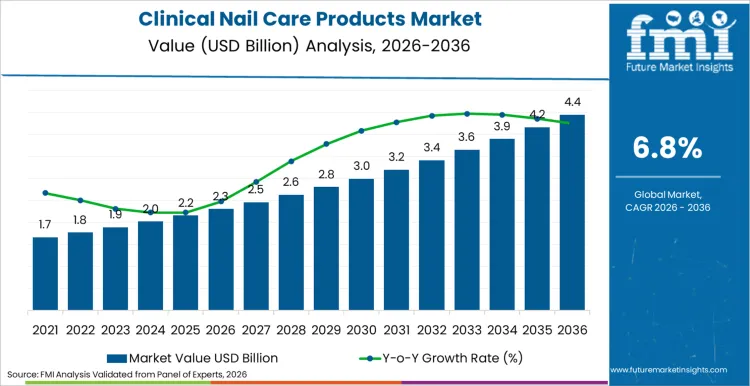
Escalating incidence of lifestyle-induced nail disorders significantly influences industry expansion. Healthcare providers are emphasizing early diagnosis, utilizing various therapeutic classes to restore nail integrity before permanent damage occurs. Clinical trials exploring novel transungual drug delivery systems are yielding promising results, fostering confidence among investors and dermatologists.
Increasing geriatric population, which is more prone to nail deformities and infections, continues to fuel incidence rates, creating sustained demand for efficacious medical treatments. Government health campaigns aimed at raising hygiene standards are facilitating faster approval processes for over-the-counter clinical solutions. Consequently, companies are witnessing robust opportunities in developing regions where personal grooming standards are rapidly evolving to align with medical health awareness.
Innovations in polymer science are transforming how active ingredients penetrate the nail plate. Researchers are integrating nail care products with antifungal agents to offer dual benefits of aesthetic improvement and clinical therapy. Development of nail strengtheners infused with biogenic nanoparticles is gaining traction, addressing brittleness barriers that often hinder patient satisfaction. Focus is also shifting towards foot care product lines that incorporate specialized applicators for precise dosage. Advancements in biotechnology allow for targeted delivery of antimycotics, enhancing efficacy of treatment protocols. Such technological strides are pivotal in shaping future product landscapes, ensuring that diverse clinical needs are met with precision and safety.
Clinical Nail Care Products Market Key Takeaways
| Metric | Value |
|---|---|
| Industry Size (2026) | USD 2.3 Billion |
| Industry Value (2036) | USD 4.5 Billion |
| CAGR (2026 to 2036) | 6.8% |
Source: FMI analysis based on primary research and proprietary forecasting model
Which Innovations Are Propelling Clinical Efficacy?
Adoption of microplastic-free nail color pigment systems for compliant formulations is serving as a significant catalyst for broader acceptance of clinical nail cosmetics. Recent breakthroughs in water-based nail color pigment dispersions with quick dry performance have revolutionized treatment protocols by offering breathable barriers that do not trap moisture, reducing fungal proliferation risks. This dual-action approach appeals strongly to healthcare providers managing patients with brittle nails treatment requirements. Clinical success of fungal testing kits in enabling rapid home diagnosis has expanded purchasing potential beyond prescriptions. Continuous education programs regarding long-term risks of untreated onychomycosis treatment are also driving patient proactivity. Pharmaceutical companies are capitalizing on these trends by launching nutricosmetics that improve nail quality from within, thereby improving holistic adherence rates.
How Is the Clinical Nail Care Products Market Structured Across Key Categories?
The clinical nail care products market is structured across several key categories that cater to diverse consumer needs and professional applications. These categories include treatments, polishes, removers, and tools, with treatments comprising antifungal solutions, moisturizers, and strengthening agents designed for specific nail conditions. Professional-grade products often dominate in clinical settings, emphasizing efficacy and safety, while retail products tend to focus on ease of use and aesthetic appeal.
Why Do Medicated Nail Solutions Retain Prominence?
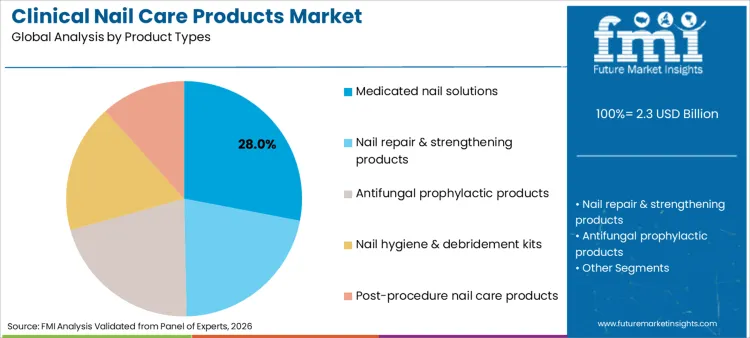
Medicated nail solutions account for 28% of share in 2026, driven by their direct mechanism of action in treating infections and structural damage. Dominance is underpinned by clinical guidelines that continue to recommend topical lacquers as first-line therapies for mild to moderate issues. This segment benefits significantly from formulation versatility, allowing incorporation of custom nail polish aesthetics with medicinal properties. Ongoing research into reducing volatile solvents in this class is renewing interest among health-conscious consumers. Furthermore, their role in managing united states onychomycosis treatment protocols remains vital for preventing recurrence. As healthcare systems strive for non-invasive disease management, demand for proven, easy-to-apply solutions is expected to remain robust, sustaining their leadership position throughout the forecast period.
Why Is Onychomycosis the Primary Indication?
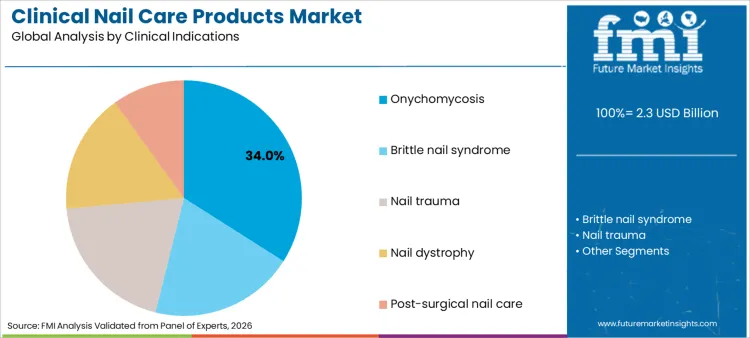
Onychomycosis applications command a 34% share of the sector in 2026, reflecting the widespread prevalence of fungal nail infections globally. Dominance is inextricably linked to the stubborn nature of the disease, where foot fungus treatments are essential to prevent spread and pain. Sector relies heavily on specialized lacquers and debridement kits to manage fungal loads effectively. These therapies are essential for preventing secondary bacterial infections in diabetic patients, which drives healthcare priorities. Consequently, relentless drive to eradicate fungal pathogens ensures that products designed to penetrate the nail plate remain highest priority for funding and procurement in both clinical and home-care settings.
How Will Biocompatibility Alter Future Revenues?
Biocompatibility is set to fundamentally reshape sales landscapes by introducing safer alternatives to harsh chemical treatments. As consumers become educated on ingredient safety, entry of "clean" clinical products is creating demand shifts, forcing legacy brands to reformulate. This shift towards non-toxic ingredients is democratizing access to high-quality treatments for pregnant women and immunocompromised individuals. Manufacturers who fail to adapt their ingredient lists risk losing share to agile competitors offering hypoallergenic products. Furthermore, availability of biocompatible options drives consumption volume, as users feel safer applying products daily. Rise of "medical pedicures" also stimulates innovation in hygiene kits, as companies seek to differentiate their commodity products through superior safety profiles and sterilization assurance.
How Are Regulatory Frameworks Impacting Development?
Regulatory bodies globally are increasingly advocating for rigorous clinical validation of "medicated" claims, directly impacting development timelines and costs. This regulatory shift forces cosmetic companies to generate robust efficacy data, increasing barriers to entry for non-compliant players. However, it also introduces opportunities for differentiation; products that demonstrate clinical superiority gain rapid dermatologist endorsement. Strict manufacturing standards are impacting production of sterile post-procedure kits. Manufacturers must now ensure rigorous quality control to prevent contamination. While these regulations drive development of safer products, they also impose higher compliance costs. Companies that proactively align with FDA and EU cosmetics directives regarding therapeutic claims will gain a competitive edge, positioning their products as the gold standard for safety.
How Will the Clinical Nail Care Industry Evolve in Major Nations?
Regional evolution is characterized by distinct growth drivers: established nations in the West are pivoting towards aesthetic restoration and anti-aging nail care, whereas Asian nations are expanding access to antifungal treatments and hygiene education. Disparity in growth rates highlights a shifting center of gravity, where rising disposable incomes in Asia-Pacific are creating massive volume demand. North American and European sectors are focusing on innovation and specialized applications, such as post-chemotherapy nail care. Government grants and private funding in these major nations are heavily slanted towards dermatology research, ensuring sustained capital influx.
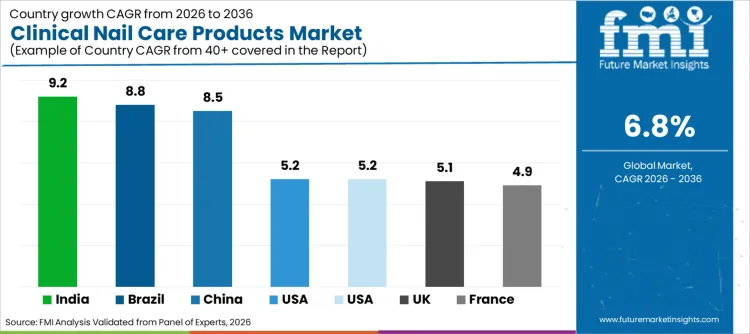
| Region | CAGR (2026 to 2036) |
|---|---|
| USA | 5.2% |
| Brazil | 8.8% |
| China | 8.5% |
| India | 9.2% |
| Germany | 5.2% |
| France | 4.9% |
| UK | 5.1% |
Source: FMI analysis based on primary research and proprietary forecasting model
Why is the Clinical Nail Care Industry in the USA Growing?
Sales of clinical nail care products in the USA are set to grow at a CAGR of 5.2% through 2036. This expansion is underpinned by high awareness of podiatric health and a healthcare system that supports regular screenings. Growth is fueled by substantial retail shelf space dedicated to specialized foot and nail care, which translates into high revenue generation per unit. Furthermore, rapid adoption of advanced laser therapies in clinics has created a follow-up market for topical recovery products. Presence of key industry players headquartered within the country also streamlines supply chains, ensuring rapid access to latest launches.
Why is the Clinical Nail Care Industry in China Expanding?
Clinical nail care industry in China is projected to rise at a 8.5% CAGR during the assessment period. "Healthy China 2030" initiatives emphasize personal hygiene, fostering a favorable environment for domestic and international dermatological brands. Increasing investments in aesthetic dermatology clinics are creating massive supply of premium recovery kits to support vast patient populations. Rising prevalence of onychomycosis in humid southern regions is prompting local pharmacies to stock advanced antifungal protocols. This shift is further supported by e-commerce platforms promoting niche medical beauty brands, thereby accelerating uptake of specialized products across provinces and fueling sector expansion.
Why is the Clinical Nail Care Industry in India Showing High Potential?
Demand for clinical nail care solutions in India is poised to expand at a CAGR of 9.2%, representing highest growth rate among analyzed nations. Surge is largely attributed to growing urbanization and increasing footfall in dermatology centers for cosmetic concerns. Government's focus on improving sanitation standards is encouraging population to upgrade from home remedies to clinically proven treatments. Furthermore, increasing number of partnerships between Indian pharma giants and global skincare innovators necessitates production of high-quality formulations. Cost advantage of manufacturing in India, combined with rising middle-class purchasing power, is attracting significant investment into the domestic personal care ecosystem.
What is the Competitive Outlook for the Clinical Nail Care Products Market?
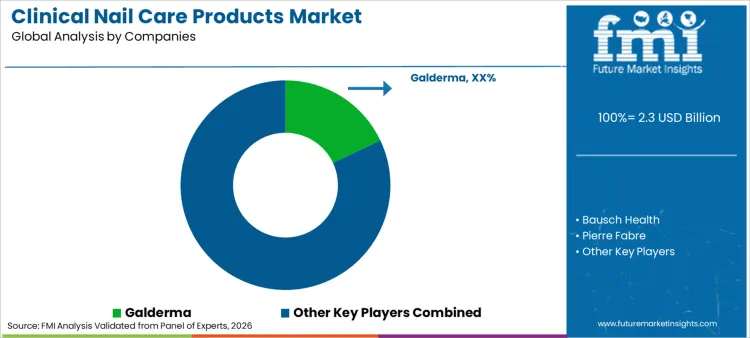
Competition in this industry is intensifying as major players leverage mergers and acquisitions to consolidate their portfolios and expand geographic footprints. Leading companies like Galderma and Bausch Health are actively developing patent-protected delivery systems to distinguish their antifungals. Strategies are increasingly focused on bundling therapeutics with educational apps to offer comprehensive disease management platforms. Strategic partnerships with podiatry associations allow companies to co-develop products that address specific clinical pain points. Competitive landscape is also witnessing a rise in influencer marketing by dermatologists, where brands are differentiating themselves by offering science-backed validation to appeal to skeptical consumers.
Key Players in Clinical Nail Care Products Market
- Galderma
- Bausch Health
- Pierre Fabre
- ISDIN
- Almirall
Scope of Report
| Items | Values |
|---|---|
| Quantitative Units | USD Million, USD Billion |
| Product Types | Medicated nail solutions, Nail repair & strengthening products, Antifungal prophylactic products, Nail hygiene & debridement kits, Post-procedure nail care products |
| Indications | Onychomycosis, Brittle nail syndrome, Nail trauma, Nail dystrophy, Post-surgical nail care |
| Sales Channels | Dermatology clinics, Retail pharmacies, Online sales, Hospital pharmacies |
| Regions | North America, Europe, East Asia, South Asia, Latin America, MEA |
Clinical Nail Care Products Market by Segments
Clinical Nail Care Product Types
- Medicated nail solutions
- Nail repair & strengthening products
- Antifungal prophylactic products
- Nail hygiene & debridement kits
- Post-procedure nail care products
Clinical Indications
- Onychomycosis
- Brittle nail syndrome
- Nail trauma
- Nail dystrophy
- Post-surgical nail care
Sales Channels
- Dermatology clinics
- Retail pharmacies
- Online sales
- Hospital pharmacies
Regions
- North America
- Europe
- East Asia
- South Asia
- Latin America
- Middle East & Africa
Bibliography
- American Academy of Dermatology. (2026, January 15). Nail fungus: Diagnosis and treatment. American Academy of Dermatology, United States.
- Centers for Disease Control and Prevention. (2024, May 20). Treatment of ringworm and fungal nail infections. Centers for Disease Control and Prevention, United States.
- USA Food and Drug Administration. (2024, July 15). Prescription-to-nonprescription switch list. USA Food and Drug Administration, United States.
- World Health Organization. (2025, May 26). Skin diseases as a global public health priority (WHA78.15). World Health Organization.
- European Medicines Agency. (2024, June 26). Cresemba: EPAR assessment report (H-C-002734-X-0042-G). European Medicines Agency.
Frequently Asked Questions
How large is the demand for Clinical Nail Care Products in the global market in 2026?
The demand for Clinical Nail Care Products in the global market is estimated to be valued at USD 2.3 billion in 2026.
What will be the market size of Clinical Nail Care Products by 2036?
The market size for Clinical Nail Care Products in the global market is projected to reach USD 4.5 billion by 2036.
What is the expected demand growth for Clinical Nail Care Products in the global market between 2026 and 2036?
The demand for Clinical Nail Care Products in the global market is expected to grow at a CAGR of 6.8% between 2026 and 2036.
Which product type in Clinical Nail Care Products is poised to lead global sales by 2026?
Medicated nail solutions are expected to be the dominant product category, capturing approximately 28% of the global market share in 2026 due to high efficacy against fungal infections.
How significant is the role of Dermatology Clinics in driving Clinical Nail Care Products adoption in 2026?
Dermatology Clinics represent a critical sales channel, projected to hold a substantial 36% share of the total market in 2026 as patients seek professional diagnosis and treatment regimens.
Preview the report firsthand - request a free sample
Get SampleGet the brochure for pricing and purchase details.
Get PDFTable of Content
- Executive Summary
- Global Market Outlook
- Demand-side Trends
- Supply-side Trends
- Technology Roadmap Analysis
- Analysis and Recommendations
- Market Overview
- Market Coverage / Taxonomy
- Market Definition / Scope / Limitations
- Market Background
- Market Dynamics
- Drivers
- Restraints
- Opportunity
- Trends
- Scenario Forecast
- Demand in Optimistic Scenario
- Demand in Likely Scenario
- Demand in Conservative Scenario
- Opportunity Map Analysis
- Product Life Cycle Analysis
- Supply Chain Analysis
- Investment Feasibility Matrix
- Value Chain Analysis
- PESTLE and Porter’s Analysis
- Regulatory Landscape
- Regional Parent Market Outlook
- Production and Consumption Statistics
- Import and Export Statistics
- Market Dynamics
- Global Market Analysis 2021 to 2025 and Forecast, 2026 to 2036
- Historical Market Size Value (USD Million) Analysis, 2021 to 2025
- Current and Future Market Size Value (USD Million) Projections, 2026 to 2036
- Y-o-Y Growth Trend Analysis
- Absolute $ Opportunity Analysis
- Global Market Pricing Analysis 2021 to 2025 and Forecast 2026 to 2036
- Global Market Analysis 2021 to 2025 and Forecast 2026 to 2036, By Product Types
- Introduction / Key Findings
- Historical Market Size Value (USD Million) Analysis By Product Types , 2021 to 2025
- Current and Future Market Size Value (USD Million) Analysis and Forecast By Product Types , 2026 to 2036
- Medicated nail solutions
- Nail repair & strengthening products
- Antifungal prophylactic products
- Nail hygiene & debridement kits
- Post-procedure nail care products
- Medicated nail solutions
- Y-o-Y Growth Trend Analysis By Product Types , 2021 to 2025
- Absolute $ Opportunity Analysis By Product Types , 2026 to 2036
- Global Market Analysis 2021 to 2025 and Forecast 2026 to 2036, By Clinical Indications
- Introduction / Key Findings
- Historical Market Size Value (USD Million) Analysis By Clinical Indications, 2021 to 2025
- Current and Future Market Size Value (USD Million) Analysis and Forecast By Clinical Indications, 2026 to 2036
- Onychomycosis
- Brittle nail syndrome
- Nail trauma
- Nail dystrophy
- Post-surgical nail care
- Onychomycosis
- Y-o-Y Growth Trend Analysis By Clinical Indications, 2021 to 2025
- Absolute $ Opportunity Analysis By Clinical Indications, 2026 to 2036
- Global Market Analysis 2021 to 2025 and Forecast 2026 to 2036, By Sales Channels
- Introduction / Key Findings
- Historical Market Size Value (USD Million) Analysis By Sales Channels, 2021 to 2025
- Current and Future Market Size Value (USD Million) Analysis and Forecast By Sales Channels, 2026 to 2036
- Dermatology clinics
- Retail pharmacies
- Online sales
- Hospital pharmacies
- Dermatology clinics
- Y-o-Y Growth Trend Analysis By Sales Channels, 2021 to 2025
- Absolute $ Opportunity Analysis By Sales Channels, 2026 to 2036
- Global Market Analysis 2021 to 2025 and Forecast 2026 to 2036, By Region
- Introduction
- Historical Market Size Value (USD Million) Analysis By Region, 2021 to 2025
- Current Market Size Value (USD Million) Analysis and Forecast By Region, 2026 to 2036
- North America
- Latin America
- Western Europe
- Eastern Europe
- East Asia
- South Asia and Pacific
- Middle East & Africa
- Market Attractiveness Analysis By Region
- North America Market Analysis 2021 to 2025 and Forecast 2026 to 2036, By Country
- Historical Market Size Value (USD Million) Trend Analysis By Market Taxonomy, 2021 to 2025
- Market Size Value (USD Million) Forecast By Market Taxonomy, 2026 to 2036
- By Country
- USA
- Canada
- Mexico
- By Product Types
- By Clinical Indications
- By Sales Channels
- By Country
- Market Attractiveness Analysis
- By Country
- By Product Types
- By Clinical Indications
- By Sales Channels
- Key Takeaways
- Latin America Market Analysis 2021 to 2025 and Forecast 2026 to 2036, By Country
- Historical Market Size Value (USD Million) Trend Analysis By Market Taxonomy, 2021 to 2025
- Market Size Value (USD Million) Forecast By Market Taxonomy, 2026 to 2036
- By Country
- Brazil
- Chile
- Rest of Latin America
- By Product Types
- By Clinical Indications
- By Sales Channels
- By Country
- Market Attractiveness Analysis
- By Country
- By Product Types
- By Clinical Indications
- By Sales Channels
- Key Takeaways
- Western Europe Market Analysis 2021 to 2025 and Forecast 2026 to 2036, By Country
- Historical Market Size Value (USD Million) Trend Analysis By Market Taxonomy, 2021 to 2025
- Market Size Value (USD Million) Forecast By Market Taxonomy, 2026 to 2036
- By Country
- Germany
- UK
- Italy
- Spain
- France
- Nordic
- BENELUX
- Rest of Western Europe
- By Product Types
- By Clinical Indications
- By Sales Channels
- By Country
- Market Attractiveness Analysis
- By Country
- By Product Types
- By Clinical Indications
- By Sales Channels
- Key Takeaways
- Eastern Europe Market Analysis 2021 to 2025 and Forecast 2026 to 2036, By Country
- Historical Market Size Value (USD Million) Trend Analysis By Market Taxonomy, 2021 to 2025
- Market Size Value (USD Million) Forecast By Market Taxonomy, 2026 to 2036
- By Country
- Russia
- Poland
- Hungary
- Balkan & Baltic
- Rest of Eastern Europe
- By Product Types
- By Clinical Indications
- By Sales Channels
- By Country
- Market Attractiveness Analysis
- By Country
- By Product Types
- By Clinical Indications
- By Sales Channels
- Key Takeaways
- East Asia Market Analysis 2021 to 2025 and Forecast 2026 to 2036, By Country
- Historical Market Size Value (USD Million) Trend Analysis By Market Taxonomy, 2021 to 2025
- Market Size Value (USD Million) Forecast By Market Taxonomy, 2026 to 2036
- By Country
- China
- Japan
- South Korea
- By Product Types
- By Clinical Indications
- By Sales Channels
- By Country
- Market Attractiveness Analysis
- By Country
- By Product Types
- By Clinical Indications
- By Sales Channels
- Key Takeaways
- South Asia and Pacific Market Analysis 2021 to 2025 and Forecast 2026 to 2036, By Country
- Historical Market Size Value (USD Million) Trend Analysis By Market Taxonomy, 2021 to 2025
- Market Size Value (USD Million) Forecast By Market Taxonomy, 2026 to 2036
- By Country
- India
- ASEAN
- Australia & New Zealand
- Rest of South Asia and Pacific
- By Product Types
- By Clinical Indications
- By Sales Channels
- By Country
- Market Attractiveness Analysis
- By Country
- By Product Types
- By Clinical Indications
- By Sales Channels
- Key Takeaways
- Middle East & Africa Market Analysis 2021 to 2025 and Forecast 2026 to 2036, By Country
- Historical Market Size Value (USD Million) Trend Analysis By Market Taxonomy, 2021 to 2025
- Market Size Value (USD Million) Forecast By Market Taxonomy, 2026 to 2036
- By Country
- Kingdom of Saudi Arabia
- Other GCC Countries
- Turkiye
- South Africa
- Other African Union
- Rest of Middle East & Africa
- By Product Types
- By Clinical Indications
- By Sales Channels
- By Country
- Market Attractiveness Analysis
- By Country
- By Product Types
- By Clinical Indications
- By Sales Channels
- Key Takeaways
- Key Countries Market Analysis
- USA
- Pricing Analysis
- Market Share Analysis, 2025
- By Product Types
- By Clinical Indications
- By Sales Channels
- Canada
- Pricing Analysis
- Market Share Analysis, 2025
- By Product Types
- By Clinical Indications
- By Sales Channels
- Mexico
- Pricing Analysis
- Market Share Analysis, 2025
- By Product Types
- By Clinical Indications
- By Sales Channels
- Brazil
- Pricing Analysis
- Market Share Analysis, 2025
- By Product Types
- By Clinical Indications
- By Sales Channels
- Chile
- Pricing Analysis
- Market Share Analysis, 2025
- By Product Types
- By Clinical Indications
- By Sales Channels
- Germany
- Pricing Analysis
- Market Share Analysis, 2025
- By Product Types
- By Clinical Indications
- By Sales Channels
- UK
- Pricing Analysis
- Market Share Analysis, 2025
- By Product Types
- By Clinical Indications
- By Sales Channels
- Italy
- Pricing Analysis
- Market Share Analysis, 2025
- By Product Types
- By Clinical Indications
- By Sales Channels
- Spain
- Pricing Analysis
- Market Share Analysis, 2025
- By Product Types
- By Clinical Indications
- By Sales Channels
- France
- Pricing Analysis
- Market Share Analysis, 2025
- By Product Types
- By Clinical Indications
- By Sales Channels
- India
- Pricing Analysis
- Market Share Analysis, 2025
- By Product Types
- By Clinical Indications
- By Sales Channels
- ASEAN
- Pricing Analysis
- Market Share Analysis, 2025
- By Product Types
- By Clinical Indications
- By Sales Channels
- Australia & New Zealand
- Pricing Analysis
- Market Share Analysis, 2025
- By Product Types
- By Clinical Indications
- By Sales Channels
- China
- Pricing Analysis
- Market Share Analysis, 2025
- By Product Types
- By Clinical Indications
- By Sales Channels
- Japan
- Pricing Analysis
- Market Share Analysis, 2025
- By Product Types
- By Clinical Indications
- By Sales Channels
- South Korea
- Pricing Analysis
- Market Share Analysis, 2025
- By Product Types
- By Clinical Indications
- By Sales Channels
- Russia
- Pricing Analysis
- Market Share Analysis, 2025
- By Product Types
- By Clinical Indications
- By Sales Channels
- Poland
- Pricing Analysis
- Market Share Analysis, 2025
- By Product Types
- By Clinical Indications
- By Sales Channels
- Hungary
- Pricing Analysis
- Market Share Analysis, 2025
- By Product Types
- By Clinical Indications
- By Sales Channels
- Kingdom of Saudi Arabia
- Pricing Analysis
- Market Share Analysis, 2025
- By Product Types
- By Clinical Indications
- By Sales Channels
- Turkiye
- Pricing Analysis
- Market Share Analysis, 2025
- By Product Types
- By Clinical Indications
- By Sales Channels
- South Africa
- Pricing Analysis
- Market Share Analysis, 2025
- By Product Types
- By Clinical Indications
- By Sales Channels
- USA
- Market Structure Analysis
- Competition Dashboard
- Competition Benchmarking
- Market Share Analysis of Top Players
- By Regional
- By Product Types
- By Clinical Indications
- By Sales Channels
- Competition Analysis
- Competition Deep Dive
- Galderma
- Overview
- Product Portfolio
- Profitability by Market Segments (Product/Age /Sales Channel/Region)
- Sales Footprint
- Strategy Overview
- Marketing Strategy
- Product Strategy
- Channel Strategy
- Bausch Health
- Pierre Fabre
- ISDIN
- Almirall
- Galderma
- Competition Deep Dive
- Assumptions & Acronyms Used
- Research Methodology


