

- Industry Size (2026)
- USD 330.4 Mn
- Forecast (2036)
- USD 497.7 Mn
- CAGR (2026 to 2036)
- 4.2%
Surgical Booms Market Size, Market Forecast and Outlook By FMI
The surgical booms market is likely to rise from USD 330.4 million in 2026 to USD 497.7 million by 2036. The market is anticipated to register a 4.2% CAGR during the forecast period. Equipment booms are expected to lead product type with a 42.0% share, while hospitals are projected to account for 68.0% of end user revenue in 2026.
Summary of the Surgical Booms Market
- Demand and Growth Drivers
- Operating room modernization is expected to support surgical boom installation across hospitals and specialty surgical centers.
- Minimally invasive surgery is likely to increase the need for organized equipment access during procedures.
- Infection control priorities are anticipated to raise demand for ceiling-mounted systems that reduce floor clutter.
- Product and Segment View
- Equipment booms are expected to lead the product type segment due to their use in integrated operating rooms.
- Roof mounting is likely to remain the main installation format because it improves movement and space use in theatres.
- Hospitals are anticipated to remain the leading end user as high procedure volumes require stable surgical infrastructure.
- Geography and Competitive Outlook
- The United States is expected to remain a core market due to robotic surgery use and operating room upgrades.
- Germany is likely to record steady expansion as hospitals invest in certified surgical suite infrastructure.
- Manufacturers with stronger modular designs and hospital integration support are anticipated to improve their market position.
- Analyst Opinion
- Sabyasachi Ghosh, Principal consultant for Healthcare at FMI, suggests, “The surgical booms market is likely to shift toward modular systems that support equipment access and cleaner operating room layouts. Hospitals are expected to prefer boom platforms that improve workflow reliability and adapt to future surgical technologies.”
- Surgical Booms Market Value Analysis
- The surgical booms market is moving from basic overhead support systems toward integrated operating room infrastructure.
- Demand is likely to rise as hospitals organize imaging devices and utilities for complex surgical procedures.
- Market expansion is expected to benefit from higher investment in minimally invasive and robotic surgery environments.
- Spending is anticipated to be backed by hospital modernization and stricter workflow requirements in surgical departments.
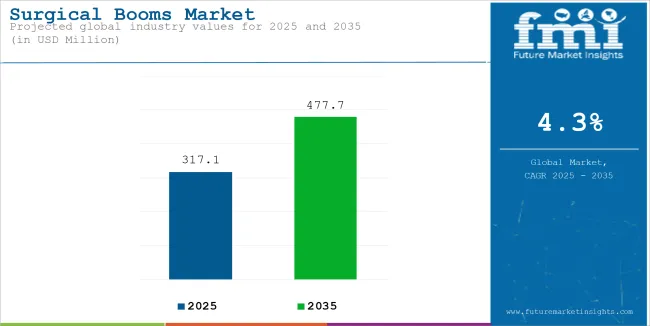
Key Takeaways, Market Size, and Forecast
| Metric | Value |
|---|---|
| Market Size (2026) | USD 330.4 Million |
| Market Size (2036) | USD 497.7 Million |
| CAGR (2026–2036) | 4.2% |
| Leading Product Type (2026) | Equipment Booms |
| Equipment Booms Share (2026) | 42.0% |
| Leading End User (2026) | Hospitals |
| Hospitals Share (2026) | 68.0% |
| Fastest-Growing Country | United States And Germany |
| United States And Germany CAGR | 4.8% |
North America and Europe remain the leading regions due to high surgical volumes, early adoption of advanced healthcare technologies, and consistent hospital renovation activity. Asia Pacific is emerging as a key growth region, supported by expanding healthcare infrastructure, rising medical tourism, and increasing public and private spending on hospital modernization in countries such as China and India.
Technological improvements such as modular designs, higher load capacity, and integration with advanced imaging and monitoring systems continue to enhance product value. Healthcare providers focus on long term durability, ease of maintenance, and compliance with strict safety standards when selecting surgical boom systems. Together, these factors position the surgical booms market for steady growth through 2036.
Surgical Booms Market Key Takeaways
| Metric | Value |
|---|---|
| Market Value (2026) | USD 330.4 million |
| Market Forecast Value (2036) | USD 497.7 million |
| Forecast CAGR (2026 to 2036) | 4.2% |
How Is the Surgical Booms Market Structured by Segment?
The surgical booms market is structured around product type, installation format, end user, and regional demand, reflecting how operating room infrastructure investments are planned and executed. By product type, the industry includes equipment booms, utility booms and anesthesia booms each designed to support specific surgical workflows and equipment loads. Installation based segmentation includes roof mounted and floor mounted systems, with ceiling integration preferred in modern operating theatres. End user demand spans hospitals, ambulatory surgical centers, specialty clinics, and hybrid operating rooms, where space optimization and workflow efficiency are critical. From a regional standpoint, demand is distributed across North America, Europe, East Asia, South Asia and Pacific, Latin America, and the Middle East and Africa. This structure highlights how adoption is driven by clinical efficiency, infection control standards, and long term hospital modernization rather than short term procurement cycles.
Which Product Type Holds the Largest Share of Global Demand?
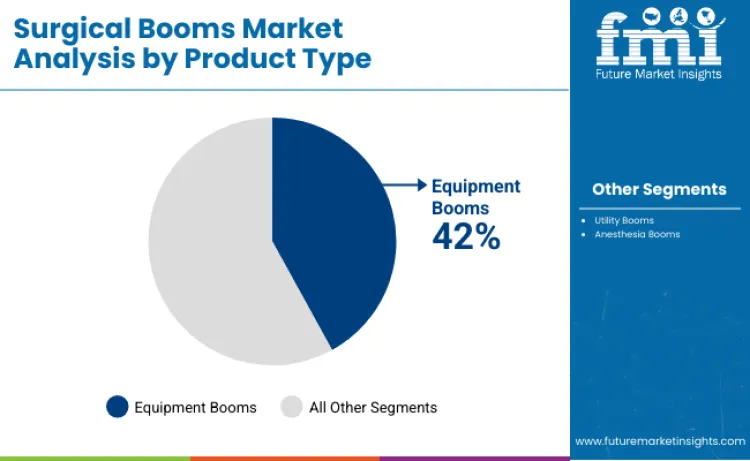
Equipment surgical booms account for around 42% of global demand in 2026, making them the leading product type within the industry. Their dominance is closely tied to hospitals prioritizing tailored operating room layouts that align with procedure mix, equipment load, and space constraints. Equipment booms allow flexible integration of medical gases, power outlets, lighting, displays, and storage based on specific surgical needs. This adaptability supports both high volume tertiary hospitals and specialized surgical centers seeking long term scalability. Unlike standardized systems, equipment boom configurations can be upgraded or reconfigured as technology evolves, protecting capital investments. Other product types such as equipment and anesthesia booms continue to see steady uptake, but configuration flexibility remains central to modern surgical suite planning where efficiency, ergonomics, and future readiness drive purchasing decisions.
Which Installation Type Represents the Largest Share of Surgical Boom Adoption?
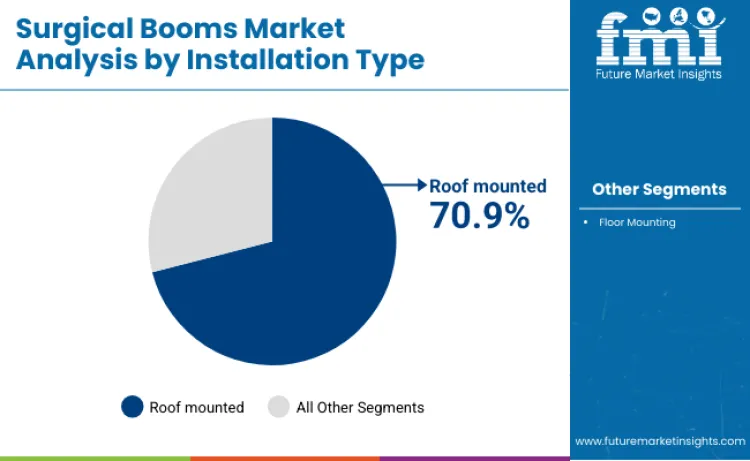
Roof mounted surgical booms represent approximately 70.9% of total installations globally in 2026, making them the dominant installation format. This preference is driven by the need to maximize floor space, improve workflow circulation, and reduce infection risks within operating rooms. Ceiling mounted systems keep critical equipment suspended and easily adjustable, allowing surgical teams faster access without clutter. Roof mounting also supports heavier equipment loads and complex multi arm configurations required in advanced surgical suites. While floor mounted systems remain relevant in older facilities and cost sensitive settings, they do not match the efficiency and sterility benefits offered by ceiling integration. As hospitals continue to modernize infrastructure and adopt minimally invasive and robotic procedures, roof mounted surgical booms remain the preferred solution for high performance operating environments.
What Are the Core Demand and Supply Dynamics Shaping the Surgical Booms Market?
Demand for surgical booms continues to strengthen as healthcare systems focus on infection control, ergonomic efficiency, and operating room modernization. Rising surgical volumes, growth in minimally invasive procedures, and integration of advanced imaging and robotic systems increase the need for organized equipment management. On the supply side, manufacturers invest in modular designs, improved load handling, and compatibility with digital operating room ecosystems. Capital intensity, compliance with medical device regulations, and customization complexity shape production planning. The industry’s growth is steady rather than rapid, reflected in a forecast CAGR of 4.2% from 2026 to 2036. Market momentum depends on hospitals balancing upfront investment with long term gains in efficiency, safety, and clinical outcomes across surgical departments.
How Are Infection Control Standards and Surgical Workflow Requirements Driving Adoption?
Infection prevention and workflow optimization are central drivers of surgical boom adoption. By removing equipment from the floor, surgical booms reduce contamination risk and support sterile operating environments. Adjustable arms and modular layouts allow surgical teams to position tools, monitors, and utilities precisely where needed, reducing movement and procedure time. This is especially important in minimally invasive and robotic surgeries, where multiple devices must be accessed simultaneously. Growing surgical volumes in Asia Pacific and ongoing hospital upgrades in North America and Europe reinforce demand. Across applications, surgical booms are valued for improving ergonomics, reducing staff fatigue, and supporting consistent surgical performance under strict safety and hygiene standards.
How Do Capital Costs, Regulatory Compliance, and Operational Constraints Limit Scalability?
Scalability in the surgical booms market is influenced by high upfront capital costs, regulatory requirements, and installation complexity. Advanced boom systems require significant investment covering customization, installation, and integration with existing operating room infrastructure. Compliance with medical device regulations, electrical safety standards, and hospital accreditation guidelines adds time and cost to deployment. Smaller hospitals and facilities in budget constrained regions often delay adoption due to financial limitations. Operational challenges include retrofitting older operating rooms and managing downtime during installation. Long term scalability depends on manufacturers offering flexible financing, modular upgrades, and compliant designs that reduce total cost of ownership while aligning with evolving surgical and regulatory requirements.
How Do Country Level Dynamics Shape the Surgical Booms Market?
The surgical booms market shows varied momentum across countries based on operating room modernization pace surgical intensity and healthcare investment priorities. Developed economies focus on precision driven workflows and advanced equipment integration, while emerging markets emphasize capacity expansion and standardized surgical environments. Across all regions, hospitals seek better organization of devices medical gases and lighting to improve safety and efficiency. Surgical booms increasingly function as core infrastructure within operating theatres rather than optional accessories. Country wise insights reveal how technology adoption hospital partnerships workforce availability and procedural growth collectively influence demand patterns within the global surgical booms market.
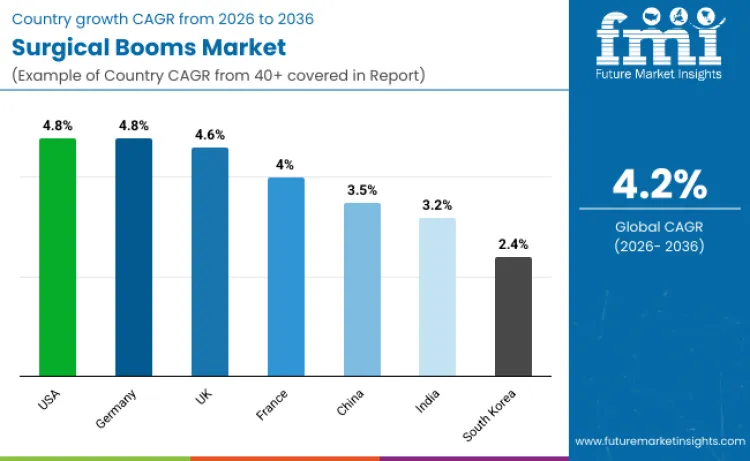
| Country | CAGR |
|---|---|
| United States | 4.8% |
| Germany | 4.8% |
| France | 4.0% |
| United Kingdom | 4.6% |
| China | 3.5% |
| India | 3.2% |
| South Korea | 2.4% |
Why Does the United States Remain a Core Surgical Booms Market?
The United States grows at a CAGR of 4.8% as hospitals continue upgrading operating rooms to support complex surgical procedures. High volumes of minimally invasive and robotic assisted surgeries drive the need for organized equipment management. Surgical booms support efficient integration of imaging systems monitors and medical gases while improving ergonomics for surgical teams. Large healthcare networks invest consistently in workflow optimization to reduce procedure time and enhance outcomes. Advanced surgical environments prioritize flexibility safety and precision. Continuous adoption of next generation surgical technologies sustains steady demand for high performance surgical boom systems across public and private facilities.
How Is Germany Anchoring Surgical Booms Demand in Europe?
Germany records a CAGR of 4.8% supported by strong investment in hospital infrastructure modernization. The country leads Europe through consistent upgrades of surgical suites focused on efficiency and safety. Hospitals emphasize structured layouts that reduce clutter and support precision driven procedures. Surgical booms enable better organization of tools lighting and gases within compact operating environments. Demand strengthens as facilities adapt to robotic surgeries and minimally invasive techniques. High regulatory standards reinforce the need for reliable certified equipment. Germany’s focus on world class healthcare delivery sustains stable adoption of advanced surgical boom solutions.
What Drives Surgical Booms Adoption in France?
France expands at a CAGR of 4.0% as hospitals modernize operating rooms to meet evolving surgical standards. Public and private healthcare providers invest in equipment that improves workflow control and patient safety. Surgical booms support efficient positioning of devices while freeing floor space in operating theatres. Demand rises across tertiary hospitals performing complex procedures and specialized treatments. Emphasis on precision care and standardized operating environments supports steady equipment upgrades. National healthcare investments and strong clinical infrastructure continue to reinforce surgical booms adoption across major urban medical centers.
Why Does the United Kingdom Show Consistent Growth in Surgical Booms?
The United Kingdom grows at a CAGR of 4.6% driven by operating room efficiency initiatives across NHS and private hospitals. Healthcare providers prioritize streamlined surgical environments to manage high procedure volumes. Surgical booms support better equipment access and reduce setup time during procedures. Adoption increases as hospitals modernize theaters for minimally invasive surgeries and advanced imaging integration. Workforce efficiency and patient safety remain key priorities. Investments in infrastructure renewal sustain demand for flexible and ergonomic boom systems that align with evolving surgical practices.
How Are Partnerships Shaping Surgical Booms Demand in China?
China records a CAGR of 3.5% supported by hospital expansion and manufacturer partnerships. Medical device suppliers collaborate with hospitals to deliver integrated solutions including installation training and maintenance. These partnerships help facilities adopt modern surgical setups efficiently. Surgical booms support standardized operating rooms across expanding healthcare networks. Demand rises as hospitals increase surgical capacity and upgrade infrastructure. Training support enables effective utilization of advanced equipment. China’s healthcare modernization efforts continue to drive gradual but steady growth in surgical booms adoption.
What Factors Support Surgical Booms Growth in India?
India grows at a CAGR of 3.2% as hospitals expand surgical capacity across urban and secondary cities. Rising procedure volumes and private healthcare investment drive demand for organized operating environments. Surgical booms help manage equipment efficiently while supporting cost conscious infrastructure planning. Hospitals focus on maximizing space utilization and improving workflow reliability. Adoption increases across multispecialty hospitals and surgical centers. Growth remains steady as healthcare providers balance affordability with the need for modern surgical infrastructure.
Why Is Growth Moderate for Surgical Booms in South Korea?
South Korea records a CAGR of 2.4% reflecting a mature healthcare system with selective infrastructure upgrades. Hospitals emphasize precision efficiency and technology compatibility within operating rooms. Surgical booms support organized layouts for advanced procedures and imaging systems. Demand remains concentrated in large urban hospitals and specialized centers. Investment focuses on quality enhancements rather than rapid capacity expansion. Stable surgical volumes and high care standards sustain gradual adoption of advanced boom systems aligned with sophisticated surgical practices.
How Is Competition Evolving in the Surgical Booms Market?
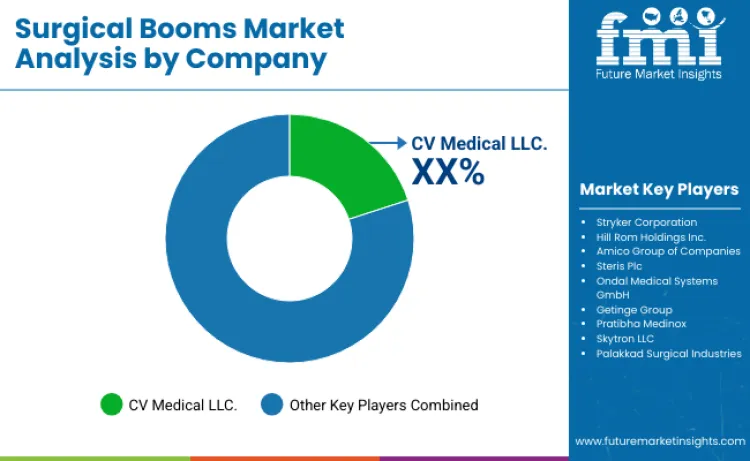
The surgical booms market remains highly competitive due to the presence of numerous global and regional manufacturers supplying equipment for modern operating rooms. Demand is closely tied to hospital infrastructure upgrades growth in surgical volumes and the need for efficient space management within operating theatres. Buyers prioritize stability load capacity ease of movement and seamless integration with imaging anesthesia and monitoring systems. This pushes manufacturers to refine mechanical design improve safety features and offer configurable solutions suited to different surgical specialties.
Leading surgical booms manufacturers focus strongly on geographic expansion to capture demand from emerging healthcare markets. Investments in Asia Latin America and parts of the Middle East are supported through local partnerships and acquisitions of regional equipment providers. These moves help companies shorten sales cycles meet local regulatory requirements and strengthen after sales service capabilities which are critical for capital equipment adoption.
Product innovation remains a central competitive lever. Manufacturers invest in research programs that improve ergonomic reach modular mounting options and compatibility with digital operating room systems. Launching updated boom platforms allows suppliers to address hospital demand for flexible layouts and future ready infrastructure. Collaboration with surgeons and hospital engineering teams plays an important role in shaping practical design improvements.
Recent activity highlights this focus on scale and portfolio depth. Baxter International expanded its surgical booms presence through the acquisition of Hillrom strengthening its position across operating room equipment. Skytron introduced the Freedom boom to address flexibility and space optimization needs. Stryker continues to compete through its S Series surgical booms supported by strong hospital relationships and a broad surgical equipment portfolio.
Key Players of Surgical Booms Market
- CV Medical LLC.
- Stryker Corporation
- Hill Rom Holdings Inc.
- Amico Group of Companies
- Steris Plc
- Ondal Medical Systems GmbH
- Getinge Group
- Pratibha Medinox
- Skytron LLC
- Palakkad Surgical Industries
Scope of Report
| Items | Values |
|---|---|
| Quantitative Units | USD million |
| Market Size Reference | Market size in value terms |
| Market Parameter | Revenue in USD million |
| Product Types Analyzed | Equipment booms, Utility booms, Anesthesia booms |
| Installation Types | Roof mounted, Floor mounted |
| End Use Facilities | Hospitals, Ambulatory surgical centers, Specialty clinics, Hybrid operating rooms |
| Regions Covered | North America, Latin America, Western Europe, Eastern Europe, South Asia and Pacific, East Asia, Middle East and Africa |
| Countries Covered | United States, Canada, Germany, United Kingdom, France, Italy, Spain, China, Japan, South Korea, India, Brazil, GCC and other regional markets |
| Key Companies Profiled | Stryker Corporation, Hill Rom Holdings Inc., CV Medical LLC, Amico Group of Companies, Steris Plc, Getinge Group, Ondal Medical Systems GmbH, Skytron LLC, Pratibha Medinox, Palakkad Surgical Industries |
| Additional Attributes | Market share analysis by product type and installation, country wise demand analysis, pricing trends, hospital infrastructure modernization impact, competitive landscape assessment, technology adoption trends, investment and capacity expansion insights |
Surgical Booms Market by Segment
By Product Type:
- Equipment Booms
- Utility Booms
- Anesthesia Booms
By Installation:
- Roof Mounting
- Floor Mounting
By End User:
- Hospitals
- Ambulatory Surgical Centers
- Specialty Clinics
- Hybrid Operating Rooms
By Region:
- North America
- United States
- Canada
- Mexico
- Latin America
- Brazil
- Chile
- Rest of Latin America
- Western Europe
- United Kingdom
- Germany
- France
- Italy
- Spain
- BENELUX
- Nordic
- Rest of Western Europe
- Eastern Europe
- Poland
- Czech Republic
- Hungary
- Rest of Eastern Europe
- East Asia
- China
- Japan
- South Korea
- South Asia & Pacific
- India
- Rest of South Asia & Pacific
- Middle East & Africa
- GCC
- Turkey
- South Africa
- Rest of Middle East & Africa
Frequently Asked Questions
What is the future outlook of the global surgical booms market?
The surgical booms market is expected to grow steadily at a CAGR of 4.2%.
What is the industry value of the surgical booms market in 2026?
The global surgical booms market is valued at USD 330.4 million in 2026.
What will be the industry size of the surgical booms market by 2036?
By 2036, the surgical booms market is projected to reach USD 497.7 million.
Which factor is driving demand for surgical booms during the forecast period?
Rising adoption of minimally invasive surgeries and hospital infrastructure upgrades is a key factor supporting surgical booms demand from 2026 to 2036.
Who are the key manufacturers in the surgical booms market?
Major players in the surgical booms market include Stryker Corporation, Hill Rom Holdings Inc., Getinge Group, Steris Plc, Skytron LLC, Amico Group of Companies, and CV Medical LLC.
Preview the report firsthand - request a free sample
Get SampleGet the brochure for pricing and purchase details.
Get PDFTable of Content
- Executive Summary
- Surgical Booms Industry Overview
- Key Industry Highlights
- Global Industry Size and Growth Snapshot
- Segment Level Performance Summary
- Competitive Landscape Snapshot
- Market Overview
- Surgical Booms Industry Definition
- Scope of the Surgical Booms Industry
- Industry Taxonomy and Segmentation
- Global Surgical Booms Industry Size Analysis 2026 to 2036
- Global Surgical Booms Industry Growth Rate Assessment
- Industry Value Chain Overview
- Market Background
- Healthcare Infrastructure Development Overview
- Evolution of Operating Room Technologies
- Role of Surgical Booms in Modern Operating Rooms
- Regulatory Framework and Medical Device Standards
- Impact of Minimally Invasive Surgery Adoption
- USA Market Analysis
- USA Surgical Booms Industry Market Size 2026 to 2036
- USA Surgical Booms Industry Growth Outlook
- USA Surgical Booms Industry Market Value Share Analysis
- USA Surgical Booms Industry Analysis by Product Type
- USA Surgical Booms Industry Analysis by Installation Type
- USA Surgical Booms Industry Analysis by End Use Facility
- USA Surgical Booms Industry Pricing Analysis
- USA Surgical Booms Industry Structure Analysis
- Market Pricing Analysis
- Global Surgical Booms Pricing Trends
- Regional Pricing Comparison
- Component and System Cost Structure
- Installation and Integration Cost Analysis
- Margin Analysis Across the Value Chain
- Market Structure Analysis
- Industry Concentration and Share Assessment
- Tier Based Manufacturer Classification
- Entry Barriers and Capital Requirement Analysis
- Distribution and Procurement Channel Review
- After Sales Service and Maintenance Structure
- Competition Analysis
- Global Competitive Landscape Overview
- Company Market Share Analysis
- Product Portfolio and Technology Comparison
- Strategic Developments and Recent Activities
- Company Positioning and Capability Assessment
- Assumptions and Acronyms Used
- Research Assumptions
- Industry Estimation Assumptions
- Acronyms Used in the Report
- Research Methodology
- Research Design and Approach
- Primary Research Methodology
- Secondary Research Methodology
- Data Validation and Triangulation Process
- Forecasting Methodology


