

- Industry Size (2026)
- USD 10.4 Bn
- Forecast (2036)
- USD 19.0 Bn
- CAGR (2026 to 2036)
- 6.2%
Surgical Dressing Material Market Forecast and Outlook 2026 to 2036
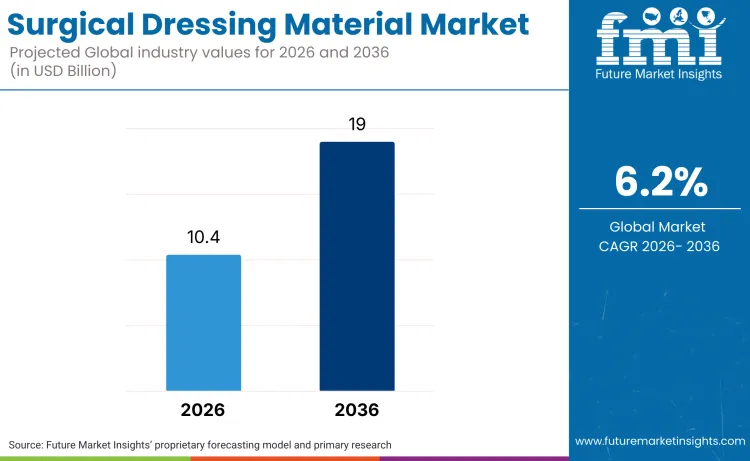
The global surgical dressing material market is positioned to reach a valuation of USD 10.4 billion in 2026 and advance toward USD 19.0 billion by 2036, representing a 6.2% CAGR. As per FMI, surge in global surgical procedure volumes, driven by expanding access to healthcare and rising adoption of advanced wound‑care protocols, continues to strengthen market momentum. Smith+Nephew validated this growth trajectory by reporting that their Advanced Wound Management division delivered 6.0% underlying revenue growth in Q3 2025, driven by double-digit gains in bioactives.
Persistent challenge of surgical site infections (SSIs) remains a primary growth driver. The CDC 2024 National and State HAI Progress Report highlighted an 8% increase in abdominal hysterectomy SSIs compared to the prior year, validating the urgent need for advanced infection-prevention dressings.
Deepak Nath, CEO of Smith+Nephew, stated: "We also announced further clinical evidence during the quarter, validating the strength of key products." Hospitals are actively upgrading procurement protocols to favor evidence-based wound care solutions over commodity supplies to ensure better patient outcomes.
The industry structure has shifted to meet this specialized demand, exemplified by 3M spinning off Solventum in April 2024 to create a standalone healthcare giant focused on medical solutions. Manufacturers aligning product portfolios with SSI reduction protocols for high-risk abdominal procedures will dominate market share through 2036.
Summary of the Surgical Dressing Material Market
What Is Growth Outlook for Surgical Dressing Material Market as per Future Market Insights Projection?
Future Market Insights projects the surgical dressing material market to grow at a CAGR of 6.2% from 2026 to 2036, expanding from USD 10.4 billion in 2026 to USD 19.0 billion by 2036.
Evidence:
- FMI proprietary forecasting model based on bottom-up revenue estimation
- Historical analysis of global surgical procedure volumes
- Primary interviews with wound care manufacturers and hospital procurement teams
- Correlation mapping with infection control and surgical protocol adoption
How Do FMI Analysts Perceive Surgical Dressing Material Market to Evolve?
FMI analysts perceive the market transitioning from passive consumable products toward bioactive, transparent, and smart dressing materials that function as diagnostic and monitoring tools within surgical care pathways.
Evidence:
- Product portfolio shifts toward bioactive and antimicrobial dressings
- Spin-offs creating pure-play medtech entities focused on wound care innovation
- Hospital procurement preference for evidence-based wound management solutions
- Clinical emphasis on reducing nursing time and dressing disturbance
Which Country Holds Largest Share in the Global Surgical Dressing Material Market?
The United States holds the largest share of the global surgical dressing material market by value.
Evidence:
- FMI country-level revenue modeling across hospitals and surgical centers
- High surgical procedure volumes and advanced wound care adoption
- Strong penetration of premium antimicrobial and bioactive dressings
- Centralized hospital procurement favoring standardized dressing protocols
How Large Will the Surgical Dressing Material Market Be by 2036?
The global surgical dressing material market is estimated to reach USD 19.0 billion by 2036.
Evidence:
- FMI long-term revenue forecast derived from product type and procedure mix
- Scaling assumptions for antimicrobial and advanced wound care adoption
- Explicit exclusion of sutures, staples, and topical pharmaceuticals
- Cross-validation with historical consumables growth in surgical care
What Is Definition of Surgical Dressing Material Market?
The surgical dressing material market comprises commercially sold sterile wound care products used to protect surgical sites, manage exudate, and support healing across inpatient and outpatient surgical settings.
Evidence:
- FMI market taxonomy and inclusion exclusion framework
- Product scope validation across gauze, foams, films, hydrocolloids, and antimicrobials
- Application mapping across general, orthopedic, cardiovascular, and gynecological surgery
- Exclusion of NPWT devices, sutures, staples, and consumer first-aid kits
What Are Globally Unique Trends Shaping Surgical Dressing Material Market?
Globally unique trends include infection prevention driven procurement, rapid adoption of transparent and smart monitoring dressings, and industry consolidation through medtech spin-offs.
Evidence:
- Infection control guidance from World Health Organization and Centers for Disease Control and Prevention
- Launches of transparent dressings enabling wound visualization without removal
- Strategic separation of healthcare units to accelerate medtech innovation
- Shift from commodity gauze toward value-based advanced wound care
Surgical Dressing Material Market Key Takeaways
| Metric | Details |
|---|---|
| Industry Size (2026) | USD 10.4 billion |
| Industry Value (2036) | USD 19.0 billion |
| CAGR (2026-2036) | 6.2% |
Source: Future Market Insights (FMI) analysis, based on proprietary forecasting model and primary research.
How Does Infection Control Policy Drive Market Demand?
The implementation of rigorous infection control protocols is fundamentally reshaping the industry. The WHO Global Guidelines for the Prevention of Surgical Site Infection 2024 explicitly recommend against prolonged antibiotic prophylaxis which shifts the burden of infection control to surgical wound care solutions. Medline validated this trend in January 2024 by launching the OptiView® Transparent Dressing designed to allow skin inspection without removal to address pressure injury protocols directly. Convatec confirmed the commercial viability of this shift by reporting 7.4% organic growth in its Advanced Wound Care unit in FY2024, driven by its silver-based anti biofilm wound dressing portfolio.
How is the Surgical Dressing Material Market Segmented?
The surgical dressing material market is segmented by product type, end user, and application. By product, the market includes sterile gauze, absorbent pads, foam dressings, hydrocolloids, and antimicrobial dressings used to manage exudate and prevent infection. By application, usage is categorized across general surgery, orthopedics, cardiovascular procedures, and wound management, reflecting specific clinical requirements for moisture balance and bacterial barrier protection. FMI observes that segmentation is heavily skewed toward volume-heavy disposables in developing regions while developed markets prioritize bioactive and smart dressing technologies.
Why do Sterile Gauze & Pad Sets hold a dominant share?
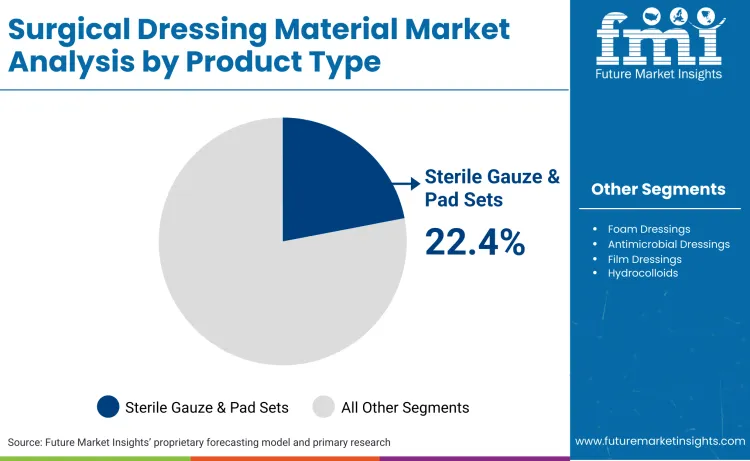
Sterile Gauze commands 22.4% of the market driven by its universal application in standard post-operative care and traditional wound management. The CDC reported a 4% decrease in colon surgery SSIs in 2024 which is a success partly attributed to standardized wound management protocols where traditional dressings play a baseline role. Margins are compressing despite high volume which pushes manufacturers toward convenience kits that bundle gauze with saline and instruments. Commoditization forces hospitals to rely on these sets for routine chlorhexidine gluconate dressing procedures where cost-efficiency is the primary decision factor.
Why are Advanced & Antimicrobial Dressings the growth leaders?
The antimicrobial and foam segments are expanding rapidly reflecting a clinical shift toward active healing and advance wound dressing adoption. In May 2024, the FDA approved new peptide hydrogel products developed by the University of Delaware which self-assemble to form a 3D matrix demonstrating the regulatory pathway for next-generation bioactive dressings. Smith+Nephew highlighted "double-digit growth in Advanced Wound Bioactives" in their Q3 2025 report, confirming that clinicians are trading up from gauze to antimicrobial wound care dressings for complex wounds. Such transition is essential for managing high-risk surgical sites where passive dressings fail to provide adequate protection.
Why do Hospitals lead the End User category?
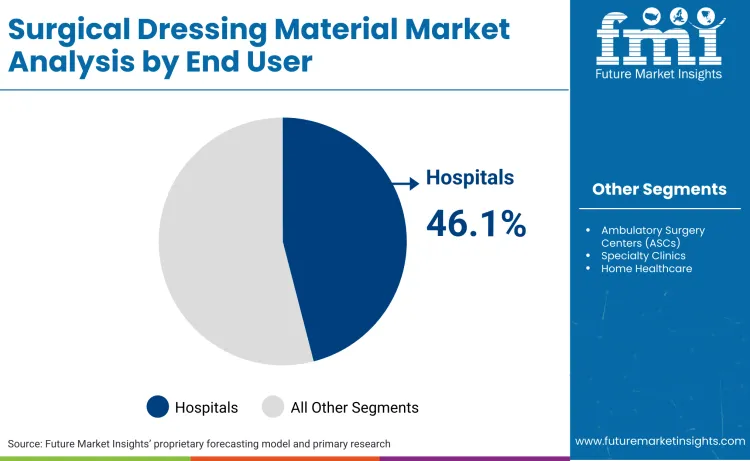
Hospitals capture a dominant 46.1% share of the market as they handle the highest volume of complex surgical procedures requiring specialized wound management. These facilities are the primary procurement points for post operative wound treatment supplies needed for inpatient recovery and infection control. Centralized procurement departments in large hospital networks are increasingly mandating the use of standardized dressing kits to reduce variability in care. Demand in this segment is further reinforced by the rising prevalence of chronic wounds treated in hospital-based outpatient departments.
How Are Strategic Spin-offs Creating Pure-Play Giants?
Large conglomerates are spinning off healthcare units to unlock value and focus on specialized medical devices like wound care. 3M completed the spin-off of Solventum in April 2024 which now operates as an independent entity listed on the NYSE retaining the legacy 3M wound care portfolio. Mike Roman, 3M CEO, stated: "This is an important day for 3M and Solventum as both companies are positioned to pursue their respective growth and tailored capital allocation plans." Separation allows Solventum to invest more aggressively in R&D for synthetic hemostatic and wound care products without competing for capital against industrial divisions.
Why Is the Rise of Transparent & Smart Monitoring Dressings Critical?
Innovation is moving toward interactive wound dressing solutions that allow wound visualization without disruption to reduce nursing time and infection risk. Medline launched OptiView in January 2024 featuring HydroCore Technology that allows caregivers to inspect skin and blanching without lifting the dressing. AJ Ford, VP of Medline Skin Health, noted: "OptiView is an exciting addition to our portfolio, aimed at overcoming healing barriers and elevating care standards." Such moves signal a shift from passive covering to active monitoring devices in the dressing market forcing competitors to integrate visualization capabilities into their standard lines.
How Is Sustainability Influencing Manufacturing Standards?
Top-tier manufacturers are aggressively decarbonizing their supply chains to meet hospital procurement standards. Mölnlycke Health Care announced in May 2025 that its long-term Net Zero targets were validated by the Science Based Targets initiative following their achievement of 100% renewable electricity at all manufacturing sites in 2024. Alignment with the NHS and EU Green Deal requirements makes sustainability a license to operate for dressing suppliers in Europe. FMI analysis suggests that companies failing to adopt green manufacturing for mass-volume items like gauze will face exclusion from major public tenders by 2030.
How Will Surgical Dressing Material Market Expansion Unfold Across Key Global Regions?
The surgical dressing material market is projected to witness divergent growth patterns where emerging markets outpace developed nations in volume expansion. India and Brazil are leading with CAGRs of 8.5% and 7.4% respectively driven by massive public healthcare initiatives and surgical volume recovery. The US and Germany are growing at 4.4% and 3.1% respectively through value-driven adoption of specialized antimicrobial products. FMI analysts opine that this split creates distinct investment corridors with high-volume commodity supply chains in the Global South versus high-margin bioactive innovation in the West.
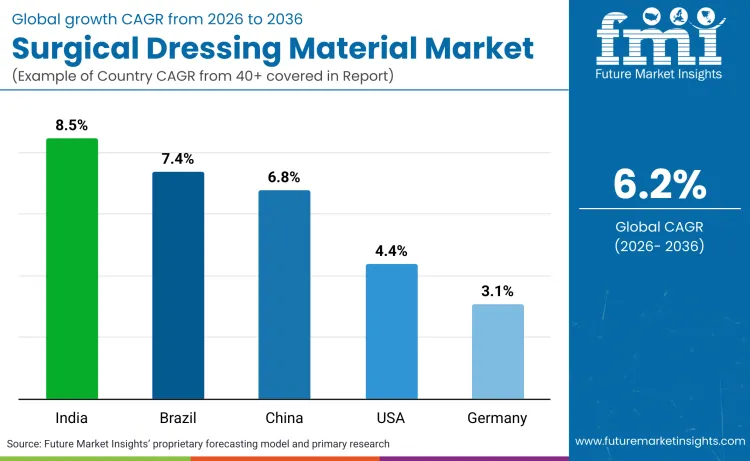
| Country | CAGR (2026 to 2036) |
|---|---|
| India | 8.5% |
| Brazil | 7.4% |
| China | 6.8% |
| USA | 4.4% |
| Germany | 3.1% |
Source: FMI historical analysis and forecast data.
Why is India emerging as a Volume-driven Powerhouse?
The surgical dressing industry in India is poised to register the highest growth at 8.5% CAGR through 2036. Growth is catalyzed by the massive expansion of public health coverage for surgical wound care. The Union Cabinet approved the expansion of Ayushman Bharat Pradhan Mantri Jan Arogya Yojana in September 2024 to cover all senior citizens aged 70+ regardless of income. This policy adds 60 million senior citizens to the insured pool which directly increases the addressable volume for surgical procedures. The Press Information Bureau of the Government of India stated: "The Ayushman Bharat-Pradhan Mantri Jan Arogya Yojana is the world's largest public healthcare scheme that aims at providing health insurance of up to Rs. 5 lakhs to each eligible household annually." India is positioned as a volume-driven powerhouse where cost-effective sterile dressing kits will see exponential demand.
Why is Brazil recovering through Surgical Backlog Clearance?
Demand for surgical dressings in Brazil is projected to expand at a 7.4% CAGR through 2036. The sector in country is recovering from a significant surgical backlog driving demand for noninvasive surgical wound closure tools. Data from the National Institute of Traumatology and Orthopedics indicates that while total surgical volumes dropped 35% post-pandemic, specific procedures like laparoscopic cholecystectomy surged by 75% in 2023 compared to 2019 levels. Complex orthopedic surgeries remain below pre-pandemic levels creating a pent-up demand reservoir.
How is the Competition in the Surgical Dressing Material Market?
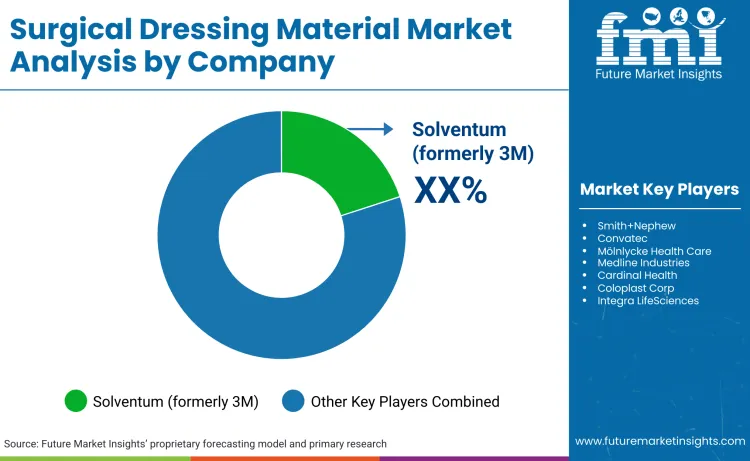
The surgical dressing material industry is consolidated among key players like Solventum, Smith+Nephew, and Mölnlycke who collectively dominate the premium segment. Solventum's emergence as an independent entity in April 2024 fundamentally alters the landscape by creating a more agile competitor focused solely on medtech. Smith+Nephew is aggressively defending its position in bioactives which identifies as a double-digit growth engine. The competitive battleground has shifted from price to clinical efficacy where leaders leverage FDA-approved hemostats for wound closure technologies to justify premium pricing.
Companies are increasingly pursuing vertical integration and portfolio modernization. Convatec has successfully pivoted to a chronic care focus evidenced by its 7.4% organic growth in Advanced Wound Care in 2024 driven by its Aquacel and ConvaFoam lines. Mölnlycke has differentiated itself by securing SBTi validation for its Net Zero targets in 2025 appealing to environmentally conscious procurement boards in Europe. Medline continues to disrupt the hospital channel with value-added innovations like OptiView and challenges incumbents by offering surgical drapes, examination gowns, and medical liners alongside dressings.
Recent Developments:
- In December 2025, New Horizon Medical Solutions acquired the business assets of Applied Tissue Technologies, a provider of advanced wound care solutions including surgical dressings and negative pressure wound therapy platforms. This acquisition bolsters NHMS's portfolio in regenerative wound care, enhancing their offerings for surgical and chronic wound management.
- In December 2025, Solventum completed the acquisition of Acera Surgical, a developer of resorbable synthetic hybrid-scale fiber matrices for soft tissue repair. This expands Solventum's advanced wound care solutions, integrating Acera's innovative dressings to improve healing outcomes in surgical applications.
- In December 2025, MPM Medical expanded its USA manufacturing capabilities by acquiring a full collagen manufacturing platform and obtaining FDA 510(k) clearance for surgical collagen devices. This development strengthens their production of advanced wound dressings, enabling better support for surgical and wound care partners with high-quality collagen-based materials.
Key Players in Surgical Dressing Material Market
- Solventum (formerly 3M)
- Smith+Nephew
- Convatec
- Mölnlycke Health Care
- Medline Industries
- Cardinal Health
- Coloplast Corp
- Integra LifeSciences
- B. Braun Melsungen AG
- Paul Hartmann AG
Market Definition
The surgical dressing material market represents revenue generated from the sale of sterile wound care products designed to protect surgical sites, manage exudate, and promote healing. The market as operationally defined in the article measures commercial sales of gauze, pads, foams, films, and antimicrobial dressings used in hospitals, clinics, and ambulatory centers. Market sizing reflects the value of consumables sold to healthcare providers analyzed by product type, application, and end user and expressed in USD billion.
The market includes sterile gauze and pad sets, transparent film dressings, foam dressings, hydrocolloids, hydrogels, alginates, and collagen dressings. Applications covered include general surgery, orthopedic surgery, cardiovascular surgery, neurological surgery, and gynecological procedures. Revenue generated from advanced antimicrobial dressings and bioactive wound care products is included. The scope counts adoption by hospitals, ambulatory surgery centers, specialty clinics, and home healthcare settings across regions such as North America, Europe, Asia Pacific, Latin America, and the Middle East & Africa.
The market excludes negative pressure wound therapy devices though NPWT consumables are often tracked separately. Basic first-aid kits sold through retail channels for consumer use are excluded unless they meet surgical-grade sterility standards. Topical pharmaceutical agents sold independently of dressings are not included. Surgical sutures, staples, and tissue adhesives are excluded from the dressing material definition. Government stockpiling contracts not intended for immediate clinical use are excluded from annual revenue calculations.
Scope of Report
| Items | Values |
|---|---|
| Quantitative Units (2026) | USD 10.4 Billion |
| Product Type | Sterile Gauze, Foam Dressings, Antimicrobial Dressings, Hydrocolloids |
| Procedure Type | General Surgery, Orthopedic Surgery, Cardiovascular Surgery |
| End User | Hospitals, Ambulatory Surgery Centers, Specialty Clinics |
| Regions Covered | North America, Europe, Asia Pacific, Latin America, Middle East & Africa |
| Countries Covered | United States, Germany, United Kingdom, India, China, Brazil, and 40+ countries |
| Key Companies Profiled | Solventum, Smith+Nephew, Convatec, Mölnlycke, Medline, Cardinal Health |
| Additional Attributes | Revenue analysis by product and procedure, adoption trends across acute and outpatient settings, regulatory compliance landscape, infection control protocol impact, sustainability in manufacturing, and competitive positioning analysis |
Source: FMI historical analysis and forecast data.
Surgical Dressing Material Market by Segments
By Product Type:
- Sterile Gauze & Pad Sets
- Foam Dressings
- Antimicrobial Dressings
- Film Dressings
- Hydrocolloids
- Alginates
By Application:
- General Surgery
- Orthopedic Surgery
- Cardiovascular Surgery
- Neurological Surgery
- Gynecological Surgery
By End User:
- Hospitals
- Ambulatory Surgery Centers (ASCs)
- Specialty Clinics
- Home Healthcare
By Region:
- North America
- Europe
- Asia Pacific
- Latin America
- Middle East & Africa
Bibliography
- Centers for Disease Control and Prevention. (2026, January 29). 2024 National and State Healthcare-Associated Infections (HAI) Progress Report. CDC.
- Press Information Bureau, Government of India. (2025, November). Ayushman Bharat expansion and hospital infrastructure update. PIB.
- National Center for Biotechnology Information. (2024). Hydrogel-based wound dressings for infection prevention and healing. PubMed Central.
- European Centre for Disease Prevention and Control. (2024). Healthcare-associated infections: surgical site infections in acute care hospitals. ECDC.
- Solventum. (2024, April). 3M completes spin-off of Solventum. Solventum Press Release.
- Smith & Nephew. (2025). Third quarter trading report. Smith+Nephew Investor Relations.
- Convatec Group Plc. (2025). Full year results 2024. Convatec Investor Relations.
Frequently Asked Questions
What is the current global market size for Surgical Dressing Materials?
The global industry is valued at USD 10.4 billion in 2026, driven by rising surgical volumes and strict infection control protocols.
What is the projected CAGR for the Surgical Dressing Material market?
Market revenues are projected to grow at a 6.2% CAGR from 2026 to 2036, reaching USD 19.0 billion.
Which segment currently dominates the industry?
Sterile Gauze & Pad Sets hold the dominant share of 22.4%, serving as the standard of care for routine post-operative management.
What are the primary risks or barriers to adoption?
Margin compression in commodity segments and the high cost of advanced bioactive dressings create significant adoption barriers in cost-sensitive regions.
Who are the leading players in the Surgical Dressing Material space?
Solventum (formerly 3M), Smith+Nephew, and Mölnlycke lead the sector, leveraging strong portfolios in both advanced and traditional wound care.
Preview the report firsthand - request a free sample
Get SampleGet the brochure for pricing and purchase details.
Get PDFTable of Content
- Executive Summary
- Surgical Dressing Material Market Introduction
- Market Definition
- Market Scope
- Market Taxonomy
- Research Methodology
- Study Framework
- Assumptions and Limitations
- Data Sources
- Market Estimation and Forecasting Approach
- Surgical Dressing Material Market Dynamics
- Drivers
- Restraints
- Opportunities
- Trends
- Global Surgical Dressing Material Market Analysis 2021 to 2025 and Forecast 2026 to 2036
- Global Surgical Dressing Material Market Analysis by Product Type
- Global Surgical Dressing Material Market Analysis by Application
- Global Surgical Dressing Material Market Analysis by End User
- Global Surgical Dressing Material Market Analysis by Region
- North America Surgical Dressing Material Market Analysis
- United States
- Canada
- Latin America Surgical Dressing Material Market Analysis
- Brazil
- Rest of Latin America
- Europe Surgical Dressing Material Market Analysis
- Germany
- United Kingdom
- France
- Italy
- Spain
- Rest of Europe
- Asia Pacific Surgical Dressing Material Market Analysis
- China
- India
- Japan
- Rest of Asia Pacific
- Middle East & Africa Surgical Dressing Material Market Analysis
- GCC
- South Africa
- Rest of Middle East & Africa
- Competitive Landscape Analysis
- Key Players Profiled
- Market Definition and Scope
- Market Segmentation Analysis
- Bibliography
- Frequently Asked Questions


