

- Industry Size (2026)
- USD 1221.3 Mn
- Forecast (2036)
- USD 2228.8 Mn
- CAGR (2026 to 2036)
- 6.2%
High-Speed Memory Signal Integrity Test Market Forecast and Outlook 2026 to 2036
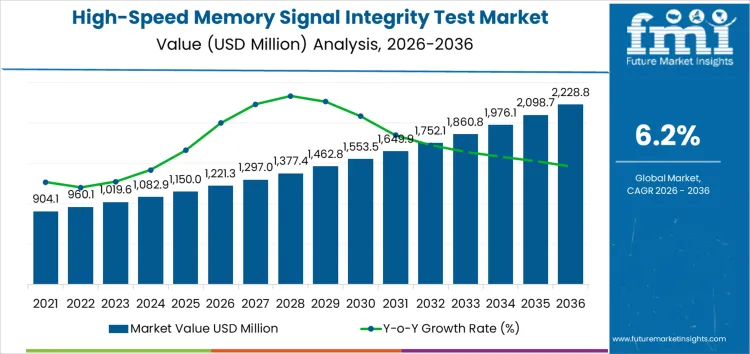
Demand for high-speed memory signal integrity test market is valued at USD 1,221.3 million in 2026 and is forecast to reach USD 2,228.8 million by 2036, expanding at a CAGR of 6.2%. Growth is driven by rapid scaling of DDR5, HBM, GDDR, and emerging memory interfaces supporting AI accelerators, data centers, and advanced networking hardware. Rising data rates, tighter timing margins, and higher channel losses increase dependency on precise signal integrity validation during design, validation, and production stages.
Real-time and sampling oscilloscopes represent the leading instrument class globally. These platforms enable accurate eye-diagram analysis, jitter decomposition, crosstalk evaluation, and channel compliance testing at multi-gigabit speeds. Adoption remains strongest in memory controller validation, interposer-based architectures, and advanced packaging environments where signal degradation directly impacts system yield and performance. Complementary demand exists for vector network analyzers, bit error rate testers, and protocol-aware analysis software supporting comprehensive electrical characterization.
Quick Stats for High-Speed Memory Signal Integrity Test Market
- High-Speed Memory Signal Integrity Test Market Value (2026): USD 1,221.3 million
- High-Speed Memory Signal Integrity Test Market Forecast Value (2036): USD 2,228.8 million
- High-Speed Memory Signal Integrity Test Market Forecast CAGR (2026-2036): 6.2%
- Leading Instrument Class in Global Demand: Real-Time or Sampling Oscilloscopes
- Fastest-Growing Countries: China, Brazil, South Korea, USA, Germany
- Top Players in Global Demand: Keysight Technologies, Rohde & Schwarz, Tektronix (Fortive), Anritsu, Teledyne LeCroy, National Instruments (Emerson), Advantest, VIAVI Solutions, Spirent Communications, EXFO
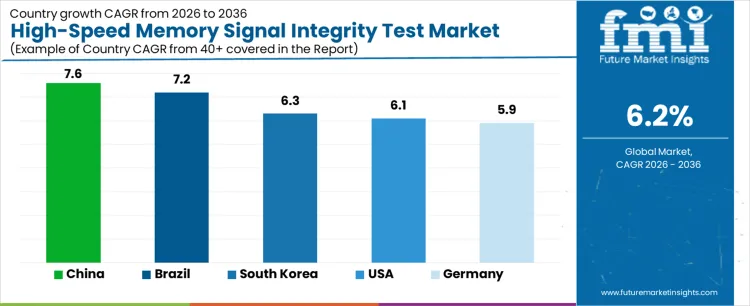
China, Brazil, South Korea, USA, and Germany rank among fastest-growing countries, supported by semiconductor manufacturing expansion and memory-intensive compute deployments. Competitive landscape is led by Keysight Technologies, Rohde & Schwarz, Tektronix, Anritsu, and Teledyne LeCroy. Market structure reflects sustained reliance on high-bandwidth, low-noise instrumentation aligned with evolving memory interface standards.
High-Speed Memory Signal Integrity Test Market Key Takeaways
| Metric | Value |
|---|---|
| Market Value (2026) | USD 1,221.3 million |
| Market Forecast Value (2036) | USD 2,228.8 million |
| Forecast CAGR (2026-2036) | 6.2% |
Why is the Demand for High-Speed Memory Signal Integrity Test Market Growing?
Demand for high-speed memory signal integrity test solutions is growing globally due to increasing complexity and performance requirements of modern computing systems. Memory technologies such as DDR, LPDDR, HBM, and GDDR operate at higher frequencies and tighter timing margins, which elevates sensitivity to signal degradation, crosstalk, and reflection effects. Semiconductor developers and system integrators require advanced test equipment to validate memory channel performance, timing accuracy, and error rates prior to production. Growth in data center compute, artificial intelligence, machine learning, and edge computing workloads intensifies pressure on memory subsystems to deliver sustained throughput with minimal latency.
Test platforms that provide high fidelity analysis of jitter, eye diagrams, and impedance profiles support design optimization and yield improvement across diverse architectures. Global adoption of next generation protocols and interface standards encourages standardized signal integrity validation practices across supply chains. Equipment suppliers deliver scalable solutions that integrate with automated test environments and support multi-channel evaluation. Research institutions and advanced packaging facilities invest in test systems to enhance understanding of high speed interconnect behavior and material impact. Demand is sustained by focus on reliability, performance consistency, and compliance with emerging signal integrity benchmarks across computing industries worldwide.
How Are the Segments Classified in the High-Speed Memory Signal Integrity Test Market?
Demand for high-speed memory signal integrity test solutions globally is shaped by rising data rates, tighter timing margins, and complex interconnect architectures. Stakeholders assess bandwidth capability, jitter tolerance, measurement accuracy, and correlation across lab and production environments. Adoption patterns reflect validation needs for advanced memory interfaces across silicon development, system integration, and large-scale compute deployments requiring consistent signal performance.
Which Instrument Class Accounts for the Largest Share of Global Demand?

Real-time or sampling oscilloscopes hold 34.0%, accounting for the largest share of global demand. These instruments enable time-domain visibility of eye diagrams, jitter components, and transient behavior at high speeds. BERTs or pattern generators hold 28.0%, supporting bit error analysis and stress testing under controlled impairment conditions. TDR and S-parameter tools account for 22.0%, enabling impedance characterization and channel loss assessment. Probing, fixtures, and software hold 16.0%, supporting accurate signal access and analysis workflows. Instrument distribution reflects priority for direct waveform observation in signal integrity validation.
Key Points
- Oscilloscopes lead due to direct time-domain signal visibility.
- BERTs support error-rate and stress validation.
- Channel tools address impedance and loss characterization.
Which End-User Segment Drives the Highest Global Demand?
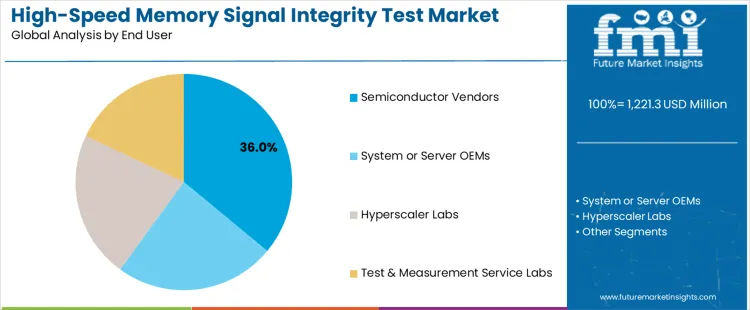
Semiconductor vendors hold 36.0%, driving the highest global demand. These organizations validate memory PHY performance, compliance, and margin during silicon development and characterization. System or server OEMs hold 24.0%, supporting platform-level signal integrity across boards and interconnects. Hyperscaler labs account for 22.0%, validating high-speed memory performance within large-scale compute architectures. Test and measurement service laboratories hold 18.0%, providing third-party validation and overflow testing capacity. End-user distribution reflects concentration of signal integrity responsibility within silicon development and system integration environments.
Key Points
- Semiconductor vendors lead due to silicon-level validation needs.
- OEMs focus on board and platform integrity.
- Hyperscalers validate performance at deployment scale.
What are the Key Dynamics in the High-Speed Memory Signal Integrity Test Market?
Global demand rises as semiconductor manufacturers, system integrators, and test service providers adopt advanced signal integrity (SI) test solutions to ensure reliability and performance of high-speed memory interfaces in servers, AI accelerators, mobile devices, and networking equipment. Memory standards such as DDR5, HBM, LPDDR, and emerging next-generation protocols impose stringent timing, crosstalk, and reflection constraints. Adoption aligns with increasing adoption of high-performance computing, data center acceleration, and edge computing platforms worldwide.
How do memory performance requirements and interface scale drive global demand?
High-speed memory systems require precise characterization of signal timing, bit error rates, channel losses, and electromagnetic interference under operational conditions. Manufacturers use SI test platforms to validate trace-length effects, material dielectric loss, and connector integrity across high-frequency bands. Test solutions integrate vector network analysis, eye-diagram evaluation, and time-domain reflectometry to isolate distortion sources. System designers evaluate memory subsystem performance within multi-die packages and heterogeneous computing architectures where margin requirements are tight. OEMs and foundries invest in automated test benches capable of high-throughput measurements that support qualification and yield improvement efforts across global supply chains.
How do capital intensity, standard fragmentation, and engineering complexity influence market scalability?
High-speed memory SI test equipment entails substantial investment in precision instruments, calibration standards, and controlled fixture environments. Fragmentation among memory standards requires adaptable test platforms that support multiple protocols and evolving specifications, increasing development workload. Engineering expertise in electromagnetic modelling, statistical analysis, and fixture design is essential to interpret results, extending test cycle durations. Regional disparities in access to high-end labs concentrate advanced capability within major semiconductor hubs, while smaller developers rely on shared facilities or outsourcing. Coordination with standards bodies and ecosystem partners adds complexity to test planning. Long-term growth depends on development of modular, scalable SI test solutions and alignment of global testing frameworks that reduce fragmentation and lower barriers for next-generation memory validation worldwide.
How Is Demand for High-Speed Memory Signal Integrity Test Systems Evolving?
Demand for high-speed memory signal integrity test systems is increasing globally due to higher data rates, tighter timing margins, and advanced packaging adoption. China leads with a 7.6% CAGR, supported by domestic semiconductor expansion and memory interface development. Brazil follows at 7.2%, driven by academic research and emerging electronics validation needs. South Korea records a 6.3% CAGR, shaped by DRAM and NAND leadership and precision characterization requirements. USA posts 6.1%, reflecting platform refresh cycles and next-generation compute systems. Germany records 5.9%, supported by automotive electronics and industrial computing standards. Growth reflects escalating signal speeds, complexity of interconnects, and necessity for repeatable integrity validation worldwide.
| Country | CAGR (%) |
|---|---|
| China | 7.6% |
| Brazil | 7.2% |
| South Korea | 6.3% |
| USA | 6.1% |
| Germany | 5.9% |
What factors are accelerating signal integrity testing demand in China?
China drives demand through rapid expansion of semiconductor manufacturing, advanced packaging, and high-speed interface development. Country’s CAGR of 7.6% reflects extensive testing of DDR, HBM, and GDDR interfaces across design and validation stages. Engineers validate eye diagrams, jitter, crosstalk, and channel loss under real operating conditions. In-house labs scale capacity to shorten design cycles and protect intellectual property. Test platforms emphasize bandwidth, automation, and correlation with simulation. Government-backed programs expand access to advanced instrumentation. Growth remains scale-driven and investment-led, aligned with domestic semiconductor capability buildout.
- Expansion of high-speed memory interface development
- In-house validation to reduce design iteration time
- Eye diagram and jitter characterization needs
- Government-supported semiconductor infrastructure
Why is Brazil emerging as a growing market for signal integrity testing?
Brazil demand is shaped by growth in electronics research, embedded systems development, and university-led validation programs. Country’s CAGR of 7.2% reflects increasing use of signal integrity test systems for memory interfaces in networking, defense, and computing research. Shared laboratories enable cost-efficient access to high-bandwidth oscilloscopes and probes. Collaboration with international vendors supports adoption of standard test methodologies. Demand favors modular platforms suitable for mixed research workloads. Growth remains capability-building focused, aligned with gradual strengthening of domestic electronics design and validation competence.
- Academic and research-driven electronics testing
- Shared access to high-bandwidth instrumentation
- Adoption of global test methodologies
- Modular systems for mixed workloads
How does South Korea’s memory leadership influence test system demand?
South Korea demand reflects global leadership in DRAM and NAND manufacturing and advanced packaging. Country’s CAGR of 6.3% is supported by intensive signal integrity validation across process nodes and product generations. Manufacturers emphasize precision timing analysis, channel modeling, and correlation with silicon yield. Automated test flows support high-volume validation. Government-backed initiatives promote standardized characterization. Growth remains process-driven, aligned with aggressive performance scaling and reliability targets across memory portfolios.
- DRAM and NAND manufacturing leadership
- Precision timing and channel analysis needs
- Automated high-volume validation flows
- Standardized characterization practices
What market dynamics sustain steady growth in the USA?
USA demand is driven by platform refresh cycles, AI and HPC systems, and server memory upgrades. Country’s CAGR of 6.1% reflects validation of next-generation memory standards and complex board designs. Test systems support compliance, debug, and optimization across development stages. Integration with simulation and design tools improves correlation. Procurement emphasizes bandwidth, accuracy, and workflow efficiency. Growth remains lifecycle-driven, aligned with system upgrades and evolving compute architectures.
- AI, HPC, and server memory validation
- Compliance and debug across development stages
- Integration with simulation workflows
- Platform refresh-driven demand
How is Germany positioned within the global signal integrity test landscape?
Germany demand reflects automotive electronics, industrial computing, and stringent reliability standards. Country’s CAGR of 5.9% is supported by testing memory interfaces used in vehicles, factories, and edge systems. Test platforms validate signal integrity under temperature variation, vibration, and long lifetimes. Shared research institutes expand access to advanced instrumentation. Procurement favors documentation, repeatability, and standards alignment. Growth remains engineering-led, aligned with safety, durability, and compliance requirements across industrial applications.
- Automotive and industrial electronics validation
- Combined-stress signal integrity testing
- Strong standards and documentation focus
- Shared research and industry facilities
What is the competitive landscape of demand for high-speed memory signal integrity test platforms?
Demand for high-speed memory signal integrity test platforms is driven by scaling of DDR5, HBM, GDDR, and emerging memory architectures used in AI accelerators and high-performance computing systems. Validation workflows focus on eye diagram integrity, jitter tolerance, crosstalk behavior, insertion loss, and timing margin analysis at multi-gigabit data rates. Buyers prioritize bandwidth headroom, low intrinsic noise, calibration traceability, and protocol-aware measurement capability across development and qualification stages. Procurement teams assess automation readiness for compliance testing, correlation between lab and production measurements, and reliability under sustained high-speed operation. Trend in the global market reflects shrinking timing budgets, higher channel losses, and tighter integration between electrical characterization and system-level validation.
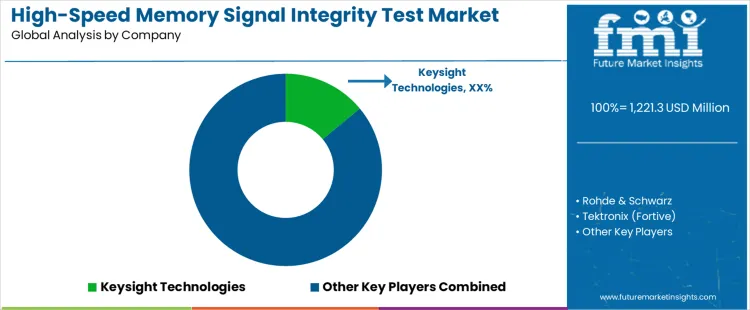
Keysight Technologies holds strong positioning through high-bandwidth oscilloscopes, BERT systems, and memory-aware analysis software supporting advanced memory standards. Rohde & Schwarz and Anritsu supply low-jitter signal generation and analysis platforms used for transmitter and receiver stress testing. Tektronix, part of Fortive, and Teledyne LeCroy support signal integrity debugging with real-time scopes emphasizing deep memory and timing analysis. National Instruments, operating under Emerson, provides modular PXI-based platforms enabling automated signal integrity workflows. Advantest integrates memory characterization within semiconductor test ecosystems, while VIAVI Solutions, Spirent Communications, and EXFO contribute interconnect, link, and channel validation tools. Competitive differentiation depends on measurement fidelity, automation depth, protocol coverage, and cross-platform correlation consistency.
Key Players in the High-Speed Memory Signal Integrity Test Market
- Keysight Technologies
- Rohde & Schwarz
- Tektronix (Fortive)
- Anritsu
- Teledyne LeCroy
- National Instruments (Emerson)
- Advantest
- VIAVI Solutions
- Spirent Communications
- EXFO
Scope of the Report
| Items | Values |
|---|---|
| Quantitative Units | USD million |
| Instrument Class | Real-Time or Sampling Oscilloscopes; BERTs or Pattern Generators; TDR and S-Parameter Measurement Tools; Probing Solutions, Fixtures, and Signal Integrity Software |
| End User | Semiconductor Vendors; System or Server OEMs; Hyperscaler and Cloud Data Center Labs; Independent Test and Measurement Service Laboratories |
| Regions Covered | Asia Pacific; Europe; North America; Latin America; Middle East & Africa |
| Countries Covered | China; Brazil; South Korea; USA; Germany; and 40+ countries |
| Key Companies Profiled | Keysight Technologies; Rohde & Schwarz; Tektronix; Anritsu; Teledyne LeCroy; National Instruments (Emerson); Advantest; VIAVI Solutions; Spirent Communications; EXFO |
| Additional Attributes | Dollar sales by instrument class and end-user category; regional adoption trends across advanced semiconductor fabs and hyperscaler labs; validation demand for DDR5, HBM, and PCIe interfaces; increased automation in signal integrity compliance testing; growing use of software-driven analysis tools. |
High-Speed Memory Signal Integrity Test Market by Segment
Instrument Class
- Real-Time or Sampling Oscilloscopes
- BERTs or Pattern Generators
- TDR & S-Parameter Tools
- Probing, Fixtures & Software
End User
- Semiconductor Vendors
- System or Server OEMs
- Hyperscaler Labs
- Test & Measurement Service Labs
Region
- Asia Pacific
- China
- Japan
- South Korea
- India
- Australia & New Zealand
- ASEAN
- Rest of Asia Pacific
- Europe
- Germany
- United Kingdom
- France
- Italy
- Spain
- Nordic
- BENELUX
- Rest of Europe
- North America
- United States
- Canada
- Mexico
- Latin America
- Brazil
- Chile
- Rest of Latin America
- Middle East & Africa
- Kingdom of Saudi Arabia
- Other GCC Countries
- Turkey
- South Africa
- Other African Union
- Rest of Middle East & Africa
Frequently Asked Questions
How big is the high-speed memory signal integrity test market in 2026?
The global high-speed memory signal integrity test market is estimated to be valued at USD 1,221.3 million in 2026.
What will be the size of high-speed memory signal integrity test market in 2036?
The market size for the high-speed memory signal integrity test market is projected to reach USD 2,228.8 million by 2036.
How much will be the high-speed memory signal integrity test market growth between 2026 and 2036?
The high-speed memory signal integrity test market is expected to grow at a 6.2% CAGR between 2026 and 2036.
What are the key instrument class types in the high-speed memory signal integrity test market?
The key instrument class types in high-speed memory signal integrity test market are real-time or sampling oscilloscopes, berts or pattern generators, tdr & s-parameter tools and probing, fixtures & software.
Which end user segment to contribute significant share in the high-speed memory signal integrity test market in 2026?
In terms of end user, semiconductor vendors segment to command 36.0% share in the high-speed memory signal integrity test market in 2026.
Preview the report firsthand - request a free sample
Get SampleGet the brochure for pricing and purchase details.
Get PDFTable of Content
- Executive Summary
- Global Market Outlook
- Demand-side Trends
- Supply-side Trends
- Technology Roadmap Analysis
- Analysis and Recommendations
- Market Overview
- Market Coverage / Taxonomy
- Market Definition / Scope / Limitations
- Market Background
- Market Dynamics
- Drivers
- Restraints
- Opportunity
- Trends
- Scenario Forecast
- Demand in Optimistic Scenario
- Demand in Likely Scenario
- Demand in Conservative Scenario
- Opportunity Map Analysis
- Product Life Cycle Analysis
- Supply Chain Analysis
- Investment Feasibility Matrix
- Value Chain Analysis
- PESTLE and Porter’s Analysis
- Regulatory Landscape
- Regional Parent Market Outlook
- Production and Consumption Statistics
- Import and Export Statistics
- Market Dynamics
- Global Market Analysis 2021 to 2025 and Forecast, 2026 to 2036
- Historical Market Size Value (USD Million) Analysis, 2021 to 2025
- Current and Future Market Size Value (USD Million) Projections, 2026 to 2036
- Y-o-Y Growth Trend Analysis
- Absolute $ Opportunity Analysis
- Global Market Pricing Analysis 2021 to 2025 and Forecast 2026 to 2036
- Global Market Analysis 2021 to 2025 and Forecast 2026 to 2036, By Instrument Class
- Introduction / Key Findings
- Historical Market Size Value (USD Million) Analysis By Instrument Class , 2021 to 2025
- Current and Future Market Size Value (USD Million) Analysis and Forecast By Instrument Class , 2026 to 2036
- Real-Time or Sampling Oscilloscopes
- BERTs or Pattern Generators
- TDR & S-Parameter Tools
- Probing, Fixtures & Software
- Real-Time or Sampling Oscilloscopes
- Y-o-Y Growth Trend Analysis By Instrument Class , 2021 to 2025
- Absolute $ Opportunity Analysis By Instrument Class , 2026 to 2036
- Global Market Analysis 2021 to 2025 and Forecast 2026 to 2036, By End User
- Introduction / Key Findings
- Historical Market Size Value (USD Million) Analysis By End User, 2021 to 2025
- Current and Future Market Size Value (USD Million) Analysis and Forecast By End User, 2026 to 2036
- Semiconductor Vendors
- System or Server OEMs
- Hyperscaler Labs
- Test & Measurement Service Labs
- Semiconductor Vendors
- Y-o-Y Growth Trend Analysis By End User, 2021 to 2025
- Absolute $ Opportunity Analysis By End User, 2026 to 2036
- Global Market Analysis 2021 to 2025 and Forecast 2026 to 2036, By Region
- Introduction
- Historical Market Size Value (USD Million) Analysis By Region, 2021 to 2025
- Current Market Size Value (USD Million) Analysis and Forecast By Region, 2026 to 2036
- North America
- Latin America
- Western Europe
- Eastern Europe
- East Asia
- South Asia and Pacific
- Middle East & Africa
- Market Attractiveness Analysis By Region
- North America Market Analysis 2021 to 2025 and Forecast 2026 to 2036, By Country
- Historical Market Size Value (USD Million) Trend Analysis By Market Taxonomy, 2021 to 2025
- Market Size Value (USD Million) Forecast By Market Taxonomy, 2026 to 2036
- By Country
- USA
- Canada
- Mexico
- By Instrument Class
- By End User
- By Country
- Market Attractiveness Analysis
- By Country
- By Instrument Class
- By End User
- Key Takeaways
- Latin America Market Analysis 2021 to 2025 and Forecast 2026 to 2036, By Country
- Historical Market Size Value (USD Million) Trend Analysis By Market Taxonomy, 2021 to 2025
- Market Size Value (USD Million) Forecast By Market Taxonomy, 2026 to 2036
- By Country
- Brazil
- Chile
- Rest of Latin America
- By Instrument Class
- By End User
- By Country
- Market Attractiveness Analysis
- By Country
- By Instrument Class
- By End User
- Key Takeaways
- Western Europe Market Analysis 2021 to 2025 and Forecast 2026 to 2036, By Country
- Historical Market Size Value (USD Million) Trend Analysis By Market Taxonomy, 2021 to 2025
- Market Size Value (USD Million) Forecast By Market Taxonomy, 2026 to 2036
- By Country
- Germany
- UK
- Italy
- Spain
- France
- Nordic
- BENELUX
- Rest of Western Europe
- By Instrument Class
- By End User
- By Country
- Market Attractiveness Analysis
- By Country
- By Instrument Class
- By End User
- Key Takeaways
- Eastern Europe Market Analysis 2021 to 2025 and Forecast 2026 to 2036, By Country
- Historical Market Size Value (USD Million) Trend Analysis By Market Taxonomy, 2021 to 2025
- Market Size Value (USD Million) Forecast By Market Taxonomy, 2026 to 2036
- By Country
- Russia
- Poland
- Hungary
- Balkan & Baltic
- Rest of Eastern Europe
- By Instrument Class
- By End User
- By Country
- Market Attractiveness Analysis
- By Country
- By Instrument Class
- By End User
- Key Takeaways
- East Asia Market Analysis 2021 to 2025 and Forecast 2026 to 2036, By Country
- Historical Market Size Value (USD Million) Trend Analysis By Market Taxonomy, 2021 to 2025
- Market Size Value (USD Million) Forecast By Market Taxonomy, 2026 to 2036
- By Country
- China
- Japan
- South Korea
- By Instrument Class
- By End User
- By Country
- Market Attractiveness Analysis
- By Country
- By Instrument Class
- By End User
- Key Takeaways
- South Asia and Pacific Market Analysis 2021 to 2025 and Forecast 2026 to 2036, By Country
- Historical Market Size Value (USD Million) Trend Analysis By Market Taxonomy, 2021 to 2025
- Market Size Value (USD Million) Forecast By Market Taxonomy, 2026 to 2036
- By Country
- India
- ASEAN
- Australia & New Zealand
- Rest of South Asia and Pacific
- By Instrument Class
- By End User
- By Country
- Market Attractiveness Analysis
- By Country
- By Instrument Class
- By End User
- Key Takeaways
- Middle East & Africa Market Analysis 2021 to 2025 and Forecast 2026 to 2036, By Country
- Historical Market Size Value (USD Million) Trend Analysis By Market Taxonomy, 2021 to 2025
- Market Size Value (USD Million) Forecast By Market Taxonomy, 2026 to 2036
- By Country
- Kingdom of Saudi Arabia
- Other GCC Countries
- Turkiye
- South Africa
- Other African Union
- Rest of Middle East & Africa
- By Instrument Class
- By End User
- By Country
- Market Attractiveness Analysis
- By Country
- By Instrument Class
- By End User
- Key Takeaways
- Key Countries Market Analysis
- USA
- Pricing Analysis
- Market Share Analysis, 2025
- By Instrument Class
- By End User
- Canada
- Pricing Analysis
- Market Share Analysis, 2025
- By Instrument Class
- By End User
- Mexico
- Pricing Analysis
- Market Share Analysis, 2025
- By Instrument Class
- By End User
- Brazil
- Pricing Analysis
- Market Share Analysis, 2025
- By Instrument Class
- By End User
- Chile
- Pricing Analysis
- Market Share Analysis, 2025
- By Instrument Class
- By End User
- Germany
- Pricing Analysis
- Market Share Analysis, 2025
- By Instrument Class
- By End User
- UK
- Pricing Analysis
- Market Share Analysis, 2025
- By Instrument Class
- By End User
- Italy
- Pricing Analysis
- Market Share Analysis, 2025
- By Instrument Class
- By End User
- Spain
- Pricing Analysis
- Market Share Analysis, 2025
- By Instrument Class
- By End User
- France
- Pricing Analysis
- Market Share Analysis, 2025
- By Instrument Class
- By End User
- India
- Pricing Analysis
- Market Share Analysis, 2025
- By Instrument Class
- By End User
- ASEAN
- Pricing Analysis
- Market Share Analysis, 2025
- By Instrument Class
- By End User
- Australia & New Zealand
- Pricing Analysis
- Market Share Analysis, 2025
- By Instrument Class
- By End User
- China
- Pricing Analysis
- Market Share Analysis, 2025
- By Instrument Class
- By End User
- Japan
- Pricing Analysis
- Market Share Analysis, 2025
- By Instrument Class
- By End User
- South Korea
- Pricing Analysis
- Market Share Analysis, 2025
- By Instrument Class
- By End User
- Russia
- Pricing Analysis
- Market Share Analysis, 2025
- By Instrument Class
- By End User
- Poland
- Pricing Analysis
- Market Share Analysis, 2025
- By Instrument Class
- By End User
- Hungary
- Pricing Analysis
- Market Share Analysis, 2025
- By Instrument Class
- By End User
- Kingdom of Saudi Arabia
- Pricing Analysis
- Market Share Analysis, 2025
- By Instrument Class
- By End User
- Turkiye
- Pricing Analysis
- Market Share Analysis, 2025
- By Instrument Class
- By End User
- South Africa
- Pricing Analysis
- Market Share Analysis, 2025
- By Instrument Class
- By End User
- USA
- Market Structure Analysis
- Competition Dashboard
- Competition Benchmarking
- Market Share Analysis of Top Players
- By Regional
- By Instrument Class
- By End User
- Competition Analysis
- Competition Deep Dive
- Keysight Technologies
- Overview
- Product Portfolio
- Profitability by Market Segments (Product/Age /Sales Channel/Region)
- Sales Footprint
- Strategy Overview
- Marketing Strategy
- Product Strategy
- Channel Strategy
- Rohde & Schwarz
- Tektronix (Fortive)
- Anritsu
- Teledyne LeCroy
- National Instruments (Emerson)
- Advantest
- VIAVI Solutions
- Spirent Communications
- EXFO
- Keysight Technologies
- Competition Deep Dive
- Assumptions & Acronyms Used
- Research Methodology


