

- Industry Size (2026)
- USD 101.0 Mn
- Forecast (2036)
- USD 214.0 Mn
- CAGR (2026 to 2036)
- 7.8%
Deepwater Subsea Structure Integrity Acoustic Test Platforms Market Size, Market Forecast and Outlook By FMI
The deepwater subsea structure integrity acoustic test platforms market was valued at USD 93.7 million in 2025. The market is estimated at USD 101.0 million in 2026 and is projected to reach USD 214.0 million by 2036, reflecting a CAGR of 7.8% over the forecast period. FMI analysis indicates that demand is being supported by a gradual shift from periodic inspection toward predictive acoustic monitoring, particularly in deepwater environments where intervention costs remain high, and failure detection windows are narrow.
Summary of Deepwater Subsea Structure Integrity Acoustic Test Platforms Market
- The market is forecast to reach USD 214.0 million by 2036.
- The market is expected to grow at a CAGR of 7.8% from 2026 to 2036.
- The market was estimated at USD 93.7 million in 2025.
- The forecast period represents an incremental opportunity of USD 113.0 million.
- This market is a specification-driven offshore niche focused on acoustic platforms used to detect fatigue, corrosion, wall loss, and structural movement in deepwater subsea assets.
- Demand is supported by offshore operators aiming to extend asset life while reducing intervention costs and minimizing personnel exposure.
- Acoustic methods are gaining importance where visual inspection is insufficient, particularly for detecting hidden defects under coatings or in low-visibility environments.
- ROV-deployed systems lead the platform segment with a 42% share due to compatibility with existing offshore inspection workflows.
- Acoustic emission dominates the method segment with a 36% share, driven by its effectiveness in monitoring active damage and corrosion-fatigue behavior.
- Permanent monitoring leads deployment mode with a 39% share, reflecting demand for continuous condition tracking over periodic inspections.
- Risers account for 31% of asset type demand due to their high failure risk and structural complexity in deepwater environments.
- Oil operators dominate the end-user segment with a 68% share, as they fund most offshore integrity programs.
- Guyana, Brazil, and Angola are the fastest-growing markets, with Guyana leading at a 10.6% CAGR.
- Sonardyne, TSC Subsea, Scanmatic, AP Sensing, MISTRAS Group, and Fugro are key participants in the competitive landscape.
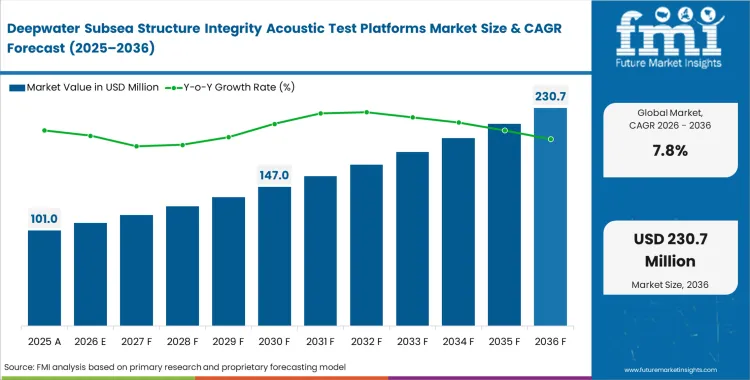
Subsea asset operators are under growing pressure to detect structural deterioration earlier without increasing offshore intervention frequency. Intermittent visual inspection leaves too much uncertainty around fatigue buildup, coating loss, joint weakness, and micro-fracture formation in aging deepwater infrastructure. That gap is increasing interest in platforms that combine condition monitoring with lower deployment complexity. Integration of subsea equipment and submarine sensors helps reduce those blind spots by widening the diagnostic range available during routine offshore campaigns. Buyers are also placing more value on systems that can be tied into existing inspection and monitoring workflows, because that lowers vessel-time requirements and avoids the cost burden of repeated specialized mobilization. Subsea navigation and tracking capability adds further value where operators need more precise positioning and repeatability across long inspection intervals.
System economics improve further when acoustic hardware can be deployed more flexibly across offshore support assets. Standardized interfaces for acoustic wave sensors make it easier to move diagnostic packages between ROV fleets and inspection campaigns without repeated customization or port-side reconfiguration. Once that level of compatibility is established, operators can expand coverage, improve survey continuity, and reduce the downtime that usually comes with fragmented subsea inspection programs. Market demand is therefore being shaped not only by sensing performance, but also by how efficiently acoustic testing platforms fit into broader field-maintenance routines.
Guyana is projected to expand at a CAGR of 10.6% through 2036 as newly installed deepwater production systems increase the need for baseline condition assessment and early-life integrity monitoring. Brazil is estimated to grow at 9.8%, supported by continued pre-salt infrastructure development and the need to monitor a widening offshore asset base. Angola is likely to record 9.1% CAGR during the forecast period, where long subsea tieback networks are raising the value of repeatable acoustic diagnostics. Nigeria is expected to register 7.5%, reflecting demand linked to deepwater asset optimization and inspection efficiency. The United States is projected to rise at 6.8%, with activity centered more on mature offshore campaign management than on large-scale new installation. Norway and the United Kingdom are anticipated to post CAGRs of 6.4% and 5.9%, respectively, where life-extension work and compliance-driven monitoring continue to support demand. Differences across these markets reflect whether operators are establishing first-cycle integrity baselines on newer deepwater systems or managing replacement and life-extension needs across more mature offshore fields.
Segmental Analysis
Deepwater Subsea Structure Integrity Acoustic Test Platforms Market Analysis by Platform Type
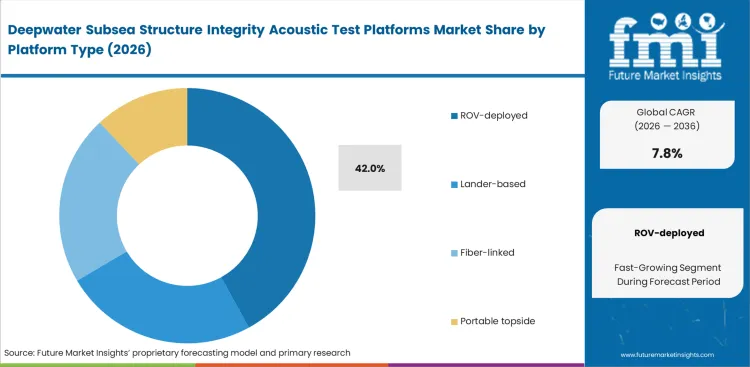
ROV deployed acoustic inspection systems are estimated to account for 42.0% share in 2026. Their lead comes from the operating flexibility of attaching acoustic payloads to existing subsea work-class vehicles instead of mobilizing dedicated systems for each campaign. This approach allows one dive program to combine visual checks and acoustic assessment, which improves vessel utilization and shortens inspection windows. Data flow still needs careful planning, since high-resolution acoustic output can exceed standard umbilical transmission capacity during active deployment. Delays become costly when teams rely on local storage and wait until recovery to review anomalies. Compatibility between telemetry architecture and offshore ROV payload requirements therefore remains central to real-time inspection value.
- Payload integration: Work-class vehicle compatibility allows faster deployment using existing subsea inspection infrastructure already present on many offshore campaigns.
- Bandwidth limitation: High-definition acoustic streams can exceed available umbilical capacity and reduce the usefulness of real-time diagnostic review.
- Surface delay: Storing inspection data onboard postpones engineering interpretation and can slow response to serious subsea anomalies.
Deepwater Subsea Structure Integrity Acoustic Test Platforms Market Analysis by Acoustic Method
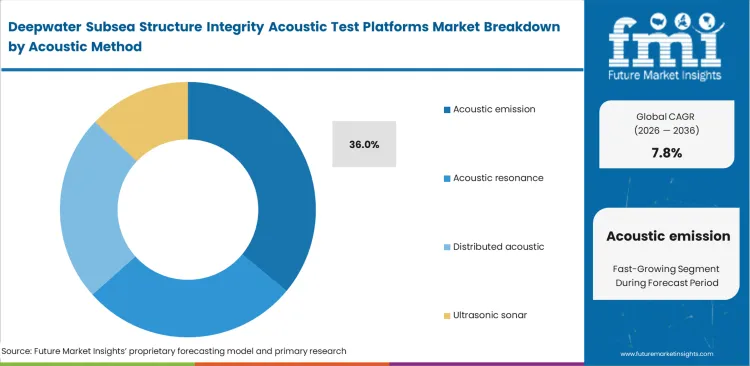
Method selection depends on whether operators need to identify existing damage patterns or detect structures that are actively deteriorating under stress. Acoustic emission subsea testing is expected to command 36.0% share in 2026 because it detects live crack growth rather than only mapping passive condition. That distinction matters in deepwater assets where fatigue progression can accelerate under continuous pressure and cyclic loading. Acoustic emission also performs more effectively than some alternate approaches when coatings, growth, or insulation make surface penetration difficult. Reliable transfer of this information still depends on stable subsea connectivity, especially where underwater connectors support distributed monitoring layouts across complex nodes. Operators looking only at purchase cost often underestimate the practical value of active flaw detection in high-risk fatigue environments.
- Active propagation: Acoustic emission identifies signals associated with real-time fracture growth and supports faster intervention decisions.
- Coating penetration: This method can remain effective even where external layers make other inspection routes less practical.
- False economy: Lower-cost alternatives may miss critical micro-fracture activity and create more expensive repair consequences later.
Deepwater Subsea Structure Integrity Acoustic Test Platforms Market Analysis by Deployment Mode
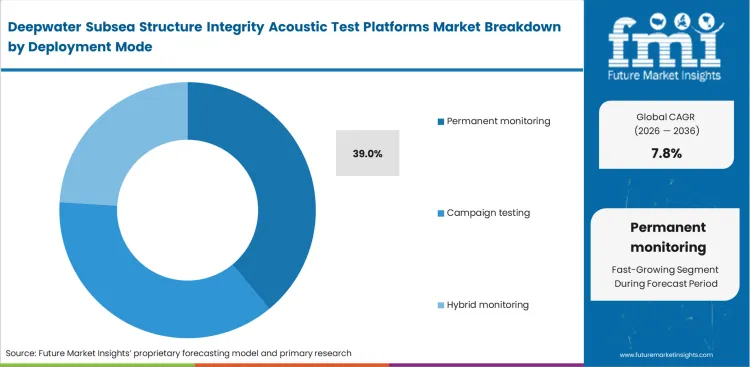
Deployment strategy in subsea integrity monitoring is increasingly shaped by the trade-off between repeated intervention cost and long-duration surveillance value. Periodic campaigns may appear less demanding at first, yet recurring vessel time builds cost quickly across multi-year asset life. Permanent subsea integrity monitoring systems are set to represent 39.0% share in 2026 because fixed arrays support uninterrupted fatigue tracking without repeated mobilization cycles. This model is especially relevant where continuous observation of offshore pipeline infrastructure and related subsea assets improves maintenance timing and anomaly detection. The advantage weakens when marine fouling is ignored, since sensor sensitivity can deteriorate long before core electronics fail. Static deployment works best when operators treat cleaning and calibration as part of the monitoring program rather than as occasional follow-up work.
- Capital frontloading: Permanent installations require heavier early spending but can reduce dependence on repeated vessel-based inspection campaigns.
- Lifecycle economics: Multi-year operating cost often becomes more favorable once recurring intervention expense is fully accounted for.
- Fouling degradation: Marine growth can steadily reduce sensor accuracy and weaken long-term comparison quality if maintenance is neglected.
Deepwater Subsea Structure Integrity Acoustic Test Platforms Market Analysis by Asset Type
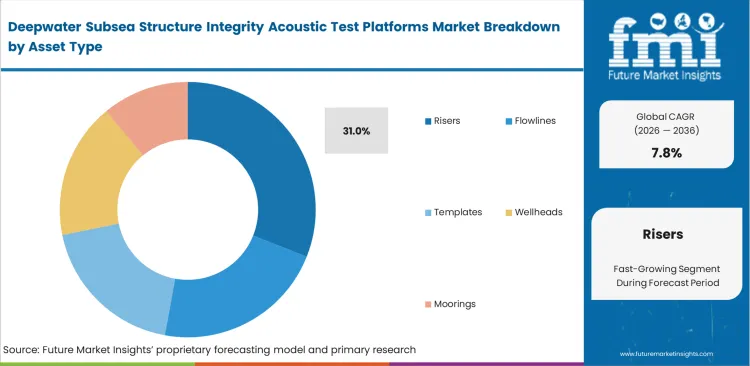
Asset-level demand in this market is influenced by where fatigue risk concentrates most severely under real offshore operating conditions. Riser systems face continuous dynamic loading from currents, vessel movement, and transition zones that are harder to monitor using static inspection assumptions. Acoustic platforms are therefore used more selectively here because failure consequences can be immediate and severe. Riser acoustic monitoring systems are poised to garner 31.0% share in 2026, reflecting the need for higher-frequency structural surveillance in these mechanically stressed vertical conduits. Mounting method also matters, since rigid interfaces can damage flexible outer layers when movement is constant. Use of fiber optic probe hydrophone FOPH modules can reduce some direct-contact issues, but fixture design still needs to match the dynamic behavior of the monitored riser.
- Dynamic fatigue: Continuous subsea motion creates severe stress concentration zones that require focused monitoring around critical riser sections.
- Mounting complexity: Sensor attachment must account for flexing behavior or the monitoring hardware can damage the asset itself.
- Inadequate protocols: Static inspection logic applied to highly dynamic riser environments can miss the signals that matter most.
Deepwater Subsea Structure Integrity Acoustic Test Platforms Market Analysis by End User
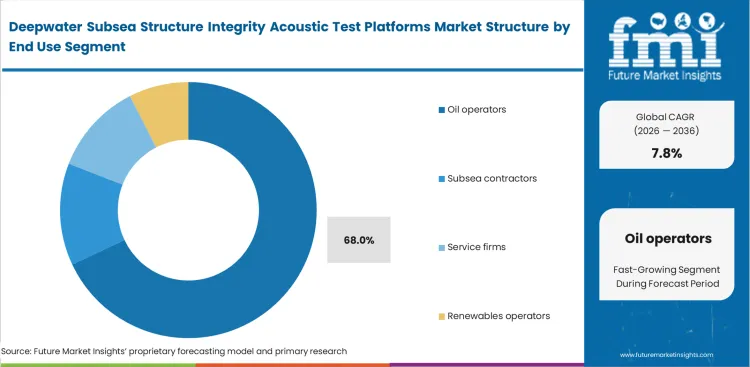
Service firms may carry out surveys and provide technical support, while infrastructure owners continue to bear the consequences of delayed anomaly detection and failed response. Direct control over interpretation, dashboard access, and emergency escalation is therefore estimated to remain important across subsea integrity operations. Proprietary data formats also continue to create integration friction when command centers attempt to unify inspection outputs across multiple assets. Oil operators are estimated to account for 68.0% share in 2026, as direct visibility into health data remains necessary across critical subsea systems. This requirement is expected to strengthen as distributed fiber optic sensors are integrated into wider monitoring networks. Interoperability is increasingly influencing response speed alongside sensing performance.
- Liability retention: Infrastructure owners keep close control over anomaly interpretation because environmental and production risk remains with them.
- Integration friction: Closed contractor data formats can obstruct centralized visibility and slow coordinated decision-making during integrity events.
- Open architecture: Interoperable data standards improve system integration and support faster response across complex subsea monitoring networks.
Deepwater Subsea Structure Integrity Acoustic Test Platforms Market Drivers, Restraints, and Opportunities
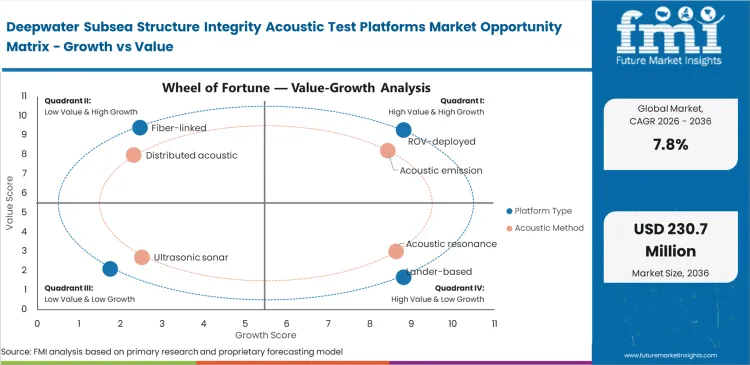
Failure risk is pushing operators to rely less on reactive maintenance across deepwater assets. Scheduled visual ROV inspections are no longer enough when micro-fractures can develop between inspection cycles. Unplanned shutdowns at deepwater production hubs can interrupt output and raise operating losses quickly. Subsea corrosion fatigue detection systems are therefore expected to become more important within integrity management programs. Delay in identifying fatigue-related damage can also increase environmental exposure and compliance pressure as offshore infrastructure continues to age.
Telemetry bandwidth remains a practical limit for wider use of subsea corrosion monitoring systems. High-definition acoustic sensors can generate more data than standard ROV umbilicals can transmit to surface vessels in real time. This slows data transfer and makes continuous monitoring more difficult in harsh subsea settings. Edge computing modules may help by compressing acoustic signatures below the surface before transmission. Cost and equipment durability under extreme hydrostatic pressure are still likely to limit broader adoption.
Opportunities in the Deepwater Subsea Structure Integrity Acoustic Test Platforms Market
- Edge computing integration: Developing pressure-tolerant processors that compress acoustic data subsea enables real-time transmission over limited bandwidths. Service firms processing a subsea acoustic monitoring RFQ capture premium pricing by solving this critical telemetry bottleneck.
- Standardized payload interfaces: Engineering universal ROV mounting brackets reduces specialized mobilization delays. Contractors looking to buy subsea acoustic monitoring system packages win higher campaign volumes by offering rapid plug-and-play deployments.
- Digital twin synchronization: Linking real-time acoustic emission data directly into predictive subsea filter separators models allows operators to simulate fracture propagation accurately. Software providers secure lucrative recurring licenses by closing this diagnostic loop.
Regional Analysis
Based on regional analysis, deepwater subsea structure integrity acoustic test platforms market is segmented into North America, Latin America, Europe, Middle East and Africa, and East Asia across 40 plus countries.
.webp "Top Country Growth Comparison Deepwater Subsea Structure Integrity Acoustic Test Platforms Market Cagr (2026 2036)")
| Country | CAGR (2026 to 2036) |
|---|---|
| Guyana | 10.6% |
| Brazil | 9.8% |
| Angola | 9.1% |
| Nigeria | 7.5% |
| United States | 6.8% |
| Norway | 6.4% |
| United Kingdom | 5.9% |
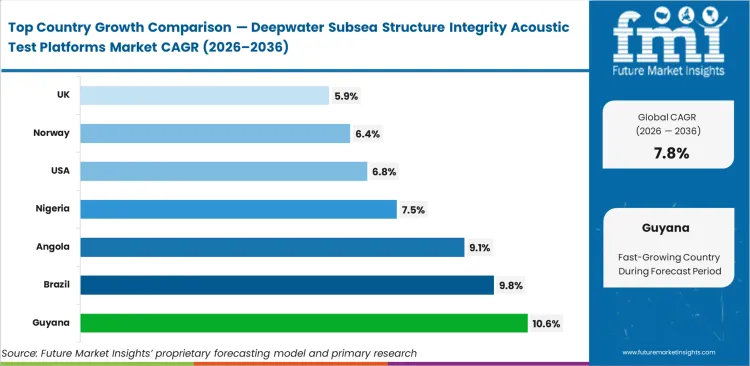
Source: Future Market Insights (FMI) analysis, based on proprietary forecasting model and primary research
Latin America Deepwater Subsea Structure Integrity Acoustic Test Platforms Market Analysis
Expansion in deepwater production networks is shaping deployment pace across the region. Operators in Latin America are expected to install permanent acoustic monitoring systems alongside new floating production, storage, and offloading units. Sensor integration during early construction stages helps reduce the cost and disruption associated with later retrofit work. Demand is also rising for structural health monitoring systems that can cover long subsea flowline networks from the start. Capital intensity remains high in this market, as asset owners continue to invest in monitoring systems that can lower future ROV intervention needs. Early project adoption also supports longer-term demand for data handling and condition tracking across the life of the asset.
- Guyana: Guyana is projected to expand at a CAGR of 10.6% during 2026-2036. New deepwater production hubs are increasing the need for baseline condition assessment at the start of field development. Permanent acoustic systems installed during construction are helping operators avoid more expensive retrofit work later. Demand is expected to stay firm as more subsea assets move into early operating cycles and require continuous integrity visibility.
- Brazil: Brazil is anticipated to grow at a CAGR of 9.8% over 2026-2036. Ongoing pre-salt infrastructure development is increasing the need to monitor dynamic risers and connected subsea assets under demanding offshore conditions. Acoustic monitoring systems are being used to identify stress-related anomalies earlier in the asset life cycle. Stronger baseline visibility is also expected to support more stable field operations as offshore networks continue to expand.
Middle East and Africa Deepwater Subsea Structure Integrity Acoustic Test Platforms Market Analysis
Extensive long-distance subsea network deployments dictate unique acoustic monitoring strategies across African basins. Operators require specialized fiber-linked acoustic nodes leveraging submarine optical fiber cables capable of transmitting data across massive distances without intermediate signal boosting. High marine fouling rates in tropical waters severely degrade static sensor performance, forcing operators into hybrid monitoring models. Operators combine permanent critical-node surveillance with regular ROV-deployed acoustic sweeps to ensure complete coverage. Dual approaches maximize detection accuracy while mitigating rapid biological degradation on static equipment.
- Angola: Long-distance subsea networks require advanced fiber-linked acoustic arrays capable of spanning vast distances. Angola is projected to witness 9.1% CAGR in the Angola deepwater acoustic inspection segment through 2036. Operators specify high-durability sensors to monitor remote tie-backs effectively. Securing uninterrupted data flow across these Angola offshore structure acoustic testing networks grants operators a massive operational advantage during scheduled maintenance planning.
- Nigeria: Deepwater asset optimization leads to targeted campaign testing across aging infrastructure. Operators prioritize ROV-deployed acoustic packages to evaluate specific high-risk wellheads systematically within the Nigeria subsea acoustic monitoring industry. Sales of these systems in Nigeria are expected to increase at a CAGR of 7.5% during the forecast period. High local content requirements compel international service firms to enter mandatory joint ventures to deploy diagnostic tools legally.
North America and Europe Deepwater Subsea Structure Integrity Acoustic Test Platforms Market Analysis
Mature asset campaign optimization dominates operations across highly regulated northern basins. Operators face stringent environmental compliance mandates requiring meticulous documentation of health on aging infrastructure. Operators increasingly shift from basic visual inspections toward advanced ultrasonic sonar testing to satisfy rigorous regulatory audits. Greenfield installations remain limited, making deepwater field life extension monitoring primary commercial drivers. Service firms navigate saturated competitive environments by integrating marine electronics seamlessly into superior data interpretation software rather than just delivering reliable underwater hardware. Linking diagnostic outcomes to comprehensive subsea umbilicals risers and flowlines management plans proves essential for securing contract renewals.
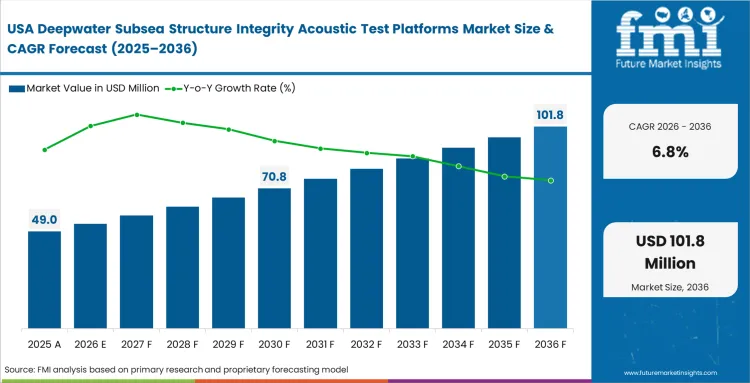
- United States: United States demand is projected to expand at a CAGR of 6.8% during 2026-2036. Mature Gulf infrastructure is sustaining steady demand for acoustic testing as operators focus on campaign efficiency and asset life management. Acoustic resonance tools are commonly used alongside routine visual inspection programs to support subsea integrity assessment across established offshore systems. Early fracture detection is also expected to support maintenance planning and improve confidence in life-extension decisions for aging assets.
- Norway: Stringent compliance demands force continuous acoustic emission monitoring on critical deepwater templates. Organizations operating here set global benchmarks for automated anomaly detection protocols. Norway is likely to post a CAGR of 6.4% in deepwater acoustic testing by 2036. Operators deploy sophisticated lander-based systems to ensure high environmental protection, creating a rigid operational standard for long-term subsea infrastructure management across the region.
- United Kingdom: Life-extension mandates rather than greenfield construction dominate regional acoustic array deployments. Operators utilize portable topside receivers to conduct highly targeted fatigue assessments on specific aging flowlines within the UK North Sea subsea integrity acoustic segment. Acoustic array adoption in the United Kingdom is expected to move ahead at a CAGR of 5.9% through 2036. Advanced diagnostic data directly determines safe operational decommissioning delays.
FMI's report includes extensive data on Mexico, Canada, and various emerging deepwater African nations. High intervention costs uniformly push operators across unlisted regions toward adopting ROV-deployed acoustic strategies to minimize dedicated vessel charting expenses.
Competitive Aligners for Market Players
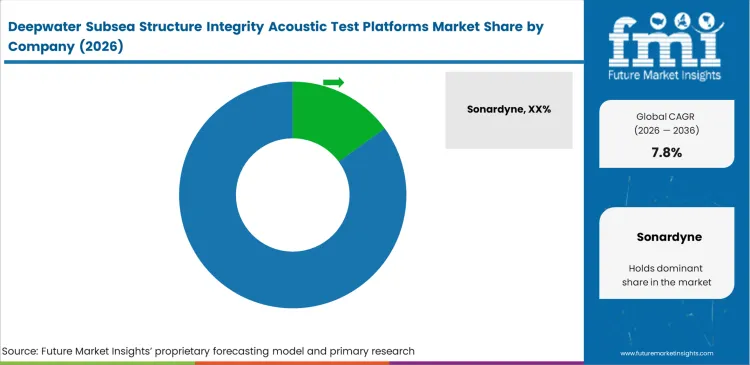
Competitive strength in this market depends as much on underwater data transmission as on acoustic detection quality. High-value suppliers are differentiated by communication protocols and telemetry handling systems that help move diagnostic data to surface vessels more reliably under subsea operating limits. Buyers place greater value on usable, timely diagnostic output than on very high acoustic sensitivity alone. Systems that collect detailed signals but struggle to transmit or compress them efficiently are less likely to meet operational requirements during platform selection.
Established suppliers also benefit from large acoustic reference libraries built across varied subsea conditions over time. New acoustic events can be assessed against prior signal patterns to improve interpretation of fatigue-related risk and reduce false alarms. Pressure-tolerant hydrophones and durable hardware remain important, though hardware alone is rarely enough to support reliable diagnostics in this segment. Depth of baseline signal history continues to shape confidence in anomaly interpretation, especially when environmental noise must be separated from structural change.
Vendor selection is also influenced by data access and integration flexibility. Oil operators increasingly prefer open data architectures that allow acoustic outputs to move into wider integrity management systems without heavy dependence on closed software environments. Raw emission data, processed results, and supporting subsea diagnostics are expected to fit more easily into centralized analytics workflows. Compatibility across offshore monitoring systems is becoming a practical requirement in greenfield deepwater projects, where long-term data use matters as much as initial sensing performance.
Key Players in Deepwater Subsea Structure Integrity Acoustic Test Platforms Market
- Sonardyne
- TSC Subsea
- Scanmatic
- AP Sensing
- MISTRAS Group
- Fugro
Scope of the Report
| Metric | Value |
|---|---|
| Quantitative Units | USD 101.0 million to USD 214.0 million, at a CAGR of 7.8% |
| Market Definition | Diagnostic acoustic arrays engineered for high-pressure subsea environments detect fatigue and material degradation. Equipment transmits specific sound frequencies through submerged steel and grout to identify hidden anomalies. |
| Segmentation | By Platform Type, By Acoustic Method, By Deployment Mode, By Asset Type, By End User, By Region |
| Regions Covered | North America, Latin America, Europe, Middle East and Africa, East Asia |
| Countries Covered | United States, United Kingdom, Norway, Brazil, Guyana, Angola, Nigeria |
| Key Companies Profiled | Sonardyne, TSC Subsea, Scanmatic, AP Sensing, MISTRAS Group, Fugro |
| Forecast Period | 2026 to 2036 |
| Approach | Annual ROV mobilization days dedicated to acoustic integrity campaigns anchored initial baseline estimates. |
Source: Future Market Insights (FMI) analysis, based on proprietary forecasting model and primary research
Deepwater Subsea Structure Integrity Acoustic Test Platforms Market Analysis by Segments
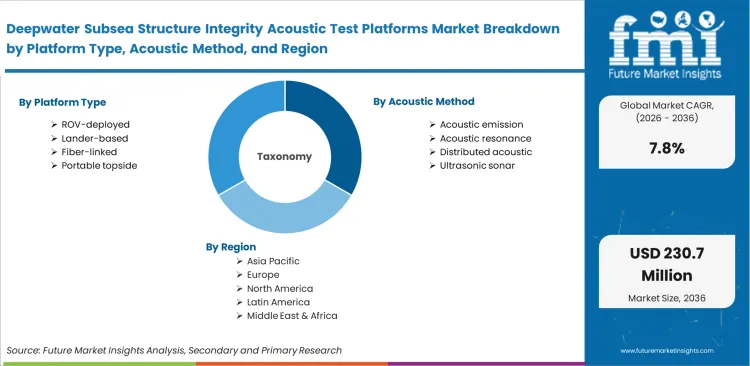
By Platform Type
- ROV-deployed
- Lander-based
- Fiber-linked
- Portable topside
By Acoustic Method
- Acoustic emission
- Acoustic resonance
- Distributed acoustic
- Ultrasonic sonar
By Deployment Mode
- Permanent monitoring
- Campaign testing
- Hybrid monitoring
By Asset Type
- Risers
- Flowlines
- Templates
- Wellheads
- Moorings
By End User
- Oil operators
- Subsea contractors
- Service firms
- Renewables operators
Region:
- North America
- United States
- Canada
- Europe
- Germany
- United Kingdom
- France
- Italy
- Spain
- Asia Pacific
- China
- Japan
- South Korea
- Taiwan
- Singapore
- Latin America
- Brazil
- Mexico
- Argentina
- Middle East & Africa
- GCC Countries
- South Africa
Bibliography
- Bureau of Safety and Environmental Enforcement. (2025, April 30). Detecting oil under ice and on the seafloor. U.S. Department of the Interior.
- Dang, T., Nguyen, T. T., Liew, A. W. C., & Elyan, E. (2024). Event classification on subsea pipeline inspection data using an ensemble of deep learning classifiers. Cognitive Computation, 17, Article 10.
- Fang, X., Wang, H., Liu, G., & Xie, Y. (2025). A review of structural health monitoring for fixed offshore wind turbines driven by multisource heterogeneous data. Structural Health Monitoring. Advance online publication.
- Jiang, Y., Liu, Y., & Wang, S. (2024). Structural damage classification in offshore structures under environmental variations and measured noises using linear discrimination analysis. Structural Control and Health Monitoring, 2024, Article 6650582.
- Nguyen, D. T. D. T., Elseth, C. L., Øvstaas, J. R., Arntzen, N., Hamre, G., & Lillestøl, D.-B. (2025). Enabling scalable inspection of offshore mooring systems using cost-effective autonomous underwater drones. Frontiers in Robotics and AI, 12.
- Riccioli, F., Gabrielsen, Ø., Høgsæt, I. S., Barros, P. S., & Pahlavan, L. (2024). Corrosion-fatigue damage identification in submerged mooring chain links using remote acoustic emission monitoring. Marine Structures, 97, 103685.
This bibliography is provided for reader reference. The full FMI report contains the complete reference list with primary source documentation.
This Report Addresses
- Acoustic emission sensitivity requirements for dynamic risers.
- Telemetry bandwidth limitations during ROV diagnostic campaigns.
- Cost differences between permanent arrays and periodic visual inspections.
- Marine fouling impacts on static lander-based sensor nodes.
- Data integration friction between contractor systems and operator dashboards.
- Regulatory compliance demands driving mature asset life-extension testing.
- Hardware specifications required for long-distance fiber-linked tie-backs.
- Capital expenditure justification for greenfield baseline acoustic networks.
Frequently Asked Questions
Give me the market size for deepwater subsea acoustic integrity test platforms?
The market was valued at USD 93.7 million in 2025 and is projected to reach USD 101.0 million in 2026. Cumulative investment propels total valuation to USD 214.0 million through 2036 as operators shift toward predictive acoustic monitoring for aging infrastructure.
Who are the key players in subsea acoustic integrity testing?
Leading suppliers include Sonardyne, TSC Subsea, Scanmatic, AP Sensing, MISTRAS Group, and Fugro. These firms dominate through advanced subsea telemetry compression and massive proprietary libraries of acoustic baseline signatures.
Which country leads deepwater subsea acoustic inspection growth?
Guyana leads geographic expansion at 10.6% CAGR, as operators install massive new deepwater production hubs requiring extensive baseline condition assessments immediately upon installation to avoid exorbitant future retrofit costs.
Compare acoustic emission and DAS for subsea integrity monitoring?
Acoustic emission detects active crack propagation sounds generated by stressed materials under high pressure, whereas distributed acoustic sensing (DAS) utilizes fiber optic cables to detect broader acoustic vibrations and strain variations across longer distances.
What assets are covered in subsea integrity acoustic testing?
Critical subsea infrastructure requiring continuous fatigue surveillance includes dynamic risers, static flowlines, complex templates, high-pressure wellheads, and highly stressed mooring lines supporting floating production storage and offloading units.
Acoustic emission vs distributed acoustic sensing subsea?
Acoustic emission provides hyper-localized detection of active micro-fractures directly at critical weld joints, while distributed acoustic sensing transforms entire lengths of fiber optic cables into continuous acoustic arrays for macro-level health monitoring.
Subsea acoustic testing vs visual inspection?
Acoustic testing identifies internal material degradation, active micro-fractures, and wall-loss hidden beneath thick protective coatings or marine growth, whereas standard visual inspection only detects surface-level damage that has already compromised the asset's exterior integrity.
Subsea acoustic testing for risers?
Continuous ocean currents create severe stress concentration points where dynamic structures meet static seafloor connections. Engineering leads target acoustic monitoring directly at touchdown zones to prevent shearing and massive hydrocarbon releases.
Subsea acoustic testing for flowlines?
Acoustic testing along static flowlines is deployed to detect internal corrosion and wall-loss accurately without requiring operators to halt production or deploy specialized internal pipeline inspection gauges.
Subsea acoustic testing for moorings?
Offshore wind turbines utilizing floating substructures experience high dynamic stress across subsea mooring lines. Engineering leads deploy acoustic emission sensors to monitor fatigue accumulation continuously and prevent anchor detachment.
Subsea acoustic testing for wellheads?
ROV-deployed acoustic packages are prioritized to evaluate specific high-risk wellheads systematically, detecting fatigue accumulation caused by prolonged drilling operations and dynamic riser motions before failure occurs.
Subsea grout integrity acoustic scanning?
Specialized acoustic resonance tools are utilized to verify grout integrity securing massive offshore platforms to the seabed, ensuring foundation stability remains uncompromised despite decades of harsh ocean current exposure.
Can acoustic testing replace subsea diver inspection?
Acoustic testing eliminates the need for dangerous manual diver interventions entirely by utilizing deepwater-rated sensors that operate safely at extreme hydrostatic pressures far beyond human diving limitations.
How much does subsea acoustic integrity monitoring cost?
Initial sensor acquisition costs represent only a fraction of total expenditure. Massive ROV vessel charter day-rates must be calculated for campaign testing or authorize heavy initial capital expenditures for permanent array installations to eliminate recurring intervention fees.
Which subsea assets need continuous acoustic monitoring?
Aging pre-salt infrastructure, highly dynamic flexible risers, and critical deepwater templates demand continuous acoustic surveillance because micro-fractures propagate unpredictably between scheduled visual inspection cycles, risking failure.
What is the CAGR of subsea acoustic integrity platforms?
The global market is projected to expand at a CAGR of 7.8% from 2026 to 2036. This sustained growth reflects operators abandoning reactive maintenance schedules in favor of predictive anomaly detection to prevent unquantifiable environmental liabilities.
What are the key growth drivers for subsea integrity platforms?
Environmental compliance mandates compel oil operators to deploy predictive failure warning systems. Simultaneously, high intervention costs push subsea contractors toward integrating non-intrusive asset integrity payloads directly onto standard ROV routines.
How are deepwater subsea structures tested for integrity?
Diagnostic arrays utilizing sound sensor nodes detect anomalies, micro-fractures, and wall-loss. Equipment transmits specific sound frequencies through submerged steel and grout to identify hidden fatigue without requiring physical disassembly.
What is acoustic emission testing for subsea structures?
This method captures active crack propagation sounds generated by stressed materials under high hydrostatic pressure. Firms rely on this precise capability to differentiate between stable historical damage and actively growing fractures.
How does distributed acoustic sensing work underwater?
DAS utilizes specialized interrogator units connected to subsea fiber optic cables, measuring microscopic light backscatter variations caused by acoustic vibrations and strain, effectively turning long-distance cables into continuous sensor arrays.
Why use ROV deployed acoustic inspection offshore?
Work-class ROV compatibility dictates immediate operational readiness without requiring dedicated vessel mobilization. Subsea contractors combine routine visual checks with advanced acoustic evaluations during single dives, reducing overall campaign costs significantly.
What are the key offshore operator integrity platform demand trends?
Owning critical infrastructure compels major producers to retain tight proprietary control over diagnostic data. Companies refuse to delegate critical anomaly alerts entirely, mandating raw data integration directly into centralized corporate dashboards.
What defines offshore IMR acoustic systems?
Inspection, Maintenance, and Repair (IMR) acoustic systems integrate directly into standard contractor workflows, providing crucial pre-intervention baseline condition data and post-repair verification without requiring specialized standalone diagnostic vessels.
Why is acoustic monitoring in harsh subsea environments difficult?
High hydrostatic pressure requires specialized marinized housings and pressure-compensated electronics to prevent implosion. Engineering teams must balance acoustic sensitivity against massive reinforcement requirements for all external transducers.
Preview the report firsthand - request a free sample
Get SampleGet the brochure for pricing and purchase details.
Get PDFTable of Content
- Executive Summary
- Global Market Outlook
- Demand-side Trends
- Supply-side Trends
- Technology Roadmap Analysis
- Analysis and Recommendations
- Market Overview
- Market Coverage / Taxonomy
- Market Definition / Scope / Limitations
- Research Methodology
- Chapter Orientation
- Analytical Lens and Working Hypotheses
- Market Structure, Signals, and Trend Drivers
- Benchmarking and Cross-market Comparability
- Market Sizing, Forecasting, and Opportunity Mapping
- Research Design and Evidence Framework
- Desk Research Programme (Secondary Evidence)
- Company Annual and Sustainability Reports
- Peer-reviewed Journals and Academic Literature
- Corporate Websites, Product Literature, and Technical Notes
- Earnings Decks and Investor Briefings
- Statutory Filings and Regulatory Disclosures
- Technical White Papers and Standards Notes
- Trade Journals, Industry Magazines, and Analyst Briefs
- Conference Proceedings, Webinars, and Seminar Materials
- Government Statistics Portals and Public Data Releases
- Press Releases and Reputable Media Coverage
- Specialist Newsletters and Curated Briefings
- Sector Databases and Reference Repositories
- FMI Internal Proprietary Databases and Historical Market Datasets
- Subscription Datasets and Paid Sources
- Social Channels, Communities, and Digital Listening Inputs
- Additional Desk Sources
- Expert Input and Fieldwork (Primary Evidence)
- Primary Modes
- Qualitative Interviews and Expert Elicitation
- Quantitative Surveys and Structured Data Capture
- Blended Approach
- Why Primary Evidence is Used
- Field Techniques
- Interviews
- Surveys
- Focus Groups
- Observational and In-context Research
- Social and Community Interactions
- Stakeholder Universe Engaged
- C-suite Leaders
- Board Members
- Presidents and Vice Presidents
- R&D and Innovation Heads
- Technical Specialists
- Domain Subject-matter Experts
- Scientists
- Physicians and Other Healthcare Professionals
- Governance, Ethics, and Data Stewardship
- Research Ethics
- Data Integrity and Handling
- Primary Modes
- Tooling, Models, and Reference Databases
- Desk Research Programme (Secondary Evidence)
- Data Engineering and Model Build
- Data Acquisition and Ingestion
- Cleaning, Normalisation, and Verification
- Synthesis, Triangulation, and Analysis
- Quality Assurance and Audit Trail
- Market Background
- Market Dynamics
- Drivers
- Restraints
- Opportunity
- Trends
- Scenario Forecast
- Demand in Optimistic Scenario
- Demand in Likely Scenario
- Demand in Conservative Scenario
- Opportunity Map Analysis
- Product Life Cycle Analysis
- Supply Chain Analysis
- Investment Feasibility Matrix
- Value Chain Analysis
- PESTLE and Porter’s Analysis
- Regulatory Landscape
- Regional Parent Market Outlook
- Production and Consumption Statistics
- Import and Export Statistics
- Market Dynamics
- Global Market Analysis 2021 to 2025 and Forecast, 2026 to 2036
- Historical Market Size Value (USD Million) Analysis, 2021 to 2025
- Current and Future Market Size Value (USD Million) Projections, 2026 to 2036
- Y-o-Y Growth Trend Analysis
- Absolute $ Opportunity Analysis
- Global Market Pricing Analysis 2021 to 2025 and Forecast 2026 to 2036
- Global Market Analysis 2021 to 2025 and Forecast 2026 to 2036, By Platform Type
- Introduction / Key Findings
- Historical Market Size Value (USD Million) Analysis By Platform Type , 2021 to 2025
- Current and Future Market Size Value (USD Million) Analysis and Forecast By Platform Type , 2026 to 2036
- ROV-deployed
- Lander-based
- Fiber-linked
- Portable topside
- ROV-deployed
- Y-o-Y Growth Trend Analysis By Platform Type , 2021 to 2025
- Absolute $ Opportunity Analysis By Platform Type , 2026 to 2036
- Global Market Analysis 2021 to 2025 and Forecast 2026 to 2036, By Acoustic Method
- Introduction / Key Findings
- Historical Market Size Value (USD Million) Analysis By Acoustic Method, 2021 to 2025
- Current and Future Market Size Value (USD Million) Analysis and Forecast By Acoustic Method, 2026 to 2036
- Acoustic emission
- Acoustic resonance
- Distributed acoustic
- Ultrasonic sonar
- Acoustic emission
- Y-o-Y Growth Trend Analysis By Acoustic Method, 2021 to 2025
- Absolute $ Opportunity Analysis By Acoustic Method, 2026 to 2036
- Global Market Analysis 2021 to 2025 and Forecast 2026 to 2036, By Deployment Mode
- Introduction / Key Findings
- Historical Market Size Value (USD Million) Analysis By Deployment Mode, 2021 to 2025
- Current and Future Market Size Value (USD Million) Analysis and Forecast By Deployment Mode, 2026 to 2036
- Permanent monitoring
- Campaign testing
- Hybrid monitoring
- Permanent monitoring
- Y-o-Y Growth Trend Analysis By Deployment Mode, 2021 to 2025
- Absolute $ Opportunity Analysis By Deployment Mode, 2026 to 2036
- Global Market Analysis 2021 to 2025 and Forecast 2026 to 2036, By Asset Type
- Introduction / Key Findings
- Historical Market Size Value (USD Million) Analysis By Asset Type, 2021 to 2025
- Current and Future Market Size Value (USD Million) Analysis and Forecast By Asset Type, 2026 to 2036
- Risers
- Flowlines
- Templates
- Wellheads
- Moorings
- Risers
- Y-o-Y Growth Trend Analysis By Asset Type, 2021 to 2025
- Absolute $ Opportunity Analysis By Asset Type, 2026 to 2036
- Global Market Analysis 2021 to 2025 and Forecast 2026 to 2036, By End Use
- Introduction / Key Findings
- Historical Market Size Value (USD Million) Analysis By End Use, 2021 to 2025
- Current and Future Market Size Value (USD Million) Analysis and Forecast By End Use, 2026 to 2036
- Oil operators
- Subsea contractors
- Service firms
- Renewables operators
- Oil operators
- Y-o-Y Growth Trend Analysis By End Use, 2021 to 2025
- Absolute $ Opportunity Analysis By End Use, 2026 to 2036
- Global Market Analysis 2021 to 2025 and Forecast 2026 to 2036, By Region
- Introduction
- Historical Market Size Value (USD Million) Analysis By Region, 2021 to 2025
- Current Market Size Value (USD Million) Analysis and Forecast By Region, 2026 to 2036
- North America
- Latin America
- Western Europe
- Eastern Europe
- East Asia
- South Asia and Pacific
- Middle East & Africa
- Market Attractiveness Analysis By Region
- North America Market Analysis 2021 to 2025 and Forecast 2026 to 2036, By Country
- Historical Market Size Value (USD Million) Trend Analysis By Market Taxonomy, 2021 to 2025
- Market Size Value (USD Million) Forecast By Market Taxonomy, 2026 to 2036
- By Country
- USA
- Canada
- Mexico
- By Platform Type
- By Acoustic Method
- By Deployment Mode
- By Asset Type
- By End Use
- By Country
- Market Attractiveness Analysis
- By Country
- By Platform Type
- By Acoustic Method
- By Deployment Mode
- By Asset Type
- By End Use
- Key Takeaways
- Latin America Market Analysis 2021 to 2025 and Forecast 2026 to 2036, By Country
- Historical Market Size Value (USD Million) Trend Analysis By Market Taxonomy, 2021 to 2025
- Market Size Value (USD Million) Forecast By Market Taxonomy, 2026 to 2036
- By Country
- Brazil
- Chile
- Rest of Latin America
- By Platform Type
- By Acoustic Method
- By Deployment Mode
- By Asset Type
- By End Use
- By Country
- Market Attractiveness Analysis
- By Country
- By Platform Type
- By Acoustic Method
- By Deployment Mode
- By Asset Type
- By End Use
- Key Takeaways
- Western Europe Market Analysis 2021 to 2025 and Forecast 2026 to 2036, By Country
- Historical Market Size Value (USD Million) Trend Analysis By Market Taxonomy, 2021 to 2025
- Market Size Value (USD Million) Forecast By Market Taxonomy, 2026 to 2036
- By Country
- Germany
- UK
- Italy
- Spain
- France
- Nordic
- BENELUX
- Rest of Western Europe
- By Platform Type
- By Acoustic Method
- By Deployment Mode
- By Asset Type
- By End Use
- By Country
- Market Attractiveness Analysis
- By Country
- By Platform Type
- By Acoustic Method
- By Deployment Mode
- By Asset Type
- By End Use
- Key Takeaways
- Eastern Europe Market Analysis 2021 to 2025 and Forecast 2026 to 2036, By Country
- Historical Market Size Value (USD Million) Trend Analysis By Market Taxonomy, 2021 to 2025
- Market Size Value (USD Million) Forecast By Market Taxonomy, 2026 to 2036
- By Country
- Russia
- Poland
- Hungary
- Balkan & Baltic
- Rest of Eastern Europe
- By Platform Type
- By Acoustic Method
- By Deployment Mode
- By Asset Type
- By End Use
- By Country
- Market Attractiveness Analysis
- By Country
- By Platform Type
- By Acoustic Method
- By Deployment Mode
- By Asset Type
- By End Use
- Key Takeaways
- East Asia Market Analysis 2021 to 2025 and Forecast 2026 to 2036, By Country
- Historical Market Size Value (USD Million) Trend Analysis By Market Taxonomy, 2021 to 2025
- Market Size Value (USD Million) Forecast By Market Taxonomy, 2026 to 2036
- By Country
- China
- Japan
- South Korea
- By Platform Type
- By Acoustic Method
- By Deployment Mode
- By Asset Type
- By End Use
- By Country
- Market Attractiveness Analysis
- By Country
- By Platform Type
- By Acoustic Method
- By Deployment Mode
- By Asset Type
- By End Use
- Key Takeaways
- South Asia and Pacific Market Analysis 2021 to 2025 and Forecast 2026 to 2036, By Country
- Historical Market Size Value (USD Million) Trend Analysis By Market Taxonomy, 2021 to 2025
- Market Size Value (USD Million) Forecast By Market Taxonomy, 2026 to 2036
- By Country
- India
- ASEAN
- Australia & New Zealand
- Rest of South Asia and Pacific
- By Platform Type
- By Acoustic Method
- By Deployment Mode
- By Asset Type
- By End Use
- By Country
- Market Attractiveness Analysis
- By Country
- By Platform Type
- By Acoustic Method
- By Deployment Mode
- By Asset Type
- By End Use
- Key Takeaways
- Middle East & Africa Market Analysis 2021 to 2025 and Forecast 2026 to 2036, By Country
- Historical Market Size Value (USD Million) Trend Analysis By Market Taxonomy, 2021 to 2025
- Market Size Value (USD Million) Forecast By Market Taxonomy, 2026 to 2036
- By Country
- Kingdom of Saudi Arabia
- Other GCC Countries
- Turkiye
- South Africa
- Other African Union
- Rest of Middle East & Africa
- By Platform Type
- By Acoustic Method
- By Deployment Mode
- By Asset Type
- By End Use
- By Country
- Market Attractiveness Analysis
- By Country
- By Platform Type
- By Acoustic Method
- By Deployment Mode
- By Asset Type
- By End Use
- Key Takeaways
- Key Countries Market Analysis
- USA
- Pricing Analysis
- Market Share Analysis, 2025
- By Platform Type
- By Acoustic Method
- By Deployment Mode
- By Asset Type
- By End Use
- Canada
- Pricing Analysis
- Market Share Analysis, 2025
- By Platform Type
- By Acoustic Method
- By Deployment Mode
- By Asset Type
- By End Use
- Mexico
- Pricing Analysis
- Market Share Analysis, 2025
- By Platform Type
- By Acoustic Method
- By Deployment Mode
- By Asset Type
- By End Use
- Brazil
- Pricing Analysis
- Market Share Analysis, 2025
- By Platform Type
- By Acoustic Method
- By Deployment Mode
- By Asset Type
- By End Use
- Chile
- Pricing Analysis
- Market Share Analysis, 2025
- By Platform Type
- By Acoustic Method
- By Deployment Mode
- By Asset Type
- By End Use
- Germany
- Pricing Analysis
- Market Share Analysis, 2025
- By Platform Type
- By Acoustic Method
- By Deployment Mode
- By Asset Type
- By End Use
- UK
- Pricing Analysis
- Market Share Analysis, 2025
- By Platform Type
- By Acoustic Method
- By Deployment Mode
- By Asset Type
- By End Use
- Italy
- Pricing Analysis
- Market Share Analysis, 2025
- By Platform Type
- By Acoustic Method
- By Deployment Mode
- By Asset Type
- By End Use
- Spain
- Pricing Analysis
- Market Share Analysis, 2025
- By Platform Type
- By Acoustic Method
- By Deployment Mode
- By Asset Type
- By End Use
- France
- Pricing Analysis
- Market Share Analysis, 2025
- By Platform Type
- By Acoustic Method
- By Deployment Mode
- By Asset Type
- By End Use
- India
- Pricing Analysis
- Market Share Analysis, 2025
- By Platform Type
- By Acoustic Method
- By Deployment Mode
- By Asset Type
- By End Use
- ASEAN
- Pricing Analysis
- Market Share Analysis, 2025
- By Platform Type
- By Acoustic Method
- By Deployment Mode
- By Asset Type
- By End Use
- Australia & New Zealand
- Pricing Analysis
- Market Share Analysis, 2025
- By Platform Type
- By Acoustic Method
- By Deployment Mode
- By Asset Type
- By End Use
- China
- Pricing Analysis
- Market Share Analysis, 2025
- By Platform Type
- By Acoustic Method
- By Deployment Mode
- By Asset Type
- By End Use
- Japan
- Pricing Analysis
- Market Share Analysis, 2025
- By Platform Type
- By Acoustic Method
- By Deployment Mode
- By Asset Type
- By End Use
- South Korea
- Pricing Analysis
- Market Share Analysis, 2025
- By Platform Type
- By Acoustic Method
- By Deployment Mode
- By Asset Type
- By End Use
- Russia
- Pricing Analysis
- Market Share Analysis, 2025
- By Platform Type
- By Acoustic Method
- By Deployment Mode
- By Asset Type
- By End Use
- Poland
- Pricing Analysis
- Market Share Analysis, 2025
- By Platform Type
- By Acoustic Method
- By Deployment Mode
- By Asset Type
- By End Use
- Hungary
- Pricing Analysis
- Market Share Analysis, 2025
- By Platform Type
- By Acoustic Method
- By Deployment Mode
- By Asset Type
- By End Use
- Kingdom of Saudi Arabia
- Pricing Analysis
- Market Share Analysis, 2025
- By Platform Type
- By Acoustic Method
- By Deployment Mode
- By Asset Type
- By End Use
- Turkiye
- Pricing Analysis
- Market Share Analysis, 2025
- By Platform Type
- By Acoustic Method
- By Deployment Mode
- By Asset Type
- By End Use
- South Africa
- Pricing Analysis
- Market Share Analysis, 2025
- By Platform Type
- By Acoustic Method
- By Deployment Mode
- By Asset Type
- By End Use
- USA
- Market Structure Analysis
- Competition Dashboard
- Competition Benchmarking
- Market Share Analysis of Top Players
- By Region
- By Platform Type
- By Acoustic Method
- By Deployment Mode
- By Asset Type
- By End Use
- Competition Analysis
- Competition Deep Dive
- Sonardyne
- Overview
- Product Portfolio
- Profitability by Market Segments (Product/Age /Sales Channel/Region)
- Sales Footprint
- Strategy Overview
- Marketing Strategy
- Product Strategy
- Channel Strategy
- TSC Subsea
- Scanmatic
- AP Sensing
- MISTRAS Group
- Fugro
- Sonardyne
- Competition Deep Dive
- Assumptions & Acronyms Used


