

- Industry Size (2026)
- USD 670.2 Mn
- Forecast (2036)
- USD 1460.4 Mn
- CAGR (2026 to 2036)
- 8.1%
AI Accelerator Thermal Test Platforms Market Forecast and Outlook 2026 to 2036
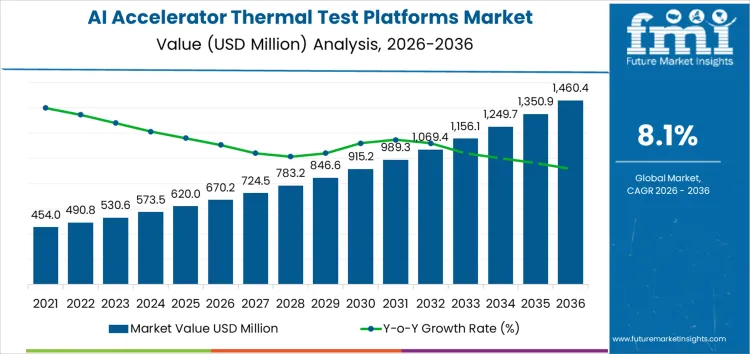
Demand for AI accelerator thermal test platforms market is valued at USD 670.2 million in 2026 and is forecast to reach USD 1,460.4 million by 2036, expanding at a CAGR of 8.1%. Segment demand reflects rising compute density, higher power dissipation, and tighter reliability thresholds across advanced semiconductor nodes. Platform selection emphasizes temperature accuracy, fast response, integration with electrical test systems, and compatibility with high-power accelerators used in data center, edge, and specialized computer environments.
Thermal chucks or contact systems account for 34.0% of global demand, representing the largest platform-type share. Adoption is driven by localized, rapid temperature control that supports device-level characterization and production testing. Thermal forcing or thermostream systems hold 26.0%, enabling non-contact and dynamic temperature transitions during functional validation. Environmental chambers represent 22%, supporting board-level and system-level thermal validation, while integrated thermal HIL rigs account for 18%, addressing closed-loop interaction between thermal behavior, power delivery, and workload emulation.
Quick Stats for AI Accelerator Thermal Test Platforms Market
- AI Accelerator Thermal Test Platforms Market Value (2026): USD 670.2 million
- AI Accelerator Thermal Test Platforms Market Forecast Value (2036): USD 1,460.4 million
- AI Accelerator Thermal Test Platforms Market Forecast CAGR (2026 to 2036): 8.1%
- Leading Platform Type in Global Demand: Thermal Chucks or Contact Systems
- Fastest-Growing Countries: China, Brazil, USA, South Korea, Germany
- Top Players in Global Demand: inTEST Thermal Solutions, ESPEC, Weiss Technik, Cincinnati Sub-Zero (CSZ), Thermotron, Watlow, Chroma ATE, Teradyne, Advantest, Angelantoni Test Technologies
AI accelerators represent 42.0% of component-level demand due to sustained high power density and sensitivity to thermal throttling. High-bandwidth memory follows with 24%, driven by proximity to compute cores and thermal sensitivity. Power delivery components hold 18%, while advanced packaging and interposers account for 16%. Temperature capability from −60°C to 150°C leads with 34.0%, supporting extended qualification and stress testing. Segment structure highlights priority on precise, device-centric thermal validation aligned with next-generation compute architectures.
AI Accelerator Thermal Test Platforms Market Key Takeaways
| Metric | Value |
|---|---|
| Market Value (2026) | USD 670.2 million |
| Market Forecast Value (2036) | USD 1,460.4 million |
| Forecast CAGR (2026 to 2036) | 8.1% |
Why is the Demand for AI Accelerator Thermal Test Platforms Market Growing Globally?
Demand for AI accelerator thermal test platforms is growing globally due to expanding deployment of high performance computing solutions in data centers, edge computing, autonomous systems, and artificial intelligence research. AI accelerators, including GPUs, ASICs, and custom neural processing units, generate substantial heat during operation, which increases the necessity for accurate thermal characterization and management validation prior to integration. Worldwide data center buildouts driven by cloud services, machine learning workloads, and real time analytics reinforce adoption of thermal test systems that verify cooling strategies, heat spreader performance, and thermal interface materials.
Semiconductor manufacturers and system integrators invest in platforms capable of replicating operational conditions, measuring temperature profiles, and evaluating thermal throttling thresholds. Growth in automotive, robotics, and telecom sectors increases use of AI hardware in environments with constrained cooling, further expanding demand for thermal test validation. Research institutions and advanced manufacturing facilities adopt test equipment to optimize design tradeoffs between power, performance, and thermal reliability. Equipment suppliers provide modular, scalable solutions that support diverse form factors while enabling repeatable test conditions. Industry emphasis on efficiency, reliability, and lifecycle performance reinforces deployment of standardized test practices across global supply chains.
How Are the Segments Classified in the AI Accelerator Thermal Test Platforms Market?
Demand for AI accelerator thermal test platforms globally is classified based on platform interaction level, component thermal sensitivity, and temperature qualification range. Segment structure reflects increasing emphasis on device-level thermal behavior under electrical load rather than ambient-only conditioning. Stakeholders prioritize temperature control accuracy, response speed, integration with electrical excitation, and compatibility with high-power accelerators operating near thermal limits. Adoption patterns highlight a shift toward test architectures capable of reproducing junction-level conditions under realistic workload envelopes across data center, edge, and specialized compute deployments.
Which Platform Type Represents the Largest Share of Global Demand?
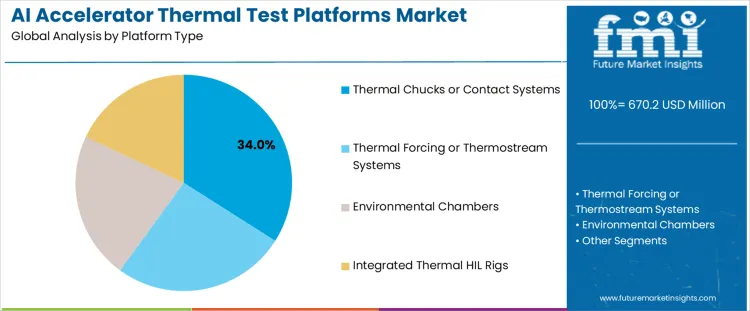
Thermal chucks or contact systems hold 34.0%, representing the largest platform-type share globally. These systems provide direct, localized temperature control with fast thermal response, enabling accurate junction-level characterization and production testing of high-power devices. Thermal forcing or thermostream systems account for 26.0%, supporting non-contact airflow-based temperature control suitable for dynamic functional testing. Environmental chambers represent 22.0%, enabling board-level and system-level thermal validation under controlled ambient conditions. Integrated thermal HIL rigs hold 18.0%, supporting closed-loop interaction between thermal behavior, power delivery, and workload emulation. Platform distribution reflects preference for precision, device-centric thermal validation solutions.
Key Points
- Thermal chucks lead due to localized and rapid temperature control.
- Thermostream systems support dynamic, non-contact testing.
- Chambers and HIL rigs address system-level validation needs.
Which Component Under Test Drives the Highest Share of Global Thermal Testing Demand?
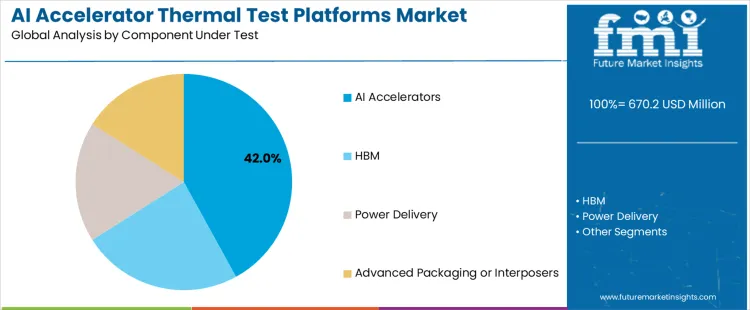
AI accelerators hold 42.0%, driving the highest share of global thermal testing demand due to sustained high power density and sensitivity to thermal throttling. High-bandwidth memory accounts for 24.0%, driven by proximity to compute cores and temperature-dependent performance behavior. Power delivery components represent 18.0%, supporting validation of thermal robustness under high current conditions. Advanced packaging and interposers account for 16.0%, requiring assessment of heat spreading efficiency and interface stability. Component distribution reflects concentration of thermal risk within compute-intensive silicon elements.
Key Points
- AI accelerators dominate due to high power density.
- HBM testing addresses thermal sensitivity near compute cores.
- Packaging validation ensures effective heat dissipation.
Which Temperature Capability Accounts for the Largest Share of Global Demand?
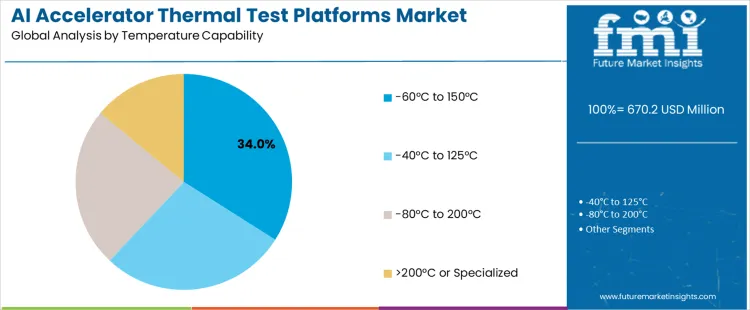
Temperature capability from −60°C to 150°C holds 34.0%, accounting for the largest share of global demand. This range supports extended qualification and accelerated stress testing required for advanced semiconductor devices. The −40°C to 125°C range accounts for 28.0%, covering standard commercial and industrial validation requirements. The −80°C to 200°C range represents 24.0%, supporting extreme stress and reliability analysis. Specialized ranges above 200°C account for 14.0%, addressing niche failure analysis and materials evaluation use cases. Temperature segmentation reflects balance between qualification standards and advanced reliability assessment.
Key Points
- −60°C to 150°C leads due to extended qualification coverage.
- Standard ranges support mainstream device validation.
- Extreme ranges address stress and failure analysis needs.
What are the Key Dynamics in the AI Accelerator Thermal Test Platforms Market?
Global demand is shaped by rising power density, tighter thermal margins, and accelerated deployment of AI accelerators across compute infrastructure. Thermal test platforms are increasingly used to validate heat dissipation, junction temperatures, and cooling effectiveness under realistic operating conditions. Demand aligns with growth in data center density, edge computing, and advanced semiconductor packaging, where thermal behavior directly constrains performance stability and device lifetime.
How do AI hardware scaling and heat management priorities shape global demand?
AI accelerators generate significant heat when processing large-scale neural workloads, increasing reliance on precise thermal characterization. Developers use thermal test platforms to measure temperature distribution, identify hotspots, and validate cooling architectures including heat sinks, cold plates, and liquid cooling systems. Data center operators require quantifiable thermal performance to optimize rack density, power utilization efficiency, and long-term reliability. Edge deployments demand compact designs capable of stable operation under variable ambient conditions. Thermal testing informs cooling strategy selection and mitigates risk of throttling or premature failure.
How do capital intensity, integration complexity, and standardization challenges influence scalability?
Thermal test platforms require substantial investment in environmental control, sensor instrumentation, and calibrated measurement systems. Integration with power delivery and workload emulation increases system complexity and setup effort. Absence of unified thermal validation standards across diverse AI architectures necessitates customized test configurations. Access to advanced test infrastructure remains concentrated within established semiconductor and data center hubs, while smaller developers rely on shared facilities. Market scalability depends on modular platforms that reduce cost barriers while supporting evolving thermal requirements.
How Is Demand for AI Accelerator Thermal Test Platforms Evolving?
Demand is increasing globally due to higher power densities, tighter reliability thresholds, and rapid deployment of accelerators in data center and edge environments. Growth patterns reflect differences in accelerator development intensity, installed base maturity, and qualification practices across regions. China records a CAGR of 9.7%, supported by domestic accelerator development, advanced packaging activity, and hyperscale infrastructure expansion. Brazil follows at 9.3%, driven by applied research programs and emerging data center capacity. USA records a CAGR of 7.9%, shaped by replacement-driven upgrades and cooling transitions. South Korea posts 7.8%, reflecting semiconductor process intensity and packaging validation needs. Germany records 7.8%, supported by industrial and automotive AI deployment. Growth reflects increasing thermal loads and accelerated qualification cycles worldwide.
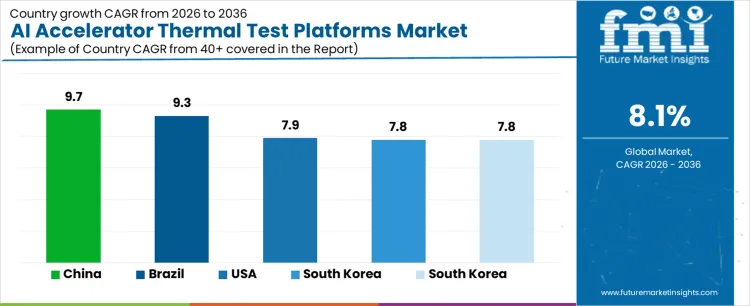
| Country | CAGR (%) |
|---|---|
| China | 9.7% |
| Brazil | 9.3% |
| USA | 7.9% |
| South Korea | 7.8% |
| Germany | 7.8% |
What factors are accelerating adoption of AI accelerator thermal test platforms in China?
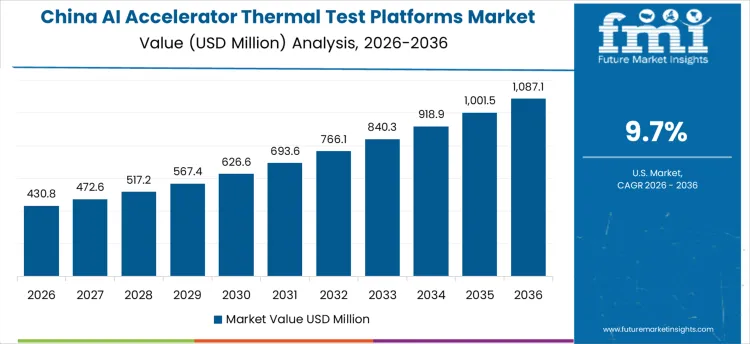
China drives demand through rapid scaling of domestic AI accelerator design, packaging innovation, and hyperscale data center expansion. Country’s CAGR of 9.7% reflects extensive use of thermal chambers, liquid cooling test rigs, and transient thermal measurement platforms. Developers validate heat spreaders, cold plates, and immersion compatibility under sustained workloads. In-house testing shortens iteration cycles and protects intellectual property. Platforms emphasize scalability, automation, and correlation with real workload profiles. Academic and industrial labs expand parallel capacity to meet volume needs. Growth remains scale-driven and investment-led, aligned with national compute infrastructure expansion.
- Domestic AI accelerator and packaging development
- Hyperscale data center thermal validation
- Liquid and immersion cooling test capability
- Scalable and automated test platforms
Why is Brazil emerging as a fast-growing market for thermal test platforms?
Brazil demand is shaped by expansion of applied AI research, regional data centers, and university-led hardware programs. Country’s CAGR of 9.3% reflects investment in thermal test setups for accelerator boards, edge devices, and pilot clusters. Shared facilities enable cost-efficient access to environmental and power cycling tests. Collaboration with global vendors supports adoption of standard thermal methodologies. Demand favors modular platforms suitable for mixed workloads and limited footprints. Growth remains capability-building focused, aligned with gradual scaling of AI compute infrastructure and research-to-deployment pathways.
- Applied AI research and pilot deployments
- Shared laboratory thermal testing access
- Adoption of standard thermal methodologies
- Modular platforms for mixed workloads
How do installed base dynamics influence demand in the USA?
USA demand reflects a large installed base of AI accelerators across cloud, enterprise, and edge deployments. Country’s CAGR of 7.9% is supported by replacement-led upgrades, qualification of next-generation devices, and cooling transitions. Operators validate air-to-liquid migration, reliability under peak utilization, and long-duration stability. Test platforms integrate telemetry, workload emulation, and failure analysis. Procurement emphasizes throughput, data accuracy, and correlation with field conditions. Growth remains lifecycle-driven, aligned with platform refresh cycles and evolving cooling architectures.
- Large installed base and refresh cycles
- Validation of air-to-liquid cooling transitions
- Long-duration stability and reliability testing
- Telemetry-integrated workload emulation
What role does South Korea’s semiconductor ecosystem play in thermal testing growth?
South Korea demand reflects advanced semiconductor manufacturing, packaging intensity, and electronics reliability standards. Country’s CAGR of 7.8% is supported by thermal testing of accelerator dies, packages, and boards under high current density. Manufacturers emphasize precision control, fast transients, and repeatability. Government-backed programs promote standardized qualification across fabs and OSATs. Facilities prioritize compact, high-accuracy systems compatible with cleanroom adjacencies. Growth remains process-driven, aligned with tight yield targets and accelerated product ramps.
- Semiconductor and advanced packaging validation
- Precision transient thermal measurement
- Standardized qualification across supply chains
- Compact, high-accuracy test systems
How is Germany positioned within the global AI thermal test platform landscape?
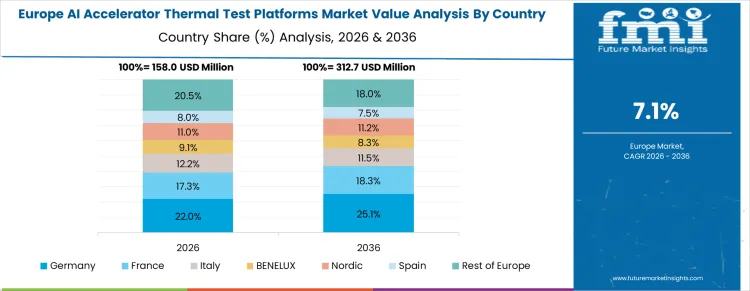
Germany demand reflects industrial AI deployment, automotive compute validation, and rigorous engineering standards. Country’s CAGR of 7.8% is supported by testing accelerators used in factories, vehicles, and edge infrastructure. Test platforms validate thermal robustness under vibration, ambient variation, and duty cycling. Shared research institutes and industry labs expand access to reliability testing. Procurement favors repeatability, documentation, and standards alignment. Growth remains engineering-led, aligned with safety, durability, and compliance requirements across industrial AI applications.
- Industrial and automotive AI validation
- Thermal testing under combined stresses
- Strong standards and documentation focus
- Shared research and industry laboratories
What is the competitive landscape of demand for AI accelerator thermal test platforms?
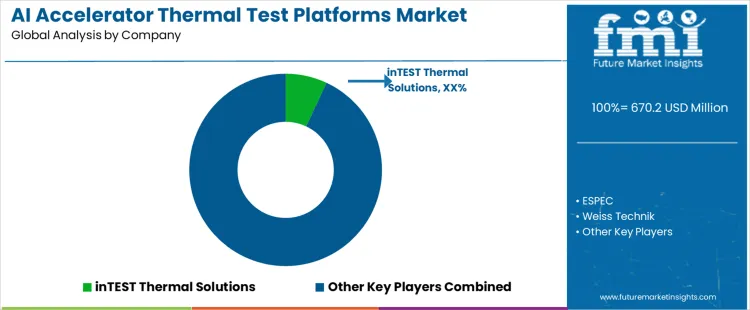
Demand for AI accelerator thermal test platforms is driven by rapid scaling of high-power compute devices across data centers and advanced semiconductor development. Testing environments must reproduce extreme heat flux, fast thermal transients, and sustained junction temperatures under realistic workload profiles. Buyers require precise temperature control, uniformity across large devices, and compatibility with automated electrical test workflows. Procurement teams evaluate ramp rates, steady-state stability, airflow management, and integration with handler and socket ecosystems. Reliability under continuous stress testing and global service availability influence vendor qualification decisions. Trend in the global market reflects higher power densities, tighter thermal margins, and convergence of thermal and electrical validation.
inTEST Thermal Solutions maintains strong positioning with thermal platforms designed for high-power semiconductor and accelerator validation environments. ESPEC and Weiss Technik supply environmental chambers adapted for electronics reliability testing and temperature cycling at scale. Cincinnati Sub-Zero and Thermotron support device and subsystem testing through configurable chambers and accelerated stress capabilities. Watlow contributes thermal control components and systems enabling precise heating and control in customized test configurations. Chroma ATE integrates thermal platforms with power and functional test systems supporting AI accelerator validation. Teradyne and Advantest participate through automated test ecosystems where thermal conditioning supports high-volume device characterization. Angelantoni Test Technologies provides environmental and thermal systems used in semiconductor reliability and qualification workflows. Competitive differentiation depends on thermal uniformity, ramp performance, automation readiness, and proven operation at elevated power levels.
Key Players in the AI Accelerator Thermal Test Platforms Market
- inTEST Thermal Solutions
- ESPEC
- Weiss Technik
- Cincinnati Sub-Zero (CSZ)
- Thermotron
- Watlow
- Chroma ATE
- Teradyne
- Advantest
- Angelantoni Test Technologies
Scope of the Report
| Items | Values |
|---|---|
| Quantitative Units | USD million |
| Platform Type | Thermal Chucks or Contact Systems; Thermal Forcing or Thermostream Systems; Environmental Chambers; Integrated Thermal HIL Rigs |
| Component Under Test | AI Accelerators; High Bandwidth Memory (HBM); Power Delivery Components; Advanced Packaging and Interposers |
| Temperature Capability | −40°C to 125°C; −60°C to 150°C; −80°C to 200°C; Above 200°C or Specialized Extreme Thermal Conditions |
| End User | Semiconductor Device Makers; OSAT and Advanced Packaging Houses; Hyperscaler Test Laboratories; Test & Measurement or ATE Laboratories |
| Regions Covered | Asia Pacific; Europe; North America; Latin America; Middle East & Africa |
| Countries Covered | USA; China; South Korea; Brazil; Germany; Japan; and 40+ countries |
| Key Companies Profiled | inTEST Thermal Solutions; ESPEC; Weiss Technik; Cincinnati Sub-Zero (CSZ); Thermotron; Watlow; Chroma ATE; Teradyne; Advantest; Angelantoni Test Technologies |
| Additional Attributes | Dollar sales by platform type, component under test, and temperature range; regional adoption across advanced semiconductor hubs; increasing use in AI accelerator validation and HBM reliability testing; integration with ATE and thermal HIL environments; demand driven by higher power densities, advanced packaging, and hyperscaler qualification requirements. |
AI Accelerator Thermal Test Platforms Market by Segment
Platform Type:
- Thermal Chucks or Contact Systems
- Thermal Forcing or Thermostream Systems
- Environmental Chambers
- Integrated Thermal HIL Rigs
Component Under Test:
- AI Accelerators
- HBM
- Power Delivery
- Advanced Packaging or Interposers
Temperature Capability:
- 40°C to 125°C
- 60°C to 150°C
- 80°C to 200°C
- >200°C or Specialized
End User:
- Semiconductor Device Makers
- OSAT or Packaging Houses
- Hyperscaler Test Labs
- Test & Measurement or ATE Labs
Region:
- Asia Pacific
- China
- Japan
- South Korea
- India
- Australia & New Zealand
- ASEAN
- Rest of Asia Pacific
- Europe
- Germany
- United Kingdom
- France
- Italy
- Spain
- Nordic
- BENELUX
- Rest of Europe
- North America
- United States
- Canada
- Mexico
- Latin America
- Brazil
- Chile
- Rest of Latin America
- Middle East & Africa
- Kingdom of Saudi Arabia
- Other GCC Countries
- Turkey
- South Africa
- Other African Union
- Rest of Middle East & Africa
Bibliography
- inTEST Thermal Solutions. (2023). Thermal chucks, thermostream systems, and thermal platforms for high-power semiconductor and AI accelerator validation. inTEST Thermal Solutions, Inc.
- ESPEC Corporation. (2023). Environmental and thermal test chambers for electronics reliability, semiconductor qualification, and power-dense device testing. ESPEC Corporation.
- Weiss Technik. (2023). Thermal and climatic test systems for semiconductor devices, advanced packaging, and high-performance computing applications. Weiss Technik GmbH.
- Teradyne. (2024). Automated test ecosystems integrating thermal conditioning for advanced semiconductor and AI accelerator characterization. Teradyne, Inc.
- Advantest. (2023). Semiconductor test platforms supporting thermal characterization and reliability validation of high-power devices. Advantest Corporation.
Frequently Asked Questions
How big is the ai accelerator thermal test platforms market in 2026?
The global ai accelerator thermal test platforms market is estimated to be valued at USD 670.2 million in 2026.
What will be the size of ai accelerator thermal test platforms market in 2036?
The market size for the ai accelerator thermal test platforms market is projected to reach USD 1,460.4 million by 2036.
How much will be the ai accelerator thermal test platforms market growth between 2026 and 2036?
The ai accelerator thermal test platforms market is expected to grow at a 8.1% CAGR between 2026 and 2036.
What are the key product types in the ai accelerator thermal test platforms market?
The key product types in ai accelerator thermal test platforms market are thermal chucks or contact systems, thermal forcing or thermostream systems, environmental chambers and integrated thermal hil rigs.
Which component under test segment to contribute significant share in the ai accelerator thermal test platforms market in 2026?
In terms of component under test, ai accelerators segment to command 42.0% share in the ai accelerator thermal test platforms market in 2026.
Preview the report firsthand - request a free sample
Get SampleGet the brochure for pricing and purchase details.
Get PDFTable of Content
- Executive Summary
- Global Market Outlook
- Demand-side Trends
- Supply-side Trends
- Technology Roadmap Analysis
- Analysis and Recommendations
- Market Overview
- Market Coverage / Taxonomy
- Market Definition / Scope / Limitations
- Market Background
- Market Dynamics
- Drivers
- Restraints
- Opportunity
- Trends
- Scenario Forecast
- Demand in Optimistic Scenario
- Demand in Likely Scenario
- Demand in Conservative Scenario
- Opportunity Map Analysis
- Product Life Cycle Analysis
- Supply Chain Analysis
- Investment Feasibility Matrix
- Value Chain Analysis
- PESTLE and Porter’s Analysis
- Regulatory Landscape
- Regional Parent Market Outlook
- Production and Consumption Statistics
- Import and Export Statistics
- Market Dynamics
- Global Market Analysis 2021 to 2025 and Forecast, 2026 to 2036
- Historical Market Size Value (USD Million) Analysis, 2021 to 2025
- Current and Future Market Size Value (USD Million) Projections, 2026 to 2036
- Y-o-Y Growth Trend Analysis
- Absolute $ Opportunity Analysis
- Global Market Pricing Analysis 2021 to 2025 and Forecast 2026 to 2036
- Global Market Analysis 2021 to 2025 and Forecast 2026 to 2036, By Platform Type
- Introduction / Key Findings
- Historical Market Size Value (USD Million) Analysis By Platform Type , 2021 to 2025
- Current and Future Market Size Value (USD Million) Analysis and Forecast By Platform Type , 2026 to 2036
- Thermal Chucks or Contact Systems
- Thermal Forcing or Thermostream Systems
- Environmental Chambers
- Integrated Thermal HIL Rigs
- Thermal Chucks or Contact Systems
- Y-o-Y Growth Trend Analysis By Platform Type , 2021 to 2025
- Absolute $ Opportunity Analysis By Platform Type , 2026 to 2036
- Global Market Analysis 2021 to 2025 and Forecast 2026 to 2036, By Component Under Test
- Introduction / Key Findings
- Historical Market Size Value (USD Million) Analysis By Component Under Test, 2021 to 2025
- Current and Future Market Size Value (USD Million) Analysis and Forecast By Component Under Test, 2026 to 2036
- AI Accelerators
- HBM
- Power Delivery
- Advanced Packaging or Interposers
- AI Accelerators
- Y-o-Y Growth Trend Analysis By Component Under Test, 2021 to 2025
- Absolute $ Opportunity Analysis By Component Under Test, 2026 to 2036
- Global Market Analysis 2021 to 2025 and Forecast 2026 to 2036, By Temperature Capability
- Introduction / Key Findings
- Historical Market Size Value (USD Million) Analysis By Temperature Capability, 2021 to 2025
- Current and Future Market Size Value (USD Million) Analysis and Forecast By Temperature Capability, 2026 to 2036
- -60°C to 150°C
- -40°C to 125°C
- -80°C to 200°C
- >200°C or Specialized
- -60°C to 150°C
- Y-o-Y Growth Trend Analysis By Temperature Capability, 2021 to 2025
- Absolute $ Opportunity Analysis By Temperature Capability, 2026 to 2036
- Global Market Analysis 2021 to 2025 and Forecast 2026 to 2036, By End User
- Introduction / Key Findings
- Historical Market Size Value (USD Million) Analysis By End User, 2021 to 2025
- Current and Future Market Size Value (USD Million) Analysis and Forecast By End User, 2026 to 2036
- Semiconductor Device Makers
- OSAT or Packaging Houses
- Hyperscaler Test Labs
- Test & Measurement or ATE Labs
- Semiconductor Device Makers
- Y-o-Y Growth Trend Analysis By End User, 2021 to 2025
- Absolute $ Opportunity Analysis By End User, 2026 to 2036
- Global Market Analysis 2021 to 2025 and Forecast 2026 to 2036, By Region
- Introduction
- Historical Market Size Value (USD Million) Analysis By Region, 2021 to 2025
- Current Market Size Value (USD Million) Analysis and Forecast By Region, 2026 to 2036
- North America
- Latin America
- Western Europe
- Eastern Europe
- East Asia
- South Asia and Pacific
- Middle East & Africa
- Market Attractiveness Analysis By Region
- North America Market Analysis 2021 to 2025 and Forecast 2026 to 2036, By Country
- Historical Market Size Value (USD Million) Trend Analysis By Market Taxonomy, 2021 to 2025
- Market Size Value (USD Million) Forecast By Market Taxonomy, 2026 to 2036
- By Country
- USA
- Canada
- Mexico
- By Platform Type
- By Component Under Test
- By Temperature Capability
- By End User
- By Country
- Market Attractiveness Analysis
- By Country
- By Platform Type
- By Component Under Test
- By Temperature Capability
- By End User
- Key Takeaways
- Latin America Market Analysis 2021 to 2025 and Forecast 2026 to 2036, By Country
- Historical Market Size Value (USD Million) Trend Analysis By Market Taxonomy, 2021 to 2025
- Market Size Value (USD Million) Forecast By Market Taxonomy, 2026 to 2036
- By Country
- Brazil
- Chile
- Rest of Latin America
- By Platform Type
- By Component Under Test
- By Temperature Capability
- By End User
- By Country
- Market Attractiveness Analysis
- By Country
- By Platform Type
- By Component Under Test
- By Temperature Capability
- By End User
- Key Takeaways
- Western Europe Market Analysis 2021 to 2025 and Forecast 2026 to 2036, By Country
- Historical Market Size Value (USD Million) Trend Analysis By Market Taxonomy, 2021 to 2025
- Market Size Value (USD Million) Forecast By Market Taxonomy, 2026 to 2036
- By Country
- Germany
- UK
- Italy
- Spain
- France
- Nordic
- BENELUX
- Rest of Western Europe
- By Platform Type
- By Component Under Test
- By Temperature Capability
- By End User
- By Country
- Market Attractiveness Analysis
- By Country
- By Platform Type
- By Component Under Test
- By Temperature Capability
- By End User
- Key Takeaways
- Eastern Europe Market Analysis 2021 to 2025 and Forecast 2026 to 2036, By Country
- Historical Market Size Value (USD Million) Trend Analysis By Market Taxonomy, 2021 to 2025
- Market Size Value (USD Million) Forecast By Market Taxonomy, 2026 to 2036
- By Country
- Russia
- Poland
- Hungary
- Balkan & Baltic
- Rest of Eastern Europe
- By Platform Type
- By Component Under Test
- By Temperature Capability
- By End User
- By Country
- Market Attractiveness Analysis
- By Country
- By Platform Type
- By Component Under Test
- By Temperature Capability
- By End User
- Key Takeaways
- East Asia Market Analysis 2021 to 2025 and Forecast 2026 to 2036, By Country
- Historical Market Size Value (USD Million) Trend Analysis By Market Taxonomy, 2021 to 2025
- Market Size Value (USD Million) Forecast By Market Taxonomy, 2026 to 2036
- By Country
- China
- Japan
- South Korea
- By Platform Type
- By Component Under Test
- By Temperature Capability
- By End User
- By Country
- Market Attractiveness Analysis
- By Country
- By Platform Type
- By Component Under Test
- By Temperature Capability
- By End User
- Key Takeaways
- South Asia and Pacific Market Analysis 2021 to 2025 and Forecast 2026 to 2036, By Country
- Historical Market Size Value (USD Million) Trend Analysis By Market Taxonomy, 2021 to 2025
- Market Size Value (USD Million) Forecast By Market Taxonomy, 2026 to 2036
- By Country
- India
- ASEAN
- Australia & New Zealand
- Rest of South Asia and Pacific
- By Platform Type
- By Component Under Test
- By Temperature Capability
- By End User
- By Country
- Market Attractiveness Analysis
- By Country
- By Platform Type
- By Component Under Test
- By Temperature Capability
- By End User
- Key Takeaways
- Middle East & Africa Market Analysis 2021 to 2025 and Forecast 2026 to 2036, By Country
- Historical Market Size Value (USD Million) Trend Analysis By Market Taxonomy, 2021 to 2025
- Market Size Value (USD Million) Forecast By Market Taxonomy, 2026 to 2036
- By Country
- Kingdom of Saudi Arabia
- Other GCC Countries
- Turkiye
- South Africa
- Other African Union
- Rest of Middle East & Africa
- By Platform Type
- By Component Under Test
- By Temperature Capability
- By End User
- By Country
- Market Attractiveness Analysis
- By Country
- By Platform Type
- By Component Under Test
- By Temperature Capability
- By End User
- Key Takeaways
- Key Countries Market Analysis
- USA
- Pricing Analysis
- Market Share Analysis, 2025
- By Platform Type
- By Component Under Test
- By Temperature Capability
- By End User
- Canada
- Pricing Analysis
- Market Share Analysis, 2025
- By Platform Type
- By Component Under Test
- By Temperature Capability
- By End User
- Mexico
- Pricing Analysis
- Market Share Analysis, 2025
- By Platform Type
- By Component Under Test
- By Temperature Capability
- By End User
- Brazil
- Pricing Analysis
- Market Share Analysis, 2025
- By Platform Type
- By Component Under Test
- By Temperature Capability
- By End User
- Chile
- Pricing Analysis
- Market Share Analysis, 2025
- By Platform Type
- By Component Under Test
- By Temperature Capability
- By End User
- Germany
- Pricing Analysis
- Market Share Analysis, 2025
- By Platform Type
- By Component Under Test
- By Temperature Capability
- By End User
- UK
- Pricing Analysis
- Market Share Analysis, 2025
- By Platform Type
- By Component Under Test
- By Temperature Capability
- By End User
- Italy
- Pricing Analysis
- Market Share Analysis, 2025
- By Platform Type
- By Component Under Test
- By Temperature Capability
- By End User
- Spain
- Pricing Analysis
- Market Share Analysis, 2025
- By Platform Type
- By Component Under Test
- By Temperature Capability
- By End User
- France
- Pricing Analysis
- Market Share Analysis, 2025
- By Platform Type
- By Component Under Test
- By Temperature Capability
- By End User
- India
- Pricing Analysis
- Market Share Analysis, 2025
- By Platform Type
- By Component Under Test
- By Temperature Capability
- By End User
- ASEAN
- Pricing Analysis
- Market Share Analysis, 2025
- By Platform Type
- By Component Under Test
- By Temperature Capability
- By End User
- Australia & New Zealand
- Pricing Analysis
- Market Share Analysis, 2025
- By Platform Type
- By Component Under Test
- By Temperature Capability
- By End User
- China
- Pricing Analysis
- Market Share Analysis, 2025
- By Platform Type
- By Component Under Test
- By Temperature Capability
- By End User
- Japan
- Pricing Analysis
- Market Share Analysis, 2025
- By Platform Type
- By Component Under Test
- By Temperature Capability
- By End User
- South Korea
- Pricing Analysis
- Market Share Analysis, 2025
- By Platform Type
- By Component Under Test
- By Temperature Capability
- By End User
- Russia
- Pricing Analysis
- Market Share Analysis, 2025
- By Platform Type
- By Component Under Test
- By Temperature Capability
- By End User
- Poland
- Pricing Analysis
- Market Share Analysis, 2025
- By Platform Type
- By Component Under Test
- By Temperature Capability
- By End User
- Hungary
- Pricing Analysis
- Market Share Analysis, 2025
- By Platform Type
- By Component Under Test
- By Temperature Capability
- By End User
- Kingdom of Saudi Arabia
- Pricing Analysis
- Market Share Analysis, 2025
- By Platform Type
- By Component Under Test
- By Temperature Capability
- By End User
- Turkiye
- Pricing Analysis
- Market Share Analysis, 2025
- By Platform Type
- By Component Under Test
- By Temperature Capability
- By End User
- South Africa
- Pricing Analysis
- Market Share Analysis, 2025
- By Platform Type
- By Component Under Test
- By Temperature Capability
- By End User
- USA
- Market Structure Analysis
- Competition Dashboard
- Competition Benchmarking
- Market Share Analysis of Top Players
- By Regional
- By Platform Type
- By Component Under Test
- By Temperature Capability
- By End User
- Competition Analysis
- Competition Deep Dive
- inTEST Thermal Solutions
- Overview
- Product Portfolio
- Profitability by Market Segments (Product/Age /Sales Channel/Region)
- Sales Footprint
- Strategy Overview
- Marketing Strategy
- Product Strategy
- Channel Strategy
- ESPEC
- Weiss Technik
- Cincinnati Sub-Zero (CSZ)
- Thermotron
- Watlow
- Chroma ATE
- Teradyne
- Advantest
- Angelantoni Test Technologies
- inTEST Thermal Solutions
- Competition Deep Dive
- Assumptions & Acronyms Used
- Research Methodology


