

- Industry Size (2026)
- USD 297.0 Mn
- Forecast (2036)
- USD 1120.5 Mn
- CAGR (2026 to 2036)
- 14.2%
AI Cabin Thermal Prediction Systems Market Forecast and Outlook 2026 to 2036
The AI cabin thermal prediction systems market is valued at USD 297.0 million in 2026 and forecasted to reach USD 1,120.5 million by 2036 at a CAGR of 14.2%. Value behavior reflects rising allocation toward software-defined thermal intelligence rather than incremental HVAC hardware expansion. Investment concentrates on predictive algorithms embedded within vehicle electronic architectures to anticipate cabin thermal loads and manage energy draw proactively.
Cost structures favor scalable software modules integrated at platform level, supported by sensors and existing control hardware. Spending aligns with electric vehicle programs where HVAC energy management directly affects usable range and real-world efficiency metrics. Revenue formation remains linked to OEM adoption of embedded prediction capability as part of broader software-defined vehicle strategies rather than standalone feature monetization.
Quick Stats for AI Cabin Thermal Prediction Systems Market
- AI Cabin Thermal Prediction Systems Market Value (2026): USD 297.0 million
- AI Cabin Thermal Prediction Systems Market Forecast Value (2036): USD 1,120.5 million
- AI Cabin Thermal Prediction Systems Market Forecast CAGR 2026 to 2036: 14.2%
- Leading Software Function in Global Demand: Thermal Load Prediction
- Fastest-Growing Countries: China, Brazil, USA, Germany, South Korea
- Top Players in Global Demand: Bosch, Valeo, Continental, HARMAN, NVIDIA, CARIAD, dSPACE, MathWorks, Siemens, Aptiv
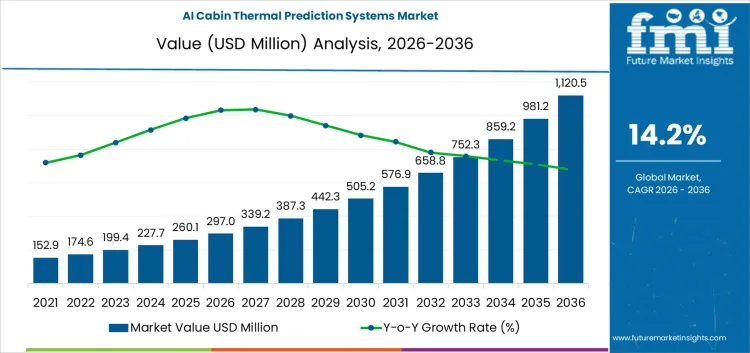
Scalability is shaped by data dependency, validation rigor, and integration discipline. Predictive systems rely on consistent sensor accuracy, calibration stability, and robust data pipelines to maintain model reliability across operating conditions. Development timelines extend due to safety validation, cybersecurity compliance, and explainability requirements for AI-driven control logic. Computational load and software maintenance introduce architectural constraints within vehicle electronic systems.
Cost sensitivity persists where predictive capability competes with battery capacity, power electronics, and infotainment investment. Platform diversity limits model transferability without retraining effort. Adoption concentrates in programs prioritizing anticipatory energy optimization, fleet-level efficiency control, and standardized software stacks. Long-term value concentration reflects persistence of software-led thermal management as a structural component of efficiency-focused vehicle design rather than optional cabin comfort enhancement.
AI Cabin Thermal Prediction Systems Market Key Takeaways
| Metric | Value |
|---|---|
| Market Value (2026) | USD 297.0 million |
| Market Forecast Value (2036) | USD 1,120.5 million |
| Forecast CAGR 2026 to 2036 | 14.2% |
Why is the Demand for AI Cabin Thermal Prediction Systems Growing?
Demand for AI cabin thermal prediction systems is rising as vehicle designers and fleet operators require advanced climate control that anticipates thermal loads and adjusts system outputs with precision. Electric and hybrid vehicle segments emphasize energy efficient cabin management because HVAC energy use directly affects operational range. AI driven prediction models analyze sensor data, ambient conditions, and occupant patterns to calibrate thermal responses before discomfort arises. Engineers specify systems that integrate with vehicle electronic control units to support coordinated management of heaters, coolers, and fans. Procurement teams evaluate algorithm accuracy, data security, and compatibility with existing thermal management architecture when selecting solutions for new platforms.
OEMs view predictive thermal control as a differentiator that improves comfort while preserving power budgets for essential propulsion functions. Growth in connected vehicle technologies and sensor networks is reinforcing uptake of AI cabin thermal prediction systems that support adaptive learning across drive cycles. Manufacturers and software developers refine machine learning models to reduce computation load and improve real time responsiveness under varied environmental conditions. Service planners align calibration procedures with production and maintenance schedules to sustain performance throughout vehicle life. These technical and operational priorities support sustained adoption of AI based thermal prediction in evolving mobility systems.
How Are the Segments Classified in the AI Cabin Thermal Prediction Systems Market?
Demand for AI cabin thermal prediction systems is shaped by energy optimization requirements, occupant comfort consistency, and software-driven vehicle functionality. Adoption aligns with shift toward predictive control replacing reactive HVAC operation. Systems rely on data fusion, learning algorithms, and real-time adjustment to reduce power draw while maintaining comfort targets. Integration supports electric vehicle efficiency objectives and connected vehicle strategies. Segment classification reflects differentiation by software function, data input source, and deployment architecture. Structure highlights how algorithm focus, data availability, and system placement influence prediction accuracy, response speed, and operational effectiveness across intelligent cabin climate control frameworks.
Which Software Function Represents the Largest Share of Demand?
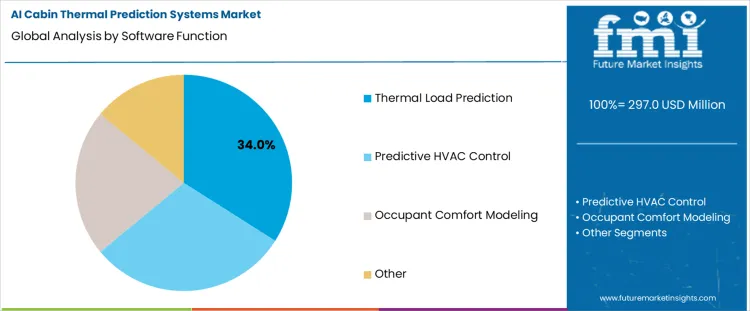
Thermal load prediction holds 34.0%, representing the largest share among software functions due to foundational role in anticipatory HVAC control. Algorithms estimate future heating and cooling requirements based on cabin conditions and external factors. Accurate load forecasting enables preemptive adjustment of airflow and temperature setpoints. System performance improves through reduced oscillation and lower energy consumption. Predictive HVAC control and occupant comfort modeling build on load estimation outputs to refine control strategies. Other functions support auxiliary optimization tasks. Software function segmentation reflects priority placed on forecasting capability enabling stable, efficient cabin thermal regulation.
Key Points
- Load prediction underpins anticipatory HVAC operation.
- Forecasting reduces energy waste and control instability.
- Other functions refine comfort and control strategies.
Which Data Input Category Accounts for the Highest Share of Demand?
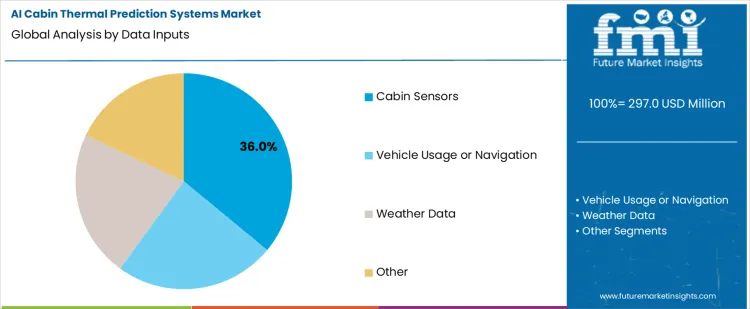
Cabin sensors hold 36.0%, representing the largest share among data input sources due to real-time condition monitoring. Temperature, humidity, and occupancy sensors provide immediate feedback for prediction models. High data fidelity improves model responsiveness and accuracy. Sensor inputs enable rapid adjustment to occupant behavior and environmental changes. Vehicle usage and navigation data support contextual prediction linked to route and duration. Weather data informs external thermal influence modeling. Other inputs address supplementary signals. Data input segmentation reflects reliance on direct, real-time cabin measurements as primary drivers of predictive accuracy.
Key Points
- Sensor data provides immediate and reliable thermal feedback.
- Real-time inputs enhance prediction responsiveness.
- Other data sources add contextual awareness.
Which Deployment Approach Drives the Largest Share of Demand?
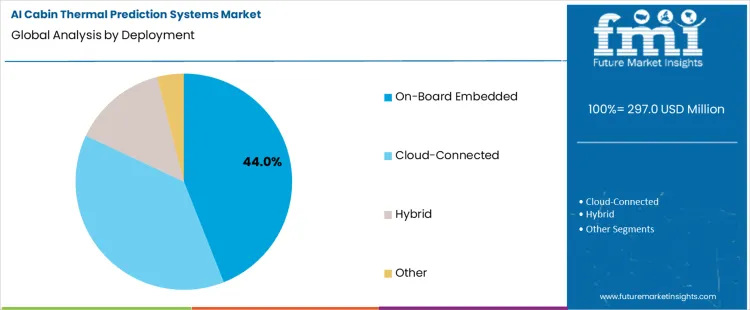
On-board embedded deployment holds 44.0%, representing the largest share among deployment approaches due to low latency requirements. Embedded systems enable real-time prediction without dependence on network connectivity. Local processing supports consistent performance under variable signal conditions. Integration aligns with safety, privacy, and functional reliability objectives. Cloud-connected deployment enables model updates and fleet learning with higher latency tolerance. Hybrid approaches balance local execution with cloud-based optimization. Other deployments address niche architectures. Deployment segmentation reflects preference for deterministic, real-time operation essential for cabin thermal control applications.
Key Points
- Embedded deployment supports low-latency prediction.
- Local processing ensures reliability and privacy.
- Other approaches enable learning and update flexibility.
What are the Key Dynamics in the AI Cabin Thermal Prediction Systems Market?
Demand for AI cabin thermal prediction systems reflects need to anticipate and manage thermal conditions before occupant discomfort or energy inefficiency occurs. Adoption spans electric vehicles, premium internal combustion vehicles, rail cabins, and specialized mobility platforms. Global scope aligns with software-driven vehicle architecture and energy optimization priorities. Usage integrates predictive algorithms, sensor fusion, and control logic embedded within vehicle thermal and energy management systems.
How do predictive control and energy optimization requirements shape adoption?
Cabin thermal behavior varies with occupancy, solar load, ambient temperature, and vehicle operating state. Demand increases as AI models enable proactive adjustment of HVAC output rather than reactive control. Predictive systems reduce energy waste by preemptively moderating airflow, temperature, and zonal distribution. Electric vehicle platforms adopt prediction to minimize range impact from HVAC usage. Integration of historical usage patterns and real-time sensor data improves comfort consistency across drive cycles. Fleet operators value predictive control to standardize cabin readiness and reduce variability in energy consumption. Software-based deployment supports continuous improvement through model refinement. Adoption reflects shift toward intelligent, anticipatory thermal management rather than rule-based control.
How do data dependency and system validation constraints influence market scalability?
AI thermal prediction relies on high-quality sensor data, increasing dependency on sensor accuracy and calibration. Demand sensitivity rises where data gaps or noisy inputs reduce model reliability. Integration complexity increases due to interaction with HVAC hardware, vehicle controls, and user interfaces. Validation requirements for safety-critical software extend development and approval timelines. Performance transparency remains limited, affecting engineering trust and regulatory acceptance. Computational requirements add load to vehicle electronic architectures. Cybersecurity and data governance obligations increase compliance burden. Model generalization across vehicle platforms remains challenging, constraining rapid scaling across diverse cabin layouts and operating environments.
How Is Demand for AI Cabin Thermal Prediction Systems Evolving Globally?
Demand for AI cabin thermal prediction systems is expanding globally as vehicle platforms adopt predictive energy management to improve comfort and efficiency. Systems use sensor data, user behavior, and environmental inputs to anticipate thermal loads before occupancy. Adoption aligns with electrification, software-defined vehicle architectures, and range optimization priorities. Integration reduces HVAC energy spikes and improves thermal response accuracy. Growth rates in China at 16.8%, Brazil at 16.5%, USA at 13.4%, Germany at 13.2%, and South Korea at 13.1% indicate sustained expansion driven by advanced vehicle software deployment, climate exposure, and predictive control integration across next-generation mobility platforms.
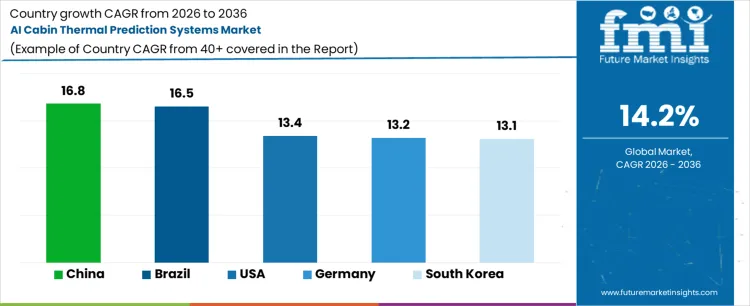
| Country | CAGR (%) |
|---|---|
| China | 16.8% |
| Brazil | 16.5% |
| USA | 13.4% |
| Germany | 13.2% |
| South Korea | 13.1% |
What Is Driving Rapid Expansion of AI Cabin Thermal Prediction Systems in China?
AI cabin thermal prediction system demand in China is expanding at a CAGR of 16.8%, supported by large-scale deployment of software-defined electric vehicles. OEMs integrate predictive thermal algorithms to manage HVAC energy consumption under dense urban driving conditions. High variability in daily temperature and traffic congestion increases value of anticipatory thermal control. Integration with navigation, charging schedules, and occupancy detection improves accuracy. Public transport electrification extends adoption into buses and rail cabins. Strong domestic AI and automotive software ecosystems accelerate validation and rollout across high-volume vehicle platforms.
- Software-defined EV platform deployment
- Urban congestion increasing thermal prediction value
- Integration with navigation and charging systems
- Strong domestic automotive AI ecosystem
Why Is Brazil Experiencing Accelerated Adoption of AI Thermal Prediction Systems?
AI cabin thermal prediction system demand in Brazil is growing at a CAGR of 16.5%, driven by climate intensity and fleet electrification. High ambient temperatures cause rapid cabin heat buildup during parking and idle periods. Predictive systems enable pre-emptive cooling strategies, reducing peak HVAC loads. Electric bus and delivery fleets benefit from route-based thermal forecasting. Depot charging enables alignment of prediction algorithms with operational schedules. Adoption reflects operational efficiency and battery preservation priorities rather than consumer-facing feature differentiation.
- High ambient temperature variability
- Fleet electrification across buses and logistics
- Route-based thermal load forecasting
- Depot charging enabling predictive scheduling
How Is the USA Supporting Strong Growth of AI Cabin Thermal Prediction Systems?
AI cabin thermal prediction system demand in the USA is expanding at a CAGR of 13.4%, shaped by connected vehicle architectures and data-driven energy management. OEMs deploy predictive models to stabilize range across diverse climate zones. Integration with cloud analytics and mobile applications supports adaptive learning of user behavior. Commercial fleets apply prediction systems to standardize cabin conditions before shifts. High data availability improves model accuracy over time. Demand growth reflects software value creation within vehicle platforms rather than hardware-driven differentiation.
- Connected vehicle data enabling predictive learning
- Climate variability across operating regions
- Fleet usage standardizing thermal conditions
- Cloud-based analytics integration
What Factors Are Sustaining AI Cabin Thermal Prediction Demand in Germany?
AI cabin thermal prediction system demand in Germany is growing at a CAGR of 13.2%, influenced by efficiency-led vehicle engineering practices. Predictive thermal control reduces energy draw during cold starts and winter driving. OEMs integrate AI models with heat pump and battery management systems. Regulatory focus on real-world efficiency performance supports adoption. Corporate fleet electrification contributes incremental deployment. Demand growth aligns with platform redesign cycles emphasizing predictive control rather than standalone feature expansion.
- Cold climate impact on HVAC energy demand
- Integration with heat pump and battery systems
- Regulatory emphasis on real-world efficiency
- Corporate fleet electrification uptake
Why Is South Korea Showing Consistent Growth in AI Cabin Thermal Prediction Systems?
AI cabin thermal prediction system demand in South Korea is expanding at a CAGR of 13.1%, driven by advanced vehicle electronics integration. OEMs emphasize coordination between AI models, sensors, and thermal actuators. Seasonal temperature swings increase benefit of predictive control. Export-oriented EV platforms require consistent performance across global climates. Strong semiconductor and software capabilities support in-house algorithm development. Demand growth reflects system-level optimization within globally deployed platforms rather than localized feature adoption.
- Integration of AI with vehicle thermal sensors
- Seasonal temperature variability benefits
- Export platform climate adaptability needs
- Strong domestic semiconductor and software base
What is the competitive landscape of demand for AI cabin thermal prediction systems globally?
Demand for AI cabin thermal prediction systems is driven by the need to enhance occupant comfort, reduce HVAC energy consumption, and improve thermal management in modern vehicles. These systems apply machine learning and predictive control algorithms to forecast cabin temperature profiles, optimize HVAC operation, and integrate with climate control hardware. Buyers evaluate model accuracy, data integration capability, real-time responsiveness, and compatibility with vehicle electronic control units and sensor arrays. Procurement teams prioritize suppliers with proven AI platforms, automotive validation experience, and ability to support software-defined thermal management across diverse vehicle architectures. Trend in the global market reflects convergence of artificial intelligence, connected vehicle data streams, and electrified powertrain thermal optimization.
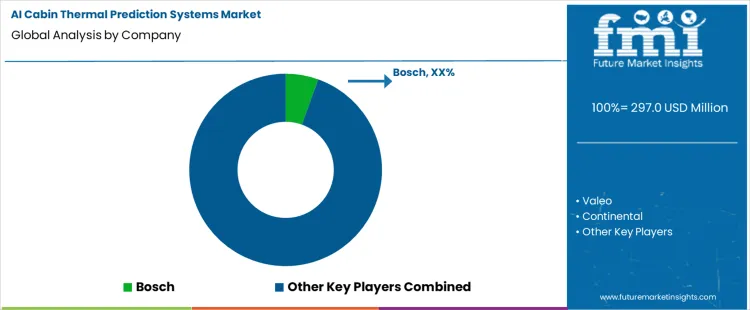
Bosch holds leading positioning through AI-enabled thermal management platforms and predictive climate control systems integrated with vehicle sensor networks and control units. Valeo supports demand with AI cabin thermal prediction capabilities embedded within smart HVAC and thermal control modules tailored for energy-efficient and comfort-centric applications. Continental participates with predictive climate and thermal system solutions that leverage vehicle context and occupant data to enhance energy utilization. NVIDIA contributes AI computing platforms and GPU-accelerated models used by vehicle OEMs and Tier-1 partners for predictive thermal analytics. dSPACE supports development and validation of AI prediction systems through real-time simulation environments used in automotive control design. Competitive differentiation depends on model precision, integration flexibility, automotive compliance, and ability to support complex sensor and control ecosystems.
Key Players in the AI Cabin Thermal Prediction Systems Market
- Bosch
- Valeo
- Continental
- HARMAN
- NVIDIA
- CARIAD
- dSPACE
- MathWorks
- Siemens
- Aptiv
Scope of the Report
| Items | Values |
|---|---|
| Quantitative Units | USD million |
| Software Function | Thermal Load Prediction; Predictive HVAC Control; Occupant Comfort Modeling; Other |
| Data Inputs | Cabin Sensors; Vehicle Usage or Navigation; Weather Data; Other |
| Deployment | On-Board Embedded; Cloud-Connected; Hybrid; Other |
| Buyer | OEMs; Tier-1 HVAC Suppliers; Software Vendors; Other |
| Regions Covered | Asia Pacific, Europe, North America, Latin America, Middle East & Africa |
| Countries Covered | China, Brazil, USA, Germany, South Korea, and 40+ countries |
| Key Companies Profiled | Bosch; Valeo; Continental; HARMAN; NVIDIA; CARIAD; dSPACE; MathWorks; Siemens; Aptiv |
| Additional Attributes | Dollar sales by software function and deployment model; adoption trends for AI-driven predictive thermal control to reduce HVAC energy consumption in EVs; forecast accuracy, inference latency, and model robustness performance metrics; integration with vehicle operating systems, zonal HVAC controllers, and energy management platforms; data governance, cybersecurity, and over-the-air model update considerations; compliance with OEM functional safety, privacy, and software validation requirements influencing AI cabin thermal system deployment. |
AI Cabin Thermal Prediction Systems Market by Segment
Software Function:
- Thermal Load Prediction
- Predictive HVAC Control
- Occupant Comfort Modeling
- Other
Data Inputs:
- Cabin Sensors
- Vehicle Usage or Navigation
- Weather Data
- Other
Deployment:
- On-Board Embedded
- Cloud-Connected
- Hybrid
- Other
Buyer:
- OEMs
- Tier-1 HVAC Suppliers
- Software Vendors
- Other
Region:
- Asia Pacific
- China
- Japan
- South Korea
- India
- Australia & New Zealand
- ASEAN
- Rest of Asia Pacific
- Europe
- Germany
- United Kingdom
- France
- Italy
- Spain
- Nordic
- BENELUX
- Rest of Europe
- North America
- United States
- Canada
- Mexico
- Latin America
- Brazil
- Chile
- Rest of Latin America
- Middle East & Africa
- Kingdom of Saudi Arabia
- Other GCC Countries
- Turkey
- South Africa
- Other African Union
- Rest of Middle East & Africa
Bibliography
- International Energy Agency. (2024).Artificial intelligence applications in energy-efficient vehicle thermal management. IEA Transport and Digitalization Reports.
- Society of Automotive Engineers International. (2023).Predictive HVAC control and AI-based thermal load modeling for vehicle cabins. SAE Technical Papers.
- European Commission Joint Research Centre. (2024).AI-driven thermal management and energy optimization in connected and electric vehicles. JRC Science for Policy Reports.
- National Renewable Energy Laboratory. (2023).Machine learning approaches for predictive cabin climate control and EV energy efficiency. NREL Transportation Research Publications.
Frequently Asked Questions
How big is the ai cabin thermal prediction systems market in 2026?
The global ai cabin thermal prediction systems market is estimated to be valued at USD 297.0 million in 2026.
What will be the size of ai cabin thermal prediction systems market in 2036?
The market size for the ai cabin thermal prediction systems market is projected to reach USD 1,120.5 million by 2036.
How much will be the ai cabin thermal prediction systems market growth between 2026 and 2036?
The ai cabin thermal prediction systems market is expected to grow at a 14.2% CAGR between 2026 and 2036.
What are the key product types in the ai cabin thermal prediction systems market?
The key product types in ai cabin thermal prediction systems market are thermal load prediction, predictive hvac control, occupant comfort modeling and other.
Which data inputs segment to contribute significant share in the ai cabin thermal prediction systems market in 2026?
In terms of data inputs, cabin sensors segment to command 36.0% share in the ai cabin thermal prediction systems market in 2026.
Preview the report firsthand - request a free sample
Get SampleGet the brochure for pricing and purchase details.
Get PDFTable of Content
- Executive Summary
- Global Market Outlook
- Demand-side Trends
- Supply-side Trends
- Technology Roadmap Analysis
- Analysis and Recommendations
- Market Overview
- Market Coverage / Taxonomy
- Market Definition / Scope / Limitations
- Market Background
- Market Dynamics
- Drivers
- Restraints
- Opportunity
- Trends
- Scenario Forecast
- Demand in Optimistic Scenario
- Demand in Likely Scenario
- Demand in Conservative Scenario
- Opportunity Map Analysis
- Product Life Cycle Analysis
- Supply Chain Analysis
- Investment Feasibility Matrix
- Value Chain Analysis
- PESTLE and Porter’s Analysis
- Regulatory Landscape
- Regional Parent Market Outlook
- Production and Consumption Statistics
- Import and Export Statistics
- Market Dynamics
- Global Market Analysis 2021 to 2025 and Forecast, 2026 to 2036
- Historical Market Size Value (USD Million) Analysis, 2021 to 2025
- Current and Future Market Size Value (USD Million) Projections, 2026 to 2036
- Y-o-Y Growth Trend Analysis
- Absolute $ Opportunity Analysis
- Global Market Pricing Analysis 2021 to 2025 and Forecast 2026 to 2036
- Global Market Analysis 2021 to 2025 and Forecast 2026 to 2036, By Software Function
- Introduction / Key Findings
- Historical Market Size Value (USD Million) Analysis By Software Function , 2021 to 2025
- Current and Future Market Size Value (USD Million) Analysis and Forecast By Software Function , 2026 to 2036
- Thermal Load Prediction
- Predictive HVAC Control
- Occupant Comfort Modeling
- Other
- Thermal Load Prediction
- Y-o-Y Growth Trend Analysis By Software Function , 2021 to 2025
- Absolute $ Opportunity Analysis By Software Function , 2026 to 2036
- Global Market Analysis 2021 to 2025 and Forecast 2026 to 2036, By Data Inputs
- Introduction / Key Findings
- Historical Market Size Value (USD Million) Analysis By Data Inputs, 2021 to 2025
- Current and Future Market Size Value (USD Million) Analysis and Forecast By Data Inputs, 2026 to 2036
- Cabin Sensors
- Vehicle Usage or Navigation
- Weather Data
- Other
- Cabin Sensors
- Y-o-Y Growth Trend Analysis By Data Inputs, 2021 to 2025
- Absolute $ Opportunity Analysis By Data Inputs, 2026 to 2036
- Global Market Analysis 2021 to 2025 and Forecast 2026 to 2036, By Deployment
- Introduction / Key Findings
- Historical Market Size Value (USD Million) Analysis By Deployment, 2021 to 2025
- Current and Future Market Size Value (USD Million) Analysis and Forecast By Deployment, 2026 to 2036
- On-Board Embedded
- Cloud-Connected
- Hybrid
- Other
- On-Board Embedded
- Y-o-Y Growth Trend Analysis By Deployment, 2021 to 2025
- Absolute $ Opportunity Analysis By Deployment, 2026 to 2036
- Global Market Analysis 2021 to 2025 and Forecast 2026 to 2036, By Buyer
- Introduction / Key Findings
- Historical Market Size Value (USD Million) Analysis By Buyer, 2021 to 2025
- Current and Future Market Size Value (USD Million) Analysis and Forecast By Buyer, 2026 to 2036
- OEMs
- Tier-1 HVAC Suppliers
- Software Vendors
- Other
- OEMs
- Y-o-Y Growth Trend Analysis By Buyer, 2021 to 2025
- Absolute $ Opportunity Analysis By Buyer, 2026 to 2036
- Global Market Analysis 2021 to 2025 and Forecast 2026 to 2036, By Region
- Introduction
- Historical Market Size Value (USD Million) Analysis By Region, 2021 to 2025
- Current Market Size Value (USD Million) Analysis and Forecast By Region, 2026 to 2036
- North America
- Latin America
- Western Europe
- Eastern Europe
- East Asia
- South Asia and Pacific
- Middle East & Africa
- Market Attractiveness Analysis By Region
- North America Market Analysis 2021 to 2025 and Forecast 2026 to 2036, By Country
- Historical Market Size Value (USD Million) Trend Analysis By Market Taxonomy, 2021 to 2025
- Market Size Value (USD Million) Forecast By Market Taxonomy, 2026 to 2036
- By Country
- USA
- Canada
- Mexico
- By Software Function
- By Data Inputs
- By Deployment
- By Buyer
- By Country
- Market Attractiveness Analysis
- By Country
- By Software Function
- By Data Inputs
- By Deployment
- By Buyer
- Key Takeaways
- Latin America Market Analysis 2021 to 2025 and Forecast 2026 to 2036, By Country
- Historical Market Size Value (USD Million) Trend Analysis By Market Taxonomy, 2021 to 2025
- Market Size Value (USD Million) Forecast By Market Taxonomy, 2026 to 2036
- By Country
- Brazil
- Chile
- Rest of Latin America
- By Software Function
- By Data Inputs
- By Deployment
- By Buyer
- By Country
- Market Attractiveness Analysis
- By Country
- By Software Function
- By Data Inputs
- By Deployment
- By Buyer
- Key Takeaways
- Western Europe Market Analysis 2021 to 2025 and Forecast 2026 to 2036, By Country
- Historical Market Size Value (USD Million) Trend Analysis By Market Taxonomy, 2021 to 2025
- Market Size Value (USD Million) Forecast By Market Taxonomy, 2026 to 2036
- By Country
- Germany
- UK
- Italy
- Spain
- France
- Nordic
- BENELUX
- Rest of Western Europe
- By Software Function
- By Data Inputs
- By Deployment
- By Buyer
- By Country
- Market Attractiveness Analysis
- By Country
- By Software Function
- By Data Inputs
- By Deployment
- By Buyer
- Key Takeaways
- Eastern Europe Market Analysis 2021 to 2025 and Forecast 2026 to 2036, By Country
- Historical Market Size Value (USD Million) Trend Analysis By Market Taxonomy, 2021 to 2025
- Market Size Value (USD Million) Forecast By Market Taxonomy, 2026 to 2036
- By Country
- Russia
- Poland
- Hungary
- Balkan & Baltic
- Rest of Eastern Europe
- By Software Function
- By Data Inputs
- By Deployment
- By Buyer
- By Country
- Market Attractiveness Analysis
- By Country
- By Software Function
- By Data Inputs
- By Deployment
- By Buyer
- Key Takeaways
- East Asia Market Analysis 2021 to 2025 and Forecast 2026 to 2036, By Country
- Historical Market Size Value (USD Million) Trend Analysis By Market Taxonomy, 2021 to 2025
- Market Size Value (USD Million) Forecast By Market Taxonomy, 2026 to 2036
- By Country
- China
- Japan
- South Korea
- By Software Function
- By Data Inputs
- By Deployment
- By Buyer
- By Country
- Market Attractiveness Analysis
- By Country
- By Software Function
- By Data Inputs
- By Deployment
- By Buyer
- Key Takeaways
- South Asia and Pacific Market Analysis 2021 to 2025 and Forecast 2026 to 2036, By Country
- Historical Market Size Value (USD Million) Trend Analysis By Market Taxonomy, 2021 to 2025
- Market Size Value (USD Million) Forecast By Market Taxonomy, 2026 to 2036
- By Country
- India
- ASEAN
- Australia & New Zealand
- Rest of South Asia and Pacific
- By Software Function
- By Data Inputs
- By Deployment
- By Buyer
- By Country
- Market Attractiveness Analysis
- By Country
- By Software Function
- By Data Inputs
- By Deployment
- By Buyer
- Key Takeaways
- Middle East & Africa Market Analysis 2021 to 2025 and Forecast 2026 to 2036, By Country
- Historical Market Size Value (USD Million) Trend Analysis By Market Taxonomy, 2021 to 2025
- Market Size Value (USD Million) Forecast By Market Taxonomy, 2026 to 2036
- By Country
- Kingdom of Saudi Arabia
- Other GCC Countries
- Turkiye
- South Africa
- Other African Union
- Rest of Middle East & Africa
- By Software Function
- By Data Inputs
- By Deployment
- By Buyer
- By Country
- Market Attractiveness Analysis
- By Country
- By Software Function
- By Data Inputs
- By Deployment
- By Buyer
- Key Takeaways
- Key Countries Market Analysis
- USA
- Pricing Analysis
- Market Share Analysis, 2025
- By Software Function
- By Data Inputs
- By Deployment
- By Buyer
- Canada
- Pricing Analysis
- Market Share Analysis, 2025
- By Software Function
- By Data Inputs
- By Deployment
- By Buyer
- Mexico
- Pricing Analysis
- Market Share Analysis, 2025
- By Software Function
- By Data Inputs
- By Deployment
- By Buyer
- Brazil
- Pricing Analysis
- Market Share Analysis, 2025
- By Software Function
- By Data Inputs
- By Deployment
- By Buyer
- Chile
- Pricing Analysis
- Market Share Analysis, 2025
- By Software Function
- By Data Inputs
- By Deployment
- By Buyer
- Germany
- Pricing Analysis
- Market Share Analysis, 2025
- By Software Function
- By Data Inputs
- By Deployment
- By Buyer
- UK
- Pricing Analysis
- Market Share Analysis, 2025
- By Software Function
- By Data Inputs
- By Deployment
- By Buyer
- Italy
- Pricing Analysis
- Market Share Analysis, 2025
- By Software Function
- By Data Inputs
- By Deployment
- By Buyer
- Spain
- Pricing Analysis
- Market Share Analysis, 2025
- By Software Function
- By Data Inputs
- By Deployment
- By Buyer
- France
- Pricing Analysis
- Market Share Analysis, 2025
- By Software Function
- By Data Inputs
- By Deployment
- By Buyer
- India
- Pricing Analysis
- Market Share Analysis, 2025
- By Software Function
- By Data Inputs
- By Deployment
- By Buyer
- ASEAN
- Pricing Analysis
- Market Share Analysis, 2025
- By Software Function
- By Data Inputs
- By Deployment
- By Buyer
- Australia & New Zealand
- Pricing Analysis
- Market Share Analysis, 2025
- By Software Function
- By Data Inputs
- By Deployment
- By Buyer
- China
- Pricing Analysis
- Market Share Analysis, 2025
- By Software Function
- By Data Inputs
- By Deployment
- By Buyer
- Japan
- Pricing Analysis
- Market Share Analysis, 2025
- By Software Function
- By Data Inputs
- By Deployment
- By Buyer
- South Korea
- Pricing Analysis
- Market Share Analysis, 2025
- By Software Function
- By Data Inputs
- By Deployment
- By Buyer
- Russia
- Pricing Analysis
- Market Share Analysis, 2025
- By Software Function
- By Data Inputs
- By Deployment
- By Buyer
- Poland
- Pricing Analysis
- Market Share Analysis, 2025
- By Software Function
- By Data Inputs
- By Deployment
- By Buyer
- Hungary
- Pricing Analysis
- Market Share Analysis, 2025
- By Software Function
- By Data Inputs
- By Deployment
- By Buyer
- Kingdom of Saudi Arabia
- Pricing Analysis
- Market Share Analysis, 2025
- By Software Function
- By Data Inputs
- By Deployment
- By Buyer
- Turkiye
- Pricing Analysis
- Market Share Analysis, 2025
- By Software Function
- By Data Inputs
- By Deployment
- By Buyer
- South Africa
- Pricing Analysis
- Market Share Analysis, 2025
- By Software Function
- By Data Inputs
- By Deployment
- By Buyer
- USA
- Market Structure Analysis
- Competition Dashboard
- Competition Benchmarking
- Market Share Analysis of Top Players
- By Regional
- By Software Function
- By Data Inputs
- By Deployment
- By Buyer
- Competition Analysis
- Competition Deep Dive
- Bosch
- Overview
- Product Portfolio
- Profitability by Market Segments (Product/Age /Sales Channel/Region)
- Sales Footprint
- Strategy Overview
- Marketing Strategy
- Product Strategy
- Channel Strategy
- Valeo
- Continental
- HARMAN
- NVIDIA
- CARIAD
- dSPACE
- MathWorks
- Siemens
- Aptiv
- Bosch
- Competition Deep Dive
- Assumptions & Acronyms Used
- Research Methodology


