

- Industry Size (2026)
- USD 474.6 Mn
- Forecast (2036)
- USD 1611.1 Mn
- CAGR (2026 to 2036)
- 13.0%
Cabin Radar Sensors Market Forecast and Outlook 2026 to 2036
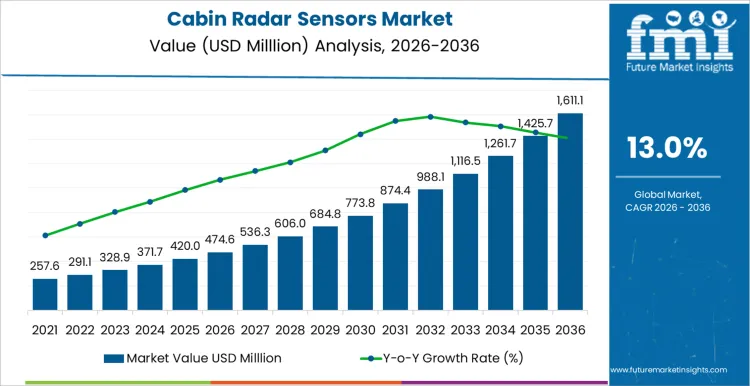
The cabin radar sensors market is forecast to grow from USD 474.6 million in 2026 to USD 1,611.1 million by 2036, expanding at a CAGR of 13%. Dominant players in this market defend their pricing power by leveraging advanced technologies like 4D imaging radar and integrated mmWave chipsets, offering highly precise detection and integration capabilities. These innovations are essential in meeting safety regulations and automakers' evolving demands for occupant monitoring and driver assistance systems. Entry barriers are maintained through complex technology requirements, automotive-grade certifications, and established relationships between OEMs and Tier-1 suppliers. High capital investment and the need for robust testing and compliance further solidify the positions of established companies. Despite these barriers, fragmentation persists as smaller firms focus on niche applications like compact radar modules or specific frequency bands. Over time, the trend toward consolidation may intensify as larger players acquire smaller companies with specialized technologies, narrowing the competitive landscape.
Quick Stats for Cabin Radar Sensors Market
- Cabin Radar Sensors Market Value (2026): USD 474.6 Million
- Cabin Radar Sensors Market Forecast Value (2036): USD 1,611.1 Million
- Cabin Radar Sensors Market Forecast CAGR (2026 to 2036): 13.0%
- Leading Frequency Band in Cabin Radar Sensors Market: 60-64 GHz Radar Sensors (56% share)
- Key Growth Regions in Cabin Radar Sensors Market: Asia Pacific, Europe, North America, Latin America, Middle East & Africa
- Top Key Players in Cabin Radar Sensors Market: Vayyar, Infineon Technologies, NXP Semiconductors, Texas Instruments, Aptiv, Hella (Forvia), Denso, Hyundai Mobis, Smart Radar, Uhnder
Cabin Radar Sensors Market Key Takeaways
| Metric | Value |
|---|---|
| Cabin Radar Sensors Market Value (2026) | USD 474.6 Million |
| Cabin Radar Sensors Market Forecast Value (2036) | USD 1,611.1 Million |
| Cabin Radar Sensors Market Forecast CAGR (2026 to 2036) | 13% |
How Are Safety Regulations and Software-Defined Vehicles Driving the Cabin Radar Sensors Market?
The cabin radar sensors market is expanding as automotive OEMs respond to tightening safety regulations and the shift toward software-defined vehicle architectures. Child presence detection, occupant monitoring, and in-cabin vital-sign sensing are moving from optional features to regulatory and brand-differentiating requirements. Unlike camera-based systems, radar offers reliable performance in low light, through obstructions, and across diverse cabin conditions, making it a preferred sensing modality for continuous in-cabin monitoring. For suppliers, demand is increasingly driven by compliance timelines rather than discretionary feature adoption.
System integration and compute efficiency are shaping purchasing decisions. OEMs and Tier-1s favor compact radar modules that integrate seamlessly with centralized vehicle compute, domain controllers, and sensor fusion stacks. Cabin radar programs are also being mapped to the car OS roadmap to reduce rework during platform refreshes. Suppliers capable of delivering radar hardware paired with validated algorithms such as respiration detection, occupancy classification, and motion sensing are gaining earlier design-in opportunities. Compatibility with over-the-air updates and scalable software licensing models is becoming as important as radar RF performance itself.
Manufacturing scalability and cost control are critical as cabin radar moves into high-volume vehicle segments. Automakers are pushing suppliers to deliver automotive-grade reliability at declining per-unit costs while maintaining multi-region production resilience. This is accelerating standardization around specific frequency bands, antenna architectures, and packaging formats. For radar and semiconductor vendors, competitive advantage increasingly depends on algorithm maturity, platform reuse across vehicle lines, and the ability to support regulatory validation at scale positioning cabin radar sensors as a core safety and intelligence layer in next-generation vehicle interiors.
How is the Cabin Radar Sensors Market Categorized?
The cabin radar sensors market is segmented by frequency and channel, reflecting how sensor range, bandwidth, and vehicle integration influence sensor adoption. By frequency, 60-64 GHz systems dominate the market, offering a balanced combination of range, resolution, and bandwidth ideal for in-cabin applications like occupant detection and monitoring. Other frequency ranges, such as 76-81 GHz, cater to higher-performance needs and longer-range applications. By channel, OEM factory-fit solutions lead adoption, as automakers integrate radar sensors directly into vehicle designs. Aftermarket solutions cater to vehicle upgrades, offering flexibility for post-purchase installations.
Why Does 60-64 GHz Frequency Lead Adoption In The Cabin Radar Sensors Market?
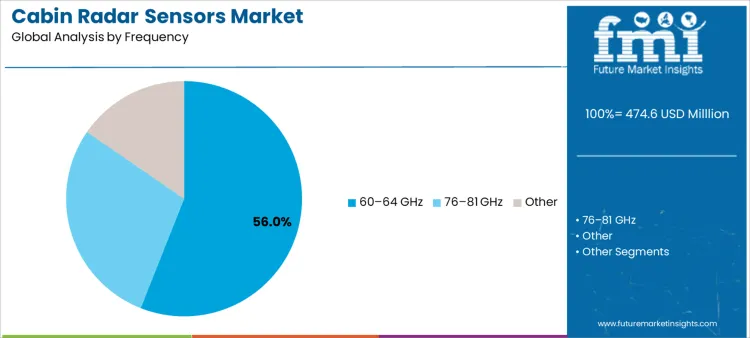
The 60-64 GHz frequency range holds 56% share of the cabin radar sensors market due to its optimal balance between range, resolution, and data processing requirements for in-cabin sensor applications. This frequency range enables accurate detection of occupants, providing essential data for systems like airbag deployment and driver monitoring. The 60-64 GHz systems support robust performance with minimal interference, making them ideal for densely packed vehicle environments. Additionally, 60 GHz sensors are cost-effective and widely supported by automotive safety standards, driving widespread adoption across mainstream vehicle models.
Why Does OEM Factory-Fit Lead Channel Demand In The Cabin Radar Sensors Market?
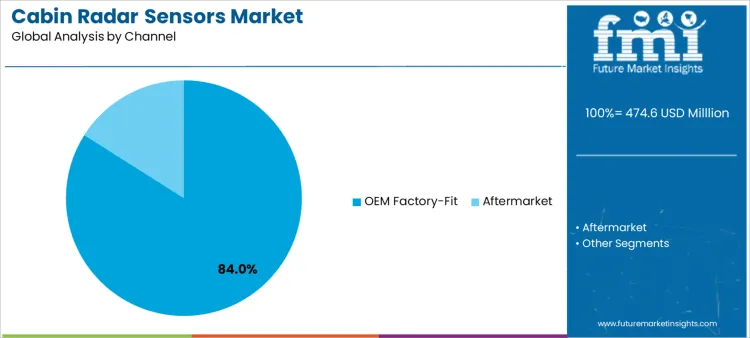
OEM factory-fit solutions account for 84% share of the cabin radar sensors market because automakers integrate radar sensors directly into vehicles during production, ensuring seamless system integration, high reliability, and compliance with safety regulations. Factory-fit systems also optimize space and power consumption, contributing to vehicle design efficiency. As radar sensors are a core component of in-vehicle safety and driver assistance features, automakers prioritize factory integration to ensure standardization, performance consistency, and warranty compliance. The scale, quality control, and long-term service agreements inherent to OEM installations explain their dominance in the channel segment.
What Are The Key Dynamics Of The Cabin Radar Sensors Market?
The cabin radar sensors market is driven by increasing integration of in-vehicle sensing technologies for occupant detection, safety systems, and comfort features in passenger cars, commercial vehicles, and mobility platforms. Cabin radar sensors use radio waves to detect presence, movement, breathing, and posture of occupants, enabling advanced functions such as smart airbag deployment, child presence detection, gesture recognition, and occupant monitoring in automated driving contexts. For sensor manufacturers, Tier-1 suppliers, and module integrators, detection accuracy, resolution, reliability under varied cabin conditions, and seamless integration with vehicle electronic architectures are key performance and procurement factors that influence adoption and system differentiation.
How Are Automotive Trends And Technology Developments Shaping This Market?
Automotive trends and technology developments are reshaping the cabin radar sensors market as vehicles evolve toward higher levels of automation, connected safety systems, and personalized occupant experiences. The growth of advanced driver assistance systems (ADAS), occupant monitoring for hands-on/eyes-off detection, and smart climate control requires precise, non-intrusive sensing inside the passenger compartment. Radar operating at millimeter-wave frequencies (such as 60 GHz and 77 GHz) supports improved object detection and reduced interference from seat materials and environmental noise. Integration with vehicle domain controllers, sensor fusion platforms, and over-the-air software updates enhances system performance over time. When cabin sensing is paired with vehicle-to-everything (V2X) connectivity, security hardening becomes part of the sensor deployment plan. For suppliers, offering compact, low-power radar modules with robust signal processing and standardized interfaces increases compatibility across multiple vehicle platforms.
Why Do Technical, Validation, And Cost Challenges Restrain Market Growth?
Technical, validation, and cost challenges restrain growth in the cabin radar sensors market due to the complexity of deploying reliable sensing solutions in confined and variable interior environments. Cabin layouts vary widely across vehicle models, seat fabrics, occupancy positions, and lighting conditions, requiring adaptive signal processing and calibration strategies. Validating sensor performance for critical safety functions as child or pet detection and smart airbag deployment necessitates extensive real-world testing, compliance documentation, and safety certification, which increases development time and expense for suppliers and OEMs alike. High-frequency hardware components and advanced digital processing add to unit costs, placing pressure on cost-sensitive vehicle segments and slowing broader adoption.
What is The Country-Wise Growth Outlook for the Cabin Radar Sensors Market?
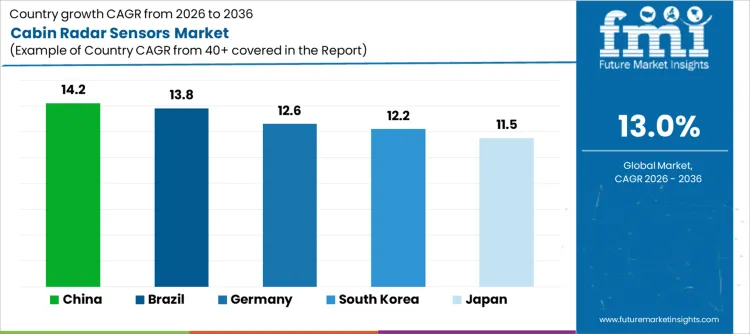
The cabin radar sensors market is expanding as automotive OEMs integrate advanced sensor systems to enhance in-vehicle safety, occupant detection, and driver assistance features. Cabin radar sensors provide real-time monitoring of the cabin environment, detecting objects, monitoring passenger positioning, and improving overall vehicle safety. Growth varies by country depending on the adoption of advanced driver assistance systems (ADAS), vehicle electrification trends, and consumer demand for enhanced cabin safety features. High-growth markets are driven by regulatory requirements and OEM push for more integrated sensor technologies, while mature automotive regions focus on technology upgrades and system optimization.
| Country | CAGR (%) |
|---|---|
| China | 14.2 |
| Brazil | 13.8 |
| Germany | 12.6 |
| South Korea | 12.2 |
| Japan | 11.5 |
Why is China Leading the Cabin Radar Sensors Market?
Demand for cabin radar sensors in China is expanding at a CAGR of 14.2% during 2026 to 2036, driven by the country’s scale advantage in vehicle production and its rapid shift toward intelligent, software-defined vehicle. Chinese OEMs are aggressively integrating cabin radar sensors to support child presence detection, occupant classification, driver monitoring, and gesture recognition across both electric and internal combustion vehicle platforms. Regulatory momentum around occupant safety, combined with rising consumer expectations for smart cockpit features, is accelerating adoption. Cabin radar sensors are increasingly preferred over camera-only systems due to their ability to function reliably in low-light conditions, through obstructions, and under variable seating configurations. OEMs prioritize cost-effective radar modules with stable detection accuracy, low power consumption, and compatibility with centralized vehicle computing platforms.
Why is Brazil Experiencing Rising Adoption of Cabin Radar Sensors?
Sale of cabin radar sensors in Brazil is growing at a CAGR of 13.8% during 2026 to 2036, supported by gradual modernization of vehicle safety features and increasing alignment with global automotive standards. As Brazilian OEMs and international manufacturers expand production of higher-spec passenger vehicles, cabin radar sensors are being adopted for occupant detection, driver monitoring, and basic in-cabin safety functions. Growth is most visible in mid-range and premium vehicles, as well as fleet, ride-hailing, and shared mobility segments. Cabin radar sensors are valued for their robustness and ability to operate reliably under diverse climatic conditions, including high humidity and temperature variation. Buyers prioritize affordability, durability, and ease of integration with existing vehicle electronics architectures. Cost sensitivity remains a key market constraint, encouraging adoption of modular radar systems that can be scaled across multiple vehicle models without extensive redesign.
How is Germany Driving Demand for High-Precision Cabin Radar Sensors?
Germany’s cabin radar sensors market is expanding at a CAGR of 12.6% during 2026 to 2036, driven by the country’s leadership in premium, performance-oriented, and technologically advanced vehicles. German OEMs are deploying high-resolution cabin radar sensors to support sophisticated occupant monitoring, driver distraction detection, and next-generation human machine interface functions. These sensors are increasingly integrated into centralized electronic architectures alongside ADAS and autonomous driving systems. Precision, reliability, and system-level integration are critical selection criteria in the German market. Cabin radar sensors must deliver high detection accuracy, low false positives, and consistent performance across varied seating positions and interior layouts. OEMs also emphasize compliance with strict automotive safety, functional safety, and automated cybersecurity standards. Radar-based solutions are favored for their ability to complement camera and ultrasonic systems, improving redundancy and overall system robustness.
How is South Korea Advancing Cabin Radar Sensor Integration?
South Korea’s cabin radar sensors market is growing at a CAGR of 12.2% during 2026 to 2036, supported by the country’s strong EV manufacturing base and rapid adoption of smart cockpit technologies. South Korean OEMs are integrating cabin radar sensors to enable occupant detection, gesture-based controls, and driver monitoring, particularly in electric and connected vehicle technology. The focus is on enhancing safety, convenience, and digital user experiences. Compact radar modules with high detection sensitivity are preferred to support space-efficient interior designs and modular dashboard layouts. Buyers emphasize seamless integration with centralized vehicle controllers, low latency data processing, and compatibility with advanced software stacks. Strong collaboration between automakers, semiconductor firms, and Tier-1 suppliers accelerates innovation and deployment of next-generation cabin radar solutions.
What Is Driving Cabin Radar Sensor Adoption in Japan?
Japan’s cabin radar sensors market is expanding at a CAGR of 11.5% during 2026 to 2036, driven by a strong emphasis on safety, reliability, and occupant protection. Japanese OEMs are adopting cabin radar sensors primarily to enhance child presence detection, seat occupancy monitoring, and driver alertness systems, particularly in hybrid and compact vehicle segments. Adoption is measured and quality-focused rather than aggressive. Radar sensors are valued for their consistent performance under varying lighting conditions and their ability to operate without infringing on occupant privacy. Buyers prioritize proven reliability, low error rates, and long validation cycles. Integration with conservative yet highly dependable vehicle electronics architectures is a key requirement, reflecting Japan’s focus on durability and lifecycle performance. Procurement decisions favor suppliers with established automotive credentials, precise manufacturing tolerances, and long-term supply stability.
How Are Technology and Tier-1 Suppliers Competing in the Cabin Radar Sensors Market?
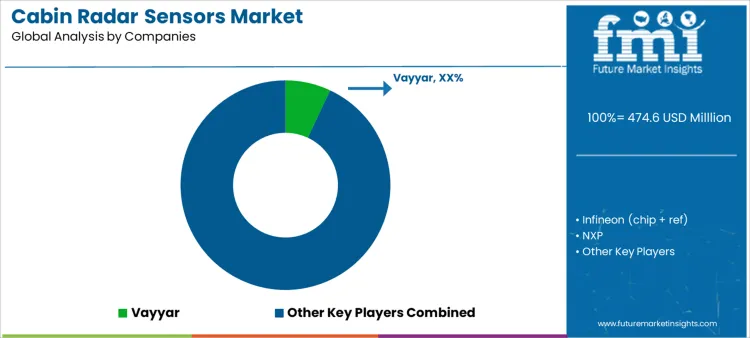
Competition in the cabin radar sensors market is driven by sensing accuracy, software intelligence, and integration readiness with vehicle safety and comfort systems. As regulations and OEM priorities shift toward child presence detection, occupant monitoring, and in-cabin gesture sensing, suppliers are differentiating through radar resolution, AI signal processing, and scalability across vehicle segments. Vayyar leads innovation with high-resolution 4D imaging radar platforms capable of full-cabin coverage from a single sensor. Its positioning emphasizes fine-grained occupant detection, posture classification, and life-sign monitoring without cameras, appealing to OEMs focused on privacy and regulatory compliance.
Semiconductor leaders compete by anchoring radar capability at the chip and reference design level. Infineon, NXP, and Texas Instruments position cabin radar through highly integrated mmWave chipsets paired with automotive-qualified reference designs. Their strategies focus on enabling Tier-1s to accelerate development with validated RF performance, embedded processing, and functional safety readiness. Uhnder differentiates through digital radar architectures that improve resolution and interference resilience, targeting premium cabin sensing use cases.
Tier-1 automotive suppliers strengthen competition through system integration and OEM alignment. Aptiv, Forvia (HELLA), Denso, and Hyundai Mobis integrate cabin radar sensors with airbags, seat systems, HMIs, and central vehicle computers. Their positioning emphasizes robustness, ASIL compliance, and seamless fusion with cameras and other in-cabin sensors. SmartRadar adds niche differentiation with compact radar modules optimized for occupant detection. Across the market, competitive advantage is defined by sensing fidelity, software intelligence, and OEM-ready integration rather than sensor hardware cost alone.
Key Players in Cabin Radar Sensors Market
- Vayyar
- Infineon (chip + ref)
- NXP
- Texas Instruments
- Aptiv
- Hella/Forvia
- Denso
- Hyundai Mobis
- SmartRadar
- Uhnder
Scope of Report
| Attribute | Details |
|---|---|
| Market Size Unit | USD Million |
| Frequency Covered | 60-64 GHz Radar Sensors, 76-81 GHz Radar Sensors, Other In-Cabin Radar Frequencies |
| Channel Covered | OEM Factory-Fit Installation, Aftermarket Integration |
| Countries Covered | China, Japan, South Korea, India, Australia & New Zealand, ASEAN, Rest of Asia Pacific, Germany, United Kingdom, France, Italy, Spain, Nordic, BENELUX, Rest of Europe, United States, Canada, Mexico, Brazil, Chile, Rest of Latin America, Kingdom of Saudi Arabia, Other GCC Countries, Turkey, South Africa, Other African Union, Rest of Middle East & Africa |
| Regions Covered | Asia Pacific, Europe, North America, Latin America, Middle East & Africa |
| Key Companies Profiled | Vayyar, Infineon Technologies, NXP Semiconductors, Texas Instruments, Aptiv, Hella (Forvia), Denso, Hyundai Mobis, SmartRadar, Uhnder |
| Additional Attributes | Dollar sales by frequency band and channel are evaluated across passenger vehicle and commercial vehicle cabins. The scope analyzes child presence detection, occupant monitoring, vital sign sensing, and integration with ADAS and safety systems. Country-level assessment reflects regulatory mandates, OEM safety adoption, and deployment of radar-based in-cabin sensing architectures. |
Cabin Radar Sensors Market by Key Segments
Frequency:
- 60-64 GHz
- 76-81 GHz
- Other
Channel
- OEM Factory‑Fit
- Aftermarket
Region:
- Asia Pacific
- China
- Japan
- South Korea
- India
- Australia & New Zealand
- ASEAN
- Rest of Asia Pacific
- Europe
- Germany
- United Kingdom
- France
- Italy
- Spain
- Nordic
- BENELUX
- Rest of Europe
- North America
- United States
- Canada
- Mexico
- Latin America
- Brazil
- Chile
- Rest of Latin America
- Middle East & Africa
- Kingdom of Saudi Arabia
- Other GCC Countries
- Turkey
- South Africa
- Other African Union
- Rest of Middle East & Africa
Bibliography
- European Commission. (2024). General Safety Regulation (EU) 2019/2144: Requirements for advanced vehicle safety systems. Publications Office of the European Union.
- National Highway Traffic Safety Administration. (2024). Child Presence Detection Technologies: Research Overview and Safety Recommendations. U.S. Department of Transportation.
- IEEE Standards Association. (2024). IEEE 2024 Automotive Radar Signal Processing and Interior Sensing Systems: Technical Report. IEEE.
Frequently Asked Questions
How big is the cabin radar sensors market in 2026?
The global cabin radar sensors market is estimated to be valued at USD 474.6 million in 2026.
What will be the size of cabin radar sensors market in 2036?
The market size for the cabin radar sensors market is projected to reach USD 1,611.1 million by 2036.
How much will be the cabin radar sensors market growth between 2026 and 2036?
The cabin radar sensors market is expected to grow at a 13.0% CAGR between 2026 and 2036.
What are the key product types in the cabin radar sensors market?
The key product types in cabin radar sensors market are 60-64 ghz, 76-81 ghz and other.
Which channel segment to contribute significant share in the cabin radar sensors market in 2026?
In terms of channel, oem factory‑fit segment to command 84.0% share in the cabin radar sensors market in 2026.
Preview the report firsthand - request a free sample
Get SampleGet the brochure for pricing and purchase details.
Get PDFTable of Content
- Executive Summary
- Global Market Outlook
- Demand-side Trends
- Supply-side Trends
- Technology Roadmap Analysis
- Analysis and Recommendations
- Market Overview
- Market Coverage / Taxonomy
- Market Definition / Scope / Limitations
- Market Background
- Market Dynamics
- Drivers
- Restraints
- Opportunity
- Trends
- Scenario Forecast
- Demand in Optimistic Scenario
- Demand in Likely Scenario
- Demand in Conservative Scenario
- Opportunity Map Analysis
- Product Life Cycle Analysis
- Supply Chain Analysis
- Investment Feasibility Matrix
- Value Chain Analysis
- PESTLE and Porter’s Analysis
- Regulatory Landscape
- Regional Parent Market Outlook
- Production and Consumption Statistics
- Import and Export Statistics
- Market Dynamics
- Global Market Analysis 2021 to 2025 and Forecast, 2026 to 2036
- Historical Market Size Value (USD Million) Analysis, 2021 to 2025
- Current and Future Market Size Value (USD Million) Projections, 2026 to 2036
- Y-o-Y Growth Trend Analysis
- Absolute $ Opportunity Analysis
- Global Market Pricing Analysis 2021 to 2025 and Forecast 2026 to 2036
- Global Market Analysis 2021 to 2025 and Forecast 2026 to 2036, By Frequency
- Introduction / Key Findings
- Historical Market Size Value (USD Million) Analysis By Frequency , 2021 to 2025
- Current and Future Market Size Value (USD Million) Analysis and Forecast By Frequency , 2026 to 2036
- 60-64 GHz
- 76-81 GHz
- Other
- 60-64 GHz
- Y-o-Y Growth Trend Analysis By Frequency , 2021 to 2025
- Absolute $ Opportunity Analysis By Frequency , 2026 to 2036
- Global Market Analysis 2021 to 2025 and Forecast 2026 to 2036, By Channel
- Introduction / Key Findings
- Historical Market Size Value (USD Million) Analysis By Channel, 2021 to 2025
- Current and Future Market Size Value (USD Million) Analysis and Forecast By Channel, 2026 to 2036
- OEM Factory‑Fit
- Aftermarket
- OEM Factory‑Fit
- Y-o-Y Growth Trend Analysis By Channel, 2021 to 2025
- Absolute $ Opportunity Analysis By Channel, 2026 to 2036
- Global Market Analysis 2021 to 2025 and Forecast 2026 to 2036, By Region
- Introduction
- Historical Market Size Value (USD Million) Analysis By Region, 2021 to 2025
- Current Market Size Value (USD Million) Analysis and Forecast By Region, 2026 to 2036
- North America
- Latin America
- Western Europe
- Eastern Europe
- East Asia
- South Asia and Pacific
- Middle East & Africa
- Market Attractiveness Analysis By Region
- North America Market Analysis 2021 to 2025 and Forecast 2026 to 2036, By Country
- Historical Market Size Value (USD Million) Trend Analysis By Market Taxonomy, 2021 to 2025
- Market Size Value (USD Million) Forecast By Market Taxonomy, 2026 to 2036
- By Country
- USA
- Canada
- Mexico
- By Frequency
- By Channel
- By Country
- Market Attractiveness Analysis
- By Country
- By Frequency
- By Channel
- Key Takeaways
- Latin America Market Analysis 2021 to 2025 and Forecast 2026 to 2036, By Country
- Historical Market Size Value (USD Million) Trend Analysis By Market Taxonomy, 2021 to 2025
- Market Size Value (USD Million) Forecast By Market Taxonomy, 2026 to 2036
- By Country
- Brazil
- Chile
- Rest of Latin America
- By Frequency
- By Channel
- By Country
- Market Attractiveness Analysis
- By Country
- By Frequency
- By Channel
- Key Takeaways
- Western Europe Market Analysis 2021 to 2025 and Forecast 2026 to 2036, By Country
- Historical Market Size Value (USD Million) Trend Analysis By Market Taxonomy, 2021 to 2025
- Market Size Value (USD Million) Forecast By Market Taxonomy, 2026 to 2036
- By Country
- Germany
- UK
- Italy
- Spain
- France
- Nordic
- BENELUX
- Rest of Western Europe
- By Frequency
- By Channel
- By Country
- Market Attractiveness Analysis
- By Country
- By Frequency
- By Channel
- Key Takeaways
- Eastern Europe Market Analysis 2021 to 2025 and Forecast 2026 to 2036, By Country
- Historical Market Size Value (USD Million) Trend Analysis By Market Taxonomy, 2021 to 2025
- Market Size Value (USD Million) Forecast By Market Taxonomy, 2026 to 2036
- By Country
- Russia
- Poland
- Hungary
- Balkan & Baltic
- Rest of Eastern Europe
- By Frequency
- By Channel
- By Country
- Market Attractiveness Analysis
- By Country
- By Frequency
- By Channel
- Key Takeaways
- East Asia Market Analysis 2021 to 2025 and Forecast 2026 to 2036, By Country
- Historical Market Size Value (USD Million) Trend Analysis By Market Taxonomy, 2021 to 2025
- Market Size Value (USD Million) Forecast By Market Taxonomy, 2026 to 2036
- By Country
- China
- Japan
- South Korea
- By Frequency
- By Channel
- By Country
- Market Attractiveness Analysis
- By Country
- By Frequency
- By Channel
- Key Takeaways
- South Asia and Pacific Market Analysis 2021 to 2025 and Forecast 2026 to 2036, By Country
- Historical Market Size Value (USD Million) Trend Analysis By Market Taxonomy, 2021 to 2025
- Market Size Value (USD Million) Forecast By Market Taxonomy, 2026 to 2036
- By Country
- India
- ASEAN
- Australia & New Zealand
- Rest of South Asia and Pacific
- By Frequency
- By Channel
- By Country
- Market Attractiveness Analysis
- By Country
- By Frequency
- By Channel
- Key Takeaways
- Middle East & Africa Market Analysis 2021 to 2025 and Forecast 2026 to 2036, By Country
- Historical Market Size Value (USD Million) Trend Analysis By Market Taxonomy, 2021 to 2025
- Market Size Value (USD Million) Forecast By Market Taxonomy, 2026 to 2036
- By Country
- Kingdom of Saudi Arabia
- Other GCC Countries
- Turkiye
- South Africa
- Other African Union
- Rest of Middle East & Africa
- By Frequency
- By Channel
- By Country
- Market Attractiveness Analysis
- By Country
- By Frequency
- By Channel
- Key Takeaways
- Key Countries Market Analysis
- USA
- Pricing Analysis
- Market Share Analysis, 2025
- By Frequency
- By Channel
- Canada
- Pricing Analysis
- Market Share Analysis, 2025
- By Frequency
- By Channel
- Mexico
- Pricing Analysis
- Market Share Analysis, 2025
- By Frequency
- By Channel
- Brazil
- Pricing Analysis
- Market Share Analysis, 2025
- By Frequency
- By Channel
- Chile
- Pricing Analysis
- Market Share Analysis, 2025
- By Frequency
- By Channel
- Germany
- Pricing Analysis
- Market Share Analysis, 2025
- By Frequency
- By Channel
- UK
- Pricing Analysis
- Market Share Analysis, 2025
- By Frequency
- By Channel
- Italy
- Pricing Analysis
- Market Share Analysis, 2025
- By Frequency
- By Channel
- Spain
- Pricing Analysis
- Market Share Analysis, 2025
- By Frequency
- By Channel
- France
- Pricing Analysis
- Market Share Analysis, 2025
- By Frequency
- By Channel
- India
- Pricing Analysis
- Market Share Analysis, 2025
- By Frequency
- By Channel
- ASEAN
- Pricing Analysis
- Market Share Analysis, 2025
- By Frequency
- By Channel
- Australia & New Zealand
- Pricing Analysis
- Market Share Analysis, 2025
- By Frequency
- By Channel
- China
- Pricing Analysis
- Market Share Analysis, 2025
- By Frequency
- By Channel
- Japan
- Pricing Analysis
- Market Share Analysis, 2025
- By Frequency
- By Channel
- South Korea
- Pricing Analysis
- Market Share Analysis, 2025
- By Frequency
- By Channel
- Russia
- Pricing Analysis
- Market Share Analysis, 2025
- By Frequency
- By Channel
- Poland
- Pricing Analysis
- Market Share Analysis, 2025
- By Frequency
- By Channel
- Hungary
- Pricing Analysis
- Market Share Analysis, 2025
- By Frequency
- By Channel
- Kingdom of Saudi Arabia
- Pricing Analysis
- Market Share Analysis, 2025
- By Frequency
- By Channel
- Turkiye
- Pricing Analysis
- Market Share Analysis, 2025
- By Frequency
- By Channel
- South Africa
- Pricing Analysis
- Market Share Analysis, 2025
- By Frequency
- By Channel
- USA
- Market Structure Analysis
- Competition Dashboard
- Competition Benchmarking
- Market Share Analysis of Top Players
- By Regional
- By Frequency
- By Channel
- Competition Analysis
- Competition Deep Dive
- Vayyar
- Overview
- Product Portfolio
- Profitability by Market Segments (Product/Age /Sales Channel/Region)
- Sales Footprint
- Strategy Overview
- Marketing Strategy
- Product Strategy
- Channel Strategy
- Infineon (chip + ref)
- NXP
- Texas Instruments
- Aptiv
- Hella/Forvia
- Denso
- Hyundai Mobis
- SmartRadar
- Uhnder
- Vayyar
- Competition Deep Dive
- Assumptions & Acronyms Used
- Research Methodology


