

- Industry Size (2026):
- USD 5.0 Bn
- Forecast (2036)
- USD 9.2 Bn
- CAGR (2026 to 2036)
- 6.3%
Cabinetry Tools Market Forecast and Outlook 2026 to 2036
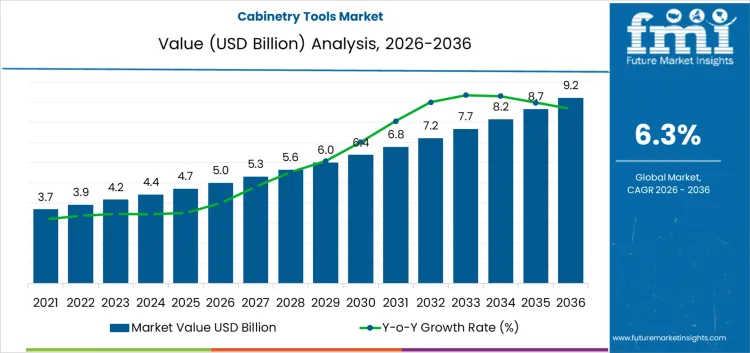
The cabinetry tools market expands from USD 5.0 billion in 2026 to USD 9.2 billion by 2036, representing a CAGR of 6.3%. Demand is anchored in professional workshops, modular furniture factories, and renovation contractors, where throughput, accuracy, and repeatability determine tool choice. Activity concentrates in regions with dense housing renovation cycles and organized furniture manufacturing, notably East Asia, Western Europe, and North America. Adoption remains uneven because small shops in many markets continue to rely on manual or mixed tool sets. Geographic cost advantages cluster around countries with mature motor, blade, and precision component supply chains, which shapes pricing and availability.
Workflow design and job mix, rather than headline tool features, guide purchasing decisions. Shops invest first in equipment that removes bottlenecks in cutting, edging, and drilling sequences, then expand into secondary operations. Once a process layout is set, tool families are standardized to control training, spares, and calibration routines. Financing access and distributor service coverage influence upgrade timing more than catalog specifications. The market grows through higher shop productivity targets and renovation driven workloads, not through uniform replacement of existing tools across all woodworking and furniture operations.
Quick Stats for Cabinetry Tools Market
- Cabinetry Tools Market Value (2026): USD 5.0 billion
- Cabinetry Tools Market Forecast Value (2036): USD 9.2 billion
- Cabinetry Tools Market Forecast CAGR 2026 to 2036: 6.3%
- Leading Type in Cabinetry Tools Market: Hand tools
- Key Growth Regions in Cabinetry Tools Market: Asia Pacific, North America, Europe
- Top Players in Cabinetry Tools Market: Bosch, DeWalt (Stanley Black & Decker), Makita, Festool, Hitachi (Metabo HPT), Milwaukee Tool (Techtronic Industries), Rockler Companies
What is the Growth Forecast for Cabinetry Tools Market through 2036?
The cabinetry tools market grows in step with renovation cycles and small workshop activity rather than with large industrial capex waves. At around USD 3.2 billion, the category is still heavily influenced by local carpentry shops, interior fit-out contractors, and do-it-yourself segments, then moves to roughly USD 3.6 billion and USD 4.1 billion as housing renovation and commercial interior refresh cycles pick up. When the market reaches about USD 5.0 billion, tools such as routers, edge banders, panel saws, and finishing equipment are no longer purchased only for capacity expansion but increasingly for workflow efficiency and precision improvement. Growth in this phase is driven by higher job volumes, tighter tolerances, and rising expectations for finish quality rather than by a jump in the number of workshops.
As activity levels and tool density per shop increase, the market advances through approximately USD 5.7 billion, USD 6.5 billion, and then around USD 7.4 billion, supported by repeat purchases, upgrades, and specialization of toolsets. By the time spending passes roughly USD 7.9 billion and moves into the USD 8.4 to 8.7 billion range, replacement demand and incremental automation features start to contribute as much as first-time purchases. Approaching about USD 9.2 billion, value growth comes mainly from higher spend per workshop and from broader adoption of semi-automated and precision tools, not from a surge in the number of cabinetry businesses. The market remains fragmented and practice-driven, with buying decisions shaped by reliability, accuracy, and service support more than by brand scale alone.
Cabinetry Tools Market Key Takeaways
| Metric | Value |
|---|---|
| Market Value (2026) | USD 5.0 billion |
| Forecast Value (2036) | USD 9.2 billion |
| Forecast CAGR 2026 to 2036 | 6.3% |
How Is the Cabinetry Tools Market Supporting Precision and Efficiency in Woodworking?
Precision and efficiency in cabinetry production have become critical as consumer demand for quality furniture and modular installations rises. Cabinetry tools are increasingly used to achieve accurate cutting, joining, and finishing in residential, commercial, and custom woodworking. Traditional hand tools limited speed and consistency, whereas modern power-driven saws, routers, drilling systems, and jigs enhance workflow, reduce errors, and improve product quality. Cabinet manufacturers, woodworking shops, and custom furniture producers prioritize tool durability, ergonomics, and compatibility with varied materials. Early adoption focused on high-end furniture and industrial cabinet production, while current demand spans residential kitchens, office furniture, and modular interiors. Accuracy, ease of operation, and durability influence supplier selection.
Efficiency, product consistency, and reduced labor costs are central drivers in the market. Compared with conventional hand tools, modern cabinetry equipment emphasizes precise performance, repeatable results, and adaptability to complex designs. Cost structures depend on motor quality, materials, and manufacturing tolerances, concentrating margins among suppliers capable of delivering reliable, high-performance solutions. Woodworking businesses adopt these tools to streamline production, minimize errors, and ensure uniform cabinet quality. By 2036, advanced cabinetry tools are expected to be widely adopted across residential, commercial, and custom woodworking applications, supporting precise fabrication, workflow optimization, and durable furniture production.
What Factors Are Shaping the Demand for Cabinetry Tools Market, Segment wise by Tool Type and End Use Industry, in 2026?
The Cabinetry Tools Market in 2026 is segmented by tool type and by end use industry. By tool category, demand in the Cabinetry Tools Market is divided into hand tools, power tools, measuring and layout tools, and finishing and sanding tools, each supporting different stages of cabinet fabrication, fitting, and installation. By end use, demand in the Cabinetry Tools Market is organized around residential cabinetry, commercial cabinetry, furniture manufacturing, and contractor and professional workshops, which differ in production scale, customization intensity, and workflow structure. These segments show how purchasing decisions in the Cabinetry Tools Market are shaped by the need to balance precision, productivity, and cost across both workshop and site based operations.
Why Do Hand Tools Continue to Anchor Volumes in the Cabinetry Tools Market?
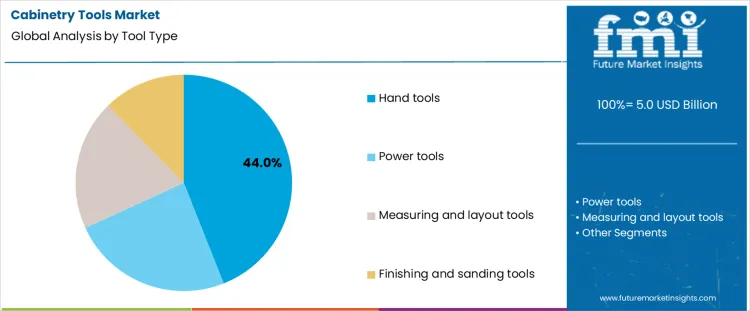
Hand tools account for about 44% of demand in the Cabinetry Tools Market in 2026 because hand tools are required at every stage of cabinetry work, from alignment and fitting to installation and finishing. Even in workshops that rely heavily on machinery, many tasks still depend on manual adjustment and fastening. Hand tools in the Cabinetry Tools Market are relatively low cost, durable, and purchased in multiple sets for different crews. Replacement demand in the Cabinetry Tools Market is steady because these tools are used daily and experience regular wear. Their universal role across job types and materials keeps hand tools as the largest category by unit volume in the Cabinetry Tools Market.
Power tools, measuring tools, and finishing equipment in the Cabinetry Tools Market serve more specialized roles. Power tools raise productivity, but each workshop needs only a limited number of units. Measuring and layout tools are essential for accuracy, yet they are replaced infrequently. Finishing and sanding tools are concentrated in specific stages of work rather than used continuously across all tasks. These categories are critical for workflow quality, but their purchasing patterns do not generate the same broad and continuous volume as hand tools in the Cabinetry Tools Market.
Why Does Residential Cabinetry Lead End Use Demand in the Cabinetry Tools Market?
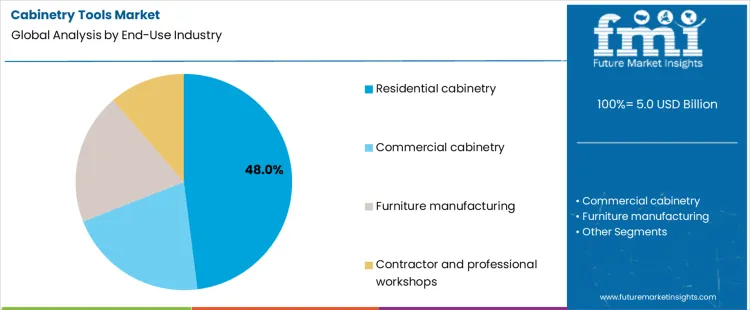
Residential cabinetry represents about 48% of demand in the Cabinetry Tools Market in 2026 because housing construction and renovation generate a steady flow of small and mid-sized cabinet projects. Each residential project involves on site fitting, adjustment, and installation, which increases tool usage intensity. The residential segment of the Cabinetry Tools Market is also highly fragmented, with many small workshops and independent contractors, each maintaining separate tool inventories. This fragmentation multiplies the number of active tool sets in use. The combination of steady renovation activity and a large base of small operators explains why residential cabinetry absorbs the largest share of demand in the Cabinetry Tools Market.
Commercial cabinetry, furniture manufacturing, and professional workshops in the Cabinetry Tools Market follow different purchasing cycles. Commercial projects are more episodic and tied to investment schedules. Furniture manufacturing relies more on fixed machinery and fewer portable tools. Professional workshops concentrate production in fewer locations. These segments invest in higher value equipment, but the number of active users is smaller. As a result, residential cabinetry remains the primary driver of unit demand in the Cabinetry Tools Market.
How Are the Key Dynamics Reshaping the Cabinetry Tools Market?
The category is being shaped by workflow efficiency pressure, cautious upgrade behavior, and the gradual move toward standardized tool platforms. Workshops and small manufacturers want faster, more repeatable output, but capital spending is disciplined and often waits for clear payback. At the same time, many shops are reducing the number of tool brands and interfaces to simplify training, spares, and maintenance. This creates a market where growth comes less from one off tool purchases and more from being specified into shop standards and production cells. Scale follows shop expansion, contractor networks, and platform adoption rather than impulsive replacement of functioning equipment.
Why Is Productivity Pressure Driving Cabinetry Tool Demand?
Demand is anchored in how quickly and consistently shops can turn designs into finished cabinets. Shorter lead times, smaller batch sizes, and higher customization increase the value of accurate cutting, drilling, edging, and fastening tools. Tools that reduce setup time and rework directly increase daily throughput and protect margins. In contract manufacturing and modular furniture, repeatability matters as much as speed. Once a shop standardizes a process, the chosen tools become part of that workflow and are replicated across stations. Volume then follows shop capacity growth and network expansion rather than seasonal furniture demand or retail cycles.
What Is Slowing Wider Tool Upgrades?
The main barrier is capital discipline and disruption risk. Many workshops operate with tight cash flow and prefer to extend the life of existing tools that already meet quality needs. Introducing new tools often requires retraining, layout changes, and process requalification, which can interrupt production. Payback is sometimes hard to quantify when gains are incremental rather than transformative. In smaller shops, versatility is valued over specialization, which reduces appetite for dedicated equipment. These factors keep upgrade cycles long and concentrate new purchases in new shops, expansions, or major process changes rather than routine replacements.
How Are Tool Platforms Changing Procurement?
The trend is toward platform standardization. Larger workshops and chains increasingly choose a small set of tool brands and systems that share accessories, consumables, and interfaces. This simplifies training, inventory, and maintenance and reduces downtime. Once a platform is chosen, additional tools are added from the same ecosystem rather than evaluated independently. Suppliers that offer broad, compatible ranges benefit from repeat purchases. Procurement shifts from individual tool deals to framework relationships. Over time, success depends less on selling a single standout tool and more on being embedded in the standard toolkit used across many workstations and sites.
What is the Demand for Cabinetry Tools by Country?
| Country | CAGR (%) |
|---|---|
| USA | 5.8% |
| UK | 5.5% |
| China | 6.5% |
| India | 6.8% |
| Brazil | 5.9% |
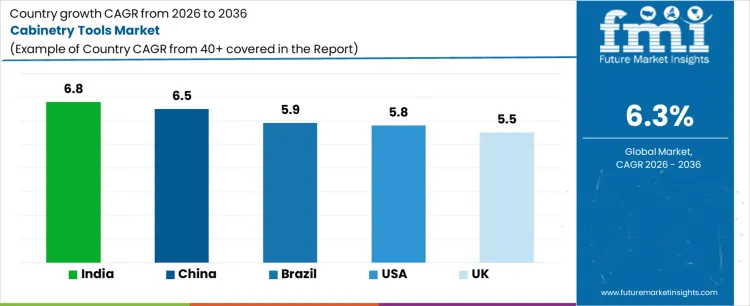
Demand for cabinetry tools is rising as furniture manufacturers, workshops, and construction businesses adopt high-performance tools to improve precision, efficiency, and assembly quality. India leads with a 6.8% CAGR, driven by growing furniture production, rising construction activity, and increased adoption of advanced cabinetry tools. China follows at 6.5%, supported by large-scale manufacturing operations and expansion of the furniture and interior design sectors. Brazil records 5.9% growth, shaped by demand from commercial and residential woodworking projects. The USA grows at 5.8%, influenced by replacement demand and integration of precision tools in carpentry and cabinetry. The UK shows 5.5% CAGR, reflecting steady adoption across furniture manufacturing and home improvement applications.
How is the United States experiencing growth in the cabinetry tools market?
United States is experiencing growth at a CAGR of 5.8%, driven by steady demand in residential and commercial woodworking across states such as California, Texas, and Florida. Installed base size and predictable replacement cycles in cabinet manufacturing and renovation projects support recurring demand. Industry concentration among home improvement chains, professional carpentry services, and custom cabinetry shops anchors adoption. Investments focus on precision, durability, and compatibility with automated and manual woodworking systems. Growth reflects ongoing residential construction, remodeling projects, and rising interest in quality cabinetry solutions.
- Residential and commercial woodworking drives adoption.
- Urban and suburban renovation hubs concentrate demand.
- Precision and durability guide investment.
- Replacement cycles support recurring demand.
How is the United Kingdom witnessing growth in the cabinetry tools market?
United Kingdom is witnessing growth at a CAGR of 5.5%, supported by labor cost structure and productivity pressures in professional carpentry and home renovation projects in London, Birmingham, and Manchester. Market concentration is moderate, with demand spread across small workshops and large home improvement chains. Investments prioritize ergonomics, tool longevity, and compatibility with UK-standard equipment. Growth reflects efficiency needs in skilled labor, adoption of modern woodworking techniques, and consistent demand from residential and commercial projects.
- Professional carpentry and home renovation drive adoption.
- Urban workshops and home improvement chains concentrate demand.
- Tool longevity and ergonomics guide investment.
- Labor productivity pressures influence adoption.
How is China experiencing growth in the cabinetry tools market?
China is experiencing growth at a CAGR of 6.5%, fueled by industrial manufacturing clusters in Guangdong, Jiangsu, and Zhejiang where large-scale cabinet production and furniture assembly require precision tools. Market concentration is high, with demand focused in manufacturing hubs. Investments focus on high-throughput, durable tools capable of supporting mass production. Growth reflects rapid expansion of residential construction, urbanization-driven furniture demand, and the adoption of automated woodworking solutions.
- Industrial manufacturing and furniture production drive adoption.
- Urban manufacturing hubs concentrate demand.
- High-throughput and durable tools guide investment.
- Automation adoption accelerates growth.
How is India witnessing growth in the cabinetry tools market?
India is experiencing growth at a CAGR of 6.8%, supported by expanding urban housing and custom furniture production in Mumbai, Delhi, and Bengaluru. Installed base size and replacement cycles support demand for both manual and semi-automated cabinetry tools. Industry concentration exists in urban carpentry hubs and furniture workshops. Investments focus on affordable, durable tools suitable for high-volume production and residential projects. Growth reflects rising construction activity, expanding middle-class home furnishing needs, and the growing influence of modular and custom cabinetry.
- Urban housing and furniture production drive adoption.
- Carpentry hubs concentrate demand.
- Durable and affordable tools guide investment.
- Replacement cycles support recurring demand.
How is Brazil experiencing growth in the cabinetry tools market?
Brazil is experiencing growth at a CAGR of 5.9%, driven by residential construction, commercial fit-outs, and custom furniture projects in São Paulo, Rio de Janeiro, and Paraná. Market concentration exists in urban construction and furniture workshops. Investments focus on reliability, ergonomics, and tools compatible with regional woodworking standards. Growth reflects consistent construction activity, increased remodeling projects, and adoption of precision cabinetry tools to improve productivity and finish quality.
- Residential and commercial projects drive adoption.
- Urban construction and furniture workshops concentrate demand.
- Reliability and ergonomics guide investment.
- Precision and finish quality support adoption.
How Leading Brands Are Shaping the Cabinetry Tools Market Through Performance and Precision?
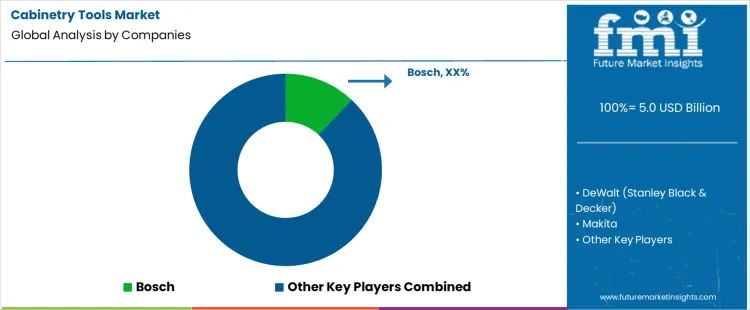
Industry professionals select cabinetry tools based on cutting accuracy, durability, and ergonomic design. Bosch develops saws, routers, and accessories engineered for consistent performance and reduced vibration, supporting fine joinery and repeatable cuts. DeWalt (Stanley Black & Decker) supplies tools with robust construction intended to withstand jobsite wear while delivering precise control for cabinetry assembly. Makita’s lineup emphasizes balance and power delivery to handle dense hardwoods and detailed work. Festool focuses on dust extraction integration and precision guides that appeal to finish carpenters and custom cabinet shops. Hitachi (Metabo HPT) offers a range of tools with reliable motor performance and compact form factors that support accessibility in tight spaces. Milwaukee Tool (Techtronic Industries) delivers products designed for heavy use with packable power and accessory ecosystems. Rockler Companies provides specialty jigs and guides that aid layout, drilling, and edge treatments specific to cabinetry fabrication.
Manufacturers differentiate through system compatibility, accessory breadth, and service support that enhances workflow efficiency. Tool performance is frequently benchmarked on cut quality, run time, and ease of adjustment without sacrificing reliability. Bosch supports modular storage and measurement systems that align with professional jobsite organization. DeWalt and Milwaukee Tool emphasize battery ecosystem compatibility, enabling cross tool power sharing. Makita introduces brushless motor designs to extend runtime and reduce maintenance demand. Festool continues to integrate guide rails and extraction ports that align with dust free environments preferred in indoor workshops. Metabo HPT develops tools tuned for repetitive sawing and routing cycles. Rockler contributes workholding fixtures and alignment aids that complement power tools, aiding repeatable joinery. Regional and specialist suppliers also contribute bespoke accessories and replacement parts that maintain precision over tool lifecycles. Competitive positioning centers on reliability under prolonged use, precision under varied material conditions, and support networks that include parts availability and technical guidance for cabinetry professionals.
Key Players in the Cabinetry Tools Market
- Bosch
- DeWalt (Stanley Black & Decker)
- Makita
- Festool
- Hitachi (Metabo HPT)
- Milwaukee Tool (Techtronic Industries)
- Rockler Companies
Scope of the Report
| Items | Values |
|---|---|
| Quantitative Units (2026) | USD billion |
| Tool Type | Hand tools, Power tools, Measuring and layout tools, Finishing and sanding tools |
| End-Use Industry | Residential cabinetry, Commercial cabinetry, Furniture manufacturing, Contractor and professional workshops |
| Regions Covered | Asia Pacific, Europe, North America, Latin America, Middle East & Africa |
| Countries Covered | China, Japan, South Korea, India, Australia & New Zealand, ASEAN, Germany, United Kingdom, France, Italy, Spain, Nordic, BENELUX, United States, Canada, Mexico, Brazil, Chile, Saudi Arabia, Turkey, South Africa, and other regional markets |
| Key Companies Profiled | Bosch, DeWalt (Stanley Black & Decker), Makita, Festool, Hitachi (Metabo HPT), Milwaukee Tool (Techtronic Industries), Rockler Companies |
| Additional Attributes | Dollar sales by tool type and end use; hand tools and residential cabinetry as leading segments; demand driven by renovation cycles, workshop productivity targets, and accuracy requirements; growth supported by repeat purchases and workflow upgrades; supplier selection based on reliability, precision, ergonomics, and distributor service coverage. |
Cabinetry Tools Market Segmentation
Tool Type:
- Hand tools
- Power tools
- Measuring and layout tools
- Finishing and sanding tools
End-Use Industry:
- Residential cabinetry
- Commercial cabinetry
- Furniture manufacturing
- Contractor and professional workshops
Region:
- Asia Pacific
- China
- Japan
- South Korea
- India
- Australia & New Zealand
- ASEAN
- Rest of Asia Pacific
- Europe
- Germany
- United Kingdom
- France
- Italy
- Spain
- Nordic
- BENELUX
- Rest of Europe
- North America
- United States
- Canada
- Mexico
- Latin America
- Brazil
- Chile
- Rest of Latin America
- Middle East & Africa
- Kingdom of Saudi Arabia
- Other GCC Countries
- Turkey
- South Africa
- Other African Union
- Rest of Middle East & Africa
Bibliography
- International Organization for Standardization. (2024). ISO 19085-9: Woodworking machines — Safety — Part 9: Circular saw benches (with and without sliding table). ISO.
- United States Census Bureau. (2024). Construction spending: Monthly estimates of total construction put in place (seasonally adjusted annual rate). U.S. Department of Commerce.
- European Committee for Standardization. (2024). EN ISO 19085-10: Woodworking machines — Safety — Part 10: Machining centres. CEN.
- Occupational Safety and Health Administration. (2025). Woodworking standards and machine guarding requirements. U.S. Department of Labor.
Frequently Asked Questions
How big is the cabinetry tools market in 2026?
The global cabinetry tools market is estimated to be valued at USD 5.0 billion in 2026.
What will be the size of cabinetry tools market in 2036?
The market size for the cabinetry tools market is projected to reach USD 9.2 billion by 2036.
How much will be the cabinetry tools market growth between 2026 and 2036?
The cabinetry tools market is expected to grow at a 6.3% CAGR between 2026 and 2036.
What are the key product types in the cabinetry tools market?
The key product types in cabinetry tools market are hand tools, power tools, measuring and layout tools and finishing and sanding tools.
Which end‑use industry segment to contribute significant share in the cabinetry tools market in 2026?
In terms of end‑use industry, residential cabinetry segment to command 48.0% share in the cabinetry tools market in 2026.
Preview the report firsthand - request a free sample
Get SampleGet the brochure for pricing and purchase details.
Get PDFTable of Content
- Executive Summary
- Global Market Outlook
- Demand-side Trends
- Supply-side Trends
- Technology Roadmap Analysis
- Analysis and Recommendations
- Market Overview
- Market Coverage / Taxonomy
- Market Definition / Scope / Limitations
- Market Background
- Market Dynamics
- Drivers
- Restraints
- Opportunity
- Trends
- Scenario Forecast
- Demand in Optimistic Scenario
- Demand in Likely Scenario
- Demand in Conservative Scenario
- Opportunity Map Analysis
- Product Life Cycle Analysis
- Supply Chain Analysis
- Investment Feasibility Matrix
- Value Chain Analysis
- PESTLE and Porter’s Analysis
- Regulatory Landscape
- Regional Parent Market Outlook
- Production and Consumption Statistics
- Import and Export Statistics
- Market Dynamics
- Global Market Analysis 2021 to 2025 and Forecast, 2026 to 2036
- Historical Market Size Value (USD Million) Analysis, 2021 to 2025
- Current and Future Market Size Value (USD Million) Projections, 2026 to 2036
- Y-o-Y Growth Trend Analysis
- Absolute $ Opportunity Analysis
- Global Market Pricing Analysis 2021 to 2025 and Forecast 2026 to 2036
- Global Market Analysis 2021 to 2025 and Forecast 2026 to 2036, By Tool Type
- Introduction / Key Findings
- Historical Market Size Value (USD Million) Analysis By Tool Type, 2021 to 2025
- Current and Future Market Size Value (USD Million) Analysis and Forecast By Tool Type, 2026 to 2036
- Hand tools
- Power tools
- Measuring and layout tools
- Finishing and sanding tools
- Hand tools
- Y-o-Y Growth Trend Analysis By Tool Type, 2021 to 2025
- Absolute $ Opportunity Analysis By Tool Type, 2026 to 2036
- Global Market Analysis 2021 to 2025 and Forecast 2026 to 2036, By End‑Use Industry
- Introduction / Key Findings
- Historical Market Size Value (USD Million) Analysis By End‑Use Industry, 2021 to 2025
- Current and Future Market Size Value (USD Million) Analysis and Forecast By End‑Use Industry, 2026 to 2036
- Residential cabinetry
- Commercial cabinetry
- Furniture manufacturing
- Contractor and professional workshops
- Residential cabinetry
- Y-o-Y Growth Trend Analysis By End‑Use Industry, 2021 to 2025
- Absolute $ Opportunity Analysis By End‑Use Industry, 2026 to 2036
- Global Market Analysis 2021 to 2025 and Forecast 2026 to 2036, By Region
- Introduction
- Historical Market Size Value (USD Million) Analysis By Region, 2021 to 2025
- Current Market Size Value (USD Million) Analysis and Forecast By Region, 2026 to 2036
- North America
- Latin America
- Western Europe
- Eastern Europe
- East Asia
- South Asia and Pacific
- Middle East & Africa
- Market Attractiveness Analysis By Region
- North America Market Analysis 2021 to 2025 and Forecast 2026 to 2036, By Country
- Historical Market Size Value (USD Million) Trend Analysis By Market Taxonomy, 2021 to 2025
- Market Size Value (USD Million) Forecast By Market Taxonomy, 2026 to 2036
- By Country
- USA
- Canada
- Mexico
- By Tool Type
- By End‑Use Industry
- By Country
- Market Attractiveness Analysis
- By Country
- By Tool Type
- By End‑Use Industry
- Key Takeaways
- Latin America Market Analysis 2021 to 2025 and Forecast 2026 to 2036, By Country
- Historical Market Size Value (USD Million) Trend Analysis By Market Taxonomy, 2021 to 2025
- Market Size Value (USD Million) Forecast By Market Taxonomy, 2026 to 2036
- By Country
- Brazil
- Chile
- Rest of Latin America
- By Tool Type
- By End‑Use Industry
- By Country
- Market Attractiveness Analysis
- By Country
- By Tool Type
- By End‑Use Industry
- Key Takeaways
- Western Europe Market Analysis 2021 to 2025 and Forecast 2026 to 2036, By Country
- Historical Market Size Value (USD Million) Trend Analysis By Market Taxonomy, 2021 to 2025
- Market Size Value (USD Million) Forecast By Market Taxonomy, 2026 to 2036
- By Country
- Germany
- UK
- Italy
- Spain
- France
- Nordic
- BENELUX
- Rest of Western Europe
- By Tool Type
- By End‑Use Industry
- By Country
- Market Attractiveness Analysis
- By Country
- By Tool Type
- By End‑Use Industry
- Key Takeaways
- Eastern Europe Market Analysis 2021 to 2025 and Forecast 2026 to 2036, By Country
- Historical Market Size Value (USD Million) Trend Analysis By Market Taxonomy, 2021 to 2025
- Market Size Value (USD Million) Forecast By Market Taxonomy, 2026 to 2036
- By Country
- Russia
- Poland
- Hungary
- Balkan & Baltic
- Rest of Eastern Europe
- By Tool Type
- By End‑Use Industry
- By Country
- Market Attractiveness Analysis
- By Country
- By Tool Type
- By End‑Use Industry
- Key Takeaways
- East Asia Market Analysis 2021 to 2025 and Forecast 2026 to 2036, By Country
- Historical Market Size Value (USD Million) Trend Analysis By Market Taxonomy, 2021 to 2025
- Market Size Value (USD Million) Forecast By Market Taxonomy, 2026 to 2036
- By Country
- China
- Japan
- South Korea
- By Tool Type
- By End‑Use Industry
- By Country
- Market Attractiveness Analysis
- By Country
- By Tool Type
- By End‑Use Industry
- Key Takeaways
- South Asia and Pacific Market Analysis 2021 to 2025 and Forecast 2026 to 2036, By Country
- Historical Market Size Value (USD Million) Trend Analysis By Market Taxonomy, 2021 to 2025
- Market Size Value (USD Million) Forecast By Market Taxonomy, 2026 to 2036
- By Country
- India
- ASEAN
- Australia & New Zealand
- Rest of South Asia and Pacific
- By Tool Type
- By End‑Use Industry
- By Country
- Market Attractiveness Analysis
- By Country
- By Tool Type
- By End‑Use Industry
- Key Takeaways
- Middle East & Africa Market Analysis 2021 to 2025 and Forecast 2026 to 2036, By Country
- Historical Market Size Value (USD Million) Trend Analysis By Market Taxonomy, 2021 to 2025
- Market Size Value (USD Million) Forecast By Market Taxonomy, 2026 to 2036
- By Country
- Kingdom of Saudi Arabia
- Other GCC Countries
- Turkiye
- South Africa
- Other African Union
- Rest of Middle East & Africa
- By Tool Type
- By End‑Use Industry
- By Country
- Market Attractiveness Analysis
- By Country
- By Tool Type
- By End‑Use Industry
- Key Takeaways
- Key Countries Market Analysis
- USA
- Pricing Analysis
- Market Share Analysis, 2025
- By Tool Type
- By End‑Use Industry
- Canada
- Pricing Analysis
- Market Share Analysis, 2025
- By Tool Type
- By End‑Use Industry
- Mexico
- Pricing Analysis
- Market Share Analysis, 2025
- By Tool Type
- By End‑Use Industry
- Brazil
- Pricing Analysis
- Market Share Analysis, 2025
- By Tool Type
- By End‑Use Industry
- Chile
- Pricing Analysis
- Market Share Analysis, 2025
- By Tool Type
- By End‑Use Industry
- Germany
- Pricing Analysis
- Market Share Analysis, 2025
- By Tool Type
- By End‑Use Industry
- UK
- Pricing Analysis
- Market Share Analysis, 2025
- By Tool Type
- By End‑Use Industry
- Italy
- Pricing Analysis
- Market Share Analysis, 2025
- By Tool Type
- By End‑Use Industry
- Spain
- Pricing Analysis
- Market Share Analysis, 2025
- By Tool Type
- By End‑Use Industry
- France
- Pricing Analysis
- Market Share Analysis, 2025
- By Tool Type
- By End‑Use Industry
- India
- Pricing Analysis
- Market Share Analysis, 2025
- By Tool Type
- By End‑Use Industry
- ASEAN
- Pricing Analysis
- Market Share Analysis, 2025
- By Tool Type
- By End‑Use Industry
- Australia & New Zealand
- Pricing Analysis
- Market Share Analysis, 2025
- By Tool Type
- By End‑Use Industry
- China
- Pricing Analysis
- Market Share Analysis, 2025
- By Tool Type
- By End‑Use Industry
- Japan
- Pricing Analysis
- Market Share Analysis, 2025
- By Tool Type
- By End‑Use Industry
- South Korea
- Pricing Analysis
- Market Share Analysis, 2025
- By Tool Type
- By End‑Use Industry
- Russia
- Pricing Analysis
- Market Share Analysis, 2025
- By Tool Type
- By End‑Use Industry
- Poland
- Pricing Analysis
- Market Share Analysis, 2025
- By Tool Type
- By End‑Use Industry
- Hungary
- Pricing Analysis
- Market Share Analysis, 2025
- By Tool Type
- By End‑Use Industry
- Kingdom of Saudi Arabia
- Pricing Analysis
- Market Share Analysis, 2025
- By Tool Type
- By End‑Use Industry
- Turkiye
- Pricing Analysis
- Market Share Analysis, 2025
- By Tool Type
- By End‑Use Industry
- South Africa
- Pricing Analysis
- Market Share Analysis, 2025
- By Tool Type
- By End‑Use Industry
- USA
- Market Structure Analysis
- Competition Dashboard
- Competition Benchmarking
- Market Share Analysis of Top Players
- By Regional
- By Tool Type
- By End‑Use Industry
- Competition Analysis
- Competition Deep Dive
- Bosch
- Overview
- Product Portfolio
- Profitability by Market Segments (Product/Age /Sales Channel/Region)
- Sales Footprint
- Strategy Overview
- Marketing Strategy
- Product Strategy
- Channel Strategy
- DeWalt (Stanley Black & Decker)
- Makita
- Festool
- Hitachi (Metabo HPT)
- Milwaukee Tool (Techtronic Industries)
- Rockler Companies
- Bosch
- Competition Deep Dive
- Assumptions & Acronyms Used
- Research Methodology


