

- Industry Size (2026)
- USD 2.4 Bn
- Forecast (2036)
- USD 6.8 Bn
- CAGR (2026 to 2036)
- 11.0%
In Cabin Monitoring Systems Market Size, Market Forecast and Outlook By FMI
In 2025, the in cabin monitoring systems market stood at USD 2.1 billion. The market is forecast to reach USD 2.4 billion in 2026 and expand to USD 6.8 billion by 2036. It is projected to register an 11.0% CAGR over the forecast period. Growth is linked with increasing focus on driver safety and occupant awareness across modern vehicles.
Automakers are integrating camera based monitoring units that analyze driver attention, eye movement, and head position. These technologies support early detection of fatigue, distraction, and unsafe behavior during driving. Governments across several regions are introducing regulations that require driver monitoring features in new vehicles. Safety assessment programs are incorporating driver monitoring as part of their evaluation criteria. Automotive manufacturers are responding by installing in cabin monitoring systems in passenger vehicles and premium segments. Expansion of advanced driver assistance systems is strengthening demand for intelligent cabin sensing solutions that assist drivers and reduce accident risk.
Another factor supporting market expansion is the rapid rise of electric and autonomous vehicle technologies. Electric vehicle manufacturers are investing heavily in digital cockpit environments that rely on cameras and sensors to understand occupant behavior. In cabin monitoring systems assist vehicle software in managing driver engagement when automated driving features are activated. These systems determine whether drivers are ready to take control during partial automation scenarios. Autonomous vehicle development programs are increasing reliance on interior sensing technologies to monitor passenger posture, seat occupancy, and seatbelt usage. Automotive suppliers are introducing AI enabled algorithms that analyze facial recognition, gesture control, and emotion detection to enhance human vehicle interaction.
Demand for personalized in vehicle experiences is strengthening the role of cabin sensing technologies. Automakers are deploying monitoring systems that adjust infotainment preferences, climate settings, and seating positions based on driver identification. Passenger safety applications such as child presence detection and seat occupancy monitoring are gaining strong attention. Ride sharing and mobility service providers are exploring cabin monitoring tools that track passenger behavior and improve fleet safety management. Increasing adoption of connected vehicle platforms is enabling real time data processing from interior sensors. As automotive interiors evolve into smart digital environments, in cabin monitoring systems are becoming essential components of modern vehicle architecture.
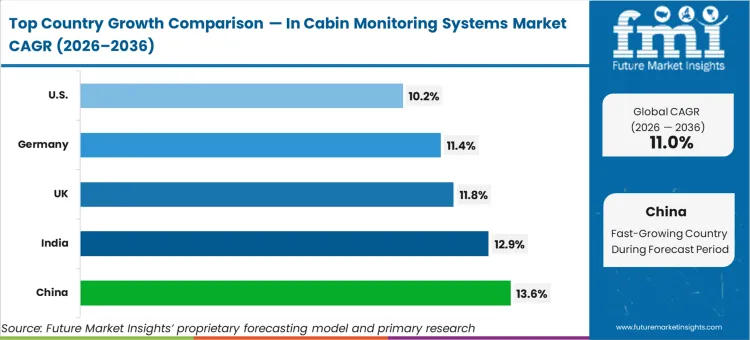
The regional growth outlook for in‑cabin monitoring systems shows steady momentum across key automotive markets, with the U.S. advancing at a 10.2% CAGR, the UK and Germany accelerating at 11.8% and 11.4% respectively, and major Asian markets, including China at 13.6% and India at 12.9%, driving some of the fastest expansion rates globally
Summary of In Cabin Monitoring Systems Market
- In Cabin Monitoring Systems Market Definition
- The industry includes monitoring systems that combine cameras and advanced sensors to analyze driver alertness and occupant activity inside vehicles. Deployment spans passenger cars, commercial fleets, and public transportation vehicles where in-cabin safety supervision is required.
- Demand Drivers in the Market
- Regulatory mandates in Europe and North America require driver monitoring system fitment across new vehicle categories, creating baseline procurement volumes independent of consumer demand cycles.
- Fleet operator liability reduction requirements expand adoption of fatigue detection and distraction alert systems in long-haul and urban delivery segments.
- Product innovation in AI-based gaze tracking reduces false alert rates while improving detection latency across variable lighting conditions.
- Key Segments Analyzed in the Report
- Component: Cameras (44%) versus radar sensors, infrared sensors, and software platforms.
- Vehicle Type: Passenger Cars (51%) versus commercial vehicles, buses, and specialized fleet categories.
- Geography: High-growth Asia Pacific versus established North American and European regulatory markets.
- Analyst Opinion at FMI
- Nikhil Kaitwade, Principal Consultant for Automotive at Future Market Insights, states, "In the coming edition of the In Cabin Monitoring Systems Market Report covering 2026 to 2036, industry stakeholders gain visibility into multimodal sensor fusion architectures that require close coordination between hardware and software development across OEM and Tier 1 ecosystems. My assessment highlights that alignment between European GSR mandates and NHTSA safety frameworks influences certification pathways, while regional regulatory divergence can restrict expansion opportunities for mid-tier technology suppliers."
- Strategic Implications/Executive Takeaways
- Reframe offerings from isolated driver monitoring devices to full in-cabin analytics platforms designed for ADAS-enabled vehicles.
- Position OEM installation contracts as the dominant commercialization pathway instead of aftermarket fleet programs.
- Invest in continuous algorithm update frameworks that sustain compliance with evolving safety mandates and maximize device longevity.
- Methodology
- Validated through OEM fitment schedules and fleet telematics adoption data.
- Zero reliance on speculative autonomous vehicle rollout timelines.
- Based on verifiable regulatory mandate schedules and confirmed Tier 1 supplier production agreements.
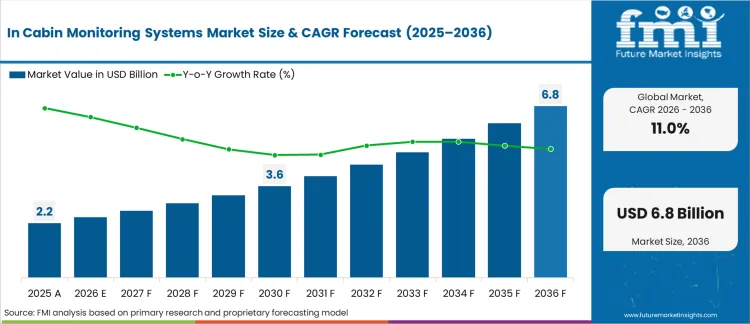
In Cabin Monitoring Systems Market Key Takeaways
| Metric | Value |
|---|---|
| Market Value (2026) | USD 2.4 billion |
| Market Forecast Value (2036) | USD 6.8 billion |
| Forecast CAGR (2026 to 2036) | 11.0% |
Source: FMI analysis based on proprietary forecasting model and primary research
In Cabin Monitoring Systems Market Definition
In cabin monitoring systems represent a key active safety category that enables real-time evaluation of driver alertness and occupant behavior within vehicles. These systems include hardware and software platforms designed for continuous operation across passenger and commercial vehicle segments. The in cabin monitoring systems market covers the global development, manufacturing, and deployment of camera, radar, and infrared sensing technologies integrated with AI-driven analytics for cabin surveillance and behavioral recognition.
In Cabin Monitoring Systems Market Inclusions
The study delivers an extensive examination of market dynamics along with global and regional market size assessment measured in value and volume. It includes a ten-year forecast spanning 2026 to 2036. The report evaluates the market through segmentation by component, vehicle type, and application. Components assessed include cameras, radar sensors, infrared sensors, and monitoring software. Vehicle categories include passenger cars, light commercial vehicles, heavy commercial vehicles, and buses. Applications analyzed include driver monitoring, occupant monitoring, gesture recognition, and fatigue detection.
In Cabin Monitoring Systems Market Exclusions
The scope does not cover standalone dashcam devices, external vehicle surveillance equipment, parking management camera systems, and traffic monitoring infrastructure. Sensor component foundries, raw semiconductor suppliers, and generic video processing software platforms are outside the scope. The analysis concentrates on finished in-cabin sensing and analytics systems designed for vehicle integration within the automotive supply chain. Aftermarket retrofit installations lacking OEM linkage and resale of used vehicle electronics with minimal brand differentiation remain outside the report coverage.
In Cabin Monitoring Systems Market Research Methodology
- Primary Research: Interviews were conducted with Tier 1 automotive suppliers, OEM procurement managers, fleet telematics operators, regulatory body representatives, and automotive safety certification consultants across major markets. Sensor technology engineers clarified detection accuracy standards and integration requirements.
- Desk Research: Vehicle production data from automotive industry databases, regulatory mandate timelines from transport authority publications, and patent filings from automotive electronics suppliers supported market benchmarking.
- Market-Sizing and Forecasting: A hybrid top-down and bottom-up model was developed. Demand was reconstructed from OEM fitment rates, regulatory adoption schedules, and fleet procurement volumes, then validated against component shipment data and software licensing revenues.
- Data Validation and Update Cycle: Outputs undergo variance checks across OEM fitment and aftermarket datasets, cross-verification with automotive safety standards bodies, and structured expert review prior to release.
Segmental Analysis
In Cabin Monitoring Systems Market Analysis by Component
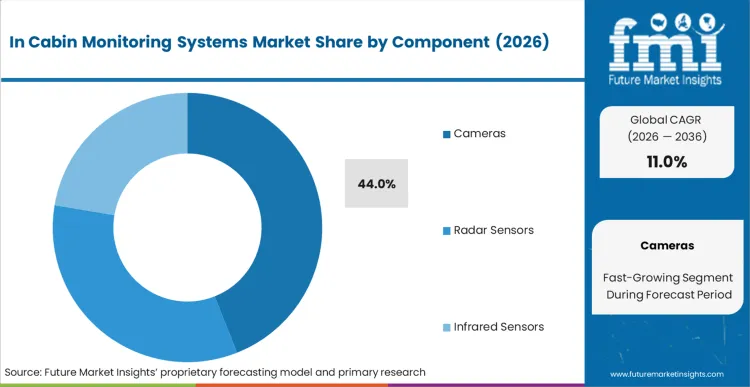
The cameras segment is expected to capture 44% share in 2026. Demand for in cabin cameras is rising as automakers prioritize driver safety and accident prevention technologies. These cameras monitor driver attention by tracking eye movement, blinking patterns, and head position during vehicle operation. When distraction or fatigue is detected, warning alerts are triggered to prevent unsafe driving situations. Regulatory agencies and vehicle safety programs are encouraging driver monitoring systems in new vehicles. Automakers are integrating in cabin cameras to meet safety compliance requirements and improve vehicle safety ratings.
- • Driver State Detection Capability: In cabin cameras enable real time monitoring of driver eye movement, head orientation, and facial behavior to identify distraction or fatigue during vehicle operation. Automakers deploy these camera units to trigger alerts when unsafe driving patterns emerge, supporting compliance with safety assessment programs that increasingly require driver monitoring features across passenger vehicles and fleet platforms.
- • Occupant Identification and Cabin Personalization: Camera based systems recognize drivers and passengers through facial recognition algorithms that link with vehicle memory profiles. The technology allows automatic adjustment of seating position, mirror alignment, and infotainment preferences once the driver enters the vehicle. Automakers are integrating these capabilities to enhance in vehicle comfort while supporting connected digital cockpit architectures.
In Cabin Monitoring Systems Market Analysis by Vehicle Type
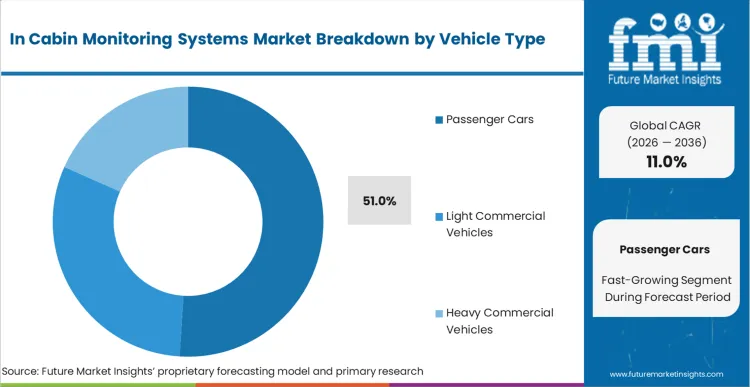
The passenger cars segment is anticipated to register 51% market share in 2026. In cabin monitoring systems are widely adopted in passenger cars as automakers expand advanced driver assistance features across mass market vehicle segments. These systems continuously observe driver behavior to ensure active supervision during assisted driving operations such as lane keeping and adaptive cruise control. Passenger vehicles often operate in urban traffic environments where distraction risks are high. Cabin monitoring solutions help reduce accidents by identifying inattentive driving conditions.
- • Driver Safety Compliance Integration: Passenger cars are increasingly equipped with in cabin monitoring systems to meet safety regulations focused on driver distraction and fatigue detection. These systems analyze eye movement, head orientation, and facial behavior to identify unsafe driving patterns during vehicle operation. Automakers integrate monitoring solutions to support safety rating programs and regulatory requirements that prioritize driver attention management across mass market passenger vehicle platforms.
- • Smart Cabin Personalization Capability: Passenger vehicles are adopting cabin monitoring technologies that recognize drivers and passengers through facial identification algorithms. Once identification is completed, vehicle systems automatically adjust seat position, climate settings, mirror alignment, and infotainment preferences according to stored user profiles. Automakers use these monitoring systems to enhance digital cockpit functionality and deliver personalized in vehicle experiences for everyday driving environments.
In Cabin Monitoring Systems Market Drivers, Restraints, and Opportunities
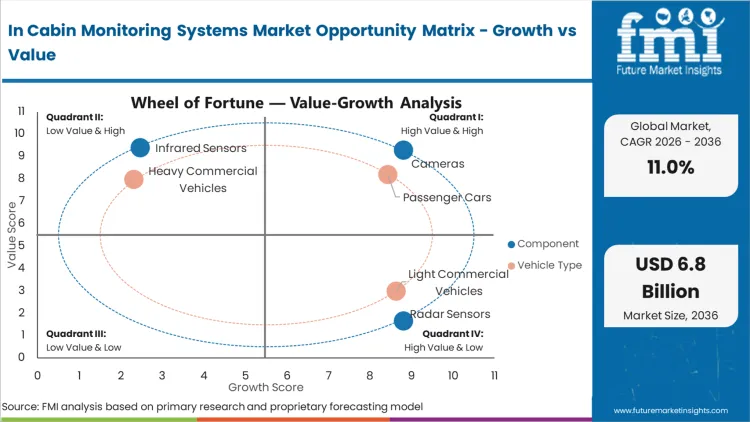
Rising focus on occupant protection technologies and growing cases of road fatalities are encouraging wider deployment of in cabin monitoring systems across passenger vehicles. Automakers are integrating interior sensing solutions that track seat occupancy, passenger posture, and seatbelt usage in real time. These systems support advanced airbag deployment strategies by identifying passenger position and weight distribution during a collision event. Cabin monitoring technology also enables child presence detection, helping prevent incidents involving unattended children inside parked vehicles. Automotive manufacturers are expanding these safety capabilities to strengthen occupant protection and meet evolving vehicle safety requirements. Growing emphasis on interior safety intelligence is driving greater adoption of cabin monitoring systems across global vehicle platforms.
Despite growing adoption, several challenges are influencing deployment of in cabin monitoring systems across global vehicle platforms. High system integration costs remain a concern for automakers operating in price sensitive vehicle segments. Camera modules, infrared illumination units, and AI processing software increase overall vehicle electronic architecture complexity. Privacy concerns related to continuous monitoring of driver and passenger behavior are also influencing customer acceptance in some regions. Data protection regulations require manufacturers to manage occupant data carefully, which increases compliance requirements. Integration of cabin monitoring hardware within compact vehicle interiors requires careful design adjustments, which can influence development timelines and manufacturing costs.
- AI‑Enhanced Cabin Intelligence: Automotive suppliers are advancing AI‑enabled camera systems that detect driver identity, emotional states, and gesture-based commands, enabling more adaptive digital cockpit experiences.
- Growing Demand from New Mobility Models: Expansion of ride‑sharing services and autonomous vehicle testing programs is accelerating the need for enhanced passenger monitoring and safety‑management tools across connected fleets.
- Advances Fueling Widespread Adoption: Ongoing improvements in camera resolution and edge processing are strengthening integration with connected‑vehicle platforms, supporting real‑time analytics, predictive alerts, and broader adoption across passenger vehicle categories.
Regional Analysis
.webp "Top Country Growth Comparison In Cabin Monitoring Systems Market Cagr (2026 2036)")
Based on regional analysis, the in cabin monitoring systems market is segmented into North America, Latin America, Europe, East Asia, South Asia, Oceania, and Middle East and Africa across 40 countries. The full report also offers market attractiveness analysis based on regional trends.
| Country | CAGR (2026 to 2036) |
|---|---|
| USA | 10.2% |
| UK | 11.8% |
| Germany | 11.4% |
| China | 13.6% |
| India | 12.9% |
Source: Market analysis based on proprietary forecasting model and primary research
North America In Cabin Monitoring Systems Market Analysis
The North America in cabin monitoring systems market is expanding steadily due to increasing integration of driver monitoring technologies across passenger vehicles. Automotive manufacturers in the United States and Canada are equipping vehicles with interior camera systems that track driver attention, eye movement, and head orientation. These technologies support accident prevention by detecting driver fatigue and distraction during long distance driving. Safety authorities are encouraging adoption of driver monitoring solutions to reduce road accidents.
- USA: The USA in cabin monitoring systems market is projected to grow at 10.2% CAGR from 2026 to 2036. Growth in electric vehicle production across the United States is strengthening demand for intelligent interior sensing technologies. Electric vehicle manufacturers are developing digital cockpit environments where cameras monitor driver engagement and passenger activity. Cabin monitoring systems also enable occupant detection functions such as seat occupancy verification and child presence alerts. These capabilities improve passenger safety while supporting advanced airbag deployment systems.
The report presents a detailed evaluation of market growth across North America, with country-level analysis covering the USA and Canada. It provides insights into fleet adoption patterns, OEM installation rate developments, and segment-level outlook across driver monitoring, occupant classification, and gesture recognition applications.
Asia Pacific In Cabin Monitoring Systems Market Analysis
Asia Pacific in cabin monitoring systems market is expanding due to rapid growth in passenger vehicle production across major automotive manufacturing economies. Countries such as China, Japan, South Korea, and India are witnessing strong vehicle demand, encouraging automakers to integrate advanced safety technologies within new models. In cabin monitoring systems help detect driver fatigue, distraction, and unsafe driving behavior through camera based sensing technologies. Governments and road safety authorities across the region are emphasizing improved vehicle safety standards.
- China: Demand for in cabin monitoring systems is poised to grow at 13.6% CAGR during the study period. Growth in electric vehicle production is supporting demand for cabin monitoring technologies across China. The country leads global electric vehicle sales, which is encouraging automakers to integrate digital cockpit systems within new models. Chinese automotive manufacturers are expanding research and development programs focused on intelligent vehicle platforms that combine sensors, cameras, and onboard computing systems.
- India: Sales of in cabin monitoring systems in India are anticipated to expand at 12.9% CAGR during the study period. Growth in urban mobility services and fleet vehicle operations is increasing focus on vehicle monitoring technologies across passenger transport segments. Automotive electronics suppliers are expanding research and development centers in India to support long term development of interior sensing technologies for next generation vehicle platforms.
The report evaluates the in cabin monitoring systems market across East and South Asia during 2021–2036. It reviews regulatory program timelines, OEM installation rate developments, and technology adoption patterns across China, Japan, South Korea, India, Singapore, and Australia.
Europe In Cabin Monitoring Systems Market Analysis
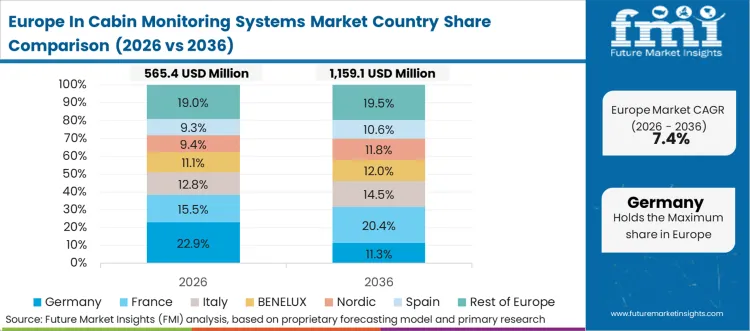
The Europe in cabin monitoring systems market is expanding due to strict vehicle safety regulations and strong adoption of advanced automotive technologies. European regulatory authorities are encouraging integration of driver monitoring systems in new vehicles to improve road safety standards. Automakers operating in the region are incorporating interior sensing technologies across passenger car platforms as part of broader advanced driver assistance system deployment. The presence of leading automotive manufacturers and component suppliers across Germany, France, Italy, and the United Kingdom is accelerating development of intelligent vehicle electronics.
- UK: Demand for in cabin monitoring systems in the UK is estimated to expand at 11.8% CAGR during the study period. The UK government is actively supporting innovation in connected and autonomous vehicle technologies through national mobility programs and testing initiatives. Automotive companies and research institutions are participating in pilot projects focused on automated driving and smart mobility infrastructure. These programs require advanced interior sensing technologies as part of broader vehicle monitoring and control architectures.
- Germany: Germany in cabin monitoring systems market is anticipated to grow at 11.4% CAGR from 2026 to 2036. The country is a major center for automotive research and development related to connected and autonomous mobility. Automotive companies and engineering firms are investing in vehicle platforms that combine sensors, cameras, and advanced computing systems. Government supported mobility programs and testing initiatives are encouraging development of intelligent vehicle technologies across the country. Leading automotive suppliers such as Robert Bosch GmbH, Continental AG, and ZF Friedrichshafen AG are expanding development of advanced electronic components and software systems.
The European in cabin monitoring systems market assessment covers country-specific analysis for the UK, Germany, France, Italy, Spain, the Netherlands, and Scandinavia. It outlines regulatory mandate rollout schedules and presents installation rate forecasts across different vehicle segments.
Competitive Landscape for In Cabin Monitoring Systems Market Players
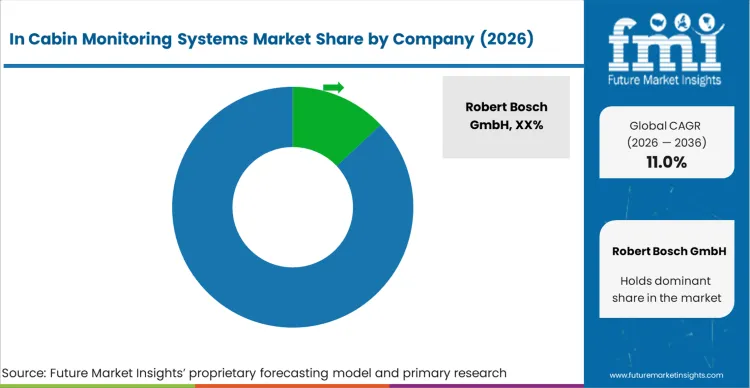
The in cabin monitoring systems market is shaped by increasing collaboration between automotive manufacturers and technology providers focused on interior sensing technologies. Automotive electronics suppliers are expanding development of integrated cabin sensing platforms that combine cameras, sensors, and embedded processing units within vehicle interiors. Companies such as Continental AG, Valeo, Magna International, and Aptiv are investing in camera hardware development and interior sensing modules designed for modern vehicle electronic architectures. These suppliers work closely with global automakers to integrate cabin monitoring solutions into digital cockpit systems and advanced vehicle electronics.
Competition in the market is also influenced by companies specializing in vision algorithms, semiconductor processing, and intelligent cockpit software. Firms such as Smart Eye, Seeing Machines, and Cipia are developing advanced driver monitoring software platforms that combine facial recognition, gaze tracking, and behavioral analysis. Many companies are investing in artificial intelligence processing capability and edge computing architecture to support real time driver monitoring performance. Strategic partnerships between automotive manufacturers and technology suppliers are becoming common as companies aim to accelerate integration of interior sensing technologies across next generation passenger vehicles. Continuous investment in research and development remains a key strategy shaping competition across the global market.
Key Players in In Cabin Monitoring Systems Market
- Robert Bosch GmbH
- Continental AG
- Valeo SA
- Aptiv PLC
- Seeing Machines Ltd.
- Smart Eye AB
- Denso Corporation
- Visteon Corporation
- Tobii Technology AB
- Magna International Inc.
Scope of the Report
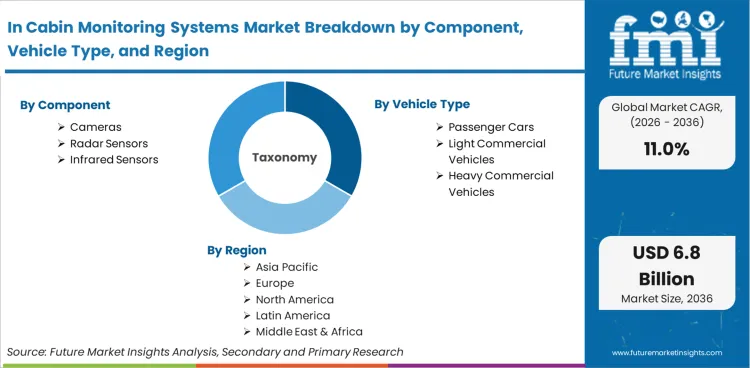
| Metric | Value |
|---|---|
| Quantitative Units | USD 2.4 billion (2026) to USD 6.8 billion (2036), at a CAGR of 11.0% |
| Market Definition | The in cabin monitoring systems market comprises the global development, production, and distribution of camera-based, radar-based, and infrared sensing technologies integrated with AI analytics software for real-time driver and occupant behavioral assessment across passenger and commercial vehicle applications. |
| Component Segmentation | Cameras, Radar Sensors, Infrared Sensors, Software |
| Vehicle Type Coverage | Passenger Cars, Light Commercial Vehicles, Heavy Commercial Vehicles, Buses |
| Application Segmentation | Driver Monitoring, Occupant Monitoring, Gesture Recognition, Fatigue Detection |
| Regions Covered | North America, Latin America, Europe, East Asia, South Asia, Oceania, Middle East and Africa |
| Countries Covered | USA, Canada, UK, Germany, France, China, Japan, India, Brazil, UAE and 40 countries |
| Key Companies Profiled | Robert Bosch GmbH, Continental AG, Valeo SA, Aptiv PLC, Seeing Machines Ltd., Smart Eye AB, Denso Corporation, Visteon Corporation, Tobii Technology AB, Magna International Inc. |
| Forecast Period | 2026 to 2036 |
| Approach | Hybrid top-down and bottom-up market modeling validated through OEM fitment schedules and fleet telematics adoption surveys, supported by regulatory mandate timeline analysis and Tier 1 supplier production agreement verification |
In Cabin Monitoring Systems Market Analysis by Segments
Component
- Cameras
- Radar Sensors
- Infrared Sensors
- Software
Vehicle Type
- Passenger Cars
- Light Commercial Vehicles
- Heavy Commercial Vehicles
- Buses
Application
- Driver Monitoring
- Occupant Monitoring
- Gesture Recognition
- Fatigue Detection
Region
- Asia Pacific
- China
- Japan
- South Korea
- India
- Australia
- Singapore
- Thailand
- Rest of Asia Pacific
- Europe
- UK
- Germany
- France
- Italy
- Spain
- Netherlands
- Scandinavia
- Switzerland
- Rest of Europe
- North America
- U.S.
- Canada
- Latin America
- Brazil
- Mexico
- Argentina
- Rest of Latin America
- Middle East and Africa
- United Arab Emirates
- Saudi Arabia
- South Africa
- Israel
- Rest of Middle East and Africa
Bibliography
- ANCAP Safety. (2026). 2026–2028 assessment protocols and policies.
- China Automotive Technology and Research Center. (2024). C-NCAP Management Regulations (2024 edition).
- Japan Automobile Standards Internationalization Center. (2024). Guideline document of driver monitoring system in driver drowsiness and attention warning system.
- National Agency for Automotive Safety and Victims’ Aid. (2025). Information of Japan New Car Assessment Program (JNCAP).
- Federal Motor Carrier Safety Administration. (2024). Research methodologies and statistical approaches for understanding driver fatigue and safety.
- Ministry of Road Transport and Highways. (2026, February 12). Mandatory safety devices for heavy commercial vehicles.
This bibliography is provided for reader reference and is not exhaustive. The full report contains the complete reference list and detailed citations.
This Report Addresses
- Market intelligence to enable strategic decision making across established and emerging automotive safety markets
- Market size estimation and 10-year revenue forecasts from 2026 to 2036, supported by validated OEM fitment data and fleet telematics adoption surveys
- Growth opportunity mapping across component types and application segments with emphasis on regulatory compliance optimization
- Segment and regional revenue forecasts covering cameras, radar sensors, infrared sensors, driver monitoring software, and vehicle type distribution networks
- Competition strategy assessment including OEM platform integration requirements, regulatory certification positioning, and AI algorithm adoption
- Product development tracking including sensor fusion innovations, edge computing integration trends, and fatigue detection capability advancements
- Market access analysis covering OEM supply agreements, fleet operator procurement programs, and government road safety mandate engagement strategies
- Market report delivery in PDF, Excel, PPT, and interactive dashboard formats for executive and operational use
Frequently Asked Questions
How large is the demand for In Cabin Monitoring Systems in the global market in 2026?
Demand for In Cabin Monitoring Systems in the global market is estimated to be valued at USD 2.4 billion in 2026.
What will be the market size of In Cabin Monitoring Systems in the global market by 2036?
Market size for In Cabin Monitoring Systems is projected to reach USD 6.8 billion by 2036.
What is the expected demand growth for In Cabin Monitoring Systems in the global market between 2026 and 2036?
Demand for In Cabin Monitoring Systems in the global market is expected to grow at a CAGR of 11.0% between 2026 and 2036.
Which Component is poised to lead global sales by 2026?
Cameras are expected to be the dominant component, capturing approximately 44% of global market share in 2026, driven by near-infrared sensing capability and embedded AI processing integration across OEM vehicle platforms.
How significant is the role of Passenger Cars in driving In Cabin Monitoring Systems adoption in 2026?
Passenger cars represent the primary vehicle type, projected to hold approximately 51% share of the total market in 2026, as EU General Safety Regulation mandates drive baseline fitment requirements across new vehicle registrations.
What is Driving In Cabin Monitoring Systems Demand in the USA?
Commercial fleet operator adoption of fatigue detection platforms and advancing federal regulatory engagement with mandatory fitment requirements across passenger vehicle categories are driving growth.
What Consumer Trends are Referenced for the USA?
Fleet operator liability reduction priorities and insurance industry incentive programs for vehicles fitted with behavioral monitoring systems are referenced as key demand behavior patterns.
What is the USA Growth Outlook in this Report?
The USA is projected to grow at a CAGR of 10.2% during 2026 to 2036.
Why is Europe described as Important for In Cabin Monitoring Systems Development in this Report?
Growth is driven by EU General Safety Regulation mandates establishing binding driver monitoring fitment requirements that create predictable OEM procurement volumes independent of consumer demand cycles.
What Type of Product Development Dominates in Europe?
Camera-based driver monitoring systems with on-device AI inference and UN ECE regulatory certification dominate regional OEM procurement across passenger and light commercial vehicle categories.
What is Germany's Growth Outlook in this Report?
Germany is projected to expand at a CAGR of 11.4% during 2026 to 2036.
Does the Report Cover China in its Regional Analysis?
China is included within East Asia under the regional scope of analysis.
What are the Sources referred to for analyzing the Market in China?
Vehicle production data, government road safety program announcements, and domestic OEM platform launch schedules covering fitment rates, price sensitivity analysis, and regulatory program adoption timelines are cited as primary reference sources.
What is the Main Development Theme Linked to China in Asia Coverage?
Asia Pacific development is associated with high EV production volumes incorporating AI-enabled cabin monitoring as standard equipment across new domestic vehicle platforms.
Does the Report Cover India in its Regional Analysis?
India is included within South Asia under the regional coverage framework.
What is the Main India Related Development Theme in Asia Coverage?
Expanding commercial vehicle fleet regulation and growing OEM investment in passenger vehicles with advanced safety features targeting both domestic and export markets is emphasized.
Which Distribution Strategies are Strategically Important for Asia Pacific Market Entry?
OEM platform pre-fitment agreements and government fleet procurement programs are prioritized for scalable market penetration across regional vehicle production volumes.
What does In Cabin Monitoring Systems Mean in this Report?
In cabin monitoring systems refer to the global development, manufacturing, and vehicle integration of camera-based, radar-based, and infrared sensing solutions for real-time driver alertness and occupant behavioral classification.
What is Included in the Scope of this In Cabin Monitoring Systems Market Report?
Scope covers systems by component, key vehicle types including passenger cars and commercial vehicles, and application segments including driver monitoring, occupant classification, and fatigue detection.
What is Excluded from the Scope of this Report?
Standalone dashcam devices, external vehicle surveillance equipment, parking camera systems, and generic video analytics platforms are excluded unless part of integrated in-cabin monitoring product offerings.
What does Market Forecast Mean on this Page?
Market forecast represents model-based projections built on OEM fitment schedules and regulatory mandate adoption assumptions for strategic planning purposes.
How is the In Cabin Monitoring Systems Market Forecast Built and Validated?
Forecast is developed using hybrid modeling validated through OEM platform production data, regulatory mandate timelines, and Tier 1 supplier shipment verification.
What does Zero Reliance on Speculative Third Party Market Research Mean Here?
Market analysis is based on verifiable OEM fitment agreements, regulatory mandate schedules, and fleet adoption data rather than speculative autonomous vehicle deployment projections.
Preview the report firsthand - request a free sample
Get SampleGet the brochure for pricing and purchase details.
Get PDFTable of Content
- Key Takeaways
- Market Size and CAGR
- Top Growth Driver
- Fastest Growing Segment
- Leading Region
- Key Companies
- Emerging Opportunities
- Executive Summary
- Global Market Outlook
- Demand-side Trends
- Supply-side Trends
- Technology Roadmap Analysis
- Analysis and Recommendations
- Analyst Perspective (What is happening? Why now? What should investors know?)
- Key Questions Answered
- How large is the market?
- What is the CAGR?
- What are key trends?
- Which region dominates?
- Who are the leaders?
- Market Overview
- Market Coverage / Taxonomy
- Market Definition / Scope / Limitations
- Research Methodology
- Chapter Orientation
- Analytical Lens and Working Hypotheses
- Market Structure, Signals, and Trend Drivers
- Benchmarking and Cross-market Comparability
- Market Sizing, Forecasting, and Opportunity Mapping
- Research Design and Evidence Framework
- Desk Research Programme (Secondary Evidence)
- Expert Input and Fieldwork (Primary Evidence)
- Tooling, Models, and Reference Databases
- Data Engineering and Model Build
- Quality Assurance and Audit Trail
- Market Background
- Market Dynamics (Drivers, Restraints, Opportunity, Trends)
- Scenario Forecast (Optimistic, Likely, Conservative)
- Impact Analysis
- AI Impact
- Sustainability Impact
- Regulatory Impact
- Technology Impact
- Consumer / Buyer Analysis
- Purchase Drivers
- Adoption Barriers
- Buyer Journey
- Opportunity Map Analysis
- Product Life Cycle Analysis
- Supply Chain Analysis
- Investment Feasibility Matrix
- Value Chain Analysis
- PESTLE and Porter's Analysis
- Regulatory Landscape
- Regional Parent Market Outlook
- Production and Consumption Statistics
- Import and Export Statistics
- Global Market Analysis and Forecast, 2021 to 2036
- Historical Market Size Value (USD Billion) & Volume (Unit) Analysis, 2021 to 2025
- Current and Future Market Size Value (USD Billion) & Volume (Unit) Projections, 2026 to 2036
- Y-o-Y Growth Trend Analysis
- Absolute $ Opportunity Analysis
- Global Market Pricing Analysis, 2021 to 2036
- Global Market Analysis and Forecast, By Component, 2021 to 2036
- Introduction / Key Findings
- Historical Market Size Value (USD Billion) & Volume (Unit) Analysis By Component, 2021 to 2025
- Current and Future Market Size Value (USD Billion) & Volume (Unit) Analysis and Forecast By Component, 2026 to 2036
- Cameras
- Radar Sensors
- Infrared Sensors
- Software
- Cameras
- Y-o-Y Growth Trend Analysis By Component, 2021 to 2025
- Absolute $ Opportunity Analysis By Component, 2026 to 2036
- Global Market Analysis and Forecast, By Vehicle Type, 2021 to 2036
- Introduction / Key Findings
- Historical Market Size Value (USD Billion) & Volume (Unit) Analysis By Vehicle Type, 2021 to 2025
- Current and Future Market Size Value (USD Billion) & Volume (Unit) Analysis and Forecast By Vehicle Type, 2026 to 2036
- Passenger Cars
- Light Commercial Vehicles
- Heavy Commercial Vehicles
- Buses
- Passenger Cars
- Y-o-Y Growth Trend Analysis By Vehicle Type, 2021 to 2025
- Absolute $ Opportunity Analysis By Vehicle Type, 2026 to 2036
- Global Market Analysis and Forecast, By Application, 2021 to 2036
- Introduction / Key Findings
- Historical Market Size Value (USD Billion) & Volume (Unit) Analysis By Application, 2021 to 2025
- Current and Future Market Size Value (USD Billion) & Volume (Unit) Analysis and Forecast By Application, 2026 to 2036
- Driver Monitoring
- Occupant Monitoring
- Gesture Recognition
- Fatigue Detection
- Driver Monitoring
- Y-o-Y Growth Trend Analysis By Application, 2021 to 2025
- Absolute $ Opportunity Analysis By Application, 2026 to 2036
- Global Market Analysis and Forecast, By Region, 2021 to 2036
- Introduction
- Historical Market Size Value (USD Billion) & Volume (Unit) Analysis By Region, 2021 to 2025
- Current Market Size Value (USD Billion) & Volume (Unit) Analysis and Forecast By Region, 2026 to 2036
- North America
- Latin America
- Western Europe
- Eastern Europe
- East Asia
- South Asia and Pacific
- Middle East & Africa
- Market Attractiveness Analysis By Region
- North America Market Analysis and Forecast, By Country, 2021 to 2036
- Historical Market Size Value (USD Billion) & Volume (Unit) Trend Analysis By Market Taxonomy, 2021 to 2025
- Market Size Value (USD Billion) & Volume (Unit) Forecast By Market Taxonomy, 2026 to 2036
- By Country
- USA
- Canada
- Mexico
- By Component
- By Vehicle Type
- By Application
- By Country
- Market Attractiveness Analysis
- By Country
- By Component
- By Vehicle Type
- By Application
- Key Takeaways
- Latin America Market Analysis and Forecast, By Country
- Historical Market Size Value (USD Billion) & Volume (Unit) Trend Analysis By Market Taxonomy, 2021 to 2025
- Market Size Value (USD Billion) & Volume (Unit) Forecast By Market Taxonomy, 2026 to 2036
- By Country
- Brazil
- Chile
- Rest of Latin America
- By Component
- By Vehicle Type
- By Application
- By Country
- Market Attractiveness Analysis
- By Country
- By Component
- By Vehicle Type
- By Application
- Key Takeaways
- Western Europe Market Analysis and Forecast, By Country
- Historical Market Size Value (USD Billion) & Volume (Unit) Trend Analysis By Market Taxonomy, 2021 to 2025
- Market Size Value (USD Billion) & Volume (Unit) Forecast By Market Taxonomy, 2026 to 2036
- By Country
- Germany
- UK
- Italy
- Spain
- France
- Nordic
- BENELUX
- Rest of Western Europe
- By Component
- By Vehicle Type
- By Application
- By Country
- Market Attractiveness Analysis
- By Country
- By Component
- By Vehicle Type
- By Application
- Key Takeaways
- Eastern Europe Market Analysis and Forecast, By Country
- Historical Market Size Value (USD Billion) & Volume (Unit) Trend Analysis By Market Taxonomy, 2021 to 2025
- Market Size Value (USD Billion) & Volume (Unit) Forecast By Market Taxonomy, 2026 to 2036
- By Country
- Russia
- Poland
- Hungary
- Balkan & Baltic
- Rest of Eastern Europe
- By Component
- By Vehicle Type
- By Application
- By Country
- Market Attractiveness Analysis
- By Country
- By Component
- By Vehicle Type
- By Application
- Key Takeaways
- East Asia Market Analysis and Forecast, By Country
- Historical Market Size Value (USD Billion) & Volume (Unit) Trend Analysis By Market Taxonomy, 2021 to 2025
- Market Size Value (USD Billion) & Volume (Unit) Forecast By Market Taxonomy, 2026 to 2036
- By Country
- China
- Japan
- South Korea
- By Component
- By Vehicle Type
- By Application
- By Country
- Market Attractiveness Analysis
- By Country
- By Component
- By Vehicle Type
- By Application
- Key Takeaways
- South Asia and Pacific Market Analysis and Forecast, By Country
- Historical Market Size Value (USD Billion) & Volume (Unit) Trend Analysis By Market Taxonomy, 2021 to 2025
- Market Size Value (USD Billion) & Volume (Unit) Forecast By Market Taxonomy, 2026 to 2036
- By Country
- India
- ASEAN
- Australia & New Zealand
- Rest of South Asia and Pacific
- By Component
- By Vehicle Type
- By Application
- By Country
- Market Attractiveness Analysis
- By Country
- By Component
- By Vehicle Type
- By Application
- Key Takeaways
- Middle East & Africa Market Analysis and Forecast, By Country
- Historical Market Size Value (USD Billion) & Volume (Unit) Trend Analysis By Market Taxonomy, 2021 to 2025
- Market Size Value (USD Billion) & Volume (Unit) Forecast By Market Taxonomy, 2026 to 2036
- By Country
- Kingdom of Saudi Arabia
- Other GCC Countries
- Türkiye
- South Africa
- Other African Union
- Rest of Middle East & Africa
- By Component
- By Vehicle Type
- By Application
- By Country
- Market Attractiveness Analysis
- By Country
- By Component
- By Vehicle Type
- By Application
- Key Takeaways
- Key Countries Market Analysis
- USA
- Pricing Analysis
- Market Share Analysis, 2025
- By Component
- By Vehicle Type
- By Application
- Canada
- Pricing Analysis
- Market Share Analysis, 2025
- By Component
- By Vehicle Type
- By Application
- Mexico
- Pricing Analysis
- Market Share Analysis, 2025
- By Component
- By Vehicle Type
- By Application
- Brazil
- Pricing Analysis
- Market Share Analysis, 2025
- By Component
- By Vehicle Type
- By Application
- Chile
- Pricing Analysis
- Market Share Analysis, 2025
- By Component
- By Vehicle Type
- By Application
- Germany
- Pricing Analysis
- Market Share Analysis, 2025
- By Component
- By Vehicle Type
- By Application
- UK
- Pricing Analysis
- Market Share Analysis, 2025
- By Component
- By Vehicle Type
- By Application
- Italy
- Pricing Analysis
- Market Share Analysis, 2025
- By Component
- By Vehicle Type
- By Application
- Spain
- Pricing Analysis
- Market Share Analysis, 2025
- By Component
- By Vehicle Type
- By Application
- France
- Pricing Analysis
- Market Share Analysis, 2025
- By Component
- By Vehicle Type
- By Application
- India
- Pricing Analysis
- Market Share Analysis, 2025
- By Component
- By Vehicle Type
- By Application
- ASEAN
- Pricing Analysis
- Market Share Analysis, 2025
- By Component
- By Vehicle Type
- By Application
- Australia & New Zealand
- Pricing Analysis
- Market Share Analysis, 2025
- By Component
- By Vehicle Type
- By Application
- China
- Pricing Analysis
- Market Share Analysis, 2025
- By Component
- By Vehicle Type
- By Application
- Japan
- Pricing Analysis
- Market Share Analysis, 2025
- By Component
- By Vehicle Type
- By Application
- South Korea
- Pricing Analysis
- Market Share Analysis, 2025
- By Component
- By Vehicle Type
- By Application
- Russia
- Pricing Analysis
- Market Share Analysis, 2025
- By Component
- By Vehicle Type
- By Application
- Poland
- Pricing Analysis
- Market Share Analysis, 2025
- By Component
- By Vehicle Type
- By Application
- Hungary
- Pricing Analysis
- Market Share Analysis, 2025
- By Component
- By Vehicle Type
- By Application
- Kingdom of Saudi Arabia
- Pricing Analysis
- Market Share Analysis, 2025
- By Component
- By Vehicle Type
- By Application
- Türkiye
- Pricing Analysis
- Market Share Analysis, 2025
- By Component
- By Vehicle Type
- By Application
- South Africa
- Pricing Analysis
- Market Share Analysis, 2025
- By Component
- By Vehicle Type
- By Application
- USA
- Market Structure Analysis
- Competition Dashboard
- Competition Benchmarking
- Market Share Analysis of Top Players
- By Regional
- By Component
- By Vehicle Type
- By Application
- Emerging Startups
- Innovation Benchmarking
- Competition Analysis
- Competition Deep Dive
- Robert Bosch GmbH
- Overview
- Product Portfolio
- Profitability by Market Segments (Product/Region/Sales Channel)
- Sales Footprint
- Strategy Overview
- Marketing Strategy
- Product Strategy
- Channel Strategy
- Continental AG
- Valeo SA
- Aptiv PLC
- Seeing Machines Ltd.
- Smart Eye AB
- Denso Corporation
- Visteon Corporation
- Tobii Technology AB
- Magna International Inc.
- Robert Bosch GmbH
- Case Studies
- Success Stories
- Recent Developments
- Competition Deep Dive
- Assumptions & Acronyms Used


