

- Industry Size (2026)
- USD 5.0 Bn
- Forecast (2036)
- USD 13.0 Bn
- CAGR (2026 to 2036)
- 10.0%
Parking Management Market Forecast and Outlook By FMI
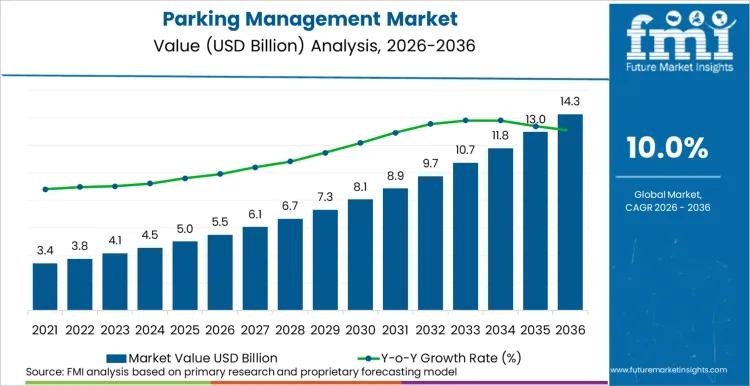
In 2025, the parking management market was valued at USD 5.0 billion. Based on Future Market Insights’ analysis, demand for parking management solutions is estimated to grow to USD 5.5 billion in 2026 and USD 14.3 billion by 2036. FMI projects a CAGR of 10.0% during the forecast period.
Absolute dollar growth of USD 8.8 billion over the decade signals a scaled digital retrofit cycle rather than a one-time capex wave. Growth is supported by smart city rollouts, digitised payments, and enforcement modernisation, while project timelines and public procurement cycles keep adoption uneven across cities and asset owners.
As Cameron Clayton, CEO of EasyPark Group, the parent company of ParkMobile, noted regarding digitalising urban mobility and payment experience, ‘Our ambition is to transform parking in America, making it easier for 100 million drivers to park and pay, so no one will ever have to park the same way again.’ [1] This signals that platform adoption is being sold as a repeatable, city-by-city operating model tied to user experience and operator monetisation, not only equipment upgrades.
Summary of the Parking Management Market
- Market definition
- Parking management covers access, guidance, enforcement, and payments across on-street and off-street assets, delivered through integrated hardware, software, and services for operators and public agencies.
- Demand drivers
- Urban densification pushes cities and asset owners to cut cruising and queueing through occupancy visibility and better turnover economics. [2]
- Interoperable digital payment and app ecosystems are shifting procurement toward platforms that can serve multiple sites and partner apps under one operating layer. [1]
- Enforcement automation is being funded as a revenue protection and compliance tool, especially where manual patrols cannot scale with rising vehicle volumes. [2]
- Key segments analyzed
- Solution: Parking Access Control Systems lead in 2025 (35.0%) as entry and exit throughput, entitlement checks, and fraud control drive ROI.
- Component: Hardware leads in 2025 (40.0%) because sensors, cameras, and gates remain the physical backbone of most deployments.
- Geography: East Asia and South Asia & Pacific post higher adoption intensity via smart city programmes and municipal digitisation, while Europe moves at a steadier pace due to public acceptance and budget constraints. [2] [4]
- Analyst opinion at FMI
- Sudip Saha, Senior Analyst at Future Market Insights, opines, ‘Operators will gain share by proving outcomes, fewer minutes of cruising, higher compliance, and auditable revenue uplift, then locking those metrics into multi-year platform contracts with interoperable payments.’
- Strategic implications / executive takeaways
- Build interoperability as a product feature, not a partnership afterthought, since city buyers now expect multi-app payment and data exchange across operators. [1]
- Treat enforcement as a workflow and evidence system, linking ALPR, digital permits, and dispute handling to reduce leakage and reputational risk.
- Package EV charging management and parking as one campus offer in garages and business parks, because buyers want a single back-office for utilisation and billing. [3]
- Methodology
- Forecasts are anchored in installed base by site type and solution mix, then translated into spend and recurring revenue assumptions.
- Desk research relies on government pricing reform guidance, smart city programme publications, and official operator releases, not third-party market reports. [2] [4] [1]
- Primary interviews test payback thresholds, procurement cycle times, and local constraints such as payment norms, union rules, and data governance.
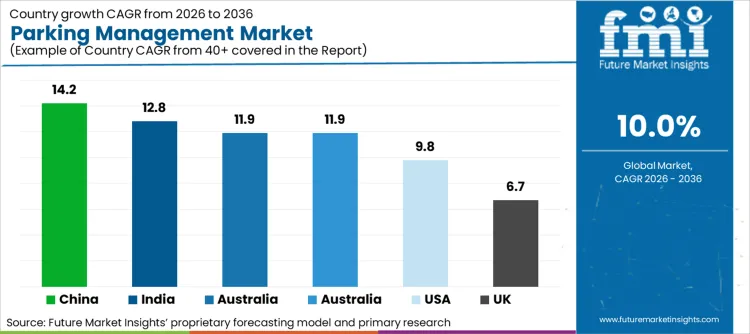
China (14.2% CAGR) grows fastest through smart city scaling and revenue modernisation, while India (12.8%) rises on municipal digitisation and enforcement gaps being addressed through tenders. Australia (11.9%) and New Zealand (11.9%) expand through campus and venue modernisation and cashless payment penetration. The United States (9.8%) advances via interoperability and pricing reform programmes, while the United Kingdom (6.7%) remains steadier as local authority budgets and public acceptance shape the pace of app-led change. [2] [1]
Market Definition
Parking management refers to the hardware, software, and operational services used to control access, guide vehicles to available bays, enforce rules, and collect payments across on-street and off-street facilities. Buyers include municipalities, airports, hospitals, commercial landlords, and parking operators that need to reduce cruising, shorten entry and exit queues, and improve compliance. The market covers systems such as barriers, sensors, cameras, meters, payment platforms, and back-office analytics that support pricing, occupancy reporting, and dispute handling.
Market inclusions
This report covers global and regional market sizing for 2025 with forecasts for 2026 to 2036, including solution-level splits (access control, guidance, enforcement), component splits (hardware, software, services), parking site splits (on-street, off-street), and application splits (airports, hospitals, commercial complexes, government and municipalities, and others). The analysis also tracks adoption drivers linked to pricing reforms, payment interoperability, and enforcement digitisation, with country narratives tied to policy actions and public procurement patterns.
Market exclusions
The scope excludes upstream civil construction of new parking structures (concrete works, building services, and structural engineering) unless bundled as part of a parking system contract. It also excludes downstream consumer navigation apps that do not integrate with operator systems for payment, occupancy, or enforcement, and it excludes road tolling and congestion charging systems unless directly integrated into parking payment and entitlement workflows.
Research methodology
- Primary research: Primary interviews include municipal parking administrators, airport and hospital facility managers, parking operators, solution integrators, and OEM channel partners across North America, Europe, and Asia-Pacific.
- Desk research: Desk research draws from government publications on parking reform and pricing, official operator press releases on platform integrations, and public-sector documentation on smart city programmes and parking tenders. [2] [1] [4]
- Market-sizing and forecasting: FMI uses a hybrid top down and bottom up model that triangulates installed base by site type, average system spend by solution, software attach rates, and recurring service contracts, then validates outputs against procurement activity and disclosed platform deployments.
- Data validation and update cycle: Outputs are validated through cross-checks of tender pipelines, published programme milestones, and corporate releases, with updates triggered by major interoperability launches, city-level pricing reforms, and enforcement rule changes. [2] [1]
Key Segments
Parking Management Market Analysis by Solution
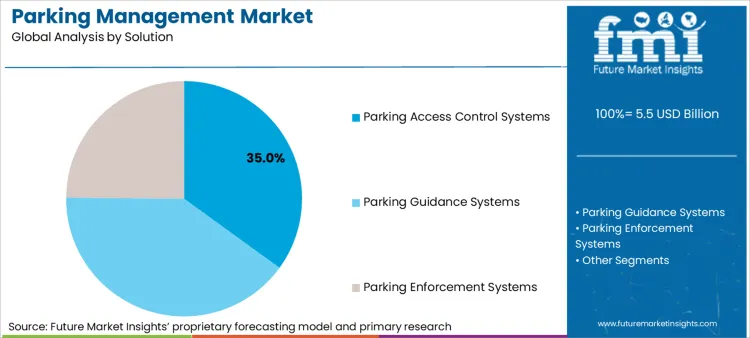
Based on FMI’s parking management market report, consumption of Parking Access Control Systems is estimated to hold 35.0% share in 2025. This segment leads because gates, ANPR, and entitlement checks control throughput and revenue at the point of entry and exit, giving buyers a measurable payback through reduced leakage, faster flow, and improved user experience in off-street assets.
- Platform partnerships: Flash and ParkMobile formed a strategic partnership (September 2024) to integrate parking access and digital payments, signalling that access control is moving toward platform-led ecosystems rather than standalone equipment. [1]
- Interoperable payments: Operator strategy increasingly links access control to payment choice and app ecosystems, reducing churn risk when cities standardise technical and commercial relations across multiple providers. [1]
- Throughput economics: Government guidance on pricing and reform links better occupancy management to reduced cruising, which raises the ROI case for access control systems that can enforce entitlements and integrate with pricing logic. [2]
Parking Management Market Analysis by Component
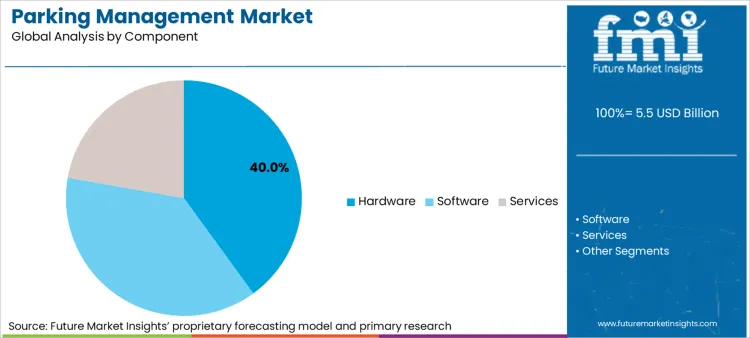
Based on FMI’s parking management market report, consumption of Hardware is estimated to hold 40.0% share in 2025. Hardware remains dominant because sensor networks, cameras, barriers, smart meters, and edge controllers are still required to digitise real-world bays and entrances, even when the control layer migrates to cloud software.
- IoT backbone: Smart parking reforms reference sensor-based technologies that supply data for pricing programmes, supporting continued procurement of field devices that produce occupancy and turnover signals. [2]
- EV-linked upgrades: As parking garages add charging and billing integration, buyers seek unified management tools, supporting demand for hardware and edge integration compatible with back-office billing and uptime targets. [3]
- Site modernisation: Hospitals and public campuses update tariffs and payment controls as part of broader site governance, sustaining demand for reliable meters, signage, and payment terminals that fit local policy and fraud controls. [5]
Parking Management Market Drivers, Restraints, Opportunities
Future Market Insights analysis indicates the market has moved from isolated equipment upgrades to programme-based digitisation where cities and large campuses tie parking to wider mobility goals. A key structural reason the market sits at USD 5.0 billion in 2025 is that most cities still operate mixed estates, part legacy meters and manual enforcement, part digitised sites, creating a multi-year replacement and integration runway rather than a single conversion event. [2]
The present shift is that buyers are no longer only paying for ‘more sensors’ or ‘new barriers’. They are paying for operating control: interoperability across payment apps, occupancy data that supports pricing, and enforcement evidence that stands up to disputes. Growth is constrained where public trust in app-only payments is low or where procurement rules slow platform consolidation, yet the value pool expands as operators bundle access, payments, and analytics into recurring contracts. [1] [2]
- Pricing reform: Demand-responsive pricing and performance-based occupancy targets are being framed as congestion and emissions levers, raising the value of software analytics and enforcement integration in city contracts. [2]
- Payment interoperability: Multi-seller and multi-app payment models push procurement toward platforms that can integrate without forcing drivers to adopt a single app, changing how operators compete for municipal frameworks. [1]
- Data governance: Data collection on vehicle movements and user behaviour creates procurement friction, driving requirements for secure architectures, audit trails, and policy-aligned data sharing in public tenders. [2]
Regional Analysis
This report covers North America, Latin America, Western Europe, Eastern Europe, East Asia, South Asia & Pacific, and the Middle East & Africa. Regional assessment links adoption to city-level procurement, payment norms, enforcement rules, and smart mobility programmes. The full report includes market attractiveness analysis by region and country.
Country CAGR outlook (2026 to 2036)
| Country | CAGR (2026 to 2036) |
|---|---|
| China | 14.2% |
| India | 12.8% |
| Australia | 11.9% |
| New Zealand | 11.9% |
| United States | 9.8% |
| United Kingdom | 6.7% |
source: Future Market Insights (FMI) analysis, based on proprietary forecasting model and primary research
North America Market Analysis
North America functions as the interoperability test bed, where platform integrations, app ecosystems, and performance-based parking reforms shape procurement language. Platform-led players push integration between access, payment, and operator analytics, while government guidance on pricing reform strengthens software value propositions tied to congestion reduction outcomes. [2] [1]
United States: Demand for parking management solutions in the United States is projected to rise at 9.8% CAGR through 2036. City buyers are linking parking to measurable mobility outcomes, which lifts demand for occupancy visibility and pricing logic that can be defended in public debate. The U.S. DOT’s parking reform guidance describes demand-responsive pricing and targets such as maintaining a small share of open spaces, supported by sensor-based technologies, which reinforces procurement of data-driven guidance and enforcement tools rather than manual-only approaches. [2] On the private-operator side, platform consolidation is shaping go-to-market. The September 2024 Flash–ParkMobile partnership ties payment and access technology into an ecosystem approach, and the quote from EasyPark Group’s CEO points to scale goals measured in driver coverage, not only site count. [1]
FMI’s analysis of parking management market in North America consists of country-wise assessment that includes the United States and Canada. Readers can find operating model shifts, platform partnership impacts, and segment attractiveness by site type and application.
Western Europe Market Analysis
Western Europe acts as a governance-led market where public acceptance, payment inclusion, and local authority budget cycles shape the pace of app-first parking changes. Operators compete on compliance outcomes, dispute handling, and service continuity, while public bodies weigh interoperability against concerns about exclusion of non-app users and data governance.
United Kingdom: Demand for parking management solutions in the United Kingdom is projected to rise at 6.7% CAGR through 2036. Interoperability is a core issue because drivers often face multiple parking apps across local authorities and private operators. The National Parking Platform narrative in the UK has focused on enabling payments via multiple established apps and standardising technical and commercial relations, signalling a procurement pull toward platforms that can support multi-seller payments and data exchange rather than single-vendor lock-in. [6] Hospitals also influence payment policy and enforcement behaviours. NHS-linked parking policies and local hospital parking rules reflect sensitivity around patient and visitor charges, and some trusts publish clear payment controls and warnings around payment methods, which affects how digital payment and enforcement tools are deployed in healthcare sites. [5]
FMI’s analysis of parking management market in Western Europe consists of country-wise assessment that includes the United Kingdom, Germany, France, Italy, and Spain. Readers can find local authority procurement patterns, payment interoperability trends, and application-level demand shifts across airports, hospitals, and commercial complexes.
East Asia Market Analysis
East Asia operates as a scale market tied to smart city buildout and municipal revenue modernisation. Buyers prioritise systems that can standardise operations across many sites, integrate enforcement, and support dynamic pricing and digital payments at high transaction volumes.
China: Demand for parking management solutions in China is projected to rise at 14.2% CAGR through 2036. Smart city and urban renewal framing supports a continuing pipeline of digital infrastructure upgrades, which includes mobility and public space management themes that influence local rollouts. [4] At the operator level, adoption is shaped by the need to improve utilisation of scarce urban land and manage congestion externalities, pushing deployments that combine guidance, enforcement, and payment data into municipal dashboards. China’s scale creates a bias toward solutions that can be replicated across districts, so platform capability, systems integration, and uptime service are weighted heavily in vendor selection.
FMI’s analysis of parking management market in East Asia consists of country-wise assessment that includes China, Japan, and South Korea. Readers can find city-led deployment models, vendor positioning by solution category, and demand outlook by application such as airports, business parks, and municipal curb assets.
South Asia & Pacific Market Analysis
South Asia & Pacific is an execution market where tenders, SPVs, and mobility digitisation programmes influence adoption speed. Buyers often seek end-to-end service packages because operational discipline, staffing, and enforcement practices are as important as the technology stack.
India: Demand for parking management solutions in India is projected to rise at 12.8% CAGR through 2036. Tender-led adoption is tied to smart city SPVs and municipal efforts to reduce leakage and improve user experience through digitised payments and monitoring. Parliamentary evaluation of the Smart Cities Mission underlines how SPVs and project frameworks drive urban technology procurement, which acts as a route for parking systems to be procured as part of wider mobility and public realm upgrades. [4] Public tenders also push requirements for real-time reporting, manpower monitoring, and revenue assurance, raising the value of integrated access control and enforcement rather than isolated meters.
Australia: Demand for parking management solutions in Australia is projected to rise at 11.9% CAGR through 2036. Growth is supported by cashless payment penetration and modernisation of off-street assets across commercial complexes, airports, and venues. Operators prioritise frictionless entry and exit, payment flexibility, and occupancy visibility to manage peak events and commuter flows. Procurement tends to favour vendors that can show stable uptime and clear operational reporting, because asset owners often outsource operations and expect service-level accountability.
New Zealand: Demand for parking management solutions in New Zealand is projected to rise at 11.9% CAGR through 2036. Adoption is shaped by city centre management goals and campus assets where enforcement and entitlement control matter as much as payments. Buyers lean toward modular deployments that can start with access and payment upgrades, then add analytics and enforcement automation once operational baselines are stable.
FMI’s analysis of parking management market in South Asia & Pacific consists of country-wise assessment that includes India, Australia, New Zealand, and ASEAN select markets. Readers can find procurement mechanisms, adoption constraints, and segment attractiveness by site type and end application.
Competitive Aligners for Market Players
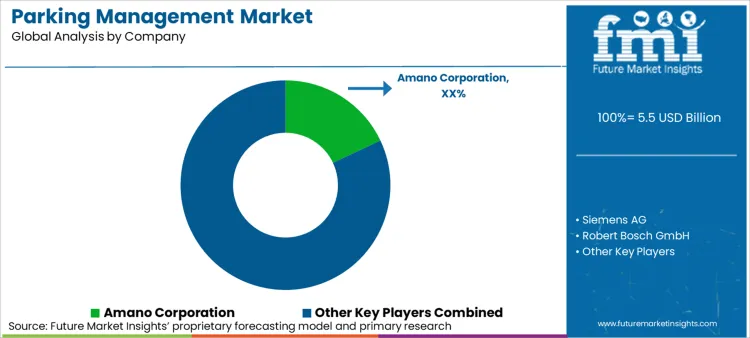
The market is moderately concentrated at the top of large systems and platform vendors, with a long tail of local integrators and specialised enforcement suppliers. Competition is not only on unit price of gates or sensors, it is on proof of outcomes: occupancy targets, reduced cruising, compliance improvements, and audited revenue integrity. This pushes vendors to build reference deployments that can be reused in tenders as evidence packages. [2]
Structural advantages come from three areas. First is installed base and service reach, which lowers lifecycle cost for asset owners that operate portfolios of garages and curb assets. Second is platform interoperability, which helps vendors meet multi-app and multi-operator expectations without forcing driver behaviour changes, reducing political risk for cities. Third is integration capability, linking access control, payment, EV charging billing, and enforcement evidence into one operating layer that supports dispute handling and reporting.
Buyer behaviour is shifting toward framework contracting and phased rollouts. Municipalities and large campuses often begin with pilots, then scale to multi-site programmes once payment and enforcement workflows are stable. This reduces single-vendor lock-in but increases requirements for integration and data governance. Operators also use procurement levers such as performance-based pricing objectives and interoperability clauses to manage supplier dependency and keep pricing power in check.
Recent developments
- In February 2024, Flash announced its Google Maps integration went live, extending discovery and payment connection points for drivers within mainstream navigation workflows. [7]
- In August 2024, Flash stated its Waze integration went live, linking navigation use-cases to parking transaction and destination flows for operators. [7]
- In September 2024, Flash and ParkMobile announced a strategic partnership to speed digital transformation of parking through integrated platform and payment capability. [1]
Key Players in Parking Management Market
- Amano Corporation
- Siemens AG
- Robert Bosch GmbH
- SAP SE
- International Business Machines Corporation
- Q-Free ASA
- SWARCO AG
- Cubic Corporation
- SKIDATA AG
- Nedap N.V.
- Precise ParkLink Inc.
- FlashParking, Inc.
Scope of Report
| Metric | Value |
|---|---|
| Quantitative units | USD 5.0 billion (2025) to USD 14.3 billion (2036), at a CAGR of 10.0% |
| Market definition | The parking management market covers integrated systems used to control access, guide vehicles, enforce parking rules, and collect payments across on-street and off-street facilities, using hardware (sensors, cameras, barriers, meters), software (platforms, analytics, payment), and services delivered to municipalities, operators, and asset owners. |
| Solution segmentation | Parking Access Control Systems, Parking Guidance Systems, Parking Enforcement Systems, Other |
| Component segmentation | Hardware, Software, Services |
| Parking site segmentation | Off-Street Parking, On-Street Parking |
| Application segmentation | Commercial Complexes, Hospitals & Healthcare Institutions, Hotels & Resorts, Airports, Corporates & Business Parks, Government And Municipalities, Others |
| Regions covered | North America, Latin America, Western Europe, Eastern Europe, East Asia, South Asia & Pacific, Middle East & Africa |
| Countries covered | United States, Canada, Mexico, Brazil, Germany, France, United Kingdom, Italy, Spain, China, India, Japan, South Korea, Australia, New Zealand and 30 plus countries |
| Key companies profiled | Amano Corporation, Siemens AG, Robert Bosch GmbH, SAP SE, International Business Machines Corporation, Q-Free ASA, SWARCO AG, Cubic Corporation, SKIDATA AG, Nedap N.V., Precise ParkLink Inc., FlashParking, Inc. |
| Forecast period | 2026 to 2036 |
| Base year | 2025 |
| Approach | Hybrid top down and bottom up market modeling validated through primary interviews with parking operators, municipalities, airport and hospital facility managers, and system integrators, supported by tender pipeline benchmarking, installed-base triangulation by site type, and verification using disclosed deployments and programme documentation. |
Top Segments Studied in the Parking Management Market
By Solution:
- Parking Access Control Systems
- Parking Guidance Systems
- Parking Enforcement Systems
- Other
By Component:
- Hardware
- Software
- Services
By Parking Site:
- Off-Street Parking
- On-Street Parking
By Application:
- Commercial Complexes
- Hospitals & Healthcare Institutions
- Hotels & Resorts
- Airports
- Corporates & Business Parks
- Government And Municipalities
- Others
By Region:
- North America
- Latin America
- Western Europe
- Eastern Europe
- East Asia
- South Asia & Pacific
- Middle East & Africa
Bibliography
- [1] Flash. (2024, September). ParkMobile and Flash form strategic partnership to speed the digital transformation of the parking industry.
- [2] U.S. Department of Transportation. (2025, January). Parking reforms.
- [3] Siemens. (2024, September). Siemens presents advanced charging solutions for eMobility.
- [4] Lok Sabha Secretariat, Standing Committee on Housing and Urban Affairs. (2024, February). Smart Cities Mission: An evaluation.
- [5] Barnsley Hospital NHS Foundation Trust. (2024, October). Car parking at the hospital.
- [6] Transport Technology Forum. (2025, May). National Parking Platform entering ‘exciting era’.
- [7] Flash. (2026). About (company timeline and integrations).
- [8] SKIDATA. (2024). AI-based mobility by SKIDATA: The future of parking.
This bibliography is provided for reader reference and is not exhaustive. The full report contains the complete reference list and detailed citations.
This report addresses
- Market sizing for 2025 and forecasts for 2026 to 2036 with CAGR and absolute dollar opportunity mapping.
- Segment forecasts by solution, component, parking site, and application with buyer rationale and adoption constraints.
- Country outlook narratives tied to procurement mechanisms, payment norms, and enforcement policy direction.
- Competitive review covering platform interoperability, installed base advantages, and service model differentiation.
- Tracking of pricing reform and governance issues that influence adoption, including public acceptance of cashless parking. [2] [6]
- Assessment of deployment pathways for smart city SPVs, municipal tenders, and campus operators. [4]
- Deliverables provided in analyst narrative format with segment tables, country forecasts, and competitive positioning.
Frequently Asked Questions
How big is the parking management market in 2026?
The global parking management market is estimated to be USD 5.5 billion in 2026.
What will be the size of the parking management market in 2036?
The market is projected to reach USD 14.3 billion by 2036.
What is the expected CAGR for parking management from 2026 to 2036?
FMI projects a 10.0% CAGR during 2026 to 2036.
What was the parking management market size in 2025?
In 2025, the market was valued at USD 5.0 billion.
What is the absolute dollar growth expected from 2026 to 2036?
The market adds USD 8.8 billion, rising from USD 5.5 billion (2026) to USD 14.3 billion (2036).
Which solution segment leads the market in 2025?
Parking Access Control Systems lead with 35.0% share in 2025.
Why do Parking Access Control Systems lead adoption?
They directly control entry and exit throughput, entitlement checks, and revenue capture at the gate, which drives faster ROI than stand-alone guidance tools.
Which component segment leads the market in 2025?
Hardware leads with 40.0% share in 2025.
Why does hardware remain the largest component share?
Sensors, cameras, barriers, and meters are still required to digitise physical bays and lanes, even when the control layer shifts to cloud platforms.
Which parking site segment dominates in 2025?
Off-Street Parking dominates with 55.0% share in 2025.
What makes off-street deployments scale faster than on-street in many cities?
Asset owners can control access, pricing, and enforcement in a closed facility, so deployments face fewer curbside governance and compliance constraints.
Which countries show the strongest growth outlook through 2036?
China (14.2%) and India (12.8%) lead growth, followed by Australia and New Zealand (11.9% each).
Why is China forecast to grow faster than mature markets?
Growth is tied to large-scale urban digitisation programmes and rapid upgrade cycles in municipal and commercial parking estates.
Why is India a high-growth market in this forecast?
Demand is linked to smart city and municipal digitisation, plus enforcement and payment upgrades in dense metros.
What is the main buying centre for parking management systems?
Municipalities, airports, commercial landlords, hospitals, and parking operators are the primary buyers because they control assets and enforcement rights.
What is the biggest adoption constraint in mature markets like the UK?
Public procurement cycles and user acceptance of payment models can slow rollouts, keeping growth steadier than in fast-build markets.
What trends support recurring revenue in parking management?
Cloud platforms, analytics subscriptions, enforcement software, and service contracts expand the recurring share of spend beyond one-time equipment installs.
How do digital payments affect market sizing?
Payments increase transaction capture and reporting, which supports platform fees and strengthens the business case for integrated access and enforcement systems.
Preview the report firsthand - request a free sample
Get SampleGet the brochure for pricing and purchase details.
Get PDFTable of Content
- Executive Summary
- Global Market Outlook
- Demand-side Trends
- Supply-side Trends
- Technology Roadmap Analysis
- Analysis and Recommendations
- Market Overview
- Market Coverage / Taxonomy
- Market Definition / Scope / Limitations
- Research Methodology
- Chapter Orientation
- Analytical Lens and Working Hypotheses
- Market Structure, Signals, and Trend Drivers
- Company Annual and Sustainability Reports
- Peer-reviewed Journals and Academic Literature
- Corporate Websites, Product Literature, and Technical Notes
- Earnings Decks and Investor Briefings
- Statutory Filings and Regulatory Disclosures
- Technical White Papers and Standards Notes
- Trade Journals, Industry Magazines, and Analyst Briefs
- Conference Proceedings, Webinars, and Seminar Materials
- Government Statistics Portals and Public Data Releases
- Press Releases and Reputable Media Coverage
- Specialist Newsletters and Curated Briefings
- Sector Databases and Reference Repositories
- FMI Internal Proprietary Databases and Historical Market Datasets
- Subscription Datasets and Paid Sources
- Social Channels, Communities, and Digital Listening Inputs
- Additional Desk Sources
- Expert Input and Fieldwork (Primary Evidence)
- Primary Modes
- Qualitative Interviews and Expert Elicitation
- Quantitative Surveys and Structured Data Capture
- Blended Approach
- Why Primary Evidence is Used
- Field Techniques
- Interviews
- Surveys
- Focus Groups
- Observational and In-context Research
- Social and Community Interactions
- Stakeholder Universe Engaged
- C-suite Leaders
- Board Members
- Presidents and Vice Presidents
- R&D and Innovation Heads
- Technical Specialists
- Domain Subject-matter Experts
- Scientists
- Physicians and Other Healthcare Professionals
- Governance, Ethics, and Data Stewardship
- Research Ethics
- Data Integrity and Handling
- Primary Modes
- Tooling, Models, and Reference Databases
- Data Engineering and Model Build
- Data Acquisition and Ingestion
- Cleaning, Normalisation, and Verification
- Synthesis, Triangulation, and Analysis
- Quality Assurance and Audit Trail
- Market Background
- Market Dynamics
- Drivers
- Restraints
- Opportunity
- Trends
- Scenario Forecast
- Demand in Optimistic Scenario
- Demand in Likely Scenario
- Demand in Conservative Scenario
- Opportunity Map Analysis
- Product Life Cycle Analysis
- Supply Chain Analysis
- Investment Feasibility Matrix
- Value Chain Analysis
- PESTLE and Porter’s Analysis
- Regulatory Landscape
- Regional Parent Market Outlook
- Production and Consumption Statistics
- Import and Export Statistics
- Market Dynamics
- Global Market Analysis 2021 to 2025 and Forecast, 2026 to 2036
- Historical Market Size Value (USD Million) Analysis, 2021 to 2025
- Current and Future Market Size Value (USD Million) Projections, 2026 to 2036
- Y-o-Y Growth Trend Analysis
- Absolute $ Opportunity Analysis
- Global Market Pricing Analysis 2021 to 2025 and Forecast 2026 to 2036
- Global Market Analysis 2021 to 2025 and Forecast 2026 to 2036, By Solution
- Introduction / Key Findings
- Historical Market Size Value (USD Million) Analysis By Solution , 2021 to 2025
- Current and Future Market Size Value (USD Million) Analysis and Forecast By Solution , 2026 to 2036
- Parking Access Control Systems
- Parking Guidance Systems
- Parking Enforcement Systems
- Parking Access Control Systems
- Y-o-Y Growth Trend Analysis By Solution , 2021 to 2025
- Absolute $ Opportunity Analysis By Solution , 2026 to 2036
- Global Market Analysis 2021 to 2025 and Forecast 2026 to 2036, By Component
- Introduction / Key Findings
- Historical Market Size Value (USD Million) Analysis By Component, 2021 to 2025
- Current and Future Market Size Value (USD Million) Analysis and Forecast By Component, 2026 to 2036
- Hardware
- Software
- Services
- Hardware
- Y-o-Y Growth Trend Analysis By Component, 2021 to 2025
- Absolute $ Opportunity Analysis By Component, 2026 to 2036
- Global Market Analysis 2021 to 2025 and Forecast 2026 to 2036, By Region
- Introduction
- Historical Market Size Value (USD Million) Analysis By Region, 2021 to 2025
- Current Market Size Value (USD Million) Analysis and Forecast By Region, 2026 to 2036
- North America
- Latin America
- Western Europe
- Eastern Europe
- East Asia
- South Asia and Pacific
- Middle East & Africa
- Market Attractiveness Analysis By Region
- North America Market Analysis 2021 to 2025 and Forecast 2026 to 2036, By Country
- Historical Market Size Value (USD Million) Trend Analysis By Market Taxonomy, 2021 to 2025
- Market Size Value (USD Million) Forecast By Market Taxonomy, 2026 to 2036
- By Country
- USA
- Canada
- Mexico
- By Solution
- By Component
- By Country
- Market Attractiveness Analysis
- By Country
- By Solution
- By Component
- Key Takeaways
- Latin America Market Analysis 2021 to 2025 and Forecast 2026 to 2036, By Country
- Historical Market Size Value (USD Million) Trend Analysis By Market Taxonomy, 2021 to 2025
- Market Size Value (USD Million) Forecast By Market Taxonomy, 2026 to 2036
- By Country
- Brazil
- Chile
- Rest of Latin America
- By Solution
- By Component
- By Country
- Market Attractiveness Analysis
- By Country
- By Solution
- By Component
- Key Takeaways
- Western Europe Market Analysis 2021 to 2025 and Forecast 2026 to 2036, By Country
- Historical Market Size Value (USD Million) Trend Analysis By Market Taxonomy, 2021 to 2025
- Market Size Value (USD Million) Forecast By Market Taxonomy, 2026 to 2036
- By Country
- Germany
- UK
- Italy
- Spain
- France
- Nordic
- BENELUX
- Rest of Western Europe
- By Solution
- By Component
- By Country
- Market Attractiveness Analysis
- By Country
- By Solution
- By Component
- Key Takeaways
- Eastern Europe Market Analysis 2021 to 2025 and Forecast 2026 to 2036, By Country
- Historical Market Size Value (USD Million) Trend Analysis By Market Taxonomy, 2021 to 2025
- Market Size Value (USD Million) Forecast By Market Taxonomy, 2026 to 2036
- By Country
- Russia
- Poland
- Hungary
- Balkan & Baltic
- Rest of Eastern Europe
- By Solution
- By Component
- By Country
- Market Attractiveness Analysis
- By Country
- By Solution
- By Component
- Key Takeaways
- East Asia Market Analysis 2021 to 2025 and Forecast 2026 to 2036, By Country
- Historical Market Size Value (USD Million) Trend Analysis By Market Taxonomy, 2021 to 2025
- Market Size Value (USD Million) Forecast By Market Taxonomy, 2026 to 2036
- By Country
- China
- Japan
- South Korea
- By Solution
- By Component
- By Country
- Market Attractiveness Analysis
- By Country
- By Solution
- By Component
- Key Takeaways
- South Asia and Pacific Market Analysis 2021 to 2025 and Forecast 2026 to 2036, By Country
- Historical Market Size Value (USD Million) Trend Analysis By Market Taxonomy, 2021 to 2025
- Market Size Value (USD Million) Forecast By Market Taxonomy, 2026 to 2036
- By Country
- India
- ASEAN
- Australia & New Zealand
- Rest of South Asia and Pacific
- By Solution
- By Component
- By Country
- Market Attractiveness Analysis
- By Country
- By Solution
- By Component
- Key Takeaways
- Middle East & Africa Market Analysis 2021 to 2025 and Forecast 2026 to 2036, By Country
- Historical Market Size Value (USD Million) Trend Analysis By Market Taxonomy, 2021 to 2025
- Market Size Value (USD Million) Forecast By Market Taxonomy, 2026 to 2036
- By Country
- Kingdom of Saudi Arabia
- Other GCC Countries
- Turkiye
- South Africa
- Other African Union
- Rest of Middle East & Africa
- By Solution
- By Component
- By Country
- Market Attractiveness Analysis
- By Country
- By Solution
- By Component
- Key Takeaways
- Key Countries Market Analysis
- USA
- Pricing Analysis
- Market Share Analysis, 2025
- By Solution
- By Component
- Canada
- Pricing Analysis
- Market Share Analysis, 2025
- By Solution
- By Component
- Mexico
- Pricing Analysis
- Market Share Analysis, 2025
- By Solution
- By Component
- Brazil
- Pricing Analysis
- Market Share Analysis, 2025
- By Solution
- By Component
- Chile
- Pricing Analysis
- Market Share Analysis, 2025
- By Solution
- By Component
- Germany
- Pricing Analysis
- Market Share Analysis, 2025
- By Solution
- By Component
- UK
- Pricing Analysis
- Market Share Analysis, 2025
- By Solution
- By Component
- Italy
- Pricing Analysis
- Market Share Analysis, 2025
- By Solution
- By Component
- Spain
- Pricing Analysis
- Market Share Analysis, 2025
- By Solution
- By Component
- France
- Pricing Analysis
- Market Share Analysis, 2025
- By Solution
- By Component
- India
- Pricing Analysis
- Market Share Analysis, 2025
- By Solution
- By Component
- ASEAN
- Pricing Analysis
- Market Share Analysis, 2025
- By Solution
- By Component
- Australia & New Zealand
- Pricing Analysis
- Market Share Analysis, 2025
- By Solution
- By Component
- China
- Pricing Analysis
- Market Share Analysis, 2025
- By Solution
- By Component
- Japan
- Pricing Analysis
- Market Share Analysis, 2025
- By Solution
- By Component
- South Korea
- Pricing Analysis
- Market Share Analysis, 2025
- By Solution
- By Component
- Russia
- Pricing Analysis
- Market Share Analysis, 2025
- By Solution
- By Component
- Poland
- Pricing Analysis
- Market Share Analysis, 2025
- By Solution
- By Component
- Hungary
- Pricing Analysis
- Market Share Analysis, 2025
- By Solution
- By Component
- Kingdom of Saudi Arabia
- Pricing Analysis
- Market Share Analysis, 2025
- By Solution
- By Component
- Turkiye
- Pricing Analysis
- Market Share Analysis, 2025
- By Solution
- By Component
- South Africa
- Pricing Analysis
- Market Share Analysis, 2025
- By Solution
- By Component
- USA
- Market Structure Analysis
- Competition Dashboard
- Competition Benchmarking
- Market Share Analysis of Top Players
- By Regional
- By Solution
- By Component
- Competition Analysis
- Competition Deep Dive
- Amano Corporation
- Overview
- Product Portfolio
- Profitability by Market Segments (Product/Age /Sales Channel/Region)
- Sales Footprint
- Strategy Overview
- Marketing Strategy
- Product Strategy
- Channel Strategy
- Siemens AG
- Robert Bosch GmbH
- SAP SE
- International Business Machines Corporation
- Q-Free ASA
- SWARCO AG
- Cubic Corporation
- SKIDATA AG
- Amano Corporation
- Competition Deep Dive
- Assumptions & Acronyms Used


