

- Market Size (2026)
- USD 507.8 Mn
- Forecast (2036)
- USD 2680.4 Mn
- CAGR (2026 to 2036)
- 18.1%
AI-Based Cabin Comfort Personalization Engines Market Size, Market Forecast and Outlook By FMI
AI-based cabin comfort personalization engines market was valued at USD 430.0 million in 2025 and is projected to reach USD 507.8 million in 2026. It is forecast to reach USD 2,680.4 million by 2036 at 18.1% CAGR. Thermal comfort engines are projected to lead engine type demand with 36.0% share. Embedded software is expected to hold 48.0% share by delivery model in 2026.
Summary of the AI-Based Cabin Comfort Personalization Engines Market
- Demand and Growth Drivers
- Demand is rising as original equipment manufacturers add comfort logic to electric vehicles and software-defined cockpits.
- Market expansion is supported by cabin sensing rules that make driver state data more useful for comfort actions.
- Automakers are moving from one-time feature fitment to software updates that can refine climate and seating logic.
- Growth is attributable to lower cockpit compute cost and stronger use of voice as the main cabin control layer.
- Product and Segment View
- Thermal comfort engines are projected to account for 36.0% share in 2026 as electric vehicles need fine climate control.
- HVAC tuning is forecast to represent 34.0% share in 2026 because climate settings are the most frequent comfort action.
- Premium passenger cars are expected to hold 42.0% share in 2026 as higher trims absorb sensor and compute cost first.
- Geography and Competitive Outlook
- China is expected to post 20.1% CAGR through 2036 as electric vehicle output and software-defined cockpit programs scale together.
- South Korea is projected at 19.0% CAGR through 2036 due to electronics depth and cabin sensor supply links.
- Companies such as HARMAN and Cerence shape the interaction layer while Bosch and Aptiv influence cockpit compute.
- Continental and Hyundai Mobis compete through cockpit integration and human-machine interface experience.
- Analyst Opinion
- Nikhil Kaitwade, Principal Consultant at FMI says, “Comfort personalization is not about adding another screen. I see the clearer opening in software that understands who is inside the car and what the cabin should do next. Suppliers that connect sensing, comfort control and safety rules in one tested loop will gain preference from OEMs because they reduce integration work.”
- AI-Based Cabin Comfort Personalization Engines Market Value Analysis
- The market is moving from profile memory and voice commands into closed-loop comfort actions. Post-sale updates make vehicle software operations relevant to comfort features that change after delivery.
- Climate control remains the first monetizable function because it affects energy use and passenger comfort.
- Seat comfort and wellness prompts create upgrade value where automakers sell connected service packages.
- Software suppliers gain pricing power when their engines reduce OEM validation work across several vehicle lines.
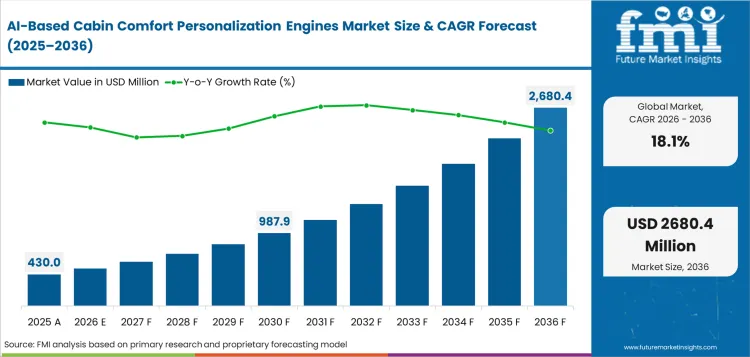
Key Takeaways, Market Size, and Forecast
- The AI-based cabin comfort personalization engines market was valued at USD 430.0 million in 2025.
- By 2036, the AI-based cabin comfort personalization engines market is expected to be worth USD 2,680.4 million.
- From 2026 to 2036, the market is projected to expand at 18.1% CAGR.
- The market is projected to create an incremental opportunity of USD 2.17 billion between 2026 and 2036.
- Thermal comfort engines are projected to account for 36.0% share of engine type demand in 2026.
- Embedded software is expected to account for 48.0% share of delivery model demand in 2026.
- China at 20.1% CAGR and South Korea at 19.0% CAGR are some of the countries with a considerable demand outlook.
Cabin comfort software is moving from fixed user profiles to context-aware adjustment. The International Energy Agency stated that electric car sales topped 20 million globally in 2025 and reached 25% of new car sales. Electric platforms raise the value of software-defined cabins because climate control and voice assistance can be updated after the vehicle is sold. HARMAN reported in January 2025 that Ready Care monitors cognitive load and breathing rate. Cerence announced in March 2025 that its xUI platform remembers user patterns and gives tailored suggestions from vehicle context. FMI analysis on software defined vehicle focuses on why update-ready cabins need shared control software.
AI-Based Cabin Comfort Personalization Engines Market Definition
The AI-based cabin comfort personalization engines market covers software engines that read cabin inputs and adjust comfort functions in passenger vehicles. Scope includes artificial intelligence models, rules software, personalization profiles and integration layers that control climate, seating, lighting, audio and wellness prompts. The market excludes basic manual controls, general infotainment screens and stand-alone driver monitoring products sold without comfort personalization functions. Revenue covers licensed software, embedded modules, cloud update layers and software bundled with cockpit controllers.
AI-Based Cabin Comfort Personalization Engines Market Inclusions
Market scope includes personalization engines used by OEMs and Tier 1 suppliers for factory-installed comfort systems. Engine type includes thermal comfort engines, occupant context engines, driver profile engines and mood inference engines. Function includes HVAC tuning, seat comfort, lighting scenes, audio settings and wellness prompts. Delivery model includes embedded software, cloud updates, SDK licensing and domain controller bundles. Data input includes camera signals, voice signals, seat sensors, climate sensors and wearable links. Factory programs depend on automotive software stacks that link controllers with user-facing cabin functions.
AI-Based Cabin Comfort Personalization Engines Market Exclusions
Scope does not include consumer mobile apps that only store a driver profile outside the vehicle. Basic seat memory modules are excluded unless they use software logic to change comfort responses from real-time cabin data. Stand-alone driver monitoring cameras are excluded unless their output feeds comfort functions. General infotainment voice assistants are excluded when they do not control cabin comfort actions.
AI-Based Cabin Comfort Personalization Engines Market Research Methodology
- Primary Research: FMI analysts reviewed OEM cockpit requirements, supplier roadmaps, software integration work and feedback from automotive electronics buyers.
- Desk Research: The study used public data from energy agencies, transport regulators, national statistics bodies and company technical releases.
- Market sizing and forecasting: Market size was estimated using bottom-up software value per vehicle and top-down cockpit software spending checks.
- Data validation: Forecast checks compared electric vehicle sales, connected vehicle readiness, driver monitoring rules and supplier cockpit controller activity.
Why is the AI-Based Cabin Comfort Personalization Engines Market Growing?
- OEMs are connecting climate control and seat settings to profile data so drivers receive fewer manual adjustments.
- Cabin sensing is turning safety data into a comfort signal when the system can respond with softer interventions.
- Voice and multimodal assistants are making comfort commands easier to use while the vehicle is moving.
Comfort personalization is gaining attention because electric cars make cabin energy use more visible to drivers. The International Energy Agency reported that electric car sales exceeded 20 million in 2025 and reached 25% of total car sales. Climate software can lower unnecessary heating or cooling while keeping occupants comfortable. It gives OEMs a clear reason to treat comfort logic as part of the software-defined vehicle stack. Comfort logic gains more value inside connected vehicle technology programs as vehicles exchange data after delivery.
Safety regulation is another factor driving the adoption of comfort software. The National Highway Traffic Safety Administration added four new driver-assistance technologies to its New Car Assessment Program roadmap in November 2024. Euro NCAP also maintains occupant monitoring and driver engagement protocols in its safe driving work. These signals make cabin state detection a normal part of vehicle design and help comfort engines use verified inputs. Driver monitoring systems help turn safety inputs into verified driver state signals for comfort logic.
Market Segmentation Analysis
- Thermal comfort engines are projected to reach 36.0% share in 2026 as climate control is the main repeat comfort action.
- HVAC tuning is expected to represent 34.0% share in 2026 because heating and cooling have clear user value.
- Premium passenger cars are forecast to account for 42.0% share in 2026 due to higher cabin feature content.
- Embedded software is projected to capture 48.0% share in 2026 as OEMs prefer functions that stay inside vehicle controllers.
- Camera signals are estimated to account for 31.0% share of data input demand in 2026 as cabin monitoring rises. Cabin radar sensors can support presence sensing when cameras have visibility limits.
The market is divided into six primary segment groups based on engine type, function, vehicle type, delivery model, data input and interaction layer. Engine type explains how the software makes a comfort decision. Function shows which cabin feature changes after the decision. Vehicle type identifies where OEMs can recover software cost first. Delivery model explains how the engine is supplied and updated.
Insights into the Thermal Comfort Engines Engine Type Segment
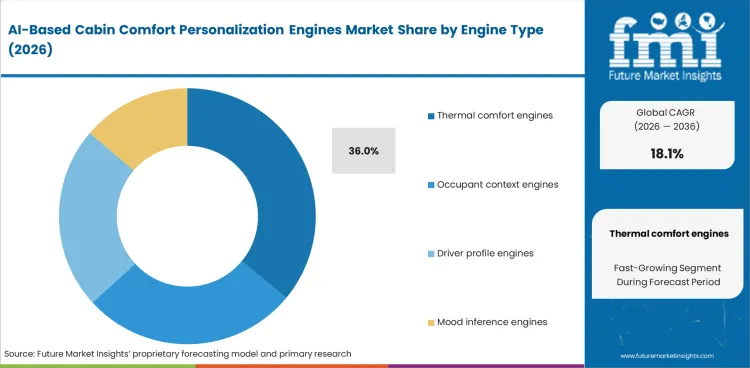
- Thermal comfort engines are projected to account for 36.0% share of engine type demand in 2026. Cabin climate is the first comfort area where software can combine passenger preference and battery range needs.
- Occupant context engines and driver profile engines address broader cabin use. Thermal engines lead because the output is immediate and easy for passengers to feel.
Insights into the HVAC Tuning Function Segment
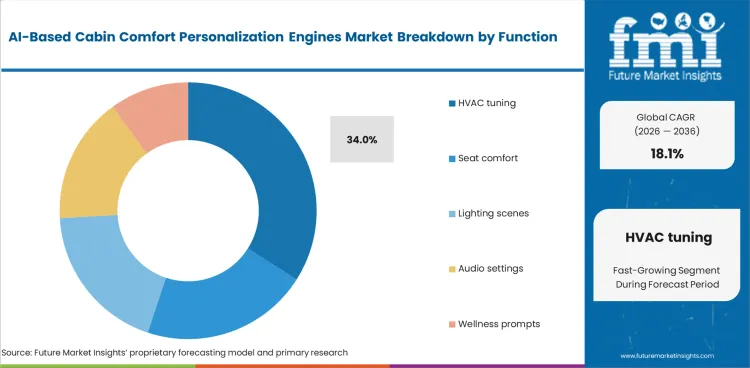
- HVAC tuning is expected to represent 34.0% share of function demand in 2026. Electric vehicle owners notice climate load because heating and cooling can affect range.
- Seat comfort and lighting scenes follow because they depend on trim level and hardware availability. HVAC tuning has a wider base across vehicle classes.
Insights into the Premium Passenger Cars Vehicle Type Segment
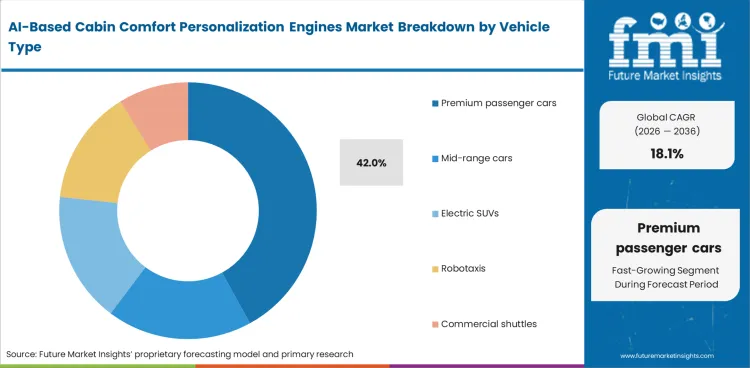
- Premium passenger cars are forecast to account for 42.0% share of vehicle type demand in 2026. Higher trim cabins can absorb cameras, microphones and seat sensors before lower-price vehicles.
- Mid-range passenger cars will follow as cockpit controllers become more common. Robotaxis and shuttles use similar logic but adoption depends on fleet contracts.
Insights into the Embedded Software Delivery Model Segment
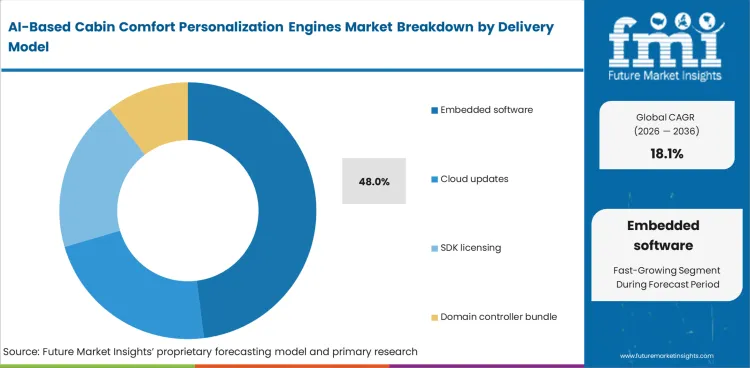
- Embedded software is projected to account for 48.0% share of delivery model demand in 2026. Automakers prefer cabin actions that work even when connectivity is weak.
- Cloud updates and SDK licensing remain important for feature refresh. Embedded delivery leads because comfort decisions must be fast and predictable.
Insights into the Camera Signals Data Input Segment
- Camera signals are estimated to account for 31.0% share of data input demand in 2026. Cabin cameras can support driver state and occupant context with one hardware path. In cabin monitoring systems cover similar driver and occupant behavior signals used by comfort engines.
- Voice signals and seat sensors fill gaps that cameras cannot address. Suppliers need consent logic and privacy controls before camera-based comfort features can scale.
Insights into the Automatic Interaction Layer Segment
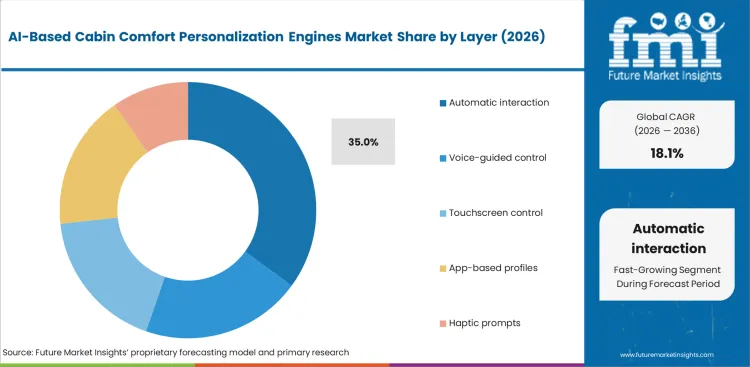
- Automatic interaction is projected to hold 35.0% share of interaction layer demand in 2026. Drivers want the cabin to adjust without repeated menu actions when the system has enough confidence. The interaction logic follows automotive human-machine interface work inside digital cockpit programs.
- Voice-guided control remains important because it gives users final control. Automatic comfort logic wins when the change is small and easily reversible.
AI-Based Cabin Comfort Personalization Engines Market Drivers, Restraints, and Opportunities
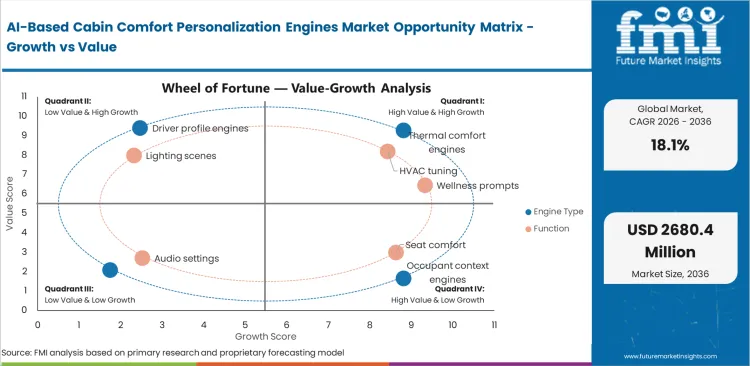
- Cabin sensing rules are raising the value of driver state inputs for comfort decisions.
- Privacy review slows scale because comfort engines process personal signals inside the vehicle.
- Embedded assistant platforms create opportunity as OEMs seek branded cabin experiences.
Cabin comfort personalization is expanding because vehicles now collect more useful interior signals. In March 2025, Magna highlighted AI-led interior cabin technologies that use cameras, radar and biometric sensors to support comfort personalization. The company said these systems can recognize occupants and adjust seating positions and infotainment options. This is important because comfort actions can stay soft and supportive instead of becoming warning-only features. Suppliers that prove closed-loop behavior gain access to climate and audio control paths.
Privacy Review Is Slowing Scale
The main restraint is the handling of personal cabin data. Camera inputs, voice signals and biometric indicators need consent rules that are clear to drivers. OEMs often avoid features that create privacy risk without a visible comfort benefit. Suppliers must show local processing and data minimization before broad platform use.
Embedded Assistants Create Module Value
A lucrative opportunity is in engines that combine voice and comfort control in one vehicle-grade module. For instance, Cerence said in April 2025 that its multimodal edge model can use interior and exterior camera feeds with in-car context. That type of setup allows OEMs to personalize comfort without sending every interaction to the cloud. That assistant layer is close to in-vehicle generative AI platforms used for in-car conversation.
Analysis of AI-Based Cabin Comfort Personalization Engines Market by Key Countries
.webp "Top Country Growth Comparison Ai Based Cabin Comfort Personalization Engines Market Cagr (2026 2036)")
| Country | CAGR |
|---|---|
| United States | 16.4% |
| China | 20.1% |
| India | 18.6% |
| Germany | 17.2% |
| Japan | 16.8% |
| South Korea | 19.0% |
| United Kingdom | 16.0% |
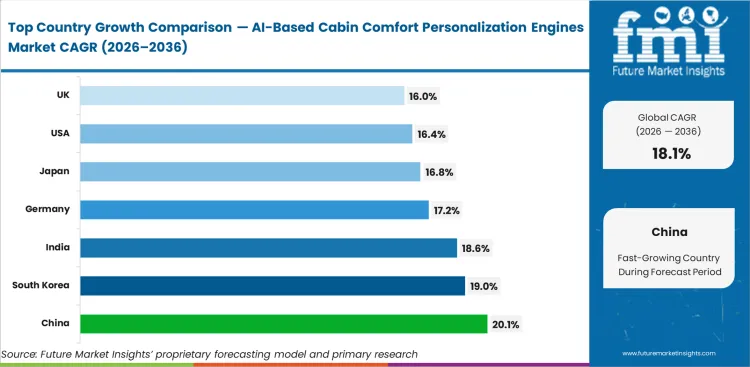
Source: Future Market Insights, 2026.
AI-Based Cabin Comfort Personalization Engines Market CAGR Analysis by Country
- China is expected to post 20.1% CAGR by 2036 as electric vehicle software and cockpit feature updates move together.
- South Korea is projected to record 19.0% CAGR by 2036 as electronics suppliers support cabin sensors and cockpit compute.
- India is forecast at 18.6% CAGR by 2036 as software-defined cockpit production expands from premium electric SUVs.
- Germany is expected to advance at 17.2% CAGR by 2036 as premium OEMs focus on comfort experience differentiation.
- The United States and United Kingdom remain notable software markets, with 16.4% CAGR and 16.0% CAGR based on connected vehicle demand.
Demand for AI-based cabin comfort personalization engines is forecast to rise at 18.1% CAGR from 2026 to 2036. Country-level analysis covers markets where electric vehicle sales, cockpit electronics and software-defined vehicle programs support early adoption.
Demand Outlook for AI-Based Cabin Comfort Personalization Engines Market in the United States
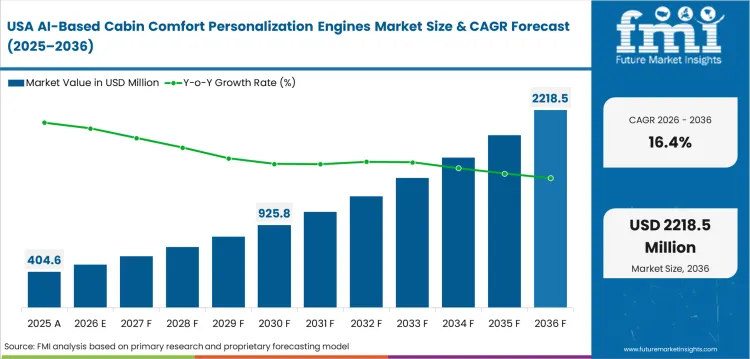
The United States has a large connected vehicle base and a deep software supplier pool. The United States is projected to record a 16.4% CAGR through 2036 as OEMs connect driver-assistance roadmaps with cabin experience upgrades. The United States Census Bureau reported that new orders for manufactured goods reached USD 630.4 billion in March 2026. That industrial base supports cockpit controller sourcing and software validation work for North American vehicle programs.
- Michigan vehicle programs can use personalization engines in premium electric SUVs and pickup interiors.
- California software suppliers can test voice, profile and wellness logic near connected vehicle development centers.
- Texas and Tennessee assembly clusters need Tier 1 support for embedded comfort software and update testing.
Sales Analysis of AI-Based Cabin Comfort Personalization Engines Market in China
China is expected to expand at 20.1% CAGR through 2036 as electric vehicle scale and in-cabin software development move together. The International Energy Agency reported that China sold more than 11 million electric cars in 2024. Domestic brands compete on cockpit experience and voice control as much as exterior styling.
- Shanghai cockpit teams can integrate artificial intelligence assistants with climate and seat functions.
- Shenzhen electronics suppliers can support cameras, microphones and cockpit chips for fast platform refresh.
- Hefei and Chongqing electric vehicle plants create repeat demand for embedded comfort software modules.
Demand Outlook for AI-Based Cabin Comfort Personalization Engines Market in India
Premium electric SUVs are creating the first Indian route for cabin personalization software. India is forecast to grow at 18.6% CAGR through 2036 as domestic OEMs add voice and comfort features to higher trims. The International Energy Agency stated that electric car sales in India grew 45% year on year in the first quarter of 2025 and neared 35,000 units. Suppliers that localize noise handling and language recognition are likely to have a clearer path to volume.
- Chennai cockpit electronics capacity supports software-defined controller production for local and export programs.
- Pune and Bengaluru software teams can build occupant profiles and voice logic for Indian driving conditions.
- Noida and Gurugram OEM centers need privacy review and validation support before cabin cameras scale.
Opportunity Analysis of AI-Based Cabin Comfort Personalization Engines Market in Germany
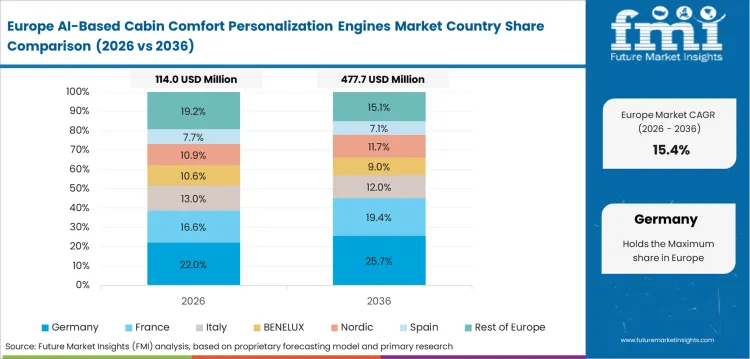
German premium OEMs treat cabin comfort as part of brand experience and vehicle software identity. Germany is expected to advance at 17.2% CAGR through 2036 as high-value interiors use comfort logic to differentiate electric models. The German Federal Statistical Office reported that 380,609 of 2,817,331 newly registered passenger cars in 2024 were electric. Faster growth depends on electric model launches and clearer user value beyond basic climate automation.
- Stuttgart OEM programs can connect seat comfort and thermal control in premium vehicle launches.
- Munich software teams can test artificial intelligence assistants against brand voice and safety rules.
- Lower Saxony and Saxony suppliers can support cockpit integration for electric vehicle platforms.
Future Outlook for AI-Based Cabin Comfort Personalization Engines Market in Japan
Japan is forecast to grow at 16.8% CAGR through 2036 as premium electronics knowledge meets conservative vehicle validation. Automakers in Japan will adopt cabin comfort engines after suppliers prove reliability and low distraction risk. Japan Automobile Manufacturers Association reported 321,000 new imported vehicles in Japan in 2024, up 3.0% from 2023. Japanese OEMs can use personalization to improve user comfort while keeping control interfaces simple.
- Tokyo software and electronics groups can test artificial intelligence voice logic for multilingual cabin use.
- Nagoya automotive suppliers can integrate comfort engines with seat, lighting and climate modules.
- Fukuoka electronics sites can support sensor validation and in-cabin signal processing.
Sales Analysis of AI-Based Cabin Comfort Personalization Engines Market in South Korea
South Korea is projected to rise at 19.0% CAGR through 2036 as electronics, displays and vehicle software are closely linked. Domestic suppliers can connect cabin screens with sensors and comfort logic inside the same user experience. The International Trade Administration said South Korea's electric vehicle share was projected to reach 20% of vehicle sales by the end of 2025. Korean cockpit suppliers can use export platforms to serve Europe and North America with update-ready modules.
- Seoul software teams can develop personalized assistant logic for export vehicle programs.
- Gyeonggi electronics clusters can support cabin displays, microphones and driver state inputs.
- Ulsan vehicle production creates a route for factory-installed comfort personalization in electric models.
Future Outlook for AI-Based Cabin Comfort Personalization Engines Market in the United Kingdom
The United Kingdom has a smaller vehicle production base but a useful software and premium engineering pool. The United Kingdom is expected to post 16.0% CAGR through 2036 as connected vehicle testing and premium vehicle programs create selective demand. The International Energy Agency reported that electric cars represented 30% of cars sold in the United Kingdom in the first quarter of 2025. Suppliers that work with engineering consultancies are expected to reach niche programs before broad OEM scale.
- Midlands engineering centers can test cabin comfort logic for premium and specialist vehicles.
- London software groups can support privacy design and voice assistant integration.
- Oxford and Cambridge technology networks can develop multimodal cabin prototypes for OEM trials.
Competitive Landscape and Strategic Positioning
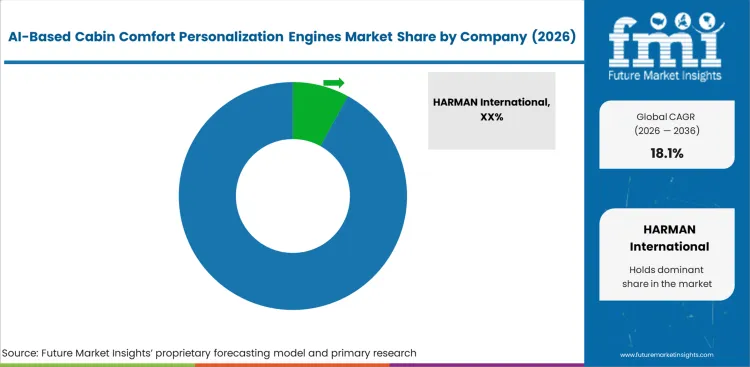
- The market is concentrated around cabin software logic, not around display size alone.
- HARMAN and Cerence shape the personalization layer through driver state and voice assistant platforms.
- Bosch and Aptiv compete through cockpit compute and integration with vehicle controllers.
- Entry barriers include privacy handling, OEM validation, real-time response and vehicle-grade software support.
Supplier competition is shifting toward closed-loop comfort logic. HARMAN is one of the key players which offer driver state monitoring connected with comfort interventions. Cerence has a different position through voice and multimodal assistant software. The winning supplier will connect sensing, interpretation and comfort action without asking the driver to manage more menus.
Compute suppliers have a second route into the sector. Bosch stated that its artificial intelligence extension platform adds 150 to 200 tera operations per second of compute power for in-cabin applications. Aptiv expanded its Chennai plant in August 2024 to produce software-defined cockpit controllers. These moves show that personalization engines need both software models and vehicle-grade hardware support. Cockpit validation also uses infotainment system UX and latency test platforms for connected vehicles.
OEM selection will depend on how safely the engine changes the cabin. A comfort prompt must be useful but not distracting. A climate adjustment must feel accurate but remain easy to override. Suppliers that document these rules can move from demonstrations into vehicle programs.
Key Companies in the AI-Based Cabin Comfort Personalization Engines Market
Competition is best read by role because sensing, assistant software and cockpit compute are not the same capability.
- Cabin Intelligence Specialists: HARMAN International and Cerence Inc. focus on driver state/voice and tailored in-cabin interaction. Their strengths are in user behavior interpretation and software integration.
- Cockpit Compute Integrators: Robert Bosch GmbH, Aptiv PLC and Continental AG are better placed where OEMs need domain controllers and vehicle-grade software support. Their value sits in reliability and platform reach.
- Interior Systems and Electronics Groups: Hyundai Mobis and LG Electronics support the ecosystem through cockpit modules, displays and connected cabin hardware. Their role is clearer where comfort software must link with interior systems.
Competitive Benchmarking: AI-Based Cabin Comfort Personalization Engines Market
| Company | Cabin AI Logic | Cockpit Integration | OEM Validation Support | Geographic Footprint |
|---|---|---|---|---|
| HARMAN International | Strong | Strong | Strong | Global with Samsung technology links and OEM cockpit access |
| Cerence Inc. | Strong | Medium | Strong | Global voice assistant base with automaker relationships |
| Robert Bosch GmbH | Medium | Strong | Strong | Europe centered with global cockpit compute reach |
| Aptiv PLC | Medium | Strong | Strong | Global with India cockpit controller expansion |
| Continental AG | Medium | Strong | Medium | Europe centered with displays and cabin systems |
| Hyundai Mobis | Medium | Medium | Strong | South Korea centered with vehicle interior electronics depth |
| LG Electronics | Medium | Medium | Medium | South Korea centered with display and mobility platform reach |
| Visteon Corporation | Medium | Medium | Medium | Global digital cockpit supplier with software integration depth |
| FORVIA | Low | Medium | Strong | Europe centered with seating and interior systems access |
| Gentherm Incorporated | Low | Medium | Medium | North America centered with thermal comfort technology |
Source: Future Market Insights competitive analysis, 2026. Ratings reflect relative positioning based on cabin logic, cockpit integration and OEM validation support.
Key Developments in AI-Based Cabin Comfort Personalization Engines Market
- In March 2025, Cerence debuted xUI as a hybrid voice assistant platform using cloud and embedded language models. The system remembers individual preferences and tailors suggestions based on user patterns and vehicle context.
- In April 2025, Cerence and MediaTek announced multimodal language models running on edge hardware with NVIDIA support. The setup can use car sensor data and cabin camera feeds for personalized multi-seat interaction.
- In July 2025, Cerence said Mahindra selected Cerence Audio AI for electric-origin SUVs. The system supports clearer in-car voice interaction in noisy road conditions.
Key Players in the AI-Based Cabin Comfort Personalization Engines Market
Major Global Players:
- HARMAN International
- Cerence Inc.
- Robert Bosch GmbH
- Aptiv PLC
- Continental AG
- Hyundai Mobis
Specialist and Regional Players:
- LG Electronics
- Visteon Corporation
- FORVIA
- Gentherm Incorporated
Report Scope and Coverage
| Parameter | Details |
|---|---|
| Quantitative Units | USD 507.8 million to USD 2,680.4 million, at 18.1% CAGR |
| Market Definition | Software engines that adjust vehicle cabin comfort from real-time cabin inputs |
| Engine Type | Thermal comfort engines, Occupant context engines, Driver profile engines, Mood inference engines |
| Function | HVAC tuning, Seat comfort, Lighting scenes, Audio settings, Wellness prompts |
| Vehicle Type | Premium passenger cars, Mid-range cars, Electric SUVs, Robotaxis, Commercial shuttles |
| Delivery Model | Embedded software, Cloud updates, SDK licensing, Domain controller bundle |
| Data Input | Camera signals, Voice signals, Seat sensors, Climate sensors, Wearable links |
| Interaction Layer | Automatic interaction, Voice-guided control, Touchscreen control, App-based profiles, Haptic prompts |
| Regions Covered | North America, Latin America, Western Europe, Eastern Europe, East Asia, South Asia and Pacific, Middle East and Africa |
| Countries Covered | United States, China, India, Germany, Japan, South Korea, United Kingdom and 30+ countries |
| Key Companies Profiled | HARMAN International, Cerence Inc., Robert Bosch GmbH, Aptiv PLC, Continental AG, Hyundai Mobis, LG Electronics, Visteon Corporation, FORVIA, Gentherm Incorporated |
| Forecast Period | 2026 to 2036 |
| Approach | Hybrid bottom-up and top-down methodology using software value per vehicle, cockpit controller checks and supplier activity |
Source: Future Market Insights, 2026.
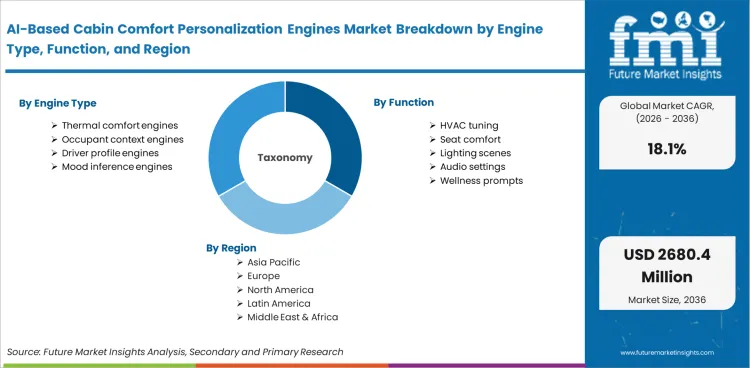
AI-Based Cabin Comfort Personalization Engines Market Breakdown by Engine Type, Function, Vehicle Type, Delivery Model, Data Input, Interaction Layer, and Region
AI-Based Cabin Comfort Personalization Engines Market Segmented by Engine Type:
- Thermal comfort engines
- Occupant context engines
- Driver profile engines
- Mood inference engines
AI-Based Cabin Comfort Personalization Engines Market Segmented by Function:
- HVAC tuning
- Seat comfort
- Lighting scenes
- Audio settings
- Wellness prompts
AI-Based Cabin Comfort Personalization Engines Market Segmented by Vehicle Type:
- Premium passenger cars
- Mid-range cars
- Electric SUVs
- Robotaxis
- Commercial shuttles
AI-Based Cabin Comfort Personalization Engines Market Segmented by Delivery Model:
- Embedded software
- Cloud updates
- SDK licensing
- Domain controller bundle
AI-Based Cabin Comfort Personalization Engines Market Segmented by Data Input:
- Camera signals
- Voice signals
- Seat sensors
- Climate sensors
- Wearable links
AI-Based Cabin Comfort Personalization Engines Market Segmented by Interaction Layer:
- Automatic interaction
- Voice-guided control
- Touchscreen control
- App-based profiles
- Haptic prompts
AI-Based Cabin Comfort Personalization Engines Market by Region:
Region:
- North America
- United States
- Canada
- Europe
- Germany
- United Kingdom
- France
- Italy
- Spain
- Asia Pacific
- China
- Japan
- South Korea
- Taiwan
- Singapore
- Latin America
- Brazil
- Mexico
- Argentina
- Middle East & Africa
- GCC Countries
- South Africa
- Israel
Research Sources and Bibliography
- International Energy Agency. (2026, May). Trends in electric cars - Global EV Outlook 2026.
- International Energy Agency. (2025, May). Trends in electric car markets - Global EV Outlook 2025.
- National Highway Traffic Safety Administration. (2024, November 18). New Car Assessment Program final decision notice - Advanced Driver Assistance Systems and Roadmap.
- European New Car Assessment Programme. (2025). Safe Driving protocols and technical bulletins.
- United States Census Bureau. (2026, May 4). Monthly full report on manufacturers shipments, inventories and orders: March 2026.
- German Federal Statistical Office. (2025, September 8). Electric cars: low number of new registrations in Germany.
- HARMAN International. (2024, January 8). HARMAN expands Road-Ready product portfolio at CES 2024.
- HARMAN International. (2025, January 6). HARMAN redefines in-cabin experiences, turning cars into intelligent companions.
- Robert Bosch GmbH. (2026). AI in the car: Bosch presents cockpit innovations at CES 2026 in Las Vegas.
- Aptiv PLC. (2024, August 13). Aptiv expands Chennai plant to produce fully integrated software-defined cockpit solutions.
- Cerence Inc. (2025, March 13). Cerence AI debuts xUI, its hybrid LLM-based platform.
- Cerence Inc. (2025, April 23). Cerence AI and MediaTek partner to introduce multimodal language models running on the edge.
- Cerence Inc. (2024, July 29). smart and Cerence collaborate to create generative AI-powered in-car experience.
- International Trade Administration. (2025, July 21). South Korea electric vehicles EV market.
- Japan Automobile Manufacturers Association. (2025, September 26). The motor industry of Japan 2025.
The bibliography is provided for reader reference and uses government, intergovernmental, safety assessment and company sources relevant to cabin software, electric vehicle demand and cockpit integration.
This Report Answers
- What is the current and future size of the AI-based cabin comfort personalization engines market?
- How fast is the AI-based cabin comfort personalization engines market expected to expand between 2026 and 2036?
- Which engine type is expected to lead AI-based cabin comfort personalization demand by 2026?
- Which function is projected to account for the largest AI-based cabin comfort personalization share in 2026?
- Why are HVAC tuning and seat comfort important for this market?
- How do privacy rules and cabin sensing affect artificial intelligence comfort engines?
- Which countries are projected to record faster expansion during the forecast period?
- Who are the main companies active in AI-based cabin comfort personalization and related cockpit software?
- How does FMI define the AI-based cabin comfort personalization engines market scope?
- How does FMI estimate and validate the AI-based cabin comfort personalization engines forecast?
Frequently Asked Questions
What is the global market demand for AI-Based Cabin Comfort Personalization Engines in 2026?
In 2026, the global AI-based cabin comfort personalization engines market is expected to be worth USD 507.8 million as cockpit software gains wider OEM use.
How big will the AI-Based Cabin Comfort Personalization Engines Market be in 2036?
By 2036, the AI-based cabin comfort personalization engines market is expected to reach USD 2,680.4 million as software-defined cabins expand.
How much is demand for AI-Based Cabin Comfort Personalization Engines expected to expand between 2026 and 2036?
Demand is projected to expand at 18.1% CAGR from 2026 to 2036 as comfort logic moves into embedded cockpit software.
Which segment is expected to hold the leading share of AI-Based Cabin Comfort Personalization Engines demand?
Thermal comfort engines are projected to hold 36.0% share in 2026 because climate control is the most frequent comfort action.
Which country is expected to grow fastest in the AI-Based Cabin Comfort Personalization Engines Market?
China is expected to post 20.1% CAGR through 2036 as electric vehicle platforms and local cockpit software scale together.
Who are key companies in the AI-Based Cabin Comfort Personalization Engines Market?
Key companies include HARMAN International, Cerence Inc., Robert Bosch GmbH, Aptiv PLC, Continental AG, Hyundai Mobis and LG Electronics.
What is included in the AI-Based Cabin Comfort Personalization Engines Market scope?
The scope includes software engines that adjust climate, seating, lighting, audio and wellness prompts using real-time cabin inputs.
Preview the report firsthand - request a free sample
Get SampleGet the brochure for pricing and purchase details.
Get PDFTable of Content
- Key Takeaways
- Market Size and CAGR
- Top Growth Driver
- Fastest Growing Segment
- Leading Region
- Key Companies
- Emerging Opportunities
- Executive Summary
- Global Market Outlook
- Demand-side Trends
- Supply-side Trends
- Technology Roadmap Analysis
- Analysis and Recommendations
- Analyst Perspective (What is happening? Why now? What should investors know?)
- Key Questions Answered
- How large is the market?
- What is the CAGR?
- What are key trends?
- Which region dominates?
- Who are the leaders?
- Market Overview
- Market Coverage / Taxonomy
- Market Definition / Scope / Limitations
- Research Methodology
- Chapter Orientation
- Analytical Lens and Working Hypotheses
- Market Structure, Signals, and Trend Drivers
- Benchmarking and Cross-market Comparability
- Market Sizing, Forecasting, and Opportunity Mapping
- Research Design and Evidence Framework
- Desk Research Programme (Secondary Evidence)
- Expert Input and Fieldwork (Primary Evidence)
- Tooling, Models, and Reference Databases
- Data Engineering and Model Build
- Quality Assurance and Audit Trail
- Market Background
- Market Dynamics (Drivers, Restraints, Opportunity, Trends)
- Scenario Forecast (Optimistic, Likely, Conservative)
- Impact Analysis
- AI Impact
- Sustainability Impact
- Regulatory Impact
- Technology Impact
- Consumer / Buyer Analysis
- Purchase Drivers
- Adoption Barriers
- Buyer Journey
- Opportunity Map Analysis
- Product Life Cycle Analysis
- Supply Chain Analysis
- Investment Feasibility Matrix
- Value Chain Analysis
- PESTLE and Porter's Analysis
- Regulatory Landscape
- Regional Parent Market Outlook
- Production and Consumption Statistics
- Import and Export Statistics
- Global Market Analysis and Forecast, 2021 to 2036
- Historical Market Size Value (USD Million) & Volume (Unit) Analysis, 2021 to 2025
- Current and Future Market Size Value (USD Million) & Volume (Unit) Projections, 2026 to 2036
- Y-o-Y Growth Trend Analysis
- Absolute $ Opportunity Analysis
- Global Market Pricing Analysis, 2021 to 2036
- Global Market Analysis and Forecast, By Engine Type, 2021 to 2036
- Introduction / Key Findings
- Historical Market Size Value (USD Million) & Volume (Unit) Analysis By Engine Type, 2021 to 2025
- Current and Future Market Size Value (USD Million) & Volume (Unit) Analysis and Forecast By Engine Type, 2026 to 2036
- Thermal comfort engines
- Occupant context engines
- Driver profile engines
- Mood inference engines
- Thermal comfort engines
- Y-o-Y Growth Trend Analysis By Engine Type, 2021 to 2025
- Absolute $ Opportunity Analysis By Engine Type, 2026 to 2036
- Global Market Analysis and Forecast, By Function, 2021 to 2036
- Introduction / Key Findings
- Historical Market Size Value (USD Million) & Volume (Unit) Analysis By Function, 2021 to 2025
- Current and Future Market Size Value (USD Million) & Volume (Unit) Analysis and Forecast By Function, 2026 to 2036
- HVAC tuning
- Seat comfort
- Lighting scenes
- Audio settings
- Wellness prompts
- HVAC tuning
- Y-o-Y Growth Trend Analysis By Function, 2021 to 2025
- Absolute $ Opportunity Analysis By Function, 2026 to 2036
- Global Market Analysis and Forecast, By Vehicle Type, 2021 to 2036
- Introduction / Key Findings
- Historical Market Size Value (USD Million) & Volume (Unit) Analysis By Vehicle Type, 2021 to 2025
- Current and Future Market Size Value (USD Million) & Volume (Unit) Analysis and Forecast By Vehicle Type, 2026 to 2036
- Premium passenger cars
- Mid-range cars
- Electric SUVs
- Robotaxis
- Commercial shuttles
- Premium passenger cars
- Y-o-Y Growth Trend Analysis By Vehicle Type, 2021 to 2025
- Absolute $ Opportunity Analysis By Vehicle Type, 2026 to 2036
- Global Market Analysis and Forecast, By Delivery Model, 2021 to 2036
- Introduction / Key Findings
- Historical Market Size Value (USD Million) & Volume (Unit) Analysis By Delivery Model, 2021 to 2025
- Current and Future Market Size Value (USD Million) & Volume (Unit) Analysis and Forecast By Delivery Model, 2026 to 2036
- Embedded software
- Cloud updates
- SDK licensing
- Domain controller bundle
- Embedded software
- Y-o-Y Growth Trend Analysis By Delivery Model, 2021 to 2025
- Absolute $ Opportunity Analysis By Delivery Model, 2026 to 2036
- Global Market Analysis and Forecast, By Data Input, 2021 to 2036
- Introduction / Key Findings
- Historical Market Size Value (USD Million) & Volume (Unit) Analysis By Data Input, 2021 to 2025
- Current and Future Market Size Value (USD Million) & Volume (Unit) Analysis and Forecast By Data Input, 2026 to 2036
- Camera signals
- Voice signals
- Seat sensors
- Climate sensors
- Wearable links
- Camera signals
- Y-o-Y Growth Trend Analysis By Data Input, 2021 to 2025
- Absolute $ Opportunity Analysis By Data Input, 2026 to 2036
- Global Market Analysis and Forecast, By Interaction Layer
- Introduction / Key Findings
- Historical Market Size Value (USD Million) & Volume (Unit) Analysis By Interaction Layer, 2021 to 2025
- Current and Future Market Size Value (USD Million) & Volume (Unit) Analysis and Forecast By Interaction Layer, 2026 to 2036
- Automatic interaction
- Voice-guided control
- Touchscreen control
- App-based profiles
- Haptic prompts
- Automatic interaction
- Y-o-Y Growth Trend Analysis By Interaction Layer, 2021 to 2025
- Absolute $ Opportunity Analysis By Interaction Layer, 2026 to 2036
- Global Market Analysis and Forecast, By Region, 2021 to 2036
- Introduction
- Historical Market Size Value (USD Million) & Volume (Unit) Analysis By Region, 2021 to 2025
- Current Market Size Value (USD Million) & Volume (Unit) Analysis and Forecast By Region, 2026 to 2036
- North America
- Latin America
- Western Europe
- Eastern Europe
- East Asia
- South Asia and Pacific
- Middle East & Africa
- Market Attractiveness Analysis By Region
- North America Market Analysis and Forecast, By Country, 2021 to 2036
- Historical Market Size Value (USD Million) & Volume (Unit) Trend Analysis By Market Taxonomy, 2021 to 2025
- Market Size Value (USD Million) & Volume (Unit) Forecast By Market Taxonomy, 2026 to 2036
- By Country
- USA
- Canada
- Mexico
- By Engine Type
- By Function
- By Vehicle Type
- By Delivery Model
- By Data Input
- By Interaction Layer
- By Country
- Market Attractiveness Analysis
- By Country
- By Engine Type
- By Function
- By Vehicle Type
- By Delivery Model
- By Data Input
- By Interaction Layer
- Key Takeaways
- Latin America Market Analysis and Forecast, By Country
- Historical Market Size Value (USD Million) & Volume (Unit) Trend Analysis By Market Taxonomy, 2021 to 2025
- Market Size Value (USD Million) & Volume (Unit) Forecast By Market Taxonomy, 2026 to 2036
- By Country
- Brazil
- Chile
- Rest of Latin America
- By Engine Type
- By Function
- By Vehicle Type
- By Delivery Model
- By Data Input
- By Interaction Layer
- By Country
- Market Attractiveness Analysis
- By Country
- By Engine Type
- By Function
- By Vehicle Type
- By Delivery Model
- By Data Input
- By Interaction Layer
- Key Takeaways
- Western Europe Market Analysis and Forecast, By Country
- Historical Market Size Value (USD Million) & Volume (Unit) Trend Analysis By Market Taxonomy, 2021 to 2025
- Market Size Value (USD Million) & Volume (Unit) Forecast By Market Taxonomy, 2026 to 2036
- By Country
- Germany
- UK
- Italy
- Spain
- France
- Nordic
- BENELUX
- Rest of Western Europe
- By Engine Type
- By Function
- By Vehicle Type
- By Delivery Model
- By Data Input
- By Interaction Layer
- By Country
- Market Attractiveness Analysis
- By Country
- By Engine Type
- By Function
- By Vehicle Type
- By Delivery Model
- By Data Input
- By Interaction Layer
- Key Takeaways
- Eastern Europe Market Analysis and Forecast, By Country
- Historical Market Size Value (USD Million) & Volume (Unit) Trend Analysis By Market Taxonomy, 2021 to 2025
- Market Size Value (USD Million) & Volume (Unit) Forecast By Market Taxonomy, 2026 to 2036
- By Country
- Russia
- Poland
- Hungary
- Balkan & Baltic
- Rest of Eastern Europe
- By Engine Type
- By Function
- By Vehicle Type
- By Delivery Model
- By Data Input
- By Interaction Layer
- By Country
- Market Attractiveness Analysis
- By Country
- By Engine Type
- By Function
- By Vehicle Type
- By Delivery Model
- By Data Input
- By Interaction Layer
- Key Takeaways
- East Asia Market Analysis and Forecast, By Country
- Historical Market Size Value (USD Million) & Volume (Unit) Trend Analysis By Market Taxonomy, 2021 to 2025
- Market Size Value (USD Million) & Volume (Unit) Forecast By Market Taxonomy, 2026 to 2036
- By Country
- China
- Japan
- South Korea
- By Engine Type
- By Function
- By Vehicle Type
- By Delivery Model
- By Data Input
- By Interaction Layer
- By Country
- Market Attractiveness Analysis
- By Country
- By Engine Type
- By Function
- By Vehicle Type
- By Delivery Model
- By Data Input
- By Interaction Layer
- Key Takeaways
- South Asia and Pacific Market Analysis and Forecast, By Country
- Historical Market Size Value (USD Million) & Volume (Unit) Trend Analysis By Market Taxonomy, 2021 to 2025
- Market Size Value (USD Million) & Volume (Unit) Forecast By Market Taxonomy, 2026 to 2036
- By Country
- India
- ASEAN
- Australia & New Zealand
- Rest of South Asia and Pacific
- By Engine Type
- By Function
- By Vehicle Type
- By Delivery Model
- By Data Input
- By Interaction Layer
- By Country
- Market Attractiveness Analysis
- By Country
- By Engine Type
- By Function
- By Vehicle Type
- By Delivery Model
- By Data Input
- By Interaction Layer
- Key Takeaways
- Middle East & Africa Market Analysis and Forecast, By Country
- Historical Market Size Value (USD Million) & Volume (Unit) Trend Analysis By Market Taxonomy, 2021 to 2025
- Market Size Value (USD Million) & Volume (Unit) Forecast By Market Taxonomy, 2026 to 2036
- By Country
- Kingdom of Saudi Arabia
- Other GCC Countries
- Türkiye
- South Africa
- Other African Union
- Rest of Middle East & Africa
- By Engine Type
- By Function
- By Vehicle Type
- By Delivery Model
- By Data Input
- By Interaction Layer
- By Country
- Market Attractiveness Analysis
- By Country
- By Engine Type
- By Function
- By Vehicle Type
- By Delivery Model
- By Data Input
- By Interaction Layer
- Key Takeaways
- Key Countries Market Analysis
- USA
- Pricing Analysis
- Market Share Analysis, 2025
- By Engine Type
- By Function
- By Vehicle Type
- By Delivery Model
- By Data Input
- By Interaction Layer
- Canada
- Pricing Analysis
- Market Share Analysis, 2025
- By Engine Type
- By Function
- By Vehicle Type
- By Delivery Model
- By Data Input
- By Interaction Layer
- Mexico
- Pricing Analysis
- Market Share Analysis, 2025
- By Engine Type
- By Function
- By Vehicle Type
- By Delivery Model
- By Data Input
- By Interaction Layer
- Brazil
- Pricing Analysis
- Market Share Analysis, 2025
- By Engine Type
- By Function
- By Vehicle Type
- By Delivery Model
- By Data Input
- By Interaction Layer
- Chile
- Pricing Analysis
- Market Share Analysis, 2025
- By Engine Type
- By Function
- By Vehicle Type
- By Delivery Model
- By Data Input
- By Interaction Layer
- Germany
- Pricing Analysis
- Market Share Analysis, 2025
- By Engine Type
- By Function
- By Vehicle Type
- By Delivery Model
- By Data Input
- By Interaction Layer
- UK
- Pricing Analysis
- Market Share Analysis, 2025
- By Engine Type
- By Function
- By Vehicle Type
- By Delivery Model
- By Data Input
- By Interaction Layer
- Italy
- Pricing Analysis
- Market Share Analysis, 2025
- By Engine Type
- By Function
- By Vehicle Type
- By Delivery Model
- By Data Input
- By Interaction Layer
- Spain
- Pricing Analysis
- Market Share Analysis, 2025
- By Engine Type
- By Function
- By Vehicle Type
- By Delivery Model
- By Data Input
- By Interaction Layer
- France
- Pricing Analysis
- Market Share Analysis, 2025
- By Engine Type
- By Function
- By Vehicle Type
- By Delivery Model
- By Data Input
- By Interaction Layer
- India
- Pricing Analysis
- Market Share Analysis, 2025
- By Engine Type
- By Function
- By Vehicle Type
- By Delivery Model
- By Data Input
- By Interaction Layer
- ASEAN
- Pricing Analysis
- Market Share Analysis, 2025
- By Engine Type
- By Function
- By Vehicle Type
- By Delivery Model
- By Data Input
- By Interaction Layer
- Australia & New Zealand
- Pricing Analysis
- Market Share Analysis, 2025
- By Engine Type
- By Function
- By Vehicle Type
- By Delivery Model
- By Data Input
- By Interaction Layer
- China
- Pricing Analysis
- Market Share Analysis, 2025
- By Engine Type
- By Function
- By Vehicle Type
- By Delivery Model
- By Data Input
- By Interaction Layer
- Japan
- Pricing Analysis
- Market Share Analysis, 2025
- By Engine Type
- By Function
- By Vehicle Type
- By Delivery Model
- By Data Input
- By Interaction Layer
- South Korea
- Pricing Analysis
- Market Share Analysis, 2025
- By Engine Type
- By Function
- By Vehicle Type
- By Delivery Model
- By Data Input
- By Interaction Layer
- Russia
- Pricing Analysis
- Market Share Analysis, 2025
- By Engine Type
- By Function
- By Vehicle Type
- By Delivery Model
- By Data Input
- By Interaction Layer
- Poland
- Pricing Analysis
- Market Share Analysis, 2025
- By Engine Type
- By Function
- By Vehicle Type
- By Delivery Model
- By Data Input
- By Interaction Layer
- Hungary
- Pricing Analysis
- Market Share Analysis, 2025
- By Engine Type
- By Function
- By Vehicle Type
- By Delivery Model
- By Data Input
- By Interaction Layer
- Kingdom of Saudi Arabia
- Pricing Analysis
- Market Share Analysis, 2025
- By Engine Type
- By Function
- By Vehicle Type
- By Delivery Model
- By Data Input
- By Interaction Layer
- Türkiye
- Pricing Analysis
- Market Share Analysis, 2025
- By Engine Type
- By Function
- By Vehicle Type
- By Delivery Model
- By Data Input
- By Interaction Layer
- South Africa
- Pricing Analysis
- Market Share Analysis, 2025
- By Engine Type
- By Function
- By Vehicle Type
- By Delivery Model
- By Data Input
- By Interaction Layer
- USA
- Market Structure Analysis
- Competition Dashboard
- Competition Benchmarking
- Market Share Analysis of Top Players
- By Regional
- By Engine Type
- By Function
- By Vehicle Type
- By Delivery Model
- By Data Input
- By Interaction Layer
- Emerging Startups
- Innovation Benchmarking
- Competition Analysis
- Competition Deep Dive
- HARMAN International
- Overview
- Product Portfolio
- Profitability by Market Segments (Product/Region/Sales Channel)
- Sales Footprint
- Strategy Overview
- Marketing Strategy
- Product Strategy
- Channel Strategy
- Cerence Inc.
- Robert Bosch GmbH
- Aptiv PLC
- Continental AG
- Hyundai Mobis
- LG Electronics
- Visteon Corporation
- FORVIA
- Gentherm Incorporated
- HARMAN International
- Case Studies
- Success Stories
- Recent Developments
- Competition Deep Dive
- Assumptions & Acronyms Used


