

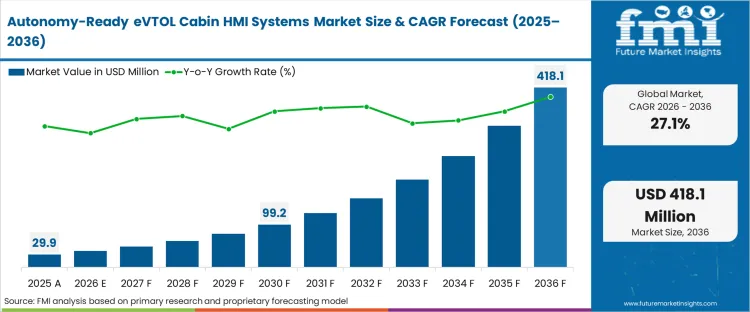
- Industry Size (2026)
- USD 38.0 Mn
- Forecast (2036)
- USD 417.0 Mn
- CAGR (2026 to 2036)
- 27.1%
Autonomy-Ready eVTOL Cabin HMI Systems Market Size, Market Forecast and Outlook By FMI
The autonomy-ready eVTOL cabin HMI systems market assessed to be at USD 29.9 million in 2025 with the industry revenue set to cross USD 38.0 million in 2026 at a CAGR of 27.1% during the forecast period. Propelled by the cumulative buildup resulting with the predicted estimation of USD 417.0 million through 2036 as regulatory bodies mandate dual-redundant manual override architectures prior to approving fully uncrewed commercial operations.
Avionics procurement directors issuing an RFQ for eVTOL cockpit interface systems face a rapidly closing window to select architectures capable of supporting both onboard pilots and remote supervisors. The penalty for miscalculating this transition timeline involves anchoring a multi-million-dollar advanced air mobility fleet to legacy displays that fail to meet forthcoming simplified vehicle operations standards. What standard specification sheets regarding the eVTOL human machine interface market miss is the hidden integration cost associated with migrating a certified cockpit framework to a passenger-facing autonomy dashboard.
Civil aviation authorities defining type-certification pathways trigger the primary structural gate governing the eVTOL cabin HMI market. Once regulators finalize the specific latency tolerances for remote-operator handoff protocols, OEMs will lock down their supplier contracts for urban air autonomous eVTOL. This regulatory threshold transitions prototype testing into scaled commercial production.
Summary of Autonomy-Ready eVTOL Cabin HMI Systems Market
- Autonomy-Ready eVTOL Cabin HMI Systems Market Definition
- Autonomy-ready eVTOL cabin HMI systems constitute the specific hardware and middleware bridging human occupants and flight computers. This category encompasses displays, tactile controls, and data layers facilitating transitions between active piloting and autonomous operation within electric vertical lift aircraft.
- Demand Drivers in the Market
- Type certification authorities compel eVTOL manufacturers to install redundant manual override interfaces before approving passenger operations.
- Weight optimization mandates push chief avionics engineers to consolidate discrete analog instruments into multimodal digital displays.
- Fleet economics require operations managers to procure software architectures capable of eventual upgrade to uncrewed flight without hardware replacement.
- Key Segments Analyzed in the FMI Report
- Pilot-Vehicle Interface Suites: 42.0% in 2026, serving as the foundational requirement for initial piloted operations.
- Touchscreen-First Interfaces: 38.0% in 2026, leveraging weight savings over physical switchgear.
- Pilot-Assist / Supervised Autonomy-Ready Systems: 44.0% in 2026, matching current regulatory willingness to certify active pilot-in-command frameworks.
- Passenger Air Taxi eVTOLS: 57.0% in 2026, representing the primary commercial target for major startups.
- OEM Line-Fit Programs: 69.0% in 2026, as manufacturers lock in their primary type design.
- United Arab Emirates: Expands at a 29.1% CAGR, reflecting sovereign initiatives to launch the earliest commercial air taxi networks.
- Analyst Opinion at FMI
- Nikhil Kaitwade, Principal Analyst, Technology, at FMI, points out, "A working digital interface in the simulator is the easy part of eVTOL development. Earning certification for a single cockpit display that must serve an active pilot today and transition into a passenger information node tomorrow is fundamentally rewriting how we approach human factors engineering. Regulators will not accept a consumer tablet glued to a dashboard. Suppliers failing to deliver an autonomy-ready cockpit HMI for eVTOL platforms will find themselves engineered out of the final type certificate, completely missing the transition to scaled production."
- Strategic Implications / Executive Takeaways
- Avionics suppliers must develop modular software stacks capable of updating to higher autonomy levels without forcing OEMs to rip out physical dashboard hardware.
- eVTOL manufacturers face critical vendor lock-in if they select an eVTOL HMI software platform provider unable to meet future EASA or FAA simplified vehicle operation directives.
- Certification specialists need to establish immediate validation protocols for multimodal inputs, including voice and haptic controls.
- Methodology
- Primary interviews with chief avionics engineers reveal exact transition timelines from piloted to supervised operations.
- Documentation analysis of FAA and EASA special conditions isolates specific hardware redundancy requirements.
- Forecasting models utilize active OEM supplier contracts rather than theoretical production capacity.
- Validation involves tracking physical component deliveries to active flight test programs.
United Arab Emirates leads at 29.1%, supported by aggressive sovereign wealth mandates prioritizing early adoption of passenger drones. China tracks closely at 28.7% based on massive domestic prototype testing scale. Brazil expands at 28.4% as regional manufacturers lock down supply chains for upcoming vehicle launches. United States grows at 27.8% driven by intensive venture capital funding in major air taxi startups. Japan advances at 26.0% ahead of planned global transportation exhibitions. Germany grows at 25.6% based on heavy engineering investments by legacy aerospace suppliers. United Kingdom tracks at 24.8% as safety regulators finalize localized testing corridors. The structural divide separates nations treating these platforms as national infrastructure projects from those restricting adoption to limited airspace test zones.
Autonomy-Ready eVTOL Cabin HMI Systems Market Definition
Autonomy-ready eVTOL cabin HMI systems constitute the integrated hardware and software architectures bridging human operators, passengers, and flight control computers within electric vertical takeoff and landing vehicles. This equipment encompasses physical displays, tactile interfaces, multimodal voice inputs, and the underlying middleware required to manage varying levels of vehicle autonomy. The boundary defines systems specifically engineered to facilitate seamless transitions between onboard piloting, remote supervision, and fully autonomous flight modes within the broader advanced air mobility cabin HMI market.
Autonomy-Ready eVTOL Cabin HMI Systems Market Inclusions
Scope incorporates aerospace avionics specifically adapted for simplified vehicle operations, including eVTOL cockpit display systems modified for unique flight envelopes. Passenger interaction panels facilitating route communication and emergency procedures fall within these parameters. The analysis covers multimodal middleware translating voice or haptic inputs into actionable flight control directives. Evaluation integrates remote-operator handoff interface eVTOL kits designed to transfer command authority smoothly between the physical cabin and ground control stations.
Autonomy-Ready eVTOL Cabin HMI Systems Market Exclusions
Standard commercial aircraft displays lacking autonomy-transition capabilities fall outside the analytical boundary because they cannot handle remote handoff protocols. Basic consumer tablet devices temporarily mounted in prototype cabins are omitted due to failing fundamental aviation HMI certification standards. Ground-based remote pilot stations are excluded because the focus remains strictly on hardware and software residing physically within the aerial vehicle. General passenger entertainment systems lacking safety-critical flight data integration are not considered.
Autonomy-Ready eVTOL Cabin HMI Systems Market Research Methodology
- Primary Research: Chief avionics engineers, eVTOL procurement directors, and flight test safety officers
- Desk Research: EASA and FAA special condition VTOL compliance documentation, type certification applicant filings
- Market-Sizing and Forecasting: OEM stated production targets and active supplier contract valuations
- Data Validation and Update Cycle: Component delivery schedules verified against major urban air mobility flight test systems deployments
Segmental Analysis
Autonomy-Ready eVTOL Cabin HMI Systems Market Analysis By System Type
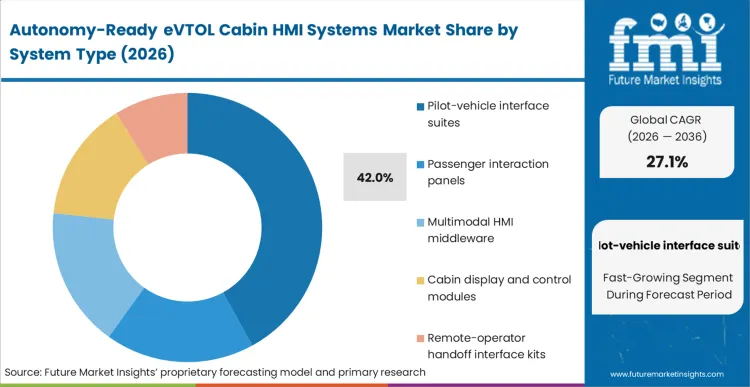
Early commercialization timelines require human pilots aboard initial air taxi fleets, validating the dominant position of primary flight instruments. Pilot-vehicle interface suites command 42.0% share in 2026, reflecting the absolute regulatory necessity for active human command authority during the initial years of commercial service. FMI's analysis indicates this figure actually obscures a deeper structural tension, OEMs are buying these pilot suites under the explicit contractual expectation that the underlying computing architecture can seamlessly absorb remote-operator handoff protocols via software updates later. Procurement directors evaluating urban air mobility HMI solutions avoid systems that lack this forward compatibility. Choosing a closed, legacy avionics architecture forces the aircraft manufacturer into a massive recertification program when the industry eventually pivots to uncrewed operations. Fleet operators acquiring aircraft with rigid pilot-only interfaces will face severe asset depreciation the moment supervised autonomy receives blanket regulatory approval.
- Initial Certification Baseline: Active piloted suites satisfy EASA and FAA demands for a qualified human-in-the-loop during early commercialization phases. Chief avionics engineers avoid experimental aerospace head up display concepts in favor of certifiable glass cockpits.
- Transitional Software Architecture: Middleware embedded within these suites must allow future integration of autonomous fallbacks without replacing the physical screen. Flight test safety officers face prolonged grounding if software updates disrupt primary flight data presentation.
- Depreciation Mitigation: Forward-compatible interfaces protect the residual value of the early production vehicles. Fleet managers gain the ability to reconfigure early piloted units into supervised autonomous cargo haulers later in their lifecycle.
Autonomy-Ready eVTOL Cabin HMI Systems Market Analysis By Interface Modality
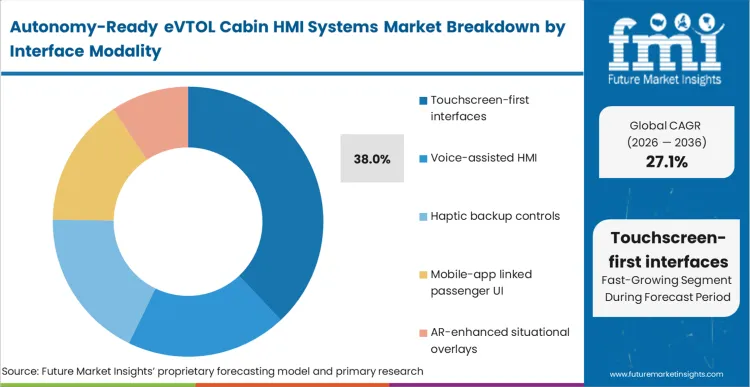
Weight reduction imperatives dictate the elimination of heavy mechanical switchgear wherever safely possible. Touchscreen-first interfaces secure 38.0% share in 2026, a figure driven directly by strict aircraft mass budgets rather than mere aesthetic preference. As per FMI's projection, this dominance hides a significant qualification hurdle: capacitive touch panels that work flawlessly in consumer electronics routinely fail vibration and gloved-hand testing in aviation environments. Cockpit ergonomists evaluating aircraft cabin interior components must validate these screens against extreme turbulence scenarios where a missed input could compromise flight safety. Failing to secure reliable eVTOL voice and haptic HMI systems leaves the manufacturer vulnerable to certification delays. A delayed type certificate immediately jeopardizes billions in pre-order revenue for the airframe builder.
- Mass Optimization Priority: Eliminating physical buttons strips critical kilograms from the overall vehicle empty weight. Systems engineering leads gain vital payload capacity necessary to meet commercial range requirements.
- Turbulence Validation Gap: Touchscreen reliability degrades sharply under severe vibration profiles typical of rotor transition phases. Human factors specialists face difficult redesign cycles if test pilots cannot consistently interact with digital sliders.
- Multimodal Redundancy: Regulatory approval requires secondary input methods to back up primary glass interfaces. Certification managers must integrate voice or haptic fallbacks to satisfy safety-critical redundancy mandates.
Autonomy-Ready eVTOL Cabin HMI Systems Market Analysis By Autonomy Readiness Level
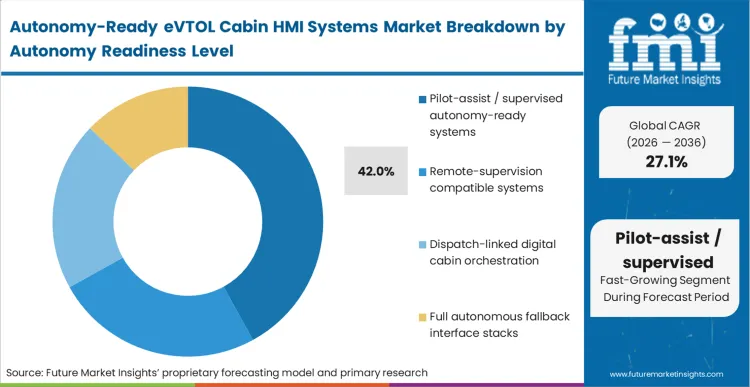
Regulators refuse to certify fully autonomous passenger flights in the immediate future, capping adoption of uncrewed systems. In FMI's view, the label "supervised autonomy" masks intense industry debate over exactly how much authority the automation possesses versus the human operator during an emergency. Flight control engineers design these remote-supervised eVTOL interface systems to reduce pilot workload dramatically, enabling pilots with lower total flight hours to operate complex multi-rotor vehicles safely. Selecting an interface that overwhelms a minimally trained operator with raw data rather than synthesized directives violates the core premise of simplified operations. Aircraft deploying poorly optimized assist systems will suffer elevated pilot training costs, ruining the anticipated fleet operating economics.
- Workload Reduction Focus: Supervised systems synthesize complex rotor management tasks into simple vector commands. Chief test pilots avoid cognitive overload, reducing the required training footprint for future commercial operators.
- Authority Transition Protocol: The system must clearly communicate when automation degrades and hands control back to the human. Safety directors face catastrophic risk if mode confusion occurs during a critical flight phase.
- Long-Term Operations Scaling: Simplified interfaces allow fleet operators to recruit pilots from a much broader talent pool. Operations managers gain the ability to scale their workforce without competing for expensive, high-hour traditional helicopter veterans.
Autonomy-Ready eVTOL Cabin HMI Systems Market Analysis By Aircraft Class
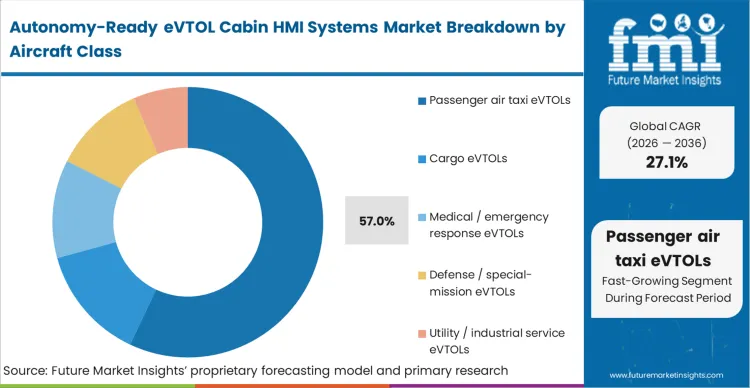
Major capital investments flow overwhelmingly toward passenger-carrying applications designed to relieve urban congestion. Passenger air taxi eVTOLs represent 57.0% share in 2026, monopolizing the attention of tier-one global aircraft cabin interior suppliers. Based on FMI's assessment, this massive share concentration forces cargo and utility developers to adapt passenger air taxi cabin interfaces for their own distinct missions rather than enjoying purpose-built solutions. Cabin layout designers working on air taxis prioritize aesthetic integration and passenger confidence markers alongside raw flight data presentation. Neglecting the passenger-facing elements of the HMI risks alienating the early-adopter consumer base necessary to validate the business model. Operators fielding intimidating or sterile cabin environments will struggle to achieve the high load factors required for profitability.
- Consumer Confidence Engineering: Passenger displays must present calming, predictable route information to mitigate anxiety in novel aircraft. Cabin experience directors depend on these eVTOL passenger interface systems to build trust with a skeptical public.
- Industrial Adaptation Constraints: Cargo developers must strip away unnecessary passenger UI layers to optimize their specific logistics workflows. Supply chain leads face integration friction when forcing passenger-grade software into ruggedized utility airframes.
- Load Factor Economics: Successful passenger interaction directly influences repeat usage rates. Fleet commercial officers must achieve high occupancy metrics, which rely heavily on an intuitive, reassuring cabin environment.
Autonomy-Ready eVTOL Cabin HMI Systems Market Analysis By Sales Channel
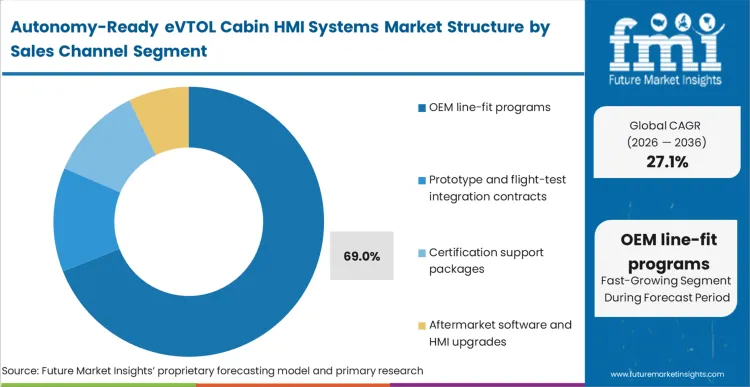
Tier-one procurement directors compiling their eVTOL HMI supplier shortlist demand aggressive pricing and deep engineering support from aircraft cabin interiors vendors trying to secure a spot on the baseline bill of materials. Suppliers who miss the initial line-fit window face a decade-long wait until the first wave of aircraft undergoes major mid-life avionics overhauls. Vendors failing to secure these prototype contracts effectively lock themselves out of the market entirely. Securing a position on the initial type certificate dictates long-term supplier survival in this novel industry. OEM line-fit programs account for 69.0% share in 2026, reflecting the reality that aftermarket upgrades barely exist for aircraft that have not yet entered commercial service. FMI observes that suppliers winning these early contracts accept severe margin compression during the development phase in exchange for a monopoly over future fleet replacements.
- Type Certificate Lock-In: Winning a line-fit contract embeds the supplier's hardware deep within the certified vehicle architecture. Avionics sales directors secure long-term revenue visibility extending far beyond the initial prototype deliveries.
- Development Margin Pressure: OEMs force suppliers to absorb significant non-recurring engineering costs during the prototype phase. Supplier program managers must balance immediate financial losses against the promise of eventual volume production.
- Aftermarket Barrier: Redesigning a certifiable HMI architecture for eVTOL aircraft requires exhaustive regulatory review, deterring operators from switching vendors post-delivery. Fleet maintenance chiefs avoid swapping primary HMI systems unless absolutely forced by hardware obsolescence.
Autonomy-Ready eVTOL Cabin HMI Systems Market Drivers, Restraints, and Opportunities
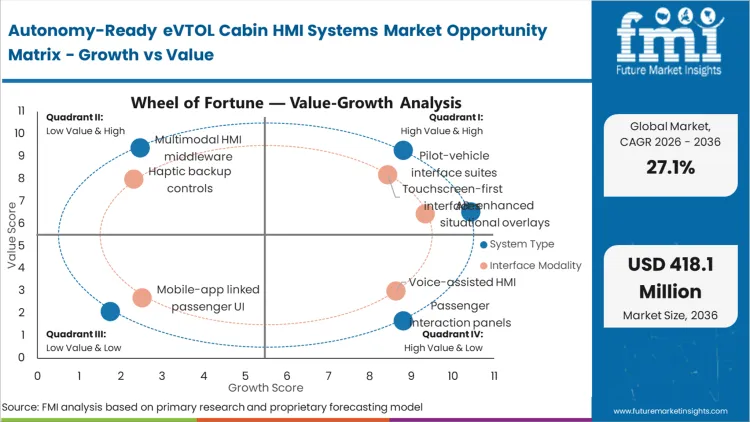
Looming type certification deadlines force eVTOL manufacturers to finalize their primary flight display architectures immediately. Procurement directors at these startups cannot wait for next-generation holographic concepts to mature; they require certifiable, redundant glass cockpits right now to satisfy regulators and keep their flight test programs on schedule. The penalty for indecision involves missing crucial commercial launch windows, a delay that burns through venture capital reserves and allows competitors to capture early market share across the advanced air mobility avionics landscape.
Severe mass constraints inside electric aircraft limit the deployment of heavy, fully redundant mechanical control systems. Weight engineers battle for every gram of payload capacity, often clashing with human factors specialists who demand physical tactile backups for digital commercial aircraft cabin interior interfaces. Until regulators accept purely digital redundancy without massive physical switchgear, manufacturers must maintain a heavy, inefficient compromise architecture.
Opportunities in the Autonomy-Ready eVTOL Cabin HMI Systems Market
- Remote Command Transition Kits: Developing certified software modules that allow ground operators to take control of an aircraft experiencing onboard pilot incapacitation. Avionics product managers secure a critical safety niche.
- Passenger Anxiety Mitigation Displays: Engineering contextual aerospace interior screens that explain novel flight maneuvers to nervous occupants. Cabin experience directors differentiate their services through superior customer communication.
- Synthetic Vision Integration: Fusing external camera feeds with topographical databases to provide cockpit workload reduction systems for AAM pilots during brownout conditions. Systems engineers solve one of the most persistent hazards in vertical flight operations.
Regional Analysis
.webp "Top Country Growth Comparison Autonomy Ready Evtol Cabin Hmi Systems Market Cagr (2026 2036)")
Based on regional analysis, autonomy-ready eVTOL cabin HMI systems market is segmented into Middle East, Asia Pacific, Latin America, North America, and Europe across 40 plus countries. The global trajectory of autonomy-ready interfaces reveals a sharp divide between nations aggressively funding air taxi infrastructure and those maintaining strict, localized testing corridors. Sovereign mandates, domestic manufacturing scale, and venture capital concentration directly dictate these regional adoption curves.
| Country | CAGR (2026 to 2036) |
|---|---|
| United Arab Emirates | 29.1% |
| China | 28.7% |
| Brazil | 28.4% |
| United States | 27.8% |
| Japan | 26.0% |
| Germany | 25.6% |
| United Kingdom | 24.8% |
Source: Future Market Insights (FMI) analysis, based on proprietary forecasting model and primary research
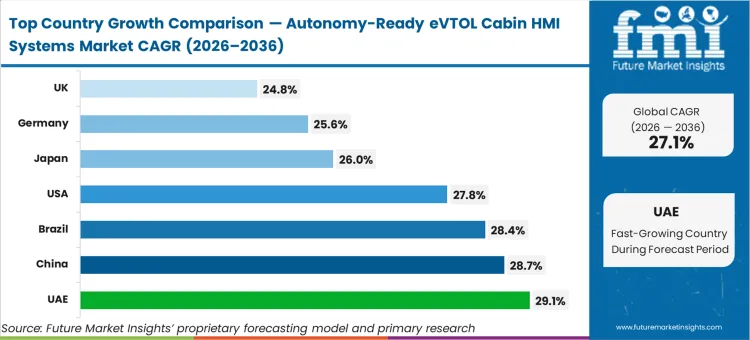
Middle East Autonomy-Ready eVTOL Cabin HMI Systems Market Analysis
Bypassing the slow evolution of complex airspace protocols, sovereign wealth initiatives across urban centers are aggressively condensing the timeline for commercial passenger drone networks. Fleet procurement officers are forcing display suppliers into accelerated integration schedules because transport ministries are explicitly mandating designated operational corridors for immediate testing. According to FMI's estimates, this top-down directive strips away the bureaucratic friction that traditionally slows aerospace development.
- United Arab Emirates: Expanding at a 29.1% CAGR, the United Arab Emirates presents a massive commercial opportunity for vendors capable of meeting inaugural flight deadlines. Transport authorities dictate rigid operational parameters, and intense government backing for immediate commercial air taxi deployment forces suppliers to fast-track certifiable interface deliveries.
FMI's report includes Saudi Arabia and Qatar. Sustained infrastructure investments in dedicated vertiports parallel the aggressive vehicle procurement strategies across the peninsula.
Asia Pacific Autonomy-Ready eVTOL Cabin HMI Systems Market Analysis
Highly subsidized testing environments enable systems integration engineers to rapidly validate multimodal control concepts through extensive practical flight hours. Because localized aerospace firms possess massive domestic manufacturing capacity, they can iterate flight interface prototypes at unmatched speeds. Avionics directors are leveraging immense datasets regarding pilot interaction during rotor transitions to refine their aircraft cabin environment sensor algorithms faster than rivals relying entirely on simulation.
- China: Systems engineering leads capitalize on state-supported airspace access to validate remote operator protocols, establishing strong competitive positioning as the nation expands at a 28.7% CAGR. This unprecedented scale in uncrewed aerial vehicle testing provides deep empirical data necessary for refining transition-to-autonomy software architectures.
- Japan: Project managers mandate the rapid integration of flight information display system components into specialized prototype vehicles to meet hard deadlines for functional passenger drone demonstrations ahead of major international exhibitions. Pushing the market forward at a CAGR of 26.0%, this urgent preparation yields an operational outcome of heightened domestic aerospace capability.
FMI's report includes South Korea and India. Dense urban demographics across these nations create structural imperatives for vertical mobility solutions independent of traditional ground infrastructure.
North America and Latin America Autonomy-Ready eVTOL Cabin HMI Systems Market Analysis
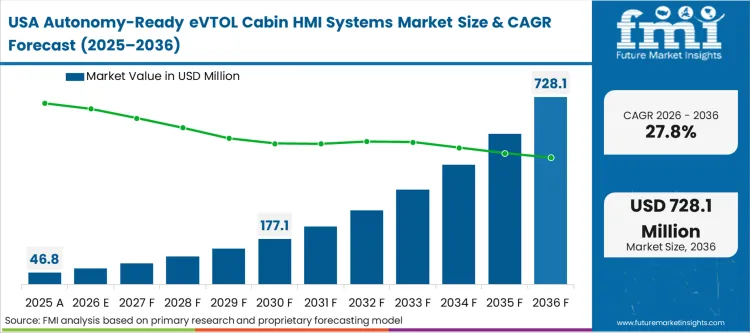
Intense venture capital concentration in the north pairs with robust regional manufacturing strongholds in the south to create a highly dynamic hemispheric supply chain. Procurement leads prioritize vendor certifiability over experimental functionality because prominent startups must demonstrate tangible progress toward type certification to sustain their valuations. Chief test pilots demand highly reliable primary flight interfaces to safely execute complex expanding-envelope test flights, pushing developers to partner with established tier-one suppliers.
- United States: Charting a structural trajectory toward consolidated supply chains at 27.8% CAGR, certification managers rely heavily on established vendor documentation libraries to secure experimental airworthiness certificates. Strict FAA compliance pathways force startups to adopt mature, certifiable avionics hardware while isolating their pure innovations to the software layer.
- Brazil: Regional manufacturers are rapidly locking down critical supply chains for upcoming vehicle launches, driving a 28.4% CAGR as they prepare for scaled production. Display vendors face intense pressure to deliver localized support frameworks that align with the aggressive commercial rollout schedules of native aerospace champions.
FMI's report includes Canada and Mexico. Cross-border aerospace manufacturing clusters provide essential sub-component assembly capacity for emerging customized avionic systems required by major developers.
Europe Autonomy-Ready eVTOL Cabin HMI Systems Market Analysis
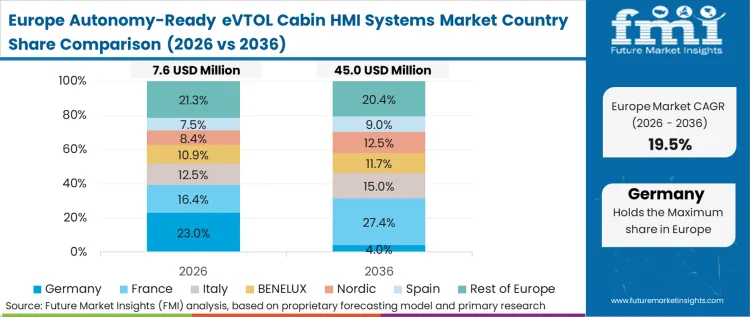
Legacy aerospace engineering prowess collides with highly stringent safety frameworks to dictate the pace of interface adoption across the continent. Rather than rushing experimental hardware into the skies, developers focus heavily on aligning their middleware architectures with evolving EASA special conditions. This methodical approach ensures that any deployed digital cabin infrastructure can withstand rigorous safety audits during the eventual transition from piloted to supervised autonomous flight.
- Germany: Heavy engineering investments by legacy aerospace suppliers form the foundation of domestic air taxi development programs. Securing a CAGR of 25.6%, firms are meticulously adapting established commercial flight deck protocols for novel vertical lift envelopes.
- United Kingdom: Registering a 24.8% CAGR, localized testing corridors are finalized by safety regulators to safely evaluate human-machine handoff procedures. Fleet operators utilize these controlled environments to prove the reliability of remote supervision links before attempting broader urban deployment.
FMI's report includes France and Italy. Collaborative multinational defense and civil aviation initiatives continuously shape the hardware qualification standards governing regional interface procurement.
Competitive Aligners for Market Players
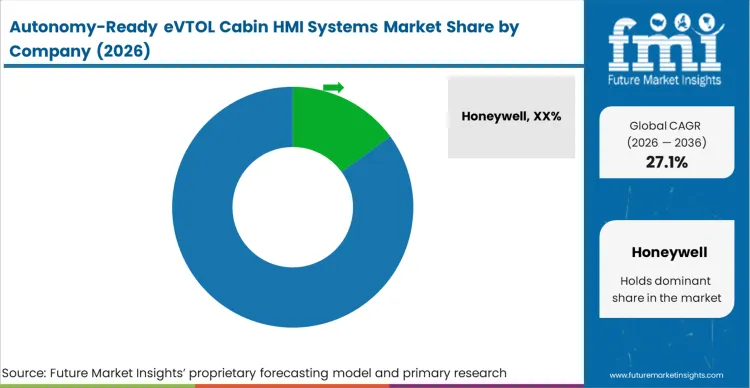
Legacy avionics giants leverage their massive libraries of certified software code to dominate the initial wave of line-fit contracts. Startups attempting to build entirely new flight interfaces face the crushing reality of documenting every single line of code to FAA or EASA standards, a process taking years and millions of dollars. Established firms bypass this friction by adapting existing primary flight display architectures to accommodate the unique thrust-vectoring requirements of eVTOLs. This dynamic forces vehicle manufacturers evaluating Honeywell vs Garmin eVTOL avionics platforms to align with incumbents to ensure their aircraft achieve certification before capital runs out.
Emerging software specialists must focus on the middleware layer, specifically the translation algorithms interpreting simplified pilot inputs into complex multi-rotor commands. Without the deep pockets required to certify primary hardware displays, an independent eVTOL HMI software supplier builds highly specific applications addressing aircraft automated inspection and monitoring or remote operator handoff sequences. They pitch these specialized modules to the tier-one integrators, attempting to become an indispensable sub-system rather than fighting for the primary cockpit real estate.
Vehicle OEMs deliberately cultivate secondary suppliers for passenger-facing interfaces to prevent complete vendor lock-in from the primary flight deck providers. Procurement directors understand that while they must rely on legacy aerospace firms for the safety-critical flight controls, they can utilize agile consumer technology firms for cabin entertainment and route visualization screens. This strategy splits the cockpit hardware ecosystem, reserving the high-margin, high-regulation eVTOL display and control systems for the established aerospace players while commoditizing the passenger experience modules.
Key Players in Autonomy-Ready eVTOL Cabin HMI Systems Market
- Honeywell
- Garmin
- Thales
- Astronics
- Diehl Aviation
- Joby Aviation
- Eve Air Mobility
Scope of the Report
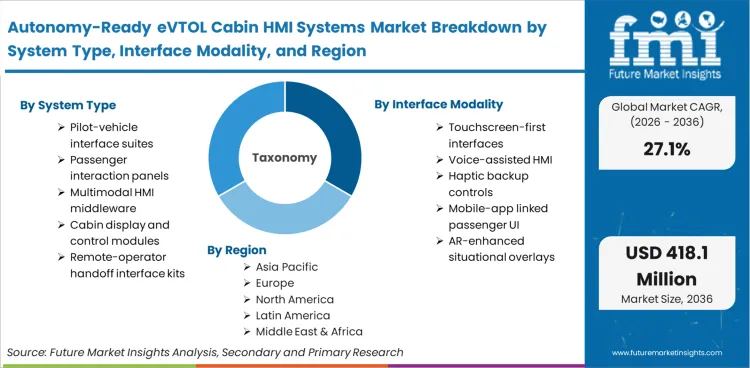
| Metric | Value |
|---|---|
| Quantitative Units | USD 38.0 million to USD 417.0 million, at a CAGR of 27.1% |
| Market Definition | Autonomy-ready eVTOL cabin HMI systems constitute the integrated hardware and software architectures bridging human operators, passengers, and flight control computers within electric vertical takeoff and landing vehicles. |
| Segmentation | System type, Interface modality, Autonomy readiness level, Aircraft class, Sales channel, and Region |
| Regions Covered | Middle East, Asia Pacific, Latin America, North America, Europe |
| Countries Covered | United Arab Emirates, China, Brazil, United States, Japan, Germany, United Kingdom |
| Key Companies Profiled | Honeywell, Garmin, Thales, Astronics, Diehl Aviation, Joby Aviation, Eve Air Mobility |
| Forecast Period | 2026 to 2036 |
| Approach | OEM stated production targets and active supplier contract valuations |
Source: Future Market Insights (FMI) analysis, based on proprietary forecasting model and primary research
Key Segments:
System Type
- Pilot-vehicle interface suites
- Passenger interaction panels
- Multimodal HMI middleware
- Cabin display and control modules
- Remote-operator handoff interface kits
Interface Modality
- Touchscreen-first interfaces
- Voice-assisted HMI
- Haptic backup controls
- Mobile-app linked passenger UI
- AR-enhanced situational overlays
Autonomy Readiness Level
- Pilot-assist / supervised autonomy-ready systems
- Remote-supervision compatible systems
- Dispatch-linked digital cabin orchestration
- Full autonomous fallback interface stacks
Aircraft Class
- Passenger air taxi eVTOLs
- Cargo eVTOLs
- Medical / emergency response eVTOLs
- Defense / special-mission eVTOLs
- Utility / industrial service eVTOLs
Sales Channel
- OEM line-fit programs
- Prototype and flight-test integration contracts
- Certification support packages
- Aftermarket software and HMI upgrades
Regions:
- North America
- United States
- Canada
- Mexico
- Latin America
- Brazil
- Argentina
- Chile
- Europe
- Germany
- United Kingdom
- France
- Italy
- Spain
- Asia-Pacific
- China
- Japan
- South Korea
- India
- ASEAN
- ANZ
- Middle East & Africa
- UAE
- Saudi Arabia
- South Africa
Bibliography
- Archer Aviation Inc. (2025, April 28). 2025 Proxy Statement & 2024 Annual Report.
- Diehl Aviation. (2024, July 22). Diehl Aviation Selected by Eve Air Mobility to Design and Produce eVTOL Interiors.
- European Union Aviation Safety Agency. (2025, July 11). MOC-4 SC-VTOL, Issue 2: Fourth Publication of Means of Compliance with the Special Condition VTOL.
- Federal Aviation Administration. (2024, June 10). FAA Statement on eVTOL Aircraft Certification.
- Federal Register. (2025, January 3). Integration of Powered-Lift: Pilot Certification and Operations; Miscellaneous Amendments Related to Rotorcraft and Airplanes.
This bibliography is provided for reader reference. The full FMI report contains the complete reference list with primary source documentation.
This Report Addresses
- Avionics integration timelines defining critical component delivery schedules for prototype testing programs.
- Certification documentation requirements isolating specific redundancy architectures demanded by leading safety regulators.
- Fleet transition software evaluating how early piloted vehicles absorb eventual remote-operator handoff protocols.
- Cockpit weight reduction metrics influencing the adoption rate of digital touchscreen arrays over mechanical switchgear.
- Pilot training simplification mapping how synthetic vision displays reduce required flight hours for commercial operators.
- Passenger interaction validation determining optimal cabin display configurations for novel vertical lift aircraft.
- Component vibration tolerances exposing hidden qualification barriers for commercial-grade digital control panels.
- Supplier consolidation pressures tracking how legacy aerospace firms secure dominant positions on initial type certificates.
Frequently Asked Questions
What is an autonomy-ready eVTOL cabin HMI system?
Autonomy-ready eVTOL cabin HMI systems constitute the integrated hardware and software architectures bridging human operators, passengers, and flight computers, specifically engineered to facilitate seamless transitions between onboard piloting, remote supervision, and fully autonomous flight modes.
How large is the eVTOL cabin HMI market in 2026 and 2036?
The valuation stands at USD 38.0 million in 2026 as prototype procurement shifts into early low-rate initial production, with sustained integration propelling the sector to USD 417.0 million by 2036.
Which technologies make an eVTOL cabin interface autonomy-ready?
Forward-compatible middleware embedded within primary flight suites makes these interfaces autonomy-ready by allowing the future integration of autonomous fallbacks and remote-operator handoff protocols without replacing the physical dashboard screen.
How do eVTOL cabin HMI systems differ from helicopter avionics?
Unlike traditional rotorcraft avionics engineered for constant manual input, powered-lift interface systems synthesize complex multi-rotor thrust vectoring into simplified commands explicitly designed to eventually transfer command authority to ground stations.
Which companies are leading the eVTOL cabin HMI market?
Legacy giants like Honeywell, Garmin, and Thales dominate initial OEM line-fit contracts due to their massive libraries of certifiable code, while integrators like Astronics and Diehl Aviation focus on passenger cabin environments.
What regulations most affect eVTOL HMI design?
EASA and FAA special condition VTOL compliance mandates dictate strict dual-redundant manual override architectures, as regulators refuse to approve uncrewed commercial operations without these certified human-in-the-loop fallback systems.
Why are multimodal interfaces becoming important in air taxis?
Because weight reduction imperatives dictate eliminating heavy mechanical switchgear in favor of touchscreens, certification managers must integrate voice or haptic fallbacks to satisfy regulatory requirements for safety-critical redundancy.
Which countries are likely to lead adoption of eVTOL cabin HMI systems?
The United Arab Emirates accelerates timelines through sovereign wealth mandates prioritizing early passenger drone testing, closely followed by China utilizing its massive domestic manufacturing capacity to rapidly iterate flight interface prototypes.
How do OEMs choose between integrated and modular HMI architectures?
Procurement directors avoid rigid avionics architectures and instead prioritize modular systems capable of absorbing future remote-operator handoff protocols via software updates to protect asset residual value and prevent massive recertification programs.
What role does remote supervision play in cabin HMI design?
Remote supervision dictates the core architectural logic of transition software, requiring systems to clearly communicate when onboard automation degrades and hands control back to human supervisors to prevent catastrophic mode confusion.
Why do pilot-vehicle interface suites lead the system type?
Active piloted suites lead because they satisfy strict EASA and FAA demands for a qualified human-in-the-loop during initial commercialization, making them the absolute foundational requirement before any passenger operations commence.
What structural gate triggers mass adoption?
Civil aviation authorities defining final type-certification pathways for remote-operator handoff protocols trigger mass adoption by transitioning prototype testing into scaled commercial production without demanding complete cockpit redesigns.
Why do touchscreen interfaces dominate interface modalities?
Touchscreen interfaces dominate because eliminating physical buttons strips critical kilograms from the overall vehicle empty weight, granting systems engineering leads vital payload capacity necessary to meet commercial range requirements.
How does vibration impact touchscreen validation?
Because touchscreen reliability degrades sharply under severe vibration profiles typical of rotor transition phases, ergonomists must validate screens against extreme turbulence scenarios where missed inputs compromise flight safety.
How do structural requirements impact cargo airframes?
Cargo developers must strip away unnecessary passenger UI layers to optimize logistics workflows and avoid integration friction when forcing passenger-grade software into ruggedized utility airframes.
Why do North American startups rely on established suppliers?
Strict FAA compliance pathways force North American startups to adopt mature, certifiable avionics hardware while innovating strictly on the software layer to reduce the risk of missing critical certification deadlines.
What role do remote command kits play?
Remote command kits utilize certified software modules that allow ground operators to take control of an aircraft experiencing onboard pilot incapacitation, securing a critical safety niche for ambitious avionics product managers.
How does synthetic vision alter pilot interaction?
Synthetic vision fuses external camera feeds with topographical databases to provide pilots with clear visual references during brownout conditions, solving one of the most persistent hazards in vertical flight operations.
What dictates OEM line-fit pricing strategy?
Tier-one procurement directors demand aggressive pricing during the prototype phase, forcing suppliers to absorb non-recurring engineering costs in exchange for a monopoly over future fleet replacements.
Preview the report firsthand - request a free sample
Get SampleGet the brochure for pricing and purchase details.
Get PDFTable of Content
- Executive Summary
- Global Market Outlook
- Demand-side Trends
- Supply-side Trends
- Technology Roadmap Analysis
- Analysis and Recommendations
- Market Overview
- Market Coverage / Taxonomy
- Market Definition / Scope / Limitations
- Research Methodology
- Chapter Orientation
- Analytical Lens and Working Hypotheses
- Market Structure, Signals, and Trend Drivers
- Benchmarking and Cross-market Comparability
- Market Sizing, Forecasting, and Opportunity Mapping
- Research Design and Evidence Framework
- Desk Research Programme (Secondary Evidence)
- Company Annual and Sustainability Reports
- Peer-reviewed Journals and Academic Literature
- Corporate Websites, Product Literature, and Technical Notes
- Earnings Decks and Investor Briefings
- Statutory Filings and Regulatory Disclosures
- Technical White Papers and Standards Notes
- Trade Journals, Industry Magazines, and Analyst Briefs
- Conference Proceedings, Webinars, and Seminar Materials
- Government Statistics Portals and Public Data Releases
- Press Releases and Reputable Media Coverage
- Specialist Newsletters and Curated Briefings
- Sector Databases and Reference Repositories
- FMI Internal Proprietary Databases and Historical Market Datasets
- Subscription Datasets and Paid Sources
- Social Channels, Communities, and Digital Listening Inputs
- Additional Desk Sources
- Expert Input and Fieldwork (Primary Evidence)
- Primary Modes
- Qualitative Interviews and Expert Elicitation
- Quantitative Surveys and Structured Data Capture
- Blended Approach
- Why Primary Evidence is Used
- Field Techniques
- Interviews
- Surveys
- Focus Groups
- Observational and In-context Research
- Social and Community Interactions
- Stakeholder Universe Engaged
- C-suite Leaders
- Board Members
- Presidents and Vice Presidents
- R&D and Innovation Heads
- Technical Specialists
- Domain Subject-matter Experts
- Scientists
- Physicians and Other Healthcare Professionals
- Governance, Ethics, and Data Stewardship
- Research Ethics
- Data Integrity and Handling
- Primary Modes
- Tooling, Models, and Reference Databases
- Desk Research Programme (Secondary Evidence)
- Data Engineering and Model Build
- Data Acquisition and Ingestion
- Cleaning, Normalisation, and Verification
- Synthesis, Triangulation, and Analysis
- Quality Assurance and Audit Trail
- Market Background
- Market Dynamics
- Drivers
- Restraints
- Opportunity
- Trends
- Scenario Forecast
- Demand in Optimistic Scenario
- Demand in Likely Scenario
- Demand in Conservative Scenario
- Opportunity Map Analysis
- Product Life Cycle Analysis
- Supply Chain Analysis
- Investment Feasibility Matrix
- Value Chain Analysis
- PESTLE and Porter’s Analysis
- Regulatory Landscape
- Regional Parent Market Outlook
- Production and Consumption Statistics
- Import and Export Statistics
- Market Dynamics
- Global Market Analysis 2021 to 2025 and Forecast, 2026 to 2036
- Historical Market Size Value (USD Million) Analysis, 2021 to 2025
- Current and Future Market Size Value (USD Million) Projections, 2026 to 2036
- Y-o-Y Growth Trend Analysis
- Absolute $ Opportunity Analysis
- Global Market Pricing Analysis 2021 to 2025 and Forecast 2026 to 2036
- Global Market Analysis 2021 to 2025 and Forecast 2026 to 2036, By System Type
- Introduction / Key Findings
- Historical Market Size Value (USD Million) Analysis By System Type , 2021 to 2025
- Current and Future Market Size Value (USD Million) Analysis and Forecast By System Type , 2026 to 2036
- Pilot-vehicle interface suites
- Passenger interaction panels
- Multimodal HMI middleware
- Cabin display and control modules
- Remote-operator handoff interface kits
- Pilot-vehicle interface suites
- Y-o-Y Growth Trend Analysis By System Type , 2021 to 2025
- Absolute $ Opportunity Analysis By System Type , 2026 to 2036
- Global Market Analysis 2021 to 2025 and Forecast 2026 to 2036, By Interface Modality
- Introduction / Key Findings
- Historical Market Size Value (USD Million) Analysis By Interface Modality, 2021 to 2025
- Current and Future Market Size Value (USD Million) Analysis and Forecast By Interface Modality, 2026 to 2036
- Touchscreen-first interfaces
- Voice-assisted HMI
- Haptic backup controls
- Mobile-app linked passenger UI
- AR-enhanced situational overlays
- Touchscreen-first interfaces
- Y-o-Y Growth Trend Analysis By Interface Modality, 2021 to 2025
- Absolute $ Opportunity Analysis By Interface Modality, 2026 to 2036
- Global Market Analysis 2021 to 2025 and Forecast 2026 to 2036, By Autonomy Readiness Level
- Introduction / Key Findings
- Historical Market Size Value (USD Million) Analysis By Autonomy Readiness Level, 2021 to 2025
- Current and Future Market Size Value (USD Million) Analysis and Forecast By Autonomy Readiness Level, 2026 to 2036
- Pilot-assist / supervised autonomy-ready systems
- Remote-supervision compatible systems
- Dispatch-linked digital cabin orchestration
- Full autonomous fallback interface stacks
- Pilot-assist / supervised autonomy-ready systems
- Y-o-Y Growth Trend Analysis By Autonomy Readiness Level, 2021 to 2025
- Absolute $ Opportunity Analysis By Autonomy Readiness Level, 2026 to 2036
- Global Market Analysis 2021 to 2025 and Forecast 2026 to 2036, By Aircraft Class
- Introduction / Key Findings
- Historical Market Size Value (USD Million) Analysis By Aircraft Class, 2021 to 2025
- Current and Future Market Size Value (USD Million) Analysis and Forecast By Aircraft Class, 2026 to 2036
- Passenger air taxi eVTOLs
- Cargo eVTOLs
- Medical / emergency response eVTOLs
- Defense / special-mission eVTOLs
- Utility / industrial service eVTOLs
- Passenger air taxi eVTOLs
- Y-o-Y Growth Trend Analysis By Aircraft Class, 2021 to 2025
- Absolute $ Opportunity Analysis By Aircraft Class, 2026 to 2036
- Global Market Analysis 2021 to 2025 and Forecast 2026 to 2036, By Sales Channel
- Introduction / Key Findings
- Historical Market Size Value (USD Million) Analysis By Sales Channel, 2021 to 2025
- Current and Future Market Size Value (USD Million) Analysis and Forecast By Sales Channel, 2026 to 2036
- OEM line-fit programs
- Prototype and flight-test integration contracts
- Certification support packages
- Aftermarket software and HMI upgrades
- OEM line-fit programs
- Y-o-Y Growth Trend Analysis By Sales Channel, 2021 to 2025
- Absolute $ Opportunity Analysis By Sales Channel, 2026 to 2036
- Global Market Analysis 2021 to 2025 and Forecast 2026 to 2036, By Region
- Introduction
- Historical Market Size Value (USD Million) Analysis By Region, 2021 to 2025
- Current Market Size Value (USD Million) Analysis and Forecast By Region, 2026 to 2036
- North America
- Latin America
- Western Europe
- Eastern Europe
- East Asia
- South Asia and Pacific
- Middle East & Africa
- Market Attractiveness Analysis By Region
- North America Market Analysis 2021 to 2025 and Forecast 2026 to 2036, By Country
- Historical Market Size Value (USD Million) Trend Analysis By Market Taxonomy, 2021 to 2025
- Market Size Value (USD Million) Forecast By Market Taxonomy, 2026 to 2036
- By Country
- USA
- Canada
- Mexico
- By System Type
- By Interface Modality
- By Autonomy Readiness Level
- By Aircraft Class
- By Sales Channel
- By Country
- Market Attractiveness Analysis
- By Country
- By System Type
- By Interface Modality
- By Autonomy Readiness Level
- By Aircraft Class
- By Sales Channel
- Key Takeaways
- Latin America Market Analysis 2021 to 2025 and Forecast 2026 to 2036, By Country
- Historical Market Size Value (USD Million) Trend Analysis By Market Taxonomy, 2021 to 2025
- Market Size Value (USD Million) Forecast By Market Taxonomy, 2026 to 2036
- By Country
- Brazil
- Chile
- Rest of Latin America
- By System Type
- By Interface Modality
- By Autonomy Readiness Level
- By Aircraft Class
- By Sales Channel
- By Country
- Market Attractiveness Analysis
- By Country
- By System Type
- By Interface Modality
- By Autonomy Readiness Level
- By Aircraft Class
- By Sales Channel
- Key Takeaways
- Western Europe Market Analysis 2021 to 2025 and Forecast 2026 to 2036, By Country
- Historical Market Size Value (USD Million) Trend Analysis By Market Taxonomy, 2021 to 2025
- Market Size Value (USD Million) Forecast By Market Taxonomy, 2026 to 2036
- By Country
- Germany
- UK
- Italy
- Spain
- France
- Nordic
- BENELUX
- Rest of Western Europe
- By System Type
- By Interface Modality
- By Autonomy Readiness Level
- By Aircraft Class
- By Sales Channel
- By Country
- Market Attractiveness Analysis
- By Country
- By System Type
- By Interface Modality
- By Autonomy Readiness Level
- By Aircraft Class
- By Sales Channel
- Key Takeaways
- Eastern Europe Market Analysis 2021 to 2025 and Forecast 2026 to 2036, By Country
- Historical Market Size Value (USD Million) Trend Analysis By Market Taxonomy, 2021 to 2025
- Market Size Value (USD Million) Forecast By Market Taxonomy, 2026 to 2036
- By Country
- Russia
- Poland
- Hungary
- Balkan & Baltic
- Rest of Eastern Europe
- By System Type
- By Interface Modality
- By Autonomy Readiness Level
- By Aircraft Class
- By Sales Channel
- By Country
- Market Attractiveness Analysis
- By Country
- By System Type
- By Interface Modality
- By Autonomy Readiness Level
- By Aircraft Class
- By Sales Channel
- Key Takeaways
- East Asia Market Analysis 2021 to 2025 and Forecast 2026 to 2036, By Country
- Historical Market Size Value (USD Million) Trend Analysis By Market Taxonomy, 2021 to 2025
- Market Size Value (USD Million) Forecast By Market Taxonomy, 2026 to 2036
- By Country
- China
- Japan
- South Korea
- By System Type
- By Interface Modality
- By Autonomy Readiness Level
- By Aircraft Class
- By Sales Channel
- By Country
- Market Attractiveness Analysis
- By Country
- By System Type
- By Interface Modality
- By Autonomy Readiness Level
- By Aircraft Class
- By Sales Channel
- Key Takeaways
- South Asia and Pacific Market Analysis 2021 to 2025 and Forecast 2026 to 2036, By Country
- Historical Market Size Value (USD Million) Trend Analysis By Market Taxonomy, 2021 to 2025
- Market Size Value (USD Million) Forecast By Market Taxonomy, 2026 to 2036
- By Country
- India
- ASEAN
- Australia & New Zealand
- Rest of South Asia and Pacific
- By System Type
- By Interface Modality
- By Autonomy Readiness Level
- By Aircraft Class
- By Sales Channel
- By Country
- Market Attractiveness Analysis
- By Country
- By System Type
- By Interface Modality
- By Autonomy Readiness Level
- By Aircraft Class
- By Sales Channel
- Key Takeaways
- Middle East & Africa Market Analysis 2021 to 2025 and Forecast 2026 to 2036, By Country
- Historical Market Size Value (USD Million) Trend Analysis By Market Taxonomy, 2021 to 2025
- Market Size Value (USD Million) Forecast By Market Taxonomy, 2026 to 2036
- By Country
- Kingdom of Saudi Arabia
- Other GCC Countries
- Turkiye
- South Africa
- Other African Union
- Rest of Middle East & Africa
- By System Type
- By Interface Modality
- By Autonomy Readiness Level
- By Aircraft Class
- By Sales Channel
- By Country
- Market Attractiveness Analysis
- By Country
- By System Type
- By Interface Modality
- By Autonomy Readiness Level
- By Aircraft Class
- By Sales Channel
- Key Takeaways
- Key Countries Market Analysis
- USA
- Pricing Analysis
- Market Share Analysis, 2025
- By System Type
- By Interface Modality
- By Autonomy Readiness Level
- By Aircraft Class
- By Sales Channel
- Canada
- Pricing Analysis
- Market Share Analysis, 2025
- By System Type
- By Interface Modality
- By Autonomy Readiness Level
- By Aircraft Class
- By Sales Channel
- Mexico
- Pricing Analysis
- Market Share Analysis, 2025
- By System Type
- By Interface Modality
- By Autonomy Readiness Level
- By Aircraft Class
- By Sales Channel
- Brazil
- Pricing Analysis
- Market Share Analysis, 2025
- By System Type
- By Interface Modality
- By Autonomy Readiness Level
- By Aircraft Class
- By Sales Channel
- Chile
- Pricing Analysis
- Market Share Analysis, 2025
- By System Type
- By Interface Modality
- By Autonomy Readiness Level
- By Aircraft Class
- By Sales Channel
- Germany
- Pricing Analysis
- Market Share Analysis, 2025
- By System Type
- By Interface Modality
- By Autonomy Readiness Level
- By Aircraft Class
- By Sales Channel
- UK
- Pricing Analysis
- Market Share Analysis, 2025
- By System Type
- By Interface Modality
- By Autonomy Readiness Level
- By Aircraft Class
- By Sales Channel
- Italy
- Pricing Analysis
- Market Share Analysis, 2025
- By System Type
- By Interface Modality
- By Autonomy Readiness Level
- By Aircraft Class
- By Sales Channel
- Spain
- Pricing Analysis
- Market Share Analysis, 2025
- By System Type
- By Interface Modality
- By Autonomy Readiness Level
- By Aircraft Class
- By Sales Channel
- France
- Pricing Analysis
- Market Share Analysis, 2025
- By System Type
- By Interface Modality
- By Autonomy Readiness Level
- By Aircraft Class
- By Sales Channel
- India
- Pricing Analysis
- Market Share Analysis, 2025
- By System Type
- By Interface Modality
- By Autonomy Readiness Level
- By Aircraft Class
- By Sales Channel
- ASEAN
- Pricing Analysis
- Market Share Analysis, 2025
- By System Type
- By Interface Modality
- By Autonomy Readiness Level
- By Aircraft Class
- By Sales Channel
- Australia & New Zealand
- Pricing Analysis
- Market Share Analysis, 2025
- By System Type
- By Interface Modality
- By Autonomy Readiness Level
- By Aircraft Class
- By Sales Channel
- China
- Pricing Analysis
- Market Share Analysis, 2025
- By System Type
- By Interface Modality
- By Autonomy Readiness Level
- By Aircraft Class
- By Sales Channel
- Japan
- Pricing Analysis
- Market Share Analysis, 2025
- By System Type
- By Interface Modality
- By Autonomy Readiness Level
- By Aircraft Class
- By Sales Channel
- South Korea
- Pricing Analysis
- Market Share Analysis, 2025
- By System Type
- By Interface Modality
- By Autonomy Readiness Level
- By Aircraft Class
- By Sales Channel
- Russia
- Pricing Analysis
- Market Share Analysis, 2025
- By System Type
- By Interface Modality
- By Autonomy Readiness Level
- By Aircraft Class
- By Sales Channel
- Poland
- Pricing Analysis
- Market Share Analysis, 2025
- By System Type
- By Interface Modality
- By Autonomy Readiness Level
- By Aircraft Class
- By Sales Channel
- Hungary
- Pricing Analysis
- Market Share Analysis, 2025
- By System Type
- By Interface Modality
- By Autonomy Readiness Level
- By Aircraft Class
- By Sales Channel
- Kingdom of Saudi Arabia
- Pricing Analysis
- Market Share Analysis, 2025
- By System Type
- By Interface Modality
- By Autonomy Readiness Level
- By Aircraft Class
- By Sales Channel
- Turkiye
- Pricing Analysis
- Market Share Analysis, 2025
- By System Type
- By Interface Modality
- By Autonomy Readiness Level
- By Aircraft Class
- By Sales Channel
- South Africa
- Pricing Analysis
- Market Share Analysis, 2025
- By System Type
- By Interface Modality
- By Autonomy Readiness Level
- By Aircraft Class
- By Sales Channel
- USA
- Market Structure Analysis
- Competition Dashboard
- Competition Benchmarking
- Market Share Analysis of Top Players
- By Regional
- By System Type
- By Interface Modality
- By Autonomy Readiness Level
- By Aircraft Class
- By Sales Channel
- Competition Analysis
- Competition Deep Dive
- Honeywell
- Overview
- Product Portfolio
- Profitability by Market Segments (Product/Age /Sales Channel/Region)
- Sales Footprint
- Strategy Overview
- Marketing Strategy
- Product Strategy
- Channel Strategy
- Garmin
- Thales
- Astronics
- Diehl Aviation
- Joby Aviation
- Eve Air Mobility
- Honeywell
- Competition Deep Dive
- Assumptions & Acronyms Used


