

- Industry Size (2026)
- USD 90.0 Mn
- Forecast (2036)
- USD 880.0 Mn
- CAGR (2026 to 2036)
- 25.6%
Cargo eVTOL External Payload Mounting Systems Market Size, Market Forecast and Outlook By FMI
The cargo eVTOL external payload mounting systems market was valued at USD 70.0 million in 2025. The sector is set to reach USD 90.0 million in 2026 at a CAGR of 25.6% during the forecast period. Sustained investment propels the valuation to USD 880.0 million through 2036 as fleet operators require standardized, rapid-swap payload interfaces to decouple aircraft ground time from cargo loading cycles, maximizing the daily utilization of capital-intensive electric airframes.
Logistics operators are being forced to decide whether to integrate their entire ground-handling infrastructure around proprietary pod dimensions or mandate open-architecture hardpoints. Relying on closed-ecosystem designs risks severing ties with broader cargo drones routing networks, limiting fleet utility. While analysts focus heavily on electric battery density, the actual operational bottleneck for heavy payloads is the mechanical swap time. An aircraft waiting on the tarmac for a forklift to load individual boxes destroys the entire economic premise of middle-mile logistics. Delaying the standardization of these interfaces strands capital in incompatible ground robots and limits early revenue generation.
Summary of Cargo eVTOL External Payload Mounting Systems Market
- Cargo eVTOL External Payload Mounting Systems Market Definition
- The sector covers the engineered locks, underbody rails, and aerodynamic fairings required to safely suspend, monitor, and release modular freight containers from the exterior of electric powered-lift aircraft during high-frequency middle-mile operations.
- Demand Drivers in the Market
- The absolute necessity to decouple aircraft charging times from freight loading cycles forces logistics integrators to specify rapid-swap external pod attachments.
- Severe aerodynamic drag penalties associated with suspended loads compel engineers to procure precision-molded external fairings that smooth airflow around bulky cargo boxes.
- Military and emergency resupply mandates push procurement directors to source autonomous, sensor-integrated drop-hooks capable of releasing payloads without ground crew intervention.
- Key Segments Analyzed in the FMI Report
- Detachable pod attachment systems: Detachable pod attachment systems is expected to garner 36.0% share in 2026, as these mechanisms allow logistics integrators to pre-load modular containers while the aircraft is in transit, converting extensive ground turnaround times into immediate mechanical pod swaps.
- Modular cargo pods: Modular cargo pods is projected to hold 42.0% share in 2026, driven by the operational necessity to protect weather-sensitive freight during high-speed forward flight without requiring internal cabin reconfigurations.
- Winged cargo eVTOL platforms: Winged cargo eVTOL platforms is anticipated to account for 41.0% share in 2026, representing the dominant architectural choice for middle-mile distances that require heavily faired underbody mounts to preserve horizontal flight efficiency.
- OEM line-fit integration: OEM line-fit integration is set to capture 82.0% share in 2026, reflecting the current industry focus on producing conforming prototype and early commercial fleets rather than modifying existing airframes.
- Middle-mile logistics: Middle-mile logistics is estimated to record 39.0% share in 2026, serving as the primary commercial anchor due to the immediate demand for automated, high-throughput freight transfers between regional distribution hubs.
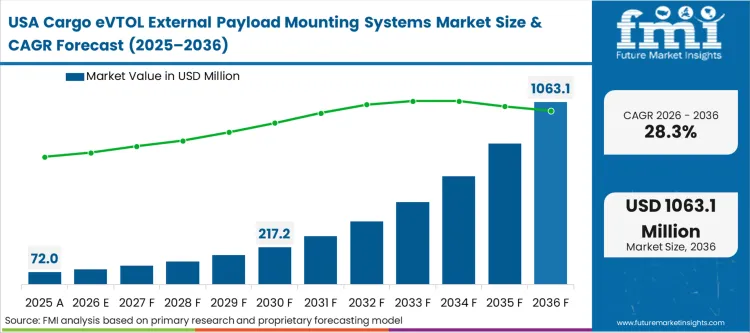
- United States: 28.3% compound growth, propelled by active federal airspace integration pilot programs that provide a clear regulatory pathway for domestic aerospace suppliers to validate external load hardware.
- Analyst Opinion at FMI
- Nikhil Kaitwade, Principal Analyst, Automotive, at FMI, highlights, "Payload measurement across the industry usually centers on weight and volume, though that method overlooks the turnaround friction tied to the mounting interface. An aircraft may be able to lift heavy loads, yet it becomes commercially inefficient when external slings need thirty minutes for rigging and balancing. Procurement directors are recognizing that rapid-release pod rails, rather than lift capability alone, set the true daily revenue potential of electric fleets."
- Strategic Implications / Executive Takeaways
- Aerospace hardware suppliers must validate automated, sensor-linked latching mechanisms to capture lucrative contracts from OEMs transitioning to uncrewed payload operations.
- Logistics integrators should standardize their container dimensions early to avoid stranding capital in proprietary pod interfaces that cannot be cross-utilized on competing aircraft platforms.
- Regulatory compliance teams face severe delays if they attempt to utilize legacy helicopter cargo hooks for electric platforms without requalifying them for continuous high-vibration duty cycles.
- Methodology
- Primary Research: Executive interviews with cargo eVTOL supply chain managers, aerodynamic fairing specialists, and aviation certification engineers.
- Desk Research: Analysis of aviation authority special conditions for external loads, supplier patent filings for quick-release locks, and logistics fleet operational models.
- Market-Sizing and Forecasting: Anchored to near-term cargo eVTOL production volumes paired with estimated mounting hardware content per aircraft.
- Data Validation and Update Cycle: Triangulated against public supplier positioning from major aerospace mechanical systems providers.
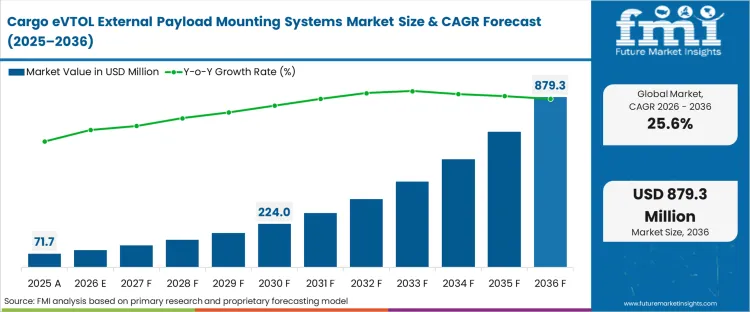
The supply chain reaches a stronger growth phase when it moves away from mission-specific underbody hooks and adopts standardized pod-rail interfaces designed for multi-vendor containers. This shift is being driven by aerospace component manufacturers that are validating modular quick-release locks against the demanding vibration profiles of cargo and air taxi use. Once universal attachment rails achieve certification, fleet integrators gain the ability to swap medical coolers for dry freight pods quickly and with far less operational complexity on the ground.
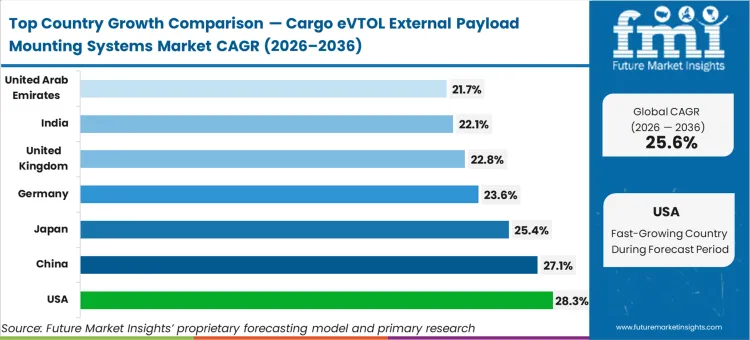
The United States is projected to expand at 28.3%, as rapid airspace integration initiatives force domestic aerospace tier-ones to freeze their external hardpoint designs to meet active deployment schedules. China follows closely, tracking a 27.1% compound rate driven by state-backed heavy drone deployments. Japan is set to register a 25.4% increase, leveraging its precision manufacturing base to develop standardized underbody rails. Germany is poised to advance at 23.6%, fueled by regional cold chain logistics network upgrades. The United Kingdom is anticipated to grow at 22.8%, while India and the United Arab Emirates track at 22.1% and 21.7% respectively. The divergence across these rates stems from the varying speeds at which national aviation authorities finalize the aerodynamic certification basis for suspended heavy payloads.
Cargo eVTOL External Payload Mounting Systems Market Definition
The market covers specialized interfaces, quick-release hardware, and aerodynamic enclosures designed for mounting heavy cargo outside the main fuselage of powered-lift aircraft. It is functionally defined by the connection hardware between the aircraft structure and the modular freight container, keeping it separate from internal tie-down systems and the freight pods themselves.
Cargo eVTOL External Payload Mounting Systems Market Inclusions
When determining what is included in cargo eVTOL external payload mounting systems, scope inclusions encompass all external load-bearing structures designed for advanced air mobility freight operations. This covers detachable pod attachment systems for eVTOL, underbody rails, mechanical release-lock assemblies, and suspended hook interfaces. The market also fully integrates the aerodynamic fairings enveloping these mounts, alongside sensor-integrated latching hardware that provides real-time load and position monitoring to the flight control computers.
Cargo eVTOL External Payload Mounting Systems Market Exclusions
Excluded from the market are internal cargo nets, cabin floor rollers, and pallet tie-downs used in passenger-converted airframes. The analysis also does not cover powertrain components, primary landing gear, or flight navigation sensors. Cargo containers, medical coolers, and parcel boxes are not included in the valuation, keeping the focus entirely on the mechanical and mounting hardware that links the payload with the airframe.
Cargo eVTOL External Payload Mounting Systems Market Research Methodology
- Primary Research: Procurement directors at leading cargo eVTOL original equipment manufacturers, engineers specializing in external aerodynamic loads, and aerospace hardware qualification leads.
- Desk Research: Aggregation of material qualification dossiers from civil aviation authorities, military logistics pilot program documentation, and mechanical testing registries for aerospace lock assemblies.
- Market-Sizing and Forecasting: Baseline sizing anchors to disclosed cargo-only eVTOL pre-order backlogs and early commercial deployment schedules, isolating the value of external mounting hardware per airframe.
- Data Validation and Update Cycle: Forecast trajectories are triangulated against the capital deployed by major aerospace suppliers for automated quick-release assembly production.
Segmental Analysis
Cargo eVTOL External Payload Mounting Systems Market Analysis by Mounting System Type
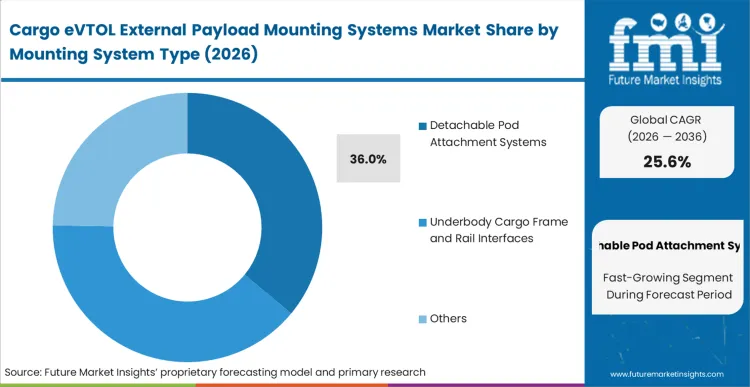
Detachable pod attachment systems hold 36.0% of the eVTOL detachable cargo pod systems market due to the hard operational logic of ground handling. A conventional cabin loaded with loose boxes reduces turnaround speed and limits the number of daily flight legs. Underbody rail systems make it possible to detach an empty urban air autonomous evtols pod and replace it with a pre-loaded container in under three minutes. According to FMI’s estimates, procurement teams prioritize these attachment rails at an early stage because non-standard locking interfaces can interfere with warehouse automation compatibility later in the chain. A bespoke, non-scalable mechanism forces continued dependence on specialized ground crews and weakens autonomous delivery economics.
- Labor reduction: Automated rail guides eliminate the need for manual rigging. Depot managers capture massive cost savings by removing specialized loadmasters from the regional hub workflow.
- Maintenance complexity: Mechanical locks subjected to high-frequency cycling require intense lubrication tracking. Unscheduled rail jams leave fully charged aircraft stranded on the tarmac.
- Lifecycle optimization: Standardizing the mechanical hardpoints allows fleet owners to constantly cycle diverse pod types without ever modifying the expensive host aircraft.
Cargo eVTOL External Payload Mounting Systems Market Analysis by Payload Interface
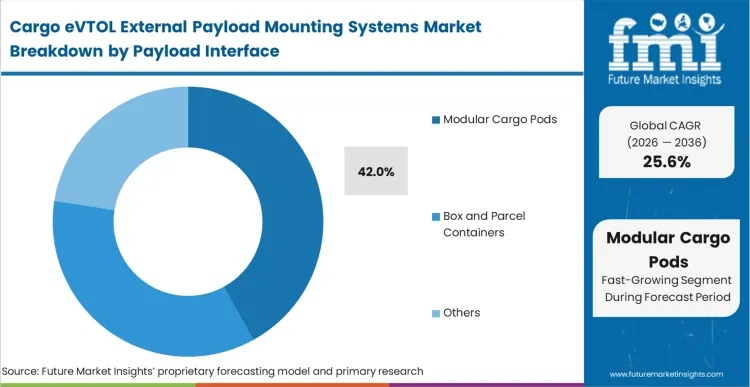
Modular cargo pods account for 42.0% share, while traditional suspended sling loads fall short of the aerodynamic requirements tied to high-speed transit. Unfaired external boxes create strong drag penalties that reduce battery efficiency and limit operating range. FMI indicates that structural engineers specify precision-molded electric aircraft pods to fit tightly with underbody rails and maintain laminar airflow during cruise flight. Buyers who choose generic open-frame slings to lower initial cost often encounter such severe range limitations that their logistics networks remain viable only for short-hop local deliveries.
- Range preservation: Aerodynamic pod integration dictates the total aerodynamic drag of the system. Procurement teams lock these interfaces first to guarantee advertised battery range metrics.
- Vibration isolation: Rigid pods transfer harmonic motor resonance directly to the cargo. Logistics operators must qualify specialized dampening mounts to protect fragile medical and electronic freight.
- Supplier consolidation: Because interface tolerances are incredibly tight, buyers typically sole-source the mounting rails and the cargo pods from the same tier-one provider.
Cargo eVTOL External Payload Mounting Systems Market Analysis by Aircraft Configuration
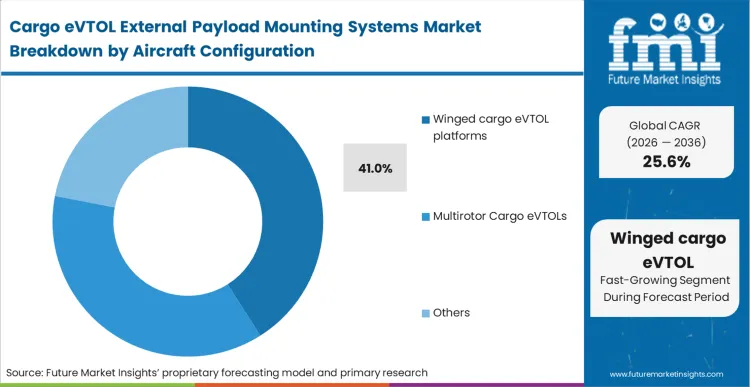
Winged cargo eVTOL platforms capture 41.0% share, reflecting the conflict between hovering lift requirements and horizontal transit efficiency. Middle-mile delivery networks need aircraft that can pick up heavy payloads from cramped distribution centers, then transition into fixed-wing flight for regional distances. FMI’s assessment notes that this architecture requires complex hybrid aircraft underbody mounting frames capable of retracting or shielding cargo pods during cruise. A pure multirotor design reduces mechanical complexity, though it permanently restricts the aircraft to shorter-range and lower-speed operations that produce weaker daily revenue.
- Drag mitigation: Fixed-wing transit requires extremely smooth underbody profiles. Structural designers specify automated fairings that close around the mounting locks after the pod is secured.
- Actuation failure: Complex retracting payload mounts introduce severe mechanical risks. Operators monitor these actuation joints rigorously to prevent pods from jamming in a high-drag configuration.
- Certification standards: Utilizing winged architectures aligns more closely with existing fixed-wing external load regulations, allowing developers to avoid protracted regulatory debates over novel multirotor sling dynamics.
Cargo eVTOL External Payload Mounting Systems Market Analysis by Sales Channel
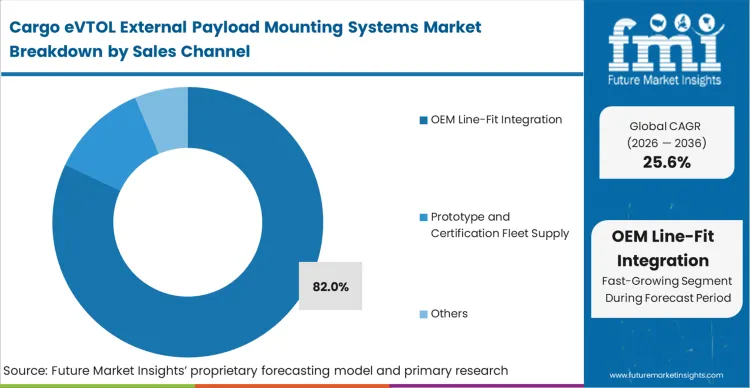
OEM line-fit integration commands an 82.0% share, shaped by the fact that cargo eVTOL fleets have not yet entered service at a scale that would support retrofit demand. Fleet operators are still waiting for the first conforming test articles to emerge from primary assembly rather than modifying aircraft already in operation. FMI analysts note that this leaves procurement power concentrated with aircraft developers, who are placing major forward contracts with established aircraft electrification mechanical prime contractors. A failure to secure reliable, high-volume supply for these critical eVTOL hardpoint cargo systems can leave costly assembled airframes stranded in the plant before basic payload drop testing can begin.
- Production scaling: All capital is currently deployed toward building initial commercial fleets. Procurement directors secure volume line-fit contracts to guarantee assembly line continuity.
- Integration conformity: Every line-fit hardpoint must perfectly match the approved aerodynamic type-design. Rigorous incoming inspections prevent non-conforming lock assemblies from halting final assembly.
- Aftermarket eventualities: Independent maintenance depots will eventually assume repair duties for worn mechanical locks, forcing suppliers to package complex rail assemblies into localized touch-up kits.
Cargo eVTOL External Payload Mounting Systems Market Analysis by End Use
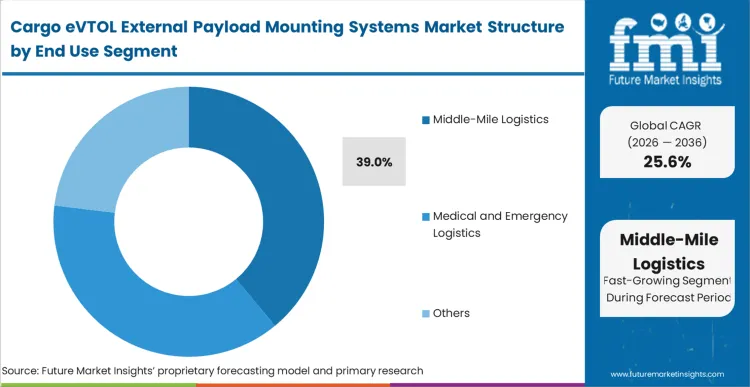
Middle-mile logistics represents 39.0% share as the demand for faster regional distribution continues to intensify. Fulfillment operators must move quickly through warehouse cycles while remaining within the strict weight and balance boundaries of electric aircraft platforms. FMI projects that commercial networks need highly specialized electric propulsion aircraft rail systems that let automated ground robots secure heavy pods directly into the underbody without manual effort. Cargo nets and forklift loading in this high-cycle environment create immediate scheduling inefficiencies that reduce the commercial strength of automated aerial logistics.
- Scheduling degradation: Manual loading friction directly ruins daily flight utilization. Operators justify premium automated locking hardware by minimizing the frequency of delayed tarmac departures.
- Sensor blind spots: Autonomous drops require flawless lock-state telemetry. Ground crews face severe safety risks if the mechanical interface fails to accurately report a secure latch to the flight computer.
- Total cost optimization: Over the decade, calculating total ownership cost proves that investing in high-end, maintenance-free rail interfaces offsets the severe revenue losses associated with extended depot downtime.
Cargo eVTOL External Payload Mounting Systems Market Drivers, Restraints, and Opportunities
The absolute imperative to minimize ground handling friction forces logistics engineers to specify automated, quick-release underbody rails. As manual loading of heavy freight drastically disrupts tight regional routing schedules, procurement directors navigating the cargo drone external payload interface market are obligated to source advanced sensor-linked latching systems that integrate directly with warehouse robotics. This is not a convenience feature; it is a strict operational requirement that dictates whether the aircraft can physically complete its promised daily revenue cycles. Fleets that utilize inferior, manually rigged aircraft fairings and slings will suffer immediate utilization degradation, rendering their regional shuttle networks economically unviable.
The primary organizational friction slowing supply chain acceleration is the protracted fatigue qualification timeline demanded for external aerospace hardware. Mechanical quick-release locks subjected to the continuous high-frequency vibration of distributed electric motors must undergo years of rigorous cyclic testing before aviation authorities clear them for commercial airspace. This testing bottleneck forces developers to freeze their underbody rail designs prematurely, limiting their ability to integrate modern, lighter-weight composite locking mechanisms into the initial production wave and constraining the overall payload efficiency of the first-generation fleets.
Opportunities in the Cargo eVTOL External Payload Mounting Systems Market
- Thermoplastic Composite Mounts: The demand for high-volume production enables the adoption of thermoplastic composites. Suppliers who validate rapid stamp-forming techniques for aerospace composites fairings capture massive line-fit contracts by drastically reducing manufacturing times.
- Integrated Weighing Sensors: Managing exact aircraft center-of-gravity requires exceptional telemetry. Manufacturers who embed dynamic load-cell sensors directly into the attachment rails eliminate the need for secondary ground-weighing procedures, securing preferred vendor status.
- Universal Pod Adapters: Competing aircraft platforms utilize proprietary underbody dimensions. Developing aviation-grade, modular adapter plates empowers logistics integrators to seamlessly swap standard cargo pods across diverse aircraft brands, eliminating fleet lock-in.
Regional Analysis
Based on the regional analysis, the Cargo eVTOL External Payload Mounting Systems Market is segmented into North America, Europe, Asia Pacific, and Rest of the World across 40 plus countries.
.webp "Top Country Growth Comparison Cargo Evtol External Payload Mounting Systems Market Cagr (2026 2036)")
| Country | CAGR (2026 to 2036) |
|---|---|
| United States | 28.3% |
| China | 27.1% |
| Japan | 25.4% |
| Germany | 23.6% |
| United Kingdom | 22.8% |
| India | 22.1% |
| United Arab Emirates | 21.7% |
Source: Future Market Insights (FMI) analysis, based on proprietary forecasting model and primary research
Asia Pacific Cargo eVTOL External Payload Mounting Systems Market Analysis
The Asia Pacific market is being driven by cost structures, available capital, and the sharp margin pressure built into e-commerce logistics. Operators are moving quickly to reduce human labor in middle-mile fulfillment through closed-ecosystem regional pilot programs that support faster validation of automated advanced composites payload rails. FMI estimates that this localized approach gives regional mechanical supply chains room to expand automated machining capacity without the protracted software validation delays holding back Western markets. The manufacturing base draws from mature expertise in commercial drone components and is systematically improving mechanical traceability architecture to satisfy baseline aerospace cargo requirements.
- China: China's aggressive push to dominate global automated logistics forces domestic fulfillment operators to rapidly deploy heavy electric cargo platforms. The Chinese landscape is set to achieve a CAGR of 27.1%. This massive, centralized demand positions Chinese tier-one mechanical suppliers to capture the first global economies of scale, eventually translating their domestic high performance composites volume dominance into highly competitive export pricing.
- Japan: Japanese robotics conglomerates transitioning into the aerospace sector face the immediate challenge of qualifying high-volume precision lock assemblies against stringent aviation standards. Operations managers evaluating the Japan detachable cargo pod eVTOL market are actively adapting existing warehouse automation technology for airborne applications, supporting a projected 25.4% CAGR. Securing these requalification gates allows legacy Japanese industrial giants to seamlessly integrate into the global supply chain as dominant providers of sensor-linked aerospace adhesives and sealants and release mechanisms.
- India: Lacking deep legacy aerospace infrastructure, domestic logistics startups leverage strategic technology transfer agreements with established global engineering firms to import critical heavy-lift mounting expertise. Demand for external payload hardware in India is estimated to expand at a CAGR of 22.1%. The structural trajectory points toward India building robust domestic machining capabilities, strategically transitioning from importing proprietary rail systems to capturing lucrative domestic e-commerce integration contracts.
FMI's report includes extensive analysis of emerging markets across Southeast Asia and Oceania. These secondary nations primarily focus on developing the ground automation infrastructure required to support imported cargo fleets rather than establishing indigenous aerospace mechanical formulation capabilities.
North America and Europe Cargo eVTOL External Payload Mounting Systems Market Analysis
Buyer behavior across North America and Europe is being shaped in a fundamental method by the regulatory environment, which in turn determines how quickly mechanical procurement decisions move forward. Aircraft integrators navigate the dual compliance structure of the FAA and EASA, making it essential for every applied rail, structural lock, and aircraft composite materials fairing to align with the drop-safety and fatigue-resistance requirements traditionally demanded of legacy commercial rotorcraft. FMI indicates that this uncompromising regulatory structure is driving developers to consolidate sourcing strategies and concentrate purchasing with established aerospace tier-one companies that already operate under certified quality management systems. Procurement priorities are centered on reducing exposure in automated latching processes so that higher production rates can be pursued without compromising the strict public safety margins that remain central to certification and market acceptance.
- United States: The United States cargo eVTOL payload systems market leverages concurrent military logistics validation programs to drastically accelerate the maturity of its domestic payload-mounting supply chain. These non-dilutive defense contracts allow operators to cycle heavy modular pods through punishing flight profiles, generating critical structural data for FAA compliance. The United States is projected to expand at 28.3%. This dual-use strategy secures a massive commercial opportunity, clearing the operational bottleneck of producing conforming test articles and pushing American OEMs toward immediate civilian middle-mile commercialization utilizing advanced aerospace lightweight materials.
- Germany: Germany's legacy stronghold in precision automotive and industrial engineering requires specialized adaptation to meet the exacting documentation standards of commercial aerospace cargo operations. Procurement directors actively validate high-cycle automated locking systems that preserve structural integrity under continuous daily loading. Germany is poised to advance at 23.6%. The structural trajectory indicates that companies successfully mapping their high-volume synthesis expertise to aviation safety standards will capture preferred supplier status in the burgeoning European cross-border logistics networks.
- United Kingdom: Airspace integration frameworks in the UK obligate structural engineering firms to focus heavily on acoustic mitigation alongside aerodynamic load efficiency. Design teams iterate payload fairings specifically engineered to maintain absolute laminar flow, preventing turbulent noise generation during urban hub approaches. The United Kingdom is anticipated to grow at 22.8%. The operational outcome of this regulatory focus is a distinct practitioner reality where British structural systems prioritize flawless aerodynamic finishes, establishing the global durability benchmark for low-noise external payload mounts for cargo eVTOL aircraft.
FMI's report includes comprehensive tracking of secondary European aerospace hubs like France and Italy. These nations leverage their deep heritage in rotary-wing external load operations to provide highly specialized dynamic hook systems and structural expertise to the broader market.
Middle East Cargo eVTOL External Payload Mounting Systems Market Analysis
Procurement practices, extreme wealth concentration, and aggressive smart-city mandates define the Middle Eastern approach to advanced aerial logistics. The region's strategy centers on deploying massive capital to support ultra-efficient port-to-city freight networks. Based on FMI's assessment, this dynamic radically shifts procurement requirements toward extreme environmental durability. Integrators supplying fleets to the region must heavily modify standard avionics and mechanical locks to withstand severe solar radiation, extreme ambient heat, and the intensely abrasive nature of airborne desert sand. The structural focus centers on integrating enclosed, dust-proof rail systems that preserve critical release functionality in harsh conditions.
- United Arab Emirates: Sovereign commitments establishing advanced maritime-to-urban logistics hubs by 2026 obligate operators in the UAE to demand severe environmental modifications from their global suppliers. Fleet managers face the intense practitioner reality of maintaining mechanical lock integrity and sensor telemetry under relentless solar baking and particulate exposure. The United Arab Emirates tracks at 21.7%. Successfully solving these extreme abrasive challenges provides massive competitive positioning, acting as the definitive proving ground for mechanical resilience across all subsequent global heavy-cargo deployments.
FMI's report includes adjacent analysis of Saudi Arabia's coastal logistics mega-projects. These massive development zones are integrating bespoke automated freight infrastructure directly into their architectural blueprints, establishing centralized procurement models for customized heavy-duty external payload systems.
Competitive Aligners for Market Players
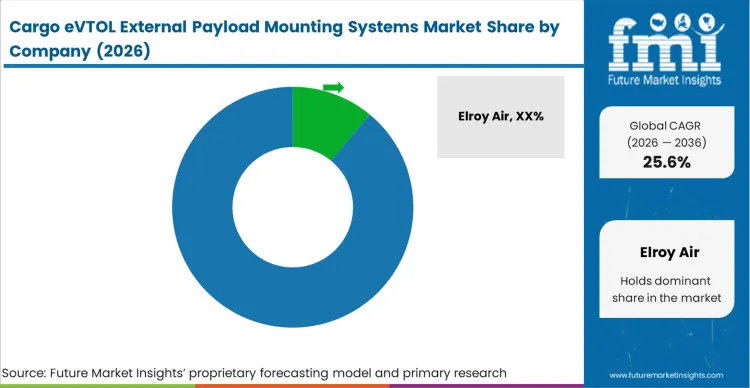
The competitive landscape shows a tightly concentrated structure shaped by the heavy capital burden attached to aerospace structural certification. Procurement directors at leading cargo eVTOL OEMs cannot afford to source mission-critical underbody rails or release locks from untested industrial vendors, regardless of the apparent cost advantage. What separates qualified suppliers from the broader mechanical systems market is their proven ability to maintain aerospace material traceability and provide extensive high-frequency vibration testing documentation. Elroy Air, BETA Technologies, and Bell Textron maintain their leadership because they carry these major upfront qualification expenses and deliver rails that consistently match the approved aerodynamic type design without deviation.
Long-term integration with civil aviation authorities allows incumbents to preserve a dominant structural position in the market. Legacy providers possess broad statistical evidence on mechanical fatigue trends and drone package delivery locking durability, which encourages developers to select their interface systems when trying to simplify an already demanding dual-certification process. Replicating this advantage is extremely difficult because a challenger must generate a large statistical base of physical load testing, showing dependable release performance across millions of simulated flight cycles and multiple temperature environments. Vendors that incorporate dynamic load-weighing sensors directly into mechanical rail assemblies create a design-level advantage that is difficult for conventional competitors to overcome.
As the market accelerates toward 2036, the structural tension between logistics operators demanding universal, open-source cargo pods and aircraft OEMs attempting to lock buyers into proprietary underbody rails will define the competitive trajectory. Integrators issuing a request quote for eVTOL cargo pod interface actively attempt to resist supplier lock-in by mandating adapter plates that allow cross-fleet compatibility for last mile delivery containers. However, the extreme performance tolerances required for high-speed forward flight ensure that the upper tier of cargo eVTOL pod manufacturers remains highly concentrated, allowing established aerospace primes to capture the vast majority of recurring line-fit revenue.
Key Players in Cargo eVTOL External Payload Mounting Systems Market
- Elroy Air
- BETA Technologies
- Bell Textron
- Yamato Holdings
- AIR
- CycloTech
- JAXA-associated concept ecosystem
Scope of the Report
| Metric | Value |
|---|---|
| Quantitative Units | USD 90.0 Million to USD 880.0 Million, at a CAGR of 25.6% |
| Market Definition | The specialized structural interfaces, quick-release mechanisms, and aerodynamic enclosures engineered to secure heavy cargo outside the primary fuselage of powered-lift aircraft. |
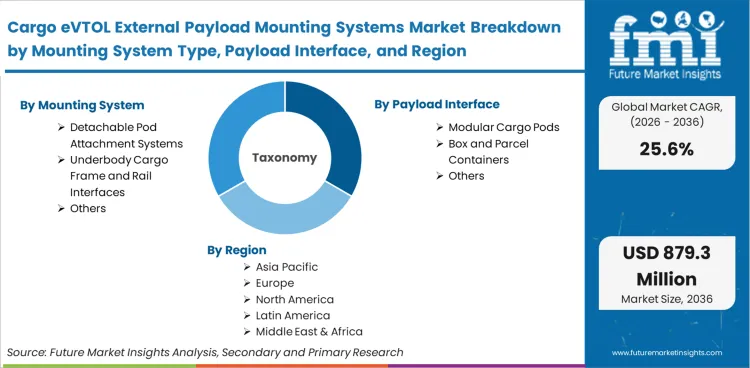
| Mounting System Type Segmentation | Detachable pod attachment systems, Underbody cargo frame and rail interfaces, External hardpoints and release-lock assemblies, Hook-based suspended payload interfaces, Aerodynamic fairings for external payload mounts, Sensor-integrated latch, load, and position-monitoring systems |
| Payload Interface Segmentation | Modular cargo pods, Box and parcel containers, Medical and cold-chain modules, Heavy utility and industrial payload carriers, ISR and special-mission external modules |
| Aircraft Configuration Segmentation | Winged cargo eVTOL platforms, Lift plus cruise cargo eVTOLs, Multirotor cargo eVTOLs, Hybrid VTOL cargo aircraft |
| Sales Channel Segmentation | OEM line-fit integration, Prototype and certification fleet supply, Retrofit and aftermarket upgrade demand |
| End Use Segmentation | Middle-mile logistics, Medical and emergency logistics, Defense and resupply missions, Industrial, offshore, and remote-site deliveries |
| Regions Covered | North America, Europe, Asia Pacific, Rest of the World |
| Countries Covered | United States, China, Japan, Germany, United Kingdom, India, United Arab Emirates, and 40 plus countries |
| Key Companies Profiled | Elroy Air, BETA Technologies, Bell Textron, Yamato Holdings, AIR, CycloTech, JAXA-associated concept ecosystem |
| Forecast Period | 2026 to 2036 |
| Approach | Procurement directors, structural engineers, and logistics operations managers were interviewed. Sizing anchors to near-term cargo eVTOL production signals and automated warehouse deployment rates. Forecasts are validated against supplier capacity expansions and commercial logistics capital expenditure models. |
Source: Future Market Insights (FMI) analysis, based on proprietary forecasting model and primary research
Cargo eVTOL External Payload Mounting Systems Market Analysis by Segments
Mounting System Type:
- Detachable pod attachment systems
- Underbody cargo frame and rail interfaces
- External hardpoints and release-lock assemblies
- Hook-based suspended payload interfaces
- Aerodynamic fairings for external payload mounts
- Sensor-integrated latch, load, and position-monitoring systems
Payload Interface:
- Modular cargo pods
- Box and parcel containers
- Medical and cold-chain modules
- Heavy utility and industrial payload carriers
- ISR and special-mission external modules
Aircraft Configuration:
- Winged cargo eVTOL platforms
- Lift plus cruise cargo eVTOLs
- Multirotor cargo eVTOLs
- Hybrid VTOL cargo aircraft
Sales Channel:
- OEM line-fit integration
- Prototype and certification fleet supply
- Retrofit and aftermarket upgrade demand
End Use:
- Middle-mile logistics
- Medical and emergency logistics
- Defense and resupply missions
- Industrial, offshore, and remote-site deliveries
Region:
- North America
- United States
- Europe
- United Kingdom
- Germany
- Asia Pacific
- China
- Japan
- India
- Rest of the World
- United Arab Emirates
Bibliography
- AIR. (2025, December 17). First production unit of cargo eVTOL unveiled [News coverage]. Aerotime.
- BETA Technologies. (2026, March 9). BETA selected to begin USA aircraft deliveries through FAA’s eVTOL Integration Pilot Program.
- Elroy Air. (2025, December 18). Elroy Air makes first A to B cargo delivery with its hybrid-electric VTOL aircraft Chaparral.
- USA Department of Transportation. (2026, March 9). The future of aviation is here.
- Yamato Holdings. (2022, April 12). CycloTech and Yamato reveal innovative cargo eVTOL concept with PUPA701.
This bibliography is provided for reader reference. The full FMI report contains the complete reference list with primary source documentation.
This Report Addresses
- Market intelligence to support strategic decision making across detachable pod interfaces, mechanical quick-release locks, and aerodynamic fairings
- Market size estimation and 10-year revenue forecasts from 2026 to 2036, supported by verifiable automated warehouse deployment rates
- Growth opportunity mapping across winged cargo eVTOL platforms with emphasis on the transition from bespoke underbody hooks to standardized pod-rail interfaces
- Segment and regional revenue forecasts covering middle-mile logistics networks across stringent airspace integration regulatory environments
- Competition strategy assessment including verifiable aerospace material traceability systems, vibration testing dossiers, and sensor-linked load telemetry
- Technology development tracking including thermoplastic composite mounts, integrated weighing sensors, and universal modular pod adapters
- Market access analysis covering civil aviation external load certification bases, FAA pilot program integration, and defense logistics validation pathways
- Market report delivery in PDF, Excel, PPT, and interactive dashboard formats for executive strategy, automated logistics planning, and operational benchmarking use
Frequently Asked Questions
How large is the Cargo eVTOL External Payload Mounting Systems Market in 2026?
The sector is valued at USD 90.0 million in 2026. This figure reflects the initial capital deployed by aerospace OEMs to secure certified underbody rail hardware for their first conforming prototype fleets designated for middle-mile testing.
What will it be valued at by 2036?
The valuation reaches USD 880.0 million by 2036. This massive expansion signals the operational transition from building single prototypes to automated, serial manufacturing of standardized quick-release locks for global logistics networks.
What CAGR is projected?
The market is projected to expand at a 25.6% CAGR. This rapid rate tracks the exact speed at which regional fulfillment centers upgrade their ground robotics to seamlessly interface with modular airborne cargo pods.
Which Mounting System Type segment leads?
Detachable pod attachment systems capture 36.0% share. By utilizing these underbody rail systems, operators can detach an empty pod and lock in a pre-loaded container in minutes, maximizing the daily flight legs an aircraft can complete.
Which Payload Interface segment leads?
Modular cargo pods hold 42.0% share. Structural engineers specify these precision-molded enclosures to smoothly integrate with the underbody rails, ensuring absolute laminar airflow and preserving vital battery range during horizontal cruise.
Which Aircraft Configuration segment leads?
Winged cargo eVTOL platforms command 41.0% share. This architecture demands complex underbody mounting frames that retract or aerodynamically shield the cargo pods during the cruise phase, facilitating high-speed regional transit.
What drives rapid growth in this market?
The absolute necessity to decouple aircraft charging times from freight loading cycles forces logistics integrators to specify rapid-swap external pod attachments, eliminating manual loading friction that ruins daily flight utilization.
What is the primary restraint facing suppliers?
The protracted fatigue qualification timeline demanded for external aerospace hardware limits agility. Mechanical quick-release locks must undergo years of rigorous cyclic testing before aviation authorities clear them for commercial airspace.
Which country grows fastest?
The United States expands at 28.3%, structurally outpacing China's 27.1%. The US leverages active federal airspace integration pilot programs that provide a clear regulatory pathway for domestic aerospace suppliers to validate external load hardware.
How do European airspace regulations shape procurement?
Harmonized EASA standards compel developers in the UK and Germany to utilize heavily documented aerospace mechanical supply chains. Operations managers cannot risk sourcing from unproven industrial vendors lacking aviation-grade material traceability.
Why does the lack of aftermarket demand influence current strategies?
With OEM line-fit capturing 82.0% of the value, suppliers concentrate entirely on guaranteeing factory floor delivery. Capital is deployed toward clearing primary assembly bottlenecks rather than building dispersed logistics repair networks.
How do incumbent aerospace tier-ones maintain dominance?
Incumbents hold immense statistical databases of mechanical fatigue testing previously validated by aviation authorities. Challengers cannot replicate this regulatory trust without spending millions to redundantly test new release locks across millions of cycles.
How does extreme heat in the Middle East alter mounting hardware design?
Operations in the UAE require severe environmental modifications. Fleets must integrate enclosed, dust-proof rail systems that preserve critical mechanical release functionality despite relentless solar baking and airborne desert sand exposure.
Why are detachable pods preferred over simple cargo nets?
Unfaired external boxes and nets create massive parasitic drag, fundamentally draining battery reserves. Modular pods preserve the aerodynamic profile of the aircraft, ensuring the horizontal flight efficiency required for middle-mile distances.
How do automated load sensors impact external payload mounts?
Autonomous drops require flawless lock-state telemetry. Manufacturers embed dynamic load-cell sensors directly into the attachment rails to eliminate secondary ground-weighing procedures and provide real-time safety data to flight computers.
What consequence do eVTOL developers face if they delay supplier lock-in?
Failing to secure production slots at established mechanical primes leaves developers without conforming underbody rails. Without these physical test articles, drop-testing halts entirely, jeopardizing lucrative logistics integration contracts.
Why do structural engineers reject manual latching systems for these platforms?
Manual locking requires specialized loadmasters, destroying the unit economics of autonomous delivery. Automated rail guides eliminate human rigging, allowing ground robots to secure heavy pods directly into the underbody.
What role do universal adapter plates play in fleet integration?
Competing aircraft platforms utilize proprietary underbody dimensions. Developing aviation-grade, modular adapter plates empowers logistics integrators to seamlessly swap standard cargo containers across diverse aircraft brands, eliminating fleet lock-in.
How does USA military funding derisk civilian commercial cargo structures?
Non-dilutive defense logistics contracts allow operators to cycle heavy modular pods through punishing flight profiles. This generates vital fatigue data for FAA compliance without burning private venture capital.
Why is thermoplastic stamp-forming considered a critical manufacturing shift?
Current thermoset composite fairings require hours inside massive autoclaves. Validating thermoplastic stamp-forming against aviation standards allows tier-one suppliers to mold complex aerodynamic payload covers in minutes, aligning output with e-commerce volume demands.
Preview the report firsthand - request a free sample
Get SampleGet the brochure for pricing and purchase details.
Get PDFTable of Content
- Executive Summary
- Global Market Outlook
- Demand-side Trends
- Supply-side Trends
- Technology Roadmap Analysis
- Analysis and Recommendations
- Market Overview
- Market Coverage / Taxonomy
- Market Definition / Scope / Limitations
- Research Methodology
- Chapter Orientation
- Analytical Lens and Working Hypotheses
- Market Structure, Signals, and Trend Drivers
- Benchmarking and Cross-market Comparability
- Market Sizing, Forecasting, and Opportunity Mapping
- Research Design and Evidence Framework
- Desk Research Programme (Secondary Evidence)
- Company Annual and Sustainability Reports
- Peer-reviewed Journals and Academic Literature
- Corporate Websites, Product Literature, and Technical Notes
- Earnings Decks and Investor Briefings
- Statutory Filings and Regulatory Disclosures
- Technical White Papers and Standards Notes
- Trade Journals, Industry Magazines, and Analyst Briefs
- Conference Proceedings, Webinars, and Seminar Materials
- Government Statistics Portals and Public Data Releases
- Press Releases and Reputable Media Coverage
- Specialist Newsletters and Curated Briefings
- Sector Databases and Reference Repositories
- FMI Internal Proprietary Databases and Historical Market Datasets
- Subscription Datasets and Paid Sources
- Social Channels, Communities, and Digital Listening Inputs
- Additional Desk Sources
- Expert Input and Fieldwork (Primary Evidence)
- Primary Modes
- Qualitative Interviews and Expert Elicitation
- Quantitative Surveys and Structured Data Capture
- Blended Approach
- Why Primary Evidence is Used
- Field Techniques
- Interviews
- Surveys
- Focus Groups
- Observational and In-context Research
- Social and Community Interactions
- Stakeholder Universe Engaged
- C-suite Leaders
- Board Members
- Presidents and Vice Presidents
- R&D and Innovation Heads
- Technical Specialists
- Domain Subject-matter Experts
- Scientists
- Physicians and Other Healthcare Professionals
- Governance, Ethics, and Data Stewardship
- Research Ethics
- Data Integrity and Handling
- Primary Modes
- Tooling, Models, and Reference Databases
- Desk Research Programme (Secondary Evidence)
- Data Engineering and Model Build
- Data Acquisition and Ingestion
- Cleaning, Normalisation, and Verification
- Synthesis, Triangulation, and Analysis
- Quality Assurance and Audit Trail
- Market Background
- Market Dynamics
- Drivers
- Restraints
- Opportunity
- Trends
- Scenario Forecast
- Demand in Optimistic Scenario
- Global Market Analysis 2021 to 2025 and Forecast, 2026 to 2036
- Historical Market Size Value (USD Million) Analysis, 2021 to 2025
- Current and Future Market Size Value (USD Million) Projections, 2026 to 2036
- Y-o-Y Growth Trend Analysis
- Absolute $ Opportunity Analysis
- Global Market Pricing Analysis 2021 to 2025 and Forecast 2026 to 2036
- Global Market Analysis 2021 to 2025 and Forecast 2026 to 2036, By Mounting System Type
- Introduction / Key Findings
- Historical Market Size Value (USD Million) Analysis By Mounting System Type , 2021 to 2025
- Current and Future Market Size Value (USD Million) Analysis and Forecast By Mounting System Type , 2026 to 2036
- Detachable Pod Attachment Systems
- Underbody Cargo Frame and Rail Interfaces
- Others
- Detachable Pod Attachment Systems
- Y-o-Y Growth Trend Analysis By Mounting System Type , 2021 to 2025
- Absolute $ Opportunity Analysis By Mounting System Type , 2026 to 2036
- Global Market Analysis 2021 to 2025 and Forecast 2026 to 2036, By Payload Interface
- Introduction / Key Findings
- Historical Market Size Value (USD Million) Analysis By Payload Interface, 2021 to 2025
- Current and Future Market Size Value (USD Million) Analysis and Forecast By Payload Interface, 2026 to 2036
- Modular Cargo Pods
- Box and Parcel Containers
- Others
- Modular Cargo Pods
- Y-o-Y Growth Trend Analysis By Payload Interface, 2021 to 2025
- Absolute $ Opportunity Analysis By Payload Interface, 2026 to 2036
- Global Market Analysis 2021 to 2025 and Forecast 2026 to 2036, By Aircraft Configuration
- Introduction / Key Findings
- Historical Market Size Value (USD Million) Analysis By Aircraft Configuration, 2021 to 2025
- Current and Future Market Size Value (USD Million) Analysis and Forecast By Aircraft Configuration, 2026 to 2036
- Winged cargo eVTOL platforms
- Multirotor Cargo eVTOLs
- Others
- Winged cargo eVTOL platforms
- Y-o-Y Growth Trend Analysis By Aircraft Configuration, 2021 to 2025
- Absolute $ Opportunity Analysis By Aircraft Configuration, 2026 to 2036
- Global Market Analysis 2021 to 2025 and Forecast 2026 to 2036, By Sales Channel
- Introduction / Key Findings
- Historical Market Size Value (USD Million) Analysis By Sales Channel, 2021 to 2025
- Current and Future Market Size Value (USD Million) Analysis and Forecast By Sales Channel, 2026 to 2036
- OEM Line-Fit Integration
- Prototype and Certification Fleet Supply
- Others
- OEM Line-Fit Integration
- Y-o-Y Growth Trend Analysis By Sales Channel, 2021 to 2025
- Absolute $ Opportunity Analysis By Sales Channel, 2026 to 2036
- Global Market Analysis 2021 to 2025 and Forecast 2026 to 2036, By End Use
- Introduction / Key Findings
- Historical Market Size Value (USD Million) Analysis By End Use, 2021 to 2025
- Current and Future Market Size Value (USD Million) Analysis and Forecast By End Use, 2026 to 2036
- Middle-Mile Logistics
- Medical and Emergency Logistics
- Others
- Middle-Mile Logistics
- Y-o-Y Growth Trend Analysis By End Use, 2021 to 2025
- Absolute $ Opportunity Analysis By End Use, 2026 to 2036
- Global Market Analysis 2021 to 2025 and Forecast 2026 to 2036, By Region
- Introduction
- Historical Market Size Value (USD Million) Analysis By Region, 2021 to 2025
- Current Market Size Value (USD Million) Analysis and Forecast By Region, 2026 to 2036
- North America
- Latin America
- Western Europe
- Eastern Europe
- East Asia
- South Asia and Pacific
- Middle East & Africa
- Market Attractiveness Analysis By Region
- North America Market Analysis 2021 to 2025 and Forecast 2026 to 2036, By Country
- Historical Market Size Value (USD Million) Trend Analysis By Market Taxonomy, 2021 to 2025
- Market Size Value (USD Million) Forecast By Market Taxonomy, 2026 to 2036
- By Country
- USA
- Canada
- Mexico
- By Mounting System Type
- By Payload Interface
- By Aircraft Configuration
- By Sales Channel
- By End Use
- By Country
- Market Attractiveness Analysis
- By Country
- By Mounting System Type
- By Payload Interface
- By Aircraft Configuration
- By Sales Channel
- By End Use
- Key Takeaways
- Latin America Market Analysis 2021 to 2025 and Forecast 2026 to 2036, By Country
- Historical Market Size Value (USD Million) Trend Analysis By Market Taxonomy, 2021 to 2025
- Market Size Value (USD Million) Forecast By Market Taxonomy, 2026 to 2036
- By Country
- Brazil
- Chile
- Rest of Latin America
- By Mounting System Type
- By Payload Interface
- By Aircraft Configuration
- By Sales Channel
- By End Use
- By Country
- Market Attractiveness Analysis
- By Country
- By Mounting System Type
- By Payload Interface
- By Aircraft Configuration
- By Sales Channel
- By End Use
- Key Takeaways
- Western Europe Market Analysis 2021 to 2025 and Forecast 2026 to 2036, By Country
- Historical Market Size Value (USD Million) Trend Analysis By Market Taxonomy, 2021 to 2025
- Market Size Value (USD Million) Forecast By Market Taxonomy, 2026 to 2036
- By Country
- Germany
- UK
- Italy
- Spain
- France
- Nordic
- BENELUX
- Rest of Western Europe
- By Mounting System Type
- By Payload Interface
- By Aircraft Configuration
- By Sales Channel
- By End Use
- By Country
- Market Attractiveness Analysis
- By Country
- By Mounting System Type
- By Payload Interface
- By Aircraft Configuration
- By Sales Channel
- By End Use
- Key Takeaways
- Eastern Europe Market Analysis 2021 to 2025 and Forecast 2026 to 2036, By Country
- Historical Market Size Value (USD Million) Trend Analysis By Market Taxonomy, 2021 to 2025
- Market Size Value (USD Million) Forecast By Market Taxonomy, 2026 to 2036
- By Country
- Russia
- Poland
- Hungary
- Balkan & Baltic
- Rest of Eastern Europe
- By Mounting System Type
- By Payload Interface
- By Aircraft Configuration
- By Sales Channel
- By End Use
- By Country
- Market Attractiveness Analysis
- By Country
- By Mounting System Type
- By Payload Interface
- By Aircraft Configuration
- By Sales Channel
- By End Use
- Key Takeaways
- East Asia Market Analysis 2021 to 2025 and Forecast 2026 to 2036, By Country
- Historical Market Size Value (USD Million) Trend Analysis By Market Taxonomy, 2021 to 2025
- Market Size Value (USD Million) Forecast By Market Taxonomy, 2026 to 2036
- By Country
- China
- Japan
- South Korea
- By Mounting System Type
- By Payload Interface
- By Aircraft Configuration
- By Sales Channel
- By End Use
- By Country
- Market Attractiveness Analysis
- By Country
- By Mounting System Type
- By Payload Interface
- By Aircraft Configuration
- By Sales Channel
- By End Use
- Key Takeaways
- South Asia and Pacific Market Analysis 2021 to 2025 and Forecast 2026 to 2036, By Country
- Historical Market Size Value (USD Million) Trend Analysis By Market Taxonomy, 2021 to 2025
- Market Size Value (USD Million) Forecast By Market Taxonomy, 2026 to 2036
- By Country
- India
- ASEAN
- Australia & New Zealand
- Rest of South Asia and Pacific
- By Mounting System Type
- By Payload Interface
- By Aircraft Configuration
- By Sales Channel
- By End Use
- By Country
- Market Attractiveness Analysis
- By Country
- By Mounting System Type
- By Payload Interface
- By Aircraft Configuration
- By Sales Channel
- By End Use
- Key Takeaways
- Middle East & Africa Market Analysis 2021 to 2025 and Forecast 2026 to 2036, By Country
- Historical Market Size Value (USD Million) Trend Analysis By Market Taxonomy, 2021 to 2025
- Market Size Value (USD Million) Forecast By Market Taxonomy, 2026 to 2036
- By Country
- Kingdom of Saudi Arabia
- Other GCC Countries
- Turkiye
- South Africa
- Other African Union
- Rest of Middle East & Africa
- By Mounting System Type
- By Payload Interface
- By Aircraft Configuration
- By Sales Channel
- By End Use
- By Country
- Market Attractiveness Analysis
- By Country
- By Mounting System Type
- By Payload Interface
- By Aircraft Configuration
- By Sales Channel
- By End Use
- Key Takeaways
- Key Countries Market Analysis
- USA
- Pricing Analysis
- Market Share Analysis, 2025
- By Mounting System Type
- By Payload Interface
- By Aircraft Configuration
- By Sales Channel
- By End Use
- Canada
- Pricing Analysis
- Market Share Analysis, 2025
- By Mounting System Type
- By Payload Interface
- By Aircraft Configuration
- By Sales Channel
- By End Use
- Mexico
- Pricing Analysis
- Market Share Analysis, 2025
- By Mounting System Type
- By Payload Interface
- By Aircraft Configuration
- By Sales Channel
- By End Use
- Brazil
- Pricing Analysis
- Market Share Analysis, 2025
- By Mounting System Type
- By Payload Interface
- By Aircraft Configuration
- By Sales Channel
- By End Use
- Chile
- Pricing Analysis
- Market Share Analysis, 2025
- By Mounting System Type
- By Payload Interface
- By Aircraft Configuration
- By Sales Channel
- By End Use
- Germany
- Pricing Analysis
- Market Share Analysis, 2025
- By Mounting System Type
- By Payload Interface
- By Aircraft Configuration
- By Sales Channel
- By End Use
- UK
- Pricing Analysis
- Market Share Analysis, 2025
- By Mounting System Type
- By Payload Interface
- By Aircraft Configuration
- By Sales Channel
- By End Use
- Italy
- Pricing Analysis
- Market Share Analysis, 2025
- By Mounting System Type
- By Payload Interface
- By Aircraft Configuration
- By Sales Channel
- By End Use
- Spain
- Pricing Analysis
- Market Share Analysis, 2025
- By Mounting System Type
- By Payload Interface
- By Aircraft Configuration
- By Sales Channel
- By End Use
- France
- Pricing Analysis
- Market Share Analysis, 2025
- By Mounting System Type
- By Payload Interface
- By Aircraft Configuration
- By Sales Channel
- By End Use
- India
- Pricing Analysis
- Market Share Analysis, 2025
- By Mounting System Type
- By Payload Interface
- By Aircraft Configuration
- By Sales Channel
- By End Use
- ASEAN
- Pricing Analysis
- Market Share Analysis, 2025
- By Mounting System Type
- By Payload Interface
- By Aircraft Configuration
- By Sales Channel
- By End Use
- Australia & New Zealand
- Pricing Analysis
- Market Share Analysis, 2025
- By Mounting System Type
- By Payload Interface
- By Aircraft Configuration
- By Sales Channel
- By End Use
- China
- Pricing Analysis
- Market Share Analysis, 2025
- By Mounting System Type
- By Payload Interface
- By Aircraft Configuration
- By Sales Channel
- By End Use
- Japan
- Pricing Analysis
- Market Share Analysis, 2025
- By Mounting System Type
- By Payload Interface
- By Aircraft Configuration
- By Sales Channel
- By End Use
- South Korea
- Pricing Analysis
- Market Share Analysis, 2025
- By Mounting System Type
- By Payload Interface
- By Aircraft Configuration
- By Sales Channel
- By End Use
- Russia
- Pricing Analysis
- Market Share Analysis, 2025
- By Mounting System Type
- By Payload Interface
- By Aircraft Configuration
- By Sales Channel
- By End Use
- Poland
- Pricing Analysis
- Market Share Analysis, 2025
- By Mounting System Type
- By Payload Interface
- By Aircraft Configuration
- By Sales Channel
- By End Use
- Hungary
- Pricing Analysis
- Market Share Analysis, 2025
- By Mounting System Type
- By Payload Interface
- By Aircraft Configuration
- By Sales Channel
- By End Use
- Kingdom of Saudi Arabia
- Pricing Analysis
- Market Share Analysis, 2025
- By Mounting System Type
- By Payload Interface
- By Aircraft Configuration
- By Sales Channel
- By End Use
- Turkiye
- Pricing Analysis
- Market Share Analysis, 2025
- By Mounting System Type
- By Payload Interface
- By Aircraft Configuration
- By Sales Channel
- By End Use
- South Africa
- Pricing Analysis
- Market Share Analysis, 2025
- By Mounting System Type
- By Payload Interface
- By Aircraft Configuration
- By Sales Channel
- By End Use
- USA
- Market Structure Analysis
- Competition Dashboard
- Competition Benchmarking
- Market Share Analysis of Top Players
- By Regional
- By Mounting System Type
- By Payload Interface
- By Aircraft Configuration
- By Sales Channel
- By End Use
- Competition Analysis
- Competition Deep Dive
- Elroy Air
- Overview
- Product Portfolio
- Profitability by Market Segments (Product/Age /Sales Channel/Region)
- Sales Footprint
- Strategy Overview
- Marketing Strategy
- Product Strategy
- Channel Strategy
- BETA Technologies
- Bell Textron
- Yamato Holdings
- AIR
- CycloTech
- Elroy Air
- Competition Deep Dive
- Market Dynamics
- Assumptions & Acronyms Used


