

- Industry Size (2026)
- USD 58.5 Mn
- Forecast (2036)
- USD 567.0 Mn
- CAGR (2026 to 2036)
- 25.5%
Cargo-to-Passenger Convertible eVTOL Cabin Systems Market Size, Market Forecast and Outlook By FMI
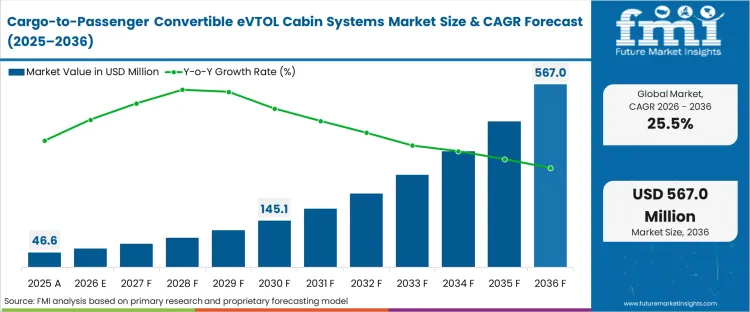
The cargo-to-passenger convertible eVTOL cabin systems market held the valuation at USD 46.6 million in 2025 steadily progressing as the industry revenue is set to hit USD 58.5 million in 2026 at a CAGR of 25.5% during the forecast period. Prompting the overall opportunity in market growth to an estimated USD 567.0 million through 2036 as fleet operators require dual-revenue utilization to amortize initial capital expenditures before battery replacement cycles begin.
Fleet utilization economics force urban air mobility operators to abandon single-mission aircraft purchases. Procurement directors demand eVTOL passenger-to-cargo conversion systems that allow an aircraft to haul priority packages when commuter traffic dips. Implementing a true dual-mission eVTOL cabin design dictates whether a platform achieves the mandatory fourteen flight hours per day required for commercial viability. Delaying this capability forces operators to buy larger mixed fleets. Securing appropriate aircraft cabin interiors guarantees that expensive aviation assets do not sit idle during midday demand troughs.
Once civil aviation authorities finalize standards for eVTOL modular cabin systems, operator adoption becomes mathematical rather than speculative. Certification of quick-swap eVTOL cabin modules triggers immediate retrofits across early prototype fleets. Manufacturers focusing on early eVTOL cabin integration for OEMs avoid crippling weight penalties later. This physical architecture transition guarantees a locked-in revenue stream for specialized component suppliers. Early validation reduces friction for air taxi exterior components as payload profiles shift.
Summary of Cargo-to-Passenger Convertible eVTOL Cabin Systems Market
- Cargo-to-Passenger Convertible eVTOL Cabin Systems Market Definition
- Convertible eVTOL cabin systems consist of modular interior hardware allowing swift transition between human transport and freight logistics. These specialized components must balance extreme lightweight construction with dual-category crashworthiness certification to ensure maximum daily aircraft utilization.
- Demand Drivers in the Market
- Low midday passenger volumes compel fleet dispatchers to swap configurations for lucrative medical logistics runs.
- High capital costs associated with new electric platforms force financial officers to mandate dual-revenue generation capabilities.
- Strict urban noise curfews push municipal transit planners to require versatile aircraft that can perform quiet nighttime cargo deliveries.
- Key Segments Analyzed in the FMI Report
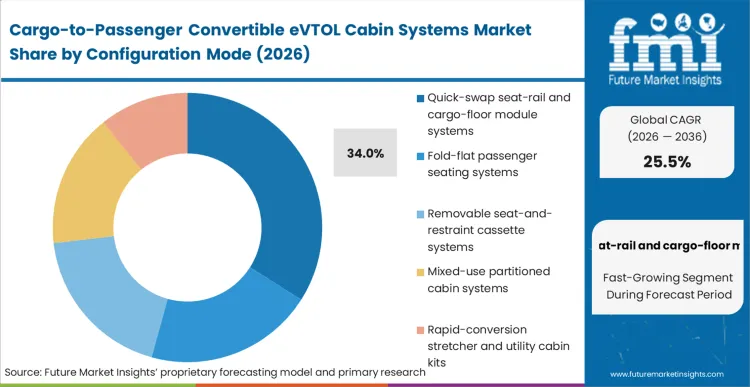
- Quick-Swap Seat-Rail And Cargo-Floor Module Systems: 34.0% share in 2026 based on their ability to minimize ground turnaround time between missions.
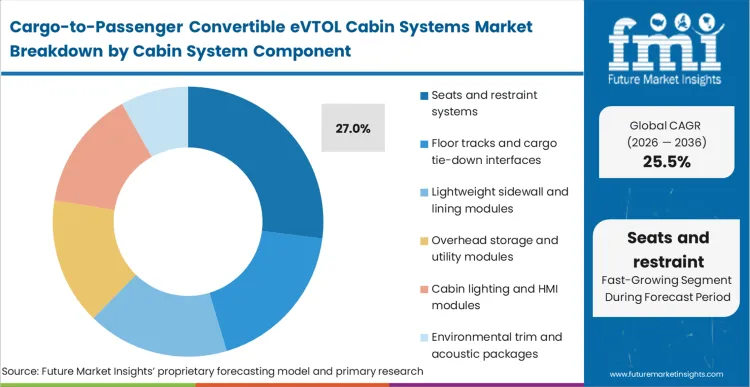
- Seats And Restraint Systems: 27.0% share driven by complex dynamic testing requirements.
- Lift-Plus-Cruise Evtol Platforms: 46.0% share due to optimal balance of hover efficiency and forward cruise payload capacity.
- Urban Passenger Shuttle Plus Logistics Dual-Use Fleets: 39.0% share, as operators pursue maximum asset utilization.
- OEM Line-Fit Cabin Integration: 72.0% share, reflecting the difficulty of retrofitting certified structural hardpoints.
- China: A CAGR of 29.4% anchored by rapid regulatory clearance for uncrewed cargo flights serving as testbeds for passenger operations.
- Analyst Opinion at FMI
- Nikhil Kaitwade, Principal Analyst, Technology, at FMI, notes that "Investors model eVTOL profitability on idealized passenger load factors. Operations managers actually calculate how fast a ground crew can strip a cabin to fly auto parts when the commuter rush ends. Designing a seat that passes 16G crash tests is routine engineering. Navigating eVTOL cabin certification requirements for hardware that a single line worker can remove in three minutes without specialized tools determines whether an operator makes money or bleeds cash. If the conversion process grounds the aircraft for an hour, the economic advantage evaporates entirely. True market winners are quietly solving the mechanical release mechanisms, not just the composite materials."
- Strategic Implications / Executive Takeaways
- Interior component suppliers must shift engineering focus from passenger comfort toward extreme modularity and toolless attachment mechanisms.
- eVTOL manufacturers face severe commercial disadvantages if they commit to fixed-cabin architectures that lock buyers into single revenue streams.
- Fleet procurement teams require guaranteed conversion times written into purchasing contracts to ensure their financial models remain viable.
- Methodology
- Direct interviews with interior completion centers reveal the hidden engineering bottlenecks in quick-release track certification.
- Analysis of regulatory special conditions exposes exactly where authorities draw the line between cargo containment and passenger safety.
- Cross-referencing prototype delivery schedules establishes a realistic timeline for commercial-scale component integration.
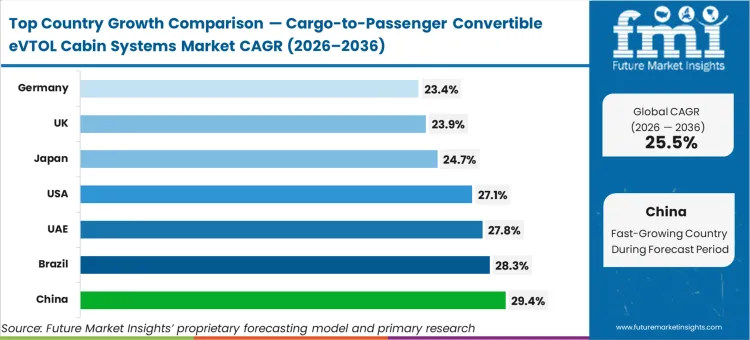
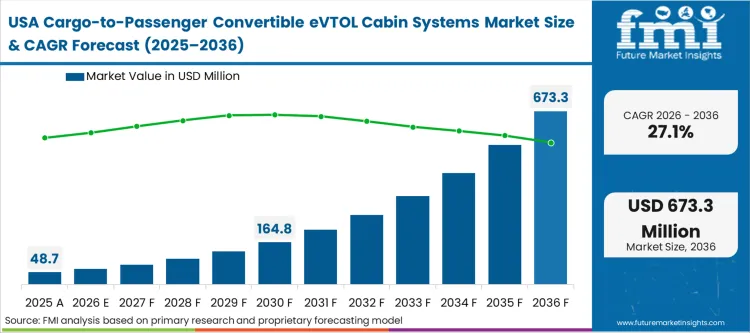
China sets the adoption pace at 29.4% as domestic manufacturers secure accelerated operational approvals for logistics routes before passenger certification. Brazil follows at 28.3% driven by established helicopter shuttle networks transitioning to electric assets. United Arab Emirates expands at 27.8% on aggressive government mandates for autonomous transit infrastructure. United States operators push for 27.1% growth through military-backed utility testing that flows into civilian applications. Japan logs 24.7% expansion tied to specialized island-hopping logistics requirements. United Kingdom and Germany track at 23.9% and 23.4% respectively. Evaluating the convertible eVTOL interior market CAGR reveals that divergent regulatory pathways for mixed payloads ultimately separate the rapid adopters from the cautious followers. Early integration of offshore exterior components further differentiates regional capabilities.
Cargo-to-Passenger Convertible eVTOL Cabin Systems Market Definition
Convertible eVTOL cabin systems represent specialized interior modular hardware enabling rapid transition between passenger transport and cargo logistics within a single electric vertical takeoff and landing aircraft. This niche forms the structural core of the eVTOL interior systems market. Physical boundaries include certified quick-release floor tracks, removable crash-rated seating cassettes, collapsible bulkheads, and integrated tie-down grids designed to satisfy dual-category aviation safety regulations.
Cargo-to-Passenger Convertible eVTOL Cabin Systems Market Inclusions
Modular interior configurations encompassing fold-flat seats and eVTOL cargo conversion kits fall strictly within scope. Acoustic treatments and specialized global aircraft cabin interiors engineered specifically for rapid reconfiguration are evaluated. Track-mounted partition bulkheads and specialized environmental trim designed to protect bare fuselage composites from freight damage constitute primary inclusion categories. Hardware must be explicitly certified for vertical lift applications.
Cargo-to-Passenger Convertible eVTOL Cabin Systems Market Exclusions
Traditional commercial airliner conversion kits and standard helicopter interior systems sit entirely outside our scope. Structural fuselage components and exterior payload pods do not qualify as cabin systems. Fixed-seat commuter configurations lacking rapid conversion mechanisms are specifically excluded because they fail the functional definition of dual-use modularity. External sling-load equipment and heavy military transport interiors are similarly bypassed.
Cargo-to-Passenger Convertible eVTOL Cabin Systems Market Research Methodology
- Primary Research: Chief engineers at eVTOL airframe manufacturers and fleet procurement directors at launch-customer operators.
- Desk Research: Type-certification basis documents from EASA, FAA special conditions for VTOL, and patent filings for lightweight quick-release aviation hardware.
- Market-Sizing and Forecasting: Confirmed prototype orders and projected line-fit rates for dual-use platforms entering commercial service.
- Data Validation and Update Cycle: Direct comparison against published supplier contracts for advanced seating mechanisms and floor track systems.
Segmental Analysis
Cargo-to-Passenger Convertible eVTOL Cabin Systems Market Analysis By Configuration Mode
FMI analysts note that turnaround time dictates profitability for short-hop networks utilizing advanced air mobility cabin systems. Floor-level mechanical interfaces dictate how quickly a ground crew can reconfigure a revenue asset. Quick-swap seat-rail and cargo-floor module systems command 34.0% share in 2026. Maintenance technicians require systems that engage positively without complex torque verifications. Ground handlers working on active vertipads cannot manage loose hardware or complicated rigging during a ten-minute turnaround window. Standard aerospace tracks require too much inspection time for daily swaps. What initial operational models miss entirely is the dirt and debris accumulation inside exposed floor rails. Operators must maintain pristine eVTOL seat rail and cargo floor systems to prevent binding. Fleets that commit to poorly sealed track systems face escalating maintenance delays that destroy their dispatch reliability metrics. Proper integration of advanced air mobility logistics depends directly on these mechanical tolerances.
- Turnaround Economics: Physical floor tracks determine conversion speed. Ramp supervisors face severe schedule disruptions if seat removal requires specialized tooling.
- Debris Vulnerability: Exposed rails collect cabin particulate. Maintenance crews must constantly clean tracks to prevent mechanical binding.
- Utilization Penalty: Complex rigging slows reconfiguration. Dispatchers lose valuable flight blocks if conversions exceed standard battery charging intervals.
Cargo-to-Passenger Convertible eVTOL Cabin Systems Market Analysis By Cabin System Component
Dynamic certification loads force extreme engineering constraints onto removable interior hardware. Seats and restraint systems hold 27.0% share because they carry the highest regulatory burden. Certification engineers spend millions proving these specific components survive emergency descent profiles. FMI observes that unlike standard commercial aviation seats which remain bolted for years, removable eVTOL seating modules endure constant handling stresses. Baggage handlers drop them, drag them across tarmac surfaces, and misalign them during installation. What pure weight-optimization studies overlook is the durability requirement of the exterior casing of the removed seat. The demand for eVTOL interior lightweight seating systems clashes directly with the ruggedness needed for daily ground handling. When operators replace damaged frames every six months, total lifecycle costs eclipse the savings from reduced vehicle weight. Purchasing managers who prioritize eVTOL cabin safety and restraint systems without factoring in handling durability face crippling replacement budgets. Connecting these mechanisms to more electric aircraft grids adds structural complexity.
- Certification Friction: Safety authorities demand rigorous drop testing. Engineering directors navigate prolonged approval cycles for any new attachment mechanism.
- Handling Attrition: Removed seats suffer tarmac damage. Logistics managers require ruggedized storage cassettes to protect fragile composite frames.
- Weight Compromise: Extreme durability adds mass. Procurement directors struggle to balance handling lifespan against the aircraft's critical payload limits.
Cargo-to-Passenger Convertible eVTOL Cabin Systems Market Analysis By Aircraft Architecture
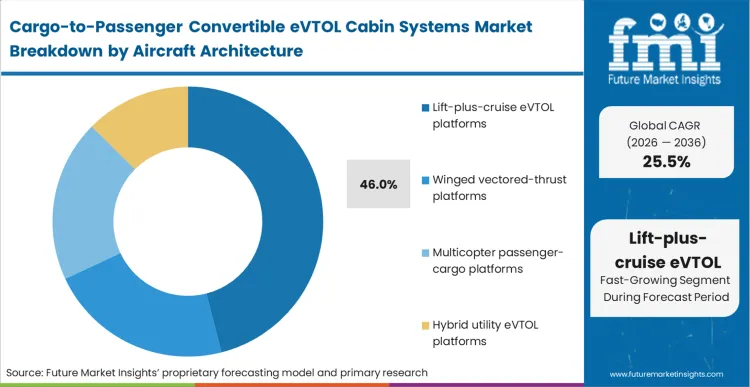
Hover efficiency combined with forward-flight speed drives the physical dimensions of the cabin interior. Lift-plus-cruise eVTOL platforms account for 46.0% share as they offer the most flexible internal volume. Based on FMI's assessment, this architecture provides a continuous flat floor structure suitable for standard cargo pallets. Airframe designers favor this approach because it accommodates a cargo passenger convertible air taxi cabin without disrupting the central payload volume. The fact that composite structural engineers rarely communicate to buyers is that lift-plus-cruise designs often create severe center-of-gravity constraints. Cargo loadmasters must precisely balance freight within a very narrow envelope compared to traditional rotorcraft. Operators who purchase these platforms anticipating simple bulk-loading capabilities quickly discover they must invest heavily in specialized load-weighing and balancing software. Securing aircraft electrification architectures inside these versatile cabins requires careful routing of high-voltage lines away from potential impact zones.
- Volume Optimization: Separate thrust pods free internal space. Cabin architects maximize usable floor area for standardized freight containers.
- Balance Sensitivity: Narrow weight envelopes restrict loading. Loadmasters face strict placement rules that complicate rapid freight loading.
- Routing Protection: High-voltage cables sit near the cabin shell. Safety inspectors demand thick armor panels that reduce the usable interior volume.
Cargo-to-Passenger Convertible eVTOL Cabin Systems Market Analysis By End Use
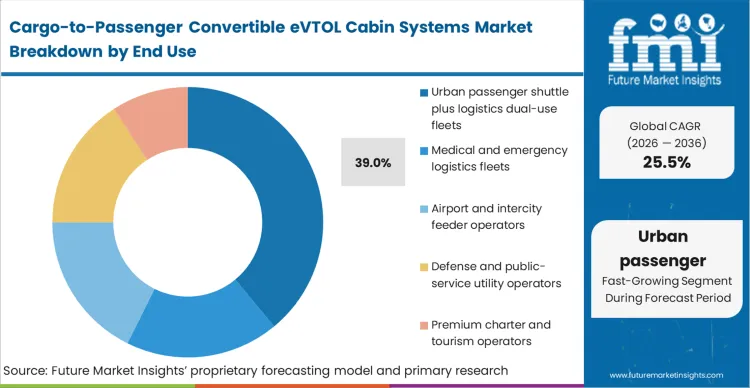
FMI's analysis indicates that independent operators cannot survive on peak-hour commuter revenue alone. Financial officers model business plans assuming the aircraft flies priority freight during off-peak hours and overnight. Asset utilization metrics determine survival in the nascent urban air mobility sector. Urban passenger shuttle plus logistics dual-use fleets capture 39.0% share. Transitioning an aircraft from moving executives to moving medical supplies requires certified physical separation barriers. The aspect that commuter-focused analyses fail to model is the odor and cleanliness degradation of the cabin. Managing eVTOL cabin systems for urban logistics requires mitigating the residue left by industrial freight. Customer experience directors frequently force maintenance crews into prolonged deep-cleaning cycles after cargo runs, quietly destroying the economic advantage of the dual-use model. Integrating electric aircraft onboard sensors is essential to monitor these environmental changes.
- Revenue Bridging: Commuter traffic creates midday valleys. Operations managers fill these dead zones with high-margin express parcel contracts.
- Cleaning Delays: Freight leaves residue. Maintenance teams consume valuable charging time scrubbing interiors before passenger service resumes.
- Brand Dilution: Mixed use damages premium perception. Marketing directors struggle to sell luxury tickets on aircraft that look like delivery vans.
Cargo-to-Passenger Convertible eVTOL Cabin Systems Market Analysis By Sales Channel
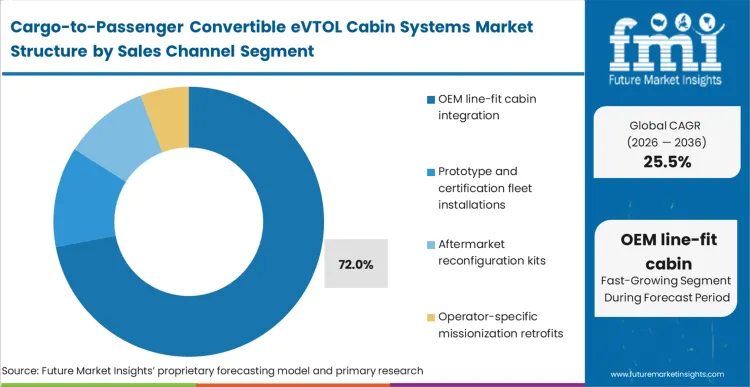
Structural hardpoints must be baked into the initial composite curing process. OEM line-fit cabin integration dominates with 72.0% share. FMI points out that retrofitting a carbon fiber fuselage to accept 16G seat tracks is prohibitively expensive and often compromises the airframe's integrity. Completion center engineers understand that eVTOL cabin reconfiguration technology must be designed into the primary structure from day one. Buyers specifying interior options must commit to modular tracks years before delivery. What fleet buyers misunderstand about line-fit dominance is that it hands absolute pricing power to the airframe manufacturer for aftermarket spares. Once a procurement director commits to a specific OEM's ecosystem, they cannot source replacement components from independent eVTOL cabin suppliers. Operators who fail to negotiate lifetime spare-parts pricing during the initial purchase find themselves paying exorbitant premiums. Validating these configurations through flight test systems helps OEMs secure their long-term aftermarket revenue.
- Structural Necessity: Composites reject aftermarket drilling. Airframe engineers embed metal tracks during the primary fuselage lay-up phase.
- Lock-In Economics: Proprietary interfaces eliminate competition. Purchasing departments lose leverage once the initial delivery contract is signed.
- Integration Forecasting: Buyers must predict future needs. Fleet planners guess their cargo volumes years before the aircraft enters service.
Cargo-to-Passenger Convertible eVTOL Cabin Systems Market Drivers, Restraints, and Opportunities
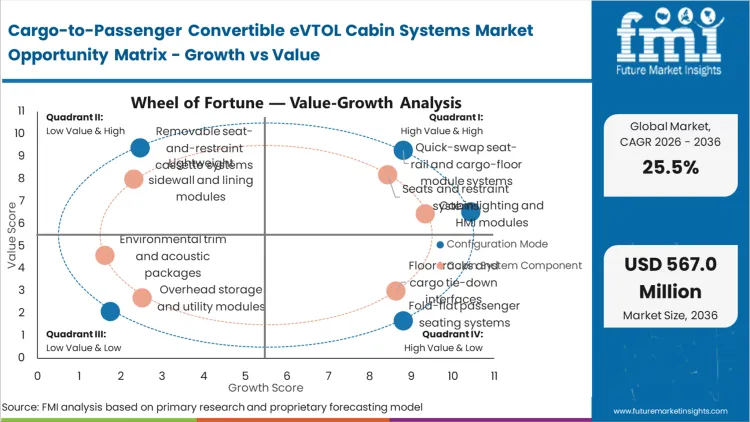
Capital amortization pressures force fleet operators to pursue maximum asset utilization. A single-purpose electric aircraft sitting idle during low-demand hours destroys the financial model of an urban mobility network. Executing an effective eVTOL cargo and passenger fleet conversion within a standard charging window accelerates the development of eVTOL mission-flexible interior systems. Procurement directors refuse to authorize multimillion-dollar acquisitions unless the airframe can transition from commuter service to freight hauling instantly. Operators recognize that survival depends on serving dual markets, driving the urgent need for modularity. Planning route compatibility with charging facilities ensures seamless transitions between passenger and payload missions.
Certification divergence between passenger and cargo containment standards slows adoption even when buyers want modularity. Aviation authorities mandate extreme crash-load survivability for human occupants but require entirely different containment thresholds for dense freight. Engineering teams struggle to design floor tracks that satisfy both regulatory extremes without adding massive weight. While partial solutions involving heavy netting exist, they consume excessive interior volume and interfere with external payload mounting systems. Until regulators establish a unified special condition for dual-use rapid-change interiors, manufacturers must over-engineer attachment points, quietly degrading the aircraft's crucial payload capacity.
Opportunities in the Cargo-to-Passenger Convertible eVTOL Cabin Systems Market
- Automated Loading Interfaces: Standardized autonomous cargo pods sliding directly into vacated passenger tracks. Fleet managers gain seamless integration with ground-based logistics hubs.
- Smart Sensor Grid Deployment: Floor panels featuring embedded weighing sensors to instantly calculate center of gravity. Loadmasters eliminate manual balance calculations during rapid turnarounds.
- Acoustic Cargo Shielding: Deployable noise-canceling blankets designed specifically for freight runs. Operations directors secure community noise compliance during overnight drone logistics transportation missions.
Regional Analysis
.webp "Top Country Growth Comparison Cargo To Passenger Convertible Evtol Cabin Systems Market Cagr (2026 2036)")
Based on regional analysis, Cargo-to-Passenger Convertible eVTOL Cabin Systems Market is segmented into Asia Pacific, Middle East and Africa, North America and Latin America, and Europe across 40 plus countries. The global adoption of convertible cabin systems reveals a fractured geographical landscape, driven by varying degrees of regulatory aggression and existing transit infrastructure. Regional timelines hinge entirely on whether local authorities prioritize uncrewed freight testing or wait for unified passenger-certification standards.
| Country | CAGR (2026 to 2036) |
|---|---|
| China | 29.4% |
| Brazil | 28.3% |
| United Arab Emirates | 27.8% |
| United States | 27.1% |
| Japan | 24.7% |
| United Kingdom | 23.9% |
| Germany | 23.4% |
Source: Future Market Insights (FMI) analysis, based on proprietary forecasting model and primary research
Asia Pacific Cargo-to-Passenger Convertible eVTOL Cabin Systems Market Analysis
Domestic OEMs in Asia Pacific enjoy profound cost advantages when engineering powered cabin components, heavily supported by the extreme density of the regional battery supply chain. Exploring the modular air taxi interiors market, these manufacturers establish massive operational datasets through the early deployment of inter-city express freight platforms. Local operators validate cargo containment hardware in active commercial service years before Western rivals, enabled by regulatory regimes that actively encourage uncrewed logistics testing prior to human-occupancy certification. Unparalleled system reliability data flows directly to operators who seamlessly integrate autonomous exterior sensors with advanced cabin telemetry. The moment passenger approvals are finalized, these freight-hardened fleets are positioned to instantly pivot into fully dual-use transit networks.
- China: Industry growth at 29.4% CAGR, stems directly from an accelerated regulatory clearance strategy for uncrewed logistics flights. Securing an immediate revenue pipeline, fleet directors procure highly adaptable cabins capable of hauling freight today while preserving full passenger readiness for tomorrow. This rapid commercialization pathway allows regional component suppliers to lock in critical fleet standards early.
- Japan: Navigating highly specific island-hopping supply chains forces Japanese logistics coordinators to demand extremely adaptable aviation platforms. Propelled by a 24.7% expansion rate, this market explicitly demonstrates the strict operational realities of balancing sensitive inbound seafood deliveries with outbound human transit using quick-change interior architectures.
FMI's report includes South Korea, India, and Australia. These nations focus heavily on establishing basic vertiport infrastructure before committing to specialized dual-use cabin architectures.
Middle East and Africa Cargo-to-Passenger Convertible eVTOL Cabin Systems Market Analysis
Specific engineering choices regarding material durability and interior cooling during rapid cargo loading are entirely dictated by the extreme thermal environments of the Middle East. Seeking electric alternatives to high-cost turbine maintenance, regional fleet operators refuse to compromise on baseline payload flexibility. Transport planners executing state-backed smart-city initiatives actively mandate the procurement of platforms that seamlessly blend human and autonomous parcel transit.
- United Arab Emirates: Municipal authorities require aviation networks that fluidly handle both peak commuter surges and autonomous parcel deliveries with equal efficiency. Pushing United Arab Emirates expansion to 27.8% CAGR, state-sponsored transit initiatives mandate fully flexible, smart-city logistics platforms.
FMI's report includes Saudi Arabia and South Africa. These markets remain highly sensitive to initial capital costs and prioritize simple passenger configurations over complex modular systems.
North America and Latin America Cargo-to-Passenger Convertible eVTOL Cabin Systems Market Analysis
Bridging the Americas reveals a stark contrast in design pressures, where extreme utility intersects with high-end luxury. North American manufacturers gravitate toward ruggedized, easily washable interior finishes, a trend heavily subsidized by military interest in utility applications. Conversely, operators across Latin America manage high-net-worth commuter routes that require premium passenger aesthetics, which must somehow withstand the brutal reality of rough off-hours freight handling. This creates a massive design friction point: preserving the pristine quality of commercial aircraft cabin interiors while simultaneously hauling dense industrial components. Ultimately, legacy urban helicopter operators across both continents are transitioning to electric fleets to drastically slash operating costs without surrendering critical payload versatility.
- United States: Climbing at 27.1% CAGR, the United States market highlights the practitioner reality that defense funding quietly solves the hardest civilian engineering problems. Subsidized military utility testing directly accelerates the development of ruggedized rapid-swap floor systems, empowering civilian fleet directors to specify exceptionally durable cabin hardware.
- Brazil: Slashing operating costs remains the primary objective for legacy urban helicopter operators transitioning to electric platforms. Registering a 28.3% of CAGR, Brazilian buyers leverage decades of intense operational experience to break into previously unprofitable mid-tier freight markets by specifying convertible interior architectures.
FMI's report includes Canada and Mexico. These nations focus intensely on establishing unified certification protocols and building cross-border operational frameworks before allowing the widespread commercial deployment of convertible assets.
Europe Cargo-to-Passenger Convertible eVTOL Cabin Systems Market Analysis
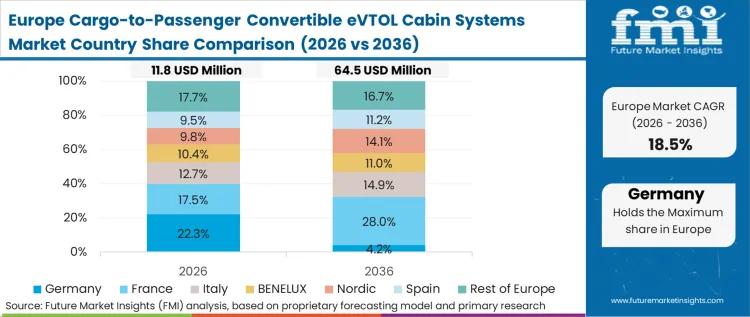
Managing the strict interior weight limits of zero emission aircraft remains the absolute binding constraint for engineers navigating European regulatory regimes. The necessity for extreme documentation inevitably slows initial line-fit approvals, though it ultimately guarantees an exceptionally robust final product. Engineering teams exhaust the majority of their development budgets satisfying rigorous EASA special conditions tailored specifically for vertical lift aircraft, as stringent crashworthiness mandates dictate every interior design parameter. Meanwhile, operators across the continent strategically prioritize ensuring these dual-use platforms integrate seamlessly with existing high-speed rail networks.
- United Kingdom: Logistics managers demand highly modular interiors capable of transitioning seamlessly from regional business shuttles to vital medical courier configurations. The United Kingdom market tracks the growth at 23.9% of CAGR, driven by regional connectivity mandates that push operators toward mixed-use platforms serving secondary airports.
- Germany: A 23.4% CAGR secures a massive commercial opportunity for established automotive tier-one suppliers pivoting into the aviation sector. Production engineers aggressively adapt fast-assembly techniques from premium vehicle lines to aircraft seating systems, leveraging the country's deep automotive manufacturing expertise to solve complex interior modularity challenges.
FMI's report includes France and Italy. These nations focus intensely on cementing unified EASA certification protocols to ensure absolute passenger safety before authorizing the broader deployment of rapid-conversion fleet assets.
Competitive Aligners for Market Players
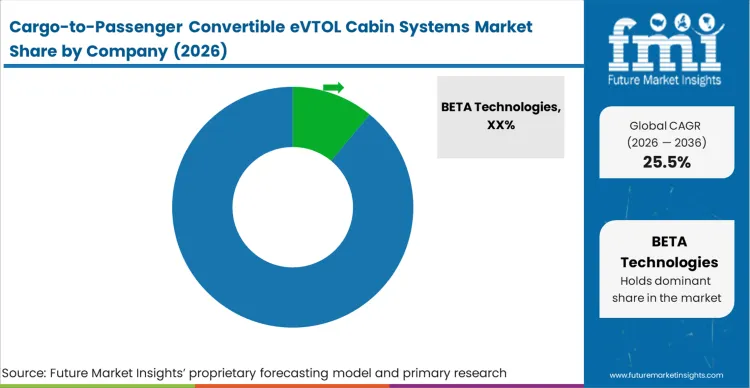
The competitive dynamic centers on certification moats rather than pure manufacturing capability. The leading eVTOL cabin systems key players secure early advantage by dragging designs through grueling regulatory approval cycles. Component suppliers face a brutal reality: an innovative quick-release mechanism is worthless without millions of dollars invested in dynamic sled testing. Airlines and fleet operators select partners based almost entirely on certification readiness. A supplier offering a slightly heavier seat with a stamped FAA approval will defeat a lighter, uncertified alternative every time. Procurement directors cannot risk their aircraft delivery schedules on unproven interior hardware. Supporting advanced urban air autonomous platforms requires absolute regulatory compliance from day one.
Established aerospace interior giants possess a massive library of certified materials and approved testing methodologies. Diehl Aviation and RECARO Aircraft Seating leverage decades of commercial aviation data to accelerate their eVTOL specific designs. Challengers must build entirely new compliance databases from scratch. Incumbents translate their deep understanding of burn-test requirements and toxicity standards into rapid prototyping. When an eVTOL manufacturer needs a track system that won't compromise the carbon fuselage during a hard landing, they turn to engineers who have already solved similar problems for traditional rotorcraft. Validating the integrity of exterior damage resistant coatings often involves the same specialized testing facilities required for interior crash structures, aligning structural requirements with advanced aircraft electric motors power grids.
Large fleet buyers fiercely resist locking their entire operational model into a single proprietary hardware ecosystem. Operators demand open-architecture floor tracks to ensure they can source replacement modules from multiple vendors over the aircraft's lifespan. Airframe manufacturers attempt to tightly control the cabin interface to capture lucrative aftermarket revenue. This conflict forces intense negotiation during initial fleet purchases. Buyers who fail to secure intellectual property rights or multi-vendor compatibility for their cabin fixtures find their maintenance budgets permanently captured by the original equipment manufacturer. Evaluating component drag alongside rotor and pylon fairing systems forces OEMs to balance aerodynamic efficiency with interior modularity, a tension that ripples down to aircraft electric motor sizing. Towards the end of the decade, operators will begin forming purchasing consortiums to force standardized interior interfaces across competing aircraft brands.
Key Players in Cargo-to-Passenger Convertible eVTOL Cabin Systems Market
- BETA Technologies
- Eve Air Mobility
- Diehl Aviation
- RECARO Aircraft Seating
- Astronics
- Supernal
- EHang
Scope of the Report
| Metric | Value |
|---|---|
| Quantitative Units | USD 58.5 million to USD 567.0 million, at a CAGR of 25.5% |
| Market Definition | Convertible eVTOL cabin systems represent specialized interior modular hardware enabling rapid transition between passenger transport and cargo logistics within a single aircraft. Physical boundaries include certified quick-release floor tracks, removable crash-rated seating cassettes, collapsible bulkheads, and integrated tie-down grids designed to meet dual-category safety regulations. |
| Segmentation | Configuration mode, Cabin system component, Aircraft architecture, End use, Sales channel, and Region |
| Regions Covered | North America, Latin America, Europe, Asia Pacific, Middle East and Africa |
| Countries Covered | United States, Canada, Brazil, Mexico, Germany, United Kingdom, France, Italy, China, Japan, South Korea, India, Australia, United Arab Emirates, Saudi Arabia, South Africa |
| Key Companies Profiled | BETA Technologies, Eve Air Mobility, Diehl Aviation, RECARO Aircraft Seating, Astronics, Supernal, EHang |
| Forecast Period | 2026 to 2036 |
| Approach | Confirmed prototype orders and projected line-fit rates verified against supplier contracts. |
Source: Future Market Insights (FMI) analysis, based on proprietary forecasting model and primary research
Key Segments:
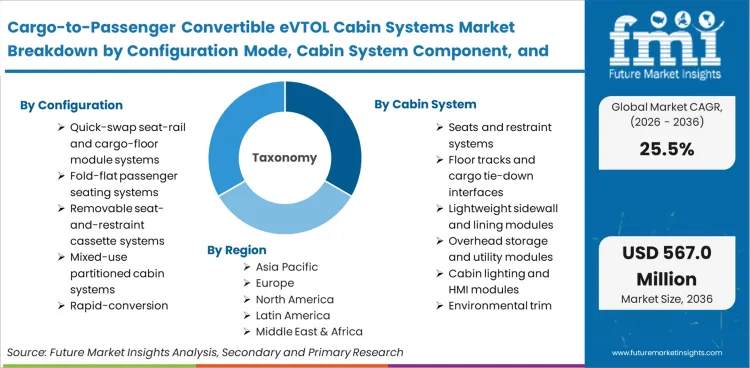
Configuration Mode
- Quick-swap seat-rail and cargo-floor module systems
- Fold-flat passenger seating systems
- Removable seat-and-restraint cassette systems
- Mixed-use partitioned cabin systems
- Rapid-conversion stretcher and utility cabin kits
Cabin System Component
- Seats and restraint systems
- Floor tracks and cargo tie-down interfaces
- Lightweight sidewall and lining modules
- Overhead storage and utility modules
- Cabin lighting and HMI modules
- Environmental trim and acoustic packages
Aircraft Architecture
- Lift-plus-cruise eVTOL platforms
- Winged vectored-thrust platforms
- Multicopter passenger-cargo platforms
- Hybrid utility eVTOL platforms
End Use
- Urban passenger shuttle plus logistics dual-use fleets
- Medical and emergency logistics fleets
- Airport and intercity feeder operators
- Defense and public-service utility operators
- Premium charter and tourism operators
Sales Channel
- OEM line-fit cabin integration
- Prototype and certification fleet installations
- Aftermarket reconfiguration kits
- Operator-specific missionization retrofits
Regions:
- North America
- United States
- Canada
- Mexico
- Latin America
- Brazil
- Argentina
- Chile
- Europe
- Germany
- United Kingdom
- France
- Italy
- Spain
- Asia-Pacific
- China
- Japan
- South Korea
- India
- ASEAN
- ANZ
- Middle East & Africa
- UAE
- Saudi Arabia
- South Africa
Bibliography
- Federal Aviation Administration. (2024, October 22). With new rule, FAA is ready for air travel of the future.
- European Union Aviation Safety Agency. (2025, July 18). Special Condition for VTOL and Means of Compliance.
- National Civil Aviation Agency of Brazil. (2024, November 6). EVE’s eVTOL airworthiness criteria published.
- Hanson, C., Klyde, D., & Bachelder, E. (2025). Urban Air Mobility passenger discomfort evaluations of sudden heave motion during non-normal conditions [Conference paper]. NASA Technical Reports Server.
- de Boer, M., Dellaert, D., Voskuijl, M., & La Rocca, G. (2024). Design of a hydrogen-powered crashworthy eVTOL using multidisciplinary design optimization. In AIAA AVIATION Forum. American Institute of Aeronautics and Astronautics.
- Voth, V., Hinners, T., & Hornung, M. (2024). Estimating aircraft power requirements: A study of more-electric aircraft architectures. Aerospace, 11(12), 958.
This bibliography is provided for reader reference. The full FMI report contains the complete reference list with primary source documentation.
This Report Addresses
- Regulatory divergence impacting the deployment of quick-release aircraft cabin interior hardware.
- The severe economic penalties operators face if dual-use platforms require prolonged conversion times.
- Weight versus durability trade-offs inherent in designing removable passenger seating cassettes.
- How military utility programs indirectly subsidize civilian rapid-swap floor track innovations.
- The hidden cleaning and maintenance delays associated with mixing freight and premium human transport.
- Certification barriers preventing aftermarket vendors from penetrating the OEM line-fit monopoly.
- Load balancing restrictions specific to lift-plus-cruise cargo configurations.
- The importance of acoustic shielding for quiet overnight municipal logistics operations.
Frequently Asked Questions
What is a cargo-to-passenger convertible eVTOL cabin system?
Convertible eVTOL cabin systems represent specialized interior modular hardware, such as certified quick-release floor tracks and removable seating cassettes, that enable rapid transitions between passenger transport and cargo logistics within a single aircraft while satisfying dual-category aviation safety regulations.
How do eVTOL cabins switch from passenger to cargo mode?
Ground crews utilize quick-release mechanical floor tracks to remove passenger seating modules and execute the eVTOL passenger cabin to cargo layout shift by locking standardized freight pallets or restraint nets into the identical structural hardpoints.
Which companies are leading the convertible eVTOL cabin systems market?
Key incumbents like Diehl Aviation and RECARO Aircraft Seating leverage established aerospace interior expertise, while innovators like BETA Technologies and Eve Air Mobility deeply integrate modular cabin architectures into their primary airframe designs from inception.
Why are modular eVTOL cabins gaining traction now?
Driven by capital amortization pressures, operators require rapid reconfiguration capabilities to capture midday logistics and medical freight revenue, ensuring expensive aircraft do not sit idle during low-demand commuter hours.
Which countries are likely to adopt convertible eVTOL cabins first?
China leads early adoption due to aggressive regulatory clearances for uncrewed logistics platforms, closely followed by Brazil where legacy helicopter operators demand electric assets capable of capturing both premium commuter and mid-tier freight contracts.
How large could the convertible eVTOL cabin systems market become by 2036?
Analysts evaluating the convertible eVTOL cabin systems market size project total industry value will reach USD 567.0 million by 2036, driven by the absolute necessity of dual-revenue fleet operations.
What regulations shape eVTOL cabin conversion design?
Interior designers must navigate aviation authority mandates that require extreme crash-load survivability for human occupants while establishing entirely different containment thresholds for dense freight, all without adding massive weight to the aircraft.
How do modular cabins improve eVTOL fleet utilization?
Convertible interiors eliminate the need to purchase separate, single-mission aircraft fleets by allowing dispatchers to fly human passengers during peak hours and quickly swap the interior to execute high-margin express parcel deliveries during midday lulls.
What is the difference between fixed passenger cabins and convertible eVTOL cabins?
While fixed cabins permanently integrate seats into the composite structure to save weight, convertible systems utilize certified metal floor tracks that allow seats to be completely removed to create a flat-floor logistics bay.
Which cabin components matter most in passenger-to-cargo conversion?
Floor tracks and cargo tie-down interfaces are the most critical components because they dictate the physical speed of conversion, preventing schedule delays that would otherwise destroy the economic advantage of the dual-use model.
What limits the adoption of convertible eVTOL cabin systems?
Regulatory divergence between passenger crashworthiness and cargo containment severely restricts adoption as engineering teams struggle to design lightweight floor tracks that meet dual-category safety mandates.
Why do quick-swap seat-rail modules dominate the market?
Quick-swap modules secure a dominant 34.0% share because they allow ground crews to strip a cabin without specialized tooling, preserving valuable charging intervals for profitable flight operations rather than maintenance.
What structural constraint affects hybrid utility eVTOLs?
Center-of-gravity limitations force severe restrictions on cargo placement, requiring loadmasters to use highly specialized weighing grids to ensure freight distributions do not exceed the platform's narrow aerodynamic balance envelope.
Why are Brazilian operators demanding rapid-conversion kits?
Legacy helicopter firms in Brazil demand rapid-conversion interiors capable of capturing mid-tier freight contracts during off-peak passenger hours to help afford the massive capital outlay required to transition toward electric assets.
How does dirt affect quick-release floor mechanisms?
Exposed track rails gather massive amounts of cabin debris that can jam the mechanisms and ground the aircraft, forcing engineers to prioritize sealed-rail designs over traditional open-channel aerospace floor fixtures.
What role do aviation authorities play in cabin design?
Aviation authorities like the FAA and EASA dictate the ultimate structural mass by insisting on 16G dynamic drop testing, which forces manufacturers to reinforce attachment mechanisms and directly reduces the maximum allowable commercial payload.
How will automated loading interfaces change the market?
Standardized cargo pods sliding directly into vacated seat rails will eliminate manual freight handling and allow operators to integrate eVTOL platforms seamlessly into autonomous ground-based warehousing networks.
Why do military programs influence civilian cabin components?
Civilian fleet directors eagerly adopt ruggedized, easily cleanable interior panels originally funded by military utility testing programs in order to reduce their own maintenance and cleaning downtimes.
What is the primary risk for aftermarket cabin suppliers?
OEMs design highly proprietary mechanical interfaces to lock buyers into closed ecosystems, meaning aftermarket vendors cannot produce replacement seating cassettes without violating airframe manufacturer patents or voiding aircraft warranties.
Preview the report firsthand - request a free sample
Get SampleGet the brochure for pricing and purchase details.
Get PDFTable of Content
- Executive Summary
- Global Market Outlook
- Demand-side Trends
- Supply-side Trends
- Technology Roadmap Analysis
- Analysis and Recommendations
- Market Overview
- Market Coverage / Taxonomy
- Market Definition / Scope / Limitations
- Research Methodology
- Chapter Orientation
- Analytical Lens and Working Hypotheses
- Market Structure, Signals, and Trend Drivers
- Benchmarking and Cross-market Comparability
- Market Sizing, Forecasting, and Opportunity Mapping
- Research Design and Evidence Framework
- Desk Research Programme (Secondary Evidence)
- Company Annual and Sustainability Reports
- Peer-reviewed Journals and Academic Literature
- Corporate Websites, Product Literature, and Technical Notes
- Earnings Decks and Investor Briefings
- Statutory Filings and Regulatory Disclosures
- Technical White Papers and Standards Notes
- Trade Journals, Industry Magazines, and Analyst Briefs
- Conference Proceedings, Webinars, and Seminar Materials
- Government Statistics Portals and Public Data Releases
- Press Releases and Reputable Media Coverage
- Specialist Newsletters and Curated Briefings
- Sector Databases and Reference Repositories
- FMI Internal Proprietary Databases and Historical Market Datasets
- Subscription Datasets and Paid Sources
- Social Channels, Communities, and Digital Listening Inputs
- Additional Desk Sources
- Expert Input and Fieldwork (Primary Evidence)
- Primary Modes
- Qualitative Interviews and Expert Elicitation
- Quantitative Surveys and Structured Data Capture
- Blended Approach
- Why Primary Evidence is Used
- Field Techniques
- Interviews
- Surveys
- Focus Groups
- Observational and In-context Research
- Social and Community Interactions
- Stakeholder Universe Engaged
- C-suite Leaders
- Board Members
- Presidents and Vice Presidents
- R&D and Innovation Heads
- Technical Specialists
- Domain Subject-matter Experts
- Scientists
- Physicians and Other Healthcare Professionals
- Governance, Ethics, and Data Stewardship
- Research Ethics
- Data Integrity and Handling
- Primary Modes
- Tooling, Models, and Reference Databases
- Desk Research Programme (Secondary Evidence)
- Data Engineering and Model Build
- Data Acquisition and Ingestion
- Cleaning, Normalisation, and Verification
- Synthesis, Triangulation, and Analysis
- Quality Assurance and Audit Trail
- Market Background
- Market Dynamics
- Drivers
- Restraints
- Opportunity
- Trends
- Scenario Forecast
- Demand in Optimistic Scenario
- Demand in Likely Scenario
- Demand in Conservative Scenario
- Opportunity Map Analysis
- Product Life Cycle Analysis
- Supply Chain Analysis
- Investment Feasibility Matrix
- Value Chain Analysis
- PESTLE and Porter’s Analysis
- Regulatory Landscape
- Regional Parent Market Outlook
- Production and Consumption Statistics
- Import and Export Statistics
- Market Dynamics
- Global Market Analysis 2021 to 2025 and Forecast, 2026 to 2036
- Historical Market Size Value (USD Million) Analysis, 2021 to 2025
- Current and Future Market Size Value (USD Million) Projections, 2026 to 2036
- Y-o-Y Growth Trend Analysis
- Absolute $ Opportunity Analysis
- Global Market Pricing Analysis 2021 to 2025 and Forecast 2026 to 2036
- Global Market Analysis 2021 to 2025 and Forecast 2026 to 2036, By Configuration Mode
- Introduction / Key Findings
- Historical Market Size Value (USD Million) Analysis By Configuration Mode , 2021 to 2025
- Current and Future Market Size Value (USD Million) Analysis and Forecast By Configuration Mode , 2026 to 2036
- Quick-swap seat-rail and cargo-floor module systems
- Fold-flat passenger seating systems
- Removable seat-and-restraint cassette systems
- Mixed-use partitioned cabin systems
- Rapid-conversion stretcher and utility cabin kits
- Quick-swap seat-rail and cargo-floor module systems
- Y-o-Y Growth Trend Analysis By Configuration Mode , 2021 to 2025
- Absolute $ Opportunity Analysis By Configuration Mode , 2026 to 2036
- Global Market Analysis 2021 to 2025 and Forecast 2026 to 2036, By Cabin System Component
- Introduction / Key Findings
- Historical Market Size Value (USD Million) Analysis By Cabin System Component, 2021 to 2025
- Current and Future Market Size Value (USD Million) Analysis and Forecast By Cabin System Component, 2026 to 2036
- Seats and restraint systems
- Floor tracks and cargo tie-down interfaces
- Lightweight sidewall and lining modules
- Overhead storage and utility modules
- Cabin lighting and HMI modules
- Environmental trim and acoustic packages
- Seats and restraint systems
- Y-o-Y Growth Trend Analysis By Cabin System Component, 2021 to 2025
- Absolute $ Opportunity Analysis By Cabin System Component, 2026 to 2036
- Global Market Analysis 2021 to 2025 and Forecast 2026 to 2036, By Aircraft Architecture
- Introduction / Key Findings
- Historical Market Size Value (USD Million) Analysis By Aircraft Architecture, 2021 to 2025
- Current and Future Market Size Value (USD Million) Analysis and Forecast By Aircraft Architecture, 2026 to 2036
- Lift-plus-cruise eVTOL platforms
- Winged vectored-thrust platforms
- Multicopter passenger-cargo platforms
- Hybrid utility eVTOL platforms
- Lift-plus-cruise eVTOL platforms
- Y-o-Y Growth Trend Analysis By Aircraft Architecture, 2021 to 2025
- Absolute $ Opportunity Analysis By Aircraft Architecture, 2026 to 2036
- Global Market Analysis 2021 to 2025 and Forecast 2026 to 2036, By End Use
- Introduction / Key Findings
- Historical Market Size Value (USD Million) Analysis By End Use, 2021 to 2025
- Current and Future Market Size Value (USD Million) Analysis and Forecast By End Use, 2026 to 2036
- Urban passenger shuttle plus logistics dual-use fleets
- Medical and emergency logistics fleets
- Airport and intercity feeder operators
- Defense and public-service utility operators
- Premium charter and tourism operators
- Urban passenger shuttle plus logistics dual-use fleets
- Y-o-Y Growth Trend Analysis By End Use, 2021 to 2025
- Absolute $ Opportunity Analysis By End Use, 2026 to 2036
- Global Market Analysis 2021 to 2025 and Forecast 2026 to 2036, By Sales Channel
- Introduction / Key Findings
- Historical Market Size Value (USD Million) Analysis By Sales Channel, 2021 to 2025
- Current and Future Market Size Value (USD Million) Analysis and Forecast By Sales Channel, 2026 to 2036
- OEM line-fit cabin integration
- Prototype and certification fleet installations
- Aftermarket reconfiguration kits
- Operator-specific missionization retrofits
- OEM line-fit cabin integration
- Y-o-Y Growth Trend Analysis By Sales Channel, 2021 to 2025
- Absolute $ Opportunity Analysis By Sales Channel, 2026 to 2036
- Global Market Analysis 2021 to 2025 and Forecast 2026 to 2036, By Region
- Introduction
- Historical Market Size Value (USD Million) Analysis By Region, 2021 to 2025
- Current Market Size Value (USD Million) Analysis and Forecast By Region, 2026 to 2036
- North America
- Latin America
- Western Europe
- Eastern Europe
- East Asia
- South Asia and Pacific
- Middle East & Africa
- Market Attractiveness Analysis By Region
- North America Market Analysis 2021 to 2025 and Forecast 2026 to 2036, By Country
- Historical Market Size Value (USD Million) Trend Analysis By Market Taxonomy, 2021 to 2025
- Market Size Value (USD Million) Forecast By Market Taxonomy, 2026 to 2036
- By Country
- USA
- Canada
- Mexico
- By Configuration Mode
- By Cabin System Component
- By Aircraft Architecture
- By End Use
- By Sales Channel
- By Country
- Market Attractiveness Analysis
- By Country
- By Configuration Mode
- By Cabin System Component
- By Aircraft Architecture
- By End Use
- By Sales Channel
- Key Takeaways
- Latin America Market Analysis 2021 to 2025 and Forecast 2026 to 2036, By Country
- Historical Market Size Value (USD Million) Trend Analysis By Market Taxonomy, 2021 to 2025
- Market Size Value (USD Million) Forecast By Market Taxonomy, 2026 to 2036
- By Country
- Brazil
- Chile
- Rest of Latin America
- By Configuration Mode
- By Cabin System Component
- By Aircraft Architecture
- By End Use
- By Sales Channel
- By Country
- Market Attractiveness Analysis
- By Country
- By Configuration Mode
- By Cabin System Component
- By Aircraft Architecture
- By End Use
- By Sales Channel
- Key Takeaways
- Western Europe Market Analysis 2021 to 2025 and Forecast 2026 to 2036, By Country
- Historical Market Size Value (USD Million) Trend Analysis By Market Taxonomy, 2021 to 2025
- Market Size Value (USD Million) Forecast By Market Taxonomy, 2026 to 2036
- By Country
- Germany
- UK
- Italy
- Spain
- France
- Nordic
- BENELUX
- Rest of Western Europe
- By Configuration Mode
- By Cabin System Component
- By Aircraft Architecture
- By End Use
- By Sales Channel
- By Country
- Market Attractiveness Analysis
- By Country
- By Configuration Mode
- By Cabin System Component
- By Aircraft Architecture
- By End Use
- By Sales Channel
- Key Takeaways
- Eastern Europe Market Analysis 2021 to 2025 and Forecast 2026 to 2036, By Country
- Historical Market Size Value (USD Million) Trend Analysis By Market Taxonomy, 2021 to 2025
- Market Size Value (USD Million) Forecast By Market Taxonomy, 2026 to 2036
- By Country
- Russia
- Poland
- Hungary
- Balkan & Baltic
- Rest of Eastern Europe
- By Configuration Mode
- By Cabin System Component
- By Aircraft Architecture
- By End Use
- By Sales Channel
- By Country
- Market Attractiveness Analysis
- By Country
- By Configuration Mode
- By Cabin System Component
- By Aircraft Architecture
- By End Use
- By Sales Channel
- Key Takeaways
- East Asia Market Analysis 2021 to 2025 and Forecast 2026 to 2036, By Country
- Historical Market Size Value (USD Million) Trend Analysis By Market Taxonomy, 2021 to 2025
- Market Size Value (USD Million) Forecast By Market Taxonomy, 2026 to 2036
- By Country
- China
- Japan
- South Korea
- By Configuration Mode
- By Cabin System Component
- By Aircraft Architecture
- By End Use
- By Sales Channel
- By Country
- Market Attractiveness Analysis
- By Country
- By Configuration Mode
- By Cabin System Component
- By Aircraft Architecture
- By End Use
- By Sales Channel
- Key Takeaways
- South Asia and Pacific Market Analysis 2021 to 2025 and Forecast 2026 to 2036, By Country
- Historical Market Size Value (USD Million) Trend Analysis By Market Taxonomy, 2021 to 2025
- Market Size Value (USD Million) Forecast By Market Taxonomy, 2026 to 2036
- By Country
- India
- ASEAN
- Australia & New Zealand
- Rest of South Asia and Pacific
- By Configuration Mode
- By Cabin System Component
- By Aircraft Architecture
- By End Use
- By Sales Channel
- By Country
- Market Attractiveness Analysis
- By Country
- By Configuration Mode
- By Cabin System Component
- By Aircraft Architecture
- By End Use
- By Sales Channel
- Key Takeaways
- Middle East & Africa Market Analysis 2021 to 2025 and Forecast 2026 to 2036, By Country
- Historical Market Size Value (USD Million) Trend Analysis By Market Taxonomy, 2021 to 2025
- Market Size Value (USD Million) Forecast By Market Taxonomy, 2026 to 2036
- By Country
- Kingdom of Saudi Arabia
- Other GCC Countries
- Turkiye
- South Africa
- Other African Union
- Rest of Middle East & Africa
- By Configuration Mode
- By Cabin System Component
- By Aircraft Architecture
- By End Use
- By Sales Channel
- By Country
- Market Attractiveness Analysis
- By Country
- By Configuration Mode
- By Cabin System Component
- By Aircraft Architecture
- By End Use
- By Sales Channel
- Key Takeaways
- Key Countries Market Analysis
- USA
- Pricing Analysis
- Market Share Analysis, 2025
- By Configuration Mode
- By Cabin System Component
- By Aircraft Architecture
- By End Use
- By Sales Channel
- Canada
- Pricing Analysis
- Market Share Analysis, 2025
- By Configuration Mode
- By Cabin System Component
- By Aircraft Architecture
- By End Use
- By Sales Channel
- Mexico
- Pricing Analysis
- Market Share Analysis, 2025
- By Configuration Mode
- By Cabin System Component
- By Aircraft Architecture
- By End Use
- By Sales Channel
- Brazil
- Pricing Analysis
- Market Share Analysis, 2025
- By Configuration Mode
- By Cabin System Component
- By Aircraft Architecture
- By End Use
- By Sales Channel
- Chile
- Pricing Analysis
- Market Share Analysis, 2025
- By Configuration Mode
- By Cabin System Component
- By Aircraft Architecture
- By End Use
- By Sales Channel
- Germany
- Pricing Analysis
- Market Share Analysis, 2025
- By Configuration Mode
- By Cabin System Component
- By Aircraft Architecture
- By End Use
- By Sales Channel
- UK
- Pricing Analysis
- Market Share Analysis, 2025
- By Configuration Mode
- By Cabin System Component
- By Aircraft Architecture
- By End Use
- By Sales Channel
- Italy
- Pricing Analysis
- Market Share Analysis, 2025
- By Configuration Mode
- By Cabin System Component
- By Aircraft Architecture
- By End Use
- By Sales Channel
- Spain
- Pricing Analysis
- Market Share Analysis, 2025
- By Configuration Mode
- By Cabin System Component
- By Aircraft Architecture
- By End Use
- By Sales Channel
- France
- Pricing Analysis
- Market Share Analysis, 2025
- By Configuration Mode
- By Cabin System Component
- By Aircraft Architecture
- By End Use
- By Sales Channel
- India
- Pricing Analysis
- Market Share Analysis, 2025
- By Configuration Mode
- By Cabin System Component
- By Aircraft Architecture
- By End Use
- By Sales Channel
- ASEAN
- Pricing Analysis
- Market Share Analysis, 2025
- By Configuration Mode
- By Cabin System Component
- By Aircraft Architecture
- By End Use
- By Sales Channel
- Australia & New Zealand
- Pricing Analysis
- Market Share Analysis, 2025
- By Configuration Mode
- By Cabin System Component
- By Aircraft Architecture
- By End Use
- By Sales Channel
- China
- Pricing Analysis
- Market Share Analysis, 2025
- By Configuration Mode
- By Cabin System Component
- By Aircraft Architecture
- By End Use
- By Sales Channel
- Japan
- Pricing Analysis
- Market Share Analysis, 2025
- By Configuration Mode
- By Cabin System Component
- By Aircraft Architecture
- By End Use
- By Sales Channel
- South Korea
- Pricing Analysis
- Market Share Analysis, 2025
- By Configuration Mode
- By Cabin System Component
- By Aircraft Architecture
- By End Use
- By Sales Channel
- Russia
- Pricing Analysis
- Market Share Analysis, 2025
- By Configuration Mode
- By Cabin System Component
- By Aircraft Architecture
- By End Use
- By Sales Channel
- Poland
- Pricing Analysis
- Market Share Analysis, 2025
- By Configuration Mode
- By Cabin System Component
- By Aircraft Architecture
- By End Use
- By Sales Channel
- Hungary
- Pricing Analysis
- Market Share Analysis, 2025
- By Configuration Mode
- By Cabin System Component
- By Aircraft Architecture
- By End Use
- By Sales Channel
- Kingdom of Saudi Arabia
- Pricing Analysis
- Market Share Analysis, 2025
- By Configuration Mode
- By Cabin System Component
- By Aircraft Architecture
- By End Use
- By Sales Channel
- Turkiye
- Pricing Analysis
- Market Share Analysis, 2025
- By Configuration Mode
- By Cabin System Component
- By Aircraft Architecture
- By End Use
- By Sales Channel
- South Africa
- Pricing Analysis
- Market Share Analysis, 2025
- By Configuration Mode
- By Cabin System Component
- By Aircraft Architecture
- By End Use
- By Sales Channel
- USA
- Market Structure Analysis
- Competition Dashboard
- Competition Benchmarking
- Market Share Analysis of Top Players
- By Regional
- By Configuration Mode
- By Cabin System Component
- By Aircraft Architecture
- By End Use
- By Sales Channel
- Competition Analysis
- Competition Deep Dive
- BETA Technologies
- Overview
- Product Portfolio
- Profitability by Market Segments (Product/Age /Sales Channel/Region)
- Sales Footprint
- Strategy Overview
- Marketing Strategy
- Product Strategy
- Channel Strategy
- Eve Air Mobility
- Diehl Aviation
- RECARO Aircraft Seating
- Astronics
- Supernal
- EHang
- BETA Technologies
- Competition Deep Dive
- Assumptions & Acronyms Used


