

- Industry Size (2026)
- USD 3.0 Bn
- Forecast (2036)
- USD 14.1 Bn
- CAGR (2026 to 2036)
- 17.2%
Exterior Coating Systems for Urban Air Mobility and eVTOL Fleets Market Forecast and Outlook 2026 to 2036
The exterior coating systems for urban air mobility and eVTOL fleets market is valued at USD 3.0 billion in 2026 and is projected to reach USD 14.1 billion by 2036, reflecting a CAGR of 17.2%. Demand accelerates as UAM and eVTOL manufacturers scale pre-commercial fleets and prioritize coatings that enhance durability, aerodynamic efficiency, and electrical insulation. Increased exposure to frequent takeoff–landing cycles and urban environmental conditions drives adoption of advanced lightweight coating systems.
Lightweight polyurethane aerodynamic coatings lead coating-type adoption because they combine low weight, high flexibility, and strong resistance to abrasion, weathering, and fluid ingress. Formulations engineered for composite airframes improve surface smoothness, reduce drag, and support efficient thermal management. Rapid-cure chemistries enable short production cycles, aligning with high-throughput assembly for emerging eVTOL fleets.
China, India, USA, and Japan act as major growth regions due to extensive UAM development programs, regulatory sandbox initiatives, and investments in regional air mobility infrastructure. AkzoNobel, PPG Aerospace, Mankiewicz, Sherwin-Williams Aerospace Coatings, and 3M define competitive momentum through next-generation polyurethane systems, lightweight multifunctional coatings, and integrated surface-protection solutions tailored to the performance and durability requirements of eVTOL and UAM platforms.
Quick Stats for Exterior Coating Systems for Urban Air Mobility and eVTOL Fleets Market
- Market Value (2026): USD 3.0 billion
- Market Forecast Value (2036): USD 14.1 billion
- Forecast CAGR (2026 to 2036): 17.2%
- Leading Coating Type in Global Demand: Lightweight polyurethane aerodynamic coatings
- Key Growth Regions in Global Demand: China, India, USA, Japan
- Top Players in Global Demand: AkzoNobel, PPG Aerospace, Mankiewicz, Sherwin-Williams Aerospace Coatings, 3M
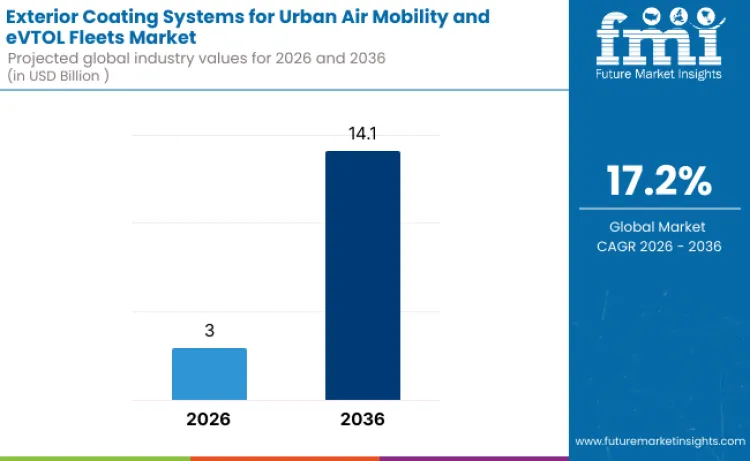
Exterior Coating Systems for Urban Air Mobility and eVTOL Fleets Market Key Takeaways
| Metric | Value |
|---|---|
| Market Value (2026) | USD 3.0 billion |
| Market Forecast Value (2036) | USD 14.1 billion |
| Forecast CAGR (2026 to 2036) | 17.2% |
How Are the Segments Classified in the Exterior Coating Systems for Urban Air Mobility and eVTOL Fleets Market?
Demand for exterior coating systems for UAM and eVTOL fleets is shaped by aerodynamic efficiency requirements, lightweight airframe design, and exposure to dense urban environments. Buyers evaluate coating mass, durability, UV resistance, EMI shielding, and compatibility with composite structures. Adoption patterns reflect rapid operational cycling, rooftop-landing exposure, and the need for coatings that support electrical safety, rotor efficiency, and long-term environmental durability.
Which Coating Type Accounts for the Largest Share of Global Demand?
Lightweight polyurethane aerodynamic coatings hold 45.9%, making them the leading coating-type segment globally. These coatings minimize mass while maintaining aerodynamic smoothness and strong adhesion to composite eVTOL structures. Nano-enhanced wear-resistant coatings support abrasion durability across rotor-driven airflow zones. Anti-UV and weatherability coatings address urban sunlight, humidity, and pollution exposure. Conductive and EMI-shielding coatings protect electrical systems, avionics, and propulsion components from electromagnetic interference. Coating-type distribution reflects preference for lightweight polyurethane films that balance aerodynamics and durability.
Key Points:
- Polyurethane coatings support mass reduction and airflow efficiency.
- Nano-enhanced coatings offer strong wear protection.
- Anti-UV systems address urban environmental stressors.
- EMI-shielding coatings enhance avionics protection.
Which Functional Attribute Represents the Largest Share of Global Demand?
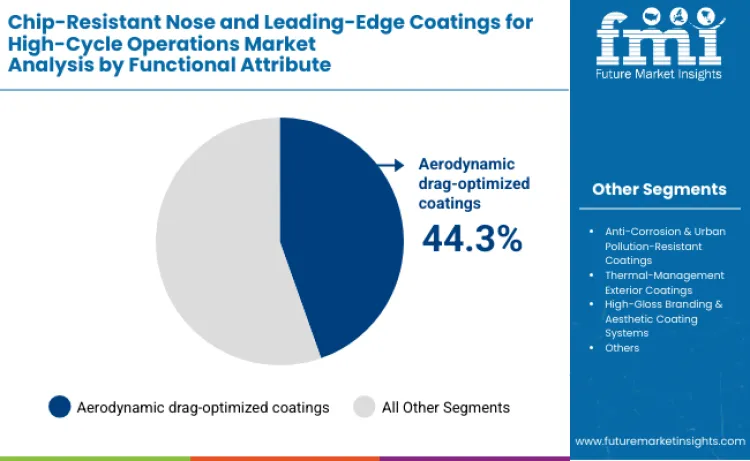
Aerodynamic drag-optimized coatings hold 44.3%, making them the largest functional-attribute segment. These systems create smooth, low-resistance surfaces that improve rotor and forward-flight efficiency. Anti-corrosion and pollution-resistant coatings protect aircraft exposed to particulate pollution and moisture in urban operations. Thermal-management exterior coatings stabilize temperatures of battery housings and propulsion-related surfaces. High-gloss branding and aesthetic coating systems support fleet visibility and commercial identity. Functional-attribute distribution reflects strong emphasis on drag reduction to extend flight time and energy efficiency.
Key Points:
- Drag-optimized coatings support efficiency in short-range eVTOL missions.
- Pollution-resistant systems protect aircraft in dense urban zones.
- Thermal-management coatings stabilize surface temperatures.
- High-gloss systems address branding and visual recognition.
Which Application Area Accounts for the Largest Share of Global Demand?
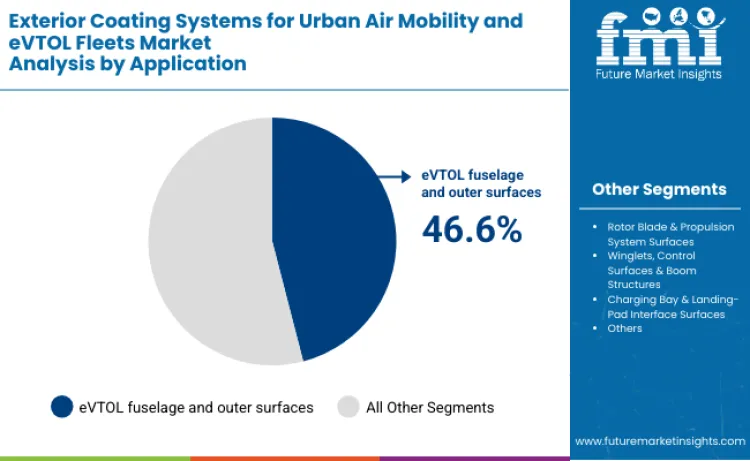
eVTOL fuselage and outer surfaces hold 46.6%, making them the leading application-area segment. These surfaces require lightweight, aerodynamic coatings that withstand continuous urban exposure and rotor-induced airflow. Rotor blade and propulsion surfaces need erosion-resistant and smooth coatings to maintain lift and efficiency. Winglets, control surfaces, and boom structures rely on coatings that preserve stiffness and aerodynamic stability. Charging-bay and landing-pad interface surfaces adopt abrasion-resistant and pollution-tolerant coatings. Application-area distribution reflects large surface-area demand on fuselage structures.
Key Points:
- Fuselage surfaces require lightweight aerodynamic coatings.
- Rotor blades need erosion resistance for consistent lift.
- Control surfaces depend on coatings that maintain structural stability.
- Charging and landing interfaces benefit from abrasion tolerance.
What are the Key Dynamics in the Exterior Coating Systems for Urban Air Mobility and eVTOL Fleets Market?
Global demand rises as UAM and eVTOL developers evaluate coating systems that protect lightweight composite structures, maintain aerodynamic smoothness, and support branding in high-frequency, short-hop operations. Coatings must withstand UV exposure, weather fluctuations, and particulate erosion across urban corridors. Manufacturers assess formulations compatible with electric propulsion thermal profiles and structural materials unique to emerging aircraft classes. Interest expands as fleets move toward certification and early commercial deployment.
How are UAM operational environments and composite airframe requirements shaping coating system development?
eVTOL and UAM aircraft rely heavily on advanced composites requiring coatings that deliver strong adhesion, flexibility, and low mass. Developers evaluate systems that maintain gloss, colour stability, and surface smoothness under frequent cycles of takeoff, landing, and hover. Urban routes expose aircraft to pollution, moisture, and variable microclimates that create additional durability demands. Coatings must tolerate thermal gradients near electric propulsion units without degrading. Manufacturers explore conductive and anti-static layers to support sensor reliability. Rapid prototyping environments within UAM programs accelerate testing of coatings for UV resistance, abrasion tolerance, and structural compatibility across diverse mission profiles.
How do certification pathways, maintenance limitations, and application challenges influence scalability?
Aerospace qualification requires verification of coating performance under vibration, thermal cycling, hydraulic fluid exposure, and weathering. MRO networks for UAM fleets remain in early stages, creating strong need for coating systems supporting rapid repair and consistent reapplication. Application processes demand controlled thickness and adhesion to avoid aerodynamic inconsistencies on compact airframes. Urban vertiports impose operational constraints that shape maintenance planning. Environmental rules influence allowable coating chemistries, especially volatile content. Fleet operators evaluate lifecycle cost, downtime, and labour requirements as part of coating selection. Variability in regulatory frameworks for emerging aircraft categories affects global adoption timelines.
How is Demand for Exterior Coating Systems for Urban Air Mobility and eVTOL Fleets Market Evolving Across Key Countries?
Demand for the exterior coating systems for urban air mobility and eVTOL fleets market is rising due to increased investment in advanced air-mobility platforms, strong interest in lightweight protective coatings, and growing requirements for durability across high-frequency short-range operations. China records a CAGR of 18.5% supported by rapid UAM ecosystem development. India shows a 17.8% CAGR driven by early-stage eVTOL adoption. USA posts a 16.6% CAGR supported by advanced aerospace-materials research. Japan holds a 15.7% CAGR linked with precision coating technologies. UK records a 15.0% CAGR supported by urban-mobility innovation programs.
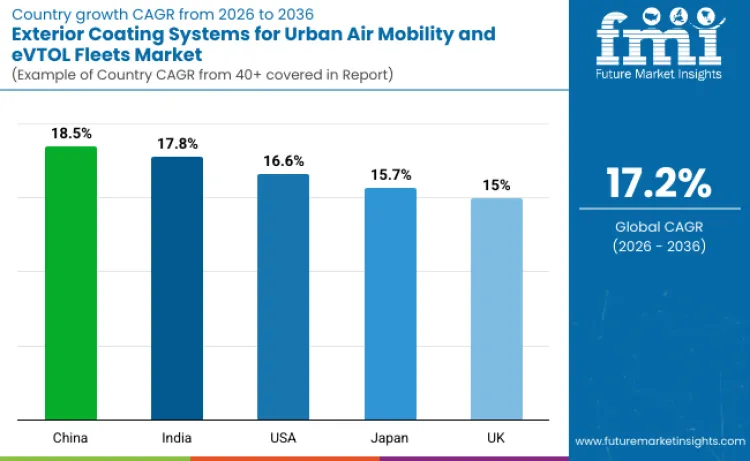
| Country | CAGR (%) |
|---|---|
| China | 18.5% |
| India | 17.8% |
| USA | 16.6% |
| Japan | 15.7% |
| UK | 15.0% |
How is China driving demand for Exterior Coating Systems for Urban Air Mobility and eVTOL Fleets?
China drives demand due to accelerated development of UAM infrastructure, strong investment in eVTOL manufacturing, and interest in lightweight coatings improving operational efficiency. The country’s CAGR of 18.5% reflects adoption of coatings enhancing surface smoothness, UV resistance, and abrasion protection. UAM manufacturers integrate ultra-light resin systems optimized for composite airframes. Research institutes develop multi-functional coatings providing environmental durability and color stability. Pilot UAM corridors in major cities strengthen demand for coatings designed to withstand high-frequency operations.
- Rapid eVTOL and UAM infrastructure development
- Lightweight coating systems for composite airframes
- Research into multi-functional durable coatings
- High-frequency operations requiring resilient exterior finishes
How is India driving demand for Exterior Coating Systems for Urban Air Mobility and eVTOL Fleets?
India supports rising demand due to increasing engagement in UAM planning, early participation in eVTOL trials, and interest in coatings supporting durability in diverse climatic environments. The country’s CAGR of 17.8% reflects adoption of weather-resistant and lightweight coating systems suited for electric aircraft. Research organizations evaluate high-gloss and erosion-resistant formulations enhancing visibility and longevity. Urban-transport initiatives explore eVTOL deployment supporting demand for advanced coating integration. MRO expansion strengthens capability to apply specialized coatings for next-generation mobility fleets.
- Early-stage eVTOL trials in varied climates
- Adoption of lightweight, weather-resistant coating systems
- Research into erosion- and UV-resistant formulations
- Growing MRO capability supporting UAM fleet maintenance
How is the USA driving demand for Exterior Coating Systems for Urban Air Mobility and eVTOL Fleets?
USA drives demand through strong aerospace R&D, rapid growth of the eVTOL industry, and interest in coating systems improving efficiency and durability for high-cycle operations. The country’s CAGR of 16.6% reflects development of coatings designed for composite structures, noise-reducing surfaces, and aerodynamic enhancement. Manufacturers incorporate thin-film and low-mass coatings maintaining gloss and surface integrity under frequent flight cycles. Research programs evaluate temperature-, erosion-, and UV-resistant formulations for urban operational environments. Certification pathways encourage development of reliable coating systems.
- Advanced coating R&D for eVTOL applications
- Thin-film coatings supporting aerodynamic efficiency
- Development of UV- and erosion-resistant formulations
- Certification-driven adoption of durable exterior systems
How is Japan driving demand for Exterior Coating Systems for Urban Air Mobility and eVTOL Fleets?
Japan drives demand due to precision-engineering capabilities, interest in next-generation mobility systems, and strong focus on coating durability and consistency. The country’s CAGR of 15.7% reflects evaluation of coatings enhancing UV stability, surface smoothness, and environmental resistance. Research institutes refine polymer-ceramic blends suited for lightweight electric aircraft. Manufacturers integrate controlled-application processes improving coating uniformity. Urban mobility trials strengthen demand for robust finishes supporting long-term performance.
- Precision development of polymer-ceramic coating blends
- Controlled-application methods enhancing uniformity
- UV- and environment-resistant coatings
- Mobility trials reinforcing demand for durable finishes
How is the UK driving demand for Exterior Coating Systems for Urban Air Mobility and eVTOL Fleets?
UK supports demand through strong UAM innovation programs, urban-airspace planning initiatives, and interest in high-durability coatings supporting early eVTOL deployments. The country’s CAGR of 15.0% reflects adoption of coatings improving weather resistance, surface smoothness, and long-term appearance. Research institutions develop lightweight formulations for composite structures. eVTOL manufacturers integrate coatings reducing erosion during frequent takeoff and landing cycles. National sustainability goals encourage coatings enabling energy-efficient flight.
- UAM and eVTOL development programs
- Lightweight coatings for composite airframes
- Erosion-resistant systems for high-frequency operations
- Sustainability goals reinforcing efficient coating solutions
What is the competitive landscape of demand for exterior coating systems for urban air mobility and eVTOL fleets globally?
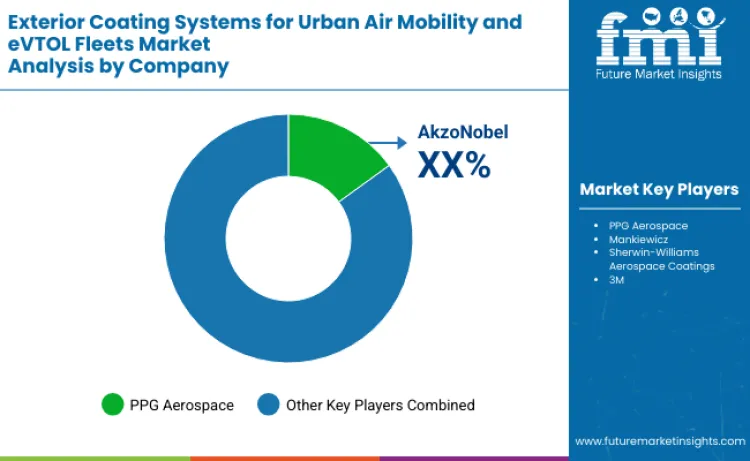
Demand for exterior coating systems for urban air mobility and eVTOL fleets grows as manufacturers advance lightweight airframes, electric propulsion platforms, and rapid-turnaround operational models. Requirements center on low-mass coatings, UV stability, erosion resistance, and adhesion compatibility with composite-intensive structures. Buyers evaluate film-build control, curing behavior, electrical insulation properties, and durability under frequent vertical takeoff and landing cycles. Procurement teams prioritize certification readiness, maintenance predictability, and coating performance aligned with high-frequency regional operations. Trend in the global market reflects expansion of eVTOL prototypes, increased composite utilization, and interest in coatings supporting electrical safety, weight reduction, and long-term exterior stability.
AkzoNobel holds an estimated 26.0% share. Position strengthens through lightweight aerospace coatings engineered for composites used widely in eVTOL fuselages and rotor structures. PPG Aerospace participates with exterior systems designed for erosion resistance, gloss stability, and compatibility with electric aircraft materials. Mankiewicz maintains visibility through aviation coatings offering controlled film thickness and durability suited for repeated short-cycle operations. Sherwin-Williams Aerospace Coatings contributes with high-solids, low-mass systems supporting rapid maintenance and color-stability requirements for commercial eVTOL fleets. 3M supports demand with advanced surface technologies and protective materials integrated into exterior systems for electric aircraft. Competitive positioning globally reflects coating weight efficiency, environmental durability, composite compatibility, and alignment with evolving certification frameworks for urban air mobility operations.
Key Players in the Exterior Coating Systems for Urban Air Mobility and eVTOL Fleets Market
- AkzoNobel
- PPG Aerospace
- Mankiewicz
- Sherwin-Williams Aerospace Coatings
- 3M
Scope of the Report
| Items | Values |
|---|---|
| Quantitative Units | USD billion |
| Coating Type | Lightweight Polyurethane Aerodynamic Coatings; Nano-Enhanced Wear-Resistant Coatings; Anti-UV & Weatherability Exterior Coatings; Conductive/EMI-Shielding Coatings for eVTOL Surfaces |
| Functional Attribute | Aerodynamic Drag-Optimized Coatings; Anti-Corrosion & Urban Pollution-Resistant Coatings; Thermal-Management Exterior Coatings; High-Gloss Branding & Aesthetic Coating Systems |
| Application Area | eVTOL Fuselage & Outer Surfaces; Rotor Blade & Propulsion System Surfaces; Winglets, Control Surfaces & Boom Structures; Charging Bay & Landing-Pad Interface Surfaces |
| End-User | eVTOL & UAM Aircraft OEMs; Urban Air Mobility Fleet Operators; MRO & Maintenance Facilities; Aerospace Coating Material Suppliers |
| Regions Covered | Asia Pacific, Europe, North America, Latin America, Middle East & Africa |
| Countries Covered | India, China, USA, Germany, South Korea, Japan, Italy, and 40+ countries |
| Key Companies Profiled | AkzoNobel; PPG Aerospace; Mankiewicz; Sherwin-Williams Aerospace Coatings; 3M |
| Additional Attributes | Dollar sales by coating type and functional attribute; adoption patterns aligned with UAM fleet scaling; lightweight aerodynamic coating developments for extended battery range; EMI-shielding coating integration for avionics and electric propulsion systems; weatherability and anti-pollution performance for urban operating environments; compatibility with rapid-turnaround MRO processes for high-frequency eVTOL operations. |
Exterior Coating Systems for Urban Air Mobility and eVTOL Fleets Market by Segment
By Coating Type:
- Lightweight Polyurethane Aerodynamic Coatings
- Nano-Enhanced Wear-Resistant Coatings
- Anti-UV & Weatherability Exterior Coatings
- Conductive/EMI-Shielding Coatings for eVTOL Surfaces
By Functional Attribute:
- Aerodynamic Drag-Optimized Coatings
- Anti-Corrosion & Urban Pollution-Resistant Coatings
- Thermal-Management Exterior Coatings
- High-Gloss Branding & Aesthetic Coating Systems
By Application Area:
- eVTOL Fuselage & Outer Surfaces
- Rotor Blade & Propulsion System Surfaces
- Winglets, Control Surfaces & Boom Structures
- Charging Bay & Landing-Pad Interface Surfaces
By End-User:
- eVTOL & UAM Aircraft OEMs
- Urban Air Mobility Fleet Operators
- MRO & Maintenance Facilities
- Aerospace Coating Material Suppliers
By Region:
- Asia Pacific
- China
- Japan
- South Korea
- India
- Australia & New Zealand
- ASEAN
- Rest of Asia Pacific
- Europe
- Germany
- United Kingdom
- France
- Italy
- Spain
- Nordic
- BENELUX
- Rest of Europe
- North America
- United States
- Canada
- Mexico
- Latin America
- Brazil
- Chile
- Rest of Latin America
- Middle East & Africa
- Kingdom of Saudi Arabia
- Other GCC Countries
- Turkey
- South Africa
- Other African Union
- Rest of Middle East & Africa
Frequently Asked Questions
What is the size of the exterior coating systems for urban air mobility and eVTOL fleets market in 2026?
The market is valued at USD 3.0 billion in 2026 due to rising investment in eVTOL fleet development and lightweight exterior coatings.
What will be the industry size by 2036?
Industry value will reach USD 14.1 billion by 2036 as operators adopt coatings engineered for reduced drag and improved structural durability.
What is the CAGR for 2026 to 2036?
The exterior coating systems for urban air mobility and eVTOL fleets market expands at a 17.2% CAGR during the forecast period.
Which coating-type segment leads in 2026?
Lightweight polyurethane aerodynamic coatings hold 45.9% share, reflecting demand for low-mass formulations suitable for electric aircraft.
Which functional-attribute segment holds the highest share?
Aerodynamic drag-optimized coatings lead with 44.3% share due to their role in improving lift-to-drag performance in vertical and short-range flights.
Preview the report firsthand - request a free sample
Get SampleGet the brochure for pricing and purchase details.
Get PDFTable of Content
- Executive Summary
- Market Overview
- Global Market Value, 2020 to 2026
- Global Market Forecast, 2026 to 2036
- Market Dynamics
- Drivers
- Restraints
- Opportunities
- Regulatory & Standards Landscape
- Technology & Material Innovation Outlook
- Market Segmentation Analysis
- By Coating Technology
- Lightweight Polyurethane Aerodynamic Coatings
- Nano-Enhanced Wear-Resistant Coatings
- Anti-UV & Weatherability Exterior Coatings
- Conductive & EMI-Shielding Coatings
- By Application
- eVTOL Fuselage & Outer Surfaces
- Rotor Blade & Propulsion System Surfaces
- Winglets, Control Surfaces & Boom Structures
- Charging Bay & Landing-Pad Interface Surfaces
- By End Use
- eVTOL & UAM Aircraft OEMs
- Urban Air Mobility Fleet Operators
- MRO Service Providers
- By Sales Channel
- Direct OEM Supply
- Authorized Coating Distributors
- Aftermarket & MRO Supply
- By Coating Technology
- Regional Outlook
- North America
- Latin America
- Western Europe
- Eastern Europe
- South Asia & Pacific
- East Asia
- Middle East & Africa
- Country-Level Outlook
- United States
- Canada
- Mexico
- Brazil
- Argentina
- Germany
- France
- United Kingdom
- Italy
- Spain
- Netherlands
- China
- India
- Japan
- South Korea
- ANZ
- GCC Countries
- South Africa
- Competitive Landscape
- Market Structure Overview
- Company Positioning
- Strategic Initiatives
- Key Player Profiles
- Scope of the Report
- Research Methodology
- Assumptions & Acronyms


