

- Industry Size (2026)
- USD 650.0 Mn
- Forecast (2036)
- USD 5800.0 Mn
- CAGR (2026 to 2036)
- 24.50%
Air Taxi Exterior Component Systems Market Size, Market Forecast and Outlook By FMI
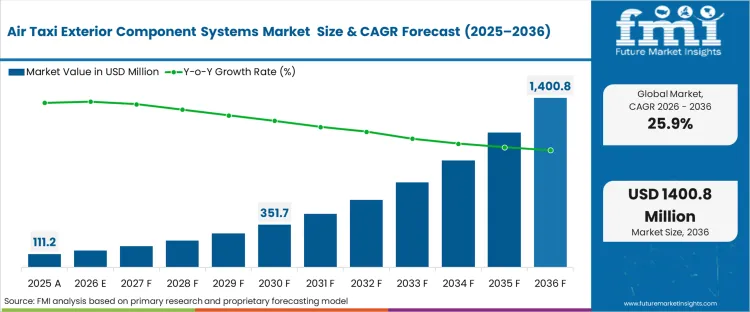
The air taxi exterior component systems market was valued at USD 450.0 million in 2025. Demand is expected to cross USD 650.0 million in 2026 at a CAGR of 24.50% during the forecast period. Steady investment is projected to raise the market to USD 5,800.0 million by 2036 as aerospace manufacturers move from prototype testing into full-scale commercial production.
Summary of Air Taxi Exterior Component Systems Market
- Air Taxi Exterior Component Systems Market Definition
- This category captures the specialized engineering, manufacturing, and certification work required to deliver lightweight outer aerodynamic structures for electric vertical flight platforms. It includes the design and production of exterior components that support aerodynamic efficiency, weight reduction, and structural reliability under demanding operating conditions. Value is created through precise integration of advanced materials, flight-critical structural performance, and airworthiness compliance requirements needed for emerging air taxi and eVTOL programs.
- Demand Drivers in the Market
- Battery density limitations force structural engineers to cut maximum weight across all external assemblies.
- Strict urban noise regulations compel manufacturers to design acoustically optimized outer shells and rotor cowlings.
- High cycle passenger operations demand extremely durable exterior surfaces capable of resisting constant environmental wear.
- Key Segments Analyzed in the FMI Report
- Component: Fuselage and canopies are expected to hold 42.0% share in 2026, dominating as operators refuse final assembly without certified main bodies.
- Material: Carbon fiber composites are projected to capture 65.0% share in 2026, reflecting intense focus on maximum strength to weight ratios.
- Aircraft Type: Vectored thrust is anticipated to lead with 48.0% share, demanding complex moving aerodynamic structures.
- Sales Channel: OEM line-fit is set to command 88.0% share, supporting initial fleet buildouts before replacement cycles mature.
- UAE: 28.4% compound growth, driven by aggressive government backed launch initiatives for urban flight.
- Analyst Opinion at FMI
- Nikhil Kaitwade, Principal Analyst, Technology, at FMI, states, " Aircraft developers tend to focus on battery technology as their main technical challenge. In practice, structural certification timelines are what most often determine when a commercial launch actually happens. Getting lightweight composites through bird strike and durability testing takes years, and suppliers who control that qualification process have significant influence over when fleets reach the market."
- Strategic Implications / Executive Takeaways
- Structural design directors must prioritize manufacturing scalability before finalizing complex geometric shapes.
- Procurement heads evaluating the eVTOL aerostructures market should mandate automated inspection standards across vendor contracts.
- Operations managers running high utilization fleets face unavoidable downtime unless integrating modular replacement panels.
- Methodology
- Primary Research: Consultations with aerospace certification authorities determine genuine approval bottlenecks.
- Desk Research: Tier one aerospace supplier earnings reports provide structural manufacturing context.
- Market-Sizing and Forecasting: Public fleet pre orders establish baseline valuation models.
- Data Validation and Update Cycle: Carbon fiber production capacity data corroborates structural manufacturing demand.
Air Taxi Exterior Component Systems Market Key Takeaways
| Metric | Details |
|---|---|
| Industry Size (2026) | USD 650.0 million |
| Industry Value (2036) | USD 5,800.0 million |
| CAGR (2026 to 2036) | 24.50% |
Source: Future Market Insights (FMI) analysis, based on proprietary forecasting model and primary research
Chief engineering officers face immediate pressure balancing maximum payload capacity against stringent weight limits dictated by battery chemistry constraints. Resolving this engineering friction drives massive capital allocation toward advanced composite materials across the air taxi exterior systems market. Structural designers minimizing aerodynamic drag secure critical range extensions necessary for profitable commercial routes. When procurement heads validate these weight savings against production costs, structural hardware contracts immediately follow.
What pure performance analysts often overlook is that external acoustic signatures dictate municipal flight approvals entirely. Outer shell geometries deflecting rotor noise away from ground observers frequently determine which aircraft secure lucrative urban vertiport access. Operators ignoring acoustic reflection profiles during shell design face permanent operational lockouts across major metropolitan hubs.
Type certification shapes the entire production timeline. Aviation authorities require outer shell designs to pass bird strike testing, lightning protection requirements, and environmental durability checks before they can be approved. If a structure fails these tests, manufacturers must rework the design and resubmit for testing, which pushes back the entire assembly schedule. Without certified exterior components, final aircraft assembly cannot move forward, which means exterior system validation must be completed before any commercial fleet can be deployed.
The UAE leads at 28.4% growth, driven by government-backed urban flight programs that require immediate fleet deployment. India follows at 26.2% as aviation authorities build new composite manufacturing facilities to support greenfield mobility corridors. China registers 24.1% growth, supported by domestic producers scaling exterior component output for dense city networks. The United States grows at 21.3%, where established aerospace suppliers are adapting existing production lines for eVTOL programs.
Japan reaches 19.5% as regulators push manufacturers to complete full structural validation ahead of scheduled public fleet demonstrations. The United Kingdom expands at 18.2%, with composite engineering suppliers concentrating in clusters around existing aerospace facilities. Germany follows at 17.6%, where automotive tier one suppliers are entering aerospace production for the first time. The main difference across these markets is how quickly regulators approve new designs. Countries with active government launch programs are moving faster than those where traditional aerospace certification timelines still apply.
Air Taxi Exterior Component Systems Market Definition
The eVTOL exterior component market encompasses structural outer shells, transparent enclosures, aerodynamic fairings, and access doors designed specifically for electric vertical takeoff and landing aircraft. Scope mandates active aerodynamic load bearing and environmental protection capabilities. Purely internal cabin fixtures and propulsion hardware fall outside this boundary. Lightweight material integration distinguishes modern air mobility structures from historical heavy rotorcraft assemblies.
Air Taxi Exterior Component Systems Market Inclusions
Carbon fiber fuselage panels, polycarbonate viewing bubbles, rotor nacelles, and integrated lighting housings are all part of this market. The core focus is on deployments across urban air mobility exterior structures. Systems developed to protect structural integrity during transition flight phases fall squarely within scope. Professional engineering services linking aerodynamic performance with host structural systems generate much of the commercial value captured across this category.
Air Taxi Exterior Component Systems Market Exclusions
Standalone electric motors and battery packs sit entirely outside this analysis because propulsion procurement operates on different capital cycles. Maintenance contracts for legacy helicopter outer shells lack advanced air mobility orchestration elements. Interior seating sold without fuselage attachment points belongs in cabin interior spending categories. General commercial aviation structures disconnected from electric vertical takeoff architecture remain excluded.
Air Taxi Exterior Component Systems Market Research Methodology
- Primary Research: Chief structural engineers, composite material scientists, and aerospace procurement directors validate production timelines.
- Desk Research: Aviation certification filings, material patent registries, and aerospace supplier capacity announcements provide structural context.
- Market-Sizing and Forecasting: Declared pre order volumes and established supplier contract values baseline current spending.
- Data Validation and Update Cycle: Advanced composite material shipment metrics cross validate structural component demand curves quarterly.
Segmental Analysis
Air Taxi Exterior Component Systems Market Analysis by Component
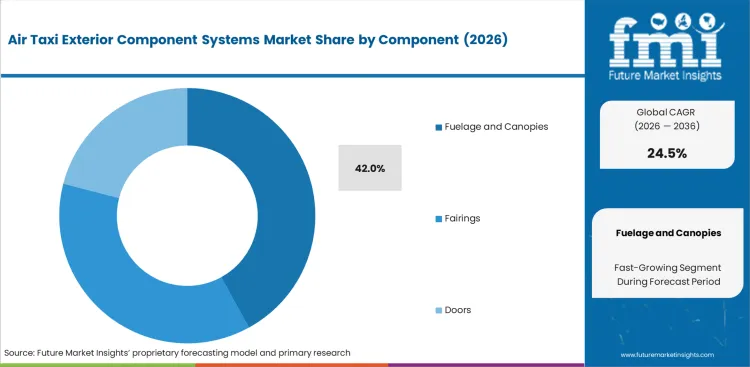
Fuelage and canopies hold 42.0% of the market in 2026 because no aircraft moves to final assembly without an approved passenger enclosure. Operations directors at major mobility networks treat the fuselage and canopy as the foundation of both passenger safety and weather protection. Extreme cyclic loading means manufacturers must test these structures repeatedly across the certification process. Suppliers who can deliver certified canopy systems ahead of assembly schedules are able to charge premium prices because they remove a bottleneck that would otherwise delay the entire program. Large transparent canopies also raise cabin temperatures, which increases the load on cooling systems and draws more power from the battery. Planners who do not account for this during design risk missing their range targets once the aircraft enters service in hot climates.
- Impact resistance: Specialized layups absorb catastrophic bird strikes. Engineering teams reduce the risk of in-flight structural failure .
- Thermal management: Advanced coatings reject solar heat gain. HVAC engineers minimize battery drain dedicated to cabin cooling.
- Acoustic damping: Integrated core materials block external rotor noise. Passenger experience directors ensure acceptable interior sound levels.
Air Taxi Exterior Component Systems Market Analysis by Material
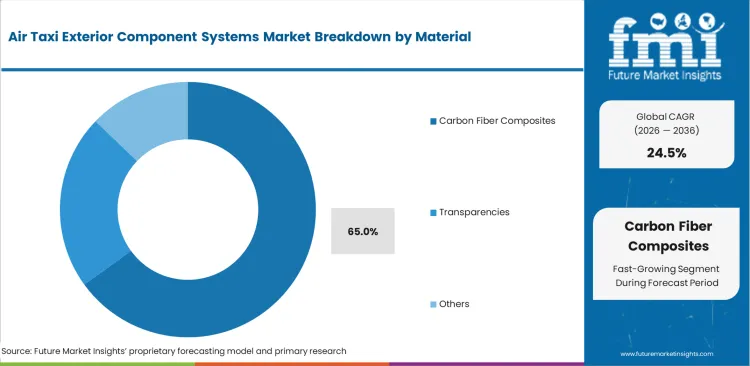
Carbon fiber composites lead with 65.0% share in 2026 because chief engineers recognize traditional metallic structures cannot support battery powered vertical flight profitably. FMI analysts note that structural heads completely redesign manufacturing processes around advanced air mobility composites to maximize payload capacity. This scope requires meticulous layup precision and continuous autoclave curing validation. Traditional aerospace facilities lacking these specialized composite mediums face massive operational disadvantages. Many designers mistakenly assume composite structures naturally resist lightning strikes, yet these non-conductive shells demand massive integrated copper mesh networks that frequently delay final weight certifications. Operators attempting hybrid metal composite zones face severe galvanic corrosion hurdles. Comparing carbon fiber vs aluminum for air taxi fuselage shells reveals that while aluminum offers cheaper prototyping, only carbon fiber meets the extreme weight targets required for commercial range.
- Weight optimization: Anisotropic fiber alignment puts strength only where needed. Payload directors maximize paying passenger capacity.
- Corrosion elimination: Polymer matrices resist environmental degradation. Fleet managers reduce ongoing surface maintenance costs.
- Lightning protection: Embedded metallic foils safely conduct electrical strikes. Certification officers avoid catastrophic avionic failures.
Air Taxi Exterior Component Systems Market Analysis by Aircraft Type
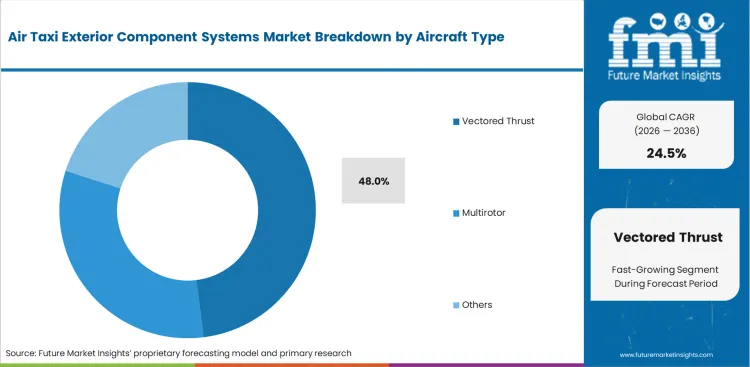
Transitioning from vertical lift to forward cruise forces intense structural complexity. Vectored thrust configurations command 48.0% share in 2026 as mobility executives abandon simple multirotor designs for longer regional routes. FMI observes that integrating articulating rotor systems alongside fixed aerodynamic surfaces requires extremely rigid distributed propulsion nacelle structures. Integrators mapping these dual purpose nodes earn significant ongoing engineering fees. Manufacturers controlling their pivot mechanism architecture adapt quickly to shifting certification requirements. Aerospace structural architects rarely discuss how heavily loaded vectored nacelles struggle to process massive vibrational fatigue, often requiring completely separate reinforcement strategies. Manufacturers clinging to static rotor mounts duplicate their aerodynamic drag penalties unnecessarily, driving intense activity in the eVTOL nacelle and cowling market.
- Vibrational dampening: Stiffened composite mounts isolate rotor frequencies. Structural engineers prevent premature airframe fatigue cracking.
- Drag reduction: Seamless transition fairings smooth airflow during cruise. Aerodynamicists extend maximum achievable flight ranges.
- Actuator integration: Reinforced pivot points handle extreme torque loads. Maintenance directors ensure reliable transition mechanics.
Air Taxi Exterior Component Systems Market Analysis by Sales Channel
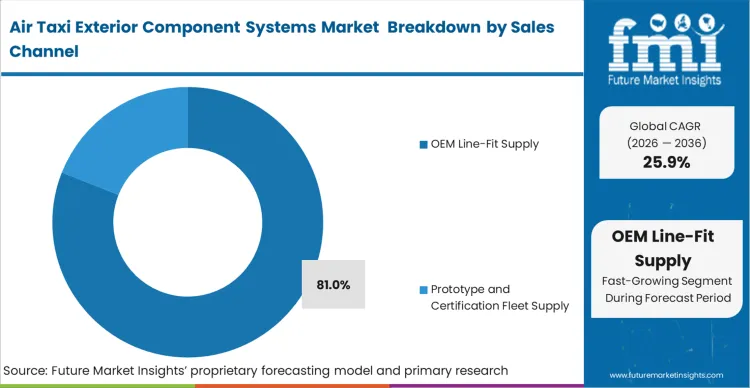
OEM line-fit represents 88.0% share in 2026 as risk averse chief procurement officers demand perfectly integrated assemblies straight from the factory. In FMI's view, buying complete structural systems from air taxi exterior systems manufacturers guarantees immediate physical interoperability across fragmented sub-assemblies. Master tier one suppliers absorb production timeline risks while commanding premium total project fees. Fragmented localized manufacturing requiring internal bonding orchestration consistently fails. While line fit contracts promise seamless execution, they quietly lock operators into specific replacement ecosystems, severely limiting future competitive bidding for spare parts. Organizations attempting third party structural repairs without OEM approval suffer massive certification rewrite costs. Sourcing managers constantly evaluate air taxi exterior component suppliers to secure reliable high volume production lines.
- Tolerance guarantee: Precision factory bonding ensures perfect aerodynamic profiles. Quality assurance directors avoid costly manual rework.
- Certification coverage: OEM supplied parts automatically carry type certificates. Regulatory compliance officers bypass independent testing requirements.
- Supply chain security: Long term supplier contracts guarantee part availability. Production managers predict precise final assembly dates.
Air Taxi Exterior Component Systems Market Drivers, Restraints, and Opportunities
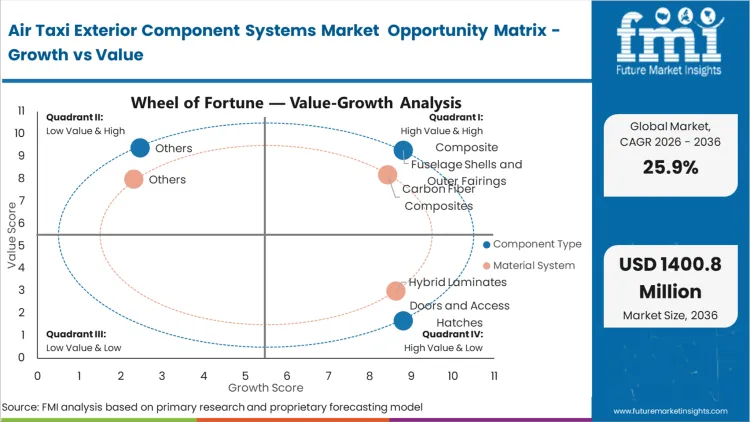
Unrelenting demand for zero emission urban transport forces operations directors to deploy highly efficient aircraft immediately. Failing to optimize structural weight guarantees missed range targets. Aerospace architects urgently require expert eVTOL fuselage supplier partnerships to manufacture complex aerodynamic shapes reliably. This pressure accelerates aggressive composite adoption across major aviation hubs. Attempting internal composite manufacturing without specialized autoclaves routinely crashes production schedules. Supply chain leaders secure multi-million dollar contracts simply to ensure structural hardware passes rigorous crash testing protocols.
Legacy aerospace manufacturing architecture creates massive friction slowing production scaling. Systems designed for low volume satellite production simply cannot process the high rate manufacturing required by modern air mobility business models. Operations directors using hand layup techniques at high production volumes regularly encounter quality consistency problems. This structural manufacturing barrier severely throttles physical aircraft deliveries. Automated tape laying offers partial relief but introduces massive capital expenditure requirements across critical production pathways.
Opportunities in the Air Taxi Exterior Component Systems Market
- High cycle transparency replacements: Urban environments cause rapid windshield degradation. Firms specializing as eVTOL windshield and transparency suppliers capture high margin recurring contracts via localized maintenance hubs leveraging aircraft transparencies for eVTOL.
- Acoustic fairing retrofits: Noise restrictions face continuous tightening. Engineering teams deploying sound dampening composite airframe fairings secure premium specialized revenue from operators needing community approval.
- Modular door systems: Rapid passenger turnover demands robust ingress mechanisms. Suppliers developing high durability composite doors for eVTOL aircraft build strong order backlogs.
Regional Analysis
.webp "Top Country Growth Comparison Air Taxi Exterior Component Systems Market Cagr (2026 2036)")
Based on regional analysis, Air Taxi Exterior Component Systems Market is segmented into North America, Europe, East Asia, South Asia & Pacific, and Middle East & Africa across 40 plus countries.
| Country | CAGR (2026 to 2036) |
|---|---|
| UAE | 28.4% |
| India | 26.2% |
| China | 24.1% |
| United States | 21.3% |
| Japan | 19.5% |
| United Kingdom | 18.2% |
| Germany | 17.6% |
Source: Future Market Insights (FMI) analysis, based on proprietary forecasting model and primary research
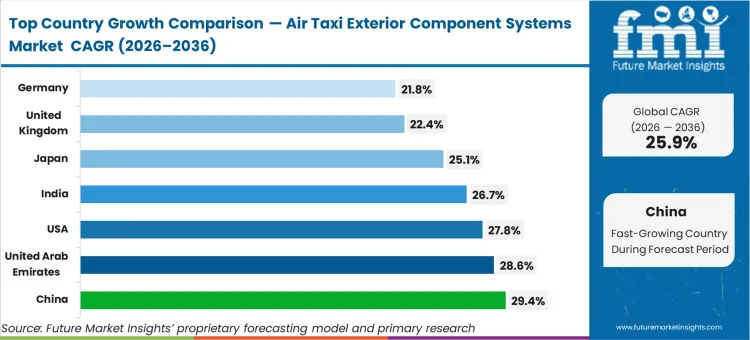
Middle East & Africa Air Taxi Exterior Component Systems Market Analysis
Policy mandates promoting advanced mobility are pushing transport infrastructure toward rapid alignment. According to FMI estimates, regional transport authorities are replacing conventional expansion frameworks with high-throughput vertical flight node development. Suppliers able to support this sharp technological transition are capturing substantial foundational contracts. Local operations teams still face major execution challenges, particularly where extreme temperature requirements must be managed without dedicated expertise in specialized materials and component behavior.
- UAE: In the UAE, government-backed launch programs are speeding up fleet deployment and creating early demand for specialized exterior structures. Operators working in high heat and dusty conditions are placing more value on erosion-resistant materials that can hold up in harsh environments. The market is growing at a 28.4% CAGR, and suppliers with reliable local support are in a stronger position to win early infrastructure contracts.
South Asia & Pacific Air Taxi Exterior Component Systems Market Analysis
Heavy congestion across fast-growing megacities is creating strong demand for new transport alternatives. FMI analysis shows that regional logistics operators are advancing aerial bypass strategies to preserve operational continuity. Deploying these physical assets calls for complex supply chain orchestration spanning production, infrastructure readiness, and fleet support. Aerospace architects keep testing payload boundaries to strengthen route-level profitability and improve the economic case for urban aerial transport systems.
India: India's growth is tied to how early the market is and how much new capacity still has to be built. These mobility programs are building demand from scratch, not expanding an existing supply base. They are creating fresh requirements for local composite production, tooling, and structural fabrication. Urban growth is adding urgency, especially where future deployment depends on having manufacturing close to the market. At 26.2% growth, the early advantage is going to suppliers that establish a local fabrication presence before long-term contracts are allocated.
East Asia Air Taxi Exterior Component Systems Market Analysis
China's manufacturing scale is testing the capacity limits of existing aerospace supply chains. FMI's analysis indicates massive regional mobility giants deploy dense structural testing grids simply to maintain baseline certification timelines. Integrating these massive production lines requires unprecedented automation bandwidth. High density urban centers demand extreme acoustic dampening across all new aircraft designs.
- China: China’s vast manufacturing scale is forcing steady upgrades across facilities serving advanced air mobility programs. The China eVTOL exterior component market is expected to register 24.1% CAGR as domestic producers aggressively export efficient structural models into neighboring markets. Expanding production lines, improving composite fabrication capabilities, and rising regional aircraft development activity are reinforcing the country’s position as a leading supply hub for exterior systems supporting electric vertical flight platforms.
- Japan: Strict regulatory environments compel complete structural perfection. Operations managers lacking expansive test ranges must integrate full safety validations immediately. Japan advances at 19.5% compound growth. Facilities achieving seamless automation operate high precision composite curing continuously.
North America Air Taxi Exterior Component Systems Market Analysis
Vast capital investment in advanced air mobility requires complete technological execution. Based on FMI's assessment, massive aviation startups urgently finalize production ready structural shells. Coordinating this transition from prototype to production requires extreme manufacturing precision. Planners rely heavily on detailed digital twin modeling ensuring zero composite layup defects.
- United States: Dominating the global certification pathway defines local capital expenditure. Engineering directors execute complex structural testing maintaining continuous regulatory dialogue. The United States air taxi exterior systems market registers 21.3% compound growth. Any eVTOL canopy manufacturer successfully orchestrating these seamless material transitions secures lucrative long term corporate partnerships.
Europe Air Taxi Exterior Component Systems Market Analysis
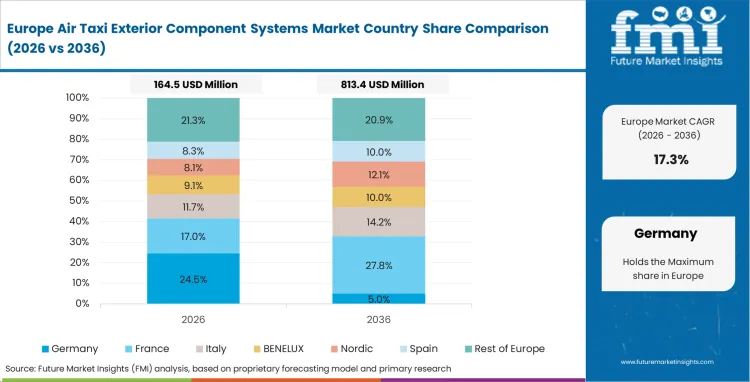
Strict sustainability regulations shape material deployment architecture heavily. FMI observes that European operations directors must balance structural weight against stringent local lifecycle recycling requirements. Vendors modifying their resin systems addressing these environmental hurdles capture significant enterprise contracts. Industrial manufacturing hubs demand extremely precise robotic layups ensuring maximum structural consistency.
- United Kingdom: Resolving composite engineering bottlenecks drives immediate investments. Supply chain leaders implement advanced automated fiber placement managing highly complex geometric flows. United Kingdom sites expand at 18.2% compound growth. Material scientists optimizing these complex cure cycles achieve critical competitive advantages.
- Germany: Heavy industrial workflow integration is shaping highly specialized manufacturing requirements in Germany’s evolving supply base. Automotive tier one suppliers are moving into aerospace production, driving greater adoption of sophisticated composite press technology and advanced thermal management systems. With growth projected at 17.6% CAGR, precision engineering facilities are focusing on process stability and temperature control to avoid delamination defects and maintain the structural integrity required for next-generation exterior component programs.
Competitive Aligners for Market Players
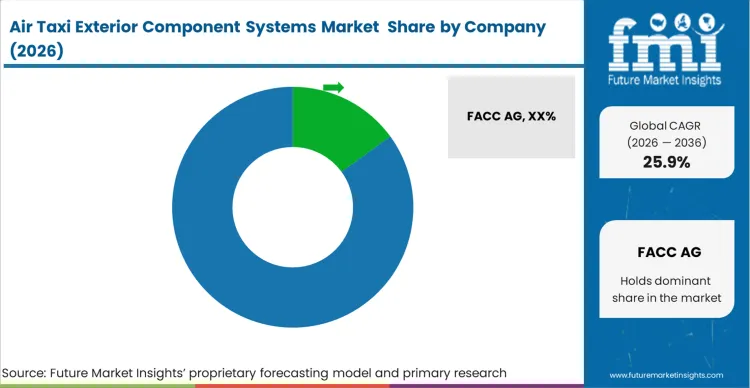
Suppliers that can run composite manufacturing at high volume have a clear advantage in this market. Automated production lines allow tier one suppliers to meet aerospace quality standards at the output rates that eVTOL programs require, and that combination is what wins long-term contracts. Aircraft developers are less focused on which resin system a supplier uses and more focused on whether that supplier can deliver certified components consistently at scale. Full-service providers with proven production capacity are taking contracts away from suppliers that can only deliver prototype quantities.
Established aerospace manufacturers hold an advantage that new entrants find difficult to close quickly. Years of documented fatigue testing and validated material data allow incumbents to move through certification faster than suppliers building these databases from the beginning. New entrants face real margin pressure because recreating this body of test data is expensive and time-consuming. Operations directors making sourcing decisions consistently favor suppliers with proven composite libraries over those offering untested structural solutions.
Large aircraft developers are deliberately avoiding dependence on a single supplier. Sourcing directors are dual-sourcing critical exterior components and requiring standardized interface points so that switching between suppliers remains possible. This puts pressure on suppliers with proprietary manufacturing approaches, as aircraft developers want production flexibility as fleet volumes grow. Suppliers that can adapt their manufacturing processes to meet open interface requirements are better positioned to retain contracts as programs scale. Procurement teams are tracking production capacity closely to make sure their supply agreements match the build rates their fleet launch schedules demand.
Key Players in Air Taxi Exterior Component Systems Market
- Toray Advanced Composites
- Hexcel Corporation
- Solvay
- Spirit AeroSystems
- GKN Aerospace
- PPG Industries
Scope of the Report
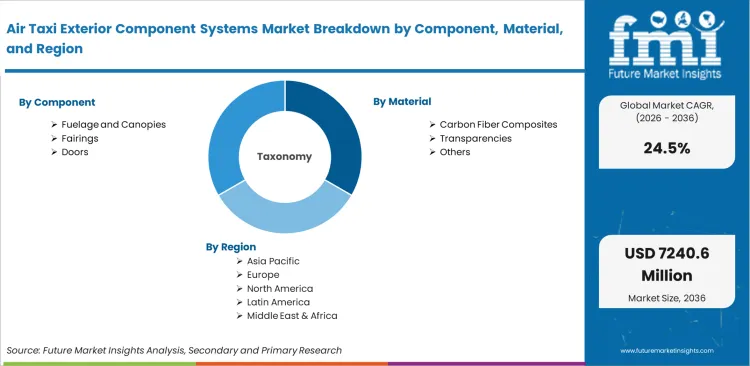
| Metric | Value |
|---|---|
| Quantitative Units | USD 650.0 million to USD 5,800.0 million, at a CAGR of 24.50% |
| Market Definition | This sector covers the specialized engineering, manufacturing, and certification of lightweight outer aerodynamic structures required for electric vertical flight. |
| Segmentation | Component, Material, Aircraft Type, Sales Channel, Region |
| Regions Covered | North America, Europe, East Asia, South Asia & Pacific, Middle East & Africa |
| Countries Covered | United States, China, India, Germany, Japan, United Kingdom, UAE |
| Key Companies Profiled | Toray Advanced Composites, Hexcel Corporation, Solvay, Spirit AeroSystems, GKN Aerospace, PPG Industries |
| Forecast Period | 2026 to 2036 |
| Approach | Public fleet pre orders and established supplier contract values baseline current spending. |
Source: Future Market Insights (FMI) analysis, based on proprietary forecasting model and primary research
Air Taxi Exterior Component Systems Market Analysis by Segments
Component
- Fuselage and canopies
- Nacelles and cowlings
- Fairings
- Doors
- Landing gear structures
Material
- Carbon fiber composites
- Transparencies
- Advanced alloys
Aircraft Type
- Vectored thrust
- Multirotor
- Lift plus cruise
Sales Channel
- OEM line-fit
- Aftermarket
Region
- North America
- Europe
- East Asia
- South Asia & Pacific
- Middle East & Africa
Bibliography
- Federal Aviation Administration. (2024, October 22). With new rule, FAA is ready for air travel of the future. U.S. Department of Transportation.
- USA Department of Transportation. (2025, December). The advanced air mobility national strategy: A bold policy vision for 2026–2036.
- European Union Aviation Safety Agency. (2025, July). Special condition for VTOL and means of compliance.
- Bridgelall, R. (2024). Aircraft innovation trends enabling advanced air mobility. Inventions, 9(4), 84.
- Bigand, A., Espinosa, C., & Bauchire, J.-M. (2025). Destructive and non-destructive analysis of lightning-induced damage in protected and painted composite aircraft laminates. Aerospace, 12(5), 446.
This bibliography is provided for reader reference. The full FMI report contains the complete reference list with primary source documentation.
This Report Addresses
- Carbon fiber adoption accelerating unified lightweighting metrics across structural designs.
- High cycle operations requiring new environmental degradation resistance standards.
- OEM line fit models transforming traditional aerospace supply chain planning.
- Legacy hand layup manufacturing causing physical component delivery bottlenecks.
- Acoustic geometry algorithms eliminating severe urban noise restriction barriers.
- UAE leading regional compound growth through aggressive launch initiatives.
- Single supplier native architectures generating massive production scaling friction.
- Structural engineers implementing specialized resins securing critical weight advantages.
Frequently Asked Questions
What is included in air taxi exterior component systems?
The market includes primary structural outer shells, passenger canopies, aerodynamic fairings, access doors, and rotor cowlings. It explicitly covers external load bearing aerodynamic surfaces while excluding internal cabin fixtures and standalone propulsion units.
How large is the air taxi exterior component systems market in 2026 and 2036?
Valuation hits USD 650.0 million in 2026. Rapidly scaling commercial production networks demand precise structural manufacturing, driving total market valuation to USD 5,800.0 million by 2036.
Why do composites dominate eVTOL exterior structures?
Battery chemistry weight constraints force extreme mass reduction across all aircraft assemblies. Carbon fiber composites provide the only viable strength to weight ratio capable of supporting profitable passenger payloads during vertical flight.
Which companies currently supply exterior systems for air taxis and eVTOL aircraft?
Leading suppliers include Toray Advanced Composites, Hexcel Corporation, Solvay, Spirit AeroSystems, GKN Aerospace, and PPG Industries. These tier one providers possess validated material databases required for rapid aviation certification.
How do canopy, fuselage, and fairing choices affect range and payload?
Minimizing aerodynamic drag and structural weight directly reduces electrical power draw during forward flight. Lighter exterior components immediately translate into extended flight ranges or increased paying passenger capacity.
Which countries are scaling fastest for air taxi exterior-component demand?
The UAE tracks at 28.4% compound growth driven by aggressive government launch mandates. India and China follow closely as they optimize dense urban mobility networks utilizing high volume domestic manufacturing infrastructure.
How is the air taxi exterior market different from conventional helicopter structures?
Electric vertical flight requires significantly lighter structures and completely different acoustic geometry profiles. Conventional helicopter shells utilize heavier metallic components that severely restrict the efficiency of battery powered distributed propulsion systems.
What is the role of line-fit OEM supply versus aftermarket demand?
OEM line fit captures 88.0% share as manufacturers build initial commercial fleets. Aftermarket demand remains minimal until these high utilization aircraft begin requiring cyclic replacement of environmentally degraded transparencies and outer fairings.
Which subsystem holds the largest share in the market?
Fuselage and canopies command 42.0% share. Protecting passengers while maintaining structural rigidity represents the core engineering challenge, absorbing the vast majority of exterior component capital expenditure.
How do certification milestones influence supplier revenue timing?
Aviation authorities mandate exhaustive bird strike and durability testing. Suppliers successfully passing these extreme qualification hurdles unlock massive multi year production contracts, making certification the ultimate gateway to recognized revenue.
What components are included in air taxi exterior systems?
Systems encompass the main composite fuselage shell, polycarbonate passenger windows, landing gear fairings, access doors, and distributed propulsion nacelles required for aerodynamic efficiency.
How big is the air taxi exterior component systems market?
The market was valued at USD 450.0 million in 2025, the base year for this forecast, expanding rapidly as prototype testing transitions into full scale rate manufacturing across major aerospace hubs.
Who are the leading suppliers for eVTOL exterior systems?
Established aerospace tier one manufacturers like Spirit AeroSystems and GKN Aerospace dominate due to their existing automated composite manufacturing capabilities and deep relationships with aviation regulators.
What structural constraint slows physical hardware delivery?
Legacy hand layup composite manufacturing causes immense friction. Older production methods cannot process the high rate volumes required by modern advanced air mobility business models.
Why does the UAE lead regional growth trajectories?
Aggressive formalization of urban air mobility networks forces massive immediate infrastructure alignment. Regional transport authorities provide significant financial backing to accelerate early commercial launch dates.
How does lightning strike protection affect composite shells?
Non conductive composite shells demand massive integrated copper mesh networks. Incorporating these metallic foils safely conducts electrical strikes but frequently threatens stringent final aircraft weight targets.
What risk accompanies single supplier manufacturing?
Proprietary manufacturing architecture heavily favors incumbent suppliers. This specific framework severely limits future competitive bidding when aircraft developers require massive production scaling utilizing dual source supply chains.
How do automated inspection systems represent specific opportunities?
High cycle passenger operations demand extremely durable exterior surfaces. Engineering teams capable of deploying automated non destructive testing secure premium specialized revenue ensuring structural integrity during rapid production.
Preview the report firsthand - request a free sample
Get SampleGet the brochure for pricing and purchase details.
Get PDFTable of Content
- Executive Summary
- Global Market Outlook
- Demand-side Trends
- Supply-side Trends
- Technology Roadmap Analysis
- Analysis and Recommendations
- Market Overview
- Market Coverage / Taxonomy
- Market Definition / Scope / Limitations
- Research Methodology
- Chapter Orientation
- Analytical Lens and Working Hypotheses
- Market Structure, Signals, and Trend Drivers
- Benchmarking and Cross-market Comparability
- Market Sizing, Forecasting, and Opportunity Mapping
- Research Design and Evidence Framework
- Desk Research Programme (Secondary Evidence)
- Company Annual and Sustainability Reports
- Peer-reviewed Journals and Academic Literature
- Corporate Websites, Product Literature, and Technical Notes
- Earnings Decks and Investor Briefings
- Statutory Filings and Regulatory Disclosures
- Technical White Papers and Standards Notes
- Trade Journals, Industry Magazines, and Analyst Briefs
- Conference Proceedings, Webinars, and Seminar Materials
- Government Statistics Portals and Public Data Releases
- Press Releases and Reputable Media Coverage
- Specialist Newsletters and Curated Briefings
- Sector Databases and Reference Repositories
- FMI Internal Proprietary Databases and Historical Market Datasets
- Subscription Datasets and Paid Sources
- Social Channels, Communities, and Digital Listening Inputs
- Additional Desk Sources
- Expert Input and Fieldwork (Primary Evidence)
- Primary Modes
- Qualitative Interviews and Expert Elicitation
- Quantitative Surveys and Structured Data Capture
- Blended Approach
- Why Primary Evidence is Used
- Field Techniques
- Interviews
- Surveys
- Focus Groups
- Observational and In-context Research
- Social and Community Interactions
- Stakeholder Universe Engaged
- C-suite Leaders
- Board Members
- Presidents and Vice Presidents
- R&D and Innovation Heads
- Technical Specialists
- Domain Subject-matter Experts
- Scientists
- Physicians and Other Healthcare Professionals
- Governance, Ethics, and Data Stewardship
- Research Ethics
- Data Integrity and Handling
- Primary Modes
- Tooling, Models, and Reference Databases
- Desk Research Programme (Secondary Evidence)
- Data Engineering and Model Build
- Data Acquisition and Ingestion
- Cleaning, Normalisation, and Verification
- Synthesis, Triangulation, and Analysis
- Quality Assurance and Audit Trail
- Market Background
- Market Dynamics
- Drivers
- Restraints
- Opportunity
- Trends
- Scenario Forecast
- Demand in Optimistic Scenario
- Demand in Likely Scenario
- Demand in Conservative Scenario
- Opportunity Map Analysis
- Product Life Cycle Analysis
- Supply Chain Analysis
- Investment Feasibility Matrix
- Value Chain Analysis
- PESTLE and Porter’s Analysis
- Regulatory Landscape
- Regional Parent Market Outlook
- Production and Consumption Statistics
- Import and Export Statistics
- Market Dynamics
- Global Market Analysis 2021 to 2025 and Forecast, 2026 to 2036
- Historical Market Size Value (USD Million) Analysis, 2021 to 2025
- Current and Future Market Size Value (USD Million) Projections, 2026 to 2036
- Y-o-Y Growth Trend Analysis
- Absolute $ Opportunity Analysis
- Global Market Pricing Analysis 2021 to 2025 and Forecast 2026 to 2036
- Global Market Analysis 2021 to 2025 and Forecast 2026 to 2036, By Component
- Introduction / Key Findings
- Historical Market Size Value (USD Million) Analysis By Component , 2021 to 2025
- Current and Future Market Size Value (USD Million) Analysis and Forecast By Component , 2026 to 2036
- Fuelage and Canopies
- Fairings
- Doors
- Fuelage and Canopies
- Y-o-Y Growth Trend Analysis By Component , 2021 to 2025
- Absolute $ Opportunity Analysis By Component , 2026 to 2036
- Global Market Analysis 2021 to 2025 and Forecast 2026 to 2036, By Material
- Introduction / Key Findings
- Historical Market Size Value (USD Million) Analysis By Material, 2021 to 2025
- Current and Future Market Size Value (USD Million) Analysis and Forecast By Material, 2026 to 2036
- Carbon Fiber Composites
- Transparencies
- Others
- Carbon Fiber Composites
- Y-o-Y Growth Trend Analysis By Material, 2021 to 2025
- Absolute $ Opportunity Analysis By Material, 2026 to 2036
- Global Market Analysis 2021 to 2025 and Forecast 2026 to 2036, By Aircraft Type
- Introduction / Key Findings
- Historical Market Size Value (USD Million) Analysis By Aircraft Type, 2021 to 2025
- Current and Future Market Size Value (USD Million) Analysis and Forecast By Aircraft Type, 2026 to 2036
- Vectored Thrust
- Multirotor
- Others
- Vectored Thrust
- Y-o-Y Growth Trend Analysis By Aircraft Type, 2021 to 2025
- Absolute $ Opportunity Analysis By Aircraft Type, 2026 to 2036
- Global Market Analysis 2021 to 2025 and Forecast 2026 to 2036, By Sales Channel
- Introduction / Key Findings
- Historical Market Size Value (USD Million) Analysis By Sales Channel, 2021 to 2025
- Current and Future Market Size Value (USD Million) Analysis and Forecast By Sales Channel, 2026 to 2036
- OEM Line-Fit
- Aftermarket
- OEM Line-Fit
- Y-o-Y Growth Trend Analysis By Sales Channel, 2021 to 2025
- Absolute $ Opportunity Analysis By Sales Channel, 2026 to 2036
- Global Market Analysis 2021 to 2025 and Forecast 2026 to 2036, By Region
- Introduction
- Historical Market Size Value (USD Million) Analysis By Region, 2021 to 2025
- Current Market Size Value (USD Million) Analysis and Forecast By Region, 2026 to 2036
- North America
- Latin America
- Western Europe
- Eastern Europe
- East Asia
- South Asia and Pacific
- Middle East & Africa
- Market Attractiveness Analysis By Region
- North America Market Analysis 2021 to 2025 and Forecast 2026 to 2036, By Country
- Historical Market Size Value (USD Million) Trend Analysis By Market Taxonomy, 2021 to 2025
- Market Size Value (USD Million) Forecast By Market Taxonomy, 2026 to 2036
- By Country
- USA
- Canada
- Mexico
- By Component
- By Material
- By Aircraft Type
- By Sales Channel
- By Country
- Market Attractiveness Analysis
- By Country
- By Component
- By Material
- By Aircraft Type
- By Sales Channel
- Key Takeaways
- Latin America Market Analysis 2021 to 2025 and Forecast 2026 to 2036, By Country
- Historical Market Size Value (USD Million) Trend Analysis By Market Taxonomy, 2021 to 2025
- Market Size Value (USD Million) Forecast By Market Taxonomy, 2026 to 2036
- By Country
- Brazil
- Chile
- Rest of Latin America
- By Component
- By Material
- By Aircraft Type
- By Sales Channel
- By Country
- Market Attractiveness Analysis
- By Country
- By Component
- By Material
- By Aircraft Type
- By Sales Channel
- Key Takeaways
- Western Europe Market Analysis 2021 to 2025 and Forecast 2026 to 2036, By Country
- Historical Market Size Value (USD Million) Trend Analysis By Market Taxonomy, 2021 to 2025
- Market Size Value (USD Million) Forecast By Market Taxonomy, 2026 to 2036
- By Country
- Germany
- UK
- Italy
- Spain
- France
- Nordic
- BENELUX
- Rest of Western Europe
- By Component
- By Material
- By Aircraft Type
- By Sales Channel
- By Country
- Market Attractiveness Analysis
- By Country
- By Component
- By Material
- By Aircraft Type
- By Sales Channel
- Key Takeaways
- Eastern Europe Market Analysis 2021 to 2025 and Forecast 2026 to 2036, By Country
- Historical Market Size Value (USD Million) Trend Analysis By Market Taxonomy, 2021 to 2025
- Market Size Value (USD Million) Forecast By Market Taxonomy, 2026 to 2036
- By Country
- Russia
- Poland
- Hungary
- Balkan & Baltic
- Rest of Eastern Europe
- By Component
- By Material
- By Aircraft Type
- By Sales Channel
- By Country
- Market Attractiveness Analysis
- By Country
- By Component
- By Material
- By Aircraft Type
- By Sales Channel
- Key Takeaways
- East Asia Market Analysis 2021 to 2025 and Forecast 2026 to 2036, By Country
- Historical Market Size Value (USD Million) Trend Analysis By Market Taxonomy, 2021 to 2025
- Market Size Value (USD Million) Forecast By Market Taxonomy, 2026 to 2036
- By Country
- China
- Japan
- South Korea
- By Component
- By Material
- By Aircraft Type
- By Sales Channel
- By Country
- Market Attractiveness Analysis
- By Country
- By Component
- By Material
- By Aircraft Type
- By Sales Channel
- Key Takeaways
- South Asia and Pacific Market Analysis 2021 to 2025 and Forecast 2026 to 2036, By Country
- Historical Market Size Value (USD Million) Trend Analysis By Market Taxonomy, 2021 to 2025
- Market Size Value (USD Million) Forecast By Market Taxonomy, 2026 to 2036
- By Country
- India
- ASEAN
- Australia & New Zealand
- Rest of South Asia and Pacific
- By Component
- By Material
- By Aircraft Type
- By Sales Channel
- By Country
- Market Attractiveness Analysis
- By Country
- By Component
- By Material
- By Aircraft Type
- By Sales Channel
- Key Takeaways
- Middle East & Africa Market Analysis 2021 to 2025 and Forecast 2026 to 2036, By Country
- Historical Market Size Value (USD Million) Trend Analysis By Market Taxonomy, 2021 to 2025
- Market Size Value (USD Million) Forecast By Market Taxonomy, 2026 to 2036
- By Country
- Kingdom of Saudi Arabia
- Other GCC Countries
- Turkiye
- South Africa
- Other African Union
- Rest of Middle East & Africa
- By Component
- By Material
- By Aircraft Type
- By Sales Channel
- By Country
- Market Attractiveness Analysis
- By Country
- By Component
- By Material
- By Aircraft Type
- By Sales Channel
- Key Takeaways
- Key Countries Market Analysis
- USA
- Pricing Analysis
- Market Share Analysis, 2025
- By Component
- By Material
- By Aircraft Type
- By Sales Channel
- Canada
- Pricing Analysis
- Market Share Analysis, 2025
- By Component
- By Material
- By Aircraft Type
- By Sales Channel
- Mexico
- Pricing Analysis
- Market Share Analysis, 2025
- By Component
- By Material
- By Aircraft Type
- By Sales Channel
- Brazil
- Pricing Analysis
- Market Share Analysis, 2025
- By Component
- By Material
- By Aircraft Type
- By Sales Channel
- Chile
- Pricing Analysis
- Market Share Analysis, 2025
- By Component
- By Material
- By Aircraft Type
- By Sales Channel
- Germany
- Pricing Analysis
- Market Share Analysis, 2025
- By Component
- By Material
- By Aircraft Type
- By Sales Channel
- UK
- Pricing Analysis
- Market Share Analysis, 2025
- By Component
- By Material
- By Aircraft Type
- By Sales Channel
- Italy
- Pricing Analysis
- Market Share Analysis, 2025
- By Component
- By Material
- By Aircraft Type
- By Sales Channel
- Spain
- Pricing Analysis
- Market Share Analysis, 2025
- By Component
- By Material
- By Aircraft Type
- By Sales Channel
- France
- Pricing Analysis
- Market Share Analysis, 2025
- By Component
- By Material
- By Aircraft Type
- By Sales Channel
- India
- Pricing Analysis
- Market Share Analysis, 2025
- By Component
- By Material
- By Aircraft Type
- By Sales Channel
- ASEAN
- Pricing Analysis
- Market Share Analysis, 2025
- By Component
- By Material
- By Aircraft Type
- By Sales Channel
- Australia & New Zealand
- Pricing Analysis
- Market Share Analysis, 2025
- By Component
- By Material
- By Aircraft Type
- By Sales Channel
- China
- Pricing Analysis
- Market Share Analysis, 2025
- By Component
- By Material
- By Aircraft Type
- By Sales Channel
- Japan
- Pricing Analysis
- Market Share Analysis, 2025
- By Component
- By Material
- By Aircraft Type
- By Sales Channel
- South Korea
- Pricing Analysis
- Market Share Analysis, 2025
- By Component
- By Material
- By Aircraft Type
- By Sales Channel
- Russia
- Pricing Analysis
- Market Share Analysis, 2025
- By Component
- By Material
- By Aircraft Type
- By Sales Channel
- Poland
- Pricing Analysis
- Market Share Analysis, 2025
- By Component
- By Material
- By Aircraft Type
- By Sales Channel
- Hungary
- Pricing Analysis
- Market Share Analysis, 2025
- By Component
- By Material
- By Aircraft Type
- By Sales Channel
- Kingdom of Saudi Arabia
- Pricing Analysis
- Market Share Analysis, 2025
- By Component
- By Material
- By Aircraft Type
- By Sales Channel
- Turkiye
- Pricing Analysis
- Market Share Analysis, 2025
- By Component
- By Material
- By Aircraft Type
- By Sales Channel
- South Africa
- Pricing Analysis
- Market Share Analysis, 2025
- By Component
- By Material
- By Aircraft Type
- By Sales Channel
- USA
- Market Structure Analysis
- Competition Dashboard
- Competition Benchmarking
- Market Share Analysis of Top Players
- By Regional
- By Component
- By Material
- By Aircraft Type
- By Sales Channel
- Competition Analysis
- Competition Deep Dive
- Toray Advanced Composites
- Overview
- Product Portfolio
- Profitability by Market Segments (Product/Age /Sales Channel/Region)
- Sales Footprint
- Strategy Overview
- Marketing Strategy
- Product Strategy
- Channel Strategy
- Hexcel Corporation
- Solvay
- Spirit AeroSystems
- GKN Aerospace
- PPG Industries
- Toray Advanced Composites
- Competition Deep Dive
- Assumptions & Acronyms Used


