

- Industry Size (2026)
- USD 331.4 Mn
- Forecast (2036)
- USD 599.1 Mn
- CAGR (2026 to 2036)
- 6.1%
Aircraft Taxiway Guidance Light Systems Market Size, Market Forecast and Outlook By FMI
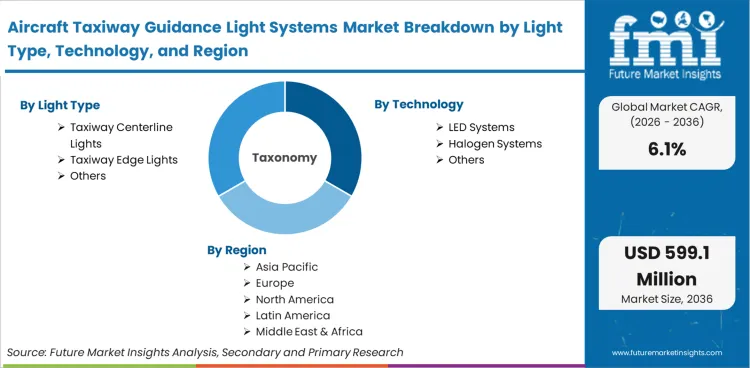
The airport taxiway guidance light systems market size anchored at USD 312.3 million in 2025, with this specialized industry sector set to hit the USD 331.4 million mark in 2026, advancing at a CAGR of 6.1% throughout the forecast period. An enduring capital commitment propels the market growth to USD 599.1 million by 2036, as the taxiway guidance lights market forecast tracks a global push by airport operators to modernize surface movement infrastructure for intensified aircraft throughput on existing tarmac footprints.
Operations directors are being forced to decide between maintaining legacy constant-current circuits or undertaking the civil works required to implement smart taxiway lighting systems. Sticking with legacy circuits preserves short-term capital but severely restricts the ability of air traffic control to route aircraft dynamically during peak congestion. Airports that delay upgrading their airfield ground lighting systems forfeit the capacity gains promised by surface movement radar integration, effectively capping their hourly flight movements. According to FMI's estimates, while procurement teams prioritize the energy savings of modern advanced airport technologies, the actual structural return on investment is the elimination of routine bulb-replacement closures, which frees up scarce nighttime maintenance windows for core pavement rehabilitation.
Summary of Aircraft Taxiway Guidance Light Systems Market
- Aircraft Taxiway Guidance Light Systems Market Definition
- The sector consists of the specialized photometric infrastructure, ranging from inset fixtures to the control nodes that power them, required to visually direct aircraft along taxiways. It is structurally bounded by strict aviation authority regulations governing light intensity, chromaticity, and failure tolerance on operational airfields.
- Demand Drivers in the Market
- The increasing frequency of low-visibility operations forces airside operations directors to deploy centerline guidance networks to maintain uninterrupted surface movement rates.
- Strict airfield ground lighting compliance audits compel maintenance managers to replace aging halogen circuits with more reliable architectures to prevent operational downgrades.
- The shift toward integrated surface movement guidance pushes airport planners to specify addressable airfield ground lighting taxiway systems that can interface directly with air traffic control automation.
- Key Segments Analyzed in the FMI Report
- Taxiway Centerline Lights: 34% share in 2026, driven by its mandatory status for executing Category II and III instrument landing system ground operations.
- LED Systems: 71% share in 2026, as their thermal and longevity advantages eliminate the need for frequent runway closures for bulb replacements.
- Inset Fixtures: 58% share in 2026, reflecting the operational requirement to allow aircraft and heavy towing vehicles to roll directly over the guidance path.
- Commercial Airports: 64% share in 2026, due to the massive footprint of complex taxiway intersections required to handle hub-and-spoke traffic.
- Conventional 6.6A Series-Circuit Systems: 54% share in 2026, maintained by the high switching cost of replacing the buried conduit infrastructure on existing operational airfields.
- India: 7.6% compound growth, driven by a national mandate establishing secondary regional airports without the constraints of legacy halogen infrastructure.
- Analyst Opinion at FMI
- Nikhil Kaitwade, Principal Analyst, Automotive, at FMI, opines, "The general consensus in aviation infrastructure is that the shift to individual lamp control is primarily an energy-saving initiative. However, the real operational value lies in predictive maintenance. When an airport can identify a failing transformer through a central dashboard rather than a manual visual sweep, the maintenance crew only enters the live taxiway for a targeted repair. This targeted approach reclaims hundreds of hours of operational capacity annually, which is the actual metric justifying the capital expenditure."
- Strategic Implications / Executive Takeaways
- Airside infrastructure planners must integrate intelligent control nodes into their upcoming resurfacing schedules to avoid stranding capital in obsolete constant-current loops.
- Airfield lighting contractors should build competencies in digital network commissioning to avoid being relegated to basic civil works providers.
- Civil aviation authorities face mounting pressure to accelerate testing protocols for hybrid retrofit systems that bridge the gap between legacy infrastructure and next-generation routing logic.
- Methodology
- Primary Research: Airside operations directors and airfield lighting maintenance managers were interviewed to determine actual replacement cycles and technology transition barriers.
- Desk Research: Aerodrome design manuals and published capital expenditure plans from national airport operators were aggregated to establish the baseline installation footprint.
- Market-Sizing and Forecasting: The baseline anchors to the volume of active commercial taxiway miles combined with the scheduled resurfacing calendar across global airports.
- Data Validation and Update Cycle: Forecasts were triangulated against the order backlogs of major airfield ground lighting equipment manufacturers.
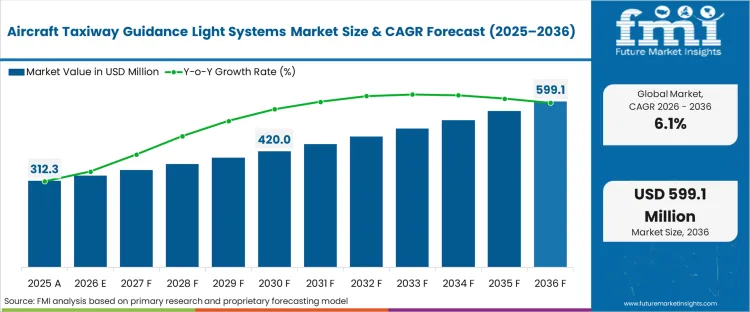
Before growth becomes self-reinforcing, civil aviation authorities must standardize the testing protocols for photometric compliance on addressable node networks. Once this certification pathway becomes predictable across jurisdictions, airport authorities and contractors can accurately model installation timelines without pricing in the risk of prolonged commissioning delays, triggering widespread adoption across major smart airport expansion projects.
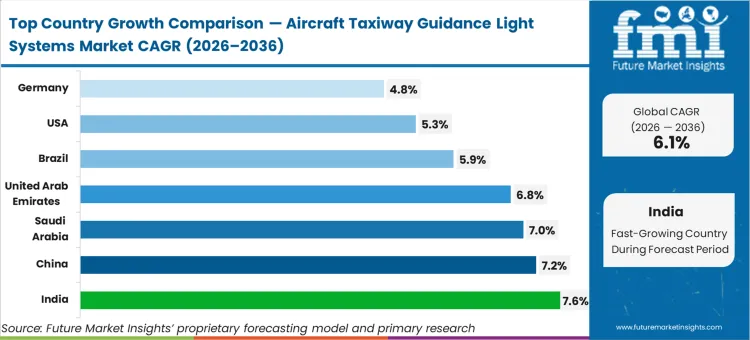
India is expected to track the highest growth at 7.6%, followed closely by China advancing at 7.2% and Saudi Arabia garnering a 7.0% expansion. The United Arab Emirates is poised to register 6.8%, Brazil is estimated to post 5.9%, the United States is anticipated to follow at 5.3%, and Germany is set to expand at 4.8%. The variance across this spectrum reflects the structural difference between regions executing unconstrained greenfield airport construction and those undertaking complex, phased retrofits on live legacy airfields.
Aircraft Taxiway Guidance Light Systems Market Definition
The market encompasses the specialized photometric fixtures, power infrastructure, and control architectures used to guide aircraft and authorized vehicles safely along airport surface movement areas. It is functionally distinct from general apron illumination, as these systems operate as active signaling components integrated directly with an airport lighting control and monitoring system, functioning under strict chromaticity and intensity standards to prevent incursions during low-visibility conditions.
Aircraft Taxiway Guidance Light Systems Market Inclusions
This sector includes inset and elevated light fixtures, the isolating transformers that power them, specialized airport runway lighting components such as runway guard lights airport configurations used at intersections, and taxiway lead on lead off lights. It also covers the primary and secondary cabling required to establish the constant-current circuits along taxiway routes, alongside portable solar units used temporarily during extensive civil works.
Aircraft Taxiway Guidance Light Systems Market Exclusions
The market explicitly excludes high-mast apron floodlighting and terminal building illumination, as these serve area visibility rather than direct aircraft routing. Approach lighting systems and runway centerline lights are excluded because they are governed by distinct certification parameters focused on airborne visual acquisition. Vehicle-mounted warning lights and autonomous towing vehicles are also excluded, as they operate independently of the fixed electrical infrastructure.
Aircraft Taxiway Guidance Light Systems Market Research Methodology
- Primary Research: Airside operations directors, airfield lighting maintenance managers, and procurement heads at major international hub airports were interviewed to determine actual replacement cycles and technology transition barriers.
- Desk Research: Aerodrome design manuals, certified product registries from civil aviation authorities, and published capital expenditure plans from national airport operators were aggregated to establish the baseline installation footprint.
- Market-Sizing and Forecasting: The baseline anchors to the volume of active commercial taxiway miles combined with the scheduled resurfacing calendar across the top 100 global airports.
- Data Validation and Update Cycle: Forecasts were triangulated against the order backlogs of major airfield ground lighting equipment manufacturers and the execution timelines of approved regional connectivity schemes.
Segmental Analysis
Aircraft Taxiway Guidance Light Systems Market Analysis by Light Type
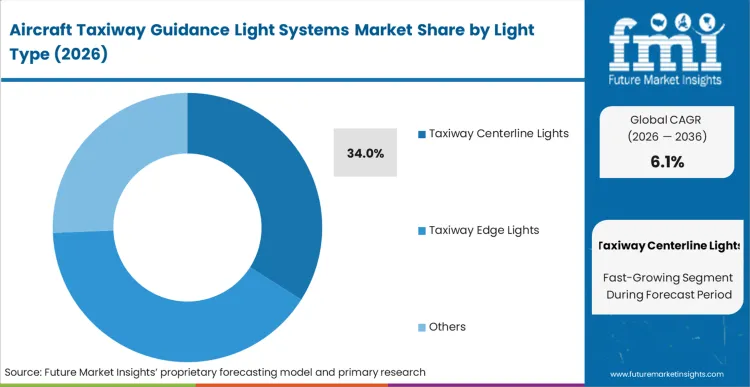
FMI analysts opine that centerline lights will capture a dominant 34% share in 2026, reflecting their mandatory installation status under strict civil aviation authority guidelines. Deploying CAT II III taxiway centerline lighting allows airside planners to specify inset fixtures at precise intervals along sweeping curves and high-speed exits to maintain safe clearance tolerances. Modern runway lighting integration further ensures that centerline guidance transitions smoothly into rapid exit taxiway indicator lights at critical intersections. Airports that attempt to defer centerline upgrades risk severe capacity constraints, as air traffic control will be forced to increase separation minimums and halt ground movements entirely during adverse weather conditions. The necessity of low-visibility operations dictates why taxiway centerline lights hold their position. While edge lights simply mark the boundary of the pavement, centerline fixtures actively define the specific routing geometry.
- Routing Geometry: Centerline fixtures guide the aircraft nose wheel precisely along complex intersections. This prevents wingtip collisions for operators maneuvering widebody aircraft through congested apron areas.
- Clearance Enforcement: Active stop bars illuminate to explicitly hold aircraft short of active runways. This physical visual barrier prevents runway incursions when radio communication is congested.
- Boundary Marking: Edge lights demarcate the safe load-bearing limits of the pavement. This ensures towing crews and pilots do not inadvertently drop landing gear into unpaved safety areas during nighttime operations.
Aircraft Taxiway Guidance Light Systems Market Analysis by Technology
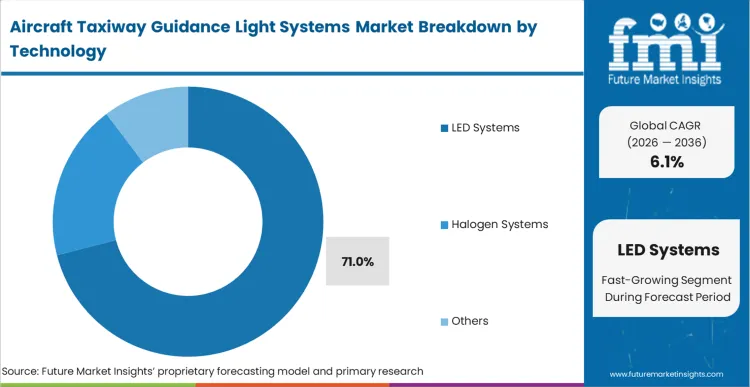
The integration of robust aircraft exterior lighting standards into airfield equipment design ensures that these LED nodes withstand extreme temperature fluctuations. As per FMI's projection, the longevity of LED arrays fueling the airfield LED retrofit market eliminates the constant cycle of manual bulb replacements, drastically reducing the taxiway light maintenance cost LED calculation. The compatibility of modern solid state lighting with advanced digital controllers further enables seamless dimming and precise routing sequences. The decision to migrate to new photometric technology opens a structural gap between the upfront capital expenditure and long-term operational savings. In any LED vs halogen taxiway lights airport evaluation, solid-state systems command a significant 71% share in 2026, not because they are cheaper to purchase, but because they drastically alter the maintenance schedule of a live airfield.
- Capital Investment: The initial deployment of LED systems requires a higher upfront budgetary commitment compared to halogen replacements. This forces finance directors to justify the expenditure through rigorous lifecycle cost modeling.
- Maintenance Burden: The extended operational life of solid-state fixtures drastically reduces the frequency of physical interventions. This hidden saving emerges operationally by allowing maintenance crews to prioritize structural pavement inspections over routine electrical work.
- Lifecycle Parity: Over a ten-year cycle, the combined energy and labor savings heavily favor the LED architecture. This economic reality eventually compels even budget-constrained regional airports to abandon legacy lighting.
Aircraft Taxiway Guidance Light Systems Market Analysis by Installation Type
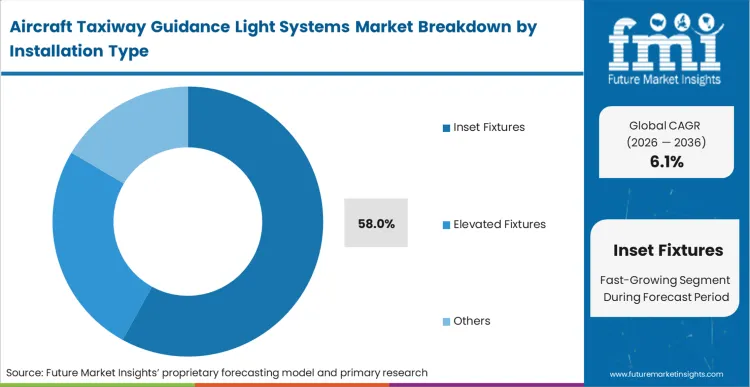
Inset fixtures present a unique operational challenge because they must deliver precise photometric performance while simultaneously surviving the direct impact of a 400-ton aircraft rolling over them. This dual requirement explains why inset fixtures hold a 58% share in 2026. Based on FMI's assessment, airside operations directors cannot utilize elevated fixtures within the active wingspan clearance zone, forcing the use of flush-mounted prisms that are bored directly into the concrete or asphalt. The installation process demands significant downtime, as the pavement must be cored and specialized adhesives must cure properly to prevent the fixture from becoming a dangerous piece of foreign object debris (FOD). For temporary routing during these extensive rehabilitation projects, robust emergency lighting and portable solar units provide critical gap coverage. If the coring and sealing processes are executed poorly, the resulting water ingress will rapidly fail the isolating transformer.
- Load Resistance: The heavy forged housings of inset lights protect the delicate optical components from direct tire strikes. This prevents immediate catastrophic failure when a widebody aircraft deviates slightly from the centerline.
- Water Ingress: The primary residual risk involves aviation fuel and de-icing fluid penetrating the housing seals over time. This requires maintenance managers to maintain a rigorous torque-checking and re-sealing schedule.
- Pavement Integrity: The physical coring required for installation weakens the surrounding pavement matrix. Civil engineering teams must carefully monitor these installation points for micro-fractures to prevent widespread surface degradation.
Aircraft Taxiway Guidance Light Systems Market Analysis by Airport Type / End Use
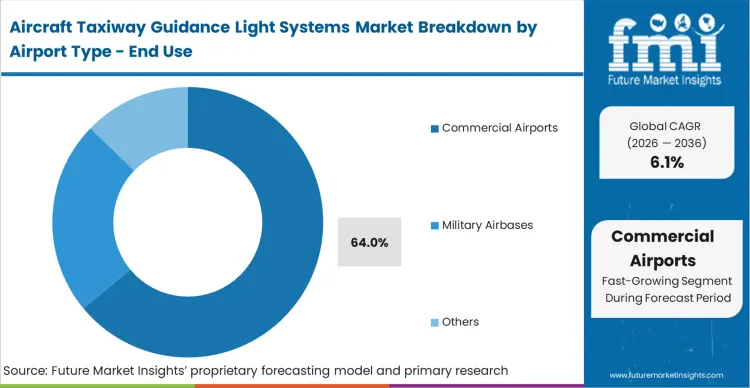
Optimizing the flow around airport moving walkways and terminal infrastructure requires precise ground routing while military airbase taxiway guidance lights prioritize rapid deployment with commercial hub operators who delay upgrading their surface movement infrastructure will inevitably suffer cascading delays. Commercial airports operate under a structural imperative that does not apply equally to regional or military airfields, they must maintain continuous, high-volume traffic flow regardless of ambient visibility. This relentless operational tempo drives commercial airport taxiway lighting demand, securing a 64% share in 2026. In FMI's view, the sheer density of intersections, rapid-exit taxiways, and terminal aprons at major hubs necessitates a highly complex, interlinked guidance network. The integration of advanced airport passenger boarding bridge docking systems with final lead-in lights ensures a seamless transition.
- Hub Operations: Major commercial operators install dense centerline networks to facilitate rapid runway exits. This allows air traffic control to safely decrease the spacing between arriving aircraft, maximizing hourly movement rates.
- Regional Facilities: Smaller commercial airports often upgrade their edge lighting and hold-short indicators sequentially. This phased approach allows them to handle increased charter traffic without triggering massive capital expenditure requests.
- Military Application: Airbases prioritize rapid deployment and resilience over complex routing logic. This drives military procurement toward hybrid or robust portable systems that can be established quickly during operational surges.
Aircraft Taxiway Guidance Light Systems Market Analysis by Control Architecture
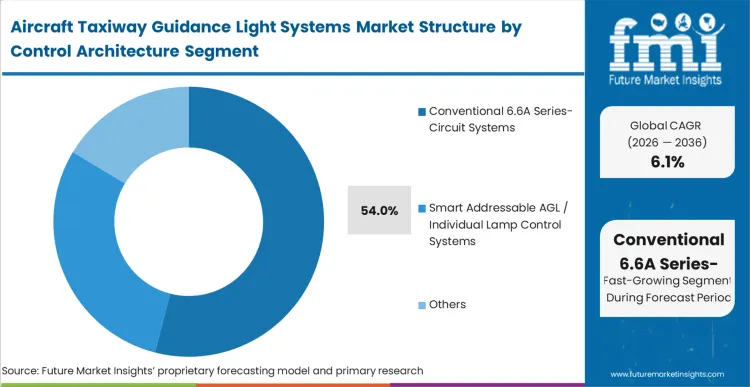
The transition toward intelligent airfield networks is reshaping how control systems are evaluated, yet the deep roots of legacy infrastructure pull in the opposite direction. When evaluating smart AGL vs conventional 6.6A taxiway systems, conventional series-circuit systems are anticipated to maintain a 54% share in 2026, primarily because ripping out the buried copper conduit is a monumental civil engineering undertaking. According to FMI's estimates, while the industry envisions a future of individually addressable lamps, the reality is that most operational airports must splice new fixtures into existing constant-current loops. Achieving proper airport stop bar system integration with a sophisticated light management system allows some legacy circuits to be controlled at the segment level. However, a fault in a conventional series circuit still affects the entire loop, meaning that airports delaying the shift to addressable nodes carry the operational risk of a single transformer failing an entire taxiway segment.
- Circuit Architecture: Constant-current loops deliver uniform power across long cable runs. This enables reliable basic illumination but prevents air traffic control from switching individual lamps to create dynamic routing paths.
- Node Addressing: Smart architectures assign a unique digital address to every fixture on the airfield. This allows the control tower to illuminate a specific 'green route' for a single aircraft, vastly reducing pilot confusion at complex intersections.
- Integration Capability: Advanced logic requires deep integration with surface movement radar. Airports must upgrade their entire digital backbone before they can fully utilize the capabilities of individual lamp modules.
Aircraft Taxiway Guidance Light Systems Market Drivers, Restraints, and Opportunities
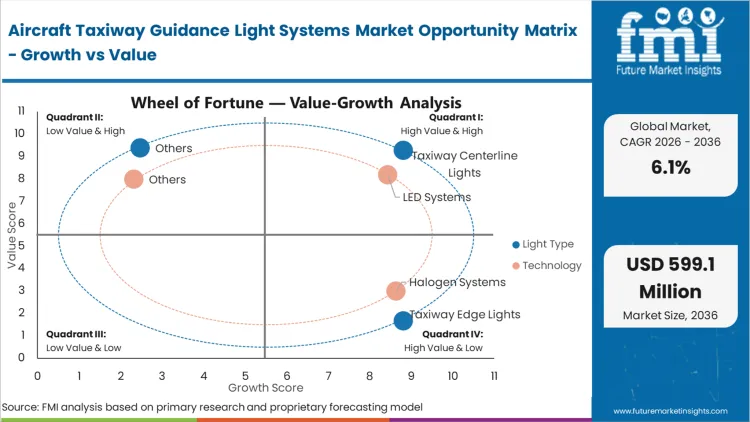
Surging aircraft throughput requirements are creating a localized crisis on existing airfield footprints, compelling operations directors to accelerate airport modernization taxiway lighting initiatives. This is not merely a preference for newer technology; it is an operational necessity driven by the fact that legacy lighting systems cannot safely route multiple widebody aircraft through complex intersections in low visibility. To meet strict taxiway lighting compliance standards and maintain the hourly movement rates required by airlines, airport authorities must deploy networks that actively guide pilots rather than just passively marking the pavement. Delaying this transition effectively caps the revenue-generating capacity of the airport.
Massive capital outlays and logistical gridlock represent the primary barriers to entry, as the sheer taxiway centerline light installation cost remains a deterrent for conducting major civil works on live, operational airfields. Upgrading from conventional series circuits to fully digital nodes require coring out existing fixtures, laying new data-capable communication lines, and replacing isolating transformers across miles of taxiway. Because these installations cannot be done while aircraft are taxiing, they are restricted to narrow nighttime maintenance windows or scheduled runway closures, making the transition painfully slow and highly disruptive.
Opportunities in the Aircraft Taxiway Guidance Light Systems Market
- Retrofit Communication Modules: The inability to easily replace buried conduit creates a massive opening for power-line communication technologies. Specialized engineering firms can capture lucrative modernization contracts by providing nodes that enable individual lamp control over existing 6.6A legacy wiring.
- Photometric Drone Auditing: Stringent compliance testing requires precise measurement of light intensity and angles. Service providers who deploy automated drone fleets to conduct these audits operationally simplify the compliance process for maintenance managers, replacing slow, manual ground-vehicle measurements.
- Extreme Environment Resilience: Airfields in harsh climates face accelerated degradation of optical prisms and seals. Manufacturers engineering robust, explosion proof lighting derivatives and advanced de-icing resistant housings can secure premium contracts with operators in extreme temperature zones.
Regional Analysis
The regional trajectory of the taxiway guidance light systems market is defined by a deep structural divide between unconstrained greenfield deployments and complex legacy airfield retrofits. The growth patterns as a result diverge sharply across 40 plus countries based on their existing infrastructure maturity, available capital, and localized regulatory calendar with the market being segmented into North America, Europe, Asia Pacific, Latin America, and Middle East & Africa across 40 plus countries.
.webp "Top Country Growth Comparison Aircraft Taxiway Guidance Light Systems Market Cagr (2026 2036)")
| Country | CAGR (2026 to 2036) |
|---|---|
| India | 7.6% |
| China | 7.2% |
| Saudi Arabia | 7.0% |
| United Arab Emirates | 6.8% |
| Brazil | 5.9% |
| United States | 5.3% |
| Germany | 4.8% |
Source: Future Market Insights (FMI) analysis, based on proprietary forecasting model and primary research
Asia Pacific Aircraft Taxiway Guidance Light Systems Market Analysis
Unlike mature markets forced to squeeze infrastructure upgrades into narrow nighttime maintenance windows, the structural reality across the Asia Pacific is dominated by massive, unconstrained greenfield airport construction. This clean-slate environment completely eliminates the friction associated with splicing modern digital routing logic into obsolete constant-current copper loops. As per FMI's projection, airside planners are taking advantage of these massive civil works to install individually addressable LED networks from day one, often utilizing temporary LED light tower arrays to keep adjacent aprons active during the build. Ultimately, this structural trajectory means the region is poised to entirely bypass the stopgap hybrid retrofit phase, leapfrogging directly into the fully integrated surface movement systems that represent the future of air traffic control.
- India: The sudden operationalization of dozens of secondary airstrips is structurally driven by the aggressive execution of the UDAN regional connectivity scheme. To safely manage the introduction of commercial jet traffic, these newly activated facilities are compelled to rapidly achieve basic ICAO photometric compliance. Tracking an expansion at an annual growth rate of 7.6%, the India taxiway guidance lights market presents a distinct commercial opportunity. Vendors successfully securing these foundational regional contracts effectively lock in their competitive positioning, ensuring they capture the highly lucrative lifecycle maintenance cycles as these domestic nodes scale into major international hubs.
- China: Airside planners operating within centralized mega-hub construction frameworks bypass the budget fragmentation that plagues decentralized aviation markets, enabling them to execute sweeping, full-system procurements. This top-down planning explicitly mandates the deep integration of follow the greens taxiway lighting logic right from the initial architectural design phase. The direct operational outcome is a highly sophisticated surface movement network capable of sustaining peak-hour widebody throughput. A robust CAGR of 7.2% as a result is expected for the China airport taxiway lighting market over the forecast period.
FMI's report includes extensive coverage of Southeast Asian markets, such as Vietnam and Indonesia. The island geography and rapid expansion of low-cost carriers in these nations compel aviation authorities to rapidly upgrade aging coastal airstrips to handle higher-capacity narrowbody aircraft under variable tropical weather conditions.
Middle East Aircraft Taxiway Guidance Light Systems Market Analysis
The imperative to function as the world's premier, fail-safe transit hubs strictly dictates the technology procurement philosophy of Middle Eastern airport authorities. Driven by an abundance of capital, operations directors heavily favor acquiring the most resilient, highest-tier infrastructure available to completely insulate their complex hub-and-spoke models against unscheduled downtime. FMI analysts opine that this structural dynamic accelerates the deployment of fully addressable node networks, entirely bypassing the severe budget constraints that hamstring modernization in other geographies. To further effectively secure the immense scale of these desert aprons, highly specialized taxiway guidance fixtures are frequently augmented by robust exterior illumination systems comparable to heavy-duty stadium lighting. Ultimately, this transforms the region into the ultimate global proving ground for the most complex architectures currently engineered.
- Saudi Arabia: The Saudi Arabia taxiway lighting systems sector is likely to post a powerful CAGR of 7.0%. This rapid expansion is fundamentally compelled by the aggressive execution calendar of Vision 2030, which forces procurement directors to orchestrate the simultaneous modernization of legacy terminals alongside the ground-up construction of massive new aviation cities. Operations directors who effectively master this rapid deployment phase secure a profound commercial advantage, proactively future-proofing their airfields to seamlessly absorb the heavily anticipated influx of international tourism and global logistics traffic.
- United Arab Emirates: Flawless and continuous surface routing is an absolute necessity to prevent localized ground bottlenecks from triggering cascading global delays across major transit hubs. To sustain this intense concentration of widebody aircraft movements, airside planners are required to specify guidance fixtures that combine perfect digital integration with the ability to withstand highly abrasive sandstorms and extreme ambient heat. Demand across the UAE smart taxiway lighting market is set to grow at a steady 6.8% as a direct result of these requirements. The practitioner reality in this environment is that absolute thermal resilience completely eclipses energy efficiency as the primary metric of success.
FMI's report includes secondary hubs across the Gulf Cooperation Council (GCC) and the Levant. These facilities leverage the technical standards established by the mega-hubs, utilizing similar high-temperature tolerant inset fixtures to maintain regional consistency in safety protocols.
Europe Aircraft Taxiway Guidance Light Systems Market Analysis
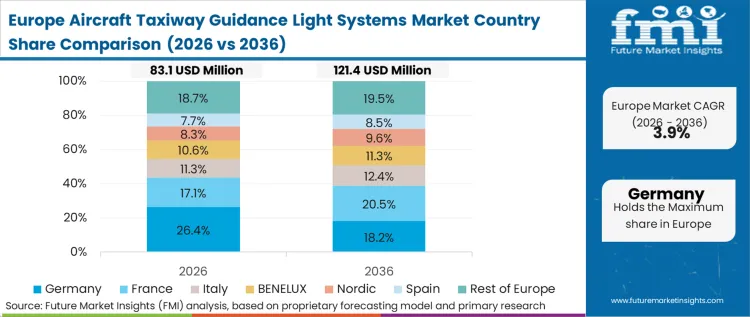
Across Europe's heavily congested airspace, the pace of technology adoption is strictly dictated by the intersection of aging airfield infrastructure and rigid environmental safety mandates. A steady, unavoidable cycle of capital expenditure is structurally forced by European civil aviation authorities, who severely penalize operators failing to maintain optimal photometric intensity levels. Based on FMI's assessment, the primary operational friction is executing these upgrades across legacy airfields severely constrained by decades-old buried electrical conduit. To satisfy comprehensive energy reduction targets, these transitions require highly meticulous, phased retrofits, often synchronizing the upgrade of critical airside inset nodes with external street and roadway lighting approaches. As a result, the adoption trajectory is highly methodical, leaning heavily on hybrid communication systems.
- Germany: Maintenance managers across German airfields are structurally compelled to proactively replace degrading halogen circuits long before actual failure occurs, driven by the rigorous enforcement of EASA compliance frameworks. Attempting to execute these complex retrofits on major transit arteries like Frankfurt introduces a severe operational reality, demanding microscopic scheduling precision. Because regulatory tolerance for the inherent inefficiencies and risks of legacy constant-current loops is rapidly approaching zero, the structural trajectory points toward a total phase-out of these older systems by the mid-2030s. Germany is forecast to register a CAGR of 4.8%, reflecting this methodical but steady transition in the market value.
FMI's report includes mature aviation markets like the United Kingdom and France, alongside rapidly modernizing Eastern European nodes. The focus in these adjacent countries remains firmly on extending the lifecycle of existing pavements through careful, targeted coring when installing new LED inset fixtures.
North America and Latin America Aircraft Taxiway Guidance Light Systems Market Analysis
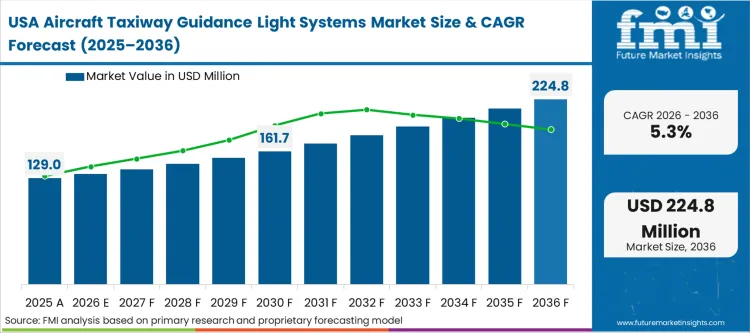
Across the Americas, the technology adoption curve is defined by a deep structural contrast between massive legacy infrastructure rehabilitation in the North and privatization-fueled modernization sweeping the South. The North America taxiway guidance light systems market is primarily locked into extending the lifecycle of highly complex, aging hub-and-spoke pavements, requiring meticulous capital allocation to replace obsolete constant-current loops without halting operations. The aggressive airport concession programs across Latin America, on the other hand, are injecting sudden waves of private capital into historically underfunded airfields. According to FMI's analysis, this geographic polarity creates a dual-speed trajectory, northern procurement directors are heavily focused on sophisticated hybrid retrofit modules to bridge communication gaps, while southern operators frequently have the mandate to rip out failing systems entirely and deploy robust, modern LED networks.
- Brazil: Generating an anticipated CAGR of 5.9%, the Brazilian trajectory is deeply influenced by the structural shift toward aggressive airport privatization blocks. As international consortiums assume control of regional and national hubs, they bring strict, contractually obligated capital expenditure mandates to fundamentally modernize aging photometric infrastructure. This sudden influx of private investment forces local procurement directors to rapidly pivot from merely patching failing halogen circuits to specifying comprehensive, high-resilience LED guidance networks capable of handling heavy widebody cargo traffic. Vendors who establish strong local supply chains to navigate Brazil's complex import tax structures secure a distinct competitive positioning.
- United States: The sheer volume of legacy constant-current infrastructure buried beneath US commercial hubs forces a highly conservative, phased approach to technology transition. Rather than executing sweeping architectural overhauls, airfield maintenance directors evaluating the United States taxiway lighting market are compelled to meticulously splice addressable nodes into existing copper loops during heavily restricted, overnight runway closures. The sector is expected to post a steady CAGR of 5.3% as these complex rehabilitations unfold. The primary operational outcome of navigating this restrictive environment successfully is the ability to incrementally activate advanced routing logic without waiting for a multi-year civil engineering complete rebuild.
FMI's report includes extensive coverage of secondary markets across North America and Latin America, including Canada and Mexico. The fundamental dynamic across these adjacent territories revolves around harmonizing cross-border aviation safety standards, ensuring that extreme weather variations do not compromise the photometric integrity of newly installed surface movement networks.
Competitive Aligners for Market Players
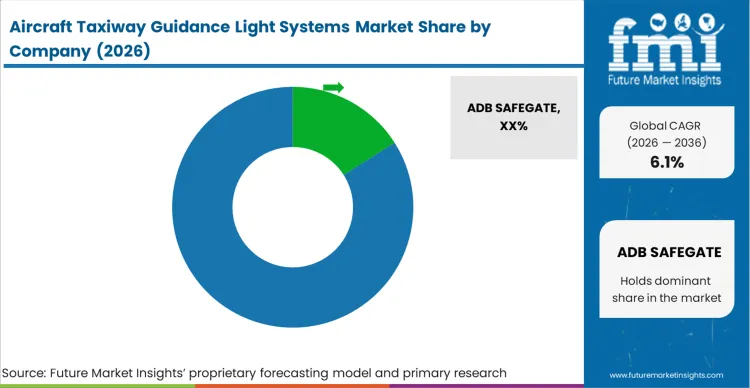
Navigating the punishing certification frameworks enforced by global aviation authorities acts as the ultimate filter in this space, erecting formidable barriers against new entrants. Procurement executives at high-capacity commercial hubs universally dismiss minor pricing differentials when evaluating bids, instead separating viable from non-viable candidates based entirely on empirical evidence of hardware survivability under the relentless physical impact of widebody aircraft. The upper tier as a result is firmly held by established airport taxiway lighting manufacturers like ADB SAFEGATE, TKH Airport Solutions, and Eaton Crouse-Hinds, whose extensive engineering pedigrees allow them to continuously clear stringent photometric and structural stress tests without triggering operational failures that would ground a taxiway.
Beneath the tarmac of the world's major runways lies a sprawling network of proprietary control architectures that deeply entrench the market dominance of incumbent providers. Specialists such as OCEM Airfield and ATG airports recognize that an airport's initial commitment to a specific digital communication node essentially locks out future competition, as the financial friction of ripping out and replacing an entire surface routing protocol is commercially unfeasible for an active hub. To successfully penetrate this tier, a challenger cannot merely engineer a robust light source; they are compelled to develop and certify a fully integrated, cyber-secure data network capable of interfacing seamlessly with existing airfield ground lighting systems. By translating ruggedized military lighting specifications and highly specialized aircraft lightning protection protocols into their commercial portfolios, these taxiway guidance light systems suppliers futher continuously widen the technological moat that protects their market share.
The coming decade will see this rigid ecosystem disrupted, as the definitive structural battleground shifts entirely toward the escalating demand for open-architecture communication protocols. Heavyweight airport conglomerates are aggressively pushing back against proprietary vendor lock-in, demanding interoperable node standards that would allow them to seamlessly integrate components from diverse manufacturers, such as pairing a digital control module from Astronics DME with a heavy-duty inset fixture from Hughey & Phillips, on a single constant-current loop. As regulatory bodies increasingly mandate these open frameworks, the competitive equilibrium is projected to fracture, forcing entrenched suppliers to win an airfield lighting RFQ taxiway lights contract based strictly on the raw physical endurance of their hardware and the predictive intelligence of their software suites, rather than depending on the captive inertia of legacy installations.
KEY PLAYERS IN AIRCRAFT TAXIWAY GUIDANCE LIGHT SYSTEMS MARKET
- ADB SAFEGATE
- TKH Airport Solutions
- Eaton Crouse-Hinds
- OCEM Airfield
- Astronics DME
- ATG airports
- Hughey & Phillips
Scope of the Report
| Metric | Value |
|---|---|
| Quantitative Units | USD 331.4 million to USD 599.1 million, at a CAGR of 6.1% |
| Market Definition | The specialized photometric fixtures, power infrastructure, and control architectures used to guide aircraft safely along airport surface movement areas under strict aviation authority regulations. |
| Light Type Segmentation | Taxiway centerline lights, Taxiway edge lights, Stop bar lights, Lead-on / lead-off lights, Clearance bar / intermediate holding position lights, Runway guard lights used at taxiway-runway intersections |
| Technology Segmentation | LED systems, Halogen systems, Hybrid LED-retrofit systems, Solar / temporary wireless guidance lights |
| Installation Type Segmentation | Inset fixtures, Elevated fixtures, Portable / temporary fixtures |
| Airport Type / End Use Segmentation | Commercial airports, Military airbases, General aviation / regional airports, Greenfield airport projects |
| Regions Covered | North America, Latin America, Europe, Asia Pacific, Middle East & Africa |
| Countries Covered | India, China, Saudi Arabia, United Arab Emirates, Brazil, United States, Germany, and 40 plus countries |
| Key Companies Profiled | ADB SAFEGATE, TKH Airport Solutions, Eaton Crouse-Hinds, OCEM Airfield, Astronics DME, ATG airports, Hughey & Phillips |
| Forecast Period | 2026 to 2036 |
| Approach | Airside operations directors and airfield lighting maintenance managers were interviewed to determine replacement cycles. The baseline anchors to the volume of active commercial taxiway miles combined with the scheduled resurfacing calendar. Forecasts were triangulated against the order backlogs of major airfield ground lighting equipment manufacturers. |
Source: Future Market Insights (FMI) analysis, based on proprietary forecasting model and primary research
Segments
Light Type:
- Taxiway centerline lights
- Taxiway edge lights
- Stop bar lights
- Lead-on / lead-off lights
- Clearance bar / intermediate holding position lights
- Runway guard lights used at taxiway-runway intersections
Technology:
- LED systems
- Halogen systems
- Hybrid LED-retrofit systems
- Solar / temporary wireless guidance lights
Installation Type:
- Inset fixtures
- Elevated fixtures
- Portable / temporary fixtures
Airport Type / End Use:
- Commercial airports
- Military airbases
- General aviation / regional airports
- Greenfield airport projects
Control Architecture:
- Conventional 6.6A series-circuit systems
- Smart addressable AGL / individual lamp control systems
- Follow-the-greens-enabled integrated guidance systems
- Standalone temporary guidance packages
Region:
- North America
- United States
- Canada
- Europe
- Germany
- United Kingdom
- France
- Italy
- Spain
- Asia Pacific
- China
- Japan
- South Korea
- Taiwan
- Singapore
- Latin America
- Brazil
- Mexico
- Argentina
- Middle East & Africa
- GCC Countries
- South Africa
- Israel
Bibliography
- ADB SAFEGATE. (2024). 2024 corporate social responsibility report. ADB SAFEGATE.
- Airports Council International World. (2025, January). Joint ACI World-ICAO Passenger Traffic Report, Trends and Outlook. Airports Council International World.
- Civil Aviation Authority. (2024, January). AMC GM ADR. Civil Aviation Authority.
- EUROCONTROL. (2025). LSSIP 2024 - LITHUANIA. EUROCONTROL.
- Federal Aviation Administration. (2024, September). AC 150/5345-46F, Specification for Runway, Taxiway, Heliport, and Vertiport Light Fixtures. Federal Aviation Administration.
- International Air Transport Association. (2025, January). Global Air Passenger Demand Reaches Record High in 2024. International Air Transport Association.
- TKH Group N.V. (2024). Annual Report 2024. TKH Group N.V.
- Transport Canada. (2024, March). AIM 2024-1 - AGA - Aerodromes. Transport Canada.
- World Civil Aviation Organization. (2024). Wings of Prosperity - Economic Growth Through Air Transport. World Civil Aviation Organization.
This bibliography is provided for reader reference. The full FMI report contains the complete reference list with primary source documentation.
This Report Addresses
- Market intelligence to support strategic decision making across Taxiway centerline lights, inset fixtures, and addressable control architectures.
- Market size estimation and 10-year revenue forecasts from 2026 to 2036, supported by scheduled resurfacing calendars and aviation authority capital expenditure plans.
- Growth opportunity mapping across Light Type and Technology with emphasis on the structural shift toward aircraft taxiway guidance light systems market routing logic.
- Segment and regional revenue forecasts covering LED systems and commercial airports across stringent European photometric compliance frameworks.
- Competition strategy assessment including proprietary control architectures, FAA/ICAO certification moats, and the resistance to open-architecture standards.
- Technology development tracking including power-line communication retrofits, predictive maintenance dashboards, and severe-weather resistant optical seals.
- Market access analysis covering regional connectivity schemes like UDAN in India and mega-hub centralized planning in the Middle East.
- Market report delivery in PDF, Excel, PPT, and interactive dashboard formats for executive strategy, airside operations planning, and operational benchmarking use.
Frequently Asked Questions
How do taxiway guidance lights work?
These systems utilize constant-current series circuits or addressable digital nodes to illuminate specific photometric fixtures built into the pavement, providing active visual instructions that guide pilots safely from the runway to the terminal.
What color are taxiway edge lights?
Taxiway edge lights emit a standardized blue color to demarcate the safe load-bearing limits of the pavement, ensuring towing crews and pilots do not inadvertently drop landing gear into unpaved safety areas during nighttime operations.
When are taxiway centerline lights required?
Aviation authorities mandate centerline guidance as a non-negotiable structural requirement for any airport executing Category II and III instrument landing operations where pilots cannot visually acquire the taxiway boundary in dense fog.
What is the difference between runway and taxiway lights?
While runway lights are designed for high-intensity airborne visual acquisition from miles away, taxiway lights utilize low-glare green centerlines and blue edges specifically tailored for ground-level navigation at lower speeds.
What are stop bar lights used for at airports?
Active stop bars illuminate a row of red inset fixtures to explicitly hold aircraft short of active runways, acting as a final physical visual barrier against runway incursions when radio communication is congested or misunderstood.
What is follow the greens at an airport?
Instead of pilots visually navigating a maze of permanently illuminated taxiways, the control tower actively switches on only the specific green centerline lights required for that aircraft's cleared route to eliminate pilot deviation at complex intersections.
Is LED taxiway lighting worth the retrofit cost?
The longevity of LED arrays eliminates the constant cycle of manual bulb replacements, shifting the ten-year lifecycle calculation to heavily favor the solid-state architecture through combined energy and labor savings.
What regulations drive taxiway centerline light demand?
Stringent low-visibility operational guidelines established by the ICAO and enforced by regional bodies penalize airports for degraded light intensity, forcing a continuous cycle of capital expenditure to maintain compliance.
How large is the Aircraft Taxiway Guidance Light Systems Market in 2026?
The industry is valued at USD 331.4 million in 2026, reflecting the baseline capital allocated by global airport authorities strictly for the photometric hardware and control nodes required to maintain certified surface movement operations.
What will it be valued at by 2036?
The sector will reach USD 599.1 million by 2036, capturing the escalating cost of integrating individual lamp control networks into legacy airfields as traffic volumes push existing surface capacity to its absolute limit.
What CAGR is projected?
A compound annual growth rate of 6.1% is expected, tracking the pace at which civil engineering teams can safely execute pavement coring and conduit replacement during narrow nighttime maintenance windows rather than the raw demand for new fixtures.
Which Light Type segment leads?
Taxiway centerline lights dominate the space because they actively define the specific routing geometry, which is an absolute requirement for modern high-speed surface movement.
Which Technology segment leads?
LED systems lead the technology transition, driven by their thermal resilience and longevity which drastically lowers the ongoing operational expenditure calculation for live airfields.
Which Installation Type segment leads?
Inset fixtures capture the majority of installations because airside planners must specify flush-mounted prisms that can withstand direct tire strikes from widebody aircraft rolling over the active wingspan clearance zone.
What drives rapid growth?
The operational mandate to increase hourly flight movements without expanding the physical tarmac footprint forces airports to adopt dynamic routing networks that allow air traffic control to safely guide multiple aircraft through complex intersections simultaneously.
What is the primary restraint?
The massive civil works required to replace buried constant-current series circuits create a severe bottleneck, as excavating miles of taxiway to lay new data-capable conduit disrupts active flight operations.
Which country grows fastest?
India advances at 7.6%, outpacing mature hubs structurally because its growth is heavily driven by the rapid activation of secondary regional airports under national connectivity schemes that avoid the complex retrofit friction seen in legacy markets.
How do European photometric compliance frameworks impact procurement?
Maintenance managers in Germany and the UK cannot wait for a complete circuit failure and must constantly audit and upgrade their inset fixtures to avoid operational downgrades during the region's frequent low-visibility winter conditions.
What makes hybrid LED-retrofit systems critical for legacy airfields?
Hybrid systems send digital control signals over existing copper power lines, allowing operations directors to achieve partial smart-routing capabilities without the impossible task of digging up decades-old conduit across an entire operational hub.
Why is the competitive structure highly concentrated among a few vendors?
Procurement directors refuse to evaluate unproven challengers because the cost of a catastrophic fixture failure on an active taxiway far outweighs any upfront equipment savings, and securing the necessary FAA and ICAO certifications requires millions of dollars in testing.
Why are commercial airports the dominant end-users?
The sheer density of rapid-exit taxiways and terminal aprons at a commercial hub necessitates a highly complex, interlinked guidance network, as these facilities face immediate gridlock without explicit centerline guidance.
What role do temporary portable fixtures play in the market?
When major hubs execute phased pavement rehabilitation that severs primary lighting circuits, portable solar guidance units provide the critical visual gap coverage required to keep adjacent taxiways open while the permanent infrastructure is rebuilt.
Preview the report firsthand - request a free sample
Get SampleGet the brochure for pricing and purchase details.
Get PDFTable of Content
- Executive Summary
- Global Market Outlook
- Demand-side Trends
- Supply-side Trends
- Technology Roadmap Analysis
- Analysis and Recommendations
- Market Overview
- Market Coverage / Taxonomy
- Market Definition / Scope / Limitations
- Research Methodology
- Chapter Orientation
- Analytical Lens and Working Hypotheses
- Market Structure, Signals, and Trend Drivers
- Benchmarking and Cross-market Comparability
- Market Sizing, Forecasting, and Opportunity Mapping
- Research Design and Evidence Framework
- Desk Research Programme (Secondary Evidence)
- Company Annual and Sustainability Reports
- Peer-reviewed Journals and Academic Literature
- Corporate Websites, Product Literature, and Technical Notes
- Earnings Decks and Investor Briefings
- Statutory Filings and Regulatory Disclosures
- Technical White Papers and Standards Notes
- Trade Journals, Industry Magazines, and Analyst Briefs
- Conference Proceedings, Webinars, and Seminar Materials
- Government Statistics Portals and Public Data Releases
- Press Releases and Reputable Media Coverage
- Specialist Newsletters and Curated Briefings
- Sector Databases and Reference Repositories
- FMI Internal Proprietary Databases and Historical Market Datasets
- Subscription Datasets and Paid Sources
- Social Channels, Communities, and Digital Listening Inputs
- Additional Desk Sources
- Expert Input and Fieldwork (Primary Evidence)
- Primary Modes
- Qualitative Interviews and Expert Elicitation
- Quantitative Surveys and Structured Data Capture
- Blended Approach
- Why Primary Evidence is Used
- Field Techniques
- Interviews
- Surveys
- Focus Groups
- Observational and In-context Research
- Social and Community Interactions
- Stakeholder Universe Engaged
- C-suite Leaders
- Board Members
- Presidents and Vice Presidents
- R&D and Innovation Heads
- Technical Specialists
- Domain Subject-matter Experts
- Scientists
- Physicians and Other Healthcare Professionals
- Governance, Ethics, and Data Stewardship
- Research Ethics
- Data Integrity and Handling
- Primary Modes
- Tooling, Models, and Reference Databases
- Desk Research Programme (Secondary Evidence)
- Data Engineering and Model Build
- Data Acquisition and Ingestion
- Cleaning, Normalisation, and Verification
- Synthesis, Triangulation, and Analysis
- Quality Assurance and Audit Trail
- Market Background
- Market Dynamics
- Drivers
- Restraints
- Opportunity
- Trends
- Scenario Forecast
- Demand in Optimistic Scenario
- Demand in Likely Scenario
- Demand in Conservative Scenario
- Opportunity Map Analysis
- Product Life Cycle Analysis
- Supply Chain Analysis
- Investment Feasibility Matrix
- Value Chain Analysis
- PESTLE and Porter’s Analysis
- Regulatory Landscape
- Regional Parent Market Outlook
- Production and Consumption Statistics
- Import and Export Statistics
- Market Dynamics
- Global Market Analysis 2021 to 2025 and Forecast, 2026 to 2036
- Historical Market Size Value (USD Million) Analysis, 2021 to 2025
- Current and Future Market Size Value (USD Million) Projections, 2026 to 2036
- Y-o-Y Growth Trend Analysis
- Absolute $ Opportunity Analysis
- Global Market Pricing Analysis 2021 to 2025 and Forecast 2026 to 2036
- Global Market Analysis 2021 to 2025 and Forecast 2026 to 2036, By Light Type
- Introduction / Key Findings
- Historical Market Size Value (USD Million) Analysis By Light Type , 2021 to 2025
- Current and Future Market Size Value (USD Million) Analysis and Forecast By Light Type , 2026 to 2036
- Taxiway Centerline Lights
- Taxiway Edge Lights
- Others
- Taxiway Centerline Lights
- Y-o-Y Growth Trend Analysis By Light Type , 2021 to 2025
- Absolute $ Opportunity Analysis By Light Type , 2026 to 2036
- Global Market Analysis 2021 to 2025 and Forecast 2026 to 2036, By Technology
- Introduction / Key Findings
- Historical Market Size Value (USD Million) Analysis By Technology, 2021 to 2025
- Current and Future Market Size Value (USD Million) Analysis and Forecast By Technology, 2026 to 2036
- LED Systems
- Halogen Systems
- Others
- LED Systems
- Y-o-Y Growth Trend Analysis By Technology, 2021 to 2025
- Absolute $ Opportunity Analysis By Technology, 2026 to 2036
- Global Market Analysis 2021 to 2025 and Forecast 2026 to 2036, By Installation Type
- Introduction / Key Findings
- Historical Market Size Value (USD Million) Analysis By Installation Type, 2021 to 2025
- Current and Future Market Size Value (USD Million) Analysis and Forecast By Installation Type, 2026 to 2036
- Inset Fixtures
- Elevated Fixtures
- Others
- Inset Fixtures
- Y-o-Y Growth Trend Analysis By Installation Type, 2021 to 2025
- Absolute $ Opportunity Analysis By Installation Type, 2026 to 2036
- Global Market Analysis 2021 to 2025 and Forecast 2026 to 2036, By Airport Type / End Use
- Introduction / Key Findings
- Historical Market Size Value (USD Million) Analysis By Airport Type / End Use, 2021 to 2025
- Current and Future Market Size Value (USD Million) Analysis and Forecast By Airport Type / End Use, 2026 to 2036
- Commercial Airports
- Military Airbases
- Others
- Commercial Airports
- Y-o-Y Growth Trend Analysis By Airport Type / End Use, 2021 to 2025
- Absolute $ Opportunity Analysis By Airport Type / End Use, 2026 to 2036
- Global Market Analysis 2021 to 2025 and Forecast 2026 to 2036, By Control Architecture
- Introduction / Key Findings
- Historical Market Size Value (USD Million) Analysis By Control Architecture, 2021 to 2025
- Current and Future Market Size Value (USD Million) Analysis and Forecast By Control Architecture, 2026 to 2036
- Conventional 6.6A Series-Circuit Systems
- Smart Addressable AGL / Individual Lamp Control Systems
- Others
- Conventional 6.6A Series-Circuit Systems
- Y-o-Y Growth Trend Analysis By Control Architecture, 2021 to 2025
- Absolute $ Opportunity Analysis By Control Architecture, 2026 to 2036
- Global Market Analysis 2021 to 2025 and Forecast 2026 to 2036, By Region
- Introduction
- Historical Market Size Value (USD Million) Analysis By Region, 2021 to 2025
- Current Market Size Value (USD Million) Analysis and Forecast By Region, 2026 to 2036
- North America
- Latin America
- Western Europe
- Eastern Europe
- East Asia
- South Asia and Pacific
- Middle East & Africa
- Market Attractiveness Analysis By Region
- North America Market Analysis 2021 to 2025 and Forecast 2026 to 2036, By Country
- Historical Market Size Value (USD Million) Trend Analysis By Market Taxonomy, 2021 to 2025
- Market Size Value (USD Million) Forecast By Market Taxonomy, 2026 to 2036
- By Country
- USA
- Canada
- Mexico
- By Light Type
- By Technology
- By Installation Type
- By Airport Type / End Use
- By Control Architecture
- By Country
- Market Attractiveness Analysis
- By Country
- By Light Type
- By Technology
- By Installation Type
- By Airport Type / End Use
- By Control Architecture
- Key Takeaways
- Latin America Market Analysis 2021 to 2025 and Forecast 2026 to 2036, By Country
- Historical Market Size Value (USD Million) Trend Analysis By Market Taxonomy, 2021 to 2025
- Market Size Value (USD Million) Forecast By Market Taxonomy, 2026 to 2036
- By Country
- Brazil
- Chile
- Rest of Latin America
- By Light Type
- By Technology
- By Installation Type
- By Airport Type / End Use
- By Control Architecture
- By Country
- Market Attractiveness Analysis
- By Country
- By Light Type
- By Technology
- By Installation Type
- By Airport Type / End Use
- By Control Architecture
- Key Takeaways
- Western Europe Market Analysis 2021 to 2025 and Forecast 2026 to 2036, By Country
- Historical Market Size Value (USD Million) Trend Analysis By Market Taxonomy, 2021 to 2025
- Market Size Value (USD Million) Forecast By Market Taxonomy, 2026 to 2036
- By Country
- Germany
- UK
- Italy
- Spain
- France
- Nordic
- BENELUX
- Rest of Western Europe
- By Light Type
- By Technology
- By Installation Type
- By Airport Type / End Use
- By Control Architecture
- By Country
- Market Attractiveness Analysis
- By Country
- By Light Type
- By Technology
- By Installation Type
- By Airport Type / End Use
- By Control Architecture
- Key Takeaways
- Eastern Europe Market Analysis 2021 to 2025 and Forecast 2026 to 2036, By Country
- Historical Market Size Value (USD Million) Trend Analysis By Market Taxonomy, 2021 to 2025
- Market Size Value (USD Million) Forecast By Market Taxonomy, 2026 to 2036
- By Country
- Russia
- Poland
- Hungary
- Balkan & Baltic
- Rest of Eastern Europe
- By Light Type
- By Technology
- By Installation Type
- By Airport Type / End Use
- By Control Architecture
- By Country
- Market Attractiveness Analysis
- By Country
- By Light Type
- By Technology
- By Installation Type
- By Airport Type / End Use
- By Control Architecture
- Key Takeaways
- East Asia Market Analysis 2021 to 2025 and Forecast 2026 to 2036, By Country
- Historical Market Size Value (USD Million) Trend Analysis By Market Taxonomy, 2021 to 2025
- Market Size Value (USD Million) Forecast By Market Taxonomy, 2026 to 2036
- By Country
- China
- Japan
- South Korea
- By Light Type
- By Technology
- By Installation Type
- By Airport Type / End Use
- By Control Architecture
- By Country
- Market Attractiveness Analysis
- By Country
- By Light Type
- By Technology
- By Installation Type
- By Airport Type / End Use
- By Control Architecture
- Key Takeaways
- South Asia and Pacific Market Analysis 2021 to 2025 and Forecast 2026 to 2036, By Country
- Historical Market Size Value (USD Million) Trend Analysis By Market Taxonomy, 2021 to 2025
- Market Size Value (USD Million) Forecast By Market Taxonomy, 2026 to 2036
- By Country
- India
- ASEAN
- Australia & New Zealand
- Rest of South Asia and Pacific
- By Light Type
- By Technology
- By Installation Type
- By Airport Type / End Use
- By Control Architecture
- By Country
- Market Attractiveness Analysis
- By Country
- By Light Type
- By Technology
- By Installation Type
- By Airport Type / End Use
- By Control Architecture
- Key Takeaways
- Middle East & Africa Market Analysis 2021 to 2025 and Forecast 2026 to 2036, By Country
- Historical Market Size Value (USD Million) Trend Analysis By Market Taxonomy, 2021 to 2025
- Market Size Value (USD Million) Forecast By Market Taxonomy, 2026 to 2036
- By Country
- Kingdom of Saudi Arabia
- Other GCC Countries
- Turkiye
- South Africa
- Other African Union
- Rest of Middle East & Africa
- By Light Type
- By Technology
- By Installation Type
- By Airport Type / End Use
- By Control Architecture
- By Country
- Market Attractiveness Analysis
- By Country
- By Light Type
- By Technology
- By Installation Type
- By Airport Type / End Use
- By Control Architecture
- Key Takeaways
- Key Countries Market Analysis
- USA
- Pricing Analysis
- Market Share Analysis, 2025
- By Light Type
- By Technology
- By Installation Type
- By Airport Type / End Use
- By Control Architecture
- Canada
- Pricing Analysis
- Market Share Analysis, 2025
- By Light Type
- By Technology
- By Installation Type
- By Airport Type / End Use
- By Control Architecture
- Mexico
- Pricing Analysis
- Market Share Analysis, 2025
- By Light Type
- By Technology
- By Installation Type
- By Airport Type / End Use
- By Control Architecture
- Brazil
- Pricing Analysis
- Market Share Analysis, 2025
- By Light Type
- By Technology
- By Installation Type
- By Airport Type / End Use
- By Control Architecture
- Chile
- Pricing Analysis
- Market Share Analysis, 2025
- By Light Type
- By Technology
- By Installation Type
- By Airport Type / End Use
- By Control Architecture
- Germany
- Pricing Analysis
- Market Share Analysis, 2025
- By Light Type
- By Technology
- By Installation Type
- By Airport Type / End Use
- By Control Architecture
- UK
- Pricing Analysis
- Market Share Analysis, 2025
- By Light Type
- By Technology
- By Installation Type
- By Airport Type / End Use
- By Control Architecture
- Italy
- Pricing Analysis
- Market Share Analysis, 2025
- By Light Type
- By Technology
- By Installation Type
- By Airport Type / End Use
- By Control Architecture
- Spain
- Pricing Analysis
- Market Share Analysis, 2025
- By Light Type
- By Technology
- By Installation Type
- By Airport Type / End Use
- By Control Architecture
- France
- Pricing Analysis
- Market Share Analysis, 2025
- By Light Type
- By Technology
- By Installation Type
- By Airport Type / End Use
- By Control Architecture
- India
- Pricing Analysis
- Market Share Analysis, 2025
- By Light Type
- By Technology
- By Installation Type
- By Airport Type / End Use
- By Control Architecture
- ASEAN
- Pricing Analysis
- Market Share Analysis, 2025
- By Light Type
- By Technology
- By Installation Type
- By Airport Type / End Use
- By Control Architecture
- Australia & New Zealand
- Pricing Analysis
- Market Share Analysis, 2025
- By Light Type
- By Technology
- By Installation Type
- By Airport Type / End Use
- By Control Architecture
- China
- Pricing Analysis
- Market Share Analysis, 2025
- By Light Type
- By Technology
- By Installation Type
- By Airport Type / End Use
- By Control Architecture
- Japan
- Pricing Analysis
- Market Share Analysis, 2025
- By Light Type
- By Technology
- By Installation Type
- By Airport Type / End Use
- By Control Architecture
- South Korea
- Pricing Analysis
- Market Share Analysis, 2025
- By Light Type
- By Technology
- By Installation Type
- By Airport Type / End Use
- By Control Architecture
- Russia
- Pricing Analysis
- Market Share Analysis, 2025
- By Light Type
- By Technology
- By Installation Type
- By Airport Type / End Use
- By Control Architecture
- Poland
- Pricing Analysis
- Market Share Analysis, 2025
- By Light Type
- By Technology
- By Installation Type
- By Airport Type / End Use
- By Control Architecture
- Hungary
- Pricing Analysis
- Market Share Analysis, 2025
- By Light Type
- By Technology
- By Installation Type
- By Airport Type / End Use
- By Control Architecture
- Kingdom of Saudi Arabia
- Pricing Analysis
- Market Share Analysis, 2025
- By Light Type
- By Technology
- By Installation Type
- By Airport Type / End Use
- By Control Architecture
- Turkiye
- Pricing Analysis
- Market Share Analysis, 2025
- By Light Type
- By Technology
- By Installation Type
- By Airport Type / End Use
- By Control Architecture
- South Africa
- Pricing Analysis
- Market Share Analysis, 2025
- By Light Type
- By Technology
- By Installation Type
- By Airport Type / End Use
- By Control Architecture
- USA
- Market Structure Analysis
- Competition Dashboard
- Competition Benchmarking
- Market Share Analysis of Top Players
- By Regional
- By Light Type
- By Technology
- By Installation Type
- By Airport Type / End Use
- By Control Architecture
- Competition Analysis
- Competition Deep Dive
- ADB SAFEGATE
- Overview
- Product Portfolio
- Profitability by Market Segments (Product/Age /Sales Channel/Region)
- Sales Footprint
- Strategy Overview
- Marketing Strategy
- Product Strategy
- Channel Strategy
- TKH Airport Solutions
- Eaton Crouse-Hinds
- OCEM Airfield
- Astronics DME
- ATG airports
- ADB SAFEGATE
- Competition Deep Dive
- Assumptions & Acronyms Used


