

- Industry Size (2026)
- USD 1517.0 Mn
- Forecast (2036)
- USD 2928.9 Mn
- CAGR (2026 to 2036)
- 6.8%
Light Scattering Systems Market Forecast and Outlook 2026 to 2036
The light scattering systems market is forecasted to reach USD 1,517.0 million in 2026 and expand to USD 2,928.9 million by 2036, at a CAGR of 6.8%. Value behavior reflects rising dependence on particle and molecular characterization within regulated research and industrial environments rather than broad laboratory expansion. Capital allocation favors systems delivering reproducible results, stable optical performance, and validated analytical models, supporting sustained replacement and upgrade cycles within established laboratories.
Laboratories prioritize compatibility with chromatography, spectroscopy, and automated sampling platforms to support multi-technique characterization strategies. Instrument adoption is constrained by data interpretation complexity, calibration sensitivity, and skilled operator requirements, reinforcing selective deployment in high-value analytical settings. Lifecycle cost exposure, including service contracts and laser maintenance, influences procurement pacing and favors vendors with strong technical support infrastructure. Adoption persistence depends on regulatory expectations for particle characterization, expansion of biologics pipelines, and continued reliance on scattering-based methods to manage formulation risk, batch consistency, and documentation requirements across research, development, and production activities.
Quick Stats for Light Scattering Systems Market
- Light Scattering Systems Market Value (2026): USD 1,517.0 million
- Light Scattering Systems Market Forecast Value (2036): USD 2,928.9 million
- Light Scattering Systems Market Forecast CAGR (2026-2036): 6.8%
- Leading Offering by Demand Share: Dynamic Light Scattering (DLS) systems
- Fastest-Growing Countries: India, Brazil, China, USA, Germany
- Top Players in Global Demand: Malvern Panalytical, Anton Paar, HORIBA, Wyatt Technology, Beckman Coulter
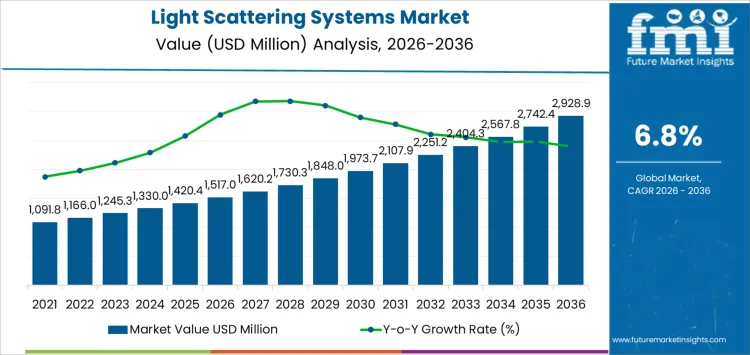
Light Scattering Systems Market Key Takeaways
| Metric | Value |
|---|---|
| Market Value (2026) | USD 1,517.0 million |
| Market Forecast Value (2036) | USD 2,928.9 million |
| Forecast CAGR 2026 to 2036 | 6.8% |
Why is the Demand for Light Scattering Systems Growing?
Demand for light scattering systems is rising as research laboratories and industrial quality control operations require precise particle characterization across a wide range of applications, from pharmaceuticals to nanomaterials. These systems measure particle size distributions and molecular interactions by analyzing how particles scatter a beam of light, which provides data critical to formulation stability, suspension uniformity, and product performance. Scientists in colloid chemistry, biotechnology, and materials science specify instruments with high sensitivity, flexible measurement ranges, and robust data analysis software to support method development and reproducibility. Procurement teams evaluate detector performance, ease of calibration, and service support because consistent measurement quality affects experimental validity and compliance with internal standards.
Expansion of advanced materials research, biologic drug development, and environmental monitoring reinforces uptake of light scattering systems that align with evolving analytical demands. Manufacturers require dependable measurement tools to ensure consistency in nanoparticle-based products and complex emulsions, where slight variations in size can influence efficacy or safety. Academic and industrial users integrate these instruments into multi-technique workflows that include microscopy, chromatography, and spectroscopy to build comprehensive characterization profiles. Technical improvements in laser stability, detector arrays, and software automation reduce user training time and enhance throughput in high-volume testing environments.
Demand concentration remains anchored in biopharmaceutical development, advanced materials research, and quality control functions where particle size distribution, aggregation behavior, and molecular weight data influence formulation decisions and compliance outcomes. These application-driven performance and operational readiness factors are contributing to sustained demand growth in the light scattering systems market.
How Is the Light Scattering Systems Industry Segmented by Offerings, Applications, and End User?
Demand for light scattering systems is shaped by characterization accuracy requirements, regulatory expectations, and expanding use of nanoscale materials. Laboratories prioritize reproducible particle sizing, molecular weight determination, and aggregation detection across development and production stages. Adoption reflects growth in biologics, advanced materials, and quality-by-design practices. Selection decisions emphasize measurement sensitivity, data interpretation reliability, and workflow integration. Segmentation clarifies how system configuration, analytical purpose, and organizational setting influence utilization patterns across scientific and industrial environments.
Which Offering Category Accounts for the Largest Share of Light Scattering System Adoption?
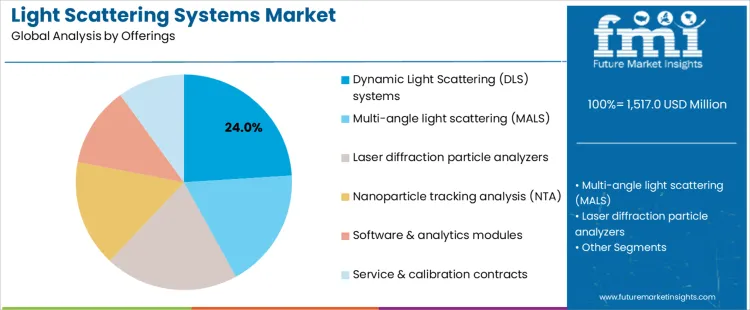
Dynamic light scattering systems represent 24.0%, reflecting routine use for rapid particle size and aggregation assessment. These systems integrate easily into formulation and stability workflows with minimal sample preparation. Laser diffraction particle analyzers at 20.0% support broader size range analysis for powders and dispersions. Multi-angle light scattering at 18.0% enables absolute molecular weight determination for complex macromolecules. Nanoparticle tracking analysis at 16.0% provides particle-by-particle visualization for heterogenous samples. Software modules at 12.0% and service contracts at 10.0% support data integrity and uptime. Offering-based segmentation shows preference for versatile platforms supported by analytics and lifecycle services.
Key Points
- DLS systems support rapid, routine particle analysis.
- Laser diffraction and MALS address complementary size and weight needs.
- Software and services enhance reliability and continuity.
How Do Analytical Applications Shape Demand for Light Scattering Systems?
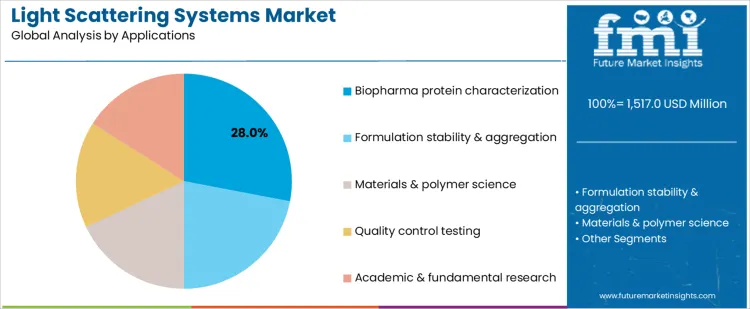
Biopharma protein characterization accounts for 28.0%, driven by need to monitor size distribution and aggregation during development. Formulation stability and aggregation studies at 22.0% rely on sensitive detection to ensure shelf-life performance. Materials and polymer science at 18.0% applies scattering techniques to understand structure and dispersion behavior. Quality control testing at 16.0% focuses on batch consistency and specification compliance. Academic and fundamental research at 16.0% explores method development and novel materials. Application-based segmentation highlights stronger adoption where molecular insight directly supports product performance and regulatory assurance.
Key Points
- Biopharma uses scattering to manage aggregation risk.
- Stability studies depend on sensitive size detection.
- Research expands methodological and material understanding.
Which End User Groups Drive Utilization of Light Scattering Systems?
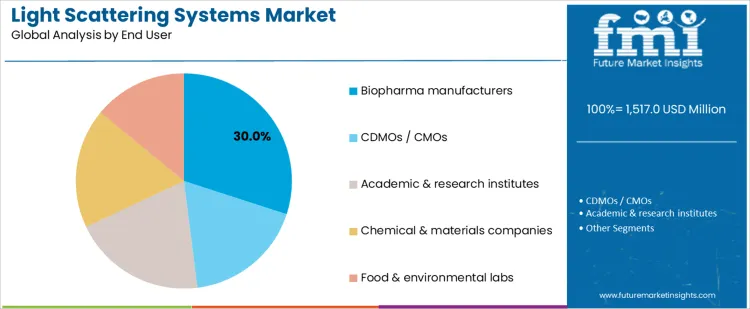
Biopharma manufacturers account for 30.0%, reflecting integration of scattering tools into development, scale-up, and release testing. Academic and research institutes at 20.0% support discovery and method innovation. CDMOs and CMOs at 18.0% require flexible platforms serving multiple client programs. Chemical and materials companies at 18.0% apply systems for formulation and process control. Food and environmental laboratories at 14.0% use scattering for quality and compliance testing. End-user segmentation indicates concentration where analytical rigor, throughput, and regulatory alignment determine system deployment.
Key Points
- Biopharma manufacturers integrate systems across lifecycle stages.
- CDMOs require adaptable, multi-application platforms.
- Research institutions drive innovation and method validation.
What are the Key Dynamics in the Light Scattering Systems Market?
Demand for light scattering systems reflects analytical requirements to measure particle size, molecular weight, and structural properties in liquids and dispersions. Adoption concentrates in pharmaceuticals, biotechnology, chemicals, food processing, and academic research laboratories. Global scope aligns with quality control, formulation development, and regulatory characterization needs. Usage centers on dynamic and static light scattering instruments integrated into laboratory and process analysis workflows for precise particle and macromolecule evaluation.
How do material characterization requirements and formulation control shape adoption?
Industries handling complex dispersions require accurate insight into particle behavior to ensure stability and performance. Demand increases where formulation outcomes depend on tight control of particle size distribution and aggregation state. Pharmaceutical developers rely on light scattering to characterize biologics, liposomes, and nanoparticles during development and release testing. Chemical manufacturers use systems to monitor polymerization and colloidal stability. Food and beverage applications apply scattering analysis to emulsions and suspensions affecting texture and shelf life. Non-destructive measurement and minimal sample preparation support routine laboratory use. Integration with automated sampling enhances throughput. Adoption reflects reliance on quantitative, reproducible characterization to support product consistency and regulatory documentation.
How do instrument complexity, data interpretation, and cost exposure influence market scalability?
Light scattering systems require precise optical alignment and calibration, increasing technical support needs. Demand sensitivity rises where sample properties such as polydispersity or opacity complicate measurement accuracy. Data interpretation depends on theoretical models that require trained users to avoid misrepresentation. High capital cost limits adoption in low-throughput laboratories. Maintenance of lasers and detectors adds lifecycle expense. Compatibility issues arise when integrating with existing laboratory information systems. Method standardization varies across industries, affecting comparability. Scalability remains constrained by skill requirements, application-specific limitations, and investment justification tied to analytical criticality.
How Is Demand for Light Scattering Systems Evolving Globally?
Demand for light scattering systems is expanding globally as particle characterization, molecular analysis, and quality control requirements intensify across life sciences and advanced materials. Pharmaceutical formulation, biologics development, nanomaterials, and polymer research rely on precise particle size and distribution measurement. Automation, data reproducibility, and regulatory validation support wider deployment in regulated laboratories. Academic research and industrial R&D funding influence adoption depth. Growth rates in India at 9.3%, Brazil at 8.8%, China at 8.3%, the USA at 5.3%, and Germany at 5.2% indicate sustained expansion driven by analytical rigor, biopharmaceutical workflows, and materials research intensity rather than basic laboratory capacity growth.
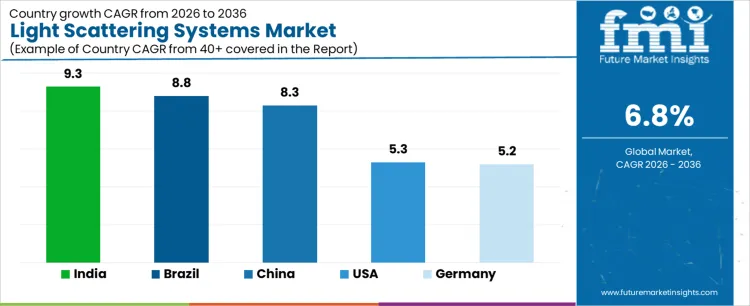
| Country | CAGR (%) |
|---|---|
| India | 9.3% |
| Brazil | 8.8% |
| China | 8.3% |
| USA | 5.3% |
| Germany | 5.2% |
What Is Driving Rapid Growth of Light Scattering System Demand in India?
Demand for light scattering systems in India is growing at a CAGR of 9.3%, supported by expansion of pharmaceutical R&D and biosimilar development. Contract research organizations increase particle analysis to support formulation stability and bioavailability studies. Academic institutes adopt dynamic and static light scattering for protein and polymer research. Regulatory scrutiny on particle size distribution strengthens quality control adoption. Domestic distributors improve service coverage and instrument accessibility. Growth reflects research intensity, compliance-driven testing, and laboratory modernization rather than routine analytical replacement cycles.
- Expansion of pharmaceutical and biosimilar research
- Increased CRO-based formulation testing activity
- Regulatory focus on particle characterization
- Improved domestic service and distribution reach
Why Is Brazil Showing Strong Momentum in Light Scattering System Adoption?
Light scattering system demand in Brazil is expanding at a CAGR of 8.8%, driven by growth in biopharmaceutical research and materials science. Public research institutes and universities invest in advanced analytical platforms. Pharmaceutical manufacturers require particle analysis for injectables and suspensions. Government-backed research funding supports laboratory instrumentation upgrades. Regional laboratories extend analytical services to industrial clients. Growth reflects institutional investment and applied research needs rather than broad laboratory automation.
- Investment in public research laboratories
- Injectable and suspension formulation analysis
- Government-backed scientific funding programs
- Expansion of regional analytical service providers
How Is China Sustaining Growth in Light Scattering System Utilization?
Demand for light scattering systems in China is growing at a CAGR of 8.3%, aligned with large-scale biopharmaceutical manufacturing and advanced materials research. Domestic drug developers integrate particle characterization within development pipelines. Nanomaterials and specialty polymer industries increase reliance on scattering techniques. National research programs fund laboratory instrumentation at universities. Domestic instrument manufacturing improves affordability. Growth reflects scale-driven adoption and research prioritization rather than exploratory academic usage alone.
- Biopharmaceutical pipeline analytical integration
- Nanomaterials and polymer research expansion
- National laboratory funding initiatives
- Improved affordability from domestic manufacturers
What Factors Are Supporting Light Scattering System Demand in United States?
Light scattering system demand in the United States is expanding at a CAGR of 5.3%, supported by mature biopharmaceutical and materials research ecosystems. Advanced laboratories use scattering techniques for protein aggregation and nanoparticle analysis. Replacement demand arises from technology upgrades and throughput improvements. Strong regulatory expectations reinforce validated analytical methods. Contract research and manufacturing organizations sustain baseline demand. Growth reflects technology refresh cycles and application refinement rather than rapid expansion of laboratory numbers.
- Protein aggregation and nanoparticle analysis needs
- Technology refresh and throughput upgrades
- Regulatory validation of analytical methods
- Stable CRO and CDMO analytical demand
Why Is Germany Experiencing Steady Expansion in Light Scattering Systems?
Light scattering system demand in Germany is growing at a CAGR of 5.2%, shaped by precision engineering, pharmaceuticals, and materials science research. Industrial laboratories apply scattering methods for quality assurance and product development. Academic institutions maintain strong adoption for polymer and colloid studies. Emphasis on measurement accuracy and standards compliance supports sustained use. Procurement discipline moderates growth pace. Expansion reflects structured research investment and analytical rigor rather than aggressive laboratory capacity scaling.
- Industrial quality assurance applications
- Strong academic polymer research base
- Emphasis on measurement accuracy standards
- Disciplined capital equipment procurement
What is the competitive landscape of demand for the light scattering systems market globally?
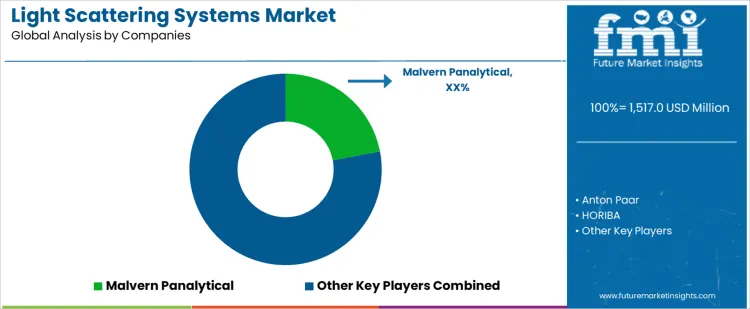
Demand for light scattering systems is driven by particle characterization needs across pharmaceuticals, chemicals, polymers, and biotechnology research. Laboratory users evaluate measurement accuracy, particle size range coverage, repeatability, sensitivity to low concentrations, and compatibility with different sample types. Buyer assessment includes software robustness, data interpretation reliability, regulatory compliance suitability, and integration with existing analytical workflows. Procurement behavior favors suppliers offering validated methodologies, strong application support, and global service infrastructure. Purchasing decisions emphasize long-term instrument stability, ease of operation, and confidence in data for quality control and research applications. Trend in the light scattering systems market reflects increased use in biologics characterization and advanced materials development.
Malvern Panalytical leads competitive positioning through a broad portfolio of laser diffraction and dynamic light scattering systems widely adopted in industrial and research laboratories. Anton Paar competes with precision measurement instruments emphasizing robustness, automation, and reproducibility for complex samples. HORIBA supports demand with versatile light scattering platforms integrated within broader analytical instrumentation portfolios. Wyatt Technology maintains relevance through specialized multi-angle light scattering systems critical for macromolecular and protein analysis. Beckman Coulter participates by supplying particle characterization systems aligned with regulated laboratory environments. Competitive differentiation centers on measurement precision, application breadth, software capability, and depth of technical and service support.
Key Players in the Light Scattering Systems Market
- Malvern Panalytical
- Anton Paar
- HORIBA
- Wyatt Technology
- Beckman Coulter
- Others
Scope of the Report
| Items | Values |
|---|---|
| Quantitative Units | USD million |
| Offerings | Dynamic Light Scattering (DLS) systems; Multi-angle light scattering (MALS); Laser diffraction particle analyzers; Nanoparticle tracking analysis (NTA); Software & analytics modules; Service & calibration contracts |
| Applications | Biopharma protein characterization; Formulation stability & aggregation; Materials & polymer science; Quality control testing; Academic & fundamental research |
| End User | Biopharma manufacturers; CDMOs / CMOs; Academic & research institutes; Chemical & materials companies; Food & environmental labs |
| Regions Covered | Asia Pacific, Europe, North America, Latin America, Middle East & Africa |
| Countries Covered | India, Brazil, China, USA, Germany, and 40+ countries |
| Key Companies Profiled | Malvern Panalytical; Anton Paar; HORIBA; Wyatt Technology; Beckman Coulter; Others |
| Additional Attributes | Dollar sales by offering, application, and end user; particle size, molecular weight, and aggregation sensitivity across DLS, MALS, laser diffraction, and NTA platforms; role of software analytics in data interpretation, repeatability, and compliance; adoption driven by biopharma formulation stability studies and QC workflows; service and calibration requirements influencing lifecycle cost; procurement dynamics shaped by research funding, CDMO expansion, and biopharma manufacturing scale-up. |
Light Scattering Systems Market by Segment
Offerings:
- Dynamic Light Scattering (DLS) systems
- Multi-angle light scattering (MALS)
- Laser diffraction particle analyzers
- Nanoparticle tracking analysis (NTA)
- Software & analytics modules
- Service & calibration contracts
Applications:
- Biopharma protein characterization
- Formulation stability & aggregation
- Materials & polymer science
- Quality control testing
- Academic & fundamental research
End User:
- Biopharma manufacturers
- CDMOs / CMOs
- Academic & research institutes
- Chemical & materials companies
- Food & environmental labs
Region:
- Asia Pacific
- China
- Japan
- South Korea
- India
- Australia & New Zealand
- ASEAN
- Rest of Asia Pacific
- Europe
- Germany
- United Kingdom
- France
- Italy
- Spain
- Nordic
- BENELUX
- Rest of Europe
- North America
- United States
- Canada
- Mexico
- Latin America
- Brazil
- Chile
- Rest of Latin America
- Middle East & Africa
- Kingdom of Saudi Arabia
- Other GCC Countries
- Turkey
- South Africa
- Other African Union
- Rest of Middle East & Africa
Bibliography
- International Organization for Standardization. (2023). ISO 22412: Particle size analysis—Dynamic light scattering (DLS). ISO.
- International Organization for Standardization. (2024). ISO 13320: Particle size analysis—Laser diffraction methods. ISO.
- United States Pharmacopeial Convention. (2023). USP–NF General Chapter <429>: Light scattering methods for particle size determination. USP.
- European Medicines Agency. (2023). Guideline on quality, non-clinical and clinical aspects of nanomedicines. EMA.
- U.S. Food and Drug Administration. (2024). Drug products, including biological products, that contain nanomaterials: Guidance for industry. U.S. Department of Health and Human Services.
- International Council for Harmonisation. (2024). ICH Q14: Analytical procedure development. ICH.
Frequently Asked Questions
How big is the light scattering systems market in 2026?
The global light scattering systems market is estimated to be valued at USD 1,517.0 million in 2026.
What will be the size of light scattering systems market in 2036?
The market size for the light scattering systems market is projected to reach USD 2,928.9 million by 2036.
How much will be the light scattering systems market growth between 2026 and 2036?
The light scattering systems market is expected to grow at a 6.8% CAGR between 2026 and 2036.
What are the key product types in the light scattering systems market?
The key product types in light scattering systems market are dynamic light scattering (dls) systems, multi-angle light scattering (mals), laser diffraction particle analyzers, nanoparticle tracking analysis (nta), software & analytics modules and service & calibration contracts.
Which applications segment to contribute significant share in the light scattering systems market in 2026?
In terms of applications, biopharma protein characterization segment to command 28.0% share in the light scattering systems market in 2026.
Preview the report firsthand - request a free sample
Get SampleGet the brochure for pricing and purchase details.
Get PDFTable of Content
- Executive Summary
- Global Market Outlook
- Demand-side Trends
- Supply-side Trends
- Technology Roadmap Analysis
- Analysis and Recommendations
- Market Overview
- Market Coverage / Taxonomy
- Market Definition / Scope / Limitations
- Market Background
- Market Dynamics
- Drivers
- Restraints
- Opportunity
- Trends
- Scenario Forecast
- Demand in Optimistic Scenario
- Demand in Likely Scenario
- Demand in Conservative Scenario
- Opportunity Map Analysis
- Product Life Cycle Analysis
- Supply Chain Analysis
- Investment Feasibility Matrix
- Value Chain Analysis
- PESTLE and Porter’s Analysis
- Regulatory Landscape
- Regional Parent Market Outlook
- Production and Consumption Statistics
- Import and Export Statistics
- Market Dynamics
- Global Market Analysis 2021 to 2025 and Forecast, 2026 to 2036
- Historical Market Size Value (USD Million) Analysis, 2021 to 2025
- Current and Future Market Size Value (USD Million) Projections, 2026 to 2036
- Y-o-Y Growth Trend Analysis
- Absolute $ Opportunity Analysis
- Global Market Pricing Analysis 2021 to 2025 and Forecast 2026 to 2036
- Global Market Analysis 2021 to 2025 and Forecast 2026 to 2036, By Offerings
- Introduction / Key Findings
- Historical Market Size Value (USD Million) Analysis By Offerings , 2021 to 2025
- Current and Future Market Size Value (USD Million) Analysis and Forecast By Offerings , 2026 to 2036
- Dynamic Light Scattering (DLS) systems
- Multi-angle light scattering (MALS)
- Laser diffraction particle analyzers
- Nanoparticle tracking analysis (NTA)
- Software & analytics modules
- Service & calibration contracts
- Dynamic Light Scattering (DLS) systems
- Y-o-Y Growth Trend Analysis By Offerings , 2021 to 2025
- Absolute $ Opportunity Analysis By Offerings , 2026 to 2036
- Global Market Analysis 2021 to 2025 and Forecast 2026 to 2036, By Applications
- Introduction / Key Findings
- Historical Market Size Value (USD Million) Analysis By Applications, 2021 to 2025
- Current and Future Market Size Value (USD Million) Analysis and Forecast By Applications, 2026 to 2036
- Biopharma protein characterization
- Formulation stability & aggregation
- Materials & polymer science
- Quality control testing
- Academic & fundamental research
- Biopharma protein characterization
- Y-o-Y Growth Trend Analysis By Applications, 2021 to 2025
- Absolute $ Opportunity Analysis By Applications, 2026 to 2036
- Global Market Analysis 2021 to 2025 and Forecast 2026 to 2036, By End User
- Introduction / Key Findings
- Historical Market Size Value (USD Million) Analysis By End User, 2021 to 2025
- Current and Future Market Size Value (USD Million) Analysis and Forecast By End User, 2026 to 2036
- Biopharma manufacturers
- CDMOs / CMOs
- Academic & research institutes
- Chemical & materials companies
- Food & environmental labs
- Biopharma manufacturers
- Y-o-Y Growth Trend Analysis By End User, 2021 to 2025
- Absolute $ Opportunity Analysis By End User, 2026 to 2036
- Global Market Analysis 2021 to 2025 and Forecast 2026 to 2036, By Region
- Introduction
- Historical Market Size Value (USD Million) Analysis By Region, 2021 to 2025
- Current Market Size Value (USD Million) Analysis and Forecast By Region, 2026 to 2036
- North America
- Latin America
- Western Europe
- Eastern Europe
- East Asia
- South Asia and Pacific
- Middle East & Africa
- Market Attractiveness Analysis By Region
- North America Market Analysis 2021 to 2025 and Forecast 2026 to 2036, By Country
- Historical Market Size Value (USD Million) Trend Analysis By Market Taxonomy, 2021 to 2025
- Market Size Value (USD Million) Forecast By Market Taxonomy, 2026 to 2036
- By Country
- USA
- Canada
- Mexico
- By Offerings
- By Applications
- By End User
- By Country
- Market Attractiveness Analysis
- By Country
- By Offerings
- By Applications
- By End User
- Key Takeaways
- Latin America Market Analysis 2021 to 2025 and Forecast 2026 to 2036, By Country
- Historical Market Size Value (USD Million) Trend Analysis By Market Taxonomy, 2021 to 2025
- Market Size Value (USD Million) Forecast By Market Taxonomy, 2026 to 2036
- By Country
- Brazil
- Chile
- Rest of Latin America
- By Offerings
- By Applications
- By End User
- By Country
- Market Attractiveness Analysis
- By Country
- By Offerings
- By Applications
- By End User
- Key Takeaways
- Western Europe Market Analysis 2021 to 2025 and Forecast 2026 to 2036, By Country
- Historical Market Size Value (USD Million) Trend Analysis By Market Taxonomy, 2021 to 2025
- Market Size Value (USD Million) Forecast By Market Taxonomy, 2026 to 2036
- By Country
- Germany
- UK
- Italy
- Spain
- France
- Nordic
- BENELUX
- Rest of Western Europe
- By Offerings
- By Applications
- By End User
- By Country
- Market Attractiveness Analysis
- By Country
- By Offerings
- By Applications
- By End User
- Key Takeaways
- Eastern Europe Market Analysis 2021 to 2025 and Forecast 2026 to 2036, By Country
- Historical Market Size Value (USD Million) Trend Analysis By Market Taxonomy, 2021 to 2025
- Market Size Value (USD Million) Forecast By Market Taxonomy, 2026 to 2036
- By Country
- Russia
- Poland
- Hungary
- Balkan & Baltic
- Rest of Eastern Europe
- By Offerings
- By Applications
- By End User
- By Country
- Market Attractiveness Analysis
- By Country
- By Offerings
- By Applications
- By End User
- Key Takeaways
- East Asia Market Analysis 2021 to 2025 and Forecast 2026 to 2036, By Country
- Historical Market Size Value (USD Million) Trend Analysis By Market Taxonomy, 2021 to 2025
- Market Size Value (USD Million) Forecast By Market Taxonomy, 2026 to 2036
- By Country
- China
- Japan
- South Korea
- By Offerings
- By Applications
- By End User
- By Country
- Market Attractiveness Analysis
- By Country
- By Offerings
- By Applications
- By End User
- Key Takeaways
- South Asia and Pacific Market Analysis 2021 to 2025 and Forecast 2026 to 2036, By Country
- Historical Market Size Value (USD Million) Trend Analysis By Market Taxonomy, 2021 to 2025
- Market Size Value (USD Million) Forecast By Market Taxonomy, 2026 to 2036
- By Country
- India
- ASEAN
- Australia & New Zealand
- Rest of South Asia and Pacific
- By Offerings
- By Applications
- By End User
- By Country
- Market Attractiveness Analysis
- By Country
- By Offerings
- By Applications
- By End User
- Key Takeaways
- Middle East & Africa Market Analysis 2021 to 2025 and Forecast 2026 to 2036, By Country
- Historical Market Size Value (USD Million) Trend Analysis By Market Taxonomy, 2021 to 2025
- Market Size Value (USD Million) Forecast By Market Taxonomy, 2026 to 2036
- By Country
- Kingdom of Saudi Arabia
- Other GCC Countries
- Turkiye
- South Africa
- Other African Union
- Rest of Middle East & Africa
- By Offerings
- By Applications
- By End User
- By Country
- Market Attractiveness Analysis
- By Country
- By Offerings
- By Applications
- By End User
- Key Takeaways
- Key Countries Market Analysis
- USA
- Pricing Analysis
- Market Share Analysis, 2025
- By Offerings
- By Applications
- By End User
- Canada
- Pricing Analysis
- Market Share Analysis, 2025
- By Offerings
- By Applications
- By End User
- Mexico
- Pricing Analysis
- Market Share Analysis, 2025
- By Offerings
- By Applications
- By End User
- Brazil
- Pricing Analysis
- Market Share Analysis, 2025
- By Offerings
- By Applications
- By End User
- Chile
- Pricing Analysis
- Market Share Analysis, 2025
- By Offerings
- By Applications
- By End User
- Germany
- Pricing Analysis
- Market Share Analysis, 2025
- By Offerings
- By Applications
- By End User
- UK
- Pricing Analysis
- Market Share Analysis, 2025
- By Offerings
- By Applications
- By End User
- Italy
- Pricing Analysis
- Market Share Analysis, 2025
- By Offerings
- By Applications
- By End User
- Spain
- Pricing Analysis
- Market Share Analysis, 2025
- By Offerings
- By Applications
- By End User
- France
- Pricing Analysis
- Market Share Analysis, 2025
- By Offerings
- By Applications
- By End User
- India
- Pricing Analysis
- Market Share Analysis, 2025
- By Offerings
- By Applications
- By End User
- ASEAN
- Pricing Analysis
- Market Share Analysis, 2025
- By Offerings
- By Applications
- By End User
- Australia & New Zealand
- Pricing Analysis
- Market Share Analysis, 2025
- By Offerings
- By Applications
- By End User
- China
- Pricing Analysis
- Market Share Analysis, 2025
- By Offerings
- By Applications
- By End User
- Japan
- Pricing Analysis
- Market Share Analysis, 2025
- By Offerings
- By Applications
- By End User
- South Korea
- Pricing Analysis
- Market Share Analysis, 2025
- By Offerings
- By Applications
- By End User
- Russia
- Pricing Analysis
- Market Share Analysis, 2025
- By Offerings
- By Applications
- By End User
- Poland
- Pricing Analysis
- Market Share Analysis, 2025
- By Offerings
- By Applications
- By End User
- Hungary
- Pricing Analysis
- Market Share Analysis, 2025
- By Offerings
- By Applications
- By End User
- Kingdom of Saudi Arabia
- Pricing Analysis
- Market Share Analysis, 2025
- By Offerings
- By Applications
- By End User
- Turkiye
- Pricing Analysis
- Market Share Analysis, 2025
- By Offerings
- By Applications
- By End User
- South Africa
- Pricing Analysis
- Market Share Analysis, 2025
- By Offerings
- By Applications
- By End User
- USA
- Market Structure Analysis
- Competition Dashboard
- Competition Benchmarking
- Market Share Analysis of Top Players
- By Regional
- By Offerings
- By Applications
- By End User
- Competition Analysis
- Competition Deep Dive
- Malvern Panalytical
- Overview
- Product Portfolio
- Profitability by Market Segments (Product/Age /Sales Channel/Region)
- Sales Footprint
- Strategy Overview
- Marketing Strategy
- Product Strategy
- Channel Strategy
- Anton Paar
- HORIBA
- Wyatt Technology
- Beckman Coulter
- Others
- Malvern Panalytical
- Competition Deep Dive
- Assumptions & Acronyms Used
- Research Methodology


