

- Market Size (2026)
- USD 52 Mn
- Forecast (2036)
- USD 100.4 Mn
- CAGR (2026 to 2036)
- 6.8%
On-Line Weld Seam Quality Monitoring Test Systems for Steel Pipelines Market Size, Forecast and Outlook By FMI
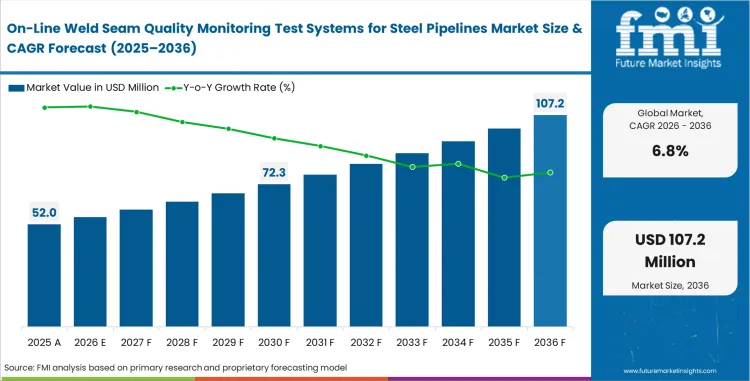
The on-line weld seam quality monitoring test systems for steel pipelines market was valued at USD 48.7 million in 2025. FMI estimates the industry will reach USD 52.0 million in 2026 and expand at a 6.80% CAGR from 2026 to 2036. Market valuation is projected to reach USD 100.4 million by 2036 as manufacturers move seam quality control closer to the weld point and reduce reliance on delayed end-of-line review.
Summary of On-Line Weld Seam Quality Monitoring Test Systems for Steel Pipelines Market
- On-Line Weld Seam Quality Monitoring Test Systems for Steel Pipelines Market Snapshot
- The on-line weld seam quality monitoring test systems for steel pipelines market is valued at USD 48.7 million in 2025 and is projected to reach USD 100.4 million by 2036.
- The industry is expected to expand at a 6.80% CAGR from 2026 to 2036, creating an incremental opportunity of USD 48.4 million.
- This is a specification-led inspection niche where buying decisions depend on seam visibility, mill compatibility, and traceable quality evidence tied to pipeline integrity requirements.
- On-Line Weld Seam Quality Monitoring Test Systems for Steel Pipelines Market Demand and Growth Drivers
- Demand is rising because mills can correct weld issues at lower cost when detection happens near the weld point instead of after end-stage rejection.
- Ultrasonic and radiographic systems remain relevant because buyers compare flaw-detection depth with inline response speed.
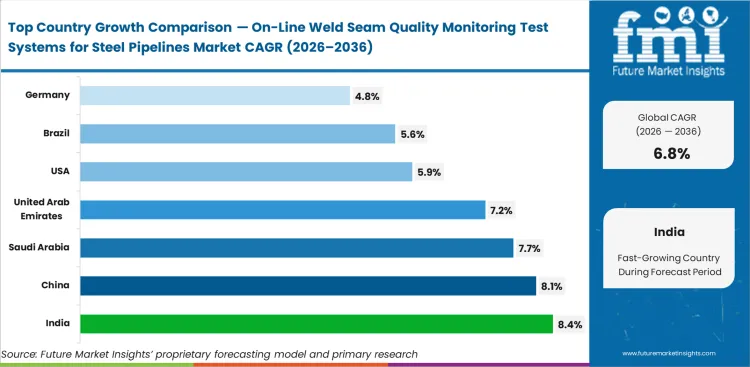
- India leads at 8.4% CAGR, followed by China at 8.1%, Saudi Arabia at 7.7%, the United Arab Emirates at 7.2%, the United States at 5.9%, Brazil at 5.6%, and Germany at 4.8%.
- Growth remains measured because purchases often follow retrofit windows, mixed project schedules, and the need to fit new logic into older control layouts.
- On-Line Weld Seam Quality Monitoring Test Systems for Steel Pipelines Market Product and Segment View
- The market covers inline optical, ultrasonic, radiographic, and thermal seam-monitoring systems used on welded steel pipeline lines, with digital radiography helping buyers compare image-led and live-process inspection routes.
- Laser vision leads inspection technology with 32.0% share in 2026 because mills value immediate seam and bead feedback during production.
- ERW leads mill type with 34.0% share in 2026 since its installed base creates the broadest recurring need for inline seam control.
- Inline fixed systems lead installation mode with 43.0% share in 2026 because they give fast weld feedback without extra scanner movement on every pipe pass.
- Defect detection leads monitoring objective with 29.0% share in 2026 as mills still justify spending first on reject prevention and acceptance confidence.
- The 16-48 inch band leads pipe diameter with 36.0% share in 2026 because it sits across many commercially important pipeline programs.
- Oil & gas leads end use with 38.0% share in 2026 where seam acceptance carries heavier commercial and service risk.
- MES/SCADA leads software integration with 31.0% share in 2026 because users want seam alerts and production context in one view.
- On-Line Weld Seam Quality Monitoring Test Systems for Steel Pipelines Market Geography and Competitive Outlook
- India, China, Saudi Arabia, and the United Arab Emirates form the faster-growth group, while the United States stays a stable high-value base for upgrades.
- Competition remains fragmented, with suppliers spread across optical, ultrasonic, and hybrid inspection systems.
- Scope includes inline seam monitoring, seam tracking, weld bead review, HAZ-oriented process control, and quality-history generation for steel pipeline mills, while excluding handheld NDT, in-service inspection pigs, and plantwide software sold without a seam-test focus.
Key Takeaways, Market Size, and Forecast
- On-Line Weld Seam Quality Monitoring Test Systems for Steel Pipelines Market is projected to grow from USD 52.0 million in 2026 to USD 100.4 million by 2036, at a CAGR of 6.8%.
- The on-line weld seam quality monitoring test systems for steel pipelines market was valued at USD 48.7 million in 2025.
- By 2036, the On-Line Weld Seam Quality Monitoring Test Systems for Steel Pipelines Market is expected to be worth USD 100.4 million.
- From 2026 to 2036, the market is projected to expand at a CAGR of 6.8%.
- The market is projected to create an incremental opportunity of USD 48.4 million between 2026 and 2036.
- In 2026, Laser vision is expected to account for 32.0% of the inspection technology segment.
- India (8.4%) and China (8.1%) are two of the fastest growing markets.
Manufacturers are shifting weld seam control from a final checkpoint to a live production function because delayed detection increases scrap, rework, and acceptance risk. End-stage review raises rework risk when bead profile, strip alignment, or heat-affected zone condition moves outside tolerance and gets detected too late. Production performance in steel pipes and large diameter pipes depends on output consistency as much as installed mill capacity, which keeps in-line seam visibility commercially important. Adoption often begins with a workflow decision, because mills first need inspection data to fit daily operating routines before approving new equipment. Once seam visibility, alarm logic, and traceable quality records operate within one routine, the case for investment becomes easier to support.
Adoption also improves when seam inspection data moves directly from the monitoring station into daily line decisions without manual reconciliation. Manufacturers are more willing to adopt these systems when weld alarms, bead review, and pass-fail signals work together in one inspection setup. After that point, system upgrades fit more naturally into standard mill quality practice and are less likely to be treated as isolated capital spending.
India is expected to grow at an 8.4% CAGR during 2026 to 2036 as gas-grid expansion keeps welded line-pipe quality under tighter review. China is likely to register 8.1% CAGR over the same period, supported by large pipe-mill capacity and broad exposure to transmission work. Saudi Arabia is projected to expand at 7.7%, while the United Arab Emirates is expected to rise at 7.2%, helped by export-linked mill activity tied to long-haul pipeline projects. Demand in the United States is forecast to increase at 5.9%, Brazil at 5.6%, and Germany at 4.8% during 2026 to 2036. Growth patterns across gas pipeline infrastructure, oil pipeline infrastructure, and pipeline monitoring still show a clear divide, with faster-growth markets adding new line exposure while mature markets focus more on replacement, compliance, and selective upgrades.
Segmental Analysis
On-Line Weld Seam Quality Monitoring Test Systems for Steel Pipelines Market Analysis by Inspection Technology
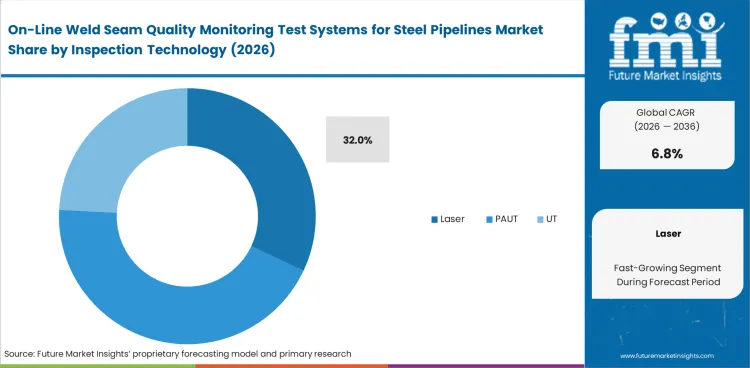
Inspection technology choice in this market starts with how quickly a mill needs usable weld feedback during production. Laser vision stays ahead because seam profile, bead condition, and visible surface irregularities can be reviewed before flawed output moves too far down the line. Mills working with changing strip alignment, scarf behavior, or unstable line conditions place high value on that immediacy. In 2026, laser vision is expected to account for 32.0% share of the inspection-technology segment. Depth limits still matter, since visual systems do not replace methods used for internal flaw confirmation or coded acceptance. Segment value therefore depends less on image clarity alone and more on whether surface visibility improves decision speed without leaving hidden weld risk unresolved.
- Surface visibility: Laser-based inspection suits mills that need seam conditions in view while weld behavior is still changing on the line.
- Faster response: Real-time visual feedback helps operators correct settings earlier and reduce avoidable scrap before final acceptance review begins.
- Internal flaw check: Ultrasonic and radiographic methods still matter where subsurface confirmation carries more weight than surface geometry alone.
On-Line Weld Seam Quality Monitoring Test Systems for Steel Pipelines Market Analysis by Mill Type
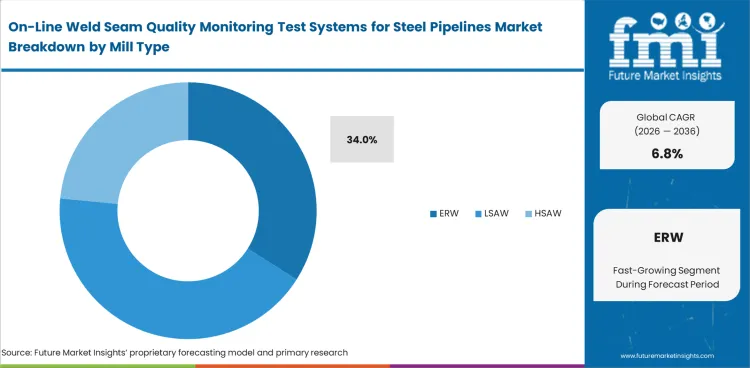
Mill-type demand follows installed-base realities more than technical preference alone. ERW lines generate the broadest recurring need for inspection because seam monitoring, heat-affected-zone review, and bead control sit close to day-to-day line stability. Inspection demand also repeats more consistently here than in formats linked to large project cycles or episodic capital spending. ERW is projected to account for 34.0% of mill-type share in 2026, reflecting how widely this mill format is used across regular welded-pipe production. LSAW and HSAW still require robust coverage, though buying decisions there are more often delayed by project timing and approval complexity. ERW leads because it creates repeat inspection demand across routine production, not just because weld criticality is high in selected applications.
- Installed-base breadth: ERW lines create recurring inspection demand because many mills need steady seam control across routine production runs.
- Project-linked spending: LSAW and HSAW purchases more often depend on large pipe programs and heavier capital approval cycles.
- Narrower application fit: HFI and TIG applications remain relevant, though system choice there follows tighter output mixes and lower purchase frequency.
On-Line Weld Seam Quality Monitoring Test Systems for Steel Pipelines Market Analysis by Installation Mode
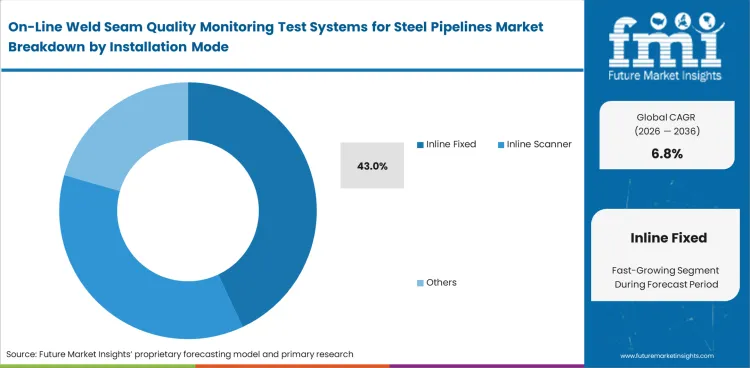
Installation mode affects how closely inspection stays connected to live weld correction. Fixed inline setups lead because they place feedback near the forming and welding zone without adding scanner movement to every pipe pass. Floor layout, line speed, and handling constraints still shape whether this arrangement works cleanly in practice. Inline fixed systems are expected to represent 43.0% of installation-mode share in 2026. Broader coverage needs can weaken that advantage where mills run across wider diameter or wall-thickness variation, since scanner-based or hybrid options offer more flexibility in such cases. Segment value is determined by whether the installation supports usable real-time intervention, not by whether the inspection station appears comprehensive after the weld cycle has already moved on.
- Live-line placement: Fixed inline systems work well where weld feedback must stay close to the active production zone.
- Coverage flexibility: Scanner-based options suit mills that need wider inspection to reach across diameter changes or more varied pipe configurations.
- Delayed correction risk: Offline review still supports confirmation, though it contributes less to correcting weld conditions during production.
On-Line Weld Seam Quality Monitoring Test Systems for Steel Pipelines Market Analysis by Monitoring Objective
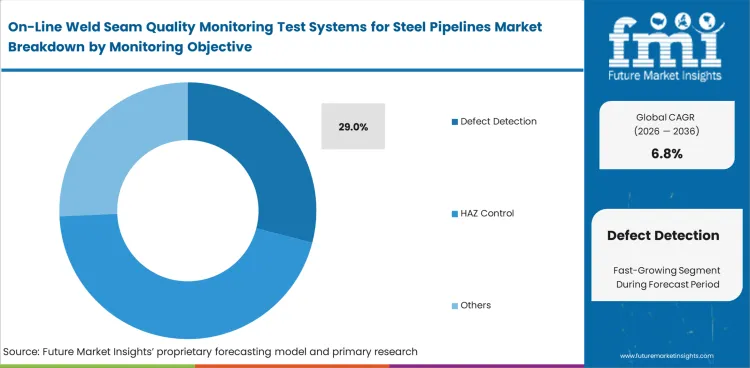
Monitoring priorities in this market are shaped by where mills feel cost pressure first. Rejection risk usually gets attention before broader process refinement because scrap, rework, delivery delays, and disputed acceptance affect daily operating results almost immediately. Defect detection is likely to secure 29.0% share within monitoring objectives in 2026 for that reason. Seam tracking, bead profiling, heat-affected-zone control, data logging, and alarm management still become more important once a line starts pushing for steadier weld discipline across changing production runs. Analytics tools add value only when teams need faster signal sorting rather than more undirected data on screen. Real segment value comes from reducing costly failure exposure first, then widening inspection usefulness into process control once baseline reliability is in place.
- Scrap reduction priority: Defect detection leads because mills can justify spending faster when it cuts scrap and disputed pipe acceptance.
- Weld-shape discipline: Bead and seam review gains importance once lines aim for steadier weld conditions across changing runs.
- Signal sorting speed: Analytics tools matter more where users need quicker defect interpretation instead of longer manual review.
On-Line Weld Seam Quality Monitoring Test Systems for Steel Pipelines Market Analysis by Pipe Diameter
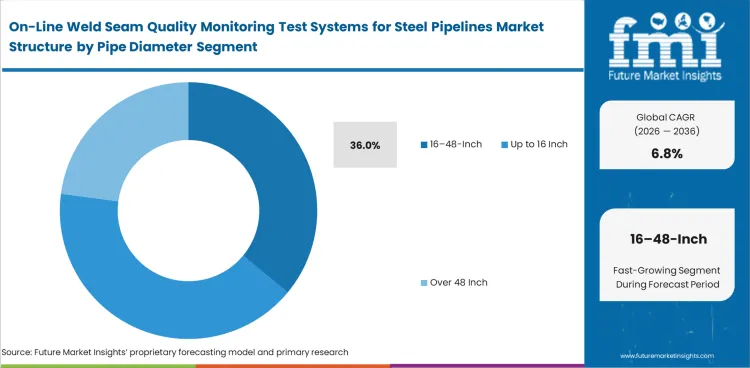
Pipe diameter changes inspection economics because exposure, throughput, and weld-assurance requirements do not stay constant across size bands. Mid-range output often creates the most commercially stable demand since mills serving several ends need consistent seam monitoring without building an excessive inspection stack for every line. Very large diameters justify stronger reviews, though buying there often rises and falls with project timing. Smaller sizes can operate with narrower setups where line economics do not support broader monitoring coverage. The 16-48-inch pipe segment is expected to hold 36.0% share in 2026. Its importance comes from higher inspection needs, as larger-diameter pipes carry greater operating and integrity risk than smaller sizes, making risk-aligned inspection more relevant than uniform inspection standards.
- Mid-range demand base: Mid-range diameters create steady inspection demand across multiple pipeline and industrial pipe programs.
- Higher-risk large sizes: Very large diameters justify deeper inspection where weld failure carries higher service and commercial risk.
- Lean smaller-size setup: Smaller sizes can work with narrower configurations when line economics do not support broader monitoring coverage.
On-Line Weld Seam Quality Monitoring Test Systems for Steel Pipelines Market Analysis by End Use
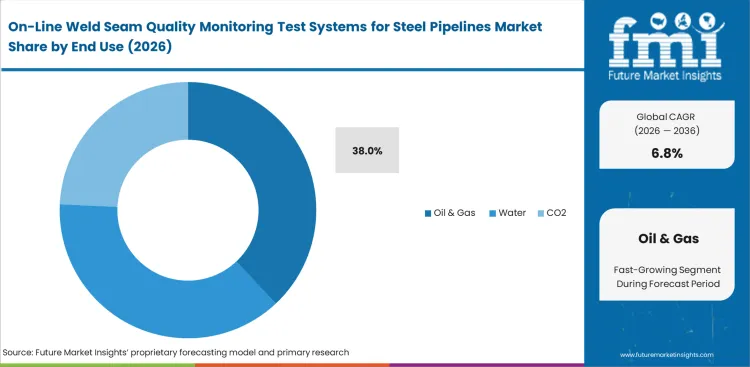
End-use demand stays anchored in transmission service because seam failure becomes far more expensive once pipe is installed and operating under pressure. Long-distance duty places greater weight on weld acceptance, traceable quality review, and predictable fabrication performance before material reaches the field. Water, CO2, slurry, and process lines still create room for system sales, especially where manufacturers want more repeatable welded output. Oil & gas infrastructure keeps inspection priorities centered on failure avoidance before installation. Oil & gas is set to account for 38.0% of end-use share in 2026 because this application places the strongest commercial value on weld assurance across long runs. Oil and gas leads because failure consequences are higher, and that gives weld assurance more budget priority than in lower-risk applications.
- Transmission-led demand: Oil and gas applications remain the strongest demand base because seam quality matters before pipe reaches service.
- Broader corridor potential: Water and CO2 corridors widen the addressable base where tighter fabrication control is becoming more important.
- Performance assurance need: Process and slurry service add demand where pipe performance and weld consistency need to stay predictable.
On-Line Weld Seam Quality Monitoring Test Systems for Steel Pipelines Market Analysis by Software Integration
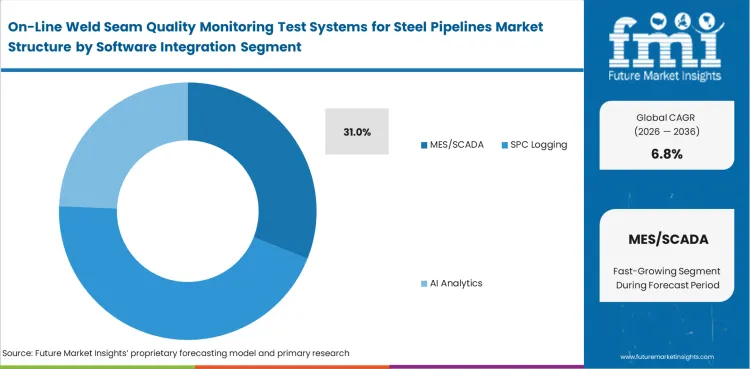
Software integration becomes commercially important once inspection data is expected to support real acceptance decisions rather than sit apart as isolated alerts. Mills want seam signals, pass-fail logic, and operating context visible in one working view, so line teams can respond without switching between disconnected systems. Stand-alone HMI, SPC logging, AI analytics, and cloud traceability remain relevant, yet broader software value weakens when core control links are not reliable. Inspection machines are increasingly judged by how well they fit existing production controls rather than by hardware output alone. MES/SCADA integration is anticipated to represent 31.0% of software-integration share in 2026 because users want alerts and production context connected inside the same operating frame. Segment value in practice depends on response usability, not on software feature count in isolation.
- Control-link integration: Integrated control connections narrow the gap between defect notice and live line response.
- Production-context visibility: Mills value software that connects seam signals with operating conditions instead of leaving them as isolated events.
- Advanced tool adoption: Analytics and cloud review gain room only after core integration works cleanly on the line.
On-Line Weld Seam Quality Monitoring Test Systems for Steel Pipelines Market Drivers, Restraints, and Opportunities
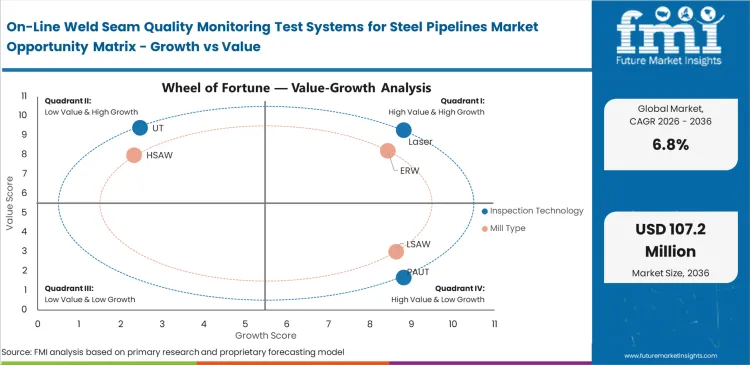
Mills are being pushed to decide whether seam quality stays at a final check or becomes part of live production control. Once pipe grades, wall thickness, and delivery commitments change within the same schedule, delayed detection becomes expensive because misalignment, bead instability, or weak seam formation can pass through several lengths before anyone intervenes. Manufacturers that move inspection closer to the weld point gain cleaner setup discipline and faster acceptance review. Pressure is strongest where pipeline pipes are sold into applications that leave little tolerance for disputed weld quality.
Installed-line habits slow adoption more than lack of interest. A mill may want better seam visibility, yet changeovers become difficult when scanners, alarms, and acceptance logic must fit existing controls without long shutdowns. Legacy equipment creates hesitation because mills want new inspection systems to work with existing controls and data structures. Partial upgrades are helping, but they can still leave a gap between live weld feedback and final quality judgment.
Opportunities in the On-Line Weld Seam Quality Monitoring Test Systems for Steel Pipelines Market
- Retrofit pathways: Pipeline safety spending favors mills that can add seam visibility without rebuilding the whole line. Manufacturers can capture this opening by offering modular stations that fit existing control layouts and shorten downtime during installation.
- Coating-linked review: Oil and Gas Pipeline Coatings often follow the same project discipline as weld acceptance. Suppliers that present seam quality and downstream surface-readiness in one workflow stand to gain better attention from pipe makers.
- Export documentation: Demand rises where mills need cleaner acceptance packages for cross-border or project-specific pipe orders. Vendors benefit when their systems produce clear pass-fail histories without adding a second manual review loop.
Regional Analysis
Based on the regional analysis, the industry is segmented into North America, Latin America, Europe, Asia Pacific, and the Middle East and Africa across 40 plus countries.
.webp "Top Country Growth Comparison On Line Weld Seam Quality Monitoring Test Systems For Steel Pipelines Market Cagr (2026 2036)")
| Country | CAGR (2026 to 2036) |
|---|---|
| India | 8.4% |
| China | 8.1% |
| Saudi Arabia | 7.7% |
| United Arab Emirates | 7.2% |
| United States | 5.9% |
| Brazil | 5.6% |
| Germany | 4.8% |
Source: Future Market Insights (FMI) analysis, based on proprietary forecasting model and primary research
North America and Latin America analysis of On-Line Weld Seam Quality Monitoring Test Systems for Steel Pipelines Market
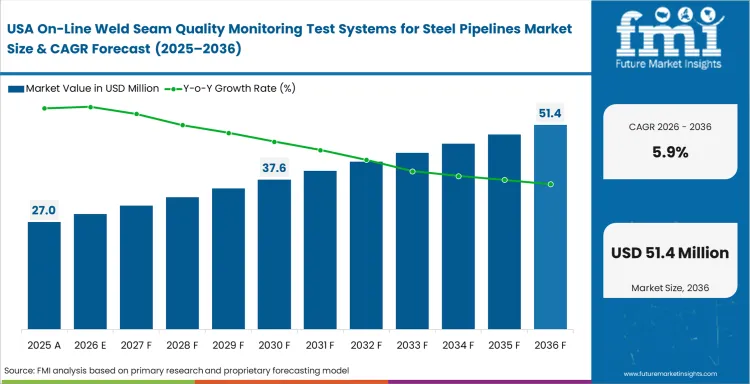
Replacement economics shape much of the buying pattern across the Americas. New line development still matters, yet many mills and inspection users in this region weigh upgrades against the cost of running proven equipment for a few more project cycles. Based on FMI's assessment, the balance favors systems that improve seam visibility without forcing long shutdowns or complex control rewiring. Export orientation also matters in parts of Latin America, where line-pipe quality packages need to move cleanly across project owners and engineering review. Faster adoption appears where new energy corridors and water-transfer programs justify tighter weld assurance at the mill stage.
- United States: Installed pipe capacity gives the United States a stable demand base, and FMI estimates the industry there will move at 5.9% CAGR from 2026 to 2036. Much of the spending comes from upgrades that improve seam review without replacing whole production cells. Domestic line-pipe exposure keeps acceptance of quality under steady attention, especially where mills serve oil, gas, and industrial transmission work. Buyers usually favor systems that fit existing automation rather than forcing a full process to reset. Adoption stays practical, yet large platform changes often take longer to approve.
- Brazil: Brazil benefits from a mix of energy and industrial pipe demand that keeps weld quality investment relevant even when project timing becomes uneven. Local spending is rarely driven by one single pipe program. Mills instead weigh inspection purchases against order visibility, export exposure, and the cost of reworking on thicker or project-grade pipe. FMI expects demand in Brazil to expand at 5.6% CAGR through 2036. Progress should stay healthiest where suppliers can improve seam control without adding long commissioning cycles.
FMI's report also covers Canada, Mexico, Argentina, and other Latin American markets not listed above. A common pattern across them is selective spending, with buyers moving faster when seam assurance can be upgraded in stages rather than through a full plant rebuild.
Europe analysis of On-Line Weld Seam Quality Monitoring Test Systems for Steel Pipelines Market
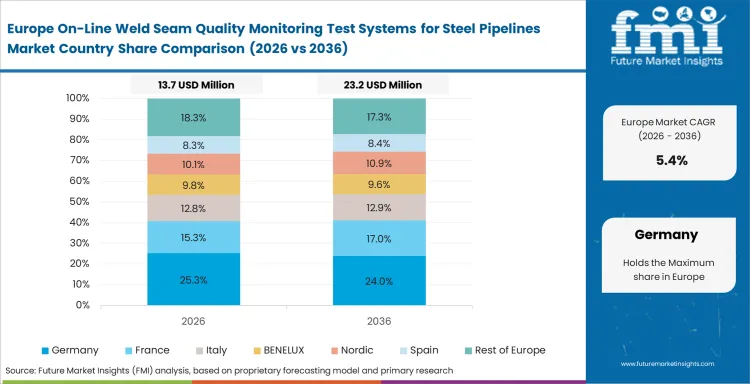
Europe shows a cautious buying pattern, but that does not mean demand is weak. Energy-transition projects, legacy pipeline maintenance, and strict acceptance culture keep seam quality on the agenda, although capital release can be slower than in faster-building regions. In FMI's view, users across Europe place unusual weight on documentation discipline because pipe acceptance often sits inside layered engineering reviews. That preference favors systems that present clear defect evidence and stable audit trails. Purchase timing still depends on plant utilization and project visibility, so system demand can lag technical need for a period.
- Germany: Germany is expected to grow at a CAGR of 4.8% during 2026 to 2036, reflecting high asset utilization and cautious, return-focused capital spending across the market. Domestic demand remains more concentrated on measured upgrades than on greenfield expansion. Pipe producers and inspection teams generally favor systems that improve seam control, strengthen inspection reliability, and fit existing industrial workflows. Project timing across energy and industrial pipe demand remains important because these installations usually follow planned capital cycles rather than short-term buying decisions. Adoption is likely to remain steady where upgrade value is clear and line disruption risk stays manageable.
FMI's report also includes the United Kingdom, France, Italy, Spain, the Netherlands, and other European countries. Across this region, technical need is rarely absent but spending releases more slowly when current lines can be extended with smaller upgrades.
Asia Pacific and Middle East & Africa analysis of On-Line Weld Seam Quality Monitoring Test Systems for Steel Pipelines Market
Fresh pipeline buildout gives Asia Pacific and the Middle East a different demand profile. Mills in these regions often face a sharper need for inline seam control because output is linked to new transmission, industrial, and export-led pipe demand rather than only replacement cycles. According to FMI's estimates, that changes the buying test from simple defect detection to broader weld-process discipline. Faster decisions tend to happen where large project pipelines, domestic energy policy, or export commitments push pipe quality higher up the production routine. Growth also spreads across mills that want systems flexible enough to handle mixed schedules without repeated manual intervention.
- India: Gas-network expansion continues to widen the addressable base in India, and FMI expects the country to advance at 8.4% CAGR from 2026 to 2036. Demand is strongest where pipe makers need tighter seam control for transmission-oriented output and where downtime from rejected lengths is hard to absorb. Local industry conditions also favor systems that can be added to active mills without excessive installation burden. Weld visibility matters here because production runs can shift between specifications. Buyers that shorten the gap between weld formation and inspection response are likely to gain cleaner output.
- China: China remains important because pipe-mill depth, scale, and export reach give inspection suppliers a large operating base. Seam-monitoring demand does not rest on one application alone. It is helped by the country's broad welded-pipe production footprint and the need to keep quality consistent across varied line conditions. China is poised to expand at 8.1% CAGR through 2036. Strong growth should continue where mills pair line speed with better control over HAZ conditions and seam profile.
- Saudi Arabia: Saudi Arabia benefits from long-haul transmission priorities and project-linked line-pipe demand that keep weld acceptance under close review. Pipe quality matters early in the production cycle because downstream correction becomes expensive once orders move into project delivery. Local demand is expected to rise at 7.7% CAGR during the forecast years, based on FMI's assessment. System suppliers with clear inline solutions are better placed here than those offering only end-stage confirmation. Serviceability and line fit matter more here than a long feature list.
- United Arab Emirates: The United Arab Emirates keeps a strong position in export-facing and energy-linked pipe activity, which supports inspection demand beyond simple replacement spending. FMI places the country on a 7.2% CAGR path through 2036 as mills and project suppliers seek cleaner seam evidence and steadier quality documentation. Compact inline systems are attractive here because floor efficiency and fast commissioning often matter alongside weld performance. Demand should stay at its healthiest, where suppliers can adapt to mixed pipe programs without constant manual reset. That balance keeps the country in a faster-growth group.
FMI's report includes Japan, South Korea, Southeast Asia, GCC markets beyond the UAE and Saudi Arabia, South Africa, and Australia. Countries with active pipe export routes or fresh transmission work adopt sooner, while mature bases still buy carefully when current lines can be extended with smaller upgrades.
Competitive Aligners for Market Players
Fragmentation continues to define the on-line weld seam quality monitoring test systems for steel pipelines market because buyer evaluation extends beyond equipment specifications alone. Mills focus on how well a system fits existing weld processes and production conditions. Line speed, accommodation diameter, coverage and alarm readability shape early supplier screening. The ability to review seam evidence after production also plays a critical role. Xiris Automation is commonly evaluated for inline production visibility, while ScanMaster Systems (IRT) Ltd. and Blue Star Industrial Solutions are often assessed through inspection and testing alignment.
Supplier shortlisting usually centers on one practical performance question. Buyers assess whether a system can deliver reliable seam judgments without disrupting line rhythm. Vendors that demonstrate consistent output under live conditions tend to remain under consideration. Integration with mill workflows carries greater weight than standalone hardware capability.
Established participants maintain position by combining sound inspection logic with commissioning support that adapts to changing production schedules. Familiarity with acceptance review processes strengthens confidence during deployment phases. Buyer comparisons across optical, ultrasonic, and radiographic systems help explain why entry barriers remain high. Users expect stable setup clear defect calls and minimal disruption during product changeovers.
Manufacturers also avoid rigid system lock‑in. They prefer data access that remains usable alongside alarm logic that can be extended as requirements evolve. This preference restricts how far any single supplier can dominate even when recognition is strong.
Fragmentation is therefore expected to persist over the forecast period. Participation standards will rise as buyers prioritize systems that fit live mill routines and simplify acceptance review. Suppliers that reduce rework pressure and support operational continuity are positioned to advance. Narrow offerings with limited adaptability may find it increasingly difficult to defend share.
Key Players in On-Line Weld Seam Quality Monitoring Test Systems for Steel Pipelines Market
- Xiris Automation
- ScanMaster Systems (IRT), Ltd.
- Blue Star Industrial Solutions
- Evident
- FOERSTER
- Magnetic Analysis Corporation (MAC)
Scope of the Report
| Metric | Value |
|---|---|
| Quantitative Units | USD 52.0 million to USD 100.4 million, at a CAGR of 6.80% |
| Market Definition | Inline systems used to monitor and test weld seams, bead condition, HAZ behavior, and related pass-fail logic on welded steel pipeline production lines. |
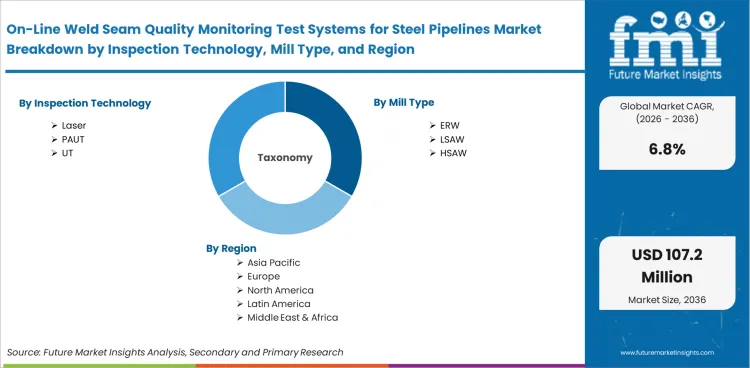
| Inspection Technology Segmentation | Laser vision, PAUT, UT, Eddy current, Radiography, Thermography |
| Mill Type Segmentation | ERW, LSAW, HSAW, HFI, TIG |
| Installation Mode Segmentation | Inline fixed, Inline scanner, Hybrid line, Offline final |
| Monitoring Objective Segmentation | Defect detection, Seam tracking, Bead profiling, HAZ control, Data logging, Alarm control |
| Pipe Diameter Segmentation | Up to 16 inch, 16-48 inch, Over 48 inch |
| End Use Segmentation | Oil & gas, Water, CO2, Process, Slurry |
| Software Integration Segmentation | Stand-alone HMI, MES/SCADA, SPC logging, AI analytics, Cloud traceability |
| Regions Covered | North America, Latin America, Europe, Asia Pacific, Middle East & Africa |
| Countries Covered | India, China, Saudi Arabia, United Arab Emirates, United States, Brazil, Germany |
| Key Companies Profiled | Xiris Automation, ScanMaster Systems (IRT), Ltd., Blue Star Industrial Solutions, Evident, FOERSTER, and Magnetic Analysis Corporation (MAC) |
| Forecast Period | 2026 to 2036 |
| Approach | Installed-base analysis of welded steel pipe lines, inspection-system fit by mill type, and proprietary forecasting based on primary research and competitive mapping. |
On-Line Weld Seam Quality Monitoring Test Systems for Steel Pipelines Market Analysis by Segments
Inspection Technology:
- Laser vision
- PAUT
- UT
- Eddy current
- Radiography
- Thermography
Mill Type:
- ERW
- LSAW
- HSAW
- HFI
- TIG
Installation Mode:
- Inline fixed
- Inline scanner
- Hybrid line
- Offline final
Monitoring Objective:
- Defect detection
- Seam tracking
- Bead profiling
- HAZ control
- Data logging
- Alarm control
Pipe Diameter:
- Up to 16 inch
- 16-48 inch
- Over 48 inch
End Use:
- Oil & gas
- Water
- CO2
- Process
- Slurry
Software Integration:
- Stand-alone HMI
- MES/SCADA
- SPC logging
- AI analytics
- Cloud traceability
Region:
- North America
- United States
- Canada
- Europe
- Germany
- United Kingdom
- France
- Italy
- Spain
- Asia Pacific
- China
- Japan
- South Korea
- Taiwan
- Singapore
- Latin America
- Brazil
- Mexico
- Argentina
- Middle East & Africa
- GCC Countries
- South Africa
Bibliography
- Chen, Y., He, D., He, S., Jin, Z., Miao, J., Shan, S., & Chen, Y. (2024). Welding defect detection based on phased array images and two-stage segmentation strategy. Advanced Engineering Informatics, 62, Article 102879.
- Han, Z., Li, S., Chen, X., Huang, B., Sun, J., Zhang, Q., & Liu, C. (2024). DFW-YOLO: YOLOv5-based algorithm using phased array ultrasonic testing for weld defect recognition. Nondestructive Testing and Evaluation, 40(6), 2516-2539.
- United States Department of Transportation (2024). Pipeline and Hazardous Materials Safety Administration 2024 Annual Modal Research Plan.
- Ravikiran, K., Xu, P., & Li, L. (2024). A critical review on high-frequency electric-resistance welding of steel linepipe. Journal of Manufacturing Processes, 124, 753-777.
- Terán Méndez, G., Capula-Colindres, S. I., Velázquez, J. C., Angeles-Herrera, D., González-Arévalo, N. E., Torres-Santillan, E., & Cervantes-Tobón, A. (2024). Mechanical characterization of resistance-welded and seamless API 5L X52 pipes: A comparative study.
This bibliography is provided for the reader’s reference. The full FMI report contains the complete reference list with primary source documentation.
This Report Addresses
- Market intelligence to support strategic decision making across inline seam monitoring, optical weld review, phased-array inspection, and software-linked acceptance workflows.
- Market size estimation and 10-year revenue forecasts from 2026 to 2036, supported by installed-base analysis of welded steel pipeline lines and competitive mapping by mill type.
- Growth opportunity mapping across inspection technology, mill type, installation mode, monitoring objective, pipe diameter, end use, and software integration with emphasis on seam control moving closer to the weld point.
- Segment and regional forecasts covering Laser vision, ERW, Inline fixed, Defect detection, 16-48 inch pipe, Oil & gas, and MES/SCADA across pipeline fabrication environments.
- Competition strategy assessment including seam visibility, mill integration, commissioning stability, data export, and acceptance review discipline.
- Technology development tracking includes PAUT, UT, Eddy current, Radiography, Thermography, AI-enabled defect sorting, and control-system integration.
- Market access analysis covering welded steel pipeline fabrication requirements, line-fit constraints, retrofit pathways, export documentation needs, and acceptance workflow discipline.
- Market report delivery in PDF, Excel, PPT, and interactive dashboard formats for executive strategy, product planning, regional prioritization, and operational benchmarking.
Frequently Asked Questions
How large is the on-line weld seam quality monitoring test systems for steel pipelines industry in 2026?
FMI estimates that the on-line weld seam quality monitoring test systems for the steel pipelines industry is anticipated to reach USD 52.0 million in 2026, supported by steady adoption of inline seam visibility and weld-quality control on steel pipeline lines.
What will it be worth by 2036?
Value is expected to reach USD 100.4 million by 2036 as mills tie seam review more closely to live production discipline and retraceable acceptance workflows.
What CAGR is projected for 2026 to 2036?
FMI projects a 6.80% CAGR from 2026 to 2036, which reflects steady upgrade-led adoption rather than a short burst of project-driven spending.
Which inspection technology leads in 2026?
Laser vision is expected to lead inspection technology with 32.0% share in 2026 because it gives immediate visual feedback on seam and bead condition.
Which mill type leads system demand?
ERW is projected to lead mill type with 34.0% share in 2026 since its installed base creates the broadest recurring need for inline seam control.
Which installation mode leads?
Inline fixed systems are anticipated to represent 43.0% share in 2026 because they fit daily mill use without adding scanner motion to every pipe pass.
Which monitoring objective leads?
Defect detection is likely to account for 29.0% share in 2026 as mills still justify spending first on reject prevention and acceptance confidence.
Which pipe diameter band leads?
The 16-48 inch band is expected to contribute 36.0% share in 2026 because it sits across many commercially important pipeline programs.
Which end-use area leads?
Oil & gas is set to hold the lead with 38.0% share in 2026 due to tighter seam-acceptance needs in transmission and pressure-rated line service.
Which software integration option leads?
MES/SCADA integration is forecast to represent 31.0% share in 2026 because users want seam alerts and production context inside one operating view.
Which company leads the competitive landscape?
Xiris Automation is one of the recognized suppliers in this market, though competition remains fragmented across optical, ultrasonic, and hybrid inspection approaches.
Which country grows fastest?
India is expected to post the fastest expansion at 8.4% CAGR through 2036 as gas-grid buildout keeps welded line-pipe quality under closer review.
Which country follows India most closely?
China follows closely with 8.1% CAGR, supported by deep pipe-mill capacity and a broad manufacturing base for welded line-pipe production.
How fast will Saudi Arabia expand?
Saudi Arabia is projected to rise at 7.7% CAGR through 2036 as transmission-oriented pipe demand keeps weld assurance commercially important.
How does the UAE compare?
The United Arab Emirates is expected to expand at 7.2% CAGR, helped by export-facing mill activity and energy-linked pipe demand.
How fast will the United States grow?
The United States is forecast to advance at 5.9% CAGR, with spending shaped more by upgrades and replacement cycles than by first-time deployment.
What is the outlook for Brazil?
Brazil is likely to grow at 5.6% CAGR through 2036 as inspection demand follows energy and industrial pipe programs with selective upgrade timing.
How does Germany rank in growth?
Germany is expected to record 4.8% CAGR, reflecting steady technical need but more careful capital release across mature industrial pipe operations.
What is the main growth driver for the on-line weld seam quality monitoring test systems for steel pipelines industry?
Growth comes mainly from earlier seam inspection, which helps mills correct issues sooner and reduce rework.
What keeps adoption from moving faster?
Installed-base constraints slow adoption because new scanners, alarms, and acceptance logic must fit existing controls without long shutdowns.
Why do buyers prefer inline systems?
Inline systems shorten the gap between seam formation and response, which makes output correction easier before weak lengths move further down the line.
What makes this niche different from broad NDT equipment?
This niche is narrower because systems are bought around weld-process fit, line speed, pipe geometry, and acceptance discipline rather than general inspection use cases.
Preview the report firsthand - request a free sample
Get SampleGet the brochure for pricing and purchase details.
Get PDFTable of Content
- Executive Summary
- Global Market Outlook
- Demand-side Trends
- Supply-side Trends
- Technology Roadmap Analysis
- Analysis and Recommendations
- Market Overview
- Market Coverage / Taxonomy
- Market Definition / Scope / Limitations
- Research Methodology
- Chapter Orientation
- Analytical Lens and Working Hypotheses
- Market Structure, Signals, and Trend Drivers
- Benchmarking and Cross-market Comparability
- Market Sizing, Forecasting, and Opportunity Mapping
- Research Design and Evidence Framework
- Desk Research Programme (Secondary Evidence)
- Company Annual and Sustainability Reports
- Peer-reviewed Journals and Academic Literature
- Corporate Websites, Product Literature, and Technical Notes
- Earnings Decks and Investor Briefings
- Statutory Filings and Regulatory Disclosures
- Technical White Papers and Standards Notes
- Trade Journals, Industry Magazines, and Analyst Briefs
- Conference Proceedings, Webinars, and Seminar Materials
- Government Statistics Portals and Public Data Releases
- Press Releases and Reputable Media Coverage
- Specialist Newsletters and Curated Briefings
- Sector Databases and Reference Repositories
- FMI Internal Proprietary Databases and Historical Market Datasets
- Subscription Datasets and Paid Sources
- Social Channels, Communities, and Digital Listening Inputs
- Additional Desk Sources
- Expert Input and Fieldwork (Primary Evidence)
- Primary Modes
- Qualitative Interviews and Expert Elicitation
- Quantitative Surveys and Structured Data Capture
- Blended Approach
- Why Primary Evidence is Used
- Field Techniques
- Interviews
- Surveys
- Focus Groups
- Observational and In-context Research
- Social and Community Interactions
- Stakeholder Universe Engaged
- C-suite Leaders
- Board Members
- Presidents and Vice Presidents
- R&D and Innovation Heads
- Technical Specialists
- Domain Subject-matter Experts
- Scientists
- Physicians and Other Healthcare Professionals
- Governance, Ethics, and Data Stewardship
- Research Ethics
- Data Integrity and Handling
- Primary Modes
- Tooling, Models, and Reference Databases
- Desk Research Programme (Secondary Evidence)
- Data Engineering and Model Build
- Data Acquisition and Ingestion
- Cleaning, Normalisation, and Verification
- Synthesis, Triangulation, and Analysis
- Quality Assurance and Audit Trail
- Market Background
- Market Dynamics
- Drivers
- Restraints
- Opportunity
- Trends
- Scenario Forecast
- Demand in Optimistic Scenario
- Demand in Likely Scenario
- Demand in Conservative Scenario
- Opportunity Map Analysis
- Product Life Cycle Analysis
- Supply Chain Analysis
- Investment Feasibility Matrix
- Value Chain Analysis
- PESTLE and Porter’s Analysis
- Regulatory Landscape
- Regional Parent Market Outlook
- Production and Consumption Statistics
- Import and Export Statistics
- Market Dynamics
- Global Market Analysis 2021 to 2025 and Forecast, 2026 to 2036
- Historical Market Size Value (USD Million) Analysis, 2021 to 2025
- Current and Future Market Size Value (USD Million) Projections, 2026 to 2036
- Y-o-Y Growth Trend Analysis
- Absolute $ Opportunity Analysis
- Global Market Pricing Analysis 2021 to 2025 and Forecast 2026 to 2036
- Global Market Analysis 2021 to 2025 and Forecast 2026 to 2036, By Inspection Technology
- Introduction / Key Findings
- Historical Market Size Value (USD Million) Analysis By Inspection Technology , 2021 to 2025
- Current and Future Market Size Value (USD Million) Analysis and Forecast By Inspection Technology , 2026 to 2036
- Laser
- PAUT
- UT
- Laser
- Y-o-Y Growth Trend Analysis By Inspection Technology , 2021 to 2025
- Absolute $ Opportunity Analysis By Inspection Technology , 2026 to 2036
- Global Market Analysis 2021 to 2025 and Forecast 2026 to 2036, By Mill Type
- Introduction / Key Findings
- Historical Market Size Value (USD Million) Analysis By Mill Type, 2021 to 2025
- Current and Future Market Size Value (USD Million) Analysis and Forecast By Mill Type, 2026 to 2036
- ERW
- LSAW
- HSAW
- ERW
- Y-o-Y Growth Trend Analysis By Mill Type, 2021 to 2025
- Absolute $ Opportunity Analysis By Mill Type, 2026 to 2036
- Global Market Analysis 2021 to 2025 and Forecast 2026 to 2036, By Installation Mode
- Introduction / Key Findings
- Historical Market Size Value (USD Million) Analysis By Installation Mode, 2021 to 2025
- Current and Future Market Size Value (USD Million) Analysis and Forecast By Installation Mode, 2026 to 2036
- Inline Fixed
- Inline Scanner
- Others
- Inline Fixed
- Y-o-Y Growth Trend Analysis By Installation Mode, 2021 to 2025
- Absolute $ Opportunity Analysis By Installation Mode, 2026 to 2036
- Global Market Analysis 2021 to 2025 and Forecast 2026 to 2036, By Monitoring Objective
- Introduction / Key Findings
- Historical Market Size Value (USD Million) Analysis By Monitoring Objective, 2021 to 2025
- Current and Future Market Size Value (USD Million) Analysis and Forecast By Monitoring Objective, 2026 to 2036
- Defect Detection
- HAZ Control
- Others
- Defect Detection
- Y-o-Y Growth Trend Analysis By Monitoring Objective, 2021 to 2025
- Absolute $ Opportunity Analysis By Monitoring Objective, 2026 to 2036
- Global Market Analysis 2021 to 2025 and Forecast 2026 to 2036, By Pipe Diameter
- Introduction / Key Findings
- Historical Market Size Value (USD Million) Analysis By Pipe Diameter, 2021 to 2025
- Current and Future Market Size Value (USD Million) Analysis and Forecast By Pipe Diameter, 2026 to 2036
- 16–48-Inch
- Up to 16 Inch
- Over 48 Inch
- Y-o-Y Growth Trend Analysis By Pipe Diameter, 2021 to 2025
- Absolute $ Opportunity Analysis By Pipe Diameter, 2026 to 2036
- 16–48-Inch
- Global Market Analysis 2021 to 2025 and Forecast 2026 to 2036, By End Use
- Introduction / Key Findings
- Historical Market Size Value (USD Million) Analysis By End Use, 2021 to 2025
- Current and Future Market Size Value (USD Million) Analysis and Forecast By End Use, 2026 to 2036
- Oil & Gas
- Water
- CO2
- Oil & Gas
- Y-o-Y Growth Trend Analysis By End Use, 2021 to 2025
- Absolute $ Opportunity Analysis By End Use, 2026 to 2036
- Global Market Analysis 2021 to 2025 and Forecast 2026 to 2036, By Software Integration
- Introduction / Key Findings
- Historical Market Size Value (USD Million) Analysis By Software Integration, 2021 to 2025
- Current and Future Market Size Value (USD Million) Analysis and Forecast By Software Integration, 2026 to 2036
- MES/SCADA
- SPC Logging
- AI Analytics
- MES/SCADA
- Y-o-Y Growth Trend Analysis By Software Integration, 2021 to 2025
- Absolute $ Opportunity Analysis By Software Integration, 2026 to 2036
- Global Market Analysis 2021 to 2025 and Forecast 2026 to 2036, By Region
- Introduction
- Historical Market Size Value (USD Million) Analysis By Region, 2021 to 2025
- Current Market Size Value (USD Million) Analysis and Forecast By Region, 2026 to 2036
- North America
- Latin America
- Western Europe
- Eastern Europe
- East Asia
- South Asia and Pacific
- Middle East & Africa
- Market Attractiveness Analysis By Region
- North America Market Analysis 2021 to 2025 and Forecast 2026 to 2036, By Country
- Historical Market Size Value (USD Million) Trend Analysis By Market Taxonomy, 2021 to 2025
- Market Size Value (USD Million) Forecast By Market Taxonomy, 2026 to 2036
- By Country
- USA
- Canada
- Mexico
- By Inspection Technology
- By Mill Type
- By Installation Mode
- By Monitoring Objective
- By Pipe Diameter
- By End Use
- By Software Integration
- By Country
- Market Attractiveness Analysis
- By Country
- By Inspection Technology
- By Mill Type
- By Installation Mode
- By Monitoring Objective
- By Pipe Diameter
- By End Use
- By Software Integration
- Key Takeaways
- Latin America Market Analysis 2021 to 2025 and Forecast 2026 to 2036, By Country
- Historical Market Size Value (USD Million) Trend Analysis By Market Taxonomy, 2021 to 2025
- Market Size Value (USD Million) Forecast By Market Taxonomy, 2026 to 2036
- By Country
- Brazil
- Chile
- Rest of Latin America
- By Inspection Technology
- By Mill Type
- By Installation Mode
- By Monitoring Objective
- By Pipe Diameter
- By End Use
- By Software Integration
- By Country
- Market Attractiveness Analysis
- By Country
- By Inspection Technology
- By Mill Type
- By Installation Mode
- By Monitoring Objective
- By Pipe Diameter
- By End Use
- By Software Integration
- Key Takeaways
- Western Europe Market Analysis 2021 to 2025 and Forecast 2026 to 2036, By Country
- Historical Market Size Value (USD Million) Trend Analysis By Market Taxonomy, 2021 to 2025
- Market Size Value (USD Million) Forecast By Market Taxonomy, 2026 to 2036
- By Country
- Germany
- UK
- Italy
- Spain
- France
- Nordic
- BENELUX
- Rest of Western Europe
- By Inspection Technology
- By Mill Type
- By Installation Mode
- By Monitoring Objective
- By Pipe Diameter
- By End Use
- By Software Integration
- By Country
- Market Attractiveness Analysis
- By Country
- By Inspection Technology
- By Mill Type
- By Installation Mode
- By Monitoring Objective
- By Pipe Diameter
- By End Use
- By Software Integration
- Key Takeaways
- Eastern Europe Market Analysis 2021 to 2025 and Forecast 2026 to 2036, By Country
- Historical Market Size Value (USD Million) Trend Analysis By Market Taxonomy, 2021 to 2025
- Market Size Value (USD Million) Forecast By Market Taxonomy, 2026 to 2036
- By Country
- Russia
- Poland
- Hungary
- Balkan & Baltic
- Rest of Eastern Europe
- By Inspection Technology
- By Mill Type
- By Installation Mode
- By Monitoring Objective
- By Pipe Diameter
- By End Use
- By Software Integration
- By Country
- Market Attractiveness Analysis
- By Country
- By Inspection Technology
- By Mill Type
- By Installation Mode
- By Monitoring Objective
- By Pipe Diameter
- By End Use
- By Software Integration
- Key Takeaways
- East Asia Market Analysis 2021 to 2025 and Forecast 2026 to 2036, By Country
- Historical Market Size Value (USD Million) Trend Analysis By Market Taxonomy, 2021 to 2025
- Market Size Value (USD Million) Forecast By Market Taxonomy, 2026 to 2036
- By Country
- China
- Japan
- South Korea
- By Inspection Technology
- By Mill Type
- By Installation Mode
- By Monitoring Objective
- By Pipe Diameter
- By End Use
- By Software Integration
- By Country
- Market Attractiveness Analysis
- By Country
- By Inspection Technology
- By Mill Type
- By Installation Mode
- By Monitoring Objective
- By Pipe Diameter
- By End Use
- By Software Integration
- Key Takeaways
- South Asia and Pacific Market Analysis 2021 to 2025 and Forecast 2026 to 2036, By Country
- Historical Market Size Value (USD Million) Trend Analysis By Market Taxonomy, 2021 to 2025
- Market Size Value (USD Million) Forecast By Market Taxonomy, 2026 to 2036
- By Country
- India
- ASEAN
- Australia & New Zealand
- Rest of South Asia and Pacific
- By Inspection Technology
- By Mill Type
- By Installation Mode
- By Monitoring Objective
- By Pipe Diameter
- By End Use
- By Software Integration
- By Country
- Market Attractiveness Analysis
- By Country
- By Inspection Technology
- By Mill Type
- By Installation Mode
- By Monitoring Objective
- By Pipe Diameter
- By End Use
- By Software Integration
- Key Takeaways
- Middle East & Africa Market Analysis 2021 to 2025 and Forecast 2026 to 2036, By Country
- Historical Market Size Value (USD Million) Trend Analysis By Market Taxonomy, 2021 to 2025
- Market Size Value (USD Million) Forecast By Market Taxonomy, 2026 to 2036
- By Country
- Kingdom of Saudi Arabia
- Other GCC Countries
- Turkiye
- South Africa
- Other African Union
- Rest of Middle East & Africa
- By Inspection Technology
- By Mill Type
- By Installation Mode
- By Monitoring Objective
- By Pipe Diameter
- By End Use
- By Software Integration
- By Country
- Market Attractiveness Analysis
- By Country
- By Inspection Technology
- By Mill Type
- By Installation Mode
- By Monitoring Objective
- By Pipe Diameter
- By End Use
- By Software Integration
- Key Takeaways
- Key Countries Market Analysis
- USA
- Pricing Analysis
- Market Share Analysis, 2025
- By Inspection Technology
- By Mill Type
- By Installation Mode
- By Monitoring Objective
- By Pipe Diameter
- By End Use
- By Software Integration
- Canada
- Pricing Analysis
- Market Share Analysis, 2025
- By Inspection Technology
- By Mill Type
- By Installation Mode
- By Monitoring Objective
- By Pipe Diameter
- By End Use
- By Software Integration
- Mexico
- Pricing Analysis
- Market Share Analysis, 2025
- By Inspection Technology
- By Mill Type
- By Installation Mode
- By Monitoring Objective
- By Pipe Diameter
- By End Use
- By Software Integration
- Brazil
- Pricing Analysis
- Market Share Analysis, 2025
- By Inspection Technology
- By Mill Type
- By Installation Mode
- By Monitoring Objective
- By Pipe Diameter
- By End Use
- By Software Integration
- Chile
- Pricing Analysis
- Market Share Analysis, 2025
- By Inspection Technology
- By Mill Type
- By Installation Mode
- By Monitoring Objective
- By Pipe Diameter
- By End Use
- By Software Integration
- Germany
- Pricing Analysis
- Market Share Analysis, 2025
- By Inspection Technology
- By Mill Type
- By Installation Mode
- By Monitoring Objective
- By Pipe Diameter
- By End Use
- By Software Integration
- UK
- Pricing Analysis
- Market Share Analysis, 2025
- By Inspection Technology
- By Mill Type
- By Installation Mode
- By Monitoring Objective
- By Pipe Diameter
- By End Use
- By Software Integration
- Italy
- Pricing Analysis
- Market Share Analysis, 2025
- By Inspection Technology
- By Mill Type
- By Installation Mode
- By Monitoring Objective
- By Pipe Diameter
- By End Use
- By Software Integration
- Spain
- Pricing Analysis
- Market Share Analysis, 2025
- By Inspection Technology
- By Mill Type
- By Installation Mode
- By Monitoring Objective
- By Pipe Diameter
- By End Use
- By Software Integration
- France
- Pricing Analysis
- Market Share Analysis, 2025
- By Inspection Technology
- By Mill Type
- By Installation Mode
- By Monitoring Objective
- By Pipe Diameter
- By End Use
- By Software Integration
- India
- Pricing Analysis
- Market Share Analysis, 2025
- By Inspection Technology
- By Mill Type
- By Installation Mode
- By Monitoring Objective
- By Pipe Diameter
- By End Use
- By Software Integration
- ASEAN
- Pricing Analysis
- Market Share Analysis, 2025
- By Inspection Technology
- By Mill Type
- By Installation Mode
- By Monitoring Objective
- By Pipe Diameter
- By End Use
- By Software Integration
- Australia & New Zealand
- Pricing Analysis
- Market Share Analysis, 2025
- By Inspection Technology
- By Mill Type
- By Installation Mode
- By Monitoring Objective
- By Pipe Diameter
- By End Use
- By Software Integration
- China
- Pricing Analysis
- Market Share Analysis, 2025
- By Inspection Technology
- By Mill Type
- By Installation Mode
- By Monitoring Objective
- By Pipe Diameter
- By End Use
- By Software Integration
- Japan
- Pricing Analysis
- Market Share Analysis, 2025
- By Inspection Technology
- By Mill Type
- By Installation Mode
- By Monitoring Objective
- By Pipe Diameter
- By End Use
- By Software Integration
- South Korea
- Pricing Analysis
- Market Share Analysis, 2025
- By Inspection Technology
- By Mill Type
- By Installation Mode
- By Monitoring Objective
- By Pipe Diameter
- By End Use
- By Software Integration
- Russia
- Pricing Analysis
- Market Share Analysis, 2025
- By Inspection Technology
- By Mill Type
- By Installation Mode
- By Monitoring Objective
- By Pipe Diameter
- By End Use
- By Software Integration
- Poland
- Pricing Analysis
- Market Share Analysis, 2025
- By Inspection Technology
- By Mill Type
- By Installation Mode
- By Monitoring Objective
- By Pipe Diameter
- By End Use
- By Software Integration
- Hungary
- Pricing Analysis
- Market Share Analysis, 2025
- By Inspection Technology
- By Mill Type
- By Installation Mode
- By Monitoring Objective
- By Pipe Diameter
- By End Use
- By Software Integration
- Kingdom of Saudi Arabia
- Pricing Analysis
- Market Share Analysis, 2025
- By Inspection Technology
- By Mill Type
- By Installation Mode
- By Monitoring Objective
- By Pipe Diameter
- By End Use
- By Software Integration
- Turkiye
- Pricing Analysis
- Market Share Analysis, 2025
- By Inspection Technology
- By Mill Type
- By Installation Mode
- By Monitoring Objective
- By Pipe Diameter
- By End Use
- By Software Integration
- South Africa
- Pricing Analysis
- Market Share Analysis, 2025
- By Inspection Technology
- By Mill Type
- By Installation Mode
- By Monitoring Objective
- By Pipe Diameter
- By End Use
- By Software Integration
- USA
- Market Structure Analysis
- Competition Dashboard
- Competition Benchmarking
- Market Share Analysis of Top Players
- By Regional
- By Inspection Technology
- By Mill Type
- By Installation Mode
- By Monitoring Objective
- By Pipe Diameter
- By End Use
- By Software Integration
- Competition Analysis
- Competition Deep Dive
- Competition Deep Dive
- Assumptions & Acronyms Used


