

- Industry Size (2026)
- USD 80 Mn
- Forecast (2036)
- USD 790 Mn
- CAGR (2026 to 2036)
- 25.8%
Offshore eVTOL Exterior Components Market Size, Market Forecast and Outlook By FMI
The Offshore eVTOL Exterior Components Market reached USD 60 million in 2025. It is expected to grow to USD 80 million in 2026 to USD 790 million by 2036, registering a CAGR of 25.8% during the forecast period. Demand is increasing as the maritime energy industry turns to offshore-capable powered-lift aircraft for crew transport, creating stronger need for ruggedized exterior component designs.
The market is pushing procurement directors to rethink how advanced airframes are equipped for service. Standard lightweight urban fairings are giving way to heavy-duty, corrosion-resistant exterior systems built for marine conditions. Operators sending aircraft over water need to prioritize specialized marine-grade protection from the beginning, since failure to do so can result in accelerated salt-fog delamination and costly fleet grounding. This shift is lifting demand for composite airframes capable of handling repeated deck impacts and abrasive wind-driven wear. The effect is especially important in the offshore wind crew transfer aircraft market, where unexpected structural interruptions can quickly erode operating efficiency.
Summary of Offshore eVTOL Exterior Components Market
- Offshore eVTOL Exterior Components Market Definition
- This market encompasses the ruggedized aerodynamic shrouds, composite shells, and protective surface chemistries engineered to defend offshore-capable electric aircraft from severe marine weathering, salt-spray corrosion, and continuous deck-handling impacts.
- Demand Drivers in the Market
- The massive capacity expansion of offshore wind installations compels logistics operators to procure specialized electric aircraft capable of executing low-cost crew transfers in harsh maritime environments.
- Severe salt-fog degradation in the marine boundary layer forces structural engineering teams to specify heavy-duty elastomeric films and corrosion-resistant metallic fittings across all exposed surfaces.
- Stringent offshore safety mandates require fleet maintenance directors to utilize advanced marine-grade sealants and protective coatings that prevent invisible moisture ingress into load-bearing composite matrices.
- Key Segments Analyzed in the FMI Report
- Composite fuselage shells and marine-exposed outer panels: Composite fuselage shells and marine-exposed outer panels is estimated to capture 29.0% share in 2026, as the primary aerodynamic envelope requires extensive structural reinforcement to survive high-impact offshore deck landings.
- Carbon fiber composites: Carbon fiber composites is poised to garner 47.0% share in 2026, providing the only viable stiffness-to-weight ratio capable of satisfying both electric battery density constraints and maritime crashworthiness rules.
- Lift plus cruise offshore eVTOL platforms: Lift plus cruise offshore eVTOL platforms is anticipated to account for 39.0% share in 2026, representing the dominant architectural compromise between vertical helideck capability and efficient, long-range forward flight over water.
- OEM line-fit supply: OEM line-fit supply is set to capture 80.0% share in 2026, driven by the reality that the entire industry is currently focused on producing the first generation of conforming offshore flight-test articles.
- Offshore wind crew transfer: Offshore wind crew transfer is expected to record 46.0% share in 2026, serving as the primary near-term commercial anchor due to the immediate need for low-cost, high-frequency maintenance logistics.
- China: 28.8% compound growth, propelled by a centralized industrial policy that seamlessly merges massive offshore wind expansion directives with accelerated domestic aviation commercialization programs.
- Analyst Opinion at FMI
- Rahul Pandita, Principal Analyst, Technology, at FMI, explains, "Flight range is often treated as the key measure of offshore viability. The more critical constraint is material degradation. An airframe that performs through thousands of urban cycles can still face severe delamination within a single season of offshore salt fog exposure when its exterior composite matrices and sealants are not engineered for the marine boundary layer."
- Strategic Implications / Executive Takeaways
- Aerospace tier-one suppliers must urgently validate automated manufacturing processes for offshore eVTOL composite exterior structures to capture lucrative line-fit contracts before OEMs lock their offshore type designs.
- Marine coating formulators face a prime opportunity to adapt offshore oil-rig surface chemistry into ultra-lightweight, aviation-compliant formats to secure preferred vendor status.
- Fleet operators attempting to utilize standard urban airframes for maritime logistics risk severe operational downtime and catastrophic structural fatigue without heavy eVTOL corrosion resistant exterior systems.
- Methodology
- Primary Research: Executive interviews with maritime logistics directors, composite structural leads, and aviation certification engineers.
- Desk Research: Analysis of offshore wind installation forecasts, aviation authority pilot project scopes, and material test registries.
- Market-Sizing and Forecasting: Anchored to verifiable aircraft pre-orders cross-referenced against expected offshore logistics deployment rates.
- Data Validation and Update Cycle: Triangulated via capacity tracking of tier-one aerospace structural manufacturing facilities and offshore energy expenditure models.
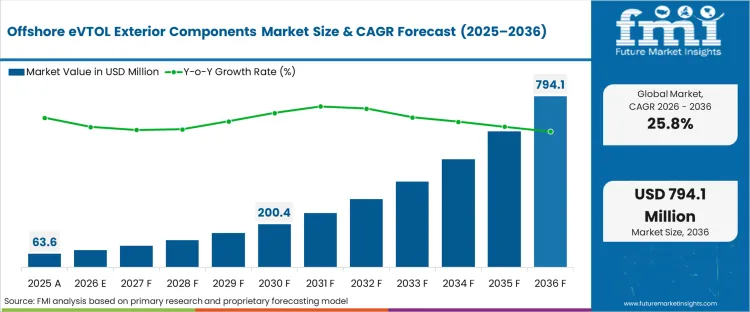
Self-sustaining volume growth across the supply chain hinges on the completion of a specific structural gate, the finalization of marine-specific type-certification standards for powered-lift aircraft by maritime aviation regulators. Maritime authorities and classification societies initiate this shift by defining the exact impact and corrosion thresholds required for offshore passenger operations. Once these rigid baseline standards are codified, aerospace tier-one suppliers can automate the production of compliant marine-grade exterior shells, moving bespoke ruggedized prototypes into standardized, high-volume production articles.
China is projected to witness growth at a CAGR of 28.8%, followed closely by the United States at 27.5%. The United Kingdom is anticipated to expand at 24.6%, while Germany tracks at 24.1%. The United Arab Emirates advances at 23.8%, India follows at 22.9%, and Japan registers 22.4%. This structural divergence reflects the uneven geographical distribution of offshore wind megaprojects and the varying speeds at which national aviation authorities grant operational clearance for passenger-carrying electric aircraft in maritime boundary layers.
Offshore eVTOL Exterior Components Market Definition
The market consists of the specialized, marine-hardened aerodynamic structures, transition covers, and protective surface layers engineered to enclose and shield powered-lift aircraft operating in maritime environments. It is functionally bounded by the hardware forming the outer mold line that directly resists salt fog, offshore deck handling, and heavy weather exposure.
Offshore eVTOL Exterior Components Market Inclusions
When evaluating what is included in offshore eVTOL exterior components, the scope encompasses all marine-exposed outer panels, corrosion-resistant doors, and specialized aircraft fairings designed for offshore operations. The boundary includes rotor and pylon aerodynamic covers, splash-exposed landing gear housings, and marine exposure aircraft exterior systems such as lighting enclosures. Furthermore, specialized acrylic canopies, heavy-duty radome covers, protective elastomeric films, and marine-grade exterior sealants applied directly to the airframe are fully integrated into this market analysis.
Offshore eVTOL Exterior Components Market Exclusions
The market excludes general urban-use eVTOL exterior parts that lack marine-grade corrosion and impact ratings. Internal structural framing, passenger cabin interiors, and enclosed powertrain components such as motors and batteries are excluded. Additionally, the specialized floatation devices, emergency life rafts, and internal avionics suites fall outside this boundary, isolating the analysis strictly to the protective and aerodynamic outer exterior envelope.
Offshore eVTOL Exterior Components Market Research Methodology
- Primary Research: Procurement directors at leading powered-lift original equipment manufacturers, offshore logistics operations managers, and composite tooling specialists at tier-one aerospace suppliers.
- Desk Research: Aggregation of material qualification dossiers from maritime classification societies, aviation authority pilot-program documentation, and supplier capacity expansion reports.
- Market-Sizing and Forecasting: Baseline sizing anchors to near-term eVTOL production signals and declared offshore pilot programs, estimating the specific marine-capable exterior component content per aircraft.
- Data Validation and Update Cycle: Forecast trajectories are triangulated against the projected capacity growth in the offshore wind sector and the capacity disclosures of major aerospace chemical and structural incumbents.
Segmental Analysis
Offshore eVTOL Exterior Components Market Analysis by Component Type
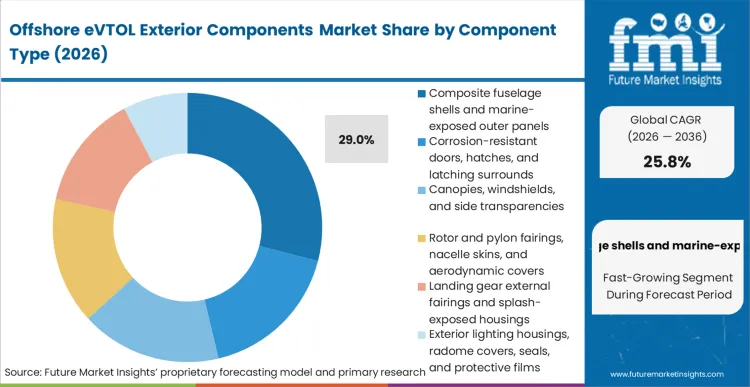
Composite fuselage shells and marine-exposed outer panels hold 29.0% share as they form the primary exterior defense against punishing maritime service conditions. Used as composite fuselage panels in marine aircraft environments, these shells must take the blunt impact of high-wind helideck landings while keeping sensitive internal electronics protected from persistent salt spray. According to FMI’s estimates, procurement teams concentrate early qualification efforts on these eVTOL salt fog resistant exterior components, since missing fatigue targets can force a complete revision of the aircraft’s aerodynamic profile. Delays in locking in these robust shells can halt progress across the full marine certification flight-test program.
- Initial specification: The vast surface area of the fuselage dictates the primary marine material selection for the entire aircraft, forcing early procurement lock-in.
- Qualification gate: These structures must pass rigorous salt-spray degradation and fatigue load simulations to satisfy both aviation and maritime safety mandates.
- Volume scaling: Sustaining profitable commercial production requires transitioning from hand-laid prototype shells to automated, repeatable aerospace composites manufacturing processes.
Offshore eVTOL Exterior Components Market Analysis by Material System
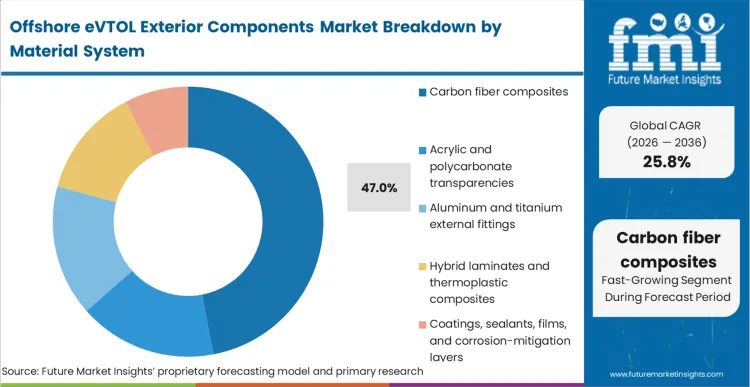
The commercial consequence of excessive weight forces structural engineers toward Carbon fiber composites, holding 47.0% share, despite the high material cost. If developers attempt to substitute cheaper, heavier metallic structures to handle marine environments, the aircraft incurs massive range penalties that render it unviable for deep-water transit. In FMI's view, designers are structurally obligated to utilize carbon matrices heavily treated with corrosion resistant coatings for offshore eVTOL aircraft and advanced exterior coating systems to prevent moisture ingress. Choosing an inferior material system risks invisible sub-surface delamination under the intense stress of continuous offshore operations.
- Weight penalty: Advanced composites deliver the strength necessary to survive deck handling without destroying the commercial payload capacity needed for offshore missions.
- Hidden vulnerabilities: Edges and joints remain highly susceptible to saltwater ingress, requiring highly engineered barrier films to ensure long-term integrity.
- Regulatory thresholds: Classification societies dictate strict flammability and crashworthiness standards, drawing strict boundaries around exactly which carbon prepregs can be deployed.
Offshore eVTOL Exterior Components Market Analysis by Aircraft Configuration
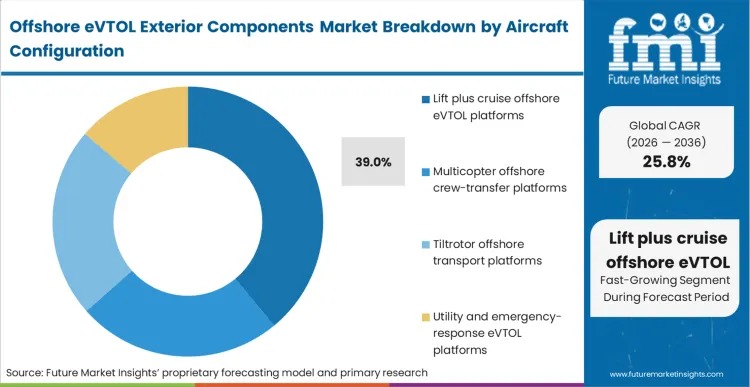
Lift plus cruise offshore eVTOL platforms lead with a 39.0% share as offshore missions demand both accurate vertical landing and strong over-water range. Operators need a configuration that can hover steadily over moving vessels and narrow offshore platforms while also maintaining efficient forward cruise for long-distance transport. FMI’s assessment points to highly specialized transition fairings as a key requirement for reducing drag around static lift rotors during horizontal flight. A pure multicopter design cannot deliver the same range profile and falls short in deep-sea logistics applications.
- Procurement savings: Separating the vertical and forward thrust systems allows developers to simplify flight control software, cutting millions in certification delays.
- Drag penalties: Static vertical rotors create immense aerodynamic drag unless perfectly shrouded by precision-molded composite covers during forward flight.
- Lifecycle efficiency: The fixed-wing cruise phase dramatically reduces battery drain over long maritime distances, lowering the overall cost per passenger transfer.
Offshore eVTOL Exterior Components Market Analysis by Sales Channel
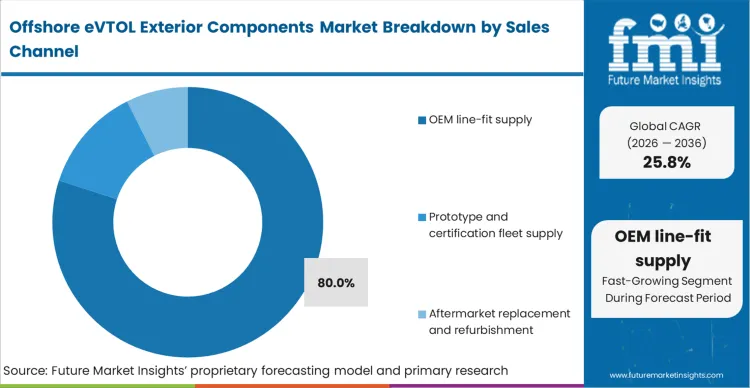
OEM line-fit supply commands 80.0% of the value because procurement teams are still focused on assembling the first sets of conforming test articles rather than supporting a mature replacement market. Aftermarket demand remains extremely limited, as commercial offshore fleets have not yet accumulated the service hours necessary to require new outer shells, replacement structural surfaces, or additional aerospace adhesives. FMI analysts indicate that purchasing behavior across major offshore eVTOL component suppliers is concentrated almost entirely on securing massive forward contracts that keep complex outer panels flowing into final assembly without delay or disruption. If a reliable line-fit supply framework is not established early, severe bottlenecks can form across the production system, leaving millions of dollars worth of internal aircraft components idle on the factory floor.
- First-mover advantage: Suppliers who integrate their products into the primary aircraft design capture the entire initial production volume.
- Follow-on transitions: As fleets enter service and log thousands of over-water hours, the data gathered from line-fit performance will dictate future aftermarket repair protocols.
- Laggard conversion: Maintenance depots will eventually transition to servicing these components, but only after initial line-fit warranties expire and ramp damage accumulates.
Offshore eVTOL Exterior Components Market Analysis by End Use
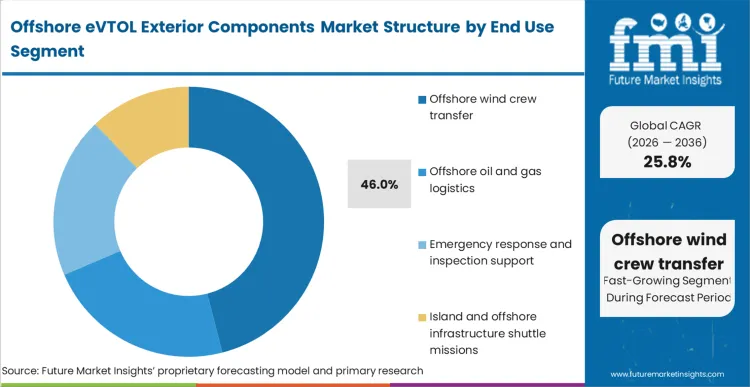
The incumbent approach of utilizing heavy helicopters for routine maintenance tasks fails to align with the cost-reduction mandates of modern renewable energy, driving Offshore wind crew transfer to a 46.0% share. Logistics operators are seeking an offshore helicopter replacement eVTOL solution, displacing expensive twin-engine rotorcraft with highly efficient electric aircraft for daily technician transfers. As per FMI's projection, securing reliable offshore crew transfer eVTOL components is critical because this specific mission profile requires aircraft to undergo rapid, high-frequency turnaround cycles in highly corrosive environments. Operators who deploy standard urban platforms for this punishing role will face immediate, catastrophic structural degradation.
- Specialized tier capabilities: Tier-one aerospace suppliers capable of delivering true marine-grade composite shells dominate this specialized supply chain.
- Capacity constraints: Producing advanced composites at the scale required for global offshore wind expansion remains a significant manufacturing bottleneck.
- Long-term consolidation: By 2036, the supply base will consolidate around a few dominant vendors capable of merging maritime durability with automated aviation production rates.
Offshore eVTOL Exterior Components Market Drivers, Restraints, and Opportunities
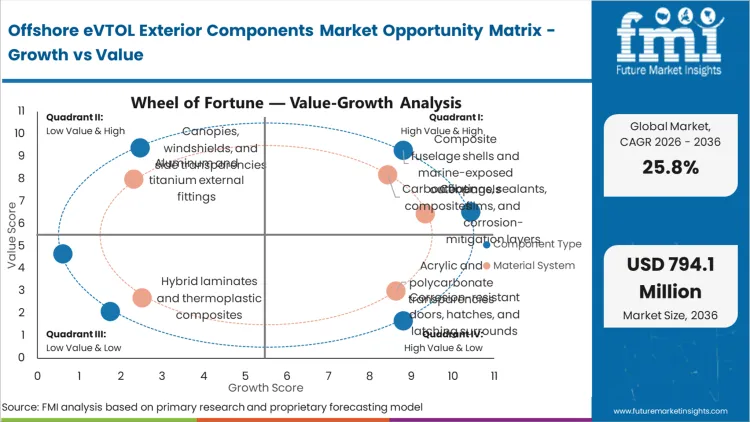
The expansion of offshore wind capacity is laying the groundwork for the offshore wind eVTOL exterior systems market, as logistics operators look to reduce dependence on expensive legacy helicopter contracts and qualify more efficient electric aircraft. This shift is driving procurement teams toward heavy-duty exterior components that can meet the strict weight limits of battery-powered platforms while resisting salt fog, deck-handling shocks, and continuous particulate wear from offshore conditions. The economic pressure is significant, since any failure to adopt marine-hardened exterior structures can ground aircraft early and weaken the narrow margins that support offshore shuttle operations.
Supply chain acceleration is being slowed most by the organizational burden of dual aerospace and marine qualification. Lightweight materials intended for urban aircraft use must complete years of accelerated weathering, flammability, and salt-spray testing before maritime classification societies allow them into offshore passenger service. Rapid-cure resins are emerging as a promising option, though the deeper issue remains the pace of testing and approval. That pressure forces developers to lock exterior material decisions earlier than ideal, leaving less room to introduce newer composite technologies into the first production wave.
Opportunities in the Offshore eVTOL Exterior Components Market
- Thermoplastic Composite Stamping: The intense demand for high-volume production enables the adoption of thermoplastic composites. Suppliers who validate rapid stamp-forming techniques capture massive line-fit contracts by drastically reducing the time required to mold complex rotor fairings.
- Integrated Conductive Layers: Managing harsh weather over open water requires exceptional lightning strike protection. Manufacturers who embed metallic meshes directly into the outer composite skins eliminate the need for heavy secondary shielding, securing preferred vendor status.
- Field-Deployable Surface Repairs: Continuous deck handling inevitably causes surface damage. Developing aviation-grade, peel-and-stick elastomeric patches empowers offshore mechanics to perform permanent structural repairs on the rig, avoiding costly return trips to onshore depots.
Regional Analysis
Based on the regional analysis, the Offshore eVTOL Exterior Components Market is segmented into North America, Europe, Asia Pacific, and Rest of the World across 40 plus countries.
.webp "Top Country Growth Comparison Offshore Evtol Exterior Components Market Cagr (2026 2036)")
| Country | CAGR (2026 to 2036) |
|---|---|
| China | 28.8% |
| United States | 27.5% |
| United Kingdom | 24.6% |
| Germany | 24.1% |
| United Arab Emirates | 23.8% |
| India | 22.9% |
| Japan | 22.4% |
Source: Future Market Insights (FMI) analysis, based on proprietary forecasting model and primary research
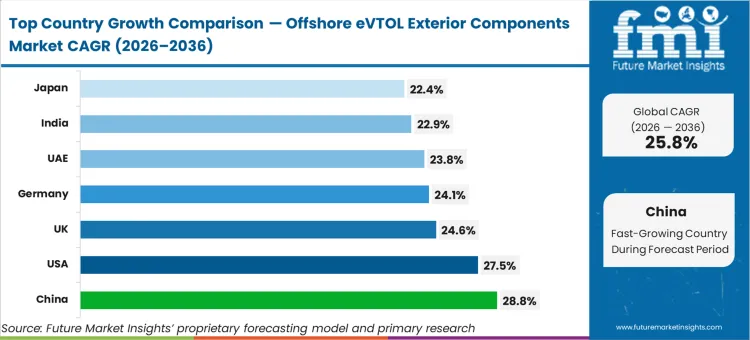
Asia Pacific Offshore eVTOL Exterior Components Market Analysis
The adoption curve across Asia Pacific is being set by centralized industrial policy, with major state-backed spending on offshore wind infrastructure feeding directly into domestic aviation commercialization plans. In contrast with Western markets that require broad harmonization across several jurisdictions, regulators in the region are relying on closed pilot ecosystems to accelerate validation of marine-capable autonomous eVTOL platforms. FMI estimates that this localized approach gives domestic manufacturers room to scale ruggedized composite output around committed regional offshore logistics contracts, while avoiding the slower airspace integration debates affecting other markets. Existing capabilities in maritime construction and automotive carbon fiber continue to strengthen the region’s manufacturing response.
- China: China's aggressive push to dominate global offshore wind capacity forces domestic logistics operators to rapidly deploy electric crew-transfer platforms. The China offshore eVTOL exterior systems market is set to achieve a CAGR of 28.8%. This massive, centralized demand positions Chinese tier-one suppliers to capture the first global economies of scale, eventually allowing them to export marine-hardened exterior components at highly disruptive price points.
- India: Lacking deep legacy aerospace infrastructure, domestic aviation startups leverage strategic technology transfer agreements with established global engineering firms to import critical marine-grade formulation expertise. Demand for offshore hardware in India is estimated to expand at a CAGR of 22.9%. The structural trajectory points toward India building robust domestic out-of-autoclave manufacturing capabilities, gradually transitioning from importing ruggedized shells to serving as an independent hub for maritime mobility components.
- Japan: Japanese materials conglomerates face the immediate requirement to adapt their world-class carbon fiber weaving capabilities to meet dual maritime and aviation certification standards. Japan's offshore exterior component sector is forecast to observe a CAGR of 22.4%. Securing these requalification gates allows legacy Japanese industrial giants to seamlessly integrate into the global aircraft electrification supply chain, establishing a formidable competitive positioning in high-end transparencies and sealants.
FMI’s report covers emerging markets across Southeast Asia and Oceania in considerable detail. Across these secondary nations, priority remains on expanding onshore vertiports infrastructure for imported offshore fleets rather than establishing indigenous composite manufacturing capabilities.
North America and Europe Offshore eVTOL Exterior Components Market Analysis
The procurement environment across North America and Europe is strongly influenced by the physical demands of mature offshore energy infrastructure. Developers must maintain support for large, aging oil and gas platforms while also scaling operations around rapidly growing deep-water wind projects. FMI projects that this commercial pressure is leading aircraft integrators to consolidate supply chains and rely exclusively on established aerospace tier-one suppliers that already operate with dual-certified marine and aviation quality management systems. Procurement teams are directing major attention toward derisking automated fiber placement so higher volumes of high performance composites can be produced without affecting the rigorous safety margins required by Western offshore regulators.
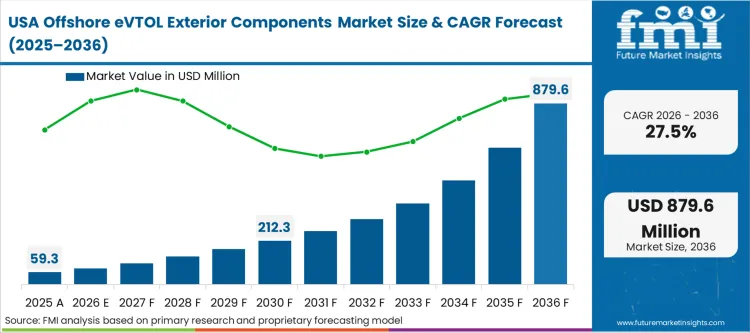
- United States: The United States offshore eVTOL exterior components market leverages concurrent military validation programs and aggressive DOT pilot expansions to drastically accelerate the maturity of its domestic aerostructure supply chain. This strategic alignment empowers domestic developers to cycle marine-grade composite fairings through punishing flight profiles. The US landscape is poised to advance at a 27.5% CAGR. This dual-use strategy secures a massive competitive positioning advantage, clearing the operational bottleneck of producing conforming test articles and pushing American OEMs toward immediate offshore commercialization.
- United Kingdom: The massive concentration of North Sea wind farms obligates British logistics operators to demand highly specialized, weather-resilient exterior structures capable of continuous operation in severe gales. The United Kingdom offshore eVTOL exterior market is set to expand at a 24.6% CAGR. This regulatory and environmental focus delivers a distinct operational outcome: British structural engineering firms prioritize extreme aerodynamic stability and anti-corrosion sealing, establishing the global durability benchmark for harsh-weather maritime platforms.
- Germany: Germany's legacy stronghold in precision chemical formulation and wind-energy engineering requires specialized adaptation to meet the exacting documentation standards of commercial offshore aviation. Within the Germany offshore eVTOL exterior systems market, procurement directors actively validate low-VOC marine aerospace coatings that preserve composite integrity under high cyclic loading. Germany is anticipated to post a CAGR of 24.1%. Companies that successfully map their high-volume synthesis expertise to maritime safety standards capture a massive commercial opportunity in the burgeoning Baltic Sea logistics networks.
FMI's report includes comprehensive tracking of secondary European aerospace hubs like Norway and France. These nations leverage their deep heritage in maritime helicopter operations to provide highly specialized dynamic rotor-blade coatings and structural expertise to the broader market.
Middle East Offshore eVTOL Exterior Components Market Analysis
A combination of buyer behavior and extreme wealth concentration defines how the Middle East is approaching advanced maritime mobility. Regional investment is being directed toward ultra-luxury island shuttles and hard-working offshore oil and gas logistics systems that require stronger operational resilience. FMI’s assessment shows that this market structure shifts procurement sharply toward solutions built for extreme durability. Integrators supplying fleets into the region must adapt standard composite protection systems to endure severe solar radiation, intense heat, and the abrasive effects of desert sand mixed with salt fog. The structural priority centers on specialized evtol charging facilities and heavy-duty elastomeric films that help safeguard critical airframe integrity in harsh environments.
- United Arab Emirates: Sovereign commitments establishing luxury offshore island networks and advanced maritime logistics by 2026 obligate operators in the UAE to demand severe environmental modifications from their global suppliers. Fleet managers face the intense practitioner reality of maintaining composite structural integrity and battery thermal efficiency under relentless solar baking and salt exposure. Over the forecast period, UAE demand is expected to track a 23.8% CAGR. Successfully solving these extreme thermal and abrasive challenges commercially positions fleets operating in the Emirates as the definitive proving ground for environmental resilience.
FMI's report includes adjacent analysis of Saudi Arabia's coastal mega-projects. These massive maritime development zones are integrating bespoke aerial mobility infrastructure directly into their architectural blueprints, establishing centralized procurement models for customized heavy-duty fleets.
Competitive Aligners for Market Players
The competitive landscape exhibits a highly concentrated structure governed by the immense capital required to achieve dual aerospace and maritime certification. When determining who supplies offshore eVTOL exterior components, procurement directors at major powered-lift OEMs cannot risk sourcing critical exterior structures from unproven vendors, regardless of cost savings. The primary variable used to distinguish qualified offshore air taxi exterior suppliers from the broader industrial composites market is their existing possession of verifiable aerospace material traceability systems combined with rigorous offshore salt-spray testing dossiers. Companies like PPG Aerospace, FACC AG, and GKN Aerospace dominate because they absorb these massive upfront qualification costs and guarantee that every manufactured shell matches the approved marine type-design exactly.
Decades of close alignment with civil aviation authorities and maritime classification societies keep incumbent suppliers in a strong structural position. Providers such as Syensqo, Hexcel Corporation, and AkzoNobel Aerospace Coatings have built extensive statistical databases around environmental weathering and composite flex fatigue, which makes their aircraft composite materials the preferred option for developers trying to streamline dual certification. A challenger aiming to replicate that credibility must create a deep coupon-testing database proving material resilience across millions of simulated flight cycles and extended saltwater submersion. Those that embed automated rapid-cure capabilities into component layup workflows gain a clear architectural advantage.
As the market accelerates toward 2036, the structural tension between developers demanding automotive-style production rates and tier-one chemical suppliers constrained by traditional aerospace batch methodologies will define the competitive trajectory. Integrators actively attempt to resist supplier lock-in by designing modular exterior panels that can be sourced from multiple regional manufacturers. However, the extreme performance tolerances required for advanced electric propulsion aircraft survival in marine boundary layers ensure that the upper tier of the supply chain remains highly concentrated, allowing established primes to capture the vast majority of recurring line-fit revenue.
Key Players in Offshore eVTOL Exterior Components Market
- PPG Aerospace
- FACC AG
- GKN Aerospace
- Syensqo
- Hexcel Corporation
- AkzoNobel Aerospace Coatings
- Mankiewicz
Scope of the Report
| Metric | Value |
|---|---|
| Quantitative Units | USD 80 million to USD 790 million, at a CAGR of 25.8% |
| Market Definition | The specialized, marine-hardened aerodynamic structures, transition covers, and protective surface layers engineered to enclose and shield powered-lift aircraft operating in maritime environments. |
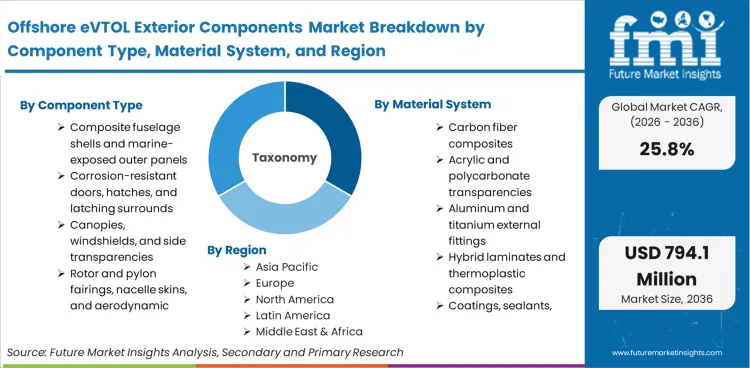
| Component Type Segmentation | Composite fuselage shells and marine-exposed outer panels, Corrosion-resistant doors, hatches, and latching surrounds, Canopies, windshields, and side transparencies, Rotor and pylon fairings, nacelle skins, and aerodynamic covers, Landing gear external fairings and splash-exposed housings, Exterior lighting housings, radome covers, seals, and protective films |
| Material System Segmentation | Carbon fiber composites, Acrylic and polycarbonate transparencies, Aluminum and titanium external fittings, Hybrid laminates and thermoplastic composites, Coatings, sealants, films, and corrosion-mitigation layers |
| Aircraft Configuration Segmentation | Lift plus cruise offshore eVTOL platforms, Multicopter offshore crew-transfer platforms, Tiltrotor offshore transport platforms, Utility and emergency-response eVTOL platforms |
| Sales Channel Segmentation | OEM line-fit supply, Prototype and certification fleet supply, Aftermarket replacement and refurbishment |
| End Use Segmentation | Offshore wind crew transfer, Offshore oil and gas logistics, Emergency response and inspection support, Island and offshore infrastructure shuttle missions |
| Regions Covered | North America, Europe, Asia Pacific, Rest of the World |
| Countries Covered | China, United States, United Kingdom, Germany, United Arab Emirates, India, Japan, and 40 plus countries |
| Key Companies Profiled | PPG Aerospace, FACC AG, GKN Aerospace, Syensqo, Hexcel Corporation, AkzoNobel Aerospace Coatings, Mankiewicz |
| Forecast Period | 2026 to 2036 |
| Approach | Procurement directors, offshore logistics operators, and certification engineers were interviewed. Sizing anchors to near-term eVTOL production signals and offshore wind deployment rates. Forecasts are validated against supplier capacity expansions and maritime energy capital expenditure models. |
Source: Future Market Insights (FMI) analysis, based on proprietary forecasting model and primary research
Offshore eVTOL Exterior Components Market Analysis by Segments
Component Type:
- Composite fuselage shells and marine-exposed outer panels
- Corrosion-resistant doors, hatches, and latching surrounds
- Canopies, windshields, and side transparencies
- Rotor and pylon fairings, nacelle skins, and aerodynamic covers
- Landing gear external fairings and splash-exposed housings
- Exterior lighting housings, radome covers, seals, and protective films
Material System:
- Carbon fiber composites
- Acrylic and polycarbonate transparencies
- Aluminum and titanium external fittings
- Hybrid laminates and thermoplastic composites
- Coatings, sealants, films, and corrosion-mitigation layers
Aircraft Configuration:
- Lift plus cruise offshore eVTOL platforms
- Multicopter offshore crew-transfer platforms
- Tiltrotor offshore transport platforms
- Utility and emergency-response eVTOL platforms
Sales Channel:
- OEM line-fit supply
- Prototype and certification fleet supply
- Aftermarket replacement and refurbishment
End Use:
- Offshore wind crew transfer
- Offshore oil and gas logistics
- Emergency response and inspection support
- Island and offshore infrastructure shuttle missions
Region:
- North America
- United States
- Canada
- Europe
- Germany
- United Kingdom
- France
- Italy
- Spain
- Asia Pacific
- China
- Japan
- South Korea
- Taiwan
- Singapore
- Latin America
- Brazil
- Mexico
- Argentina
- Middle East & Africa
- GCC Countries
- South Africa
Bibliography
- Federal Aviation Administration. (2026, March 9). Future of aviation is here: DOT and FAA unveil eight eVTOL integration pilot projects. U.S. Department of Transportation / Federal Aviation Administration.
- EHang Holdings Limited. (2026, March 12). EHang reports fourth quarter and fiscal year 2025 unaudited financial results.
- Joby Aviation. (2026, March 9). Joby to begin U.S. operations in 2026 under White House air taxi program.
- NHV Group. (2025, April 23). NHV introduces SAF for offshore operations in cooperation with Vestas.
- PPG Aerospace. (2025). Electric vertical take-off and landing (eVTOL).
- U.S. Department of Transportation. (2025, December 17). The Advanced Air Mobility National Strategy.
This bibliography is provided for reader reference. The full FMI report contains the complete reference list with primary source documentation.
This Report Addresses
- Market intelligence to support strategic decision making across marine-grade composites, corrosion-tolerant fairings, and ruggedized exterior systems
- Market size estimation and 10-year revenue forecasts from 2026 to 2036, supported by baseline anchoring to near-term eVTOL production signals and declared offshore pilot programs
- Growth opportunity mapping across lift plus cruise architectures with emphasis on the finalization of marine-specific type-certification standards for powered-lift aircraft
- Segment and regional revenue forecasts covering offshore wind crew transfer operations across highly corrosive maritime environments
- Competition strategy assessment including verifiable aerospace material traceability systems, offshore salt-spray testing dossiers, and automated fiber placement processes
- Technology development tracking including thermoplastic composite stamping, integrated conductive layers, and field-deployable elastomeric patches
- Market access analysis covering dual aerospace-marine certification pathways, classification society mandates, and FAA pilot program integration
- Market report delivery in PDF, Excel, PPT, and interactive dashboard formats for executive strategy, offshore logistics planning, and operational benchmarking use
Frequently Asked Questions
How big is the offshore evtol exterior components market?
The sector is valued at USD 80 million in 2026. This figure reflects the initial capital deployed by aerospace OEMs to secure marine-grade structural materials for their first conforming prototype fleets designated for offshore testing.
Estimate the offshore evtol exterior components market by 2036?
The valuation reaches USD 790 million by 2036. This scale signals the transition from bespoke engineering projects to standardized, high-volume production of ruggedized air taxis tailored specifically for maritime logistics.
What is included in offshore evtol exterior components?
The scope encompasses marine-exposed outer panels, corrosion-resistant doors, specialized aerodynamic fairings, splash-exposed landing gear housings, acrylic canopies, heavy-duty radome covers, and the specific elastomeric films and marine sealants applied to the outer mold line.
Explain the value chain for offshore evtol exterior systems?
The value chain begins with raw material and chemical suppliers providing carbon prepregs and marine-grade sealants. These flow to tier-one aerospace structural integrators who automate the molding and curing of robust outer shells, before shipping them to the eVTOL OEM for final assembly and marine certification testing.
Compare offshore evtol exteriors with urban evtol exteriors?
While urban eVTOL platforms utilize lightweight, standard aerospace fairings aimed purely at aerodynamic efficiency, offshore exteriors must incorporate heavier salt fog resistant aerospace composites, advanced corrosion-mitigation layers, and reinforced shells designed to withstand violent deck landings and continuous marine boundary exposure.
How do offshore conditions change evtol exterior design?
Relentless salt spray, abrasive wind-driven particulate matter, and the physical impacts of offshore helideck handling force engineers to thicken composite layers, integrate heavy-duty elastomeric protective films, and seal every exposed joint with specialized marine-grade chemical barriers to prevent moisture ingress.
Why do offshore evtol aircraft need corrosion resistant exteriors?
Unlike urban environments, the marine boundary layer saturates surfaces with saltwater fog that rapidly penetrates microscopic pores in standard composites. Without highly crosslinked chemical barriers, this moisture causes internal delamination and catastrophic structural fatigue, grounding the aircraft.
Which materials dominate offshore evtol exterior systems?
Carbon fiber composites dominate with a 47.0% share due to their unrivaled strength-to-weight ratio. To survive maritime conditions, these matrices are heavily supplemented with advanced polyurethane topcoats, acrylic transparencies, and specialized titanium fittings that resist galvanic corrosion.
Who supplies offshore evtol exterior components?
The market is led by established tier-one prime contractors including PPG Aerospace, FACC AG, GKN Aerospace, Syensqo, Hexcel Corporation, and AkzoNobel. These companies possess the rare combination of aerospace quality management systems and deep statistical databases on maritime weathering.
Are offshore evtol exterior components mainly OEM line-fit?
Yes, OEM line-fit supply captures 80.0% of the value. The industry is intensely focused on building the first generation of conforming offshore test vehicles, meaning almost all capital is directed toward the primary assembly line rather than aftermarket repair networks.
What drives growth in the offshore evtol exterior market?
The massive capacity expansion of offshore wind installations forces logistics operators to abandon expensive legacy helicopter contracts. Utilizing electric aircraft for daily technician transfers drastically lowers the levelized cost of energy for offshore mega-projects.
What is the primary restraint facing suppliers?
The severe and protracted qualification timeline required for dual aerospace-marine certification limits agility. Specialized lightweight materials must undergo years of accelerated weathering and salt-spray testing before classification societies clear them for maritime passenger transport.
Which country grows fastest?
China expands at 28.8%, structurally outpacing the United States' 27.5%. China leverages centralized industrial policies that seamlessly integrate massive offshore wind capacity directives with rapid domestic aviation commercialization programs.
How do European offshore wind demands shape procurement?
The massive concentration of North Sea wind farms compels British and German logistics operators to demand highly specialized, weather-resilient exterior structures capable of continuous operation in severe marine gales.
Why does the lack of aftermarket demand influence current strategies?
With OEM line-fit capturing 80.0% of the value, suppliers concentrate entirely on guaranteeing factory floor delivery. Capital is deployed toward clearing primary assembly bottlenecks rather than building dispersed offshore maintenance networks.
How do incumbent aerospace tier-ones maintain dominance?
Incumbents hold immense statistical databases of material fatigue testing previously validated by both aviation authorities and maritime classification societies. Challengers cannot replicate this regulatory trust without spending millions to redundantly test new composites.
How does extreme heat in the Middle East alter offshore component design?
Operations in the UAE require severe environmental modifications. Fleets must integrate specialized reflective topcoats and heavy-duty elastomeric films to prevent intense solar radiation and airborne desert sand from degrading sensitive composite structures during offshore transits.
Why are lift plus cruise platforms preferred over pure multicopters for offshore work?
Separating vertical hover rotors from horizontal cruise systems grants the aircraft the extended range necessary to reach deep-water platforms. The fixed-wing cruise phase dramatically reduces battery drain compared to continuous multicopter hovering.
What consequence do eVTOL developers face if they delay supplier lock-in?
Failing to secure production slots at established aerospace tier-ones leaves developers without conforming, marine-rated test hardware. Without these physical articles, offshore certification flights halt entirely, jeopardizing lucrative logistics contracts.
Why do structural engineers reject aluminum for the primary offshore fuselage?
Legacy metallic structures consume too much of the total weight allowance and are highly susceptible to galvanic corrosion in saltwater environments. Eliminating heavy metals is the only reliable way to preserve payload margins.
What role do rapid-cure bonding systems play in offshore fleet maintenance?
Continuous deck handling inevitably causes surface damage. Fleet operators require advanced room-temperature curing adhesives that allow mechanics to perform localized structural repairs directly on the offshore platform, eliminating costly depot returns.
How does US regulatory expansion derisk commercial offshore structures?
Aggressive FAA pilot expansions and non-dilutive defense contracts allow operators to cycle marine-grade composite fairings through punishing flight profiles. This generates vital fatigue data for civil compliance without burning private venture capital.
Preview the report firsthand - request a free sample
Get SampleGet the brochure for pricing and purchase details.
Get PDFTable of Content
- Executive Summary
- Global Market Outlook
- Demand-side Trends
- Supply-side Trends
- Technology Roadmap Analysis
- Analysis and Recommendations
- Market Overview
- Market Coverage / Taxonomy
- Market Definition / Scope / Limitations
- Research Methodology
- Chapter Orientation
- Analytical Lens and Working Hypotheses
- Market Structure, Signals, and Trend Drivers
- Benchmarking and Cross-market Comparability
- Market Sizing, Forecasting, and Opportunity Mapping
- Research Design and Evidence Framework
- Desk Research Programme (Secondary Evidence)
- Company Annual and Sustainability Reports
- Peer-reviewed Journals and Academic Literature
- Corporate Websites, Product Literature, and Technical Notes
- Earnings Decks and Investor Briefings
- Statutory Filings and Regulatory Disclosures
- Technical White Papers and Standards Notes
- Trade Journals, Industry Magazines, and Analyst Briefs
- Conference Proceedings, Webinars, and Seminar Materials
- Government Statistics Portals and Public Data Releases
- Press Releases and Reputable Media Coverage
- Specialist Newsletters and Curated Briefings
- Sector Databases and Reference Repositories
- FMI Internal Proprietary Databases and Historical Market Datasets
- Subscription Datasets and Paid Sources
- Social Channels, Communities, and Digital Listening Inputs
- Additional Desk Sources
- Expert Input and Fieldwork (Primary Evidence)
- Primary Modes
- Qualitative Interviews and Expert Elicitation
- Quantitative Surveys and Structured Data Capture
- Blended Approach
- Why Primary Evidence is Used
- Field Techniques
- Interviews
- Surveys
- Focus Groups
- Observational and In-context Research
- Social and Community Interactions
- Stakeholder Universe Engaged
- C-suite Leaders
- Board Members
- Presidents and Vice Presidents
- R&D and Innovation Heads
- Technical Specialists
- Domain Subject-matter Experts
- Scientists
- Physicians and Other Healthcare Professionals
- Governance, Ethics, and Data Stewardship
- Research Ethics
- Data Integrity and Handling
- Primary Modes
- Tooling, Models, and Reference Databases
- Desk Research Programme (Secondary Evidence)
- Data Engineering and Model Build
- Data Acquisition and Ingestion
- Cleaning, Normalisation, and Verification
- Synthesis, Triangulation, and Analysis
- Quality Assurance and Audit Trail
- Market Background
- Market Dynamics
- Drivers
- Restraints
- Opportunity
- Trends
- Scenario Forecast
- Demand in Optimistic Scenario
- Demand in Likely Scenario
- Demand in Conservative Scenario
- Opportunity Map Analysis
- Product Life Cycle Analysis
- Supply Chain Analysis
- Investment Feasibility Matrix
- Value Chain Analysis
- PESTLE and Porter’s Analysis
- Regulatory Landscape
- Regional Parent Market Outlook
- Production and Consumption Statistics
- Import and Export Statistics
- Market Dynamics
- Global Market Analysis 2021 to 2025 and Forecast, 2026 to 2036
- Historical Market Size Value (USD Million) Analysis, 2021 to 2025
- Current and Future Market Size Value (USD Million) Projections, 2026 to 2036
- Y-o-Y Growth Trend Analysis
- Absolute $ Opportunity Analysis
- Global Market Pricing Analysis 2021 to 2025 and Forecast 2026 to 2036
- Global Market Analysis 2021 to 2025 and Forecast 2026 to 2036, By Component Type
- Introduction / Key Findings
- Historical Market Size Value (USD Million) Analysis By Component Type , 2021 to 2025
- Current and Future Market Size Value (USD Million) Analysis and Forecast By Component Type , 2026 to 2036
- Composite fuselage shells and marine-exposed outer panels
- Corrosion-resistant doors, hatches, and latching surrounds
- Canopies, windshields, and side transparencies
- Rotor and pylon fairings, nacelle skins, and aerodynamic covers
- Landing gear external fairings and splash-exposed housings
- Exterior lighting housings, radome covers, seals, and protective films
- Composite fuselage shells and marine-exposed outer panels
- Y-o-Y Growth Trend Analysis By Component Type , 2021 to 2025
- Absolute $ Opportunity Analysis By Component Type , 2026 to 2036
- Global Market Analysis 2021 to 2025 and Forecast 2026 to 2036, By Material System
- Introduction / Key Findings
- Historical Market Size Value (USD Million) Analysis By Material System, 2021 to 2025
- Current and Future Market Size Value (USD Million) Analysis and Forecast By Material System, 2026 to 2036
- Carbon fiber composites
- Acrylic and polycarbonate transparencies
- Aluminum and titanium external fittings
- Hybrid laminates and thermoplastic composites
- Coatings, sealants, films, and corrosion-mitigation layers
- Carbon fiber composites
- Y-o-Y Growth Trend Analysis By Material System, 2021 to 2025
- Absolute $ Opportunity Analysis By Material System, 2026 to 2036
- Global Market Analysis 2021 to 2025 and Forecast 2026 to 2036, By Aircraft Configuration
- Introduction / Key Findings
- Historical Market Size Value (USD Million) Analysis By Aircraft Configuration, 2021 to 2025
- Current and Future Market Size Value (USD Million) Analysis and Forecast By Aircraft Configuration, 2026 to 2036
- Lift plus cruise offshore eVTOL platforms
- Multicopter offshore crew-transfer platforms
- Tiltrotor offshore transport platforms
- Utility and emergency-response eVTOL platforms
- Lift plus cruise offshore eVTOL platforms
- Y-o-Y Growth Trend Analysis By Aircraft Configuration, 2021 to 2025
- Absolute $ Opportunity Analysis By Aircraft Configuration, 2026 to 2036
- Global Market Analysis 2021 to 2025 and Forecast 2026 to 2036, By Sales Channel
- Introduction / Key Findings
- Historical Market Size Value (USD Million) Analysis By Sales Channel, 2021 to 2025
- Current and Future Market Size Value (USD Million) Analysis and Forecast By Sales Channel, 2026 to 2036
- OEM line-fit supply
- Prototype and certification fleet supply
- Aftermarket replacement and refurbishment
- OEM line-fit supply
- Y-o-Y Growth Trend Analysis By Sales Channel, 2021 to 2025
- Absolute $ Opportunity Analysis By Sales Channel, 2026 to 2036
- Global Market Analysis 2021 to 2025 and Forecast 2026 to 2036, By End Use
- Introduction / Key Findings
- Historical Market Size Value (USD Million) Analysis By End Use, 2021 to 2025
- Current and Future Market Size Value (USD Million) Analysis and Forecast By End Use, 2026 to 2036
- Offshore wind crew transfer
- Offshore oil and gas logistics
- Emergency response and inspection support
- Island and offshore infrastructure shuttle missions
- Offshore wind crew transfer
- Y-o-Y Growth Trend Analysis By End Use, 2021 to 2025
- Absolute $ Opportunity Analysis By End Use, 2026 to 2036
- Global Market Analysis 2021 to 2025 and Forecast 2026 to 2036, By Region
- Introduction
- Historical Market Size Value (USD Million) Analysis By Region, 2021 to 2025
- Current Market Size Value (USD Million) Analysis and Forecast By Region, 2026 to 2036
- North America
- Latin America
- Western Europe
- Eastern Europe
- East Asia
- South Asia and Pacific
- Middle East & Africa
- Market Attractiveness Analysis By Region
- North America Market Analysis 2021 to 2025 and Forecast 2026 to 2036, By Country
- Historical Market Size Value (USD Million) Trend Analysis By Market Taxonomy, 2021 to 2025
- Market Size Value (USD Million) Forecast By Market Taxonomy, 2026 to 2036
- By Country
- USA
- Canada
- Mexico
- By Component Type
- By Material System
- By Aircraft Configuration
- By Sales Channel
- By End Use
- By Country
- Market Attractiveness Analysis
- By Country
- By Component Type
- By Material System
- By Aircraft Configuration
- By Sales Channel
- By End Use
- Key Takeaways
- Latin America Market Analysis 2021 to 2025 and Forecast 2026 to 2036, By Country
- Historical Market Size Value (USD Million) Trend Analysis By Market Taxonomy, 2021 to 2025
- Market Size Value (USD Million) Forecast By Market Taxonomy, 2026 to 2036
- By Country
- Brazil
- Chile
- Rest of Latin America
- By Component Type
- By Material System
- By Aircraft Configuration
- By Sales Channel
- By End Use
- By Country
- Market Attractiveness Analysis
- By Country
- By Component Type
- By Material System
- By Aircraft Configuration
- By Sales Channel
- By End Use
- Key Takeaways
- Western Europe Market Analysis 2021 to 2025 and Forecast 2026 to 2036, By Country
- Historical Market Size Value (USD Million) Trend Analysis By Market Taxonomy, 2021 to 2025
- Market Size Value (USD Million) Forecast By Market Taxonomy, 2026 to 2036
- By Country
- Germany
- UK
- Italy
- Spain
- France
- Nordic
- BENELUX
- Rest of Western Europe
- By Component Type
- By Material System
- By Aircraft Configuration
- By Sales Channel
- By End Use
- By Country
- Market Attractiveness Analysis
- By Country
- By Component Type
- By Material System
- By Aircraft Configuration
- By Sales Channel
- By End Use
- Key Takeaways
- Eastern Europe Market Analysis 2021 to 2025 and Forecast 2026 to 2036, By Country
- Historical Market Size Value (USD Million) Trend Analysis By Market Taxonomy, 2021 to 2025
- Market Size Value (USD Million) Forecast By Market Taxonomy, 2026 to 2036
- By Country
- Russia
- Poland
- Hungary
- Balkan & Baltic
- Rest of Eastern Europe
- By Component Type
- By Material System
- By Aircraft Configuration
- By Sales Channel
- By End Use
- By Country
- Market Attractiveness Analysis
- By Country
- By Component Type
- By Material System
- By Aircraft Configuration
- By Sales Channel
- By End Use
- Key Takeaways
- East Asia Market Analysis 2021 to 2025 and Forecast 2026 to 2036, By Country
- Historical Market Size Value (USD Million) Trend Analysis By Market Taxonomy, 2021 to 2025
- Market Size Value (USD Million) Forecast By Market Taxonomy, 2026 to 2036
- By Country
- China
- Japan
- South Korea
- By Component Type
- By Material System
- By Aircraft Configuration
- By Sales Channel
- By End Use
- By Country
- Market Attractiveness Analysis
- By Country
- By Component Type
- By Material System
- By Aircraft Configuration
- By Sales Channel
- By End Use
- Key Takeaways
- South Asia and Pacific Market Analysis 2021 to 2025 and Forecast 2026 to 2036, By Country
- Historical Market Size Value (USD Million) Trend Analysis By Market Taxonomy, 2021 to 2025
- Market Size Value (USD Million) Forecast By Market Taxonomy, 2026 to 2036
- By Country
- India
- ASEAN
- Australia & New Zealand
- Rest of South Asia and Pacific
- By Component Type
- By Material System
- By Aircraft Configuration
- By Sales Channel
- By End Use
- By Country
- Market Attractiveness Analysis
- By Country
- By Component Type
- By Material System
- By Aircraft Configuration
- By Sales Channel
- By End Use
- Key Takeaways
- Middle East & Africa Market Analysis 2021 to 2025 and Forecast 2026 to 2036, By Country
- Historical Market Size Value (USD Million) Trend Analysis By Market Taxonomy, 2021 to 2025
- Market Size Value (USD Million) Forecast By Market Taxonomy, 2026 to 2036
- By Country
- Kingdom of Saudi Arabia
- Other GCC Countries
- Turkiye
- South Africa
- Other African Union
- Rest of Middle East & Africa
- By Component Type
- By Material System
- By Aircraft Configuration
- By Sales Channel
- By End Use
- By Country
- Market Attractiveness Analysis
- By Country
- By Component Type
- By Material System
- By Aircraft Configuration
- By Sales Channel
- By End Use
- Key Takeaways
- Key Countries Market Analysis
- USA
- Pricing Analysis
- Market Share Analysis, 2025
- By Component Type
- By Material System
- By Aircraft Configuration
- By Sales Channel
- By End Use
- Canada
- Pricing Analysis
- Market Share Analysis, 2025
- By Component Type
- By Material System
- By Aircraft Configuration
- By Sales Channel
- By End Use
- Mexico
- Pricing Analysis
- Market Share Analysis, 2025
- By Component Type
- By Material System
- By Aircraft Configuration
- By Sales Channel
- By End Use
- Brazil
- Pricing Analysis
- Market Share Analysis, 2025
- By Component Type
- By Material System
- By Aircraft Configuration
- By Sales Channel
- By End Use
- Chile
- Pricing Analysis
- Market Share Analysis, 2025
- By Component Type
- By Material System
- By Aircraft Configuration
- By Sales Channel
- By End Use
- Germany
- Pricing Analysis
- Market Share Analysis, 2025
- By Component Type
- By Material System
- By Aircraft Configuration
- By Sales Channel
- By End Use
- UK
- Pricing Analysis
- Market Share Analysis, 2025
- By Component Type
- By Material System
- By Aircraft Configuration
- By Sales Channel
- By End Use
- Italy
- Pricing Analysis
- Market Share Analysis, 2025
- By Component Type
- By Material System
- By Aircraft Configuration
- By Sales Channel
- By End Use
- Spain
- Pricing Analysis
- Market Share Analysis, 2025
- By Component Type
- By Material System
- By Aircraft Configuration
- By Sales Channel
- By End Use
- France
- Pricing Analysis
- Market Share Analysis, 2025
- By Component Type
- By Material System
- By Aircraft Configuration
- By Sales Channel
- By End Use
- India
- Pricing Analysis
- Market Share Analysis, 2025
- By Component Type
- By Material System
- By Aircraft Configuration
- By Sales Channel
- By End Use
- ASEAN
- Pricing Analysis
- Market Share Analysis, 2025
- By Component Type
- By Material System
- By Aircraft Configuration
- By Sales Channel
- By End Use
- Australia & New Zealand
- Pricing Analysis
- Market Share Analysis, 2025
- By Component Type
- By Material System
- By Aircraft Configuration
- By Sales Channel
- By End Use
- China
- Pricing Analysis
- Market Share Analysis, 2025
- By Component Type
- By Material System
- By Aircraft Configuration
- By Sales Channel
- By End Use
- Japan
- Pricing Analysis
- Market Share Analysis, 2025
- By Component Type
- By Material System
- By Aircraft Configuration
- By Sales Channel
- By End Use
- South Korea
- Pricing Analysis
- Market Share Analysis, 2025
- By Component Type
- By Material System
- By Aircraft Configuration
- By Sales Channel
- By End Use
- Russia
- Pricing Analysis
- Market Share Analysis, 2025
- By Component Type
- By Material System
- By Aircraft Configuration
- By Sales Channel
- By End Use
- Poland
- Pricing Analysis
- Market Share Analysis, 2025
- By Component Type
- By Material System
- By Aircraft Configuration
- By Sales Channel
- By End Use
- Hungary
- Pricing Analysis
- Market Share Analysis, 2025
- By Component Type
- By Material System
- By Aircraft Configuration
- By Sales Channel
- By End Use
- Kingdom of Saudi Arabia
- Pricing Analysis
- Market Share Analysis, 2025
- By Component Type
- By Material System
- By Aircraft Configuration
- By Sales Channel
- By End Use
- Turkiye
- Pricing Analysis
- Market Share Analysis, 2025
- By Component Type
- By Material System
- By Aircraft Configuration
- By Sales Channel
- By End Use
- South Africa
- Pricing Analysis
- Market Share Analysis, 2025
- By Component Type
- By Material System
- By Aircraft Configuration
- By Sales Channel
- By End Use
- USA
- Market Structure Analysis
- Competition Dashboard
- Competition Benchmarking
- Market Share Analysis of Top Players
- By Regional
- By Component Type
- By Material System
- By Aircraft Configuration
- By Sales Channel
- By End Use
- Competition Analysis
- Competition Deep Dive
- PPG Aerospace
- Overview
- Product Portfolio
- Profitability by Market Segments (Product/Age /Sales Channel/Region)
- Sales Footprint
- Strategy Overview
- Marketing Strategy
- Product Strategy
- Channel Strategy
- FACC AG
- GKN Aerospace
- Syensqo
- Hexcel Corporation
- AkzoNobel Aerospace Coatings
- Mankiewicz
- PPG Aerospace
- Competition Deep Dive
- Assumptions & Acronyms Used


