

- Market Size (2026)
- USD 190.0 Mn
- Forecast (2036)
- USD 363.4 Mn
- CAGR (2026 to 2036)
- 6.7%
Offshore Mooring Line Fatigue Monitoring and Test Equipment Market Size, Market Forecast and Outlook By FMI
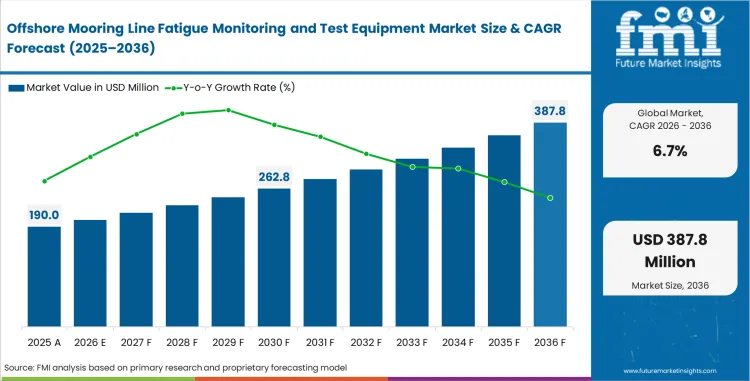
Offshore mooring line fatigue monitoring and test equipment demand crossed a valuation of USD 178.1 million in 2025. Market value is projected to reach USD 190.0 million in 2026, and the category is expected to expand at a CAGR of 6.7% from 2026 to 2036. Total opportunity is likely to rise to USD 363.4 million by 2036 as offshore operators place more weight on earlier fatigue visibility, remaining life assessment, and better control over intervention risk across moored assets.
Summary of Offshore Mooring Line Fatigue Monitoring and Test Equipment Market
- Offshore Mooring Line Fatigue Monitoring and Test Equipment Market Snapshot
- The Offshore Mooring Line Fatigue Monitoring and Test Equipment Market is estimated at USD 178.1 million in 2025 and is projected to reach USD 363.4 million by 2036.
- Industry value is expected to rise from USD 190.0 million in 2026 at a CAGR of 6.7%, creating an incremental opportunity of USD 173.4 million over the forecast period.
- Category scope covers specialist offshore integrity equipment that sits inside wider subsea equipment spending rather than the full mooring hardware chain.
- Commercial relevance comes from earlier fatigue visibility, better remaining-life judgment, and fewer costly offshore interventions.
- Offshore Mooring Line Fatigue Monitoring and Test Equipment Demand and Growth Drivers
- Ageing floating assets keep monitoring demand active because operators need clearer evidence before extending line service life or delaying replacement.
- Use of load and condition data is widening as oil and gas sensor systems become easier to integrate with offshore integrity review.
- Floating wind adds a second demand layer because mooring oversight must scale across a broader base of moving assets in harsher metocean conditions.
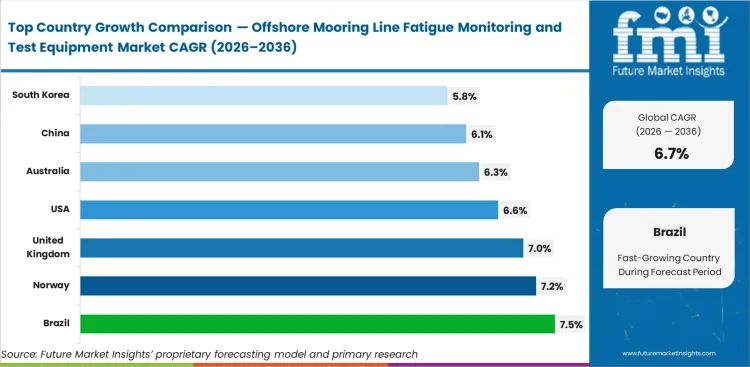
- Brazil leads at 7.5%, followed by Norway at 7.2%, United Kingdom at 7.0%, United States at 6.6%, Australia at 6.3%, China at 6.1%, and South Korea at 5.8% CAGR through 2036.
- Offshore Mooring Line Fatigue Monitoring and Test Equipment Product and Segment View
- Market coverage includes sensing, telemetry, analytics, and lab validation systems built around chain, wire, and rope mooring behavior as well as test programs similar in discipline to marine electronics tester equipment.
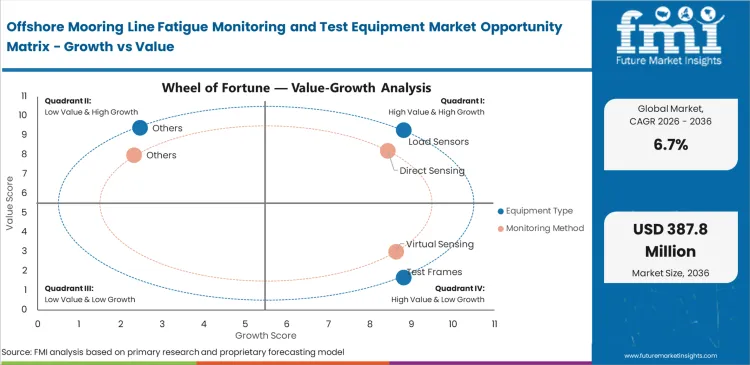
- Load sensors lead the Equipment Type segment with 24.0% share in 2026 because direct line-load capture remains the easiest first step in a monitoring program.
- Direct sensing leads the Monitoring Method segment with 39.0% share because many owners still prefer measured physical evidence before relying on modeled interpretation.
- Fatigue testing is estimated to account for 34.0% share in 2026 within Test Type because remaining-life decisions still need lab-backed confidence.
- Chain lines are expected to represent 42.0% share in 2026 in Line Material, supported by permanent mooring use patterns and inspection needs that remain closely tied to surface contact wire rope and related line technologies.
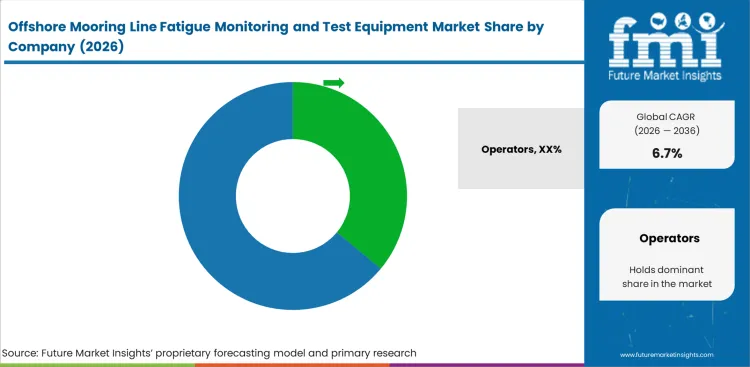
- Deepwater leads Water Depth with 41.0% share, FPSOs lead Application with 31.0%, permanent systems lead Deployment Mode with 58.0%, and operators lead End User with 36.0% share in 2026.
- Offshore Mooring Line Fatigue Monitoring and Test Equipment Geography and Competitive Outlook
- Brazil, Norway, and the United Kingdom form the strongest growth cluster, while the United States remains a steady demand base with a larger integrity-service installed base.
- Competition stays fragmented because buyers compare offshore survivability, analytics quality, testing credibility, and service response rather than one single hardware feature.
- DNV, IMES International, BES Group, AMOG Consulting, BMT, and MSL Oilfield Services remain visible participants across testing, monitoring, and advisory work.
Key Takeaways, Market Size, and Forecast
- Offshore Mooring Line Fatigue Monitoring and Test Equipment Market is projected to grow from USD 190.0 million in 2026 to USD 363.4 million by 2036, at a CAGR of 6.7%.
- The offshore mooring line fatigue monitoring and test equipment market was valued at USD 178.1 million in 2025.
- By 2036, the Offshore Mooring Line Fatigue Monitoring and Test Equipment Market is expected to be worth USD 363.4 million.
- From 2026 to 2036, the market is projected to expand at a CAGR of 6.7%.
- The market is projected to create an incremental opportunity of USD 173.4 million between 2026 and 2036.
- In 2026, Load sensors are expected to account for 24.0% of the equipment type segment.
- Brazil (7.5%) and Norway (7.2%) are two of the fastest growing markets.
Asset owners are being forced to decide whether periodic inspection still gives enough confidence for long-life mooring systems, or whether continuous measurement and interpretation now deserve a permanent place in integrity programs. Choice matters because older floating assets and newer deepwater developments both expose the cost of waiting until line condition becomes uncertain. FMI sees the shift more clearly where floating offshore wind energy broadens the installed base and where life-extension work turns data quality into an operating issue instead of a reporting exercise. One point often missed is that buyers do not pay for more hardware by itself. Confidence rises when monitoring data can support a defensible line-life decision before offshore retrieval becomes the only safe option.
Broader adoption becomes easier once owners can move sensor output into a repeatable integrity workflow instead of treating it as a stand-alone readout. Once engineering review, offshore operations, and service planning start using the same evidence stream, demand for structural health monitoring tools begins to reinforce itself. That gate matters because equipment value increases sharply when the data changes maintenance timing rather than just adding another dashboard.
Brazil is expected to post 7.5% CAGR as permanently moored production assets keep fatigue control tied to uptime risk, while Norway is projected to expand at 7.2% as harsh-water engineering standards keep monitoring quality under close review. United Kingdom is likely to register 7.0% CAGR because floating projects connected with offshore wind widen the need for scalable mooring oversight, and United States is estimated to grow at 6.6% where Gulf integrity work still supports demand for oil and gas sensor systems. Australia is forecast to advance at 6.3%, China at 6.1%, and South Korea at 5.8% as offshore engineering capability expands at different speeds across project pipelines, local service depth, and installed-base maturity.
Segmental Analysis
Offshore Mooring Line Fatigue Monitoring and Test Equipment Market Analysis by Equipment Type
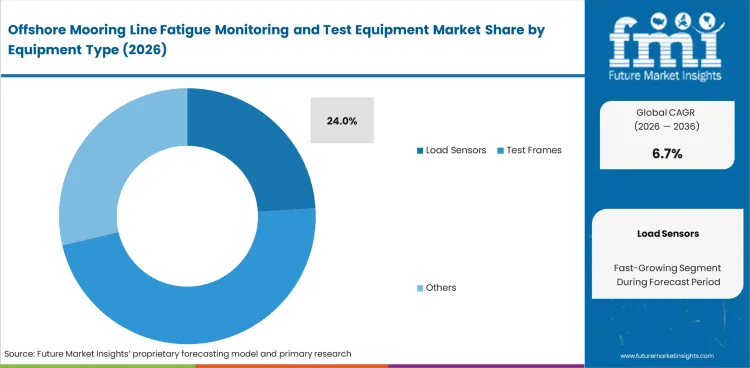
Field users generally prefer hardware that can remain in a harsh marine setting and still send usable information into review cycles without disrupting offshore operations. FMI also finds support for this demand in adjacent sensing areas such as distributed fiber optic sensors, even though mooring applications still favor direct force capture where failure consequences are high. Load sensors are therefore expected to account for 24.0% share in 2026 within the equipment-type segment. That preference remains practical rather than experimental, since later analytics cannot fully correct for poor base measurements. Buyers that delay this step often end up with a weaker fatigue picture and more debate around maintenance timing.
- Direct load path: Force data gives engineers a cleaner starting point for fatigue judgment and reduces ambiguity in later review.
- Higher signal trust: Measured load histories are easier to defend during asset-life assessments than weaker inferred condition signals.
- Stronger marine fit: Hardware that tolerates saltwater exposure and motion earns faster acceptance on permanent offshore systems.
Offshore Mooring Line Fatigue Monitoring and Test Equipment Market Analysis by Monitoring Method
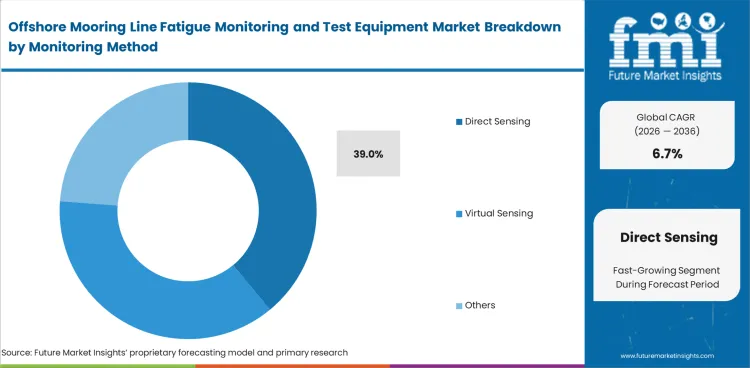
Confidence in line condition still begins with measured evidence on many offshore assets, which keeps direct sensing ahead of more indirect approaches. Owners usually want a trusted baseline before they lean too heavily on modeled interpretation, especially when design assumptions need to be compared against live load behavior. Virtual tools are gaining attention, but many programs still treat them as additions rather than replacements in the first phase of adoption. Direct sensing is expected to represent 39.0% share in 2026 within the monitoring-method segment because it gives owners a clearer basis for judging whether line behavior remains within expectation. That practical preference also explains why tools related to distributed temperature sensing systems and other condition-led methods usually enter through hybrid use rather than through full substitution. Programs that move too quickly into indirect methods may save hardware cost at first, yet they often create more disagreement around what the data means.
- Stronger evidence base: Measured load data shortens debate around whether a line is behaving within design expectation.
- Easier interpretation path: Direct signals are simpler to explain across offshore crews and onshore integrity teams.
- Clearer upgrade route: Owners often add hybrid tools after building trust in direct sensing, not before.
Offshore Mooring Line Fatigue Monitoring and Test Equipment Market Analysis by Test Type
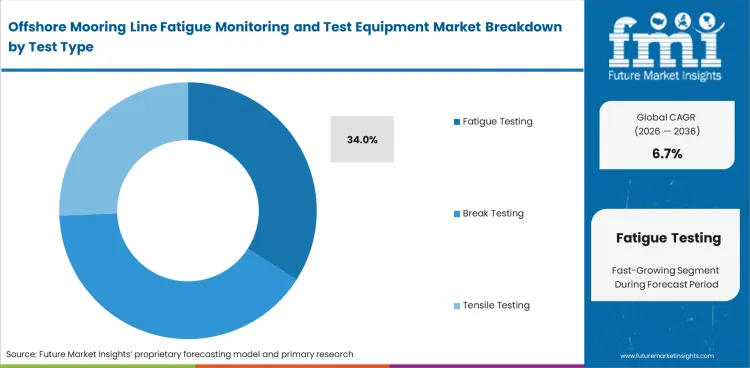
Remaining-life judgment sits at the center of mooring integrity work, so test programs that help evaluate fatigue continue to carry the clearest commercial weight. Break and tensile checks still matter, but they do not answer the timing question as directly as repeated-load validation does when operators are deciding whether service can continue. Buyers place more value on equipment that supports verification under operating stress rather than one-time confirmation alone, and FMI sees a comparable purchase logic in marine electronics, where repeated performance under demanding conditions matters more than a single check. Fatigue testing is estimated to account for 34.0% share in 2026 within the test-type segment because offshore owners want lab evidence before extending duty on lines exposed to long service cycles. Skipping fatigue-focused validation can leave them choosing between early replacement and uncertain continued use.
- Clearer life review: Fatigue tests convert material behavior into a more practical view of remaining service life.
- Better cycle realism: Repeated loading reflects offshore duty more effectively than static checks alone.
- Smarter maintenance timing: Stronger fatigue evidence supports outage planning before offshore work becomes urgent.
Offshore Mooring Line Fatigue Monitoring and Test Equipment Market Analysis by Line Material
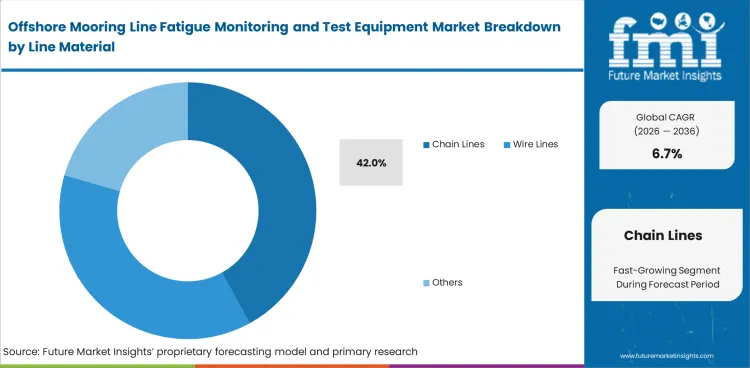
Chain remains the reference material for many permanent mooring layouts, so monitoring and test demand continues to follow how chain links age under repeated offshore loading. Buyers still focus heavily on link wear, corrosion exposure, and fatigue behavior because these factors shape whether a permanent system can stay in service safely for longer intervals. Wire and polyester lines bring their own monitoring needs, yet chain still determines how much testing depth many owners want before making a service decision. Wrong material assumptions can distort the entire monitoring setup and leave operators with a weaker picture of actual line condition. In 2026, chain lines are expected to contribute 42.0% of total line-material share. Permanent systems built around chain also tend to need closer review because small defects can become expensive once offshore intervention is required.
- More visible link behavior: Chain condition is easier to connect with wear and fatigue evidence during life review.
- Heavier inspection burden: Permanent chain systems often need closer assessment than lighter mooring formats.
- Higher replacement cost: Better condition evidence helps avoid poorly timed retrieval campaigns once offshore work becomes necessary.
Offshore Mooring Line Fatigue Monitoring and Test Equipment Market Analysis by Water Depth
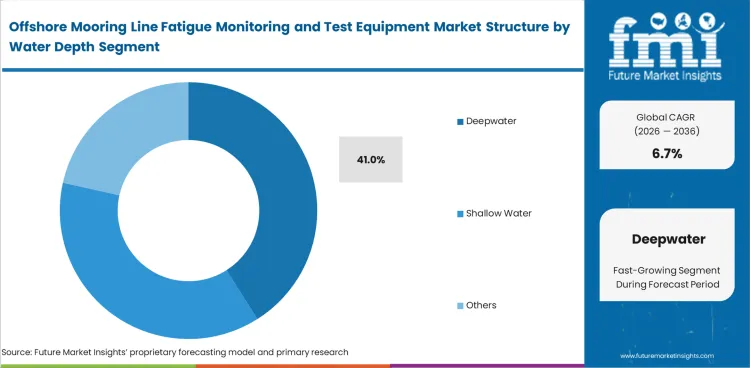
Intervention cost rises sharply once mooring work moves into deeper water, so monitoring value tends to increase before any failure signal becomes obvious at the surface. Owners in deeper developments usually place more weight on early warning because retrieval, replacement, and service logistics become harder to organize as depth increases. Shallower assets can absorb some uncertainty without the same cost penalty, but deepwater systems usually cannot do so comfortably. That operating pressure also makes lab work more valuable when it improves confidence around remaining line life before offshore action is scheduled. Deepwater is projected to hold 41.0% share in 2026 within the water-depth segment. Small condition issues matter more here because late response can turn a routine service plan into a larger integrity event. Monitoring budgets also become easier to defend once the first deepwater intervention cost is visible.
- Greater access difficulty: Deeper assets make physical intervention slower, costlier, and harder to schedule efficiently.
- Earlier risk timing: Small condition changes matter more when offshore correction takes longer to arrange.
- Stronger budget defense: Monitoring spend is easier to justify in deepwater settings once intervention cost is understood.
Offshore Mooring Line Fatigue Monitoring and Test Equipment Market Analysis by Application
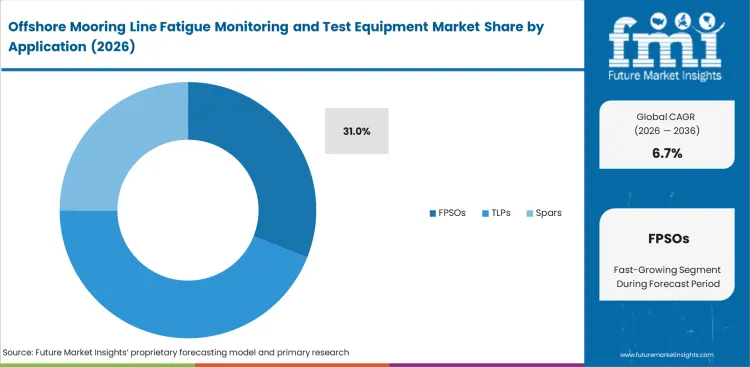
Long-life floating production assets keep this market tied closely to installed-base economics, which is why FPSOs continue to lead application demand. Their mooring systems sit close to uptime, production continuity, and life-extension planning, so operators often see clearer value in continuous condition visibility here than in several other floater types. Semi-subs, TLPs, spars, and floating wind platforms still contribute to demand, but FPSOs create the strongest commercial case for durable monitoring systems. Maintenance logic around low VOC coatings for floating offshore structures points to the same pattern, where hard offshore access and long asset lives keep owners focused on solutions that reduce repeat intervention. FPSOs are expected to account for 31.0% share in 2026 within the application segment because monitoring evidence directly supports operating-horizon decisions. Application choice still matters, since a package designed for an FPSO may be too narrow or too heavy for another floater type. Segment value therefore depends on whether the monitoring system fits the asset service pattern rather than simply matching offshore branding or general marine use.
- Higher uptime pressure: Production-linked assets place a greater cost on unplanned mooring work and service disruption.
- Longer operating horizon: FPSO owners often balance extension decisions against intervention cost and line uncertainty.
- Tighter asset fit: Application-specific design keeps monitoring systems useful through longer operating cycles.
Offshore Mooring Line Fatigue Monitoring and Test Equipment Market Analysis by Deployment Mode
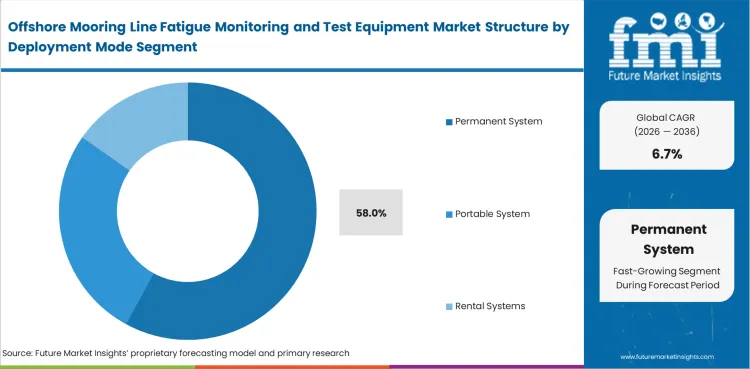
Continuous visibility usually wins when an asset is expected to stay in service for years, which explains why permanent deployment leads this market. Portable and rental units still have a place in targeted verification, but they do not provide the same continuity for interpreting long fatigue trends across normal operating cycles. Owners generally prefer installed systems when service discipline, uptime, and review consistency matter every day rather than during one campaign window alone. FMI sees a similar buying logic in oil and gas flow control equipment, where fixed systems attract stronger demand when control must remain stable over long periods. Permanent systems are estimated to represent 58.0% share in 2026 within the deployment-mode segment because long-life floaters benefit more from steady condition history than from short-term readings. Relying too heavily on temporary deployment in this setting can leave large gaps between one observation window and the next. Segment value depends on how well the equipment preserves condition history across routine operations instead of offering only intermittent proof points.
- Longer continuity window: Permanent systems keep condition history intact across normal operating cycles and review periods.
- Steadier service rhythm: Continuous data supports planned maintenance rather than reactive offshore visits.
- Stronger use discipline: Installed systems are easier to build into routine integrity review than temporary gear.
Offshore Mooring Line Fatigue Monitoring and Test Equipment Market Analysis by End User
Operating responsibility usually determines who spends first in this niche, so end-user leadership remains with the asset owner rather than with outside service groups. EPC firms, OEMs, inspectors, test labs, and class-related bodies still influence equipment choice, but the strongest spending logic stays closest to the party carrying downtime risk and line-life uncertainty. Owners also tend to decide how much evidence is sufficient before maintenance or intervention begins, which keeps their role more commercially decisive than advisory participants. Demand patterns near subsea navigation and tracking show a similar logic, where continuous field responsibility shapes technology budgets more directly than external guidance do. Operators are likely to account for 36.0% share in 2026 within the end-user segment because the cost of line uncertainty falls on them first. When the main user does not remain closely involved, monitoring programs can lose focus and drift into data collection with limited operating effect. Segment value depends on whether the party using the data also has authority to convert it into action offshore.
- Clearer ownership risk: Asset owners feel the cost of line uncertainty first and usually commit budget more directly.
- Faster decision control: End users tend to decide how much evidence is enough before acting on warning signals.
- Stronger operational use: Monitoring data has more value when the main user can turn it into maintenance timing.
Offshore Mooring Line Fatigue Monitoring and Test Equipment Market Drivers, Restraints, and Opportunities
Early action on mooring conditions has become harder to postpone because offshore owners now face a more direct choice between steady visibility and late-stage intervention. Ageing floating assets keep pushing that choice into routine operating decisions. When line behavior is not understood early enough, even a small concern can turn into a larger service problem because offshore access is limited and shutdown costs rise quickly. Floating wind adds another layer because wider deployment increases the need for repeatable monitoring logic across moving assets. Demand is also helped by adjacent sensing categories such as gas sensors, where safety-led instrumentation has already trained buyers to value earlier warning over delayed confirmation.
Internal agreement across engineering, offshore operations, and maintenance planning still slows wider adoption than hardware interest does. Each group wants usable evidence, yet each group reads risk through a different lens. One side may want cleaner fatigue interpretation while another may focus on installation burden or service access. That makes the friction structural rather than temporary because the issue sits inside how offshore integrity decisions are made. Digital tools can reduce some of that delay, especially where AI in oil and gas improves condition review, but better software still cannot solve a weak data foundation or unclear ownership of the final call.
Opportunities in the Offshore Mooring Line Fatigue Monitoring and Test Equipment Market
- Floating wind coverage: Broader floating wind deployment creates room for lighter and more scalable monitoring packages. Suppliers that adapt systems for newer floating assets can enter earlier design cycles.
- Life-extension testing: Older floaters need clearer evidence before line replacement is delayed. Test service providers can win where fatigue proof shortens debate around remaining life.
- Hybrid analytics: More programs are ready to pair direct measurement with model-based review. Providers that make both pieces easier to use can improve uptake without asking owners to abandon trusted hardware.
Regional Analysis
Based on the regional analysis, the Offshore Mooring Line Fatigue Monitoring and Test Equipment Market market is segmented into North America, Latin America, Europe, Asia Pacific, and the Middle East & Africa across more than 40 countries. Regional demand does not move in one straight line because each offshore base brings a different mix of floater age, service depth, and project timing.
.webp "Top Country Growth Comparison Offshore Mooring Line Fatigue Monitoring And Test Equipment Market Cagr (2026 2036)")
| Country | CAGR (2026 to 2036) |
|---|---|
| Brazil | 7.5% |
| Norway | 7.2% |
| United Kingdom | 7.0% |
| United States | 6.6% |
| Australia | 6.3% |
| China | 6.1% |
| South Korea | 5.8% |
Source: Future Market Insights (FMI) analysis, based on proprietary forecasting model and primary research
Americas Offshore Mooring Line Fatigue Monitoring and Test Equipment Market Analysis
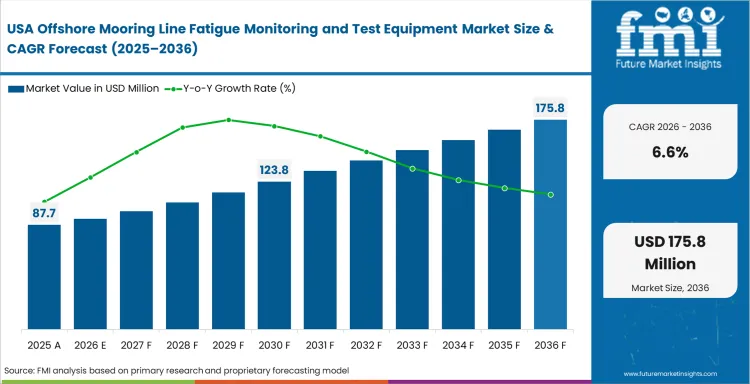
Installed floating production capacity gives the Americas a practical edge in this niche because mooring condition stays close to uptime planning across older and newer offshore assets. Brazil sets the tone for the region, while the United States adds steadier support through Gulf integrity work and a gradual offshore wind build-out. Demand formation here is shaped less by theory and more by what owners need to know before they commit to offshore service activity. Related offshore infrastructure spending around submarine cable projects and floating installations also keeps marine monitoring discipline in view.
- Brazil: Brazil’s offshore operating model keeps mooring condition closely linked with production continuity, so demand tends to form where fatigue visibility can reduce uncertainty before offshore intervention is scheduled. Deepwater exposure makes waiting costly, which is why operators place more value on dependable line-life evidence. Demand for offshore mooring line fatigue monitoring and test equipment in Brazil is anticipated to rise at a 7.5% CAGR from 2026 to 2036. Growth at that level points to a market where long-life floaters keep monitoring and testing tied directly to uptime protection.
- United States: Ageing offshore assets in the Gulf keep the United States relevant because line replacement and inspection decisions often need stronger condition evidence before service plans are extended. Offshore wind adds another layer to future demand, though the present market still rests more on established integrity work across floating and moored systems. Sales of offshore mooring line fatigue monitoring and test equipment in the United States are expected to increase at a 6.6% CAGR during the forecast period. That pace reflects a mature demand base where replacement logic matters more than a fast new-build cycle.
FMI’s report also reviews Canada, Mexico, Guyana, and other offshore-facing countries across the wider Americas. Regional demand outside Brazil and the United States tends to form around project timing rather than around a large standing installed base. That makes orders flow less even from year to year. Commercial traction improves when operators can tie mooring visibility to a clear service decision.
Europe Offshore Mooring Line Fatigue Monitoring and Test Equipment Market Analysis
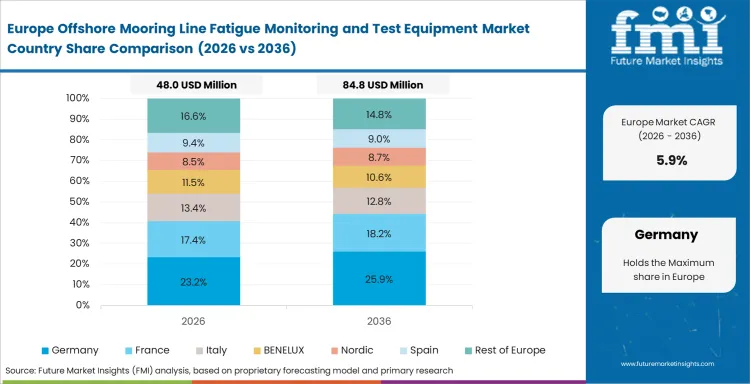
Engineering discipline shapes Europe’s position in this market more than pure asset count because buyers in the region usually expect tighter proof before accepting line-life assumptions. Norway and the United Kingdom each support demand, but they do so for slightly different reasons. Norway leans on harsh-water offshore practice, while the United Kingdom gains from floating wind activity and the spread of condition-led maintenance thinking. Adjacent marine instrumentation categories such as marine radar show the same preference for reliable performance in demanding offshore conditions.
- Norway: Offshore service decisions in Norway are shaped by harsh metocean exposure and by the need for monitoring systems that can stay dependable under demanding field conditions. Buyers usually look for evidence that can support a maintenance call rather than just confirm that a line is under load. That buying logic keeps demand firm, and Norway is set to record a 7.2% CAGR in offshore mooring line fatigue monitoring and test equipment during the assessment period. Technical standards remain a strong support for spending here.
- United Kingdom: Established offshore operating experience keeps current service demand commercially relevant in the United Kingdom, while floating wind broadens the next wave of use cases. The market for offshore mooring line fatigue monitoring and test equipment in the country is expected to grow at a CAGR of 7.0% through 2036. Growth is likely to come from a wider mix of legacy offshore assets and emerging floating installations, which gives suppliers more room to serve both maintenance-led and new-build demand.
FMI’s report extends the Europe view to other North Sea and Atlantic-facing countries as well as selected continental service hubs. Regional demand usually strengthens where offshore engineering capability sits close to inspection and repair resources. Markets with less direct floater exposure still matter, but they tend to support service partnerships more than standalone equipment volume. Europe remains important because buyers there often set a high bar for what counts as usable integrity evidence.
Asia Pacific Offshore Mooring Line Fatigue Monitoring and Test Equipment Market Analysis
Asia Pacific combines very different demand types, which makes the region harder to read through one simple pattern. Australia benefits from offshore engineering needs tied to demanding operating conditions, while China and South Korea add strength through fabrication, marine equipment capability, and future floating project interest. Buyers across the region often weigh monitoring value against project stage, installed-base depth, and local service support at the same time. Equipment categories close to subsea filter separators show a similar pattern where adoption becomes firmer when offshore assets are hard to access after installation.
- China: Industrial scale gives China a credible position in offshore systems, yet market growth still depends on how quickly engineering capability is converted into routine spending on line integrity and monitoring. Local manufacturing strength can improve equipment availability, but buying decisions remain tied to where floating assets are deployed and maintained. Through 2036, the offshore mooring line fatigue monitoring and test equipment industry in China is expected to record a 6.1% CAGR. That rate points to real headroom, though wider use of decision-led monitoring will be needed for faster acceleration.
- South Korea: Offshore mooring line fatigue monitoring and test equipment demand in South Korea is likely to rise at a 5.8% CAGR from 2026 to 2036. Marine engineering depth gives South Korea a credible role in specialized offshore equipment and support, though domestic demand remains smaller than in countries with a broader operating base of floating assets. Growth therefore depends on how strongly local capability connects back to active floating projects and long-life mooring systems. Commercial potential improves when offshore execution places more monitoring work closer to local service channels.
FMI’s report also studies Japan, Singapore, India, and other Asia Pacific countries that influence offshore engineering and service support. Regional variation stays wide because fabrication strength does not always convert into equal operating demand for mooring oversight. Some countries matter first as supply and service centers. Others matter because local floating assets create direct need for testing depth and condition evidence.
Oceania Offshore Mooring Line Fatigue Monitoring and Test Equipment Market Analysis
Oceania is smaller in installed-base terms, yet it remains relevant because offshore access is difficult, and intervention timing carries more commercial weight once line uncertainty appears. Australia is the main demand center in this regional group. Buying logic here is shaped less by fleet size and more by the cost of offshore work when service windows are narrow. That makes monitoring and testing decisions closely tied to planning discipline rather than routine equipment replacement.
- Australia: Australia faces costly offshore intervention and difficult service access, which keeps fatigue visibility commercially useful before line issues become field campaigns. Demand for offshore mooring line fatigue monitoring and test equipment in Australia is forecast to rise at a 6.3% CAGR through 2036. Buyers usually place greater value on condition evidence once service timing begins to affect project economics. Demand quality stays attractive where offshore planning is harder to manage.
Wider Oceania demand remains smaller and more project-led than in the Americas or Europe. Service access, offshore distance, and timing of intervention windows matter more here than simple fleet scale. Order flow therefore stays selective. Well-timed monitoring and testing work still carries clear commercial value when offshore campaigns are expensive to organize.
FMI’s report also studies Japan, Singapore, India, and other Asia Pacific countries that influence offshore engineering and service support. Regional variation stays wide because fabrication strength does not always translate into equal operating demand for mooring oversight. Some countries matter as supply or service centers first. Others matter because local floating assets create direct need for condition evidence and testing depth.
Competitive Aligners for Market Players
Competitive positioning in the market is shaped by how effectively suppliers support the conversion of offshore measurement data into reliable line‑life decisions. This requirement often favors providers such as DNV and IMES International, where testing capability is closely linked with monitoring interpretation. Other suppliers remain competitive where procurement places higher value on practical deployment and offshore service readiness rather than analytical depth. As a result, buying decisions continue to reflect a balance between engineering rigor and operational usability, preventing any single capability from setting the market standard.
Service depth remains an important differentiator, as monitoring systems typically operate within broader offshore integrity workflows. Buyers seeking stronger condition assessment and advisory input alongside monitoring often look to firms such as AMOG Consulting and BMT, particularly in long‑term review scenarios. In contrast, demand persists for suppliers that emphasize straightforward deployment and clear field‑level outputs, especially where monitoring is applied to specific offshore tasks. Challenger suppliers can still compete effectively if their systems are easy to operate and generate results that are trusted by asset teams.
Buyer bargaining power is expected to remain high, especially among larger operators that separate testing, monitoring, analytics, and advisory roles across multiple vendors. Engineering‑led providers such as DNV benefit in projects where long asset life elevates the importance of technical credibility and risk assurance. More focused suppliers continue to find opportunities where clearly defined offshore use cases drive procurement decisions. Overall, the market structure is unlikely to tighten materially through 2036, with buyers continuing to favor solutions that address operational needs without adding complexity to offshore execution.
Key Players in Offshore Mooring Line Fatigue Monitoring and Test Equipment Market
- DNV
- IMES International
- BES Group
- AMOG Consulting
- BMT
- MSL Oilfield Services
Scope of the Report
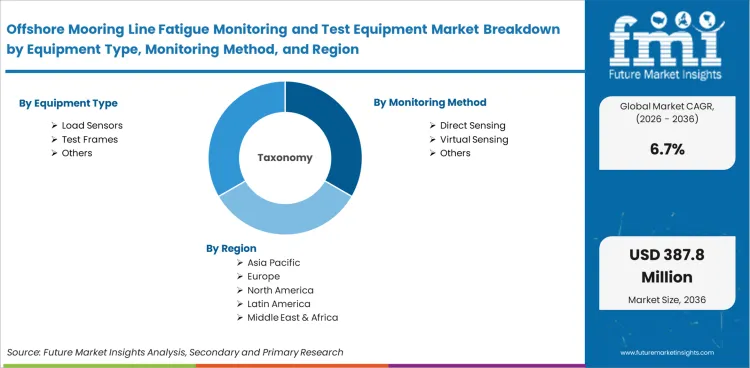
| Metric | Value |
|---|---|
| Quantitative Units | USD 190.0 million to USD 363.4 million, at a CAGR of 6.7% |
| Market Definition | This report covers equipment and software used to measure mooring loads, interpret fatigue behavior, and support line-life validation on offshore floating assets. Scope includes monitoring hardware, telemetry units, analytics used directly for mooring integrity decisions, and lab-oriented test systems used in fatigue, break, tensile, wear, corrosion, and material review. |
| Equipment Type Segmentation | Load sensors, Tension meters, Acoustic tags, Fiber sensors, Data loggers, Telemetry units, Test frames, Hydraulic rigs |
| Monitoring Method Segmentation | Direct sensing, Virtual sensing, Acoustic tracking, Fiber monitoring, Hybrid monitoring |
| Test Type Segmentation | Fatigue testing, Break testing, Tensile testing, Wear testing, Corrosion testing, Material testing |
| Line Material Segmentation | Chain lines, Wire lines, Polyester ropes, Hybrid lines |
| Water Depth Segmentation | Shallow water, Deepwater, Ultra-deepwater |
| Application Segmentation | FPSOs, Semi-subs, TLPs, Spars, FOWT platforms, CALM buoys |
| Deployment Mode Segmentation | Permanent systems, Portable systems, Rental systems |
| End User Segmentation | Operators, EPC firms, OEMs, Test labs, Inspectors, Class societies |
| Regions Covered | North America, Latin America, Europe, Asia Pacific, and the Middle East & Africa |
| Countries Covered | Brazil, Norway, United Kingdom, United States, Australia, China, South Korea, and 40 plus countries |
| Key Companies Profiled | DNV, IMES International, BES Group, AMOG Consulting, BMT, MSL Oilfield Services |
| Forecast Period | 2026 to 2036 |
| Approach | FMI combined primary interviews with offshore integrity participants, desk research across public technical literature, and a bottom-up review of installed-base demand logic. Forecasts were anchored to the relationship between floating asset exposure, monitoring penetration, and testing intensity. Results were checked against supplier positioning, offshore application patterns, and country-level demand logic. |
Source: Future Market Insights (FMI) analysis, based on proprietary forecasting model and primary research
Offshore Mooring Line Fatigue Monitoring and Test Equipment Market Analysis by Segments
Equipment Type:
- Load sensors
- Tension meters
- Acoustic tags
- Fiber sensors
- Data loggers
- Telemetry units
- Test frames
- Hydraulic rigs
Monitoring Method:
- Direct sensing
- Virtual sensing
- Acoustic tracking
- Fiber monitoring
- Hybrid monitoring
Test Type:
- Fatigue testing
- Break testing
- Tensile testing
- Wear testing
- Corrosion testing
- Material testing
Line Material:
- Chain lines
- Wire lines
- Polyester ropes
- Hybrid lines
Water Depth:
- Shallow water
- Deepwater
- Ultra-deepwater
Application:
- FPSOs
- Semi-subs
- TLPs
- Spars
- FOWT platforms
- CALM buoys
Deployment Mode:
- Permanent systems
- Portable systems
- Rental systems
End User:
- Operators
- EPC firms
- OEMs
- Test labs
- Inspectors
- Class societies
Region:
- North America
- United States
- Canada
- Europe
- Germany
- United Kingdom
- France
- Italy
- Spain
- Asia Pacific
- China
- Japan
- South Korea
- Taiwan
- Singapore
- Latin America
- Brazil
- Mexico
- Argentina
- Middle East & Africa
- GCC Countries
- South Africa
Bibliography
- Das, S., Maroju, S. S., Lewis, J., & Arantes, J. (2024). Application of digitalization and digital twins to mooring integrity assessment of floaters.
- Coraddu, A., Oneto, L., Walker, J., Patryniak, K., Prothero, A., & Collu, M. (2024). Floating offshore wind turbine mooring line sections health status nowcasting: From supervised shallow to weakly supervised deep learning.
- Jebari, O., Kwon, D.-S., Kim, S.-J., Jin, C., & Kim, M. (2025). Machine learning-based mooring failure detection for FPSOs: A two-step ANN approach.
- Ludot, A., Snedker, T. H., Kolios, A., & Bayati, I. (2025). Data-driven surrogate models for real-time fatigue monitoring of chain mooring lines in floating wind turbines.
- Ma, K.-T., Lai, Z.-Y., Wu, Y., Noorizadegan, A., Mizushima, Y., & Wada, R. (2026). Fatigue assessment for mooring chain of floating offshore wind turbines in monsoon and typhoon regions.
This bibliography is provided for reader reference. The full FMI report contains the complete reference list with primary source documentation.
This Report Addresses
- Market intelligence to support strategic decision making across load sensors, tension meters, telemetry units, fatigue testing systems, and mooring analytics used on floating assets.
- Market size estimation and 10-year revenue forecasts from 2026 to 2036, supported by installed-base logic, monitoring penetration assessment, and offshore integrity workflow review.
- Growth opportunity mapping across Equipment Type, Monitoring Method, Test Type, Line Material, Water Depth, Application, Deployment Mode, and End User.
- Segment and regional revenue forecasts covering chain lines, direct sensing, fatigue testing, deepwater systems, FPSOs, and permanent systems across leading offshore demand centers.
- Competition assessment including service credibility, offshore survivability, analytics readability, test depth, and field support responsiveness.
- Coverage of product scope that includes monitoring hardware, telemetry, analytics linked to mooring decisions, and lab validation systems used in line-life review.
- Regional analysis across Brazil, Norway, United Kingdom, United States, Australia, China, and South Korea with forecast-period CAGR comparisons.
- Report delivery geared toward asset-life planning, offshore integrity budgeting, technology prioritization, and supplier positioning.
Frequently Asked Questions
How large is the offshore mooring line fatigue monitoring and test equipment market?
FMI estimates the market at USD 190.0 million in 2026. It is projected to reach USD 363.4 million by 2036 as offshore owners place more value on fatigue visibility and line-life evidence.
What does this market include?
This market includes equipment and software used to measure mooring loads, monitor fatigue behavior, and support line-life decisions on floating offshore assets. It covers sensors, telemetry units, analytics, and lab test systems used in fatigue, break, tensile, wear, corrosion, and material review.
Why is this market growing?
Demand is rising because operators need earlier warning before mooring condition turns into an offshore intervention problem. Growth is also supported by ageing floaters, deepwater assets, and wider floating wind deployment.
Why do load sensors lead the equipment segment?
Load sensors are expected to account for 24.0% share in 2026 because direct force capture is still the simplest starting point for many monitoring programs. Buyers trust measured load history more easily than weaker inferred signals when service-life decisions are involved.
Why does direct sensing lead the monitoring method segment?
Direct sensing is expected to represent 39.0% share because owners still prefer measured physical evidence before relying heavily on modeled interpretation. It gives offshore and onshore teams a clearer basis for judging whether line behavior remains within design expectations.
Why does fatigue testing lead test demand?
Fatigue testing is estimated to hold 34.0% share in 2026 because repeated-load evidence is central to remaining-life assessment. Operators need stronger lab-backed confidence before extending service on lines exposed to long offshore duty cycles.
Why do chain lines lead the line material segment?
Chain lines are expected to account for 42.0% share in 2026 because many permanent mooring systems still rely on chain. Monitoring and test demand remains strong here since link wear, corrosion, and fatigue can become costly once offshore intervention is required.
Why does deepwater lead by water depth?
Deepwater is projected to hold 41.0% share in 2026 because intervention becomes harder and more expensive as depth increases. Early condition visibility matters more when line retrieval or replacement cannot be organized easily.
Why do FPSOs lead application demand?
FPSOs are expected to account for 31.0% share in 2026 because mooring condition is closely tied to uptime, production continuity, and life-extension planning. That makes continuous monitoring more valuable than on several other floater types.
Why do permanent systems lead deployment mode?
Permanent systems are estimated to represent 58.0% share in 2026 because long-life floating assets benefit more from continuous condition history than from short inspection windows. Owners use that steady evidence stream to support routine integrity review and maintenance planning.
Why do operators lead the end-user segment?
Operators are likely to account for 36.0% share in 2026 because they carry the cost of line uncertainty first. Monitoring data has more value when the party using it can also turn it into an offshore maintenance decision.
Which countries are growing the fastest?
Brazil leads with 7.5% CAGR through 2036, followed by Norway at 7.2% and the United Kingdom at 7.0%. These markets benefit from a mix of long-life floaters, harsh offshore conditions, and rising monitoring discipline.
Why is Brazil a strong growth market?
Brazil remains important because permanently moored production assets keep fatigue control closely tied to uptime risk. Deepwater exposure also raises the value of better line-life evidence before offshore intervention is scheduled.
Why is Norway growing strongly?
Norway is projected to expand at 7.2% CAGR because harsh-water engineering standards keep monitoring quality under close review. Buyers there usually want condition evidence that can support a real maintenance call, not just a data readout.
What is the main restraint in this market?
A major restraint is the difficulty of aligning engineering, offshore operations, and maintenance planning around one integrity decision. Many programs slow down not because hardware is unavailable, but because users interpret risk through different operating priorities.
What creates the next growth opportunity?
Growth improves when sensor output moves into a repeatable integrity workflow instead of staying as a stand-alone readout. Value rises sharply once the data changes maintenance timing rather than only adding another dashboard.
How competitive is this market?
The market remains fragmented because buyers compare offshore survivability, analytics quality, test credibility, and service response rather than one single hardware feature. Suppliers stay competitive by fitting different parts of the monitoring, testing, and advisory workflow.
Who are the key companies in this market?
Key participants include DNV, IMES International, BES Group, AMOG Consulting, BMT, and MSL Oilfield Services. These companies remain visible across monitoring, testing, and offshore integrity support.
What falls outside the scope of this market?
This market does not cover the full mooring hardware chain or general offshore equipment spending. It stays focused on specialist monitoring, telemetry, analytics, and lab validation systems used for mooring integrity decisions.
Preview the report firsthand - request a free sample
Get SampleGet the brochure for pricing and purchase details.
Get PDFTable of Content
- Executive Summary
- Global Market Outlook
- Demand-side Trends
- Supply-side Trends
- Technology Roadmap Analysis
- Analysis and Recommendations
- Market Overview
- Market Coverage / Taxonomy
- Market Definition / Scope / Limitations
- Research Methodology
- Chapter Orientation
- Analytical Lens and Working Hypotheses
- Market Structure, Signals, and Trend Drivers
- Benchmarking and Cross-market Comparability
- Market Sizing, Forecasting, and Opportunity Mapping
- Research Design and Evidence Framework
- Desk Research Programme (Secondary Evidence)
- Company Annual and Sustainability Reports
- Peer-reviewed Journals and Academic Literature
- Corporate Websites, Product Literature, and Technical Notes
- Earnings Decks and Investor Briefings
- Statutory Filings and Regulatory Disclosures
- Technical White Papers and Standards Notes
- Trade Journals, Industry Magazines, and Analyst Briefs
- Conference Proceedings, Webinars, and Seminar Materials
- Government Statistics Portals and Public Data Releases
- Press Releases and Reputable Media Coverage
- Specialist Newsletters and Curated Briefings
- Sector Databases and Reference Repositories
- FMI Internal Proprietary Databases and Historical Market Datasets
- Subscription Datasets and Paid Sources
- Social Channels, Communities, and Digital Listening Inputs
- Additional Desk Sources
- Expert Input and Fieldwork (Primary Evidence)
- Primary Modes
- Qualitative Interviews and Expert Elicitation
- Quantitative Surveys and Structured Data Capture
- Blended Approach
- Why Primary Evidence is Used
- Field Techniques
- Interviews
- Surveys
- Focus Groups
- Observational and In-context Research
- Social and Community Interactions
- Stakeholder Universe Engaged
- C-suite Leaders
- Board Members
- Presidents and Vice Presidents
- R&D and Innovation Heads
- Technical Specialists
- Domain Subject-matter Experts
- Scientists
- Physicians and Other Healthcare Professionals
- Governance, Ethics, and Data Stewardship
- Research Ethics
- Data Integrity and Handling
- Primary Modes
- Tooling, Models, and Reference Databases
- Desk Research Programme (Secondary Evidence)
- Data Engineering and Model Build
- Data Acquisition and Ingestion
- Cleaning, Normalisation, and Verification
- Synthesis, Triangulation, and Analysis
- Quality Assurance and Audit Trail
- Market Background
- Market Dynamics
- Drivers
- Restraints
- Opportunity
- Trends
- Scenario Forecast
- Demand in Optimistic Scenario
- Demand in Likely Scenario
- Demand in Conservative Scenario
- Opportunity Map Analysis
- Product Life Cycle Analysis
- Supply Chain Analysis
- Investment Feasibility Matrix
- Value Chain Analysis
- PESTLE and Porter’s Analysis
- Regulatory Landscape
- Regional Parent Market Outlook
- Production and Consumption Statistics
- Import and Export Statistics
- Market Dynamics
- Global Market Analysis 2021 to 2025 and Forecast, 2026 to 2036
- Historical Market Size Value (USD Million) Analysis, 2021 to 2025
- Current and Future Market Size Value (USD Million) Projections, 2026 to 2036
- Y-o-Y Growth Trend Analysis
- Absolute $ Opportunity Analysis
- Global Market Pricing Analysis 2021 to 2025 and Forecast 2026 to 2036
- Global Market Analysis 2021 to 2025 and Forecast 2026 to 2036, By Equipment Type
- Introduction / Key Findings
- Historical Market Size Value (USD Million) Analysis By Equipment Type , 2021 to 2025
- Current and Future Market Size Value (USD Million) Analysis and Forecast By Equipment Type , 2026 to 2036
- Load Sensors
- Test Frames
- Others
- Load Sensors
- Y-o-Y Growth Trend Analysis By Equipment Type , 2021 to 2025
- Absolute $ Opportunity Analysis By Equipment Type , 2026 to 2036
- Global Market Analysis 2021 to 2025 and Forecast 2026 to 2036, By Monitoring Method
- Introduction / Key Findings
- Historical Market Size Value (USD Million) Analysis By Monitoring Method, 2021 to 2025
- Current and Future Market Size Value (USD Million) Analysis and Forecast By Monitoring Method, 2026 to 2036
- Direct Sensing
- Virtual Sensing
- Others
- Direct Sensing
- Y-o-Y Growth Trend Analysis By Monitoring Method, 2021 to 2025
- Absolute $ Opportunity Analysis By Monitoring Method, 2026 to 2036
- Global Market Analysis 2021 to 2025 and Forecast 2026 to 2036, By Test Type
- Introduction / Key Findings
- Historical Market Size Value (USD Million) Analysis By Test Type, 2021 to 2025
- Current and Future Market Size Value (USD Million) Analysis and Forecast By Test Type, 2026 to 2036
- Fatigue Testing
- Break Testing
- Tensile Testing
- Fatigue Testing
- Y-o-Y Growth Trend Analysis By Test Type, 2021 to 2025
- Absolute $ Opportunity Analysis By Test Type, 2026 to 2036
- Global Market Analysis 2021 to 2025 and Forecast 2026 to 2036, By Line Material
- Introduction / Key Findings
- Historical Market Size Value (USD Million) Analysis By Line Material, 2021 to 2025
- Current and Future Market Size Value (USD Million) Analysis and Forecast By Line Material, 2026 to 2036
- Chain Lines
- Wire Lines
- Others
- Chain Lines
- Y-o-Y Growth Trend Analysis By Line Material, 2021 to 2025
- Absolute $ Opportunity Analysis By Line Material, 2026 to 2036
- Global Market Analysis 2021 to 2025 and Forecast 2026 to 2036, By Water Depth
- Introduction / Key Findings
- Historical Market Size Value (USD Million) Analysis By Water Depth, 2021 to 2025
- Current and Future Market Size Value (USD Million) Analysis and Forecast By Water Depth, 2026 to 2036
- Deepwater
- Shallow Water
- Others
- Deepwater
- Y-o-Y Growth Trend Analysis By Water Depth, 2021 to 2025
- Absolute $ Opportunity Analysis By Water Depth, 2026 to 2036
- Global Market Analysis 2021 to 2025 and Forecast 2026 to 2036, By Application
- Introduction / Key Findings
- Historical Market Size Value (USD Million) Analysis By Application, 2021 to 2025
- Current and Future Market Size Value (USD Million) Analysis and Forecast By Application, 2026 to 2036
- FPSOs
- TLPs
- Spars
- FPSOs
- Y-o-Y Growth Trend Analysis By Application, 2021 to 2025
- Absolute $ Opportunity Analysis By Application, 2026 to 2036
- Global Market Analysis 2021 to 2025 and Forecast 2026 to 2036, By Deployment Mode
- Introduction / Key Findings
- Historical Market Size Value (USD Million) Analysis By Deployment Mode, 2021 to 2025
- Current and Future Market Size Value (USD Million) Analysis and Forecast By Deployment Mode, 2026 to 2036
- Permanent System
- Portable System
- Rental Systems
- Permanent System
- Y-o-Y Growth Trend Analysis By Deployment Mode, 2021 to 2025
- Absolute $ Opportunity Analysis By Deployment Mode, 2026 to 2036
- Global Market Analysis 2021 to 2025 and Forecast 2026 to 2036, By Region
- Introduction
- Historical Market Size Value (USD Million) Analysis By Region, 2021 to 2025
- Current Market Size Value (USD Million) Analysis and Forecast By Region, 2026 to 2036
- North America
- Latin America
- Western Europe
- Eastern Europe
- East Asia
- South Asia and Pacific
- Middle East & Africa
- Market Attractiveness Analysis By Region
- North America Market Analysis 2021 to 2025 and Forecast 2026 to 2036, By Country
- Historical Market Size Value (USD Million) Trend Analysis By Market Taxonomy, 2021 to 2025
- Market Size Value (USD Million) Forecast By Market Taxonomy, 2026 to 2036
- By Country
- USA
- Canada
- Mexico
- By Equipment Type
- By Monitoring Method
- By Test Type
- By Line Material
- By Water Depth
- By Application
- By Deployment Mode
- By Country
- Market Attractiveness Analysis
- By Country
- By Equipment Type
- By Monitoring Method
- By Test Type
- By Line Material
- By Water Depth
- By Application
- By Deployment Mode
- Key Takeaways
- Latin America Market Analysis 2021 to 2025 and Forecast 2026 to 2036, By Country
- Historical Market Size Value (USD Million) Trend Analysis By Market Taxonomy, 2021 to 2025
- Market Size Value (USD Million) Forecast By Market Taxonomy, 2026 to 2036
- By Country
- Brazil
- Chile
- Rest of Latin America
- By Equipment Type
- By Monitoring Method
- By Test Type
- By Line Material
- By Water Depth
- By Application
- By Deployment Mode
- By Country
- Market Attractiveness Analysis
- By Country
- By Equipment Type
- By Monitoring Method
- By Test Type
- By Line Material
- By Water Depth
- By Application
- By Deployment Mode
- Key Takeaways
- Western Europe Market Analysis 2021 to 2025 and Forecast 2026 to 2036, By Country
- Historical Market Size Value (USD Million) Trend Analysis By Market Taxonomy, 2021 to 2025
- Market Size Value (USD Million) Forecast By Market Taxonomy, 2026 to 2036
- By Country
- Germany
- UK
- Italy
- Spain
- France
- Nordic
- BENELUX
- Rest of Western Europe
- By Equipment Type
- By Monitoring Method
- By Test Type
- By Line Material
- By Water Depth
- By Application
- By Deployment Mode
- By Country
- Market Attractiveness Analysis
- By Country
- By Equipment Type
- By Monitoring Method
- By Test Type
- By Line Material
- By Water Depth
- By Application
- By Deployment Mode
- Key Takeaways
- Eastern Europe Market Analysis 2021 to 2025 and Forecast 2026 to 2036, By Country
- Historical Market Size Value (USD Million) Trend Analysis By Market Taxonomy, 2021 to 2025
- Market Size Value (USD Million) Forecast By Market Taxonomy, 2026 to 2036
- By Country
- Russia
- Poland
- Hungary
- Balkan & Baltic
- Rest of Eastern Europe
- By Equipment Type
- By Monitoring Method
- By Test Type
- By Line Material
- By Water Depth
- By Application
- By Deployment Mode
- By Country
- Market Attractiveness Analysis
- By Country
- By Equipment Type
- By Monitoring Method
- By Test Type
- By Line Material
- By Water Depth
- By Application
- By Deployment Mode
- Key Takeaways
- East Asia Market Analysis 2021 to 2025 and Forecast 2026 to 2036, By Country
- Historical Market Size Value (USD Million) Trend Analysis By Market Taxonomy, 2021 to 2025
- Market Size Value (USD Million) Forecast By Market Taxonomy, 2026 to 2036
- By Country
- China
- Japan
- South Korea
- By Equipment Type
- By Monitoring Method
- By Test Type
- By Line Material
- By Water Depth
- By Application
- By Deployment Mode
- By Country
- Market Attractiveness Analysis
- By Country
- By Equipment Type
- By Monitoring Method
- By Test Type
- By Line Material
- By Water Depth
- By Application
- By Deployment Mode
- Key Takeaways
- South Asia and Pacific Market Analysis 2021 to 2025 and Forecast 2026 to 2036, By Country
- Historical Market Size Value (USD Million) Trend Analysis By Market Taxonomy, 2021 to 2025
- Market Size Value (USD Million) Forecast By Market Taxonomy, 2026 to 2036
- By Country
- India
- ASEAN
- Australia & New Zealand
- Rest of South Asia and Pacific
- By Equipment Type
- By Monitoring Method
- By Test Type
- By Line Material
- By Water Depth
- By Application
- By Deployment Mode
- By Country
- Market Attractiveness Analysis
- By Country
- By Equipment Type
- By Monitoring Method
- By Test Type
- By Line Material
- By Water Depth
- By Application
- By Deployment Mode
- Key Takeaways
- Middle East & Africa Market Analysis 2021 to 2025 and Forecast 2026 to 2036, By Country
- Historical Market Size Value (USD Million) Trend Analysis By Market Taxonomy, 2021 to 2025
- Market Size Value (USD Million) Forecast By Market Taxonomy, 2026 to 2036
- By Country
- Kingdom of Saudi Arabia
- Other GCC Countries
- Turkiye
- South Africa
- Other African Union
- Rest of Middle East & Africa
- By Equipment Type
- By Monitoring Method
- By Test Type
- By Line Material
- By Water Depth
- By Application
- By Deployment Mode
- By Country
- Market Attractiveness Analysis
- By Country
- By Equipment Type
- By Monitoring Method
- By Test Type
- By Line Material
- By Water Depth
- By Application
- By Deployment Mode
- Key Takeaways
- Key Countries Market Analysis
- USA
- Pricing Analysis
- Market Share Analysis, 2025
- By Equipment Type
- By Monitoring Method
- By Test Type
- By Line Material
- By Water Depth
- By Application
- By Deployment Mode
- Canada
- Pricing Analysis
- Market Share Analysis, 2025
- By Equipment Type
- By Monitoring Method
- By Test Type
- By Line Material
- By Water Depth
- By Application
- By Deployment Mode
- Mexico
- Pricing Analysis
- Market Share Analysis, 2025
- By Equipment Type
- By Monitoring Method
- By Test Type
- By Line Material
- By Water Depth
- By Application
- By Deployment Mode
- Brazil
- Pricing Analysis
- Market Share Analysis, 2025
- By Equipment Type
- By Monitoring Method
- By Test Type
- By Line Material
- By Water Depth
- By Application
- By Deployment Mode
- Chile
- Pricing Analysis
- Market Share Analysis, 2025
- By Equipment Type
- By Monitoring Method
- By Test Type
- By Line Material
- By Water Depth
- By Application
- By Deployment Mode
- Germany
- Pricing Analysis
- Market Share Analysis, 2025
- By Equipment Type
- By Monitoring Method
- By Test Type
- By Line Material
- By Water Depth
- By Application
- By Deployment Mode
- UK
- Pricing Analysis
- Market Share Analysis, 2025
- By Equipment Type
- By Monitoring Method
- By Test Type
- By Line Material
- By Water Depth
- By Application
- By Deployment Mode
- Italy
- Pricing Analysis
- Market Share Analysis, 2025
- By Equipment Type
- By Monitoring Method
- By Test Type
- By Line Material
- By Water Depth
- By Application
- By Deployment Mode
- Spain
- Pricing Analysis
- Market Share Analysis, 2025
- By Equipment Type
- By Monitoring Method
- By Test Type
- By Line Material
- By Water Depth
- By Application
- By Deployment Mode
- France
- Pricing Analysis
- Market Share Analysis, 2025
- By Equipment Type
- By Monitoring Method
- By Test Type
- By Line Material
- By Water Depth
- By Application
- By Deployment Mode
- India
- Pricing Analysis
- Market Share Analysis, 2025
- By Equipment Type
- By Monitoring Method
- By Test Type
- By Line Material
- By Water Depth
- By Application
- By Deployment Mode
- ASEAN
- Pricing Analysis
- Market Share Analysis, 2025
- By Equipment Type
- By Monitoring Method
- By Test Type
- By Line Material
- By Water Depth
- By Application
- By Deployment Mode
- Australia & New Zealand
- Pricing Analysis
- Market Share Analysis, 2025
- By Equipment Type
- By Monitoring Method
- By Test Type
- By Line Material
- By Water Depth
- By Application
- By Deployment Mode
- China
- Pricing Analysis
- Market Share Analysis, 2025
- By Equipment Type
- By Monitoring Method
- By Test Type
- By Line Material
- By Water Depth
- By Application
- By Deployment Mode
- Japan
- Pricing Analysis
- Market Share Analysis, 2025
- By Equipment Type
- By Monitoring Method
- By Test Type
- By Line Material
- By Water Depth
- By Application
- By Deployment Mode
- South Korea
- Pricing Analysis
- Market Share Analysis, 2025
- By Equipment Type
- By Monitoring Method
- By Test Type
- By Line Material
- By Water Depth
- By Application
- By Deployment Mode
- Russia
- Pricing Analysis
- Market Share Analysis, 2025
- By Equipment Type
- By Monitoring Method
- By Test Type
- By Line Material
- By Water Depth
- By Application
- By Deployment Mode
- Poland
- Pricing Analysis
- Market Share Analysis, 2025
- By Equipment Type
- By Monitoring Method
- By Test Type
- By Line Material
- By Water Depth
- By Application
- By Deployment Mode
- Hungary
- Pricing Analysis
- Market Share Analysis, 2025
- By Equipment Type
- By Monitoring Method
- By Test Type
- By Line Material
- By Water Depth
- By Application
- By Deployment Mode
- Kingdom of Saudi Arabia
- Pricing Analysis
- Market Share Analysis, 2025
- By Equipment Type
- By Monitoring Method
- By Test Type
- By Line Material
- By Water Depth
- By Application
- By Deployment Mode
- Turkiye
- Pricing Analysis
- Market Share Analysis, 2025
- By Equipment Type
- By Monitoring Method
- By Test Type
- By Line Material
- By Water Depth
- By Application
- By Deployment Mode
- South Africa
- Pricing Analysis
- Market Share Analysis, 2025
- By Equipment Type
- By Monitoring Method
- By Test Type
- By Line Material
- By Water Depth
- By Application
- By Deployment Mode
- USA
- Market Structure Analysis
- Competition Dashboard
- Competition Benchmarking
- Market Share Analysis of Top Players
- By Regional
- By Equipment Type
- By Monitoring Method
- By Test Type
- By Line Material
- By Water Depth
- By Application
- By Deployment Mode
- Competition Analysis
- Competition Deep Dive
- Operators
- Overview
- Product Portfolio
- Profitability by Market Segments (Product/Age /Sales Channel/Region)
- Sales Footprint
- Strategy Overview
- Marketing Strategy
- Product Strategy
- Channel Strategy
- OEMs
- Others
- Operators
- Competition Deep Dive
- Assumptions & Acronyms Used


