

- Industry Size (2026)
- USD 168.0 Mn
- Forecast (2036)
- USD 394.1 Mn
- CAGR (2026 to 2036)
- 8.9%
In-Process Composite Layup Monitoring Sensors and Test Equipment Market Size, Market Forecast and Outlook By FMI
The in-process composite layup monitoring sensors and test equipment market surpassed a valuation of USD 154.3 million in 2025. Sales are estimated to reach USD 168.0 million in 2026, and the market is projected to expand at a CAGR of 8.9% from 2026 to 2036. Demand is expected to lift total valuation to USD 394.1 million by 2036 as composite fabrication shifts toward in-cell verification that identifies layup drift before cure turns a process deviation into costly rework.
Summary of In-Process Composite Layup Monitoring Sensors and Test Equipment Market
- Market Snapshot
- Industry value stands at USD 154.3 million in 2025 and is projected to reach USD 394.1 million by 2036.
- Forecast expansion at 8.9% CAGR from 2026 to 2036 creates an incremental opportunity of USD 226.1 million over the period.
- Category sits inside production quality tools where line fit, data trust, and rework avoidance carry more weight than hardware price alone, much like adjacent machine vision and inspection tools categories.
- Scope covers monitoring sensors and test equipment used during or directly beside layup, rather than full post-cure inspection programs or complete layup machine revenue.
- Demand and Growth Drivers
- Demand is moving up because composite programs want proof of correct placement before downstream work adds more cost, and that logic is close to the adoption pattern seen in industrial vision systems.
- Inline review is gaining ground because buyers want fewer breaks between placement and correction.
- Thermoplastic and high-rate programs are widening the need for verification tools that can live closer to cycle time pressure.
- Country growth is led by China at 9.8%, India at 9.4%, United Kingdom at 8.7%, United States at 8.6%, France at 8.4%, Germany at 8.1%, and Japan at 7.8%.
- Expansion still slows where signal review, software fit, and false alarm handling are weak.
- Product and Segment View
- Equipment scope covers guidance and verification tools such as laser projection, cameras, profilometers, OCT systems, thermography, and selected test hardware linked to automated optical inspection and cell-level review.
- Laser projection leads Equipment Type with 29.0% share in 2026 because it supports both guidance and fast visual confirmation.
- Inline integrated leads Deployment Mode with 58.0% share in 2026 because buyers prefer review inside the production step.
- Ply placement leads Process Coverage with 24.0% share in 2026 because every later check depends on correct starting placement.
- AFP leads Layup Method with 46.0% share in 2026 because automation raises the cost of small mistakes across composite airframes work.
- Aerospace leads End Use with 61.0% share in 2026 because traceability pressure and part value stay high.
- Thermoset prepreg leads Material System with 56.0% share in 2026 because installed process habits still favor prepreg fibers in qualified programs.
- OEM integrated leads Sales Channel with 52.0% share in 2026 because inspection is being specified with the cell rather than added later.
- Scope includes inline and near-line layup monitoring hardware, review software, and reporting layers, but excludes full layup machine revenue, post-cure NDT services, and general plant sensors with no composite focus.
- Geography and Competitive Outlook
- China and India are the faster-growth locations because new capacity allows monitoring habits to be built into fresh programs.
- United States, France, Germany, United Kingdom, and Japan remain stable demand bases where upgrade logic is tied to process refinement.
- Competition is shaped by fit inside the cell, ease of review, software handling, and process trust, similar to what buyers compare in metrology software and vision cameras workflows.
- Virtek Vision International, LAP GmbH, FARO Technologies, Electroimpact, and Hexagon AB remain the names most visible in this space.
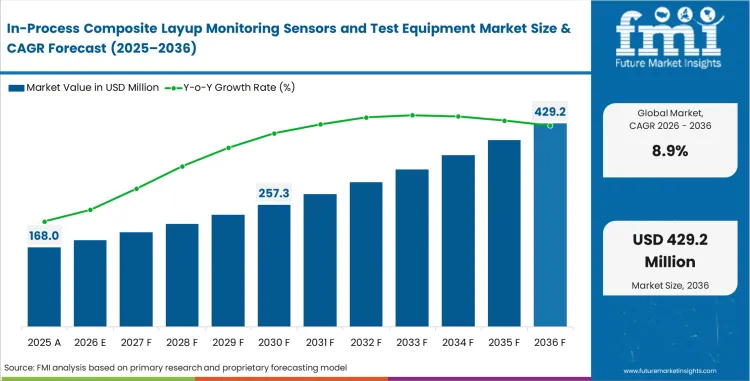
Key Takeaways, Market Size, and Forecast
- In-Process Composite Layup Monitoring Sensors and Test Equipment Market is projected to grow from USD 168.0 million in 2026 to USD 394.1 million by 2036, at a CAGR of 8.9%.
- The market was valued at USD 154.3 million in 2025.
- The market is projected to create an incremental opportunity of USD 226.1 million between 2026 and 2036.
- In 2026, Laser Projection is expected to account for 29.0% of the equipment type segment.
- Inline Integrated systems are projected to lead deployment mode with 58.0% share in 2026.
- Aerospace is expected to dominate end use with 61.0% share in 2026.
- China (9.8%) and India (9.4%) are among the fastest growing markets.
Quality control in this market is no longer centered only on final review. Production teams increasingly need to decide whether inspection evidence is collected after layup or generated during each layup step itself. Older review routines leave too much time between material placement and corrective action, allowing a misaligned ply or visible defect to move further into the build before intervention begins. FMI analysis indicates sensor capability alone does not determine adoption. Data flow must fit into normal advanced composites production without interrupting takt time, adding review burden, or slowing operator response inside the cell. Delays at this stage raise scrap exposure and weaken confidence in automated correction where guidance, verification, and approval often need to happen within the same production window.
A shift begins once inspection of output feeds directly into the layup record and the quality review path. Manufacturing and quality teams are more willing to adopt in-process systems when one view can support placement confirmation, angle validation, and visible defect checks without creating a parallel workflow. At that stage, sensor integration is more likely to be treated as a practical cell upgrade rather than a stand-alone inspection initiative.
China is projected to record a 9.8% CAGR through 2036 as new composite manufacturing capacity creates room for first-time cell-level investment. India is expected to expand at a 9.4% CAGR, supported by wider industrial adoption and rising process control requirements. The United Kingdom is likely to grow at 8.7% during the forecast period, while the United States is estimated to register 8.6%. France is projected to post 8.4% CAGR, compared with 8.1% for Germany and 7.8% for Japan. Faster-growth markets are still embedding inspection routines into newer programs, while mature manufacturing bases are advancing through line upgrades, process refinement, and tighter quality traceability across existing operations.
Segmental Analysis
In-Process Composite Layup Monitoring Sensors and Test Equipment Market Analysis by Equipment Type
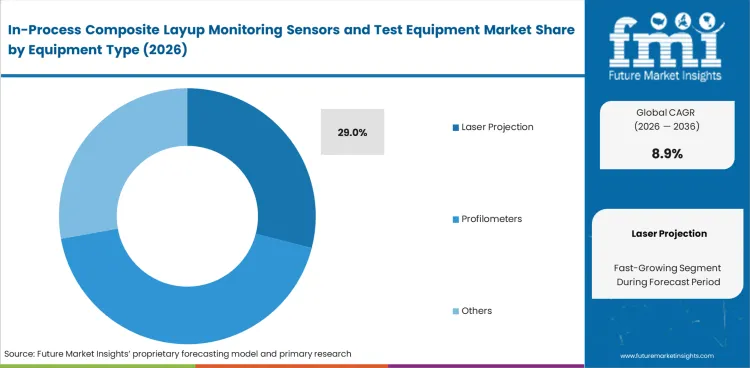
Equipment choice in this market is shaped by how quickly crews can correct a placement issue before more value is added to the laminate. Laser projection stays ahead because it gives operators a visible layup reference without interrupting the work surface or adding a contact-based check. Plants using fast-moving cells often prefer that low-disruption fit, especially when the same system is expected to support both guidance and quick verification. Market estimates indicate laser projection is expected to account for 29.0% share in 2026. Competing tools can provide richer measurement depth, yet many facilities still favor projection where ease of use and operator confidence matter more than added data layers. Segment value, therefore, depends on how well the tool supports correction at the point of placement, before drift turns into slower review loops and added rework.
- Placement alignment: Projected guidance helps crews position material with less guesswork and reduces hesitation during ply placement.
- Non-contact fit: Light-based guidance suits cells that cannot absorb another physical measurement step without slowing work.
- Fast visual control: Clear reference cues support earlier review and reduce the chance of small drift moving downstream unnoticed.
In-Process Composite Layup Monitoring Sensors and Test Equipment Market Analysis by Deployment Mode
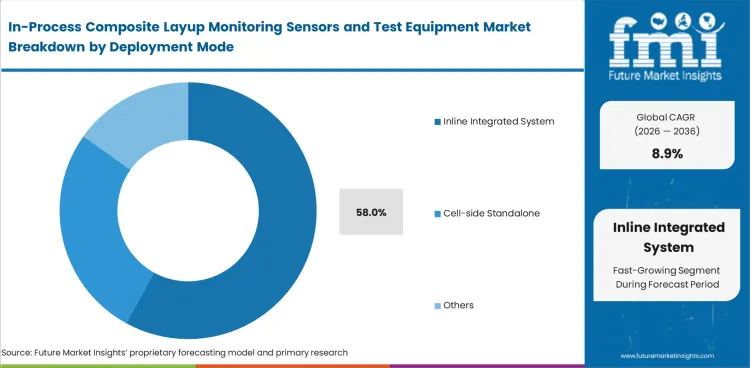
Deployment mode matters here because quality review loses value once it sits too far from the point where the layup decision is made. Inline integrated systems lead this segment because plants want confirmation while the part is still in place, and correction is still manageable. A review that comes later can break cell rhythm and turn a minor issue into a rework event with broader labor impact. Strongest demand appears in cells where camera data, angle checks, and pass-fail logic need to move through one working interface, and inline integrated systems are projected to represent 58.0% share in 2026. Standalone tools still have a place, especially in retrofit situations, but they usually add a handoff that slows reaction. Segment strength rests on keeping production and verification inside the same work cycle rather than separating them into two disconnected steps.
- Integrated continuity: In-cell review keeps placement and confirmation within one cycle and shortens avoidable stoppage.
- Shared handover path: Common screens and logs make it easier to move from operator action to quality acceptance.
- Retrofit installation limits: Older cells can struggle to absorb inline hardware cleanly, raising fit effort and slowing payback.
In-Process Composite Layup Monitoring Sensors and Test Equipment Market Analysis by Process Coverage
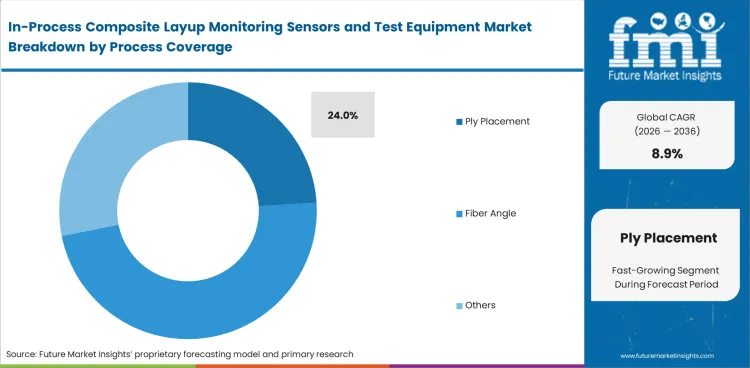
Process coverage starts with one basic commercial fact: downstream checks become less useful if ply position is wrong at the beginning. Buyers usually want proof of location before spending more time and labor on the next layer, since early error control affects everything that follows in the layup sequence. Boundary checks, gap review, and angle confirmation all matter, yet the first control point usually carries the highest practical weight. Ply placement is anticipated to represent 24.0% of market share in 2026 because it sits at the start of both the work sequence and the risk chain. Correct starting positions also make later verification easier to interpret and faster to trust. Weak control at this stage increases the chance that scrap and manual rework appear only after more labor has already been committed.
- Early placement proof: Initial confirmation protects the whole layup sequence by reducing error before more layers are added.
- Clear boundary view: Strong edge visibility helps crews judge placement accuracy and avoid slower acceptance decisions.
- Higher scrap exposure: Early ply misplacement can force broader rework later in the stack and raise material loss.
In-Process Composite Layup Monitoring Sensors and Test Equipment Market Analysis by Layup Method
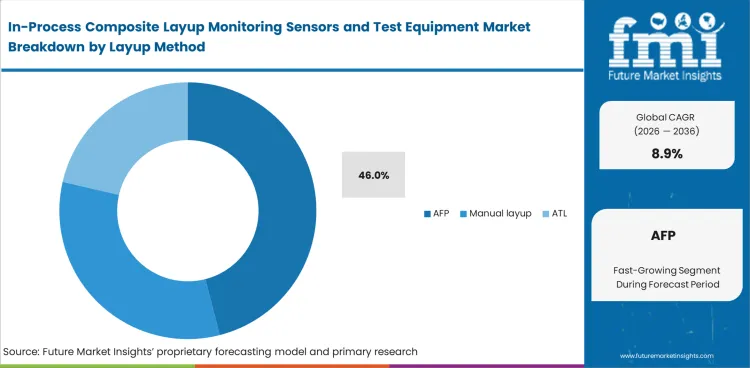
Layup method changes the cost of late discovery because error exposure rises as process speed increases. AFP leads because automated programs move material quickly, leaving less time to detect drift before more laminate is placed and correction becomes more disruptive. Manual layup still uses guidance and checking tools, but slower pace gives operators more room to intervene before deviation spreads across the part. AFP is likely to secure 46.0% share in 2026 as buyers place greater emphasis on verification in high-speed automated cells. That lead also reflects the larger and more repeatable work often handled in automated programs. Segment value in practice depends on whether monitoring keeps pace with production speed, since weak verification on AFP lines usually creates more interruptions, more review effort, and harder root-cause work later.
- High-throughput fit: Automated cells need verification that can keep pace with material placement without slowing output.
- Useful alarm quality: Actionable alerts matter more than raw sensor volume in fast programs with tight correction windows.
- Short correction window: Faster layup lines give crews less time to fix drift before the next step begins.
In-Process Composite Layup Monitoring Sensors and Test Equipment Market Analysis by End Use
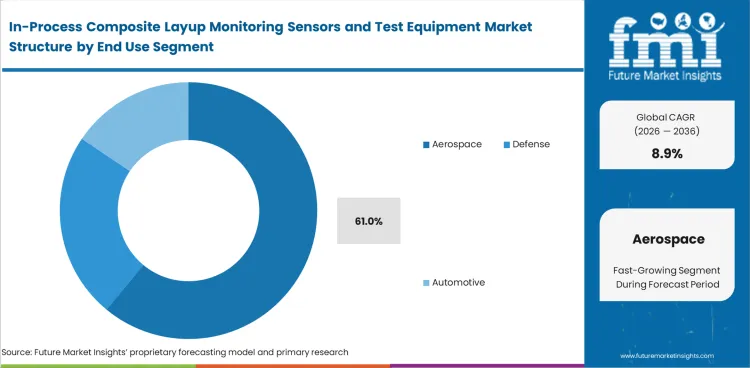
Aerospace stays ahead because part value is high, qualification standards are demanding, and hidden layup errors can create larger review burdens later in the build route. Defense, automotive, wind, marine, and space programs all use layup monitoring, yet aerospace continues to set the pace where inspection habits are tied closely to qualified production practice. Demand also stays broad here because repeated use across major programs supports more consistent equipment adoption. Aerospace is forecast to account for 61.0% share in 2026. Lower monitoring investment may reduce cost early, but in high-value aerospace work it often leads to more disruption once a defect appears later in the process.
- Certification-driven demand: Traceable layup evidence supports acceptance in regulated build settings where documentation quality matters.
- Large program depth: Repeated aerospace use cases make it easier for suppliers to scale the same tool set.
- Late defect risk: Missed issues on high-value parts can disrupt schedules quickly and raise downstream review cost.
In-Process Composite Layup Monitoring Sensors and Test Equipment Market Analysis by Material System
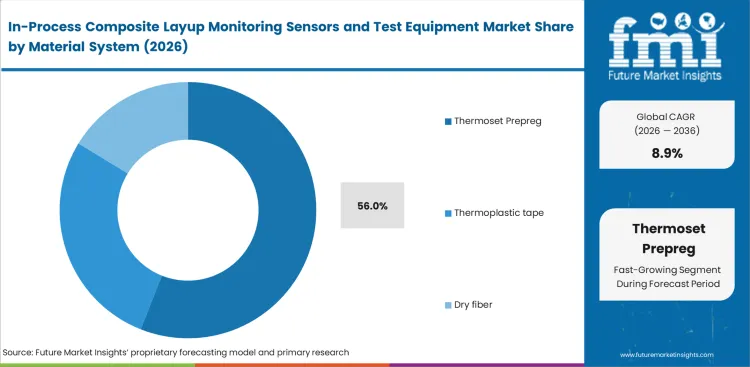
Material-system demand follows installed process habits as much as it follows technical capability. Many qualified layup programs still run on established thermoset prepreg workflows, so buyers tend to favor tools that match familiar process timing, review evidence, and operator expectations. Thermoplastic tape is drawing more attention, but existing thermoset practice continues to shape the larger demand base for now. Buyers also place value on familiarity because trusted workflows reduce setup uncertainty and make verification results easier to interpret on the shop floor. Thermoset prepreg is set to make up 56.0% of the market in 2026. Segment value therefore depends on how well the equipment fits resin behavior and process window, since a poor match can weaken signal quality and create avoidable setup effort.
- Resin-system fit: Sensor choice must match surface condition and process timing to produce usable verification evidence.
- Tight heat window: Some lines need review methods that work without disturbing temperature-sensitive production steps.
- Familiar operator learning: Established prepreg routines make it easier for crews to trust known verification methods.
In-Process Composite Layup Monitoring Sensors and Test Equipment Market Analysis by Sales Channel
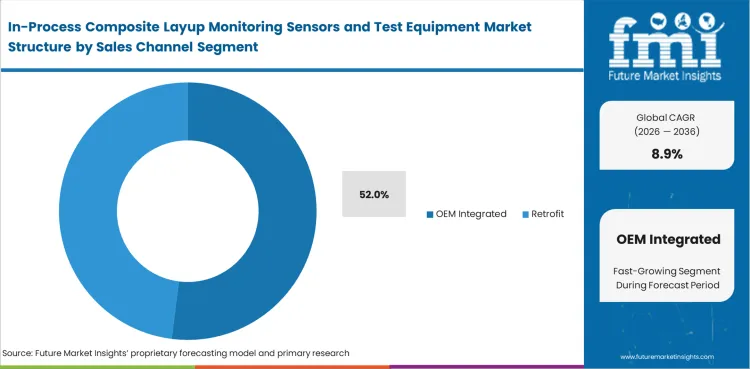
Sales-channel preference is shifting earlier in the cell-planning cycle because buyers increasingly want monitoring built into the production logic from the start. OEM integrated systems lead because sensing, review logic, and reporting are easier to validate when they are designed with the cell instead of added after commissioning. Retrofit demand remains real, particularly where older lines need better visibility, but factory-fit integration tends to reduce interface work and smooth the approval path. Bundled design also helps limit disruption during launch and lowers the burden of custom integration. OEM integrated systems are expected to capture 52.0% share in 2026. Segment leadership therefore comes from cleaner implementation rather than channel convenience alone, since weak channel choice can leave plants with slower acceptance and more custom work during active production periods.
- Factory bundling effect: Pre-integrated packages simplify installation and early validation during cell launch.
- Cleaner approval path: Planned data flow supports faster acceptance within normal cell logic and reporting structure.
- Legacy retrofit drag: Older controls and mixed software paths can stretch implementation time in retrofit programs.
In-Process Composite Layup Monitoring Sensors and Test Equipment Market Drivers, Restraints, and Opportunities
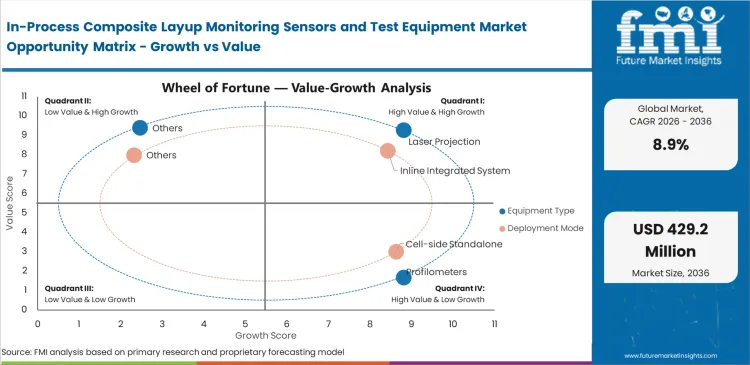
Quality checks are moving closer to the layup stage because defects cost far more once the laminate has advanced to later steps. A single misplaced ply can create a combined burden across labor, material, and production timing. Demand is strongest in programs aiming to narrow the gap between guidance, verification, and immediate correction. Plants that catch issues earlier keep rework contained and preserve confidence at the stage where process decisions are still simple to change.
Integration remains the main restraint, since inspection data must fit the production cell, the review interface, and the quality record in a way users accept without hesitation. Hardware on its own does not solve that problem. Poor software fit or excessive alert noise can quickly reduce trust in a system that looked promising during evaluation. Adoption slows once facilities realize results still need heavy customization before they can be used in routine review. Partial solutions exist, yet each one adds setup effort and can lengthen approval cycles.
Opportunities in the In-Process Composite Layup Monitoring Sensors and Test Equipment Market
- Retrofit packages: Older lines still need clearer layup evidence. Suppliers that offer compact upgrades can win where full cell replacement is unrealistic.
- Software layer: Review tools that turn sensor output into simple pass-fail logic can widen acceptance. Buyers value clarity more than raw data volume.
- Thermoplastic shift: Faster programs and newer material flows open room for equipment tailored to thermoplastic prepreg routines. Vendors that fit those heat and speed conditions can gain ground early.
Regional Analysis
Based on the regional analysis, the in-process composite layup monitoring sensors and test equipment market is segmented into Asia Pacific, North America, and Europe across 40-plus countries.
.webp "Top Country Growth Comparison In Process Composite Layup Monitoring Sensors And Test Equipment Market Cagr (2026 2036)")
| Country | CAGR (2026 to 2036) |
|---|---|
| China | 9.8% |
| India | 9.4% |
| United Kingdom | 8.7% |
| United States | 8.6% |
| France | 8.4% |
| Germany | 8.1% |
| Japan | 7.8% |
Source: Future Market Insights (FMI) analysis, based on proprietary forecasting model and primary research
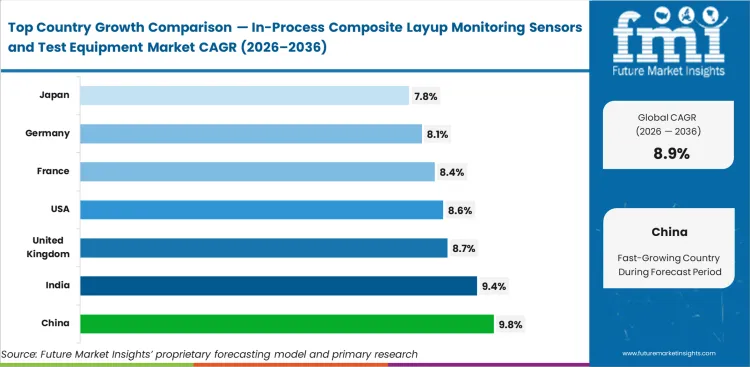
Regional demand does not move in one straight line. Faster-growth countries are still shaping new cell layouts and buying habits, while mature countries are refining lines that already run composite work at scale.
Asia Pacific In-Process Composite Layup Monitoring Sensors and Test Equipment Market Analysis
Fresh capacity and broader industrial learning give the Asia Pacific a different demand profile from the rest of the field. Buyers here are often deciding how much verification belongs inside the first version of the cell instead of asking whether an older line can absorb an upgrade. This region is the clearest base for first-cycle adoption in composite production. Need stays strongest where carbon fiber composites programs and newer automation plans grow together. Choices made early in this region can shape tool preference for years because cell architecture and review habits are being built at the same time.
- China: New composite capacity gives China a wide opening for first-time installation of layup monitoring and test equipment inside production cells. Plants usually prefer to place guidance, review, and correction logic early, since fixing weak cell design later can interrupt output and raise rework burden. Demand for in-process composite layup monitoring sensors and test equipment in China is anticipated to rise at a CAGR of 9.8% from 2026 to 2036. Growth here comes mainly from fresh adoption across expanding composite programs rather than replacement of established equipment.
- India: India is building this category from a smaller installed base, so buying decisions often center on practical fit, training ease, and how naturally a system fits daily factory work. Review tools that stay simple at operator level tend to move ahead more easily than heavier setups. In-process composite layup monitoring sensors and test equipment demand in India is likely to grow at a CAGR of 9.4% during the forecast period. Wider adoption will depend on how smoothly plants can move from pilot use into repeatable production without adding unnecessary review burden.
- Japan: Process discipline carries clear weight in Japan, and that shapes demand toward systems that support repeatability without disturbing stable manufacturing flow. Buyers usually focus on review quality and usable evidence before giving priority to sensing novelty alone. Japan is projected to post a CAGR of 7.8% in this industry from 2026 to 2036, which reflects a measured style of adoption. Growth here comes more from refinement inside established production routines than from broad new line installation, and that keeps equipment choice closely tied to working fit.
FMI's report also reviews South Korea, Singapore, and other Asia Pacific countries that are building composite capability at different speeds. Common ground across the wider region is a preference for tools that fit the cell cleanly and can be learned without long setup cycles.
North America In-Process Composite Layup Monitoring Sensors and Test Equipment Market Analysis
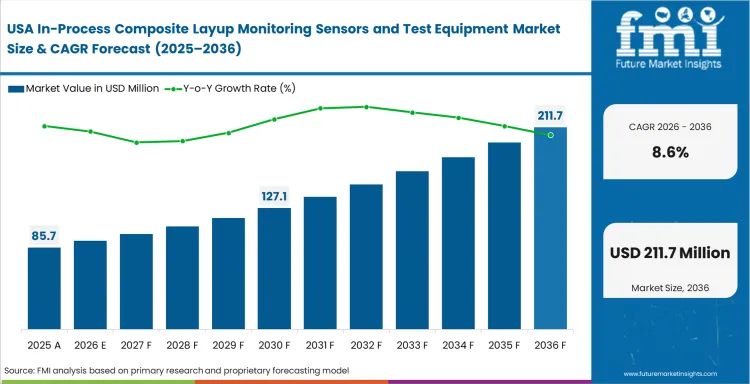
North America leans more on upgrade logic than on blank-sheet cell design. Existing aerospace and advanced manufacturing lines already have working routines, so new sensor spending must prove it can improve those routines without forcing extra disruption. Demand is shaped by process depth and by the need to trust incoming data. Spending here often rises when review speed and acceptance logic improve together.
- United States: Installed composite activity keeps the United States near the front of demand, though buying logic here is more selective than in regions building fresh capacity. Manufacturers usually compare line fit, software usability, and review speed before focusing on sensing detail alone. Demand for in-process composite layup monitoring sensors and test equipment in the United States is expected to register a CAGR of 8.6% through 2036. Spending stays active where upgrade value is visible in daily quality control and where plants can trust the output without major process disruption.
FMI's report includes Canada and other North American locations where demand is tied to specialized composite programs and selective automation upgrades. Wider regional behavior still points to measured adoption built around proof of fit rather than fast expansion.
Europe In-Process Composite Layup Monitoring Sensors and Test Equipment Market Analysis
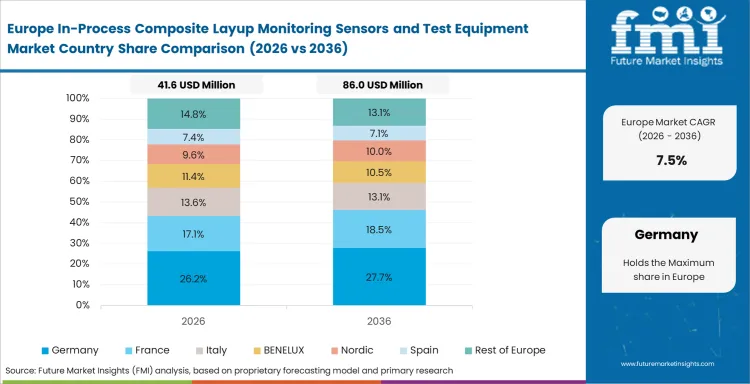
Europe sits in the middle ground between fresh program buildout and careful line refinement. Buyers across the region tend to ask how verification tools support process discipline, program documentation, and cleaner review inside qualified workflows. Demand remains important in settings linked to structural composites and long-cycle industrial work. Spending is less about adding sensors everywhere and more about adding them where proof of placement or defect handling closes a visible operating gap. That buying style keeps the region important even when headline growth trails Asia Pacific.
- United Kingdom: Aerospace production routines keep attention on proof of correct layup and on evidence that can move cleanly into normal review without adding delay. Buyers often prefer systems that improve in-cell visibility while staying close to familiar working methods. Supported by ongoing program depth, demand for in-process composite layup monitoring sensors and test equipment in the United Kingdom is expected to rise at a CAGR of 8.7% through 2036. Stronger growth here reflects active upgrade interest where reliable confirmation inside qualified workflows carries clear operating value.
- France: Workflow continuity matters strongly in France, where manufacturers often judge a system by how well process evidence moves from one stage to the next. Tools that simplify data handling and reduce review effort tend to stand out more clearly in this setting. In-process composite layup monitoring sensors and test equipment demand in France, at a projected CAGR of 8.4% through 2036, reflects steady adoption in environments where part value is high. Suppliers that keep evidence usable inside the normal factory flow can improve acceptance more easily.
- Germany: Germany places slightly more emphasis on production consistency and software fit than on sensing novelty by itself. Plants usually invest when monitoring tools help reduce manual follow-up work and support stable throughput under routine operating conditions. Buyers here look for systems that strengthen review without making the line harder to manage. By 2036, demand for in-process composite layup monitoring sensors and test equipment in Germany is expected to post a CAGR of 8.1%. That pace is measured, though targeted upgrades still leave dependable room for adoption.
FMI's report also covers Italy, Spain, and other European countries where demand is linked to selective composite manufacturing programs and quality-system upgrades. Wider regional behavior points to steady buying tied to process reliability and clear evidence flow.
Competitive Aligners for Market Players
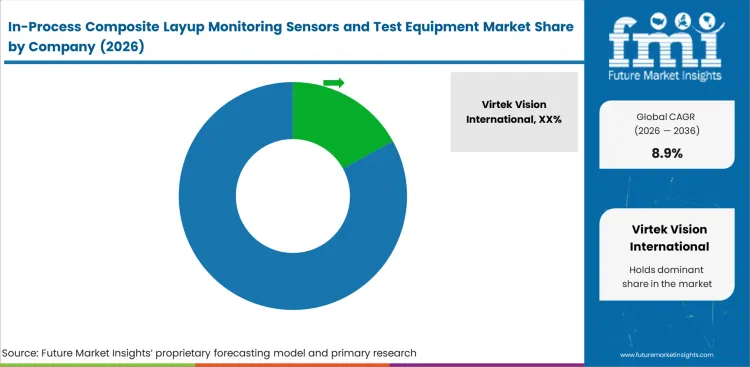
Decision‑maker evaluation in this space centers on how naturally a solution fits into day‑to‑day layup activity and how quickly operators gain confidence in the results. Providers such as Virtek Vision International and LAP GmbH are often referenced where projection guidance and immediate visual confirmation need to occur within the same work step. FARO Technologies is more commonly assessed when measurement discipline and the availability of reviewable inspection data are essential. While each supplier is recognized for a different strength, ease of use remains a consistent driver in purchasing discussions. Solutions that appear compelling on specifications alone can lose ground if they slow production flow or complicate review processes.
In settings where inspection sit close to automated layup equipment, attention frequently shifts to suppliers such as Electroimpact. These platforms are typically evaluated in programs that aim to reduce separation between material placement, defect identification, and acceptance logic. Program teams tend to favor systems that operate as part of established production routines, as this limits the need for customization or additional handling steps. Tools that feel detached from normal workflows can increase integration effort, which many users prefer to avoid.
The competitive landscape is further influenced by software capability and workflow structure, an area where Hexagon AB broadens the comparison beyond sensing hardware alone. Assessments focus on how intuitive the review process is, how smoothly data moves between systems, and how manageable future expansion appears. Preferences remain fragmented between projection‑led guidance, cell‑integrated inspection approaches, and more analytics‑driven frameworks. Similar to adoption dynamics observed in emerging segments such as fermented protein, suppliers gain traction when they reduce the effort required to move from shop‑floor action to usable inspection evidence. This emphasis on workflow alignment and usability continues to shape positioning and near‑term adoption across the market.
Key Players in In-Process Composite Layup Monitoring Sensors and Test Equipment Market
- Virtek Vision International
- LAP GmbH
- FARO Technologies
- Electroimpact
- Hexagon AB
Scope of the Report
| Metric | Value |
|---|---|
| Quantitative Units | USD 168.0 million to USD 394.1 million, at a CAGR of 8.9% |
| Market Definition | Monitoring sensors, guidance tools, and test equipment used during or directly beside composite layup to verify placement, angle, surface condition, and related quality signals before later processing locks errors into the part. |
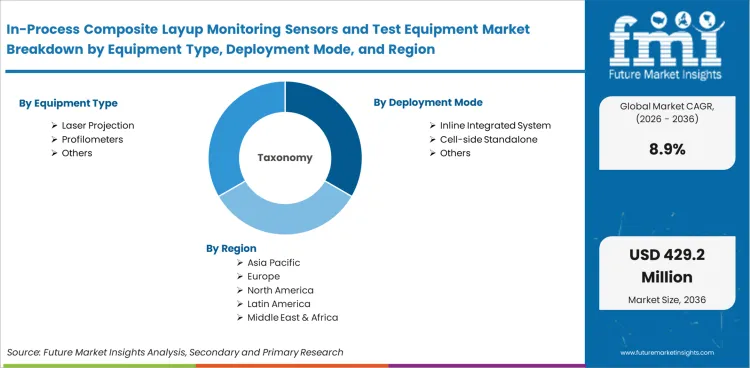
| Equipment Type Segmentation | Laser projection, Machine vision, Profilometers, Thermography, OCT systems, Ultrasonics |
| Deployment Mode Segmentation | Inline integrated, Cell-side standalone, Portable offline |
| Process Coverage Segmentation | Ply placement, Boundary checks, Gap overlap, FOD detection, Fiber angle, Surface mapping, Temperature checks |
| Layup Method Segmentation | AFP, Manual layup, ATL |
| End Use Segmentation | Aerospace, Defense, Automotive, Wind energy, Marine, Space |
| Material System Segmentation | Thermoset prepreg, Thermoplastic tape, Dry fiber |
| Sales Channel Segmentation | OEM integrated, Retrofit |
| Regions Covered | Asia Pacific, North America, Europe |
| Countries Covered | China, India, United Kingdom, United States, France, Germany, Japan, and 40 plus countries |
| Key Companies Profiled | Virtek Vision International, LAP GmbH, FARO Technologies, Electroimpact, Hexagon AB |
| Forecast Period | 2026 to 2036 |
| Approach | FMI based the outlook on composite manufacturing activity, buyer adoption logic, active supplier presence, and comparative cell-level inspection needs across major industrial countries. |
Source: Future Market Insights (FMI) analysis, based on proprietary forecasting model and primary research
In-Process Composite Layup Monitoring Sensors and Test Equipment Market Analysis by Segments
By Equipment Type
- Laser projection
- Machine vision
- Profilometers
- Thermography
- OCT systems
- Ultrasonics
By Deployment Mode
- Inline integrated
- Cell-side standalone
- Portable offline
By Process Coverage
- Ply placement
- Boundary checks
- Gap overlap
- FOD detection
- Fiber angle
- Surface mapping
- Temperature checks
By Layup Method
- AFP
- Manual layup
- ATL
By End Use
- Aerospace
- Defense
- Automotive
- Wind energy
- Marine
- Space
By Material System
- Thermoset prepreg
- Thermoplastic tape
- Dry fiber
By Sales Channel
- OEM integrated
- Retrofit
By Region
- North America
- United States
- Canada
- Europe
- Germany
- United Kingdom
- France
- Italy
- Spain
- Asia Pacific
- China
- Japan
- South Korea
- Taiwan
- Singapore
- Latin America
- Brazil
- Mexico
- Argentina
- Middle East & Africa
- GCC Countries
- South Africa
Bibliography
- Ghamisi, A., Case, A., Scaife, R., Wada, T., & Fayek, A. R. (2024). Anomaly detection in automated fibre placement: Learning with data limitations.
- Zemzemoglu, M., Unel, M., & Tunc, L. T. (2024). Enhancing automated fiber placement process monitoring and quality inspection: A hybrid thermal vision based framework.
- Wen, L., Wang, W., Zhang, J., Zhang, Z., Liu, B., & Xu, P. (2024). Research on automated fiber placement surface defect detection based on improved YOLOv7.
- Tang, C., Sun, D., Zou, J., Xiong, Y., Fang, G., & Zhang, W. (2025). Lay-up defects inspection for automated fiber placement with structural light scanning and deep learning.
- National Institute of Standards and Technology. (2024). Research opportunities for advancing measurement science for manufacturing robotics. USA Department of Commerce.
This bibliography is provided for the reader’s reference. The full FMI report contains the complete reference list with primary source documentation.
This Report Addresses
- Current industry value and long-range outlook.
- Expected CAGR from 2026 to 2036.
- Leading equipment type and why it stays ahead.
- Deployment logic behind inline integrated systems.
- Core process coverage priorities during layup.
- Country growth differences across major industrial locations.
- Supplier positions and buyer comparison points.
- Scope boundaries for included and excluded tool categories.
Frequently Asked Questions
What is the current industry size?
Industry value is estimated at USD 154.3 million in 2025.
How large can the industry become by 2036?
Total valuation is projected to reach USD 394.1 million by 2036.
What CAGR is forecast from 2026 to 2036?
FMI estimates expansion at 8.9% CAGR through the forecast period.
Which equipment type leads in 2026?
Laser projection is expected to lead Equipment Type with 29.0% share in 2026.
Which deployment mode stays ahead?
Inline integrated systems are projected to hold 58.0% share in 2026 because review stays inside the cell.
Why does ply placement matter most?
Ply placement leads Process Coverage at 24.0% share in 2026 because later checks depend on a correct starting position.
Why does AFP lead by layup method?
AFP is set to account for 46.0% share in 2026 because automation raises the cost of even small placement errors.
Which end use carries the most demand?
Aerospace is forecast to represent 61.0% share in 2026 due to high part value and tighter traceability needs.
Which material system stays ahead?
Thermoset prepreg is expected to contribute 56.0% share in 2026 because installed qualified workflows still favor it.
How does OEM integrated demand compare with retrofit?
OEM integrated systems are projected to reach 52.0% share in 2026 as buyers specify monitoring with the cell more often than after installation.
Which country grows fastest?
China leads the country outlook with 9.8% CAGR through 2036.
Why is China ahead?
Fresh capacity and first-cycle cell investment give China more room for new adoption than mature upgrade-heavy countries.
How does India differ from Japan?
India grows faster at 9.4% CAGR because adoption is widening from a smaller installed base, while Japan grows at 7.8% through refinement of mature lines.
Why do mature countries still buy these tools?
United States, United Kingdom, France, Germany, and Japan keep buying because upgrade logic still rewards clearer in-cell evidence.
What do buyers compare first?
Buyers usually compare cell fit, review clarity, software handling, and alarm trust before they compare raw sensing detail.
How do false alarms affect adoption?
Weak alarm quality can reduce operator trust and slow acceptance even when sensor capability is strong.
Why does inline integration matter?
Inline integration matters because it shortens the path between placement, review, and correction.
How do thermoplastic programs change equipment needs?
Thermoplastic lines raise interest in tools that can work close to faster cycles and tighter heat conditions.
Which companies are active in this space?
Virtek Vision International, LAP GmbH, FARO Technologies, Electroimpact, and Hexagon AB remain visible participants.
What does the scope include?
Scope includes inline and near-line layup monitoring sensors, test equipment, and review software used during composite layup.
Preview the report firsthand - request a free sample
Get SampleGet the brochure for pricing and purchase details.
Get PDFTable of Content
- Executive Summary
- Global Market Outlook
- Demand-side Trends
- Supply-side Trends
- Technology Roadmap Analysis
- Analysis and Recommendations
- Market Overview
- Market Coverage / Taxonomy
- Market Definition / Scope / Limitations
- Research Methodology
- Chapter Orientation
- Analytical Lens and Working Hypotheses
- Market Structure, Signals, and Trend Drivers
- Benchmarking and Cross-market Comparability
- Market Sizing, Forecasting, and Opportunity Mapping
- Research Design and Evidence Framework
- Desk Research Programme (Secondary Evidence)
- Company Annual and Sustainability Reports
- Peer-reviewed Journals and Academic Literature
- Corporate Websites, Product Literature, and Technical Notes
- Earnings Decks and Investor Briefings
- Statutory Filings and Regulatory Disclosures
- Technical White Papers and Standards Notes
- Trade Journals, Industry Magazines, and Analyst Briefs
- Conference Proceedings, Webinars, and Seminar Materials
- Government Statistics Portals and Public Data Releases
- Press Releases and Reputable Media Coverage
- Specialist Newsletters and Curated Briefings
- Sector Databases and Reference Repositories
- FMI Internal Proprietary Databases and Historical Market Datasets
- Subscription Datasets and Paid Sources
- Social Channels, Communities, and Digital Listening Inputs
- Additional Desk Sources
- Expert Input and Fieldwork (Primary Evidence)
- Primary Modes
- Qualitative Interviews and Expert Elicitation
- Quantitative Surveys and Structured Data Capture
- Blended Approach
- Why Primary Evidence is Used
- Field Techniques
- Interviews
- Surveys
- Focus Groups
- Observational and In-context Research
- Social and Community Interactions
- Stakeholder Universe Engaged
- C-suite Leaders
- Board Members
- Presidents and Vice Presidents
- R&D and Innovation Heads
- Technical Specialists
- Domain Subject-matter Experts
- Scientists
- Physicians and Other Healthcare Professionals
- Governance, Ethics, and Data Stewardship
- Research Ethics
- Data Integrity and Handling
- Primary Modes
- Tooling, Models, and Reference Databases
- Desk Research Programme (Secondary Evidence)
- Data Engineering and Model Build
- Data Acquisition and Ingestion
- Cleaning, Normalisation, and Verification
- Synthesis, Triangulation, and Analysis
- Quality Assurance and Audit Trail
- Market Background
- Market Dynamics
- Drivers
- Restraints
- Opportunity
- Trends
- Scenario Forecast
- Demand in Optimistic Scenario
- Demand in Likely Scenario
- Demand in Conservative Scenario
- Opportunity Map Analysis
- Product Life Cycle Analysis
- Supply Chain Analysis
- Investment Feasibility Matrix
- Value Chain Analysis
- PESTLE and Porter’s Analysis
- Regulatory Landscape
- Regional Parent Market Outlook
- Production and Consumption Statistics
- Import and Export Statistics
- Market Dynamics
- Global Market Analysis 2021 to 2025 and Forecast, 2026 to 2036
- Historical Market Size Value (USD Million) Analysis, 2021 to 2025
- Current and Future Market Size Value (USD Million) Projections, 2026 to 2036
- Y-o-Y Growth Trend Analysis
- Absolute $ Opportunity Analysis
- Global Market Pricing Analysis 2021 to 2025 and Forecast 2026 to 2036
- Global Market Analysis 2021 to 2025 and Forecast 2026 to 2036, By Equipment Type
- Introduction / Key Findings
- Historical Market Size Value (USD Million) Analysis By Equipment Type , 2021 to 2025
- Current and Future Market Size Value (USD Million) Analysis and Forecast By Equipment Type , 2026 to 2036
- Laser Projection
- Profilometers
- Others
- Laser Projection
- Y-o-Y Growth Trend Analysis By Equipment Type , 2021 to 2025
- Absolute $ Opportunity Analysis By Equipment Type , 2026 to 2036
- Global Market Analysis 2021 to 2025 and Forecast 2026 to 2036, By Deployment Mode
- Introduction / Key Findings
- Historical Market Size Value (USD Million) Analysis By Deployment Mode, 2021 to 2025
- Current and Future Market Size Value (USD Million) Analysis and Forecast By Deployment Mode, 2026 to 2036
- Inline Integrated System
- Cell-side Standalone
- Others
- Inline Integrated System
- Y-o-Y Growth Trend Analysis By Deployment Mode, 2021 to 2025
- Absolute $ Opportunity Analysis By Deployment Mode, 2026 to 2036
- Global Market Analysis 2021 to 2025 and Forecast 2026 to 2036, By Process Coverage
- Introduction / Key Findings
- Historical Market Size Value (USD Million) Analysis By Process Coverage, 2021 to 2025
- Current and Future Market Size Value (USD Million) Analysis and Forecast By Process Coverage, 2026 to 2036
- Ply Placement
- Fiber Angle
- Others
- Ply Placement
- Y-o-Y Growth Trend Analysis By Process Coverage, 2021 to 2025
- Absolute $ Opportunity Analysis By Process Coverage, 2026 to 2036
- Global Market Analysis 2021 to 2025 and Forecast 2026 to 2036, By Layup Method
- Introduction / Key Findings
- Historical Market Size Value (USD Million) Analysis By Layup Method, 2021 to 2025
- Current and Future Market Size Value (USD Million) Analysis and Forecast By Layup Method, 2026 to 2036
- AFP
- Manual layup
- ATL
- AFP
- Y-o-Y Growth Trend Analysis By Layup Method, 2021 to 2025
- Absolute $ Opportunity Analysis By Layup Method, 2026 to 2036
- Global Market Analysis 2021 to 2025 and Forecast 2026 to 2036, By End Use
- Introduction / Key Findings
- Historical Market Size Value (USD Million) Analysis By End Use, 2021 to 2025
- Current and Future Market Size Value (USD Million) Analysis and Forecast By End Use, 2026 to 2036
- Aerospace
- Defense
- Automotive
- Aerospace
- Y-o-Y Growth Trend Analysis By End Use, 2021 to 2025
- Absolute $ Opportunity Analysis By End Use, 2026 to 2036
- Global Market Analysis 2021 to 2025 and Forecast 2026 to 2036, By Material System
- Introduction / Key Findings
- Historical Market Size Value (USD Million) Analysis By Material System, 2021 to 2025
- Current and Future Market Size Value (USD Million) Analysis and Forecast By Material System, 2026 to 2036
- Thermoset Prepreg
- Thermoplastic tape
- Dry fiber
- Thermoset Prepreg
- Y-o-Y Growth Trend Analysis By Material System, 2021 to 2025
- Absolute $ Opportunity Analysis By Material System, 2026 to 2036
- Global Market Analysis 2021 to 2025 and Forecast 2026 to 2036, By Sales Channel
- Introduction / Key Findings
- Historical Market Size Value (USD Million) Analysis By Sales Channel, 2021 to 2025
- Current and Future Market Size Value (USD Million) Analysis and Forecast By Sales Channel, 2026 to 2036
- OEM Integrated
- Retrofit
- OEM Integrated
- Y-o-Y Growth Trend Analysis By Sales Channel, 2021 to 2025
- Absolute $ Opportunity Analysis By Sales Channel, 2026 to 2036
- Global Market Analysis 2021 to 2025 and Forecast 2026 to 2036, By Region
- Introduction
- Historical Market Size Value (USD Million) Analysis By Region, 2021 to 2025
- Current Market Size Value (USD Million) Analysis and Forecast By Region, 2026 to 2036
- North America
- Latin America
- Western Europe
- Eastern Europe
- East Asia
- South Asia and Pacific
- Middle East & Africa
- Market Attractiveness Analysis By Region
- North America Market Analysis 2021 to 2025 and Forecast 2026 to 2036, By Country
- Historical Market Size Value (USD Million) Trend Analysis By Market Taxonomy, 2021 to 2025
- Market Size Value (USD Million) Forecast By Market Taxonomy, 2026 to 2036
- By Country
- USA
- Canada
- Mexico
- By Equipment Type
- By Deployment Mode
- By Process Coverage
- By Layup Method
- By End Use
- By Material System
- By Sales Channel
- By Country
- Market Attractiveness Analysis
- By Country
- By Equipment Type
- By Deployment Mode
- By Process Coverage
- By Layup Method
- By End Use
- By Material System
- By Sales Channel
- Key Takeaways
- Latin America Market Analysis 2021 to 2025 and Forecast 2026 to 2036, By Country
- Historical Market Size Value (USD Million) Trend Analysis By Market Taxonomy, 2021 to 2025
- Market Size Value (USD Million) Forecast By Market Taxonomy, 2026 to 2036
- By Country
- Brazil
- Chile
- Rest of Latin America
- By Equipment Type
- By Deployment Mode
- By Process Coverage
- By Layup Method
- By End Use
- By Material System
- By Sales Channel
- By Country
- Market Attractiveness Analysis
- By Country
- By Equipment Type
- By Deployment Mode
- By Process Coverage
- By Layup Method
- By End Use
- By Material System
- By Sales Channel
- Key Takeaways
- Western Europe Market Analysis 2021 to 2025 and Forecast 2026 to 2036, By Country
- Historical Market Size Value (USD Million) Trend Analysis By Market Taxonomy, 2021 to 2025
- Market Size Value (USD Million) Forecast By Market Taxonomy, 2026 to 2036
- By Country
- Germany
- UK
- Italy
- Spain
- France
- Nordic
- BENELUX
- Rest of Western Europe
- By Equipment Type
- By Deployment Mode
- By Process Coverage
- By Layup Method
- By End Use
- By Material System
- By Sales Channel
- By Country
- Market Attractiveness Analysis
- By Country
- By Equipment Type
- By Deployment Mode
- By Process Coverage
- By Layup Method
- By End Use
- By Material System
- By Sales Channel
- Key Takeaways
- Eastern Europe Market Analysis 2021 to 2025 and Forecast 2026 to 2036, By Country
- Historical Market Size Value (USD Million) Trend Analysis By Market Taxonomy, 2021 to 2025
- Market Size Value (USD Million) Forecast By Market Taxonomy, 2026 to 2036
- By Country
- Russia
- Poland
- Hungary
- Balkan & Baltic
- Rest of Eastern Europe
- By Equipment Type
- By Deployment Mode
- By Process Coverage
- By Layup Method
- By End Use
- By Material System
- By Sales Channel
- By Country
- Market Attractiveness Analysis
- By Country
- By Equipment Type
- By Deployment Mode
- By Process Coverage
- By Layup Method
- By End Use
- By Material System
- By Sales Channel
- Key Takeaways
- East Asia Market Analysis 2021 to 2025 and Forecast 2026 to 2036, By Country
- Historical Market Size Value (USD Million) Trend Analysis By Market Taxonomy, 2021 to 2025
- Market Size Value (USD Million) Forecast By Market Taxonomy, 2026 to 2036
- By Country
- China
- Japan
- South Korea
- By Equipment Type
- By Deployment Mode
- By Process Coverage
- By Layup Method
- By End Use
- By Material System
- By Sales Channel
- By Country
- Market Attractiveness Analysis
- By Country
- By Equipment Type
- By Deployment Mode
- By Process Coverage
- By Layup Method
- By End Use
- By Material System
- By Sales Channel
- Key Takeaways
- South Asia and Pacific Market Analysis 2021 to 2025 and Forecast 2026 to 2036, By Country
- Historical Market Size Value (USD Million) Trend Analysis By Market Taxonomy, 2021 to 2025
- Market Size Value (USD Million) Forecast By Market Taxonomy, 2026 to 2036
- By Country
- India
- ASEAN
- Australia & New Zealand
- Rest of South Asia and Pacific
- By Equipment Type
- By Deployment Mode
- By Process Coverage
- By Layup Method
- By End Use
- By Material System
- By Sales Channel
- By Country
- Market Attractiveness Analysis
- By Country
- By Equipment Type
- By Deployment Mode
- By Process Coverage
- By Layup Method
- By End Use
- By Material System
- By Sales Channel
- Key Takeaways
- Middle East & Africa Market Analysis 2021 to 2025 and Forecast 2026 to 2036, By Country
- Historical Market Size Value (USD Million) Trend Analysis By Market Taxonomy, 2021 to 2025
- Market Size Value (USD Million) Forecast By Market Taxonomy, 2026 to 2036
- By Country
- Kingdom of Saudi Arabia
- Other GCC Countries
- Turkiye
- South Africa
- Other African Union
- Rest of Middle East & Africa
- By Equipment Type
- By Deployment Mode
- By Process Coverage
- By Layup Method
- By End Use
- By Material System
- By Sales Channel
- By Country
- Market Attractiveness Analysis
- By Country
- By Equipment Type
- By Deployment Mode
- By Process Coverage
- By Layup Method
- By End Use
- By Material System
- By Sales Channel
- Key Takeaways
- Key Countries Market Analysis
- USA
- Pricing Analysis
- Market Share Analysis, 2025
- By Equipment Type
- By Deployment Mode
- By Process Coverage
- By Layup Method
- By End Use
- By Material System
- By Sales Channel
- Canada
- Pricing Analysis
- Market Share Analysis, 2025
- By Equipment Type
- By Deployment Mode
- By Process Coverage
- By Layup Method
- By End Use
- By Material System
- By Sales Channel
- Mexico
- Pricing Analysis
- Market Share Analysis, 2025
- By Equipment Type
- By Deployment Mode
- By Process Coverage
- By Layup Method
- By End Use
- By Material System
- By Sales Channel
- Brazil
- Pricing Analysis
- Market Share Analysis, 2025
- By Equipment Type
- By Deployment Mode
- By Process Coverage
- By Layup Method
- By End Use
- By Material System
- By Sales Channel
- Chile
- Pricing Analysis
- Market Share Analysis, 2025
- By Equipment Type
- By Deployment Mode
- By Process Coverage
- By Layup Method
- By End Use
- By Material System
- By Sales Channel
- Germany
- Pricing Analysis
- Market Share Analysis, 2025
- By Equipment Type
- By Deployment Mode
- By Process Coverage
- By Layup Method
- By End Use
- By Material System
- By Sales Channel
- UK
- Pricing Analysis
- Market Share Analysis, 2025
- By Equipment Type
- By Deployment Mode
- By Process Coverage
- By Layup Method
- By End Use
- By Material System
- By Sales Channel
- Italy
- Pricing Analysis
- Market Share Analysis, 2025
- By Equipment Type
- By Deployment Mode
- By Process Coverage
- By Layup Method
- By End Use
- By Material System
- By Sales Channel
- Spain
- Pricing Analysis
- Market Share Analysis, 2025
- By Equipment Type
- By Deployment Mode
- By Process Coverage
- By Layup Method
- By End Use
- By Material System
- By Sales Channel
- France
- Pricing Analysis
- Market Share Analysis, 2025
- By Equipment Type
- By Deployment Mode
- By Process Coverage
- By Layup Method
- By End Use
- By Material System
- By Sales Channel
- India
- Pricing Analysis
- Market Share Analysis, 2025
- By Equipment Type
- By Deployment Mode
- By Process Coverage
- By Layup Method
- By End Use
- By Material System
- By Sales Channel
- ASEAN
- Pricing Analysis
- Market Share Analysis, 2025
- By Equipment Type
- By Deployment Mode
- By Process Coverage
- By Layup Method
- By End Use
- By Material System
- By Sales Channel
- Australia & New Zealand
- Pricing Analysis
- Market Share Analysis, 2025
- By Equipment Type
- By Deployment Mode
- By Process Coverage
- By Layup Method
- By End Use
- By Material System
- By Sales Channel
- China
- Pricing Analysis
- Market Share Analysis, 2025
- By Equipment Type
- By Deployment Mode
- By Process Coverage
- By Layup Method
- By End Use
- By Material System
- By Sales Channel
- Japan
- Pricing Analysis
- Market Share Analysis, 2025
- By Equipment Type
- By Deployment Mode
- By Process Coverage
- By Layup Method
- By End Use
- By Material System
- By Sales Channel
- South Korea
- Pricing Analysis
- Market Share Analysis, 2025
- By Equipment Type
- By Deployment Mode
- By Process Coverage
- By Layup Method
- By End Use
- By Material System
- By Sales Channel
- Russia
- Pricing Analysis
- Market Share Analysis, 2025
- By Equipment Type
- By Deployment Mode
- By Process Coverage
- By Layup Method
- By End Use
- By Material System
- By Sales Channel
- Poland
- Pricing Analysis
- Market Share Analysis, 2025
- By Equipment Type
- By Deployment Mode
- By Process Coverage
- By Layup Method
- By End Use
- By Material System
- By Sales Channel
- Hungary
- Pricing Analysis
- Market Share Analysis, 2025
- By Equipment Type
- By Deployment Mode
- By Process Coverage
- By Layup Method
- By End Use
- By Material System
- By Sales Channel
- Kingdom of Saudi Arabia
- Pricing Analysis
- Market Share Analysis, 2025
- By Equipment Type
- By Deployment Mode
- By Process Coverage
- By Layup Method
- By End Use
- By Material System
- By Sales Channel
- Turkiye
- Pricing Analysis
- Market Share Analysis, 2025
- By Equipment Type
- By Deployment Mode
- By Process Coverage
- By Layup Method
- By End Use
- By Material System
- By Sales Channel
- South Africa
- Pricing Analysis
- Market Share Analysis, 2025
- By Equipment Type
- By Deployment Mode
- By Process Coverage
- By Layup Method
- By End Use
- By Material System
- By Sales Channel
- USA
- Market Structure Analysis
- Competition Dashboard
- Competition Benchmarking
- Market Share Analysis of Top Players
- By Regional
- By Equipment Type
- By Deployment Mode
- By Process Coverage
- By Layup Method
- By End Use
- By Material System
- By Sales Channel
- Competition Analysis
- Competition Deep Dive
- Virtek Vision International
- Overview
- Product Portfolio
- Profitability by Market Segments (Product/Age /Sales Channel/Region)
- Sales Footprint
- Strategy Overview
- Marketing Strategy
- Product Strategy
- Channel Strategy
- LAP GmbH
- FARO Technologies
- Electroimpact
- Hexagon AB
- Virtek Vision International
- Competition Deep Dive
- Assumptions & Acronyms Used


