

- Industry Size (2026)
- USD 155 Mn
- Forecast (2036)
- USD 1689 Mn
- CAGR (2026 to 2036)
- 24%
Ultra-Wideband Spectrum Monitoring and Interference Analysis Test Equipment Market Forecast and Outlook 2026 to 2036
Global ultra-wideband spectrum monitoring and interference analysis test equipment market, valued at USD 155 million in 2026, is projected to grow to USD 1,689 million by 2036, with a CAGR of 24%. Growth is driven by the increasing demand for accurate spectrum monitoring and interference analysis in the development of next-generation wireless technologies, including 6G.
Growth is further fueled by the growing adoption of ultra-wideband technologies and the need for advanced testing equipment in the wireless communication sector. Spectrum analyzers, which account for 28% of the equipment type market share, are essential tools for monitoring and analyzing wideband frequency spectrums, ensuring the proper functioning of communication systems. AI-assisted interference analysis, representing 27% of the technology type segment, is becoming increasingly popular due to its ability to efficiently detect and analyze interference patterns, improving overall network performance.
Quick Stats for Ultra-Wideband Spectrum Monitoring and Interference Analysis Test Equipment Market
- Ultra-Wideband Spectrum Monitoring and Interference Analysis Test Equipment Market Value (2026): USD 155 million
- Ultra-Wideband Spectrum Monitoring and Interference Analysis Test Equipment Market Forecast Value (2036): USD 1,689 million
- Ultra-Wideband Spectrum Monitoring and Interference Analysis Test Equipment Market Global Forecast CAGR: 24%
- Leading Equipment Type in Ultra-Wideband Spectrum Monitoring and Interference Analysis Test Equipment Market: Spectrum analyzers (28%)
- Key Growth Regions in Ultra-Wideband Spectrum Monitoring and Interference Analysis Test Equipment Market: China, USA, India, UK, Japan
- Top Players in Ultra-Wideband Spectrum Monitoring and Interference Analysis Test Equipment Market: Keysight Technologies, Rohde & Schwarz, Anritsu Corporation, Viavi Solutions Inc., Tektronix, National Instruments (NI), EXFO, Signal Hound, Aaronia AG, Sunrise Telecom, Advantest Corporation, LitePoint Corporation, Copper Mountain Technologies, ETS-Lindgren, Smartec Test & Measurement
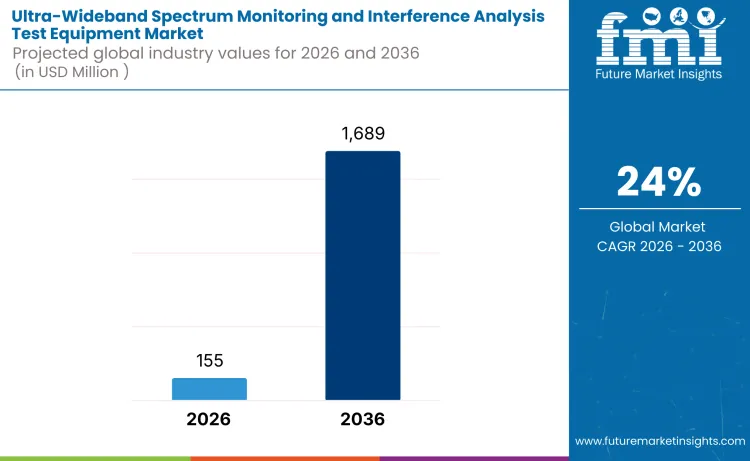
Ultra-Wideband Spectrum Monitoring and Interference Analysis Test Equipment Market Key Takeaways
| Metric | Value |
|---|---|
| Industry Sales Value (2026) | USD 155 million |
| Industry Forecast Value (2036) | USD 1,689 million |
| Industry Forecast CAGR (2026 to 2036) | 24% |
What Is Driving the Demand for Ultra-Wideband Spectrum Monitoring and Interference Analysis Test Equipment Globally?
Adoption of ultrawideband spectrum monitoring and interference analysis test equipment is driven by the increasing use of wireless technologies and the need for reliable spectrum performance. As 5G and future 6G networks expand across broader frequency ranges, the risk of interference and signal congestion grows. Operators, regulators, and equipment manufacturers require advanced tools to monitor wide frequency bands, detect interference, and ensure efficient spectrum management. These systems help optimize network performance, ensure regulatory compliance, and enable more efficient spectrum allocation.
Future demand for these test systems is expected to grow with the rise of IoT, connected devices, and high-capacity broadband services, increasing spectrum utilization and interference risks. Advanced signal processing, real-time analytics, and automation will improve the capabilities of monitoring systems. As wireless infrastructure investments rise globally, the need for effective spectrum monitoring and interference analysis will expand to maintain network quality and regulatory compliance.
What Are the Key Segments in Ultra-Wideband Spectrum Monitoring and Interference Analysis Test Equipment Market?
Ultra-wideband spectrum monitoring and interference analysis test equipment market is growing due to the increasing demand for reliable spectrum management in wireless communication systems. Spectrum analyzers represent 28% of the market, providing essential tools for monitoring and analyzing frequency spectrum use. AI-assisted interference analysis accounts for 27%, leveraging artificial intelligence to enhance the detection and management of interference in ultra-wideband systems. These technologies are critical as the demand for spectrum resources increases, particularly with the advent of 5G and 6G networks.
Which Equipment Type Drives Ultra-Wideband Spectrum Monitoring and Interference Analysis Test Equipment Demand Globally?
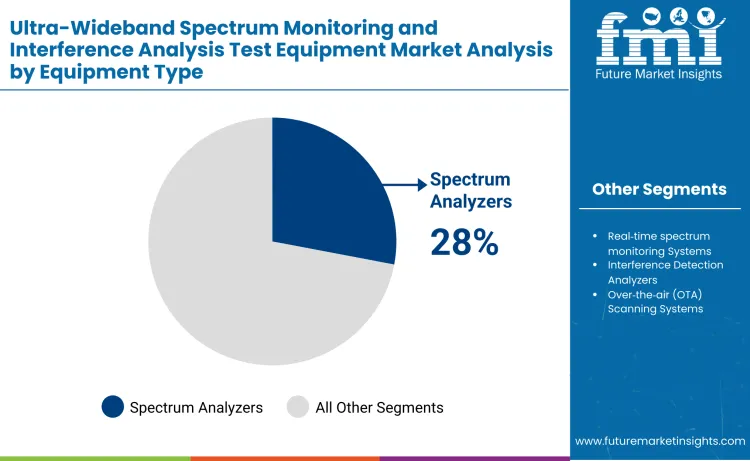
Spectrum analyzers lead the market with 28% of the share. These instruments are essential for identifying and monitoring signals within the ultra-wideband spectrum, which covers a broad range of frequencies used by modern communication systems. Spectrum analyzers measure the strength of signals, identify interference, and assess the quality of spectrum usage. They are widely used in regulatory environments, research, and development, as well as in the deployment of new wireless technologies such as 5G. As spectrum management becomes more complex with the introduction of ultra-wideband frequencies, the need for precise, high-performance spectrum analyzers continues to grow. These tools allow operators to identify underutilized or overcrowded frequencies, optimize spectrum allocation, and ensure compliance with regulatory standards. The increasing need for monitoring devices capable of handling broad frequency ranges, coupled with the rapid expansion of wireless networks, drives the demand for advanced spectrum analyzers in the market.
Which Technology Type Drives Ultra-Wideband Spectrum Monitoring and Interference Analysis Test Equipment Demand Globally?
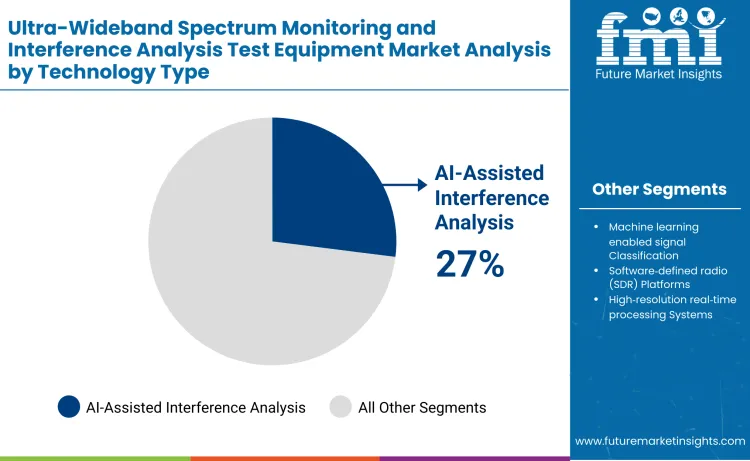
AI-assisted interference analysis represents 27% of the market share. This technology uses artificial intelligence algorithms to enhance the detection and analysis of interference in ultra-wideband spectrum systems. AI-assisted tools can automatically identify interference patterns, classify sources of disruption, and provide actionable insights for mitigating issues. This technology is particularly useful in environments where large amounts of data and complex signal interactions need to be processed quickly, such as in 5G or future 6G networks. AI-assisted interference analysis improves the efficiency and accuracy of monitoring systems by identifying problems that traditional methods might miss, enabling faster response times and better decision-making. With the growing complexity of wireless communication and the increasing need for interference-free spectrum use, AI-driven solutions are becoming crucial for effective spectrum management. The integration of AI with traditional spectrum monitoring tools is accelerating market growth as it enhances the ability to manage spectrum more effectively, particularly in densely packed frequency bands.
What is the Summary of the Global Ultra-Wideband Spectrum Monitoring and Interference Analysis Test Equipment Market?
Global ultrawideband spectrum monitoring and interference analysis test equipment market is growing as wireless systems become more crowded and complex with technologies such as 5G, WiFi, satellite, IoT and future 6G. Ultrawideband monitoring tools are used to observe wide portions of the radio frequency spectrum, detect interference sources, and ensure reliable communication performance. Operators, regulators and equipment manufacturers rely on these systems to validate signal integrity, manage spectrum usage, and troubleshoot issues. The market reflects increasing demand for accurate, real-time spectrum visibility and quality assurance in dense and dynamic radio environments.
What are the Key Drivers for the Global Ultra-Wideband Spectrum Monitoring and Interference Analysis Test Equipment Market?
A key driver is the rapid growth in wireless technologies and the proliferation of connected devices, which increases spectrum use and the potential for interference. Network operators, regulators and enterprises require tools that can monitor broad frequency ranges to identify interference, ensure compliance, and optimize performance. Adoption of advanced communication standards such as 5G, WiFi 6 and emerging 6G research expands monitoring needs across low, mid and high frequency bands. Growth of IoT, industrial automation, autonomous systems and high capacity data services also fuels demand for equipment capable of detailed interference analysis and spectrum assurance.
What are the Restraints for the Global Ultra-Wideband Spectrum Monitoring and Interference Analysis Test Equipment Market?
Designing hardware and software capable of handling large data volumes and providing precise detection across dynamic environments requires advanced engineering, which can raise product prices and limit adoption among smaller operators and labs. Variability in regulatory standards for spectrum management across regions may slow harmonized deployment of monitoring solutions. Integration challenges with existing network infrastructure and legacy test systems also create barriers to seamless adoption.
What is the Global Demand Outlook for Ultra-Wideband Spectrum Monitoring and Interference Analysis Test Equipment?
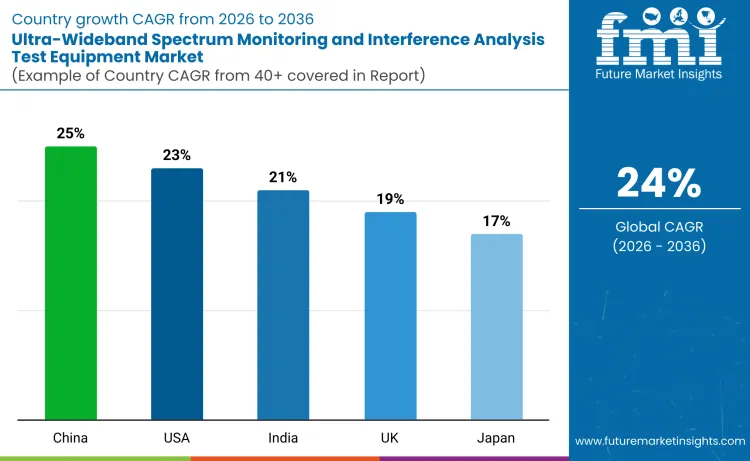
Ultra-wideband spectrum monitoring and interference analysis test equipment market is projected to experience strong growth across various countries, with China leading the market at a projected CAGR of 25%. The USA follows with a growth rate of 23%, while India is expected to grow at 21%. The UK is projected to grow at 19%, and Japan at 17%. As wireless communication systems, including 5G and upcoming 6G networks, rely on broader spectrum bandwidth, the demand for effective spectrum monitoring and interference analysis equipment to ensure optimal performance is increasing. These test solutions are crucial for detecting interference, validating spectrum allocation, and ensuring efficient use of the available bandwidth.
| Country | CAGR (2026 to 2036) |
|---|---|
| China | 25% |
| USA | 23% |
| India | 21% |
| UK | 19% |
| Japan | 17% |
What is Driving the Growth of Ultra-Wideband Spectrum Monitoring and Interference Analysis Test Equipment in China?
China is projected to experience the highest growth in the ultra-wideband spectrum monitoring and interference analysis test equipment market, with a projected CAGR of 25%. As the world’s largest telecommunications market, China is investing heavily in the expansion of its wireless communication infrastructure, particularly with 5G and the future 6G networks. The demand for spectrum monitoring and interference analysis is growing as these advanced networks require careful management of broader spectrum bandwidth to ensure smooth and efficient communication. With China’s rapid adoption of wireless technologies, such as IoT, smart cities, and autonomous vehicles, the need for high-performance spectrum monitoring equipment is rising. Furthermore, China’s regulatory environment, which emphasizes efficient spectrum management and interference mitigation, is driving the adoption of these test solutions.
Why is the Ultra-Wideband Spectrum Monitoring and Interference Analysis Test Equipment Market Expanding in the USA?
In the USA, the ultra-wideband spectrum monitoring and interference analysis test equipment market is projected to grow at a CAGR of 23%. The USA has a well-established telecommunications infrastructure, and the transition to 5G networks is creating new demands for efficient spectrum monitoring and interference detection solutions. With the deployment of 5G and upcoming 6G networks, the demand for technologies that can handle high-bandwidth, ultra-wideband communications is increasing. The USA’s focus on ensuring seamless connectivity for a variety of applications, including IoT, autonomous systems, and smart cities, is driving the need for effective spectrum management solutions. These test systems help monitor and manage interference, ensuring optimal performance across the growing spectrum of wireless networks. As the USA continues to lead in wireless technology innovation, the market for spectrum monitoring and interference analysis solutions is expected to grow steadily.
How is the Ultra-Wideband Spectrum Monitoring and Interference Analysis Test Equipment Market Growing in India?
In India, the ultra-wideband spectrum monitoring and interference analysis test equipment market is projected to grow at a CAGR of 21%. India’s telecommunications sector is undergoing rapid expansion, with the government’s push for 5G rollout and digital transformation driving the demand for advanced spectrum monitoring solutions. As India develops its 5G networks and prepares for the future deployment of 6G, the need for effective interference analysis and spectrum management will become increasingly important. These test systems are essential for ensuring the efficient use of the frequency spectrum, particularly in densely populated areas where interference can be a significant challenge. India’s focus on improving its digital infrastructure and increasing connectivity across urban and rural areas is fueling the market growth for ultra-wideband spectrum monitoring and interference analysis equipment.
What is Contributing to the Growth of Ultra-Wideband Spectrum Monitoring and Interference Analysis Test Equipment in the UK?
In the UK, the demand for ultra-wideband spectrum monitoring and interference analysis test equipment is projected to grow at a CAGR of 19%. The UK is increasingly focusing on the deployment of 5G networks and the development of future wireless technologies, including 6G. As the UK transitions to these next-generation networks, the need for advanced test equipment to monitor and manage spectrum allocation and mitigate interference is growing. These solutions play a critical role in ensuring that high-bandwidth applications, such as IoT, autonomous vehicles, and smart cities, can operate efficiently without signal interference. The UK’s regulatory framework, which emphasizes efficient spectrum use and the prevention of interference, is contributing to the increasing demand for these test systems. As the UK moves toward a more connected future, the need for effective spectrum monitoring and interference analysis will continue to drive the market.
What is Influencing the Growth of Ultra-Wideband Spectrum Monitoring and Interference Analysis Test Equipment in Japan?
In Japan, the demand for ultra-wideband spectrum monitoring and interference analysis test equipment is projected to grow at a CAGR of 17%. Japan’s commitment to digital innovation and its leadership in wireless technology development are contributing to the growing demand for advanced spectrum monitoring solutions. As Japan prepares for the rollout of 5G and 6G networks, the need for precise and efficient interference analysis and spectrum monitoring is becoming crucial. The country’s growing focus on smart cities, autonomous transportation, and industrial automation is driving the demand for high-performance wireless networks. To support these applications and ensure the smooth operation of next-generation communication systems, Japan is investing in test equipment that can monitor and manage the broader spectrum bandwidth. This demand is expected to continue as Japan advances its telecommunications infrastructure.
What is the Competitive Landscape for the Ultra-Wideband Spectrum Monitoring and Interference Analysis Test Equipment Market?
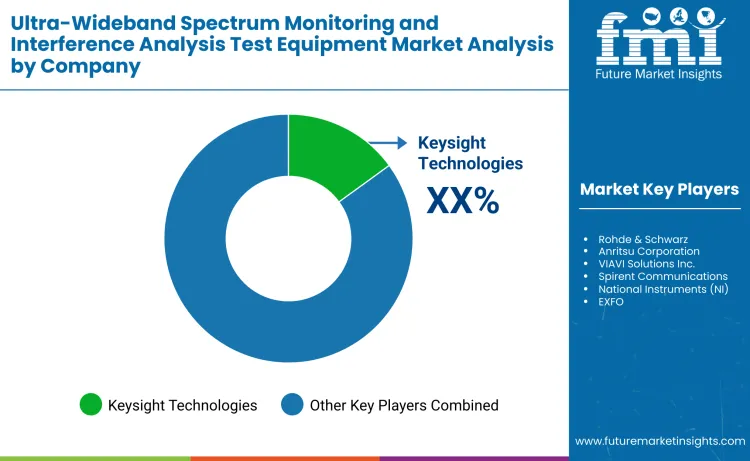
Global demand for ultrawideband spectrum monitoring and interference analysis test equipment is rising as wireless systems become more complex and crowded. Growth of 5G, expansion of WiFi and IoT devices, satellite communications and preparation for 6G drive the need to detect, analyse and mitigate interference across broader frequency ranges. Regulators, network operators, defence agencies and service providers increasingly invest in monitoring systems that can capture wide bandwidths, identify signal anomalies quickly and support real-time spectrum management. As spectrum sharing and dynamic allocation become more common, the ability to analyse interference sources and maintain signal quality becomes critical for service continuity and quality. Growth of connected vehicles, smart infrastructure and industrial wireless systems further expands testing needs for robust spectrum oversight worldwide.
A range of test equipment and measurement firms compete to serve this expanding market. Keysight Technologies is widely recognised as a key player with a strong portfolio of spectrum analysers, monitoring solutions and interference analysis systems. Other significant competitors include Rohde & Schwarz, Anritsu Corporation, Viavi Solutions Inc., Tektronix, National Instruments (NI), EXFO, Signal Hound, Aaronia AG, Sunrise Telecom, Advantest Corporation, LitePoint Corporation, Copper Mountain Technologies, ETSLindgren and Smartec Test & Measurement. These firms provide a mix of instruments such as realtime spectrum analysers, wideband receivers, signal identification tools and software platforms for data analysis. Competition among suppliers centres on bandwidth capability, measurement accuracy, ease of use, interoperability with other test systems, software analytics and global support services. Vendors that combine high-performance hardware, intuitive software and strong technical support are best positioned to capture growth as spectrum environments become more complex and demand for interference analysis intensifies around the world.
Key Players
- Keysight Technologies
- Rohde & Schwarz
- Anritsu Corporation
- Viavi Solutions Inc.
- Tektronix
- National Instruments (NI)
- EXFO
- Signal Hound
- Aaronia AG
- Sunrise Telecom
- Advantest Corporation
- LitePoint Corporation
- Copper Mountain Technologies
- ETS‑Lindgren
- Smartec Test & Measurement
Scope of the Report
| Items | Values |
|---|---|
| Quantitative Units (2026) | USD Million |
| Equipment Type | Spectrum analyzers, Real-time spectrum monitoring systems, Interference detection analyzers, Over-the-air (OTA) scanning systems, Portable field spectrum monitors |
| Technology Type | AI-assisted interference analysis, Machine learning enabled signal classification, Software-defined radio (SDR) platforms, High-resolution real-time processing systems, Cloud-based spectrum monitoring solutions |
| Deployment Mode | On-premise installations, Cloud-based monitoring systems, Hybrid spectrum monitoring solutions |
| Sales Channel | Direct enterprise sales, Authorized distributors, Channel partners, OEM integrations |
| Companies | Keysight Technologies, Rohde & Schwarz, Anritsu Corporation, Viavi Solutions Inc., Tektronix, National Instruments (NI), EXFO, Signal Hound, Aaronia AG, Sunrise Telecom, Advantest Corporation, LitePoint Corporation, Copper Mountain Technologies, ETS-Lindgren, Smartec Test & Measurement |
| Regions Covered | North America, Latin America, Western Europe, Eastern Europe, South Asia and Pacific, East Asia, Middle East & Africa |
| Countries Covered | United States, Canada, Mexico, Brazil, Argentina, Germany, France, United Kingdom, Italy, Spain, Netherlands, China, India, Japan, South Korea, ANZ, GCC Countries, South Africa |
| Additional Attributes | Dollar by sales by equipment type, technology type, deployment mode, sales channel, and region. Includes market trends in AI-assisted and machine learning-enabled interference analysis, performance in ultra-wideband spectrum monitoring, cost-effectiveness, sustainability practices, regulatory compliance, market share and competitive positioning of key companies, and the role of advanced spectrum monitoring systems in ensuring efficient operation and interference-free communication in various sectors including telecom, defense, and research. |
Key Segments in the Ultra-Wideband Spectrum Monitoring and Interference Analysis Test Equipment Market
Equipment Type
- Spectrum analyzers
- Realtime spectrum monitoring systems
- Interference detection analyzers
- Over the air (OTA) scanning systems
- Portable field spectrum monitors
Technology Type
- AI-assisted interference analysis
- Machine learning enabled signal classification
- Software-defined radio (SDR) platforms
- High-resolution real-time processing systems
- Cloud-based spectrum monitoring solutions
Deployment Mode
- On-premise installations
- Cloud-based monitoring systems
- Hybrid spectrum monitoring solutions
Sales Channel
- Direct enterprise sales
- Authorized distributors
- Channel partners
- OEM integrations
Region
- Asia Pacific
- China
- India
- Japan
- South Korea
- ASEAN
- Rest of Asia Pacific
- Europe
- Germany
- United Kingdom
- France
- Italy
- Spain
- Nordic
- BENELUX
- Rest of Europe
- North America
- United States
- Canada
- Mexico
- Latin America
- Brazil
- Chile
- Rest of Latin America
- Middle East & Africa
- Kingdom of Saudi Arabia
- Other GCC Countries
- Turkey
- South Africa
- Other African Union
- Rest of Middle East & Africa
Frequently Asked Questions
How big is the Ultra-Wideband Spectrum Monitoring and Interference Analysis Test Equipment market?
The market is valued at USD 155 million in 2026 and is expected to grow at a CAGR of 24%, reaching USD 1.689 billion by 2036.
What is the growth outlook for the Ultra-Wideband Spectrum Monitoring and Interference Analysis Test Equipment market?
The market is projected to grow at a CAGR of 24% from 2026 to 2036.
Which regions are expected to experience the fastest growth in the Ultra-Wideband Spectrum Monitoring and Interference Analysis Test Equipment market?
China is expected to lead with a growth rate of 25%, followed by the USA at 23%, India at 21%, the UK at 19%, and Japan at 17%, driven by increased demand for spectrum monitoring and interference analysis in advanced wireless systems.
What are the key applications of Ultra-Wideband Spectrum Monitoring and Interference Analysis Test Equipment?
These test equipment are primarily used for spectrum analysis and interference detection in wireless communication systems, ensuring optimal performance and minimal signal disruptions.
Who is the major player in the Ultra-Wideband Spectrum Monitoring and Interference Analysis Test Equipment market?
The leading player in the market is Keysight Technologies.
Preview the report firsthand - request a free sample
Get SampleGet the brochure for pricing and purchase details.
Get PDFTable of Content
- Executive Summary
- Market Overview
- Global Market Value, 2020-2025
- Global Market Forecast, 2026-2036
- Market Dynamics
- Drivers
- Restraints
- Opportunities
- Regulatory & Standards Landscape
- Technology & Innovation Outlook
- Market Segmentation Analysis
- By Equipment Type
- Spectrum Analyzers
- Real-Time Spectrum Monitoring Systems
- Interference Detection Analyzers
- Over-the-Air (OTA) Scanning Systems
- Portable Field Spectrum Monitors
- By Technology Type
- AI-Assisted Interference Analysis
- Machine Learning Enabled Signal Classification
- Software-Defined Radio (SDR) Platforms
- High-Resolution Real-Time Processing Systems
- Cloud-Based Spectrum Monitoring Solutions
- By Deployment Mode
- On-Premise Installations
- Cloud-Based Monitoring Systems
- Hybrid Spectrum Monitoring Solutions
- By Sales Channel
- Direct Enterprise Sales
- Authorized Distributors
- Channel Partners
- OEM Integrations
- By Equipment Type
- Regional Outlook
- North America
- Latin America
- Western Europe
- Eastern Europe
- South Asia & Pacific
- East Asia
- Middle East & Africa
- Country-Level Outlook
- United States
- Canada
- Mexico
- Brazil
- Argentina
- Germany
- France
- United Kingdom
- Italy
- Spain
- Netherlands
- China
- India
- Japan
- South Korea
- ANZ
- GCC Countries
- South Africa
- Competitive Landscape
- Market Structure Overview
- Company Positioning
- Strategic Initiatives
- Key Player Profiles
- Scope of the Report
- Research Methodology
- Assumptions & Acronyms


