

- Market Size (2026)
- USD 690 Mn
- Forecast (2036)
- USD 1694.4 Mn
- CAGR (2026 to 2036)
- 9.4%
Aquaculture Water Quality and Biomass Monitoring Test Equipment Market Size, Market Forecast and Outlook By FMI
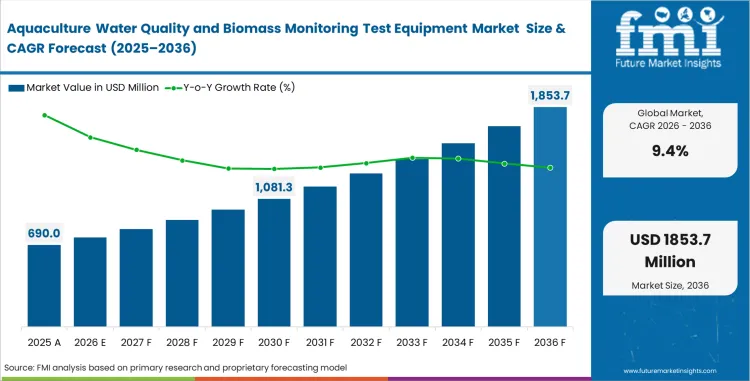
Aquaculture water quality and biomass monitoring test equipment market was valued at USD 630.7 million in 2025. Industry valuation is estimated to reach USD 690 million in 2026 at a CAGR of 9.4% during the forecast period. Market valuation is expected to advance to USD 1,694.4 million by 2036 as fish farms rely more on continuous water condition tracking and biomass visibility to support feeding control, stock health decisions, and harvest planning.
Summary of the Aquaculture Water Quality and Biomass Monitoring Test Equipment Market
- The market is valued at USD 690 million in 2026, rising from USD 630.7 million in 2025, and is projected to reach USD 1,694.4 million by 2036.
- Expansion is projected at 9.4% CAGR through 2036 as aquaculture operations shift toward continuous monitoring of water quality and biomass to support real-time feeding, survival control, and harvest planning.
- Farm-level workflows are being adjusted to reduce manual sampling gaps, improve condition visibility, and support faster response to oxygen, ammonia, and biomass fluctuations during live production cycles.
- Equipment selection depends on field reliability, calibration burden, operator usability, and alignment with daily farm routines rather than measurement capability alone.
- Optical sensors are expected to account for 31% share in 2026, reflecting their lower maintenance needs and better fit for continuous use in aquaculture environments.
- Salmonids are projected to hold 24% share, where higher stock value and tighter production control requirements support deeper monitoring adoption.
- Fixed systems are likely to represent 42% share, as farms prioritize continuous installed monitoring over periodic handheld measurements.
Key Takeaways, Market Size, and Forecast
- Aquaculture Water Quality and Biomass Monitoring Test Equipment Market is projected to grow from USD 690 million in 2026 to USD 1,694.4 million by 2036, at a CAGR of 9.4%.
- The aquaculture water quality and biomass monitoring test equipment market was valued at USD 630.7 million in 2025.
- By 2036, the Aquaculture Water Quality and Biomass Monitoring Test Equipment Market is expected to be worth USD 1,694.4 million.
- From 2026 to 2036, the market is projected to expand at a CAGR of 9.4%.
- The market is projected to create an incremental opportunity of USD 1,004.4 million between 2026 and 2036.
- In 2026, Dissolved Oxygen is expected to account for 26.0% of the parameter segment.
- India (10.8%) and Chile (10.7%) are two of the fastest growing markets.
Aquaculture Water Quality and Biomass Monitoring Test Equipment Market Key Takeaways
| Parameter | Details |
|---|---|
| Market value (2026) | USD 690 million |
| Forecast value (2036) | USD 1,694.4 million |
| CAGR (2026 to 2036) | 9.4% |
| Estimated market value (2025) | USD 630.7 million |
| Incremental opportunity | USD 1,004.4 million |
| Leading parameter | Dissolved Oxygen |
| Leading technology | Optical Sensors |
| Leading deployment | Fixed Systems |
| Leading culture system | Sea Cages |
| Leading species | Salmonids |
| Leading equipment type | Multiparameter Sondes |
| Leading end user | Commercial Farms |
| Fastest-growing country | India |
| India CAGR | 10.8% |
| Key supplier brands referenced in market landscape | AKVA group, ScaleAQ, Innovasea, Xylem |
| Brands referenced in market landscape | AKVA group, ScaleAQ, Innovasea, Xylem, Endress+Hauser, In-Situ, Hach |
Source: Future Market Insights (FMI) analysis, based on proprietary forecasting model and primary research
Farm operators are now deciding whether water quality and biomass monitoring should remain a periodic technical task or become part of routine production control. Choice matters because oxygen stress, ammonia imbalance, feed loss, and weak biomass visibility affect daily site decisions, not just technical review. Budget approval becomes easier when monitoring tools can be tied to feed control, mortality prevention, labor reduction, and harvest timing rather than being positioned as a technical add-on. Aquaculture equipment and precision aquaculture adoption are both helping this category move into regular farm use.
Reliable field performance is the main adoption gate because farms will not scale monitoring tools that create calibration strain, inconsistent readings, or extra task burden during live production. Farm teams need readings they can trust without constant recalibration, repeated manual correction, or long downtime. Once equipment proves dependable through normal farming conditions, wider installation becomes easier across ponds, cages, hatcheries, and recirculating systems.
India is expected to advance at 10.8% CAGR through 2036, followed by Chile at 10.7%, Ecuador at 10.4%, Vietnam at 10.3%, Norway at 10.1%, Indonesia at 9.9%, and China at 8.6%. Faster country growth is concentrated where aquaculture is expanding, site control needs are rising, and monitoring still has room to move from selective use into routine operating practice, while larger established bases move more through upgrades and replacement demand.
Environmental Compliance Is Expanding The Device Brief
A major shift in this market is that monitoring equipment is being pulled into environmental compliance, not just production optimization. New Zealand’s 2025 open-ocean aquaculture guidance emphasizes best-practice benthic and water-quality monitoring, while South Australia’s 2025-26 aquaculture cost-recovery documentation requires monitoring of key physical and water-quality parameters and lower pelagic ecosystem structure inside and outside aquaculture zones. That matters commercially because farms increasingly need devices that can support licence conditions, reporting, and environmental defensibility alongside day-to-day stock management. Buyers are therefore moving toward systems that can generate auditable data across nutrients, oxygen, turbidity, or chlorophyll-related indicators, depending on the farming context. Vendors that position equipment as part of farm compliance architecture will be better placed than those framing it only as operational instrumentation.
Segmental Analysis
Key Facts About Segments
-
Multispectral imaging leads with 28.4% share due to its ability to capture both surface and internal seed traits without significantly increasing laboratory complexity.
- Germination probability outputs account for 24.7% share as labs prioritize predictive insights that support early decision-making rather than post-test validation.
- Vegetable seeds dominate with 31.6% share because higher commercial value and uniformity requirements justify early-stage imaging investment.
- At-line benches hold 34.2% share as labs prefer integrating imaging directly within workflow checkpoints rather than isolated testing rooms.
- Balancing speed with manageable data processing and validation effort, mid throughput systems represent 39.1% share.
- Seed companies contribute 42.8% share since they control bulk testing, certification preparation, and lot release decisions.
- Quality control stage accounts for 36.5% share as imaging tools are mainly used before packaging and distribution decisions.
- Semi-automated systems dominate with 44.3% share, allowing human verification while reducing manual workload.
Aquaculture Water Quality and Biomass Monitoring Test Equipment Market Analysis by Parameter
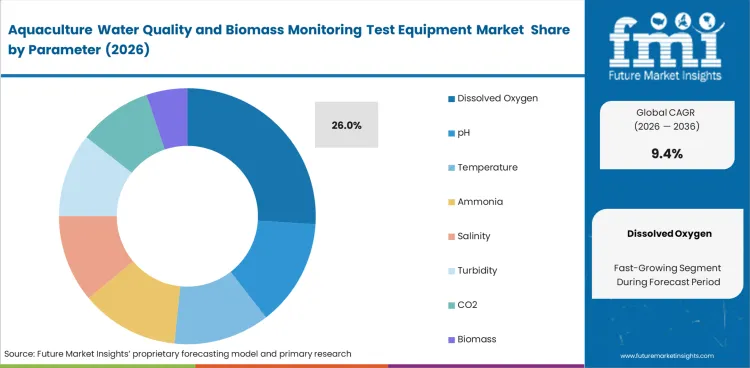
Water condition control often starts with one reading. Oxygen loss reaches farm teams faster than most other water problems because feeding response, stress level, and mortality risk can weaken quickly once dissolved oxygen moves outside a safe operating band. Dissolved Oxygen is expected to account for 26% share in 2026, and that lead comes from its role as the first parameter many sites choose to monitor continuously rather than occasionally. Farm teams do not treat oxygen equipment as a narrow technical add-on. It sits close to stock welfare, feeding discipline, and night-time risk control, especially where dense stocking leaves little room for delayed correction. Broader parameter coverage still matters, yet oxygen monitoring usually wins budget priority first because it affects more immediate farm decisions than turbidity or carbon dioxide in routine use. Weak judgment here can leave teams reacting after stock condition has already slipped.
- Oxygen priority: Continuous oxygen visibility supports faster aeration response and better feeding control. Farm managers lose useful decision time when oxygen readings arrive too late or too inconsistently.
- Stress signaling: Oxygen readings often reveal stock pressure before broader production symptoms become obvious. Site teams can act earlier when one dependable signal anchors daily checks.
- Night control: Overnight oxygen swings place more strain on manual routines than many other parameters. Automated monitoring reduces reliance on scattered spot checks during the most vulnerable hours.
Aquaculture Water Quality and Biomass Monitoring Test Equipment Market Analysis by Technology
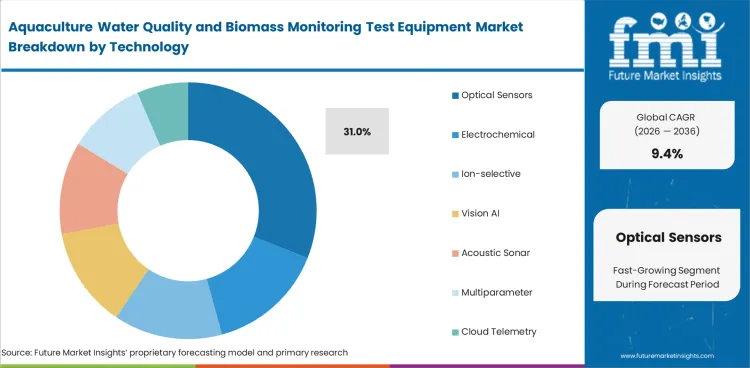
Maintenance burden matters almost as much as measurement quality in wet, fouling-prone farming conditions. Optical Sensors are anticipated to represent 31% of the market in 2026 because farms want continuous monitoring that does not demand the same level of frequent servicing associated with older sensing approaches. Lower intervention matters commercially. Site teams already handle feeding, stock checks, and routine husbandry work, so equipment that adds repeated calibration effort can lose favor even when headline performance looks adequate. Optical systems suit operators trying to reduce hands-on adjustment while still keeping reliable oxygen or multiparameter coverage at the production site. Electrochemical and other alternatives retain relevance in specific use cases, yet optical platforms are on a positive trend because they fit everyday farm routines more cleanly. Equipment that reads well in controlled conditions but creates more field handling rarely remains the preferred option for long.
- Service load: Lower routine servicing makes optical systems easier to keep online across active farming cycles. Less time spent on upkeep improves installation acceptance at busy sites.
- Reading stability: Steadier long-duration performance gives farm teams more confidence in continuous monitoring output. Decision quality weakens when readings fluctuate for maintenance reasons rather than real water changes.
- Field fit: Wet and biologically active environments reward equipment that can handle real operating conditions with fewer interruptions. Technology adoption tends to follow usability more closely than specification sheets.
Aquaculture Water Quality and Biomass Monitoring Test Equipment Market Analysis by Deployment
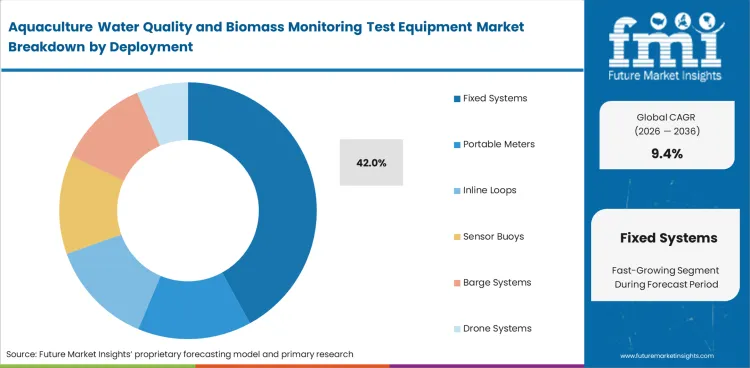
Permanent visibility changes how farms use data. Fixed Systems are forecast to account for 42% share in 2026 because most operators need condition tracking that stays in place and supports decisions throughout the day rather than only during manual inspection rounds. Portable meters remain useful for verification and spot diagnosis, yet daily production control depends more heavily on readings that are always available at the site. Fixed deployment fits aquaculture better once monitoring becomes part of routine feed, welfare, and survival management. Remote cages, larger ponds, and recirculating systems all benefit when condition checks do not rely on staff being present with handheld tools at the exact moment a problem begins. Installation cost can be higher at the start, but the operating case improves where site teams need dependable observation without adding more labor pressure.
- Continuity advantage: Permanent installation keeps readings available through daily farming cycles. Manual checks leave blind periods that can hide fast-moving water problems.
- Labor relief: Fixed deployment reduces how often teams must interrupt routine site work for sampling rounds. Time saved becomes valuable where staff coverage is already tight.
- Alarm utility: Early warning is more useful when monitoring remains active between human inspections. Response quality improves when alerts arrive before stock condition visibly deteriorates.
Aquaculture Water Quality and Biomass Monitoring Test Equipment Market Analysis by Culture System
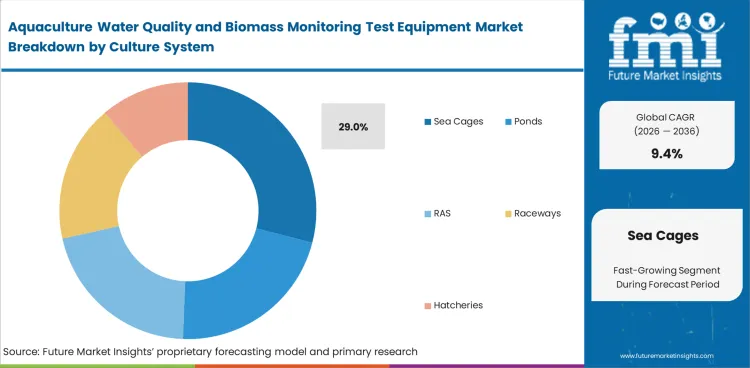
Marine farming sites bring a different operating burden. Sea Cages are projected to represent 29% market share in 2026 because offshore and nearshore production depends heavily on remote observation, biomass estimation, and dependable condition tracking in environments where manual access is slower and more costly. Cage-based operations cannot rely on short-interval physical checks in the same way smaller enclosed systems sometimes can. Weather, distance, and stock concentration all raise the value of installed monitoring and camera-based visibility. Cage farming gives this equipment category a stronger commercial case because missing a water condition problem or misreading biomass can affect feeding discipline and harvest timing at larger stock values. Ponds and hatcheries remain important, but sea cages justify premium monitoring more readily where each site carries heavier biological and logistical exposure.
- Distance penalty: Remote marine sites make repeated manual inspection slower and costlier. Installed monitoring reduces dependence on physical access for every condition check.
- Stock concentration: Higher stock value per site raises the penalty attached to poor visibility. Cage operators need better control over feeding and welfare decisions under live conditions.
- Marine exposure: Water movement and environmental variability create a tougher operating setting than many enclosed systems. Equipment must stay useful where access windows are less forgiving.
Aquaculture Water Quality and Biomass Monitoring Test Equipment Market Analysis by Species
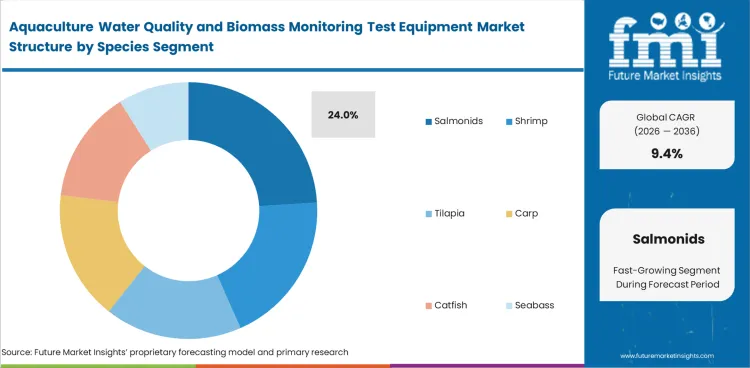
Fish value and farming discipline often determine where monitoring spend rises first. Salmonids are expected to make up 24% of the market in 2026 because salmon farming places tighter commercial weight on biomass accuracy, welfare oversight, and condition stability than many lower-value species categories. Feeding errors, biomass misreads, and unmanaged water stress carry a larger penalty where each production cycle represents heavier biological and financial exposure. Farms in this segment are therefore more willing to adopt cameras, acoustic tools, and continuous water monitoring as part of routine site management. Shrimp and tilapia remain sizeable users, especially in water quality equipment, but salmonids support a stronger case for integrated monitoring depth. Category direction here keeps inclining because tighter stock control has clearer economic value in high-value species.
- Value density: Higher stock value justifies heavier monitoring spend per site. Farm teams protect production quality more tightly where biological losses are harder to absorb.
- Biomass discipline: Better biomass visibility supports feed planning and harvest timing in species where weight accuracy matters closely. Poor biomass calls can distort both feed cost and harvest readiness.
- Welfare scrutiny: Species with tighter welfare expectations push farms toward steadier monitoring routines. Equipment selection becomes more rigorous when stock condition needs closer observation.
Aquaculture Water Quality and Biomass Monitoring Test Equipment Market Analysis by Equipment Type
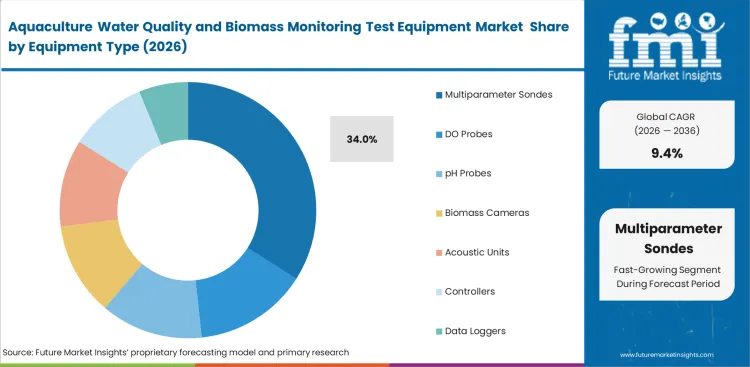
One unit that covers several variables can simplify field work more effectively than multiple standalone devices. Multiparameter Sondes are likely to secure 34% share in 2026 because farms prefer a consolidated monitoring approach where oxygen, pH, temperature, salinity, and related readings can be managed through one installation point. Buying logic here is practical. Each added device increases installation effort, servicing time, and site-level handling needs, particularly in farms already dealing with dispersed assets and variable water conditions. Multiparameter sondes remain on a positive trend because they reduce equipment sprawl while still giving teams a fuller operating picture. Single-parameter probes continue to serve focused needs, yet consolidated units fit broader farm oversight more cleanly when day-to-day management depends on several readings rather than one. Wrong equipment choices in this category often create maintenance overhead that weakens confidence in the whole monitoring program.
- Consolidation benefit: One installed platform reduces equipment clutter and simplifies field management. Fewer separate devices also reduce handling effort during service visits.
- Reading breadth: Broader parameter coverage supports better interpretation of water condition than isolated single-variable monitoring. Farm teams can connect changes more quickly when data arrives together.
- Maintenance discipline: Integrated equipment still needs proper upkeep, yet service routines are easier to organize than managing multiple scattered units. Cleaner maintenance planning supports steadier use.
Aquaculture Water Quality and Biomass Monitoring Test Equipment Market Analysis by End User
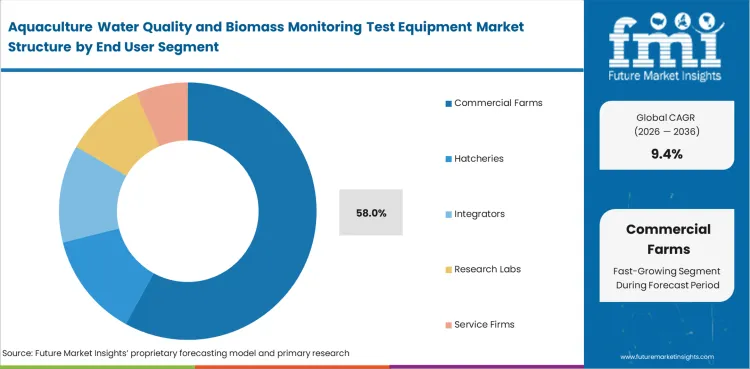
Operating farms decide most of the spending in this category because they carry the daily burden of keeping stock alive, feed use efficient, and site conditions under control. Commercial Farms are set to account for 58% share in 2026, reflecting their position as the main buyers of installed monitoring systems, replacement probes, biomass tools, and site-linked control equipment. Hatcheries, research labs, and service firms all contribute useful demand analysis, but routine purchase volume remains anchored in active production sites where equipment affects immediate husbandry choices. End-user leadership here comes from repetition of need rather than one-time project activity. Farms buy, replace, upgrade, and service equipment under live operating pressure. Smaller institutional users help shape product expectations, yet commercial farms determine where most category valuation sits because their monitoring needs return more directly across production cycles.
- Usage intensity: Daily operation creates more frequent need for monitoring equipment than occasional testing environments. Recurrent use supports repeat replacement and upgrade demand.
- Decision ownership: Farm-level teams tie equipment utility to live production outcomes rather than periodic technical review. Purchase justification is clearer when readings support everyday husbandry action.
- Replacement cycle: Sensors and related units face wear under active field conditions. Ongoing site use keeps aftermarket demand more regular than in lower-intensity environments.
Aquaculture Water Quality and Biomass Monitoring Test Equipment Market Drivers, Restraints, and Opportunities
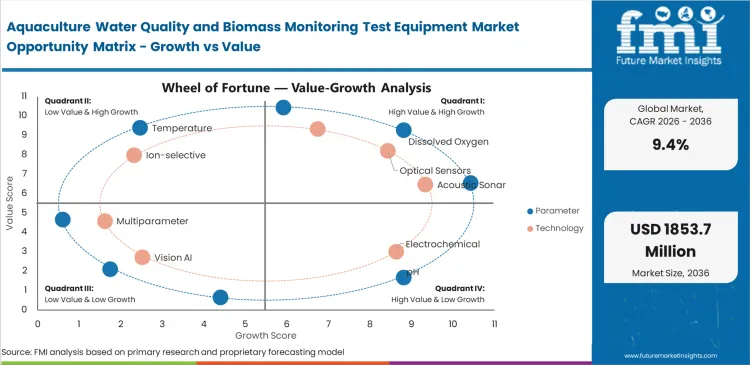
Farm operators are being pressed to treat monitoring as part of production control rather than a support activity that can wait for periodic review. Oxygen variability, feed waste, biomass uncertainty, and tighter survival management have made that decision harder to postpone, especially in sites where stock density or stock value leaves less room for delayed response. Monitoring equipment gains relevance because it helps convert water condition and biomass readings into timing decisions on feeding, welfare checks, and harvest planning. Capital approval becomes easier when equipment can be tied to everyday operating discipline instead of being framed as a technical add-on. Category valuation is therefore expanding on a practical business case: farms need readings they can act on under live conditions, not only records they can file away afterward.
Calibration burden, fouling exposure, and weak local service support remain the main barriers to faster adoption because farms lose confidence quickly when equipment adds intervention without dependable operational benefit. Site teams often hesitate when equipment needs frequent intervention, creates doubts around data consistency, or demands technical attention that farms cannot spare during routine production cycles. Budget pressure matters, but operating effort is often the bigger obstacle because farms will delay wider rollout when a system looks affordable upfront but becomes difficult to maintain across normal farming cycles. Partial fixes are available through better interfaces, remote visibility, and easier servicing, yet limits remain where fouling, harsh deployment conditions, or weak site-level technical support make continuous use harder to sustain. Expansion slows when farms believe added monitoring will create another task burden instead of reducing one.
Opportunities in the Aquaculture Water Quality and Biomass Monitoring Test Equipment Market
- Cage digitalization: Marine farms moving toward remote oversight create stronger room for fixed monitoring and biomass tools. Suppliers that tie installation, service discipline, and readable outputs together can gain traction where cage access is harder and observation needs are heavier.
- Shrimp intensification: Higher-control shrimp farming opens room for broader uptake of oxygen, ammonia, and multiparameter systems. Vendors positioned near water analysis instrumentation demand can serve farms that want tighter pond visibility without multiplying manual checks.
- RAS expansion: Recirculating systems reward dependable, continuous monitoring because water condition directly affects tighter production environments. Suppliers able to support stable operation and practical servicing can win more attention in technically demanding sites.
Regional Analysis
Key facts of country
- India is projected to expand at a CAGR of 10.8%, supported by wider aquaculture activity, stronger pond-level control needs, and growing demand for practical monitoring tools that can stay reliable under daily farm conditions.
- China continues to expand at a steadier pace because a broader installed aquaculture base shifts more demand toward replacement, upgrade, and service-supported monitoring adoption rather than first-time installation alone.
- North American demand remains tied to farms and aquaculture systems where operating discipline, data visibility, and reliable control tools carry direct value for stock management and site performance.
- European demand stays strongest in high-value aquaculture systems where buyers place more weight on biomass accuracy, welfare visibility, and dependable continuous monitoring.
- Latin American adoption is supported by export-oriented aquaculture systems where water stability, survival control, and feed efficiency have direct commercial implications.
Based on the regional analysis, the aquaculture water quality and biomass monitoring test equipment market is segmented into North America, Latin America, Europe, Asia Pacific, and Middle East & Africa across 40 plus countries.
.webp "Top Country Growth Comparison Aquaculture Water Quality And Biomass Monitoring Test Equipment Market Cagr (2026 2036)")
| Country | CAGR (2026 to 2036) |
|---|---|
| India | 10.8% |
| Chile | 10.7% |
| Ecuador | 10.4% |
| Vietnam | 10.3% |
| Norway | 10.1% |
| Indonesia | 9.9% |
| China | 8.6% |
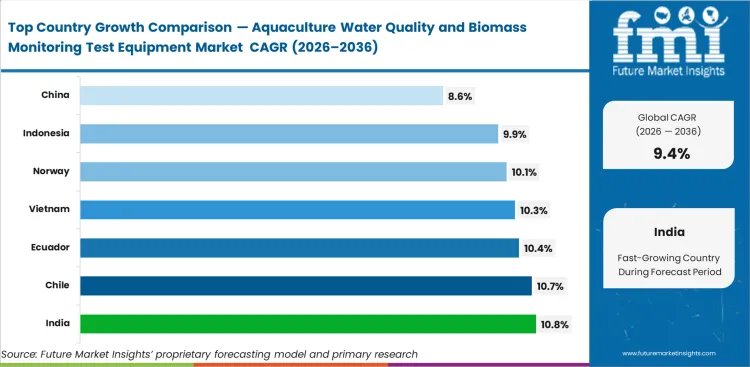
Source: Future Market Insights (FMI) analysis, based on proprietary forecasting model and primary research
Asia Pacific Aquaculture Water Quality and Biomass Monitoring Test Equipment Market Analysis
Aquaculture expansion in Asia Pacific keeps monitoring needs closely tied to survival control, pond stability, and labor efficiency rather than premium technology alone. Large production volumes matter, yet what pushes equipment adoption more directly is the need to keep variable water conditions from eroding output consistency across widely distributed farming sites. Buyers in this region favor equipment that is practical to install, simple to service, and credible under routine farm handling. Complex feature sets carry less weight if upkeep becomes too demanding for site teams already working within narrow operating windows. Water quality monitoring usually enters first, while biomass tools gain ground where stocking intensity and harvest discipline justify the extra spend. Regional preference therefore favors equipment that reduces manual burden while preserving useful day-to-day decision support.
- India: Farm expansion and intensification are raising the need for dependable monitoring across shrimp and freshwater operations. Broader site dispersion makes manual checking harder to manage consistently, especially where pond conditions can change quickly under live production pressure. Industry outlook in India points to 10.8% CAGR through 2036, supported by stronger use of tools that improve oxygen visibility, feeding control, and routine site discipline. Practical field use will matter more than headline sophistication. Suppliers that keep service and upkeep manageable are likely to gain wider acceptance.
- Vietnam: Export-linked aquaculture creates tighter pressure to control water condition and stock performance with fewer avoidable losses. Site teams need equipment that can support routine monitoring without adding too much maintenance burden across active farms. Vietnam is likely to post 10.3% CAGR in the sector by 2036, helped by wider use of monitoring in systems where production consistency carries direct commercial value. Equipment demand here remains tied to operating usefulness, not only category awareness. Cleaner service support can widen adoption further.
- Indonesia: Pond-based aquaculture and dispersed operating locations keep practical deployment at the center of buying decisions. Water condition can vary sharply across sites, so monitoring tools that reduce repeated manual rounds hold stronger appeal than systems that require heavy technical oversight. Adoption in Indonesia is anticipated to move ahead at a CAGR of 9.9% during the assessment period. Broader uptake will depend on whether suppliers can support durable field use and timely servicing across scattered farming regions. Category progress here rewards operating fit more than feature breadth.
- China: Large installed aquaculture activity supports steady equipment valuation, though the category is advancing from a broader existing base than some faster-moving peers. Farm operators in China still need stronger day-to-day control over water condition and biomass interpretation, yet replacement and upgrade logic tends to be more measured when coverage is already wider. A CAGR of 8.6% is expected for the market in China through 2036. Expansion remains positive, but product acceptance will continue to depend on reliability, service response, and clear farm-level utility rather than scale alone.
FMI's report includes Japan, South Korea, Thailand, Malaysia, Philippines, and Australia within Asia Pacific. Aquaculture operations across these countries differ by species mix and farm model, yet equipment acceptance follows a common rule: readings must be dependable enough to support live husbandry decisions without creating more field handling than site teams can absorb.
Latin America Aquaculture Water Quality and Biomass Monitoring Test Equipment Market Analysis
Latin America gains importance in this category because export-oriented aquaculture leaves less tolerance for water instability, inconsistent biomass reading, and weak site visibility. Shrimp and salmon operations both place operating pressure on farms to control condition changes before they turn into feed inefficiency or harvest disruption. Country outlooks do not move on technology appeal alone. Installation credibility, local support, and dependable field use carry more weight when site conditions are demanding and travel to production locations can be difficult. Region-wide acceptance therefore depends closely on whether equipment can stay usable under daily operating pressure.
- Chile: Salmon farming gives Chile a stronger case for biomass tools, underwater observation, and continuous site monitoring than many other aquaculture countries. Higher stock value means farms are more willing to support equipment that can improve feed planning, welfare control, and harvest timing when performance is proven in live marine conditions. Chile is projected to record a CAGR of 10.7% in this market during the forecast period. Field credibility will continue to decide which suppliers gain repeat adoption. Service quality matters because remote cage operations leave little room for unreliable systems.
- Ecuador: Shrimp farming keeps water quality control central to operating performance, particularly where pond conditions can influence survival and feed use quickly. Monitoring systems gain attention when they help farms react faster without multiplying manual oversight at the site. Industry outlook in Ecuador points to 10.4% CAGR from 2026 to 2036, supported by stronger need for practical oxygen, ammonia, and multiparameter visibility in export-focused production. Uptake should remain strongest where equipment proves easy to maintain under routine pond use. Farm teams need tools that work cleanly in real conditions, not only during evaluation.
FMI's report includes Brazil, Mexico, Peru, Colombia, and Central American aquaculture countries within Latin America. Regional direction shows a clear pattern: farms with stronger export discipline and tighter production control needs adopt monitoring earlier, while less intensive settings remain more selective about when automated systems deserve capital allocation.
Europe Aquaculture Water Quality and Biomass Monitoring Test Equipment Market Analysis
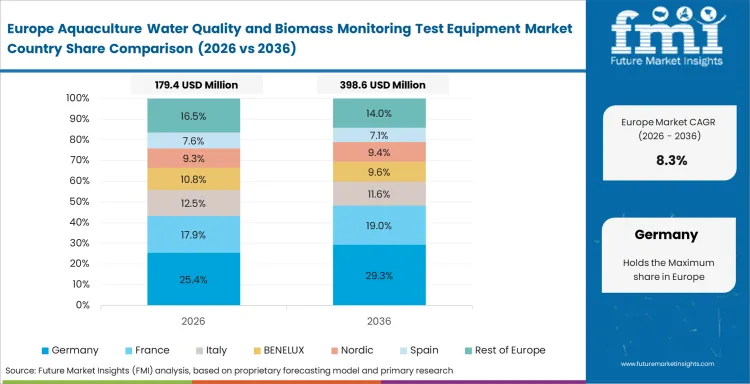
Europe stays important because aquaculture monitoring spend is pulled by mature technical expectations, closer welfare attention, and tighter operating control in high-value species systems. Category valuation is not simply a matter of more farms. Spend per site can be stronger where fish value is higher and site teams need dependable visibility over biomass and water condition to support daily decisions. Buyers here may adopt more carefully, yet accepted systems can become deeply embedded in operating routines once they prove their worth. Regional valuation therefore rests on depth of use as much as on number of installations.
- Norway: Salmon farming keeps Norway near the front of premium monitoring adoption because biomass accuracy and site condition visibility influence feed planning, welfare oversight, and harvest judgment at a high-value stock base. Operators need systems that can support marine conditions without becoming a constant technical burden. Norway is forecast to register 10.1% CAGR in this market over the study period. Acceptance remains tied to dependable use in cage operations where access windows are not always forgiving. Reliable monitoring can strengthen operating control without adding avoidable service strain.
FMI's report includes the United Kingdom, Ireland, Denmark, Iceland, Faroe-linked salmon activity, and wider Western and Northern European aquaculture hubs. Farming and processing activity in these areas acts as a regional base for high-value species production, where monitoring depth matters less for category breadth and more for how closely it supports everyday stock management.
Competitive Aligners for Market Players
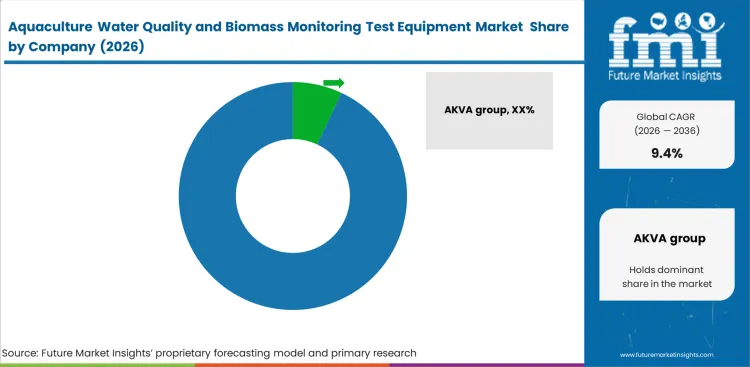
Competition remains fragmented because farms usually compare vendors on uptime credibility, service response, calibration discipline, and farm-condition fit before brand reputation becomes decisive. Site teams compare service reliability, calibration discipline, field durability, installation fit, and the usefulness of outputs under live operating conditions. AKVA group, ScaleAQ, and Innovasea carry stronger visibility where aquaculture-specific integration matters, especially in marine and salmon settings. Xylem, Endress+Hauser, In-Situ, and Hach remain relevant where water analytics depth and broader instrument familiarity support buyer confidence. Equipment that reads well in controlled demonstrations but creates more upkeep in daily use usually loses ground once farms start comparing repeat operating burden against measurement value.
Incumbents hold an advantage when they can support more than the initial installation. Service coverage, replacement availability, data credibility, and familiarity with farm conditions are difficult for smaller challengers to replicate quickly. Suppliers trying to win share from established names need more than comparable hardware; they need faster troubleshooting, stronger site-level trust, and equipment that stays usable through fouling, weather exposure, and variable staffing conditions. They need trust at site level, faster troubleshooting, and equipment that works cleanly through real biofouling, weather exposure, and variable staffing conditions. Competitive pressure is also influenced by links to adjacent environmental monitoring and environmental sensor categories where farms increasingly expect steadier digital visibility.
Large farm operators resist lock-in when equipment creates dependence without dependable support. Category direction through 2036 points toward deeper use of connected monitoring, yet farms will continue to balance digital convenience against field-service reality and replacement cost. More suppliers can stay relevant where applications remain species-specific, site-specific, or region-specific. Wider concentration is therefore limited by one practical fact: monitoring systems still need to earn trust at the farm gate, not only in a product brief.
Key Players in Aquaculture Water Quality and Biomass Monitoring Test Equipment Market
- AKVA group
- ScaleAQ
- Innovasea
- Xylem
- Endress+Hauser
- In-Situ
- Hach
Scope of the Report
| Metric | Value |
|---|---|
| Quantitative Units | USD 690 million to USD 1,694.4 million, at a CAGR of 9.4% |
| Market Definition | Aquaculture Water Quality and Biomass Monitoring Test Equipment Market covers instruments used to monitor water condition and biomass inside aquaculture operations. Scope includes farm-linked sensing, testing, and monitoring equipment sold for fish and shrimp production control. Coverage excludes broad farm hardware, therapeutics, and non-aquaculture general-purpose instrumentation. |
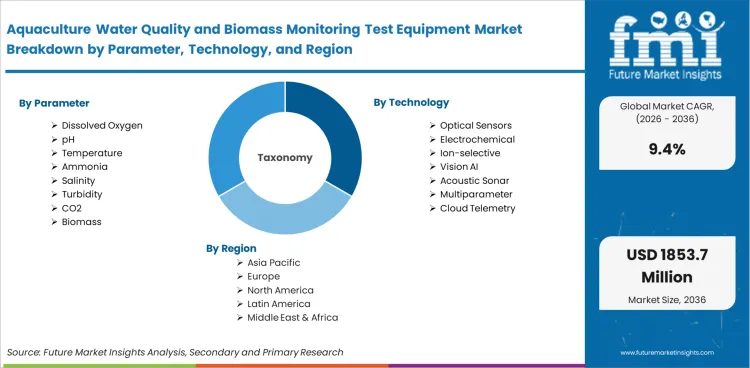
| Parameter Segmentation | Dissolved Oxygen, pH, Temperature, Ammonia, Salinity, Turbidity, CO2, Biomass |
| Technology Segmentation | Optical Sensors, Electrochemical, Ion-selective, Vision AI, Acoustic Sonar, Multiparameter, Cloud Telemetry |
| Deployment Segmentation | Fixed Systems, Portable Meters, Inline Loops, Sensor Buoys, Barge Systems, Drone Systems |
| Culture System Segmentation | Sea Cages, Ponds, RAS, Raceways, Hatcheries |
| Species Segmentation | Salmonids, Shrimp, Tilapia, Carp, Catfish, Seabass |
| Equipment Type Segmentation | Multiparameter Sondes, DO Probes, pH Probes, Biomass Cameras, Acoustic Units, Controllers, Data Loggers |
| End User Segmentation | Commercial Farms, Hatcheries, Integrators, Research Labs, Service Firms |
| Regions Covered | North America, Latin America, Europe, Asia Pacific, Middle East & Africa |
| Countries Covered | India, Chile, Ecuador, Vietnam, Norway, Indonesia, China, and 40 plus countries |
| Key Companies Profiled | AKVA group, ScaleAQ, Innovasea, Xylem, Endress+Hauser, In-Situ, Hach |
| Forecast Period | 2026 to 2036 |
| Approach | FMI combined primary interviews with farm operators and supplier-side participants, desk review of aquaculture and monitoring references, and cross-checking against application fit by farming system. Baseline estimates were built from aquaculture monitoring relevance across species and site formats. Validation considered supplier positioning, farm-use logic, and competitive positioning across active suppliers. |
Source: Future Market Insights (FMI) analysis, based on proprietary forecasting model and primary research
Aquaculture Water Quality and Biomass Monitoring Test Equipment Market Analysis by Segments
Parameter:
- Dissolved Oxygen
- pH
- Temperature
- Ammonia
- Salinity
- Turbidity
- CO2
- Biomass
Technology:
- Optical Sensors
- Electrochemical
- Ion-selective
- Vision AI
- Acoustic Sonar
- Multiparameter
- Cloud Telemetry
Deployment:
- Fixed Systems
- Portable Meters
- Inline Loops
- Sensor Buoys
- Barge Systems
- Drone Systems
Culture System:
- Sea Cages
- Ponds
- RAS
- Raceways
- Hatcheries
Species:
- Salmonids
- Shrimp
- Tilapia
- Carp
- Catfish
- Seabass
Equipment Type:
- Multiparameter Sondes
- DO Probes
- pH Probes
- Biomass Cameras
- Acoustic Units
- Controllers
- Data Loggers
End User:
- Commercial Farms
- Hatcheries
- Integrators
- Research Labs
- Service Firms
Region:
- North America
- Latin America
- Chile
- Ecuador
- Europe
- Norway
- Asia Pacific
- India
- Vietnam
- Indonesia
- China
- Middle East & Africa
Bibliography
- Ministry for Primary Industries. (2025). AEBR 353 Environmental Health Measures for Open Ocean Aquaculture, Physiological responses of epifauna to enrichment under laboratory and field studies. New Zealand Government.
- Department of Primary Industries and Regions South Australia. (2025). 2025–26 PIRSA Fisheries and Aquaculture Cost Recovery Implementation Statement. Government of South Australia.
- Food and Agriculture Organization of the United Nations. (2024). The State of World Fisheries and Aquaculture 2024. FAO.
- Organisation for Economic Co-operation and Development & Food and Agriculture Organization of the United Nations. (2025). OECD-FAO Agricultural Outlook 2025-2034: Fish and other aquatic products. OECD Publishing.
- Xylem Inc. (2026). Xylem Reports Fourth Quarter and Full Year 2025 Results.
- Shete, R. P., Bongale, A. M., & Dharrao, D. (2024). IoT-enabled effective real-time water quality monitoring method for aquaculture.
This bibliography is provided for reader reference. The full FMI report contains the complete reference list with primary source documentation.
This Report Addresses
- Market intelligence to support strategic decision making across dissolved oxygen monitoring, multiparameter sondes, biomass cameras, acoustic units, and fixed monitoring systems
- Market size estimation and 10-year revenue forecasts from 2026 to 2036, supported by farm-use logic, supplier exposure review, and application mapping by culture system
- Growth opportunity mapping across Parameter, Technology, Deployment, Culture System, Species, Equipment Type, and End User with emphasis on continuous monitoring adoption at operating sites
- Segment and regional revenue forecasts covering Dissolved Oxygen, Optical Sensors, Fixed Systems, Sea Cages, Salmonids, Multiparameter Sondes, and Commercial Farms across key aquaculture geographies
- Competition assessment including service reliability, calibration discipline, installation fit, field durability, local support reach, and data credibility in live farming conditions
- Product development tracking including optical sensing, electrochemical systems, vision AI, acoustic biomass tools, cloud telemetry, and controller-linked monitoring equipment
- Market access analysis covering pond farms, cage farms, hatcheries, raceways, and recirculating aquaculture systems where equipment utility depends on dependable field operation
- Market report delivery in PDF, Excel, PPT, and interactive dashboard formats for executive strategy, aquaculture category planning, and operating benchmark use
Frequently Asked Questions
How big is this market in 2026?
Aquaculture Water Quality and Biomass Monitoring Test Equipment Market is expected to be worth USD 690 million in 2026. Size at that level shows that monitoring tools are becoming part of normal farm operations, not just occasional testing.
What could the market be worth by 2036?
Market valuation is expected to reach USD 1,694.4 million by 2036. Long-term expansion reflects wider use of continuous monitoring in fish and shrimp production.
What CAGR is projected from 2026 to 2036?
Forecast CAGR for the market is 9.4%. Pace at that level suggests healthy category expansion, though adoption still depends on field reliability and ease of use.
Which Parameter segment is expected to lead?
Dissolved Oxygen is expected to lead with 26% share in 2026. Farms watch oxygen closely because it affects feeding behavior, stock stress, and survival.
Which Technology segment is expected to lead?
Optical Sensors are projected to lead with 31% share in 2026. Main reason is simpler continuous use with lower servicing pressure in many farm conditions.
Which Deployment segment is expected to lead?
Fixed Systems are expected to hold the lead with 42% share in 2026. Farms prefer installed monitoring when they need readings throughout the day instead of only during manual checks.
Why is this market rising?
Fish farms need faster and more reliable information on water condition and biomass. Better readings help teams make feeding, health, and harvest decisions with less delay.
What is the biggest restraint?
Maintenance effort and field reliability are the main issues. Equipment loses favor quickly when it needs too much calibration or creates doubts about data quality.
Which country is expected to grow the fastest?
India leads the country set with a forecast CAGR of 10.8% through 2036. Faster aquaculture build-out and stronger need for site-level control support that outlook.
Why does dissolved oxygen matter so much in aquaculture?
Oxygen can change quickly and affect stock condition fast. Farms often treat it as one of the first signals that tells them whether feeding and survival conditions are still stable.
Why are optical sensors doing well?
Many farms want equipment that can stay online longer with less manual servicing. Optical systems fit that need better in many day-to-day farming situations.
What do suppliers compete on in this market?
Farms compare service reliability, calibration discipline, field durability, installation fit, and how useful the readings are in real operating conditions. Brand alone is rarely enough.
Why do sea cages create stronger demand for monitoring tools?
Cage farms are harder to check by hand as often as pond or hatchery sites. Remote visibility matters more when weather, distance, and stock value all raise the cost of weak oversight.
Why are salmonids important for this market?
Salmon farming places more weight on biomass accuracy, welfare checks, and water condition control. Higher stock value makes advanced monitoring easier to justify.
Why do multiparameter sondes lead their category?
Farms like one installed unit that can read several variables together. That makes field handling simpler and reduces the need for multiple separate devices.
Why do commercial farms account for most of the market?
Commercial farms use monitoring tools every day during live production. Regular use creates more need for replacement, upgrades, and service support than occasional-use settings.
How should India be read in this market?
India combines wider aquaculture activity with stronger need for dependable site monitoring. Equipment that is easy to run and maintain should perform best there.
Why is Chile important here?
Chile has strong salmon farming exposure, which raises the value of biomass tools and continuous monitoring. Farms in that setting need dependable systems that work well in marine conditions.
What makes Ecuador a key country?
Shrimp farming makes water condition control a daily operating issue in Ecuador. Monitoring becomes more useful when farms need faster reaction without more manual checking.
What supports Vietnam’s outlook?
Vietnam’s aquaculture base is closely tied to production consistency and export quality. Equipment that helps farms control water condition with less operating burden should keep gaining use.
Why is Norway still important even with a smaller country count in this report?
Norway matters because salmon farming there supports premium monitoring use. Depth of equipment use can be high when biomass visibility and welfare control have direct value.
Why is China growing more slowly than the fastest countries in this set?
Why is China growing more slowly than the fastest countries in this set?
What does Indonesia add to the regional picture?
Indonesia highlights how dispersed pond farming rewards practical, durable monitoring tools. Equipment must work well in field conditions and stay manageable for site teams.
What is included in this market and what is left out?
Included products are water quality instruments, biomass monitoring tools, data loggers, controllers, and linked monitoring systems used in aquaculture. Cages, nets, feeders, aerators, vaccines, therapeutics, and general-purpose lab or municipal instruments are outside scope.
Preview the report firsthand - request a free sample
Get SampleGet the brochure for pricing and purchase details.
Get PDFTable of Content
- Executive Summary
- Global Market Outlook
- Demand-side Trends
- Supply-side Trends
- Technology Roadmap Analysis
- Analysis and Recommendations
- Market Overview
- Market Coverage / Taxonomy
- Market Definition / Scope / Limitations
- Research Methodology
- Chapter Orientation
- Analytical Lens and Working Hypotheses
- Market Structure, Signals, and Trend Drivers
- Benchmarking and Cross-market Comparability
- Market Sizing, Forecasting, and Opportunity Mapping
- Research Design and Evidence Framework
- Desk Research Programme (Secondary Evidence)
- Company Annual and Sustainability Reports
- Peer-reviewed Journals and Academic Literature
- Corporate Websites, Product Literature, and Technical Notes
- Earnings Decks and Investor Briefings
- Statutory Filings and Regulatory Disclosures
- Technical White Papers and Standards Notes
- Trade Journals, Industry Magazines, and Analyst Briefs
- Conference Proceedings, Webinars, and Seminar Materials
- Government Statistics Portals and Public Data Releases
- Press Releases and Reputable Media Coverage
- Specialist Newsletters and Curated Briefings
- Sector Databases and Reference Repositories
- FMI Internal Proprietary Databases and Historical Market Datasets
- Subscription Datasets and Paid Sources
- Social Channels, Communities, and Digital Listening Inputs
- Additional Desk Sources
- Expert Input and Fieldwork (Primary Evidence)
- Primary Modes
- Qualitative Interviews and Expert Elicitation
- Quantitative Surveys and Structured Data Capture
- Blended Approach
- Why Primary Evidence is Used
- Field Techniques
- Interviews
- Surveys
- Focus Groups
- Observational and In-context Research
- Social and Community Interactions
- Stakeholder Universe Engaged
- C-suite Leaders
- Board Members
- Presidents and Vice Presidents
- R&D and Innovation Heads
- Technical Specialists
- Domain Subject-matter Experts
- Scientists
- Physicians and Other Healthcare Professionals
- Governance, Ethics, and Data Stewardship
- Research Ethics
- Data Integrity and Handling
- Primary Modes
- Tooling, Models, and Reference Databases
- Desk Research Programme (Secondary Evidence)
- Data Engineering and Model Build
- Data Acquisition and Ingestion
- Cleaning, Normalisation, and Verification
- Synthesis, Triangulation, and Analysis
- Quality Assurance and Audit Trail
- Market Background
- Market Dynamics
- Drivers
- Restraints
- Opportunity
- Trends
- Scenario Forecast
- Demand in Optimistic Scenario
- Demand in Likely Scenario
- Demand in Conservative Scenario
- Opportunity Map Analysis
- Product Life Cycle Analysis
- Supply Chain Analysis
- Investment Feasibility Matrix
- Value Chain Analysis
- PESTLE and Porter’s Analysis
- Regulatory Landscape
- Regional Parent Market Outlook
- Production and Consumption Statistics
- Import and Export Statistics
- Market Dynamics
- Global Market Analysis 2021 to 2025 and Forecast, 2026 to 2036
- Historical Market Size Value (USD Million) Analysis, 2021 to 2025
- Current and Future Market Size Value (USD Million) Projections, 2026 to 2036
- Y-o-Y Growth Trend Analysis
- Absolute $ Opportunity Analysis
- Global Market Pricing Analysis 2021 to 2025 and Forecast 2026 to 2036
- Global Market Analysis 2021 to 2025 and Forecast 2026 to 2036, By Parameter
- Introduction / Key Findings
- Historical Market Size Value (USD Million) Analysis By Parameter , 2021 to 2025
- Current and Future Market Size Value (USD Million) Analysis and Forecast By Parameter , 2026 to 2036
- Dissolved Oxygen
- pH
- Temperature
- Ammonia
- Salinity
- Turbidity
- CO2
- Biomass
- Dissolved Oxygen
- Y-o-Y Growth Trend Analysis By Parameter , 2021 to 2025
- Absolute $ Opportunity Analysis By Parameter , 2026 to 2036
- Global Market Analysis 2021 to 2025 and Forecast 2026 to 2036, By Technology
- Introduction / Key Findings
- Historical Market Size Value (USD Million) Analysis By Technology, 2021 to 2025
- Current and Future Market Size Value (USD Million) Analysis and Forecast By Technology, 2026 to 2036
- Optical Sensors
- Electrochemical
- Ion-selective
- Vision AI
- Acoustic Sonar
- Multiparameter
- Cloud Telemetry
- Optical Sensors
- Y-o-Y Growth Trend Analysis By Technology, 2021 to 2025
- Absolute $ Opportunity Analysis By Technology, 2026 to 2036
- Global Market Analysis 2021 to 2025 and Forecast 2026 to 2036, By Deployment
- Introduction / Key Findings
- Historical Market Size Value (USD Million) Analysis By Deployment, 2021 to 2025
- Current and Future Market Size Value (USD Million) Analysis and Forecast By Deployment, 2026 to 2036
- Fixed Systems
- Portable Meters
- Inline Loops
- Sensor Buoys
- Barge Systems
- Drone Systems
- Fixed Systems
- Y-o-Y Growth Trend Analysis By Deployment, 2021 to 2025
- Absolute $ Opportunity Analysis By Deployment, 2026 to 2036
- Global Market Analysis 2021 to 2025 and Forecast 2026 to 2036, By Culture System
- Introduction / Key Findings
- Historical Market Size Value (USD Million) Analysis By Culture System, 2021 to 2025
- Current and Future Market Size Value (USD Million) Analysis and Forecast By Culture System, 2026 to 2036
- Sea Cages
- Ponds
- RAS
- Raceways
- Hatcheries
- Sea Cages
- Y-o-Y Growth Trend Analysis By Culture System, 2021 to 2025
- Absolute $ Opportunity Analysis By Culture System, 2026 to 2036
- Global Market Analysis 2021 to 2025 and Forecast 2026 to 2036, By Species
- Introduction / Key Findings
- Historical Market Size Value (USD Million) Analysis By Species, 2021 to 2025
- Current and Future Market Size Value (USD Million) Analysis and Forecast By Species, 2026 to 2036
- Salmonids
- Shrimp
- Tilapia
- Carp
- Catfish
- Seabass
- Salmonids
- Y-o-Y Growth Trend Analysis By Species, 2021 to 2025
- Absolute $ Opportunity Analysis By Species, 2026 to 2036
- Global Market Analysis 2021 to 2025 and Forecast 2026 to 2036, By Equipment Type
- Introduction / Key Findings
- Historical Market Size Value (USD Million) Analysis By Equipment Type, 2021 to 2025
- Current and Future Market Size Value (USD Million) Analysis and Forecast By Equipment Type, 2026 to 2036
- Multiparameter Sondes
- DO Probes
- pH Probes
- Biomass Cameras
- Acoustic Value (USD Million)s
- Controllers
- Data Loggers
- Multiparameter Sondes
- Y-o-Y Growth Trend Analysis By Equipment Type, 2021 to 2025
- Absolute $ Opportunity Analysis By Equipment Type, 2026 to 2036
- Global Market Analysis 2021 to 2025 and Forecast 2026 to 2036, By End User
- Introduction / Key Findings
- Historical Market Size Value (USD Million) Analysis By End User, 2021 to 2025
- Current and Future Market Size Value (USD Million) Analysis and Forecast By End User, 2026 to 2036
- Commercial Farms
- Hatcheries
- Integrators
- Research Labs
- Service Firms
- Commercial Farms
- Y-o-Y Growth Trend Analysis By End User, 2021 to 2025
- Absolute $ Opportunity Analysis By End User, 2026 to 2036
- Global Market Analysis 2021 to 2025 and Forecast 2026 to 2036, By Region
- Introduction
- Historical Market Size Value (USD Million) Analysis By Region, 2021 to 2025
- Current Market Size Value (USD Million) Analysis and Forecast By Region, 2026 to 2036
- North America
- Latin America
- Western Europe
- Eastern Europe
- East Asia
- South Asia and Pacific
- Middle East & Africa
- Market Attractiveness Analysis By Region
- North America Market Analysis 2021 to 2025 and Forecast 2026 to 2036, By Country
- Historical Market Size Value (USD Million) Trend Analysis By Market Taxonomy, 2021 to 2025
- Market Size Value (USD Million) Forecast By Market Taxonomy, 2026 to 2036
- By Country
- USA
- Canada
- Mexico
- By Parameter
- By Technology
- By Deployment
- By Culture System
- By Species
- By Equipment Type
- By End User
- By Country
- Market Attractiveness Analysis
- By Country
- By Parameter
- By Technology
- By Deployment
- By Culture System
- By Species
- By Equipment Type
- By End User
- Key Takeaways
- Latin America Market Analysis 2021 to 2025 and Forecast 2026 to 2036, By Country
- Historical Market Size Value (USD Million) Trend Analysis By Market Taxonomy, 2021 to 2025
- Market Size Value (USD Million) Forecast By Market Taxonomy, 2026 to 2036
- By Country
- Brazil
- Chile
- Rest of Latin America
- By Parameter
- By Technology
- By Deployment
- By Culture System
- By Species
- By Equipment Type
- By End User
- By Country
- Market Attractiveness Analysis
- By Country
- By Parameter
- By Technology
- By Deployment
- By Culture System
- By Species
- By Equipment Type
- By End User
- Key Takeaways
- Western Europe Market Analysis 2021 to 2025 and Forecast 2026 to 2036, By Country
- Historical Market Size Value (USD Million) Trend Analysis By Market Taxonomy, 2021 to 2025
- Market Size Value (USD Million) Forecast By Market Taxonomy, 2026 to 2036
- By Country
- Germany
- UK
- Italy
- Spain
- France
- Nordic
- BENELUX
- Rest of Western Europe
- By Parameter
- By Technology
- By Deployment
- By Culture System
- By Species
- By Equipment Type
- By End User
- By Country
- Market Attractiveness Analysis
- By Country
- By Parameter
- By Technology
- By Deployment
- By Culture System
- By Species
- By Equipment Type
- By End User
- Key Takeaways
- Eastern Europe Market Analysis 2021 to 2025 and Forecast 2026 to 2036, By Country
- Historical Market Size Value (USD Million) Trend Analysis By Market Taxonomy, 2021 to 2025
- Market Size Value (USD Million) Forecast By Market Taxonomy, 2026 to 2036
- By Country
- Russia
- Poland
- Hungary
- Balkan & Baltic
- Rest of Eastern Europe
- By Parameter
- By Technology
- By Deployment
- By Culture System
- By Species
- By Equipment Type
- By End User
- By Country
- Market Attractiveness Analysis
- By Country
- By Parameter
- By Technology
- By Deployment
- By Culture System
- By Species
- By Equipment Type
- By End User
- Key Takeaways
- East Asia Market Analysis 2021 to 2025 and Forecast 2026 to 2036, By Country
- Historical Market Size Value (USD Million) Trend Analysis By Market Taxonomy, 2021 to 2025
- Market Size Value (USD Million) Forecast By Market Taxonomy, 2026 to 2036
- By Country
- China
- Japan
- South Korea
- By Parameter
- By Technology
- By Deployment
- By Culture System
- By Species
- By Equipment Type
- By End User
- By Country
- Market Attractiveness Analysis
- By Country
- By Parameter
- By Technology
- By Deployment
- By Culture System
- By Species
- By Equipment Type
- By End User
- Key Takeaways
- South Asia and Pacific Market Analysis 2021 to 2025 and Forecast 2026 to 2036, By Country
- Historical Market Size Value (USD Million) Trend Analysis By Market Taxonomy, 2021 to 2025
- Market Size Value (USD Million) Forecast By Market Taxonomy, 2026 to 2036
- By Country
- India
- ASEAN
- Australia & New Zealand
- Rest of South Asia and Pacific
- By Parameter
- By Technology
- By Deployment
- By Culture System
- By Species
- By Equipment Type
- By End User
- By Country
- Market Attractiveness Analysis
- By Country
- By Parameter
- By Technology
- By Deployment
- By Culture System
- By Species
- By Equipment Type
- By End User
- Key Takeaways
- Middle East & Africa Market Analysis 2021 to 2025 and Forecast 2026 to 2036, By Country
- Historical Market Size Value (USD Million) Trend Analysis By Market Taxonomy, 2021 to 2025
- Market Size Value (USD Million) Forecast By Market Taxonomy, 2026 to 2036
- By Country
- Kingdom of Saudi Arabia
- Other GCC Countries
- Turkiye
- South Africa
- Other African Union
- Rest of Middle East & Africa
- By Parameter
- By Technology
- By Deployment
- By Culture System
- By Species
- By Equipment Type
- By End User
- By Country
- Market Attractiveness Analysis
- By Country
- By Parameter
- By Technology
- By Deployment
- By Culture System
- By Species
- By Equipment Type
- By End User
- Key Takeaways
- Key Countries Market Analysis
- USA
- Pricing Analysis
- Market Share Analysis, 2025
- By Parameter
- By Technology
- By Deployment
- By Culture System
- By Species
- By Equipment Type
- By End User
- Canada
- Pricing Analysis
- Market Share Analysis, 2025
- By Parameter
- By Technology
- By Deployment
- By Culture System
- By Species
- By Equipment Type
- By End User
- Mexico
- Pricing Analysis
- Market Share Analysis, 2025
- By Parameter
- By Technology
- By Deployment
- By Culture System
- By Species
- By Equipment Type
- By End User
- Brazil
- Pricing Analysis
- Market Share Analysis, 2025
- By Parameter
- By Technology
- By Deployment
- By Culture System
- By Species
- By Equipment Type
- By End User
- Chile
- Pricing Analysis
- Market Share Analysis, 2025
- By Parameter
- By Technology
- By Deployment
- By Culture System
- By Species
- By Equipment Type
- By End User
- Germany
- Pricing Analysis
- Market Share Analysis, 2025
- By Parameter
- By Technology
- By Deployment
- By Culture System
- By Species
- By Equipment Type
- By End User
- UK
- Pricing Analysis
- Market Share Analysis, 2025
- By Parameter
- By Technology
- By Deployment
- By Culture System
- By Species
- By Equipment Type
- By End User
- Italy
- Pricing Analysis
- Market Share Analysis, 2025
- By Parameter
- By Technology
- By Deployment
- By Culture System
- By Species
- By Equipment Type
- By End User
- Spain
- Pricing Analysis
- Market Share Analysis, 2025
- By Parameter
- By Technology
- By Deployment
- By Culture System
- By Species
- By Equipment Type
- By End User
- France
- Pricing Analysis
- Market Share Analysis, 2025
- By Parameter
- By Technology
- By Deployment
- By Culture System
- By Species
- By Equipment Type
- By End User
- India
- Pricing Analysis
- Market Share Analysis, 2025
- By Parameter
- By Technology
- By Deployment
- By Culture System
- By Species
- By Equipment Type
- By End User
- ASEAN
- Pricing Analysis
- Market Share Analysis, 2025
- By Parameter
- By Technology
- By Deployment
- By Culture System
- By Species
- By Equipment Type
- By End User
- Australia & New Zealand
- Pricing Analysis
- Market Share Analysis, 2025
- By Parameter
- By Technology
- By Deployment
- By Culture System
- By Species
- By Equipment Type
- By End User
- China
- Pricing Analysis
- Market Share Analysis, 2025
- By Parameter
- By Technology
- By Deployment
- By Culture System
- By Species
- By Equipment Type
- By End User
- Japan
- Pricing Analysis
- Market Share Analysis, 2025
- By Parameter
- By Technology
- By Deployment
- By Culture System
- By Species
- By Equipment Type
- By End User
- South Korea
- Pricing Analysis
- Market Share Analysis, 2025
- By Parameter
- By Technology
- By Deployment
- By Culture System
- By Species
- By Equipment Type
- By End User
- Russia
- Pricing Analysis
- Market Share Analysis, 2025
- By Parameter
- By Technology
- By Deployment
- By Culture System
- By Species
- By Equipment Type
- By End User
- Poland
- Pricing Analysis
- Market Share Analysis, 2025
- By Parameter
- By Technology
- By Deployment
- By Culture System
- By Species
- By Equipment Type
- By End User
- Hungary
- Pricing Analysis
- Market Share Analysis, 2025
- By Parameter
- By Technology
- By Deployment
- By Culture System
- By Species
- By Equipment Type
- By End User
- Kingdom of Saudi Arabia
- Pricing Analysis
- Market Share Analysis, 2025
- By Parameter
- By Technology
- By Deployment
- By Culture System
- By Species
- By Equipment Type
- By End User
- Turkiye
- Pricing Analysis
- Market Share Analysis, 2025
- By Parameter
- By Technology
- By Deployment
- By Culture System
- By Species
- By Equipment Type
- By End User
- South Africa
- Pricing Analysis
- Market Share Analysis, 2025
- By Parameter
- By Technology
- By Deployment
- By Culture System
- By Species
- By Equipment Type
- By End User
- USA
- Market Structure Analysis
- Competition Dashboard
- Competition Benchmarking
- Market Share Analysis of Top Players
- By Regional
- By Parameter
- By Technology
- By Deployment
- By Culture System
- By Species
- By Equipment Type
- By End User
- Competition Analysis
- Competition Deep Dive
- AKVA group
- Overview
- Product Portfolio
- Profitability by Market Segments (Product/Age /Sales Channel/Region)
- Sales Footprint
- Strategy Overview
- Marketing Strategy
- Product Strategy
- Channel Strategy
- ScaleAQ
- Innovasea
- Xylem
- Endress+Hauser
- In-Situ
- Hach
- AKVA group
- Competition Deep Dive
- Assumptions & Acronyms Used


