

- Industry Size (2026)
- USD 566 Mn
- Forecast (2036)
- USD 1052.5 Mn
- CAGR (2026 to 2036)
- 6.4%
Environmental Monitoring Reagents for On-Site Water Testing Market Forecast and Outlook 2026 to 2036
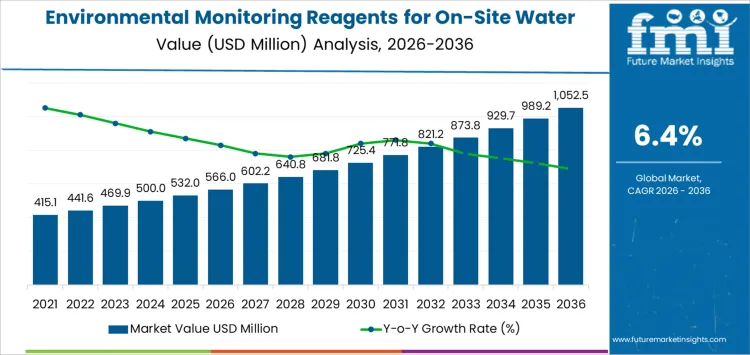
The global environmental monitoring reagents for on-site water testing market is expected to grow significantly, with a market value of USD 566 million in 2026, projected to reach USD 1,052.5 million by 2036, at a CAGR of 6.4%. Key drivers include the rising demand for rapid and accurate water quality testing solutions across industries, municipalities, and environmental agencies. Liquid concentrated reagents, holding 46% of the market share, are the most widely used due to their cost-effectiveness and versatility in various applications such as municipal drinking water testing (24% share) and wastewater monitoring. Other important formulations include ready-to-use liquids, wipes, and powders, contributing to the growing demand for on-site testing kits.
Quick Stats for Environmental Monitoring Reagents for On-Site Water Testing Market
- Environmental Monitoring Reagents for On-Site Water Testing Market Value (2026): USD 566 million
- Environmental Monitoring Reagents for On-Site Water Testing Market Forecast Value (2036): USD 1,052.5 million
- Environmental Monitoring Reagents for On-Site Water Testing Market Forecast CAGR (2026-2036): 6.4%
- Leading Formulation in Environmental Monitoring Reagents for On-Site Water Testing Market: Liquid Concentrated (Bulk) (46%)
- Key Growth Regions in Environmental Monitoring Reagents for On-Site Water Testing Market: India, China, USA, Germany
- Top Players in Environmental Monitoring Reagents for On-Site Water Testing Market: Hach (Danaher), Thermo Fisher Scientific, Merck / MilliporeSigma, Palintest (HORIBA / Palintest brand), Metrohm / Metrohm USA, Chemetrics
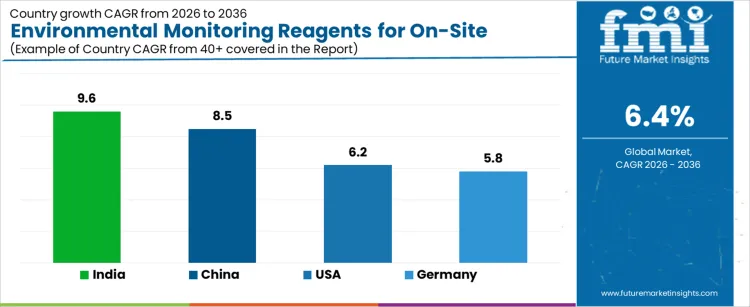
Regional growth is led by India, with the highest CAGR of 9.6%, driven by increasing water pollution concerns and the adoption of ecological water management practices. China follows with an 8.5% growth rate, fueled by its large industrial base and government-driven water quality improvements. The USA, growing at 6.2%, sees steady expansion due to rising water quality concerns across various sectors. Germany’s market, growing at 5.8%, is supported by stringent environmental regulations and an increasing shift toward real-time water testing in industrial and environmental monitoring. With advancements in reagent formulations and the integration of digital tools for real-time data capture, the market is poised for continued expansion, supported by both innovation and regulatory compliance.
Environmental Monitoring Reagents for On‑Site Water Testing Market Key Takeaways
| Metric | Value |
|---|---|
| Industry Value (2026) | USD 566 million |
| Forecast Value (2036) | USD 1,052.5 million |
| Forecast CAGR (2026-2036) | 6.4% |
How is the Global Environmental Monitoring Reagents for On-Site Water Testing Sector Advancing?
The global environmental monitoring reagents for on-site water testing market is experiencing steady growth due to the increasing demand for efficient, real-time water quality testing solutions across various industries and municipalities. These reagents are vital in ensuring that on-site testing systems can accurately detect contaminants in water, including heavy metals, pathogens, and chemical pollutants. On-site testing offers a faster alternative to traditional laboratory methods, allowing for immediate corrective actions and compliance with water quality regulations. As environmental concerns grow and the importance of water quality management becomes more critical, the adoption of portable, easy-to-use water testing kits has surged.
Looking ahead, the market is expected to expand further, driven by the rising demand for water safety in urban, industrial, and agricultural sectors. Innovations in reagent formulations that offer greater sensitivity, faster results, and the ability to detect a broader range of contaminants will enhance the value of these on-site testing systems. As regulatory frameworks become more stringent, particularly regarding industrial discharge and drinking water safety, the need for reliable on-site testing solutions will increase. Challenges such as the cost of multi-parameter testing kits, regulatory compliance, and the development of standardized testing procedures across regions may affect the market’s growth trajectory. Despite these challenges, the ongoing focus on water conservation and pollution control will continue to drive the demand for environmental monitoring reagents.
What is the Segment-Wise Analysis for the Global Environmental Monitoring Reagents for On-Site Water Testing Market?
The global environmental monitoring reagents for on-site water testing market is segmented by formulation/format and application/end-use. Liquid concentrated (bulk) reagents lead the market with a 46% share due to their effectiveness and efficiency in on-site water testing. Other significant formulations include ready-to-use liquids, wipes & impregnated cloths, powder/solid formulations, foams, gels, aerosol alternatives, and specialty dispensers/cartridge systems. In terms of application, municipal drinking water testing holds the largest share at 24%, followed by wastewater/sewage treatment, industrial effluent monitoring, environmental field monitoring (rivers, lakes), and other applications like aquaculture, agriculture runoff, and research/academic & QC labs.
How Do Liquid Concentrated (Bulk) Reagents Lead the Global Environmental Monitoring Reagents Market?
Liquid concentrated (bulk) reagents hold a 46% share in the global environmental monitoring reagents for on-site water testing market due to their cost-effectiveness and high performance. These reagents provide concentrated solutions that can be diluted for various testing applications, offering versatility and flexibility. This makes them ideal for large-scale monitoring activities, including municipal drinking water testing. The ability to use these reagents in a wide range of applications, while reducing the need for excessive packaging, appeals to commercial and industrial users. They ensure precise chemical reactions and consistent, reliable results, driving their popularity. As the demand for efficient and ecological testing solutions increases, liquid concentrated reagents remain the preferred choice for water testing across industries, contributing to their dominant market position.
Why Does Municipal Drinking Water Testing Hold the Largest Market Share?
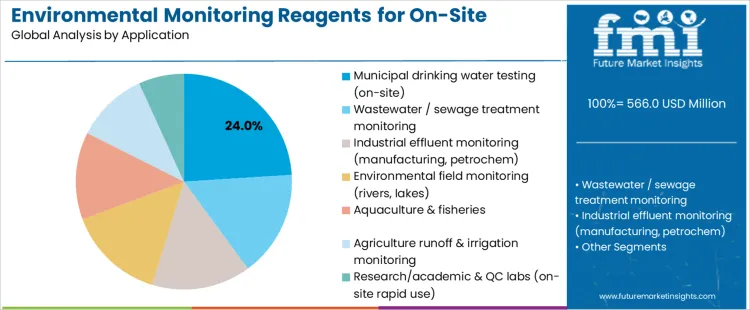
Municipal drinking water testing holds the largest share of 24% in the global environmental monitoring reagents for on-site water testing market due to the critical importance of ensuring the safety and quality of public drinking water. Regular testing is necessary to detect contaminants, bacteria, and harmful chemicals that could affect public health. As concerns about water quality rise and regulations become stricter, municipalities prioritize reliable, rapid, and accurate on-site testing. Environmental monitoring reagents ensure that water meets safety standards and compliance requirements, making them indispensable for municipal water systems. The growing demand for safe, potable water, especially in urban areas, drives the significant market share held by municipal drinking water testing.
What is Shaping the Environmental Monitoring Reagents for On Site Water Testing Market?
The environmental monitoring reagents for on site water testing market is shaped by growing concerns over water quality, public health, and regulatory compliance. Industries, municipalities, and environmental agencies increasingly require rapid, accurate detection of contaminants such as heavy metals, pathogens, pesticides, and chemical pollutants. On site testing reagents enable timely decision making without the delays of lab analysis. Heightened regulatory standards for wastewater discharge, drinking water quality, and environmental reporting are driving investment in portable, easy to use reagent kits and sensor compatible chemistries that deliver reliable field results.
What Challenges Are Limiting the Adoption of Environmental Monitoring Reagents for On Site Water Testing?
Adoption is limited by concerns over reagent stability and performance variability in diverse field conditions. Some reagents may require careful storage or preparation, which can be challenging in remote locations. Cost considerations also affect budget sensitive public agencies or smaller organizations, particularly when testing frequency is high. Accuracy and reproducibility compared with laboratory analysis can be perceived as a limitation, leading some users to still rely on lab confirmation. Finally, training and user proficiency are needed to ensure consistent testing results, which can pose operational challenges.
What Key Trends Are Shaping the Environmental Monitoring Reagents for On Site Water Testing Market?
Key trends include the development of more robust, user friendly reagents that work across a wide range of environmental conditions, requiring minimal handling. There is increasing integration of reagents with portable digital analyzers and sensor platforms that enable real time data capture and cloud based reporting. Bio based and low toxicity reagent chemistries are emerging to reduce environmental impact. Multi parameter test kits capable of simultaneous detection of several contaminants are gaining traction. The adoption of smart water monitoring networks that combine on site reagents with IoT and data analytics is enhancing predictive water quality management.
What is the Growth Outlook for the Environmental Monitoring Reagents for On-Site Water Testing Market by Country?
| Country | CAGR (%) |
|---|---|
| USA | 6.2% |
| China | 8.5% |
| Germany | 5.8% |
| India | 9.6% |
The environmental monitoring reagents for on-site water testing market is growing steadily, with India leading at a 9.6% CAGR, driven by increasing water pollution concerns and a rising focus on ecological water management practices. China follows with 8.5%, supported by its massive industrial base and government efforts to improve water quality monitoring. The USA shows moderate growth at 6.2%, fueled by the rising need for on-site water testing in both industrial and municipal sectors. Germany’s market grows at 5.8%, driven by stringent environmental regulations and the increasing adoption of real-time water quality testing.
Why is India Leading in the Environmental Monitoring Reagents for On-Site Water Testing Market?
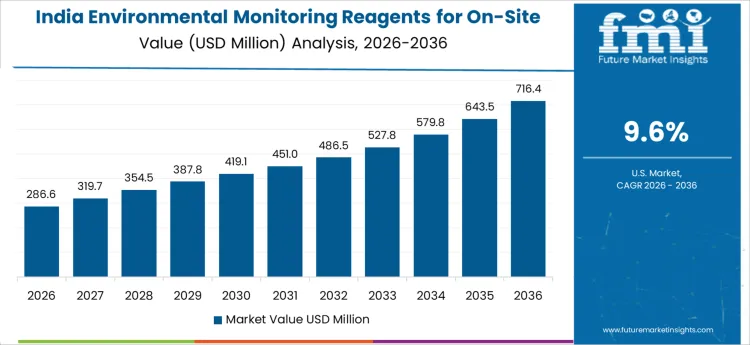
India’s environmental monitoring reagents for on-site water testing market is growing at 9.6%, driven by the country’s rapid industrialization and increasing water pollution concerns. With growing urbanization and industrial waste, India is facing significant challenges in water quality management, prompting the need for efficient and affordable on-site water testing solutions. Government initiatives to improve water quality monitoring systems and address pollution are further fueling demand for environmental monitoring reagents. Rising public awareness about water contamination and its impact on health is increasing the adoption of water testing technologies across industrial, municipal, and agricultural sectors. As India continues to focus on ecological water management and pollution control, the market for environmental monitoring reagents is expected to grow robustly.
What is Driving the Growth of the Environmental Monitoring Reagents for On-Site Water Testing Market in China?
China’s environmental monitoring reagents for on-site water testing market is growing at 8.5%, supported by the country’s massive industrial base and the government’s efforts to improve water quality monitoring. China’s rapid industrialization and urbanization have led to significant water pollution, creating a pressing need for on-site water testing solutions. The government is implementing strict environmental regulations and promoting ecological water management practices, which are increasing demand for monitoring reagents. With the growing need for real-time water quality data in industries like manufacturing, agriculture, and municipal services, China’s market for environmental monitoring reagents is expected to continue its strong growth. As the country focuses on reducing water pollution and improving water treatment processes, the demand for on-site water testing reagents is expected to rise steadily.
How is the Environmental Monitoring Reagents for On-Site Water Testing Market Expanding in the United States?
The USA’s environmental monitoring reagents for on-site water testing market is growing at 6.2%, driven by increasing water quality concerns and the need for efficient monitoring solutions in both industrial and municipal applications. The rising demand for real-time water testing in industries such as agriculture, manufacturing, and municipal water management is contributing to market growth. Stricter environmental regulations and the push for cleaner, safer water are encouraging the adoption of on-site testing solutions. Government initiatives to improve water quality monitoring systems are also playing a role in driving demand. As the USA continues to prioritize ecological water management practices, the market for environmental monitoring reagents for on-site water testing is expected to expand steadily, fueled by both regulatory pressures and growing public awareness.
What is Contributing to the Growth of the Environmental Monitoring Reagents for On-Site Water Testing Market in Germany?
Germany’s environmental monitoring reagents for on-site water testing market is growing at 5.8%, supported by the country’s strict environmental regulations and strong commitment to water quality management. Germany is at the forefront of adopting advanced environmental monitoring technologies, including real-time water quality testing solutions, to ensure compliance with stringent water protection standards. The country’s industrial sectors, particularly manufacturing and agriculture, require effective on-site testing to manage water consumption and pollution levels. As Germany continues to emphasize ecological water use and pollution control, the market for environmental monitoring reagents is expected to grow steadily. Growing awareness about water pollution and its impact on public health is further driving the adoption of on-site water testing solutions in Germany.
How Are Companies Competing in the Environmental Monitoring Reagents for On‑Site Water Testing Market?
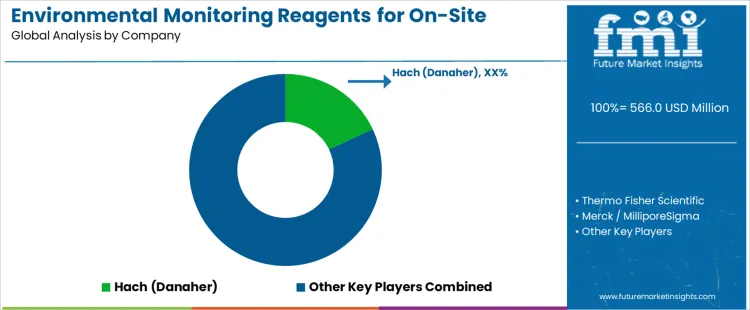
Hach (Danaher), Thermo Fisher Scientific, Merck / MilliporeSigma, Palintest (HORIBA / Palintest brand), Metrohm / Metrohm USA, and Chemetrics compete with tailored reagent systems and test kits designed for reliable on‑site water analysis. Hach brochures highlight comprehensive reagent portfolios paired with portable meters and colorimeters that deliver rapid results for parameters like pH, nutrients, and contaminants, with clear instructions for field technicians. Thermo Fisher Scientific positions its reagents alongside robust instrumentation, focusing on accuracy and compatibility with handheld spectrophotometers that serve diverse environmental testing needs. Merck / MilliporeSigma materials emphasize certified quality reagents with broad parameter coverage and documented traceability, appealing to professionals requiring stringent data integrity.
Palintest and HORIBA / Palintest brand literature present easy‑to‑use reagent tablets and strips with technical guidance tailored for environmental, industrial, and municipal water monitoring. Metrohm and Metrohm USA focus on reagent sets optimized for ion chromatography and titration‑based portable systems, with messaging that underscores precision and repeatability in field conditions. Chemetrics brochures showcase colorimetric kits with pre‑measured reagents designed for fast on‑site assessment of key water quality parameters. Across all firms, product collateral stresses detection limits, shelf stability, safety data, and application guidance. Competitive strategies rely on reagent specificity, ease of use, integration with field instruments, global distribution, and clear performance documentation to influence decisions by environmental consultants, water utilities, and compliance teams.
Key Players in Environmental Monitoring Reagents for On-Site Water Testing Market
- Hach (Danaher)
- Thermo Fisher Scientific
- Merck / MilliporeSigma
- Palintest (HORIBA / Palintest brand)
- Metrohm / Metrohm USA
- Chemetrics
Scope of Report
| Items | Values |
|---|---|
| Quantitative Units (2026) | USD million |
| End Use Application | Municipal Drinking Water Testing (On-Site), Wastewater / Sewage Treatment Monitoring, Industrial Effluent Monitoring (Manufacturing, Petrochem), Environmental Field Monitoring (Rivers, Lakes), Aquaculture & Fisheries, Agriculture Runoff & Irrigation Monitoring, Research/Academic & QC Labs (On-Site Rapid Use) |
| Formulation / Format | Liquid Concentrated (Bulk), Ready-to-Use Liquids, Wipes & Impregnated Cloths, Powder / Solid Formulations, Foams, Gels & Aerosol Alternatives, Specialty Dispensers/Cartridge Systems |
| Regions Covered | Asia Pacific, Europe, North America, Latin America, Middle East & Africa |
| Countries Covered | USA, China, Japan, South Korea, India, Australia & New Zealand, ASEAN, Germany, UK, France, Italy, Spain, Nordic, BENELUX, Brazil, Chile, Mexico, Saudi Arabia, Other GCC Countries, Turkey, South Africa, Other African Union |
| Key Companies Profiled | Hach (Danaher), Thermo Fisher Scientific, Merck / MilliporeSigma, Palintest (HORIBA / Palintest Brand), Metrohm / Metrohm USA, Chemetrics |
| Additional Attributes | Dollar sales by formulation/format, application/end-use, and region; regional CAGR and growth outlook; distribution channels including on-site testing providers, municipalities, and industrial clients; innovation trends in rapid testing and specialized dispensers; competitive positioning of global vs regional suppliers. |
Environmental Monitoring Reagents for On-Site Water Testing Market by Segments
Formulation / Format
- Liquid concentrated (bulk)
- Ready-to-use liquids
- Wipes & impregnated cloths
- Powder / solid formulations
- Foams, gels & aerosol alternatives
- Specialty dispensers/cartridge systems
Application / End-Use
- Municipal drinking water testing (on-site)
- Wastewater / sewage treatment monitoring
- Industrial effluent monitoring (manufacturing, petrochem)
- Environmental field monitoring (rivers, lakes)
- Aquaculture & fisheries
- Agriculture runoff & irrigation monitoring
- Research/academic & QC labs (on-site rapid use)
Region:
- Asia Pacific
- China
- Japan
- South Korea
- India
- Australia & New Zealand
- ASEAN
- Rest of Asia Pacific
- Europe
- Germany
- United Kingdom
- France
- Italy
- Spain
- Nordic
- BENELUX
- Rest of Europe
- North America
- United States
- Canada
- Mexico
- Latin America
- Brazil
- Chile
- Rest of Latin America
- Middle East & Africa
- Kingdom of Saudi Arabia
- Other GCC Countries
- Turkey
- South Africa
- Other African Union
- Rest of Middle East & Africa
Frequently Asked Questions
How big is the environmental monitoring reagents for on-site water testing market in 2026?
The global environmental monitoring reagents for on-site water testing market is estimated to be valued at USD 566.0 million in 2026.
What will be the size of environmental monitoring reagents for on-site water testing market in 2036?
The market size for the environmental monitoring reagents for on-site water testing market is projected to reach USD 1,052.5 million by 2036.
How much will be the environmental monitoring reagents for on-site water testing market growth between 2026 and 2036?
The environmental monitoring reagents for on-site water testing market is expected to grow at a 6.4% CAGR between 2026 and 2036.
What are the key product types in the environmental monitoring reagents for on-site water testing market?
The key product types in environmental monitoring reagents for on-site water testing market are liquid concentrated (bulk), ready-to-use liquids, wipes & impregnated cloths, powder / solid formulations, foams, gels & aerosol alternatives and specialty dispensers/cartridge systems.
Which application segment to contribute significant share in the environmental monitoring reagents for on-site water testing market in 2026?
In terms of application, municipal drinking water testing (on-site) segment to command 24.0% share in the environmental monitoring reagents for on-site water testing market in 2026.
Preview the report firsthand - request a free sample
Get SampleGet the brochure for pricing and purchase details.
Get PDFTable of Content
- Executive Summary
- Global Market Outlook
- Demand-side Trends
- Supply-side Trends
- Technology Roadmap Analysis
- Analysis and Recommendations
- Market Overview
- Market Coverage / Taxonomy
- Market Definition / Scope / Limitations
- Market Background
- Market Dynamics
- Drivers
- Restraints
- Opportunity
- Trends
- Scenario Forecast
- Demand in Optimistic Scenario
- Demand in Likely Scenario
- Demand in Conservative Scenario
- Opportunity Map Analysis
- Product Life Cycle Analysis
- Supply Chain Analysis
- Investment Feasibility Matrix
- Value Chain Analysis
- PESTLE and Porter’s Analysis
- Regulatory Landscape
- Regional Parent Market Outlook
- Production and Consumption Statistics
- Import and Export Statistics
- Market Dynamics
- Global Market Analysis 2021 to 2025 and Forecast, 2026 to 2036
- Historical Market Size Value (USD Million) Analysis, 2021 to 2025
- Current and Future Market Size Value (USD Million) Projections, 2026 to 2036
- Y-o-Y Growth Trend Analysis
- Absolute $ Opportunity Analysis
- Global Market Pricing Analysis 2021 to 2025 and Forecast 2026 to 2036
- Global Market Analysis 2021 to 2025 and Forecast 2026 to 2036, By Formulation / Format
- Introduction / Key Findings
- Historical Market Size Value (USD Million) Analysis By Formulation / Format , 2021 to 2025
- Current and Future Market Size Value (USD Million) Analysis and Forecast By Formulation / Format , 2026 to 2036
- Liquid concentrated (bulk)
- Ready-to-use liquids
- Wipes & impregnated cloths
- Powder / solid formulations
- Foams, gels & aerosol alternatives
- Specialty dispensers/cartridge systems
- Y-o-Y Growth Trend Analysis By Formulation / Format , 2021 to 2025
- Absolute $ Opportunity Analysis By Formulation / Format , 2026 to 2036
- Global Market Analysis 2021 to 2025 and Forecast 2026 to 2036, By Application
- Introduction / Key Findings
- Historical Market Size Value (USD Million) Analysis By Application, 2021 to 2025
- Current and Future Market Size Value (USD Million) Analysis and Forecast By Application, 2026 to 2036
- Municipal drinking water testing (on-site)
- Wastewater / sewage treatment monitoring
- Industrial effluent monitoring (manufacturing, petrochem)
- Environmental field monitoring (rivers, lakes)
- Aquaculture & fisheries
- Agriculture runoff & irrigation monitoring
- Research/academic & QC labs (on-site rapid use)
- Y-o-Y Growth Trend Analysis By Application, 2021 to 2025
- Absolute $ Opportunity Analysis By Application, 2026 to 2036
- Global Market Analysis 2021 to 2025 and Forecast 2026 to 2036, By Region
- Introduction
- Historical Market Size Value (USD Million) Analysis By Region, 2021 to 2025
- Current Market Size Value (USD Million) Analysis and Forecast By Region, 2026 to 2036
- North America
- Latin America
- Western Europe
- Eastern Europe
- East Asia
- South Asia and Pacific
- Middle East & Africa
- Market Attractiveness Analysis By Region
- North America Market Analysis 2021 to 2025 and Forecast 2026 to 2036, By Country
- Historical Market Size Value (USD Million) Trend Analysis By Market Taxonomy, 2021 to 2025
- Market Size Value (USD Million) Forecast By Market Taxonomy, 2026 to 2036
- By Country
- USA
- Canada
- Mexico
- By Formulation / Format
- By Application
- By Country
- Market Attractiveness Analysis
- By Country
- By Formulation / Format
- By Application
- Key Takeaways
- Latin America Market Analysis 2021 to 2025 and Forecast 2026 to 2036, By Country
- Historical Market Size Value (USD Million) Trend Analysis By Market Taxonomy, 2021 to 2025
- Market Size Value (USD Million) Forecast By Market Taxonomy, 2026 to 2036
- By Country
- Brazil
- Chile
- Rest of Latin America
- By Formulation / Format
- By Application
- By Country
- Market Attractiveness Analysis
- By Country
- By Formulation / Format
- By Application
- Key Takeaways
- Western Europe Market Analysis 2021 to 2025 and Forecast 2026 to 2036, By Country
- Historical Market Size Value (USD Million) Trend Analysis By Market Taxonomy, 2021 to 2025
- Market Size Value (USD Million) Forecast By Market Taxonomy, 2026 to 2036
- By Country
- Germany
- UK
- Italy
- Spain
- France
- Nordic
- BENELUX
- Rest of Western Europe
- By Formulation / Format
- By Application
- By Country
- Market Attractiveness Analysis
- By Country
- By Formulation / Format
- By Application
- Key Takeaways
- Eastern Europe Market Analysis 2021 to 2025 and Forecast 2026 to 2036, By Country
- Historical Market Size Value (USD Million) Trend Analysis By Market Taxonomy, 2021 to 2025
- Market Size Value (USD Million) Forecast By Market Taxonomy, 2026 to 2036
- By Country
- Russia
- Poland
- Hungary
- Balkan & Baltic
- Rest of Eastern Europe
- By Formulation / Format
- By Application
- By Country
- Market Attractiveness Analysis
- By Country
- By Formulation / Format
- By Application
- Key Takeaways
- East Asia Market Analysis 2021 to 2025 and Forecast 2026 to 2036, By Country
- Historical Market Size Value (USD Million) Trend Analysis By Market Taxonomy, 2021 to 2025
- Market Size Value (USD Million) Forecast By Market Taxonomy, 2026 to 2036
- By Country
- China
- Japan
- South Korea
- By Formulation / Format
- By Application
- By Country
- Market Attractiveness Analysis
- By Country
- By Formulation / Format
- By Application
- Key Takeaways
- South Asia and Pacific Market Analysis 2021 to 2025 and Forecast 2026 to 2036, By Country
- Historical Market Size Value (USD Million) Trend Analysis By Market Taxonomy, 2021 to 2025
- Market Size Value (USD Million) Forecast By Market Taxonomy, 2026 to 2036
- By Country
- India
- ASEAN
- Australia & New Zealand
- Rest of South Asia and Pacific
- By Formulation / Format
- By Application
- By Country
- Market Attractiveness Analysis
- By Country
- By Formulation / Format
- By Application
- Key Takeaways
- Middle East & Africa Market Analysis 2021 to 2025 and Forecast 2026 to 2036, By Country
- Historical Market Size Value (USD Million) Trend Analysis By Market Taxonomy, 2021 to 2025
- Market Size Value (USD Million) Forecast By Market Taxonomy, 2026 to 2036
- By Country
- Kingdom of Saudi Arabia
- Other GCC Countries
- Turkiye
- South Africa
- Other African Union
- Rest of Middle East & Africa
- By Formulation / Format
- By Application
- By Country
- Market Attractiveness Analysis
- By Country
- By Formulation / Format
- By Application
- Key Takeaways
- Key Countries Market Analysis
- USA
- Pricing Analysis
- Market Share Analysis, 2025
- By Formulation / Format
- By Application
- Canada
- Pricing Analysis
- Market Share Analysis, 2025
- By Formulation / Format
- By Application
- Mexico
- Pricing Analysis
- Market Share Analysis, 2025
- By Formulation / Format
- By Application
- Brazil
- Pricing Analysis
- Market Share Analysis, 2025
- By Formulation / Format
- By Application
- Chile
- Pricing Analysis
- Market Share Analysis, 2025
- By Formulation / Format
- By Application
- Germany
- Pricing Analysis
- Market Share Analysis, 2025
- By Formulation / Format
- By Application
- UK
- Pricing Analysis
- Market Share Analysis, 2025
- By Formulation / Format
- By Application
- Italy
- Pricing Analysis
- Market Share Analysis, 2025
- By Formulation / Format
- By Application
- Spain
- Pricing Analysis
- Market Share Analysis, 2025
- By Formulation / Format
- By Application
- France
- Pricing Analysis
- Market Share Analysis, 2025
- By Formulation / Format
- By Application
- India
- Pricing Analysis
- Market Share Analysis, 2025
- By Formulation / Format
- By Application
- ASEAN
- Pricing Analysis
- Market Share Analysis, 2025
- By Formulation / Format
- By Application
- Australia & New Zealand
- Pricing Analysis
- Market Share Analysis, 2025
- By Formulation / Format
- By Application
- China
- Pricing Analysis
- Market Share Analysis, 2025
- By Formulation / Format
- By Application
- Japan
- Pricing Analysis
- Market Share Analysis, 2025
- By Formulation / Format
- By Application
- South Korea
- Pricing Analysis
- Market Share Analysis, 2025
- By Formulation / Format
- By Application
- Russia
- Pricing Analysis
- Market Share Analysis, 2025
- By Formulation / Format
- By Application
- Poland
- Pricing Analysis
- Market Share Analysis, 2025
- By Formulation / Format
- By Application
- Hungary
- Pricing Analysis
- Market Share Analysis, 2025
- By Formulation / Format
- By Application
- Kingdom of Saudi Arabia
- Pricing Analysis
- Market Share Analysis, 2025
- By Formulation / Format
- By Application
- Turkiye
- Pricing Analysis
- Market Share Analysis, 2025
- By Formulation / Format
- By Application
- South Africa
- Pricing Analysis
- Market Share Analysis, 2025
- By Formulation / Format
- By Application
- USA
- Market Structure Analysis
- Competition Dashboard
- Competition Benchmarking
- Market Share Analysis of Top Players
- By Regional
- By Formulation / Format
- By Application
- Competition Analysis
- Competition Deep Dive
- Hach (Danaher)
- Overview
- Product Portfolio
- Profitability by Market Segments (Product/Age /Sales Channel/Region)
- Sales Footprint
- Strategy Overview
- Marketing Strategy
- Product Strategy
- Channel Strategy
- Thermo Fisher Scientific
- Merck / MilliporeSigma
- Palintest (HORIBA / Palintest brand)
- Metrohm / Metrohm USA
- Chemetrics
- Hach (Danaher)
- Competition Deep Dive
- Assumptions & Acronyms Used
- Research Methodology


