

- Industry Size (2026)
- USD 528.7 Mn
- Forecast (2036)
- USD 1346.6 Mn
- CAGR (2026 to 2036)
- 9.8%
Mining Tailings Water-Soluble Flocculants Market Forecast and Outlook 2026 to 2036
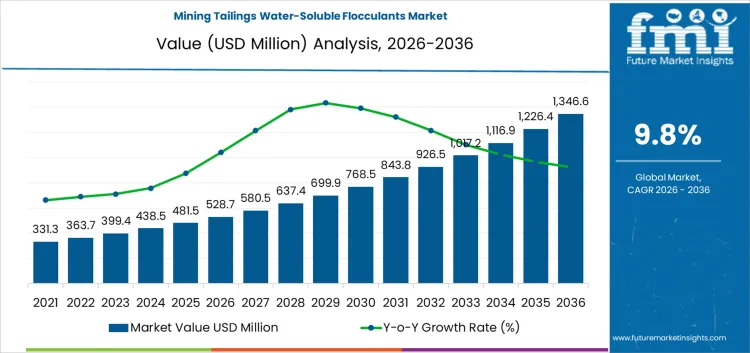
The mining tailings water-soluble flocculants market is expected to reach USD 1,346.6 million by 2036, growing at a CAGR of 9.8% from its 2026 valuation of USD 528.7 million. Capital intensity will significantly influence the pace of market expansion, with the need for advanced manufacturing capabilities and robust infrastructure requiring substantial investments. Return timelines will shape investment decisions, as the long development and regulatory approval processes in mining-related sectors often extend payback periods. As such, investors will likely exhibit selectivity, focusing on companies with strong track records, efficient production methods, and a clear path to profitability. With the demand for water-soluble flocculants tied to long-term mining operations, capital allocation strategies will need to balance short-term growth opportunities with the market’s reliance on sustainable, scalable production. Companies demonstrating cost-efficiency, technology-driven solutions, and strategic market positioning will likely attract more focused investment, supporting their expansion through the next decade.
Quick Stats for the Mining Tailings Water-Soluble Flocculants Market
- Mining Tailings Water-Soluble Flocculants Market Value (2026): USD 528.7 million
- Mining Tailings Water-Soluble Flocculants Market Forecast Value (2036): USD 1,346.6 million
- Mining Tailings Water-Soluble Flocculants Market Global Forecast CAGR 2026 to 2036: 9.8%
- Mining Tailings Water-Soluble Flocculants Market Leading Segment: Mining Operators (56%)
- Key Growth Regions in Mining Tailings Water-Soluble Flocculants Market: India
- Top Players in Mining Tailings Water-Soluble Flocculants Market: SNF Group, BASF SE, Kemira Oyj, Archer Daniels Midland (ADM), Solvay SA
What is the Growth Forecast for the Mining Tailings Water-Soluble Flocculants Market through 2036?
The mining tailings water-soluble flocculants market is expected to experience consistent growth over the next decade, with market values increasing year on year. By 2027, the market value is projected to reach USD 580.9 million, followed by a rise to USD 638.7 million in 2028. Continued market expansion is anticipated, with the market reaching USD 703.2 million in 2029 and USD 775 million in 2030. As mining operations evolve to meet stricter environmental regulations, the use of water-soluble flocculants in tailings management is becoming a key solution for improving water quality and reducing waste.
By 2031, the market is expected to reach USD 855.8 million, and further growth is anticipated, with the value rising to USD 947.7 million by 2032. The demand for water-soluble flocculants will continue to rise as mining companies prioritize sustainable practices, with the market reaching USD 1,309.9 million by 2035 and USD 1,346.6 million by 2036. This consistent upward trajectory is a reflection of the ongoing adoption of advanced water treatment solutions in the mining sector, aligning with global efforts to improve resource management and environmental responsibility.
Mining Tailings Water-Soluble Flocculants Market Key Takeaways
| Metric | Value |
|---|---|
| Industry Sales Value (2026) | USD 528.7 million |
| Industry Forecast Value (2036) | USD 1,346.6 million |
| Industry Forecast CAGR 2026 to 2036 | 9.8% |
What Is Driving the Mining Tailings Water-Soluble Flocculants Market?
Historically, the mining tailings water-soluble flocculants market developed as mining operations sought reliable methods to separate fine solids from process water and minimize environmental impact. Conventional practices relied on gravity settling and coarse chemical coagulants, which were often inefficient for ultra-fine particles typical of modern mining by-products. Early water-soluble flocculants, including synthetic polymers such as polyacrylamides, were introduced to improve settling rates and water clarity, enabling more effective reuse of process water and reduced tailings pond volume. Adoption was driven by the need to meet increasingly stringent discharge limits and reduce freshwater intake in arid regions. Mining engineers evaluated various polymer chemistries and dosages to balance performance with cost and to prevent adverse effects on downstream processes. Initial uptake was concentrated in large operations with dedicated technical teams capable of optimizing flocculant application across varied ore types and tailings compositions, generating practical insights into performance parameters and dosing practices.
Future demand for mining tailings water-soluble flocculants is expected to be shaped by tighter environmental regulations, expanding production in resource extraction, and the drive to improve water management efficiency across mining regions. Regulatory frameworks are anticipated to require lower turbidity and suspended solids in effluents, prompting operators to adopt advanced flocculation technologies to meet compliance. Growth will also be influenced by increasing emphasis on water recycling within mines, where effective flocculants reduce the volume of make-up water needed and lower costs associated with freshwater sourcing. Advances in polymer design, including tailored molecular weights and charge densities, are likely to improve performance with diverse tailings chemistries. Challenges include balancing cost pressures with specialized flocculant formulations and training on optimal application techniques. Long-term market expansion will depend on demonstrating consistent performance improvements, integration with automated dosing systems, and alignment between regulatory expectations, water resource constraints, and operational efficiency goals in mining.
What are the Key Segments in the Mining Tailings Water-Soluble Flocculants Market?
The Mining Tailings Water-Soluble Flocculants market is divided into end-users and flocculant types. The end-user segments include mining operators, water treatment providers, independent commodity producers, and specialty chemical distributors, with mining operators holding the largest share at 56%. On the flocculant type side, polyacrylamide (PAM) is the leading segment, accounting for 38% of the market share. Other types include natural polymers (e.g., starch, chitosan), bio-based flocculants, and anionic copolymers. The demand for water-soluble flocculants is driven by the need to enhance the efficiency of tailings management in the mining industry and ensure that wastewater treatment meets environmental standards. Regions like North America, Europe, and Asia Pacific are seeing increasing investments in mining operations and water treatment infrastructure, further expanding the market for these specialized flocculants.
What is Driving Growth in the Mining Operators Segment?
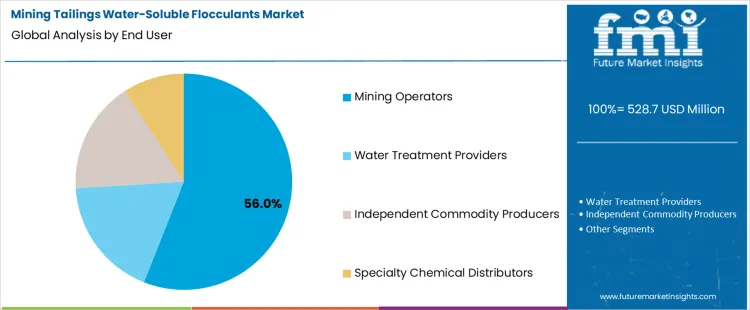
Mining operators make up the largest end-user segment in the Mining Tailings Water-Soluble Flocculants market, with a 56% share. This is largely due to the critical need for efficient water management in mining operations, where flocculants are used to improve the dewatering process of tailings and ensure compliance with environmental regulations. The use of water-soluble flocculants in tailings management helps reduce the volume of water used and facilitates the safe disposal of waste materials. As mining activities expand globally, especially in emerging economies with growing mining operations, the demand for efficient flocculants is increasing. Mining operators are turning to flocculants to streamline operations, reduce costs, and mitigate environmental risks associated with wastewater disposal. The rise in regulatory pressure to minimize the environmental impact of mining operations is also a significant driver for this segment, with mining operators seeking sustainable solutions to manage waste and water usage. Additionally, innovations in flocculant formulations that enhance performance in challenging mining conditions are contributing to the increased adoption of water-soluble flocculants in the industry.
What is Driving the Demand for Polyacrylamide (PAM) in the Mining Tailings Water-Soluble Flocculants Market?
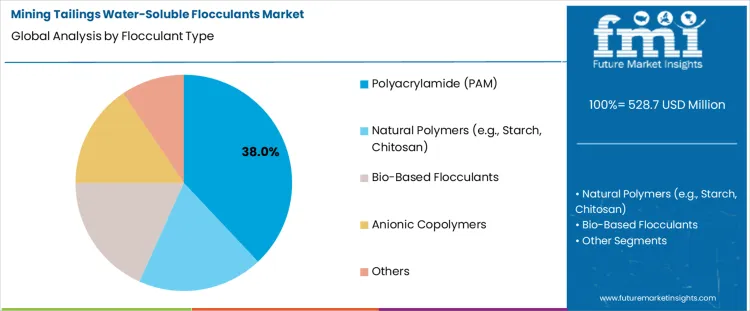
Polyacrylamide (PAM) is the leading flocculant type in the Mining Tailings Water-Soluble Flocculants market, holding a 38% share. PAM is widely used in mining operations for its excellent water absorption and coagulation properties, making it highly effective in dewatering tailings and facilitating the separation of solids from liquids. Its ability to form a gel-like consistency in water helps bind particles together, improving the overall efficiency of the tailings management process. The demand for PAM is particularly strong in large-scale mining operations, where it plays a crucial role in optimizing water recovery and minimizing environmental impact. In addition, PAM's versatility in adapting to different types of mining waste, including those from gold, coal, and iron ore extraction, makes it a preferred choice for mining operators. Despite concerns over the environmental impact of synthetic polymers, ongoing developments in PAM formulations are enhancing its biodegradability and reducing its toxicity, making it more attractive to companies seeking to meet stringent environmental standards. As global mining activities continue to grow, especially in regions such as Asia Pacific and Latin America, the use of PAM in tailings management is expected to increase, driving continued market growth.
What are the Key Dynamics in the Mining Tailings Water-Soluble Flocculants Market?
The mining tailings water-soluble flocculants market plays a critical role in the management of tailings and water treatment in the mining industry. Flocculants are used to aggregate fine particles and facilitate their separation from water, which is crucial in the mining process for tailings disposal and water recovery. The global push for more sustainable mining practices, including the reduction of water usage and improving water quality, is driving the demand for water-soluble flocculants. These chemicals help to enhance the recycling of water in mining operations, reducing the need for fresh water, which is increasingly scarce. Moreover, regulatory pressures regarding environmental compliance and the safe disposal of mining waste are contributing to the market’s growth, as companies seek effective solutions for tailings management and water treatment.
What are the Key Drivers of Growth in the Mining Tailings Water-Soluble Flocculants Market?
Several factors are driving the growth of the mining tailings water-soluble flocculants market. The increased demand for sustainable mining practices is one of the primary drivers, as companies look to minimize their environmental impact, especially regarding water usage and waste disposal. Flocculants enable mining operations to treat and reuse water, which is becoming more important in regions where water scarcity is an issue. Moreover, strict environmental regulations governing the disposal of mining tailings and wastewater are compelling mining companies to adopt flocculants as part of their water treatment processes to ensure compliance. Technological advancements in flocculant formulations and their increasing cost-effectiveness also make them more attractive for large-scale mining operations, further supporting market growth. Additionally, the expansion of mining activities in emerging economies is driving demand for water treatment solutions to manage the increasing volumes of mining waste and tailings.
What are the Key Restraints in the Mining Tailings Water-Soluble Flocculants Market?
Despite the market's growth, several challenges may limit its potential. One key restraint is the high cost of flocculants, particularly the more advanced formulations that offer improved efficiency in water treatment. This can be a barrier for smaller mining companies or operations in regions with limited budgets for environmental management. Additionally, the effectiveness of flocculants can vary depending on the type of tailings and the specific mining process, which may require tailor-made solutions that increase costs and complexity. Environmental concerns related to the use of synthetic flocculants also present a challenge, as some of these chemicals may not be fully biodegradable, leading to potential contamination issues. Furthermore, the lack of proper infrastructure for effective tailings management in some regions can hinder the widespread adoption of flocculants, as mining operations may struggle to implement the necessary technologies and disposal practices.
What are the Key Trends in the Mining Tailings Water-Soluble Flocculants Market?
Key trends in the mining tailings water-soluble flocculants market include an increasing focus on the development of eco-friendly and biodegradable flocculants. As environmental concerns continue to grow, mining companies are looking for more sustainable options to replace traditional synthetic flocculants, which can pose long-term environmental risks. The trend toward green chemistry is driving the development of plant-based or bio-based flocculants that offer improved biodegradability and reduced toxicity. Additionally, advances in flocculant performance, such as the ability to handle a wider range of mineral compositions and optimize water recovery rates, are also gaining attention. The increasing adoption of digital technologies in mining, including automation and monitoring systems, is enabling better tracking of water usage and tailings management, which further supports the efficient application of flocculants. As mining operations continue to scale, there is also a growing trend toward the integration of flocculants into broader waste management and resource recovery systems, supporting circular economy initiatives within the mining industry.
What is the Country-Wise Analysis of the Mining Tailings Water-Soluble Flocculants Market?
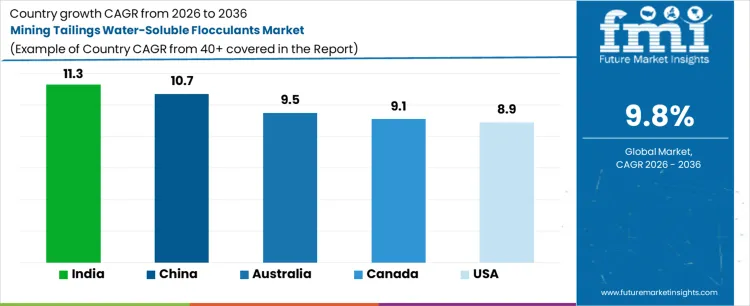
The mining tailings water-soluble flocculants market is seeing steady growth across key regions such as the USA, China, Australia, Canada, and India. These flocculants play a crucial role in the mining industry, helping to treat water used in tailings management, which is a major environmental concern. The rising demand for these flocculants is primarily driven by stricter environmental regulations, the need for efficient water treatment solutions, and the growing importance of sustainable mining practices. Each of these countries has unique market dynamics, influenced by their mining activities, environmental policies, and innovations in water treatment technologies.
| Country | CAGR 2026 to 2036 |
|---|---|
| USA | 8.9% |
| China | 10.7% |
| Australia | 9.5% |
| Canada | 9.1% |
| India | 11.3% |
What is Driving the Growth of the Mining Tailings Water-Soluble Flocculants Market in the USA?
The mining tailings water-soluble flocculants market in the USA is growing at a CAGR of 8.9%. This growth is driven by the increasing focus on water management and the environmental impact of mining activities. The USA has stringent regulations in place to control water contamination and ensure that mining companies manage their tailings in an environmentally responsible manner. Water-soluble flocculants help to treat and clarify water, making them a critical tool in tailings management. With a strong emphasis on sustainability and environmental compliance, mining companies in the USA are increasingly adopting these flocculants to meet regulatory standards. Moreover, technological advancements in flocculant formulations are further boosting their adoption in the mining industry.
How is the Mining Tailings Water-Soluble Flocculants Market Performing in China?
China’s mining tailings water-soluble flocculants market is growing at a CAGR of 10.7%, driven by the country’s large-scale mining activities and rising environmental concerns. As one of the world’s largest producers of minerals, China faces significant challenges in managing mining waste and water contamination. The government has implemented stricter regulations around waste disposal, particularly in the mining industry, to minimize environmental impact. Water-soluble flocculants are increasingly being used in China to treat mining tailings water, helping to reduce the environmental footprint of mining operations. As the demand for sustainable mining practices rises, China’s market for these flocculants is expected to expand significantly.
What Factors are Shaping the Mining Tailings Water-Soluble Flocculants Market in Australia?
In Australia, the mining tailings water-soluble flocculants market is experiencing steady growth, with a CAGR of 9.5%. Australia’s mining sector, which is one of the largest in the world, is facing increasing pressure to adopt environmentally sustainable practices. The management of water used in mining tailings has become a critical issue, as the country grapples with water scarcity and the need for responsible waste disposal. Water-soluble flocculants are key in helping mining operations treat and manage tailings water effectively, and their adoption is growing as part of Australia’s broader focus on improving environmental performance in mining. As the Australian government continues to enforce stricter regulations on water usage and waste management, the demand for these flocculants is expected to rise.
What is Contributing to the Growth of the Mining Tailings Water-Soluble Flocculants Market in Canada?
Canada’s mining tailings water-soluble flocculants market is growing at a CAGR of 9.1%, driven by the country’s commitment to environmental sustainability and responsible mining practices. With vast mineral resources and a well-established mining industry, Canada is focusing on improving water management and reducing the environmental impact of tailings storage. The Canadian government has set high environmental standards for mining operations, particularly regarding the treatment of water used in tailings management. Water-soluble flocculants are increasingly being utilized to help mining companies comply with these regulations. As the demand for sustainable mining practices rises, the market for water-soluble flocculants in Canada is expected to continue expanding.
How is the Mining Tailings Water-Soluble Flocculants Market Evolving in India?
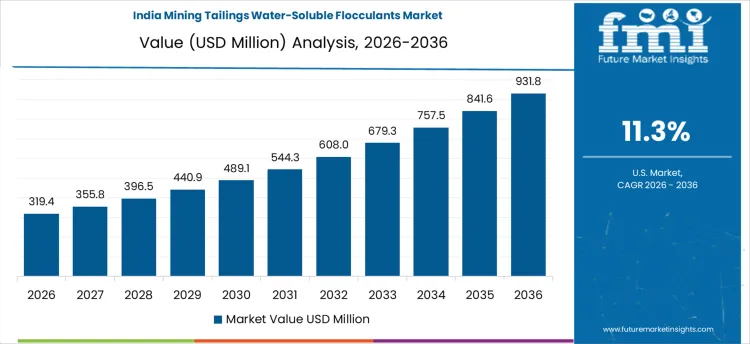
India’s mining tailings water-soluble flocculants market is growing at the highest rate in this group, with a CAGR of 11.3%. India’s growing mining industry and the associated environmental concerns regarding tailings management are driving the adoption of water-soluble flocculants. As India continues to develop its mining sector, there is increasing pressure to manage tailings water efficiently and responsibly. The government has started to enforce stricter environmental regulations regarding water use and waste management in mining, pushing companies to adopt better water treatment solutions. Water-soluble flocculants are a cost-effective and environmentally friendly solution, which is why their use is expanding rapidly. India’s focus on sustainable mining and water management practices will continue to drive the growth of this market.
What is the Competitive Landscape for the Mining Tailings Water-Soluble Flocculants Market?
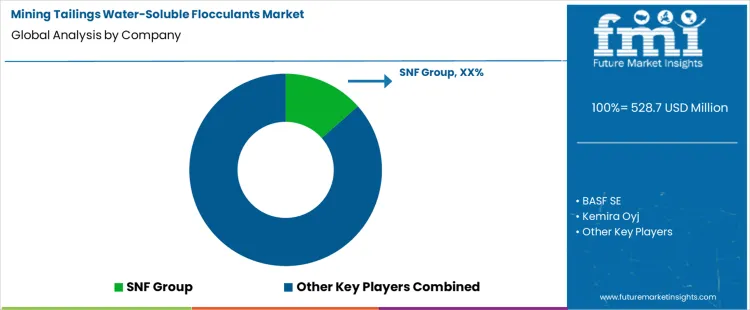
The mining tailings water-soluble flocculants market is driven by a competitive mix of global companies focused on sustainability, product performance, and operational efficiency. SNF Group, as a market leader, provides innovative water-soluble flocculants that are key in the mining industry for improving water recovery and reducing environmental impact. The company's strong presence in various regions and its investment in research and development have made it a dominant force. BASF SE, a key player, focuses on producing high-performance flocculants tailored for mining applications. Their advanced chemical solutions help optimize the extraction process, ensuring greater efficiency in water management and reducing the risk of environmental contamination. Kemira Oyj and Archer Daniels Midland (ADM) also contribute significantly to the market by offering water-soluble flocculants that enhance mining operations, focusing on cost-effective and environmentally friendly solutions. Solvay SA rounds out the major players, offering a range of specialty chemicals that support water treatment in mining operations.
Companies in the mining tailings water-soluble flocculants market adopt diverse strategies to maintain competitiveness. Research and development are central to advancing product efficacy, with companies working to improve flocculant performance in various environmental conditions. SNF Group continues to refine its offerings, ensuring its flocculants can handle diverse mining tailings scenarios while minimizing water consumption and waste. BASF SE focuses on expanding its product line with environmentally friendly alternatives, meeting increasingly stringent regulations. Kemira Oyj prioritizes sustainability in its chemical solutions, ensuring that its flocculants contribute to reducing water usage and environmental impact. ADM’s strategy includes expanding its geographic footprint, targeting emerging markets with growing mining sectors. Solvay SA collaborates with mining companies to create customized solutions that meet specific operational needs. These strategies, combined with the growing demand for water management solutions in mining, position these companies to capture significant shares of the market.
Key Players of the Mining Tailings Water-Soluble Flocculants Market
- SNF Group
- BASF SE
- Kemira Oyj
- Archer Daniels Midland (ADM)
- Solvay SA
- Others
Scope of the Report
| Items | Values |
|---|---|
| Quantitative Units (2026) | USD Million |
| Flocculant Type | Polyacrylamide (PAM), Natural Polymers (e.g., Starch, Chitosan), Bio-Based Flocculants, Anionic Copolymers, Others |
| Tailings Type | Gold Tailings, Copper Tailings, Iron Ore Tailings, Coal & Energy Minerals, Others |
| End User | Mining Operators, Water Treatment Providers, Independent Commodity Producers, Specialty Chemical Distributors |
| Companies | SNF Group, BASF SE, Kemira Oyj, Archer Daniels Midland (ADM), Solvay SA, Others |
| Regions Covered | North America, Latin America, Western Europe, Eastern Europe, South Asia and Pacific, East Asia, Middle East & Africa |
| Countries Covered | United States, Canada, Mexico, Brazil, Argentina, Germany, France, United Kingdom, Italy, Spain, Netherlands, China, India, Japan, South Korea, ANZ, GCC Countries, South Africa |
| Additional Attributes | Dollar by sales by flocculant type, tailings type, end user, and region. Includes market trends towards sustainable water treatment solutions, cost-effectiveness, regulatory compliance, impact on environmental safety, and the role of flocculants in enhancing mining tailings management. |
Mining Tailings Water-Soluble Flocculants Market Segmentation
Flocculant Type
- Polyacrylamide (PAM)
- Natural Polymers (e.g., Starch, Chitosan)
- Bio-Based Flocculants
- Anionic Copolymers
- Others
Tailings Type
- Gold Tailings
- Copper Tailings
- Iron Ore Tailings
- Coal & Energy Minerals
- Others
End User
- Mining Operators
- Water Treatment Providers
- Independent Commodity Producers
- Specialty Chemical Distributors
- Others
Region
- Asia Pacific
- China
- Japan
- India
- Australia & New Zealand
- ASEAN
- Rest of Asia Pacific
- Europe
- Germany
- United Kingdom
- France
- Italy
- Spain
- Nordic
- BENELUX
- Rest of Europe
- North America
- United States
- Canada
- Mexico
- Latin America
- Brazil
- Argentina
- Rest of Latin America
- Middle East & Africa
- Kingdom of Saudi Arabia
- Other GCC Countries
- South Africa
- Rest of Middle East & Africa
Bibliography
SNF. (2021). Mining solutions for sustainable development (brochure). SNF.
BASF. (n.d.). Mining solutions product range (Product Range brochure; includes Magnafloc® flocculants/coagulants for mineral processing). BASF.
Kemira. (n.d.). Chemical flocculants (product information page). Kemira.
Solvay. (2018). Alumina specialty chemicals: Your full service partner (brochure; includes CYFLOC® hydrate flocculants used in alumina processing). Solvay.
Orchard, M. J. (2024). Development of bioflocculants for mineral processing. Cleaner Engineering and Technology. Elsevier.
Frequently Asked Questions
How big is the mining tailings water-soluble flocculants market in 2026?
The global mining tailings water-soluble flocculants market is estimated to be valued at USD 528.7 million in 2026.
What will be the size of mining tailings water-soluble flocculants market in 2036?
The market size for the mining tailings water-soluble flocculants market is projected to reach USD 1,346.6 million by 2036.
How much will be the mining tailings water-soluble flocculants market growth between 2026 and 2036?
The mining tailings water-soluble flocculants market is expected to grow at a 9.8% CAGR between 2026 and 2036.
What are the key product types in the mining tailings water-soluble flocculants market?
The key product types in mining tailings water-soluble flocculants market are polyacrylamide (pam), natural polymers (e.g., starch, chitosan), bio-based flocculants, anionic copolymers and others.
Which tailings type segment to contribute significant share in the mining tailings water-soluble flocculants market in 2026?
In terms of tailings type, gold tailings segment to command 22.0% share in the mining tailings water-soluble flocculants market in 2026.
Preview the report firsthand - request a free sample
Get SampleGet the brochure for pricing and purchase details.
Get PDFTable of Content
- Executive Summary
- Global Market Outlook
- Demand-side Trends
- Supply-side Trends
- Technology Roadmap Analysis
- Analysis and Recommendations
- Market Overview
- Market Coverage / Taxonomy
- Market Definition / Scope / Limitations
- Market Background
- Market Dynamics
- Drivers
- Restraints
- Opportunity
- Trends
- Scenario Forecast
- Demand in Optimistic Scenario
- Demand in Likely Scenario
- Demand in Conservative Scenario
- Opportunity Map Analysis
- Product Life Cycle Analysis
- Supply Chain Analysis
- Investment Feasibility Matrix
- Value Chain Analysis
- PESTLE and Porter’s Analysis
- Regulatory Landscape
- Regional Parent Market Outlook
- Production and Consumption Statistics
- Import and Export Statistics
- Market Dynamics
- Global Market Analysis 2021 to 2025 and Forecast, 2026 to 2036
- Historical Market Size Value (USD Million) Analysis, 2021 to 2025
- Current and Future Market Size Value (USD Million) Projections, 2026 to 2036
- Y-o-Y Growth Trend Analysis
- Absolute $ Opportunity Analysis
- Global Market Pricing Analysis 2021 to 2025 and Forecast 2026 to 2036
- Global Market Analysis 2021 to 2025 and Forecast 2026 to 2036, By Flocculant Type
- Introduction / Key Findings
- Historical Market Size Value (USD Million) Analysis By Flocculant Type , 2021 to 2025
- Current and Future Market Size Value (USD Million) Analysis and Forecast By Flocculant Type , 2026 to 2036
- Polyacrylamide (PAM)
- Natural Polymers (e.g., Starch, Chitosan)
- Bio-Based Flocculants
- Anionic Copolymers
- Others
- Polyacrylamide (PAM)
- Y-o-Y Growth Trend Analysis By Flocculant Type , 2021 to 2025
- Absolute $ Opportunity Analysis By Flocculant Type , 2026 to 2036
- Global Market Analysis 2021 to 2025 and Forecast 2026 to 2036, By Tailings Type
- Introduction / Key Findings
- Historical Market Size Value (USD Million) Analysis By Tailings Type, 2021 to 2025
- Current and Future Market Size Value (USD Million) Analysis and Forecast By Tailings Type, 2026 to 2036
- Gold Tailings
- Copper Tailings
- Iron Ore Tailings
- Coal & Energy Minerals
- Others
- Gold Tailings
- Y-o-Y Growth Trend Analysis By Tailings Type, 2021 to 2025
- Absolute $ Opportunity Analysis By Tailings Type, 2026 to 2036
- Global Market Analysis 2021 to 2025 and Forecast 2026 to 2036, By End User
- Introduction / Key Findings
- Historical Market Size Value (USD Million) Analysis By End User, 2021 to 2025
- Current and Future Market Size Value (USD Million) Analysis and Forecast By End User, 2026 to 2036
- Mining Operators
- Water Treatment Providers
- Independent Commodity Producers
- Specialty Chemical Distributors
- Mining Operators
- Y-o-Y Growth Trend Analysis By End User, 2021 to 2025
- Absolute $ Opportunity Analysis By End User, 2026 to 2036
- Global Market Analysis 2021 to 2025 and Forecast 2026 to 2036, By Region
- Introduction
- Historical Market Size Value (USD Million) Analysis By Region, 2021 to 2025
- Current Market Size Value (USD Million) Analysis and Forecast By Region, 2026 to 2036
- North America
- Latin America
- Western Europe
- Eastern Europe
- East Asia
- South Asia and Pacific
- Middle East & Africa
- Market Attractiveness Analysis By Region
- North America Market Analysis 2021 to 2025 and Forecast 2026 to 2036, By Country
- Historical Market Size Value (USD Million) Trend Analysis By Market Taxonomy, 2021 to 2025
- Market Size Value (USD Million) Forecast By Market Taxonomy, 2026 to 2036
- By Country
- USA
- Canada
- Mexico
- By Flocculant Type
- By Tailings Type
- By End User
- By Country
- Market Attractiveness Analysis
- By Country
- By Flocculant Type
- By Tailings Type
- By End User
- Key Takeaways
- Latin America Market Analysis 2021 to 2025 and Forecast 2026 to 2036, By Country
- Historical Market Size Value (USD Million) Trend Analysis By Market Taxonomy, 2021 to 2025
- Market Size Value (USD Million) Forecast By Market Taxonomy, 2026 to 2036
- By Country
- Brazil
- Chile
- Rest of Latin America
- By Flocculant Type
- By Tailings Type
- By End User
- By Country
- Market Attractiveness Analysis
- By Country
- By Flocculant Type
- By Tailings Type
- By End User
- Key Takeaways
- Western Europe Market Analysis 2021 to 2025 and Forecast 2026 to 2036, By Country
- Historical Market Size Value (USD Million) Trend Analysis By Market Taxonomy, 2021 to 2025
- Market Size Value (USD Million) Forecast By Market Taxonomy, 2026 to 2036
- By Country
- Germany
- UK
- Italy
- Spain
- France
- Nordic
- BENELUX
- Rest of Western Europe
- By Flocculant Type
- By Tailings Type
- By End User
- By Country
- Market Attractiveness Analysis
- By Country
- By Flocculant Type
- By Tailings Type
- By End User
- Key Takeaways
- Eastern Europe Market Analysis 2021 to 2025 and Forecast 2026 to 2036, By Country
- Historical Market Size Value (USD Million) Trend Analysis By Market Taxonomy, 2021 to 2025
- Market Size Value (USD Million) Forecast By Market Taxonomy, 2026 to 2036
- By Country
- Russia
- Poland
- Hungary
- Balkan & Baltic
- Rest of Eastern Europe
- By Flocculant Type
- By Tailings Type
- By End User
- By Country
- Market Attractiveness Analysis
- By Country
- By Flocculant Type
- By Tailings Type
- By End User
- Key Takeaways
- East Asia Market Analysis 2021 to 2025 and Forecast 2026 to 2036, By Country
- Historical Market Size Value (USD Million) Trend Analysis By Market Taxonomy, 2021 to 2025
- Market Size Value (USD Million) Forecast By Market Taxonomy, 2026 to 2036
- By Country
- China
- Japan
- South Korea
- By Flocculant Type
- By Tailings Type
- By End User
- By Country
- Market Attractiveness Analysis
- By Country
- By Flocculant Type
- By Tailings Type
- By End User
- Key Takeaways
- South Asia and Pacific Market Analysis 2021 to 2025 and Forecast 2026 to 2036, By Country
- Historical Market Size Value (USD Million) Trend Analysis By Market Taxonomy, 2021 to 2025
- Market Size Value (USD Million) Forecast By Market Taxonomy, 2026 to 2036
- By Country
- India
- ASEAN
- Australia & New Zealand
- Rest of South Asia and Pacific
- By Flocculant Type
- By Tailings Type
- By End User
- By Country
- Market Attractiveness Analysis
- By Country
- By Flocculant Type
- By Tailings Type
- By End User
- Key Takeaways
- Middle East & Africa Market Analysis 2021 to 2025 and Forecast 2026 to 2036, By Country
- Historical Market Size Value (USD Million) Trend Analysis By Market Taxonomy, 2021 to 2025
- Market Size Value (USD Million) Forecast By Market Taxonomy, 2026 to 2036
- By Country
- Kingdom of Saudi Arabia
- Other GCC Countries
- Turkiye
- South Africa
- Other African Union
- Rest of Middle East & Africa
- By Flocculant Type
- By Tailings Type
- By End User
- By Country
- Market Attractiveness Analysis
- By Country
- By Flocculant Type
- By Tailings Type
- By End User
- Key Takeaways
- Key Countries Market Analysis
- USA
- Pricing Analysis
- Market Share Analysis, 2025
- By Flocculant Type
- By Tailings Type
- By End User
- Canada
- Pricing Analysis
- Market Share Analysis, 2025
- By Flocculant Type
- By Tailings Type
- By End User
- Mexico
- Pricing Analysis
- Market Share Analysis, 2025
- By Flocculant Type
- By Tailings Type
- By End User
- Brazil
- Pricing Analysis
- Market Share Analysis, 2025
- By Flocculant Type
- By Tailings Type
- By End User
- Chile
- Pricing Analysis
- Market Share Analysis, 2025
- By Flocculant Type
- By Tailings Type
- By End User
- Germany
- Pricing Analysis
- Market Share Analysis, 2025
- By Flocculant Type
- By Tailings Type
- By End User
- UK
- Pricing Analysis
- Market Share Analysis, 2025
- By Flocculant Type
- By Tailings Type
- By End User
- Italy
- Pricing Analysis
- Market Share Analysis, 2025
- By Flocculant Type
- By Tailings Type
- By End User
- Spain
- Pricing Analysis
- Market Share Analysis, 2025
- By Flocculant Type
- By Tailings Type
- By End User
- France
- Pricing Analysis
- Market Share Analysis, 2025
- By Flocculant Type
- By Tailings Type
- By End User
- India
- Pricing Analysis
- Market Share Analysis, 2025
- By Flocculant Type
- By Tailings Type
- By End User
- ASEAN
- Pricing Analysis
- Market Share Analysis, 2025
- By Flocculant Type
- By Tailings Type
- By End User
- Australia & New Zealand
- Pricing Analysis
- Market Share Analysis, 2025
- By Flocculant Type
- By Tailings Type
- By End User
- China
- Pricing Analysis
- Market Share Analysis, 2025
- By Flocculant Type
- By Tailings Type
- By End User
- Japan
- Pricing Analysis
- Market Share Analysis, 2025
- By Flocculant Type
- By Tailings Type
- By End User
- South Korea
- Pricing Analysis
- Market Share Analysis, 2025
- By Flocculant Type
- By Tailings Type
- By End User
- Russia
- Pricing Analysis
- Market Share Analysis, 2025
- By Flocculant Type
- By Tailings Type
- By End User
- Poland
- Pricing Analysis
- Market Share Analysis, 2025
- By Flocculant Type
- By Tailings Type
- By End User
- Hungary
- Pricing Analysis
- Market Share Analysis, 2025
- By Flocculant Type
- By Tailings Type
- By End User
- Kingdom of Saudi Arabia
- Pricing Analysis
- Market Share Analysis, 2025
- By Flocculant Type
- By Tailings Type
- By End User
- Turkiye
- Pricing Analysis
- Market Share Analysis, 2025
- By Flocculant Type
- By Tailings Type
- By End User
- South Africa
- Pricing Analysis
- Market Share Analysis, 2025
- By Flocculant Type
- By Tailings Type
- By End User
- USA
- Market Structure Analysis
- Competition Dashboard
- Competition Benchmarking
- Market Share Analysis of Top Players
- By Regional
- By Flocculant Type
- By Tailings Type
- By End User
- Competition Analysis
- Competition Deep Dive
- SNF Group
- Overview
- Product Portfolio
- Profitability by Market Segments (Product/Age /Sales Channel/Region)
- Sales Footprint
- Strategy Overview
- Marketing Strategy
- Product Strategy
- Channel Strategy
- BASF SE
- Kemira Oyj
- Archer Daniels Midland (ADM)
- Solvay SA
- Others
- SNF Group
- Competition Deep Dive
- Assumptions & Acronyms Used
- Research Methodology


