

- Industry Size (2025)
- USD 8.0 Bn
- Forecast (2035)
- USD 14.6 Bn
- CAGR (2025 to 2035)
- 6.2%
Demand for Water Soluble Fertilizers in USA Forecast and Outlook 2025 to 2035
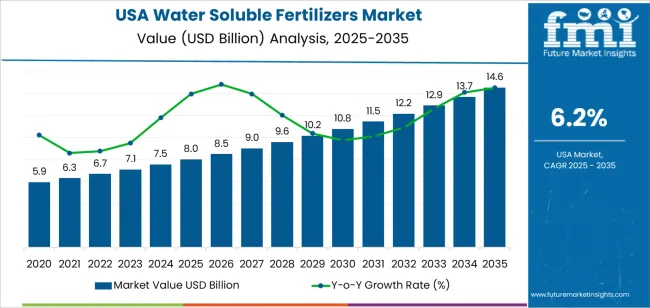
The demand for water soluble fertilizers in USA is valued at USD 8.0 billion in 2025 and is projected to reach USD 14.6 billion by 2035, reflecting a compound annual growth rate of 6.2%. Growth is shaped by increased adoption of controlled irrigation systems, fertigation practices and crop-specific formulations used across horticulture, high-value crop farming and greenhouse operations. Water soluble blends support precise nutrient delivery and compatibility with automated distribution methods, reinforcing stable procurement across commercial growers. As producers refine application schedules to maintain consistency in crop growth and output quality, fertilizer demand rises in alignment with expanding production cycles. These factors contribute to a steady upward trajectory across USA’s agricultural landscape throughout the forecast window.
The growth curve shows a gradual, consistent rise beginning at USD 5.9 billion in earlier years and reaching USD 8.0 billion in 2025 before advancing toward USD 14.6 billion by 2035. Annual values increase predictably, moving from USD 8.5 billion in 2026 to USD 9.0 billion in 2027 and continuing through USD 10.8 billion in 2031 and USD 12.9 billion in 2033. This pattern reflects stable integration of soluble nutrient systems across controlled-environment agriculture and field-based cultivation. As growers expand irrigation-linked fertilization and optimize nutrient mixes for yield uniformity, year-to-year demand remains consistent. The curve highlights a maturing but steadily advancing segment supported by routine crop management needs across USA.
Quick Stats of the Demand for Water Soluble Fertilizers in USA
- Demand for Water Soluble Fertilizers in USA Value (2025): USD 8.0 billion
- Demand for Water Soluble Fertilizers in USA Forecast Value (2035): USD 14.6 billion
- Demand for Water Soluble Fertilizers in USA Forecast CAGR (2025–2035): 6.2%
- Demand for Water Soluble Fertilizers in USA Leading Product Type: Nitrogenous (21%)
- Demand for Water Soluble Fertilizers in USA Key Growth Regions: West, South, Northeast, Midwest
- Demand for Water Soluble Fertilizers in USA Top Players: Yara International ASA, The Mosaic Company, Haifa Group, ICL Group, Deepak Fertilisers and Petrochemical
What is the Growth Forecast for Demand for Water Soluble Fertilizers in USA through 2035?
Demand in the USA for water soluble fertilizers is projected to grow from USD 8.0 billion in 2025 to USD 14.6 billion by 2035, representing a compound annual growth rate (CAGR) of approximately 6.2%. Starting at USD 5.9 billion in 2020, the value increases steadily USD 7.5 billion by 2024, then USD 8.0 billion in 2025 and continues upward through USD 10.8 billion around 2030, reaching USD 14.6 billion by 2035. Growth is driven by increasing adoption of precision agriculture techniques (such as fertigation and foliar feeding), rising production of high value horticultural crops, and stronger emphasis on sustainable nutrient delivery systems that improve uptake efficiency and reduce waste.
The absolute value uplift from 2025 to 2035 is USD 6.6 billion. In the early years (2025 2030) the increase is primarily volume driven as more growers transition to water soluble systems and irrigation infrastructure expands. In the later half of the decade (2030 2035), value growth becomes increasingly important higher spec formulations, premium micronutrient blends, and tailored solutions for specialty crops command higher average selling prices. Suppliers with innovation in formulation and service model differentiation are best positioned to capture the full opportunity toward USD 14.6 billion by 2035.
Water Soluble Fertilizers Industry in USA Key Takeaways
| Metric | Value |
|---|---|
| Industry Value (2025) | USD 8.0 billion |
| Forecast Value (2035) | USD 14.6 billion |
| Forecast CAGR (2025–2035) | 6.2% |
What Is Driving the Demand for Water Soluble Fertilizers in USA?
The demand for water soluble fertilizers in USA has historically been driven by the growing use of high-value crops such as fruits, vegetables and greenhouse produce, which require precise nutrient delivery. In earlier periods farmers shifted away from bulk granular fertilizers to water-soluble formats because they offered improved absorption when applied via fertigation or drip irrigation systems. This trend was especially strong in regions with controlled‐environment agriculture, smaller acreage farms and greenhouse operations. Standard agricultural expansion and increased adoption of micro-irrigation supported this uptake and provided reliable volumes for soluble fertilizer supplies.
Looking ahead, future growth is expected to stem from sustainability targets, increased indoor and vertical farming, precision agriculture and nutrient-use efficiency mandates. As US growers adopt digital crop-management systems, sensors and variable-rate fertigation, water soluble fertilizers will benefit from ability to deliver tailored nutrient formulations. Expansion of organic and specialty crops, stricter environmental regulation around nutrient runoff and increasing controlled-environment agriculture will further support demand. Although cost and perception barriers remain among commodity crop producers, the alignment of advanced farming practices and regulatory pressure suggests steady growth going forward.
What Factors Are Affecting the Demand for Water Soluble Fertilizers in USA in Terms of Product Type and Application?
The demand for water soluble fertilizers in USA is shaped by the nutrient compositions selected for crop programs and by the application methods that determine how nutrients reach the root zone or foliage. Product types include nitrogenous, phosphate-based, potassium-based, N.P complex, sulfur and micronutrient formulations, each supporting different growth stages and soil conditions. Application methods such as fertigation and foliar feeding reflect varied irrigation structures and management practices. As growers focus on consistent nutrient delivery, predictable solubility and efficient use of inputs, the combination of formulation type and application method influences fertilizer use across USA’s agricultural sectors.
What Drives the Leading Demand for Nitrogenous Water Soluble Fertilizers in USA?
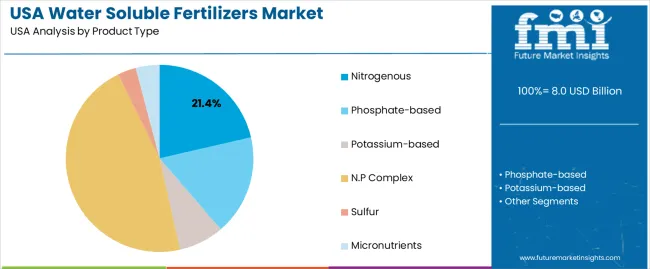
Nitrogenous fertilizers account for 21% of total demand across product type categories in USA. Their leading share reflects the essential role of nitrogen in supporting early vegetative growth, leaf development and overall plant vigor. Growers rely on nitrogenous formulations for dependable solubility and uniform distribution through irrigation systems. These products help maintain steady nutrient availability in crops that respond strongly to controlled nitrogen inputs. Their adaptability across soil types and climatic zones reinforces their use in vegetable production, horticulture and protected cultivation settings where precise nutrient timing improves outcomes.
Demand for nitrogenous fertilizers also rises as producers refine nutrient management practices to support controlled growth rates and rapid correction of deficiencies. Their compatibility with fertigation systems allows growers to adjust concentrations efficiently during seasonal shifts. Many operations value the predictable uptake patterns associated with these formulations, which help maintain uniform crop quality. As USA’s crop systems continue emphasizing consistent yield performance and efficient nutrient use, nitrogenous water soluble fertilizers remain a central component of fertilization strategies.
What Drives the Leading Demand for Fertigation in USA?
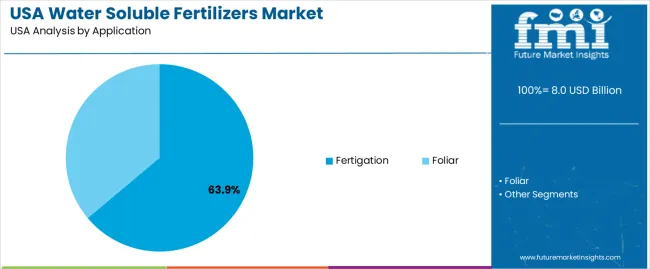
Fertigation accounts for 63.9% of total demand across application categories in USA. Its leading position reflects widespread reliance on irrigation-based nutrient delivery in specialty crops, greenhouse production and precision field systems. Fertigation enables controlled dosing directly into the root zone, improving nutrient uptake efficiency and helping growers respond to changing crop requirements. The method supports predictable application schedules and reduces waste associated with surface broadcasting. These characteristics make fertigation a preferred choice for growers managing water-sensitive crops and high-value production environments.
Demand for fertigation also grows as drip and micro-irrigation systems become more common across USA’s horticultural regions. The method enhances uniformity in nutrient distribution, supporting consistent growth patterns across large plant populations. Growers value the ability to tailor nutrient concentrations throughout different development stages using simple adjustments. Fertigation aligns with production systems seeking efficient input use and stable crop performance. As controlled agriculture and quality-focused cultivation expand, fertigation remains the dominant application shaping water soluble fertilizer demand across USA.
What Is Shaping the Demand for Water-Soluble Fertilizers in USA Today?
Demand for water-soluble fertilizers in the USA is influenced by shifts in controlled-environment agriculture, the spread of drip and micro-irrigation, and rising precision-fertigation practices in high-value crops. Greenhouse vegetable production, berry cultivation and specialty crop systems increasingly rely on soluble nutrients for dosing accuracy. At the same time, fertilizer price volatility, regional water-management constraints and uneven adoption of fertigation infrastructure shape how widely these products are used across USA commercial farms, horticulture operations and protected-agriculture facilities.
How Is the Shift Toward Controlled-Environment and High-Value Crop Production Shaping Demand?
A clear trend comes from the expansion of USA greenhouse vegetables, hydroponic leafy-greens farms and berry operations in states such as California, Arizona and the Northeast. These producers require nutrient mixes that dissolve consistently and support precision dosing through automated fertigation. Water-soluble fertilizers suit climates where irrigation water quality varies and growers need tighter control of EC, pH and micronutrient balance. This shift toward protected and high-value cultivation strengthens demand for soluble formulations rather than traditional granular options.
Where Do Growth Opportunities Emerge in the USA Fertigation and Specialty-Crop Landscape?
Opportunities arise in regions adopting drip-irrigation at scale, particularly the West and Southwest where water scarcity drives growers toward efficiency-focused practices. Expansion of controlled-environment farms for lettuce, tomatoes and strawberries also opens steady demand for soluble blends tailored to crop stage and local water chemistry. Specialty nurseries, urban vertical-farm operators and professional turf managers present further openings. Suppliers offering region-specific nutrient recipes, compatibility testing and advisory services can capture growth within these technical, fertigation-dependent segments.
What Practical Constraints Limit Wider Adoption of Water-Soluble Fertilizers in USA?
A key restraint is the uneven availability of fertigation infrastructure across USA field-crop regions, where many growers still rely on broadcast dry fertilizers. Upfront investment in pumps, injectors and filtration can deter smaller farms. Water-quality issues in some states, such as high bicarbonate content or variable salinity, complicate consistent dissolution and may require additional treatment. Fertilizer price swings and supply uncertainties also influence purchasing decisions. These constraints slow expansion beyond greenhouse, specialty-crop and irrigated-horticulture users.
What is the Demand for Water Soluble Fertilizers in USA by Region?
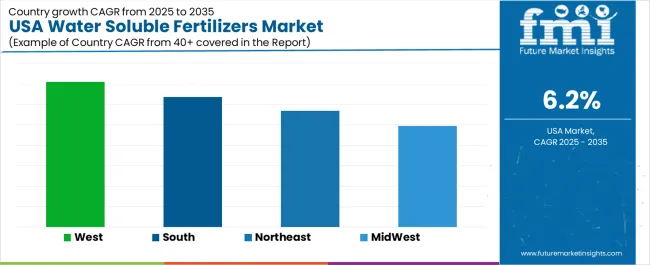
| Region | CAGR (%) |
|---|---|
| West USA | 7.1% |
| South USA | 6.4% |
| Northeast USA | 5.7% |
| Midwest USA | 4.9% |
Demand for water soluble fertilizers in the USA is increasing across regions, with the West leading at 7.1%. Growth in this region reflects active horticulture, greenhouse operations, and high-value crop production that rely on controlled nutrient delivery. The South follows at 6.4%, supported by large agricultural areas adopting fertigation systems to improve efficiency. The Northeast records 5.7%, shaped by diversified farming and steady use of soluble nutrients in specialty crops. The Midwest grows at 4.9%, where greenhouse operations and irrigated farms integrate water soluble fertilizers at a measured pace. These regional patterns show broad national interest in nutrient-efficient practices aligned with intensive cultivation.
How Is West USA Driving Demand for Water Soluble Fertilizers?
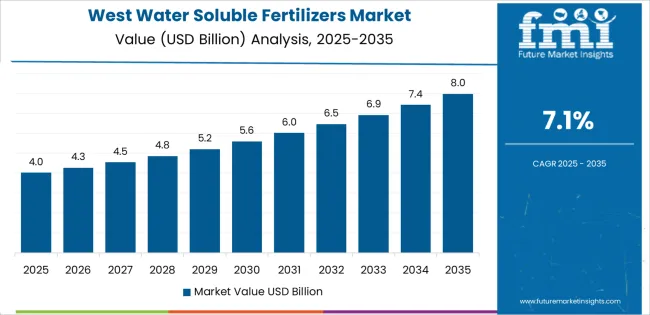
West USA is projected to grow at a CAGR of 7.1% through 2035 in demand for water soluble fertilizers. California, Washington, and surrounding agricultural regions are increasingly adopting fertilizers for high-value crops, horticulture, and precision farming. Rising focus on crop yield optimization, nutrient management, and efficient irrigation drives adoption. Manufacturers provide soluble fertilizers suitable for foliar application, fertigation, and soil enrichment. Distributors ensure accessibility across farms, nurseries, and agricultural cooperatives. Expansion in high-value crop production, greenhouse farming, and horticulture supports steady adoption of water soluble fertilizers in West USA.
- California and Washington adopt water soluble fertilizers for high-value crops.
- Crop yield optimization and nutrient management drive regional adoption trends.
- Fertilizers suitable for foliar application, fertigation, and soil enrichment.
- Distributors ensure access across farms, nurseries, and cooperatives.
How Is South USA Supporting Demand for Water Soluble Fertilizers?
South USA is projected to grow at a CAGR of 6.4% through 2035 in demand for water soluble fertilizers. Texas, Florida, and surrounding agricultural regions are increasingly using fertilizers for fruit, vegetable, and row crop cultivation. Rising focus on nutrient efficiency, crop quality, and irrigation management drives adoption. Manufacturers provide high-performance soluble fertilizers compatible with fertigation and foliar application systems. Distributors ensure availability across farms, nurseries, and agricultural supply chains. Expansion in horticulture, greenhouse production, and precision farming supports steady adoption of water soluble fertilizers across South USA.
- Texas and Florida adopt fertilizers for fruit, vegetable, and row crops.
- Nutrient efficiency and crop quality drive regional adoption trends.
- Fertilizers compatible with fertigation and foliar application systems.
- Distributors ensure access across farms, nurseries, and supply chains.
How Is Northeast USA Contributing to Demand for Water Soluble Fertilizers?
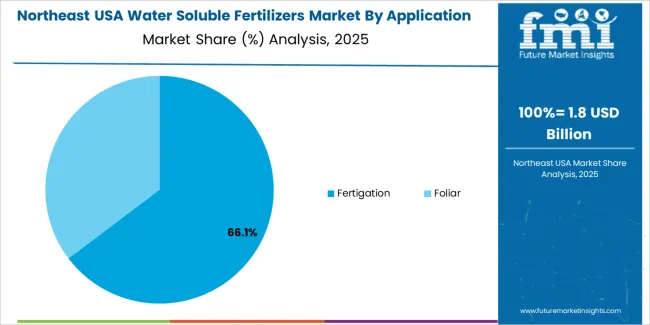
Northeast USA is projected to grow at a CAGR of 5.7% through 2035 in demand for water soluble fertilizers. New York, Pennsylvania, and surrounding agricultural regions are gradually adopting fertilizers for high-value crops, vegetables, and specialty farming operations. Rising focus on crop productivity, nutrient management, and water-efficient fertilization drives adoption. Manufacturers provide soluble fertilizers suitable for foliar feeding, fertigation, and greenhouse applications. Distributors ensure accessibility across farms, nurseries, and agricultural cooperatives. Expansion in horticulture, greenhouse production, and precision farming supports steady adoption of water soluble fertilizers across Northeast USA.
- New York and Pennsylvania adopt fertilizers for high-value and vegetable crops.
- Crop productivity and nutrient management drive regional adoption trends.
- Fertilizers suitable for foliar feeding, fertigation, and greenhouse use.
- Distributors ensure access across farms, nurseries, and cooperatives.
How Is Midwest USA Contributing to Demand for Water Soluble Fertilizers?
Midwest USA is projected to grow at a CAGR of 4.9% through 2035 in demand for water soluble fertilizers. Illinois, Ohio, and surrounding agricultural regions are gradually adopting fertilizers for row crops, horticulture, and greenhouse cultivation. Rising demand for nutrient efficiency, crop quality, and irrigation management drives adoption. Manufacturers provide high-quality soluble fertilizers suitable for fertigation, foliar application, and soil enrichment. Distributors ensure accessibility across farms, nurseries, and agricultural suppliers. Expansion in horticulture, greenhouse production, and precision farming supports steady adoption of water soluble fertilizers across Midwest USA.
- Illinois and Ohio adopt fertilizers for row crops and horticulture.
- Nutrient efficiency and crop quality drive regional adoption trends.
- Fertilizers suitable for fertigation, foliar application, and soil enrichment.
- Distributors ensure access across farms, nurseries, and agricultural suppliers.
What Is Driving the Demand for Water Soluble Fertilizers in USA and Who Are the Key Players Shaping the Industry?
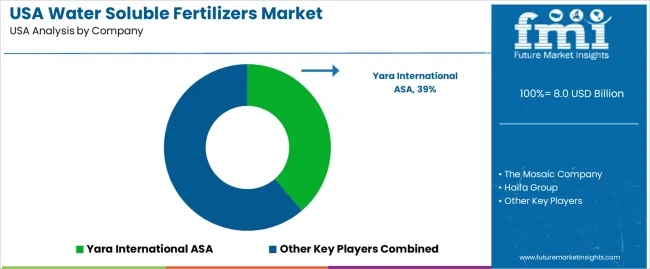
Demand for water soluble fertilizers in USA is growing as producers focus on precision nutrient delivery, especially in high-value crops such as vegetables, fruits and ornamentals. Controlled-environment agriculture, including greenhouses and vertical farms, depends on fertigation systems that require fertilizers dissolving quickly with predictable nutrient release. Drip irrigation continues to expand in western and southern states, increasing reliance on formulations that support efficient uptake and reduce nutrient losses. As producers seek consistent crop quality and improved yield stability, they turn to water soluble blends that allow precise adjustments through the growing cycle. Weather variability and soil-health concerns also encourage growers to adopt fertilizers that integrate smoothly with modern irrigation technologies, supporting broader use across both specialty and field production regions.
Key players shaping USA’s water soluble fertilizer environment include Yara International ASA, The Mosaic Company, Haifa Group, ICL Group and Deepak Fertilisers and Petrochemical. Yara and Mosaic offer broad nutrient programs aligned with USA agronomic practices, while Haifa and ICL supply specialized formulations for fertigation and greenhouse production. Deepak Fertilisers participates through export channels serving distributors that support horticulture and specialty-crop growers. USA distributors and blending facilities play a central role by tailoring nutrient mixes for regional conditions and irrigation systems used across diverse farming areas. This combination of international suppliers and domestic distribution networks influences how water soluble fertilizers are selected, adapted and applied throughout American specialty agriculture.
Key Players in Water Soluble Fertilizers Industry in USA
- Yara International ASA
- The Mosaic Company
- Haifa Group
- ICL Group
- Deepak Fertilisers and Petrochemical
Report Scope for Water Soluble Fertilizers Industry in USA
| Items | Values |
|---|---|
| Quantitative Units (2025) | USD billion |
| Type | Nitrogenous, Phosphate-based, Potassium-based, N.P Complex, Sulfur, Micronutrients |
| Application | Fertigation, Foliar |
| Crop Type | Cereals & Pulses, Horticulture, Lawn, Turf & Ornamental, Others |
| Region | Northeast, West, Midwest, South |
| Countries Covered | USA |
| Key Companies Profiled | Yara International ASA, The Mosaic Company, Haifa Group, ICL Group, Deepak Fertilisers and Petrochemical |
| Additional Attributes | Dollar by sales by type, application, crop type, and region; regional CAGR and adoption trends; volume and value growth projections; growth driven by precision agriculture, controlled-environment agriculture, and rising use of fertigation and foliar feeding systems; specialty crop focus; regional water management and fertilizer application efficiency; increased use of organic farming and environmental regulation; adoption driven by weather variability and irrigation infrastructure expansion. |
Water Soluble Fertilizers Industry in USA Segmentation
Product Type:
- Nitrogenous
- Phosphate-based
- Potassium-based
- N.P Complex
- Sulfur
- Micronutrients
Application:
- Fertigation
- Foliar
Crop Type:
- Cereals & Pulses
- Horticulture
- Lawn, Turf & Ornamental
- Others
Region:
- Northeast USA
- West USA
- Midwest USA
- South USA
Frequently Asked Questions
How big is the demand for water soluble fertilizers in usa in 2025?
The demand for water soluble fertilizers in usa is estimated to be valued at USD 8.0 billion in 2025.
What will be the size of water soluble fertilizers in usa in 2035?
The market size for the water soluble fertilizers in usa is projected to reach USD 14.6 billion by 2035.
How much will be the demand for water soluble fertilizers in usa growth between 2025 and 2035?
The demand for water soluble fertilizers in usa is expected to grow at a 6.2% CAGR between 2025 and 2035.
What are the key product types in the water soluble fertilizers in usa?
The key product types in water soluble fertilizers in usa are nitrogenous, phosphate-based, potassium-based, n.p complex, sulfur and micronutrients.
Which application segment is expected to contribute significant share in the water soluble fertilizers in usa in 2025?
In terms of application, fertigation segment is expected to command 63.9% share in the water soluble fertilizers in usa in 2025.
Preview the report firsthand - request a free sample
Get SampleGet the brochure for pricing and purchase details.
Get PDFTable of Content
- Executive Summary
- USA Market Outlook
- Demand-side Trends
- Supply-side Trends
- Technology Roadmap Analysis
- Analysis and Recommendations
- Market Overview
- Market Coverage / Taxonomy
- Market Definition / Scope / Limitations
- Market Background
- Market Dynamics
- Drivers
- Restraints
- Opportunity
- Trends
- Scenario Forecast
- Demand in Optimistic Scenario
- Demand in Likely Scenario
- Demand in Conservative Scenario
- Opportunity Map Analysis
- Product Life Cycle Analysis
- Supply Chain Analysis
- Investment Feasibility Matrix
- Value Chain Analysis
- PESTLE and Porter’s Analysis
- Regulatory Landscape
- Regional Parent Market Outlook
- Production and Consumption Statistics
- Import and Export Statistics
- Market Dynamics
- USA Market Analysis 2020 to 2024 and Forecast, 2025 to 2035
- Historical Market Size Value (USD Million) Analysis, 2020 to 2024
- Current and Future Market Size Value (USD Million) Projections, 2025 to 2035
- Y-o-Y Growth Trend Analysis
- Absolute $ Opportunity Analysis
- USA Market Pricing Analysis 2020 to 2024 and Forecast 2025 to 2035
- USA Market Analysis 2020 to 2024 and Forecast 2025 to 2035, By Product Type
- Introduction / Key Findings
- Historical Market Size Value (USD Million) Analysis By Product Type , 2020 to 2024
- Current and Future Market Size Value (USD Million) Analysis and Forecast By Product Type , 2025 to 2035
- Nitrogenous
- Phosphate-based
- Potassium-based
- N.P Complex
- Sulfur
- Micronutrients
- Y-o-Y Growth Trend Analysis By Product Type , 2020 to 2024
- Absolute $ Opportunity Analysis By Product Type , 2025 to 2035
- USA Market Analysis 2020 to 2024 and Forecast 2025 to 2035, By Application
- Introduction / Key Findings
- Historical Market Size Value (USD Million) Analysis By Application, 2020 to 2024
- Current and Future Market Size Value (USD Million) Analysis and Forecast By Application, 2025 to 2035
- Fertigation
- Foliar
- Y-o-Y Growth Trend Analysis By Application, 2020 to 2024
- Absolute $ Opportunity Analysis By Application, 2025 to 2035
- USA Market Analysis 2020 to 2024 and Forecast 2025 to 2035, By Crop Type
- Introduction / Key Findings
- Historical Market Size Value (USD Million) Analysis By Crop Type, 2020 to 2024
- Current and Future Market Size Value (USD Million) Analysis and Forecast By Crop Type, 2025 to 2035
- Cereals & Pulses
- Horticulture
- Lawn, Turf & Ornamental
- Others
- Y-o-Y Growth Trend Analysis By Crop Type, 2020 to 2024
- Absolute $ Opportunity Analysis By Crop Type, 2025 to 2035
- Market Structure Analysis
- Competition Dashboard
- Competition Benchmarking
- Market Share Analysis of Top Players
- By Regional
- By Product Type
- By Application
- By Crop Type
- Competition Analysis
- Competition Deep Dive
- Yara International ASA
- Overview
- Product Portfolio
- Profitability by Market Segments (Product/Age /Sales Channel/Region)
- Sales Footprint
- Strategy Overview
- Marketing Strategy
- Product Strategy
- Channel Strategy
- The Mosaic Company
- Haifa Group
- ICL Group
- Deepak Fertilisers and Petrochemical
- Yara International ASA
- Competition Deep Dive
- Assumptions & Acronyms Used
- Research Methodology


