

- Industry Size (2026)
- USD 659.7 Mn
- Forecast (2036)
- USD 1226.8 Mn
- CAGR (2026 to 2036)
- 6.40%
Composite Airframes Market Forecast and Outlook 2026 to 2036
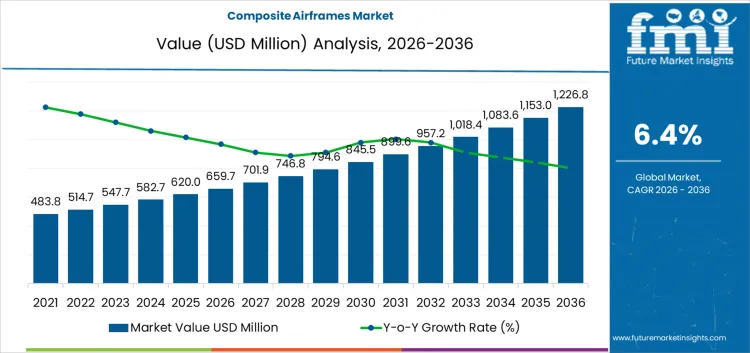
The composite airframes market is valued at USD 659.7 million in 2026 and is projected to reach USD 1,226.8 million by 2036, reflecting a CAGR of 6.4%. Production is concentrated among a limited number of high-capacity aerospace manufacturers. Regional manufacturing hubs exert control over supply chains, influencing material availability and lead times. Reliability of supply is affected by dependency on specialized composite materials, skilled labor, and precision assembly facilities. Certification requirements and regulatory compliance further constrain operational flexibility. Suppliers with integrated production and validated quality control achieve more predictable delivery performance, while fragmented or less-equipped operators face delays and variability.
Performance is constrained by raw material sourcing, tooling complexity, and logistical dependencies. Adoption rates vary by aircraft program and regional fleet deployment. Maintenance and repair cycles are influenced by structural integration and long-term durability of composites. Operators able to maintain consistent production, robust supply agreements, and regulatory alignment achieve concentrated value. Smaller or non-integrated players encounter challenges in scaling and meeting certification timelines. Revenue concentration is closely linked to production control, regional manufacturing capabilities, and supply chain predictability rather than fleet demand alone.
Quick Stats of the Composite Airframes Market
- Composite Airframes Market Value (2026): USD 659.7 million
- Composite Airframes Forecast Value (2036): USD 1,226.8 million
- Composite Airframes Forecast CAGR 2026 to 2036: 6.40%
- Composite Airframes Leading Composite Structure: Fuselage Sections
- Composite Airframes Leading Material System: Carbon Fiber/Epoxy
- Composite Airframes Key Growth Regions: China, Brazil, USA, South Korea, UK
- Composite Airframes Top Players: Solvay, Toray, Hexcel, Teijin, SGL Carbon, Gurit, Arkema, BASF, Mitsubishi Chemical, Cytec (Solvay)
What is the Growth Forecast for Composite Airframes Market through 2036?
Between 2026 and 2031, the composite airframes market is projected to grow from USD 659.7 million to USD 845.5 million, generating an absolute increase of USD 185.8 million. The rolling CAGR over this five-year period is approximately 5.9%. Growth is driven by increasing adoption of composite materials in fuselage, wings, and empennage to reduce aircraft weight, improve fuel efficiency, and enhance performance. Volume expansion contributes around 66% of growth due to new aircraft programs and retrofits, while price growth accounts for 34%, supported by advanced material formulations and supplier premium positioning. Value capture favors manufacturers with validated supply chains and OEM partnerships.
From 2031 to 2036, the market is expected to expand from USD 845.5 million to USD 1,226.8 million, adding USD 381.3 million. The rolling CAGR for this period is approximately 7.1%, reflecting accelerated adoption of composite structures across commercial, business jet, and military aircraft. Volume remains the dominant driver, representing roughly 68% of growth due to fleet expansion, higher composite integration rates, and new aircraft program deployments. Price growth contributes 32%, influenced by material innovation, advanced manufacturing processes, and regulatory compliance. Competitive advantage favors suppliers controlling material performance, production consistency, and strong OEM collaboration.
Composite Airframes Market Key Takeaways
| Metric | Value |
|---|---|
| Market Value (2026) | USD 659.7 million |
| Forecast Value (2036) | USD 1,226.8 million |
| Forecast CAGR 2026 to 2036 | 6.40% |
How Is the Adoption of Composite Materials Transforming Aircraft Airframes?
The composite airframes market is expanding as manufacturers seek lighter, stronger, and more corrosion-resistant structures to improve fuel efficiency and reduce maintenance costs. Historically, aircraft relied on aluminum and traditional metals, which limited design flexibility and increased structural weight. Modern airframes incorporate carbon fiber reinforced polymers, glass fiber composites, and hybrid materials to achieve high strength-to-weight ratios and enhanced fatigue resistance. Airlines, OEMs, and defense operators prioritize manufacturability, regulatory compliance, and lifecycle durability. Early adoption focused on high-performance military and regional aircraft, while current demand extends to commercial fleets seeking operational efficiency, extended range, and reduced environmental impact. Material quality, production methods, and assembly precision guide adoption and supplier selection.
Increasing pressure to lower operating costs and improve environmental performance is driving broader adoption of composite airframes. Compared with metal structures, contemporary composites offer improved corrosion resistance, weight reduction, and design flexibility for fuel-efficient aircraft. Cost factors include raw material pricing, fabrication complexity, and quality control, concentrating margins among suppliers capable of consistent, certified composite production. Airlines and manufacturers adopt composites to extend airframe life, reduce maintenance cycles, and enhance performance metrics. By 2036, composite airframes are expected to become a standard feature in commercial and military aircraft, supporting efficiency, durability, and environmental compliance objectives across the aviation industry.
What Factors Are Shaping the Demand for Composite Airframes in Terms of Composite Structure and Material System?
The demand for composite airframes is segmented by composite structure and material system. Composite structures include fuselage sections, wings, empennage and control surfaces, and other assemblies. Material systems include carbon fiber/epoxy, thermoplastic composites, glass fiber composites, and other advanced materials. Segment adoption is influenced by weight reduction, structural strength, and fatigue resistance. Uptake is driven by operational efficiency, fuel savings, and regulatory compliance. Structure and material selection depend on aerodynamic requirements, load distribution, and manufacturing capabilities. Adoption reflects long-term durability, safety, and performance optimization across commercial, regional, and military aircraft applications.
Why Are Fuselage Sections Leading the Composite Structure Segment in Composite Airframes?
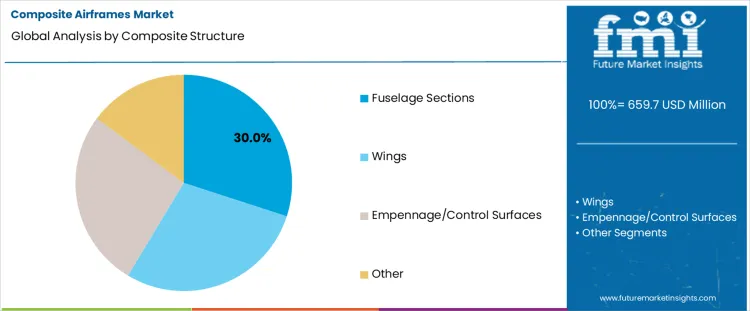
Fuselage sections account for approximately 30% of total composite structure demand, making them the leading category. These components require high strength-to-weight ratios, durability, and crashworthiness. Airlines and manufacturers adopt composite fuselage sections to reduce overall aircraft weight and improve fuel efficiency. Adoption is reinforced by regulatory certification, structural integrity requirements, and long-term operational reliability. Composite fuselage sections integrate with wings and empennage using advanced joining methods. Maintenance teams monitor surface integrity, inspect for delamination, and ensure compliance with safety standards. The segment leads because fuselage sections combine critical operational benefits, weight reduction, and structural performance in airframe design.
Operational considerations further support adoption. Composite fuselage sections must withstand pressure differentials, thermal cycling, and environmental exposure. Manufacturing processes require precise fiber alignment, curing, and quality control to ensure structural consistency. They reduce lifecycle costs by lowering maintenance needs and improving fatigue resistance. The segment leads because fuselage composites deliver measurable efficiency, safety, and durability benefits, establishing them as the primary driver of composite airframe adoption.
Why Is Carbon Fiber and Epoxy Representing the Largest Material System Segment in Composite Airframes?
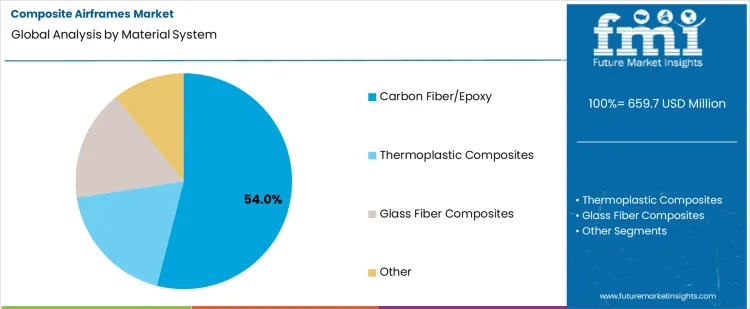
Carbon fiber/epoxy accounts for approximately 54% of total material system demand, making it the largest segment. These composites provide high tensile strength, stiffness, and fatigue resistance while maintaining low weight. Airlines and manufacturers use carbon fiber/epoxy in fuselage, wing, and empennage applications to optimize fuel efficiency and structural performance. Adoption is reinforced by compatibility with advanced joining methods, regulatory compliance, and long-term durability. Material properties ensure stability under thermal and mechanical stress, preserving structural integrity during flight.
Operational factors influence adoption. Carbon fiber/epoxy composites allow complex shaping, precise aerodynamic profiles, and reduced maintenance needs. Quality control ensures consistent fiber alignment, resin curing, and layer adhesion. The segment leads because carbon fiber/epoxy systems combine weight savings, structural performance, and operational reliability, establishing them as the primary material choice for modern composite airframes across commercial, regional, and military aircraft.
How Are Composite Airframes Transforming Aircraft Design and Performance?
Composite airframes are increasingly adopted in commercial, military, and business aircraft to reduce weight, improve fuel efficiency, and enhance structural strength. Adoption is strongest in regions with advanced aerospace manufacturing and high air traffic. Materials are selected for fatigue resistance, corrosion tolerance, and impact performance. Growth is driven by operational efficiency, extended service life, and compliance with structural and safety standards. Investment focuses on manufacturing precision, material certification, and integration with assembly processes. Operators prioritize airframes that lower operating costs, improve payload capacity, and maintain aerodynamic efficiency while meeting regional aviation regulations.
Why Are Regional Aviation Regulations and Fuel Efficiency Targets Driving Adoption?
Airlines and aircraft manufacturers adopt composite airframes to comply with regional safety and environmental regulations. Reducing aircraft weight improves fuel economy, lowers emissions, and supports sustainability targets. Airframes with high damage tolerance and corrosion resistance gain preference. Adoption is concentrated in regions with strict emission standards and growing commercial aviation demand. The driver is operational performance and regulatory compliance rather than cost. Manufacturers capable of producing certified, high-quality composite structures achieve market advantage in both commercial and military aircraft segments.
What Challenges Limit Broader Use of Composite Airframes?
Manufacturing complexity and high material costs restrict adoption among smaller aircraft programs. Specialized equipment and skilled labor are required for fabrication and assembly. Repair and maintenance of composites require unique procedures and certification. Regulatory approval and structural validation processes can delay deployment of new designs. Some operators face difficulties integrating composite airframes into existing production and maintenance workflows. These factors concentrate early adoption among large OEMs and well-funded airlines or defense programs, slowing broader market penetration despite performance advantages.
How Are Technological Advances and Industry Collaboration Shaping the Market?
Recent developments include advanced fiber-reinforced composites, resin infusion techniques, and hybrid material integration for improved strength-to-weight ratios. Collaboration between material suppliers, OEMs, and aerospace research institutions enables testing, certification, and process optimization. Pilot programs validate structural performance and durability before full-scale implementation. Quality monitoring and traceability ensure compliance with regulatory and safety standards. Emphasis is on structural reliability, fuel efficiency, and operational performance rather than cost or production scale. Partnerships support adoption of composite airframes that enhance aircraft performance, reduce operating costs, and meet regional aviation requirements.
What is the Demand for Composite Airframes by Country?
| Country | CAGR (%) |
|---|---|
| USA | 6.2% |
| South Korea | 6.0% |
| China | 7.8% |
| UK | 5.8% |
| Brazil | 7.2% |
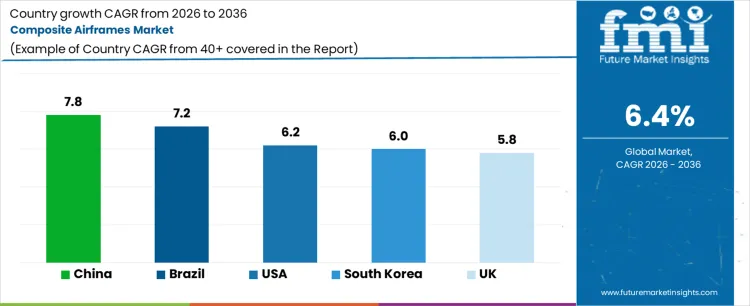
Demand for composite airframes is rising as aircraft manufacturers seek weight reduction, improved fuel efficiency, and enhanced structural performance. China leads with a 7.8% CAGR, driven by rapid expansion of commercial and regional aircraft production and adoption of advanced composite materials. Brazil follows at 7.2%, supported by domestic aerospace manufacturing and fleet modernization initiatives. The USA grows at 6.2%, shaped by new aircraft programs, retrofitting of existing fleets, and adoption in commercial and military applications. South Korea records 6.0% growth, driven by aerospace R&D and production of regional and defense aircraft. The UK shows 5.8% CAGR, reflecting steady integration of composite structures in aircraft programs and maintenance operations.
How Is the United States Experiencing Growth in the Composite Airframes Market?
United States is experiencing growth at a CAGR of 6.2%, supported by increasing adoption of composite materials in commercial and military aircraft to reduce weight, improve fuel efficiency, and enhance structural performance. Airlines and aerospace OEMs are implementing composite airframes in fuselage, wings, and control surfaces to optimize aerodynamics, reduce maintenance, and extend service life. Demand is concentrated in airline hubs, MRO centers, and aerospace manufacturing facilities. Investments focus on material performance, manufacturing processes, and quality control rather than fleet expansion. Growth reflects rising operational efficiency targets, modernization programs, and adoption of lightweight, high-strength airframe technologies across new aircraft models.
- Composite materials drive adoption.
- Fuselage, wings, and control surfaces are primary applications.
- Airline hubs and aerospace manufacturing facilities concentrate demand.
- Material performance and manufacturing processes guide investment.
How Is South Korea Witnessing Steady Adoption with Aircraft Modernization?
South Korea is witnessing growth at a CAGR of 6%, fueled by adoption of composite airframes to improve aircraft performance, reduce weight, and enhance fuel efficiency. Airlines and OEMs are integrating composite materials into fuselage, wings, and control surfaces to optimize structural integrity and reduce operational costs. Demand is concentrated in urban airport hubs, aerospace manufacturing sites, and maintenance centers. Investments prioritize material durability, production precision, and quality assurance rather than fleet expansion. Growth reflects modernization initiatives, operational efficiency goals, and adoption of lightweight, high-strength materials in commercial and military aircraft.
- Aircraft modernization drives adoption.
- Fuselage, wings, and control surfaces are primary applications.
- Urban airport hubs and aerospace facilities concentrate demand.
- Material durability and production precision guide investment.
How Is China Experiencing Rapid Growth with Fleet Expansion and Lightweight Materials?
China is experiencing rapid growth at a CAGR of 7.8%, supported by the expansion of commercial and military aircraft fleets and adoption of composite airframes to reduce weight, enhance fuel efficiency, and improve structural performance. Airlines and OEMs are integrating composite materials in fuselage, wings, and control surfaces to optimize aerodynamics and reduce maintenance requirements. Demand is concentrated in major airline hubs, aerospace manufacturing facilities, and MRO centers. Investments focus on material performance, manufacturing technology, and precision rather than fleet expansion. Growth reflects fleet modernization, operational efficiency objectives, and adoption of advanced airframe technologies.
- Fleet expansion drives adoption.
- Fuselage, wings, and control surfaces are primary applications.
- Airline hubs and manufacturing facilities concentrate demand.
- Material performance and manufacturing technology guide investment.
How Is the United Kingdom Growing Through Aircraft Modernization Initiatives?
The United Kingdom is growing at a CAGR of 5.8%, supported by adoption of composite airframes to reduce aircraft weight, improve fuel efficiency, and enhance operational performance. Airlines and aerospace OEMs are implementing composites in fuselage, wings, and control surfaces to optimize aerodynamics and reduce maintenance costs. Demand is concentrated in airline hubs, MRO centers, and aerospace manufacturing facilities. Investments prioritize material performance, quality control, and precision manufacturing rather than fleet expansion. Growth reflects modernization programs, adoption of lightweight high-strength materials, and operational efficiency measures across commercial and military aircraft.
- Aircraft modernization drives adoption.
- Fuselage, wings, and control surfaces are primary applications.
- Airline hubs and MRO centers concentrate demand.
- Material performance and quality control guide investment.
How Is Brazil Experiencing Expansion with Fleet Modernization and Lightweight Structures?
Brazil is experiencing growth at a CAGR of 7.2%, supported by modernization of commercial and military aircraft fleets and adoption of composite airframes to improve fuel efficiency, reduce weight, and enhance structural performance. Airlines and OEMs are integrating composite materials in fuselage, wings, and control surfaces to optimize aerodynamics, reduce maintenance, and extend service life. Demand is concentrated in airline hubs, aerospace manufacturing facilities, and MRO centers. Investments focus on material performance, precision manufacturing, and durability rather than fleet expansion. Growth reflects operational efficiency goals, adoption of lightweight high-strength materials, and fleet modernization programs.
- Fleet modernization drives adoption.
- Fuselage, wings, and control surfaces are primary applications.
- Airline hubs and aerospace facilities concentrate demand.
- Material performance and precision manufacturing guide investment.
Who Competes in the Composite Airframes Market and What Defines Their Capabilities?
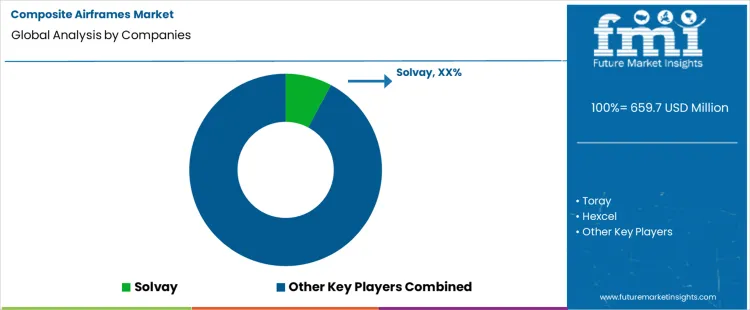
Competition in the composite airframes market centers on advanced material performance, structural integrity, and integration with aircraft manufacturing processes. Solvay supplies high performance resin systems and prepregs engineered for fatigue resistance and lightweight structural applications in commercial and defense airframes. Toray focuses on carbon fiber and composite solutions that deliver high strength to weight ratios critical for primary and secondary airframe structures. Hexcel competes through engineered fiber reinforcements and resin systems designed for impact resistance and manufacturability in large panel assemblies. Teijin develops composite fabrics and resins that address specific aerospace specification requirements for stiffness and durability.
SGL Carbon supplies carbon fiber and specialty composites calibrated for structural and thermal performance in airframe applications. Gurit delivers core materials and engineered composite systems for optimized load distribution. Arkema contributes high performance polymers that improve matrix toughness and environmental resistance. BASF offers composite materials and additives that enhance processing and mechanical properties. Mitsubishi Chemical provides carbon fiber and resin technologies tailored for scale production. Cytec (Solvay) brings legacy composite chemistries and engineering support for certified aerospace applications. Competitive differences arise in fiber quality, resin systems, processing efficiency, and ability to meet airframe certification standards, with suppliers that balance high structural performance with manufacturability positioned to support evolving aircraft design demands.
Key Players in the Composite Airframes Market
- Solvay
- Toray
- Hexcel
- Teijin
- SGL Carbon
- Gurit
- Arkema
- BASF
- Mitsubishi Chemical
- Cytec (Solvay)
Scope of the Report
| Items | Values |
|---|---|
| Quantitative Units (2026) | USD million |
| Composite Structure | Fuselage Sections, Wings, Empennage/Control Surfaces, Other |
| Material System | Carbon Fiber/Epoxy, Thermoplastic Composites, Glass Fiber Composites, Other |
| Aircraft Type | Commercial, Military, Business Jets, Other |
| Value Chain Stage | Material Supply, Layup & Cure, Assembly/Integration, Other |
| Region | Asia Pacific, Europe, North America, Latin America, Middle East & Africa |
| Key Countries Covered | China, Japan, South Korea, India, Australia & New Zealand, Germany, United Kingdom, France, Italy, Spain, Nordic, BENELUX, United States, Canada, Mexico, Brazil, Chile, Kingdom of Saudi Arabia, Other GCC Countries, Turkey, South Africa, Other African Union |
| Key Companies Profiled | Solvay, Toray, Hexcel, Teijin, SGL Carbon, Gurit, Arkema, BASF, Mitsubishi Chemical, Cytec (Solvay) |
| Additional Attributes | Dollar sales by composite structure and material system, material performance metrics, production efficiency, supply chain reliability, OEM integration, regulatory compliance, quality control, forecast CAGR and growth value by region, adoption rates by aircraft type and value chain stage |
Composite Airframes Market Segmentation
Composite Structure:
- Fuselage Sections
- Wings
- Empennage/Control Surfaces
- Other
Material System:
- Carbon Fiber/Epoxy
- Thermoplastic Composites
- Glass Fiber Composites
- Other
Aircraft Type:
- Commercial
- Military
- Business Jets
- Other
Value Chain Stage:
- Material Supply
- Layup & Cure
- Assembly/Integration
- Other
Region:
- Asia Pacific
- China
- Japan
- South Korea
- India
- Australia & New Zealand
- ASEAN
- Rest of Asia Pacific
- Europe
- Germany
- United Kingdom
- France
- Italy
- Spain
- Nordic
- BENELUX
- Rest of Europe
- North America
- United States
- Canada
- Mexico
- Latin America
- Brazil
- Chile
- Rest of Latin America
- Middle East & Africa
- Kingdom of Saudi Arabia
- Other GCC Countries
- Turkey
- South Africa
- Other African Union
- Rest of Middle East & Africa
Bibliography
- Bai, Q., Hao, Q., Dai, H., Chen, Y., & Dai, N. (2025). Integrated design and manufacturing of fiber-reinforced composite structures in aerospace. Thin-Walled Structures.
- Janeikaitė, J., Misiūnaitė, I., & Gribniak, V. (2025). Fiber-reinforced polymer laminates in aviation and structural engineering. Materials, 18(21), 4938.
- Federal Aviation Administration (FAA). (2024). Transport Airplane Composite Structures Report. Washington, D.C.
- Soutis, C. (2023). Composite materials in modern aerospace structures. Progress in Aerospace Sciences, 115, 1–26.
Frequently Asked Questions
How big is the composite airframes market in 2026?
The global composite airframes market is estimated to be valued at USD 659.7 million in 2026.
What will be the size of composite airframes market in 2036?
The market size for the composite airframes market is projected to reach USD 1,226.8 million by 2036.
How much will be the composite airframes market growth between 2026 and 2036?
The composite airframes market is expected to grow at a 6.4% CAGR between 2026 and 2036.
What are the key product types in the composite airframes market?
The key product types in composite airframes market are fuselage sections, wings, empennage/control surfaces and other.
Which material system segment to contribute significant share in the composite airframes market in 2026?
In terms of material system, carbon fiber/epoxy segment to command 54.0% share in the composite airframes market in 2026.
Preview the report firsthand - request a free sample
Get SampleGet the brochure for pricing and purchase details.
Get PDFTable of Content
- Executive Summary
- Global Market Outlook
- Demand-side Trends
- Supply-side Trends
- Technology Roadmap Analysis
- Analysis and Recommendations
- Market Overview
- Market Coverage / Taxonomy
- Market Definition / Scope / Limitations
- Market Background
- Market Dynamics
- Drivers
- Restraints
- Opportunity
- Trends
- Scenario Forecast
- Demand in Optimistic Scenario
- Demand in Likely Scenario
- Demand in Conservative Scenario
- Opportunity Map Analysis
- Product Life Cycle Analysis
- Supply Chain Analysis
- Investment Feasibility Matrix
- Value Chain Analysis
- PESTLE and Porter’s Analysis
- Regulatory Landscape
- Regional Parent Market Outlook
- Production and Consumption Statistics
- Import and Export Statistics
- Market Dynamics
- Global Market Analysis 2021 to 2025 and Forecast, 2026 to 2036
- Historical Market Size Value (USD Million) Analysis, 2021 to 2025
- Current and Future Market Size Value (USD Million) Projections, 2026 to 2036
- Y-o-Y Growth Trend Analysis
- Absolute $ Opportunity Analysis
- Global Market Pricing Analysis 2021 to 2025 and Forecast 2026 to 2036
- Global Market Analysis 2021 to 2025 and Forecast 2026 to 2036, By Composite Structure
- Introduction / Key Findings
- Historical Market Size Value (USD Million) Analysis By Composite Structure , 2021 to 2025
- Current and Future Market Size Value (USD Million) Analysis and Forecast By Composite Structure , 2026 to 2036
- Fuselage Sections
- Wings
- Empennage/Control Surfaces
- Other
- Fuselage Sections
- Y-o-Y Growth Trend Analysis By Composite Structure , 2021 to 2025
- Absolute $ Opportunity Analysis By Composite Structure , 2026 to 2036
- Global Market Analysis 2021 to 2025 and Forecast 2026 to 2036, By Material System
- Introduction / Key Findings
- Historical Market Size Value (USD Million) Analysis By Material System, 2021 to 2025
- Current and Future Market Size Value (USD Million) Analysis and Forecast By Material System, 2026 to 2036
- Carbon Fiber/Epoxy
- Thermoplastic Composites
- Glass Fiber Composites
- Other
- Carbon Fiber/Epoxy
- Y-o-Y Growth Trend Analysis By Material System, 2021 to 2025
- Absolute $ Opportunity Analysis By Material System, 2026 to 2036
- Global Market Analysis 2021 to 2025 and Forecast 2026 to 2036, By Aircraft Type
- Introduction / Key Findings
- Historical Market Size Value (USD Million) Analysis By Aircraft Type, 2021 to 2025
- Current and Future Market Size Value (USD Million) Analysis and Forecast By Aircraft Type, 2026 to 2036
- Commercial
- Military
- Business Jets
- Other
- Commercial
- Y-o-Y Growth Trend Analysis By Aircraft Type, 2021 to 2025
- Absolute $ Opportunity Analysis By Aircraft Type, 2026 to 2036
- Global Market Analysis 2021 to 2025 and Forecast 2026 to 2036, By Value Chain Stage
- Introduction / Key Findings
- Historical Market Size Value (USD Million) Analysis By Value Chain Stage, 2021 to 2025
- Current and Future Market Size Value (USD Million) Analysis and Forecast By Value Chain Stage, 2026 to 2036
- Material Supply
- Layup & Cure
- Assembly/Integration
- Other
- Material Supply
- Y-o-Y Growth Trend Analysis By Value Chain Stage, 2021 to 2025
- Absolute $ Opportunity Analysis By Value Chain Stage, 2026 to 2036
- Global Market Analysis 2021 to 2025 and Forecast 2026 to 2036, By Region
- Introduction
- Historical Market Size Value (USD Million) Analysis By Region, 2021 to 2025
- Current Market Size Value (USD Million) Analysis and Forecast By Region, 2026 to 2036
- North America
- Latin America
- Western Europe
- Eastern Europe
- East Asia
- South Asia and Pacific
- Middle East & Africa
- Market Attractiveness Analysis By Region
- North America Market Analysis 2021 to 2025 and Forecast 2026 to 2036, By Country
- Historical Market Size Value (USD Million) Trend Analysis By Market Taxonomy, 2021 to 2025
- Market Size Value (USD Million) Forecast By Market Taxonomy, 2026 to 2036
- By Country
- USA
- Canada
- Mexico
- By Composite Structure
- By Material System
- By Aircraft Type
- By Value Chain Stage
- By Country
- Market Attractiveness Analysis
- By Country
- By Composite Structure
- By Material System
- By Aircraft Type
- By Value Chain Stage
- Key Takeaways
- Latin America Market Analysis 2021 to 2025 and Forecast 2026 to 2036, By Country
- Historical Market Size Value (USD Million) Trend Analysis By Market Taxonomy, 2021 to 2025
- Market Size Value (USD Million) Forecast By Market Taxonomy, 2026 to 2036
- By Country
- Brazil
- Chile
- Rest of Latin America
- By Composite Structure
- By Material System
- By Aircraft Type
- By Value Chain Stage
- By Country
- Market Attractiveness Analysis
- By Country
- By Composite Structure
- By Material System
- By Aircraft Type
- By Value Chain Stage
- Key Takeaways
- Western Europe Market Analysis 2021 to 2025 and Forecast 2026 to 2036, By Country
- Historical Market Size Value (USD Million) Trend Analysis By Market Taxonomy, 2021 to 2025
- Market Size Value (USD Million) Forecast By Market Taxonomy, 2026 to 2036
- By Country
- Germany
- UK
- Italy
- Spain
- France
- Nordic
- BENELUX
- Rest of Western Europe
- By Composite Structure
- By Material System
- By Aircraft Type
- By Value Chain Stage
- By Country
- Market Attractiveness Analysis
- By Country
- By Composite Structure
- By Material System
- By Aircraft Type
- By Value Chain Stage
- Key Takeaways
- Eastern Europe Market Analysis 2021 to 2025 and Forecast 2026 to 2036, By Country
- Historical Market Size Value (USD Million) Trend Analysis By Market Taxonomy, 2021 to 2025
- Market Size Value (USD Million) Forecast By Market Taxonomy, 2026 to 2036
- By Country
- Russia
- Poland
- Hungary
- Balkan & Baltic
- Rest of Eastern Europe
- By Composite Structure
- By Material System
- By Aircraft Type
- By Value Chain Stage
- By Country
- Market Attractiveness Analysis
- By Country
- By Composite Structure
- By Material System
- By Aircraft Type
- By Value Chain Stage
- Key Takeaways
- East Asia Market Analysis 2021 to 2025 and Forecast 2026 to 2036, By Country
- Historical Market Size Value (USD Million) Trend Analysis By Market Taxonomy, 2021 to 2025
- Market Size Value (USD Million) Forecast By Market Taxonomy, 2026 to 2036
- By Country
- China
- Japan
- South Korea
- By Composite Structure
- By Material System
- By Aircraft Type
- By Value Chain Stage
- By Country
- Market Attractiveness Analysis
- By Country
- By Composite Structure
- By Material System
- By Aircraft Type
- By Value Chain Stage
- Key Takeaways
- South Asia and Pacific Market Analysis 2021 to 2025 and Forecast 2026 to 2036, By Country
- Historical Market Size Value (USD Million) Trend Analysis By Market Taxonomy, 2021 to 2025
- Market Size Value (USD Million) Forecast By Market Taxonomy, 2026 to 2036
- By Country
- India
- ASEAN
- Australia & New Zealand
- Rest of South Asia and Pacific
- By Composite Structure
- By Material System
- By Aircraft Type
- By Value Chain Stage
- By Country
- Market Attractiveness Analysis
- By Country
- By Composite Structure
- By Material System
- By Aircraft Type
- By Value Chain Stage
- Key Takeaways
- Middle East & Africa Market Analysis 2021 to 2025 and Forecast 2026 to 2036, By Country
- Historical Market Size Value (USD Million) Trend Analysis By Market Taxonomy, 2021 to 2025
- Market Size Value (USD Million) Forecast By Market Taxonomy, 2026 to 2036
- By Country
- Kingdom of Saudi Arabia
- Other GCC Countries
- Turkiye
- South Africa
- Other African Union
- Rest of Middle East & Africa
- By Composite Structure
- By Material System
- By Aircraft Type
- By Value Chain Stage
- By Country
- Market Attractiveness Analysis
- By Country
- By Composite Structure
- By Material System
- By Aircraft Type
- By Value Chain Stage
- Key Takeaways
- Key Countries Market Analysis
- USA
- Pricing Analysis
- Market Share Analysis, 2025
- By Composite Structure
- By Material System
- By Aircraft Type
- By Value Chain Stage
- Canada
- Pricing Analysis
- Market Share Analysis, 2025
- By Composite Structure
- By Material System
- By Aircraft Type
- By Value Chain Stage
- Mexico
- Pricing Analysis
- Market Share Analysis, 2025
- By Composite Structure
- By Material System
- By Aircraft Type
- By Value Chain Stage
- Brazil
- Pricing Analysis
- Market Share Analysis, 2025
- By Composite Structure
- By Material System
- By Aircraft Type
- By Value Chain Stage
- Chile
- Pricing Analysis
- Market Share Analysis, 2025
- By Composite Structure
- By Material System
- By Aircraft Type
- By Value Chain Stage
- Germany
- Pricing Analysis
- Market Share Analysis, 2025
- By Composite Structure
- By Material System
- By Aircraft Type
- By Value Chain Stage
- UK
- Pricing Analysis
- Market Share Analysis, 2025
- By Composite Structure
- By Material System
- By Aircraft Type
- By Value Chain Stage
- Italy
- Pricing Analysis
- Market Share Analysis, 2025
- By Composite Structure
- By Material System
- By Aircraft Type
- By Value Chain Stage
- Spain
- Pricing Analysis
- Market Share Analysis, 2025
- By Composite Structure
- By Material System
- By Aircraft Type
- By Value Chain Stage
- France
- Pricing Analysis
- Market Share Analysis, 2025
- By Composite Structure
- By Material System
- By Aircraft Type
- By Value Chain Stage
- India
- Pricing Analysis
- Market Share Analysis, 2025
- By Composite Structure
- By Material System
- By Aircraft Type
- By Value Chain Stage
- ASEAN
- Pricing Analysis
- Market Share Analysis, 2025
- By Composite Structure
- By Material System
- By Aircraft Type
- By Value Chain Stage
- Australia & New Zealand
- Pricing Analysis
- Market Share Analysis, 2025
- By Composite Structure
- By Material System
- By Aircraft Type
- By Value Chain Stage
- China
- Pricing Analysis
- Market Share Analysis, 2025
- By Composite Structure
- By Material System
- By Aircraft Type
- By Value Chain Stage
- Japan
- Pricing Analysis
- Market Share Analysis, 2025
- By Composite Structure
- By Material System
- By Aircraft Type
- By Value Chain Stage
- South Korea
- Pricing Analysis
- Market Share Analysis, 2025
- By Composite Structure
- By Material System
- By Aircraft Type
- By Value Chain Stage
- Russia
- Pricing Analysis
- Market Share Analysis, 2025
- By Composite Structure
- By Material System
- By Aircraft Type
- By Value Chain Stage
- Poland
- Pricing Analysis
- Market Share Analysis, 2025
- By Composite Structure
- By Material System
- By Aircraft Type
- By Value Chain Stage
- Hungary
- Pricing Analysis
- Market Share Analysis, 2025
- By Composite Structure
- By Material System
- By Aircraft Type
- By Value Chain Stage
- Kingdom of Saudi Arabia
- Pricing Analysis
- Market Share Analysis, 2025
- By Composite Structure
- By Material System
- By Aircraft Type
- By Value Chain Stage
- Turkiye
- Pricing Analysis
- Market Share Analysis, 2025
- By Composite Structure
- By Material System
- By Aircraft Type
- By Value Chain Stage
- South Africa
- Pricing Analysis
- Market Share Analysis, 2025
- By Composite Structure
- By Material System
- By Aircraft Type
- By Value Chain Stage
- USA
- Market Structure Analysis
- Competition Dashboard
- Competition Benchmarking
- Market Share Analysis of Top Players
- By Regional
- By Composite Structure
- By Material System
- By Aircraft Type
- By Value Chain Stage
- Competition Analysis
- Competition Deep Dive
- Solvay
- Overview
- Product Portfolio
- Profitability by Market Segments (Product/Age /Sales Channel/Region)
- Sales Footprint
- Strategy Overview
- Marketing Strategy
- Product Strategy
- Channel Strategy
- Toray
- Hexcel
- Teijin
- SGL Carbon
- Gurit
- Arkema
- BASF
- Mitsubishi Chemical
- Cytec (Solvay)
- Solvay
- Competition Deep Dive
- Assumptions & Acronyms Used
- Research Methodology


