

- Industry Size (2026)
- USD 350 Mn
- Forecast (2036)
- USD 1090 Mn
- CAGR (2026 to 2036)
- 12%
Low-Temperature Cure Exterior Coatings for Composite Airframes Market Forecast and Outlook 2026 to 2036
The global market for low-temperature cure exterior coatings for composite airframes, valued at USD 350 million in 2026, is projected to grow to USD 1,090 million by 2036, with a CAGR of 12%. This growth is driven by the increasing use of composite materials in aircraft manufacturing and the demand for coatings that offer both durability and energy efficiency.
Epoxy-based low-temperature cure systems, which account for 38% of the coating chemistry market share, are preferred for their strong adhesion, durability, and ability to cure at lower temperatures, reducing energy costs during the manufacturing process. Commercial aircraft composite airframes, representing 50% of the end-use application market share, are the primary consumers of these coatings, as they help protect composite materials from environmental damage while maintaining structural integrity. The market is further supported by the growing trend of lightweight, fuel-efficient aircraft designs and the need for cost-effective, environmentally friendly coating solutions.
Quick Stats for Low-Temperature Cure Exterior Coatings for Composite Airframes Market
- Low-Temperature Cure Exterior Coatings for Composite Airframes Market Value (2026): USD 350 million
- Low-Temperature Cure Exterior Coatings for Composite Airframes Market Forecast Value (2036): USD 1,090 million
- Low-Temperature Cure Exterior Coatings for Composite Airframes Market Global Forecast CAGR (2026-2036): 12%
- Top End-Use Application by Share in Low-Temperature Cure Exterior Coatings for Composite Airframes Market: Commercial Aircraft Composite Airframes (50%)
- Key Growth Regions in Low-Temperature Cure Exterior Coatings for Composite Airframes Market: China, India, USA, UK, Japan
- Top Players in Low-Temperature Cure Exterior Coatings for Composite Airframes Market: PPG Aerospace, AkzoNobel Aerospace Coatings, Sherwin-Williams Aerospace, Axalta Coating Systems, Hentzen Coatings
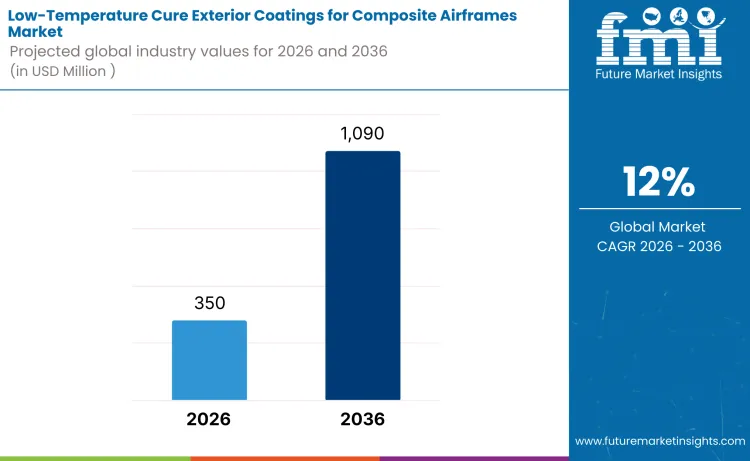
Low-Temperature Cure Exterior Coatings for Composite Airframes Market Key Takeaways
| Metric | Value |
|---|---|
| Industry Sales Value (2026) | USD 350 million |
| Industry Forecast Value (2036) | USD 1,090 million |
| Industry Forecast CAGR (2026-2036) | 12% |
What Are the Key Segments in Low-Temperature Cure Exterior Coatings for Composite Airframes Market?
The low-temperature cure exterior coatings for composite airframes market is segmented by coating chemistry and end-use application. Epoxy-based low-temperature cure systems lead the coating chemistry segment with 38% of the market share, providing durable, effective protection for composite materials. Commercial aircraft composite airframes dominate the end-use application segment with 50%, driven by the need for efficient, high-performance coatings that can withstand harsh conditions while minimizing curing temperatures. The market is growing as the aerospace industry seeks advanced, cost-effective coatings to enhance the durability and performance of composite airframes.
Which Coating Chemistry Drives Low-Temperature Cure Exterior Coatings for Composite Airframes Market Demand Globally?
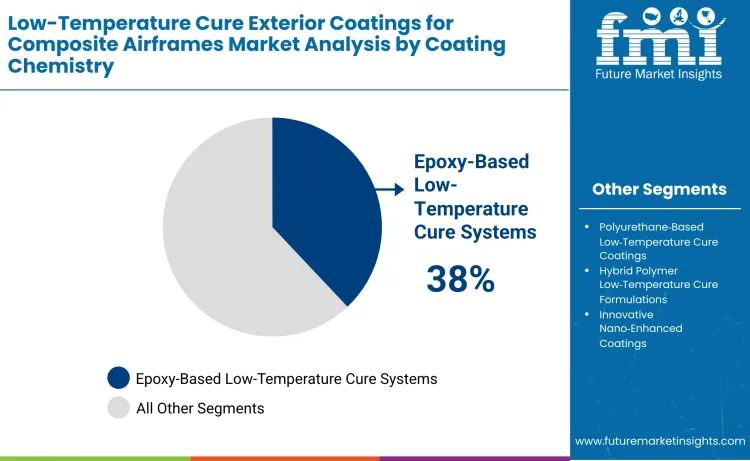
Epoxy-based low-temperature cure systems account for 38% of the market share. These systems are highly favored for their excellent adhesion, durability, and resistance to environmental factors such as UV radiation, moisture, and temperature extremes. Epoxy-based coatings are particularly effective in protecting composite airframes, which are commonly used in modern aircraft due to their light weight and high strength. The ability of epoxy-based coatings to cure at lower temperatures reduces energy consumption and enhances manufacturing efficiency, making them an attractive solution for both new aircraft production and maintenance. These coatings form a tough, protective layer on composite surfaces, ensuring long-lasting protection against corrosion, scratches, and wear, all while maintaining the structural integrity of the composite materials. As the aerospace industry continues to prioritize energy-efficient, environmentally friendly manufacturing processes, epoxy-based low-temperature cure systems are expected to remain a key driver of market growth.
Which End-Use Application Drives Low-Temperature Cure Exterior Coatings for Composite Airframes Market Demand Globally?
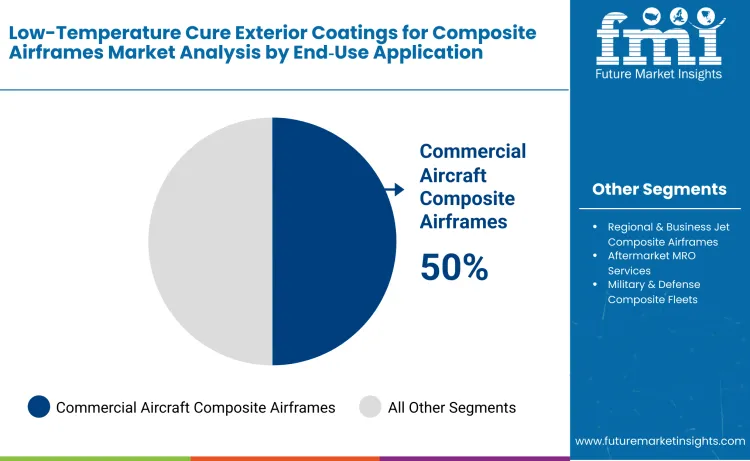
Commercial aircraft composite airframes lead the application segment, holding 50% of the market share. Composite materials are increasingly used in commercial aircraft for their high strength-to-weight ratio, which contributes to improved fuel efficiency and reduced operational costs. The demand for low-temperature cure coatings is growing as airlines seek ways to reduce aircraft weight, improve maintenance processes, and extend the lifespan of composite airframes. These coatings help protect composite materials from the harsh environmental conditions encountered during flight, such as exposure to UV radiation, rain, and extreme temperatures. The ability to apply coatings at lower temperatures reduces manufacturing and operational costs while maintaining the structural integrity and performance of the aircraft. Commercial aircraft manufacturers and maintenance operators are driving the demand for low-temperature cure exterior coatings to enhance the performance and durability of composite airframes, making this the dominant segment in the market. Other applications, such as regional & business jet composite airframes, aftermarket MRO services, and military & defense composite fleets, contribute to the growth but remain smaller in comparison to the commercial aircraft sector.
What is the Key Trends of the Global Low Temperature Cure Exterior Coatings for Composite Airframes Market?
The global low‑temperature cure exterior coatings for composite airframes market is expanding as aerospace manufacturers and operators adopt advanced surface systems that reduce energy use and enhance production throughput. These coatings enable curing at lower temperatures, which protects composite materials from heat‑induced stress and accelerates assembly timelines. Demand is supported by growth in composite airframe use across commercial, regional and business jets. Operators and OEMs are seeking coatings that deliver durable weather resistance, UV protection and surface resilience while supporting efficient manufacturing and maintenance practices worldwide.
What are the Key Drivers for the Global Low‑Temperature Cure Exterior Coatings for Composite Airframes Market?
One key driver is increasing use of composite structures in new aircraft designs, driven by their strength‑to‑weight benefits and fuel‑efficiency performance. Composite airframes require coatings that can be applied and cured without degrading substrate integrity. Low‑temperature cure coatings address this need while reducing energy consumption and supporting leaner production workflows. Stricter environmental regulations on coating emissions and energy use encourage adoption of formulations that meet performance criteria with reduced curing demands. OEMs and tier‑one suppliers are prioritizing coatings that deliver long‑term exterior protection, adhesion, and surface durability under diverse operational conditions.
What are the Restraints for the Global Low‑Temperature Cure Exterior Coatings for Composite Airframes Market?
One restraint is the technical complexity of developing coatings that cure effectively at lower temperatures while still providing equivalent resistance to weathering, abrasion, and UV exposure compared with conventional high‑temperature systems. Achieving robust performance under real‑world flight conditions requires precise formulation and quality control. Qualification and certification of new materials by aerospace standards bodies involves rigorous testing of adhesion, flexibility, and environmental stability, which can require extended validation periods. Higher initial formulation and application costs may slow adoption in programs with tight cost constraints. Variation in composite types and surface preparation practices across manufacturers also influences specification and deployment complexity.
What is the Country-Wise Outlook for Low-Temperature Cure Exterior Coatings for Composite Airframes?
The Low-Temperature Cure Exterior Coatings for Composite Airframes market is expected to grow steadily, driven by the increasing demand for lightweight, durable, and efficient materials in the aerospace industry. Countries like China, India, and the USA are at the forefront of this growth, as their aerospace sectors continue to expand and modernize. These coatings offer key advantages, including energy efficiency, faster curing times, and compatibility with composite materials, making them ideal for use in modern aircraft construction. As the demand for more efficient, eco-friendly solutions in aerospace manufacturing rises, the market for low-temperature cure coatings is projected to experience steady growth across these regions.
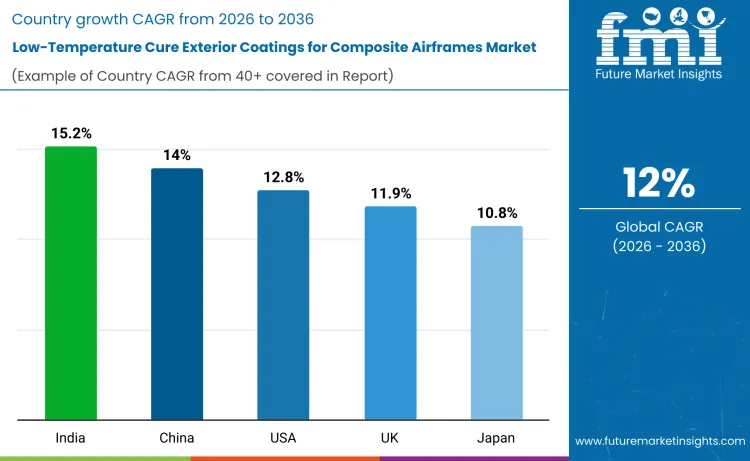
| Country | CAGR (2026-2036) |
|---|---|
| China | 14% |
| India | 15.2% |
| USA | 12.8% |
| UK | 11.9% |
| Japan | 10.8% |
What is Driving the Growth of Low-Temperature Cure Exterior Coatings for Composite Airframes in China?
China’s Low-Temperature Cure Exterior Coatings for Composite Airframes market is projected to grow at a CAGR of 14%. This growth is driven by China’s rapidly expanding aerospace industry, particularly in the development of lightweight and fuel-efficient aircraft. Low-temperature cure coatings are increasingly being used to enhance composite airframe performance, offering improved durability, reduced energy consumption, and faster production times. As China focuses on modernizing its aircraft fleet and increasing the use of composite materials, the adoption of these coatings is expected to accelerate, contributing to steady market growth.
What is Contributing to the Growth of Low-Temperature Cure Exterior Coatings for Composite Airframes in India?
India’s Low-Temperature Cure Exterior Coatings for Composite Airframes market is expected to grow at an impressive CAGR of 15.2%. The expansion of India’s aerospace sector, coupled with the increasing use of composite materials in aircraft manufacturing, is driving the demand for these coatings. Low-temperature cure coatings offer several benefits, including faster curing times, energy efficiency, and excellent adhesion to composite substrates, making them an ideal solution for modern aircraft production. As India continues to invest in fleet modernization and aerospace innovation, the market for low-temperature cure coatings is expected to see strong growth.
What is Driving the Low-Temperature Cure Exterior Coatings Market Growth in the USA?
The USA’s Low-Temperature Cure Exterior Coatings for Composite Airframes market is projected to grow at a CAGR of 12.8%. The USA remains a leader in the aerospace industry, with continued investments in composite material technologies and the development of more fuel-efficient, lightweight aircraft. Low-temperature cure coatings offer significant advantages, including reduced curing times, lower energy consumption, and improved performance of composite airframes. As US manufacturers and aerospace companies continue to focus on improving aircraft performance and reducing environmental impact, the demand for low-temperature cure coatings is expected to grow, further driving market expansion.
What is Influencing the Growth of Low-Temperature Cure Exterior Coatings for Composite Airframes in the UK?
The UK’s Low-Temperature Cure Exterior Coatings for Composite Airframes market is expected to grow at a CAGR of 11.9%. The UK aerospace sector’s focus on sustainability and reducing manufacturing times is fueling the demand for these advanced coatings. Low-temperature cure coatings help reduce energy consumption and accelerate production processes, making them an attractive option for composite airframe manufacturers. As the UK continues to innovate in the field of aerospace manufacturing and modernize its fleet, the adoption of low-temperature cure coatings is expected to increase, contributing to steady market growth.
What is Contributing to the Growth of Low-Temperature Cure Exterior Coatings for Composite Airframes in Japan?
Japan’s Low-Temperature Cure Exterior Coatings for Composite Airframes market is projected to grow at a CAGR of 10.8%. Japan’s aerospace industry, known for its emphasis on innovation and efficiency, is increasingly adopting advanced coatings that improve the durability and performance of composite airframes. Low-temperature cure coatings, which offer benefits such as energy efficiency and faster curing times, are well-suited to Japan’s focus on sustainable manufacturing processes. As Japan continues to modernize its aircraft fleet and expand its aerospace capabilities, the demand for these coatings is expected to grow, supporting steady market growth throughout the forecast period.
What is the Competitive Landscape for the Low Temperature Cure Exterior Coatings for Composite Airframes Market?
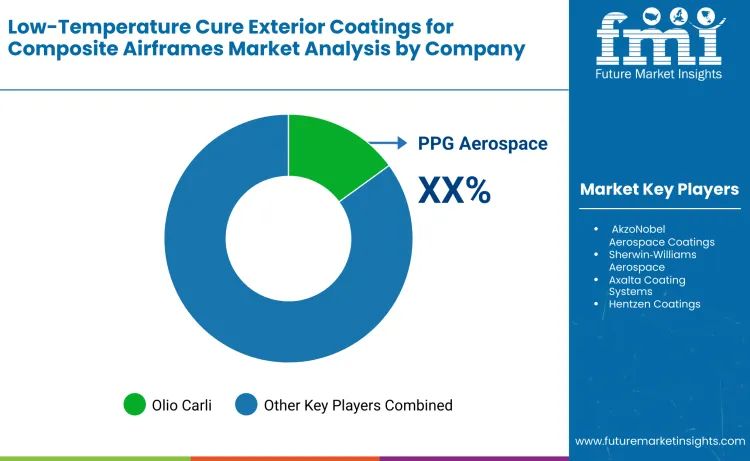
Global demand for low‑temperature cure exterior coatings for composite airframes is growing as aircraft manufacturers and operators pursue weight savings, reduced production costs and enhanced sustainability. Composite structures are increasingly used in modern airframes because they offer strength with lower weight compared with traditional aluminum, and they improve fuel efficiency and performance. Low‑temperature cure coatings enable application and curing without high heat, protecting sensitive composite substrates and reducing energy use in paint shops. This capability is especially valued in narrow‑body, regional and next‑generation aircraft where composite materials are prominent. Growth in commercial aviation demand, fleet renewals and more stringent environmental and energy‑efficiency regulations all support the uptake of advanced cure technologies across regions including North America, Europe and Asia Pacific.
On the supply side several major aerospace coatings and materials companies compete to serve this specialised segment. PPG Aerospace is recognised as a leading player with established low‑temperature cure exterior coating systems designed for composite applications. Other significant competitors include AkzoNobel Aerospace Coatings, Sherwin‑Williams Aerospace, Axalta Coating Systems and Hentzen Coatings, each offering formulations that balance adhesion, durability, weather resistance and compatibility with composite substrates. Competition among these suppliers centers on coating performance in harsh environmental conditions, ease of processing in factory and maintenance settings, cure speed under lower thermal budgets, and compliance with aerospace specifications and certification requirements. Firms that combine innovative chemistries, robust quality assurance, technical support and global supply networks are best positioned to capture growth as demand increases for exterior coatings tailored to composite airframes in commercial and military aircraft programs.
Key Players
- PPG Aerospace
- AkzoNobel Aerospace Coatings
- Sherwin‑Williams Aerospace
- Axalta Coating Systems
- Hentzen Coatings
Scope of the Report
| Items | Values |
|---|---|
| Quantitative Units (2025) | USD Million |
| Coating Chemistry | Epoxy-Based Low-Temperature Cure Systems, Polyurethane-Based Low-Temperature Cure Coatings, Hybrid Polymer Low-Temperature Cure Formulations, Innovative Nano-Enhanced Coatings |
| End-Use Application | Commercial Aircraft Composite Airframes, Regional & Business Jet Composite Airframes, Aftermarket MRO Services, Military & Defense Composite Fleets |
| Companies | PPG Aerospace, AkzoNobel Aerospace Coatings, Sherwin-Williams Aerospace, Axalta Coating Systems, Hentzen Coatings |
| Regions Covered | North America, Latin America, Western Europe, Eastern Europe, South Asia and Pacific, East Asia, Middle East & Africa |
| Countries Covered | United States, Canada, Mexico, Brazil, Argentina, Germany, France, United Kingdom, Italy, Spain, Netherlands, China, India, Japan, South Korea, ANZ, GCC Countries, South Africa |
| Additional Attributes | Dollar by sales by coating chemistry, end-use application, and region. Includes market trends in low-temperature cure exterior coatings for composite airframes, performance in commercial, military, and regional aircraft applications, aftermarket MRO services, cost-effectiveness, sustainability practices, regulatory compliance, market share and competitive positioning of key companies, and the role of low-temperature cure coatings in improving durability, efficiency, and ease of application for composite airframes across the aerospace industry. |
Key Segments in the Low-Temperature Cure Exterior Coatings for Composite Airframes Market
By Coating Chemistry:
- Epoxy‑Based Low‑Temperature Cure Systems
- Polyurethane‑Based Low‑Temperature Cure Coatings
- Hybrid Polymer Low‑Temperature Cure Formulations
- Innovative Nano‑Enhanced Coatings
By End‑Use Application:
- Commercial Aircraft Composite Airframes
- Regional & Business Jet Composite Airframes
- Aftermarket MRO Services
- Military & Defense Composite Fleets
By Region:
- Asia Pacific
- China
- India
- Japan
- South Korea
- ASEAN
- Rest of Asia Pacific
- Europe
- Germany
- United Kingdom
- France
- Italy
- Spain
- Nordic
- BENELUX
- Rest of Europe
- North America
- United States
- Canada
- Mexico
- Latin America
- Brazil
- Chile
- Rest of Latin America
- Middle East & Africa
- Kingdom of Saudi Arabia
- Other GCC Countries
- Turkey
- South Africa
- Other African Union
- Rest of Middle East & Africa
Frequently Asked Questions
How big is the Low-Temperature Cure Exterior Coatings for Composite Airframes market?
The market is valued at USD 350 million in 2026 and will reach USD 1.09 billion by 2036, growing at a CAGR of 12%.
What is the growth outlook for the Low-Temperature Cure Exterior Coatings for Composite Airframes market?
The market is projected to grow at a CAGR of 12% from 2026 to 2036.
Which region is expected to experience the fastest growth in the Low-Temperature Cure Exterior Coatings for Composite Airframes market?
India is expected to lead with a growth rate of 15.2%.
What are the key applications of Low-Temperature Cure Exterior Coatings for Composite Airframes?
These coatings are primarily used in commercial aircraft composite airframes, which account for 50% of the market share.
Who are the major players in the Low-Temperature Cure Exterior Coatings for Composite Airframes market?
Key players include PPG Aerospace, AkzoNobel Aerospace Coatings, Sherwin-Williams Aerospace, Axalta Coating Systems, and Hentzen Coatings.
Preview the report firsthand - request a free sample
Get SampleGet the brochure for pricing and purchase details.
Get PDFTable of Content
- Executive Summary
- Market Overview
- Global Market Value, 2020-2026
- Global Market Forecast, 2026-2036
- Market Dynamics
- Drivers
- Restraints
- Opportunities
- Regulatory & Standards Landscape
- Low-Temperature Cure Coating Technology Outlook
- Market Segmentation Analysis
- By Coating Chemistry
- Epoxy-Based Low-Temperature Cure Systems
- Polyurethane-Based Low-Temperature Cure Coatings
- Hybrid Polymer Low-Temperature Cure Formulations
- Innovative Nano-Enhanced Coatings
- By End-Use Application
- Commercial Aircraft Composite Airframes
- Regional & Business Jet Composite Airframes
- Aftermarket MRO Services
- Military & Defense Composite Fleets
- By Sales Channel
- Direct OEM Supply
- MRO & Repaint Facilities
- Aftermarket & Distributor Channels
- By Coating Chemistry
- Regional Outlook
- North America
- Latin America
- Western Europe
- Eastern Europe
- South Asia & Pacific
- East Asia
- Middle East & Africa
- Country-Level Outlook
- United States
- Canada
- Mexico
- Brazil
- Argentina
- Germany
- France
- United Kingdom
- Italy
- Spain
- Netherlands
- China
- India
- Japan
- South Korea
- ANZ
- GCC Countries
- South Africa
- Competitive Landscape
- Market Structure Overview
- Company Positioning
- Strategic Initiatives
- Key Player Profiles
- Scope of the Report
- Research Methodology
- Assumptions & Acronyms


