

- Industry Size (2026)
- USD 64 Mn
- Forecast (2036)
- USD 117 Mn
- CAGR (2026 to 2036)
- 6.3%
Low-Temperature Cure Coil Coatings for Heat Sensitive Substrates Market Forecast and Outlook 2026 to 2036
The low-temperature cure coil coatings for heat sensitive substrates market is valued at USD 64 million in 2026 and is projected to reach USD 117 million by 2036, reflecting a CAGR of 6.3%. Growth during this period is shaped by substrate tolerance limits, line speed requirements, and coating performance retention at reduced bake temperatures. Cost structures reflect resin modification, catalyst selection, and tighter process control on coil lines. Producers incur higher formulation costs to achieve cure completion without damaging thin gauge metals or coated laminates. Suppliers aligning coating behavior with existing line infrastructure maintain steadier pricing outcomes.
Between 2026 and 2036, adoption is influenced by manufacturing flexibility and energy management priorities rather than coating volumes. Coil processors value coatings that reduce oven temperatures while preserving surface finish and adhesion. Once qualified, formulations remain specified due to revalidation cost and line disruption risk. Entry barriers persist through pilot line trials and performance testing. Strategic trade offs arise between cure speed, coating durability, and production consistency. Firms integrating formulation design with processor requirements secure stable demand. Competitive positioning favors suppliers embedded in long term supply agreements tied to specialized substrate programs.
Quick Stats for Low Temperature Cure Coil Coatings for Heat Sensitive Substrates Market
- Low-Temperature Cure Coil Coatings for Heat Sensitive Substrates Market Value (2026): USD 64 million
- Low-Temperature Cure Coil Coatings for Heat Sensitive Substrates Market Forecast Value (2036): USD 117 million
- Low-Temperature Cure Coil Coatings for Heat Sensitive Substrates Market Forecast CAGR (2026 to 2036): 6.3%
- Leading Coating Technology in Low Temperature Cure Coil Coatings for Heat Sensitive Substrates Market: UV and EB curable energy cure coil coatings
- Key Growth Regions in Low Temperature Cure Coil Coatings for Heat Sensitive Substrates Market: Asia Pacific, North America, Europe
- Top Players in Low Temperature Cure Coil Coatings for Heat Sensitive Substrates Market: AkzoNobel, PPG Industries, The Sherwin-Williams Company (Valspar), Nippon Paint

What Is the Growth Forecast for Low-Temperature Cure Coil Coatings for Heat Sensitive Substrates Market through 2036?
Thermal tolerance limitations and material distortion risks define the early growth phase of the Low-Temperature Cure Coil Coatings for Heat Sensitive Substrates Market between 2026 and 2031. During this period, the market expands from USD 64 million to USD 79 million, adding USD 15 million in value. Annual progression from USD 45 million to USD 64 million reflects increasing use of coated thin gauge metals, polymer laminated sheets, and composite panels that cannot withstand conventional bake temperatures. Historical growth was constrained by narrow formulation windows and slower line speeds. Forward expansion in this phase is supported by improved resin chemistry, better cure efficiency at reduced temperatures, and rising adoption in appliance panels, lighting components, and decorative building materials.
Process compatibility and production efficiency drive growth from 2031 to 2036. Over this period, the market increases from USD 79 million to USD 117 million, adding USD 44 million and representing the stronger expansion window. Annual values rise from USD 83 million to USD 117 million, indicating steady year over year momentum. Earlier demand focused on niche applications with strict thermal limits, while future growth reflects broader use across packaging panels, modular construction elements, and specialty industrial components. Expanded coating line integration, reduced energy consumption, and stable surface performance support sustained expansion as low temperature cure systems gain acceptance for heat sensitive substrates.
Low-Temperature Cure Coil Coatings for Heat Sensitive Substrates Market Key Takeaways
| Metric | Value |
|---|---|
| Market Value (2026) | USD 64 million |
| Forecast Value (2036) | USD 123 million |
| Forecast CAGR (2026 to 2036) | 6.3% |
What Is Driving Demand in the Low-Temperature Cure Coil Coatings for Heat-Sensitive Substrates Market?
Demand for low-temperature cure coil coatings arises from material constraints in substrates that cannot withstand conventional cure cycles rather than routine coating specification. Traditional coil coatings require elevated bake temperatures to achieve crosslinking and performance properties, but heat-sensitive substrates such as thin gauge metals, aluminium alloys, and engineered composites used in lightweight structures distort, degrade, or lose mechanical properties under high thermal exposure. Manufacturers observed that standard curing led to warping, loss of dimensional tolerances, and compromised substrate integrity during processing. This created a performance barrier in applications such as lightweight building panels, architectural trims, and enclosure systems where substrate choice was driven by weight reduction, corrosion resistance, or design criteria rather than thermal robustness.
Future demand will be shaped by broader adoption of lightweight materials and integration of coatings into low-thermal-stress manufacturing lines rather than incremental formulation changes alone. Regulatory pressure to reduce energy consumption in coating ovens, combined with sustainability commitments to lower process emissions, is influencing procurement of coatings that cure effectively at reduced temperatures. Advances in resin systems and catalyst technologies are enabling robust film formation, adhesion, and durability while reducing required cure energy input. Material engineers are embedding low-temperature cure criteria into early design and process planning to balance performance with manufacturing constraints. Adoption will follow documented performance benchmarks for adhesion, weathering resistance, and mechanical stability under service conditions, positioning low-temperature cure coil coatings as engineered solutions for heat-sensitive substrate applications rather than optional adjustments to conventional processes.
What Factors Are Affecting the Demand for Low-Temperature Cure Coil Coatings for Heat Sensitive Substrates Market in Terms of Coating Technology and Heat Sensitive Substrate?
The low temperature cure coil coatings market for heat sensitive substrates is driven by the expansion of lightweight materials, limits on thermal exposure during processing, and demand for energy efficient coating lines. Adoption focuses on technologies that achieve full cure at reduced temperatures while preserving substrate integrity and surface quality. Market leadership reflects curing reliability, line speed compatibility, and adhesion performance rather than maximum hardness or film build.
What Is Driving Leadership by Coating Technology in the Low Temperature Cure Coil Coatings Market?
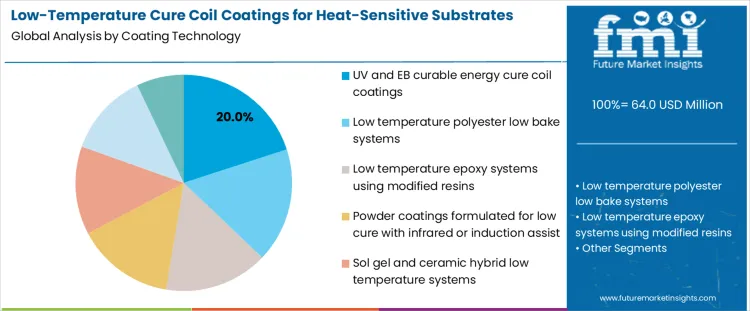
UV and EB curable energy cure coil coatings account for about 20% of demand because they enable instant curing with minimal thermal load on substrates. These systems rely on radiation rather than heat, allowing coatings to be applied on plastics, polymer clad strips, and thin composites without deformation.
Coil coaters favor energy cure technologies for their high line speeds, reduced oven footprint, and consistent film properties. Low bake polyester and modified epoxy systems follow where radiation curing is impractical. These chemistries achieve cure at lower temperatures through resin modification, supporting compatibility with composite panels and wood based laminates. Powder coatings with infrared or induction assist expand options for thicker films but require precise control. Technology leadership therefore reflects curing efficiency, substrate protection, and integration with continuous coil processes rather than standalone coating performance.
Sol gel, ceramic hybrid, and waterborne low temperature systems address niche requirements such as barrier performance or environmental compliance. Primer and conversion coatings support adhesion but are preparatory layers. These technologies complement energy cure systems without displacing their role in sensitive applications.
What Is Driving Leadership by Heat Sensitive Substrate in the Low Temperature Cure Coil Coatings Market?
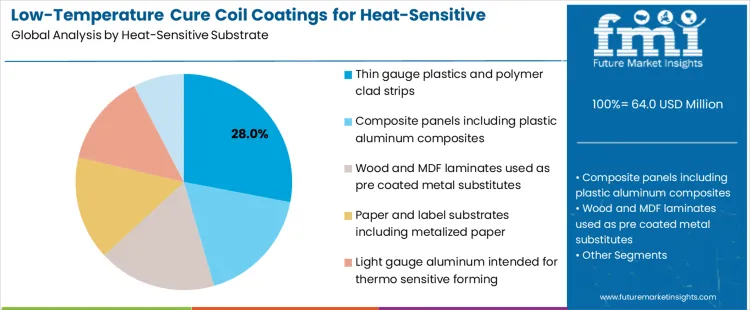
Thin gauge plastics and polymer clad strips represent about 28% of demand because they are widely used in lightweight panels, appliances, and interior components that cannot tolerate conventional bake temperatures. These substrates deform or discolor under heat, making low temperature cure essential. Coil coating provides uniformity and throughput advantages for these materials, driving adoption. Composite panels, including plastic aluminum composites, contribute significant secondary demand due to their layered structure and thermal limits. Wood and MDF laminates used as metal substitutes also rely on low temperature systems to preserve dimensional stability and surface finish.
Paper and label substrates, light gauge aluminum for thermo sensitive forming, and specialty materials such as foams and textiles represent smaller but important segments. These substrates require tailored adhesion and curing profiles. Substrate leadership therefore reflects volume use in lightweight construction and appliance markets rather than diversity of materials requiring protection from heat.
How Are Low-Temperature Cure Coil Coatings Being Applied Across Heat-Sensitive Substrates?
Use appears in architectural, appliance, and industrial applications where metal substrates cannot withstand conventional high-temperature curing. Manufacturers adopt low-temperature cure coil coatings to provide corrosion resistance, durability, and aesthetic finish without damaging heat-sensitive metals or composites. Coil coaters integrate these coatings in aluminum, zinc-coated steel, and composite panels used in façades, roofing, and appliances. These applications reflect operational and material protection priorities rather than purely aesthetic objectives, with adoption driven by substrate compatibility, coating performance, and process efficiency.
What Operational and Material Conditions Support Adoption of Low-Temperature Cure Coil Coatings?
Selection aligns with substrates requiring adhesion, flexibility, and chemical resistance at lower cure temperatures. Formulations are optimized for viscosity, cure kinetics, and surface wetting to achieve uniform coverage on continuous coil lines. Process engineers monitor line speed, oven temperature, and coating thickness to ensure consistent film properties. Quality control evaluates adhesion, corrosion resistance, flexibility, and surface finish to meet industry and regulatory standards. These conditions emerge from operational efficiency, coating performance, and substrate protection priorities in structured coil coating workflows.
Which Practical Considerations Limit Wider Use of Low-Temperature Cure Coil Coatings?
Higher material cost and slower cure kinetics may limit adoption in high-speed production lines. Substrate surface preparation and compatibility with primers or topcoats must be verified. Process control, monitoring, and equipment calibration are critical to maintain consistent performance. Regulatory compliance and environmental standards influence chemical selection. These factors lead to selective deployment where substrate protection, coating durability, and operational reliability justify incremental cost and precise process management.
What is the Demand for Low Temperature Cure Coil Coatings for Heat Sensitive Substrates by Country?
| Country | CAGR (%) |
|---|---|
| China | 8.5% |
| USA | 6.5% |
| Japan | 7.0% |
| Germany | 6.0% |
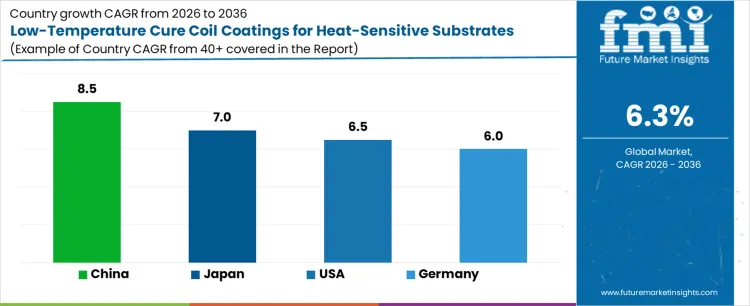
The demand for low temperature cure coil coatings for heat sensitive substrates varies across countries, driven by lightweight construction, energy efficiency initiatives, and adoption in metal forming industries. China leads with an 8.5% CAGR, supported by growth in industrial and architectural coil coating applications, and adoption of low temperature cure technologies to protect heat sensitive materials. Japan follows at 7.0%, driven by advanced manufacturing processes and industrial efficiency requirements. The USA grows at 6.5%, reflecting steady adoption in industrial and building applications. Germany records 6.0%, shaped by mature manufacturing infrastructure and focus on energy efficient coating technologies.
How Are Low-Temperature Cure Coil Coatings Expanding Applications in China?
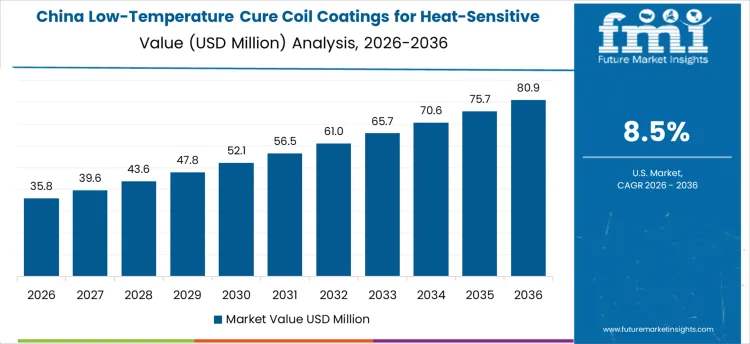
In China, the Low-Temperature Cure Coil Coatings for Heat-Sensitive Substrates Market is growing at a CAGR of 8.5% through 2036, driven by rapid industrial manufacturing and increasing use of heat-sensitive materials in construction, electronics, and appliance production. Manufacturers are adopting low-temperature cure coatings to protect sensitive substrates, improve adhesion, and reduce energy consumption during curing. Demand is concentrated in industrial coating hubs, electronics fabrication zones, and appliance manufacturing clusters. Compared to the USA, China emphasizes large-scale industrial integration and high-volume production. Domestic suppliers provide high-performance, energy-efficient coatings suitable for recurring coil processing and finishing operations.
- Industrial coating hubs, electronics fabrication zones, and appliance manufacturing clusters drive adoption
- Coatings protect heat-sensitive substrates and reduce energy consumption
- Domestic suppliers provide high-performance, energy-efficient solutions
- Recurring coil processing and finishing operations sustain adoption
How Are Energy Efficiency and Industrial Expansion Driving Growth in the United States?
In the United States, revenue is growing at a CAGR of 6.5% through 2036, supported by industrial manufacturing of appliances, HVAC systems, and coated metal components. Contractors and coating manufacturers are adopting low-temperature cure coatings to maintain substrate integrity, reduce operational energy use, and improve surface durability. Demand is concentrated in industrial production hubs, appliance manufacturing facilities, and HVAC component assembly plants. Compared to China, adoption emphasizes operational efficiency and regulatory compliance over large-scale volume deployment. Domestic suppliers provide durable coatings suitable for recurring coil finishing and production cycles.
- Industrial production hubs, appliance facilities, and HVAC component assembly plants drive adoption
- Coatings preserve substrate integrity and reduce energy use
- Domestic suppliers provide durable, production-compatible solutions
- Recurring coil finishing and production cycles sustain adoption
How Are Precision Manufacturing and Substrate Protection Driving Adoption in Japan?
In Japan, the market is expanding at a CAGR of 7% through 2036, driven by precision appliance manufacturing, electronics fabrication, and construction material coating applications. Manufacturers are integrating low-temperature cure coatings to protect heat-sensitive substrates, ensure adhesion quality, and reduce thermal stress during processing. Demand is concentrated in industrial hubs, electronics production clusters, and appliance manufacturing facilities. Compared to Germany, adoption emphasizes high precision and substrate protection alongside energy efficiency. Domestic suppliers provide high-performance, chemically compatible coatings suitable for recurring coil processing and finishing cycles.
- Industrial hubs, electronics clusters, and appliance manufacturing facilities drive adoption
- Coatings ensure adhesion quality and substrate protection
- Domestic suppliers provide high-performance, chemically compatible solutions
- Recurring coil processing and finishing cycles sustain adoption
How Are Industrial Standards and Substrate Protection Driving Growth in Germany?
In Germany, revenue is growing at a CAGR of 6% through 2036, supported by industrial manufacturing of appliances, HVAC systems, and metal components requiring low-temperature coatings. Contractors and industrial coating specialists are adopting these formulations to protect heat-sensitive substrates, ensure consistent surface quality, and reduce curing energy requirements. Demand is concentrated in industrial production hubs, appliance manufacturing facilities, and HVAC component assembly zones. Compared to Japan, adoption emphasizes regulatory compliance and consistent performance over high-volume integration. Domestic suppliers provide certified, high-quality coatings suitable for recurring coil processing and finishing operations.
- Industrial production hubs, appliance facilities, and HVAC component zones drive adoption
- Coatings protect substrates and ensure consistent surface quality
- Domestic suppliers provide certified, high-quality, low-temperature solutions
- Recurring coil processing and finishing operations sustain adoption
Which Strategic Approaches Define Competition in the Low Temperature Cure Coil Coatings for Heat Sensitive Substrates Market?
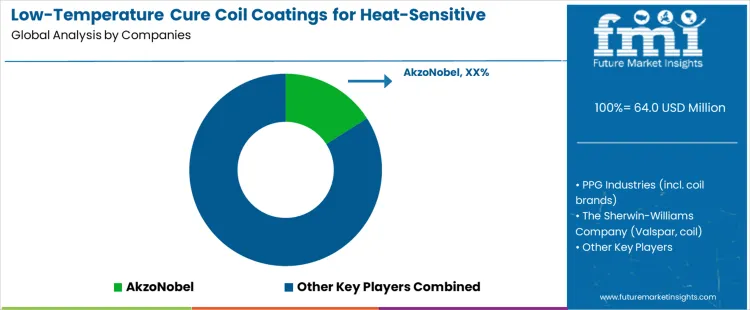
Competition in the low temperature cure coil coatings market is shaped by how suppliers adapt coating chemistry to substrates that cannot tolerate conventional bake profiles. AkzoNobel and PPG Industries compete by reformulating polyester and hybrid systems to achieve full cure at reduced peak metal temperatures while preserving adhesion, flexibility, and corrosion resistance. Their strategies focus on stabilizing cure windows across variable line speeds and coil gauges, which is critical for coated aluminum, thin steel, and polymer clad metals. Qualification is driven by bend performance, color stability, and coating integrity after forming operations rather than by cure speed alone. Customers prioritize coatings that reduce energy demand without increasing scrap or limiting downstream fabrication.
A different strategic emphasis is visible among suppliers closely aligned with appliance and building product manufacturers. Sherwin Williams, through its Valspar coil portfolio, positions low temperature cure coatings around line efficiency and retrofit compatibility, allowing processors to lower oven settings without major capital changes. Nippon Paint focuses on formulation control and surface tolerance, supporting consistent film build and appearance on lightweight substrates prone to distortion. Across the market, competitive advantage depends on predictable curing under real production variability, support during line trials, and conservative formulation evolution. Success is defined by operational reliability, energy efficiency gains, and maintained end use performance rather than aggressive chemistry changes or rapid product turnover.
Key Players in the Low-Temperature Cure Coil Coatings for Heat Sensitive Substrates Market
- AkzoNobel
- PPG Industries (incl. coil brands)
- The Sherwin-Williams Company (Valspar, coil)
- Nippon Paint
Scope of the Report
| Items | Values |
|---|---|
| Quantitative Units (2026) | USD million |
| Type | UV and EB curable energy cure coil coatings, Low temperature polyester low bake systems, Low temperature epoxy systems using modified resins, Powder coatings formulated for low cure with infrared or induction assist, Sol gel and ceramic hybrid low temperature systems, Waterborne and low temperature aqueous systems, Primer and conversion coatings for adhesion on heat sensitive substrates |
| Application | Building envelope and decorative cladding using pre finished panels, Appliances and white goods using low temperature formed parts, Lighting and luminaires using thin gauge substrates, Automotive non structural trim and interior metalized parts, Packaging and labels using metalized and low temperature paper, Specialty industrial applications including furniture signage and HVAC ducts |
| End Users | Coil coating processors, Appliance manufacturers, Building product manufacturers, Lighting and electrical equipment manufacturers, Automotive component suppliers, Packaging and label converters |
| Regions Covered | Asia Pacific, Europe, North America, Latin America, Middle East and Africa |
| Countries Covered | China, United States, Japan, Germany, South Korea, India, United Kingdom, France, Italy, Spain, Canada, Mexico, Brazil, GCC countries, and other industrial manufacturing regions |
| Key Companies Profiled | AkzoNobel, PPG Industries including coil brands, The Sherwin Williams Company through Valspar coil portfolio, Nippon Paint |
| Additional Attributes | Dollar by sales across coating technology heat sensitive substrate and application, cure temperature and peak metal temperature benchmarks, line speed compatibility and process window constraints, energy consumption and oven profile optimization considerations, adhesion and formability performance after downstream fabrication, qualification requirements through pilot line trials and processor validation programs |
Low-Temperature Cure Coil Coatings for Heat Sensitive Substrates Market Segmentation
By Coating Technology:
- UV and EB curable energy cure coil coatings
- Low temperature polyester low bake systems
- Low temperature epoxy systems using modified resins
- Powder coatings formulated for low cure with infrared or induction assist
- Sol gel and ceramic hybrid low temperature systems
- Waterborne and low temperature aqueous systems
- Primer and conversion coatings for adhesion on heat sensitive substrates
By Heat-Sensitive Substrate:
- Thin gauge plastics and polymer clad strips
- Composite panels including plastic aluminum composites
- Wood and MDF laminates used as pre coated metal substitutes
- Paper and label substrates including metalized paper
- Light gauge aluminum intended for thermo sensitive forming
- Specialty substrates including textiles, foams, and flexible materials
By Application:
- Building envelope and decorative cladding using pre finished panels
- Appliances and white goods using low temperature formed parts
- Lighting and luminaires using thin gauge substrates
- Automotive non structural trim and interior metalized parts
- Packaging and labels using metalized and low temperature paper
- Specialty industrial applications including furniture, signage, and HVAC ducts
Cure Method:
- Continuous coil UV and EB energy cure lines
- Conventional low bake thermal ovens with reduced temperature profiles
- Infrared and induction assisted cure lines
- Post coating on formed parts for lower volume production
By Region
- Asia Pacific
- China
- Japan
- South Korea
- India
- Australia & New Zealand
- ASEAN
- Rest of Asia Pacific
- Europe
- Germany
- United Kingdom
- France
- Italy
- Spain
- Nordic
- BENELUX
- Rest of Europe
- North America
- United States
- Canada
- Mexico
- Latin America
- Brazil
- Chile
- Rest of Latin America
- Middle East & Africa
- Kingdom of Saudi Arabia
- Other GCC Countries
- Turkey
- South Africa
- Other African Union
- Rest of Middle East & Africa
Frequently Asked Questions
How big is the low-temperature cure coil coatings for heat-sensitive substrates market in 2026?
The global low-temperature cure coil coatings for heat-sensitive substrates market is estimated to be valued at USD 64.0 million in 2026.
What will be the size of low-temperature cure coil coatings for heat-sensitive substrates market in 2036?
The market size for the low-temperature cure coil coatings for heat-sensitive substrates market is projected to reach USD 117.9 million by 2036.
How much will be the low-temperature cure coil coatings for heat-sensitive substrates market growth between 2026 and 2036?
The low-temperature cure coil coatings for heat-sensitive substrates market is expected to grow at a 6.3% CAGR between 2026 and 2036.
What are the key product types in the low-temperature cure coil coatings for heat-sensitive substrates market?
The key product types in low-temperature cure coil coatings for heat-sensitive substrates market are uv and eb curable energy cure coil coatings, low temperature polyester low bake systems, low temperature epoxy systems using modified resins, powder coatings formulated for low cure with infrared or induction assist, sol gel and ceramic hybrid low temperature systems, waterborne and low temperature aqueous systems and primer and conversion coatings for adhesion on heat sensitive substrates.
Which heat-sensitive substrate segment to contribute significant share in the low-temperature cure coil coatings for heat-sensitive substrates market in 2026?
In terms of heat-sensitive substrate, thin gauge plastics and polymer clad strips segment to command 28.0% share in the low-temperature cure coil coatings for heat-sensitive substrates market in 2026.
Preview the report firsthand - request a free sample
Get SampleGet the brochure for pricing and purchase details.
Get PDFTable of Content
- Executive Summary
- Global Market Outlook
- Demand-side Trends
- Supply-side Trends
- Technology Roadmap Analysis
- Analysis and Recommendations
- Market Overview
- Market Coverage / Taxonomy
- Market Definition / Scope / Limitations
- Market Background
- Market Dynamics
- Drivers
- Restraints
- Opportunity
- Trends
- Scenario Forecast
- Demand in Optimistic Scenario
- Demand in Likely Scenario
- Demand in Conservative Scenario
- Opportunity Map Analysis
- Product Life Cycle Analysis
- Supply Chain Analysis
- Investment Feasibility Matrix
- Value Chain Analysis
- PESTLE and Porter’s Analysis
- Regulatory Landscape
- Regional Parent Market Outlook
- Production and Consumption Statistics
- Import and Export Statistics
- Market Dynamics
- Global Market Analysis 2021 to 2025 and Forecast, 2026 to 2036
- Historical Market Size Value (USD Million) Analysis, 2021 to 2025
- Current and Future Market Size Value (USD Million) Projections, 2026 to 2036
- Y-o-Y Growth Trend Analysis
- Absolute $ Opportunity Analysis
- Global Market Pricing Analysis 2021 to 2025 and Forecast 2026 to 2036
- Global Market Analysis 2021 to 2025 and Forecast 2026 to 2036, By Coating Technology
- Introduction / Key Findings
- Historical Market Size Value (USD Million) Analysis By Coating Technology , 2021 to 2025
- Current and Future Market Size Value (USD Million) Analysis and Forecast By Coating Technology , 2026 to 2036
- UV and EB curable energy cure coil coatings
- Low temperature polyester low bake systems
- Low temperature epoxy systems using modified resins
- Powder coatings formulated for low cure with infrared or induction assist
- Sol gel and ceramic hybrid low temperature systems
- Waterborne and low temperature aqueous systems
- Primer and conversion coatings for adhesion on heat sensitive substrates
- UV and EB curable energy cure coil coatings
- Y-o-Y Growth Trend Analysis By Coating Technology , 2021 to 2025
- Absolute $ Opportunity Analysis By Coating Technology , 2026 to 2036
- Global Market Analysis 2021 to 2025 and Forecast 2026 to 2036, By Heat-Sensitive Substrate
- Introduction / Key Findings
- Historical Market Size Value (USD Million) Analysis By Heat-Sensitive Substrate, 2021 to 2025
- Current and Future Market Size Value (USD Million) Analysis and Forecast By Heat-Sensitive Substrate, 2026 to 2036
- Thin gauge plastics and polymer clad strips
- Composite panels including plastic aluminum composites
- Wood and MDF laminates used as pre coated metal substitutes
- Paper and label substrates including metalized paper
- Light gauge aluminum intended for thermo sensitive forming
- Specialty substrates including textiles, foams, and flexible materials
- Thin gauge plastics and polymer clad strips
- Y-o-Y Growth Trend Analysis By Heat-Sensitive Substrate, 2021 to 2025
- Absolute $ Opportunity Analysis By Heat-Sensitive Substrate, 2026 to 2036
- Global Market Analysis 2021 to 2025 and Forecast 2026 to 2036, By Application
- Introduction / Key Findings
- Historical Market Size Value (USD Million) Analysis By Application, 2021 to 2025
- Current and Future Market Size Value (USD Million) Analysis and Forecast By Application, 2026 to 2036
- Building envelope and decorative cladding using pre finished panels
- Appliances and white goods using low temperature formed parts
- Lighting and luminaires using thin gauge substrates
- Automotive non structural trim and interior metalized parts
- Packaging and labels using metalized and low temperature paper
- Specialty industrial applications including furniture, signage, and HVAC ducts
- Building envelope and decorative cladding using pre finished panels
- Y-o-Y Growth Trend Analysis By Application, 2021 to 2025
- Absolute $ Opportunity Analysis By Application, 2026 to 2036
- Global Market Analysis 2021 to 2025 and Forecast 2026 to 2036, By Cure Method
- Introduction / Key Findings
- Historical Market Size Value (USD Million) Analysis By Cure Method, 2021 to 2025
- Current and Future Market Size Value (USD Million) Analysis and Forecast By Cure Method, 2026 to 2036
- Continuous coil UV and EB energy cure lines
- Conventional low bake thermal ovens with reduced temperature profiles
- Infrared and induction assisted cure lines
- Post coating on formed parts for lower volume production
- Continuous coil UV and EB energy cure lines
- Y-o-Y Growth Trend Analysis By Cure Method, 2021 to 2025
- Absolute $ Opportunity Analysis By Cure Method, 2026 to 2036
- Global Market Analysis 2021 to 2025 and Forecast 2026 to 2036, By Region
- Introduction
- Historical Market Size Value (USD Million) Analysis By Region, 2021 to 2025
- Current Market Size Value (USD Million) Analysis and Forecast By Region, 2026 to 2036
- North America
- Latin America
- Western Europe
- Eastern Europe
- East Asia
- South Asia and Pacific
- Middle East & Africa
- Market Attractiveness Analysis By Region
- North America Market Analysis 2021 to 2025 and Forecast 2026 to 2036, By Country
- Historical Market Size Value (USD Million) Trend Analysis By Market Taxonomy, 2021 to 2025
- Market Size Value (USD Million) Forecast By Market Taxonomy, 2026 to 2036
- By Country
- USA
- Canada
- Mexico
- By Coating Technology
- By Heat-Sensitive Substrate
- By Application
- By Cure Method
- By Country
- Market Attractiveness Analysis
- By Country
- By Coating Technology
- By Heat-Sensitive Substrate
- By Application
- By Cure Method
- Key Takeaways
- Latin America Market Analysis 2021 to 2025 and Forecast 2026 to 2036, By Country
- Historical Market Size Value (USD Million) Trend Analysis By Market Taxonomy, 2021 to 2025
- Market Size Value (USD Million) Forecast By Market Taxonomy, 2026 to 2036
- By Country
- Brazil
- Chile
- Rest of Latin America
- By Coating Technology
- By Heat-Sensitive Substrate
- By Application
- By Cure Method
- By Country
- Market Attractiveness Analysis
- By Country
- By Coating Technology
- By Heat-Sensitive Substrate
- By Application
- By Cure Method
- Key Takeaways
- Western Europe Market Analysis 2021 to 2025 and Forecast 2026 to 2036, By Country
- Historical Market Size Value (USD Million) Trend Analysis By Market Taxonomy, 2021 to 2025
- Market Size Value (USD Million) Forecast By Market Taxonomy, 2026 to 2036
- By Country
- Germany
- UK
- Italy
- Spain
- France
- Nordic
- BENELUX
- Rest of Western Europe
- By Coating Technology
- By Heat-Sensitive Substrate
- By Application
- By Cure Method
- By Country
- Market Attractiveness Analysis
- By Country
- By Coating Technology
- By Heat-Sensitive Substrate
- By Application
- By Cure Method
- Key Takeaways
- Eastern Europe Market Analysis 2021 to 2025 and Forecast 2026 to 2036, By Country
- Historical Market Size Value (USD Million) Trend Analysis By Market Taxonomy, 2021 to 2025
- Market Size Value (USD Million) Forecast By Market Taxonomy, 2026 to 2036
- By Country
- Russia
- Poland
- Hungary
- Balkan & Baltic
- Rest of Eastern Europe
- By Coating Technology
- By Heat-Sensitive Substrate
- By Application
- By Cure Method
- By Country
- Market Attractiveness Analysis
- By Country
- By Coating Technology
- By Heat-Sensitive Substrate
- By Application
- By Cure Method
- Key Takeaways
- East Asia Market Analysis 2021 to 2025 and Forecast 2026 to 2036, By Country
- Historical Market Size Value (USD Million) Trend Analysis By Market Taxonomy, 2021 to 2025
- Market Size Value (USD Million) Forecast By Market Taxonomy, 2026 to 2036
- By Country
- China
- Japan
- South Korea
- By Coating Technology
- By Heat-Sensitive Substrate
- By Application
- By Cure Method
- By Country
- Market Attractiveness Analysis
- By Country
- By Coating Technology
- By Heat-Sensitive Substrate
- By Application
- By Cure Method
- Key Takeaways
- South Asia and Pacific Market Analysis 2021 to 2025 and Forecast 2026 to 2036, By Country
- Historical Market Size Value (USD Million) Trend Analysis By Market Taxonomy, 2021 to 2025
- Market Size Value (USD Million) Forecast By Market Taxonomy, 2026 to 2036
- By Country
- India
- ASEAN
- Australia & New Zealand
- Rest of South Asia and Pacific
- By Coating Technology
- By Heat-Sensitive Substrate
- By Application
- By Cure Method
- By Country
- Market Attractiveness Analysis
- By Country
- By Coating Technology
- By Heat-Sensitive Substrate
- By Application
- By Cure Method
- Key Takeaways
- Middle East & Africa Market Analysis 2021 to 2025 and Forecast 2026 to 2036, By Country
- Historical Market Size Value (USD Million) Trend Analysis By Market Taxonomy, 2021 to 2025
- Market Size Value (USD Million) Forecast By Market Taxonomy, 2026 to 2036
- By Country
- Kingdom of Saudi Arabia
- Other GCC Countries
- Turkiye
- South Africa
- Other African Union
- Rest of Middle East & Africa
- By Coating Technology
- By Heat-Sensitive Substrate
- By Application
- By Cure Method
- By Country
- Market Attractiveness Analysis
- By Country
- By Coating Technology
- By Heat-Sensitive Substrate
- By Application
- By Cure Method
- Key Takeaways
- Key Countries Market Analysis
- USA
- Pricing Analysis
- Market Share Analysis, 2025
- By Coating Technology
- By Heat-Sensitive Substrate
- By Application
- By Cure Method
- Canada
- Pricing Analysis
- Market Share Analysis, 2025
- By Coating Technology
- By Heat-Sensitive Substrate
- By Application
- By Cure Method
- Mexico
- Pricing Analysis
- Market Share Analysis, 2025
- By Coating Technology
- By Heat-Sensitive Substrate
- By Application
- By Cure Method
- Brazil
- Pricing Analysis
- Market Share Analysis, 2025
- By Coating Technology
- By Heat-Sensitive Substrate
- By Application
- By Cure Method
- Chile
- Pricing Analysis
- Market Share Analysis, 2025
- By Coating Technology
- By Heat-Sensitive Substrate
- By Application
- By Cure Method
- Germany
- Pricing Analysis
- Market Share Analysis, 2025
- By Coating Technology
- By Heat-Sensitive Substrate
- By Application
- By Cure Method
- UK
- Pricing Analysis
- Market Share Analysis, 2025
- By Coating Technology
- By Heat-Sensitive Substrate
- By Application
- By Cure Method
- Italy
- Pricing Analysis
- Market Share Analysis, 2025
- By Coating Technology
- By Heat-Sensitive Substrate
- By Application
- By Cure Method
- Spain
- Pricing Analysis
- Market Share Analysis, 2025
- By Coating Technology
- By Heat-Sensitive Substrate
- By Application
- By Cure Method
- France
- Pricing Analysis
- Market Share Analysis, 2025
- By Coating Technology
- By Heat-Sensitive Substrate
- By Application
- By Cure Method
- India
- Pricing Analysis
- Market Share Analysis, 2025
- By Coating Technology
- By Heat-Sensitive Substrate
- By Application
- By Cure Method
- ASEAN
- Pricing Analysis
- Market Share Analysis, 2025
- By Coating Technology
- By Heat-Sensitive Substrate
- By Application
- By Cure Method
- Australia & New Zealand
- Pricing Analysis
- Market Share Analysis, 2025
- By Coating Technology
- By Heat-Sensitive Substrate
- By Application
- By Cure Method
- China
- Pricing Analysis
- Market Share Analysis, 2025
- By Coating Technology
- By Heat-Sensitive Substrate
- By Application
- By Cure Method
- Japan
- Pricing Analysis
- Market Share Analysis, 2025
- By Coating Technology
- By Heat-Sensitive Substrate
- By Application
- By Cure Method
- South Korea
- Pricing Analysis
- Market Share Analysis, 2025
- By Coating Technology
- By Heat-Sensitive Substrate
- By Application
- By Cure Method
- Russia
- Pricing Analysis
- Market Share Analysis, 2025
- By Coating Technology
- By Heat-Sensitive Substrate
- By Application
- By Cure Method
- Poland
- Pricing Analysis
- Market Share Analysis, 2025
- By Coating Technology
- By Heat-Sensitive Substrate
- By Application
- By Cure Method
- Hungary
- Pricing Analysis
- Market Share Analysis, 2025
- By Coating Technology
- By Heat-Sensitive Substrate
- By Application
- By Cure Method
- Kingdom of Saudi Arabia
- Pricing Analysis
- Market Share Analysis, 2025
- By Coating Technology
- By Heat-Sensitive Substrate
- By Application
- By Cure Method
- Turkiye
- Pricing Analysis
- Market Share Analysis, 2025
- By Coating Technology
- By Heat-Sensitive Substrate
- By Application
- By Cure Method
- South Africa
- Pricing Analysis
- Market Share Analysis, 2025
- By Coating Technology
- By Heat-Sensitive Substrate
- By Application
- By Cure Method
- USA
- Market Structure Analysis
- Competition Dashboard
- Competition Benchmarking
- Market Share Analysis of Top Players
- By Regional
- By Coating Technology
- By Heat-Sensitive Substrate
- By Application
- By Cure Method
- Competition Analysis
- Competition Deep Dive
- AkzoNobel
- Overview
- Product Portfolio
- Profitability by Market Segments (Product/Age /Sales Channel/Region)
- Sales Footprint
- Strategy Overview
- Marketing Strategy
- Product Strategy
- Channel Strategy
- PPG Industries (incl. coil brands)
- The Sherwin-Williams Company (Valspar, coil)
- Nippon Paint
- AkzoNobel
- Competition Deep Dive
- Assumptions & Acronyms Used
- Research Methodology


