

- Industry Size (2026)
- USD 227.6 Mn
- Forecast (2036)
- USD 509.9 Mn
- CAGR (2026 to 2036)
- 8.40%
Anti-Soiling Aircraft Exterior Coatings Market Forecast and Outlook 2026 to 2036
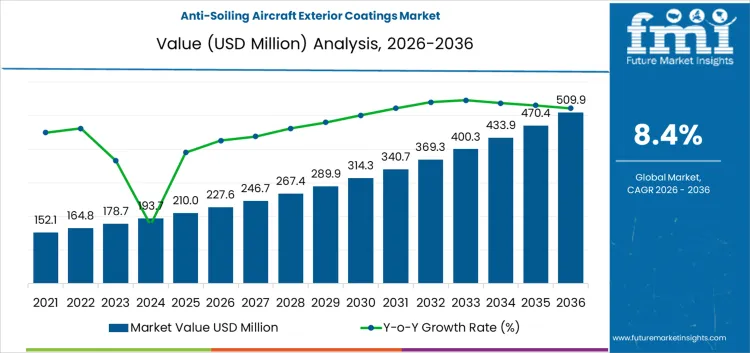
The anti-soiling aircraft exterior coatings market is valued at USD 227.6 million in 2026 and is projected to reach USD 509.9 million by 2036, reflecting a CAGR of 8.4%. Procurement decisions are heavily influenced by demonstrated performance in reducing surface contamination and operational maintenance costs. Buyer risk aversion is reflected in preference for validated technologies that have undergone extensive testing across multiple aircraft types. Vendor lock-in is reinforced where proprietary formulations are paired with certified application services and fleet-wide maintenance support. High switching costs discourage transitions between suppliers once coating systems have been integrated into operational workflows.
Long-term outcomes are shaped by the balance between supplier reliability and performance guarantees. Adoption rates are affected by fleet composition, regulatory approvals, and historical performance data. Margins are concentrated among providers delivering predictable efficacy and integrated support services. Pricing strategies are stabilized through multi-year service agreements that secure repeat business. Smaller operators face challenges in capturing value without proprietary validation or operational integration. Overall, revenue concentration is achieved where coatings are standardized across large fleets and supported by trusted service delivery networks.
Quick Stats of the Anti-Soiling Aircraft Exterior Coatings Market
- Anti-Soiling Aircraft Exterior Coatings Market Value (2026): USD 227.6 million
- Anti-Soiling Aircraft Exterior Coatings Market Forecast Value (2036): USD 509.9 million
- Anti-Soiling Aircraft Exterior Coatings Market Forecast CAGR 2026 to 2036: 8.40%
- Anti-Soiling Aircraft Exterior Coatings Leading Coating Function: Anti-Soiling Topcoats
- Anti-Soiling Aircraft Exterior Coatings Leading Aircraft Segment: Narrow-body
- Anti-Soiling Aircraft Exterior Coatings Key Growth Regions: China, Brazil, USA, South Korea, UK
- Anti-Soiling Aircraft Exterior Coatings Top Players: PPG Industries, AkzoNobel, Sherwin-Williams, 3M, Mankiewicz, Henkel, BASF, DuPont, Solvay, Saint-Gobain
What is the Growth Forecast for Anti-Soiling Aircraft Exterior Coatings Market through 2036?
Between 2026 and 2031, the anti-soiling aircraft exterior coatings market is projected to grow from USD 227.6 million to USD 314.3 million, generating an absolute increase of USD 86.7 million and reflecting a CAGR of 8.4%. Growth is driven by adoption of anti-soiling topcoats, easy-clean clearcoats, and anti-fouling sealants across narrow-body, wide-body, and business jet aircraft. Upper fuselage and nacelles are primary application areas. Cost structures are influenced by coating chemistry, surface preparation, and application methods. Value capture favors suppliers offering validated performance, operational reliability, and integration with MRO and OEM programs.
From 2031 to 2036, the market is expected to expand from USD 314.3 million to USD 509.9 million, adding USD 195.2 million. Growth is supported by retrofit programs, line-fit OEM applications, and expansion across airline and MRO channels. Adoption increases on wings, empennage, and fuselage surfaces. Competitive advantage favors suppliers with full-service coating portfolios, validated anti-soiling performance, and strong OEM partnerships. Leading companies include PPG Industries, AkzoNobel, Sherwin-Williams, 3M, Mankiewicz, Henkel, BASF, DuPont, Solvay, and Saint-Gobain, emphasizing durability, application expertise, and operational support.
Anti-Soiling Aircraft Exterior Coatings Market Key Takeaways
| Metric | Value |
|---|---|
| Market Value (2026) | USD 227.6 million |
| Forecast Value (2036) | USD 509.9 million |
| Forecast CAGR 2026 to 2036 | 8.40% |
What Is Driving Demand for Anti-Soiling Aircraft Exterior Coatings?
Anti-soiling aircraft exterior coatings are increasingly adopted to prevent accumulation of dust, dirt, and environmental residues on airframe surfaces. Conventional coatings offered limited resistance, requiring frequent cleaning that increased maintenance time and costs. Modern anti-soiling coatings incorporate nanostructured or low-energy surface technologies that repel particulates and liquids while maintaining aerodynamic efficiency. Airlines, maintenance providers, and military operators prioritize coating durability, adhesion, and compatibility with existing paint systems. Early adoption focused on high-value aircraft and specialized fleets, while current demand extends to commercial, regional, and cargo fleets seeking reduced cleaning cycles and operational costs. Performance consistency, surface preparation, and lifecycle resilience determine coating selection and deployment strategies.
Increasing pressure to reduce operational costs and maintain fuel efficiency is shaping market growth. Compared with previous formulations, contemporary coatings emphasize chemical resistance, uniform application, and scalability for large fleet deployment. Cost factors include raw materials, labor, and surface preparation, concentrating margins among suppliers delivering validated, repeatable coatings. Airlines and operators adopt anti-soiling coatings to minimize maintenance frequency, preserve aerodynamic performance, and extend coating longevity. By 2036, these coatings are expected to become standard across commercial and military fleets, supporting enhanced operational efficiency, environmental compliance, and aircraft performance.
What Factors Are Shaping the Demand for Anti-Soiling Aircraft Exterior Coatings in Terms of Coating Function and Aircraft Segment?
The demand for anti-soiling aircraft exterior coatings is segmented by coating function and aircraft segment. Coating functions include anti-soiling topcoats, easy-clean clearcoats, anti-fouling sealants, and other specialized coatings. Aircraft segments cover narrow-body, wide-body, business jets, and other categories. Adoption is influenced by surface cleanliness, operational efficiency, and compliance with aerospace standards. Uptake is driven by fuel efficiency, reduced maintenance cycles, and extended coating lifespan. Coating selection depends on aircraft type, operational exposure, and maintenance accessibility. Operators prioritize performance, durability, and operational cost savings in both commercial and business aviation applications.
Why Are Anti-Soiling Topcoats Leading the Coating Function Segment in Aircraft Exterior Coatings?
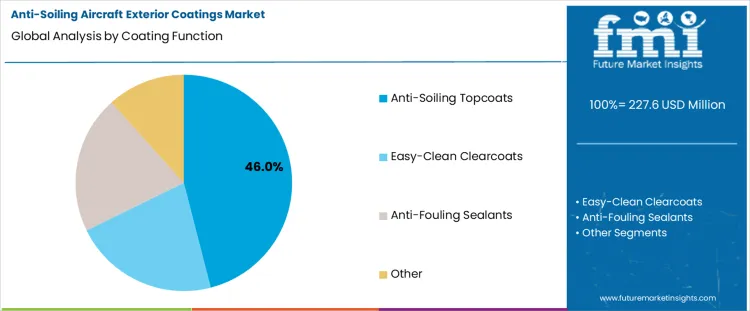
Anti-soiling topcoats account for approximately 46% of total coating function demand. These coatings reduce dirt, grime, and environmental particle adhesion on aircraft surfaces, maintaining aerodynamic smoothness. Airlines and maintenance teams apply them on fuselage, wings, and tail surfaces to minimize cleaning frequency and maintain operational efficiency. Adoption is reinforced by chemical and UV resistance, durability under high-speed airflow, and compatibility with existing primer and basecoat systems. Maintenance crews ensure uniform application and verify coating integrity during scheduled inspections. Anti-soiling topcoats deliver measurable fuel efficiency improvements and reduce surface degradation, establishing them as the primary choice in exterior aircraft protection.
Operational and environmental considerations further support adoption. Coatings withstand repeated exposure to rain, dust, and industrial pollution while maintaining adhesion and surface performance. Application procedures integrate with routine maintenance schedules to minimize aircraft downtime. The segment leads because anti-soiling topcoats combine aerodynamic efficiency, operational reliability, and cost-effectiveness, providing consistent protection across commercial and business aircraft.
Why Are Narrow-Body Aircraft Representing the Largest Segment in Anti-Soiling Coatings Adoption?
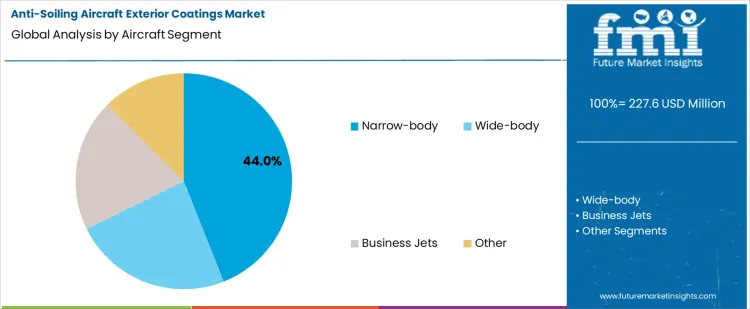
Narrow-body aircraft account for approximately 44% of total aircraft segment demand, making them the largest category. These aircraft are widely used in short- to medium-haul commercial operations and experience frequent takeoffs, landings, and exposure to environmental contaminants. Adoption is driven by the need to maintain aerodynamic performance, minimize cleaning requirements, and reduce operational costs. Coatings are applied to fuselage, wings, and control surfaces to ensure smooth airflow and structural protection.
Operational factors influence adoption in narrow-body fleets. Maintenance teams integrate anti-soiling coatings with scheduled inspections and cleaning routines. Coatings must resist UV exposure, rain, dust, and industrial contaminants while maintaining adhesion and surface finish. Airlines prioritize coatings that optimize fuel efficiency, reduce maintenance labor, and extend coating lifespan. The segment leads because narrow-body aircraft represent high operational volumes, offering measurable benefits from anti-soiling coatings across commercial aviation networks.
How Are Anti-Soiling Coatings Enhancing Aircraft Operational Efficiency?
Anti-soiling coatings are applied to aircraft exteriors to prevent accumulation of dirt, pollutants, and other environmental contaminants. Adoption is strongest among commercial airlines, business jets, and military fleets operating in regions with high dust, pollution, or coastal exposure. Coatings are chosen for adhesion, durability, and resistance to chemical and environmental degradation. Growth is driven by reduced cleaning frequency, fuel efficiency maintenance, and extended surface life. Investment decisions prioritize coating longevity, regulatory compliance, and compatibility with maintenance protocols. Operators value coatings that maintain aerodynamic smoothness and minimize operational downtime while ensuring consistent surface protection.
Why Are Regional Environmental Conditions and Maintenance Regulations Driving Adoption?
Aircraft operating in arid, urban, or coastal regions face higher contaminant exposure, increasing the need for protective coatings. Airlines adopt anti-soiling solutions to meet operational standards, reduce labor-intensive cleaning, and comply with safety and environmental regulations. Coatings that maintain surface performance and reduce contamination accumulation gain preference. Adoption is concentrated in regions where operational efficiency and regulatory compliance are critical. Reliable anti-soiling coatings help operators optimize maintenance schedules, minimize service interruptions, and reduce overall operating costs, supporting fleet performance in challenging environments.
What Factors Constrain Broader Implementation of Anti-Soiling Coatings?
High material and application costs limit adoption for smaller fleets. Surface preparation requirements and precise application techniques are critical for performance. Exposure to extreme temperatures, UV radiation, and abrasion can reduce coating effectiveness over time. Certification and approval processes for new formulations can extend deployment timelines. Smaller operators or those in regions with milder environmental conditions adopt coatings more slowly. These constraints restrict early deployment to well-funded airlines, military fleets, and OEM maintenance programs capable of maintaining technical and regulatory standards.
How Are Innovation and Industry Partnerships Influencing Anti-Soiling Coating Applications?
Developments focus on coatings with improved contaminant repellency, UV resistance, and long-term durability. Collaboration between coating manufacturers, aircraft OEMs, and airlines enables testing under real-world operational conditions and alignment with regulatory requirements. Pilot studies evaluate cleaning reduction and aerodynamic performance before large-scale adoption. Quality monitoring and traceability systems enhance reliability and compliance documentation. Emphasis is on operational efficiency, surface protection, and regulatory alignment rather than cost or production scale. Collaborative efforts enable consistent application of anti-soiling coatings, reducing maintenance, improving fuel efficiency, and supporting regional aviation standards.
What is the Demand for Anti-Soiling Aircraft Exterior Coatings by Country?
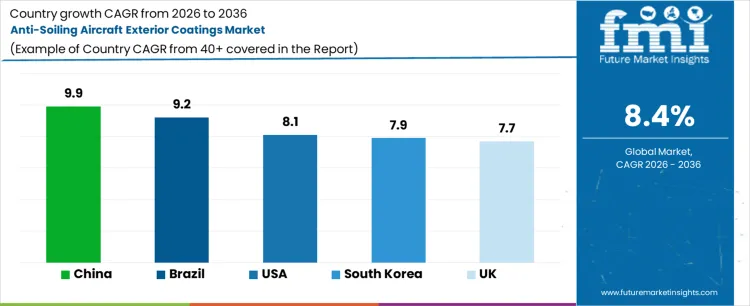
| Country | CAGR (%) |
|---|---|
| USA | 8.1% |
| South Korea | 7.9% |
| China | 9.9% |
| UK | 7.7% |
| Brazil | 9.2% |
Demand for anti-soiling aircraft exterior coatings is rising as airlines and manufacturers aim to maintain aircraft aesthetics, reduce cleaning frequency, and improve operational efficiency. China leads with a 9.9% CAGR, driven by rapid expansion of commercial aircraft fleets and adoption of advanced coating technologies to minimize surface contamination. Brazil follows at 9.2%, supported by domestic aircraft manufacturing and retrofitting initiatives. The USA grows at 8.1%, shaped by fleet maintenance programs and regulatory compliance requirements. South Korea records 7.9% growth, driven by technological upgrades and high-quality maintenance standards. The UK shows 7.7% CAGR, reflecting steady adoption of anti-soiling coatings in both commercial and defense aviation sectors.
How Is the United States Experiencing Growth in the Anti-Soiling Aircraft Exterior Coatings Market?
United States is experiencing growth at a CAGR of 8.1%, supported by adoption of anti-soiling coatings to reduce dirt accumulation, improve surface performance, and lower maintenance costs. Airlines and aerospace OEMs are applying coatings on fuselage, wings, and control surfaces to enhance aerodynamic efficiency and maintain aesthetic appearance. Demand is concentrated in airline hubs, MRO centers, and aerospace manufacturing facilities. Investments prioritize coating durability, application precision, and performance under environmental exposure rather than fleet expansion. Growth reflects increasing operational efficiency requirements, extended maintenance intervals, and adoption of advanced surface technologies. Manufacturers are developing formulations that resist dirt, corrosion, and environmental degradation while maintaining aerodynamic properties.
- Airlines and OEMs drive adoption.
- Coatings reduce dirt accumulation on wings and fuselage.
- Airline hubs and MRO centers concentrate demand.
- Coating durability and application precision guide investment.
How Is South Korea Witnessing Steady Adoption Through Aircraft Maintenance Programs?
South Korea is witnessing steady adoption at a CAGR of 7.9%, supported by airline maintenance programs and initiatives to enhance aircraft performance. Anti-soiling coatings are applied to fuselage, wings, and tail surfaces to maintain cleanliness, improve aerodynamic efficiency, and reduce cleaning cycles. Demand is concentrated in urban airport hubs, MRO facilities, and aerospace manufacturing centers. Investments focus on coating performance, material longevity, and precise application rather than fleet expansion. Growth reflects operational efficiency goals, reduced maintenance costs, and rising adoption of advanced surface technologies to protect aircraft in diverse weather conditions.
- Maintenance programs drive adoption.
- Fuselage, wings, and tail surfaces are primary applications.
- Urban airport hubs and MRO centers concentrate demand.
- Coating performance and material longevity guide investment.
How Is China Experiencing Rapid Growth With Expanding Aircraft Fleets?
China is experiencing rapid growth at a CAGR of 9.9%, fueled by expansion of commercial and military aircraft fleets and adoption of anti-soiling coatings to maintain surface performance and reduce maintenance costs. Airlines and aerospace OEMs are implementing coatings on wings, fuselage, and control surfaces to resist dirt, dust, and environmental contaminants. Demand is concentrated in major airline hubs, aerospace manufacturing facilities, and maintenance centers. Investments prioritize coating durability, application accuracy, and surface performance rather than fleet expansion. Growth reflects fleet modernization, operational efficiency objectives, and adoption of advanced surface technologies to improve aircraft longevity.
- Fleet expansion drives adoption.
- Coatings resist dirt and environmental contaminants.
- Airline hubs and manufacturing facilities concentrate demand.
- Durability and application accuracy guide investment.
How Is the United Kingdom Growing Through Operational Efficiency Initiatives?
The United Kingdom is growing at a CAGR of 7.7%, supported by adoption of anti-soiling coatings to reduce maintenance frequency, maintain surface aesthetics, and enhance aerodynamic performance. Airlines and OEMs are applying coatings on fuselage, wings, and control surfaces for operational efficiency and reduced cleaning costs. Demand is concentrated in airline hubs, MRO centers, and aerospace manufacturing facilities. Investments focus on coating performance, material durability, and precise application rather than fleet expansion. Growth reflects the integration of advanced surface protection technologies and operational optimization measures to improve aircraft service life and reduce maintenance intervals.
- Airlines and OEMs drive adoption.
- Coatings enhance aerodynamic performance and reduce cleaning.
- Airline hubs and MRO centers concentrate demand.
- Coating performance and material durability guide investment.
How Is Brazil Experiencing Expansion With Fleet Modernization and Surface Protection?
Brazil is experiencing growth at a CAGR of 9.2%, supported by commercial and military fleet modernization and adoption of anti-soiling coatings to maintain surface integrity and reduce maintenance cycles. Airlines and aerospace OEMs are applying coatings on fuselage, wings, and tail surfaces to resist dirt, environmental contaminants, and corrosion. Demand is concentrated in airline hubs, MRO centers, and aerospace manufacturing sites. Investments prioritize coating durability, performance, and application precision rather than fleet expansion. Growth reflects operational efficiency goals, regulatory compliance, and adoption of advanced surface technologies to reduce downtime and extend aircraft service life.
- Fleet modernization drives adoption.
- Coatings resist dirt and environmental damage.
- Airline hubs and MRO centers concentrate demand.
- Coating durability and performance guide investment.
Who Competes in the Anti Soiling Aircraft Exterior Coatings Market and What Defines Their Roles?
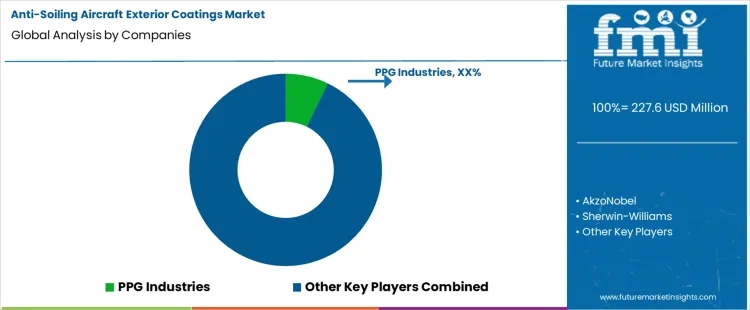
Market participants in anti soiling aircraft exterior coatings offer formulations that reduce deposition of dust, exhaust residues, and environmental grime on airframes. PPG Industries supplies exterior coatings engineered to maintain surface cleanliness and preserve aerodynamic performance. AkzoNobel provides coatings formulated for ease of removal of contaminants under routine wash cycles. Sherwin Williams delivers anti soiling systems designed for durable performance under repeated operational exposure. 3M focuses on surface treatments that resist particulate adherence without compromising surface integrity. Mankiewicz develops tailored coating chemistries suited to aircraft exterior materials and finish requirements.
Regional and technology oriented firms contribute differentiated solutions calibrated to operational contexts. Henkel offers engineered resin systems compatible with primers and topcoats. BASF advances polymer additives that improve surface repellency. DuPont supplies low surface energy chemistries that influence contaminant release. Solvay develops advanced materials enhancing coating cohesion. Saint Gobain provides substrate interfaces that support adherence of anti soiling layers. Market distinctions arise from coating longevity, resistance metrics under diverse climates, and qualification records with aircraft manufacturers and maintenance providers.
Key Players in the Anti-Soiling Aircraft Exterior Coatings Market
- PPG Industries
- AkzoNobel
- Sherwin-Williams
- 3M
- Mankiewicz
- Henkel
- BASF
- DuPont
- Solvay
- Saint-Gobain
Scope of the Report
| Items | Values |
|---|---|
| Quantitative Units (2026) | USD million |
| Coating Function | Anti-Soiling Topcoats, Easy-Clean Clearcoats, Anti-Fouling Sealants, Other |
| Aircraft Segment | Narrow-body, Wide-body, Business Jets, Other |
| Application Area | Upper Fuselage, Nacelles, Wings/Empennage, Other |
| Sales Channel | MRO and Aftermarket, OEM Line-Fit, Airline In-House, Other |
| Region | Asia Pacific, Europe, North America, Latin America, Middle East & Africa |
| Key Countries Covered | China, Japan, South Korea, India, Australia & New Zealand, Germany, United Kingdom, France, Italy, Spain, Nordic, BENELUX, United States, Canada, Mexico, Brazil, Chile, Kingdom of Saudi Arabia, Other GCC Countries, Turkey, South Africa, Other African Union |
| Key Companies Profiled | PPG Industries, AkzoNobel, Sherwin-Williams, 3M, Mankiewicz, Henkel, BASF, DuPont, Solvay, Saint-Gobain |
| Additional Attributes | Dollar sales by coating function, aircraft segment, application area, and sales channel; regional CAGR and forecast value growth 2026 to 2036; operational performance, contaminant resistance, durability, regulatory compliance, fleet maintenance integration, MRO support, lifecycle protection |
Anti-Soiling Aircraft Exterior Coatings Market Segmentation
Coating Function:
- Anti-Soiling Topcoats
- Easy-Clean Clearcoats
- Anti-Fouling Sealants
- Other
Aircraft Segment:
- Narrow-body
- Wide-body
- Business Jets
- Other
Application Area:
- Upper Fuselage
- Nacelles
- Wings/Empennage
- Other
Sales Channel:
- MRO and Aftermarket
- OEM Line-Fit
- Airline In-House
- Other
Region:
- Asia Pacific
- China
- Japan
- South Korea
- India
- Australia & New Zealand
- ASEAN
- Rest of Asia Pacific
- Europe
- Germany
- United Kingdom
- France
- Italy
- Spain
- Nordic
- BENELUX
- Rest of Europe
- North America
- United States
- Canada
- Mexico
- Latin America
- Brazil
- Chile
- Rest of Latin America
- Middle East & Africa
- Kingdom of Saudi Arabia
- Other GCC Countries
- Turkey
- South Africa
- Other African Union
- Rest of Middle East & Africa
Bibliography
- European Aviation Safety Agency (EASA). Environmental and material compliance guidelines for aircraft coatings and finishes, 2023 Edition.
- Boeing Material Specification (BMS) 10-83H. Exterior Finishing Systems—Coatings for Aircraft Applications, 2023 revision.
- ICAO Environmental Standards. Aircraft emissions and coating waste disposal compliance framework, 2023 Technical Circular.
- Future Market Insights. Anti-Soiling Aircraft Exterior Coatings Market Size and Share Forecast Outlook 2026–2036, internal model dataset, updated January 2026.
Frequently Asked Questions
How big is the anti-soiling aircraft exterior coatings market in 2026?
The global anti-soiling aircraft exterior coatings market is estimated to be valued at USD 227.6 million in 2026.
What will be the size of anti-soiling aircraft exterior coatings market in 2036?
The market size for the anti-soiling aircraft exterior coatings market is projected to reach USD 509.9 million by 2036.
How much will be the anti-soiling aircraft exterior coatings market growth between 2026 and 2036?
The anti-soiling aircraft exterior coatings market is expected to grow at a 8.4% CAGR between 2026 and 2036.
What are the key product types in the anti-soiling aircraft exterior coatings market?
The key product types in anti-soiling aircraft exterior coatings market are anti-soiling topcoats, easy-clean clearcoats, anti-fouling sealants and other.
Which aircraft segment segment to contribute significant share in the anti-soiling aircraft exterior coatings market in 2026?
In terms of aircraft segment, narrow-body segment to command 44.0% share in the anti-soiling aircraft exterior coatings market in 2026.
Preview the report firsthand - request a free sample
Get SampleGet the brochure for pricing and purchase details.
Get PDFTable of Content
- Executive Summary
- Global Market Outlook
- Demand-side Trends
- Supply-side Trends
- Technology Roadmap Analysis
- Analysis and Recommendations
- Market Overview
- Market Coverage / Taxonomy
- Market Definition / Scope / Limitations
- Market Background
- Market Dynamics
- Drivers
- Restraints
- Opportunity
- Trends
- Scenario Forecast
- Demand in Optimistic Scenario
- Demand in Likely Scenario
- Demand in Conservative Scenario
- Opportunity Map Analysis
- Product Life Cycle Analysis
- Supply Chain Analysis
- Investment Feasibility Matrix
- Value Chain Analysis
- PESTLE and Porter’s Analysis
- Regulatory Landscape
- Regional Parent Market Outlook
- Production and Consumption Statistics
- Import and Export Statistics
- Market Dynamics
- Global Market Analysis 2021 to 2025 and Forecast, 2026 to 2036
- Historical Market Size Value (USD Million) Analysis, 2021 to 2025
- Current and Future Market Size Value (USD Million) Projections, 2026 to 2036
- Y-o-Y Growth Trend Analysis
- Absolute $ Opportunity Analysis
- Global Market Pricing Analysis 2021 to 2025 and Forecast 2026 to 2036
- Global Market Analysis 2021 to 2025 and Forecast 2026 to 2036, By Coating Function
- Introduction / Key Findings
- Historical Market Size Value (USD Million) Analysis By Coating Function , 2021 to 2025
- Current and Future Market Size Value (USD Million) Analysis and Forecast By Coating Function , 2026 to 2036
- Anti-Soiling Topcoats
- Easy-Clean Clearcoats
- Anti-Fouling Sealants
- Other
- Anti-Soiling Topcoats
- Y-o-Y Growth Trend Analysis By Coating Function , 2021 to 2025
- Absolute $ Opportunity Analysis By Coating Function , 2026 to 2036
- Global Market Analysis 2021 to 2025 and Forecast 2026 to 2036, By Aircraft Segment
- Introduction / Key Findings
- Historical Market Size Value (USD Million) Analysis By Aircraft Segment, 2021 to 2025
- Current and Future Market Size Value (USD Million) Analysis and Forecast By Aircraft Segment, 2026 to 2036
- Narrow-body
- Wide-body
- Business Jets
- Other
- Narrow-body
- Y-o-Y Growth Trend Analysis By Aircraft Segment, 2021 to 2025
- Absolute $ Opportunity Analysis By Aircraft Segment, 2026 to 2036
- Global Market Analysis 2021 to 2025 and Forecast 2026 to 2036, By Application Area
- Introduction / Key Findings
- Historical Market Size Value (USD Million) Analysis By Application Area, 2021 to 2025
- Current and Future Market Size Value (USD Million) Analysis and Forecast By Application Area, 2026 to 2036
- Upper Fuselage
- Nacelles
- Wings and Empennage
- Other
- Upper Fuselage
- Y-o-Y Growth Trend Analysis By Application Area, 2021 to 2025
- Absolute $ Opportunity Analysis By Application Area, 2026 to 2036
- Global Market Analysis 2021 to 2025 and Forecast 2026 to 2036, By Sales Channel
- Introduction / Key Findings
- Historical Market Size Value (USD Million) Analysis By Sales Channel, 2021 to 2025
- Current and Future Market Size Value (USD Million) Analysis and Forecast By Sales Channel, 2026 to 2036
- MRO/Aftermarket
- OEM Line-Fit
- Airline In-House
- Other
- MRO/Aftermarket
- Y-o-Y Growth Trend Analysis By Sales Channel, 2021 to 2025
- Absolute $ Opportunity Analysis By Sales Channel, 2026 to 2036
- Global Market Analysis 2021 to 2025 and Forecast 2026 to 2036, By Region
- Introduction
- Historical Market Size Value (USD Million) Analysis By Region, 2021 to 2025
- Current Market Size Value (USD Million) Analysis and Forecast By Region, 2026 to 2036
- North America
- Latin America
- Western Europe
- Eastern Europe
- East Asia
- South Asia and Pacific
- Middle East & Africa
- Market Attractiveness Analysis By Region
- North America Market Analysis 2021 to 2025 and Forecast 2026 to 2036, By Country
- Historical Market Size Value (USD Million) Trend Analysis By Market Taxonomy, 2021 to 2025
- Market Size Value (USD Million) Forecast By Market Taxonomy, 2026 to 2036
- By Country
- USA
- Canada
- Mexico
- By Coating Function
- By Aircraft Segment
- By Application Area
- By Sales Channel
- By Country
- Market Attractiveness Analysis
- By Country
- By Coating Function
- By Aircraft Segment
- By Application Area
- By Sales Channel
- Key Takeaways
- Latin America Market Analysis 2021 to 2025 and Forecast 2026 to 2036, By Country
- Historical Market Size Value (USD Million) Trend Analysis By Market Taxonomy, 2021 to 2025
- Market Size Value (USD Million) Forecast By Market Taxonomy, 2026 to 2036
- By Country
- Brazil
- Chile
- Rest of Latin America
- By Coating Function
- By Aircraft Segment
- By Application Area
- By Sales Channel
- By Country
- Market Attractiveness Analysis
- By Country
- By Coating Function
- By Aircraft Segment
- By Application Area
- By Sales Channel
- Key Takeaways
- Western Europe Market Analysis 2021 to 2025 and Forecast 2026 to 2036, By Country
- Historical Market Size Value (USD Million) Trend Analysis By Market Taxonomy, 2021 to 2025
- Market Size Value (USD Million) Forecast By Market Taxonomy, 2026 to 2036
- By Country
- Germany
- UK
- Italy
- Spain
- France
- Nordic
- BENELUX
- Rest of Western Europe
- By Coating Function
- By Aircraft Segment
- By Application Area
- By Sales Channel
- By Country
- Market Attractiveness Analysis
- By Country
- By Coating Function
- By Aircraft Segment
- By Application Area
- By Sales Channel
- Key Takeaways
- Eastern Europe Market Analysis 2021 to 2025 and Forecast 2026 to 2036, By Country
- Historical Market Size Value (USD Million) Trend Analysis By Market Taxonomy, 2021 to 2025
- Market Size Value (USD Million) Forecast By Market Taxonomy, 2026 to 2036
- By Country
- Russia
- Poland
- Hungary
- Balkan & Baltic
- Rest of Eastern Europe
- By Coating Function
- By Aircraft Segment
- By Application Area
- By Sales Channel
- By Country
- Market Attractiveness Analysis
- By Country
- By Coating Function
- By Aircraft Segment
- By Application Area
- By Sales Channel
- Key Takeaways
- East Asia Market Analysis 2021 to 2025 and Forecast 2026 to 2036, By Country
- Historical Market Size Value (USD Million) Trend Analysis By Market Taxonomy, 2021 to 2025
- Market Size Value (USD Million) Forecast By Market Taxonomy, 2026 to 2036
- By Country
- China
- Japan
- South Korea
- By Coating Function
- By Aircraft Segment
- By Application Area
- By Sales Channel
- By Country
- Market Attractiveness Analysis
- By Country
- By Coating Function
- By Aircraft Segment
- By Application Area
- By Sales Channel
- Key Takeaways
- South Asia and Pacific Market Analysis 2021 to 2025 and Forecast 2026 to 2036, By Country
- Historical Market Size Value (USD Million) Trend Analysis By Market Taxonomy, 2021 to 2025
- Market Size Value (USD Million) Forecast By Market Taxonomy, 2026 to 2036
- By Country
- India
- ASEAN
- Australia & New Zealand
- Rest of South Asia and Pacific
- By Coating Function
- By Aircraft Segment
- By Application Area
- By Sales Channel
- By Country
- Market Attractiveness Analysis
- By Country
- By Coating Function
- By Aircraft Segment
- By Application Area
- By Sales Channel
- Key Takeaways
- Middle East & Africa Market Analysis 2021 to 2025 and Forecast 2026 to 2036, By Country
- Historical Market Size Value (USD Million) Trend Analysis By Market Taxonomy, 2021 to 2025
- Market Size Value (USD Million) Forecast By Market Taxonomy, 2026 to 2036
- By Country
- Kingdom of Saudi Arabia
- Other GCC Countries
- Turkiye
- South Africa
- Other African Union
- Rest of Middle East & Africa
- By Coating Function
- By Aircraft Segment
- By Application Area
- By Sales Channel
- By Country
- Market Attractiveness Analysis
- By Country
- By Coating Function
- By Aircraft Segment
- By Application Area
- By Sales Channel
- Key Takeaways
- Key Countries Market Analysis
- USA
- Pricing Analysis
- Market Share Analysis, 2025
- By Coating Function
- By Aircraft Segment
- By Application Area
- By Sales Channel
- Canada
- Pricing Analysis
- Market Share Analysis, 2025
- By Coating Function
- By Aircraft Segment
- By Application Area
- By Sales Channel
- Mexico
- Pricing Analysis
- Market Share Analysis, 2025
- By Coating Function
- By Aircraft Segment
- By Application Area
- By Sales Channel
- Brazil
- Pricing Analysis
- Market Share Analysis, 2025
- By Coating Function
- By Aircraft Segment
- By Application Area
- By Sales Channel
- Chile
- Pricing Analysis
- Market Share Analysis, 2025
- By Coating Function
- By Aircraft Segment
- By Application Area
- By Sales Channel
- Germany
- Pricing Analysis
- Market Share Analysis, 2025
- By Coating Function
- By Aircraft Segment
- By Application Area
- By Sales Channel
- UK
- Pricing Analysis
- Market Share Analysis, 2025
- By Coating Function
- By Aircraft Segment
- By Application Area
- By Sales Channel
- Italy
- Pricing Analysis
- Market Share Analysis, 2025
- By Coating Function
- By Aircraft Segment
- By Application Area
- By Sales Channel
- Spain
- Pricing Analysis
- Market Share Analysis, 2025
- By Coating Function
- By Aircraft Segment
- By Application Area
- By Sales Channel
- France
- Pricing Analysis
- Market Share Analysis, 2025
- By Coating Function
- By Aircraft Segment
- By Application Area
- By Sales Channel
- India
- Pricing Analysis
- Market Share Analysis, 2025
- By Coating Function
- By Aircraft Segment
- By Application Area
- By Sales Channel
- ASEAN
- Pricing Analysis
- Market Share Analysis, 2025
- By Coating Function
- By Aircraft Segment
- By Application Area
- By Sales Channel
- Australia & New Zealand
- Pricing Analysis
- Market Share Analysis, 2025
- By Coating Function
- By Aircraft Segment
- By Application Area
- By Sales Channel
- China
- Pricing Analysis
- Market Share Analysis, 2025
- By Coating Function
- By Aircraft Segment
- By Application Area
- By Sales Channel
- Japan
- Pricing Analysis
- Market Share Analysis, 2025
- By Coating Function
- By Aircraft Segment
- By Application Area
- By Sales Channel
- South Korea
- Pricing Analysis
- Market Share Analysis, 2025
- By Coating Function
- By Aircraft Segment
- By Application Area
- By Sales Channel
- Russia
- Pricing Analysis
- Market Share Analysis, 2025
- By Coating Function
- By Aircraft Segment
- By Application Area
- By Sales Channel
- Poland
- Pricing Analysis
- Market Share Analysis, 2025
- By Coating Function
- By Aircraft Segment
- By Application Area
- By Sales Channel
- Hungary
- Pricing Analysis
- Market Share Analysis, 2025
- By Coating Function
- By Aircraft Segment
- By Application Area
- By Sales Channel
- Kingdom of Saudi Arabia
- Pricing Analysis
- Market Share Analysis, 2025
- By Coating Function
- By Aircraft Segment
- By Application Area
- By Sales Channel
- Turkiye
- Pricing Analysis
- Market Share Analysis, 2025
- By Coating Function
- By Aircraft Segment
- By Application Area
- By Sales Channel
- South Africa
- Pricing Analysis
- Market Share Analysis, 2025
- By Coating Function
- By Aircraft Segment
- By Application Area
- By Sales Channel
- USA
- Market Structure Analysis
- Competition Dashboard
- Competition Benchmarking
- Market Share Analysis of Top Players
- By Regional
- By Coating Function
- By Aircraft Segment
- By Application Area
- By Sales Channel
- Competition Analysis
- Competition Deep Dive
- PPG Industries
- Overview
- Product Portfolio
- Profitability by Market Segments (Product/Age /Sales Channel/Region)
- Sales Footprint
- Strategy Overview
- Marketing Strategy
- Product Strategy
- Channel Strategy
- AkzoNobel
- Sherwin-Williams
- 3M
- Mankiewicz
- Henkel
- BASF
- DuPont
- Solvay
- Saint-Gobain
- PPG Industries
- Competition Deep Dive
- Assumptions & Acronyms Used
- Research Methodology


