

- Industry Size (2026)
- USD 2.0 Bn
- Forecast (2036)
- USD 5.0 Bn
- CAGR (2026 to 2036)
- 9.6%
Composite Grade PCR for Decorative & Structural Surfaces Market Forecast and Outlook 2026 to 2036
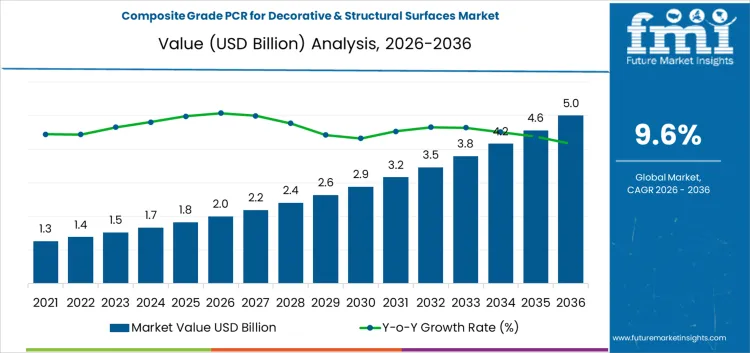
The composite grade PCR for decorative and structural surfaces market is likely to be valued at USD 2 billion in 2026 and is projected to reach USD 5 billion by 2036, expanding at a CAGR of 9.6%. Growth is being shaped by procurement shifts within construction, furniture, and interior surface manufacturing toward materials that balance mechanical performance, cost control, and supply security. Post-consumer recycled content is increasingly specified in composite panels, boards, and surface systems as manufacturers seek to reduce exposure to virgin raw material price volatility while maintaining required strength, finish quality, and processing consistency.
Composite grade PCR materials are gaining acceptance because they offer predictable performance, stable input costs, and compatibility with existing production lines. In decorative and structural applications, purchasing decisions are driven by durability, machining behavior, surface finish, and long-term maintenance requirements rather than by material origin alone. Adoption is also supported by improving sorting, compounding, and quality control practices, which have reduced variability in recycled feedstock. Over the forecast period, demand is expected to expand through broader specification in commercial buildings, furniture, and interior fit-out projects, supported by standardization of material grades and qualification by large-volume buyers.
Quick Stats for Composite Grade PCR for Decorative & Structural Surfaces Market
- Composite Grade PCR for Decorative & Structural Surfaces Market Value (2026): USD 2.0 billion
- Composite Grade PCR for Decorative & Structural Surfaces Market Forecast Value (2036): USD 5.0 billion
- Composite Grade PCR for Decorative & Structural Surfaces Market Forecast CAGR 2026 to 2036: 9.6%
- Leading Type in Composite Grade PCR for Decorative & Structural Surfaces Market: Composite panels & boards
- Key Growth Regions in Composite Grade PCR for Decorative & Structural Surfaces Market: Asia Pacific, North America, Europe
- Top Players in Composite Grade PCR for Decorative & Structural Surfaces Market: Trespa, BASF, Wilsonart, Kingfa, Greenpanel, Duratex, Sumitomo Chemical
What is the Growth Forecast for Composite Grade PCR for Decorative & Structural Surfaces Market through 2036?
The composite grade PCR for decorative and structural surfaces market is projected to reach USD 2 billion in 2026 and grow to USD 5 billion by 2036, registering a compound annual growth rate (CAGR) of 9.6%. From 2020 to 2026, the market expands from USD 1.1 billion to USD 2 billion, driven by increased demand for eco-efficient materials in both decorative and structural applications. As industries prioritize performance and environmental compliance, the adoption of composite grade PCR materials is rising. North America leads in adoption, influenced by stringent environmental regulations, while Asia Pacific shows rapid growth as production capabilities and market demand for cost-effective solutions increase.
Between 2026 and 2036, the composite grade PCR for decorative and structural surfaces market will continue to rise, reaching USD 5 billion by 2036. The market will grow from USD 2.2 billion in 2027 to USD 4.6 billion by 2034. The drive for eco-efficient construction and design practices is expected to support this expansion. Adoption rates will vary across regions, with mature markets focusing on high-performance materials, while emerging markets experience faster adoption due to lower initial costs and rising infrastructure projects. Vendors that meet both performance and environmental standards will be well-positioned to capture significant market share in these diverse regions.
Composite Grade PCR for Decorative & Structural Surfaces Market Key Takeaways
| Metric | Value |
|---|---|
| Market Value (2026) | USD 2.0 billion |
| Forecast Value (2036) | USD 5.0 billion |
| Forecast CAGR 2026 to 2036 | 9.6% |
What Are the Key Drivers Behind the Growth of Composite Grade PCR for Decorative and Structural Surfaces?
The demand for composite grade post-consumer recycled (PCR) materials in decorative and structural surfaces is rising as industries seek materials that combine both high performance and environmental responsibility. Applications such as wall panels, flooring, and facades are increasingly incorporating PCR composites, which offer a balance of durability, aesthetic quality, and cost-effectiveness. These materials are carefully selected to meet performance criteria including wear resistance, impact strength, and environmental resilience, making them suitable for a wide range of interior and exterior applications. As product designers and manufacturers focus on eco-efficient material sourcing, PCR-based composites are becoming an essential choice in the production of surfaces that can withstand the wear and tear of everyday use while offering a visually appealing finish.
The growing adoption of composite grade PCR materials is influenced by economic factors and the evolving needs of the construction and interior design sectors. Manufacturers are responding to the demand for PCR materials by ensuring consistent quality control, offering products that meet both aesthetic and structural requirements. In many cases, PCR composites are proving to be a cost-effective alternative to traditional materials, providing comparable durability and performance at a lower price point. As the industry adapts to shifting procurement and regulatory demands, composite grade PCR materials are increasingly being integrated into a variety of applications, from residential building interiors to commercial cladding, contributing to the wider acceptance of recycled content in construction and design.
What Are the Key Segments in the Composite Grade PCR for Decorative & Structural Surfaces Market?
The Composite Grade PCR for Decorative & Structural Surfaces Market is segmented into End-use and Surface or Panel Type. Facades, cladding & interiors lead the End-use segment with 42%, while Composite panels & boards dominate the Surface or Panel Type segment, holding 45% of the market share. These segments reflect the demand for eco-efficient, durable, and high-performance materials in construction and interior design. As the construction and design industries continue to prioritize both aesthetic appeal and functionality, the adoption of post-consumer recycled (PCR) materials in composite surfaces is expanding, driven by regulatory standards and market demands for more eco-friendly building solutions.
How Do Facades, Cladding & Interiors Drive Adoption of Composite Grade PCR Materials?
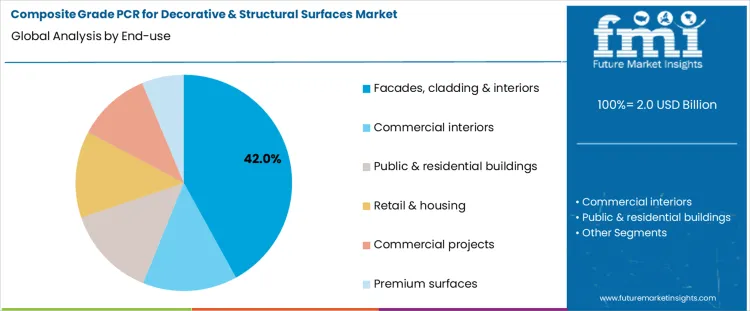
The Facades, cladding & interiors segment captures 42% of the End-use share in the Composite Grade PCR for Decorative & Structural Surfaces Market. This segment includes materials used in both the exterior and interior design of buildings. Facades and cladding systems are crucial for energy efficiency, aesthetics, and weather resistance, while interior components such as wall coverings and panels contribute to building performance and comfort. Composite PCR materials are increasingly being used for these applications due to their strength, durability, and lightweight properties. Incorporating recycled content in these components offers an attractive solution for builders and architects looking to meet environmental standards without compromising on performance.
The adoption of composite PCR materials in facades, cladding, and interiors is influenced by the increasing demand for high-performance materials that combine aesthetics and functionality. Sustainability and regulatory requirements are key drivers, as many regions impose strict standards on the environmental impact of building materials. The supply side is shaped by the ability to produce composite materials that provide the desired mechanical and aesthetic qualities while using recycled content. Challenges include ensuring material consistency and achieving the necessary strength and durability standards in high-performance applications. Despite these obstacles, the demand for PCR-based composite materials is expected to grow as manufacturers improve recycling processes and material formulations.
How Do Composite Panels & Boards Impact the Demand for Composite Grade PCR Materials?
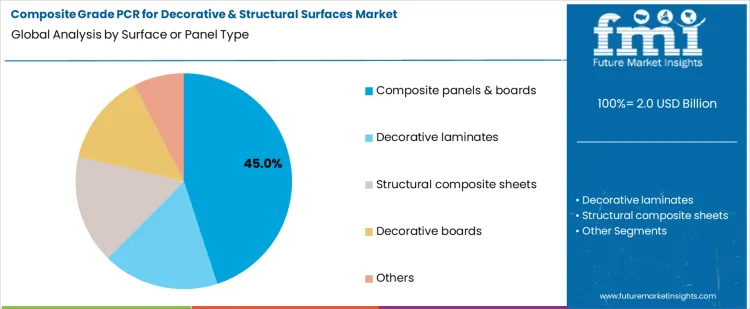
Composite panels & boards dominate the Surface or Panel Type segment, holding 45% of the market share in the Composite Grade PCR for Decorative & Structural Surfaces Market. These panels are extensively used in construction, interior design, and furniture due to their ability to combine aesthetic appeal with structural strength. Composite panels made from PCR materials, such as recycled wood, plastics, and resins, are particularly valued for their lightweight nature and high mechanical properties. These panels provide excellent resistance to wear and tear, moisture, and fire, making them ideal for both interior and exterior applications in commercial and residential buildings.
The demand for composite panels and boards is driven by the need for high-performance, cost-effective, and environmentally responsible materials in both the residential and commercial construction markets. As building regulations tighten and the focus on reducing carbon footprints intensifies, the adoption of composite panels made from PCR materials provides an attractive alternative to traditional materials. Constraints such as variations in recycled feedstock, challenges in processing recycled polymers, and the need for consistent performance across large surface areas remain. However, as recycling technologies improve and material formulations evolve, the demand for composite panels and boards in construction and design is set to increase in the Composite Grade PCR for Decorative & Structural Surfaces Market.
What Specification and Procurement Criteria Are Driving Demand for Composite Grade PCR For Decorative & Structural Surfaces?
Procurement teams for interior design and construction specify composite grade PCR materials based on measurable metrics such as flexural strength, surface hardness, and impact resistance for applications like countertops, wall panels, and flooring. Buyers compare post-consumer recycled (PCR) resin composites with conventional laminates using standardized performance reports and certificates of analysis. Specifications often include UV stability and stain resistance data to ensure decorative surfaces maintain appearance over time. Tender evaluations include supplier capability for consistent batch properties and delivery schedules. Decisions hinge on verifiable performance data and fit with project design standards, shaping adoption across residential, commercial, and institutional surface applications.
What Material Quality and Processing Barriers Are Restricting Growth Of Composite Grade PCR For Decorative & Structural Surfaces?
Inconsistent feedstock composition in PCR streams affects mechanical and aesthetic outcomes for composite surfaces. Variability in polymer types and residual contaminants can alter color uniformity, surface finish, and structural performance under load. Processing these materials requires careful control of resin blending, filler distribution, and curing conditions to achieve targeted property profiles. Extensive compliance testing for fire performance, abrasion resistance, and moisture absorption adds development time. Regional differences in material approval criteria complicate cross-area acceptance for products destined for varied climates. These quality and processing constraints limit the pace at which composite grade PCR materials are specified for decorative and load-bearing surface applications.
How Are Application Patterns Shaping Use of Composite Grade PCR for Decorative & Structural Surfaces?
Design professionals are aligning part geometry and performance needs with specific PCR composite formulations. Interior architects refer to property data such as flexural modulus and scratch resistance to assign PCR composites to applications like reception desks, partition walls, and decorative trim. Structural engineers evaluate load-bearing capability through modeled stress profiles for floor inlays and stair components. Suppliers provide detailed guides that map PCR resin characteristics to installation methods, enabling planners to match materials with project requirements. Increasing use of digital simulation tools in early design stages allows assessment of finish quality and mechanical behavior before fabrication. These practices are informing where composite grade PCR materials are applied.
What Supply Chain and Cost Constraints Are Limiting Expansion Of Composite Grade PCR For Decorative & Structural Surfaces?
The composite grade PCR for decorative & structural surfaces market is constrained by variation in recycled feedstock availability. Post-consumer sources suitable for high-quality surface composites are unevenly distributed, resulting in irregular material streams. Sorting, cleaning, and preprocessing add handling costs and extend lead times. Infrastructure for compounding PCR into surface-grade composites remains limited, keeping costs higher compared with conventional materials. Price variability of recycled inputs complicates long-term procurement planning for large projects. Transport logistics and storage challenges for graded PCR materials introduce scheduling risk. These supply chain and cost dynamics restrict the ability of suppliers to provide stable pricing and guaranteed volumes of composite grade PCR products.
What Are the Growth Trends for Composite Grade PCR in Decorative & Structural Surfaces by Country?
| Country | CAGR (%) |
|---|---|
| Germany | 8.6% |
| USA | 8.2% |
| China | 12.4% |
| India | 13.2% |
| Brazil | 8.7% |
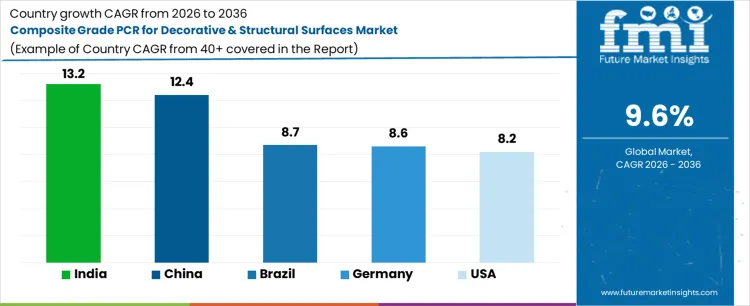
The composite grade PCR for decorative and structural surfaces market is experiencing robust growth across several countries. India leads with a 13.2% CAGR, driven by rising construction activities, increased demand for eco-efficient building materials, and a growing preference for PCR materials in both decorative and structural applications. China follows closely with a 12.4% growth rate, supported by a vast construction sector and significant adoption of eco-friendly materials in both residential and commercial projects. Germany shows steady growth at 8.6%, reflecting strong industry standards and demand for high-quality composite materials in decorative and structural surfaces. The USA records a growth rate of 8.2%, with an increasing shift toward eco-efficient building practices and materials in the construction industry. Brazil, at 8.7%, is seeing gradual adoption of composite grade PCR materials as demand for both aesthetic and functional building solutions increases.
What Is Driving Demand for Composite Grade PCR in Decorative & Structural Surfaces in Germany?
Composite grade PCR for decorative and structural surfaces in Germany is expected to grow at a CAGR of 8.6%. The construction and interior design sectors are increasingly adopting recycled materials to meet growing sustainability demands. As Germany pushes for reduced carbon footprints and energy-efficient designs, the demand for high-performance PCR composites in decorative and structural applications is rising. Stringent environmental regulations and consumer preference for eco-friendly materials in building and design further drive this trend. With innovations in polymer processing and material strength, Germany’s market for composite grade PCR continues to expand, making it a key player in eco-efficient construction and design.
- Consumer demand for eco-friendly materials fuels market expansion.
- Stringent regulations drive adoption of high-performance recycled materials.
- Innovations in composite materials improve durability and aesthetic appeal.
How Is the Composite Grade PCR Market in the USA Evolving?
In the USA, the composite grade PCR for decorative and structural surfaces market is projected to grow at a CAGR of 8.2%. USA manufacturers are increasingly turning to recycled materials to meet consumer demand for eco-efficient and durable design solutions. The construction and home improvement sectors are leading the charge in adopting PCR materials for both functional and decorative applications. Government regulations supporting recycling and waste management further contribute to the growth of this market. As the USA construction industry continues to emphasize green building practices, composite grade PCR materials are becoming essential in providing eco-friendly solutions for interior and exterior surfaces.
- Strong demand for eco-efficient building materials accelerates market growth.
- Regulatory incentives for recycling push the adoption of PCR composites.
- Increased focus on green building practices boosts demand for recycled materials.
What Is Accelerating the Growth of Composite Grade PCR in Decorative & Structural Surfaces in China?
Sales of composite grade PCR for decorative and structural surfaces in China are forecasted to grow at a CAGR of 12.4%. The rapid expansion in the construction industry, along with its commitment to sustainability, is driving the increased use of recycled materials in both decorative and structural applications. Government policies aimed at promoting circular economy practices and reducing waste are pushing for higher adoption of PCR composites. The demand for eco-friendly and durable materials, particularly in the interior design and construction sectors, is growing as China moves towards more eco-efficient development. With continued advancements in recycling and manufacturing technologies, China is set to dominate this market.
- Government policies promote the use of recycled materials in construction.
- Growing demand for eco-efficient and durable building materials drives adoption.
- Advancements in manufacturing technologies improve the quality of PCR composites.
What Is Fueling the Adoption of Composite Grade PCR in Decorative & Structural Surfaces in India?
Composite grade PCR for decorative and structural surfaces in India is set to grow at a CAGR of 13.2%. The booming construction industry in India is increasingly turning to recycled materials to meet both sustainability and performance requirements. As urbanization continues, demand for eco-friendly materials in both residential and commercial projects rises. Government initiatives that promote recycling and waste management are further accelerating this shift. The growing focus on energy-efficient buildings and eco-efficient development is pushing manufacturers to integrate PCR composites into a wider range of applications, from wall panels to flooring and ceilings, reinforcing India’s position in the global market.
- Urbanization drives the demand for eco-efficient building materials.
- Government incentives encourage recycling and eco-efficient construction practices.
- Growing focus on energy-efficient buildings accelerates the use of PCR composites.
How Is Brazil Adopting Composite Grade PCR for Decorative & Structural Surfaces?
Composite grade PCR for decorative and structural surfaces market in Brazil is expected to grow at a CAGR of 8.7%. The country’s expanding construction sector, combined with rising demand for eco-friendly and durable materials, is driving the adoption of PCR composites. As Brazil’s construction industry embraces green building practices, the use of recycled materials in both interior and exterior applications is increasing. Government policies supporting eco-efficient construction and recycling further encourage the shift to PCR materials. Local manufacturers are investing in technologies to enhance the performance of PCR composites, making them a key component in growing market for eco-efficient building materials.
- Growing construction industry drives demand for eco-efficient materials.
- Government regulations foster the use of recycled materials in construction.
- Investment in technology improves the quality of PCR composites for building applications.
What Differentiates Competition in Composite Grade PCR for Decorative & Structural Surfaces Market?
In Composite Grade PCR for Decorative & Structural Surfaces Market, Trespa and BASF compete with engineered composite panels and PCR-enhanced resin systems specified for façades, countertops, and high-use surfacing. Trespa markets Trespa® PCR decorative panels that combine post-consumer recycled content with phenolic and thermoset technology, with datasheets emphasizing uniform surface finish and resistance to impact and abrasion. BASF supplies PCR-modified polymers and resin binders used by fabricators to produce decorative laminates and structural panels, with technical literature detailing cured resin strength, moisture resistance, and consistent panel thickness. Wilsonart’s approach focuses on PCR composite surfacing materials that match specific decor aesthetics while providing validated mechanical properties for interior and exterior applications. Kingfa offers PCR resin compounds tailored for decorative laminate producers, emphasizing controlled melt flow and adhesion properties that support vertical and horizontal surface fabrication. Greenpanel competes with composite boards incorporating PCR polymers and wood fibers, promoted with performance data on bending strength and surface smoothness suitable for furniture and wall systems.
Duratex advances decorative and structural panels with PCR content integrated into its polymer matrix, supported by brochures outlining standardized test results for scratch resistance, load-bearing performance, and moisture tolerance. Sumitomo Chemical targets PCR-enhanced high-performance resin grades that facers and panel producers use to meet specific surface quality and dimensional stability requirements. Suppliers emphasize quantifiable properties such as modulus of rupture, coefficient of thermal expansion, and surface abrasion resistance, enabling designers and fabricators to specify materials with predictable results. Innovation focus varies from improved resin formulations that enhance decorative finish retention to composite panel systems engineered for structural loading, with each company highlighting product literature that aligns with decor trends and fabrication workflows.
Key Players in the Composite Grade PCR for Decorative & Structural Surfaces Market
- Trespa
- BASF
- Wilsonart
- Kingfa
- Greenpanel
- Duratex
- Sumitomo Chemical
Scope of the Report
| Items | Values |
|---|---|
| Quantitative Units (2026) | USD billion |
| End-use | Facades, Cladding & Interiors, Commercial Interiors, Public & Residential Buildings, Retail & Housing, Commercial Projects, Premium Surfaces |
| Surface or Panel Type | Composite Panels & Boards, Decorative Laminates, Structural Composite Sheets, Decorative Boards, Others |
| Material | PCR-PET, PCR-PET Composites, PCR Polymers, Others |
| Technology | Thermo-Compression & Surface Lamination, High-Pressure Lamination, High-Volume Panel Pressing, Cost-Efficient Composite Processing, Others |
| Regions Covered | Asia Pacific, Europe, North America, Latin America, Middle East & Africa |
| Countries Covered | China, Japan, South Korea, India, Australia & New Zealand, ASEAN, Germany, United Kingdom, France, Italy, Spain, Nordic, BENELUX, United States, Canada, Mexico, Brazil, Chile, Saudi Arabia, Turkey, South Africa, and other regional markets |
| Key Companies Profiled | Trespa, BASF, Wilsonart, Kingfa, Greenpanel, Duratex, Sumitomo Chemical |
| Additional Attributes | Dollar sales by end-use, surface type, material, and technology; facades, cladding, and interiors as the leading use; composite panels and boards as the main format; demand driven by durability and design requirements; procurement shaped by surface wear, impact, and moisture standards; performance influenced by feedstock quality, lamination processes, and compliance with building codes. |
Composite Grade PCR for Decorative & Structural Surfaces Market Segmentation
By End-use:
- Facades, cladding & interiors
- Commercial interiors
- Public & residential buildings
- Retail & housing
- Commercial projects
- Premium surfaces
By Surface or Panel Type:
- Composite panels & boards
- Decorative laminates
- Structural composite sheets
- Decorative boards
- Others
By Material:
- PCR-PET
- PCR-PET composites
- PCR polymers
- Others
By Technology:
- Thermo-compression & surface lamination
- High-pressure lamination
- High-volume panel pressing
- Cost-efficient composite processing
- Others
By Region:
- Asia Pacific
- China
- Japan
- South Korea
- India
- Australia & New Zealand
- ASEAN
- Rest of Asia Pacific
- Europe
- Germany
- United Kingdom
- France
- Italy
- Spain
- Nordic
- BENELUX
- Rest of Europe
- North America
- United States
- Canada
- Mexico
- Latin America
- Brazil
- Chile
- Rest of Latin America
- Middle East & Africa
- Kingdom of Saudi Arabia
- Other GCC Countries
- Turkey
- South Africa
- Other African Union
- Rest of Middle East & Africa
Bibliography
- European Parliament & Council of the European Union. (2024). Regulation (EU) 2024/… laying down harmonised rules for the marketing of construction products (Construction Products Regulation – CPR). Official Journal of the European Union.
- PlasticsEurope. (2023). Plastics — the facts 2023: An analysis of European plastics production, demand and waste data. PlasticsEurope.
- United States Environmental Protection Agency. (2023). Advancing sustainable materials management: 2023 fact sheet. U.S. EPA.
Frequently Asked Questions
How big is the composite grade pcr for decorative & structural surfaces market in 2026?
The global composite grade pcr for decorative & structural surfaces market is estimated to be valued at USD 2.0 billion in 2026.
What will be the size of composite grade pcr for decorative & structural surfaces market in 2036?
The market size for the composite grade pcr for decorative & structural surfaces market is projected to reach USD 5.0 billion by 2036.
How much will be the composite grade pcr for decorative & structural surfaces market growth between 2026 and 2036?
The composite grade pcr for decorative & structural surfaces market is expected to grow at a 9.6% CAGR between 2026 and 2036.
What are the key product types in the composite grade pcr for decorative & structural surfaces market?
The key product types in composite grade pcr for decorative & structural surfaces market are facades, cladding & interiors, commercial interiors, public & residential buildings, retail & housing, commercial projects and premium surfaces.
Which surface or panel type segment to contribute significant share in the composite grade pcr for decorative & structural surfaces market in 2026?
In terms of surface or panel type, composite panels & boards segment to command 45.0% share in the composite grade pcr for decorative & structural surfaces market in 2026.
Preview the report firsthand - request a free sample
Get SampleGet the brochure for pricing and purchase details.
Get PDFTable of Content
- Executive Summary
- Global Market Outlook
- Demand-side Trends
- Supply-side Trends
- Technology Roadmap Analysis
- Analysis and Recommendations
- Market Overview
- Market Coverage / Taxonomy
- Market Definition / Scope / Limitations
- Market Background
- Market Dynamics
- Drivers
- Restraints
- Opportunity
- Trends
- Scenario Forecast
- Demand in Optimistic Scenario
- Demand in Likely Scenario
- Demand in Conservative Scenario
- Opportunity Map Analysis
- Product Life Cycle Analysis
- Supply Chain Analysis
- Investment Feasibility Matrix
- Value Chain Analysis
- PESTLE and Porter’s Analysis
- Regulatory Landscape
- Regional Parent Market Outlook
- Production and Consumption Statistics
- Import and Export Statistics
- Market Dynamics
- Global Market Analysis 2021 to 2025 and Forecast, 2026 to 2036
- Historical Market Size Value (USD Million) Analysis, 2021 to 2025
- Current and Future Market Size Value (USD Million) Projections, 2026 to 2036
- Y-o-Y Growth Trend Analysis
- Absolute $ Opportunity Analysis
- Global Market Pricing Analysis 2021 to 2025 and Forecast 2026 to 2036
- Global Market Analysis 2021 to 2025 and Forecast 2026 to 2036, By End-use
- Introduction / Key Findings
- Historical Market Size Value (USD Million) Analysis By End-use , 2021 to 2025
- Current and Future Market Size Value (USD Million) Analysis and Forecast By End-use , 2026 to 2036
- Facades, cladding & interiors
- Commercial interiors
- Public & residential buildings
- Retail & housing
- Commercial projects
- Premium surfaces
- Facades, cladding & interiors
- Y-o-Y Growth Trend Analysis By End-use , 2021 to 2025
- Absolute $ Opportunity Analysis By End-use , 2026 to 2036
- Global Market Analysis 2021 to 2025 and Forecast 2026 to 2036, By Surface or Panel Type
- Introduction / Key Findings
- Historical Market Size Value (USD Million) Analysis By Surface or Panel Type, 2021 to 2025
- Current and Future Market Size Value (USD Million) Analysis and Forecast By Surface or Panel Type, 2026 to 2036
- Composite panels & boards
- Decorative laminates
- Structural composite sheets
- Decorative boards
- Others
- Composite panels & boards
- Y-o-Y Growth Trend Analysis By Surface or Panel Type, 2021 to 2025
- Absolute $ Opportunity Analysis By Surface or Panel Type, 2026 to 2036
- Global Market Analysis 2021 to 2025 and Forecast 2026 to 2036, By Material
- Introduction / Key Findings
- Historical Market Size Value (USD Million) Analysis By Material, 2021 to 2025
- Current and Future Market Size Value (USD Million) Analysis and Forecast By Material, 2026 to 2036
- PCR-PET
- PCR-PET composites
- PCR polymers
- Others
- PCR-PET
- Y-o-Y Growth Trend Analysis By Material, 2021 to 2025
- Absolute $ Opportunity Analysis By Material, 2026 to 2036
- Global Market Analysis 2021 to 2025 and Forecast 2026 to 2036, By Technology
- Introduction / Key Findings
- Historical Market Size Value (USD Million) Analysis By Technology, 2021 to 2025
- Current and Future Market Size Value (USD Million) Analysis and Forecast By Technology, 2026 to 2036
- Thermo-compression & surface lamination
- High-pressure lamination
- High-volume panel pressing
- Cost-efficient composite processing
- Others
- Thermo-compression & surface lamination
- Y-o-Y Growth Trend Analysis By Technology, 2021 to 2025
- Absolute $ Opportunity Analysis By Technology, 2026 to 2036
- Global Market Analysis 2021 to 2025 and Forecast 2026 to 2036, By 0.36
- Introduction / Key Findings
- Historical Market Size Value (USD Million) Analysis By 0.36, 2021 to 2025
- Current and Future Market Size Value (USD Million) Analysis and Forecast By 0.36, 2026 to 2036
- 0.28
- 0.22
- 0.1
- 0.02
- 0.02
- 0.28
- Y-o-Y Growth Trend Analysis By 0.36, 2021 to 2025
- Absolute $ Opportunity Analysis By 0.36, 2026 to 2036
- Global Market Analysis 2021 to 2025 and Forecast 2026 to 2036, By Region
- Introduction
- Historical Market Size Value (USD Million) Analysis By Region, 2021 to 2025
- Current Market Size Value (USD Million) Analysis and Forecast By Region, 2026 to 2036
- North America
- Latin America
- Western Europe
- Eastern Europe
- East Asia
- South Asia and Pacific
- Middle East & Africa
- Market Attractiveness Analysis By Region
- North America Market Analysis 2021 to 2025 and Forecast 2026 to 2036, By Country
- Historical Market Size Value (USD Million) Trend Analysis By Market Taxonomy, 2021 to 2025
- Market Size Value (USD Million) Forecast By Market Taxonomy, 2026 to 2036
- By Country
- USA
- Canada
- Mexico
- By End-use
- By Surface or Panel Type
- By Material
- By Technology
- By 0.36
- By Country
- Market Attractiveness Analysis
- By Country
- By End-use
- By Surface or Panel Type
- By Material
- By Technology
- By 0.36
- Key Takeaways
- Latin America Market Analysis 2021 to 2025 and Forecast 2026 to 2036, By Country
- Historical Market Size Value (USD Million) Trend Analysis By Market Taxonomy, 2021 to 2025
- Market Size Value (USD Million) Forecast By Market Taxonomy, 2026 to 2036
- By Country
- Brazil
- Chile
- Rest of Latin America
- By End-use
- By Surface or Panel Type
- By Material
- By Technology
- By 0.36
- By Country
- Market Attractiveness Analysis
- By Country
- By End-use
- By Surface or Panel Type
- By Material
- By Technology
- By 0.36
- Key Takeaways
- Western Europe Market Analysis 2021 to 2025 and Forecast 2026 to 2036, By Country
- Historical Market Size Value (USD Million) Trend Analysis By Market Taxonomy, 2021 to 2025
- Market Size Value (USD Million) Forecast By Market Taxonomy, 2026 to 2036
- By Country
- Germany
- UK
- Italy
- Spain
- France
- Nordic
- BENELUX
- Rest of Western Europe
- By End-use
- By Surface or Panel Type
- By Material
- By Technology
- By 0.36
- By Country
- Market Attractiveness Analysis
- By Country
- By End-use
- By Surface or Panel Type
- By Material
- By Technology
- By 0.36
- Key Takeaways
- Eastern Europe Market Analysis 2021 to 2025 and Forecast 2026 to 2036, By Country
- Historical Market Size Value (USD Million) Trend Analysis By Market Taxonomy, 2021 to 2025
- Market Size Value (USD Million) Forecast By Market Taxonomy, 2026 to 2036
- By Country
- Russia
- Poland
- Hungary
- Balkan & Baltic
- Rest of Eastern Europe
- By End-use
- By Surface or Panel Type
- By Material
- By Technology
- By 0.36
- By Country
- Market Attractiveness Analysis
- By Country
- By End-use
- By Surface or Panel Type
- By Material
- By Technology
- By 0.36
- Key Takeaways
- East Asia Market Analysis 2021 to 2025 and Forecast 2026 to 2036, By Country
- Historical Market Size Value (USD Million) Trend Analysis By Market Taxonomy, 2021 to 2025
- Market Size Value (USD Million) Forecast By Market Taxonomy, 2026 to 2036
- By Country
- China
- Japan
- South Korea
- By End-use
- By Surface or Panel Type
- By Material
- By Technology
- By 0.36
- By Country
- Market Attractiveness Analysis
- By Country
- By End-use
- By Surface or Panel Type
- By Material
- By Technology
- By 0.36
- Key Takeaways
- South Asia and Pacific Market Analysis 2021 to 2025 and Forecast 2026 to 2036, By Country
- Historical Market Size Value (USD Million) Trend Analysis By Market Taxonomy, 2021 to 2025
- Market Size Value (USD Million) Forecast By Market Taxonomy, 2026 to 2036
- By Country
- India
- ASEAN
- Australia & New Zealand
- Rest of South Asia and Pacific
- By End-use
- By Surface or Panel Type
- By Material
- By Technology
- By 0.36
- By Country
- Market Attractiveness Analysis
- By Country
- By End-use
- By Surface or Panel Type
- By Material
- By Technology
- By 0.36
- Key Takeaways
- Middle East & Africa Market Analysis 2021 to 2025 and Forecast 2026 to 2036, By Country
- Historical Market Size Value (USD Million) Trend Analysis By Market Taxonomy, 2021 to 2025
- Market Size Value (USD Million) Forecast By Market Taxonomy, 2026 to 2036
- By Country
- Kingdom of Saudi Arabia
- Other GCC Countries
- Turkiye
- South Africa
- Other African Union
- Rest of Middle East & Africa
- By End-use
- By Surface or Panel Type
- By Material
- By Technology
- By 0.36
- By Country
- Market Attractiveness Analysis
- By Country
- By End-use
- By Surface or Panel Type
- By Material
- By Technology
- By 0.36
- Key Takeaways
- Key Countries Market Analysis
- USA
- Pricing Analysis
- Market Share Analysis, 2025
- By End-use
- By Surface or Panel Type
- By Material
- By Technology
- By 0.36
- Canada
- Pricing Analysis
- Market Share Analysis, 2025
- By End-use
- By Surface or Panel Type
- By Material
- By Technology
- By 0.36
- Mexico
- Pricing Analysis
- Market Share Analysis, 2025
- By End-use
- By Surface or Panel Type
- By Material
- By Technology
- By 0.36
- Brazil
- Pricing Analysis
- Market Share Analysis, 2025
- By End-use
- By Surface or Panel Type
- By Material
- By Technology
- By 0.36
- Chile
- Pricing Analysis
- Market Share Analysis, 2025
- By End-use
- By Surface or Panel Type
- By Material
- By Technology
- By 0.36
- Germany
- Pricing Analysis
- Market Share Analysis, 2025
- By End-use
- By Surface or Panel Type
- By Material
- By Technology
- By 0.36
- UK
- Pricing Analysis
- Market Share Analysis, 2025
- By End-use
- By Surface or Panel Type
- By Material
- By Technology
- By 0.36
- Italy
- Pricing Analysis
- Market Share Analysis, 2025
- By End-use
- By Surface or Panel Type
- By Material
- By Technology
- By 0.36
- Spain
- Pricing Analysis
- Market Share Analysis, 2025
- By End-use
- By Surface or Panel Type
- By Material
- By Technology
- By 0.36
- France
- Pricing Analysis
- Market Share Analysis, 2025
- By End-use
- By Surface or Panel Type
- By Material
- By Technology
- By 0.36
- India
- Pricing Analysis
- Market Share Analysis, 2025
- By End-use
- By Surface or Panel Type
- By Material
- By Technology
- By 0.36
- ASEAN
- Pricing Analysis
- Market Share Analysis, 2025
- By End-use
- By Surface or Panel Type
- By Material
- By Technology
- By 0.36
- Australia & New Zealand
- Pricing Analysis
- Market Share Analysis, 2025
- By End-use
- By Surface or Panel Type
- By Material
- By Technology
- By 0.36
- China
- Pricing Analysis
- Market Share Analysis, 2025
- By End-use
- By Surface or Panel Type
- By Material
- By Technology
- By 0.36
- Japan
- Pricing Analysis
- Market Share Analysis, 2025
- By End-use
- By Surface or Panel Type
- By Material
- By Technology
- By 0.36
- South Korea
- Pricing Analysis
- Market Share Analysis, 2025
- By End-use
- By Surface or Panel Type
- By Material
- By Technology
- By 0.36
- Russia
- Pricing Analysis
- Market Share Analysis, 2025
- By End-use
- By Surface or Panel Type
- By Material
- By Technology
- By 0.36
- Poland
- Pricing Analysis
- Market Share Analysis, 2025
- By End-use
- By Surface or Panel Type
- By Material
- By Technology
- By 0.36
- Hungary
- Pricing Analysis
- Market Share Analysis, 2025
- By End-use
- By Surface or Panel Type
- By Material
- By Technology
- By 0.36
- Kingdom of Saudi Arabia
- Pricing Analysis
- Market Share Analysis, 2025
- By End-use
- By Surface or Panel Type
- By Material
- By Technology
- By 0.36
- Turkiye
- Pricing Analysis
- Market Share Analysis, 2025
- By End-use
- By Surface or Panel Type
- By Material
- By Technology
- By 0.36
- South Africa
- Pricing Analysis
- Market Share Analysis, 2025
- By End-use
- By Surface or Panel Type
- By Material
- By Technology
- By 0.36
- USA
- Market Structure Analysis
- Competition Dashboard
- Competition Benchmarking
- Market Share Analysis of Top Players
- By Regional
- By End-use
- By Surface or Panel Type
- By Material
- By Technology
- By 0.36
- Competition Analysis
- Competition Deep Dive
- Trespa
- Overview
- Product Portfolio
- Profitability by Market Segments (Product/Age /Sales Channel/Region)
- Sales Footprint
- Strategy Overview
- Marketing Strategy
- Product Strategy
- Channel Strategy
- BASF
- Wilsonart
- Kingfa
- Greenpanel
- Duratex
- Sumitomo Chemical
- Trespa
- Competition Deep Dive
- Assumptions & Acronyms Used
- Research Methodology


