

- Industry Size (2026)
- USD 640 Mn
- Forecast (2036)
- USD 2480 Mn
- CAGR (2026 to 2036)
- 14.5%
Industrial-Grade PCR Filaments for 3D Printing Market Forecast and Outlook 2026 to 2036
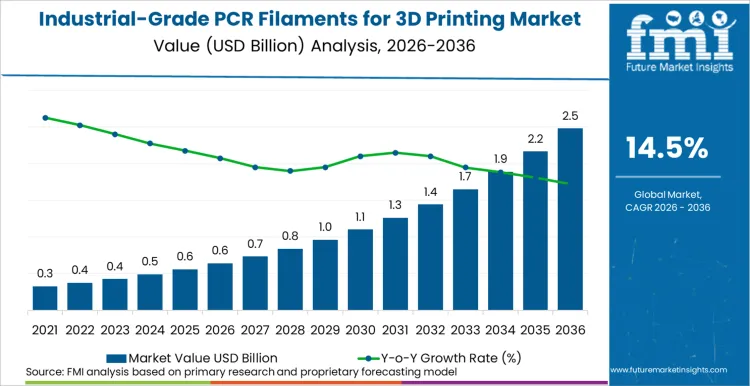
The global industrial-grade PCR filaments for 3D printing market is estimated to be valued at USD 640 million in 2026 and is projected to reach USD 2,480 million by 2036, expanding at a 14.5% CAGR. FMI analysis indicates that growth is structurally tied to the industrialization of additive manufacturing, where materials are selected based on their ability to deliver predictable outcomes across repeated print cycles and multiple production sites.
Manufacturers are deploying 3D printing beyond design validation into functional prototyping, tooling, fixtures, and selected end-use components. These applications impose stricter requirements on filaments, including stable melt flow, consistent layer adhesion, and resistance to thermal cycling. PCR filaments are gaining traction where suppliers can demonstrate disciplined recycling, controlled compounding, and narrow property tolerances that align with industrial operating standards.
Sustainability commitments reinforce this transition, particularly in industrial sectors under pressure to reduce virgin polymer consumption and Scope 3 emissions. However, FMI observes that adoption accelerates only where PCR filaments integrate into existing print workflows without increasing scrap rates or machine downtime, framing industrial-grade PCR as a materials engineering challenge rather than a sustainability experiment.
Summary of Industrial-Grade PCR Filaments for 3D Printing Market
- The industrial-grade PCR filaments for 3D printing market comprises recycled polymer filament materials engineered for use in industrial additive manufacturing applications, including tooling, jigs, fixtures, functional prototyping, and selected end-use components across manufacturing environments.
- The defined scope is structured under FMI taxonomy with segmentation across end use, filament type, material, and printing technology, focusing exclusively on industrial-grade PCR filaments and excluding consumer-grade filaments, printer hardware, and additive manufacturing services.
- The industrial-grade PCR filaments for 3D printing market is projected to grow at a CAGR of 14.5% from 2026 to 2036, expanding from USD 640 million in 2026 to USD 2,480 million by 2036, based on FMI proprietary forecasting integrating additive manufacturing industrialization rates, material qualification dynamics, and recycled polymer compounding capabilities.
- The sector is transitioning from sustainability-led pilot use toward qualification-driven industrial materials adoption, where PCR filaments are evaluated on extrusion stability, dimensional repeatability, and mechanical consistency to support predictable outcomes across repeated print cycles and multi-site manufacturing operations.
- Competition is concentrated among material specialists and industrial additive manufacturing suppliers such as Stratasys, BASF Forward AM, Evonik, and Mitsubishi Chemical Advanced Materials, with competitive advantage increasingly defined by compounding discipline, quality assurance depth, and the ability to meet industrial tolerance and reliability requirements.
- India is projected to record the fastest growth at a 16.0% CAGR through 2036, while the United States retains the largest value share, supported by mature industrial additive manufacturing ecosystems, large installed printer fleets, and growing integration of recycled materials into manufacturing sustainability and procurement strategies.
Industrial-Grade PCR Filaments for 3D Printing Market Key Takeaways
| Metric | Value |
|---|---|
| Expected Value 2026E | USD 640 million |
| Forecast Value 2036F | USD 2,480 million |
| CAGR 2026 to 2036 | 14.5% |
Source: Future Market Insights analysis based on proprietary forecasting model and primary research
Why is the Industrial-Grade PCR Filaments for 3D Printing Market Growing?
The primary growth driver is the shift of additive manufacturing from design validation toward functional industrial use. As manufacturers rely on 3D printing for tooling, jigs, and fixtures, material variability becomes a direct operational risk. This elevates demand for PCR filaments that can deliver consistent extrusion behavior, stable interlayer bonding, and predictable mechanical performance across repeated builds.
A second driver is procurement resilience and cost management. PCR filaments offer the potential to stabilize material costs in environments exposed to virgin polymer price volatility. Industrial users increasingly evaluate PCR filaments as part of broader sourcing strategies, provided that print reliability and part performance remain within defined tolerance limits.
Growth is further reinforced by corporate sustainability mandates. Industrial manufacturers are under rising pressure to demonstrate circular material use within manufacturing operations. Additive manufacturing, due to its digital workflows and localized material consumption, offers a visible pathway for integrating recycled polymers, accelerating interest in industrial-grade PCR filament solutions.
What is the Segment Profile of Industrial-Grade PCR Filaments for 3D Printing Market?
The segment landscape reflects where PCR filaments can be deployed with the lowest operational and qualification risk. FMI retains only the dominant segment in each category and expands the analysis to execution depth and industrial realism.
Why does Industrial Prototyping and Tooling anchor End-Use Demand?
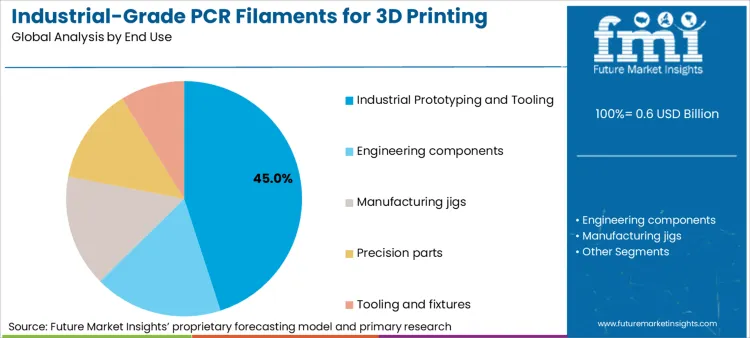
Industrial prototyping and tooling represents 45% of end-use demand because these applications balance high utilization with controlled performance exposure. Tools, fixtures, and jigs are typically used internally, which allows manufacturers to adopt PCR materials while maintaining acceptable risk thresholds. This makes tooling a practical entry point for PCR filaments in industrial environments where performance expectations are well defined but liability exposure is limited.
A second reinforcing factor is workflow repetition. Prototyping and tooling involve recurring print jobs with similar geometries, which amplifies the importance of filament consistency. FMI observes that PCR filaments gain adoption fastest where suppliers can demonstrate batch-to-batch stability and where users can lock print parameters across machines and sites. This repeatability builds internal confidence and supports gradual expansion of PCR use into more demanding applications.
Why do High-Strength Filaments Dominate Filament Type Selection?
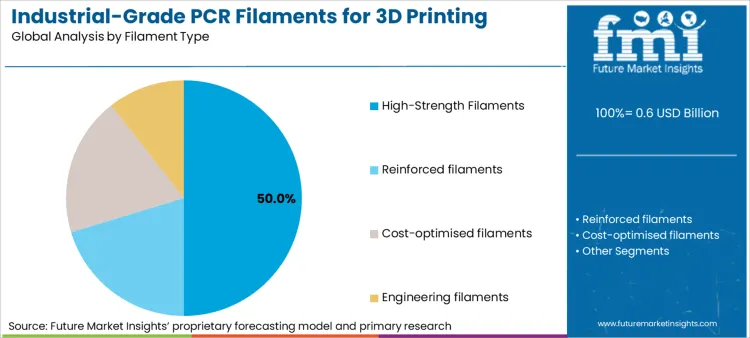
High-strength filaments account for 50% of filament type demand because industrial users prioritize durability and load-bearing capability over cosmetic attributes. Tooling and fixtures are exposed to mechanical stress, thermal variation, and repeated handling, making strength retention and dimensional stability critical selection criteria.
FMI analysis shows that buyers increasingly assess filaments based on defined performance envelopes rather than polymer origin. High-strength PCR filaments succeed when compounding controls and reinforcement strategies offset the variability traditionally associated with recycled polymers. This allows industrial users to treat PCR filaments as functional materials suitable for demanding applications rather than downgraded substitutes.
How do PCR PETG, PCR ABS, and PCR PLA Sustain Material Leadership?
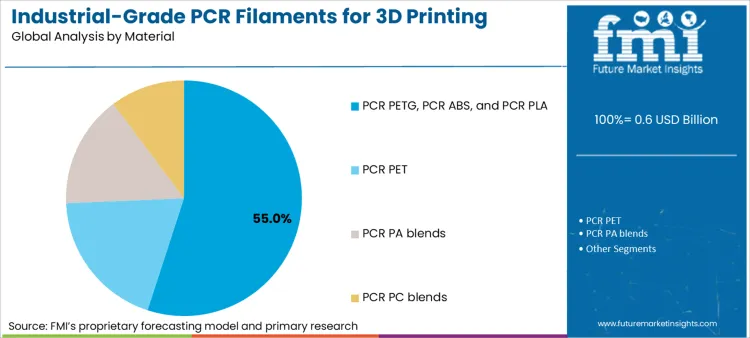
PCR PETG, PCR ABS, and PCR PLA collectively account for 55% of material demand due to their established processing behavior and broad compatibility with existing industrial printer fleets. These polymers provide a balanced combination of strength, thermal stability, and extrusion predictability that aligns with industrial printing requirements.
Another critical factor is workforce familiarity. Engineers and technicians are already trained on these material families, which reduces the learning curve associated with PCR adoption. FMI finds that material familiarity significantly lowers adoption barriers in multi-site manufacturing environments, where retraining and process requalification can slow deployment.
Why do FDM and FFF compatible compounds dominate printing technology alignment?
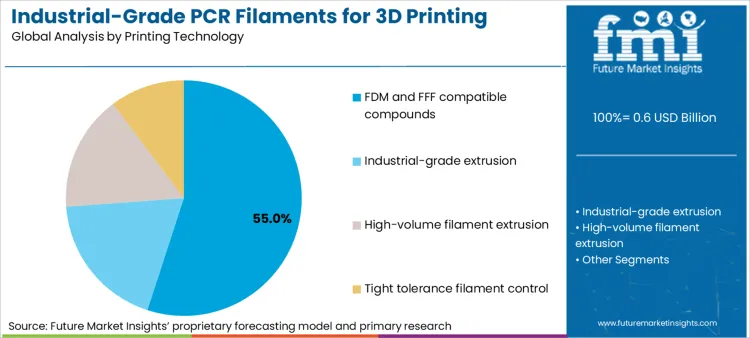
FDM and FFF compatible compounds represent 55% of printing technology alignment because these platforms dominate the installed base of industrial 3D printers. Industrial users favor materials that can be deployed across existing equipment without hardware modification or specialized print heads.
From a scaling perspective, FDM and FFF compatibility enables rapid penetration across large printer fleets. FMI analysis indicates that suppliers focusing on extrusion stability, nozzle compatibility, and thermal consistency within FDM workflows achieve faster commercial scaling than those targeting narrower or proprietary printing technologies.
What Drivers, Restraints, Opportunities, and Trends Prevail in the Industrial-Grade PCR Filaments for 3D Printing Market?
The industrial-grade PCR filament market is driven by the maturation of additive manufacturing into a production-support technology. As 3D printing is integrated into tooling, jigs, fixtures, and low-volume production, material reliability becomes a gating factor for adoption. This shift elevates demand for PCR filaments that can deliver predictable extrusion behavior, stable mechanical properties, and repeatable outcomes across extended production runs. Sustainability commitments further reinforce demand, but only where performance parity with virgin materials can be demonstrated.
A major restraint is concern over material variability. PCR filaments must overcome persistent perceptions of inconsistency in melt flow, strength, and dimensional accuracy. In industrial settings, print failures translate directly into downtime and lost productivity, making manufacturers cautious about adopting recycled materials without strong evidence of process control. Qualification costs and internal validation cycles can also slow adoption, particularly in sectors with strict internal material approval processes.
Opportunities are emerging in closed-loop manufacturing environments. Many industrial users generate significant volumes of failed prints, support structures, and end-of-life tooling. Controlled recycling of this waste into PCR feedstock offers a pathway to align cost savings with sustainability objectives. FMI observes growing interest in captive or semi-captive recycling models where material streams are tightly controlled, reducing variability and improving confidence in PCR filament performance.
The market is also shaped by a trend toward industrial-grade compounding and quality assurance. Suppliers are investing in filtration, blending, and characterization infrastructure to reduce property variation and improve consistency. Certification, performance benchmarking, and tighter quality documentation are becoming important differentiators. Over the forecast period, FMI expects competitive advantage to accrue to suppliers that position PCR filaments as dependable industrial inputs supported by data, rather than as sustainability-driven alternatives.
How is the Industrial-Grade PCR Filaments for 3D Printing Market Analyzed in Key Countries?
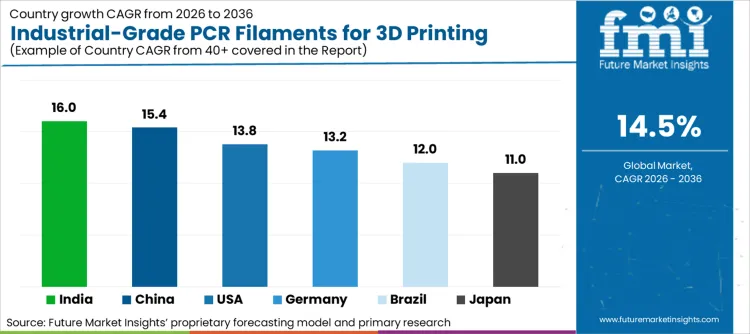
| Country | CAGR 2026 to 2036 |
|---|---|
| USA | 13.8% |
| Germany | 13.2% |
| China | 15.4% |
| Japan | 11.0% |
| India | 16.0% |
| Brazil | 12.0% |
Source: Future Market Insights analysis based on proprietary forecasting model and primary research
How is USA scaling adoption through industrial AM maturity?
USA is projected to grow at a 13.8% CAGR, anchored by one of the world’s most mature industrial additive manufacturing ecosystems. Widespread deployment of 3D printing across aerospace, automotive, defense, and industrial equipment manufacturing has normalized the use of printed tooling, fixtures, and jigs as part of daily operations. Large installed printer fleets and standardized AM workflows enable manufacturers to qualify materials once and deploy them across multiple plants, which significantly lowers the marginal cost of adopting PCR filaments at scale.
A second structural driver is the integration of sustainability metrics into manufacturing operations rather than product-facing narratives. U.S. manufacturers increasingly treat recycled materials as internal efficiency levers tied to Scope 3 emissions reduction, waste minimization, and procurement resilience. FMI observes that PCR filaments gain traction where sustainability targets align directly with operational performance, such as reducing material waste in tooling cycles or stabilizing filament costs across high-utilization printer fleets. Adoption accelerates when PCR filaments are positioned as reliability-equivalent inputs that support both cost discipline and environmental reporting without introducing production risk.
Why is Germany advancing Through Engineering Discipline and Qualification Rigor?
Germany is forecast to expand at a 13.2% CAGR, driven by a manufacturing culture that prioritizes engineering validation, documentation, and repeatability. German industrial users approach additive manufacturing as a precision production tool rather than a rapid experimentation platform. This mindset favors PCR filaments only when they can be integrated into existing material qualification frameworks that emphasize traceability, controlled compounding, and documented performance consistency.
FMI analysis indicates that adoption in Germany is concentrated in tooling, fixtures, and engineering components where additive manufacturing complements high-precision machining and forming processes. PCR materials are introduced incrementally, often starting with non-critical tooling applications and expanding only after extended performance validation. This disciplined rollout reduces risk and builds institutional confidence in recycled materials, positioning Germany as a market where PCR filament growth is steady, methodical, and closely tied to qualification depth rather than speed of scale.
How is China Leveraging Scale And Manufacturing Economics?
China is expected to grow at a 15.4% CAGR, reflecting the rapid industrialization of additive manufacturing across high-volume production environments. Chinese manufacturers increasingly use 3D printing for jigs, fixtures, and manufacturing aids that support large-scale assembly and production lines. In these settings, even small reductions in filament cost or material waste can generate meaningful economic returns, magnifying the attractiveness of PCR filaments when quality consistency is maintained.
Policy direction further reinforces this trajectory. National emphasis on resource efficiency, domestic manufacturing resilience, and circular economy development is encouraging investment in recycled polymer processing and compounding infrastructure. FMI expects this combination of scale economics and policy alignment to sustain strong PCR filament adoption, particularly where suppliers can demonstrate stable extrusion behavior across large production runs. China’s growth is therefore driven less by experimental sustainability initiatives and more by the industrial math of cost, volume, and throughput.
Why does Japan Follow a Precision-Led Adoption Trajectory?
Japan is projected to grow at an 11.0% CAGR, shaped by conservative quality thresholds and a strong preference for process stability. Japanese manufacturers adopt additive manufacturing selectively, focusing on precision parts, internal tooling, and applications where dimensional accuracy and material consistency are paramount. In this environment, PCR filaments are scrutinized heavily, and adoption progresses only after extended validation under real operating conditions.
PCR filaments gain acceptance in Japan where suppliers demonstrate exceptional control over compounding, filtration, and quality documentation. FMI observes that adoption typically begins with tightly scoped pilot programs, often confined to specific plants or applications, before broader rollout is considered. This cautious approach favors long-term reliability over rapid scaling and results in slower growth compared to other markets, but with higher confidence in sustained use once materials are approved. Japan’s trajectory reflects depth of trust rather than speed of conversion.
Why is India emerging as the fastest-growing market for industrial-grade PCR filaments?
India is projected to grow at a 16.0% CAGR, making it the fastest-growing national market due to the rapid industrialization of additive manufacturing across tooling, fixtures, and short-run production environments. Indian manufacturers are increasingly adopting 3D printing to reduce dependence on imported tooling, shorten lead times, and support localized manufacturing under cost-sensitive conditions. This creates a structurally favorable environment for PCR filaments, as recycled materials offer a pathway to reduce raw material costs while aligning with emerging sustainability expectations from global customers.
A second, more structural driver is India’s role in global supply chains. Many Indian manufacturers serve export-oriented industries such as automotive components, industrial equipment, and contract manufacturing, where buyers are pushing suppliers to demonstrate material circularity without compromising functional performance. FMI observes that PCR filament adoption is strongest among firms that have integrated additive manufacturing into lean production systems, where material efficiency, scrap reduction, and rapid iteration deliver immediate operational value. As printer fleets expand and material qualification practices mature, PCR filaments are positioned as viable industrial inputs rather than experimental alternatives.
How is Brazil building industrial-grade PCR filament demand through manufacturing modernization?
Brazil is forecast to expand at a 12.0% CAGR, supported by gradual modernization of its industrial base and increasing use of additive manufacturing for maintenance, tooling, and spare parts production. Brazilian manufacturers often operate in environments where downtime is costly and supply chains for replacement parts are fragmented. Additive manufacturing offers a practical solution to produce tooling and components locally, creating a steady entry point for PCR filaments in applications where performance requirements are defined but liability exposure is limited.
Another important driver is the growing alignment between industrial efficiency goals and waste reduction policies. Brazil’s strengthening focus on reverse logistics and material recovery is indirectly encouraging manufacturers to explore recycled polymer inputs within controlled industrial processes. FMI analysis indicates that PCR filament adoption progresses where suppliers can provide stable quality and technical support, enabling manufacturers to integrate recycled materials without disrupting production reliability. Over the forecast period, demand is expected to rise as confidence builds around material consistency and as additive manufacturing becomes more embedded in routine industrial operations rather than isolated pilot projects.
How Competitive is the Industrial-Grade PCR Filaments for 3D Printing Market?
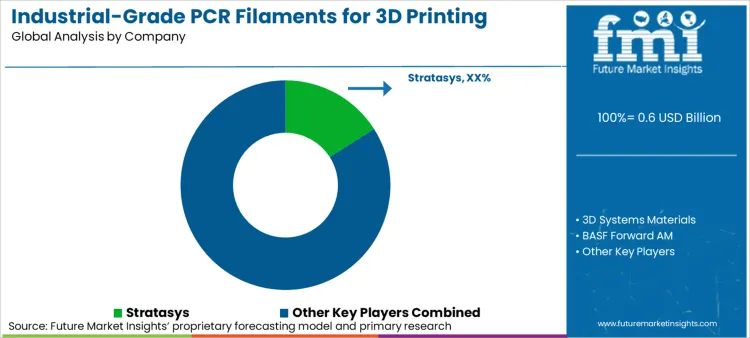
The competitive landscape is characterized by high intensity as material suppliers compete on compounding expertise, quality assurance, and industrial credibility. Competitive advantage increasingly depends on the ability to deliver PCR filaments with predictable mechanical performance, narrow tolerance control, and stable extrusion behavior.
FMI observes a shift toward long-term supply agreements and ecosystem partnerships. Suppliers that align closely with printer manufacturers, service bureaus, and industrial users are better positioned to embed PCR filaments into standardized workflows. As additive manufacturing scales, competition is expected to move away from price-led differentiation toward reliability, qualification depth, and support capability.
Key Players Profiled
- Stratasys
- 3D Systems Materials
- BASF Forward AM
- Evonik
- eSUN
- Polymaker
- Mitsubishi Chemical Advanced Materials
Market Definition
The industrial-grade PCR filaments for 3D printing market comprises revenues generated from recycled polymer filament materials engineered for industrial additive manufacturing applications. These filaments are designed to deliver consistent mechanical performance, dimensional accuracy, and extrusion stability.
The scope includes PCR filaments used in industrial prototyping, tooling, fixtures, and selected end-use components. It excludes consumer-grade filaments, printer hardware, and additive manufacturing services.
Scope of Report
| Items | Values |
|---|---|
| Quantitative Units | USD 640 million |
| End Use | Industrial prototyping and tooling, Engineering components, Manufacturing jigs, Precision parts, Tooling and fixtures |
| Filament Type | High-strength filaments, Reinforced filaments, Cost-optimised filaments, Engineering filaments |
| Material | PCR PETG, PCR ABS, PCR PLA, PCR PET, PCR PA blends, PCR PC blends |
| Printing Technology | FDM and FFF compatible compounds, Industrial-grade extrusion, High-volume filament extrusion, Tight tolerance filament control |
| Countries Covered | USA, Germany, China, Japan, India, Brazil |
| Regions Profiled | North America, Latin America, Europe, Asia Pacific, Middle East & Africa |
Industrial-Grade PCR Filaments for 3D Printing Market Key Segments
End Use:
- Industrial prototyping and tooling
- Engineering components
- Manufacturing jigs
- Precision parts
- Tooling and fixtures
Filament Type:
- High-strength filaments
- Reinforced filaments
- Cost-optimised filaments
- Engineering filaments
Material:
- PCR PETG
- PCR ABS
- PCR PLA
- PCR PET
- PCR PA blends
- PCR PC blends
Printing Technology:
- FDM and FFF compatible compounds
- Industrial-grade extrusion
- High-volume filament extrusion
- Tight tolerance filament control
Region:
- North America
- Latin America
- Europe
- Asia Pacific
- Middle East & Africa
Bibliography
- International Organization for Standardization. 2023. ISO ASTM 52900 Additive manufacturing general principles terminology.
- ASTM International. 2024. ASTM F3091 Standard guide for mechanical testing of polymer materials used in additive manufacturing.
- USA Department of Energy. 2025. Additive manufacturing for industrial sustainability and resource efficiency.
- European Commission. 2024. Circular economy action plan progress and plastics circularity measures.
- Japan Ministry of Economy Trade and Industry. 2024. Additive manufacturing materials and industrial adoption roadmap.
Frequently Asked Questions
How big is the industrial-grade pcr filaments for 3d printing market in 2026?
The global industrial-grade pcr filaments for 3d printing market is estimated to be valued at USD 0.6 billion in 2026.
What will be the size of industrial-grade pcr filaments for 3d printing market in 2036?
The market size for the industrial-grade pcr filaments for 3d printing market is projected to reach USD 2.5 billion by 2036.
How much will be the industrial-grade pcr filaments for 3d printing market growth between 2026 and 2036?
The industrial-grade pcr filaments for 3d printing market is expected to grow at a 14.5% CAGR between 2026 and 2036.
What are the key product types in the industrial-grade pcr filaments for 3d printing market?
The key product types in industrial-grade pcr filaments for 3d printing market are industrial prototyping and tooling , engineering components, manufacturing jigs, precision parts and tooling and fixtures.
Which filament type segment to contribute significant share in the industrial-grade pcr filaments for 3d printing market in 2026?
In terms of filament type, high-strength filaments segment to command 50.0% share in the industrial-grade pcr filaments for 3d printing market in 2026.
Preview the report firsthand - request a free sample
Get SampleGet the brochure for pricing and purchase details.
Get PDFTable of Content
- Executive Summary
- Global Market Outlook
- Demand-side Trends
- Supply-side Trends
- Technology Roadmap Analysis
- Analysis and Recommendations
- Market Overview
- Market Coverage / Taxonomy
- Market Definition / Scope / Limitations
- Research Methodology
- Chapter Orientation
- Analytical Lens and Working Hypotheses
- Market Structure, Signals, and Trend Drivers
- Benchmarking and Cross-market Comparability
- Market Sizing, Forecasting, and Opportunity Mapping
- Research Design and Evidence Framework
- Desk Research Programme (Secondary Evidence)
- Company Annual and Sustainability Reports
- Peer-reviewed Journals and Academic Literature
- Corporate Websites, Product Literature, and Technical Notes
- Earnings Decks and Investor Briefings
- Statutory Filings and Regulatory Disclosures
- Technical White Papers and Standards Notes
- Trade Journals, Industry Magazines, and Analyst Briefs
- Conference Proceedings, Webinars, and Seminar Materials
- Government Statistics Portals and Public Data Releases
- Press Releases and Reputable Media Coverage
- Specialist Newsletters and Curated Briefings
- Sector Databases and Reference Repositories
- FMI Internal Proprietary Databases and Historical Market Datasets
- Subscription Datasets and Paid Sources
- Social Channels, Communities, and Digital Listening Inputs
- Additional Desk Sources
- Expert Input and Fieldwork (Primary Evidence)
- Primary Modes
- Qualitative Interviews and Expert Elicitation
- Quantitative Surveys and Structured Data Capture
- Blended Approach
- Why Primary Evidence is Used
- Field Techniques
- Interviews
- Surveys
- Focus Groups
- Observational and In-context Research
- Social and Community Interactions
- Stakeholder Universe Engaged
- C-suite Leaders
- Board Members
- Presidents and Vice Presidents
- R&D and Innovation Heads
- Technical Specialists
- Domain Subject-matter Experts
- Scientists
- Physicians and Other Healthcare Professionals
- Governance, Ethics, and Data Stewardship
- Research Ethics
- Data Integrity and Handling
- Primary Modes
- Tooling, Models, and Reference Databases
- Desk Research Programme (Secondary Evidence)
- Data Engineering and Model Build
- Data Acquisition and Ingestion
- Cleaning, Normalisation, and Verification
- Synthesis, Triangulation, and Analysis
- Quality Assurance and Audit Trail
- Market Background
- Market Dynamics
- Drivers
- Restraints
- Opportunity
- Trends
- Scenario Forecast
- Demand in Optimistic Scenario
- Demand in Likely Scenario
- Demand in Conservative Scenario
- Opportunity Map Analysis
- Product Life Cycle Analysis
- Supply Chain Analysis
- Investment Feasibility Matrix
- Value Chain Analysis
- PESTLE and Porter’s Analysis
- Regulatory Landscape
- Regional Parent Market Outlook
- Production and Consumption Statistics
- Import and Export Statistics
- Market Dynamics
- Global Market Analysis 2021 to 2025 and Forecast, 2026 to 2036
- Historical Market Size Value (USD Million) Analysis, 2021 to 2025
- Current and Future Market Size Value (USD Million) Projections, 2026 to 2036
- Y-o-Y Growth Trend Analysis
- Absolute $ Opportunity Analysis
- Global Market Pricing Analysis 2021 to 2025 and Forecast 2026 to 2036
- Global Market Analysis 2021 to 2025 and Forecast 2026 to 2036, By End Use
- Introduction / Key Findings
- Historical Market Size Value (USD Million) Analysis By End Use , 2021 to 2025
- Current and Future Market Size Value (USD Million) Analysis and Forecast By End Use , 2026 to 2036
- Industrial Prototyping and Tooling
- Engineering components
- Manufacturing jigs
- Precision parts
- Tooling and fixtures
- Industrial Prototyping and Tooling
- Y-o-Y Growth Trend Analysis By End Use , 2021 to 2025
- Absolute $ Opportunity Analysis By End Use , 2026 to 2036
- Global Market Analysis 2021 to 2025 and Forecast 2026 to 2036, By Filament Type
- Introduction / Key Findings
- Historical Market Size Value (USD Million) Analysis By Filament Type, 2021 to 2025
- Current and Future Market Size Value (USD Million) Analysis and Forecast By Filament Type, 2026 to 2036
- High-Strength Filaments
- Reinforced filaments
- Cost-optimised filaments
- Engineering filaments
- High-Strength Filaments
- Y-o-Y Growth Trend Analysis By Filament Type, 2021 to 2025
- Absolute $ Opportunity Analysis By Filament Type, 2026 to 2036
- Global Market Analysis 2021 to 2025 and Forecast 2026 to 2036, By Material
- Introduction / Key Findings
- Historical Market Size Value (USD Million) Analysis By Material, 2021 to 2025
- Current and Future Market Size Value (USD Million) Analysis and Forecast By Material, 2026 to 2036
- PCR PETG, PCR ABS, and PCR PLA
- PCR PET
- PCR PA blends
- PCR PC blends
- PCR PETG, PCR ABS, and PCR PLA
- Y-o-Y Growth Trend Analysis By Material, 2021 to 2025
- Absolute $ Opportunity Analysis By Material, 2026 to 2036
- Global Market Analysis 2021 to 2025 and Forecast 2026 to 2036, By Printing Technology
- Introduction / Key Findings
- Historical Market Size Value (USD Million) Analysis By Printing Technology, 2021 to 2025
- Current and Future Market Size Value (USD Million) Analysis and Forecast By Printing Technology, 2026 to 2036
- FDM and FFF compatible compounds
- Industrial-grade extrusion
- High-volume filament extrusion
- Tight tolerance filament control
- FDM and FFF compatible compounds
- Y-o-Y Growth Trend Analysis By Printing Technology, 2021 to 2025
- Absolute $ Opportunity Analysis By Printing Technology, 2026 to 2036
- Global Market Analysis 2021 to 2025 and Forecast 2026 to 2036, By Region
- Introduction
- Historical Market Size Value (USD Million) Analysis By Region, 2021 to 2025
- Current Market Size Value (USD Million) Analysis and Forecast By Region, 2026 to 2036
- North America
- Latin America
- Western Europe
- Eastern Europe
- East Asia
- South Asia and Pacific
- Middle East & Africa
- Market Attractiveness Analysis By Region
- North America Market Analysis 2021 to 2025 and Forecast 2026 to 2036, By Country
- Historical Market Size Value (USD Million) Trend Analysis By Market Taxonomy, 2021 to 2025
- Market Size Value (USD Million) Forecast By Market Taxonomy, 2026 to 2036
- By Country
- USA
- Canada
- Mexico
- By End Use
- By Filament Type
- By Material
- By Printing Technology
- By Country
- Market Attractiveness Analysis
- By Country
- By End Use
- By Filament Type
- By Material
- By Printing Technology
- Key Takeaways
- Latin America Market Analysis 2021 to 2025 and Forecast 2026 to 2036, By Country
- Historical Market Size Value (USD Million) Trend Analysis By Market Taxonomy, 2021 to 2025
- Market Size Value (USD Million) Forecast By Market Taxonomy, 2026 to 2036
- By Country
- Brazil
- Chile
- Rest of Latin America
- By End Use
- By Filament Type
- By Material
- By Printing Technology
- By Country
- Market Attractiveness Analysis
- By Country
- By End Use
- By Filament Type
- By Material
- By Printing Technology
- Key Takeaways
- Western Europe Market Analysis 2021 to 2025 and Forecast 2026 to 2036, By Country
- Historical Market Size Value (USD Million) Trend Analysis By Market Taxonomy, 2021 to 2025
- Market Size Value (USD Million) Forecast By Market Taxonomy, 2026 to 2036
- By Country
- Germany
- UK
- Italy
- Spain
- France
- Nordic
- BENELUX
- Rest of Western Europe
- By End Use
- By Filament Type
- By Material
- By Printing Technology
- By Country
- Market Attractiveness Analysis
- By Country
- By End Use
- By Filament Type
- By Material
- By Printing Technology
- Key Takeaways
- Eastern Europe Market Analysis 2021 to 2025 and Forecast 2026 to 2036, By Country
- Historical Market Size Value (USD Million) Trend Analysis By Market Taxonomy, 2021 to 2025
- Market Size Value (USD Million) Forecast By Market Taxonomy, 2026 to 2036
- By Country
- Russia
- Poland
- Hungary
- Balkan & Baltic
- Rest of Eastern Europe
- By End Use
- By Filament Type
- By Material
- By Printing Technology
- By Country
- Market Attractiveness Analysis
- By Country
- By End Use
- By Filament Type
- By Material
- By Printing Technology
- Key Takeaways
- East Asia Market Analysis 2021 to 2025 and Forecast 2026 to 2036, By Country
- Historical Market Size Value (USD Million) Trend Analysis By Market Taxonomy, 2021 to 2025
- Market Size Value (USD Million) Forecast By Market Taxonomy, 2026 to 2036
- By Country
- China
- Japan
- South Korea
- By End Use
- By Filament Type
- By Material
- By Printing Technology
- By Country
- Market Attractiveness Analysis
- By Country
- By End Use
- By Filament Type
- By Material
- By Printing Technology
- Key Takeaways
- South Asia and Pacific Market Analysis 2021 to 2025 and Forecast 2026 to 2036, By Country
- Historical Market Size Value (USD Million) Trend Analysis By Market Taxonomy, 2021 to 2025
- Market Size Value (USD Million) Forecast By Market Taxonomy, 2026 to 2036
- By Country
- India
- ASEAN
- Australia & New Zealand
- Rest of South Asia and Pacific
- By End Use
- By Filament Type
- By Material
- By Printing Technology
- By Country
- Market Attractiveness Analysis
- By Country
- By End Use
- By Filament Type
- By Material
- By Printing Technology
- Key Takeaways
- Middle East & Africa Market Analysis 2021 to 2025 and Forecast 2026 to 2036, By Country
- Historical Market Size Value (USD Million) Trend Analysis By Market Taxonomy, 2021 to 2025
- Market Size Value (USD Million) Forecast By Market Taxonomy, 2026 to 2036
- By Country
- Kingdom of Saudi Arabia
- Other GCC Countries
- Turkiye
- South Africa
- Other African Union
- Rest of Middle East & Africa
- By End Use
- By Filament Type
- By Material
- By Printing Technology
- By Country
- Market Attractiveness Analysis
- By Country
- By End Use
- By Filament Type
- By Material
- By Printing Technology
- Key Takeaways
- Key Countries Market Analysis
- USA
- Pricing Analysis
- Market Share Analysis, 2025
- By End Use
- By Filament Type
- By Material
- By Printing Technology
- Canada
- Pricing Analysis
- Market Share Analysis, 2025
- By End Use
- By Filament Type
- By Material
- By Printing Technology
- Mexico
- Pricing Analysis
- Market Share Analysis, 2025
- By End Use
- By Filament Type
- By Material
- By Printing Technology
- Brazil
- Pricing Analysis
- Market Share Analysis, 2025
- By End Use
- By Filament Type
- By Material
- By Printing Technology
- Chile
- Pricing Analysis
- Market Share Analysis, 2025
- By End Use
- By Filament Type
- By Material
- By Printing Technology
- Germany
- Pricing Analysis
- Market Share Analysis, 2025
- By End Use
- By Filament Type
- By Material
- By Printing Technology
- UK
- Pricing Analysis
- Market Share Analysis, 2025
- By End Use
- By Filament Type
- By Material
- By Printing Technology
- Italy
- Pricing Analysis
- Market Share Analysis, 2025
- By End Use
- By Filament Type
- By Material
- By Printing Technology
- Spain
- Pricing Analysis
- Market Share Analysis, 2025
- By End Use
- By Filament Type
- By Material
- By Printing Technology
- France
- Pricing Analysis
- Market Share Analysis, 2025
- By End Use
- By Filament Type
- By Material
- By Printing Technology
- India
- Pricing Analysis
- Market Share Analysis, 2025
- By End Use
- By Filament Type
- By Material
- By Printing Technology
- ASEAN
- Pricing Analysis
- Market Share Analysis, 2025
- By End Use
- By Filament Type
- By Material
- By Printing Technology
- Australia & New Zealand
- Pricing Analysis
- Market Share Analysis, 2025
- By End Use
- By Filament Type
- By Material
- By Printing Technology
- China
- Pricing Analysis
- Market Share Analysis, 2025
- By End Use
- By Filament Type
- By Material
- By Printing Technology
- Japan
- Pricing Analysis
- Market Share Analysis, 2025
- By End Use
- By Filament Type
- By Material
- By Printing Technology
- South Korea
- Pricing Analysis
- Market Share Analysis, 2025
- By End Use
- By Filament Type
- By Material
- By Printing Technology
- Russia
- Pricing Analysis
- Market Share Analysis, 2025
- By End Use
- By Filament Type
- By Material
- By Printing Technology
- Poland
- Pricing Analysis
- Market Share Analysis, 2025
- By End Use
- By Filament Type
- By Material
- By Printing Technology
- Hungary
- Pricing Analysis
- Market Share Analysis, 2025
- By End Use
- By Filament Type
- By Material
- By Printing Technology
- Kingdom of Saudi Arabia
- Pricing Analysis
- Market Share Analysis, 2025
- By End Use
- By Filament Type
- By Material
- By Printing Technology
- Turkiye
- Pricing Analysis
- Market Share Analysis, 2025
- By End Use
- By Filament Type
- By Material
- By Printing Technology
- South Africa
- Pricing Analysis
- Market Share Analysis, 2025
- By End Use
- By Filament Type
- By Material
- By Printing Technology
- USA
- Market Structure Analysis
- Competition Dashboard
- Competition Benchmarking
- Market Share Analysis of Top Players
- By Regional
- By End Use
- By Filament Type
- By Material
- By Printing Technology
- Competition Analysis
- Competition Deep Dive
- Stratasys
- Overview
- Product Portfolio
- Profitability by Market Segments (Product/Age /Sales Channel/Region)
- Sales Footprint
- Strategy Overview
- Marketing Strategy
- Product Strategy
- Channel Strategy
- 3D Systems Materials
- BASF Forward AM
- Evonik
- eSUN
- Polymaker
- Stratasys
- Competition Deep Dive
- Assumptions & Acronyms Used


