

- Market Size (2026)
- USD 2.8 Bn
- Forecast (2036)
- USD 10.4 Bn
- CAGR (2026 to 2036)
- 13.8%
How big is the 3D Printing Materials Market in 2026?
USD 2.8 billion in 2026, reaching USD 10.4 billion by 2036 at a 13.8% CAGR
The 3d printing materials market was valued at USD 2.5 billion in 2025. The market is set to reach USD 2.8 billion by 2026-end and grow at a CAGR of 13.8% between 2026-2036 to reach USD 10.4 billion by 2036. Plastics will dominate with a 52.0% share, while Filament will lead with a 45.4% share.
3D printing materials procurement is shaped by additive manufacturing production adoption, material qualification timelines, and application-specific performance requirements. Demand reflects consumption of plastic filaments, metal powders, liquid resins, and engineering-grade compounds for automotive, aerospace, healthcare, and industrial end-use production. Buyers include additive manufacturing engineers, prototype shop managers, and production procurement teams evaluating mechanical properties, print consistency, and regulatory compliance.
Growth reflects accelerating adoption of additive manufacturing for end-use production beyond prototyping. Wohlers Associates reported in 2025 that 3D printing materials revenue maintained double-digit growth, driven by production application expansion across automotive and aerospace sectors.
Suppliers compete mainly on material performance certification, print technology compatibility, and engineering-grade portfolio breadth. Stratasys and 3D Systems hold position through printer-material ecosystems; BASF and Evonik win where engineering-grade filament and powder chemistry drive material selection.
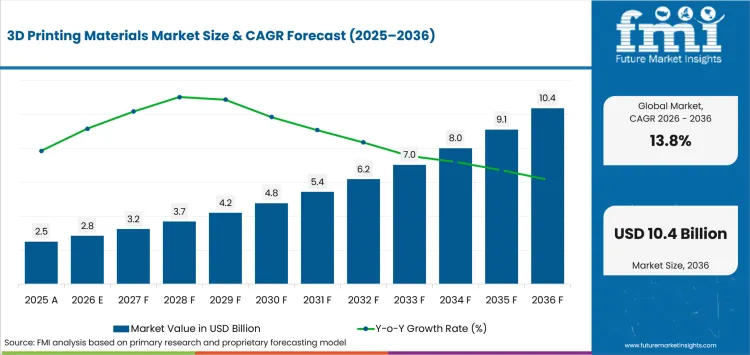
Key Takeaways of 3D Printing Materials Market
- Additive manufacturing production adoption is expected to sustain 3D printing material procurement beyond prototyping.
- Plastics is expected to account for 52.0% of material type demand in 2026 because plastic filaments, powders, and resins dominate desktop and industrial printing applications.
- Filament is projected to hold 45.4% of form demand in 2026, driven by FDM printer installed base and accessibility.
- Automotive is anticipated to represent 28.0% of application demand in 2026, supported by prototyping, tooling, and end-use component production.
- United Kingdom leads with an 11.7% CAGR through 2036 as additive manufacturing adoption across aerospace, automotive, and healthcare sustains material procurement.
- Stratasys and 3D Systems are expected to compete through printer-material ecosystem portfolios.
Analyst Perspective
"Buyers are expected to judge plastics on performance and total cost of ownership rather than headline price. 3D printing material adoption is expected to depend on additive manufacturing production expansion and material qualification progression. Suppliers that combine material performance certification with print technology compatibility are likely to secure production-scale material supply agreements. Market success is projected to depend on meeting end-use part mechanical and regulatory requirements across automotive, aerospace, and healthcare applications."
- Sudip Saha, Principal Consultant at Future Market Insights
Why is the 3D Printing Materials Market growing?
Rising Plastics and Filament demand across manufacturing end users
- 3D-printing-material demand follows additive-manufacturing adoption and production-part qualification rather than prototyping alone.
- United Kingdom leads growth at 11.7% CAGR as additive manufacturing adoption across aerospace, automotive, and healthcare sustains material procurement.
- Filament holds 45.4% of form revenue, indicating where standardization is concentrating buyer spend.
Because materials are qualified per process and application, spend concentrates with suppliers offering polymer and metal breadth, consistent quality, and process-validated formulations.
How is the 3D Printing Materials Market segmented?
The 3D printing materials industry is segmented by material type, form, application, technology, material grade, and region.
The 3D printing materials market is segmented by material type, form, application, technology, material grade, and region. By material type, the market covers plastics, metals, ceramics, and composites. By form, the market covers filament, powder, liquid resin, and pellets. By application, the market covers automotive, aerospace, healthcare, consumer goods, and industrial. By technology, the market covers fused deposition modeling (FDM), selective laser sintering (SLS), stereolithography (SLA), direct metal laser sintering (DMLS), and binder jetting. By material grade, the market covers engineering grade materials, standard grade materials, and high performance materials. Regions include North America, Latin America, Western Europe, Eastern Europe, East Asia, South Asia and Pacific, and the Middle East and Africa.
How do application and technology shape procurement?
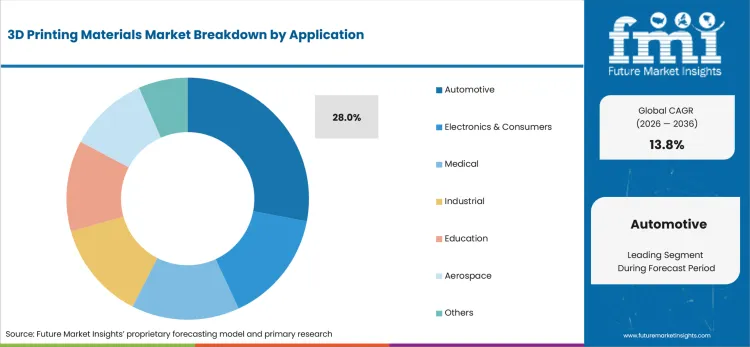
Application and technology decide who controls the purchase and how the product reaches the account; together they determine integration path, deployment cost, and upgrade cadence for buyers. Demand concentrates here because prototyping, tooling, and end-use component production sustain broad material consumption.
- Automotive is expected to hold 28.0% of application demand because prototyping, tooling, and end-use component production sustain broad material consumption.
- FDM is anticipated to account for 41.5% of technology demand because FDM printer accessibility and diverse material compatibility sustain the largest printing technology procurement base.
How do plastics shape demand within the material type category?
Material type selection determines integration path, deployment cost, and upgrade cadence for buyers. Demand concentrates here because ABS, PLA, nylon, and PEEK materials serve the broadest range of desktop and industrial printing applications.
- Plastics is expected to account for 52.0% of material type demand in 2026 because ABS, PLA, nylon, and PEEK materials serve the broadest range of desktop and industrial printing applications.
- Engineering Grade Materials is projected to hold 46.7% of material grade demand as production applications require materials meeting mechanical and thermal specifications.
What supports filament form demand?
Filament form shapes buyer requirements because segment choice here determines integration path, deployment cost, and upgrade cadence for buyers. Demand concentrates here because the large FDM printer installed base sustains filament consumption for prototyping and production.
- Filament is projected to hold 45.4% of form demand in 2026 because the large FDM printer installed base sustains filament consumption for prototyping and production.
- Fused Deposition Modeling (FDM) is forecast to represent 41.5% of technology demand as FDM accessibility and material breadth sustain the largest printing technology share.
What are the drivers, restraints, and opportunities in the 3D Printing Materials Market?
Near-term sourcing is shaped by production adoption, material certification, and application-specific performance requirements.
- Driver: Additive manufacturing adoption for end-use production is expected to push 3D printing material procurement as applications move beyond prototyping.
- Restraint: Material qualification timelines and certification costs are likely to slow production adoption if end-use part approval processes extend beyond OEM timeline expectations.
- Opportunity: Recycled and bio-based 3D printing materials are expected to open procurement if sustainability-certified filaments and powders meet mechanical performance requirements.
Production adoption is expected to increase material procurement. Wohlers Associates reported in 2025 that 3D printing materials revenue maintained double-digit growth driven by end-use production expansion.
Qualification timelines are expected to limit adoption speed. BASF reported in 2025 that engineering-grade material certification for aerospace and automotive production remained time-intensive.
Recycled materials create a practical route by addressing sustainability requirements. Arkema reported in 2025 that its bio-based and recycled PA powder portfolio expanded across SLS production applications.
Which country CAGRs are profiled in the 3D Printing Materials Market?
UK 11.7%, India 10.3%, China 10.1%, USA 9.5%, Germany 8.9% through 2036
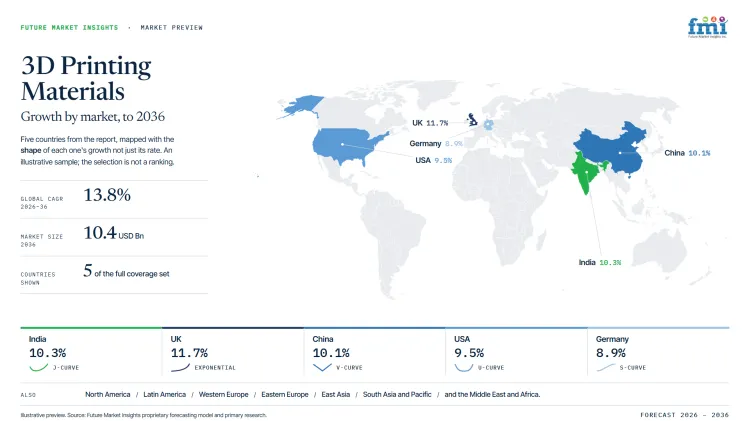
| Country | CAGR (2026 to 2036) |
|---|---|
| UK | 11.7% |
| India | 10.3% |
| China | 10.1% |
| USA | 9.5% |
| Germany | 8.9% |
Source: FMI's proprietary forecasting model and primary research. 5 of the countries covered in the full report are shown here as a representative subset.
How do country-level CAGRs compare in the 3D Printing Materials Market?
The country comparison spans 2.8 percentage points and reveals three distinct growth groups across the 3D printing materials market. The UK and India form the upper tier with a 1.4-point difference, while China and the USA create a closely aligned middle group separated by 0.6 percentage points. Germany remains at the lower end with a 0.6-point gap from the USA.
- The UK leads the comparison at an 11.7% CAGR through 2036, supported by structured purchasing, steady digitalization budgets and growing adoption of additive manufacturing across production and engineering applications.
- India follows at a 10.3% CAGR, remaining 1.4 percentage points below the UK. Manufacturing and service-sector digitalization, along with price-sensitive and phased adoption, support expansion of 3D printing materials demand.
- China records a 10.1% CAGR, creating a 0.2-percentage-point gap from India. Rapid digital adoption, large-scale manufacturing programs and strong domestic technology ecosystems support high-volume 3D printing materials demand.
- The USA grows at a 9.5% CAGR, remaining 0.6 percentage points below China. Deep enterprise technology budgets, early adoption of productivity solutions and established platform integration support premium material demand.
- Germany records an 8.9% CAGR, 0.6 percentage points below the USA. Industrial digitalization programs and engineering-led evaluation support demand for integrated, standards-compliant 3D printing materials.
Comparable CAGRs can still produce different market conditions. Differences in additive-manufacturing adoption, production-part qualification, prototyping activity, engineering-grade material use, industrial digitalization and end-use certification influence 3D printing materials demand across countries. The full report provides country-level CAGR analysis across major regions and individual markets within the 3D printing materials market.
Country-wise Analysis
- UK 3D printing materials adoption runs through structured enterprise procurement in a services-heavy economy. Sales in the United Kingdom are forecast to expand at an 11.7% CAGR by 2036, supported by steady 3D printing materials budgets and structured procurement. Plastic materials lead form demand in 2026, concentrating spend on filament and powder for polymer printing. Compliance review and procurement structure lengthen 3D printing materials enterprise sales cycles.Suppliers of 3D printing materials win UK accounts with compliance-ready offerings and local integration partners.
- India's growing digitalization budgets drive phased, price-sensitive 3D printing materials adoption. Demand draws on additive manufacturing adoption for end-use production. The market outlook in India is anticipated to advance at a 10.3% CAGR over the assessment period, supported by growing 3D printing materials budgets across manufacturing and services. Price sensitivity and phased budgets stretch 3D printing materials deployment timelines.Suppliers of 3D printing materials win India with modular pricing, local integration partners, and demonstrable payback.
- China's large digitalization programs and domestic platform ecosystems drive fast 3D printing materials adoption. Demand in China is forecast to rise at a 10.1% CAGR over the forecast period, supported by rapid digital adoption and large-scale digitalization programs. Localization and data-compliance requirements lengthen 3D printing materials qualification for foreign vendors.Suppliers of 3D printing materials convert Chinese demand with localization, domestic integration partnerships, and ecosystem fit.
- US enterprises adopt 3D printing materials early, with deep budgets and integration into established platforms. Adoption in the United States is estimated to expand at a 9.5% CAGR through 2036, supported by deep enterprise budgets and early 3D printing materials adoption. Security review and ecosystem fit dominate 3D printing materials procurement gates for new vendors.Suppliers of 3D printing materials win US accounts with enterprise-grade security, ecosystem integrations, and reference deployments.
- German 3D printing materials adoption runs through industrial digitalization programs with engineering-led evaluation. In Germany, demand is predicted to advance at an 8.9% CAGR through 2036, supported by industrial digitalization programs and engineering-led evaluation. Interoperability and data-compliance expectations extend 3D printing materials evaluation before rollout.Suppliers of 3D printing materials hold German positions through interoperability with installed systems and strong data governance.
Who are the notable companies in the 3D Printing Materials Market?
Stratasys Ltd., 3D Systems Corporation, Arkema S.A., Evonik Industries AG, Materialise NV, HP Inc., and Colibrium Additive (a GE Aerospace company) are the notable companies shaping this market.
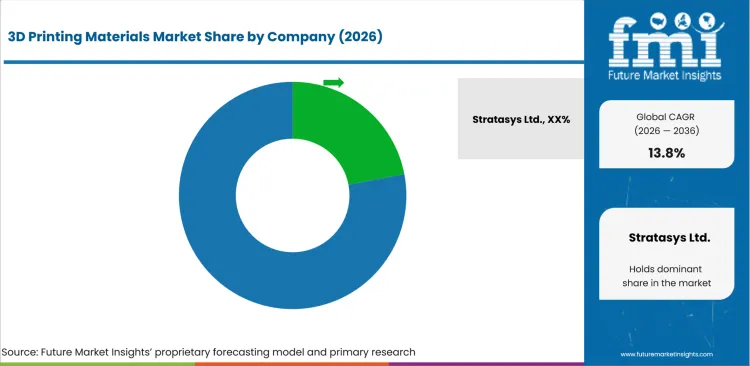
The field concentrates around additive-material suppliers that pair polymer and metal breadth with process validation and printer-platform compatibility. Specialty chemical and material companies emphasize Engineering-grade filaments and Specialty PA powders, while 3D printing software and service companies serve regional demand through 3D printing software and materials. Additive manufacturing platform companies compete across FDM and PolyJet materials, SLA resins and metal powders and MJF PA12 materials throughout established accounts. A workable entry is a specialty-polymer or metal-powder niche, or a regional supply position for a printing process. Growth then depends on process qualification, consistent quality, and application validation across each launch market. Breadth pays off through material scientists who validate formulations across printing processes and support production part qualification.
- Stratasys Ltd. and 3D Systems Corporation combine FDM and PolyJet materials and SLA resins and metal powders across multiple national markets. HP Inc. adds MJF PA12 materials through established account relationships. Their edge comes from polymer and metal material breadth with process-validated formulations.
- Arkema S.A. and Evonik Industries AG follow focused routes across Engineering-grade filaments, Specialty PA powders and PEEK and PA12 powders. Their commercial edge comes from specialty PA, PEEK, and metal-powder niches rather than one standardized material.
- Materialise NV provides regional coverage through 3D printing software and materials. These firms compete on focused additive-material strengths, though reach trails the global materials majors.
Competitive Benchmarking: 3D Printing Materials Market
| Company | Portfolio Relevance | Material Focus | Account Access | Service Reach |
|---|---|---|---|---|
| Stratasys Ltd. | High | FDM and PolyJet materials | Strong | Global |
| 3D Systems Corporation | High | SLA resins and metal powders | Strong | Global |
| Carpenter Technology Corporation | High | Engineering-grade filaments | Strong | Global |
| Arkema S.A. | Medium | Specialty PA powders | Strong | Global |
| Evonik Industries AG | Medium | PEEK and PA12 powders | Strong | Global |
| Materialise NV | Medium | 3D printing software and materials | Strong | Global |
| HP Inc. | Medium | MJF PA12 materials | Strong | Global |
| Colibrium Additive (a GE Aerospace company) | Medium | Metal AM powders | Strong | Global |
Source: Future Market Insights competitive analysis, 2026. Ratings reflect relative portfolio relevance, workflow or project fit, service capability, and geographic reach.
Key Developments in the 3D Printing Materials Market
- In April 2025, Stratasys unveiled its Neo800+ stereolithography printer and PolyJet ToughONE material at RAPID + TCT 2025 in Detroit.
- In November 2025, Stratasys announced new materials, features, and software advancements across its FDM, SAF, and P3 DLP platforms, showcased at Formnext 2025 in Frankfurt.
Key Players in the 3D Printing Materials Market
Additive manufacturing platform companies
- Stratasys Ltd.
- 3D Systems Corporation
- HP Inc.
- Colibrium Additive (a GE Aerospace company)
Specialty chemical and material companies
- Carpenter Technology CorporationArkema S.A.
- Evonik Industries AG
- Henkel AG & Co. KGaA
3D printing software and service companies
- Materialise NV
3D Printing Materials Market: Report Scope
| Coverage field | Report scope |
|---|---|
| Market breakdown | Material type, form, application, technology, material grade, and region. |
| Market Definition | 3D printing materials include plastic filaments, metal powders, liquid resins, and composite compounds in standard, engineering, and high-performance grades for FDM, SLS, SLA, DMLS, and binder jetting additive manufacturing across automotive, aerospace, healthcare, and industrial applications. |
| Regions Covered | North America, Latin America, Western Europe, Eastern Europe, East Asia, South Asia and Pacific, and the Middle East and Africa. |
| Countries Covered | United States, China, India, Japan, Germany, Australia, and United Kingdom. |
| Key Companies Profiled | Stratasys Ltd., 3D Systems Corporation, Carpenter Technology Corporation, Arkema S.A., Evonik Industries AG, Materialise NV, HP Inc., Colibrium Additive (a GE Aerospace company). |
| Forecast Period | 2026 to 2036. |
| Approach | FMI used primary interviews, source validation, and proprietary demand modeling. |
Source: Future Market Insights, analysis driven by proprietary forecasting models and primary research
3D Printing Materials Market: Research Methodology
| Method | Approach |
|---|---|
| Primary Research | FMI interviewed 3D printing materials suppliers, buyers, and procurement leads. |
| Desk Research | Government releases, regulator updates, company filings, and product pages. |
| Market Sizing | Forecast model linked 2026 anchors to demand drivers and country conditions. |
| Data Validation | Forecast values checked against ten-year CAGR formula. |
Source: Future Market Insights (FMI) analysis
Market Segmentation Analysis
3D Printing Materials Market Segmented by Material Type:
- Plastics
- Acrylonitrile Butadiene Styrene (ABS)
- High Strength Prototyping Material
- Improved Impact Resistance
- Nylon (Polyamide)
- Flexible Engineering Applications
- Enhanced Wear Resistance
- Polylactic Acid (PLA)
- Eco Friendly Printing Material
- Improved Printability And Surface Finish
- High Impact Polystyrene (HIPS)
- Support Structure Material
- Enhanced Dissolvability Features
- Polyethylene Terephthalate (PET-PETG)
- Chemical Resistant Printing Material
- Improved Mechanical Strength
- Polyvinyl Alcohol (PVA)
- Water Soluble Support Material
- Enhanced Complex Geometry Printing
- Acrylonitrile Butadiene Styrene (ABS)
- Metals
- Stainless Steel Powders
- High Strength Functional Parts
- Improved Corrosion Resistance
- Aluminum Alloys
- Lightweight Structural Components
- Enhanced Thermal Conductivity
- Nickel And Cobalt Alloys
- High Temperature Resistant Parts
- Improved Aerospace Performance
- Stainless Steel Powders
- Ceramics
- Alumina Based Ceramics
- High Heat Resistance Components
- Improved Electrical Insulation
- Zirconia Ceramics
- Enhanced Mechanical Strength
- Biocompatible Applications
- Alumina Based Ceramics
- Others
3D Printing Materials Market Segmented by Form:
- Filament
- Thermoplastic Filaments
- Easy FDM Printing Compatibility
- Improved Surface Finish Quality
- Engineering Grade Filaments
- Enhanced Mechanical Strength
- Improved Functional Prototyping
- Thermoplastic Filaments
- Powder
- Metal Powder Bed Materials
- High Precision Industrial Parts
- Improved Structural Integrity
- Ceramic Powders
- Advanced Heat Resistant Printing
- Enhanced Material Durability
- Metal Powder Bed Materials
- Liquid
- Photoresin Materials
- High Resolution SLA Printing
- Improved Detail Accuracy
- Biocompatible Liquid Resins
- Medical Grade Applications
- Enhanced Precision Modeling
- Photoresin Materials
3D Printing Materials Market Segmented by Application:
- Automotive
- Vehicle Component Prototyping
- Improved Design Optimization
- Enhanced Lightweight Structures
- Custom Automotive Parts
- Faster Product Development Cycles
- Improved Performance Testing
- Vehicle Component Prototyping
- Electronics & Consumers
- Smart Device Components
- Customized Product Design
- Improved Product Development Speed
- Consumer Product Prototyping
- Rapid Design Validation
- Reduced Manufacturing Costs
- Smart Device Components
- Medical
- Implants And Prosthetics
- Patient Specific Customization
- Improved Surgical Outcomes
- Dental Modeling Systems
- Enhanced Treatment Accuracy
- Reduced Production Time
- Implants And Prosthetics
- Industrial
- Industrial Tooling Components
- Improved Manufacturing Efficiency
- Reduced Production Waste
- Machine Part Fabrication
- Enhanced Design Flexibility
- Improved Durability
- Industrial Tooling Components
- Education
- STEM Learning Models
- Enhanced Practical Training
- Improved Technical Understanding
- Research And Academic Prototyping
- STEM Learning Models
- Aerospace
- Aircraft Component Prototyping
- Space Grade Manufacturing Parts
- Others
3D Printing Materials Market Segmented by Technology:
- Fused Deposition Modeling (FDM)
- Extrusion Based 3D Printing Technology
- Cost Effective Manufacturing Process
- Widely Used Prototyping Method
- Industrial FDM Systems
- Improved Production Scalability
- Enhanced Material Compatibility
- Extrusion Based 3D Printing Technology
- Stereolithography (SLA)
- Laser Based Resin Printing Technology
- High Precision Surface Finish
- Improved Detail Accuracy
- DLP Based SLA Systems
- Faster Layer Curing Process
- Enhanced Micro Structure Printing
- Laser Based Resin Printing Technology
- Selective Laser Sintering (SLS)
- Powder Bed Fusion Technology
- No Support Structure Requirement
- Improved Design Flexibility
- Polymer SLS Systems
- Enhanced Functional Part Production
- Improved Mechanical Strength
- Powder Bed Fusion Technology
- Direct Metal Laser Sintering (DMLS)
- Metal Powder Laser Fusion
- High Strength Industrial Components
- Improved Aerospace Applications
- Electron Beam Melting (EBM)
- High Performance Metal Printing
- Enhanced Thermal Resistance
- Metal Powder Laser Fusion
3D Printing Materials Market Segmented by Material Grade:
- Engineering Grade Materials
- High Performance Thermoplastics
- Enhanced Mechanical Strength
- Improved Heat Resistance
- Advanced Metal Alloys
- Superior Durability And Strength
- Improved Functional Performance
- High Performance Thermoplastics
- Standard Grade Materials
- Basic Polymer Printing Materials
- Cost Effective Prototyping Solutions
- Improved Accessibility For Users
- Entry Level Metal Powders
- General Purpose Industrial Use
- Moderate Mechanical Properties
- Basic Polymer Printing Materials
- Medical Grade Materials
- Biocompatible Polymers
- Safe Medical Applications
- Enhanced Patient Specific Solutions
- Dental And Implant Grade Materials
- High Precision Medical Fabrication
- Improved Clinical Outcomes
- Biocompatible Polymers
3D Printing Materials Market by Region:
- North America
- USA
- Canada
- Mexico
- Latin America
- Brazil
- Chile
- Rest of Latin America
- Western Europe
- Germany
- UK
- Italy
- Spain
- France
- Nordic
- BENELUX
- Rest of Western Europe
- Eastern Europe
- Russia
- Poland
- Hungary
- Balkan & Baltic
- Rest of Eastern Europe
- East Asia
- China
- Japan
- South Korea
- South Asia and Pacific
- India
- ASEAN
- Australia & New Zealand
- Rest of South Asia and Pacific
- Middle East & Africa
- Kingdom of Saudi Arabia
- Other GCC Countries
- Türkiye
- South Africa
- Other African Union
- Rest of Middle East & Africa
Research Sources and Bibliography
- 1. Wohlers Associates. (2025). 3D Printing Materials Revenue and Growth Trends.
- 2. Stratasys Ltd. (2025). Additive Manufacturing Materials Portfolio Report.
- 3. BASF SE. (2025). Engineering-Grade 3D Printing Filament Portfolio Update.
- 5. UK Research and Innovation. (2025). Additive Manufacturing Research Programs.
- 6. FDA. (2025). 3D Printing Medical Device Regulation and Material Standards.
- 7. MEITY India. (2025). Manufacturing Digitalization and AM Adoption.
- 8. MIIT China. (2025). Advanced Manufacturing and 3D Printing Standards.
- 9. JAMA. (2025). Japanese Automotive AM Adoption Report.
- 10. Evonik Industries AG. (2025). PEEK and PA12 Powder Portfolio Update.
This bibliography uses primary government and company sources.
This Report Answers
- What is the estimated 2026 value of the 3D printing materials market?
- What market value is projected by 2036?
- What CAGR is forecast from 2026 to 2036?
- Which material type is expected to account for a notable 2026 share?
- Which countries are profiled for CAGR comparison?
- Which companies are notable in the competitive landscape?
Frequently Asked Questions
How big is the 3D Printing Materials Market in 2026?
The 3D Printing Materials Market is valued at USD 2.8 billion in 2026 and is forecast to reach USD 10.4 billion by 2036, expanding at a 13.8% CAGR. The 3D Printing Materials Market grew from USD 2.5 billion in 2025, with Plastics holding 52.0% of material type demand in 2026.
What is the CAGR of the 3D Printing Materials Market from 2026 to 2036?
The 3D Printing Materials Market is projected to grow at a CAGR of 13.8% between 2026 and 2036, supported by accelerating adoption of additive manufacturing for end-use production beyond prototyping. Plastics holds 52.0% of 3D Printing Materials Market material type demand in 2026, while Filament leads form with 45.4% in 2026.
Which material type leads the 3D Printing Materials Market?
Plastics accounts for 52.0% of the 3D Printing Materials Market by material type in 2026, driven by accelerating adoption of additive manufacturing for end-use production beyond prototyping. The 3D Printing Materials Market is valued at USD 2.8 billion in 2026 and grows at a 13.8% CAGR through 2036, while Filament leads form with 45.4% in 2026.
How much will the 3D Printing Materials Market add between 2026 and 2036?
The 3D Printing Materials Market is set to add USD 7.6 billion between 2026 and 2036, growing from USD 2.8 billion to USD 10.4 billion at a 13.8% CAGR. Filament leads form with 45.4% of 3D Printing Materials Market revenue in 2026, anchoring that incremental demand.
Who are the leading companies in the 3D Printing Materials Market?
The 3D Printing Materials Market profiles 8 key companies in 2026, led by Stratasys Ltd., 3D Systems Corporation, BASF SE, Arkema S.A., and Evonik Industries AG. These suppliers compete across material type, where Plastics holds 52.0% of 3D Printing Materials Market demand in 2026.
Preview the report firsthand - request a free sample
Get SampleGet the brochure for pricing and purchase details.
Get PDFTable of Content
- Key Takeaways
- Market Size and CAGR
- Top Growth Driver
- Fastest Growing Segment
- Leading Region
- Key Companies
- Emerging Opportunities
- Executive Summary
- Global Market Outlook
- Demand-side Trends
- Supply-side Trends
- Technology Roadmap Analysis
- Analysis and Recommendations
- Analyst Perspective (What is happening? Why now? What should investors know?)
- Key Questions Answered
- How large is the market?
- What is the CAGR?
- What are key trends?
- Which region dominates?
- Who are the leaders?
- Market Overview
- Market Coverage / Taxonomy
- Market Definition / Scope / Limitations
- Research Methodology
- Chapter Orientation
- Analytical Lens and Working Hypotheses
- Market Structure, Signals, and Trend Drivers
- Benchmarking and Cross-market Comparability
- Market Sizing, Forecasting, and Opportunity Mapping
- Research Design and Evidence Framework
- Desk Research Programme (Secondary Evidence)
- Expert Input and Fieldwork (Primary Evidence)
- Tooling, Models, and Reference Databases
- Data Engineering and Model Build
- Quality Assurance and Audit Trail
- Market Background
- Market Dynamics (Drivers, Restraints, Opportunity, Trends)
- Scenario Forecast (Optimistic, Likely, Conservative)
- Impact Analysis
- AI Impact
- Sustainability Impact
- Regulatory Impact
- Technology Impact
- Consumer / Buyer Analysis
- Purchase Drivers
- Adoption Barriers
- Buyer Journey
- Opportunity Map Analysis
- Product Life Cycle Analysis
- Supply Chain Analysis
- Investment Feasibility Matrix
- Value Chain Analysis
- PESTLE and Porter's Analysis
- Regulatory Landscape
- Regional Parent Market Outlook
- Production and Consumption Statistics
- Import and Export Statistics
- Global Market Analysis and Forecast, 2021 to 2036
- Historical Market Size Value (USD Billion) Analysis, 2021 to 2025
- Current and Future Market Size Value (USD Billion) Projections, 2026 to 2036
- Y-o-Y Growth Trend Analysis
- Absolute $ Opportunity Analysis
- Global Market Pricing Analysis, 2021 to 2036
- Global Market Analysis and Forecast, By Material Type, 2021 to 2036
- Introduction / Key Findings
- Historical Market Size Value (USD Billion) Analysis By Material Type, 2021 to 2025
- Current and Future Market Size Value (USD Billion) Analysis and Forecast By Material Type, 2026 to 2036
- Plastics
- Acrylonitrile Butadiene Styrene (ABS)
- Nylon (Polyamide)
- Polylactic Acid (PLA)
- High Impact Polystyrene (HIPS)
- Metals
- Stainless Steel Powders
- Aluminum Alloys
- Ceramics
- Alumina Based Ceramics
- Zirconia Ceramics
- Others
- Plastics
- Y-o-Y Growth Trend Analysis By Material Type, 2021 to 2025
- Absolute $ Opportunity Analysis By Material Type, 2026 to 2036
- Global Market Analysis and Forecast, By Form, 2021 to 2036
- Introduction / Key Findings
- Historical Market Size Value (USD Billion) Analysis By Form, 2021 to 2025
- Current and Future Market Size Value (USD Billion) Analysis and Forecast By Form, 2026 to 2036
- Filament
- Thermoplastic Filaments
- Engineering Grade Filaments
- Powder
- Metal Powder Bed Materials
- Ceramic Powders
- Liquid
- Photoresin Materials
- Biocompatible Liquid Resins
- Filament
- Y-o-Y Growth Trend Analysis By Form, 2021 to 2025
- Absolute $ Opportunity Analysis By Form, 2026 to 2036
- Global Market Analysis and Forecast, By Application, 2021 to 2036
- Introduction / Key Findings
- Historical Market Size Value (USD Billion) Analysis By Application, 2021 to 2025
- Current and Future Market Size Value (USD Billion) Analysis and Forecast By Application, 2026 to 2036
- Automotive
- Vehicle Component Prototyping
- Custom Automotive Parts
- Electronics & Consumers
- Smart Device Components
- Consumer Product Prototyping
- Medical
- Implants And Prosthetics
- Dental Modeling Systems
- Industrial
- Industrial Tooling Components
- Machine Part Fabrication
- Education
- STEM Learning Models
- Research And Academic Prototyping
- Aerospace
- Aircraft Component Prototyping
- Space Grade Manufacturing Parts
- Others
- Automotive
- Y-o-Y Growth Trend Analysis By Application, 2021 to 2025
- Absolute $ Opportunity Analysis By Application, 2026 to 2036
- Global Market Analysis and Forecast, By Technology, 2021 to 2036
- Introduction / Key Findings
- Historical Market Size Value (USD Billion) Analysis By Technology, 2021 to 2025
- Current and Future Market Size Value (USD Billion) Analysis and Forecast By Technology, 2026 to 2036
- Fused Deposition Modeling (FDM)
- Extrusion Based 3D Printing Technology
- Industrial FDM Systems
- Stereolithography (SLA)
- Laser Based Resin Printing Technology
- DLP Based SLA Systems
- Selective Laser Sintering (SLS)
- Powder Bed Fusion Technology
- Polymer SLS Systems
- Direct Metal Laser Sintering (DMLS)
- Metal Powder Laser Fusion
- Electron Beam Melting (EBM)
- Fused Deposition Modeling (FDM)
- Y-o-Y Growth Trend Analysis By Technology, 2021 to 2025
- Absolute $ Opportunity Analysis By Technology, 2026 to 2036
- Global Market Analysis and Forecast, By Material Grade, 2021 to 2036
- Introduction / Key Findings
- Historical Market Size Value (USD Billion) Analysis By Material Grade, 2021 to 2025
- Current and Future Market Size Value (USD Billion) Analysis and Forecast By Material Grade, 2026 to 2036
- Engineering Grade Materials
- High Performance Thermoplastics
- Advanced Metal Alloys
- Standard Grade Materials
- Basic Polymer Printing Materials
- Entry Level Metal Powders
- Medical Grade Materials
- Biocompatible Polymers
- Dental And Implant Grade Materials
- Engineering Grade Materials
- Y-o-Y Growth Trend Analysis By Material Grade, 2021 to 2025
- Absolute $ Opportunity Analysis By Material Grade, 2026 to 2036
- Global Market Analysis and Forecast, By Region, 2021 to 2036
- Introduction
- Historical Market Size Value (USD Billion) Analysis By Region, 2021 to 2025
- Current Market Size Value (USD Billion) Analysis and Forecast By Region, 2026 to 2036
- North America
- Latin America
- Western Europe
- Eastern Europe
- East Asia
- South Asia and Pacific
- Middle East & Africa
- Market Attractiveness Analysis By Region
- North America Market Analysis and Forecast, By Country, 2021 to 2036
- Historical Market Size Value (USD Billion) Trend Analysis By Market Taxonomy, 2021 to 2025
- Market Size Value (USD Billion) Forecast By Market Taxonomy, 2026 to 2036
- By Country
- USA
- Canada
- By Material Type
- By Form
- By Application
- By Technology
- By Material Grade
- By Country
- Market Attractiveness Analysis
- By Country
- By Material Type
- By Form
- By Application
- By Technology
- By Material Grade
- Key Takeaways
- Latin America Market Analysis and Forecast, By Country
- Historical Market Size Value (USD Billion) Trend Analysis By Market Taxonomy, 2021 to 2025
- Market Size Value (USD Billion) Forecast By Market Taxonomy, 2026 to 2036
- By Country
- Brazil
- Mexico
- Chile
- Rest of Latin America
- By Material Type
- By Form
- By Application
- By Technology
- By Material Grade
- By Country
- Market Attractiveness Analysis
- By Country
- By Material Type
- By Form
- By Application
- By Technology
- By Material Grade
- Key Takeaways
- Western Europe Market Analysis and Forecast, By Country
- Historical Market Size Value (USD Billion) Trend Analysis By Market Taxonomy, 2021 to 2025
- Market Size Value (USD Billion) Forecast By Market Taxonomy, 2026 to 2036
- By Country
- Germany
- UK
- Italy
- Spain
- France
- Nordic
- BENELUX
- Rest of Western Europe
- By Material Type
- By Form
- By Application
- By Technology
- By Material Grade
- By Country
- Market Attractiveness Analysis
- By Country
- By Material Type
- By Form
- By Application
- By Technology
- By Material Grade
- Key Takeaways
- Eastern Europe Market Analysis and Forecast, By Country
- Historical Market Size Value (USD Billion) Trend Analysis By Market Taxonomy, 2021 to 2025
- Market Size Value (USD Billion) Forecast By Market Taxonomy, 2026 to 2036
- By Country
- Russia
- Poland
- Hungary
- Balkan & Baltic
- Rest of Eastern Europe
- By Material Type
- By Form
- By Application
- By Technology
- By Material Grade
- By Country
- Market Attractiveness Analysis
- By Country
- By Material Type
- By Form
- By Application
- By Technology
- By Material Grade
- Key Takeaways
- East Asia Market Analysis and Forecast, By Country
- Historical Market Size Value (USD Billion) Trend Analysis By Market Taxonomy, 2021 to 2025
- Market Size Value (USD Billion) Forecast By Market Taxonomy, 2026 to 2036
- By Country
- China
- Japan
- South Korea
- By Material Type
- By Form
- By Application
- By Technology
- By Material Grade
- By Country
- Market Attractiveness Analysis
- By Country
- By Material Type
- By Form
- By Application
- By Technology
- By Material Grade
- Key Takeaways
- South Asia and Pacific Market Analysis and Forecast, By Country
- Historical Market Size Value (USD Billion) Trend Analysis By Market Taxonomy, 2021 to 2025
- Market Size Value (USD Billion) Forecast By Market Taxonomy, 2026 to 2036
- By Country
- India
- ASEAN
- Australia & New Zealand
- Rest of South Asia and Pacific
- By Material Type
- By Form
- By Application
- By Technology
- By Material Grade
- By Country
- Market Attractiveness Analysis
- By Country
- By Material Type
- By Form
- By Application
- By Technology
- By Material Grade
- Key Takeaways
- Middle East & Africa Market Analysis and Forecast, By Country
- Historical Market Size Value (USD Billion) Trend Analysis By Market Taxonomy, 2021 to 2025
- Market Size Value (USD Billion) Forecast By Market Taxonomy, 2026 to 2036
- By Country
- Kingdom of Saudi Arabia
- Other GCC Countries
- Türkiye
- South Africa
- Other African Union
- Rest of Middle East & Africa
- By Material Type
- By Form
- By Application
- By Technology
- By Material Grade
- By Country
- Market Attractiveness Analysis
- By Country
- By Material Type
- By Form
- By Application
- By Technology
- By Material Grade
- Key Takeaways
- Key Countries Market Analysis
- USA
- Pricing Analysis
- Market Share Analysis, 2025
- By Material Type
- By Form
- By Application
- By Technology
- By Material Grade
- Canada
- Pricing Analysis
- Market Share Analysis, 2025
- By Material Type
- By Form
- By Application
- By Technology
- By Material Grade
- Mexico
- Pricing Analysis
- Market Share Analysis, 2025
- By Material Type
- By Form
- By Application
- By Technology
- By Material Grade
- Brazil
- Pricing Analysis
- Market Share Analysis, 2025
- By Material Type
- By Form
- By Application
- By Technology
- By Material Grade
- Chile
- Pricing Analysis
- Market Share Analysis, 2025
- By Material Type
- By Form
- By Application
- By Technology
- By Material Grade
- Germany
- Pricing Analysis
- Market Share Analysis, 2025
- By Material Type
- By Form
- By Application
- By Technology
- By Material Grade
- UK
- Pricing Analysis
- Market Share Analysis, 2025
- By Material Type
- By Form
- By Application
- By Technology
- By Material Grade
- Italy
- Pricing Analysis
- Market Share Analysis, 2025
- By Material Type
- By Form
- By Application
- By Technology
- By Material Grade
- Spain
- Pricing Analysis
- Market Share Analysis, 2025
- By Material Type
- By Form
- By Application
- By Technology
- By Material Grade
- France
- Pricing Analysis
- Market Share Analysis, 2025
- By Material Type
- By Form
- By Application
- By Technology
- By Material Grade
- India
- Pricing Analysis
- Market Share Analysis, 2025
- By Material Type
- By Form
- By Application
- By Technology
- By Material Grade
- ASEAN
- Pricing Analysis
- Market Share Analysis, 2025
- By Material Type
- By Form
- By Application
- By Technology
- By Material Grade
- Australia & New Zealand
- Pricing Analysis
- Market Share Analysis, 2025
- By Material Type
- By Form
- By Application
- By Technology
- By Material Grade
- China
- Pricing Analysis
- Market Share Analysis, 2025
- By Material Type
- By Form
- By Application
- By Technology
- By Material Grade
- Japan
- Pricing Analysis
- Market Share Analysis, 2025
- By Material Type
- By Form
- By Application
- By Technology
- By Material Grade
- South Korea
- Pricing Analysis
- Market Share Analysis, 2025
- By Material Type
- By Form
- By Application
- By Technology
- By Material Grade
- Russia
- Pricing Analysis
- Market Share Analysis, 2025
- By Material Type
- By Form
- By Application
- By Technology
- By Material Grade
- Poland
- Pricing Analysis
- Market Share Analysis, 2025
- By Material Type
- By Form
- By Application
- By Technology
- By Material Grade
- Hungary
- Pricing Analysis
- Market Share Analysis, 2025
- By Material Type
- By Form
- By Application
- By Technology
- By Material Grade
- Kingdom of Saudi Arabia
- Pricing Analysis
- Market Share Analysis, 2025
- By Material Type
- By Form
- By Application
- By Technology
- By Material Grade
- Türkiye
- Pricing Analysis
- Market Share Analysis, 2025
- By Material Type
- By Form
- By Application
- By Technology
- By Material Grade
- South Africa
- Pricing Analysis
- Market Share Analysis, 2025
- By Material Type
- By Form
- By Application
- By Technology
- By Material Grade
- USA
- Market Structure Analysis
- Competition Dashboard
- Competition Benchmarking
- Market Share Analysis of Top Players
- By Regional
- By Material Type
- By Form
- By Application
- By Technology
- By Material Grade
- Emerging Startups
- Innovation Benchmarking
- Competition Analysis
- Competition Deep Dive
- Stratasys Ltd.
- Overview
- Product Portfolio
- Profitability by Market Segments
- Sales Footprint
- Strategy Overview
- Marketing Strategy
- Product Strategy
- Channel Strategy
- 3D Systems Corporation
- Carpenter Technology Corporation
- Arkema S.A.
- Evonik Industries AG
- Materialise NV
- HP Inc.
- General Electric (GE) Additive
- DSM
- Henkel AG & Co. KGaA
- ExOne
- Stratasys Ltd.
- Case Studies
- Success Stories
- Recent Developments
- Competition Deep Dive
- Assumptions & Acronyms Used


