

- Industry Size (2026)
- USD 1520.0 Mn
- Forecast (2036)
- USD 4980.0 Mn
- CAGR (2026 to 2036)
- 12.6%
PCR-Compatible Printing and Labeling Market Size, Market Forecast and Outlook By FMI
The PCR-compatible printing and labeling market is expected to reach USD 1,520.0 million in 2026 and is forecasted to expand to USD 4,980.0 million by 2036, registering a 12.6% CAGR over the forecast period. Growth is closely linked to rising adoption of post-consumer recycled substrates across food, beverage, personal care, and FMCG packaging, where brand owners require printed graphics and labels to perform consistently despite variability in recycled materials. PCR films and rigid plastics often differ from virgin substrates in surface energy, porosity, and contamination levels, increasing demand for inks, coatings, and adhesives engineered specifically for reliable adhesion, color stability, and abrasion resistance.
Summary of PCR-Compatible Printing and Labeling Market
- Market Introduction
- The PCR-Compatible Printing and Labeling Market is valued at USD 1,520.0 million in 2026.
- The PCR-Compatible Printing and Labeling Market is projected to reach USD 4,980.0 million by 2036.
- The PCR-Compatible Printing and Labeling Market is expected to grow at a CAGR of 12.6% from 2026 to 2036.
- Demand and Growth Drivers
- Increasing adoption of post-consumer recycled (PCR) substrates across FMCG, food, and personal care packaging is driving demand.
- Requirement for inks and labels that ensure adhesion, color stability, and abrasion resistance on PCR materials is supporting growth.
- Regulatory mandates on recycled content and retailer sustainability scorecards are accelerating procurement of PCR-compatible solutions.
- Product and Segment View
- Low-migration inks and labels account for 50.0% share due to food-contact safety and recyclability compliance.
- De-inking friendly inks and wash-off labels hold 55.0% share driven by clean separation during recycling processes.
- FMCG and packaging applications contribute 45.0% share due to high packaging volumes and sustainability requirements.
- Geography and Competitive Outlook
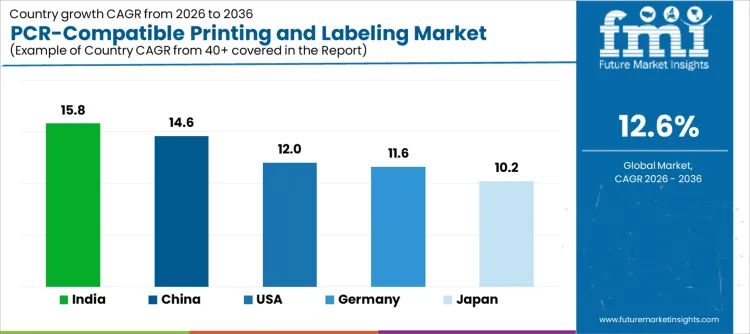
- India is the fastest-growing country with a CAGR of 15.8% during 2026 to 2036.
- China and the USA are growing at 14.6% CAGR and 12.0% CAGR respectively.
- The market is led by companies such as Siegwerk, Flint Group, Avery Dennison, Sun Chemical, and DIC Corporation.
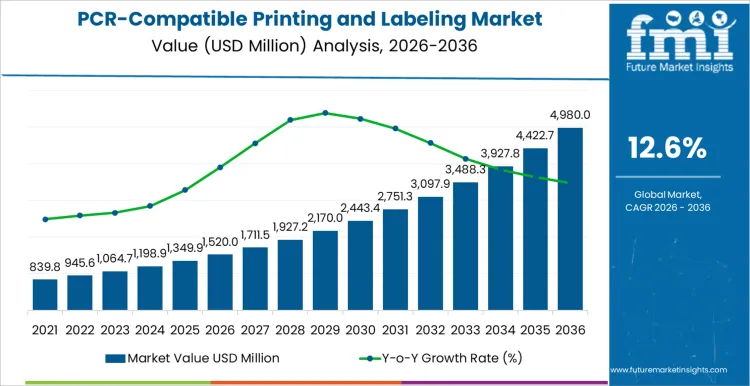
Advances in low-migration inks, de-inking friendly systems, and wash-off labels support both print quality and recyclability objectives, enabling compliance with circular packaging guidelines. Converters and brand owners emphasize spectrophotometric color control, adhesion testing, and barcode readability to ensure shelf consistency and logistics durability.
Regulatory pressure on recycled content, combined with retailer sustainability scorecards, reinforces procurement of PCR-compatible printing solutions that do not compromise recycling efficiency. Market expansion is driven by qualification requirements and performance parity on recycled substrates rather than growth in packaging volumes, positioning PCR-compatible printing and labeling as a critical enabler of large-scale PCR packaging adoption.
PCR-Compatible Printing and Labeling Market Key Takeaways
| Metric | Value |
|---|---|
| Market Value (2026) | USD 1,520.0 million |
| Market Forecast Value (2036) | USD 4,980.0 million |
| Forecast CAGR (2026-2036) | 12.6% |
Why is the Demand for PCR-Compatible Printing and Labeling Market Growing?
Brand owners shifting to post-consumer recycled (PCR) substrates in packaging increasingly require printing and labeling systems that perform reliably on materials with variable surface properties. PCR films, cartons, and rigid plastics can present differences in porosity, surface energy, and ink adhesion compared with virgin materials, affecting color reproduction, print clarity, and adhesion durability. Converters supplying food, beverage, and personal care brands invest in inks, primers, and label adhesives formulated to adhere consistently to PCR surfaces without scratching or peeling during high-speed filling and distribution. Retailers enforcing planogram and shelf standardization expect printed graphics and brand elements on PCR packages to match the quality seen on traditional materials, driving procurement of specialized printing inks and labelstocks optimized for recycled substrates.
Procurement decisions in this market reflect both regulatory recycled content targets and aesthetics that influence purchase decisions at point of sale. Regions with mandatory PCR usage in packaging stimulate demand for compatible printing technologies that maintain vibrancy and contrast on diverse recycled materials. Material scientists and print engineers refine formulations to balance abrasion resistance with solvent tolerance under varied environmental exposures typical in transit and retail display. Quality assurance teams implement spectrophotometric checks and adhesion testing protocols to validate performance before bulk production. Growth in flexible packaging and shrink sleeve applications using PCR films further expands demand for labels and inks designed with tailored drying profiles and adhesion promoters.
How Is the PCR-Compatible Printing and Labeling Industry Segmented by Label Type, Compatibility Technology, and End Use?
Demand for PCR-compatible printing and labeling solutions is shaped by recyclability targets, brand sustainability commitments, and regulatory guidance on packaging design for recycling. Packaging owners and converters focus on inks, labels, and adhesives that do not interfere with mechanical recycling or de-inking processes. Selection priorities include migration safety, residue control, and compatibility with high-speed packaging lines. Segmentation by label type, compatibility technology, and end use explains how labeling systems align with circular packaging requirements across FMCG-driven applications.
Which Label Type Holds the Largest Share in PCR-Compatible Printing and Labeling?
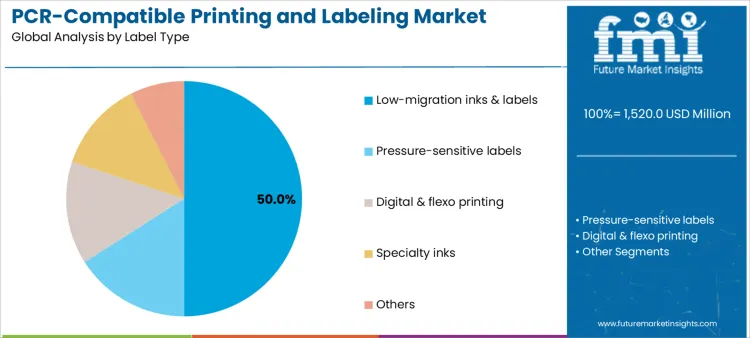
Low-migration inks and labels account for 50.0%, reflecting their importance in food-contact safety and recyclability compliance. These solutions minimize ink transfer, chemical migration, and contamination risk during recycling and product use. Adoption is strongest in regulated packaging formats where both safety and material recovery are critical. Pressure-sensitive labels, digital and flexo printing solutions, specialty inks, and other label types support specific design or cost objectives without disclosed share values. Label-type segmentation highlights concentration in systems balancing print performance, regulatory acceptance, and recyclability compatibility.
Key Points
- Low-migration systems dominate due to safety and compliance needs.
- Ink control supports recyclability and food-contact use.
- Alternative label formats address specialized branding needs.
How Does Compatibility Technology Influence PCR-Friendly Label Adoption?
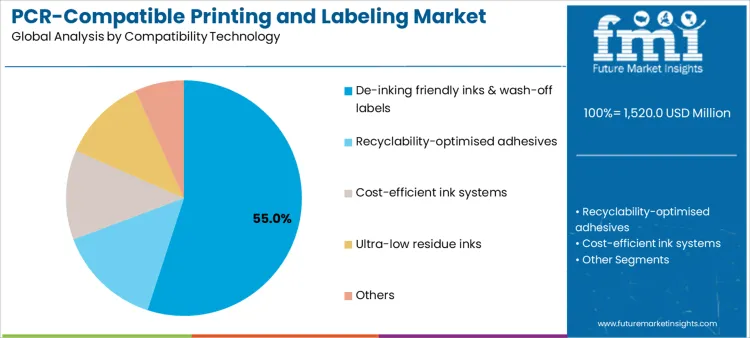
De-inking friendly inks and wash-off labels represent 55.0%, emphasizing the role of clean separation during recycling processes. These technologies enable effective ink and label removal in washing stages, improving recyclate quality. Adoption aligns with packaging formats entering closed-loop recycling streams. Recyclability-optimised adhesives, cost-efficient ink systems, ultra-low residue inks, and other technologies address operational priorities without quantified shares. Compatibility-technology segmentation reflects increasing emphasis on design-for-recycling principles within labeling and printing systems.
Key Points
- De-inking solutions improve recyclate purity.
- Wash-off labels support closed-loop recycling.
- Adhesive selection influences residue control.
Which End Uses Drive Demand for PCR-Compatible Printing and Labeling?
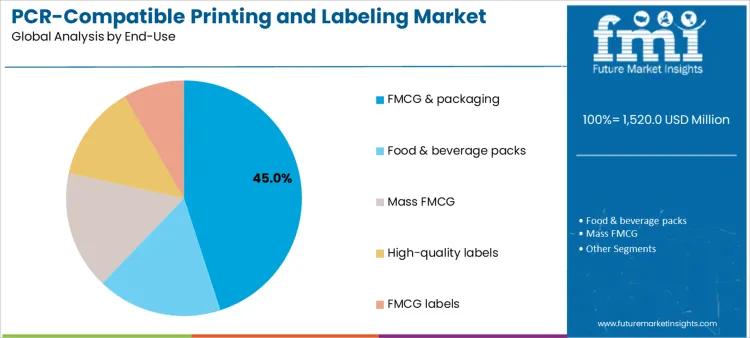
FMCG and packaging applications account for 45.0%, driven by high packaging volumes and strong sustainability commitments. These segments face increasing scrutiny on recyclability performance and material recovery outcomes. Food and beverage packs, mass FMCG formats, high-quality labels, and other FMCG labeling applications contribute to demand without disclosed share values. End-use segmentation shows concentration where scale, regulatory exposure, and brand visibility accelerate adoption of PCR-compatible labeling solutions.
Key Points
- FMCG packaging leads due to volume and visibility.
- Recycling performance influences label selection decisions.
- Sustainability targets shape end-use adoption patterns.
What are the Key Dynamics in the PCR-Compatible Printing and Labeling Market?
Demand in the PCR-compatible printing and labeling market is shaped by brand requirements to communicate sustainability while ensuring adhesion and legibility on recycled substrates. Beauty, beverage, and consumer packaged goods companies increase PCR film and rigid PCR use, and printing/labeling systems must function without compromising appearance or durability. Solutions that perform well during high-speed converting and remain stable through filling, cold chain, or moisture exposure gain preference. Printing technologies and inks that bond reliably to high-PCR surfaces influence material choice.
How do substrate characteristics and print performance expectations influence uptake?
High-PCR films and rigid plastics often exhibit variable surface energy and porosity compared to virgin substrates, which affects ink wetting and label adhesion. In beverage packaging, for example, condensation on PCR bottles can cause label lifting unless coatings and adhesives are tuned to maintain tack in wet conditions.
Cosmetic tubes and jars with high recycled content require printing systems that deliver sharp graphics and consistent color without ink bleed or flaking under mechanical handling. Thermal and UV curing processes are evaluated for compatibility with PCR resin thermo-mechanical limits to avoid surface distortion during production. Manufacturers assess how well printing and labeling components preserve barcode readability and scuff resistance throughout distribution and retail handling.
How do supply chain adaptation and compliance requirements affect market viability?
Roll-to-roll and sheet-fed converters adjust equipment settings and select inks and adhesives that meet both PCR substrate behavior and regulatory mandates for food contact and consumer safety. Some adhesives that perform on virgin films lose cohesion on high-recycled content materials, prompting development of tailored chemistries that bond consistently while meeting migration limits in food packaging. Traceability systems that link printed codes with recycled content documentation support brand transparency objectives but require integration between printing software and enterprise quality systems.
Variation in regional labeling requirements for recycled content claims guides where specific printing protocols are validated, influencing procurement and production planning for global brands seeking uniform appearance across markets. Cost pressure emerges where specialized printing components add upfront expense, and converters must demonstrate value through reduced rejects and improved shelf presence.
How Is Demand for the PCR-Compatible Printing and Labeling Market Evolving Globally?
Global demand for PCR-compatible printing and labeling is accelerating as packaging shifts toward recycled plastic substrates. Growth reflects rising PCR usage across personal care, food, household, and beauty packaging requiring print systems maintaining adhesion and recyclability. Surface variability, contamination, and color inconsistency in PCR materials increase technical demands on inks and labels. India records 15.8% CAGR, China records 14.6% CAGR, USA records 12.0% CAGR, Germany records 11.6% CAGR, and Japan records 10.2% CAGR. Market momentum is driven by compliance mandates, brand sustainability targets, and packaging qualification requirements rather than volume-led expansion.
| Country | CAGR (%) |
|---|---|
| India | 15.8% |
| China | 14.6% |
| USA | 12.0% |
| Germany | 11.6% |
| Japan | 10.2% |
What is driving growth of PCR-compatible printing and labeling demand in India?
Demand for PCR-compatible printing and labeling in India is accelerating as packaging converters adapt operations for recycled plastic substrates. Growth at 15.8% CAGR reflects rising use of PCR bottles, pouches, and films requiring inks, coatings, and adhesives that maintain adhesion and legibility. Variable surface energy and contamination levels in PCR materials increase technical complexity for printers. Brand commitments to recycled content amplify specification pressure across FMCG, personal care, and home care packaging.
Investments focus on low-migration inks, wash-off labels, and de-inking compatible systems. Demand concentrates within flexible packaging and shrink sleeve applications supplying large urban consumer markets. Contract printing houses upgrade curing and inspection systems to manage recycled material variability.
- Growth of PCR flexible packaging formats
- Rising specification pressure from FMCG brands
- Need for adhesion on variable PCR surfaces
- Investment in de-inking compatible print systems
Why is China seeing expansion in PCR-compatible printing and labeling adoption?
PCR-compatible printing and labeling demand in China is expanding as packaging supply chains scale recycled content usage. Growth at 14.6% CAGR reflects high-volume adoption of PCR containers across food, beverage, and personal care segments. Large converters face challenges from inconsistent PCR surface quality affecting ink anchorage and color consistency.
Regulatory pressure on plastic reduction accelerates printer qualification of PCR-safe inks and coatings. Investments emphasize high-speed gravure and flexographic systems optimized for recycled substrates. Demand remains centered on export-oriented packaging requiring compliance with international recyclability and de-inking standards. Converter certification programs expand to address traceability documentation and audit requirements linked to recycled packaging.
- High-volume PCR packaging adoption
- Export-driven compliance requirements
- Ink anchorage challenges on recycled substrates
- Expansion of printer certification programs
What factors are shaping PCR-compatible printing and labeling sales in the USA?
Sales of PCR-compatible printing and labeling in the USA are rising as brands transition packaging portfolios toward recycled plastics. Growth at 12.0% CAGR reflects strong activity in personal care, household, and beverage packaging. PCR variability creates challenges for ink adhesion, scuff resistance, and barcode readability. Retail sustainability scorecards increase scrutiny on label removability and recycling compatibility. Printers invest in low-VOC inks, digital printing, and compliant adhesive systems. Demand is driven by nationwide brand mandates rather than localized packaging innovation cycles. Contract converters standardize qualification protocols across multiple substrates to minimize operational risk during PCR scale-up. Compliance documentation and performance testing gain importance across national supply chains.
- Retail sustainability scorecard pressure
- Growth of digital and low-VOC ink systems
- Need for barcode and scuff performance
- Standardization of nationwide print qualification
How is Germany supporting growth of PCR-compatible printing and labeling demand?
PCR-compatible printing and labeling demand in Germany is advancing as circular economy rules tighten packaging requirements. Growth at 11.6% CAGR reflects adoption across food, personal care, and household packaging using recycled plastics. Strict recyclability standards require inks and labels supporting clean separation and de-inking. Printers prioritize water-based inks, removable labels, and certified recycling compatibility. Advanced testing and documentation processes increase qualification timelines.
Demand remains anchored in compliance-driven upgrades across established packaging operations. Industry associations guide standardization of print materials aligned with EU packaging waste directives and audit frameworks governing recycled content usage across markets. Certification costs and testing cycles influence converter investment planning decisions.
- EU-aligned recyclability standards
- Emphasis on de-inking and label removability
- Growth of water-based ink systems
- High documentation and testing requirements
What is driving expansion of PCR-compatible printing and labeling demand in Japan?
PCR-compatible printing and labeling demand in Japan is increasing as packaging transitions cautiously toward recycled plastics. Growth at 10.2% CAGR reflects adoption within personal care, cosmetics, and household products. High aesthetic expectations amplify sensitivity to print defects on PCR substrates. Printers focus on precision registration, low-odor inks, and stable color reproduction. Conservative qualification processes lengthen adoption timelines.
Demand remains concentrated among premium brands executing controlled recycled content integration strategies. Supplier collaboration centers on material testing, surface treatment, and print durability validation supporting brand quality standards. Export-oriented packaging adds documentation and compliance complexity for converters. Operational risk management remains central to investment decisions.
- High aesthetic quality expectations
- Conservative PCR qualification timelines
- Focus on low-odor and color stability
- Premium brand-driven adoption patterns
What is the competitive landscape of demand for the PCR-compatible printing and labeling market globally?
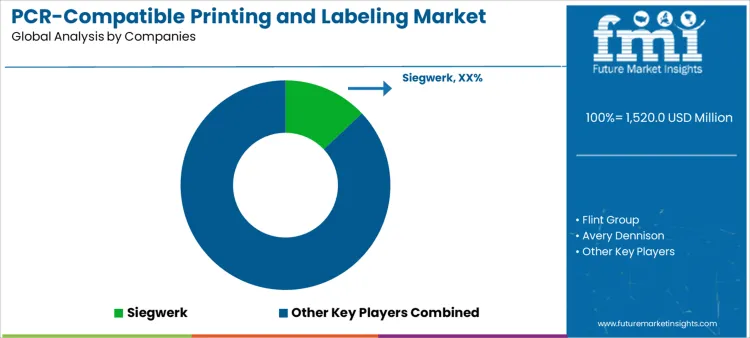
Rising PCR adoption in rigid and flexible packaging is reshaping demand for inks, coatings, and labels compatible with recycled substrates. Brand owners and converters assess ink adhesion on PCR surfaces, resistance to scuffing, color stability, and migration compliance. Buyer evaluation includes de-inkability during recycling, low-odor performance, and behavior on variable surface energies typical of PCR plastics. Procurement behavior favors suppliers with validated PCR print trials, food and cosmetic compliance credentials, and global technical support. Trend in the PCR-compatible printing and labeling market reflects tighter brand specifications linking print performance directly to recyclability outcomes.
Siegwerk leads competitive positioning through ink systems engineered specifically for PCR substrates, supported by extensive recycling compatibility testing. Sun Chemical competes by aligning low-migration and de-inkable ink technologies with circular packaging requirements. Flint Group maintains relevance through packaging inks optimized for adhesion consistency across recycled polymer variability. Avery Dennison supports demand via labeling materials and adhesives designed for PCR containers without compromising recycling streams. DIC Corporation participates with resin and ink technologies enabling stable print quality on recycled plastics. Competitive differentiation centers on print reliability on PCR, recycling compatibility, regulatory compliance, and converter-level technical collaboration.
Scope of the Report
| Items | Values |
|---|---|
| Quantitative Units | USD million |
| Label Type | Low-migration inks & labels; Pressure-sensitive labels; Digital & flexo printing; Specialty inks; Others |
| Compatibility Technology | De-inking friendly inks & wash-off labels; Recyclability-optimised adhesives; Cost-efficient ink systems; Ultra-low residue inks; Others |
| End-Use | FMCG & packaging; Food & beverage packs; Mass FMCG; High-quality labels; FMCG labels |
| Regions Covered | Asia Pacific, Europe, North America, Latin America, Middle East & Africa |
| Countries Covered | India, China, USA, Germany, Japan, and 40+ countries |
| Key Companies Profiled | Siegwerk; Flint Group; Avery Dennison; Sun Chemical; Zhejiang Huangshan; T&K Toka; DIC Corporation; Toyo Ink; Others |
| Additional Attributes | Revenue contribution by label type, compatibility technology, and end-use; performance of wash-off labels and de-inking inks in PCR recovery streams; adoption of low-migration inks across food and FMCG packaging; impact of recyclability-compliant adhesives on polymer purity; procurement trends influenced by circular packaging mandates and brand sustainability targets. |
Key Players in the PCR-Compatible Printing and Labeling Market
- Siegwerk
- Flint Group
- Avery Dennison
- Sun Chemical
- Zhejiang Huangshan
- T&K Toka
- DIC Corporation
- Toyo Ink
- Others
Scope of the Report
|
Items |
Values |
|
Quantitative Units |
USD million |
|
Label Type |
Low-migration inks & labels; Pressure-sensitive labels; Digital & flexo printing; Specialty inks; Others |
|
Compatibility Technology |
De-inking friendly inks & wash-off labels; Recyclability-optimised adhesives; Cost-efficient ink systems; Ultra-low residue inks; Others |
|
End-Use |
FMCG & packaging; Food & beverage packs; Mass FMCG; High-quality labels; FMCG labels |
|
Regions Covered |
Asia Pacific, Europe, North America, Latin America, Middle East & Africa |
|
Countries Covered |
India, China, USA, Germany, Japan, and 40+ countries |
|
Key Companies Profiled |
Siegwerk; Flint Group; Avery Dennison; Sun Chemical; Zhejiang Huangshan; T&K Toka; DIC Corporation; Toyo Ink; Others |
|
Additional Attributes |
Revenue contribution by label type, compatibility technology, and end-use; performance of wash-off labels and de-inking inks in PCR recovery streams; adoption of low-migration inks across food and FMCG packaging; impact of recyclability-compliant adhesives on polymer purity; procurement trends influenced by circular packaging mandates and brand sustainability targets. |
PCR-Compatible Printing and Labeling Market by Segment
Label Type:
- Low-migration inks & labels
- Pressure-sensitive labels
- Digital & flexo printing
- Specialty inks
- Others
Compatibility Technology:
- De-inking friendly inks & wash-off labels
- Recyclability-optimised adhesives
- Cost-efficient ink systems
- Ultra-low residue inks
- Others
End-Use:
- FMCG & packaging
- Food & beverage packs
- Mass FMCG
- High-quality labels
- FMCG labels
Region:
- Asia Pacific
- China
- Japan
- South Korea
- India
- Australia & New Zealand
- ASEAN
- Rest of Asia Pacific
- Europe
- Germany
- United Kingdom
- France
- Italy
- Spain
- Nordic
- BENELUX
- Rest of Europe
- North America
- United States
- Canada
- Mexico
- Latin America
- Brazil
- Chile
- Rest of Latin America
- Middle East & Africa
- Kingdom of Saudi Arabia
- Other GCC Countries
- Turkey
- South Africa
- Other African Union
- Rest of Middle East & Africa
Bibliography
- European Commission. (2023). Proposal for a regulation on packaging and packaging waste: Requirements for recyclability, labeling, and material compatibility. Publications Office of the European Union.
- European Food Safety Authority. (2023). Guidance on migration testing of printing inks and coatings used on plastic food packaging containing recycled materials. EFSA Journal, 21(7), e08134.
- International Organization for Standardization. (2024). ISO 23900‑2:2024—Plastics—Recycled plastics—Evaluation of label, ink, and adhesive impact on mechanical recycling streams. International Organization for Standardization.
Frequently Asked Questions
How big is the pcr-compatible printing and labeling market in 2026?
The global pcr-compatible printing and labeling market is estimated to be valued at USD 1,520.0 million in 2026.
What will be the size of pcr-compatible printing and labeling market in 2036?
The market size for the pcr-compatible printing and labeling market is projected to reach USD 4,980.0 million by 2036.
How much will be the pcr-compatible printing and labeling market growth between 2026 and 2036?
The pcr-compatible printing and labeling market is expected to grow at a 12.6% CAGR between 2026 and 2036.
What are the key product types in the pcr-compatible printing and labeling market?
The key product types in pcr-compatible printing and labeling market are low-migration inks & labels, pressure-sensitive labels, digital & flexo printing, specialty inks and others.
Which compatibility technology segment to contribute significant share in the pcr-compatible printing and labeling market in 2026?
In terms of compatibility technology, de-inking friendly inks & wash-off labels segment to command 55.0% share in the pcr-compatible printing and labeling market in 2026.
Preview the report firsthand - request a free sample
Get SampleGet the brochure for pricing and purchase details.
Get PDFTable of Content
- Executive Summary
- Global Market Outlook
- Demand-side Trends
- Supply-side Trends
- Technology Roadmap Analysis
- Analysis and Recommendations
- Market Overview
- Market Coverage / Taxonomy
- Market Definition / Scope / Limitations
- Market Background
- Market Dynamics
- Drivers
- Restraints
- Opportunity
- Trends
- Scenario Forecast
- Demand in Optimistic Scenario
- Demand in Likely Scenario
- Demand in Conservative Scenario
- Opportunity Map Analysis
- Product Life Cycle Analysis
- Supply Chain Analysis
- Investment Feasibility Matrix
- Value Chain Analysis
- PESTLE and Porter’s Analysis
- Regulatory Landscape
- Regional Parent Market Outlook
- Production and Consumption Statistics
- Import and Export Statistics
- Market Dynamics
- Global Market Analysis 2021 to 2025 and Forecast, 2026 to 2036
- Historical Market Size Value (USD Million) Analysis, 2021 to 2025
- Current and Future Market Size Value (USD Million) Projections, 2026 to 2036
- Y-o-Y Growth Trend Analysis
- Absolute $ Opportunity Analysis
- Global Market Pricing Analysis 2021 to 2025 and Forecast 2026 to 2036
- Global Market Analysis 2021 to 2025 and Forecast 2026 to 2036, By Label Type
- Introduction / Key Findings
- Historical Market Size Value (USD Million) Analysis By Label Type , 2021 to 2025
- Current and Future Market Size Value (USD Million) Analysis and Forecast By Label Type , 2026 to 2036
- Low-migration inks & labels
- Pressure-sensitive labels
- Digital & flexo printing
- Specialty inks
- Others
- Low-migration inks & labels
- Y-o-Y Growth Trend Analysis By Label Type , 2021 to 2025
- Absolute $ Opportunity Analysis By Label Type , 2026 to 2036
- Global Market Analysis 2021 to 2025 and Forecast 2026 to 2036, By Compatibility Technology
- Introduction / Key Findings
- Historical Market Size Value (USD Million) Analysis By Compatibility Technology, 2021 to 2025
- Current and Future Market Size Value (USD Million) Analysis and Forecast By Compatibility Technology, 2026 to 2036
- De-inking friendly inks & wash-off labels
- Recyclability-optimised adhesives
- Cost-efficient ink systems
- Ultra-low residue inks
- Others
- De-inking friendly inks & wash-off labels
- Y-o-Y Growth Trend Analysis By Compatibility Technology, 2021 to 2025
- Absolute $ Opportunity Analysis By Compatibility Technology, 2026 to 2036
- Global Market Analysis 2021 to 2025 and Forecast 2026 to 2036, By End-Use
- Introduction / Key Findings
- Historical Market Size Value (USD Million) Analysis By End-Use, 2021 to 2025
- Current and Future Market Size Value (USD Million) Analysis and Forecast By End-Use, 2026 to 2036
- FMCG & packaging
- Food & beverage packs
- Mass FMCG
- High-quality labels
- FMCG labels
- FMCG & packaging
- Y-o-Y Growth Trend Analysis By End-Use, 2021 to 2025
- Absolute $ Opportunity Analysis By End-Use, 2026 to 2036
- Global Market Analysis 2021 to 2025 and Forecast 2026 to 2036, By Region
- Introduction
- Historical Market Size Value (USD Million) Analysis By Region, 2021 to 2025
- Current Market Size Value (USD Million) Analysis and Forecast By Region, 2026 to 2036
- North America
- Latin America
- Western Europe
- Eastern Europe
- East Asia
- South Asia and Pacific
- Middle East & Africa
- Market Attractiveness Analysis By Region
- North America Market Analysis 2021 to 2025 and Forecast 2026 to 2036, By Country
- Historical Market Size Value (USD Million) Trend Analysis By Market Taxonomy, 2021 to 2025
- Market Size Value (USD Million) Forecast By Market Taxonomy, 2026 to 2036
- By Country
- USA
- Canada
- Mexico
- By Label Type
- By Compatibility Technology
- By End-Use
- By Country
- Market Attractiveness Analysis
- By Country
- By Label Type
- By Compatibility Technology
- By End-Use
- Key Takeaways
- Latin America Market Analysis 2021 to 2025 and Forecast 2026 to 2036, By Country
- Historical Market Size Value (USD Million) Trend Analysis By Market Taxonomy, 2021 to 2025
- Market Size Value (USD Million) Forecast By Market Taxonomy, 2026 to 2036
- By Country
- Brazil
- Chile
- Rest of Latin America
- By Label Type
- By Compatibility Technology
- By End-Use
- By Country
- Market Attractiveness Analysis
- By Country
- By Label Type
- By Compatibility Technology
- By End-Use
- Key Takeaways
- Western Europe Market Analysis 2021 to 2025 and Forecast 2026 to 2036, By Country
- Historical Market Size Value (USD Million) Trend Analysis By Market Taxonomy, 2021 to 2025
- Market Size Value (USD Million) Forecast By Market Taxonomy, 2026 to 2036
- By Country
- Germany
- UK
- Italy
- Spain
- France
- Nordic
- BENELUX
- Rest of Western Europe
- By Label Type
- By Compatibility Technology
- By End-Use
- By Country
- Market Attractiveness Analysis
- By Country
- By Label Type
- By Compatibility Technology
- By End-Use
- Key Takeaways
- Eastern Europe Market Analysis 2021 to 2025 and Forecast 2026 to 2036, By Country
- Historical Market Size Value (USD Million) Trend Analysis By Market Taxonomy, 2021 to 2025
- Market Size Value (USD Million) Forecast By Market Taxonomy, 2026 to 2036
- By Country
- Russia
- Poland
- Hungary
- Balkan & Baltic
- Rest of Eastern Europe
- By Label Type
- By Compatibility Technology
- By End-Use
- By Country
- Market Attractiveness Analysis
- By Country
- By Label Type
- By Compatibility Technology
- By End-Use
- Key Takeaways
- East Asia Market Analysis 2021 to 2025 and Forecast 2026 to 2036, By Country
- Historical Market Size Value (USD Million) Trend Analysis By Market Taxonomy, 2021 to 2025
- Market Size Value (USD Million) Forecast By Market Taxonomy, 2026 to 2036
- By Country
- China
- Japan
- South Korea
- By Label Type
- By Compatibility Technology
- By End-Use
- By Country
- Market Attractiveness Analysis
- By Country
- By Label Type
- By Compatibility Technology
- By End-Use
- Key Takeaways
- South Asia and Pacific Market Analysis 2021 to 2025 and Forecast 2026 to 2036, By Country
- Historical Market Size Value (USD Million) Trend Analysis By Market Taxonomy, 2021 to 2025
- Market Size Value (USD Million) Forecast By Market Taxonomy, 2026 to 2036
- By Country
- India
- ASEAN
- Australia & New Zealand
- Rest of South Asia and Pacific
- By Label Type
- By Compatibility Technology
- By End-Use
- By Country
- Market Attractiveness Analysis
- By Country
- By Label Type
- By Compatibility Technology
- By End-Use
- Key Takeaways
- Middle East & Africa Market Analysis 2021 to 2025 and Forecast 2026 to 2036, By Country
- Historical Market Size Value (USD Million) Trend Analysis By Market Taxonomy, 2021 to 2025
- Market Size Value (USD Million) Forecast By Market Taxonomy, 2026 to 2036
- By Country
- Kingdom of Saudi Arabia
- Other GCC Countries
- Turkiye
- South Africa
- Other African Union
- Rest of Middle East & Africa
- By Label Type
- By Compatibility Technology
- By End-Use
- By Country
- Market Attractiveness Analysis
- By Country
- By Label Type
- By Compatibility Technology
- By End-Use
- Key Takeaways
- Key Countries Market Analysis
- USA
- Pricing Analysis
- Market Share Analysis, 2025
- By Label Type
- By Compatibility Technology
- By End-Use
- Canada
- Pricing Analysis
- Market Share Analysis, 2025
- By Label Type
- By Compatibility Technology
- By End-Use
- Mexico
- Pricing Analysis
- Market Share Analysis, 2025
- By Label Type
- By Compatibility Technology
- By End-Use
- Brazil
- Pricing Analysis
- Market Share Analysis, 2025
- By Label Type
- By Compatibility Technology
- By End-Use
- Chile
- Pricing Analysis
- Market Share Analysis, 2025
- By Label Type
- By Compatibility Technology
- By End-Use
- Germany
- Pricing Analysis
- Market Share Analysis, 2025
- By Label Type
- By Compatibility Technology
- By End-Use
- UK
- Pricing Analysis
- Market Share Analysis, 2025
- By Label Type
- By Compatibility Technology
- By End-Use
- Italy
- Pricing Analysis
- Market Share Analysis, 2025
- By Label Type
- By Compatibility Technology
- By End-Use
- Spain
- Pricing Analysis
- Market Share Analysis, 2025
- By Label Type
- By Compatibility Technology
- By End-Use
- France
- Pricing Analysis
- Market Share Analysis, 2025
- By Label Type
- By Compatibility Technology
- By End-Use
- India
- Pricing Analysis
- Market Share Analysis, 2025
- By Label Type
- By Compatibility Technology
- By End-Use
- ASEAN
- Pricing Analysis
- Market Share Analysis, 2025
- By Label Type
- By Compatibility Technology
- By End-Use
- Australia & New Zealand
- Pricing Analysis
- Market Share Analysis, 2025
- By Label Type
- By Compatibility Technology
- By End-Use
- China
- Pricing Analysis
- Market Share Analysis, 2025
- By Label Type
- By Compatibility Technology
- By End-Use
- Japan
- Pricing Analysis
- Market Share Analysis, 2025
- By Label Type
- By Compatibility Technology
- By End-Use
- South Korea
- Pricing Analysis
- Market Share Analysis, 2025
- By Label Type
- By Compatibility Technology
- By End-Use
- Russia
- Pricing Analysis
- Market Share Analysis, 2025
- By Label Type
- By Compatibility Technology
- By End-Use
- Poland
- Pricing Analysis
- Market Share Analysis, 2025
- By Label Type
- By Compatibility Technology
- By End-Use
- Hungary
- Pricing Analysis
- Market Share Analysis, 2025
- By Label Type
- By Compatibility Technology
- By End-Use
- Kingdom of Saudi Arabia
- Pricing Analysis
- Market Share Analysis, 2025
- By Label Type
- By Compatibility Technology
- By End-Use
- Turkiye
- Pricing Analysis
- Market Share Analysis, 2025
- By Label Type
- By Compatibility Technology
- By End-Use
- South Africa
- Pricing Analysis
- Market Share Analysis, 2025
- By Label Type
- By Compatibility Technology
- By End-Use
- USA
- Market Structure Analysis
- Competition Dashboard
- Competition Benchmarking
- Market Share Analysis of Top Players
- By Regional
- By Label Type
- By Compatibility Technology
- By End-Use
- Competition Analysis
- Competition Deep Dive
- Siegwerk
- Overview
- Product Portfolio
- Profitability by Market Segments (Product/Age /Sales Channel/Region)
- Sales Footprint
- Strategy Overview
- Marketing Strategy
- Product Strategy
- Channel Strategy
- Flint Group
- Avery Dennison
- Sun Chemical
- Zhejiang Huangshan
- T&K Toka
- DIC Corporation
- Toyo Ink
- Others
- Siegwerk
- Competition Deep Dive
- Assumptions & Acronyms Used
- Research Methodology


