

- Industry Size (2026)
- USD 1.6 Bn
- Forecast (2036)
- USD 3.3 Bn
- CAGR (2026 to 2036)
- 7.4%
Composite Winglet and Sharklet Structures for Fuel Burn Optimization Market Size, Market Forecast and Outlook By FMI
The composite winglet and sharklet structures for fuel burn optimization market was valued at USD 1.5 billion in 2025. Industry is expected to reach USD 1.6 billion in 2026 and USD 3.30 billion by 2036, reflecting a CAGR of 7.4% from 2026 to 2036. Expansion is being driven by airlines adding physical aerodynamic upgrades after exhausting easier operational measures to improve fuel efficiency and meet stricter emissions targets.
Procurement teams are working under tighter timing pressure as fleet renewal is taking longer while emissions obligations remain immediate. Delays in next-generation narrowbody deliveries leave operators exposed to higher carbon-related costs. Advanced winglets offer a practical way to reduce fuel burn on aircraft already in service. These upgrades are increasingly being treated as necessary efficiency investments rather than optional enhancements.
Summary of Composite Winglet and Sharklet Structures Market
- The market is estimated at USD 1.5 billion in 2025.
- The market is projected to reach USD 3.30 billion by 2036.
- The market is expected to grow at a CAGR of 7.4% from 2026 to 2036.
- The forecast period represents an incremental opportunity of USD 1.70 billion.
- Narrowbody aircraft lead by platform with a 52.0% share in 2026.
- OEM line-fit dominates by fit type with a 74.0% share in 2026.
- Carbon epoxy leads by material system with a 61.0% share in 2026.
- Blended winglets lead by architecture with a 36.0% share in 2026.
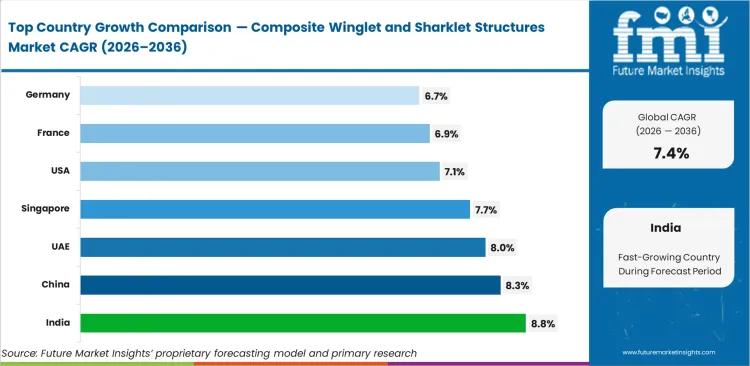
- India (8.8%), China (8.3%), and UAE (8.0%) are among the fastest-growing markets.
- Airlines lead by end user with a 58.0% share in 2026.
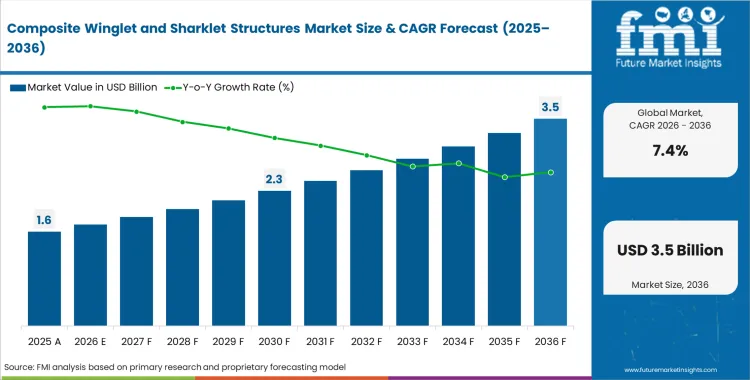
Composite Winglet and Sharklet Structures for Fuel Burn Optimization Market Key Takeaways
| Metric | Values (2026-2036) |
|---|---|
| Industry Size (2026) | USD 1.6 Billion |
| Industry Value (2036) | USD 3.3 Billion |
| CAGR (2026-2036) | 7.4% |
Source: Future Market Insights (FMI) analysis, based on proprietary forecasting model and primary research
Residual value gaps can widen quickly once major lessors start treating blended tip configurations as a baseline requirement in narrowbody lease renewals. Asset managers can reinforce that divide by placing lower acceptance on unmodified airframes. That leaves second-tier airlines with little choice but to fund aerodynamic upgrades before returning leased aircraft.
India is expected to record 8.8% CAGR during 2026 to 2036 as domestic airlines continue adding narrowbody aircraft. Policy pressure around aviation carbon intensity is supporting 8.3% CAGR in China over the same period. In the United Arab Emirates, demand is projected to expand at 8.0% as carriers place greater emphasis on widebody efficiency. Singapore is estimated at 7.7%, helped by its growing MRO role in regional aviation support. Retrofit continuity keeps the United States on a 7.1% growth path, while France and Germany are likely to post 6.9% and 6.7% CAGR, respectively, with line-fit adoption remaining the main area of focus.
Segmental Analysis
Composite Winglet and Sharklet Structures for Fuel Burn Optimization Market Analysis by Platform
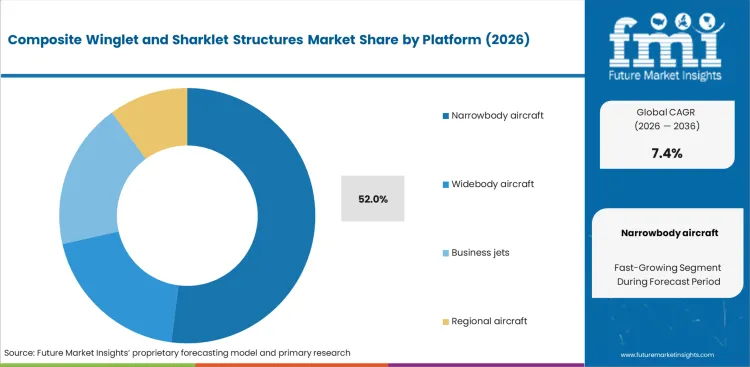
Narrowbody aircraft are expected to account for 52.0% share in 2026 because this platform has the largest global fleet and the highest daily utilization. Low-cost carriers and large network operators prefer common tip configurations because standardization makes spare planning, maintenance handling, and fleet deployment easier across hundreds of aircraft. Tip-device choice also affects takeoff performance on hot-and-high routes, where poor aerodynamic fit can reduce payload flexibility. The narrowbody fleets also face more frequent tip damage because fast turnarounds and congested gates increase the risk of ground contact. Airlines that continue using older metallic configurations can face higher repair expense over time.
- Payload limitation: Hot-and-high runway operations require strong lift-to-drag performance. Fleet planners rely on that margin to protect payload on constrained routes.
- Turnaround damage: Congested gates increase the risk of wingtip contact. Maintenance teams therefore face faster repair cycles and greater need for composite patch capability.
- Lease standardization: Asset transfers depend on uniform specifications. Technical teams must match common tip architectures to avoid costly reconfiguration work.
Composite Winglet and Sharklet Structures for Fuel Burn Optimization Market Analysis by Fit
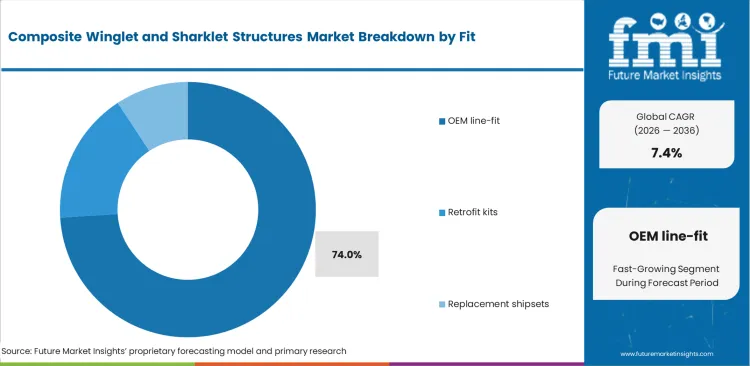
Airframers tightly control aerodynamic baselines on newly certified platforms. OEM line-fit is predicted to secure 74.0% share in 2026 because current-generation commercial aircraft require tip devices to meet initial certification performance guarantees. Supply chain directors at tier-one integrators lock in long-term advanced composites production contracts matching airframer delivery schedules. Selecting factory installation transfers integration risk entirely to aircraft manufacturers. This share figure does not reflect the wide margin gap across business models. Retrofit kits usually offer stronger margins for independent engineering firms than OEM line-fit contracts. Operators that delay factory installation can face a weaker operating position against more efficient rival fleets.
- Certification transfer: Factory completion provides validated baseline performance. Procurement teams prefer that route because it avoids the added approval risk that comes with aftermarket modifications.
- Assembly integration: Automated layup processes improve production consistency. Quality teams benefit from tighter aerodynamic tolerances and lower variation across the fleet.
- Margin disparity: Aftermarket exclusivity supports premium pricing. Financial teams often see stronger returns when specialized upgrades are approved for older airframes.
Composite Winglet and Sharklet Structures for Fuel Burn Optimization Market Analysis by Material System
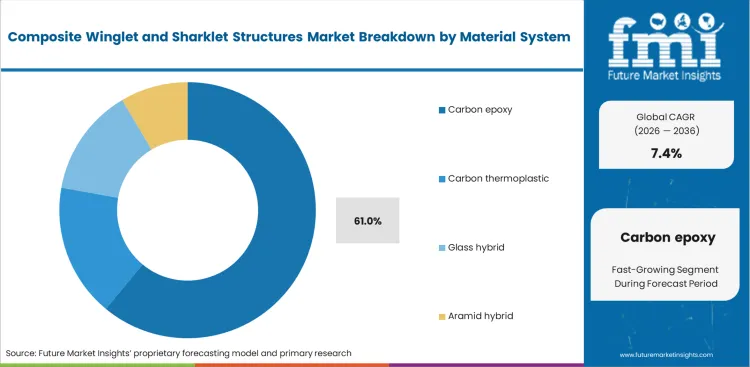
Carbon epoxy is expected to account for 61.0% share in 2026 because it has the strongest long-run record under repeated flex loading in aircraft applications. Engineering teams continue to specify this matrix because certification bodies are more familiar with its approved performance data, which reduces the need for fresh baseline validation. That shortens the approval path, but it also leaves operators with more demanding repair routines after ramp damage or tip strikes, especially where temperature-controlled handling is required. The thermoplastic uptake remains lower than its technical potential would suggest. Many buyers still overlook that high performance composites built on thermoplastic matrices can support faster weld-based repairs at airport gates and reduce dependence on epoxy curing cycles. Slower adoption of these newer systems keeps MRO facilities tied to higher repair handling requirements.
- Allowable data: Long flight history supports confidence in performance margins. Certification teams use existing data libraries to move approvals forward more efficiently.
- Curing delays: Epoxy matrices require longer thermal processing during repair work. Maintenance teams therefore face more downtime after major tip-damage events.
- Weldability transition: Thermoplastic architectures allow localized heat-based repairs. Line maintenance teams can address minor delamination issues without moving every case into a hangar.
Composite Winglet and Sharklet Structures for Fuel Burn Optimization Market Analysis by Architecture
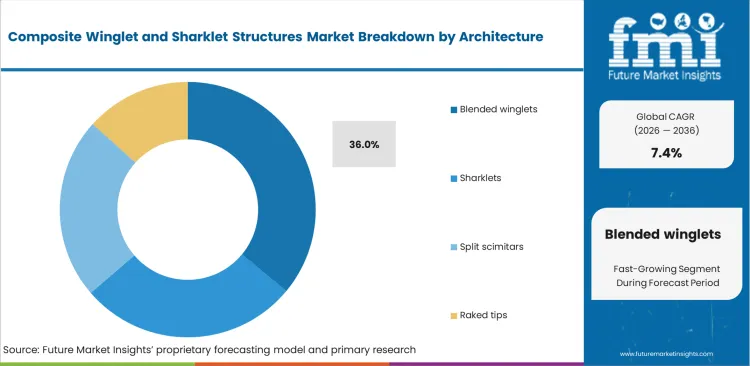
Blended winglets are expected to account for 36.0% share in 2026 as older aircraft programs continue to move through late-life aerodynamic upgrades. Their position reflects a clear engineering benefit, as smoother tip transitions help reduce localized load concentration compared with sharper-angle designs. That makes blended configurations easier to integrate on aging platforms, where added reinforcement inside the main wing box can quickly raise modification cost and complexity. This category also benefits from earlier certification investment. Split scimitar designs can offer better aircraft fairings integration, but the added engineering and approval work is often difficult to justify on older fleets. Operators that stay with baseline tip designs leave fuel-saving potential unused over the remaining life of the aircraft.
- Stress distribution: Smooth geometric curves help reduce localized fatigue risk. Engineering teams use that advantage to avoid heavier reinforcement work inside the main wing.
- Vortex isolation: Continuous surface profiles can delay airflow separation. That gives operators a small but useful efficiency benefit on longer sectors.
- Clearance constraints: Upward-sweeping extensions can create compatibility issues at some gates. Ground operations teams may need to manage positioning more carefully at older airport terminals.
Composite Winglet and Sharklet Structures for Fuel Burn Optimization Market Analysis by End User
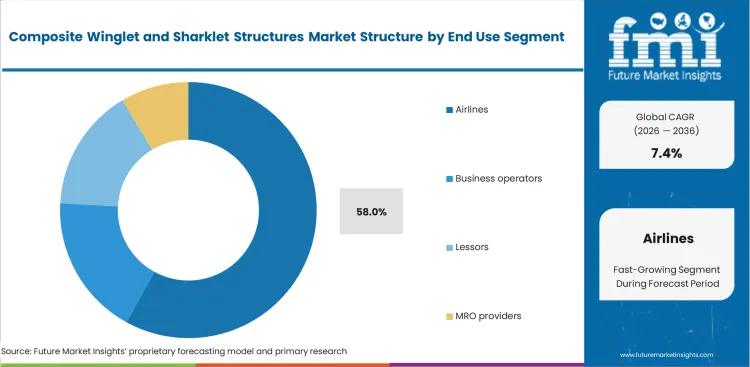
Airlines are expected to account for 58.0% share in 2026 because fuel expense sits directly within their daily operating budget. Purchase decisions for tip devices are usually tied to clear payback periods, with fleet managers and finance teams favoring modifications that recover cost within a limited time frame. The same upgrades can also improve route flexibility by extending the usable range of existing narrowbody aircraft without requiring larger platform additions. The airline preference is not always the final factor, as lessors often influence configuration choices through lease return conditions tied to pylon and strut fairing retrofit requirements. Airlines that misread those conditions can face high rework and reconfiguration costs before aircraft transfer.
- Payback calculation: Daily fuel savings help offset installation cost. Finance teams approve modifications when route economics support a clear and timely recovery period.
- Range extension: Drag reduction can improve the viability of marginal city-pairs. Route planners use that benefit to deploy existing aircraft on longer sectors without adding new platforms.
- Residual preservation: Asset condition influences secondary market value. Lessor technical teams often require specific aerodynamic upgrades before approving aircraft transfer or lease return.
Composite Winglet and Sharklet Structures for Fuel Burn Optimization Market Drivers, Restraints, and Opportunities
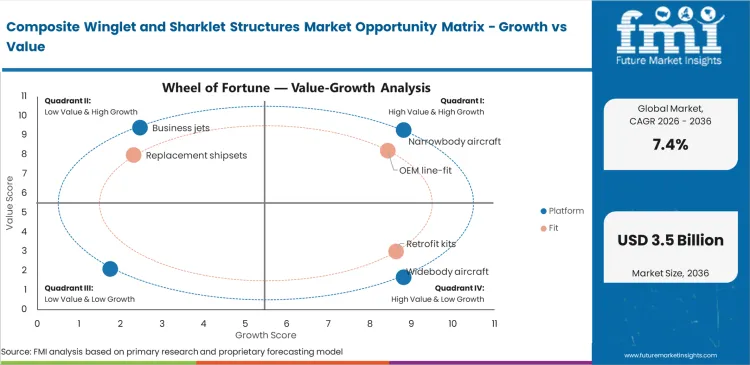
Aviation carbon pricing is pushing fleet managers to move faster on aerodynamic upgrade programs. Airlines operating older narrowbody aircraft face rising cost pressure under expanding emissions trading rules when fuel efficiency does not improve. Wingtip modifications offer a direct way to reduce carbon output per passenger kilometer. That pressure is making tip installations more necessary in fleet planning. Delays can also weaken route economics when competing carriers operate with lower fuel burn on the same sectors.
Retrofit adoption still depends on the design limits of older wing boxes. Aircraft not originally built for heavier tip extensions often need added internal reinforcement before new winglets can be installed. Engineering teams may have to open wing tanks, add belly fairing modification supports, and re-seal fuel barriers as part of the work. This raises hangar time and disrupts operating schedules. Load-alleviation software can reduce part of the stress in severe turbulence, but reinforcement remains necessary where airframe limits are already tight.
Opportunities in the Composite Winglet and Sharklet Structures for Fuel Burn Optimization Market
- Adaptive geometry: Engineers are incorporating smart materials that allow tip angles to adjust during specific phases of flight. This approach is gaining attention where operators want aerodynamic improvement without redesigning the full wing architecture.
- Thermoplastic welding: Line maintenance managers are adopting rapid-repair tooling to handle gate-level composite fixes more efficiently. The appeal is operational, as faster repair turnaround can reduce aircraft downtime and lower maintenance disruption.
- Integration synergy: Aerodynamic teams are increasingly pairing winglet installations with high lift device aerodynamic modification packages during heavy maintenance checks. The approach improves execution efficiency by aligning multiple aerodynamic upgrades within the same aircraft downtime window.
Regional Analysis
Based on regional analysis, Composite Winglet and Sharklet Structures for Fuel Burn Optimization is segmented into North America, Latin America, Western Europe, Eastern Europe, Middle East and Africa, East Asia, South Asia and Pacific across 40 plus countries.
.webp "Top Country Growth Comparison Composite Winglet And Sharklet Structures Market Cagr (2026 2036)")
| Country | CAGR (2026 to 2036) |
|---|---|
| India | 8.8% |
| China | 8.3% |
| United Arab Emirates | 8.0% |
| Singapore | 7.7% |
| United States | 7.1% |
| France | 6.9% |
| Germany | 6.7% |
Source: Future Market Insights (FMI) analysis, based on proprietary forecasting model and primary research
Asia-Pacific Composite Winglet and Sharklet Structures for Fuel Burn Optimization Market Analysis
Aircraft delivery backlogs moving into execution are shaping fleet plans across Asia-Pacific. Airlines replacing older turboprops with newer jet aircraft increasingly prefer factory-installed tip devices as a baseline efficiency feature. Local MRO capability for complex composite repair still varies across the region, so operators often keep larger spare inventories at primary hubs. FMI’s assessment indicates that this repair constraint is also encouraging interest in metallic-composite hybrid designs, as they are better able to absorb minor ramp damage than pure carbon epoxy configurations.
- India: The market in India is expected to grow at a CAGR of 8.8% through 2036. Domestic route networks are expanding deeper into secondary cities, where ground support quality can be inconsistent. Airlines are therefore giving greater preference to reinforced tip edges that can better withstand repeated ramp contact. That operating reality is influencing configuration decisions early in fleet planning.
- China: Centralized procurement remains a defining feature of the China market, where large airline groups align retrofit work with heavy maintenance schedules to keep downtime under control. Industry is projected to expand at a CAGR of 8.3% through 2036, supported by the scale of coordinated fleet upgrade programs. Bulk procurement also gives carriers stronger leverage in installation planning and supplier negotiations.
- Singapore: Singapore remains an important aviation service center, with demand supported by its role in maintenance, repair, and fleet transition activity across Southeast Asia. Operators and lessors use the market as a practical base for configuration management across multiple jurisdictions. This market is expected to register 7.7% CAGR through 2036. Its commercial importance is therefore larger than its domestic fleet size alone would suggest.
FMI’s report also includes Australia, New Zealand, Japan, South Korea, and Southeast Asian nations. Large widebody fleets in parts of the region keep attention on long-haul aerodynamic efficiency, while regional lessors continue to influence configuration standards so aircraft can move more easily across varied operating conditions.
Middle East and Africa Composite Winglet and Sharklet Structures for Fuel Burn Optimization Market Analysis
Hot climates and airborne particulates place additional pressure on aerodynamic surfaces across many Middle Eastern operating environments. Maintenance teams deal with faster leading-edge wear, which increases the need for protective coatings, more frequent replacement cycles, and added attention during aircraft refurbishing programs. That creates a distinct replacement market for tip devices alongside original fitment demand. The high-utilization widebody fleets can justify expensive customized tip configurations more easily than short-haul operators, because the fuel and payload gains carry greater route-level value.
- United Arab Emirates: The United Arab Emirates is anticipated to see the market advance at a CAGR of 8.0% through 2036. That outlook remains closely tied to continued investment by major carriers in aircraft efficiency programs. Hub-based airline models place a strong premium on payload and range performance, especially in high-temperature operating conditions. Engineering teams therefore focus closely on lift-to-drag improvement to limit payload restrictions during extreme weather periods.
FMI's report includes Saudi Arabia, Qatar, and South Africa. Route expansion into hot-and-high African destinations forces carriers to adopt aerodynamic packages specifically engineered for high-altitude density performance.
North America Composite Winglet and Sharklet Structures for Fuel Burn Optimization Market Analysis
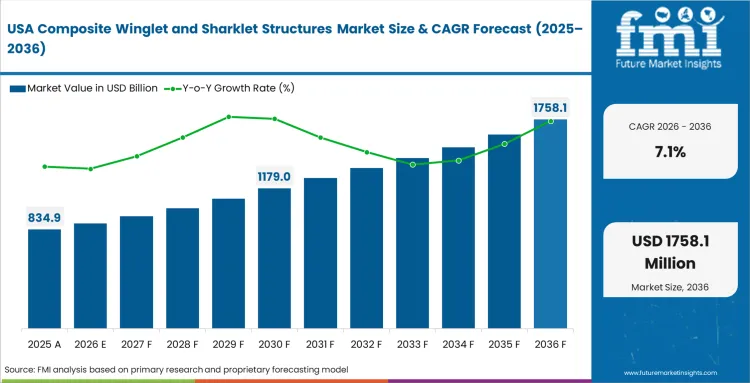
Large installed fleets and mature retrofit ecosystems keep North America important for aerodynamic upgrade programs. Airlines and lessors continue to evaluate wingtip modifications as a practical way to improve fuel efficiency without waiting for full fleet replacement. Commercial aircraft MRO capacity across the region also supports retrofit execution, inspection cycles, and replacement demand. Wide fleet diversity adds complexity, but it also creates a broader market for certified tip-device upgrades across legacy and in-service aircraft.
- United States: The market in the United States is expected to grow at a CAGR of 7.1% through 2036. Retrofit activity across a large installed fleet continues to support industry momentum, especially where operators pursue fuel-efficiency gains without waiting for full fleet replacement. Airlines, lessors, and maintenance providers continue to evaluate certified wingtip upgrades as a practical route to improve operating economics on in-service aircraft. Strong commercial aircraft MRO depth also helps the market by supporting installation planning, inspection cycles, and replacement demand. That keeps the United States commercially important in both upgrade planning and installed-base support.
FMI’s report includes Canada and Mexico. Regional demand continues to be shaped by retrofit capability, commercial aircraft MRO depth, and the need to improve fuel efficiency across large in-service fleets. Market activity also remains supported by lessor requirements, installed-base economics, and certified upgrade programs for legacy aircraft.
Europe Composite Winglet and Sharklet Structures for Fuel Burn Optimization Market Analysis
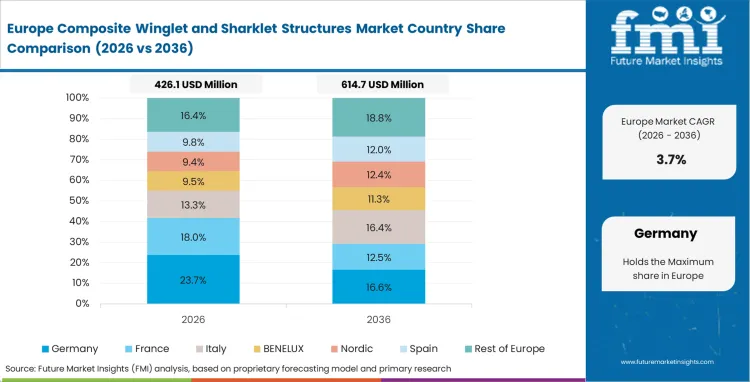
Airframer presence and established aerospace supply chains keep Europe central to this market. Line-fit program relevance, composite engineering capability, and certification depth continue to support demand across both production and replacement activity. Operators in the region also face steady pressure to improve fuel efficiency and emissions performance, which supports continued interest in aerodynamic upgrades. That keeps Europe commercially important not only for aircraft integration, but also for long-term technology development and supply continuity.
- France: Airframer presence and line-fit program relevance continue to support the French market. The country is expected to register a CAGR of 6.9% through 2036, which keeps it important within the European aerospace supply base. Its role is also supported by close alignment with major aircraft programs, where engineering capability and certified production remain central to supplier positioning. Demand is shaped less by fleet volume and more by participation in high-value aerostructure and integration activity. That keeps France commercially important across both program execution and long-term aerospace manufacturing support.
- Germany: Germany remains closely linked to high-value aerospace engineering and composite manufacturing. Supplier strength in precision manufacturing, materials processing, and program support continues to underpin demand across the market. The market is likely to post a CAGR of 6.7% by 2036, reflecting its role in advanced production capability rather than volume-led airline expansion. Its position is reinforced by participation in technically demanding aerospace component programs where consistency and certification matter. That keeps Germany important to the regional supply base and long-term production continuity.
FMI’s report includes the United Kingdom, Italy, and other European markets. Regional demand continues to be shaped by airframer linkages, certified manufacturing capability, and the need for fuel-efficiency upgrades across both line-fit and in-service aircraft programs.
Competitive Aligners for Market Players
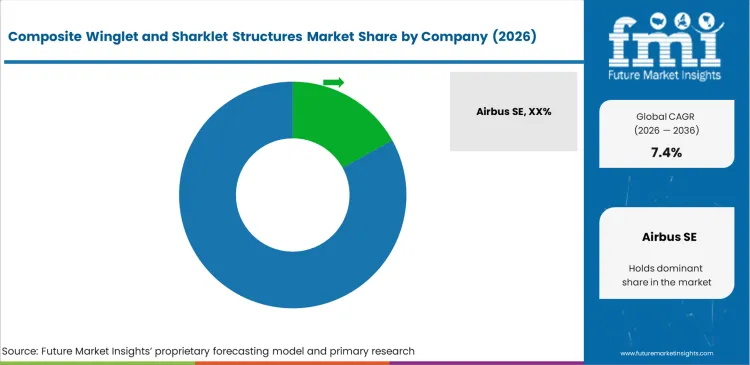
Certification control defines competition in this market. Airbus SE and The Boeing Company retain the aerodynamic and interface data needed for clean airframe integration, which makes market access difficult for independent suppliers such as Aviation Partners Boeing and Tamarack Aerospace Group. Fleet vice presidents reviewing commercial aircraft MRO packages rely on proven flight-hour performance, not on theoretical efficiency claims.
Incumbents also benefit from large internal databases of certified material properties and validated fatigue data. GKN Aerospace and FACC AG can use that accumulated knowledge to shorten development cycles and reduce repeated baseline testing. Challengers face a far longer and more expensive path, because they must first prove safety and durability before discussing efficiency benefits with airline procurement teams. Global air transport MRO providers usually favor incumbent hardware for the same reason, as unproven attachments increase certification and liability risk.
Large leasing companies also influence hardware selection by setting lease return conditions. Lessors often avoid non-standard tip configurations because customized aircraft strut and wing interface requirements can complicate remarketing and future placements. The industry outlook through 2036 depends heavily on whether airframers are willing to open proprietary wing-box interface data to third-party engineering firms.
Key Players in Composite Winglet and Sharklet Structures for Fuel Burn Optimization Market
- Airbus SE
- Aviation Partners Boeing
- FACC AG
- GKN Aerospace
- Daher
- Tamarack Aerospace Group
- The Boeing Company
Scope of the Report
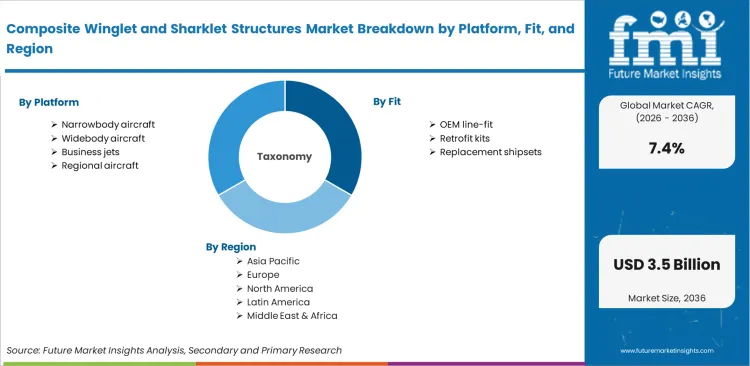
| Metric | Value |
|---|---|
| Quantitative Units | USD 1.6 Billion to USD 3.30 Billion, at a CAGR of 7.4% |
| Market Definition | Composite Winglet and Sharklet Structures for Fuel Burn Optimization comprises engineered aerodynamic extensions installed at aircraft wingtips to reduce lift-induced drag. Functional boundaries restrict this category to load-bearing structural components manufactured from fiber-reinforced polymer matrices. Products must explicitly demonstrate measurable reductions in specific fuel consumption during cruise phases. |
| Segmentation | By platform, fit, material system, architecture, and end user |
| Regions Covered | North America, Latin America, Western Europe, Eastern Europe, Middle East and Africa, East Asia, South Asia and Pacific |
| Countries Covered | India, China, United Arab Emirates, Singapore, United States, France, Germany |
| Key Companies Profiled | Airbus SE, Aviation Partners Boeing, FACC AG, GKN Aerospace, Daher, Tamarack Aerospace Group, The Boeing Company |
| Forecast Period | 2026 to 2036 |
| Approach | Annual commercial aircraft delivery rates multiplied by tip-device attachment ratios |
Source: Future Market Insights (FMI) analysis, based on proprietary forecasting model and primary research
Composite Winglet and Sharklet Structures for Fuel Burn Optimization Market Analysis by Segments
Platform
- Narrowbody aircraft
- Widebody aircraft
- Business jets
- Regional aircraft
Fit
- OEM line-fit
- Retrofit kits
- Replacement shipsets
Material system
- Carbon epoxy
- Carbon thermoplastic
- Glass hybrid
- Aramid hybrid
Architecture
- Blended winglets
- Sharklets
- Split scimitars
- Raked tips
End user
- Airlines
- Business operators
- Lessors
- MRO providers
Region
- North America
- Latin America
- Western Europe
- Eastern Europe
- Middle East and Africa
- East Asia
- South Asia and Pacific
Bibliography
- Airbus. (2025, April). Airbus A320 Family Facts and Figures April 2025.
- Aviation Partners Boeing. (2026). Aviation Partners Boeing.
- Boeing. (2026, January 13). Boeing Announces Fourth Quarter Deliveries.
- Embraer. (2025, April 2). Embraer delivers 30 aircraft in the 1st quarter of 2025, 20% more than in 1Q24.
- International Civil Aviation Organization. (2025). Realizing Aviation’s Sustainable Future.
This bibliography is provided for reader reference. The full FMI report contains the complete reference list with primary source documentation.
This Report Addresses
- Carbon pricing exposure driving structural aerodynamic modifications.
- Narrowbody lease conditions dictating tip standardization requirements.
- Thermoplastic weldability replacing epoxy curing cycles at hangar level.
- Airframer baseline control over factory-installed tip configurations.
- Pylon and strut fairing interfaces complicating aftermarket retrofit paths.
- Lessor asset management protocols preserving secondary market valuations.
- High-altitude density performance metrics determining specific geometry selection.
- Supplemental type certification barriers blocking independent supplier entry.
Frequently Asked Questions
What calculates baseline growth figures for composite aircraft wingtip devices?
Fleet expansion rates combined with mandate-driven fuel burn penalties support a 7.40% forecast trajectory through 2036.
Why does carbon epoxy maintain share over alternative materials?
Decades of validated flight-hour fatigue data eliminate fundamental material testing requirements during certification.
What limits rapid thermoplastic adoption among aircraft winglet retrofit vendors?
Incumbents resist abandoning massive capital investments tied to legacy epoxy autoclave infrastructure despite thermoplastic welding advantages.
How do lessors control sharklet structures deployment?
Asset managers mandate standardized configurations to ensure rapid transferability between secondary operators without reconfiguration.
Who captures aftermarket installation margins for retrofit winglet shipsets?
Independent engineering firms possessing specialized supplemental type certificates bypass OEM pricing structures.
What restricts older airframe upgrades seeking narrowbody fuel burn optimization?
Legacy wing boxes require invasive structural reinforcements to handle increased bending moments generated by modern tips.
How does India outpace China in winglet adoption?
Indian carriers expand regional footprints requiring extreme durability, while Chinese operators execute centralized replacements.
Why do operators prefer line-fit over retrofits for aircraft fuel efficiency upgrades?
Airframer factory installation transfers all structural integration and performance guarantee risks back to original manufacturers.
What changes when fleet utilization drops below optimal thresholds?
Fuel savings payback periods stretch beyond acceptable thirty-six-month windows, collapsing discretionary upgrade authorizations.
How do gate operations impact selection between a winglet vs raked wingtip?
Ramp congestion increases ground strike probabilities, forcing maintenance directors to demand rapid-repair tip architectures.
What role does payload limitation play in business jet range enhancement winglets?
Tip installations unlock higher takeoff weights on hot-and-high runways, transforming marginal routes into profitable sectors.
Why are composite winglets preferred over metal alternatives?
Excessive weight penalties negate aerodynamic drag reduction benefits entirely during critical climb phases.
How do widebody requirements differ from narrowbody winglet demand?
Ultra-long-haul sectors demand extreme aerodynamic optimization where minor drag reductions yield massive absolute fuel savings.
What forces airlines to procure certified aircraft modification structures early?
Upcoming carbon emission trading scheme penalties penalize inefficient airframes before scheduled retirement dates.
How does structural load alleviation function alongside physical tips?
Software algorithms rapidly adjust control surfaces during turbulence, artificially reducing maximum bending moments at wing roots.
Why do blended designs persist despite newer architectures?
Smooth geometric transitions avoid concentrated stress points, eliminating expensive localized wing structure reinforcement requirements.
What complicates split scimitar retrofits for ground crews?
Downward-pointing ventral strakes reduce ground clearance, requiring specialized towing protocols during ramp repositioning.
How do winglet MRO providers adapt to newer materials?
Hangars invest heavily in localized thermal repair equipment to service expanding thermoplastic tip inventories.
What defines functional boundaries for aircraft drag reduction structures?
Components must structurally bear aerodynamic loads and provide verifiable specific fuel consumption reductions during cruise.
How do airlines finance modifications like OEM line-fit winglets?
Route planners prove fuel savings amortize capital expenditure within remaining lease terms before financial directors approve.
What disrupts incumbent monopolies in sharklet manufacturing aerospace?
Airframers opening proprietary wing-box interface data allows independent firms to bypass expensive structural validation testing.
How does Middle East geography influence aerospace composite exterior structures?
Severe atmospheric particulates cause rapid leading-edge erosion, requiring specialized surface coatings absent in temperate models.
Preview the report firsthand - request a free sample
Get SampleGet the brochure for pricing and purchase details.
Get PDFTable of Content
- Executive Summary
- Global Market Outlook
- Demand-side Trends
- Supply-side Trends
- Technology Roadmap Analysis
- Analysis and Recommendations
- Market Overview
- Market Coverage / Taxonomy
- Market Definition / Scope / Limitations
- Research Methodology
- Chapter Orientation
- Analytical Lens and Working Hypotheses
- Market Structure, Signals, and Trend Drivers
- Benchmarking and Cross-market Comparability
- Market Sizing, Forecasting, and Opportunity Mapping
- Research Design and Evidence Framework
- Desk Research Programme (Secondary Evidence)
- Company Annual and Sustainability Reports
- Peer-reviewed Journals and Academic Literature
- Corporate Websites, Product Literature, and Technical Notes
- Earnings Decks and Investor Briefings
- Statutory Filings and Regulatory Disclosures
- Technical White Papers and Standards Notes
- Trade Journals, Industry Magazines, and Analyst Briefs
- Conference Proceedings, Webinars, and Seminar Materials
- Government Statistics Portals and Public Data Releases
- Press Releases and Reputable Media Coverage
- Specialist Newsletters and Curated Briefings
- Sector Databases and Reference Repositories
- FMI Internal Proprietary Databases and Historical Market Datasets
- Subscription Datasets and Paid Sources
- Social Channels, Communities, and Digital Listening Inputs
- Additional Desk Sources
- Expert Input and Fieldwork (Primary Evidence)
- Primary Modes
- Qualitative Interviews and Expert Elicitation
- Quantitative Surveys and Structured Data Capture
- Blended Approach
- Why Primary Evidence is Used
- Field Techniques
- Interviews
- Surveys
- Focus Groups
- Observational and In-context Research
- Social and Community Interactions
- Stakeholder Universe Engaged
- C-suite Leaders
- Board Members
- Presidents and Vice Presidents
- R&D and Innovation Heads
- Technical Specialists
- Domain Subject-matter Experts
- Scientists
- Physicians and Other Healthcare Professionals
- Governance, Ethics, and Data Stewardship
- Research Ethics
- Data Integrity and Handling
- Primary Modes
- Tooling, Models, and Reference Databases
- Desk Research Programme (Secondary Evidence)
- Data Engineering and Model Build
- Data Acquisition and Ingestion
- Cleaning, Normalisation, and Verification
- Synthesis, Triangulation, and Analysis
- Quality Assurance and Audit Trail
- Market Background
- Market Dynamics
- Drivers
- Restraints
- Opportunity
- Trends
- Scenario Forecast
- Demand in Optimistic Scenario
- Demand in Likely Scenario
- Demand in Conservative Scenario
- Opportunity Map Analysis
- Product Life Cycle Analysis
- Supply Chain Analysis
- Investment Feasibility Matrix
- Value Chain Analysis
- PESTLE and Porter’s Analysis
- Regulatory Landscape
- Regional Parent Market Outlook
- Production and Consumption Statistics
- Import and Export Statistics
- Market Dynamics
- Global Market Analysis 2021 to 2025 and Forecast, 2026 to 2036
- Historical Market Size Value (USD Million) Analysis, 2021 to 2025
- Current and Future Market Size Value (USD Million) Projections, 2026 to 2036
- Y-o-Y Growth Trend Analysis
- Absolute $ Opportunity Analysis
- Global Market Pricing Analysis 2021 to 2025 and Forecast 2026 to 2036
- Global Market Analysis 2021 to 2025 and Forecast 2026 to 2036, By Platform
- Introduction / Key Findings
- Historical Market Size Value (USD Million) Analysis By Platform , 2021 to 2025
- Current and Future Market Size Value (USD Million) Analysis and Forecast By Platform , 2026 to 2036
- Narrowbody aircraft
- Widebody aircraft
- Business jets
- Regional aircraft
- Narrowbody aircraft
- Y-o-Y Growth Trend Analysis By Platform , 2021 to 2025
- Absolute $ Opportunity Analysis By Platform , 2026 to 2036
- Global Market Analysis 2021 to 2025 and Forecast 2026 to 2036, By Fit
- Introduction / Key Findings
- Historical Market Size Value (USD Million) Analysis By Fit, 2021 to 2025
- Current and Future Market Size Value (USD Million) Analysis and Forecast By Fit, 2026 to 2036
- OEM line-fit
- Retrofit kits
- Replacement shipsets
- OEM line-fit
- Y-o-Y Growth Trend Analysis By Fit, 2021 to 2025
- Absolute $ Opportunity Analysis By Fit, 2026 to 2036
- Global Market Analysis 2021 to 2025 and Forecast 2026 to 2036, By Material System
- Introduction / Key Findings
- Historical Market Size Value (USD Million) Analysis By Material System, 2021 to 2025
- Current and Future Market Size Value (USD Million) Analysis and Forecast By Material System, 2026 to 2036
- Carbon epoxy
- Carbon thermoplastic
- Glass hybrid
- Aramid hybrid
- Carbon epoxy
- Y-o-Y Growth Trend Analysis By Material System, 2021 to 2025
- Absolute $ Opportunity Analysis By Material System, 2026 to 2036
- Global Market Analysis 2021 to 2025 and Forecast 2026 to 2036, By Architecture
- Introduction / Key Findings
- Historical Market Size Value (USD Million) Analysis By Architecture, 2021 to 2025
- Current and Future Market Size Value (USD Million) Analysis and Forecast By Architecture, 2026 to 2036
- Blended winglets
- Sharklets
- Split scimitars
- Raked tips
- Blended winglets
- Y-o-Y Growth Trend Analysis By Architecture, 2021 to 2025
- Absolute $ Opportunity Analysis By Architecture, 2026 to 2036
- Global Market Analysis 2021 to 2025 and Forecast 2026 to 2036, By End Use
- Introduction / Key Findings
- Historical Market Size Value (USD Million) Analysis By End Use, 2021 to 2025
- Current and Future Market Size Value (USD Million) Analysis and Forecast By End Use, 2026 to 2036
- Airlines
- Business operators
- Lessors
- MRO providers
- Airlines
- Y-o-Y Growth Trend Analysis By End Use, 2021 to 2025
- Absolute $ Opportunity Analysis By End Use, 2026 to 2036
- Global Market Analysis 2021 to 2025 and Forecast 2026 to 2036, By Region
- Introduction
- Historical Market Size Value (USD Million) Analysis By Region, 2021 to 2025
- Current Market Size Value (USD Million) Analysis and Forecast By Region, 2026 to 2036
- North America
- Latin America
- Western Europe
- Eastern Europe
- East Asia
- South Asia and Pacific
- Middle East & Africa
- Market Attractiveness Analysis By Region
- North America Market Analysis 2021 to 2025 and Forecast 2026 to 2036, By Country
- Historical Market Size Value (USD Million) Trend Analysis By Market Taxonomy, 2021 to 2025
- Market Size Value (USD Million) Forecast By Market Taxonomy, 2026 to 2036
- By Country
- USA
- Canada
- Mexico
- By Platform
- By Fit
- By Material System
- By Architecture
- By End Use
- By Country
- Market Attractiveness Analysis
- By Country
- By Platform
- By Fit
- By Material System
- By Architecture
- By End Use
- Key Takeaways
- Latin America Market Analysis 2021 to 2025 and Forecast 2026 to 2036, By Country
- Historical Market Size Value (USD Million) Trend Analysis By Market Taxonomy, 2021 to 2025
- Market Size Value (USD Million) Forecast By Market Taxonomy, 2026 to 2036
- By Country
- Brazil
- Chile
- Rest of Latin America
- By Platform
- By Fit
- By Material System
- By Architecture
- By End Use
- By Country
- Market Attractiveness Analysis
- By Country
- By Platform
- By Fit
- By Material System
- By Architecture
- By End Use
- Key Takeaways
- Western Europe Market Analysis 2021 to 2025 and Forecast 2026 to 2036, By Country
- Historical Market Size Value (USD Million) Trend Analysis By Market Taxonomy, 2021 to 2025
- Market Size Value (USD Million) Forecast By Market Taxonomy, 2026 to 2036
- By Country
- Germany
- UK
- Italy
- Spain
- France
- Nordic
- BENELUX
- Rest of Western Europe
- By Platform
- By Fit
- By Material System
- By Architecture
- By End Use
- By Country
- Market Attractiveness Analysis
- By Country
- By Platform
- By Fit
- By Material System
- By Architecture
- By End Use
- Key Takeaways
- Eastern Europe Market Analysis 2021 to 2025 and Forecast 2026 to 2036, By Country
- Historical Market Size Value (USD Million) Trend Analysis By Market Taxonomy, 2021 to 2025
- Market Size Value (USD Million) Forecast By Market Taxonomy, 2026 to 2036
- By Country
- Russia
- Poland
- Hungary
- Balkan & Baltic
- Rest of Eastern Europe
- By Platform
- By Fit
- By Material System
- By Architecture
- By End Use
- By Country
- Market Attractiveness Analysis
- By Country
- By Platform
- By Fit
- By Material System
- By Architecture
- By End Use
- Key Takeaways
- East Asia Market Analysis 2021 to 2025 and Forecast 2026 to 2036, By Country
- Historical Market Size Value (USD Million) Trend Analysis By Market Taxonomy, 2021 to 2025
- Market Size Value (USD Million) Forecast By Market Taxonomy, 2026 to 2036
- By Country
- China
- Japan
- South Korea
- By Platform
- By Fit
- By Material System
- By Architecture
- By End Use
- By Country
- Market Attractiveness Analysis
- By Country
- By Platform
- By Fit
- By Material System
- By Architecture
- By End Use
- Key Takeaways
- South Asia and Pacific Market Analysis 2021 to 2025 and Forecast 2026 to 2036, By Country
- Historical Market Size Value (USD Million) Trend Analysis By Market Taxonomy, 2021 to 2025
- Market Size Value (USD Million) Forecast By Market Taxonomy, 2026 to 2036
- By Country
- India
- ASEAN
- Australia & New Zealand
- Rest of South Asia and Pacific
- By Platform
- By Fit
- By Material System
- By Architecture
- By End Use
- By Country
- Market Attractiveness Analysis
- By Country
- By Platform
- By Fit
- By Material System
- By Architecture
- By End Use
- Key Takeaways
- Middle East & Africa Market Analysis 2021 to 2025 and Forecast 2026 to 2036, By Country
- Historical Market Size Value (USD Million) Trend Analysis By Market Taxonomy, 2021 to 2025
- Market Size Value (USD Million) Forecast By Market Taxonomy, 2026 to 2036
- By Country
- Kingdom of Saudi Arabia
- Other GCC Countries
- Turkiye
- South Africa
- Other African Union
- Rest of Middle East & Africa
- By Platform
- By Fit
- By Material System
- By Architecture
- By End Use
- By Country
- Market Attractiveness Analysis
- By Country
- By Platform
- By Fit
- By Material System
- By Architecture
- By End Use
- Key Takeaways
- Key Countries Market Analysis
- USA
- Pricing Analysis
- Market Share Analysis, 2025
- By Platform
- By Fit
- By Material System
- By Architecture
- By End Use
- Canada
- Pricing Analysis
- Market Share Analysis, 2025
- By Platform
- By Fit
- By Material System
- By Architecture
- By End Use
- Mexico
- Pricing Analysis
- Market Share Analysis, 2025
- By Platform
- By Fit
- By Material System
- By Architecture
- By End Use
- Brazil
- Pricing Analysis
- Market Share Analysis, 2025
- By Platform
- By Fit
- By Material System
- By Architecture
- By End Use
- Chile
- Pricing Analysis
- Market Share Analysis, 2025
- By Platform
- By Fit
- By Material System
- By Architecture
- By End Use
- Germany
- Pricing Analysis
- Market Share Analysis, 2025
- By Platform
- By Fit
- By Material System
- By Architecture
- By End Use
- UK
- Pricing Analysis
- Market Share Analysis, 2025
- By Platform
- By Fit
- By Material System
- By Architecture
- By End Use
- Italy
- Pricing Analysis
- Market Share Analysis, 2025
- By Platform
- By Fit
- By Material System
- By Architecture
- By End Use
- Spain
- Pricing Analysis
- Market Share Analysis, 2025
- By Platform
- By Fit
- By Material System
- By Architecture
- By End Use
- France
- Pricing Analysis
- Market Share Analysis, 2025
- By Platform
- By Fit
- By Material System
- By Architecture
- By End Use
- India
- Pricing Analysis
- Market Share Analysis, 2025
- By Platform
- By Fit
- By Material System
- By Architecture
- By End Use
- ASEAN
- Pricing Analysis
- Market Share Analysis, 2025
- By Platform
- By Fit
- By Material System
- By Architecture
- By End Use
- Australia & New Zealand
- Pricing Analysis
- Market Share Analysis, 2025
- By Platform
- By Fit
- By Material System
- By Architecture
- By End Use
- China
- Pricing Analysis
- Market Share Analysis, 2025
- By Platform
- By Fit
- By Material System
- By Architecture
- By End Use
- Japan
- Pricing Analysis
- Market Share Analysis, 2025
- By Platform
- By Fit
- By Material System
- By Architecture
- By End Use
- South Korea
- Pricing Analysis
- Market Share Analysis, 2025
- By Platform
- By Fit
- By Material System
- By Architecture
- By End Use
- Russia
- Pricing Analysis
- Market Share Analysis, 2025
- By Platform
- By Fit
- By Material System
- By Architecture
- By End Use
- Poland
- Pricing Analysis
- Market Share Analysis, 2025
- By Platform
- By Fit
- By Material System
- By Architecture
- By End Use
- Hungary
- Pricing Analysis
- Market Share Analysis, 2025
- By Platform
- By Fit
- By Material System
- By Architecture
- By End Use
- Kingdom of Saudi Arabia
- Pricing Analysis
- Market Share Analysis, 2025
- By Platform
- By Fit
- By Material System
- By Architecture
- By End Use
- Turkiye
- Pricing Analysis
- Market Share Analysis, 2025
- By Platform
- By Fit
- By Material System
- By Architecture
- By End Use
- South Africa
- Pricing Analysis
- Market Share Analysis, 2025
- By Platform
- By Fit
- By Material System
- By Architecture
- By End Use
- USA
- Market Structure Analysis
- Competition Dashboard
- Competition Benchmarking
- Market Share Analysis of Top Players
- By Regional
- By Platform
- By Fit
- By Material System
- By Architecture
- By End Use
- Competition Analysis
- Competition Deep Dive
- Airbus SE
- Overview
- Product Portfolio
- Profitability by Market Segments (Product/Age /Sales Channel/Region)
- Sales Footprint
- Strategy Overview
- Marketing Strategy
- Product Strategy
- Channel Strategy
- Aviation Partners Boeing
- FACC AG
- GKN Aerospace
- Daher
- Tamarack Aerospace Group
- The Boeing Company
- Airbus SE
- Competition Deep Dive
- Assumptions & Acronyms Used


