

- Market Size (2026)
- USD 4.7 Bn
- Forecast (2036)
- USD 8.7 Bn
- CAGR (2026 to 2036)
- 6.3%
Aircraft Strut Market Size, Market Forecast and Outlook By FMI
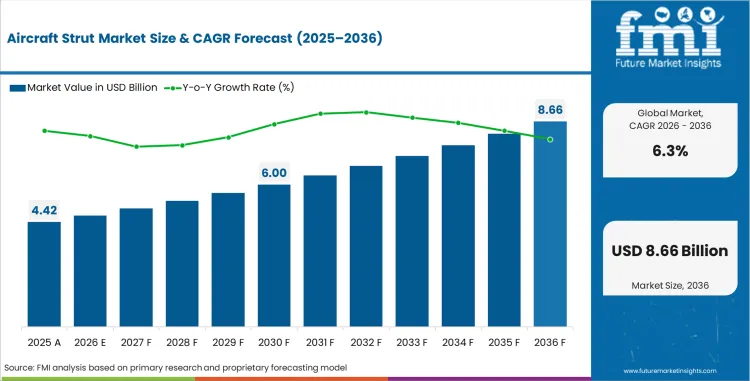
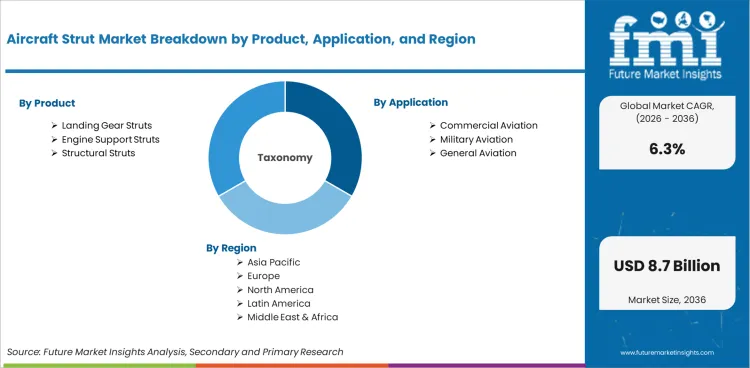
The aircraft strut market was valued at USD 4.4 billion in 2025. The market is set to reach USD 4.7 billion by 2026-end and grow at a CAGR of 6.3% between 2026-2036 to reach USD 8.7 billion by 2036. Landing Gear Struts will dominate with a 70.0% share, while Commercial Aviation will lead with a 60.0% share.
Summary of the Aircraft Strut Market
- Demand and Growth Drivers
- Commercial aircraft fleet growth driven by passenger traffic recovery and airline fleet renewal programs is generating OEM strut procurement demand proportional to new aircraft deliveries from Boeing and Airbus production lines.
- MRO aftermarket demand for landing gear overhaul and strut replacement provides recurring revenue as the global commercial fleet ages, with landing gear maintenance cycles of 8 to 12 years creating predictable replacement demand.
- Military aviation modernization programs and defense budget increases in NATO countries, India, and Asia Pacific are generating procurement demand for high-specification struts meeting military qualification standards.
- Product and Segment View
- Landing Gear Struts is likely to remain the leading product segment at 70% share, supported by established demand and procurement patterns.
- Buyer preference and application pattern. Commercial Aviation is expected to hold 60% of the application segment.
- The original equipment manufacturers are expected to dominate the end-use segment during the forecast period with a share of 65%.
- Geography and Competitive Outlook
- China is likely to remain a key market at 8.51% CAGR, supported by strong demand fundamentals and expanding adoption.
- India is likely to sustain growth at 7.88% CAGR owing to rising investment and expanding infrastructure.
- Companies with integrated capabilities and qualified supply positions are likely to gain traction during the forecast period.
- Analyst Opinion
- The aircraft strut market is evolving with clear segment leaders, established supply chains, and qualification-driven procurement shaping competitive dynamics.
- Increasing end-user demand, infrastructure investment expansion and product performance advantages awareness are driving adoption higher.
- Additional demand is created by application diversification into new end-user segments and regulatory compliance requirements.
- In the key segments, companies capable of delivering consistent quality and meeting specification requirements are expected to strengthen their position over the forecast period.
Key Takeaways, Market Size, and Forecast
- The aircraft strut market was valued at USD 4.42 billion in 2025.
- By 2036, the Aircraft Strut Market is expected to be worth USD 8.66 billion.
- From 2026 to 2036, the market is projected to expand at a CAGR of 6.3%.
- The market is projected to create an incremental opportunity of USD 3.96 billion between 2026 and 2036.
- In 2026, landing gear struts is expected to account for 70% of the product segment, driven by demand for landing gear structural components designed to absorb impact loads during touchdown and support aircraft weight during ground operations across commercial and military aviation platforms.
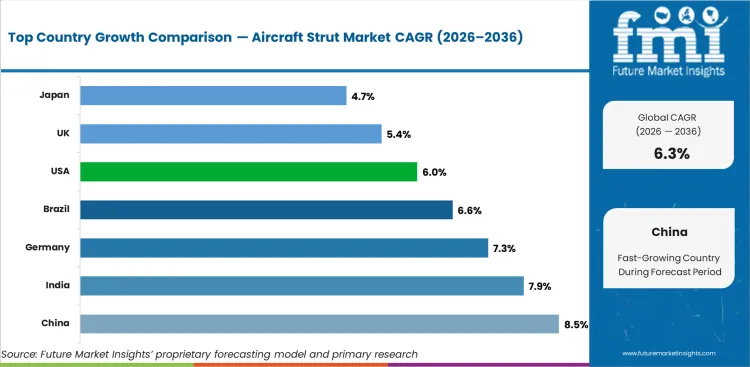
- China (8.51%) and India (7.88%) are two of the fastest growing markets in the world.
Aircraft Strut Market Definition
The aircraft strut market encompasses commercially traded structural components used in aircraft landing gear, wing support, and fuselage bracing systems. Product categories include landing gear struts, wing struts, and fuselage struts manufactured from metal alloys and composite materials for commercial, military, and general aviation applications.
Aircraft Strut Market Inclusions
Market scope covers all commercially traded aircraft strut products categorized by product (landing gear struts, wing struts, fuselage struts), application (commercial aviation, military aviation, general aviation), end use (original equipment manufacturers, maintenance repair and overhaul), distribution channel (direct sales, authorized distributors), material (metal alloys, composite materials), and aircraft type (fixed wing aircraft, rotary wing aircraft). The revenue range spans from 2026 to 2036.
Aircraft Strut Market Exclusions
The scope does not include non-structural aircraft fairings, interior cabin components, or automotive suspension struts using similar engineering principles.
Aircraft Strut Market Research Methodology
- Primary Research: FMI analysts engaged with aerospace component manufacturers, airline fleet managers, MRO service providers, and defense procurement agencies across key markets.
- Desk Research: Combined data from aerospace industry associations, fleet delivery databases, and defense procurement records.
- Market sizing and forecasting: Bottom-up aggregation across application categories and end-user segments, with regional adoption curves adjusted for fleet delivery forecasts, MRO spending, and defense budget allocations.
- Data validation: Cross-checked quarterly against aircraft delivery data and aerospace component procurement records.
Why is the Aircraft Strut Market Growing?
- OEM strut procurement demand is being driven by commercial aircraft fleet growth due to passenger traffic recovery and airline fleet renewal programs, aligned with new aircraft deliveries from the Boeing and Airbus production lines.
- MRO aftermarket landing gear overhaul and strut replacement generates recurring revenue as the global commercial fleet ages, with predictable replacement demand driven by landing gear maintenance cycles of 8-12 years.
- NATO countries, India . Modernization programmes of military aviation, growth of defense budgets.
The aircraft strut market is anticipated to grow at a CAGR of 6.3% during the forecast period as the growth of commercial fleet and defense modernization sustains the procurement of components. Landing gear struts lead at 70.0% of the product segment, being the most structurally critical and top-value strut category in aircraft design. OEM procurement volumes are driven by narrow- and wide-body aircraft programs, with commercial aviation accounting for 60.0% of application demand.
The end-user demand is 65.0% from original equipment manufacturers. Struts are procured from qualified Tier-1 landing gear suppliers by Boeing, Airbus, COMAC and defense aircraft manufacturers. Distribution control 70.0% of sales is through direct sales, with procurement relationships based on long-term supply agreements between strut manufacturers and aircraft OEMs. Metal alloys are the predominant materials with 75.0%. High strength steel, titanium and aluminum alloys provide the load bearing characteristics required for landing gear applications.
Market Segmentation Analysis
- The product segment accounted for 70% of the Landing Gear Struts, indicating established demand patterns.
- Original Equipment Manufacturers dominates the end use segment with 65% share.
The aircraft strut market is segmented by product, application, end use, distribution channel, material, aircraft type.
Insights into the Landing Gear Struts Product Segment
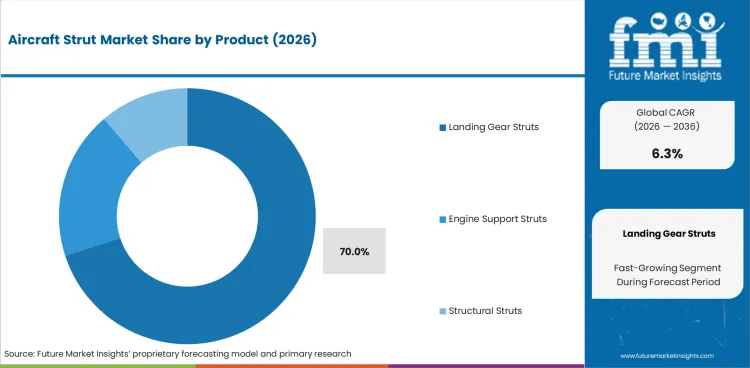
Landing gear struts are estimated to hold 70.0% of the product segment in 2026. The main and nose landing gear struts absorb the impact loads at touchdown and support the weight of the aircraft during ground operations. The standard design for commercial and military aircraft is the oleo-pneumatic shock absorber strut. Built with high strength steel and titanium alloy, it has the fatigue resistance and load-carrying capability for 60,000+ landing cycle lifetimes.
Insights into the Commercial Aviation Application Segment
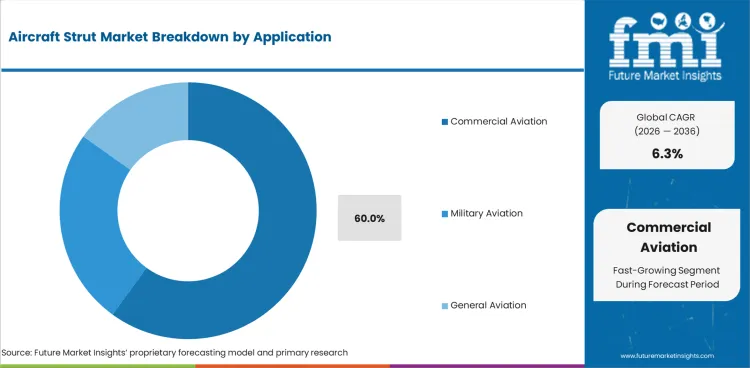
The application segment includes commercial aviation at 60.0%. OEM strut procurement volumes are fueled by the Boeing 737 MAX, Airbus A320neo and wide-body programs such as the A350 and 787. Narrow-body aircraft programs generate the highest unit volumes as production rates for each major platform are exceeding 50 aircraft per month. The MRO aftermarket is a recurring demand source with the landing gear overhaul cycle including strut inspection, repair and replacement.
Aircraft Strut Market Drivers, Restraints, and Opportunities
- Commercial Fleet Growth and is generating structured demand in key segments.
- Long Qualification Timelines and moderating growth in some segments.
The dynamics of aircraft strut market are shaped by demand side catalysts and supply side constraints varying across region, application and specification tier.
Commercial Fleet Growth and Aircraft Deliveries
Demand is also driven by the delivery rates of commercial aircraft produced by Boeing, Airbus and emerging manufacturers such as COMAC. The demand for procurement of landing gear struts is directly proportional to the production line output rates, as each new aircraft delivered needs a complete set of landing gear struts.
MRO Aftermarket and Landing Gear Overhaul Cycles
Growth is driven by the recurring nature of landing gear maintenance. MRO overhaul cycles of 8 to 12 years generate strut inspection, repair and replacement demand across the global installed fleet. As the fleet ages, MRO spend per aircraft goes up.
Long Qualification Timelines and Certification Barriers
Adoption of new strut designs or suppliers is constrained by aerospace qualification timelines of New strut designs and suppliers can only be adopted after 3-7 years of aerospace qualification and FAA/EASA certification. High barriers to entry exist for new entrants to qualify alternative strut products for existing aircraft programs.
Defense Modernization and Military Aviation Programs
Military aircraft modernization programs in NATO countries, India, China and Asia Pacific support growth. Fighter aircraft, transport aircraft and helicopter programs require high specification struts that meet military qualification standards and have extended service life requirements.
Analysis of Aircraft Strut Market By Key Countries
.webp "Top Country Growth Comparison Aircraft Strut Market Cagr (2026 2036)")
| Country | CAGR |
|---|---|
| China | 8.51% |
| India | 7.88% |
| Germany | 7.25% |
| Brazil | 6.62% |
| USA | 5.99% |
| UK | 5.36% |
| Japan | 4.73% |
- China leads at 8.51% CAGR, supported by the largest demand base and expanding procurement.
- India at 7.88% shows strong demand supported by rising investment and infrastructure expansion.
- Germany (7.25%) and Brazil (6.62%) sustain growth through expanding market development.
The global aircraft strut market is projected to expand at 6.3% per year from 2026 to 2036. The study covers more than 30 countries.
Sales Analysis of Aircraft Strut Market in China
China is at 8.51% through 2036. “The ramp-up in commercial aircraft production by COMAC C919 and military aviation modernization programs are creating demand for domestic strut manufacturing. The government has a policy to promote the qualification of domestic origin aerospace components to minimize dependence on imports.
- Domestic OEM struts demand driven by COMAC C919 production ramp-up.
- High-specification strut procurement comes from military aviation modernization programs.
- The local manufacture of aerospace components is encouraged by government strategy to curb import dependency.
Demand Outlook for Aircraft Strut Market in India
India is growing at 7.88% to 2036. Defence Acquisition Procedure and HAL manufacturing programmes drive procurement of military struts. Demand for MRO and OEM components is being driven by expanding civil aviation fleet of domestic carriers.
- Procurement of military aircraft component through domestic sourcing is governed by Defence Acquisition Procedure.
- Qualified strut supply is required for HAL manufacturing programs for military aircraft.
- Growth in the civil aviation fleet is fueling increased demand for landing gear component services within MRO.
Future Outlook for Aircraft Strut Market in the United States
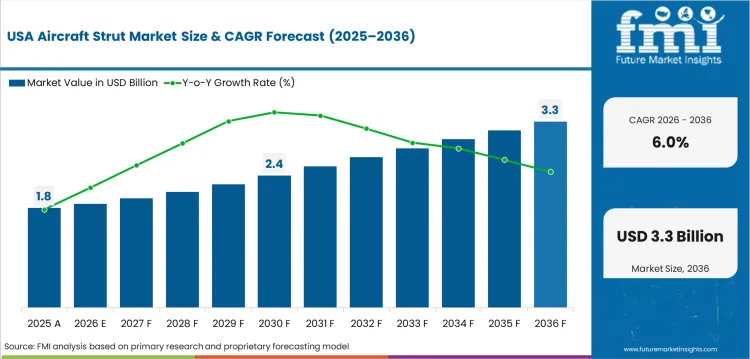
USA 6.5% growth to 2036. demand for Boeing’s commercial aircraft production, USA military aviation programs and the world’s largest MRO aftermarket support. Tier-1 landing gear supply positions are held by Safran, Collins Aerospace and Liebherr Aerospace.
- OEM strut procurement is proportional to aircraft deliveries based on Boeing commercial production rates.
- USA military aviation programs, including the F-35 and next-generation platforms, are driving USA defense demand.
- Largest global MRO aftermarket drives recurring demand for landing gear overhaul and strut replacement.
In-depth Analysis of Aircraft Strut Market in Germany
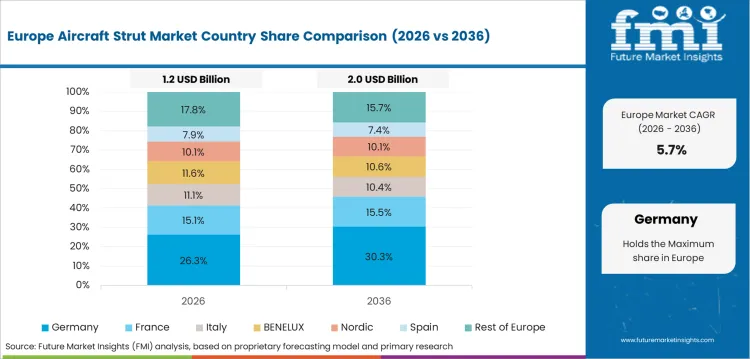
Germany is expanding at 5.8% through 2036. Airbus Hamburg production and Liebherr Aerospace landing gear manufacturing provide domestic strut demand and production capability. EASA certification standards shape qualification requirements for European-produced components.
- Airbus production programs at Hamburg create OEM strut procurement demand.
- Liebherr Aerospace provides domestic landing gear and strut manufacturing capability.
- EASA certification standards define qualification requirements for aerospace structural components.
In-depth Analysis of Aircraft Strut Market in Japan
Japan is growing at 5.2% through 2036. Japanese aerospace component manufacturing serves both domestic defense programs and international commercial aircraft supply chains. Long supplier qualification cycles and quality standards sustain established procurement relationships.
- Aerospace component manufacturing serves domestic defense and international commercial programs.
- Long qualification cycles sustain established supplier relationships and procurement stability.
- Quality and precision manufacturing standards support Japanese aerospace component positioning.
Competitive Landscape and Strategic Positioning
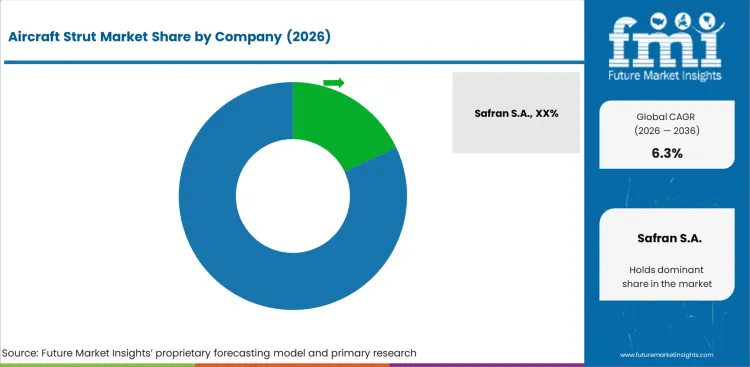
- Safran S.A. Safran Landing Systems is the world's largest landing gear manufacturer. The company supplies the Boeing 737, Airbus A320 and military platforms around the world with complete landing gear assemblies, including struts.
- Collins Aerospace (RTX) competes with landing gear design, manufacturing and MRO services for both commercial and military aircraft platforms with strong positions on Boeing and military programs.
- Liebherr Aerospace and Circor Aerospace operate through specialized manufacturing of landing gear components; Liebherr provides complete landing gear systems for Airbus A380, A350 and regional aircraft platforms.
The competitive landscape is characterized by companies with integrated manufacturing, qualification credentials and established procurement relationships across key end-user segments.
Key Companies in the Aircraft Strut Market
Key global companies leading the aircraft strut market include:
- Safran S.A. (France), Collins Aerospace (USA), and Liebherr Aerospace (Germany) lead through Tier-1 landing gear system design, manufacturing, and MRO capability serving major commercial and military aircraft OEMs globally.
- Circor Aerospace (USA) and Triumph Group (USA) compete through specialized aerospace structural component manufacturing, landing gear actuation systems, and qualified supply positions on established aircraft programs.
- Emerging aerospace component manufacturers in China, India, and South Korea are developing qualification pathways for strut and landing gear component supply to domestic and international aircraft programs.
Competitive Benchmarking: Aircraft Strut Market
| Company | Landing Gear Systems | OEM Positions | MRO Capability | Defense Programs |
|---|---|---|---|---|
| Safran S.A. | Very High | Boeing, Airbus | Very Strong | Strong |
| Collins Aerospace | Very High | Boeing, Military | Very Strong | Very Strong |
| Liebherr Aerospace | High | Airbus | Strong | Medium |
| Circor Aerospace | Medium | Multiple | Moderate | Medium |
| Triumph Group | Medium | Multiple | Moderate | Strong |
Source: Future Market Insights competitive analysis, 2026.
Key Developments in Aircraft Strut Market
- In 2025, Safran Landing Systems continued to strengthen its position as a major landing gear supplier through ongoing partnerships and production ramp-up for various commercial aircraft programs, while advancing joint development initiatives in the global aviation supply chain.
- In 2025, Collins Aerospace expanded its landing gear production and MRO facility in Tajęcina, Poland by 4,000 square meters to increase capacity and serve growing aftermarket and OEM demand from commercial and defense aircraft fleets.
Key Players in the Aircraft Strut Market
Major Global Players
- Safran S.A.
- Collins Aerospace
- Liebherr -Aerospace
- Circor Aerospace
- Triumph Group
Emerging Players/Startups
- Heroux-Devtek
- Meggitt PLC
- Eaton Aerospace
- Magellan Aerospace
- GKN Aerospace
Report Scope and Coverage
| Parameter | Details |
|---|---|
| Quantitative Units | USD 4.7 billion to USD 8.66 billion, at a CAGR of 6.3% |
| Market Definition | The aircraft strut market encompasses commercially traded structural components used in aircraft landing gear, wing support, and fuselage bracing systems. Product categories include landing gear struts, wing struts, and fuselage struts manufactured from metal alloys and composite materials for commercial, military, and general aviation applications. |
| Regions Covered | North America, Latin America, Europe, East Asia, South Asia and Pacific, Middle East and Africa |
| Countries Covered | China, India, Germany, Brazil, USA, UK, Japan, 30 plus countries |
| Key Companies Profiled | Safran S.A., Collins Aerospace, Liebherr -Aerospace, Circor Aerospace, Triumph Group, Heroux-Devtek, Meggitt PLC, Eaton Aerospace |
| Forecast Period | 2026 to 2036 |
| Approach | Hybrid bottom-up and top-down methodology starting with verified transaction data, projecting adoption velocity across segments and regions. |
Market Segmentation Analysis
Aircraft Strut Market Segmented by Product:
- Landing Gear Struts
- Nose Gear Struts
- Single Wheel Nose Gear
- Twin Wheel Nose Gear
- Main Gear Struts
- Single Axle Main Gear
- Multi Axle Main Gear
- Nose Gear Struts
- Engine Support Struts
- Pylon Struts
- Underwing Mounts
- Fuselage Mounts
- Auxiliary Support Struts
- Secondary Structural Supports
- Vibration Dampening Struts
- Pylon Struts
- Structural Struts
- Wing Support Struts
- External Wing Bracing
- Internal Structural Supports
- Fuselage Support Struts
- Cabin Structural Reinforcement
- Cargo Section Support
- Wing Support Struts
Aircraft Strut Market Segmented by Application:
- Commercial Aviation
- Narrow Body Aircraft
- Short Haul Aircraft
- Medium Range Aircraft
- Wide Body Aircraft
- Long Haul Aircraft
- High Capacity Aircraft
- Narrow Body Aircraft
- Military Aviation
- Fighter Aircraft
- Combat Aircraft
- Multirole Aircraft
- Transport Aircraft
- Cargo Aircraft
- Refueling Aircraft
- Fighter Aircraft
- General Aviation
- Business Jets
- Light Jets
- Mid Size Jets
- Helicopters
- Civil Helicopters
- Utility Helicopters
- Business Jets
Aircraft Strut Market Segmented by End Use:
- Original Equipment Manufacturers
- Aircraft Manufacturers
- Commercial Aircraft Manufacturers
- Defense Aircraft Manufacturers
- Component Integrators
- Tier One Suppliers
- System Integrators
- Aircraft Manufacturers
- Maintenance Repair And Overhaul Providers
- Scheduled Maintenance
- Routine Inspection
- Component Replacement
- Unscheduled Maintenance
- Damage Repair
- Emergency Replacement
- Scheduled Maintenance
Aircraft Strut Market Segmented by Distribution Channel:
- Direct Sales
- Manufacturer To OEM
- Long Term Supply Agreements
- Program Based Contracts
- Aftermarket Supply
- Spare Parts Supply
- Maintenance Contracts
- Manufacturer To OEM
- Distributors
- Aviation Parts Distributors
- Regional Distributors
- Global Distributors
- Online Platforms
- Aviation Marketplaces
- Digital Procurement Platforms
- Aviation Parts Distributors
Aircraft Strut Market Segmented by Material:
- Metal Alloys
- Steel Alloys
- High Strength Steel
- Corrosion Resistant Steel
- Aluminum Alloys
- Lightweight Aluminum
- High Strength Aluminum
- Steel Alloys
- Composite Materials
- Carbon Fiber Composites
- Reinforced Carbon Structures
- Lightweight Structural Parts
- Hybrid Composites
- Metal Composite Blends
- Advanced Lightweight Materials
- Carbon Fiber Composites
Aircraft Strut Market Segmented by Aircraft Type:
- Fixed Wing Aircraft
- Commercial Aircraft
- Passenger Aircraft
- Cargo Aircraft
- Military Aircraft
- Fighter Jets
- Transport Aircraft
- Commercial Aircraft
- Rotary Wing Aircraft
- Helicopters
- Light Helicopters
- Heavy Helicopters
- Helicopters
Aircraft Strut Market by Region:
- North America
- USA
- Canada
- Mexico
- Latin America
- Brazil
- Chile
- Rest of Latin America
- Western Europe
- Germany
- UK
- Italy
- Spain
- France
- Nordic
- BENELUX
- Rest of Western Europe
- Eastern Europe
- Russia
- Poland
- Hungary
- Balkan & Baltic
- Rest of Eastern Europe
- East Asia
- China
- Japan
- South Korea
- South Asia and Pacific
- India
- ASEAN
- Australia & New Zealand
- Rest of South Asia and Pacific
- Middle East & Africa
- Kingdom of Saudi Arabia
- Other GCC Countries
- Turkiye
- South Africa
- Other African Union
- Rest of Middle East & Africa
Research Sources and Bibliography
- 1. International Air Transport Association. (2025). IATA Global Fleet Forecast and Delivery Report. IATA.
- 2. Federal Aviation Administration. (2025). FAA Aircraft Certification Standards: Landing Gear Components. FAA.
- 3. European Union Aviation Safety Agency. (2024). EASA CS-25 Certification Specifications: Structural Components. EASA.
- 4. Boeing Company. (2025). Boeing Commercial Market Outlook. Boeing.
- 5. Airbus S.A.S. (2025). Airbus Global Market Forecast. Airbus.
This bibliography is provided for reader reference.
This Report Answers
- Estimating the market size and revenue generation from 2026 to 2036.
- Segmenting by product, application, end use, distribution channel, material, and aircraft type.
- Providing regional insights across more than 30 markets.
- Analyzing commercial fleet growth and MRO aftermarket dynamics.
- Assessing the competitive landscape across landing gear, wing, and fuselage strut categories.
- Identifying investment opportunities in composite materials and defense programs.
- Tracking aircraft delivery rates and qualification timeline trends.
- Delivering data in PDF and Excel formats.
Frequently Asked Questions
How big is the aircraft strut market in 2026?
The global aircraft strut market is estimated to be valued at USD 4.70 billion in 2026.
What will be the size of aircraft strut market in 2036?
The market size for the aircraft strut market is projected to reach USD 8.66 billion by 2036.
How much will be the aircraft strut market growth between 2026 and 2036?
The aircraft strut market is expected to grow at a 6.3% CAGR between 2026 and 2036.
What are the key product types in the aircraft strut market?
The key product types in aircraft strut market are landing gear struts, engine support struts and structural struts.
Which application segment is expected to contribute significant share in the aircraft strut market in 2026?
In terms of application, commercial aviation segment is expected to command 60.0% share in the aircraft strut market in 2026.
Preview the report firsthand - request a free sample
Get SampleGet the brochure for pricing and purchase details.
Get PDFTable of Content
- Executive Summary
- Global Market Outlook
- Demand-side Trends
- Supply-side Trends
- Technology Roadmap Analysis
- Analysis and Recommendations
- Market Overview
- Market Coverage / Taxonomy
- Market Definition / Scope / Limitations
- Research Methodology
- Chapter Orientation
- Analytical Lens and Working Hypotheses
- Market Structure, Signals, and Trend Drivers
- Benchmarking and Cross-market Comparability
- Market Sizing, Forecasting, and Opportunity Mapping
- Research Design and Evidence Framework
- Desk Research Programme (Secondary Evidence)
- Company Annual and Sustainability Reports
- Peer-reviewed Journals and Academic Literature
- Corporate Websites, Product Literature, and Technical Notes
- Earnings Decks and Investor Briefings
- Statutory Filings and Regulatory Disclosures
- Technical White Papers and Standards Notes
- Trade Journals, Industry Magazines, and Analyst Briefs
- Conference Proceedings, Webinars, and Seminar Materials
- Government Statistics Portals and Public Data Releases
- Press Releases and Reputable Media Coverage
- Specialist Newsletters and Curated Briefings
- Sector Databases and Reference Repositories
- FMI Internal Proprietary Databases and Historical Market Datasets
- Subscription Datasets and Paid Sources
- Social Channels, Communities, and Digital Listening Inputs
- Additional Desk Sources
- Expert Input and Fieldwork (Primary Evidence)
- Primary Modes
- Qualitative Interviews and Expert Elicitation
- Quantitative Surveys and Structured Data Capture
- Blended Approach
- Why Primary Evidence is Used
- Field Techniques
- Interviews
- Surveys
- Focus Groups
- Observational and In-context Research
- Social and Community Interactions
- Stakeholder Universe Engaged
- C-suite Leaders
- Board Members
- Presidents and Vice Presidents
- R&D and Innovation Heads
- Technical Specialists
- Domain Subject-matter Experts
- Scientists
- Physicians and Other Healthcare Professionals
- Governance, Ethics, and Data Stewardship
- Research Ethics
- Data Integrity and Handling
- Primary Modes
- Tooling, Models, and Reference Databases
- Desk Research Programme (Secondary Evidence)
- Data Engineering and Model Build
- Data Acquisition and Ingestion
- Cleaning, Normalisation, and Verification
- Synthesis, Triangulation, and Analysis
- Quality Assurance and Audit Trail
- Market Background
- Market Dynamics
- Drivers
- Restraints
- Opportunity
- Trends
- Scenario Forecast
- Demand in Optimistic Scenario
- Demand in Likely Scenario
- Demand in Conservative Scenario
- Opportunity Map Analysis
- Product Life Cycle Analysis
- Supply Chain Analysis
- Investment Feasibility Matrix
- Value Chain Analysis
- PESTLE and Porter’s Analysis
- Regulatory Landscape
- Regional Parent Market Outlook
- Production and Consumption Statistics
- Import and Export Statistics
- Market Dynamics
- Global Market Analysis 2021 to 2025 and Forecast, 2026 to 2036
- Historical Market Size Value (USD Million) Analysis, 2021 to 2025
- Current and Future Market Size Value (USD Million) Projections, 2026 to 2036
- Y-o-Y Growth Trend Analysis
- Absolute $ Opportunity Analysis
- Global Market Pricing Analysis 2021 to 2025 and Forecast 2026 to 2036
- Global Market Analysis 2021 to 2025 and Forecast 2026 to 2036, By Product
- Introduction / Key Findings
- Historical Market Size Value (USD Million) Analysis By Product , 2021 to 2025
- Current and Future Market Size Value (USD Million) Analysis and Forecast By Product , 2026 to 2036
- Landing Gear Struts
- Nose Gear Struts
- Single Wheel Nose Gear
- Twin Wheel Nose Gear
- Main Gear Struts
- Single Axle Main Gear
- Multi Axle Main Gear
- Engine Support Struts
- Pylon Struts
- Underwing Mounts
- Fuselage Mounts
- Auxiliary Support Struts
- Secondary Structural Supports
- Structural Struts
- Wing Support Struts
- External Wing Bracing
- Internal Structural Supports
- Fuselage Support Struts
- Cabin Structural Reinforcement
- Landing Gear Struts
- Y-o-Y Growth Trend Analysis By Product , 2021 to 2025
- Absolute $ Opportunity Analysis By Product , 2026 to 2036
- Global Market Analysis 2021 to 2025 and Forecast 2026 to 2036, By Application
- Introduction / Key Findings
- Historical Market Size Value (USD Million) Analysis By Application, 2021 to 2025
- Current and Future Market Size Value (USD Million) Analysis and Forecast By Application, 2026 to 2036
- Commercial Aviation
- Narrow Body Aircraft
- Short Haul Aircraft
- Medium Range Aircraft
- Wide Body Aircraft
- Long Haul Aircraft
- High Capacity Aircraft
- Military Aviation
- Fighter Aircraft
- Combat Aircraft
- Multirole Aircraft
- Transport Aircraft
- Cargo Aircraft
- General Aviation
- Business Jets
- Light Jets
- Mid Size Jets
- Helicopters
- Civil Helicopters
- Commercial Aviation
- Y-o-Y Growth Trend Analysis By Application, 2021 to 2025
- Absolute $ Opportunity Analysis By Application, 2026 to 2036
- Global Market Analysis 2021 to 2025 and Forecast 2026 to 2036, By End Use
- Introduction / Key Findings
- Historical Market Size Value (USD Million) Analysis By End Use, 2021 to 2025
- Current and Future Market Size Value (USD Million) Analysis and Forecast By End Use, 2026 to 2036
- Original Equipment Manufacturers
- Aircraft Manufacturers
- Commercial Aircraft Manufacturers
- Defense Aircraft Manufacturers
- Component Integrators
- Tier One Suppliers
- System Integrators
- Maintenance Repair And Overhaul Providers
- Scheduled Maintenance
- Routine Inspection
- Component Replacement
- Unscheduled Maintenance
- Damage Repair
- Original Equipment Manufacturers
- Y-o-Y Growth Trend Analysis By End Use, 2021 to 2025
- Absolute $ Opportunity Analysis By End Use, 2026 to 2036
- Global Market Analysis 2021 to 2025 and Forecast 2026 to 2036, By Distribution Channel
- Introduction / Key Findings
- Historical Market Size Value (USD Million) Analysis By Distribution Channel, 2021 to 2025
- Current and Future Market Size Value (USD Million) Analysis and Forecast By Distribution Channel, 2026 to 2036
- Direct Sales
- Manufacturer To OEM
- Long Term Supply Agreements
- Program Based Contracts
- Aftermarket Supply
- Spare Parts Supply
- Maintenance Contracts
- Distributors
- Aviation Parts Distributors
- Regional Distributors
- Global Distributors
- Online Platforms
- Aviation Marketplaces
- Direct Sales
- Y-o-Y Growth Trend Analysis By Distribution Channel, 2021 to 2025
- Absolute $ Opportunity Analysis By Distribution Channel, 2026 to 2036
- Global Market Analysis 2021 to 2025 and Forecast 2026 to 2036, By Material
- Introduction / Key Findings
- Historical Market Size Value (USD Million) Analysis By Material, 2021 to 2025
- Current and Future Market Size Value (USD Million) Analysis and Forecast By Material, 2026 to 2036
- Metal Alloys
- Steel Alloys
- High Strength Steel
- Corrosion Resistant Steel
- Aluminum Alloys
- Lightweight Aluminum
- High Strength Aluminum
- Composite Materials
- Carbon Fiber Composites
- Reinforced Carbon Structures
- Lightweight Structural Parts
- Hybrid Composites
- Metal Composite Blends
- Metal Alloys
- Y-o-Y Growth Trend Analysis By Material, 2021 to 2025
- Absolute $ Opportunity Analysis By Material, 2026 to 2036
- Global Market Analysis 2021 to 2025 and Forecast 2026 to 2036, By Aircraft Type
- Introduction / Key Findings
- Historical Market Size Value (USD Million) Analysis By Aircraft Type, 2021 to 2025
- Current and Future Market Size Value (USD Million) Analysis and Forecast By Aircraft Type, 2026 to 2036
- Fixed Wing Aircraft
- Commercial Aircraft
- Passenger Aircraft
- Cargo Aircraft
- Military Aircraft
- Fighter Jets
- Transport Aircraft
- Rotary Wing Aircraft
- Helicopters
- Light Helicopters
- Heavy Helicopters
- Fixed Wing Aircraft
- Y-o-Y Growth Trend Analysis By Aircraft Type, 2021 to 2025
- Absolute $ Opportunity Analysis By Aircraft Type, 2026 to 2036
- Global Market Analysis 2021 to 2025 and Forecast 2026 to 2036, By Region
- Introduction
- Historical Market Size Value (USD Million) Analysis By Region, 2021 to 2025
- Current Market Size Value (USD Million) Analysis and Forecast By Region, 2026 to 2036
- North America
- Latin America
- Western Europe
- Eastern Europe
- East Asia
- South Asia and Pacific
- Middle East & Africa
- Market Attractiveness Analysis By Region
- North America Market Analysis 2021 to 2025 and Forecast 2026 to 2036, By Country
- Historical Market Size Value (USD Million) Trend Analysis By Market Taxonomy, 2021 to 2025
- Market Size Value (USD Million) Forecast By Market Taxonomy, 2026 to 2036
- By Country
- USA
- Canada
- Mexico
- By Product
- By Application
- By End Use
- By Distribution Channel
- By Material
- By Aircraft Type
- By Country
- Market Attractiveness Analysis
- By Country
- By Product
- By Application
- By End Use
- By Distribution Channel
- By Material
- By Aircraft Type
- Key Takeaways
- Latin America Market Analysis 2021 to 2025 and Forecast 2026 to 2036, By Country
- Historical Market Size Value (USD Million) Trend Analysis By Market Taxonomy, 2021 to 2025
- Market Size Value (USD Million) Forecast By Market Taxonomy, 2026 to 2036
- By Country
- Brazil
- Chile
- Rest of Latin America
- By Product
- By Application
- By End Use
- By Distribution Channel
- By Material
- By Aircraft Type
- By Country
- Market Attractiveness Analysis
- By Country
- By Product
- By Application
- By End Use
- By Distribution Channel
- By Material
- By Aircraft Type
- Key Takeaways
- Western Europe Market Analysis 2021 to 2025 and Forecast 2026 to 2036, By Country
- Historical Market Size Value (USD Million) Trend Analysis By Market Taxonomy, 2021 to 2025
- Market Size Value (USD Million) Forecast By Market Taxonomy, 2026 to 2036
- By Country
- Germany
- UK
- Italy
- Spain
- France
- Nordic
- BENELUX
- Rest of Western Europe
- By Product
- By Application
- By End Use
- By Distribution Channel
- By Material
- By Aircraft Type
- By Country
- Market Attractiveness Analysis
- By Country
- By Product
- By Application
- By End Use
- By Distribution Channel
- By Material
- By Aircraft Type
- Key Takeaways
- Eastern Europe Market Analysis 2021 to 2025 and Forecast 2026 to 2036, By Country
- Historical Market Size Value (USD Million) Trend Analysis By Market Taxonomy, 2021 to 2025
- Market Size Value (USD Million) Forecast By Market Taxonomy, 2026 to 2036
- By Country
- Russia
- Poland
- Hungary
- Balkan & Baltic
- Rest of Eastern Europe
- By Product
- By Application
- By End Use
- By Distribution Channel
- By Material
- By Aircraft Type
- By Country
- Market Attractiveness Analysis
- By Country
- By Product
- By Application
- By End Use
- By Distribution Channel
- By Material
- By Aircraft Type
- Key Takeaways
- East Asia Market Analysis 2021 to 2025 and Forecast 2026 to 2036, By Country
- Historical Market Size Value (USD Million) Trend Analysis By Market Taxonomy, 2021 to 2025
- Market Size Value (USD Million) Forecast By Market Taxonomy, 2026 to 2036
- By Country
- China
- Japan
- South Korea
- By Product
- By Application
- By End Use
- By Distribution Channel
- By Material
- By Aircraft Type
- By Country
- Market Attractiveness Analysis
- By Country
- By Product
- By Application
- By End Use
- By Distribution Channel
- By Material
- By Aircraft Type
- Key Takeaways
- South Asia and Pacific Market Analysis 2021 to 2025 and Forecast 2026 to 2036, By Country
- Historical Market Size Value (USD Million) Trend Analysis By Market Taxonomy, 2021 to 2025
- Market Size Value (USD Million) Forecast By Market Taxonomy, 2026 to 2036
- By Country
- India
- ASEAN
- Australia & New Zealand
- Rest of South Asia and Pacific
- By Product
- By Application
- By End Use
- By Distribution Channel
- By Material
- By Aircraft Type
- By Country
- Market Attractiveness Analysis
- By Country
- By Product
- By Application
- By End Use
- By Distribution Channel
- By Material
- By Aircraft Type
- Key Takeaways
- Middle East & Africa Market Analysis 2021 to 2025 and Forecast 2026 to 2036, By Country
- Historical Market Size Value (USD Million) Trend Analysis By Market Taxonomy, 2021 to 2025
- Market Size Value (USD Million) Forecast By Market Taxonomy, 2026 to 2036
- By Country
- Kingdom of Saudi Arabia
- Other GCC Countries
- Turkiye
- South Africa
- Other African Union
- Rest of Middle East & Africa
- By Product
- By Application
- By End Use
- By Distribution Channel
- By Material
- By Aircraft Type
- By Country
- Market Attractiveness Analysis
- By Country
- By Product
- By Application
- By End Use
- By Distribution Channel
- By Material
- By Aircraft Type
- Key Takeaways
- Key Countries Market Analysis
- USA
- Pricing Analysis
- Market Share Analysis, 2025
- By Product
- By Application
- By End Use
- By Distribution Channel
- By Material
- By Aircraft Type
- Canada
- Pricing Analysis
- Market Share Analysis, 2025
- By Product
- By Application
- By End Use
- By Distribution Channel
- By Material
- By Aircraft Type
- Mexico
- Pricing Analysis
- Market Share Analysis, 2025
- By Product
- By Application
- By End Use
- By Distribution Channel
- By Material
- By Aircraft Type
- Brazil
- Pricing Analysis
- Market Share Analysis, 2025
- By Product
- By Application
- By End Use
- By Distribution Channel
- By Material
- By Aircraft Type
- Chile
- Pricing Analysis
- Market Share Analysis, 2025
- By Product
- By Application
- By End Use
- By Distribution Channel
- By Material
- By Aircraft Type
- Germany
- Pricing Analysis
- Market Share Analysis, 2025
- By Product
- By Application
- By End Use
- By Distribution Channel
- By Material
- By Aircraft Type
- UK
- Pricing Analysis
- Market Share Analysis, 2025
- By Product
- By Application
- By End Use
- By Distribution Channel
- By Material
- By Aircraft Type
- Italy
- Pricing Analysis
- Market Share Analysis, 2025
- By Product
- By Application
- By End Use
- By Distribution Channel
- By Material
- By Aircraft Type
- Spain
- Pricing Analysis
- Market Share Analysis, 2025
- By Product
- By Application
- By End Use
- By Distribution Channel
- By Material
- By Aircraft Type
- France
- Pricing Analysis
- Market Share Analysis, 2025
- By Product
- By Application
- By End Use
- By Distribution Channel
- By Material
- By Aircraft Type
- India
- Pricing Analysis
- Market Share Analysis, 2025
- By Product
- By Application
- By End Use
- By Distribution Channel
- By Material
- By Aircraft Type
- ASEAN
- Pricing Analysis
- Market Share Analysis, 2025
- By Product
- By Application
- By End Use
- By Distribution Channel
- By Material
- By Aircraft Type
- Australia & New Zealand
- Pricing Analysis
- Market Share Analysis, 2025
- By Product
- By Application
- By End Use
- By Distribution Channel
- By Material
- By Aircraft Type
- China
- Pricing Analysis
- Market Share Analysis, 2025
- By Product
- By Application
- By End Use
- By Distribution Channel
- By Material
- By Aircraft Type
- Japan
- Pricing Analysis
- Market Share Analysis, 2025
- By Product
- By Application
- By End Use
- By Distribution Channel
- By Material
- By Aircraft Type
- South Korea
- Pricing Analysis
- Market Share Analysis, 2025
- By Product
- By Application
- By End Use
- By Distribution Channel
- By Material
- By Aircraft Type
- Russia
- Pricing Analysis
- Market Share Analysis, 2025
- By Product
- By Application
- By End Use
- By Distribution Channel
- By Material
- By Aircraft Type
- Poland
- Pricing Analysis
- Market Share Analysis, 2025
- By Product
- By Application
- By End Use
- By Distribution Channel
- By Material
- By Aircraft Type
- Hungary
- Pricing Analysis
- Market Share Analysis, 2025
- By Product
- By Application
- By End Use
- By Distribution Channel
- By Material
- By Aircraft Type
- Kingdom of Saudi Arabia
- Pricing Analysis
- Market Share Analysis, 2025
- By Product
- By Application
- By End Use
- By Distribution Channel
- By Material
- By Aircraft Type
- Turkiye
- Pricing Analysis
- Market Share Analysis, 2025
- By Product
- By Application
- By End Use
- By Distribution Channel
- By Material
- By Aircraft Type
- South Africa
- Pricing Analysis
- Market Share Analysis, 2025
- By Product
- By Application
- By End Use
- By Distribution Channel
- By Material
- By Aircraft Type
- USA
- Market Structure Analysis
- Competition Dashboard
- Competition Benchmarking
- Market Share Analysis of Top Players
- By Regional
- By Product
- By Application
- By End Use
- By Distribution Channel
- By Material
- By Aircraft Type
- Competition Analysis
- Competition Deep Dive
- Safran S.A.
- Overview
- Product Portfolio
- Profitability by Market Segments (Product/Age /Sales Channel/Region)
- Sales Footprint
- Strategy Overview
- Marketing Strategy
- Product Strategy
- Channel Strategy
- Collins Aerospace
- Liebherr -Aerospace
- Circor Aerospace
- Triumph Group
- Safran S.A.
- Competition Deep Dive
- Assumptions & Acronyms Used


