

- Industry Size (2026)
- USD 298.33 Mn
- Forecast (2036)
- USD 412.76 Mn
- CAGR (2026 to 2036)
- 3.3%
Resin Silencer Market Size, Market Forecast and Outlook By FMI
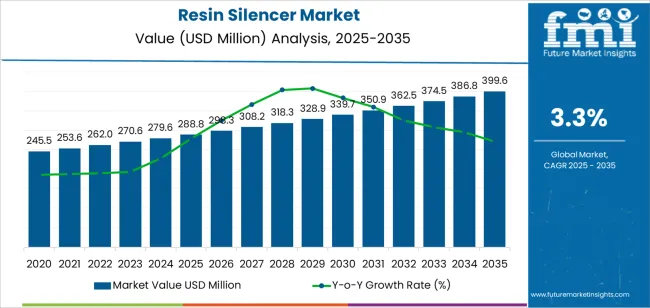
The resin silencer market was valued at USD 288.8 million in 2025, projected to reach USD 298.33 million in 2026, and is forecast to expand to USD 412.76 million by 2036 at a 3.3% CAGR. Sustained manufacturing facility construction in Asia Pacific and factory automation upgrades in North America and Europe are maintaining demand for pneumatic exhaust silencers that attenuate compressed air discharge noise. Male threaded silencers command 58.0% share, reflecting their compatibility with standard pneumatic valve and actuator port configurations.
Summary of Resin Silencer Market
- Market Snapshot
- The resin silencer market is valued at USD 288.8 million in 2025 and is projected to reach USD 412.76 million by 2036.
- The industry is expected to grow at a 3.3% CAGR from 2026 to 2036, creating an incremental opportunity of USD 114.43 million.
- The market is a steady-state industrial component category where manufacturing density, automation investment cycles, and workplace noise compliance define replacement and new installation demand.
- Demand and Growth Drivers
- Sustained manufacturing facility construction in Asia Pacific is generating new pneumatic system installations requiring exhaust silencer components at every valve and actuator port.
- Factory automation upgrades in North America and Europe are replacing legacy pneumatic systems with modern configurations that include integrated noise attenuation specifications.
- Workplace noise exposure regulations are tightening compliance requirements for compressed air exhaust noise levels, mandating silencer installation in existing pneumatic networks.
- Among key countries, China at 4.5%, India at 4.1%, Germany at 3.8%, Brazil at 3.5%, USA at 3.1%, UK at 2.8%, Japan at 2.5%.
- Product and Segment View
- The market includes male threaded, push-in fitting, and specialty resin silencer configurations for pneumatic exhaust noise attenuation in manufacturing and industrial automation.
- Male Threaded Silencers leads by Connection Type with 58% share in 2026.
- Manufacturing Facilities leads by Application with 64% share in 2026.
- Scope includes market scope includes male threaded resin silencers, push-in fitting silencers, flat silencers, and specialty exhaust silencer configurations. Metal and sintered bronze silencers are excluded.
- Geography and Competitive Outlook
- China and India are the fastest-growing markets at 4.5% and 4.1% CAGR respectively, driven by expanding manufacturing facility expansion and factory automation investments.
- USA represents a mature demand base where reshoring manufacturing investment and automated production line installations sustain pneumatic silencer demand.
- Competition is shaped by thread compatibility, noise attenuation performance, and distribution network coverage across pneumatic component channels, with key players including SMC, CKD Corporation, Airtac International, Festo, Parker Hannifin, Norgren, Camozzi.
- Analyst Opinion at FMI
- Nikhil Kaitwade, Principal Consultant for Industrial Automation, opines,: 'In my analysis, I have observed that pneumatic silencer replacement cycles remain a steady-state procurement requirement that tracks directly with manufacturing facility density and automation investment. Component distributors maintaining narrow silencer inventories limited to one or two manufacturers face losing specification share as factory automation integrators diversify supplier requirements. Manufacturers that fail to expand push-in fitting silencer product lines to match modern quick-connect pneumatic architectures will cede growing market share to competitors offering plug-and-play compatibility.'
- Strategic Implications / Executive Takeaways
- Silencer manufacturers must expand push-in fitting product lines to match the growing adoption of quick-connect pneumatic architectures in modern factory automation installations.
- Industrial component distributors should maintain broad silencer inventory across thread sizes and fitting configurations to serve the replacement cycle requirements of diverse manufacturing environments.
- Factory planning engineers must include pneumatic exhaust silencing specifications in automation system design documents to ensure compliance with tightening workplace noise exposure regulations.
Resin Silencer Market Key Takeaways
| Metric | Details |
|---|---|
| Industry Size (2026) | USD 298.33 million |
| Industry Value (2036) | USD 412.76 million |
| CAGR (2026-2036) | 3.3% |
Source: Future Market Insights, 2026
The incremental opportunity of USD 114.43 million over the forecast period reflects gradual expansion of pneumatic system installations in manufacturing and industrial automation facilities globally. Manufacturing facilities account for 64.0% of application share as compressed air system density in production environments generates the highest silencer replacement and new installation volumes.
China leads at 4.5 CAGR, driven by manufacturing facility expansion across automotive, electronics, and general industrial sectors generating increased pneumatic system installations. India follows at 4.1, propelled by the Make in India manufacturing initiative and factory automation upgrades across pharmaceutical, automotive, and food processing sectors. Germany registers 3.8, anchored by Industrie 4.0 factory automation programmes and pneumatic system upgrades in established manufacturing facilities. Brazil advances at 3.5, supported by manufacturing sector recovery and growing adoption of pneumatic automation in food and beverage production facilities. The United States expands at 3.1, driven by reshoring manufacturing investment and automated production line installations requiring pneumatic exhaust silencing. The United Kingdom posts 2.8, anchored by factory modernization investments and compliance with workplace noise exposure regulations requiring pneumatic exhaust attenuation. Japan registers 2.5 growth as robotics-intensive manufacturing facilities require precision pneumatic silencing to maintain clean-room and low-noise production environments.
Resin Silencer Market Definition
The resin silencer market covers pneumatic exhaust noise attenuation devices manufactured from sintered polymer and resin materials designed to reduce compressed air discharge noise at valve and actuator exhaust ports. Products include male threaded silencers, push-in fitting silencers, and specialty silencer configurations used in manufacturing facilities and industrial automation systems.
Resin Silencer Market Inclusions
Market scope includes male threaded resin silencers, push-in fitting silencers, flat silencers, and specialty exhaust silencer configurations. All standard pneumatic port sizes and thread specifications for manufacturing and industrial automation applications are covered.
Resin Silencer Market Exclusions
Metal and sintered bronze silencers are excluded. The scope omits hydraulic system silencers, industrial exhaust mufflers, and acoustic enclosures. Pneumatic valves, actuators, and air preparation equipment sold separately from silencer components fall outside analytical parameters.
Resin Silencer Market Research Methodology
- Primary Research: Analysts engaged with pneumatic component distributors, factory automation integrators, and manufacturing facility maintenance managers to map silencer procurement patterns and replacement cycles.
- Desk Research: Data collection phases aggregated manufacturing facility construction databases, pneumatic equipment trade statistics, workplace noise regulation publications, and industrial automation investment indices.
- Market-Sizing and Forecasting: Baseline values derive from a bottom-up aggregation of installation and procurement tracking data, applying region-specific adoption curves to project future deployment velocity.
- Data Validation and Update Cycle: Projections are tested against publicly reported expenditure guidance from leading industry participants and cross-referenced with regulatory filing data.
Why is the Resin Silencer Market Growing?
The resin silencer market grows by enabling industrial facilities to achieve superior workplace noise control and pneumatic system efficiency while maintaining regulatory compliance with occupational safety standards. Manufacturing operations face mounting pressure to reduce noise exposure and improve working conditions, with resin silencer installations typically providing 15-25 decibel noise reduction in pneumatic exhaust applications, making these components essential for workplace safety compliance and equipment maintenance optimization. The industrial automation sector's need for reliable pneumatic component accessories creates demand for cost-effective silencer solutions that deliver consistent acoustic performance across diverse operating conditions and equipment configurations.
Occupational health and safety regulations mandating workplace noise level management drive adoption in automotive manufacturing, electronics assembly, and food processing applications, where pneumatic equipment noise has a direct impact on worker safety and regulatory compliance status. The global expansion of automated manufacturing systems and increasing investment in factory modernization accelerates resin silencer demand as equipment specifiers include noise management components in pneumatic system designs. Availability of lower-cost alternatives and limited awareness of noise reduction benefits may restrict adoption rates among small-scale manufacturers and regions with less stringent occupational noise regulations.
Segmental Analysis
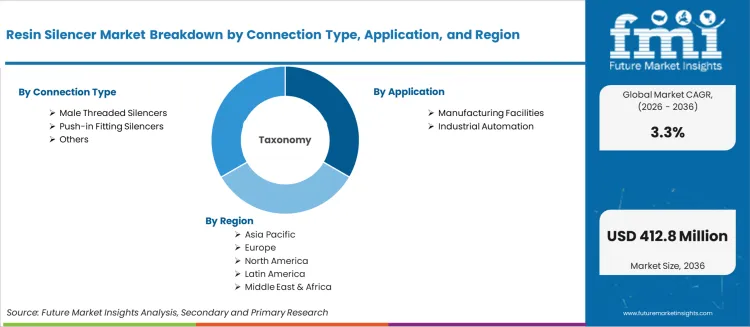
The market is segmented by connection type, application, and region. By connection type, the market is divided into male threaded silencers, push-in fitting silencers, and others. Based on application, the market is categorized into industrial automation and manufacturing facilities. Regionally, the market is divided into Asia Pacific, Europe, North America, Latin America, and Middle East & Africa.
By Connection Type, the Male Threaded Silencers Segment Accounts for a Dominant Market Share
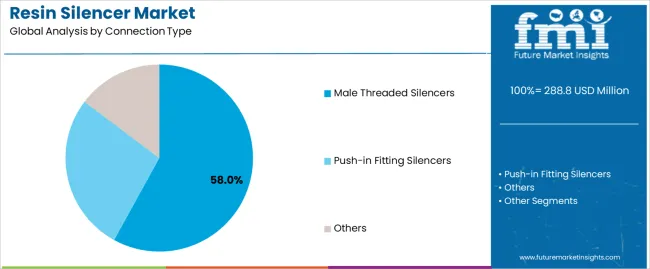
The male threaded silencers segment represents the dominant force in the resin silencer market, capturing approximately 58% of total market share in 2026. This advanced category encompasses configurations featuring NPT thread standards, metric thread specifications, and universal connection formats, delivering comprehensive installation compatibility with standard pneumatic equipment exhaust ports. The male threaded silencers segment's market leadership stems from its exceptional versatility across diverse pneumatic equipment types, secure connection reliability preventing accidental disconnection during operation, and compatibility with established pneumatic system design practices that specify threaded exhaust connections as industry standard.
The push-in fitting silencers segment maintains a 31.0% market share, serving applications requiring tool-free installation through quick-connect push-in mechanisms, simplified maintenance replacement procedures, and compatibility with modern pneumatic tubing systems. The others segment accounts for 11.0% market share, featuring flanged connections, barbed hose fittings, and specialty mounting configurations for unique equipment requirements.
Key advantages driving the male threaded silencers segment include universal compatibility enabling installation on pneumatic cylinders, directional valves, and air preparation equipment across manufacturers, robust connection security ensuring leak-free operation and reliable acoustic performance throughout equipment service life, established industry acceptance supporting specification in original equipment designs and aftermarket replacement applications, cost-effective manufacturing enabling competitive pricing for standard thread configurations serving high-volume industrial applications.
By Application, the Manufacturing Facilities Segment Accounts for the Largest Market Share
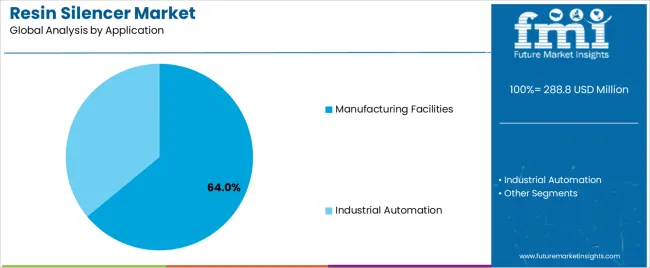
Manufacturing facilities dominate the resin silencer market with approximately 64.0% market share in 2026, reflecting the substantial deployment of pneumatic equipment in production operations where noise control and workplace environment management are critical operational priorities. The manufacturing facilities segment's market leadership is reinforced by widespread pneumatic system utilization across assembly lines, material handling systems, and automated production equipment where exhaust noise from actuators and valves requires management to maintain acceptable workplace sound levels.
The industrial automation segment represents 36.0% market share through specialized requirements in robotics installations, automated packaging systems, and precision manufacturing equipment where pneumatic actuators serve motion control and positioning functions. This segment benefits from system integrators specifying noise reduction components as standard elements in comprehensive automation solutions designed for workplace safety compliance.
Key market dynamics supporting application preferences include manufacturing operations requiring comprehensive noise control across multiple pneumatic equipment installations to achieve cumulative workplace noise reduction, production line optimization driving demand for maintenance-free silencer components that minimize downtime and servicing interruptions, workplace safety compliance necessitating exhaust noise management to meet occupational health standards and regulatory inspection requirements, equipment reliability priorities favoring corrosion-resistant resin construction that maintains performance in industrial environments with humidity and contamination exposure.
What are the Drivers, Restraints, and Key Trends of the Resin Silencer Market?
The market is driven by three concrete demand factors tied to workplace safety and operational efficiency. First, occupational noise regulations accelerate silencer adoption, with workplace noise exposure limits tightening in major manufacturing regions worldwide, requiring industrial facilities to implement pneumatic exhaust noise control measures that reduce sound levels by 15-25 decibels for regulatory compliance. Second, industrial automation expansion drives pneumatic component demand, with automated manufacturing systems incorporating 50-100 pneumatic actuators per production line, creating requirements for comprehensive exhaust noise management across equipment installations. Third, maintenance cost reduction motivates adoption of resin silencers, with corrosion-resistant polymer construction eliminating rust-related failures that occur in metallic alternatives, reducing replacement frequency by 30-40% and lowering total ownership costs for pneumatic systems.
Market restraints include price competition from unbranded alternatives affecting market share, with low-cost silencer products from regional manufacturers priced 30-50% below established brands, posing adoption barriers in cost-sensitive manufacturing segments where procurement decisions prioritize initial component costs over performance consistency. Limited awareness of noise reduction benefits creates additional challenges, as smaller manufacturers often overlook exhaust silencer specifications unless specifically required by safety audits or regulatory inspections, reducing market penetration in facilities without comprehensive safety management programs. Performance variability across operating conditions impacts customer satisfaction, particularly in high-flow pneumatic applications where inadequate silencer flow capacity creates backpressure that reduces actuator speed and system efficiency.
Key trends indicate growing adoption of integrated silencer designs that combine noise reduction with exhaust flow control, enabling single-component solutions that optimize pneumatic system performance while managing acoustic output. Material innovation trends toward reinforced resin compounds offering enhanced impact resistance and temperature tolerance for demanding industrial environments, modular silencer platforms with interchangeable connection adapters enabling inventory consolidation and flexible installation options, and color-coded product lines facilitating visual identification and maintenance tracking across factory pneumatic systems are driving product development. The market thesis could face disruption if alternative pneumatic exhaust management technologies such as centralized exhaust collection systems gain acceptance in large manufacturing facilities, reducing demand for individual point-of-use silencers, or if industry shifts toward electric actuator technologies that eliminate pneumatic exhaust noise concerns accelerate beyond current adoption rates.
What is the Outlook for the Resin Silencer Market in Key Countries?
.webp "Top Country Growth Comparison Resin Silencer Market Cagr (2026 2036)")
| Country | CAGR (2026-2036) |
|---|---|
| China | 4.5% |
| India | 4.1% |
| Germany | 3.8% |
| Brazil | 3.5% |
| USA | 3.1% |
| UK | 2.8% |
| Japan | 2.5% |
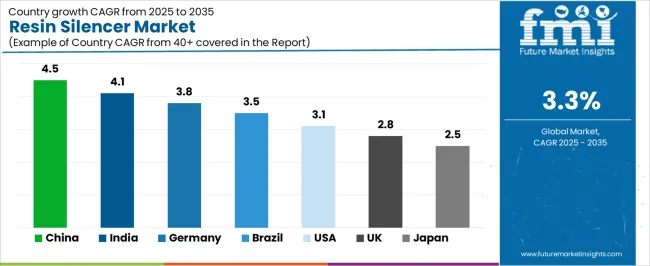
The resin silencer market is gaining momentum worldwide, with China taking the lead thanks to aggressive manufacturing capacity expansion and growing industrial automation adoption. Close behind, India benefits from manufacturing sector development and increasing workplace safety regulation enforcement, positioning itself as a strategic growth hub in the Asia-Pacific region. Germany shows strong advancement, where precision manufacturing culture and comprehensive safety standards strengthen its role in European pneumatic component markets. The US demonstrates steady growth through established industrial base and workplace safety compliance emphasis, signaling continued investment in pneumatic system optimization. The UK stands out for its mature manufacturing sector and regulatory compliance focus, while Brazil and Japan continue to record consistent progress driven by industrial modernization programs and automation expansion. China and India anchor the global expansion story, while established markets build stability and diversity into the market's growth path.
Why is China Leading Global Market Expansion in Resin Silencers?
China demonstrates the strongest growth potential in the resin silencer market with a CAGR of 4.5% through 2036. The country's leadership position stems from comprehensive manufacturing sector expansion, intensive industrial automation deployment, and growing workplace safety regulation enforcement driving adoption of pneumatic noise control solutions. Growth is concentrated in major industrial regions, including Guangdong, Jiangsu, Zhejiang, and Shandong provinces, where factories are implementing pneumatic system upgrades incorporating silencer components for noise management and regulatory compliance. Distribution channels through pneumatic component distributors, industrial supply wholesalers, and automation equipment suppliers expand deployment across automotive plants, electronics factories, and general manufacturing facilities. The country's Made in China 2026 initiative provides support for industrial modernization, including workplace environment improvement and manufacturing automation advancement.
Key market factors include manufacturing concentration in coastal industrial zones with comprehensive pneumatic equipment utilization across production operations, domestic component manufacturing capabilities enabling competitive silencer supply for price-sensitive industrial markets serving local and export production, labor protection regulations driving workplace noise control requirements with increasing enforcement in major manufacturing provinces, technology adoption featuring integration with locally-manufactured pneumatic equipment and automation systems adapted for Chinese industrial applications.
What is Driving India’s High-Growth Potential in Resin Silencers?
In major industrial states, manufacturing clusters, and automation hubs, the adoption of resin silencer components is accelerating across automotive manufacturing facilities, electronics assembly operations, and food processing plants, driven by industrial expansion programs and workplace safety compliance initiatives. The market demonstrates strong growth momentum with a CAGR of 4.1% through 2036, linked to comprehensive manufacturing sector development and increasing focus on occupational health and safety standards. Indian manufacturers are implementing pneumatic noise control measures to improve working conditions while addressing regulatory compliance requirements in organized manufacturing sectors. The country's Make in India program creates demand for industrial automation components, while increasing emphasis on workplace safety drives adoption of pneumatic system accessories that reduce noise exposure.
Leading industrial development regions, including Gujarat, Tamil Nadu, Maharashtra, and Karnataka, driving resin silencer adoption across manufacturing operations. Growing organized manufacturing sector enabling systematic specification of pneumatic components including noise control accessories in factory installations. International manufacturing investment flows accelerating adoption of comprehensive pneumatic system designs incorporating silencer components as standard specifications. Policy support through factory safety regulations and occupational health standards linked to industrial development programs promoting workplace environment improvement.
How is Germany Maintaining Regional Leadership in Resin Silencers?
Germany's advanced manufacturing sector demonstrates sophisticated implementation of pneumatic noise control systems, with documented installations showing 20-30% workplace noise reduction through comprehensive silencer deployment across automated production lines. The country's industrial infrastructure in major manufacturing regions, including Bavaria, Baden-Württemberg, North Rhine-Westphalia, and Lower Saxony, showcases integration of resin silencer technologies with existing pneumatic systems, leveraging expertise in precision manufacturing and workplace safety management. German manufacturers emphasize quality standards and regulatory compliance, creating demand for certified silencer components that support stringent occupational safety requirements and equipment reliability expectations. The market maintains steady growth through focus on industrial automation expansion and manufacturing facility modernization, with a CAGR of 3.8% through 2036.
Key development areas include workplace safety compliance with comprehensive noise protection regulations requiring systematic exhaust noise management across pneumatic installations, technical specification standards ensuring component quality through industry certifications and performance verification with documented acoustic attenuation ratings, strategic partnerships between pneumatic equipment suppliers and silencer manufacturers enabling integrated system solutions for automated production lines, integration of advanced resin materials and comprehensive testing protocols ensuring long-term performance reliability in demanding industrial environments.
What is Driving Brazil’s Growth in Resin Silencers?
The Brazilian market demonstrates growing resin silencer adoption based on industrial manufacturing expansion and increasing workplace safety awareness driving demand for pneumatic noise control components. The country shows solid potential with a CAGR of 3.5% through 2036, driven by automotive industry development and manufacturing sector investments across major industrial regions, including São Paulo, Minas Gerais, Rio Grande do Sul, and Paraná states. Brazilian manufacturers are adopting pneumatic silencer components to improve factory working conditions and support compliance with labor safety standards. Technology deployment channels through industrial distributors, pneumatic equipment suppliers, and automation system integrators expand coverage across manufacturing facilities.
Leading market segments include automotive manufacturing operations implementing comprehensive pneumatic system noise control across assembly lines and production equipment installations, food processing facilities adopting silencer components for pneumatic conveying systems and packaging machinery serving hygiene-sensitive production environments, technology partnerships with international pneumatic component suppliers enabling access to proven silencer designs and technical support services, strategic focus on workplace environment improvement supporting investment in noise control components as manufacturing facilities modernize operations.
How is the United States Demonstrating Mature Market Characteristics for Resin Silencers?
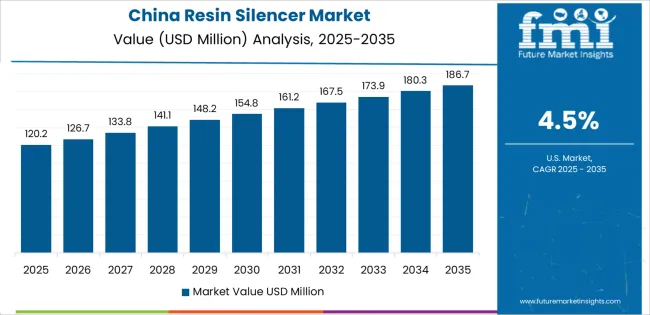
The USA market demonstrates established resin silencer adoption based on mature industrial base and comprehensive workplace safety regulations governing noise exposure in manufacturing environments. The country shows solid potential with a CAGR of 3.1% through 2036, driven by industrial automation expansion and factory modernization projects across major manufacturing regions, including Midwest industrial belt, Southeast automotive corridor, and West Coast technology manufacturing centers. American manufacturers are implementing pneumatic noise control solutions to maintain OSHA compliance and support continuous improvement in workplace safety performance. Technology deployment channels through established industrial distributors, pneumatic specialty suppliers, and maintenance service providers expand deployment across diverse manufacturing sectors.
Key market characteristics include OSHA workplace noise regulations driving systematic assessment and control of pneumatic exhaust noise in manufacturing facilities nationwide, industrial automation growth requiring comprehensive pneumatic component specifications including exhaust noise management in system designs, technology partnerships between pneumatic equipment manufacturers and end users enabling customized silencer solutions for specific application requirements, strategic emphasis on total cost of ownership reduction supporting adoption of durable resin construction that minimizes maintenance and replacement expenses.
How is the United Kingdom Advancing Resin Silencer Adoption?
In major manufacturing regions and industrial estates, factories are implementing resin silencer installations that support Health and Safety Executive workplace noise regulations, with documented integration achieving 15-20 decibel noise reduction in pneumatic equipment exhaust applications. The market shows steady growth potential with a CAGR of 2.8% through 2036, linked to established workplace safety culture, industrial base maintenance, and emphasis on regulatory compliance standards. British manufacturers are adopting pneumatic silencer components that ensure compliance with Control of Noise at Work Regulations while maintaining equipment operational efficiency.
Market development factors include workplace safety regulations requiring systematic noise risk assessment and control measures in manufacturing environments with pneumatic equipment, industrial equipment modernization programs incorporating noise control specifications in pneumatic system upgrades and replacement projects, strategic partnerships between industrial distributors and manufacturing facilities ensuring appropriate silencer specification for diverse pneumatic applications, emphasis on maintenance reduction and operational reliability supporting preference for corrosion-resistant resin construction in humid industrial environments.
Why is Japan’s Resin Silencer Market Focused on Precision Manufacturing?
Japan's resin silencer market demonstrates mature implementation focused on quality component engineering and integration with precision manufacturing operations serving automotive, electronics, and machinery production sectors. The country maintains steady growth momentum with a CAGR of 2.5% through 2036, driven by manufacturing sector stability and continuous improvement initiatives in major industrial regions including Aichi, Kanagawa, Osaka, and other manufacturing prefectures. Major production facilities showcase deployment of high-quality silencer components that achieve consistent acoustic performance and long service life in demanding industrial applications.
Key market characteristics include precision manufacturing standards driving specification of quality silencer components that maintain reliable performance throughout equipment service life, workplace environment emphasis supporting systematic noise control measures in manufacturing facilities prioritizing worker comfort and safety, technology development by domestic pneumatic component manufacturers incorporating advanced resin formulations and precision molding processes for optimal performance, collaboration between equipment manufacturers and component suppliers enabling integrated pneumatic system solutions with comprehensive noise management across automated production lines.
Europe Market Split by Country
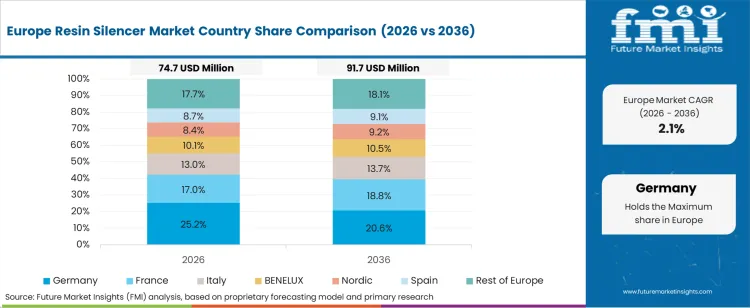
The resin silencer market in Europe is projected to grow from USD 106.0 million in 2026 to USD 137.7 million by 2036, registering a CAGR of 2.7% over the forecast period. Germany is expected to maintain its leadership position with a 34.2% market share in 2026, declining slightly to 33.6% by 2036, supported by its extensive industrial manufacturing infrastructure and major production centers, including Bavaria, Baden-Württemberg, and North Rhine-Westphalia regions.
The United Kingdom follows with a 16.8% share in 2026, projected to reach 16.5% by 2036, driven by established manufacturing operations and workplace safety compliance requirements. Italy holds a 14.3% share in 2026, expected to maintain 14.2% by 2036 through industrial equipment modernization. France commands a 12.7% share in both 2026 and 2036, backed by automotive and aerospace manufacturing sectors. Spain accounts for 9.4% in 2026, rising to 9.5% by 2036 on industrial expansion. The Netherlands maintains 4.8% in 2026, reaching 4.9% by 2036 on logistics automation growth. The Rest of Europe region is anticipated to hold 7.8% in 2026, expanding to 8.0% by 2036, attributed to increasing resin silencer adoption in Nordic countries and emerging Central and Eastern European manufacturing facility development.
Quality Standards Dominate Component Specifications in Japan
The Japanese resin silencer market demonstrates a mature and quality-focused landscape, characterized by sophisticated integration of precision-manufactured silencer components and comprehensive pneumatic system designs with existing industrial infrastructure across automotive manufacturing, electronics assembly, and machinery production facilities. Japan's emphasis on equipment reliability and workplace environment quality drives demand for premium silencer components that support long-term operational performance and consistent acoustic attenuation in demanding manufacturing applications. The market benefits from established relationships between domestic pneumatic equipment manufacturers and component suppliers, creating service ecosystems that prioritize product consistency and technical support programs. Manufacturing centers in Aichi, Kanagawa, Osaka, and other major industrial prefectures showcase advanced pneumatic system implementations where silencer components achieve 95% performance retention through precision engineering and comprehensive quality control protocols.
International Providers Lead Technology Supply in South Korea
The South Korean resin silencer market is characterized by growing international pneumatic component supplier presence, with companies maintaining significant positions through comprehensive product portfolios and technical services capabilities for industrial automation and manufacturing applications. The market demonstrates increasing emphasis on factory automation and workplace safety enhancement, as Korean manufacturers increasingly demand reliable pneumatic components that integrate with advanced production equipment and automation systems deployed across manufacturing facilities. Regional component distributors are gaining market share through strategic partnerships with international suppliers, offering specialized services including technical specification support and inventory management programs for industrial customers. The competitive landscape shows increasing collaboration between global pneumatic equipment manufacturers and Korean industrial automation specialists, creating hybrid service models that combine international product quality with local market knowledge and customer support capabilities.
What is the Competitive Landscape of the Resin Silencer Market?
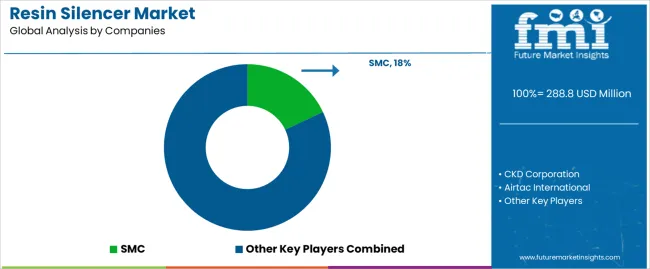
The resin silencer market features approximately 15-18 meaningful players with moderate concentration, where the top three companies control roughly 42-48% of global market share through established manufacturing capabilities and comprehensive distribution networks. Competition centers on product reliability, acoustic performance consistency, and connection compatibility rather than price competition alone. SMC leads with approximately 18.0% market share through its comprehensive pneumatic component portfolio.
Market leaders include SMC, CKD Corporation, and Airtac International, which maintain competitive advantages through proven product engineering, global distribution infrastructure, and deep expertise in pneumatic system components across multiple industrial applications, creating reliability advantages with equipment manufacturers and industrial end users. These companies leverage research and development capabilities in resin material formulations and ongoing technical support relationships to defend market positions while expanding into specialized industrial automation and precision manufacturing applications.
Challengers encompass Festo and Parker Hannifin, which compete through comprehensive pneumatic product portfolios and strong regional presence in key industrial markets. Product specialists, including Norgren, Camozzi, and Mindman Industrial, focus on specific connection types or regional markets, offering differentiated capabilities in custom configurations, rapid delivery programs, and specialized technical support services.
Regional players and emerging component manufacturers create competitive pressure through cost-competitive product offerings and local service advantages, particularly in high-growth markets where domestic manufacturers including Tameson and Koganei provide localized distribution support and competitive pricing structures adapted to regional industrial market conditions. Market dynamics favor companies that combine reliable acoustic performance with comprehensive product availability that addresses diverse pneumatic equipment connection requirements throughout industrial manufacturing and automation applications.
Key Players in the Resin Silencer Market
- SMC
- CKD Corporation
- Airtac International
- Festo
- Parker Hannifin
- Norgren
- Camozzi
- Mindman Industrial
- Tameson
- Koganei
Scope of the Report
| Metric | Value |
|---|---|
| Quantitative Units | USD 298.33 million to USD 412.76 million, at a CAGR of 3.3% |
| Market Definition | The resin silencer market covers pneumatic exhaust noise attenuation devices manufactured from sintered polymer and resin materials designed to reduce compressed air discharge noise at valve and actua... |
| Segmentation | Connection Type: Male Threaded Silencers, Push-in Fitting Silencers, Others; Application: Manufacturing Facilities, Industrial Automation |
| Regions Covered | North America, Latin America, Europe, East Asia, South Asia, Oceania, Middle East & Africa |
| Countries Covered | China, India, Germany, Brazil, USA, UK, Japan, and 40 plus countries |
| Key Companies Profiled | SMC, CKD Corporation, Airtac International, Festo, Parker Hannifin, Norgren, Camozzi, Mindman Industrial, Tameson, Koganei |
| Forecast Period | 2026 to 2036 |
| Approach | Forecasting models apply a bottom-up methodology starting with installation and procurement tracking data and projecting adoption rates using region-specific deployment curves. |
Resin Silencer Market by Segments
Connection Type:
- Male Threaded Silencers
- Push-in Fitting Silencers
- Others
Application:
- Industrial Automation
- Manufacturing Facilities
Region:
- Asia Pacific
- China
- India
- Japan
- South Korea
- Vietnam
- Australia & New Zealand
- ASEAN
- Rest of Asia Pacific
- Europe
- Germany
- United Kingdom
- France
- Italy
- Spain
- Netherlands
- Nordic
- BENELUX
- Rest of Europe
- North America
- United States
- Canada
- Mexico
- Latin America
- Brazil
- Argentina
- Rest of Latin America
- Middle East & Africa
- Kingdom of Saudi Arabia
- Other GCC Countries
- Turkey
- South Africa
- Other African Union
- Rest of Middle East & Africa
Bibliography
- International Organization for Standardization. (2024). ISO 7183: Compressed air dryers and pneumatic component specifications. ISO.
- European Committee for Standardization. (2024). EN ISO 4414: Pneumatic fluid power systems requirements. CEN.
- Occupational Safety and Health Administration. (2024). 29 CFR 1910.95: Occupational noise exposure standards update. OSHA.
- Bureau of Indian Standards. (2024). IS 10063: Pneumatic components specification revision. BIS.
- Ministry of Economy, Trade and Industry, Japan. (2024). Industrial machinery and pneumatic equipment production statistics. METI.
This bibliography is provided for reader reference. The full Future Market Insights report contains the complete reference list with primary research documentation.
Frequently Asked Questions
How large is the demand for Resin Silencer Market in the global market in 2026?
Demand for resin silencer in the global market is estimated to be valued at USD 298.33 million in 2026.
What will be the market size of Resin Silencer Market in the global market by 2036?
Market size for resin silencer is projected to reach USD 412.76 million by 2036.
What is the expected demand growth for Resin Silencer Market between 2026 and 2036?
Demand for resin silencer is expected to grow at a CAGR of 3.3% between 2026 and 2036.
Which Connection Type is poised to lead global sales by 2026?
Male Threaded Silencers accounts for 58% share in 2026 as male threaded connections match standard pneumatic valve and actuator exhaust port configurations across global manufacturing equipment.
How is the role of Manufacturing Facilities in driving Resin Silencer Market adoption in 2026?
Manufacturing Facilities represents 64% of Application share in 2026 as manufacturing facilities maintain the highest compressed air system density, generating the greatest silencer replacement and new installation volumes.
What is driving demand in China?
China is projected to grow at a CAGR of 4.5% during 2026 to 2036, driven by manufacturing facility expansion across automotive, electronics, and general industrial sectors generating increased pneumatic system installations.
What is Resin Silencer and what is it mainly used for?
Resin silencers are pneumatic exhaust noise attenuation devices made from sintered polymer materials. They are installed at valve and actuator exhaust ports in manufacturing and industrial automation systems to reduce compressed air discharge noise.
How does FMI build and validate the Resin Silencer Market forecast?
Forecasting models apply a bottom-up methodology starting with procurement and installation tracking data and cross-validate projections against publicly reported expenditure data from leading industry participants.
Preview the report firsthand - request a free sample
Get SampleGet the brochure for pricing and purchase details.
Get PDFTable of Content
- Executive Summary
- Global Market Outlook
- Demand-side Trends
- Supply-side Trends
- Technology Roadmap Analysis
- Analysis and Recommendations
- Market Overview
- Market Coverage / Taxonomy
- Market Definition / Scope / Limitations
- Research Methodology
- Chapter Orientation
- Analytical Lens and Working Hypotheses
- Market Structure, Signals, and Trend Drivers
- Benchmarking and Cross-market Comparability
- Market Sizing, Forecasting, and Opportunity Mapping
- Research Design and Evidence Framework
- Desk Research Programme (Secondary Evidence)
- Company Annual and Sustainability Reports
- Peer-reviewed Journals and Academic Literature
- Corporate Websites, Product Literature, and Technical Notes
- Earnings Decks and Investor Briefings
- Statutory Filings and Regulatory Disclosures
- Technical White Papers and Standards Notes
- Trade Journals, Industry Magazines, and Analyst Briefs
- Conference Proceedings, Webinars, and Seminar Materials
- Government Statistics Portals and Public Data Releases
- Press Releases and Reputable Media Coverage
- Specialist Newsletters and Curated Briefings
- Sector Databases and Reference Repositories
- FMI Internal Proprietary Databases and Historical Market Datasets
- Subscription Datasets and Paid Sources
- Social Channels, Communities, and Digital Listening Inputs
- Additional Desk Sources
- Expert Input and Fieldwork (Primary Evidence)
- Primary Modes
- Qualitative Interviews and Expert Elicitation
- Quantitative Surveys and Structured Data Capture
- Blended Approach
- Why Primary Evidence is Used
- Field Techniques
- Interviews
- Surveys
- Focus Groups
- Observational and In-context Research
- Social and Community Interactions
- Stakeholder Universe Engaged
- C-suite Leaders
- Board Members
- Presidents and Vice Presidents
- R&D and Innovation Heads
- Technical Specialists
- Domain Subject-matter Experts
- Scientists
- Physicians and Other Healthcare Professionals
- Governance, Ethics, and Data Stewardship
- Research Ethics
- Data Integrity and Handling
- Primary Modes
- Tooling, Models, and Reference Databases
- Desk Research Programme (Secondary Evidence)
- Data Engineering and Model Build
- Data Acquisition and Ingestion
- Cleaning, Normalisation, and Verification
- Synthesis, Triangulation, and Analysis
- Quality Assurance and Audit Trail
- Market Background
- Market Dynamics
- Drivers
- Restraints
- Opportunity
- Trends
- Scenario Forecast
- Demand in Optimistic Scenario
- Demand in Likely Scenario
- Demand in Conservative Scenario
- Opportunity Map Analysis
- Product Life Cycle Analysis
- Supply Chain Analysis
- Investment Feasibility Matrix
- Value Chain Analysis
- PESTLE and Porter’s Analysis
- Regulatory Landscape
- Regional Parent Market Outlook
- Production and Consumption Statistics
- Import and Export Statistics
- Market Dynamics
- Global Market Analysis 2021 to 2025 and Forecast, 2026 to 2036
- Historical Market Size Value (USD Million) Analysis, 2021 to 2025
- Current and Future Market Size Value (USD Million) Projections, 2026 to 2036
- Y-o-Y Growth Trend Analysis
- Absolute $ Opportunity Analysis
- Global Market Pricing Analysis 2021 to 2025 and Forecast 2026 to 2036
- Global Market Analysis 2021 to 2025 and Forecast 2026 to 2036, By Connection Type
- Introduction / Key Findings
- Historical Market Size Value (USD Million) Analysis By Connection Type , 2021 to 2025
- Current and Future Market Size Value (USD Million) Analysis and Forecast By Connection Type , 2026 to 2036
- Male Threaded Silencers
- Push-in Fitting Silencers
- Others
- Male Threaded Silencers
- Y-o-Y Growth Trend Analysis By Connection Type , 2021 to 2025
- Absolute $ Opportunity Analysis By Connection Type , 2026 to 2036
- Global Market Analysis 2021 to 2025 and Forecast 2026 to 2036, By Application
- Introduction / Key Findings
- Historical Market Size Value (USD Million) Analysis By Application, 2021 to 2025
- Current and Future Market Size Value (USD Million) Analysis and Forecast By Application, 2026 to 2036
- Manufacturing Facilities
- Industrial Automation
- Manufacturing Facilities
- Y-o-Y Growth Trend Analysis By Application, 2021 to 2025
- Absolute $ Opportunity Analysis By Application, 2026 to 2036
- Global Market Analysis 2021 to 2025 and Forecast 2026 to 2036, By Region
- Introduction
- Historical Market Size Value (USD Million) Analysis By Region, 2021 to 2025
- Current Market Size Value (USD Million) Analysis and Forecast By Region, 2026 to 2036
- North America
- Latin America
- Western Europe
- Eastern Europe
- East Asia
- South Asia and Pacific
- Middle East & Africa
- Market Attractiveness Analysis By Region
- North America Market Analysis 2021 to 2025 and Forecast 2026 to 2036, By Country
- Historical Market Size Value (USD Million) Trend Analysis By Market Taxonomy, 2021 to 2025
- Market Size Value (USD Million) Forecast By Market Taxonomy, 2026 to 2036
- By Country
- USA
- Canada
- Mexico
- By Connection Type
- By Application
- By Country
- Market Attractiveness Analysis
- By Country
- By Connection Type
- By Application
- Key Takeaways
- Latin America Market Analysis 2021 to 2025 and Forecast 2026 to 2036, By Country
- Historical Market Size Value (USD Million) Trend Analysis By Market Taxonomy, 2021 to 2025
- Market Size Value (USD Million) Forecast By Market Taxonomy, 2026 to 2036
- By Country
- Brazil
- Chile
- Rest of Latin America
- By Connection Type
- By Application
- By Country
- Market Attractiveness Analysis
- By Country
- By Connection Type
- By Application
- Key Takeaways
- Western Europe Market Analysis 2021 to 2025 and Forecast 2026 to 2036, By Country
- Historical Market Size Value (USD Million) Trend Analysis By Market Taxonomy, 2021 to 2025
- Market Size Value (USD Million) Forecast By Market Taxonomy, 2026 to 2036
- By Country
- Germany
- UK
- Italy
- Spain
- France
- Nordic
- BENELUX
- Rest of Western Europe
- By Connection Type
- By Application
- By Country
- Market Attractiveness Analysis
- By Country
- By Connection Type
- By Application
- Key Takeaways
- Eastern Europe Market Analysis 2021 to 2025 and Forecast 2026 to 2036, By Country
- Historical Market Size Value (USD Million) Trend Analysis By Market Taxonomy, 2021 to 2025
- Market Size Value (USD Million) Forecast By Market Taxonomy, 2026 to 2036
- By Country
- Russia
- Poland
- Hungary
- Balkan & Baltic
- Rest of Eastern Europe
- By Connection Type
- By Application
- By Country
- Market Attractiveness Analysis
- By Country
- By Connection Type
- By Application
- Key Takeaways
- East Asia Market Analysis 2021 to 2025 and Forecast 2026 to 2036, By Country
- Historical Market Size Value (USD Million) Trend Analysis By Market Taxonomy, 2021 to 2025
- Market Size Value (USD Million) Forecast By Market Taxonomy, 2026 to 2036
- By Country
- China
- Japan
- South Korea
- By Connection Type
- By Application
- By Country
- Market Attractiveness Analysis
- By Country
- By Connection Type
- By Application
- Key Takeaways
- South Asia and Pacific Market Analysis 2021 to 2025 and Forecast 2026 to 2036, By Country
- Historical Market Size Value (USD Million) Trend Analysis By Market Taxonomy, 2021 to 2025
- Market Size Value (USD Million) Forecast By Market Taxonomy, 2026 to 2036
- By Country
- India
- ASEAN
- Australia & New Zealand
- Rest of South Asia and Pacific
- By Connection Type
- By Application
- By Country
- Market Attractiveness Analysis
- By Country
- By Connection Type
- By Application
- Key Takeaways
- Middle East & Africa Market Analysis 2021 to 2025 and Forecast 2026 to 2036, By Country
- Historical Market Size Value (USD Million) Trend Analysis By Market Taxonomy, 2021 to 2025
- Market Size Value (USD Million) Forecast By Market Taxonomy, 2026 to 2036
- By Country
- Kingdom of Saudi Arabia
- Other GCC Countries
- Turkiye
- South Africa
- Other African Union
- Rest of Middle East & Africa
- By Connection Type
- By Application
- By Country
- Market Attractiveness Analysis
- By Country
- By Connection Type
- By Application
- Key Takeaways
- Key Countries Market Analysis
- USA
- Pricing Analysis
- Market Share Analysis, 2025
- By Connection Type
- By Application
- Canada
- Pricing Analysis
- Market Share Analysis, 2025
- By Connection Type
- By Application
- Mexico
- Pricing Analysis
- Market Share Analysis, 2025
- By Connection Type
- By Application
- Brazil
- Pricing Analysis
- Market Share Analysis, 2025
- By Connection Type
- By Application
- Chile
- Pricing Analysis
- Market Share Analysis, 2025
- By Connection Type
- By Application
- Germany
- Pricing Analysis
- Market Share Analysis, 2025
- By Connection Type
- By Application
- UK
- Pricing Analysis
- Market Share Analysis, 2025
- By Connection Type
- By Application
- Italy
- Pricing Analysis
- Market Share Analysis, 2025
- By Connection Type
- By Application
- Spain
- Pricing Analysis
- Market Share Analysis, 2025
- By Connection Type
- By Application
- France
- Pricing Analysis
- Market Share Analysis, 2025
- By Connection Type
- By Application
- India
- Pricing Analysis
- Market Share Analysis, 2025
- By Connection Type
- By Application
- ASEAN
- Pricing Analysis
- Market Share Analysis, 2025
- By Connection Type
- By Application
- Australia & New Zealand
- Pricing Analysis
- Market Share Analysis, 2025
- By Connection Type
- By Application
- China
- Pricing Analysis
- Market Share Analysis, 2025
- By Connection Type
- By Application
- Japan
- Pricing Analysis
- Market Share Analysis, 2025
- By Connection Type
- By Application
- South Korea
- Pricing Analysis
- Market Share Analysis, 2025
- By Connection Type
- By Application
- Russia
- Pricing Analysis
- Market Share Analysis, 2025
- By Connection Type
- By Application
- Poland
- Pricing Analysis
- Market Share Analysis, 2025
- By Connection Type
- By Application
- Hungary
- Pricing Analysis
- Market Share Analysis, 2025
- By Connection Type
- By Application
- Kingdom of Saudi Arabia
- Pricing Analysis
- Market Share Analysis, 2025
- By Connection Type
- By Application
- Turkiye
- Pricing Analysis
- Market Share Analysis, 2025
- By Connection Type
- By Application
- South Africa
- Pricing Analysis
- Market Share Analysis, 2025
- By Connection Type
- By Application
- USA
- Market Structure Analysis
- Competition Dashboard
- Competition Benchmarking
- Market Share Analysis of Top Players
- By Regional
- By Connection Type
- By Application
- Competition Analysis
- Competition Deep Dive
- SMC
- Overview
- Product Portfolio
- Profitability by Market Segments (Product/Age /Sales Channel/Region)
- Sales Footprint
- Strategy Overview
- Marketing Strategy
- Product Strategy
- Channel Strategy
- CKD Corporation
- Airtac International
- Festo
- Parker Hannifin
- Norgren
- Camozzi
- Mindman Industrial
- Tameson
- Koganei
- SMC
- Competition Deep Dive
- Assumptions & Acronyms Used


