

- Industry Size (2026)
- USD 2.05 Bn
- Forecast (2036)
- USD 5.82 Bn
- CAGR (2026 to 2036)
- 11.0%
Agar Resin Market size, market forecast and outlook by FMI
The agar resin market was worth USD 1.85 billion in 2025 and is expected to grow to USD 2.05 billion in 2026. By 2036, it is expected to be worth USD 5.82 billion at an 11.0% CAGR.
Summary of Agar Resin Market
- By 2036, the market is expected to be worth USD 5.82 billion.
- The market is expected to grow at a rate of 11.0% per year from 2026 to 2036.
- In 2025, the market was thought to be worth USD 1.85 billion.
- The forecast period is a chance to make an extra USD 3.77 billion.
- Powder has 52.0% resin type, which is best for food and drug applications that need exact formulation.
- Pharmaceuticals lead the way with 24.0%, thanks to the need for excipients to bind tablets and make capsules..
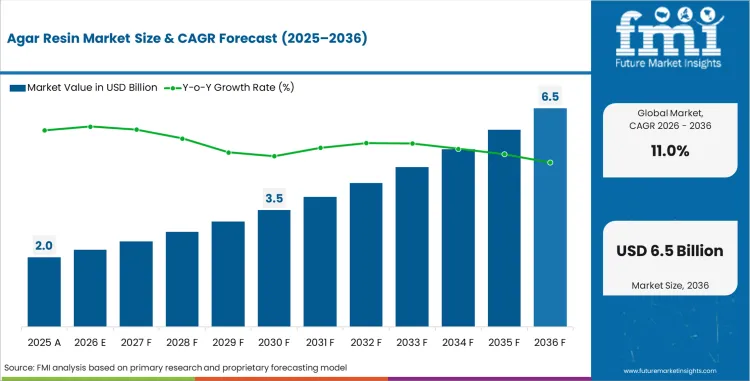
Agar Resin Market key Takeaways
| Parameter | Details |
|---|---|
| Market value (2026) | USD 2.05 billion |
| Forecast value (2036) | USD 5.82 billion |
| CAGR (2026 to 2036) | 11.0% |
| Estimated market value (2025) | USD 1.85 billion |
| Incremental opportunity | USD 3.77 billion |
| Leading resin type | Powder (52.0%) |
| Leading application | Pharmaceutical (24.0%) |
| Key players | D&R Dispersions& Resins Sp Z O O, Nippon Epoxy Resin Manufacturing Co. Ltd., Reichhold Holdings International B.V., MSR Holding B.V., PolyLabs Ltd. |
Source: Future Market Insights, 2026
According to Future Market Insights, the market will add an extra chance worth USD 3.77 billion over the forecast period. According to FMI, demand is changing because of the use of bio-based materials instead of traditional ones, the growth of pharmaceutical excipients, and the need for sustainable packaging resin.
Three things are driving strong double-digit growth in the agar resin market. First, the use of bio-based materials instead of synthetic polymers in the pharmaceutical, food, and packaging industries is making agar-derived resins more popular as eco-friendly alternatives. Second, the pharmaceutical industry needs plant-based capsule materials, tablet binders, and drug delivery systems, which is making high-value procurement channels. Third, sustainable packaging innovation is using agar resins as biodegradable film and coating materials to meet rules that say we need to use less plastic once.
China is the fastest-growing country in terms of CAGR, with a rate of 14.8%. India comes in second with 13.8%. The next country is Germany, with 12.7%. Brazil comes next with 11.6%. The United States comes next with 10.4%. The UK comes next at 9.3%.
Agar Resin Market Definition
The agar resin market includes biopolymer resins made from agar (agarose and agaropectin taken from red algae) that have been turned into powder, granules, films, and solutions for use in pharmaceuticals, food processing, biotechnology, cosmetics, and packaging. Products can be used as gelling agents, materials for encapsulation, chromatography media, and biodegradable packaging substrates.
Agar Resin Market Inclusions
Market scope includes all commercially traded agar resin products segmented by resin type, application, functionality, and end user. Revenue sizing spans 2026 to 2036.
Agar Resin Market Exclusions
Food-grade agar sold as a cooking ingredient, raw seaweed biomass, and synthetic polymer resins that don't come from agar sources are not included in the scope.
Agar Resin Market Research Methodology
- FMI analysts did primary research by talking to agar resin manufacturers, pharmaceutical excipient buyers, and bio-based packaging developers in important markets.
- Desk Research: The data collection included information from the biopolymer industry, pharmaceutical excipient statistics, and reports from manufacturers.
- Market Sizing and Forecasting: Baseline values come from adding up the amounts of agar resin transactions in the pharmaceutical, food, biotech, and packaging industries from the bottom up.
- Data validation and update cycle: Projections are checked against biopolymer market data and manufacturer disclosures every three months.
Why is the Agar Resin Market Growing?
Bio-based materials are becoming more popular because the pharmaceutical, food, and packaging industries are looking for environmentally friendly alternatives to synthetic polymers. Agar resins are fully biodegradable.
Tablet binding, capsule formulation, and controlled-release drug delivery applications make up 24.0% of the pharmaceutical excipient market, which has the highest per-unit value.
China leads with a 14.8% CAGR, which is due to the country's large seaweed cultivation base and growing pharmaceutical manufacturing capacity, which drives up demand for agar resin.
The agar resin market is growing quickly, at a rate of more than 10% per year. This is due to the demand for bio-based materials, the growth of pharmaceutical excipients, and new ideas for eco-friendly packaging. Biopolymers made from agar have special properties that make them useful for many different industrial applications, such as gelling, film-forming, and encapsulation.
The most value per unit comes from pharmaceutical uses. Agar resins are used to make vegetarian capsules instead of gelatin from animals, tablet binders, and controlled-release drug delivery matrices. The switch from gelatin to plant-based capsule materials is a factor that drives structural growth.
Sustainable packaging is the next big thing in growth. Agar-based films and coatings are fully biodegradable options for single-use plastic packaging that follow EU, US, and Asian rules for cutting down on single-use plastics..
Segmental Analysis
Powder at 52.0% is the most common type of resin used in pharmaceuticals and food that need accurate weight measurement and consistent formulation properties.
Pharmaceuticals make up 24.0% of all applications. The high demand for excipients makes it easy to get them through pharmaceutical manufacturing channels.
Biodegradable packaging is the fastest-growing use because rules about single-use plastics make agar-based film and coating solutions more popular.
There are different types of agar resin on the market, including powder, granule, film, and solution. There are also different uses for it, such as in pharmaceuticals, food processing, biotechnology, cosmetics, and packaging.
Insights into the Powder Resin Type Segment
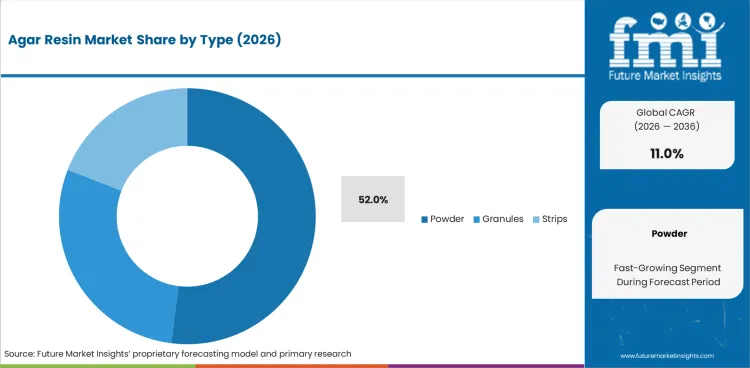
Powder is the most popular choice, with a 52.0% market share. It is best for pharmaceutical excipient applications where precise weight measurement and consistent quality from batch to batch are important.
Film and solution forms are used for packaging and coating, and agar's ability to make biodegradable films makes it a good substitute for synthetic polymers.
Insights into the Pharmaceutical Application Segment
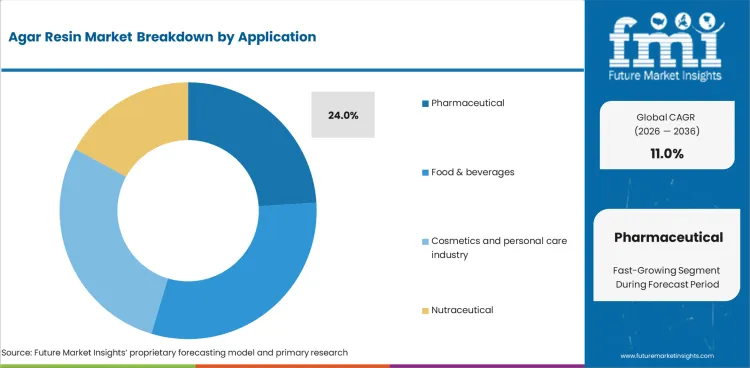
Pharmaceuticals account for 24.0% of applications. The main sub-applications are making vegetarian capsules, binding tablets, and delivering drugs in a controlled way.
The switch from animal-based gelatin to plant-based capsule materials around the world is a structural growth driver for pharmaceutical-grade agar resins.
What are the Drivers, Restraints, and Key Trends of the Agar Resin Market?
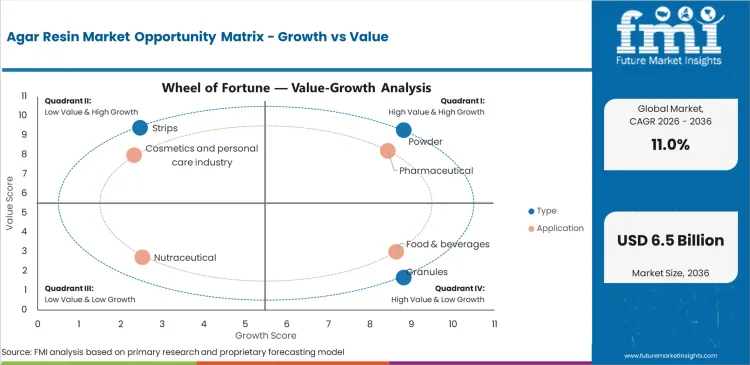
- The main drivers are the rise in demand for bio-based materials and the rise in pharmaceutical excipients.
- The variability in seaweed cultivation and the high costs of processing make it hard to scale up the supply.
- New laws about sustainable packaging are making biodegradable agar-based films and coatings more popular.
The market expands strongly, shaped by bio-based substitution, pharma excipient demand, and packaging innovation. Despite supply constraints, growth opportunities are substantial across pharmaceutical, packaging, and biotechnology verticals.
Bio-Based Material Substitution
The market is growing quickly because of bio-based substitutes, demand for pharmaceutical excipients, and new packaging ideas. Even though there are problems with supply, there are a lot of chances for growth in the pharmaceutical, packaging, and biotechnology sectors.
Seaweed Supply Constraints
Growing red algae and harvesting it from the wild are both necessary for agar extraction. This means that the supply can change depending on the time of year, the weather, and the fact that most of it comes from Asian and South American coastal areas.
Pharmaceutical Gelatin Replacement
Agar resins are the best vegetarian alternative for making pharmaceutical capsules, and the switch from animal-derived gelatin to plant-based capsule materials is a structural growth drive.
Sustainable Packaging Innovation
The EU, US, and Asia all have rules that require less single-use plastic. This has led to a need for biodegradable packaging materials. Agar-based films are a food-safe, compostable option..
Analysis of Agar Resin Market By Key Countries
.webp "Top Country Growth Comparison Agar Resin Market Cagr (2026 2036)")
| Country | CAGR |
|---|---|
| China | 14.8% |
| India | 13.8% |
| Germany | 12.7% |
| Brazil | 11.6% |
| USA | 10.4% |
| UK | 9.3% |
| Japan | 8.3% |
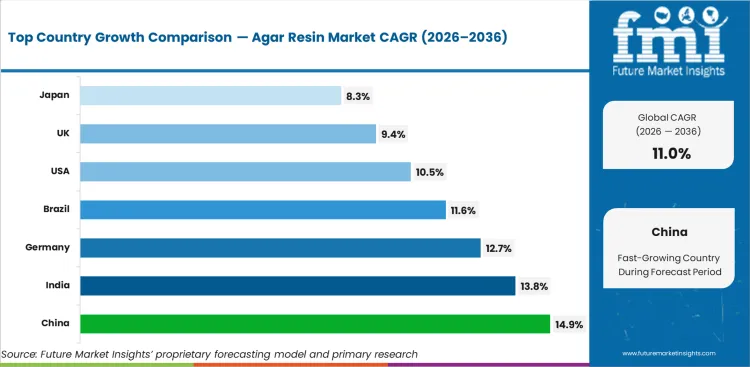
- China is in the lead with a 14.8% CAGR. This is because it has the largest seaweed farming base in the world, more pharmaceutical manufacturing, and more demand for bio-based materials.
- India's 13.8% growth rate shows that demand for pharmaceutical excipients is growing quickly and that the country is developing its own seaweed farms.
- Germany's growth rate of 12.7% is due to the size of its pharmaceutical industry, EU sustainability rules, and new ideas for bio-based packaging.
- The US (10.4%) and the UK (9.3%) both show steady growth in the pharmaceutical and packaging industries.
The agar resin market is projected to grow globally at a CAGR of 11.0% from 2026 to 2036. The analysis spans over 30 countries, with the leading markets detailed below.
Demand Outlook for Agar Resin Market in the United States
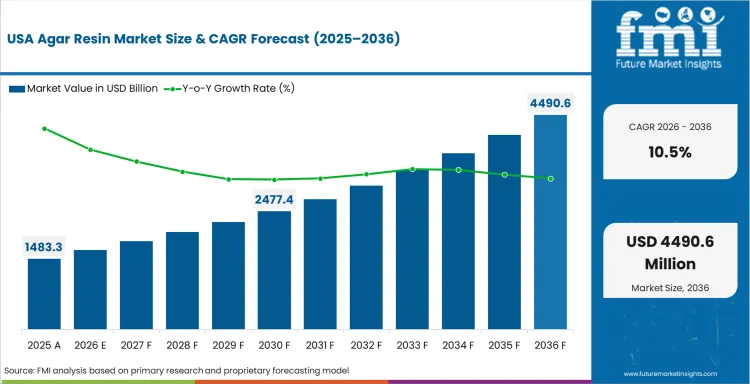
The U.S. is expected to grow at a CAGR of 10.4% through 2036, thanks to demand for pharmaceutical excipients, new bio-based packaging ideas, and more people wanting plant-based capsule products.
- The need for pharmaceutical excipients drives procurement.
- Innovation in bio-based packaging creates demand.
- More and more people want plant-based capsules.
Future Outlook for Agar Resin Market in the United Kingdom
The UK's economy is expected to grow at a rate of 9.3% per year until 2036, thanks to demand from the pharmaceutical industry, requirements for eco-friendly packaging, and research in biotechnology.
- The pharmaceutical industry keeps demand strong.
- Sustainable packaging laws push people to use it.
- Biotechnology research makes new uses for things..
Opportunity Analysis of Agar Resin Market in Germany
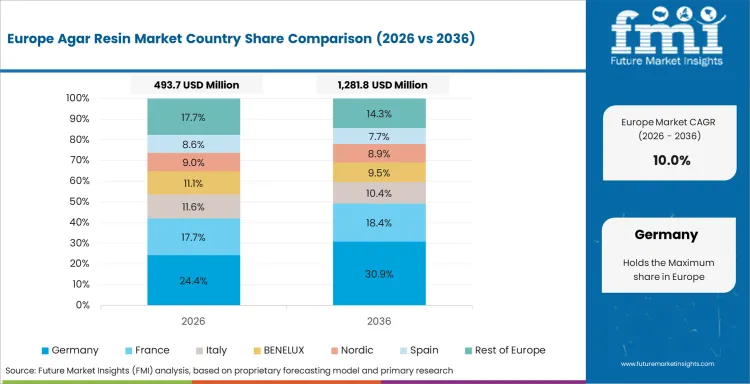
Germany is growing quickly, at 12.7% per year, until 2036. This is due to the size of its pharmaceutical industry, EU bio-based material rules, and being a leader in sustainable packaging innovation.
- Demand is driven by the scale of pharmaceutical manufacturing.
- EU rules help bio-based adoption.
- New ways of packaging lead to new uses..
In-depth Analysis of Agar Resin Market in Japan
Japan will continue to grow until 2036 because of its established seaweed industry, the need for pharmaceutical excipients, and cutting-edge biopolymer research that is making new uses for agar resin.
- The seaweed industry gives us raw materials.
- The need for drugs keeps procurement going.
- Research on biopolymers leads to new ideas..
Sales Analysis of Agar Resin Market in China
China is in the lead with 14.8% through 2036, thanks to its huge seaweed farming capacity, quickly growing pharmaceutical manufacturing, and government support for industries that use bio-based materials.
- The biggest seaweed farms provide the supply.
- The production of drugs is growing quickly.
- The government backs industries that use bio-based materials..
In-depth Analysis of Agar Resin Market in India
India is growing quickly, at a rate of 13.8% per year until 2036. This is due to an increase in demand for pharmaceutical excipients, the development of coastal seaweed farming, and the growing use of bio-based materials.
- The need for pharmaceutical excipients is growing.
- Coastal farming increases supply.
- The use of bio-based materials is growing.
Competitive Landscape of Agar Resin Market
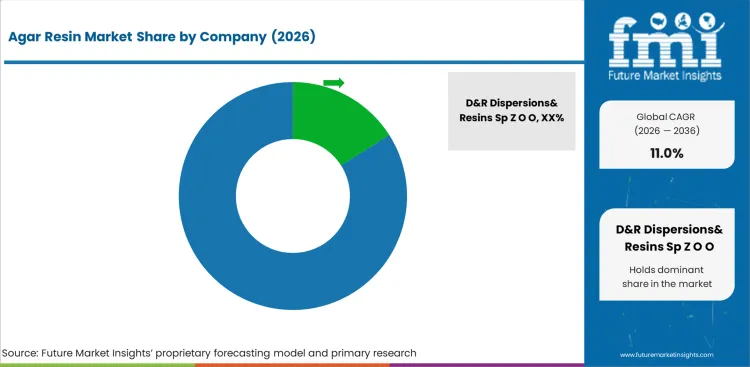
- D&R Dispersions & Resins and Nippon Epoxy Resin Manufacturing are the best at making special resins.
- Reichhold Holdings and MSR Holding both offer a wide range of resin products, including those made from agar.
- New biopolymer makers are focusing on the pharmaceutical and packaging markets.
D&R Dispersions & Resins Sp Z O O is the leader in making biopolymer resins. Nippon Epoxy Resin Manufacturing Company Ltd. makes resin compounds from agar for use in the pharmaceutical and industrial fields.
Reichhold Holdings International B.V. and MSR Holding B.V. offer a wide range of resin portfolios. PolyLabs Ltd. and Plasma Ruggedized Solutions Inc. both work on special projects.
Barriers include finding raw materials for seaweed, processing technology for resin, getting pharmaceutical-grade certification, and having established supply relationships with manufacturers.
Major Industry Players
Key global companies leading the agar resin market include:
- D&R Dispersions & Resins Sp Z O O (Poland) and Nippon Epoxy Resin Manufacturing Co. Reichhold Holdings International B.V. and Ltd. (Japan) (MSR Holding B.V. in the Netherlands) Some of the star players were (Netherlands) because they have a strong resin production infrastructure and established relationships with pharmaceutical and industrial suppliers.
- PolyLabs Ltd. and Plasma Ruggedized Solutions Inc. have made a name for themselves in the field of specialty resin applications.
- New biopolymer companies that make biodegradable packaging and pharmaceutical capsule materials have set themselves apart in high-end niche markets..
Competitive Benchmarking: Agar Resin Market
| Company | Resin Portfolio | Pharma Grade | Production Scale | Geographic Footprint |
|---|---|---|---|---|
| D&R Dispersions | High | Medium | High | Europe |
| Nippon Epoxy Resin | High | High | High | Asia, Global |
| Reichhold Holdings | High | Medium | High | Global |
| MSR Holding | Medium | Medium | Medium | Europe |
| PolyLabs Ltd. | Medium | Medium | Medium | Europe |
| Plasma Ruggedized | Medium | Low | Medium | N. America |
Source: Future Market Insights competitive analysis, 2026.
Key Developments in Agar Resin Market
- In 2025, Nippon Epoxy Resin Manufacturing increased its production of pharmaceutical-grade agar resin to meet the growing demand for vegetarian capsules.
- Reichhold Holdings released a biodegradable agar-based packaging resin in 2025 that can be used instead of single-use plastic in the food industry.
Key Players in the Agar Resin Market
Major Global Players:
- D&R Dispersions & Resins Sp Z O O
- Nippon Epoxy Resin Manufacturing Co. Ltd.
- Reichhold Holdings International B.V.
- MSR Holding B.V.
- PolyLabs Ltd.
- Plasma Ruggedized Solutions Inc.
Emerging Players/Startups
- Emerging biopolymer and biodegradable packaging companies
Scope of the report
| Parameter | Details |
|---|---|
| Quantitative Units | USD 2.05 billion to USD 5.82 billion, at a CAGR of 11.0% |
| Market Definition | The agar resin market encompasses biopolymer resins derived from red algae for pharmaceutical, food, biotechnology, cosmetic, and packaging applications. |
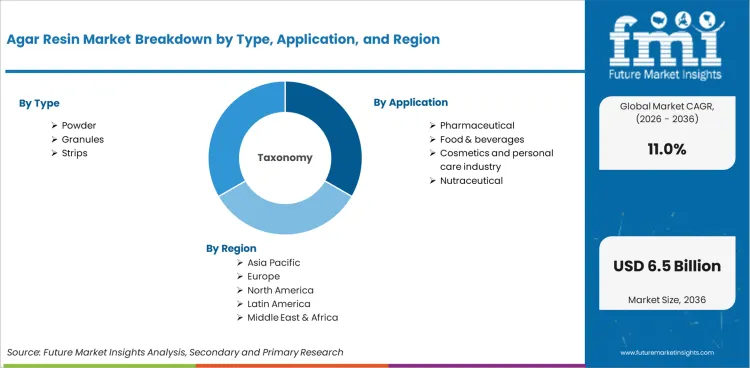
| Regions Covered | North America, Latin America, Europe, East Asia, South Asia and Pacific, Middle East and Africa |
| Countries Covered | China, India, Germany, Brazil, USA, UK, Japan, 30 plus countries |
| Key Companies Profiled | D&R Dispersions& Resins Sp Z O O, Nippon Epoxy Resin Manufacturing Co. Ltd., Reichhold Holdings International B.V., MSR Holding B.V., PolyLabs Ltd., Plasma Ruggedized Solutions Inc., Agar Scientific Ltd. , Grasim Industries Limited., Spolek pro chemickou a hutní výrobu, alcove spolecnost., KI Chemistry S. à r. L and others. |
| Forecast Period | 2026 to 2036 |
| Approach | Hybrid bottom-up and top-down methodology starting with verified transaction data, projecting adoption velocity across segments and regions. |
Agar Resin Market by Segments
Agar Resin Market Market Segmented by Type:
- Powder
- Granules
- Strips
Agar Resin Market Market Segmented by Application:
- Pharmaceutical
- Food & beverages
- Cosmetics and personal care industry
- Nutraceutical
Agar Resin Market Market by Region:
- North America
- USA
- Canada
- Mexico
- Latin America
- Brazil
- Chile
- Rest of Latin America
- Western Europe
- Germany
- UK
- Italy
- Spain
- France
- Nordic
- BENELUX
- Rest of Western Europe
- Eastern Europe
- Russia
- Poland
- Hungary
- Balkan & Baltic
- Rest of Eastern Europe
- East Asia
- China
- Japan
- South Korea
- South Asia and Pacific
- India
- ASEAN
- Australia & New Zealand
- Rest of South Asia and Pacific
- Middle East & Africa
- Kingdom of Saudi Arabia
- Other GCC Countries
- Turkiye
- South Africa
- Other African Union
- Rest of Middle East & Africa
Bibliography
- 1. The Bioplastics Association of Europe. (2025). Report on the Bioplastics Market. Bioplastics from Europe.
- 2. USA Pharmacopeia. (2024). USP Monograph: Agar as a Drug Additive. USP.
- 3. The Food and Agriculture Organization. (2025). FAO Report on the Seaweed Industry and Agar Production. FAO.
- 4. European Commission. (2024). Standards for biodegradable materials in the EU Single-Use Plastics Directive. EC.
- 5. Council of International Pharmaceutical Excipients. (2025). IPEC Report on the Market for Excipients. IPEC.
This bibliography is here for you to look at. The complete FMI report has the full reference list and all the main research documents.
Frequently Asked Questions
In 2026, how big will the global market for Agar Resin be?
In 2026, the global market for agar resin is expected to be worth $2.05 billion.
What will the Agar Resin market be like in 2036?
By 2036, the market for agar resin is expected to be worth USD 5.82 billion.
What will the demand for Agar Resin be like from 2026 to 2036?
Between 2026 and 2036, demand for agar resin is expected to grow at a rate of 11.0% per year.
Which type of resin is likely to be the best seller worldwide by 2026?
In 2026, powder will make up 52.0% of the total. This shows that people want precise formulation in food and pharmaceutical processing.
How is the use of Agar Resin in pharmaceuticals driving its use?
Pharmaceuticals make up 24.0% of the application segment because making vegetarian capsules and binding tablets create a high demand for excipients.
What is making people want things in China?
China's economy will grow at a rate of 14.8% per year until 2036, thanks to the world's largest seaweed farm and a rapidly growing pharmaceutical manufacturing capacity.
What does the definition of the Agar Resin Market in this report mean?
The agar resin market includes biopolymer resins made from red algae agar that are used in pharmaceuticals, food, biotechnology, cosmetics, and packaging that breaks down naturally.
How does FMI make the Agar Resin forecast and check it?
Forecasting models use a mix of bottom-up and top-down methods. They start with verified transaction data and then check it against biopolymer market statistics and pharmaceutical excipient consumption data..
Preview the report firsthand - request a free sample
Get SampleGet the brochure for pricing and purchase details.
Get PDFTable of Content
- Executive Summary
- Global Market Outlook
- Demand-side Trends
- Supply-side Trends
- Technology Roadmap Analysis
- Analysis and Recommendations
- Market Overview
- Market Coverage / Taxonomy
- Market Definition / Scope / Limitations
- Research Methodology
- Chapter Orientation
- Analytical Lens and Working Hypotheses
- Market Structure, Signals, and Trend Drivers
- Benchmarking and Cross-market Comparability
- Market Sizing, Forecasting, and Opportunity Mapping
- Research Design and Evidence Framework
- Desk Research Programme (Secondary Evidence)
- Company Annual and Sustainability Reports
- Peer-reviewed Journals and Academic Literature
- Corporate Websites, Product Literature, and Technical Notes
- Earnings Decks and Investor Briefings
- Statutory Filings and Regulatory Disclosures
- Technical White Papers and Standards Notes
- Sector Databases and Reference Repositories
- FMI Internal Proprietary Databases and Historical Market Datasets
- Subscription Datasets and Paid Sources
- Social Channels, Communities, and Digital Listening Inputs
- Additional Desk Sources
- Expert Input and Fieldwork (Primary Evidence)
- Primary Modes
- Qualitative Interviews and Expert Elicitation
- Quantitative Surveys and Structured Data Capture
- Blended Approach
- Why Primary Evidence is Used
- Field Techniques
- Interviews
- Surveys
- Focus Groups
- Observational and In-context Research
- Social and Community Interactions
- Stakeholder Universe Engaged
- C-suite Leaders
- Board Members
- Presidents and Vice Presidents
- R&D and Innovation Heads
- Technical Specialists
- Domain Subject-matter Experts
- Scientists
- Physicians and Other Healthcare Professionals
- Governance, Ethics, and Data Stewardship
- Research Ethics
- Data Integrity and Handling
- Primary Modes
- Tooling, Models, and Reference Databases
- Desk Research Programme (Secondary Evidence)
- Data Engineering and Model Build
- Data Acquisition and Ingestion
- Cleaning, Normalisation, and Verification
- Synthesis, Triangulation, and Analysis
- Quality Assurance and Audit Trail
- Market Background
- Market Dynamics
- Drivers
- Restraints
- Opportunity
- Trends
- Scenario Forecast
- Demand in Optimistic Scenario
- Demand in Likely Scenario
- Demand in Conservative Scenario
- Opportunity Map Analysis
- Product Life Cycle Analysis
- Supply Chain Analysis
- Investment Feasibility Matrix
- Value Chain Analysis
- PESTLE and Porter’s Analysis
- Regulatory Landscape
- Regional Parent Market Outlook
- Production and Consumption Statistics
- Import and Export Statistics
- Market Dynamics
- Global Market Analysis 2021 to 2025 and Forecast, 2026 to 2036
- Historical Market Size Value (USD Million) Analysis, 2021 to 2025
- Current and Future Market Size Value (USD Million) Projections, 2026 to 2036
- Y-o-Y Growth Trend Analysis
- Absolute $ Opportunity Analysis
- Global Market Pricing Analysis 2021 to 2025 and Forecast 2026 to 2036
- Global Market Analysis 2021 to 2025 and Forecast 2026 to 2036, By Type
- Introduction / Key Findings
- Historical Market Size Value (USD Million) Analysis By Type , 2021 to 2025
- Current and Future Market Size Value (USD Million) Analysis and Forecast By Type , 2026 to 2036
- Powder
- Granules
- Strips
- Powder
- Y-o-Y Growth Trend Analysis By Type , 2021 to 2025
- Absolute $ Opportunity Analysis By Type , 2026 to 2036
- Global Market Analysis 2021 to 2025 and Forecast 2026 to 2036, By Application
- Introduction / Key Findings
- Historical Market Size Value (USD Million) Analysis By Application, 2021 to 2025
- Current and Future Market Size Value (USD Million) Analysis and Forecast By Application, 2026 to 2036
- Pharmaceutical
- Food & beverages
- Cosmetics and personal care industry
- Nutraceutical
- Pharmaceutical
- Y-o-Y Growth Trend Analysis By Application, 2021 to 2025
- Absolute $ Opportunity Analysis By Application, 2026 to 2036
- Global Market Analysis 2021 to 2025 and Forecast 2026 to 2036, By Region
- Introduction
- Historical Market Size Value (USD Million) Analysis By Region, 2021 to 2025
- Current Market Size Value (USD Million) Analysis and Forecast By Region, 2026 to 2036
- North America
- Latin America
- Western Europe
- Eastern Europe
- East Asia
- South Asia and Pacific
- Middle East & Africa
- Market Attractiveness Analysis By Region
- North America Market Analysis 2021 to 2025 and Forecast 2026 to 2036, By Country
- Historical Market Size Value (USD Million) Trend Analysis By Market Taxonomy, 2021 to 2025
- Market Size Value (USD Million) Forecast By Market Taxonomy, 2026 to 2036
- By Country
- USA
- Canada
- Mexico
- By Type
- By Application
- By Country
- Market Attractiveness Analysis
- By Country
- By Type
- By Application
- Key Takeaways
- Latin America Market Analysis 2021 to 2025 and Forecast 2026 to 2036, By Country
- Historical Market Size Value (USD Million) Trend Analysis By Market Taxonomy, 2021 to 2025
- Market Size Value (USD Million) Forecast By Market Taxonomy, 2026 to 2036
- By Country
- Brazil
- Chile
- Rest of Latin America
- By Type
- By Application
- By Country
- Market Attractiveness Analysis
- By Country
- By Type
- By Application
- Key Takeaways
- Western Europe Market Analysis 2021 to 2025 and Forecast 2026 to 2036, By Country
- Historical Market Size Value (USD Million) Trend Analysis By Market Taxonomy, 2021 to 2025
- Market Size Value (USD Million) Forecast By Market Taxonomy, 2026 to 2036
- By Country
- Germany
- UK
- Italy
- Spain
- France
- Nordic
- BENELUX
- Rest of Western Europe
- By Type
- By Application
- By Country
- Market Attractiveness Analysis
- By Country
- By Type
- By Application
- Key Takeaways
- Eastern Europe Market Analysis 2021 to 2025 and Forecast 2026 to 2036, By Country
- Historical Market Size Value (USD Million) Trend Analysis By Market Taxonomy, 2021 to 2025
- Market Size Value (USD Million) Forecast By Market Taxonomy, 2026 to 2036
- By Country
- Russia
- Poland
- Hungary
- Balkan & Baltic
- Rest of Eastern Europe
- By Type
- By Application
- By Country
- Market Attractiveness Analysis
- By Country
- By Type
- By Application
- Key Takeaways
- East Asia Market Analysis 2021 to 2025 and Forecast 2026 to 2036, By Country
- Historical Market Size Value (USD Million) Trend Analysis By Market Taxonomy, 2021 to 2025
- Market Size Value (USD Million) Forecast By Market Taxonomy, 2026 to 2036
- By Country
- China
- Japan
- South Korea
- By Type
- By Application
- By Country
- Market Attractiveness Analysis
- By Country
- By Type
- By Application
- Key Takeaways
- South Asia and Pacific Market Analysis 2021 to 2025 and Forecast 2026 to 2036, By Country
- Historical Market Size Value (USD Million) Trend Analysis By Market Taxonomy, 2021 to 2025
- Market Size Value (USD Million) Forecast By Market Taxonomy, 2026 to 2036
- By Country
- India
- ASEAN
- Australia & New Zealand
- Rest of South Asia and Pacific
- By Type
- By Application
- By Country
- Market Attractiveness Analysis
- By Country
- By Type
- By Application
- Key Takeaways
- Middle East & Africa Market Analysis 2021 to 2025 and Forecast 2026 to 2036, By Country
- Historical Market Size Value (USD Million) Trend Analysis By Market Taxonomy, 2021 to 2025
- Market Size Value (USD Million) Forecast By Market Taxonomy, 2026 to 2036
- By Country
- Kingdom of Saudi Arabia
- Other GCC Countries
- Turkiye
- South Africa
- Other African Union
- Rest of Middle East & Africa
- By Type
- By Application
- By Country
- Market Attractiveness Analysis
- By Country
- By Type
- By Application
- Key Takeaways
- Key Countries Market Analysis
- USA
- Pricing Analysis
- Market Share Analysis, 2025
- By Type
- By Application
- Canada
- Pricing Analysis
- Market Share Analysis, 2025
- By Type
- By Application
- Mexico
- Pricing Analysis
- Market Share Analysis, 2025
- By Type
- By Application
- Brazil
- Pricing Analysis
- Market Share Analysis, 2025
- By Type
- By Application
- Chile
- Pricing Analysis
- Market Share Analysis, 2025
- By Type
- By Application
- Germany
- Pricing Analysis
- Market Share Analysis, 2025
- By Type
- By Application
- UK
- Pricing Analysis
- Market Share Analysis, 2025
- By Type
- By Application
- Italy
- Pricing Analysis
- Market Share Analysis, 2025
- By Type
- By Application
- Spain
- Pricing Analysis
- Market Share Analysis, 2025
- By Type
- By Application
- France
- Pricing Analysis
- Market Share Analysis, 2025
- By Type
- By Application
- India
- Pricing Analysis
- Market Share Analysis, 2025
- By Type
- By Application
- ASEAN
- Pricing Analysis
- Market Share Analysis, 2025
- By Type
- By Application
- Australia & New Zealand
- Pricing Analysis
- Market Share Analysis, 2025
- By Type
- By Application
- China
- Pricing Analysis
- Market Share Analysis, 2025
- By Type
- By Application
- Japan
- Pricing Analysis
- Market Share Analysis, 2025
- By Type
- By Application
- South Korea
- Pricing Analysis
- Market Share Analysis, 2025
- By Type
- By Application
- Russia
- Pricing Analysis
- Market Share Analysis, 2025
- By Type
- By Application
- Poland
- Pricing Analysis
- Market Share Analysis, 2025
- By Type
- By Application
- Hungary
- Pricing Analysis
- Market Share Analysis, 2025
- By Type
- By Application
- Kingdom of Saudi Arabia
- Pricing Analysis
- Market Share Analysis, 2025
- By Type
- By Application
- Turkiye
- Pricing Analysis
- Market Share Analysis, 2025
- By Type
- By Application
- South Africa
- Pricing Analysis
- Market Share Analysis, 2025
- By Type
- By Application
- USA
- Market Structure Analysis
- Competition Dashboard
- Competition Benchmarking
- Market Share Analysis of Top Players
- By Regional
- By Type
- By Application
- Competition Analysis
- Competition Deep Dive
- Competition Deep Dive
- Assumptions & Acronyms Used


