

- Industry Size (2026)
- USD 214.0 Mn
- Forecast (2036)
- USD 376.1 Mn
- CAGR (2026 to 2036)
- 5.8%
Composite Wing-to-Body Fairing Structures for Wide-Body Aircraft Market Size, Market Forecast, and Outlook By FMI
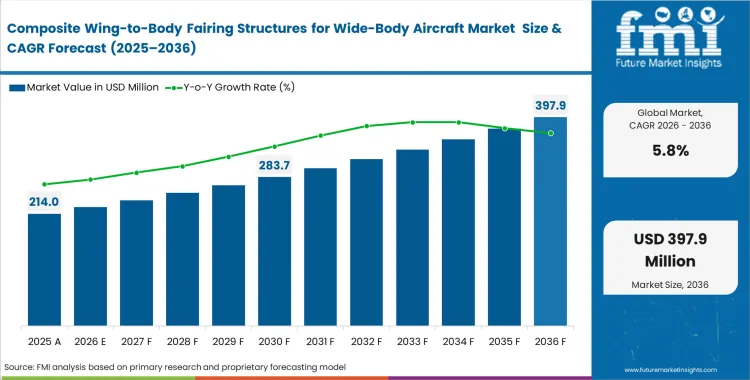
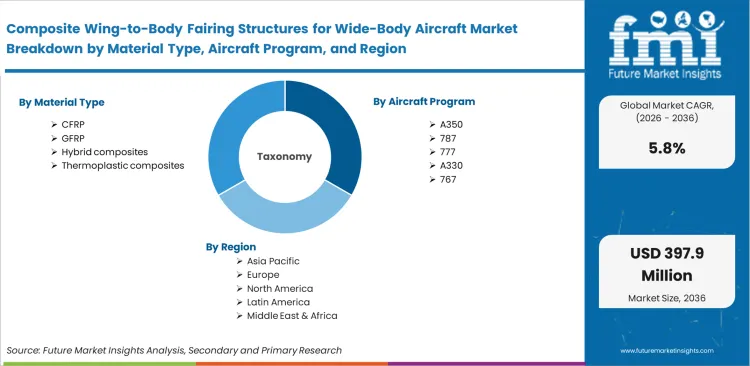
The composite wing-to-body fairing structures for the wide-body aircraft market crossed a valuation of USD 202.3 million in 2025. Sales are estimated to surpass USD 214.0 million in 2026 at a CAGR of 5.8% during this forecast period. Revenue is expected to total USD 376.1 million through 2036 as early-generation 787 and A350 airframes enter heavy maintenance checks requiring component-level replacement rather than patch repairs.
Summary of Composite Wing-to-Body Fairing Structures for Wide-Body Aircraft Market
- The market is forecast to reach USD 376.1 million by 2036.
- The market is expected to grow at a CAGR of 5.8% from 2026 to 2036.
- The market was estimated at USD 202.3 million in 2025.
- The forecast period represents an incremental opportunity of USD 162.1 million.
- This market represents a specification-driven aerostructures niche focused on composite fairings that improve aerodynamics, protect systems, and reduce drag in wide-body aircraft.
- Demand is supported by expanding wide-body fleets and increasing use of composite-intensive platforms in long-haul passenger and cargo aviation.
- Aftermarket demand remains significant due to inspection, repair, and replacement needs as composite structures age through maintenance cycles.
- CFRP dominates the material segment with a 61.0% share, driven by lightweight performance, durability, and widespread qualification across aircraft programs.
- The A350 leads the aircraft program segment with a 34.0% share, supported by higher composite content and strong delivery volumes.
- OEM line-fit accounts for 68.0% of the fitment segment, reflecting the importance of factory-installed components in overall demand.
- Side fairings hold a 31.0% share in the structure type segment due to broader coverage and installation complexity.
- Passenger jets dominate end use with a 59.0% share, supported by the larger global fleet compared to freighters and tankers.
- India, Singapore, and the UAE are the fastest-growing markets, with India leading at a 7.0% CAGR.
- FACC AG, Spirit AeroSystems, GKN Aerospace, NORDAM, and Avior Integrated Products are key players shaping the competitive landscape.
Airlines operating wide-body fleets face a practical cost decision when lower and side fairing panels are damaged. Operators must either accept temporary metallic doublers that raise fuel burn or wait weeks for replacement wing-to-body fairing structures for wide-body aircraft. Longer replacement cycles are likely to reduce route profitability on long-haul services as added drag builds across flight hours. Mixed-fleet operators are also estimated to keep buffer stock for fairing sections exposed to higher wear. That inventory pattern is likely to support replacement demand beyond visible removal activity and keep aftermarket demand structurally firm.
Regional repair capability is expected to gain importance as composite maintenance qualifications widen beyond major OEM-linked centers. Faster access to approved repair work is likely to improve the position of regional repair bases in fairing support activity. Repair-versus-replacement economics are also projected to carry more weight in fleet planning decisions. Dense long-haul operators tend to place greater value on turnaround time because extended aircraft downtime is estimated to weaken utilization and revenue efficiency. Demand in this market is therefore shaped by both part consumption and the speed at which operators can restore aircraft to service.
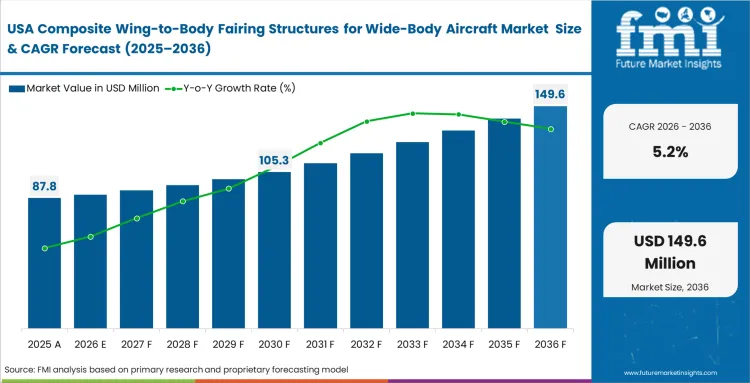
India is projected to expand at a CAGR of 7.0% during 2026 to 2036 as twin-aisle fleet additions strengthen the base for heavy maintenance and composite repair. Singapore is estimated to grow at a CAGR of 6.8% over the same period, supported by its established overhaul ecosystem for complex fairing and aerostructure work. Demand in the United Arab Emirates is likely to rise at a 6.5% CAGR through 2036 as long-haul carriers deepen internal repair capability for composite wing fairings and adjacent exterior structures. China is expected to register a CAGR of 6.2% during 2026 to 2036, reflecting fleet scale, traffic growth, and broader domestic aerospace support capacity. France is projected to record a 5.6% CAGR, while demand in the United States and Germany is estimated to grow at CAGRs of 5.2% and 5.1%, respectively, across the forecast period. Country-level differences are largely shaped by how quickly maintenance hubs are adding composite service depth and how steadily mature aerospace bases continue to generate replacement demand.
Segmental Analysis
Composite Wing-to-Body Fairing Structures for Wide-Body Aircraft Market Analysis by Material Type
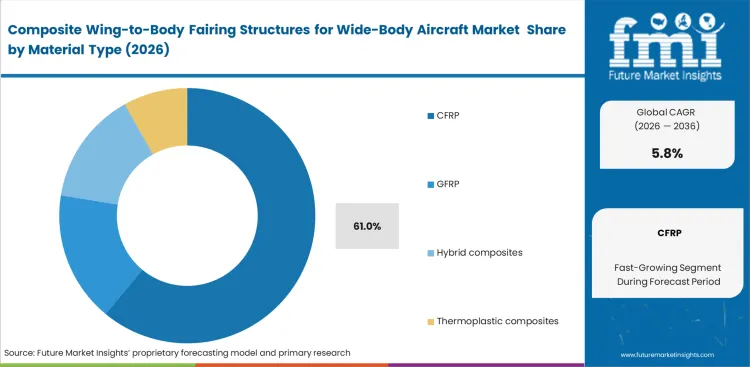
Low weight, corrosion resistance, and compatibility with approved aircraft specifications are expected to keep carbon fiber composites central to material selection for wing-to-body fairings on wide-body aircraft. Performance demands at the wing-fuselage junction also support CFRP use because the material is able to handle high structural loads without adding unnecessary mass to exterior assemblies. Material continuity across certified aircraft programs is likely to further limit substitution. Similar logic appears when aircraft belly fairing modification kits cost is weighed against long-term operating efficiency and qualification burden. Comparisons between composite wing-to-body fairing and metallic fairing options also continue to favor carbon fiber where weight control, compliance, and platform fit carry greater value than lower upfront material cost. CFRP is estimated to account for 61.0% share of the material type segment in 2026. Impact sensitivity and added inspection effort may raise maintenance cost, yet those constraints have not been enough to displace carbon fiber from leading purchase decisions.
- Structural qualification: Prepreg carbon panels are expected to require tightly controlled curing and repeatable production conditions, which keep supply concentrated within certified aerospace manufacturing lines. Spare availability is likely to tighten when line-fit aircraft fairing demand absorbs a larger share of qualified production capacity.
- Impact sensitivity: Ground handling contact can leave subsurface delamination that may not remain visible during routine checks. Inspection cost is therefore expected to rise because confirmation often depends on non-destructive testing.
- Disposal economics: Recovery economics for aviation-grade carbon composites are estimated to remain weaker than metallic alternatives. Lifecycle cost is likely to extend beyond purchase value, even as in-service performance keeps CFRP in the lead.
Composite Wing-to-Body Fairing Structures for Wide-Body Aircraft Market Analysis by Aircraft Program
Airbus wide-body programs are expected to remain a major demand center for composite fairing assemblies because current platform architecture already supports high composite content across exterior and adjoining airframe sections. A350 variants are estimated to account for 34.0% share of the aircraft program segment in 2026. Demand for A350 wing-to-body fairing composites is likely to remain firm, as material integration, aerodynamic contour requirements, and compatibility with adjacent aircraft over wing exit aerodynamic enhancement kits keep both replacement and line-fit demand closely linked to this program. Part continuity carries greater importance here than in simpler exterior components because even minor configuration differences can restrict interchangeability across aircraft produced in different batches. Limited supplier breadth and serial-specific replacement needs are also expected to support this position, since operators often require exact panel matches to avoid maintenance-related delays during heavy service intervals. Program strength in this segment is therefore tied to configuration discipline as much as to material performance.
- Configuration management: Fleet operators are expected to track part numbers by production block and modification history. Matching replacement panels to older airframes can become more difficult when field changes or early-build differences reduce direct interchangeability.
- Performance margins: Advanced composite integration is likely to support tighter aerodynamic control across complex transition zones. Fuel-efficiency performance can weaken when temporary metallic repairs interrupt the intended airflow profile.
- Vendor consolidation: Only a limited number of qualified facilities are estimated to have the tooling and process control required for complex belly and transition panel geometries. Lead times are therefore likely to remain part of normal support conditions for this aircraft program.
Composite Wing-to-Body Fairing Structures for Wide-Body Aircraft Market Analysis by Fitment
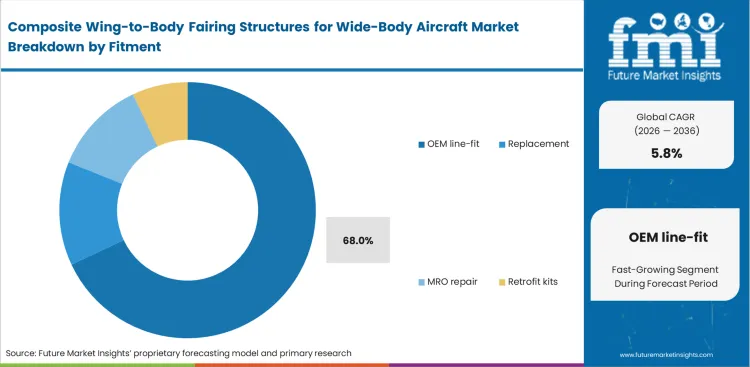
Production continuity is expected to keep OEM line-fit at the center of demand because fairing assemblies move first through new-aircraft build schedules before entering the slower replacement cycle. Recovery in twin-aisle output is also likely to keep factory-installed volumes ahead of aftermarket demand, especially on programs still working through sizable delivery backlogs. OEM line-fit is estimated to account for 68.0% share of the fitment segment in 2026. Dimensional accuracy and surface consistency remain critical at this stage because poor fit can slow installation flow and create rework at final assembly. Similar qualification discipline applies across adjacent exterior components, including low noise landing gear fairing composite designs, where installation precision and repeatable curing behavior remain necessary to support program execution. Supplier position is also likely to remain stronger once a part qualifies for line-fit, since the same approval base often supports later spare demand across the installed fleet. Demand leadership in this segment is therefore shaped by production flow, qualification depth, and installed-base continuity.
- Initial assembly logic: Precision-molded panels are expected to support joining speed during final aircraft build. Pre-drilled composite sections can also reduce alignment effort and help adjoining workstations stay on schedule.
- Aftermarket captive pricing: Replacement demand is likely to remain tied to design ownership and approved supply pathways established during the original program phase. Pricing strength can remain higher where independent manufacturing access stays limited.
- Repair versus replacement tension: Larger damage zones can push operators toward full panel replacement instead of localized repair. Availability of certified OEM spares is therefore expected to influence how quickly that decision is made.Top of Form
Composite Wing-to-Body Fairing Structures for Wide-Body Aircraft Market Analysis by Structure Type
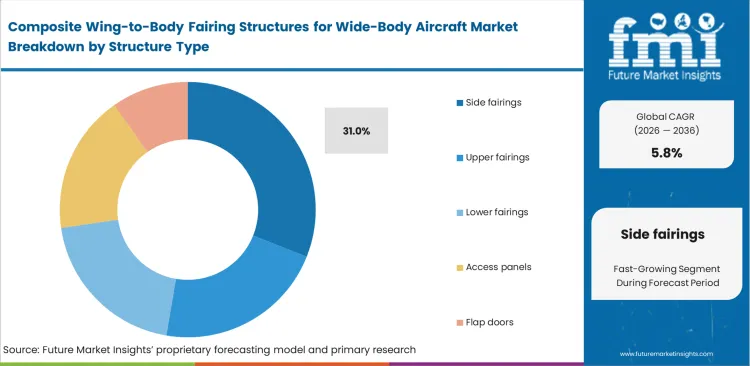
Side fairings remain commercially important because they cover one of the largest continuous transition zones between the fuselage and wing root on wide-body aircraft. Complex curvature, broad panel span, and tight fit requirements at this junction keep value concentration elevated compared with more localized fairing structures. Adjacent aircraft nose and belly fairing systems for advanced avionics serve important functions, yet side fairings carry greater structural and aerodynamic sensitivity at the wing-body interface. Airflow stability across long-haul operations depends on correct panel alignment in this area, where even small deviations can affect aerodynamic performance. Exposure to ramp contact, handling pressure, and localized impact is also likely to keep replacement demand higher than in less exposed exterior sections. Load transfer around the attachment zone adds further design and maintenance complexity across active fleets. Side fairings are estimated to account for 31.0% of the structure type segment in 2026, supported by broad coverage, fit sensitivity, and higher wear exposure.
- Flexural tolerance: Repeated bending during turbulence places strain around mounting points and curved attachment areas. Inspection remains important because fatigue or cracking is likely to develop gradually over long operating cycles.
- Ground equipment risk: Ramp activity leaves side fairings exposed to lateral contact from service vehicles and handling equipment. Replacement demand is expected to remain elevated because even minor impact damage can affect fit, surface condition, or core integrity.
- Aerodynamic consequence: Panel seating and alignment directly influence airflow across the wing-body transition. Fuel efficiency can weaken when misalignment disrupts the intended contour during long-haul operations.
Composite Wing-to-Body Fairing Structures for Wide-Body Aircraft Market Analysis by End Use
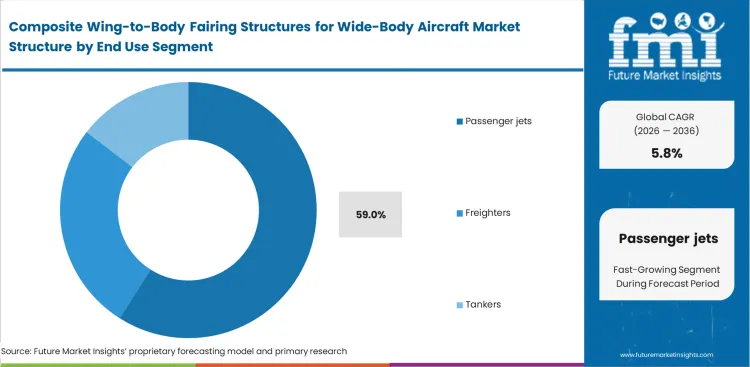
Passenger jets remain the largest end-use base because global twin-aisle passenger fleets operate at much greater scale than dedicated cargo aircraft and face more frequent service exposure across active route networks. Composite fairings used on passenger wide-body jets generate steadier replacement demand because appearance standards carry greater weight and aerodynamic efficiency matters more in scheduled passenger service. Passenger jets are estimated to account for 59.0% of the end use segment in 2026. Replacement demand is likely to stay elevated as operators position composite spares at major network hubs to reduce disruption from unscheduled damage and limit aircraft downtime. Schedule recovery pressure also supports faster turnover in this segment, where full assembly replacement is often more practical than extended on-wing repair. This pattern keeps passenger aircraft at the center of recurring fairing demand across the installed base.
- Utilization frequency: Higher daily flight activity exposes passenger airframes to repeated thermal cycling, ground handling contact, and more frequent maintenance events. Attrition risk is therefore expected to build faster across active passenger fleets.
- Cosmetic mandates: Exterior condition carries greater commercial importance in passenger service, where visible damage on composite fairings and adjacent aircraft antenna fairing systems can affect presentation as well as aerodynamic performance. Replacement decisions are likely to move faster even when damage does not create an immediate airworthiness concern.
- Turnaround pressure: Tight network scheduling leaves limited time for complex gate-side composite work. Full fairing swaps are often expected to remain the preferred option when operators need to return aircraft to service without disrupting onward rotations.
Composite Wing-to-Body Fairing Structures for Wide-Body Aircraft Market Drivers, Restraints, and Opportunities
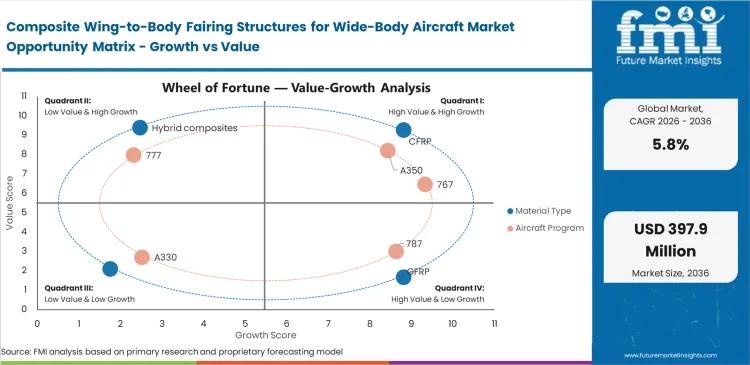
Fuel price volatility keeps attention fixed on aerodynamic efficiency across wide-body fleets. Misaligned or temporarily patched wing-to-body fairings can raise drag on long-haul aircraft, turning small surface deviations into recurring operating cost pressure. This cost burden shortens tolerance for deferred replacement when transition panels are damaged. Airlines often find that continued fuel burn from suboptimal fairing condition can outweigh the cost of a new composite panel over time. Sustainability targets add another layer of pressure because aerodynamic losses work directly against fuel-efficiency goals. Aftermarket demand therefore strengthens when operators prioritize surface integrity between major maintenance events.
Repair constraints also support replacement demand across this category. Composite fairing repairs often require controlled conditions, precise curing profiles, and specialized technical capability that is not available across every line station. Limited repair access can extend aircraft downtime, especially when damage affects fit, contour, or attachment stability. In such cases, replacement becomes the more practical route for returning aircraft to service without prolonged disruption. Demand stays firm because operators value predictable turnaround and restored aerodynamic performance when repair execution is harder to standardize.
Opportunities in the Composite Wing-to-Body Fairing Structures for Wide-Body Aircraft Market
- Thermoplastic resin substitution: Utilizing short-cycle thermoplastic composites achieve weldable repairs on tarmacs. Procurement directors adopting this material immediately slash component replacement costs and bypass autoclave curing bottlenecks entirely.
- Predictive delamination sensors: Avionics integrators embedding fiber-optic strain gauges inside fairing cores provide real-time health monitoring. Airline technical departments deploying this aircraft SATCOM radome systems, adjacent technology eliminates costly manual ultrasonic inspections and prevents catastrophic in-flight panel separation.
- Recycled carbon fiber integration: Sustainability officers championing circular supply chains for non-primary structures establish viable secondary material uses. Manufacturers are substituting virgin carbon with recycled tow to lower raw material expenditures while satisfying emerging European aerospace sustainability mandates.
Regional Analysis
Based on regional analysis, composite wing-to-body fairing structures for wide-body aircraft market is segmented into North America, Europe, Asia Pacific, and the Middle East and Africa across 40 plus countries.
.webp "Top Country Growth Comparison Composite Wing To Body Fairing Structures For Wide Body Aircraft Market Cagr (2026 2036)")
| Country | CAGR (2026 to 2036) |
|---|---|
| India | 7.0% |
| Singapore | 6.8% |
| United Arab Emirates | 6.5% |
| China | 6.2% |
| France | 5.6% |
| United States | 5.2% |
| Germany | 5.1% |
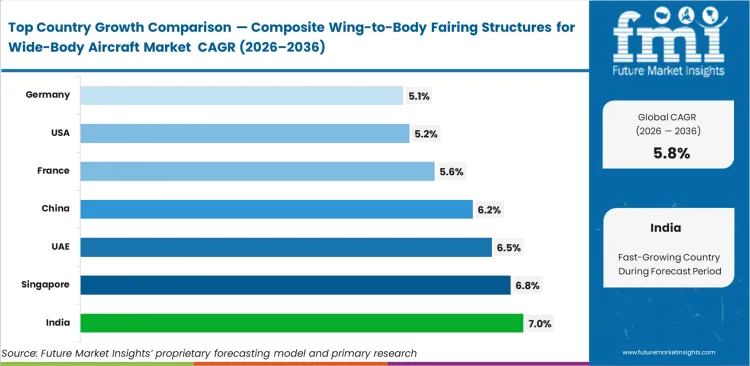
Source: Future Market Insights (FMI) analysis, based on a proprietary forecasting model and primary research
Asia Pacific Composite Wing-to-Body Fairing Structures for Wide-Body Aircraft Market Analysis
Asia Pacific remains the most expansion-oriented regional market as twin-aisle fleet additions, long-haul network growth, and improving maintenance depth are increasing the need for in-region support of composite fairing assemblies. Overseas routing for heavy repair is becoming less attractive when turnaround time, freight cost, and aircraft availability carry direct economic consequences. Local capability now matters across repair execution, spares positioning, tooling support, and material handling linked to metallic-composite hybrid aircraft exterior components. Regional demand is therefore being shaped by the build-out of maintenance ecosystems that can support a larger installed base of wide-body aircraft, not by legacy replacement alone.
- India: Rapid twin-aisle fleet induction is strengthening India’s role in this market. Demand for composite wing-to-body fairing structures in India is projected to expand at a CAGR of 7.0% from 2026 to 2036 as operators place greater emphasis on local spares access and faster turnaround during scheduled maintenance events. Broader domestic repair capability is also expected to improve the case for retaining more fairing-related work within the country instead of routing it abroad. Fleet growth and maintenance localization continue to reinforce India’s position as one of the region’s strongest demand centers.
- Singapore: Dense engineering infrastructure and cross-border MRO dependence keep Singapore commercially important. Technical concentration is likely to support higher-value activity where certification discipline and repeatable turnaround carry more weight than labor cost alone. Demand routed through Singapore is estimated to rise at a CAGR of 6.8% from 2026 to 2036, supported by its role in handling complex composite inspection, repair, and overhaul work for airlines across Asia. This role is expected to keep Singapore central to regional fairing support even as more local capability develops elsewhere.
- China: Domestic traffic scale and future wide-body fleet requirements continue to support China’s market position. Local operators also have stronger incentive to protect network continuity through better control over spare availability and approved repair pathways. Composite wing-to-body fairing structure demand in China is anticipated to advance at a CAGR of 6.2% from 2026 to 2036 as fleet expansion is matched by broader maintenance and parts-support investment. Growth is likely to remain solid, even below India, because capability expansion is advancing within a more complex certification and operating environment.
Japan is also likely to remain a relevant opportunity market. Aerospace manufacturing depth and established composite processing capability are expected to support steady demand for precision fairing components over time.
Middle East and Africa Composite Wing-to-Body Fairing Structures for Wide-Body Aircraft Market Analysis
Desert operating conditions give this region a distinct maintenance profile, as thermal stress, sand exposure, and high long-haul utilization are likely to raise wear on exterior composite fairing assemblies faster than in milder operating environments. Replacement planning carries greater importance here because fairing condition can influence both aerodynamic efficiency and dispatch reliability across hub-based wide-body fleets. Local support capability also matters more in this region, since long turnaround cycles and overseas repair dependence can disrupt tightly scheduled international operations. Regional demand is therefore shaped by harsh service conditions, concentrated long-haul fleet activity, and the need to keep critical composite repairs closer to the aircraft base. This combination is expected to sustain steady demand for replacement fairings and approved repair support across the region.
- United Arab Emirates: Large twin-aisle fleets and hub-driven operating intensity keep the United Arab Emirates at the center of regional demand. Demand for composite wing-to-body fairing structures in the United Arab Emirates is projected to expand at a CAGR of 6.5% through 2036 as carriers deepen local repair capability and maintain broader spare-panel coverage to protect aircraft availability. In-house maintenance depth is also likely to carry greater value where turnaround speed and fleet utilization matter more than continued dependence on external repair networks. Such operating conditions are expected to keep the United Arab Emirates a key regional market for approved repairs, replacement fairings, and reliable supply coverage.
Saudi Arabia is also likely to gain long-term relevance in this market as wider aviation investment and local aerospace capability build-out support stronger replacement and repair demand. Ongoing expansion in domestic support capacity is expected to improve the case for handling more fairing-related work within the country over time.
Europe Composite Wing-to-Body Fairing Structures for Wide-Body Aircraft Market Analysis
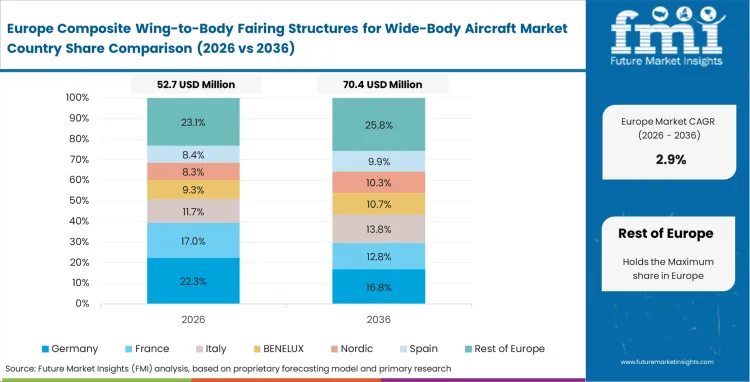
Manufacturing density and Airbus-linked assembly activity keep this region tied closely to OEM output rather than predominantly to replacement-led demand. Aftermarket requirements remain relevant, yet production continuity, material flow, and process control carry more weight here than in markets shaped mainly by localized maintenance build-out. Short logistics loops also help move certified fairing panels more efficiently between manufacturing and service points, while environmental compliance is adding cost and complexity to composite disposal and recovery. Demand across the region is defined by manufacturing depth, process maturity, and the need to balance output efficiency with tighter end-of-life handling requirements.
- France: Final assembly concentration keeps France central to regional demand, especially where wide-body production schedules depend on a steady flow of certified composite fairing assemblies. Demand for composite wing-to-body fairing structures in the country is expected to rise at a 5.6% CAGR from 2026 to 2036, supported by its close linkage to aircraft build activity and tightly coordinated supply movement around major aerospace production sites. Logistical discipline matters more here than in many other markets because delays in part availability can quickly affect broader assembly sequencing. Reliable panel flow remains especially important in France because production timing leaves little room for supply inconsistency.
- Germany: Advanced materials capability and aerospace manufacturing depth continue to support the country’s role in this market. Demand for composite wing-to-body fairing assemblies in Germany is likely to increase at a CAGR of 5.1% from 2026 to 2036, supported by its position in material development, precision processing, and broader aerostructure support work. Process improvement also carries added value where shorter molding cycles and better production efficiency can strengthen competitiveness in future composite panel supply.
FMI’s report also includes Spain as an important supporting market, with aerostructure manufacturing capability and Airbus-linked industrial activity expected to sustain its role in regional fairing supply.
North America Composite Wing-to-Body Fairing Structures for Wide-Body Aircraft Market Analysis
Installed wide-body fleets and a mature aftermarket base keep this region more sustainment-oriented than production-led. Demand is shaped by the need to extend service life on in-operation aircraft, where composite fairing condition affects maintenance timing, aerodynamic efficiency, and asset availability across long-haul networks. Wide-body fairing repair stations carry added importance in this market because operators depend on established maintenance networks to handle irregular damage, scheduled heavy checks, and selected retrofit work, including aircraft pylon and strut fairing retrofit kits. Market direction across North America is defined by installed-fleet support, repair depth, and the ability to respond quickly to replacement-panel demand.
- United States: A large installed fleet and broad maintenance infrastructure keep demand in the United States anchored in ongoing sustainment rather than only in new-aircraft activity. Composite wing-to-body fairing component demand is projected to expand at a 5.2% CAGR from 2026 to 2036, supported by recurring heavy-check replacement needs and the requirement to keep older wide-body aircraft available across long-haul networks. Approved bonded-composite repair capability also helps preserve panel life in cases where full replacement can be deferred without compromising turnaround planning. Continued need for both rapid panel access and qualified repair support keeps the country commercially important across the regional aftermarket.
FMI’s report also recognizes Canada as a relevant market, where aerospace manufacturing capability and cross-border maintenance integration are expected to support stable demand for composite fairing repair and component supply.
Competitive Aligners for Market Players
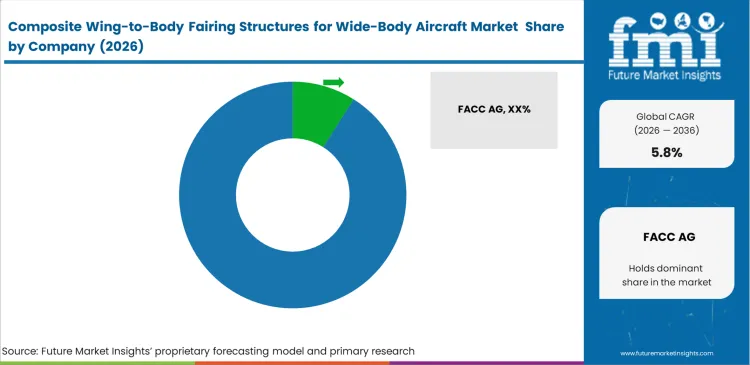
Competition remains concentrated among established aerostructure suppliers because this market is shaped by high capital intensity and long OEM qualification cycles. FACC AG, Spirit AeroSystems, and GKN Aerospace hold strong positions due to their ability to manufacture large composite fairing panels within tightly controlled aerospace production environments. Entry remains difficult because airframers rarely shift fairing programs toward unproven suppliers when part consistency, certification continuity, and delivery reliability carry direct program risk. Aftermarket participation is also limited by OEM-linked supply channels, which restrict room for independent panel manufacturing. Competitive standing depends heavily on production yield, since suppliers that maintain tighter control over porosity, curing consistency, and scrap rates are better placed to protect margins and sustain program credibility.
Incumbent advantage is also supported by access to aerospace-grade raw materials, validated tooling, and repeatable molding capability for complex geometries. NORDAM remain well placed in applications where curvature control, layup precision, and molded-part consistency matter across difficult fairing profiles. Entry barriers are not defined by equipment investment alone, because material qualification, process validation, and property matching take time before alternative suppliers can be accepted for flight-critical exterior parts. This dynamic keeps established suppliers in a stronger pricing position across radome and wing-to-body fairing component supply. Deeper integration with airline maintenance requirements further supports that position where suppliers can align spare availability and replacement support with existing technical service structures.
Large airline groups still retain some influence through spares-pooling requirements tied to new aircraft orders and long-term fleet support arrangements. Availability commitments carry clear commercial importance, especially where replacement fairings are expected at major hubs on short notice after aircraft-on-ground events. Failure to meet these expectations can reduce margins through penalties, expedited logistics, or loss of follow-on support volume. Buyer influence also remains linked to the extent to which airlines can support independent composite repair capability through regional MRO networks. As repair qualification advances, part of the aftermarket is expected to shift from full panel replacement toward approved repair pathways. Competition is therefore moving gradually toward repair capability and service response, not panel production alone.
Key Players in Composite Wing-to-Body Fairing Structures for Wide-Body Aircraft Market
- FACC AG
- Spirit AeroSystems
- GKN Aerospace
- NORDAM
- Avior Integrated Products
Scope of the Report
| Metric | Value |
|---|---|
| Quantitative Units | USD 214.0 million to USD 376.1 million, at a CAGR of 5.8% |
| Market Definition | Composite wing-to-body fairings are non-primary aerodynamic structures made of fiber-reinforced polymers smoothing junctions between wide-body aircraft fuselages and wing roots to minimize parasitic drag. |
| Segmentation | Material Type, Aircraft Program, Fitment, Structure Type, End Use, Region |
| Regions Covered | North America, Latin America, Europe, Asia Pacific, Middle East and Africa |
| Countries Covered | India, Singapore, United Arab Emirates, China, France, United States, Germany |
| Key Companies Profiled | FACC AG, Spirit AeroSystems, GKN Aerospace, NORDAM, Avior Integrated Products |
| Forecast Period | 2026 to 2036 |
| Approach | Bottom-up OEM shipset value plus installed-base aftermarket replacement and repair demand. |
Source: Future Market Insights (FMI) analysis, based on proprietary forecasting model and primary research
Composite Wing-to-Body Fairing Structures for Wide-Body Aircraft Market Analysis by Segments
Material Type
- CFRP
- GFRP
- Hybrid composites
- Thermoplastic composites
Aircraft Program
- A350
- 787
- 777
- A330
- 767
Fitment
- OEM line-fit
- Replacement
- MRO repair
- Retrofit kits
Structure Type
- Side fairings
- Upper fairings
- Lower fairings
- Access panels
- Flap doors
End Use
- Passenger jets
- Freighters
- Tankers
Region
- North America
- Latin America
- Europe
- Asia Pacific
- Middle East and Africa
Bibliography
- Federal Aviation Administration William J. Hughes Technical Center. (2024, May). State of the industry - Resin infusion: A literature review.
- International Civil Aviation Organization. (2024, August). Wings of prosperity: Economic growth through air transport.
- Korba, P., Al-Rabeei, S., Hovanec, M., Sekelová, I., & Kale, U. (2024). Structural design and material comparison for aircraft wing box beam panel. Heliyon, 10(5), e27403.
- Skoczylas, J., Kłonica, M., & Samborski, S. (2026). Recent advances in application of composite materials in the aerospace industry. Advances in Science and Technology Research Journal, 20(4), 475-491.
- Wang, H., Wu, J., Guo, Q., Liu, G., Wu, J., Liu, D., Tao, Y., & Xiong, N. (2024). Study on the influence of a powered nacelle on the wake vortex characteristics of wide-body aircraft. Aerospace, 11(6), 452.
This bibliography is provided for reader reference. The full FMI report contains the complete reference list with primary source documentation.
This Report Addresses
- Airline procurement strategies for securing OEM-certified 787 wing-to-body fairing composite structures.
- Autoclave curing bottlenecks impacting Tier-1 side fairing production schedules.
- Regulatory certification gates required for out-of-autoclave MRO bonded repairs.
- Fuel burn penalty calculations compelling immediate lower fairing replacements.
- Delamination risks associated with ground equipment collisions on tarmacs.
- Thermoplastic resin substitution viability for next-generation aircraft programs.
- Localized shadow inventory stockpiling practices among major passenger fleets.
- Disposal cost implications surrounding end-of-life carbon fiber aviation structures.
Frequently Asked Questions
What is a wing-to-body fairing on a wide-body aircraft?
These are non-primary aerodynamic covers made of fiber-reinforced polymers positioned between fuselages and wing roots. They smooth airflow separation gradients, preventing turbulence and minimizing parasitic drag during high-altitude cruise conditions.
Why are wing-to-body fairings made from composites?
Carbon fiber offers unmatched stiffness-to-weight ratios crucial for massive aerodynamic surfaces bridging wings and fuselages. Engineering directors mandate composites maintaining original type certificates and ensuring structural integrity under extreme dynamic air pressure without adding massive fuel-burning weight.
How much drag does a wing-to-body fairing reduce?
Operating twin-aisle aircraft with misaligned wing-to-body covers incurs measurable drag penalties compounding exponentially over fourteen-hour long-haul flights. Proper flush installation eliminates microscopic vortex generation, significantly lowering total trip fuel burn.
How are composite wing-to-body fairings repaired?
Airlines utilizing advanced out-of-autoclave structural patches require controlled environments, exact thermal curing profiles, and highly specialized labor. Because very few line-stations possess this capability, engineers often purchase entirely new panels from Tier-1 suppliers instead of executing complex bonded repairs.
Which aircraft use composite wing-to-body fairings?
Next-generation twin-aisle platforms like the A350 and 787 rely heavily on these structures due to baseline clean-sheet design philosophies. Legacy platforms including the 777, A330, and 767 also incorporate massive composite transition covers supporting aerodynamic efficiency.
Which companies supply composite wing-to-body fairings?
FACC AG, Spirit AeroSystems, and GKN Aerospace dominate landscapes possessing massive industrial autoclaves required curing 15-foot panels. NORDAM hold specific capability advantages in complex geometric molding utilizing automated fiber placement machines.
How big is the composite wing-to-body fairing market?
Sales are expected surpassing USD 214.0 million in 2026. Fleet planners scheduling heavy maintenance C-checks map out predictable component attrition rates for wing-to-fuselage transitions, securing long-term revenue floors resisting cyclical economic downturns.
What is the wing-to-body fairing market size 2026 2036 trajectory?
Sustained investment propels cumulative revenue to USD 376.1 million through 2036. Early-generation 787 and A350 airframes entering heavy maintenance checks require component-level replacement rather than patch repairs, driving consistent long-term procurement.
What drives demand for wide-body fairing structures?
Severe fuel price volatility forces airline operations managers hunting for microscopic aerodynamic inefficiencies across fleets. This economic pressure compels maintenance directors abandoning deferred repair strategies and ordering immediate factory-new composite replacements for damaged panels.
Why do OEM line-fit parts maintain a 68.0% position?
Final assembly line managers mandate flawless surface finishes and exact dimensional tolerances maintaining rapid twin-aisle production rates. Securing initial qualification locks suppliers into lucrative sole-source contracts for all subsequent aftermarket spare requirements.
What operational consequence drives A350 component demand?
Airlines operating A350s face strict configuration management challenges due to platform-specific composite intensity. Technical operations managers source specific serial-matched belly panels replacing damaged sections, eliminating possibilities utilizing cheaper generic metallic substitutes.
Why do side fairings capture 31.0% of procurement volume?
Massive transition panels absorb brunt forces during accidental ground equipment collisions during routine ramp operations. Station managers frequently order replacements because localized patch repairs on highly curved side sections disrupt critical aerodynamic flow.
How does India outpace global growth at 7.0%?
Aggressive fleet induction by national carriers necessitates immediate construction of localized heavy maintenance infrastructure. Procurement heads lock in long-term spares pooling agreements guaranteeing high-cycle dispatch reliability, bypassing European logistical bottlenecks entirely.
What separates Singapore's 6.8% trajectory from adjacent hubs?
Dense engineering ecosystems allow facility directors deploying advanced robotics for automated ultrasonic composite inspections. Localized technical supremacy forces neighboring operators routing heavily damaged wide-body panels through local hubs rather than attempting domestic repairs.
What hidden cost impacts CFRP lifecycle calculations?
End-of-life recycling for aviation-grade carbon fiber remains commercially unviable at required scales. Fleet managers absorb massive disposal fees retiring damaged panels, significantly altering total cost of ownership models compared to legacy metallic structures.
How do passenger fleets influence replacement cycles?
Brand managers enforce incredibly strict visual standards for exterior surfaces of passenger aircraft. Airline engineering heads mandate immediate composite panel replacement rather than aerodynamic patch repairs preventing passenger alarm over visible structural damage.
What structural gate dictates regional expansion?
Regulatory authorities granting out-of-autoclave repair certifications directly transfer power from original manufacturers to independent MROs. Passing this technical threshold drops turnaround times from weeks to days, fundamentally altering maintenance economics.
How does thermoplastic substitution alter procurement strategy?
Structural engineers specifying short-cycle thermoplastic composites achieve rapid, weldable repairs without massive industrial autoclaves. Procurement officers adopting this material immediately bypass current Tier-1 curing bottlenecks and slash long-term component replacement expenditures.
Why do buyers stockpile fairing inventory?
Operating wide-body jets with temporary metallic doublers incurs severe fuel penalties compounding over oceanic routes. Airline operations managers build shadow inventories of high-attrition side panels protecting route profitability from supply chain lead times.
What determines competitive survival among Tier-1 suppliers?
Production yield rates dictate financial viability inside composite manufacturing oligopolies. Factory managers eliminating micro-porosity during resin infusion phases protect margins, while those facing high scrap rates lose competitive footing immediately.
How do large airlines counter supplier monopolies?
Fleet procurement officers demand extensive spares pooling agreements as prerequisites confirming new aircraft orders. If aerostructure manufacturers fail positioning replacement panels at strategic global hubs, punitive financial clauses erase component profit margins.
What limits third-party aftermarket manufacturing?
Incumbents defend positions through proprietary tooling designs and exclusive aerospace-grade material allocations. Challengers endure rigorous multi-year material allowable testing phases proving cured panels match flexural properties of original parts.
Why does the United Arab Emirates track at 6.5% compound growth?
Mega-carriers operating massive A380 and 777 fleets actively internalize composite repair capabilities maximizing fleet utilization. Technical directors invest heavily in localized autoclaves insulating operations from Western supply chain volatility.
What restricts the use of recycled carbon fiber?
Structural safety mandates strictly limit application of mechanically recycled tow in primary aerospace components. Sustainability officers establish circular supply chains only for non-primary transition panels, navigating European environmental mandates without jeopardizing flight safety.
Preview the report firsthand - request a free sample
Get SampleGet the brochure for pricing and purchase details.
Get PDFTable of Content
- Executive Summary
- Global Market Outlook
- Demand-side Trends
- Supply-side Trends
- Technology Roadmap Analysis
- Analysis and Recommendations
- Market Overview
- Market Coverage / Taxonomy
- Market Definition / Scope / Limitations
- Research Methodology
- Chapter Orientation
- Analytical Lens and Working Hypotheses
- Market Structure, Signals, and Trend Drivers
- Benchmarking and Cross-market Comparability
- Market Sizing, Forecasting, and Opportunity Mapping
- Research Design and Evidence Framework
- Desk Research Programme (Secondary Evidence)
- Company Annual and Sustainability Reports
- Peer-reviewed Journals and Academic Literature
- Corporate Websites, Product Literature, and Technical Notes
- Earnings Decks and Investor Briefings
- Statutory Filings and Regulatory Disclosures
- Technical White Papers and Standards Notes
- Trade Journals, Industry Magazines, and Analyst Briefs
- Conference Proceedings, Webinars, and Seminar Materials
- Government Statistics Portals and Public Data Releases
- Press Releases and Reputable Media Coverage
- Specialist Newsletters and Curated Briefings
- Sector Databases and Reference Repositories
- FMI Internal Proprietary Databases and Historical Market Datasets
- Subscription Datasets and Paid Sources
- Social Channels, Communities, and Digital Listening Inputs
- Additional Desk Sources
- Expert Input and Fieldwork (Primary Evidence)
- Primary Modes
- Qualitative Interviews and Expert Elicitation
- Quantitative Surveys and Structured Data Capture
- Blended Approach
- Why Primary Evidence is Used
- Field Techniques
- Interviews
- Surveys
- Focus Groups
- Observational and In-context Research
- Social and Community Interactions
- Stakeholder Universe Engaged
- C-suite Leaders
- Board Members
- Presidents and Vice Presidents
- R&D and Innovation Heads
- Technical Specialists
- Domain Subject-matter Experts
- Scientists
- Physicians and Other Healthcare Professionals
- Governance, Ethics, and Data Stewardship
- Research Ethics
- Data Integrity and Handling
- Primary Modes
- Tooling, Models, and Reference Databases
- Desk Research Programme (Secondary Evidence)
- Data Engineering and Model Build
- Data Acquisition and Ingestion
- Cleaning, Normalisation, and Verification
- Synthesis, Triangulation, and Analysis
- Quality Assurance and Audit Trail
- Market Background
- Market Dynamics
- Drivers
- Restraints
- Opportunity
- Trends
- Scenario Forecast
- Demand in Optimistic Scenario
- Demand in Likely Scenario
- Demand in Conservative Scenario
- Opportunity Map Analysis
- Product Life Cycle Analysis
- Supply Chain Analysis
- Investment Feasibility Matrix
- Value Chain Analysis
- PESTLE and Porter’s Analysis
- Regulatory Landscape
- Regional Parent Market Outlook
- Production and Consumption Statistics
- Import and Export Statistics
- Market Dynamics
- Global Market Analysis 2021 to 2025 and Forecast, 2026 to 2036
- Historical Market Size Value (USD Million) Analysis, 2021 to 2025
- Current and Future Market Size Value (USD Million) Projections, 2026 to 2036
- Y-o-Y Growth Trend Analysis
- Absolute $ Opportunity Analysis
- Global Market Pricing Analysis 2021 to 2025 and Forecast 2026 to 2036
- Global Market Analysis 2021 to 2025 and Forecast 2026 to 2036, By Material Type
- Introduction / Key Findings
- Historical Market Size Value (USD Million) Analysis By Material Type , 2021 to 2025
- Current and Future Market Size Value (USD Million) Analysis and Forecast By Material Type , 2026 to 2036
- CFRP
- GFRP
- Hybrid composites
- Thermoplastic composites
- CFRP
- Y-o-Y Growth Trend Analysis By Material Type , 2021 to 2025
- Absolute $ Opportunity Analysis By Material Type , 2026 to 2036
- Global Market Analysis 2021 to 2025 and Forecast 2026 to 2036, By Aircraft Program
- Introduction / Key Findings
- Historical Market Size Value (USD Million) Analysis By Aircraft Program, 2021 to 2025
- Current and Future Market Size Value (USD Million) Analysis and Forecast By Aircraft Program, 2026 to 2036
- A350
- 787
- 777
- A330
- 767
- A350
- Y-o-Y Growth Trend Analysis By Aircraft Program, 2021 to 2025
- Absolute $ Opportunity Analysis By Aircraft Program, 2026 to 2036
- Global Market Analysis 2021 to 2025 and Forecast 2026 to 2036, By Fitment
- Introduction / Key Findings
- Historical Market Size Value (USD Million) Analysis By Fitment, 2021 to 2025
- Current and Future Market Size Value (USD Million) Analysis and Forecast By Fitment, 2026 to 2036
- OEM line-fit
- Replacement
- MRO repair
- Retrofit kits
- OEM line-fit
- Y-o-Y Growth Trend Analysis By Fitment, 2021 to 2025
- Absolute $ Opportunity Analysis By Fitment, 2026 to 2036
- Global Market Analysis 2021 to 2025 and Forecast 2026 to 2036, By Structure Type
- Introduction / Key Findings
- Historical Market Size Value (USD Million) Analysis By Structure Type, 2021 to 2025
- Current and Future Market Size Value (USD Million) Analysis and Forecast By Structure Type, 2026 to 2036
- Side fairings
- Upper fairings
- Lower fairings
- Access panels
- Flap doors
- Side fairings
- Y-o-Y Growth Trend Analysis By Structure Type, 2021 to 2025
- Absolute $ Opportunity Analysis By Structure Type, 2026 to 2036
- Global Market Analysis 2021 to 2025 and Forecast 2026 to 2036, By End Use
- Introduction / Key Findings
- Historical Market Size Value (USD Million) Analysis By End Use, 2021 to 2025
- Current and Future Market Size Value (USD Million) Analysis and Forecast By End Use, 2026 to 2036
- Passenger jets
- Freighters
- Tankers
- Passenger jets
- Y-o-Y Growth Trend Analysis By End Use, 2021 to 2025
- Absolute $ Opportunity Analysis By End Use, 2026 to 2036
- Global Market Analysis 2021 to 2025 and Forecast 2026 to 2036, By Region
- Introduction
- Historical Market Size Value (USD Million) Analysis By Region, 2021 to 2025
- Current Market Size Value (USD Million) Analysis and Forecast By Region, 2026 to 2036
- North America
- Latin America
- Western Europe
- Eastern Europe
- East Asia
- South Asia and Pacific
- Middle East & Africa
- Market Attractiveness Analysis By Region
- North America Market Analysis 2021 to 2025 and Forecast 2026 to 2036, By Country
- Historical Market Size Value (USD Million) Trend Analysis By Market Taxonomy, 2021 to 2025
- Market Size Value (USD Million) Forecast By Market Taxonomy, 2026 to 2036
- By Country
- USA
- Canada
- Mexico
- By Material Type
- By Aircraft Program
- By Fitment
- By Structure Type
- By End Use
- By Country
- Market Attractiveness Analysis
- By Country
- By Material Type
- By Aircraft Program
- By Fitment
- By Structure Type
- By End Use
- Key Takeaways
- Latin America Market Analysis 2021 to 2025 and Forecast 2026 to 2036, By Country
- Historical Market Size Value (USD Million) Trend Analysis By Market Taxonomy, 2021 to 2025
- Market Size Value (USD Million) Forecast By Market Taxonomy, 2026 to 2036
- By Country
- Brazil
- Chile
- Rest of Latin America
- By Material Type
- By Aircraft Program
- By Fitment
- By Structure Type
- By End Use
- By Country
- Market Attractiveness Analysis
- By Country
- By Material Type
- By Aircraft Program
- By Fitment
- By Structure Type
- By End Use
- Key Takeaways
- Western Europe Market Analysis 2021 to 2025 and Forecast 2026 to 2036, By Country
- Historical Market Size Value (USD Million) Trend Analysis By Market Taxonomy, 2021 to 2025
- Market Size Value (USD Million) Forecast By Market Taxonomy, 2026 to 2036
- By Country
- Germany
- UK
- Italy
- Spain
- France
- Nordic
- BENELUX
- Rest of Western Europe
- By Material Type
- By Aircraft Program
- By Fitment
- By Structure Type
- By End Use
- By Country
- Market Attractiveness Analysis
- By Country
- By Material Type
- By Aircraft Program
- By Fitment
- By Structure Type
- By End Use
- Key Takeaways
- Eastern Europe Market Analysis 2021 to 2025 and Forecast 2026 to 2036, By Country
- Historical Market Size Value (USD Million) Trend Analysis By Market Taxonomy, 2021 to 2025
- Market Size Value (USD Million) Forecast By Market Taxonomy, 2026 to 2036
- By Country
- Russia
- Poland
- Hungary
- Balkan & Baltic
- Rest of Eastern Europe
- By Material Type
- By Aircraft Program
- By Fitment
- By Structure Type
- By End Use
- By Country
- Market Attractiveness Analysis
- By Country
- By Material Type
- By Aircraft Program
- By Fitment
- By Structure Type
- By End Use
- Key Takeaways
- East Asia Market Analysis 2021 to 2025 and Forecast 2026 to 2036, By Country
- Historical Market Size Value (USD Million) Trend Analysis By Market Taxonomy, 2021 to 2025
- Market Size Value (USD Million) Forecast By Market Taxonomy, 2026 to 2036
- By Country
- China
- Japan
- South Korea
- By Material Type
- By Aircraft Program
- By Fitment
- By Structure Type
- By End Use
- By Country
- Market Attractiveness Analysis
- By Country
- By Material Type
- By Aircraft Program
- By Fitment
- By Structure Type
- By End Use
- Key Takeaways
- South Asia and Pacific Market Analysis 2021 to 2025 and Forecast 2026 to 2036, By Country
- Historical Market Size Value (USD Million) Trend Analysis By Market Taxonomy, 2021 to 2025
- Market Size Value (USD Million) Forecast By Market Taxonomy, 2026 to 2036
- By Country
- India
- ASEAN
- Australia & New Zealand
- Rest of South Asia and Pacific
- By Material Type
- By Aircraft Program
- By Fitment
- By Structure Type
- By End Use
- By Country
- Market Attractiveness Analysis
- By Country
- By Material Type
- By Aircraft Program
- By Fitment
- By Structure Type
- By End Use
- Key Takeaways
- Middle East & Africa Market Analysis 2021 to 2025 and Forecast 2026 to 2036, By Country
- Historical Market Size Value (USD Million) Trend Analysis By Market Taxonomy, 2021 to 2025
- Market Size Value (USD Million) Forecast By Market Taxonomy, 2026 to 2036
- By Country
- Kingdom of Saudi Arabia
- Other GCC Countries
- Turkiye
- South Africa
- Other African Union
- Rest of Middle East & Africa
- By Material Type
- By Aircraft Program
- By Fitment
- By Structure Type
- By End Use
- By Country
- Market Attractiveness Analysis
- By Country
- By Material Type
- By Aircraft Program
- By Fitment
- By Structure Type
- By End Use
- Key Takeaways
- Key Countries Market Analysis
- USA
- Pricing Analysis
- Market Share Analysis, 2025
- By Material Type
- By Aircraft Program
- By Fitment
- By Structure Type
- By End Use
- Canada
- Pricing Analysis
- Market Share Analysis, 2025
- By Material Type
- By Aircraft Program
- By Fitment
- By Structure Type
- By End Use
- Mexico
- Pricing Analysis
- Market Share Analysis, 2025
- By Material Type
- By Aircraft Program
- By Fitment
- By Structure Type
- By End Use
- Brazil
- Pricing Analysis
- Market Share Analysis, 2025
- By Material Type
- By Aircraft Program
- By Fitment
- By Structure Type
- By End Use
- Chile
- Pricing Analysis
- Market Share Analysis, 2025
- By Material Type
- By Aircraft Program
- By Fitment
- By Structure Type
- By End Use
- Germany
- Pricing Analysis
- Market Share Analysis, 2025
- By Material Type
- By Aircraft Program
- By Fitment
- By Structure Type
- By End Use
- UK
- Pricing Analysis
- Market Share Analysis, 2025
- By Material Type
- By Aircraft Program
- By Fitment
- By Structure Type
- By End Use
- Italy
- Pricing Analysis
- Market Share Analysis, 2025
- By Material Type
- By Aircraft Program
- By Fitment
- By Structure Type
- By End Use
- Spain
- Pricing Analysis
- Market Share Analysis, 2025
- By Material Type
- By Aircraft Program
- By Fitment
- By Structure Type
- By End Use
- France
- Pricing Analysis
- Market Share Analysis, 2025
- By Material Type
- By Aircraft Program
- By Fitment
- By Structure Type
- By End Use
- India
- Pricing Analysis
- Market Share Analysis, 2025
- By Material Type
- By Aircraft Program
- By Fitment
- By Structure Type
- By End Use
- ASEAN
- Pricing Analysis
- Market Share Analysis, 2025
- By Material Type
- By Aircraft Program
- By Fitment
- By Structure Type
- By End Use
- Australia & New Zealand
- Pricing Analysis
- Market Share Analysis, 2025
- By Material Type
- By Aircraft Program
- By Fitment
- By Structure Type
- By End Use
- China
- Pricing Analysis
- Market Share Analysis, 2025
- By Material Type
- By Aircraft Program
- By Fitment
- By Structure Type
- By End Use
- Japan
- Pricing Analysis
- Market Share Analysis, 2025
- By Material Type
- By Aircraft Program
- By Fitment
- By Structure Type
- By End Use
- South Korea
- Pricing Analysis
- Market Share Analysis, 2025
- By Material Type
- By Aircraft Program
- By Fitment
- By Structure Type
- By End Use
- Russia
- Pricing Analysis
- Market Share Analysis, 2025
- By Material Type
- By Aircraft Program
- By Fitment
- By Structure Type
- By End Use
- Poland
- Pricing Analysis
- Market Share Analysis, 2025
- By Material Type
- By Aircraft Program
- By Fitment
- By Structure Type
- By End Use
- Hungary
- Pricing Analysis
- Market Share Analysis, 2025
- By Material Type
- By Aircraft Program
- By Fitment
- By Structure Type
- By End Use
- Kingdom of Saudi Arabia
- Pricing Analysis
- Market Share Analysis, 2025
- By Material Type
- By Aircraft Program
- By Fitment
- By Structure Type
- By End Use
- Turkiye
- Pricing Analysis
- Market Share Analysis, 2025
- By Material Type
- By Aircraft Program
- By Fitment
- By Structure Type
- By End Use
- South Africa
- Pricing Analysis
- Market Share Analysis, 2025
- By Material Type
- By Aircraft Program
- By Fitment
- By Structure Type
- By End Use
- USA
- Market Structure Analysis
- Competition Dashboard
- Competition Benchmarking
- Market Share Analysis of Top Players
- By Region
- By Material Type
- By Aircraft Program
- By Fitment
- By Structure Type
- By End Use
- Competition Analysis
- Competition Deep Dive
- FACC AG
- Overview
- Product Portfolio
- Profitability by Market Segments (Product/Age /Sales Channel/Region)
- Sales Footprint
- Strategy Overview
- Marketing Strategy
- Product Strategy
- Channel Strategy
- Spirit AeroSystems
- GKN Aerospace
- NORDAM
- Avior Integrated Products
- FACC AG
- Competition Deep Dive
- Assumptions & Acronyms Used


