

- Market Size (2026)
- USD 271.7 Mn
- Forecast (2036)
- USD 490.0 Mn
- CAGR (2026 to 2036)
- 6.1%
Emergency Exit Hatch Lightweight Composite Structures Market Size, Market Forecast and Outlook By FMI
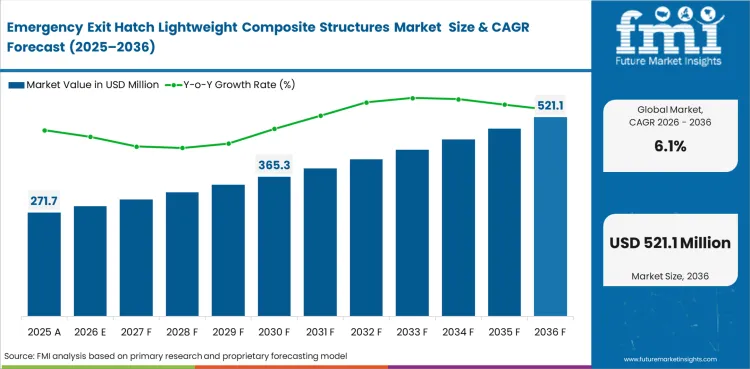
Emergency exit hatch lightweight composite structures market was valued at USD 256.1 million in 2025. Market is poised to surpass USD 271.7 million by 2026 and register a CAGR of 6.1% between 2026 and 2036 to reach a value of USD 490.0 million by 2036. Single-aisle aircraft in the aircraft platform segment is projected to dominate with 41.0%, while overwing exits in the exit type segment are projected to lead with 44.0%.
Summary of the Emergency Exit Hatch Lightweight Composite Structures Market
- Demand and Growth Drivers
- Aircraft output recovery across single-aisle programs is supporting fresh line-fit demand for overwing exits and crew hatches.
- Composite hatch structures are becoming more important because they offer lower weight and better stiffness-to-mass balance in certified exterior structures.
- Replacement demand grows across aging fleets due to repair-versus-replace decisions during deeper maintenance cycles.
- Product and Segment View
- Carbon epoxy and honeycomb sandwich designs lead market volume because they have already been tested and accepted in aerospace applications.
- Overwing exits are more important on narrowbody and regional aircraft, while this market remains part of the broader certified aircraft door market.
- OEM line-fit is the main source of revenue, while the aircraft refurbishing market supports a smaller retrofit and replacement layer.
- Geography and Competitive Outlook
- India, China, and Brazil garner faster percentage growth due to industrial build-up, fleet support demand, and supplier localization.
- The United States and France account for larger market shares due to OEM depth and certification capability.
- Competitive advantage depends on composite manufacturing maturity and program approval access.
- Analyst Opinion
- Nikhil Kaitwade, Principal Analyst states, Lightweight emergency hatch demand gains stronger traction across programs using composite door architectures, however supplier scale still depends on certification depth and repeat platform access.
- Emergency Exit Hatch Lightweight Composite Structures Market Value Analysis
- The emergency exit hatch lightweight composite structures market is evolving from a small certified aerostructure niche into a more defined composite hatch category.
- Adoption is being driven by OEM line-fit demand across single-aisle aircraft and overwing exit programs.
- The market is also benefiting from the wider use of composite structures that reduce weight and support better stiffness-to-mass performance.
- Demand is further supported by replacement needs during heavy maintenance checks and by the need for hatch structures that balance certification, durability, and lifecycle value.
Emergency Exit Hatch Lightweight Composite Structures Market Key Takeaways
- Market value reached USD 256.1 million in 2025.
- Market size is projected to touch USD 490.0 million by 2036.
- Industry expansion is estimated to record 6.1% CAGR for 2026 to 2036.
- Incremental opportunity across 2026 to 2036 is set to be USD 218.3 million.
- Single-aisle aircraft in the aircraft platform segment is expected to account for 41.0% share in 2026.
- India (8.3%) and China (7.7%) are the two of the fastest growing markets in the world.
Emergency Exit Hatch Lightweight Composite Structures Market Definition
Emergency exit hatch lightweight composite structures are certified aircraft hatch and exit assemblies. They use composite skins, sandwich panels, reinforced frames, and related structural parts. These structures serve overwing exits, crew escape doors, cockpit escape hatches, and selected cabin emergency hatches. The market covers structural parts handling load, pressure, and evacuation function.
Emergency Exit Hatch Lightweight Composite Structures Market Inclusions
This market includes composite hatch shells, hatch panels, and bonded or co-cured reinforcements. It also includes honeycomb or foam core structures and metallic-composite interface parts. Latch-ready structural housings and platform-specific line-fit or replacement structures are included.
Emergency Exit Hatch Lightweight Composite Structures Market Exclusions
This market excludes full main passenger doors, cargo doors, and evacuation slides. It also excludes non-structural trim, soft seals sold separately, ropes, and placards. Lighting kits and cabin-only escape accessories are outside this scope. Pure maintenance services without component replacement are also excluded.
Emergency Exit Hatch Lightweight Composite Structures Market Research Methodology
- Primary Research: interviews across aerostructure suppliers, MRO participants, and aerospace component executives.
- Desk Research: review of OEM delivery data, aviation safety rules, company product pages, and technical publications.
- Market sizing and forecasting: bottom-up platform mapping with composite structure penetration and replacement logic.
- Data validation: cross-check using supplier capability review, country manufacturing logic, and adjacent benchmarks such as the aircraft fairings market and the composite airframe specialty fasteners market.
Why is the Emergency Exit Hatch Lightweight Composite Structures Market Growing?
- Single-aisle aircraft output creates the broadest installed base for overwing emergency exits.
- Composite door and hatch designs reduce weight and part count in certified exterior structures.
- Heavy maintenance cycles create room for replacement demand once repairs lose cost advantage.
OEM line-fit is the main source of revenue in this market. Narrowbody aircraft production matters more than widebody production because overwing exits are used more often in single-aisle fleets. The aircraft over-wing exit aerodynamic enhancement kits is related because it covers design changes around exit areas.
Composite structures are preferred because they reduce weight and improve performance. Carbon laminates and sandwich structures also match aerospace needs for fatigue performance, stiffness, and corrosion resistance better than many older all-metal designs. The aircraft antenna fairing systems and the aircraft sensor pod mounting structures reflect wider demand for lightweight exterior aircraft components.
Growth still faces clear limits effort and long approval cycles keep entry barriers high. Supplier growth usually depends on aircraft program awards rather than short-term open-market purchases.
Market Segmentation Analysis
- Single-aisle aircraft in the aircraft platform segment is expected to account for 41.0% share in 2026 because narrowbody programs use overwing exits more often and carry larger annual output.
- Overwing exits in the exit type segment are anticipated to represent 44.0% of the market in 2026 due to narrowbody fleet mix and wider use across regional aircraft.
- Carbon epoxy in the material system segment is likely to secure 48.0% share in 2026 because it has a longer aerospace approval record and more established manufacturing methods.
- Honeycomb sandwich in the core structure segment is set to make up 46.0% of the market in 2026 due to better stiffness at lower mass and broad use in plug-type hatch shells.
- Removable plug in the operation mode segment is forecast to account for 39.0% share in 2026 because manual hatch architecture stays common across overwing exit layouts.
- Autoclave prepreg in the manufacturing process segment is expected to represent 52.0% share in 2026 due to stable laminate quality and established aerospace approval history.
- OEM line-fit in the end use segment is projected to contribute 68.0% of total market share in 2026 because fresh aircraft output contributes major revenue base.
- Segment leadership depends on production volume, exit design, certification history, and replacement cost. Demand also relates to the composite wing-to-body fairing structures for wide-body aircraft market and the aircraft flap track fairing retrofit kits market.
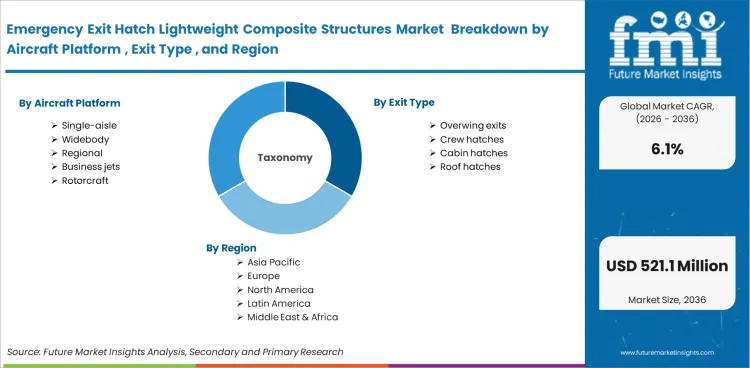
The market for emergency exit hatch lightweight composite structures is divided into groups based on aircraft platform, exit type, material system, core structure, operation mode, manufacturing process, end use, and region. By aircraft platform, the market includes single-aisle, widebody, regional, business jets, and rotorcraft. Based on exit type, it is segmented into overwing exits, crew hatches, cabin hatches, and roof hatches. By material system, the market covers carbon epoxy, carbon thermoplastic, glass sandwich, and hybrid laminates. By core structure, the market includes honeycomb sandwich, monolithic skins, ribbed shells, and foam cores. Based on operation mode, it is segmented into removable plug, hinged plug, spring assist, and power assist. By manufacturing process, the market covers autoclave prepreg, resin transfer, compression molding, and induction welding. By end use, the market includes OEM line-fit, aftermarket parts, MRO repair, and retrofit kits.
Insights into the Aircraft Platform Segment
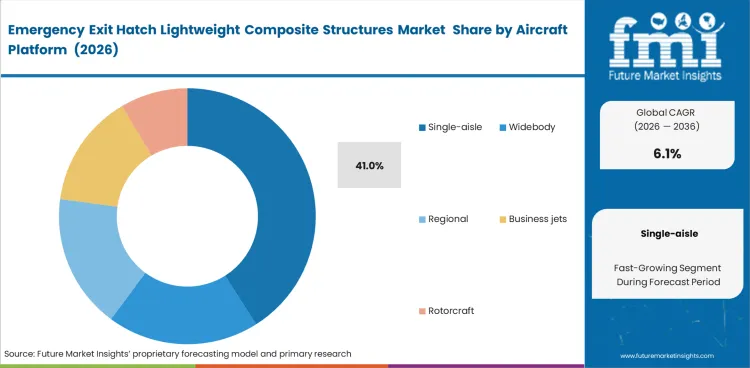
- Single-aisle aircraft is expected to account for 41.0% share in 2026 because A220, A320-family, and 737-family output creates the largest installed base for hatch structures.
- Widebody, regional, and business-jet programs contribute demand, though unit volumes stay lower than narrowbody output.
Insights into the Exit Type Segment
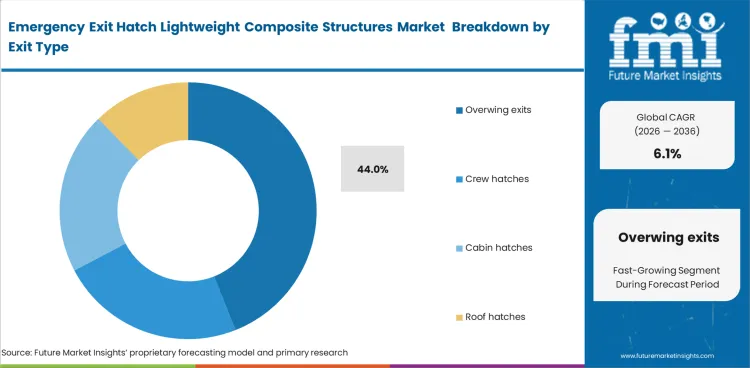
- Overwing exits are projected to lead the exit type segment with 44.0% in 2026 because narrowbody and regional fleets use hatch-format exits more broadly.
- Crew hatches support demand across cockpit and upper-deck escape systems, especially in aircraft using composite door structures.
Insights into the Material System Segment
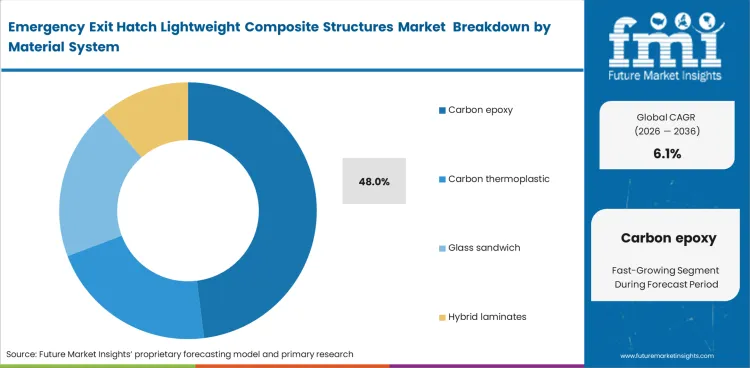
- Carbon epoxy is projected to lead the material system segment with 48.0% in 2026 driven by mature approval history and broad aerospace familiarity.
- Carbon thermoplastic and hybrid laminates support demand in aircraft hatch structures using faster production methods and fewer fasteners.
Insights into the Core Structure Segment
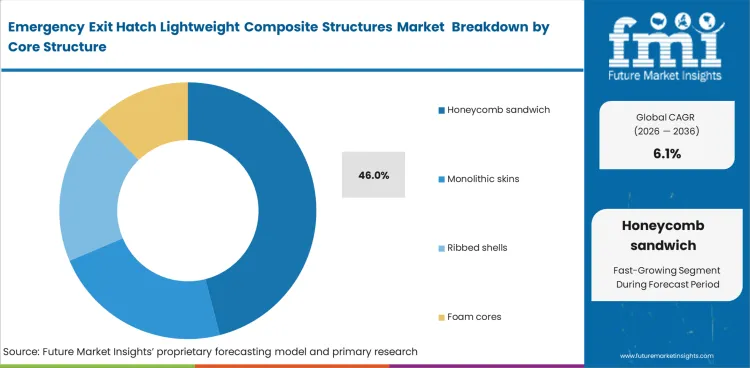
- Honeycomb sandwich is projected to lead the core structure segment with 46.0% in 2026 because lower mass and strong stiffness suit removable and plug-type hatch shells.
- Monolithic skins and ribbed shells are used in some hatch structures, though sandwich formats suit more hatch applications.
Insights into the Operation Mode Segment
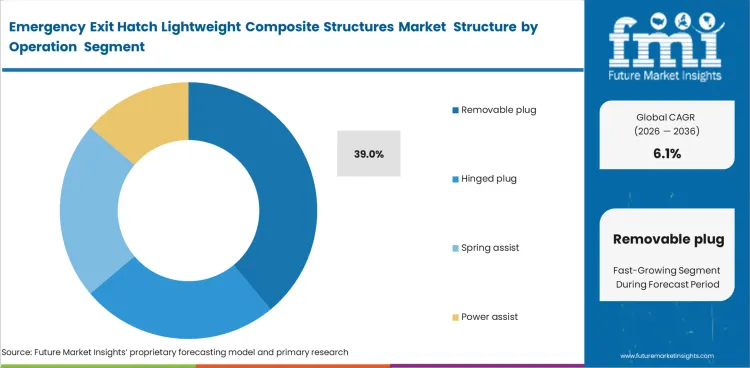
- Removable plug is expected to account for 39.0% share in 2026 because manual release systems are common in overwing emergency exits.
- Hinged plug and assisted systems are used in some layouts, though removable structures use fewer parts and simpler hardware.
Insights into the Manufacturing Process Segment
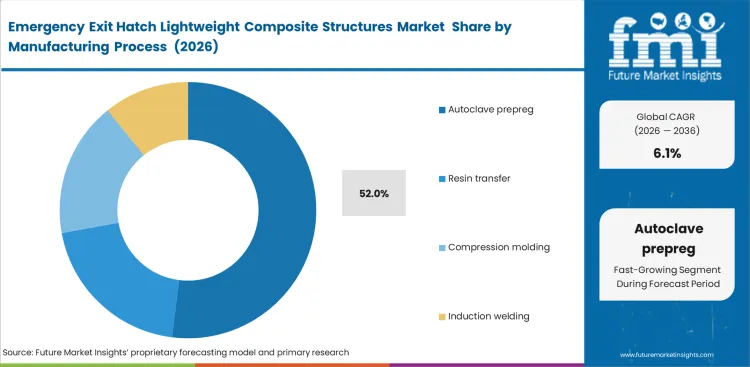
- Autoclave prepreg is expected to account for 52.0% share in 2026 because aerospace manufacturers prefer controlled laminate quality and consistent curing results.
- Resin transfer and compression molding are used in some structures, though prepreg routes have stronger approval history.
Insights into the End Use Segment
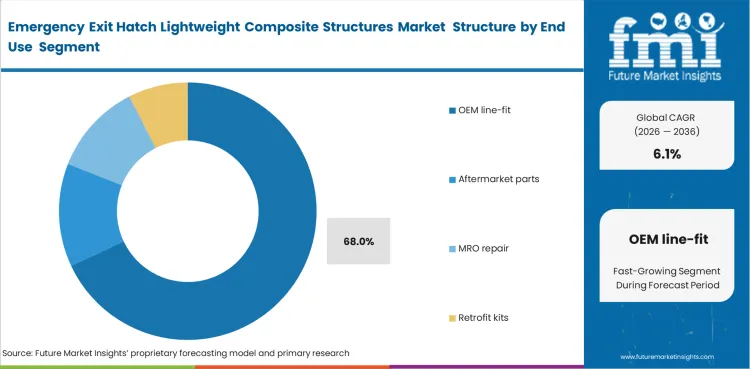
- OEM line-fit is expected to account for 68.0% share in 2026 because fresh aircraft production drives the largest volume of certified hatch demand.
- Aftermarket parts, retrofit kits, and MRO repair keep a smaller role, though heavy checks can lift replacement demand.
Emergency Exit Hatch Lightweight Composite Structures Market Drivers, Restraints, and Opportunities
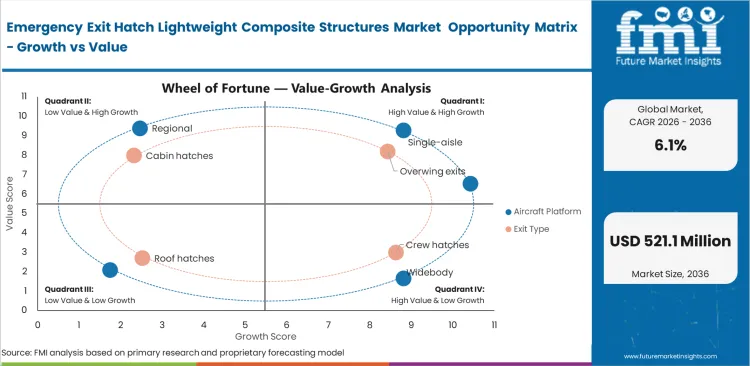
- Narrowbody output and program backlog support fresh hatch demand.
- Certification cost and long approval cycles slow supplier entry.
- Heavy maintenance cycles create room for replacement demand.
Market demand depends on certified program access and aircraft production volume. Growth comes from long program contracts, replacement demand, and local supplier expansion. Related demand links to automated composite structure inspection systems for aerospace and the aerospace composite materials using PCR.
Qualification Cost and Program Entry Limits
Adoption is limited by high certification cost, tooling recovery pressure, and long approval cycles in safety-critical hatch structures. Low part volumes make it harder for new suppliers to spread testing and documentation expense across larger output. Entry therefore stays concentrated around companies with prior aerospace approval history, stronger composite process control, and repeat platform access.
Replacement Demand During Heavy Checks
Growth is supported by replacement demand as aging fleets move into deeper maintenance cycles and repair starts losing cost advantage. Airlines and MRO teams place more value on certified replacement structures when downtime, traceability, and lifecycle reliability become more important. This creates added demand beyond OEM line-fit supply, especially across single-aisle fleets using overwing exits and other composite hatch structures.
Analysis of Emergency Exit Hatch Lightweight Composite Structures Market By Key Countries
.webp "Top Country Growth Comparison Emergency Exit Hatch Lightweight Composite Structures Market Cagr (2026 2036)")
| Country | CAGR |
|---|---|
| India | 8.3% |
| China | 7.7% |
| Brazil | 7.1% |
| Canada | 6.4% |
| United States | 6.0% |
| France | 5.9% |
| Germany | 5.6% |
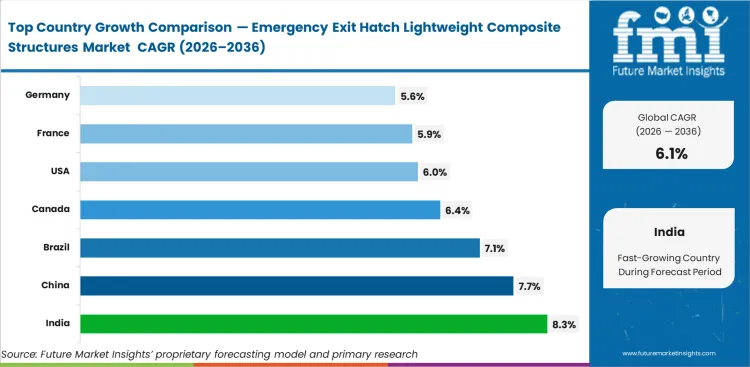
Source: FMI analysis based on primary research and proprietary forecasting model
Emergency Exit Hatch Lightweight Composite Structures Market Cagr Analysis By Country
- India is projected to advance at a CAGR of 8.3% because aircraft manufacturing build-up, local aerostructure capability, and rising export-linked work support hatch demand.
- China is projected to expand at a CAGR of 7.7% due to fleet growth, civil aviation investment, and broader composite manufacturing ambition.
- Brazil is forecast to record a CAGR of 7.1% because Embraer-linked production depth and regional-aircraft relevance support composite hatch demand.
- Canada is set to post a CAGR of 6.4%, supported by A220 assembly activity and approved supplier depth.
- United States is expected to register a CAGR of 6.0%, backed by OEM scale, fleet size, and heavy-check replacement work.
- France is likely to progress at a CAGR of 5.9% from a large industrial base, with Airbus-linked output and tier-one aerostructure depth supporting steady demand.
- Germany is anticipated to see growth at a CAGR of 5.6% over the forecast period because supply-chain participation is strong, though first-time expansion is lower than in newer aerospace hubs.
Country spread covers both mature OEM centers and rising supplier bases. Percentage growth is higher in countries adding fresh industrial capacity.
Demand Outlook for Emergency Exit Hatch Lightweight Composite Structures in India
India shows faster growth due to rising aerospace manufacturing and local supplier expansion. Demand for emergency exit hatch lightweight composite structures in India is anticipated to rise at a CAGR of 8.3% through 2036, supported by local door production and higher line-fit demand. Commercial value grows through export aerostructure work and domestic manufacturing expansion.
- Airbus-linked door work raises program visibility.
- Composite manufacturing capability is widening.
- Supplier scale improves across certified exports.
Future Outlook for Emergency Exit Hatch Lightweight Composite Structures in China
China benefits from fleet growth, local industrial capacity, and stronger aerospace materials ambition. Sales of emergency exit hatch lightweight composite structures in China are expected to increase at a CAGR of 7.7% during the forecast period due to aircraft build-up and broader composite adoption. Supplier opportunity improves across civil aircraft programs needing new exit structures.
- Fleet growth supports new-install demand.
- Composite content keeps rising across local builds.
- Industrial depth supports supplier participation.
Opportunity Analysis of Emergency Exit Hatch Lightweight Composite Structures in Brazil
Brazil holds a favorable position due to Embraer-linked platform activity and regional-aircraft demand. Emergency exit hatch lightweight composite structures adoption in Brazil is likely to advance at a CAGR of 7.1% by 2036, driven by aerostructure specialization and regional-aircraft demand. Market value is stronger across applications requiring lighter certified exterior structures.
- Regional-aircraft activity supports hatch demand.
- Aerostructure know-how is well established.
- Platform-linked supply improves supplier stickiness.
In-depth Analysis of Emergency Exit Hatch Lightweight Composite Structures in Canada
Canada benefits from A220 assembly concentration and a mature aerospace supplier base. Canada is projected to witness 6.4% CAGR in the emergency exit hatch lightweight composite structures market through 2036, owing to assembly activity and composite aerostructure depth. Supplier access improves across approved programs using cockpit escape hatches and overwing exit structures.
- A220 ecosystem supports hatch-related demand.
- Composite experience aids qualification depth.
- Program continuity supports stable contracts.
Sales Analysis of Emergency Exit Hatch Lightweight Composite Structures in the United States
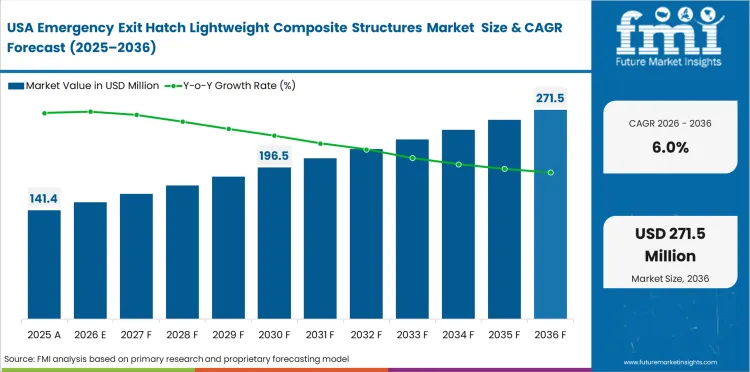
The United States demand is supported by large OEM activity, a big active fleet, and strong MRO work. The market for emergency exit hatch lightweight composite structures in the United States is expected to grow at a CAGR of 6.0% during the study period, driven by broad aircraft program exposure and replacement demand. Commercial value is stronger across line-fit supply and heavy-check replacement work.
- OEM depth supports broad program exposure.
- Fleet size sustains replacement demand.
- MRO activity improves part turnover potential.
Future Outlook for Emergency Exit Hatch Lightweight Composite Structures in France
France benefits from Airbus-linked industrial depth and established aerostructure supply chains. France is likely to post a CAGR of 5.9% in emergency exit hatch lightweight composite structures by 2036 because composite structures and certified door-system work carry long program cycles. Supplier strength improves across line-fit contracts requiring stable quality and delivery discipline.
- Airbus ecosystem supports program continuity.
- Tier-one supplier depth supports quality control.
- Certified door work carries long contract visibility.
In-depth Analysis of Emergency Exit Hatch Lightweight Composite Structures in Germany
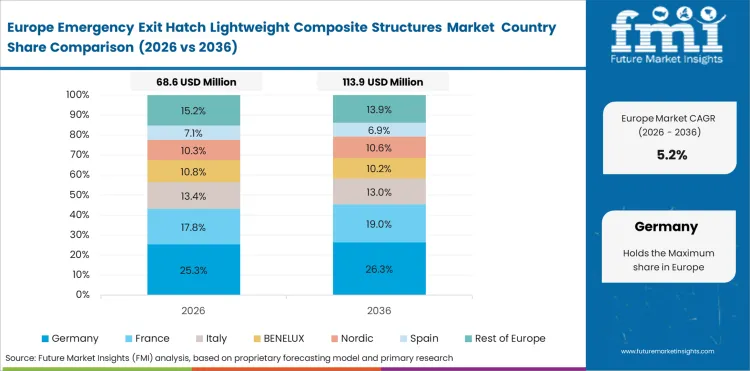
Germany has a strong aerospace manufacturing base and established suppliers. Germany is anticipated to see emergency exit hatch lightweight composite structures grow at a CAGR of 5.6% over the forecast period, driven by structural-component capability and participation in European aircraft programs. Commercial value is lower than in faster-growth countries. Approved aerospace structure work still supports supplier demand.
- Structural-component capability supports steady demand.
- European integration improves program continuity.
- Mature supply depth keeps execution reliable.
Competitive Landscape and Strategic Positioning
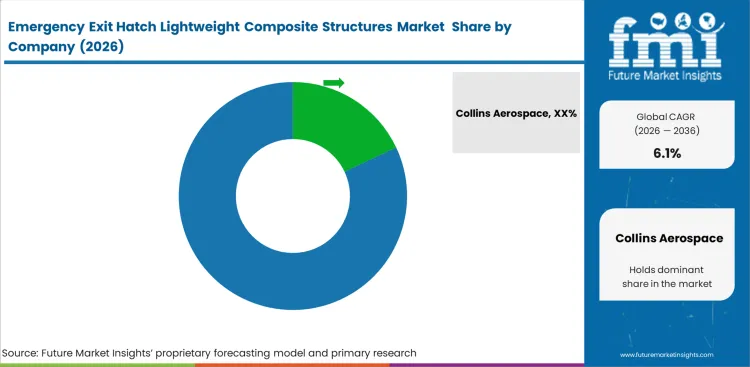
- Leading suppliers compete on composite structure capability, door-system integration, and platform approval access.
- Program awards matter more than open-volume competition due to long supply cycles and low supplier turnover.
- Entry barriers stay high due to tooling cost, testing burden, and certification effort.
Collins Aerospace, Saab, and Latécoère have a strong position due to long experience in aircraft doors and related aerostructures. Spirit AeroSystems, GKN Aerospace, Ducommun, and Dynamatic Technologies strengthen market supply through composite manufacturing and program-linked structures.
Aircraft manufacturers and tier suppliers prefer companies with stable quality systems, approved program experience, and reliable delivery for safety-critical structures. Smaller entrants can supply subassemblies, regional programs, or localized production, while full-hatch system supply usually requires deeper approval records.
Key Companies in the Emergency Exit Hatch Lightweight Composite Structures Market
Key global companies leading the emergency exit hatch lightweight composite structures market include:
- Door-system and composite structure leaders: Collins Aerospace, Saab, Latécoère
- Program-linked aerostructure suppliers: Spirit AeroSystems, GKN Aerospace
- Emerging structure and localization players: Dynamatic Technologies, Ducommun
Competitive Benchmarking: Emergency Exit Hatch Lightweight Composite Structures
| Company | Composite Door Structures | Program Integration | Production Scale | Geographic Footprint |
|---|---|---|---|---|
| Collins Aerospace | High | High | Strong | North America, Europe, Asia |
| Saab | High | High | Medium | Europe, North America |
| Latécoère | High | Medium | Medium | Europe, North America, Latin America |
| Spirit AeroSystems | Medium | High | Strong | North America, Europe, Asia |
| GKN Aerospace | Medium | High | Strong | Europe, North America, Asia |
| Dynamatic Technologies | Medium | Medium | Medium | India, Europe |
| Ducommun | Medium | Medium | Medium | North America |
Source: Future Market Insights competitive analysis, 2026. Ratings reflect relative positioning based on Composite Door Structures, Program Integration, and Production Scale.
Key Developments in Emergency Exit Hatch Lightweight Composite Structures
- February 2024: Airbus awarded Dynamatic Technologies a contract for manufacturing and assembly of A220 Family aircraft doors, expanding aerospace export production capacity from India.
- December 2025: Saab marked 20 years of successful collaboration with Boeing 787, continuing to manufacture doors and hatches for the aircraft.
- January 2026: Dynamatic Technologies announced readiness for delivery of the first complete ship-set of all eight Airbus A220 doors, marking a major “Make in India” aerostructure milestone.
Key Players in the Emergency Exit Hatch Lightweight Composite Structures:
Major Global Players:
- Collins Aerospace
- Saab
- Latécoère
- Spirit AeroSystems
Emerging Players/Startups
- Dynamatic Technologies
- Ducommun
- Select regional composite aerostructure specialists
Report Scope and Coverage
| Parameter | Details |
|---|---|
| Quantitative Units | USD 271.7 million to USD 490.0 million, at a CAGR of 6.1% |
| Market Definition | The emergency exit hatch lightweight composite structures market covers certified composite hatch and exit assemblies used in overwing exits, crew escape doors, cockpit escape hatches, and selected cabin emergency hatches across commercial aircraft platforms. |
| Regions Covered | North America, Latin America, Europe, Asia Pacific, Middle East & Africa |
| Countries Covered | India, China, Brazil, Canada, United States, France, Germany |
| Key Companies Profiled | Collins Aerospace, Saab, Latécoère, Spirit AeroSystems, GKN Aerospace, Dynamatic Technologies, Ducommun |
| Forecast Period | 2026 to 2036 |
| Approach | Bottom-up platform mapping with composite structure penetration and replacement logic, supported by primary interviews, desk research, and supplier capability validation across aircraft programs and regions. |
Emergency Exit Hatch Lightweight Composite Structures Market by Segments
Emergency Exit Hatch Lightweight Composite Structures Market Segmented by Aircraft Platform:
- Single-aisle
- Widebody
- Regional
- Business jets
- Rotorcraft
Emergency Exit Hatch Lightweight Composite Structures Market Segmented by Exit Type:
- Overwing exits
- Crew hatches
- Cabin hatches
- Roof hatches
Emergency Exit Hatch Lightweight Composite Structures Market Segmented by Material System:
- Carbon epoxy
- Carbon thermoplastic
- Glass sandwich
- Hybrid laminates
Emergency Exit Hatch Lightweight Composite Structures Market Segmented by Core Structure:
- Honeycomb sandwich
- Monolithic skins
- Ribbed shells
- Foam cores
Emergency Exit Hatch Lightweight Composite Structures Market Segmented by Operation Mode:
- Removable plug
- Hinged plug
- Spring assist
- Power assist
Emergency Exit Hatch Lightweight Composite Structures Market Segmented by Manufacturing Process:
- Autoclave prepreg
- Resin transfer
- Compression molding
- Induction welding
Emergency Exit Hatch Lightweight Composite Structures Market Segmented by End Use:
- OEM line-fit
- Aftermarket parts
- MRO repair
- Retrofit kits
Emergency Exit Hatch Lightweight Composite Structures Market Segmented by Region:
- North America
- USA
- Canada
- Mexico
- Latin America
- Brazil
- Chile
- Rest of Latin America
- Western Europe
- Germany
- UK
- Italy
- Spain
- France
- Nordic
- BENELUX
- Rest of Western Europe
- Eastern Europe
- Russia
- Poland
- Hungary
- Balkan & Baltic
- Rest of Eastern Europe
- East Asia
- China
- Japan
- South Korea
- South Asia and Pacific
- India
- ASEAN
- Australia & New Zealand
- Rest of South Asia and Pacific
- Middle East & Africa
- Kingdom of Saudi Arabia
- Other GCC Countries
- Turkiye
- South Africa
- Other African Union
- Rest of Middle East & Africa
Research Sources and Bibliography
- Airbus. (2024, February 9). Airbus awards landmark aerospace order for A220 aircraft doors to Bengaluru.
- Saab. (2025, December 21). Saab and Boeing 787 - 20 years of successful collaboration.
- Dynamatic Technologies Limited. (2026, January 13). Dynamatic Technologies sets new benchmark for ‘Make in India’: Delivers complete set of Airbus A220 doors in record time.
- Xinyue Xu, Jun Li, and Peng Zhao. (2025). Full-size mechanical evaluation for large aircraft cabin door with complex fabric rubber composite seal structures.
- Nutchanon Suvittawat, Christian Kurniawan, Jetanat Datephanyawat, Jordan Tay, Zhihao Liu, De Wen Soh, and Nuno Antunes Ribeiro. (2025, April). Advances in Aircraft Skin Defect Detection Using Computer Vision: A Survey and Comparison of YOLOv9 and RT-DETR Performance.
- Angelos Plastropoulos, Kostas Bardis, George Yazigi, Nicolas P. Avdelidis, and Mark Droznika. (2024, September). Aircraft Skin Machine Learning-Based Defect Detection and Size Estimation in Visual Inspections.
This Report Answers
- Can composite hatch structures add value faster in line-fit supply or in replacement demand?
- Is single-aisle aircraft demand stronger than widebody demand in this market?
- Can overwing exits keep a larger share than crew hatches through 2036?
- Is carbon epoxy still the main material route in certified hatch structures?
- Can thermoplastic systems gain faster attention in future programs?
- Is India likely to outpace mature aerospace hubs in percentage growth?
- Can Canada benefit from A220-linked production depth?
- Are qualification cost and tooling recovery limiting fresh supplier entry?
- Can replacement demand rise during heavy maintenance cycles?
- Is supplier advantage stronger across long-cycle platform awards?
- Can localized aerospace manufacturing lift country-level growth?
- Are composite structure inspection tools adding support to hatch quality control?
Frequently Asked Questions
What is included in this market?
Coverage includes certified composite structures used in overwing exits, crew hatches, cockpit escape hatches, and related emergency hatch assemblies.
Why does single-aisle aircraft lead demand?
Single-aisle fleets use overwing exits more broadly and carry larger production volumes.
How large is the market by 2036?
FMI projects USD 490.0 million by 2036.
Which exit type leads demand?
Overwing exits lead due to narrowbody and regional fleet mix.
What keeps supplier entry difficult?
Qualification cost, testing burden, and low part volumes keep entry barriers high.
Which country shows the fastest growth?
India leads current country ranking with 8.3% CAGR.
Why do OEM contracts matter more than spot demand?
Program awards lock suppliers into long production cycles and reduce easy share shifts.
How does replacement demand build over time?
Heavy checks can shift account logic from repair work toward replacement once downtime and traceability matter more.
Which material system leads this market?
Carbon epoxy keeps first position due to mature aerospace approval history.
What gives incumbent suppliers an edge?
Program history, composite structure maturity, and stable delivery performance carry strong weight.
Preview the report firsthand - request a free sample
Get SampleGet the brochure for pricing and purchase details.
Get PDFTable of Content
- Executive Summary
- Global Market Outlook
- Demand-side Trends
- Supply-side Trends
- Technology Roadmap Analysis
- Analysis and Recommendations
- Market Overview
- Market Coverage / Taxonomy
- Market Definition / Scope / Limitations
- Research Methodology
- Chapter Orientation
- Analytical Lens and Working Hypotheses
- Market Structure, Signals, and Trend Drivers
- Benchmarking and Cross-market Comparability
- Market Sizing, Forecasting, and Opportunity Mapping
- Research Design and Evidence Framework
- Desk Research Programme (Secondary Evidence)
- Company Annual and Sustainability Reports
- Peer-reviewed Journals and Academic Literature
- Corporate Websites, Product Literature, and Technical Notes
- Earnings Decks and Investor Briefings
- Statutory Filings and Regulatory Disclosures
- Technical White Papers and Standards Notes
- Trade Journals, Industry Magazines, and Analyst Briefs
- Conference Proceedings, Webinars, and Seminar Materials
- Government Statistics Portals and Public Data Releases
- Press Releases and Reputable Media Coverage
- Specialist Newsletters and Curated Briefings
- Sector Databases and Reference Repositories
- FMI Internal Proprietary Databases and Historical Market Datasets
- Subscription Datasets and Paid Sources
- Social Channels, Communities, and Digital Listening Inputs
- Additional Desk Sources
- Expert Input and Fieldwork (Primary Evidence)
- Primary Modes
- Qualitative Interviews and Expert Elicitation
- Quantitative Surveys and Structured Data Capture
- Blended Approach
- Why Primary Evidence is Used
- Field Techniques
- Interviews
- Surveys
- Focus Groups
- Observational and In-context Research
- Social and Community Interactions
- Stakeholder Universe Engaged
- C-suite Leaders
- Board Members
- Presidents and Vice Presidents
- R&D and Innovation Heads
- Technical Specialists
- Domain Subject-matter Experts
- Scientists
- Physicians and Other Healthcare Professionals
- Governance, Ethics, and Data Stewardship
- Research Ethics
- Data Integrity and Handling
- Primary Modes
- Tooling, Models, and Reference Databases
- Desk Research Programme (Secondary Evidence)
- Data Engineering and Model Build
- Data Acquisition and Ingestion
- Cleaning, Normalisation, and Verification
- Synthesis, Triangulation, and Analysis
- Quality Assurance and Audit Trail
- Market Background
- Market Dynamics
- Drivers
- Restraints
- Opportunity
- Trends
- Scenario Forecast
- Demand in Optimistic Scenario
- Demand in Likely Scenario
- Demand in Conservative Scenario
- Opportunity Map Analysis
- Product Life Cycle Analysis
- Supply Chain Analysis
- Investment Feasibility Matrix
- Value Chain Analysis
- PESTLE and Porter’s Analysis
- Regulatory Landscape
- Regional Parent Market Outlook
- Production and Consumption Statistics
- Import and Export Statistics
- Market Dynamics
- Global Market Analysis 2021 to 2025 and Forecast, 2026 to 2036
- Historical Market Size Value (USD Million) Analysis, 2021 to 2025
- Current and Future Market Size Value (USD Million) Projections, 2026 to 2036
- Y-o-Y Growth Trend Analysis
- Absolute $ Opportunity Analysis
- Global Market Pricing Analysis 2021 to 2025 and Forecast 2026 to 2036
- Global Market Analysis 2021 to 2025 and Forecast 2026 to 2036, By Aircraft Platform
- Introduction / Key Findings
- Historical Market Size Value (USD Million) Analysis By Aircraft Platform , 2021 to 2025
- Current and Future Market Size Value (USD Million) Analysis and Forecast By Aircraft Platform , 2026 to 2036
- Single-aisle
- Widebody
- Regional
- Business jets
- Rotorcraft
- Single-aisle
- Y-o-Y Growth Trend Analysis By Aircraft Platform , 2021 to 2025
- Absolute $ Opportunity Analysis By Aircraft Platform , 2026 to 2036
- Global Market Analysis 2021 to 2025 and Forecast 2026 to 2036, By Exit Type
- Introduction / Key Findings
- Historical Market Size Value (USD Million) Analysis By Exit Type, 2021 to 2025
- Current and Future Market Size Value (USD Million) Analysis and Forecast By Exit Type, 2026 to 2036
- Overwing exits
- Crew hatches
- Cabin hatches
- Roof hatches
- Overwing exits
- Y-o-Y Growth Trend Analysis By Exit Type, 2021 to 2025
- Absolute $ Opportunity Analysis By Exit Type, 2026 to 2036
- Global Market Analysis 2021 to 2025 and Forecast 2026 to 2036, By Material System
- Introduction / Key Findings
- Historical Market Size Value (USD Million) Analysis By Material System, 2021 to 2025
- Current and Future Market Size Value (USD Million) Analysis and Forecast By Material System, 2026 to 2036
- Carbon epoxy
- Carbon thermoplastic
- Glass sandwich
- Hybrid laminates
- Carbon epoxy
- Y-o-Y Growth Trend Analysis By Material System, 2021 to 2025
- Absolute $ Opportunity Analysis By Material System, 2026 to 2036
- Global Market Analysis 2021 to 2025 and Forecast 2026 to 2036, By Core Structure
- Introduction / Key Findings
- Historical Market Size Value (USD Million) Analysis By Core Structure, 2021 to 2025
- Current and Future Market Size Value (USD Million) Analysis and Forecast By Core Structure, 2026 to 2036
- Honeycomb sandwich
- Monolithic skins
- Ribbed shells
- Foam cores
- Honeycomb sandwich
- Y-o-Y Growth Trend Analysis By Core Structure, 2021 to 2025
- Absolute $ Opportunity Analysis By Core Structure, 2026 to 2036
- Global Market Analysis 2021 to 2025 and Forecast 2026 to 2036, By Operation
- Introduction / Key Findings
- Historical Market Size Value (USD Million) Analysis By Operation, 2021 to 2025
- Current and Future Market Size Value (USD Million) Analysis and Forecast By Operation, 2026 to 2036
- Removable plug
- Hinged plug
- Spring assist
- Power assist
- Removable plug
- Y-o-Y Growth Trend Analysis By Operation, 2021 to 2025
- Absolute $ Opportunity Analysis By Operation, 2026 to 2036
- Global Market Analysis 2021 to 2025 and Forecast 2026 to 2036, By Manufacturing Process
- Introduction / Key Findings
- Historical Market Size Value (USD Million) Analysis By Manufacturing Process, 2021 to 2025
- Current and Future Market Size Value (USD Million) Analysis and Forecast By Manufacturing Process, 2026 to 2036
- Autoclave prepreg
- Resin transfer
- Compression molding
- Induction welding
- Autoclave prepreg
- Y-o-Y Growth Trend Analysis By Manufacturing Process, 2021 to 2025
- Absolute $ Opportunity Analysis By Manufacturing Process, 2026 to 2036
- Global Market Analysis 2021 to 2025 and Forecast 2026 to 2036, By End Use
- Introduction / Key Findings
- Historical Market Size Value (USD Million) Analysis By End Use, 2021 to 2025
- Current and Future Market Size Value (USD Million) Analysis and Forecast By End Use, 2026 to 2036
- OEM line-fit
- Aftermarket parts
- MRO repair
- Retrofit kits
- OEM line-fit
- Y-o-Y Growth Trend Analysis By End Use, 2021 to 2025
- Absolute $ Opportunity Analysis By End Use, 2026 to 2036
- Global Market Analysis 2021 to 2025 and Forecast 2026 to 2036, By Region
- Introduction
- Historical Market Size Value (USD Million) Analysis By Region, 2021 to 2025
- Current Market Size Value (USD Million) Analysis and Forecast By Region, 2026 to 2036
- North America
- Latin America
- Western Europe
- Eastern Europe
- East Asia
- South Asia and Pacific
- Middle East & Africa
- Market Attractiveness Analysis By Region
- North America Market Analysis 2021 to 2025 and Forecast 2026 to 2036, By Country
- Historical Market Size Value (USD Million) Trend Analysis By Market Taxonomy, 2021 to 2025
- Market Size Value (USD Million) Forecast By Market Taxonomy, 2026 to 2036
- By Country
- USA
- Canada
- Mexico
- By Aircraft Platform
- By Exit Type
- By Material System
- By Core Structure
- By Operation
- By Manufacturing Process
- By End Use
- By Country
- Market Attractiveness Analysis
- By Country
- By Aircraft Platform
- By Exit Type
- By Material System
- By Core Structure
- By Operation
- By Manufacturing Process
- By End Use
- Key Takeaways
- Latin America Market Analysis 2021 to 2025 and Forecast 2026 to 2036, By Country
- Historical Market Size Value (USD Million) Trend Analysis By Market Taxonomy, 2021 to 2025
- Market Size Value (USD Million) Forecast By Market Taxonomy, 2026 to 2036
- By Country
- Brazil
- Chile
- Rest of Latin America
- By Aircraft Platform
- By Exit Type
- By Material System
- By Core Structure
- By Operation
- By Manufacturing Process
- By End Use
- By Country
- Market Attractiveness Analysis
- By Country
- By Aircraft Platform
- By Exit Type
- By Material System
- By Core Structure
- By Operation
- By Manufacturing Process
- By End Use
- Key Takeaways
- Western Europe Market Analysis 2021 to 2025 and Forecast 2026 to 2036, By Country
- Historical Market Size Value (USD Million) Trend Analysis By Market Taxonomy, 2021 to 2025
- Market Size Value (USD Million) Forecast By Market Taxonomy, 2026 to 2036
- By Country
- Germany
- UK
- Italy
- Spain
- France
- Nordic
- BENELUX
- Rest of Western Europe
- By Aircraft Platform
- By Exit Type
- By Material System
- By Core Structure
- By Operation
- By Manufacturing Process
- By End Use
- By Country
- Market Attractiveness Analysis
- By Country
- By Aircraft Platform
- By Exit Type
- By Material System
- By Core Structure
- By Operation
- By Manufacturing Process
- By End Use
- Key Takeaways
- Eastern Europe Market Analysis 2021 to 2025 and Forecast 2026 to 2036, By Country
- Historical Market Size Value (USD Million) Trend Analysis By Market Taxonomy, 2021 to 2025
- Market Size Value (USD Million) Forecast By Market Taxonomy, 2026 to 2036
- By Country
- Russia
- Poland
- Hungary
- Balkan & Baltic
- Rest of Eastern Europe
- By Aircraft Platform
- By Exit Type
- By Material System
- By Core Structure
- By Operation
- By Manufacturing Process
- By End Use
- By Country
- Market Attractiveness Analysis
- By Country
- By Aircraft Platform
- By Exit Type
- By Material System
- By Core Structure
- By Operation
- By Manufacturing Process
- By End Use
- Key Takeaways
- East Asia Market Analysis 2021 to 2025 and Forecast 2026 to 2036, By Country
- Historical Market Size Value (USD Million) Trend Analysis By Market Taxonomy, 2021 to 2025
- Market Size Value (USD Million) Forecast By Market Taxonomy, 2026 to 2036
- By Country
- China
- Japan
- South Korea
- By Aircraft Platform
- By Exit Type
- By Material System
- By Core Structure
- By Operation
- By Manufacturing Process
- By End Use
- By Country
- Market Attractiveness Analysis
- By Country
- By Aircraft Platform
- By Exit Type
- By Material System
- By Core Structure
- By Operation
- By Manufacturing Process
- By End Use
- Key Takeaways
- South Asia and Pacific Market Analysis 2021 to 2025 and Forecast 2026 to 2036, By Country
- Historical Market Size Value (USD Million) Trend Analysis By Market Taxonomy, 2021 to 2025
- Market Size Value (USD Million) Forecast By Market Taxonomy, 2026 to 2036
- By Country
- India
- ASEAN
- Australia & New Zealand
- Rest of South Asia and Pacific
- By Aircraft Platform
- By Exit Type
- By Material System
- By Core Structure
- By Operation
- By Manufacturing Process
- By End Use
- By Country
- Market Attractiveness Analysis
- By Country
- By Aircraft Platform
- By Exit Type
- By Material System
- By Core Structure
- By Operation
- By Manufacturing Process
- By End Use
- Key Takeaways
- Middle East & Africa Market Analysis 2021 to 2025 and Forecast 2026 to 2036, By Country
- Historical Market Size Value (USD Million) Trend Analysis By Market Taxonomy, 2021 to 2025
- Market Size Value (USD Million) Forecast By Market Taxonomy, 2026 to 2036
- By Country
- Kingdom of Saudi Arabia
- Other GCC Countries
- Turkiye
- South Africa
- Other African Union
- Rest of Middle East & Africa
- By Aircraft Platform
- By Exit Type
- By Material System
- By Core Structure
- By Operation
- By Manufacturing Process
- By End Use
- By Country
- Market Attractiveness Analysis
- By Country
- By Aircraft Platform
- By Exit Type
- By Material System
- By Core Structure
- By Operation
- By Manufacturing Process
- By End Use
- Key Takeaways
- Key Countries Market Analysis
- USA
- Pricing Analysis
- Market Share Analysis, 2025
- By Aircraft Platform
- By Exit Type
- By Material System
- By Core Structure
- By Operation
- By Manufacturing Process
- By End Use
- Canada
- Pricing Analysis
- Market Share Analysis, 2025
- By Aircraft Platform
- By Exit Type
- By Material System
- By Core Structure
- By Operation
- By Manufacturing Process
- By End Use
- Mexico
- Pricing Analysis
- Market Share Analysis, 2025
- By Aircraft Platform
- By Exit Type
- By Material System
- By Core Structure
- By Operation
- By Manufacturing Process
- By End Use
- Brazil
- Pricing Analysis
- Market Share Analysis, 2025
- By Aircraft Platform
- By Exit Type
- By Material System
- By Core Structure
- By Operation
- By Manufacturing Process
- By End Use
- Chile
- Pricing Analysis
- Market Share Analysis, 2025
- By Aircraft Platform
- By Exit Type
- By Material System
- By Core Structure
- By Operation
- By Manufacturing Process
- By End Use
- Germany
- Pricing Analysis
- Market Share Analysis, 2025
- By Aircraft Platform
- By Exit Type
- By Material System
- By Core Structure
- By Operation
- By Manufacturing Process
- By End Use
- UK
- Pricing Analysis
- Market Share Analysis, 2025
- By Aircraft Platform
- By Exit Type
- By Material System
- By Core Structure
- By Operation
- By Manufacturing Process
- By End Use
- Italy
- Pricing Analysis
- Market Share Analysis, 2025
- By Aircraft Platform
- By Exit Type
- By Material System
- By Core Structure
- By Operation
- By Manufacturing Process
- By End Use
- Spain
- Pricing Analysis
- Market Share Analysis, 2025
- By Aircraft Platform
- By Exit Type
- By Material System
- By Core Structure
- By Operation
- By Manufacturing Process
- By End Use
- France
- Pricing Analysis
- Market Share Analysis, 2025
- By Aircraft Platform
- By Exit Type
- By Material System
- By Core Structure
- By Operation
- By Manufacturing Process
- By End Use
- India
- Pricing Analysis
- Market Share Analysis, 2025
- By Aircraft Platform
- By Exit Type
- By Material System
- By Core Structure
- By Operation
- By Manufacturing Process
- By End Use
- ASEAN
- Pricing Analysis
- Market Share Analysis, 2025
- By Aircraft Platform
- By Exit Type
- By Material System
- By Core Structure
- By Operation
- By Manufacturing Process
- By End Use
- Australia & New Zealand
- Pricing Analysis
- Market Share Analysis, 2025
- By Aircraft Platform
- By Exit Type
- By Material System
- By Core Structure
- By Operation
- By Manufacturing Process
- By End Use
- China
- Pricing Analysis
- Market Share Analysis, 2025
- By Aircraft Platform
- By Exit Type
- By Material System
- By Core Structure
- By Operation
- By Manufacturing Process
- By End Use
- Japan
- Pricing Analysis
- Market Share Analysis, 2025
- By Aircraft Platform
- By Exit Type
- By Material System
- By Core Structure
- By Operation
- By Manufacturing Process
- By End Use
- South Korea
- Pricing Analysis
- Market Share Analysis, 2025
- By Aircraft Platform
- By Exit Type
- By Material System
- By Core Structure
- By Operation
- By Manufacturing Process
- By End Use
- Russia
- Pricing Analysis
- Market Share Analysis, 2025
- By Aircraft Platform
- By Exit Type
- By Material System
- By Core Structure
- By Operation
- By Manufacturing Process
- By End Use
- Poland
- Pricing Analysis
- Market Share Analysis, 2025
- By Aircraft Platform
- By Exit Type
- By Material System
- By Core Structure
- By Operation
- By Manufacturing Process
- By End Use
- Hungary
- Pricing Analysis
- Market Share Analysis, 2025
- By Aircraft Platform
- By Exit Type
- By Material System
- By Core Structure
- By Operation
- By Manufacturing Process
- By End Use
- Kingdom of Saudi Arabia
- Pricing Analysis
- Market Share Analysis, 2025
- By Aircraft Platform
- By Exit Type
- By Material System
- By Core Structure
- By Operation
- By Manufacturing Process
- By End Use
- Turkiye
- Pricing Analysis
- Market Share Analysis, 2025
- By Aircraft Platform
- By Exit Type
- By Material System
- By Core Structure
- By Operation
- By Manufacturing Process
- By End Use
- South Africa
- Pricing Analysis
- Market Share Analysis, 2025
- By Aircraft Platform
- By Exit Type
- By Material System
- By Core Structure
- By Operation
- By Manufacturing Process
- By End Use
- USA
- Market Structure Analysis
- Competition Dashboard
- Competition Benchmarking
- Market Share Analysis of Top Players
- By Regional
- By Aircraft Platform
- By Exit Type
- By Material System
- By Core Structure
- By Operation
- By Manufacturing Process
- By End Use
- Competition Analysis
- Competition Deep Dive
- Collins Aerospace
- Overview
- Product Portfolio
- Profitability by Market Segments (Product/Age /Sales Channel/Region)
- Sales Footprint
- Strategy Overview
- Marketing Strategy
- Product Strategy
- Channel Strategy
- Saab
- Latécoère
- Spirit AeroSystems
- Dynamatic Technologies
- Ducommun
- Select regional composite aerostructure specialists
- Collins Aerospace
- Competition Deep Dive
- Assumptions & Acronyms Used


