

- Industry Size (2026)
- USD 63.5 Mn
- Forecast (2036)
- USD 154.5 Mn
- CAGR (2026 to 2036)
- 9.30%
Aircraft Flap Track Fairing Retrofit Kits Market Size, Market Forecast and Outlook By FMI
The aircraft flap track fairing retrofit kits market was valued at USD 58.1 million in 2025 and it is poised to hit USD 63.5 million in 2026 at a CAGR of 9.30% during the forecast period. Rising revenues drive the market’s overall valuation upward to USD 154.5 million through 2036 as airlines aggressively target trailing edge drag reduction to offset rising operational fuel minimums.
Airlines calculating fractional fuel penalties on aging fleets possess zero tolerance for aerodynamic degradation, shifting momentum across the aircraft flap fairing retrofit market. Maintenance directors at tier-one operators face a strict reality where evaluating fairing retrofit kits for aging narrowbody fleets yields verifiable gallon-per-block-hour savings, making standard aircraft fairings repair insufficient. Delaying this transition forces airlines to absorb compounded fuel penalties that quickly exceed the aircraft flap track fairing retrofit cost. FMI's assessment indicates that procurement teams prioritize drop-in flap track fairing retrofit kits over patch repairs, bypassing legacy metal variants for shape-optimized configurations.
Summary of Aircraft Flap Track Fairing Retrofit Kits Market
- Aircraft Flap Track Fairing Retrofit Kits Market Definition
- Aircraft Flap Track Fairing Retrofit Kits represent engineered assemblies designed to replace original trailing-edge aerodynamic shields on existing commercial and military fleets. These packages minimize drag profiles, lower fuel consumption, and extend component lifecycles for operators managing legacy airframes.
- Demand Drivers in the Market
- Rising fuel costs compel fleet operations managers to implement fractional aerodynamic improvements across mature narrowbody assets.
- Aging factory-installed metallic fairings force maintenance directors to seek advanced composite replacements rather than execute repetitive localized repairs.
- Sustainability mandates push airline executives to deploy airline fuel burn reduction retrofit kits as a quantifiable emissions-lowering strategy.
- Key Segments Analyzed in the FMI Report
- Narrowbody commercial aircraft is projected to hold 61.0% share in 2026, driven by the sheer volume of aging 737NG and A320ceo airframes requiring lifecycle extensions.
- Flap track fairing tip replacement kits is anticipated to lead by retrofit scope through 2036 based on favourable cost-to-benefit installation ratios during short ground times.
- Composite kits is set to command 68.0% share in 2026, favoured for exceptional strength-to-weight characteristics that amplify baseline fuel savings.
- Airline direct retrofit programs is estimated to secure 44.0% share in 2026 as major carriers bypass intermediaries to lock in fleet-wide component supply.
- Heavy-check scheduled installations is poised to capture 52.0% share in 2026, aligning upgrades with mandatory airframe inspection intervals to avoid dedicated downtime.
- India: 10.4% compound growth, reflecting intense utilization rates and aggressive cost-per-seat optimization strategies among domestic low-cost carriers.
- Analyst Opinion at FMI
- Nikhil Kaitwade, Principal Analyst, Process Automation, at FMI, points out, "Procurement directors assume that composite material costs represent the primary barrier to widespread retrofit adoption. The critical friction point sits in the certification workflow. Developing a superior aerodynamic shape in the lab means nothing until it secures a Supplemental Type Certificate that covers multiple variants of a single aircraft family. We see MRO facilities actively delaying bulk orders until flap track fairing retrofit kit manufacturers can guarantee cross-compatibility across an entire mixed fleet, effectively turning regulatory approval breadth into a hard commercial moat within the commercial aviation retrofit market fairings sector."
- Strategic Implications / Executive Takeaways
- Component manufacturers must prioritize multi-variant STC approvals to satisfy fleet planners managing diverse legacy assets.
- Airline procurement officers gain significant pricing leverage by bundling fairing upgrades with scheduled heavy-check airframe overhauls.
- MRO facility managers who secure exclusive regional installation rights for high-performance kits immediately capture high-margin overflow business from major carriers.
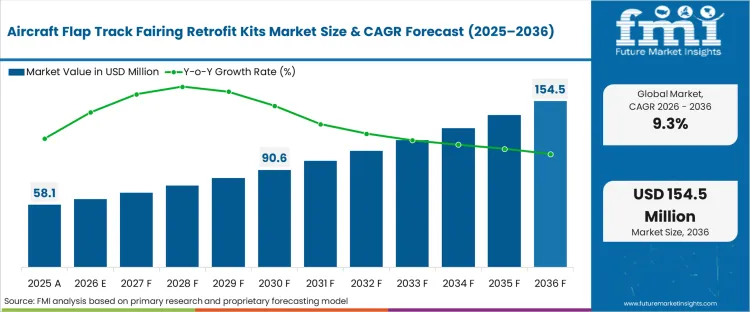
Key Takeaways
| Metric | Details |
|---|---|
| Industry Size (2026) | USD 63.5 million |
| Industry Value (2036) | USD 154.5 million |
| CAGR (2026 to 2036) | 9.30% |
Source: Future Market Insights (FMI) analysis, based on proprietary forecasting model and primary research
Once an engineering department validates a specific fairing modification under a Supplemental Type Certificate, fleet-wide standardization becomes the default financial strategy. Engineering planners schedule these upgrades directly into existing heavy-check intervals, eliminating dedicated downtime. This synchronized installation profile changes the investment from a discretionary aerodynamic enhancement to a scheduled compliance action.
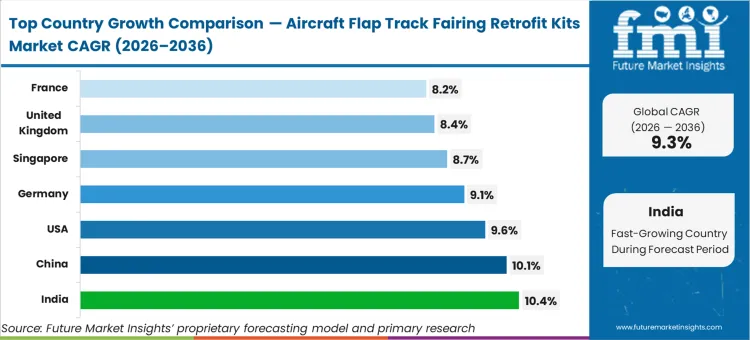
India leads at 10.4% as extreme cost-per-seat pressure forces low-cost carriers to maximize efficiency on legacy narrowbody frames, while China tracks at 10.1% backed by intense domestic fleet utilization. The United States advances at 9.6% due to its massive installed base and established certification ecosystem. Germany expands at 9.1%, followed by Singapore at 8.7%, the United Kingdom at 8.4%, and France at 8.2%, reflecting adoption timelines tied to established airframe lifecycle transitions. Regional variation ultimately hinges on the balance between sheer fleet expansion in Asian hubs versus validation-led transition cycles in mature Western regulatory environments.
Aircraft Flap Track Fairing Retrofit Kits Market Definition
Aerodynamic retrofit kits for aircraft encompass engineered enclosures and hardware designed to replace original trailing-edge flap mechanisms on existing airframes. These components attach directly to the wing structure, shielding the extension tracks from drag while maintaining integrity under flight loads. Fleet operators install these assemblies post-delivery to improve fuel efficiency and restore baseline aerodynamic profiles. FMI notes that these packages rely heavily on advanced aircraft branding decal systems integrations to match existing aesthetics while upgrading underlying performance.
Aircraft Flap Track Fairing Retrofit Kits Market Inclusions
Scope covers full composite shells, attachment brackets, replacement tips, and associated fastening hardware found within aircraft fairing retrofit kits necessary for post-delivery installation. Modifications validated through Supplemental Type Certificates for specific narrowbody and widebody platforms fall within this boundary. FMI analysts highlight that global air transport mro integration services packaged directly with the physical hardware are measured within the core valuation.
Aircraft Flap Track Fairing Retrofit Kits Market Exclusions
Original equipment installations executed on the primary assembly line sit outside this specific tracking parameter. Standard cosmetic paints, pure aircraft livery change film applications, and aircraft winglet retrofit kits without trailing-edge hardware changes are explicitly excluded. The functional rationale stems from distinguishing operational fleet upgrades from initial manufacturing supply chains, isolating the aftermarket aerodynamic improvement cycle.
Aircraft Flap Track Fairing Retrofit Kits Market Research Methodology
- Primary Research: Fleet maintenance directors, airline procurement officers, and operational heads at certified aircraft modification kit suppliers.
- Desk Research: FAA Supplemental Type Certificate registries, EASA airworthiness directives, and OEM technical service bulletins.
- Market-Sizing and Forecasting: Post-delivery heavy-check schedules correlated with registered legacy narrowbody fleet data.
- Data Validation and Update Cycle: Independent aftermarket aviation component distributor sales records cross-referenced annually.
Segmental Analysis
Aircraft Flap Track Fairing Retrofit Kits Market Analysis by Aircraft Platform
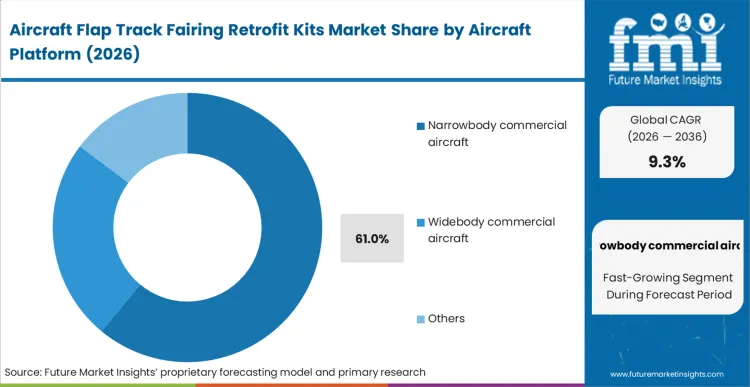
Airlines aggressively prioritising unit cost reduction turn first to their highest-utilization assets, making narrowbody aircraft drag reduction retrofit kits the absolute center of gravity for aftermarket upgrades. Narrowbody commercial aircraft holds 61.0% share in 2026, and FMI's analysis indicates this dominance stems directly from operators calculating aerodynamic kits for 737-800 fuel savings as airframes enter mid-life heavy-check windows. Fleet maintenance directors managing these massive homogeneous fleets evaluate a 737 flap track fairing retrofit knowing that fractional fuel savings on a single trailing-edge component multiplies into millions of dollars annually. Substituting degraded original components with advanced metallic composite hybrid geometries operational economics favourably. What procurement directors rarely factor into early ROI models is that widebody platforms, despite burning significantly more fuel per hour, spend a higher percentage of their flight profiles in cruise conditions where specific trailing-edge drag penalties are less pronounced than during the high-frequency cycles typical of narrowbody routing. Operators pursuing flap track fairing retrofit for 737NG fleets capture immediate savings, whereas widebody upgrades often trap capital in low-frequency assets with slower payback periods.
- Initial screening: Fleet planners target narrowbody airframes approaching scheduled commercial aircraft mro C-checks. Maintenance directors gain verifiable fuel burn reductions without adding dedicated out-of-service time.
- Performance validation: Engineering teams measure post-installation block-hour fuel consumption against historical baseline data. Procurement officers validate the capital expenditure by confirming the promised aerodynamic efficiency gains in live operations.
- Fleet expansion: Carriers execute follow-on orders to standardize the modification across all remaining identical tail numbers. Airline executives secure long-term operational cost predictability by eliminating mixed-configuration drag penalties.
Aircraft Flap Track Fairing Retrofit Kits Market Analysis by Retrofit Scope
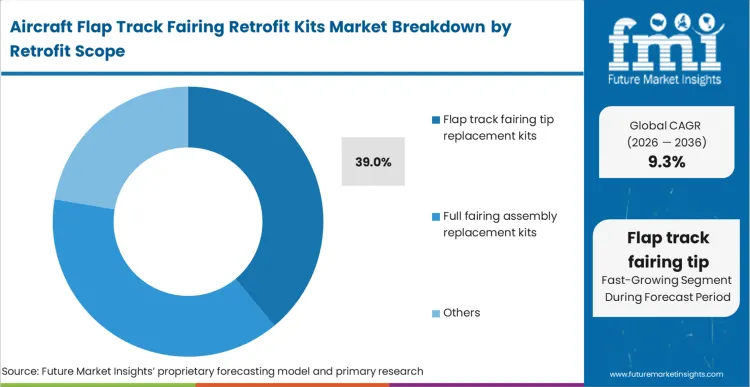
Replacing worn trailing edges entirely represents a massive capital expenditure, forcing operators to closely analyze flap track fairing replacement vs retrofit economics. Flap track fairing tip replacement kits capture 39.0% share because they isolate the aerodynamic intervention to the aft-most section, where vortex shedding creates the most severe drag penalty. FMI observes that engineers evaluating aircraft MRO fairing modification kits prefer this targeted approach because it leaves primary load-bearing forward sections untouched, radically simplifying installation workflows. Modifying just the aft tips with repairable composite leading edge technology delivers approximately eighty per cent of the aerodynamic benefit of a full assembly replacement at a third of the cost. What the share figure alone does not communicate is that tip-only replacements frequently mask underlying corrosion issues in the retained forward metallic brackets, a reality that line mechanics routinely discover only after the aft section is removed. Maintenance managers who ignore the condition of the forward housing when scheduling a tip replacement routinely face unscheduled repairs that destroy the planned margin of the original upgrade.
- Procurement targeting: Supply chain managers authorize tip replacements based on immediate component cost metrics. Financial planners avoid the heavy capital outlay required for complete fairing assembly transitions.
- Operational discovery: Line mechanics identify fatigue within the retained forward brackets during tip integration. Maintenance supervisors face unbudgeted labor hours to address legacy corrosion hidden beneath the new aerodynamic surface.
- Lifecycle comparison: Engineering directors evaluate the true total cost of segmented upgrades versus full assembly replacements over a ten-year horizon. Fleet executives must decide whether piecemeal aerodynamic gains justify the retained risk.
Aircraft Flap Track Fairing Retrofit Kits Market Analysis by Material
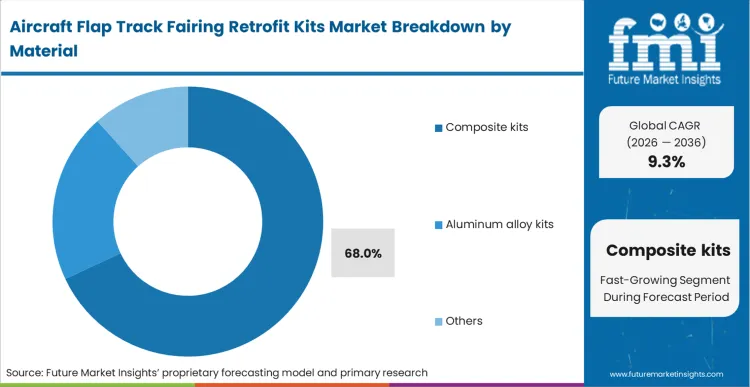
Weight penalties nullify aerodynamic gains, forcing a strict selection process where buyers contrast composite vs aluminum flap fairing retrofit kits before issuing approvals. Composite flap track fairing retrofit kits secure 68.0% share in 2026, driven by an undeniable strength-to-weight advantage that allows designers to optimize curvature without adding dead weight. FMI's assessment indicates that engineers favor these composite airframes components because they resist the intense vibrational fatigue generated directly behind engine exhaust plumes far better than legacy alloys. This specific fatigue resistance drastically stretches the interval between required visual inspections. The practitioner reality hidden beneath this massive adoption rate is that standard line mechanics cannot easily patch minor ramp-damage on thermoplastic fairings using legacy metal-working techniques, inadvertently increasing the aircraft fairing retrofit maintenance burden. Airlines that transition their entire fleet to composite fairings without simultaneously upgrading the composite repair capabilities of their regional outstations quickly accumulate a backlog of grounded aircraft waiting for specialized technicians.
- Fatigue resistance: Composite materials withstand extreme trailing-edge vibration profiles without stress fracturing. Engineers avoid the repetitive crack-propagation monitoring required for aging aluminum assemblies.
- Vulnerability reality: Ground service vehicles routinely strike low-hanging flap mechanisms during turnarounds. Line mechanics lack the specialized curing tools to execute rapid ramp repairs on complex carbon-fiber geometries.
- Procedural compliance: Quality assurance managers demand strict adherence to composite-specific curing protocols during unscheduled maintenance. Maintenance directors must dispatch specialized repair teams to remote outstations to clear minor damage hold-outs.
Aircraft Flap Track Fairing Retrofit Kits Market Analysis by Sales Channel
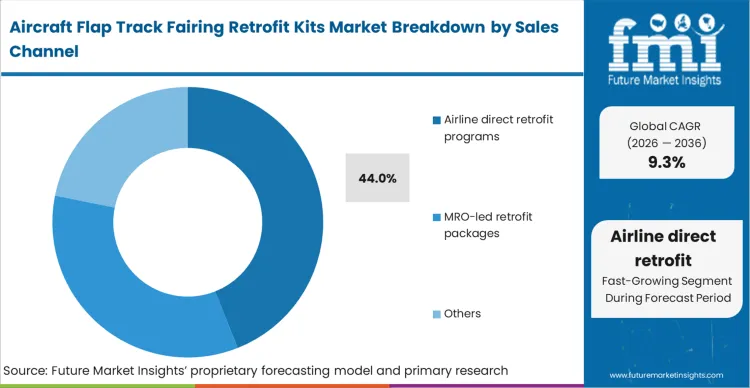
Major carriers refuse to surrender aftermarket pricing control to third-party integrators when scaling modifications across hundreds of airframes. Airline direct retrofit programs account for 44.0% share in 2026, as operators managing the retrofit kit supply chain for aircraft fairings bypass MRO markups entirely. Based on FMI's estimates, procurement officers issue an aircraft retrofit kit RFQ fairings directly to specialized component manufacturers to guarantee component availability exactly when specific tail numbers enter the hangar. By controlling the aerostructure hardware flow internally, airlines dictate the installation pace. What generalist market models miss is that this direct-procurement dominance silently starves the secondary MRO channel of critical allocation volume, severely complicating MRO partner selection for aerodynamic retrofit programs for mid-tier leasing companies. Carriers attempting to build direct channels without a sufficiently large fleet footprint inevitably fail to secure priority manufacturing slots, leaving them exposed to erratic delivery schedules that shatter carefully planned maintenance alignments.
- Direct negotiation: Procurement officers bypass third-party integrators to secure baseline component pricing. Airline executives lock in multi-year supply agreements that insulate their upgrade programs from spot-market volatility.
- Allocation control: Supply chain managers dictate exact delivery dates synchronized with internal heavy-check calendars. Maintenance directors avoid hangar bottlenecks caused by delayed third-party hardware shipments.
- Secondary market squeeze: MRO facility managers struggle to source identical kits for smaller regional operators due to tier-one allocation commitments. Leasing directors face extended out-of-service periods waiting for delayed hardware.
Aircraft Flap Track Fairing Retrofit Kits Market Analysis by Installation Type
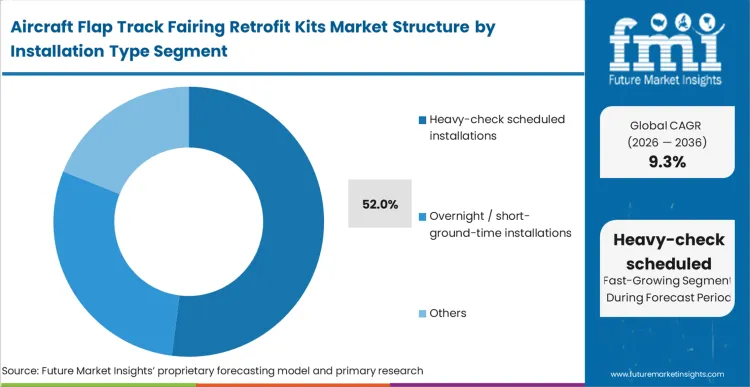
Aligning upgrades with existing teardown schedules represents the only financially viable path for complex trailing-edge modifications. Heavy-check scheduled installations capture 52.0% share in 2026, reflecting the absolute necessity of executing a fairing retrofit during heavy maintenance check intervals. FMI analysts note that maintenance planners categorically refuse to take revenue-generating aircraft out of service solely for an aerodynamic upgrade, making aircraft fairing retrofit downtime reduction the primary installation metric. Embedding the aerospace lightweight materials installation into an already-scheduled teardown effectively neutralizes the flap track fairing retrofit installation time penalty. A critical contradiction exists within this planning logic: heavy-check facilities are fundamentally optimized for inspection and repair, not rapid production-style component swapping. Operators who ship unverified or partially complete fairing kits to heavy-maintenance bases routinely trigger cascading delays that hold up the entire aircraft return-to-service date, transforming a planned efficiency win into a catastrophic scheduling failure.
- Early adopters: Legacy carriers integrate fairing replacements strictly during mandatory mid-life airframe overhauls. Maintenance planners secure aerodynamic improvements without logging dedicated out-of-service penalty hours.
- Workflow disruption: Lead mechanics encounter undocumented fitment issues between new composite fairings and aging wing structures. Heavy-check supervisors face critical-path delays as technicians fabricate custom shims to resolve mating discrepancies.
- Late converts: Smaller operators attempt identical installations during compressed overnight line-maintenance windows. Engineering directors ultimately abandon short-ground-time retrofits after repeated dispatch delays force them back into the heavy-check paradigm.
Aircraft Flap Track Fairing Retrofit Kits Market Drivers, Restraints, and Opportunities
Aggressive cost-per-seat optimization strategies force airline executives to target previously ignored trailing-edge aerodynamic inefficiencies to maximize fuel savings from flap track fairing retrofit programs. High-utilization operators face a reality where fractional fuel penalties generated by degraded metallic fairings compound rapidly, fundamentally changing how airlines evaluate retrofit ROI for fairing kits. Procurement directors must identify the airline retrofit kits with fastest payback to stem this specific operational hemorrhage. Delaying the transition to shape-optimised fairings guarantees that the carrier will continue burning excess fuel alongside high-draw systems like aircraft exterior lighting on every cycle, a continued financial leak that rapidly eclipses the initial capital requirement of the upgrade hardware.
The certification timeline for multi-variant compatibility introduces immense certification risk in aircraft fairing retrofit kits, restricting the pace at which suppliers can release viable packages. Regulatory authorities demand exhaustive computational fluid dynamics validation before issuing an FAA STC flap track fairing retrofit approval for any aerodynamic modification. These strict aircraft flap track fairing retrofit challenges cap the number of approved kits available on the market, forcing fleet managers to wait for official clearance even when the physical hardware is ready for deployment. Emerging digital twin modeling accelerates initial validation phases, but physical flight testing requirements remain a rigid bottleneck.
Opportunities in the Aircraft Flap Track Fairing Retrofit Kits Market
- Lease-transition bundling: Component suppliers target flap track fairing retrofit for leased aircraft directly into the mandatory maintenance checks executed when narrowbody aircraft transfer between operators. Asset managers secure higher lease rates by executing aircraft lease return fairing modifications prior to delivery.
- Thermoplastic recycling integration: Manufacturers utilize aerospace composite materials using pcr capabilities to produce sustainable fairing components. Procurement officers meet internal ESG mandates and hit retrofit kits for airline carbon reduction targets while achieving baseline drag reduction goals.
- Outstation repair tooling: Tooling developers create portable composite curing systems designed specifically for ramp environments. Line mechanics execute permanent fairing repairs without routing the aircraft back to a central heavy-maintenance hub.
Regional Analysis
Regionally, the Aircraft Flap Track Fairing Retrofit Kits market spans more than 40 countries across North America, Latin America, Western and Eastern Europe, East Asia, South Asia & the Pacific, and the Middle East & Africa.
.webp "Top Country Growth Comparison Aircraft Flap Track Fairing Retrofit Kits Market Cagr (2026 2036)")
| Country | CAGR (2026 to 2036) |
|---|---|
| India | 10.4% |
| China | 10.1% |
| United States | 9.6% |
| Germany | 9.1% |
| Singapore | 8.7% |
| United Kingdom | 8.4% |
| France | 8.2% |
Source: Future Market Insights (FMI) analysis, based on proprietary forecasting model and primary research
South Asia and Pacific Aircraft Flap Track Fairing Retrofit Kits Market Analysis
Extreme cost-per-seat pressure defines the operational calculus for carriers scaling massive narrowbody fleets across the subcontinent. Low-cost operators facing razor-thin margins cannot tolerate the aerodynamic penalties inherent in aging factory fairings. FMI's analysis indicates that engineering directors in this region aggressively pursue aftermarket composite retrofits to maximize the block-hour efficiency of second-hand 737NG and A320ceo assets acquired from Western operators. The reliance on outsourced heavy-maintenance facilities means that local adoption rates depend entirely on the ability of regional MRO hubs to source and integrate STC-approved hardware at scale.
- India: Legacy narrowbody fleet expansion collides directly with volatile aviation turbine fuel pricing, driving momentum across the India aircraft retrofit fairings market. Expanding at a 10.4% CAGR, the Indian sector accelerates as tier-one low-cost carriers standardise their trailing-edge configurations. Operations directors deploy targeted fairing upgrades to extract fractional margin improvements utilizing specialized aerospace maintenance chemical applications on high-frequency domestic routes. Suppliers who establish localized distribution for composite kits capture long-term supply agreements with these rapidly scaling domestic operators.
- Singapore: Mature maintenance hubs position themselves as the premium integration centers for complex upgrades, driving volume in Singapore MRO aircraft retrofit kits. Facility managers leverage existing high-technology aircraft refurbishing capabilities to execute fairing transitions during standard heavy checks. Growing at an 8.7% CAGR, this hub relies on technical execution rather than domestic fleet size. Engineering teams successfully integrate these modifications during lease-transition overhauls, cementing the country's status as a critical node for asset optimization.
East Asia Aircraft Flap Track Fairing Retrofit Kits Market Analysis
Intense domestic fleet utilization leaves virtually zero margin for unscheduled maintenance, fundamentally altering how operators approach modifications. Airline planners in this sector prioritize absolute component reliability over theoretical maximum drag reduction, demanding fairing kits that survive relentless climb-and-descent cycles without fatiguing. As per FMI's projection, procurement officers mandate rigorous vibration-resistance profiles before authorizing fleet-wide transitions. Regional adoption accelerates only when suppliers prove that their composite geometries eliminate the repetitive crack-monitoring requirements associated with legacy metallic trailing edges.
- China: Massive state-backed carriers operate high-density domestic networks, aggressively fueling the China aviation drag reduction retrofit market. Expanding at a 10.1% CAGR, adoption relies heavily on utilizing advanced aerospace adhesives and sealants to ensure permanent bonding. Maintenance supervisors demand robust composite fairing solutions that eliminate the recurring aluminum fatigue cracks found on aging platforms. Chinese operators eventually dictate regional upgrade standards, forcing secondary Asian carriers to adopt identical aerodynamic configurations to remain competitive.
North America Aircraft Flap Track Fairing Retrofit Kits Market Analysis
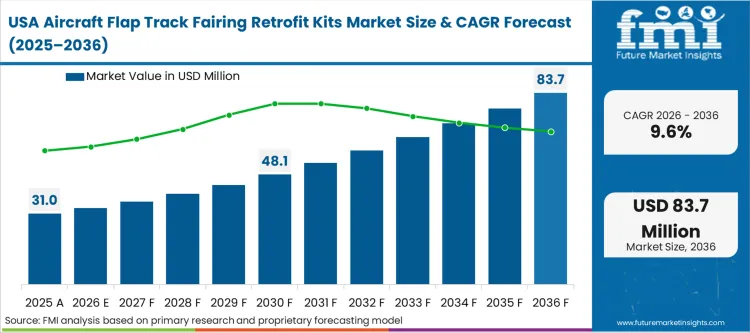
The sheer density of the installed 737NG and classic narrowbody base creates an immediate demand profile for aerodynamic life-extension programs. Regulatory proximity plays a massive role; engineering teams operate within the same FAA certification ecosystem as the primary retrofit developers, drastically shrinking the timeline from STC issuance to hangar integration. FMI observes that major legacy carriers execute these upgrades as programmatic fleet-renewal initiatives rather than isolated efficiency tests. The dynamic switch from proving the aerodynamic concept to securing sufficient hardware allocation from a constrained domestic supply chain.
- United States: Tracking at a 9.6% CAGR, the aircraft flap track fairing retrofit kits market in the USA expands as these massive orders consume available production capacity. Fleet directors manage hundreds of identical airframes approaching critical mid-life heavy-check intervals simultaneously, driving expansion across the aircraft flap track fairing retrofit kits USA segment. Procurement teams leverage this volume to bypass intermediaries and secure direct allocations of high performance composites fairing kits directly from specialised manufacturers. This concentration of buying power effectively locks out smaller international operators from securing near-term delivery slots for premium aerodynamic hardware.
Western Europe Aircraft Flap Track Fairing Retrofit Kits Market Analysis
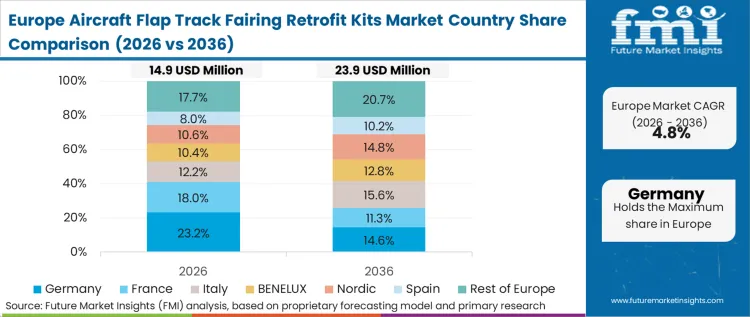
Strict sustainability mandates and aggressive carbon-reduction targets reshape the financial justification for aftermarket aerodynamic improvements. Airline executives utilize fairing retrofits not just for immediate fuel savings, but to demonstrate quantifiable progress against emerging continental emissions frameworks. In FMI's view, environmental compliance officers increasingly dictate procurement priorities, elevating an EASA approved aircraft drag reduction retrofit from an operational preference to a regulatory shield. The established network of premium MRO facilities guarantees high-quality installation, but the fragmented nature of national fleets complicates the rollout of uniform STC approvals across varied registries.
- Germany: High-tier maintenance providers integrate sophisticated composite fairings into standard overhaul packages, establishing themselves as elite aircraft fairing retrofit suppliers Europe. Engineering directors prioritize flawless aerodynamic fitment utilizing specialized aerospace fasteners to maximize the specific fuel consumption benefits demanded by carbon-conscious executive boards. Registering a 9.1% CAGR, German MROs refine the installation workflow to eliminate any dedicated out-of-service time. This technical proficiency allows these facilities to capture complex upgrade contracts from adjacent continental carriers lacking specialized composite integration expertise.
- United Kingdom: Major leasing companies headquartered here orchestrate fairing upgrades precisely at the point of asset transition between operators. Asset managers authorize these installations to increase the residual value and marketability of aging narrowbody frames entering their secondary lease lifecycles. Advancing at an 8.4% CAGR, the pace reflects the deliberate rhythm of commercial lease expirations rather than rapid active-fleet retrofits.
- France: Proximity to primary OEM engineering centers influences how national carriers evaluate aftermarket modifications versus factory-supported upgrades. Procurement officers demand strict parity between independent retrofit kits and original-equipment aerodynamic profiles before authorizing installation. Growing at an 8.2% CAGR, adoption remains methodical and highly validated. FMI analysts note that this rigorous evaluation process creates the baseline technical standard that smaller European operators eventually adopt without secondary testing.
FMI's report includes comprehensive tracking of secondary national markets across Latin America and the Middle East. Carriers in these emerging aviation hubs increasingly demand pre-installed fairing upgrades as a non-negotiable condition when acquiring mid-life aircraft from European and North American lessors.
Competitive Aligners for Market Players
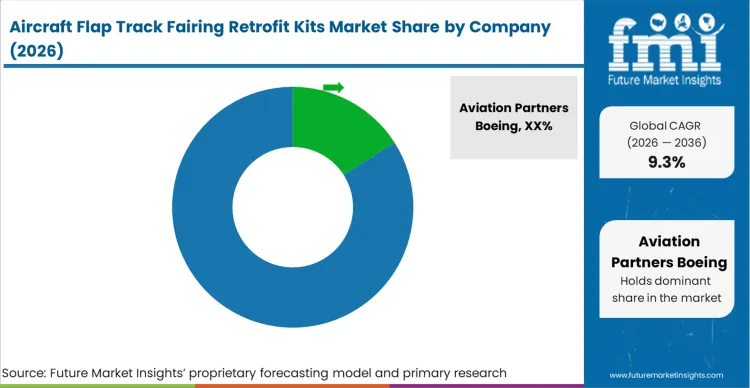
Competition hinges on the breadth of a supplier's Supplemental Type Certificate portfolio rather than raw manufacturing capacity. Buyers actively researching who are the leading suppliers in aircraft fairing retrofit kits discover that companies like Aviation Partners Boeing and Vortex Control Technologies dominate procurement evaluations. They win because their aircraft strut and aerodynamic modifications are already legally cleared to fly on multiple variants. Engineering directors at major airlines refuse to evaluate superior composite geometries from unproven aircraft aerodynamic retrofit suppliers if the manufacturer has only secured an STC for a single sub-variant. The competitive advantage belongs entirely to the supplier who successfully navigates the FAA and EASA certification maze first, erecting a regulatory barrier that keeps technologically capable but uncertified competitors locked out of the hangar.
Incumbents leverage deep historical flight-data libraries to prove their specific aerodynamic shapes deliver the exact gallon-per-hour fuel savings promised in their brochures. Challengers claiming to offer the best aircraft aerodynamic retrofit kits must spend millions on computational fluid dynamics and live-flight testing just to establish the baseline credibility that established players already possess. Engineering directors evaluating aerodynamic upgrades frequently compare fairing retrofit kits and finlets for 737 operators to determine which intervention yields superior block-hour savings. This empirical data advantage allows legacy suppliers to integrate their fairing upgrades into the broader aerospace radome efficiency models utilized by airline financial planners. A new entrant cannot simply offer a cheaper composite shell; they must provide irrefutable telemetry proving that finlets vs flap track fairing retrofit dynamics will not induce unexpected vibrations or compromise the limits of the aging trailing edge.
Airline procurement officers actively resist the pricing leverage held by STC-monopoly suppliers by demanding modular kit designs that allow partial replacements rather than full assembly swaps. FMI's assessment indicates that maintenance directors closely evaluate split scimitar vs fairing retrofit savings while leaning on suppliers who guarantee transparent flap track fairing retrofit after-service support. Large carriers wield their massive fleet volume to force manufacturers into providing lifecycle cost guarantees, moving the financial risk of premature composite delamination back onto the supplier. The reality is that operators utilizing aircraft automated inspection tools will immediately detect any performance degradation in aftermarket fairings, punishing suppliers who fail to meet strict durability standards with immediate fleet-wide contract cancellations.
Key Players in Aircraft Flap Track Fairing Retrofit Kits Market
- Aviation Partners Boeing
- Aero Design Labs
- Vortex Control Technologies
- SACS Aerospace
- AAR Corp.
- ALOFT AeroArchitects
- The NORDAM Group
Scope of the Report
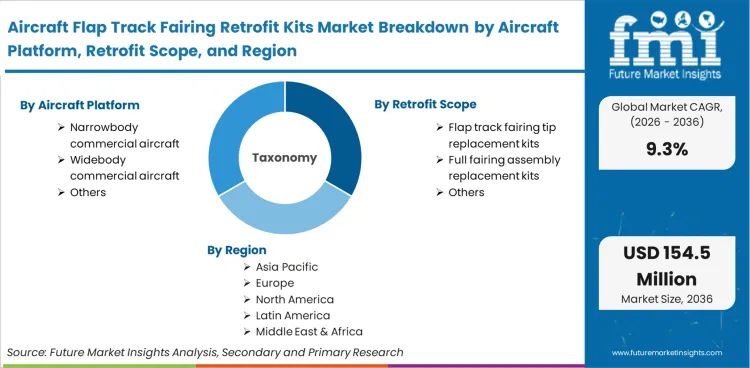
| Metric | Value |
|---|---|
| Quantitative Units | USD 63.5 million to USD 154.5 million, at a CAGR of 9.30% |
| Market Definition | Aircraft Flap Track Fairing Retrofit Kits represent engineered assemblies designed to replace original trailing-edge aerodynamic shields on existing commercial and military fleets. These packages minimize drag profiles, lower fuel consumption, and extend component lifecycles for operators managing legacy airframes. |
| Segmentation | By aircraft platform, By retrofit scope, By material, By sales channel, By installation type, and Region. |
| Regions Covered | North America, Latin America, Western Europe, Eastern Europe, East Asia, South Asia and Pacific, Middle East and Africa |
| Countries Covered | United States, Germany, United Kingdom, France, China, India, Singapore |
| Key Companies Profiled | Aviation Partners Boeing, Aero Design Labs, Vortex Control Technologies, SACS Aerospace, AAR Corp., ALOFT AeroArchitects, The NORDAM Group |
| Forecast Period | 2026 to 2036 |
| Approach | Post-delivery heavy-check schedules correlated with registered legacy narrowbody fleet data. |
Source: Future Market Insights (FMI) analysis, based on proprietary forecasting model and primary research
Aircraft Flap Track Fairing Retrofit Kits Market Analysis by Segments
By aircraft platform:
- Narrowbody commercial aircraft
- Widebody commercial aircraft
- Regional aircraft
- Military transport aircraft
- Business jets
By retrofit scope:
- Flap track fairing tip replacement kits
- Full fairing assembly replacement kits
- Hybrid drag-reduction kits with fairing modifications
- Repair-and-retrofit reinforcement kits
- Custom airline-specific retrofit kits
By material:
- Composite kits
- Aluminum alloy kits
- Hybrid metallic-composite kits
- Thermoplastic composite kits
By sales channel:
- Airline direct retrofit programs
- MRO-led retrofit packages
- OEM / JV-approved upgrade packages
- Leasing / asset-transition modification programs
By installation type:
- Heavy-check scheduled installations
- Overnight / short-ground-time installations
- Line-maintenance coordinated installs
- Conversion / transition maintenance installs
Region:
- North America
- United States
- Canada
- Latin America
- Brazil
- Mexico
- Rest of Latin America
- Western Europe
- Germany
- United Kingdom
- France
- Spain
- Italy
- BENELUX
- Rest of Western Europe
- Eastern Europe
- Russia
- Poland
- Rest of Eastern Europe
- East Asia
- China
- Japan
- South Korea
- South Asia and Pacific
- India
- ASEAN
- Oceania
- Rest of South Asia and Pacific
- Middle East and Africa
- GCC
- South Africa
- North Africa
- Rest of Middle East and Africa
Bibliography
- International Civil Aviation Organization. (2025). ICAO Environmental Report 2025.
- European Union Aviation Safety Agency, European Commission, and EUROCONTROL. (2025). European Aviation Environmental Report 2025.
- Delta Air Lines. (2025). Ocean to sky: How Delta is learning from nature to drive fuel efficiency.
- AAR Corp. (2025). AAR to acquire Aircraft Reconfig Technologies, expanding its engineering and certification capabilities and creating additional revenue streams.
- Aircraft Owners and Pilots Association (AOPA). (2025). Let’s Talk STC: Understanding Supplemental Type Certificates for Aircraft Modifications.
This bibliography is provided for reader reference. The full FMI report contains the complete reference list with primary source documentation.
This Report Addresses
- Fractional aerodynamic penalties and aircraft flap track fairing retrofit trends 2026 forcing maintenance directors to execute immediate trailing-edge upgrades.
- Regulatory bottlenecks surrounding Supplemental Type Certificate issuances that dictate retrofit kit availability.
- Multi-variant STC approvals determining the dominant suppliers within the narrowbody modification sector as part of the aircraft aerodynamic retrofit forecast 2036.
- Installation synchronization strategies utilized by fleet planners to embed fairing upgrades into existing heavy-check intervals.
- Severe operational risks associated with composite curing limitations at remote line-maintenance outstations.
- Direct procurement channels bypassing traditional MRO intermediaries to secure baseline pricing for major legacy carriers evaluating emerging aircraft drag reduction retrofit technologies.
- Extreme utilization rates and cost-per-seat pressures driving the 10.4% compound growth trajectory in the Indian market.
- Lease-transition bundling opportunities utilized by asset managers to elevate residual values on aging 737NG and A320ceo frames.
Frequently Asked Questions
What is the market size for aircraft flap track fairing retrofit kits?
FMI's model indicates the sector reached USD 63.5 million in 2026. This figure isolates aftermarket hardware and necessary installation components, cleanly separating operational fleet upgrades from original equipment manufacturing supply lines.
What drives growth in the flap track fairing retrofit kits market?
Total revenue expands to USD 154.5 million by 2036. This consistent climb reflects the compounding pressure on airline executives to extract fractional fuel efficiency gains from an ageing global fleet of mature narrowbody aircraft.
Are flap track fairing retrofit kits worth it for airlines?
Maintenance directors calculate that eliminating fractional drag penalties compounds rapidly across high-utilization fleets. Capital investments in these upgrades routinely pay for themselves within eighteen months of block-hour fuel savings.
What aircraft types use flap track fairing retrofit kits?
Narrowbody commercial aircraft hold 61.0% share because airlines deploy these assets on relentless, high-frequency climb-and-descent cycles where trailing-edge drag penalties are most severe. Procurement directors target these workhorses to maximize fleet-wide fuel savings.
How much fuel can fairing retrofit kits save?
Flap track fairing tip replacement kits lead the scope segment by effectively targeting the precise aft-zone where vortex shedding occurs. Engineering teams secure the majority of available aerodynamic benefits without undertaking the massive capital expense of a complete replacement.
When are fairing retrofit kits installed on aircraft?
Heavy-check scheduled installations account for 52.0% share. Fleet operators absolutely refuse to log dedicated out-of-service penalty hours for aerodynamic upgrades, forcing engineering planners to integrate fairing swaps exclusively during mandatory airframe teardowns.
Do fairing retrofit kits require FAA STC?
The requirement for comprehensive Supplemental Type Certificates across multiple aircraft variants acts as a hard regulatory barrier. Fleet managers routinely delay bulk procurement until a single supplier can guarantee cross-compatibility for their entire mixed fleet.
Explain aircraft flap track fairing retrofit kits for airline buyers?
These kits are engineered aerodynamic enclosures designed to replace original trailing-edge flap mechanisms. Fleet operators install these assemblies post-delivery to improve fuel efficiency, restore baseline aerodynamic profiles, and shield extension tracks from excess drag.
What is the aircraft drag reduction modification market size?
The sector advances at a 9.30% CAGR through 2036. This velocity mirrors the precise heavy-check schedules of 737NG and A320ceo airframes entering their optimal mid-life modification windows.
What is retrofit payback for aircraft fairing kits?
Airlines evaluate payback based on direct gallon-per-block-hour savings. By targeting high-frequency narrowbody routes, legacy carriers typically recover their capital and installation costs within eighteen to twenty-four months of continuous flight operations.
What is carbon reduction from aircraft retrofit kits?
Environmental compliance officers increasingly dictate procurement priorities, elevating fairing upgrades from an operational preference to a regulatory shield. Advanced geometries deliver specific fuel consumption benefits demanded by carbon-conscious executive boards.
What is MRO installation for fairing retrofit kits?
Regional adoption rates depend entirely on the ability of local MRO hubs to source and integrate STC-approved hardware at scale. Mature maintenance hubs position themselves as the premium integration centers for complex upgrades during standard heavy checks.
What is retrofit kit certification for aircraft exterior fairings?
Competition hinges on the breadth of a supplier's Supplemental Type Certificate portfolio rather than raw manufacturing capacity. Engineering directors refuse to evaluate superior composite geometries if the manufacturer lacks multi-variant regulatory approval.
How is the airline engineering approved fairing retrofit?
Procurement officers demand strict aerodynamic parity testing before authorizing aftermarket components. This rigorous evaluation sets the baseline technical standard that adjacent operators utilize to bypass secondary validation testing and ensure total fleet compliance.
What are the aircraft flap track fairing kits?
Incumbents leverage deep historical flight-data libraries that empirically prove their specific geometries deliver the promised fuel savings. Challengers struggle to overcome this data advantage without spending millions on live-flight validation.
What are the aerospace aftermarket fairing kits?
Suppliers package fairing upgrade kits specifically for the mandatory maintenance checks required when an aircraft changes operators. This strategy allows lessors to market aerodynamically optimized airframes, securing premium lease rates from secondary carriers.
What are procurement checklist for aircraft fairing retrofit kits?
Procurement directors closely evaluate modular kit designs that allow partial replacements, transparent after-service support guarantees, and multi-variant cross-compatibility. Financial planners prioritize these metrics to move the risk of premature composite delamination back onto the supplier.
Explain aircraft fuel efficiency retrofit technologies?
Composite kits capture 68.0% share by delivering superior strength-to-weight characteristics. Engineers specify these materials specifically because they survive the extreme vibrational fatigue directly behind the engine exhaust far better than legacy metals.
What is the aircraft fairings market size?
The broader exterior market funnels demand directly into specialized fairing retrofits as carriers bypass standard localized patching. Maintenance managers upgrade to advanced shapes rather than continuously repairing degraded metallic surfaces.
Explain the aircraft drag reduction systems?
Airline planners prioritize absolute component reliability over theoretical maximum drag reduction, demanding kits that survive relentless climb-and-descent cycles without fatiguing. Procurement officers mandate rigorous vibration-resistance profiles before authorizing transitions.
What is aircraft finlet retrofit?
Engineering teams utilize comparative testing to determine which specific aerodynamic intervention yields the highest ROI. Finlets and specialized fairing modifications are often evaluated head-to-head to isolate the exact geometry that resolves legacy drag issues most effectively.
What are airline fuel burn reduction retrofit kits?
Operators deploying these kits gain immediate operational cost predictability by eliminating mixed configuration drag penalties. Fleet executives secure long-term margin improvements by standardizing these efficiency upgrades across thousands of annual block hours.
What is commercial aviation retrofit market fairings?
Supply chain managers at legacy airlines leverage their massive fleet volume to bypass MRO intermediaries, locking in direct allocations and shielding their upgrade schedules from spot-market volatility.
Preview the report firsthand - request a free sample
Get SampleGet the brochure for pricing and purchase details.
Get PDFTable of Content
- Executive Summary
- Global Market Outlook
- Demand-side Trends
- Supply-side Trends
- Technology Roadmap Analysis
- Analysis and Recommendations
- Market Overview
- Market Coverage / Taxonomy
- Market Definition / Scope / Limitations
- Research Methodology
- Chapter Orientation
- Analytical Lens and Working Hypotheses
- Market Structure, Signals, and Trend Drivers
- Benchmarking and Cross-market Comparability
- Market Sizing, Forecasting, and Opportunity Mapping
- Research Design and Evidence Framework
- Desk Research Programme (Secondary Evidence)
- Company Annual and Sustainability Reports
- Peer-reviewed Journals and Academic Literature
- Corporate Websites, Product Literature, and Technical Notes
- Earnings Decks and Investor Briefings
- Statutory Filings and Regulatory Disclosures
- Technical White Papers and Standards Notes
- Trade Journals, Industry Magazines, and Analyst Briefs
- Conference Proceedings, Webinars, and Seminar Materials
- Government Statistics Portals and Public Data Releases
- Press Releases and Reputable Media Coverage
- Specialist Newsletters and Curated Briefings
- Sector Databases and Reference Repositories
- FMI Internal Proprietary Databases and Historical Market Datasets
- Subscription Datasets and Paid Sources
- Social Channels, Communities, and Digital Listening Inputs
- Additional Desk Sources
- Expert Input and Fieldwork (Primary Evidence)
- Primary Modes
- Qualitative Interviews and Expert Elicitation
- Quantitative Surveys and Structured Data Capture
- Blended Approach
- Why Primary Evidence is Used
- Field Techniques
- Interviews
- Surveys
- Focus Groups
- Observational and In-context Research
- Social and Community Interactions
- Stakeholder Universe Engaged
- C-suite Leaders
- Board Members
- Presidents and Vice Presidents
- R&D and Innovation Heads
- Technical Specialists
- Domain Subject-matter Experts
- Scientists
- Physicians and Other Healthcare Professionals
- Governance, Ethics, and Data Stewardship
- Research Ethics
- Data Integrity and Handling
- Primary Modes
- Tooling, Models, and Reference Databases
- Desk Research Programme (Secondary Evidence)
- Data Engineering and Model Build
- Data Acquisition and Ingestion
- Cleaning, Normalisation, and Verification
- Synthesis, Triangulation, and Analysis
- Quality Assurance and Audit Trail
- Market Background
- Market Dynamics
- Drivers
- Restraints
- Opportunity
- Trends
- Scenario Forecast
- Demand in Optimistic Scenario
- Demand in Likely Scenario
- Demand in Conservative Scenario
- Opportunity Map Analysis
- Product Life Cycle Analysis
- Supply Chain Analysis
- Investment Feasibility Matrix
- Value Chain Analysis
- PESTLE and Porter’s Analysis
- Regulatory Landscape
- Regional Parent Market Outlook
- Production and Consumption Statistics
- Import and Export Statistics
- Market Dynamics
- Global Market Analysis 2021 to 2025 and Forecast, 2026 to 2036
- Historical Market Size Value (USD Million) Analysis, 2021 to 2025
- Current and Future Market Size Value (USD Million) Projections, 2026 to 2036
- Y-o-Y Growth Trend Analysis
- Absolute $ Opportunity Analysis
- Global Market Pricing Analysis 2021 to 2025 and Forecast 2026 to 2036
- Global Market Analysis 2021 to 2025 and Forecast 2026 to 2036, By Aircraft Platform
- Introduction / Key Findings
- Historical Market Size Value (USD Million) Analysis By Aircraft Platform , 2021 to 2025
- Current and Future Market Size Value (USD Million) Analysis and Forecast By Aircraft Platform , 2026 to 2036
- Narrowbody commercial aircraft
- Widebody commercial aircraft
- Others
- Narrowbody commercial aircraft
- Y-o-Y Growth Trend Analysis By Aircraft Platform , 2021 to 2025
- Absolute $ Opportunity Analysis By Aircraft Platform , 2026 to 2036
- Global Market Analysis 2021 to 2025 and Forecast 2026 to 2036, By Retrofit Scope
- Introduction / Key Findings
- Historical Market Size Value (USD Million) Analysis By Retrofit Scope, 2021 to 2025
- Current and Future Market Size Value (USD Million) Analysis and Forecast By Retrofit Scope, 2026 to 2036
- Flap track fairing tip replacement kits
- Full fairing assembly replacement kits
- Others
- Flap track fairing tip replacement kits
- Y-o-Y Growth Trend Analysis By Retrofit Scope, 2021 to 2025
- Absolute $ Opportunity Analysis By Retrofit Scope, 2026 to 2036
- Global Market Analysis 2021 to 2025 and Forecast 2026 to 2036, By Material
- Introduction / Key Findings
- Historical Market Size Value (USD Million) Analysis By Material, 2021 to 2025
- Current and Future Market Size Value (USD Million) Analysis and Forecast By Material, 2026 to 2036
- Composite kits
- Aluminum alloy kits
- Others
- Composite kits
- Y-o-Y Growth Trend Analysis By Material, 2021 to 2025
- Absolute $ Opportunity Analysis By Material, 2026 to 2036
- Global Market Analysis 2021 to 2025 and Forecast 2026 to 2036, By Sales Channel
- Introduction / Key Findings
- Historical Market Size Value (USD Million) Analysis By Sales Channel, 2021 to 2025
- Current and Future Market Size Value (USD Million) Analysis and Forecast By Sales Channel, 2026 to 2036
- Airline direct retrofit programs
- MRO-led retrofit packages
- Others
- Airline direct retrofit programs
- Y-o-Y Growth Trend Analysis By Sales Channel, 2021 to 2025
- Absolute $ Opportunity Analysis By Sales Channel, 2026 to 2036
- Global Market Analysis 2021 to 2025 and Forecast 2026 to 2036, By Installation Type
- Introduction / Key Findings
- Historical Market Size Value (USD Million) Analysis By Installation Type, 2021 to 2025
- Current and Future Market Size Value (USD Million) Analysis and Forecast By Installation Type, 2026 to 2036
- Heavy-check scheduled installations
- Overnight / short-ground-time installations
- Others
- Heavy-check scheduled installations
- Y-o-Y Growth Trend Analysis By Installation Type, 2021 to 2025
- Absolute $ Opportunity Analysis By Installation Type, 2026 to 2036
- Global Market Analysis 2021 to 2025 and Forecast 2026 to 2036, By Region
- Introduction
- Historical Market Size Value (USD Million) Analysis By Region, 2021 to 2025
- Current Market Size Value (USD Million) Analysis and Forecast By Region, 2026 to 2036
- North America
- Latin America
- Western Europe
- Eastern Europe
- East Asia
- South Asia and Pacific
- Middle East & Africa
- Market Attractiveness Analysis By Region
- North America Market Analysis 2021 to 2025 and Forecast 2026 to 2036, By Country
- Historical Market Size Value (USD Million) Trend Analysis By Market Taxonomy, 2021 to 2025
- Market Size Value (USD Million) Forecast By Market Taxonomy, 2026 to 2036
- By Country
- USA
- Canada
- Mexico
- By Aircraft Platform
- By Retrofit Scope
- By Material
- By Sales Channel
- By Installation Type
- By Country
- Market Attractiveness Analysis
- By Country
- By Aircraft Platform
- By Retrofit Scope
- By Material
- By Sales Channel
- By Installation Type
- Key Takeaways
- Latin America Market Analysis 2021 to 2025 and Forecast 2026 to 2036, By Country
- Historical Market Size Value (USD Million) Trend Analysis By Market Taxonomy, 2021 to 2025
- Market Size Value (USD Million) Forecast By Market Taxonomy, 2026 to 2036
- By Country
- Brazil
- Chile
- Rest of Latin America
- By Aircraft Platform
- By Retrofit Scope
- By Material
- By Sales Channel
- By Installation Type
- By Country
- Market Attractiveness Analysis
- By Country
- By Aircraft Platform
- By Retrofit Scope
- By Material
- By Sales Channel
- By Installation Type
- Key Takeaways
- Western Europe Market Analysis 2021 to 2025 and Forecast 2026 to 2036, By Country
- Historical Market Size Value (USD Million) Trend Analysis By Market Taxonomy, 2021 to 2025
- Market Size Value (USD Million) Forecast By Market Taxonomy, 2026 to 2036
- By Country
- Germany
- UK
- Italy
- Spain
- France
- Nordic
- BENELUX
- Rest of Western Europe
- By Aircraft Platform
- By Retrofit Scope
- By Material
- By Sales Channel
- By Installation Type
- By Country
- Market Attractiveness Analysis
- By Country
- By Aircraft Platform
- By Retrofit Scope
- By Material
- By Sales Channel
- By Installation Type
- Key Takeaways
- Eastern Europe Market Analysis 2021 to 2025 and Forecast 2026 to 2036, By Country
- Historical Market Size Value (USD Million) Trend Analysis By Market Taxonomy, 2021 to 2025
- Market Size Value (USD Million) Forecast By Market Taxonomy, 2026 to 2036
- By Country
- Russia
- Poland
- Hungary
- Balkan & Baltic
- Rest of Eastern Europe
- By Aircraft Platform
- By Retrofit Scope
- By Material
- By Sales Channel
- By Installation Type
- By Country
- Market Attractiveness Analysis
- By Country
- By Aircraft Platform
- By Retrofit Scope
- By Material
- By Sales Channel
- By Installation Type
- Key Takeaways
- East Asia Market Analysis 2021 to 2025 and Forecast 2026 to 2036, By Country
- Historical Market Size Value (USD Million) Trend Analysis By Market Taxonomy, 2021 to 2025
- Market Size Value (USD Million) Forecast By Market Taxonomy, 2026 to 2036
- By Country
- China
- Japan
- South Korea
- By Aircraft Platform
- By Retrofit Scope
- By Material
- By Sales Channel
- By Installation Type
- By Country
- Market Attractiveness Analysis
- By Country
- By Aircraft Platform
- By Retrofit Scope
- By Material
- By Sales Channel
- By Installation Type
- Key Takeaways
- South Asia and Pacific Market Analysis 2021 to 2025 and Forecast 2026 to 2036, By Country
- Historical Market Size Value (USD Million) Trend Analysis By Market Taxonomy, 2021 to 2025
- Market Size Value (USD Million) Forecast By Market Taxonomy, 2026 to 2036
- By Country
- India
- ASEAN
- Australia & New Zealand
- Rest of South Asia and Pacific
- By Aircraft Platform
- By Retrofit Scope
- By Material
- By Sales Channel
- By Installation Type
- By Country
- Market Attractiveness Analysis
- By Country
- By Aircraft Platform
- By Retrofit Scope
- By Material
- By Sales Channel
- By Installation Type
- Key Takeaways
- Middle East & Africa Market Analysis 2021 to 2025 and Forecast 2026 to 2036, By Country
- Historical Market Size Value (USD Million) Trend Analysis By Market Taxonomy, 2021 to 2025
- Market Size Value (USD Million) Forecast By Market Taxonomy, 2026 to 2036
- By Country
- Kingdom of Saudi Arabia
- Other GCC Countries
- Turkiye
- South Africa
- Other African Union
- Rest of Middle East & Africa
- By Aircraft Platform
- By Retrofit Scope
- By Material
- By Sales Channel
- By Installation Type
- By Country
- Market Attractiveness Analysis
- By Country
- By Aircraft Platform
- By Retrofit Scope
- By Material
- By Sales Channel
- By Installation Type
- Key Takeaways
- Key Countries Market Analysis
- USA
- Pricing Analysis
- Market Share Analysis, 2025
- By Aircraft Platform
- By Retrofit Scope
- By Material
- By Sales Channel
- By Installation Type
- Canada
- Pricing Analysis
- Market Share Analysis, 2025
- By Aircraft Platform
- By Retrofit Scope
- By Material
- By Sales Channel
- By Installation Type
- Mexico
- Pricing Analysis
- Market Share Analysis, 2025
- By Aircraft Platform
- By Retrofit Scope
- By Material
- By Sales Channel
- By Installation Type
- Brazil
- Pricing Analysis
- Market Share Analysis, 2025
- By Aircraft Platform
- By Retrofit Scope
- By Material
- By Sales Channel
- By Installation Type
- Chile
- Pricing Analysis
- Market Share Analysis, 2025
- By Aircraft Platform
- By Retrofit Scope
- By Material
- By Sales Channel
- By Installation Type
- Germany
- Pricing Analysis
- Market Share Analysis, 2025
- By Aircraft Platform
- By Retrofit Scope
- By Material
- By Sales Channel
- By Installation Type
- UK
- Pricing Analysis
- Market Share Analysis, 2025
- By Aircraft Platform
- By Retrofit Scope
- By Material
- By Sales Channel
- By Installation Type
- Italy
- Pricing Analysis
- Market Share Analysis, 2025
- By Aircraft Platform
- By Retrofit Scope
- By Material
- By Sales Channel
- By Installation Type
- Spain
- Pricing Analysis
- Market Share Analysis, 2025
- By Aircraft Platform
- By Retrofit Scope
- By Material
- By Sales Channel
- By Installation Type
- France
- Pricing Analysis
- Market Share Analysis, 2025
- By Aircraft Platform
- By Retrofit Scope
- By Material
- By Sales Channel
- By Installation Type
- India
- Pricing Analysis
- Market Share Analysis, 2025
- By Aircraft Platform
- By Retrofit Scope
- By Material
- By Sales Channel
- By Installation Type
- ASEAN
- Pricing Analysis
- Market Share Analysis, 2025
- By Aircraft Platform
- By Retrofit Scope
- By Material
- By Sales Channel
- By Installation Type
- Australia & New Zealand
- Pricing Analysis
- Market Share Analysis, 2025
- By Aircraft Platform
- By Retrofit Scope
- By Material
- By Sales Channel
- By Installation Type
- China
- Pricing Analysis
- Market Share Analysis, 2025
- By Aircraft Platform
- By Retrofit Scope
- By Material
- By Sales Channel
- By Installation Type
- Japan
- Pricing Analysis
- Market Share Analysis, 2025
- By Aircraft Platform
- By Retrofit Scope
- By Material
- By Sales Channel
- By Installation Type
- South Korea
- Pricing Analysis
- Market Share Analysis, 2025
- By Aircraft Platform
- By Retrofit Scope
- By Material
- By Sales Channel
- By Installation Type
- Russia
- Pricing Analysis
- Market Share Analysis, 2025
- By Aircraft Platform
- By Retrofit Scope
- By Material
- By Sales Channel
- By Installation Type
- Poland
- Pricing Analysis
- Market Share Analysis, 2025
- By Aircraft Platform
- By Retrofit Scope
- By Material
- By Sales Channel
- By Installation Type
- Hungary
- Pricing Analysis
- Market Share Analysis, 2025
- By Aircraft Platform
- By Retrofit Scope
- By Material
- By Sales Channel
- By Installation Type
- Kingdom of Saudi Arabia
- Pricing Analysis
- Market Share Analysis, 2025
- By Aircraft Platform
- By Retrofit Scope
- By Material
- By Sales Channel
- By Installation Type
- Turkiye
- Pricing Analysis
- Market Share Analysis, 2025
- By Aircraft Platform
- By Retrofit Scope
- By Material
- By Sales Channel
- By Installation Type
- South Africa
- Pricing Analysis
- Market Share Analysis, 2025
- By Aircraft Platform
- By Retrofit Scope
- By Material
- By Sales Channel
- By Installation Type
- USA
- Market Structure Analysis
- Competition Dashboard
- Competition Benchmarking
- Market Share Analysis of Top Players
- By Regional
- By Aircraft Platform
- By Retrofit Scope
- By Material
- By Sales Channel
- By Installation Type
- Competition Analysis
- Competition Deep Dive
- Aviation Partners Boeing
- Overview
- Product Portfolio
- Profitability by Market Segments (Product/Age /Sales Channel/Region)
- Sales Footprint
- Strategy Overview
- Marketing Strategy
- Product Strategy
- Channel Strategy
- Aero Design Labs
- Vortex Control Technologies
- SACS Aerospace
- AAR Corp.
- ALOFT AeroArchitects
- Aviation Partners Boeing
- Competition Deep Dive
- Assumptions & Acronyms Used


