

- Industry Size (2026)
- USD 83 Mn
- Forecast (2036)
- USD 160.4 Mn
- CAGR (2026 to 2036)
- 6.8%
Belly Fairing Modifications for Freighter and Combi Aircraft Market Size, Market Forecast and Outlook By FMI
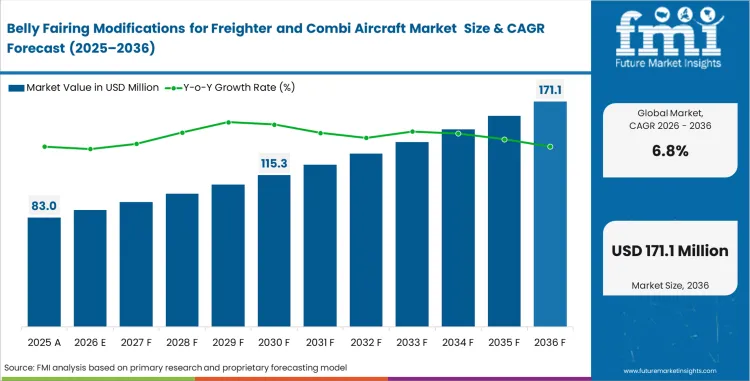
Belly fairing modifications for freighter and combi aircraft market was valued at USD 77.6 million in 2025. Sector is projected to cross USD 83 million in 2026 at a CAGR of 6.8% during the forecast period. Revenue expansion takes the total opportunity to USD 160.4 million through 2036 as cargo operators keep treating underside retrofit work as a fuel-use, maintenance exposure, and airframe-life decision rather than a cosmetic exterior upgrade.
Summary of Belly Fairing Modifications for Freighter and Combi Aircraft Market
- Belly Fairing Modifications for Freighter and Combi Aircraft Market Snapshot
- The belly fairing modifications for freighter and combi aircraft market is valued at USD 77.6 million in 2025 and is projected to reach USD 160.4 million by 2036.
- The sector is expected to expand at a CAGR of 6.8% from 2026 to 2036, creating an incremental opportunity of USD 77.5 million over the forecast period.
- This category remains a specification-led retrofit niche focused on post-production belly fairing changes, lower-fuselage protection, and drag-reduction kits for freighter and combi aircraft. STC approval, aircraft downtime, and fuel-payback discipline continue to shape supplier selection and installation timing.
- Belly Fairing Modifications for Freighter and Combi Aircraft Market Demand and Growth Drivers
- Freighter fleet expansion continues to support this sector, with Boeing projecting the global freighter fleet to increase from 2,340 aircraft in 2023 to 3,900 aircraft by 2043, while Airbus sees demand for 2,470 freighters between 2024 and 2043.
- Widebody aerodynamic retrofits are drawing stronger interest because approved 777 programs have already shown a measurable fuel-saving case, which gives airlines a clearer basis for retrofit evaluation.
- Protection-focused belly and lower-fuselage kits remain relevant on regional cargo and combi aircraft because they address repeat wear exposure without forcing a complex modification event. Installation effort also stays manageable in these programs.
- By 2036, India is expected to lead at 8.1% CAGR, followed by China at 7.8%, Singapore at 7.2%, the United Arab Emirates at 7%, the United States at 6.2%, Germany at 6%, and Brazil at 5.9%.
- Retrofit evaluation remains active because fuel cost still carries enough weight in airline operating economics to keep drag-reduction and underbody upgrade decisions commercially relevant.
- Belly Fairing Modifications for Freighter and Combi Aircraft Market Product and Segment View
- The market includes aerodynamic kits, protection kits, access kits, and hybrid kits built mainly from composites, aluminum, films, and hybrid laminates for belly fairings, lower-fuselage zones, cargo pods, and other drag-sensitive exterior areas.
- These modifications are used across express freighters, scheduled cargo aircraft, regional turboprop freighters, and combi aircraft, especially where repeat mission cycles make fuel savings or underside protection easier to justify.
- As the most visible retrofit activity remains concentrated in drag-reduction films, finlets, and contour-refinement packages, Aerodynamic kits are expected to account for 34% share of the Kit Type segment in 2026.
- In 2026, narrowbody aircraft are projected to contribute 41% of total market share within the Aircraft Type segment because converted freighter demand remains centered on standard-body platforms. This keeps the retrofit base broader than in widebody fleets.
- Composites are likely to represent 46% of the Material segment in 2026 because lightweight exterior structures and add-on aerodynamic surfaces remain the practical choice for approved retrofit work.
- Reflecting buyer preference for modification routes that are easier to repeat across active fleets, the market is expected to see STC retrofits account for 53% share in the Certification Path segment in 2026.
- Independent MRO is projected to secure 38% share of the Installation Channel segment in 2026 because operators still depend heavily on specialist engineering and modification centers for certification, installation, and continued airworthiness support.
- As high-utilization freighters show the clearest operating case for drag-reduction and protective belly upgrades, Express carriers are anticipated to emerge with 36% market share in the End User segment in 2026.
- Fuel savings are forecast to represent 33% share of the Objective segment in 2026 because the strongest quantified retrofit case in this sector still comes from burn reduction and related operating discipline on repetitive cargo missions.
- The scope includes post-production belly-fairing and lower-fuselage retrofit kits for freighter and combi aircraft, while full passenger-to-freighter conversions, OEM line-fit fairings, stand-alone winglets, and raw materials without approved kit documentation remain outside the category boundary.
- Belly Fairing Modifications for Freighter and Combi Aircraft Market Geography and Competitive Outlook
- India, China, Singapore, and the United Arab Emirates sit above the 6.8% global CAGR because certification activity, conversion capacity, cargo demand, and fleet additions are moving faster in these locations.
- The market remains fragmented, with value distributed across belly protection, finlets, cargo-pod solutions, and retrofit work linked to freighter conversion activity.
- Competitive position is shaped more by approval fit, installation capability, and service support than by scale alone.
Key Takeaways, Market Size, and Forecast
- Belly Fairing Modifications for Freighter and Combi Aircraft Market is projected to grow from USD 83 million in 2026 to USD 160.4 million by 2036, expanding at a CAGR of 6.8%.
- The belly fairing modifications for freighter and combi aircraft market was valued at USD 77.6 million in 2025.
- By 2036, the market for belly fairing modifications on freighter and combi aircraft is expected to reach USD 160.4 million.
- From 2026 to 2036, the market is forecast to expand at a compound annual growth rate of 6.8%, driven by fuel‑use discipline and retrofit timing within maintenance windows.
- The market is expected to generate an incremental opportunity of USD 77.5 million between 2026 and 2036 as cargo operators prioritize underbody drag‑reduction and protection upgrades.
- In 2026, aerodynamic kits are anticipated to account for 34% of the kit‑type segment, supported by measurable fuel‑saving benefits on repeat cargo missions.
- India (8.1% CAGR) and China (7.8% CAGR) are among the fastest‑growing country markets due to rising freighter conversion activity and expanding MRO capability.
Belly Fairing Modifications for Freighter and Combi Aircraft Market Key Takeaways
| Metric | Details |
|---|---|
| Industry Size (2026) | USD 83 million |
| Industry Value (2036) | USD 160.4 million |
| CAGR (2026-2036) | 6.8% |
Source: Future Market Insights analysis, based on proprietary forecasting model and primary research
Airlines now need to decide whether belly-area modifications should be installed during heavy checks, freighter conversions, and underbody repair cycles, or postponed as separate engineering work later. Delay usually weakens the economic case because downtime, certification effort, and installation access become harder to justify once the aircraft returns to service. Retrofit demand is supported more by repeat mission economics than by product novelty, especially when drag cleanup, lower-fuselage protection, and easier service access can be combined in one work package. Broader alignment with air cargo operations and commercial aircraft mro keeps this sector tied to fleet-use discipline rather than optional exterior spending.
Approval readiness and installation timing remain the main gate for wider adoption. Once operators align engineering sign-off, parts availability, and hangar access within planned maintenance windows, retrofit programs become easier to repeat across sister aircraft. Timing control matters more than product visibility in this sector because it decides whether modification work is treated as necessary fleet upkeep or deferred discretionary activity.
India is expected to record 8.1% CAGR through 2036 as local conversion activity and cargo-fleet interest improve the case for retrofit work. China follows at 7.8%, while Singapore is likely to post 7.2% and the United Arab Emirates 7% as engineering support, hub activity, and conversion capability strengthen installation fit. Installed fleet relevance keeps the United States active at 6.2%, with Germany at 6% and Brazil at 5.9%, though retrofit decisions in these countries are moving at a more measured pace. The spread across these countries reflects where conversion lines, MRO access, and cargo utilization make belly-area work easier to justify within scheduled aircraft downtime.
Segmental Analysis
Belly Fairing Modifications for Freighter and Combi Aircraft Market Analysis by Kit Type
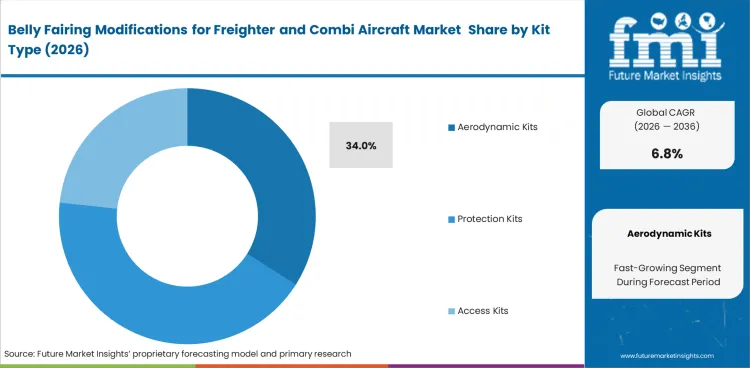
Aerodynamic kits matter because carriers can connect their value to repeat aircraft use, fuel discipline, and lower drag around exposed underbody areas without changing the aircraft’s core mission. Protection kits still serve a practical role on aircraft that face repeated debris, moisture, or service-access wear, yet retrofit budgets tend to favor packages that can affect operating cost as well as physical exposure. Aerodynamic kits are projected to capture a 34% share in 2026, as airlines and maintenance teams prioritize modifications with more clearly demonstrable in-service economic benefits. Hybrid kits and access-oriented packages remain relevant, though they are more often tied to local engineering preference and task-specific maintenance needs.
- Operational fit: Aerodynamic kits are easier to justify when carriers can combine drag cleanup with planned external work.
- Buyer logic: Airlines tend to favor packages that can influence route economics instead of solving only a localized wear issue.
- Adoption limit: Retrofit interest weakens when engineering approval and installation effort sit outside scheduled downtime.
Belly Fairing Modifications for Freighter and Combi Aircraft Market Analysis by Aircraft Type
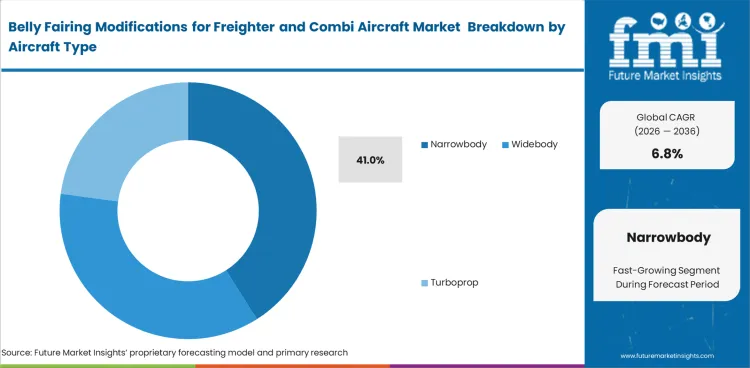
In 2026, narrowbody aircraft are projected to contribute 41% of total market share. Narrowbody freighters generate the broadest retrofit base because they sit closest to conversion activity, regional cargo rotation, and shorter-cycle utilization patterns where underbody wear and fuel-use discipline stay visible. Widebody freighters support higher-value modification work, especially where long-haul missions can reward drag cleanup over time, but fleet count is narrower. Turboprop and combi aircraft keep a place in this sector because underside protection and local-fit retrofit work still matter where routes are frequent and field conditions are less forgiving.
- Fleet concentration: Narrowbody aircraft benefit from a larger addressable retrofit base across converted cargo fleets.
- Service pattern: Repeated short and medium-haul missions keep underbody condition and fuel-use differences easier to track.
- Commercial consequence: Operators usually move faster on retrofit work where the aircraft type is already central to cargo deployment plans.
Belly Fairing Modifications for Freighter and Combi Aircraft Market Analysis by Material
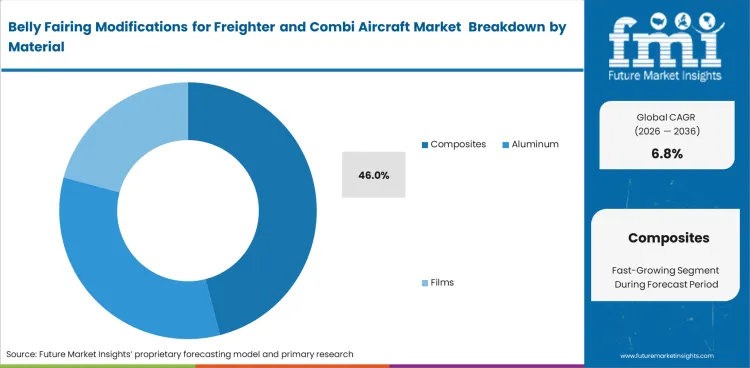
Material choice in this category is judged less by novelty and more by weight discipline, install practicality, and fit with approved external aircraft work. Composite content supports that requirement well, especially where belly-area modifications need shaped surfaces, lower mass, and repairable exterior performance. Composites are expected to account for 46% share in 2026. Aluminum and film-based solutions remain useful where operators want simpler replacement handling or lower package cost, yet material decisions still come back to approval burden, installation fit, and whether the aircraft can return to service without added maintenance complication.
- Installation reality: Composite-based parts suit shaped retrofit content where weight control and contour quality matter together.
- Carrier preference: Airlines usually back material choices that support approval ease and manageable repair work.
- Constraint: Material advantage means little if replacement handling becomes harder for line maintenance teams.
Belly Fairing Modifications for Freighter and Combi Aircraft Market Analysis by Certification Path
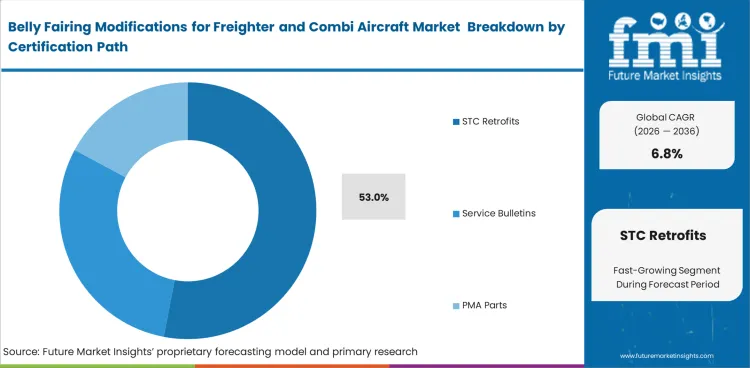
Market estimates place STC retrofits at 53% share in 2026. Certification path decides how quickly a retrofit can move from engineering interest to fleet-level installation. STC-backed work remains the main route because operators need an approval basis that can be repeated across aircraft without rebuilding the technical case each time. Service bulletin and minor-change routes still exist, though they are usually more limited in scale or tied to narrower modification scope. PMA-linked content can support replacement economics, yet broad carrier acceptance still leans toward approved retrofit packages that reduce uncertainty for engineering teams and lessors.
- Approval discipline: STC pathways give airlines a clearer route for acceptance, documentation, and repeat application.
- Execution benefit: Approved retrofit packages reduce the need for case-by-case engineering rework.
- Market consequence: Certification choice can decide whether a program stays local or expands across multiple aircraft.
Belly Fairing Modifications for Freighter and Combi Aircraft Market Analysis by Installation Channel
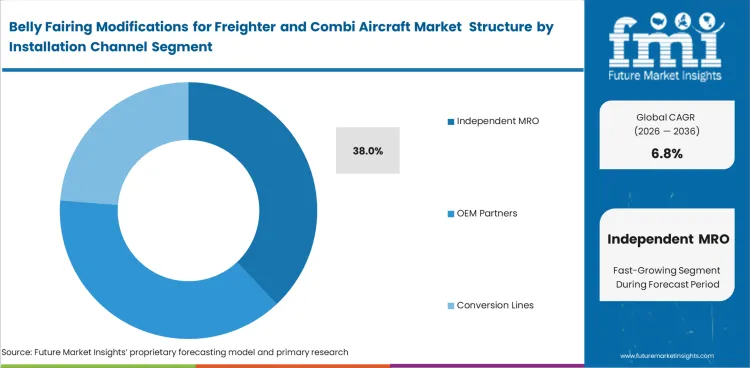
Independent MRO providers play the largest role because retrofit work in this sector is tied closely to aircraft downtime, engineering coordination, and hands-on installation capability outside original delivery channels. Carriers frequently use specialist facilities that can manage external modification tasks alongside maintenance events and freighter-support work. Independent MRO is likely to represent 38% share in 2026. OEM partners and conversion lines still matter where retrofit work is bundled into wider aircraft programs, while operator-led engineering remains narrower because internal capability is uneven across cargo fleets.
- Execution role: Independent MRO facilities are often best placed to combine modification work with maintenance scheduling.
- Capacity logic: Airlines use outside installation support when internal engineering teams cannot absorb repeat retrofit programs.
- Scaling issue: Channel choice matters because installation bottlenecks can slow fleet-wide rollout even when the technical case is accepted.
Belly Fairing Modifications for Freighter and Combi Aircraft Market Drivers, Restraints, and Opportunities
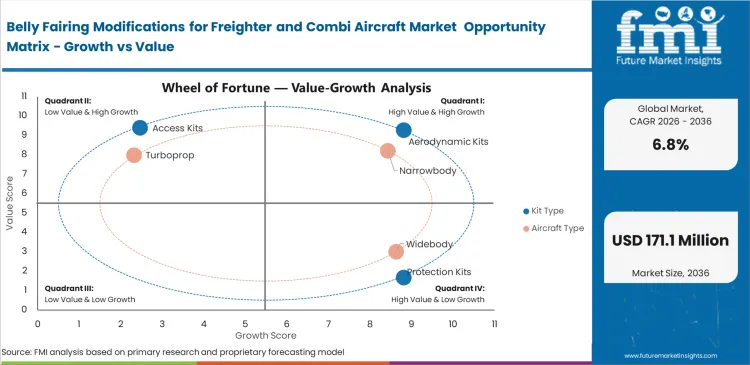
Cargo aircraft operators keep evaluating belly fairing modification work because underside drag, debris exposure, and service wear can accumulate across repeated freighter missions. Future Market Insights analysis suggests retrofit budgets are most likely to open where carriers can combine airframe protection, drag cleanup, and downtime efficiency in one approved package. Demand analysis also benefits from the broader relevance of air transport mro, aerospace maintenance chemicals, and aircraft cargo containers, since each category points back to the same operating question; how to keep cargo aircraft productive without adding avoidable service burden.
Adoption still slows when engineering review, approval paperwork, part availability, and hangar access do not line up inside scheduled maintenance windows. Airlines may accept the technical argument for retrofit work and still delay spending if installation becomes a separate event with its own aircraft-on-ground burden. Lesser exposure also matters because some fleets do not fly mission patterns that make retrofit payback clear enough. Future Market Insights is of the opinion that this keeps the category practical rather than universal.
Opportunities
- Bundled retrofit work: Opportunity remains strongest where carriers combine belly fairing modifications with other external aircraft tasks during planned checks.
- Conversion-linked installs: Conversion lines can support retrofit demand when modification content is defined early enough to avoid duplicate engineering work.
- Material optimization: Broader use of advanced polymer composites and aircraft contaminant-resistant coatings can improve package fit where weight, exposure control, and maintenance handling matter together.
Regional Analysis
Regional demand analysis for belly fairing modifications on freighter and combi aircraft remains tied to conversion activity, cargo-aircraft utilization, MRO access, and the ease of fitting approved retrofit work into planned maintenance schedules.
.webp "Top Country Growth Comparison Belly Fairing Modifications For Freighter And Combi Aircraft Market Cagr (2026 2036)")
| Country | CAGR (2026-2036) |
|---|---|
| India | 8.1% |
| China | 7.8% |
| Singapore | 7.2% |
| United Arab Emirates | 7% |
| United States | 6.2% |
| Germany | 6% |
| Brazil | 5.9% |
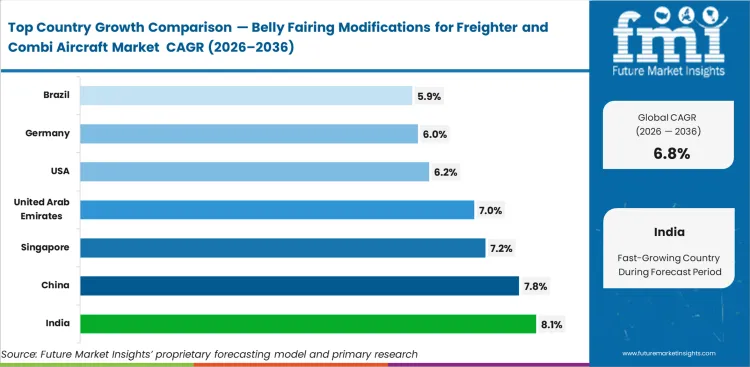
Asia Pacific Belly Fairing Modifications for Freighter and Combi Aircraft Market Analysis
Asia Pacific carries the strongest industry outlook for belly fairing modifications on freighter and combi aircraft because conversion activity, maintenance capacity, and cargo-aircraft utilization are aligning in a way that supports repeat retrofit work. Installation logic is clearer in this region where operators are already managing fleets that need regular attention, scheduled downtime discipline, and engineering approval support. Retrofit work also fits more naturally into broader fleet programs instead of being treated as a stand-alone expense. Wider relevance of air freight forwarding and air freight forwarding system reinforces this position, because cargo-handling intensity supports the wider commercial case for aircraft productivity, turnaround discipline, and airframe-use efficiency.
- India: India is expected to record 8.1% CAGR in this market through 2036. Local conversion-linked activity and growing engineering support are making retrofit work easier to justify across cargo-aircraft fleets that are moving into more composed maintenance cycles. Belly-area modifications fit better where operators can combine them with other aircraft events instead of opening a separate engineering task later. Airlines also benefit when underbody work can be aligned with heavy checks and repair schedules, because that improves installation practicality. The country remains important not only for activity levels, but for the way retrofit work can be organized within expanding freighter operations.
- China: Cargo-network scale keeps China firmly relevant in this sector, and the country is likely to post 7.8% CAGR by 2036. Retrofit work remains commercially sensible where aircraft utilization is frequent and local engineering capability can support approved exterior modifications without adding avoidable delay. Belly fairing changes are easier to justify on fleets that operate under constant use, because lower-fuselage exposure and drag-related performance matter more when aircraft keep rotating through active cargo routes. Installation timing still shapes adoption, but the operating base is large enough to support repeat programs. That gives suppliers a more reliable path when modification packages are tied to fleet-use discipline.
- Singapore: The industry outlook in Singapore points to 7.2% CAGR through 2036. MRO concentration and conversion support continue to strengthen installation practicality, which matters when operators want modification work that can be repeated without creating extra scheduling pressure. The country’s role is not based on fleet size alone. Its advantage comes from engineering organization, turnaround discipline, and the ability to absorb specialist retrofit work within established maintenance programs. Belly fairing modifications fit well in that environment because approval, installation access, and technical coordination can be managed more cleanly than in locations with weaker aviation support depth. This keeps Singapore commercially relevant despite its smaller aircraft base.
According to FMI, Asia Pacific remains the strongest regional base because retrofit work here can be connected to active fleet programs, engineering readiness, and cargo-aircraft use patterns that keep the operating case visible over time.
North America and Latin America Belly Fairing Modifications for Freighter and Combi Aircraft Market Analysis
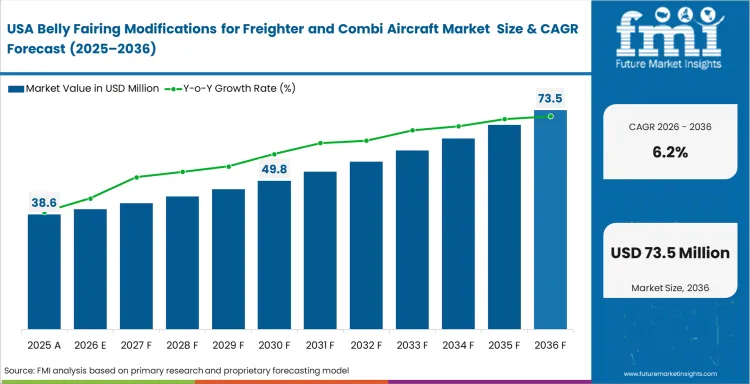
North America and Latin America present a more selective industry outlook, shaped by deep installed fleet presence in some markets and narrower retrofit breadth in others. The region remains relevant because freighter operators, conversion-linked support, and maintenance systems give the category a workable foundation. Belly fairing modifications are easier to sustain where aircraft are already cycling through scheduled maintenance events and where engineering teams are used to managing approved retrofit content. Yet not every fleet moves at the same pace. Program rollout depends heavily on whether operators can absorb installation work without stretching downtime. Broader links with cargo shipping and air cargo also keep the regional case tied to aircraft-use economics and cargo movement rather than isolated hardware spending.
- United States: The United States is projected to expand at a CAGR of 6.2% through 2036. Mature engineering support, a large freighter base, and established maintenance capability keep retrofit activity on a dependable path. Belly fairing modifications remain relevant because operators can often evaluate them within broader aircraft upkeep cycles instead of treating them as fully separate investments. Adoption still depends on timing discipline. Airlines usually screen retrofit work carefully against downtime exposure, documentation effort, and installation fit before moving ahead. That keeps the market commercially steady rather than fast-moving. The country remains important because it offers scale, technical familiarity, and a strong base for repeat retrofit planning.
- Brazil: Retrofit activity remains more selective here, and approval timing can weigh more heavily on rollout than it does in larger cargo hubs. Belly fairing modification programs are easier to justify when the work can be folded into planned aircraft events, because stand-alone installation creates a weaker case for operators managing tighter scheduling limits. Brazil is on a positive trend at 5.9% CAGR through 2036. Cargo-aircraft interest keeps the category active, but market depth is still narrower than in more established freighter centers. That makes execution discipline especially important. Suppliers need installation pathways that reduce disruption if they want retrofit work to move beyond isolated opportunities.
According to FMI, North America and Latin America remain commercially relevant, though the sector advances at a more measured pace where retrofit scale is narrower and maintenance-window discipline carries greater weight in operator decisions.
Europe and Middle East Belly Fairing Modifications for Freighter and Combi Aircraft Market Analysis
Europe and the Middle East remain important to this sector through widebody cargo operations, engineering depth, and hub-driven freighter deployment. Belly fairing modifications fit these markets where operators place value on aircraft availability, route economics, and well-coordinated maintenance work. The regional position is supported by strong aviation capability in some countries and concentrated freighter activity in others. Retrofit adoption still depends on whether approval-ready installation can be handled within planned events rather than added as a separate burden. This is one reason the region stays commercially relevant even without the same breadth seen in Asia Pacific. Broader links with aircraft automated inspection and aircraft structural coatings also support this view because underbody retrofit evaluation often sits close to wider aircraft-condition management priorities.
- Germany: Germany is expected to record 6% CAGR in the market during the forecast period. Engineering capability and maintenance quality support adoption, but fleet decisions are usually tied to careful work-package discipline. Belly fairing modifications fit best when airlines can connect them to scheduled checks, compositional upkeep, and approved installation planning without adding unnecessary aircraft downtime. That makes the market practical and technically credible, though not unusually fast in pace. The country remains relevant because operators value engineering control and execution quality when approving external aircraft modifications. This supports steady sector expansion built around maintenance logic rather than short-term retrofit enthusiasm.
- United Arab Emirates: Hub intensity and freighter concentration give the United Arab Emirates a stronger operating case for retrofit work, and adoption in the country is anticipated to move ahead at a CAGR of 7% during the assessment period. Belly fairing modifications are easier to justify where aircraft productivity and route economics stay under close review, especially on fleets that operate repeated cargo patterns. Installation value becomes more visible in that setting because underbody upgrades can support availability as well as operating discipline. The country’s role is shaped by utilization focus and cargo-fleet attention rather than sheer fleet breadth. That keeps the market active where retrofit timing is aligned with commercial aircraft use.
According to FMI, Europe and the Middle East remain firmer where operators can tie underbody retrofit work to long-haul freighter use, planned maintenance timing, and approval-ready installation support rather than discretionary exterior modification spending.
Competitive Aligners for Market Players
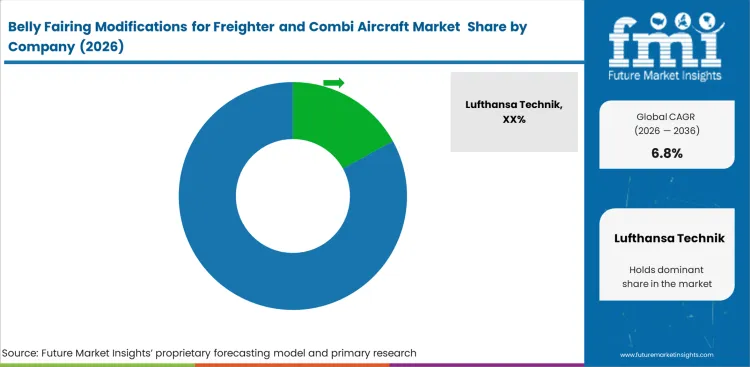
Competition in this sector remains fragmented because value is spread across certified retrofit content, engineering support, installation capability, and the ability to fit work into airline maintenance schedules. Carriers do not judge suppliers on part design alone. Approval pathway, documentation quality, fit on cargo-configured aircraft, and the ability to minimize extra ground time all influence supplier selection. Future Market Insights analysis suggests that companies positioned closest to approved installation work usually hold the clearest advantage.
Lufthansa Technik, Eirtech Aviation Services, Vortex Control Technologies, Raisbeck Engineering, Aeronautical Engineers, Inc., Elbe Flugzeugwerke GmbH, and Precision Aircraft Solutions approach the category from different technical positions. Some are strongest in drag-related exterior modification logic, while others sit nearer to conversion-linked work, underbody protection, or specialist installation engineering. Broader relevance of commercial aircraft mro, aircraft hydraulic system, and aerospace sealants shows that adjacent aircraft support categories also reward suppliers that can pair product fit with dependable in-service support.
Winning position in this market depends on repeatable installation quality, approval clarity, and the ability to fit retrofit work into planned aircraft events without adding avoidable disruption. Carrier acceptance usually remains strongest when suppliers reduce engineering burden and keep the technical package manageable for long-term service teams.
Key Players in Belly Fairing Modifications for Freighter and Combi Aircraft Market
- Lufthansa Technik
- Eirtech Aviation Services
- Vortex Control Technologies
- Raisbeck Engineering
- Aeronautical Engineers, Inc.
- Elbe Flugzeugwerke GmbH
- Precision Aircraft Solutions
Scope of the Report
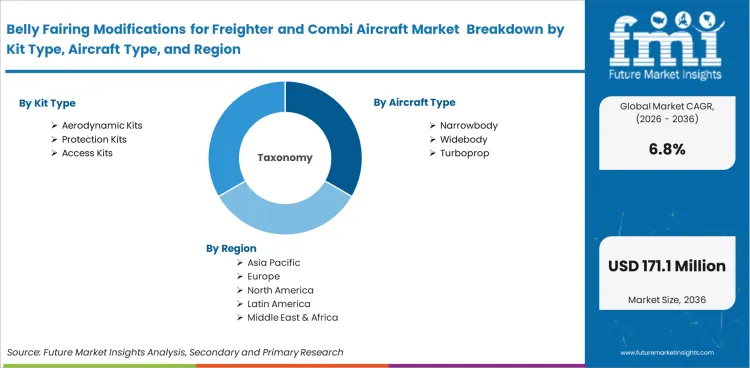
| Item | Value |
|---|---|
| Quantitative Units | USD 83 million in 2026 to USD 160.4 million by 2036, at a CAGR of 6.8% |
| Market Definition | Approved retrofit packages for belly fairings and adjacent lower-fuselage areas on freighter and combi aircraft |
| Segmentation | By Kit Type, Aircraft Type, Material, Certification Path, Installation Channel, and Region |
| By Kit Type | Aerodynamic Kits, Protection Kits, Access Kits, Hybrid Kits |
| By Aircraft Type | Narrowbody, Widebody, Turboprop, Combi |
| By Material | Composites, Aluminum, Films, Hybrid Laminates |
| By Certification Path | STC Retrofits, Service Bulletins, PMA Parts, Minor Changes |
| By Installation Channel | Independent MRO, OEM Partners, Conversion Lines, Operator Engineering |
| Regions Covered | Asia Pacific, North America and Latin America, Europe and Middle East |
| Countries Covered | India, China, Singapore, United Arab Emirates, United States, Germany, Brazil |
| Key Companies Profiled | Lufthansa Technik, Eirtech Aviation Services, Vortex Control Technologies, Raisbeck Engineering, Aeronautical Engineers, Inc., Elbe Flugzeugwerke GmbH, Precision Aircraft Solutions |
| Forecast Period | 2026 to 2036 |
| Approach | Installed-base retrofit modeling tied to modification timing, approval pathway, and blended kit-installation values |
Belly Fairing Modifications for Freighter and Combi Aircraft Market Analysis by Segments
By Kit Type:
- Aerodynamic Kits
- Protection Kits
- Access Kits
- Hybrid Kits
By Aircraft Type:
- Narrowbody
- Widebody
- Turboprop
- Combi
By Material:
- Composites
- Aluminum
- Films
- Hybrid Laminates
By Certification Path:
- STC Retrofits
- Service Bulletins
- PMA Parts
- Minor Changes
By Installation Channel:
- Independent MRO
- OEM Partners
- Conversion Lines
- Operator Engineering
By Region:
- North America
- United States
- Canada
- Mexico
- Latin America
- Brazil
- Western Europe
- Germany
- France
- UK
- Italy
- Spain
- Eastern Europe
- East Asia
- China
- Japan
- South Korea
- South Asia & Pacific
- India
- ASEAN
- Australia & New Zealand
- Middle East & Africa
Bibliography
- Boeing. (2024). World Air Cargo Forecast 2024-2043. Boeing.
- Airbus. (2024, July). Global Market Forecast 2024-2043. Airbus.
- International Air Transport Association. (2026, March 30). Air Cargo Demand up 11.2% in February 2026. IATA.
- Lufthansa Technik. (2026, February 5). LATAM extends AeroSHARK use across its entire Boeing 777 fleet. Lufthansa Technik.
- Elbe Flugzeugwerke GmbH. (2025, July 10). EFW secures CAAC’s validation of the STC for its A321P2F and A320P2F programmes. EFW.
This bibliography is provided for reader reference. The full FMI report contains the complete reference list with primary source documentation.
This Report Addresses
- Market intelligence to support strategic decision making across aerodynamic retrofit kits, protection kits, composite belly-area parts, and approved installation services for cargo aircraft.
- Market size estimation and 10-year revenue forecasts from 2026 to 2036, supported by installed-base retrofit modeling and maintenance-window analysis
- Growth opportunity mapping across kit type, aircraft type, material, certification path, and installation channel with emphasis on approval-ready installation timing
- Segment and regional revenue forecasts covering aerodynamic kits, narrowbody aircraft, composites, STC retrofits, and independent MRO participation across cargo-aircraft engineering environments
- Competition strategy assessment including approval clarity, installation capability, engineering support, documentation discipline, and aircraft downtime management
- Retrofit package development tracking including aerodynamic kits, protection kits, composite parts, STC pathways, and independent MRO execution capability
- Market access analysis covering approval pathways, engineering acceptance, airline maintenance timing, and conversion-linked installation routes
- Market report delivery in PDF, Excel, PPT, and interactive dashboard formats for executive strategy, fleet planning, and operational benchmarking use
Frequently Asked Questions
How large is the Belly Fairing Modifications for Freighter and Combi Aircraft Market in 2026?
FMI estimates the Belly Fairing Modifications for Freighter and Combi Aircraft Market at USD 83 million in 2026.
What will the Belly Fairing Modifications for Freighter and Combi Aircraft Market be valued at by 2036?
Future Market Insights projects the Belly Fairing Modifications for Freighter and Combi Aircraft Market to reach USD 160.4 million by 2036.
What CAGR is projected for the Belly Fairing Modifications for Freighter and Combi Aircraft Market?
FMI projects the Belly Fairing Modifications for Freighter and Combi Aircraft Market to expand at a CAGR of 6.8% from 2026 to 2036.
Which kit type leads the Belly Fairing Modifications for Freighter and Combi Aircraft Market?
Aerodynamic kits lead the Belly Fairing Modifications for Freighter and Combi Aircraft Market with an expected 34% share in 2026.
Which aircraft type leads the Belly Fairing Modifications for Freighter and Combi Aircraft Market?
Narrowbody aircraft are expected to lead the Belly Fairing Modifications for Freighter and Combi Aircraft Market with 41% share in 2026.
Which material segment leads the Belly Fairing Modifications for Freighter and Combi Aircraft Market?
Composites are projected to represent 46% of the Belly Fairing Modifications for Freighter and Combi Aircraft Market in 2026.
What drives rapid expansion in the Belly Fairing Modifications for Freighter and Combi Aircraft
Carrier focus on fuel-use discipline, underbody protection, and retrofit timing inside scheduled maintenance windows supports category expansion.
What is the main restraint in the Belly Fairing Modifications for Freighter and Combi Aircraft Market?
Installation timing, engineering approval effort, and extra aircraft ground time remain the main restraints in this market.
Why do STC retrofits hold the largest certification-path share in the Belly Fairing Modifications for Freighter and Combi Aircraft Market?
STC retrofits lead with 53% share because operators prefer approved packages that can be repeated across multiple aircraft.
Which installation channel leads the Belly Fairing Modifications for Freighter and Combi Aircraft Market?
Independent MRO leads the Belly Fairing Modifications for Freighter and Combi Aircraft Market with 38% share expected in 2026.
Which country records the fastest CAGR in the Belly Fairing Modifications for Freighter and Combi Aircraft Market?
India records the fastest CAGR at 8.1%, supported by cargo-aircraft engineering activity and a rising retrofit addressable base.
Which other countries remain important in the Belly Fairing Modifications for Freighter and Combi Aircraft Market?
China, Singapore, the United Arab Emirates, the United States, Germany, and Brazil remain important country markets through 2036.
Why do narrowbody aircraft account for the largest share in the Belly Fairing Modifications for Freighter and Combi Aircraft Market?
Narrowbody freighters align closely with conversion activity, regional cargo use, and broader retrofit deployment across active fleets.
Narrowbody freighters align closely with conversion activity, regional cargo use, and broader retrofit deployment across active fleets.
This market covers approved belly-area retrofit packages, while full conversion programs involve broader aircraft reconfiguration outside this scope.
What does the Belly Fairing Modifications for Freighter and Combi Aircraft Market include?
What does the Belly Fairing Modifications for Freighter and Combi Aircraft Market include?
What does the Belly Fairing Modifications for Freighter and Combi Aircraft Market exclude?
It excludes complete freighter conversions, factory line-fit fuselage design, unrelated repairs, and raw materials sold without approved modification content.
Why do airlines evaluate belly fairing modifications during planned heavy checks?
Planned heavy checks reduce separate downtime burden and make retrofit labor, access, and approval work easier to absorb.
How do carriers judge suppliers in the Belly Fairing Modifications for Freighter and Combi Aircraft Market?
Carriers judge suppliers on approval clarity, installation fit, documentation quality, engineering support, and manageable aircraft downtime.
Is the Belly Fairing Modifications for Freighter and Combi Aircraft Market concentrated or fragmented?
Future Market Insights considers the Belly Fairing Modifications for Freighter and Combi Aircraft Market fragmented, with value spread across specialist retrofit providers.
Preview the report firsthand - request a free sample
Get SampleGet the brochure for pricing and purchase details.
Get PDFTable of Content
- Executive Summary
- Global Market Outlook
- Demand-side Trends
- Supply-side Trends
- Technology Roadmap Analysis
- Analysis and Recommendations
- Market Overview
- Market Coverage / Taxonomy
- Market Definition / Scope / Limitations
- Research Methodology
- Chapter Orientation
- Analytical Lens and Working Hypotheses
- Market Structure, Signals, and Trend Drivers
- Benchmarking and Cross-market Comparability
- Market Sizing, Forecasting, and Opportunity Mapping
- Research Design and Evidence Framework
- Desk Research Programme (Secondary Evidence)
- Company Annual and Sustainability Reports
- Peer-reviewed Journals and Academic Literature
- Corporate Websites, Product Literature, and Technical Notes
- Earnings Decks and Investor Briefings
- Statutory Filings and Regulatory Disclosures
- Technical White Papers and Standards Notes
- Trade Journals, Industry Magazines, and Analyst Briefs
- Conference Proceedings, Webinars, and Seminar Materials
- Government Statistics Portals and Public Data Releases
- Press Releases and Reputable Media Coverage
- Specialist Newsletters and Curated Briefings
- Sector Databases and Reference Repositories
- FMI Internal Proprietary Databases and Historical Market Datasets
- Subscription Datasets and Paid Sources
- Social Channels, Communities, and Digital Listening Inputs
- Additional Desk Sources
- Expert Input and Fieldwork (Primary Evidence)
- Primary Modes
- Qualitative Interviews and Expert Elicitation
- Quantitative Surveys and Structured Data Capture
- Blended Approach
- Why Primary Evidence is Used
- Field Techniques
- Interviews
- Surveys
- Focus Groups
- Observational and In-context Research
- Social and Community Interactions
- Stakeholder Universe Engaged
- C-suite Leaders
- Board Members
- Presidents and Vice Presidents
- R&D and Innovation Heads
- Technical Specialists
- Domain Subject-matter Experts
- Scientists
- Physicians and Other Healthcare Professionals
- Governance, Ethics, and Data Stewardship
- Research Ethics
- Data Integrity and Handling
- Primary Modes
- Tooling, Models, and Reference Databases
- Desk Research Programme (Secondary Evidence)
- Data Engineering and Model Build
- Data Acquisition and Ingestion
- Cleaning, Normalisation, and Verification
- Synthesis, Triangulation, and Analysis
- Quality Assurance and Audit Trail
- Market Background
- Market Dynamics
- Drivers
- Restraints
- Opportunity
- Trends
- Scenario Forecast
- Demand in Optimistic Scenario
- Demand in Likely Scenario
- Demand in Conservative Scenario
- Opportunity Map Analysis
- Product Life Cycle Analysis
- Supply Chain Analysis
- Investment Feasibility Matrix
- Value Chain Analysis
- PESTLE and Porter’s Analysis
- Regulatory Landscape
- Regional Parent Market Outlook
- Production and Consumption Statistics
- Import and Export Statistics
- Market Dynamics
- Global Market Analysis 2021 to 2025 and Forecast, 2026 to 2036
- Historical Market Size Value (USD Million) Analysis, 2021 to 2025
- Current and Future Market Size Value (USD Million) Projections, 2026 to 2036
- Y-o-Y Growth Trend Analysis
- Absolute $ Opportunity Analysis
- Global Market Pricing Analysis 2021 to 2025 and Forecast 2026 to 2036
- Global Market Analysis 2021 to 2025 and Forecast 2026 to 2036, By Kit Type
- Introduction / Key Findings
- Historical Market Size Value (USD Million) Analysis By Kit Type , 2021 to 2025
- Current and Future Market Size Value (USD Million) Analysis and Forecast By Kit Type , 2026 to 2036
- Aerodynamic Kits
- Protection Kits
- Access Kits
- Aerodynamic Kits
- Y-o-Y Growth Trend Analysis By Kit Type , 2021 to 2025
- Absolute $ Opportunity Analysis By Kit Type , 2026 to 2036
- Global Market Analysis 2021 to 2025 and Forecast 2026 to 2036, By Aircraft Type
- Introduction / Key Findings
- Historical Market Size Value (USD Million) Analysis By Aircraft Type, 2021 to 2025
- Current and Future Market Size Value (USD Million) Analysis and Forecast By Aircraft Type, 2026 to 2036
- Narrowbody
- Widebody
- Turboprop
- Narrowbody
- Y-o-Y Growth Trend Analysis By Aircraft Type, 2021 to 2025
- Absolute $ Opportunity Analysis By Aircraft Type, 2026 to 2036
- Global Market Analysis 2021 to 2025 and Forecast 2026 to 2036, By Material
- Introduction / Key Findings
- Historical Market Size Value (USD Million) Analysis By Material, 2021 to 2025
- Current and Future Market Size Value (USD Million) Analysis and Forecast By Material, 2026 to 2036
- Composites
- Aluminum
- Films
- Composites
- Y-o-Y Growth Trend Analysis By Material, 2021 to 2025
- Absolute $ Opportunity Analysis By Material, 2026 to 2036
- Global Market Analysis 2021 to 2025 and Forecast 2026 to 2036, By Certification Path
- Introduction / Key Findings
- Historical Market Size Value (USD Million) Analysis By Certification Path, 2021 to 2025
- Current and Future Market Size Value (USD Million) Analysis and Forecast By Certification Path, 2026 to 2036
- STC Retrofits
- Service Bulletins
- PMA Parts
- STC Retrofits
- Y-o-Y Growth Trend Analysis By Certification Path, 2021 to 2025
- Absolute $ Opportunity Analysis By Certification Path, 2026 to 2036
- Global Market Analysis 2021 to 2025 and Forecast 2026 to 2036, By Installation Channel
- Introduction / Key Findings
- Historical Market Size Value (USD Million) Analysis By Installation Channel, 2021 to 2025
- Current and Future Market Size Value (USD Million) Analysis and Forecast By Installation Channel, 2026 to 2036
- Independent MRO
- OEM Partners
- Conversion Lines
- Independent MRO
- Y-o-Y Growth Trend Analysis By Installation Channel, 2021 to 2025
- Absolute $ Opportunity Analysis By Installation Channel, 2026 to 2036
- Global Market Analysis 2021 to 2025 and Forecast 2026 to 2036, By Region
- Introduction
- Historical Market Size Value (USD Million) Analysis By Region, 2021 to 2025
- Current Market Size Value (USD Million) Analysis and Forecast By Region, 2026 to 2036
- North America
- Latin America
- Western Europe
- Eastern Europe
- East Asia
- South Asia and Pacific
- Middle East & Africa
- Market Attractiveness Analysis By Region
- North America Market Analysis 2021 to 2025 and Forecast 2026 to 2036, By Country
- Historical Market Size Value (USD Million) Trend Analysis By Market Taxonomy, 2021 to 2025
- Market Size Value (USD Million) Forecast By Market Taxonomy, 2026 to 2036
- By Country
- USA
- Canada
- Mexico
- By Kit Type
- By Aircraft Type
- By Material
- By Certification Path
- By Installation Channel
- By Country
- Market Attractiveness Analysis
- By Country
- By Kit Type
- By Aircraft Type
- By Material
- By Certification Path
- By Installation Channel
- Key Takeaways
- Latin America Market Analysis 2021 to 2025 and Forecast 2026 to 2036, By Country
- Historical Market Size Value (USD Million) Trend Analysis By Market Taxonomy, 2021 to 2025
- Market Size Value (USD Million) Forecast By Market Taxonomy, 2026 to 2036
- By Country
- Brazil
- Chile
- Rest of Latin America
- By Kit Type
- By Aircraft Type
- By Material
- By Certification Path
- By Installation Channel
- By Country
- Market Attractiveness Analysis
- By Country
- By Kit Type
- By Aircraft Type
- By Material
- By Certification Path
- By Installation Channel
- Key Takeaways
- Western Europe Market Analysis 2021 to 2025 and Forecast 2026 to 2036, By Country
- Historical Market Size Value (USD Million) Trend Analysis By Market Taxonomy, 2021 to 2025
- Market Size Value (USD Million) Forecast By Market Taxonomy, 2026 to 2036
- By Country
- Germany
- UK
- Italy
- Spain
- France
- Nordic
- BENELUX
- Rest of Western Europe
- By Kit Type
- By Aircraft Type
- By Material
- By Certification Path
- By Installation Channel
- By Country
- Market Attractiveness Analysis
- By Country
- By Kit Type
- By Aircraft Type
- By Material
- By Certification Path
- By Installation Channel
- Key Takeaways
- Eastern Europe Market Analysis 2021 to 2025 and Forecast 2026 to 2036, By Country
- Historical Market Size Value (USD Million) Trend Analysis By Market Taxonomy, 2021 to 2025
- Market Size Value (USD Million) Forecast By Market Taxonomy, 2026 to 2036
- By Country
- Russia
- Poland
- Hungary
- Balkan & Baltic
- Rest of Eastern Europe
- By Kit Type
- By Aircraft Type
- By Material
- By Certification Path
- By Installation Channel
- By Country
- Market Attractiveness Analysis
- By Country
- By Kit Type
- By Aircraft Type
- By Material
- By Certification Path
- By Installation Channel
- Key Takeaways
- East Asia Market Analysis 2021 to 2025 and Forecast 2026 to 2036, By Country
- Historical Market Size Value (USD Million) Trend Analysis By Market Taxonomy, 2021 to 2025
- Market Size Value (USD Million) Forecast By Market Taxonomy, 2026 to 2036
- By Country
- China
- Japan
- South Korea
- By Kit Type
- By Aircraft Type
- By Material
- By Certification Path
- By Installation Channel
- By Country
- Market Attractiveness Analysis
- By Country
- By Kit Type
- By Aircraft Type
- By Material
- By Certification Path
- By Installation Channel
- Key Takeaways
- South Asia and Pacific Market Analysis 2021 to 2025 and Forecast 2026 to 2036, By Country
- Historical Market Size Value (USD Million) Trend Analysis By Market Taxonomy, 2021 to 2025
- Market Size Value (USD Million) Forecast By Market Taxonomy, 2026 to 2036
- By Country
- India
- ASEAN
- Australia & New Zealand
- Rest of South Asia and Pacific
- By Kit Type
- By Aircraft Type
- By Material
- By Certification Path
- By Installation Channel
- By Country
- Market Attractiveness Analysis
- By Country
- By Kit Type
- By Aircraft Type
- By Material
- By Certification Path
- By Installation Channel
- Key Takeaways
- Middle East & Africa Market Analysis 2021 to 2025 and Forecast 2026 to 2036, By Country
- Historical Market Size Value (USD Million) Trend Analysis By Market Taxonomy, 2021 to 2025
- Market Size Value (USD Million) Forecast By Market Taxonomy, 2026 to 2036
- By Country
- Kingdom of Saudi Arabia
- Other GCC Countries
- Turkiye
- South Africa
- Other African Union
- Rest of Middle East & Africa
- By Kit Type
- By Aircraft Type
- By Material
- By Certification Path
- By Installation Channel
- By Country
- Market Attractiveness Analysis
- By Country
- By Kit Type
- By Aircraft Type
- By Material
- By Certification Path
- By Installation Channel
- Key Takeaways
- Key Countries Market Analysis
- USA
- Pricing Analysis
- Market Share Analysis, 2025
- By Kit Type
- By Aircraft Type
- By Material
- By Certification Path
- By Installation Channel
- Canada
- Pricing Analysis
- Market Share Analysis, 2025
- By Kit Type
- By Aircraft Type
- By Material
- By Certification Path
- By Installation Channel
- Mexico
- Pricing Analysis
- Market Share Analysis, 2025
- By Kit Type
- By Aircraft Type
- By Material
- By Certification Path
- By Installation Channel
- Brazil
- Pricing Analysis
- Market Share Analysis, 2025
- By Kit Type
- By Aircraft Type
- By Material
- By Certification Path
- By Installation Channel
- Chile
- Pricing Analysis
- Market Share Analysis, 2025
- By Kit Type
- By Aircraft Type
- By Material
- By Certification Path
- By Installation Channel
- Germany
- Pricing Analysis
- Market Share Analysis, 2025
- By Kit Type
- By Aircraft Type
- By Material
- By Certification Path
- By Installation Channel
- UK
- Pricing Analysis
- Market Share Analysis, 2025
- By Kit Type
- By Aircraft Type
- By Material
- By Certification Path
- By Installation Channel
- Italy
- Pricing Analysis
- Market Share Analysis, 2025
- By Kit Type
- By Aircraft Type
- By Material
- By Certification Path
- By Installation Channel
- Spain
- Pricing Analysis
- Market Share Analysis, 2025
- By Kit Type
- By Aircraft Type
- By Material
- By Certification Path
- By Installation Channel
- France
- Pricing Analysis
- Market Share Analysis, 2025
- By Kit Type
- By Aircraft Type
- By Material
- By Certification Path
- By Installation Channel
- India
- Pricing Analysis
- Market Share Analysis, 2025
- By Kit Type
- By Aircraft Type
- By Material
- By Certification Path
- By Installation Channel
- ASEAN
- Pricing Analysis
- Market Share Analysis, 2025
- By Kit Type
- By Aircraft Type
- By Material
- By Certification Path
- By Installation Channel
- Australia & New Zealand
- Pricing Analysis
- Market Share Analysis, 2025
- By Kit Type
- By Aircraft Type
- By Material
- By Certification Path
- By Installation Channel
- China
- Pricing Analysis
- Market Share Analysis, 2025
- By Kit Type
- By Aircraft Type
- By Material
- By Certification Path
- By Installation Channel
- Japan
- Pricing Analysis
- Market Share Analysis, 2025
- By Kit Type
- By Aircraft Type
- By Material
- By Certification Path
- By Installation Channel
- South Korea
- Pricing Analysis
- Market Share Analysis, 2025
- By Kit Type
- By Aircraft Type
- By Material
- By Certification Path
- By Installation Channel
- Russia
- Pricing Analysis
- Market Share Analysis, 2025
- By Kit Type
- By Aircraft Type
- By Material
- By Certification Path
- By Installation Channel
- Poland
- Pricing Analysis
- Market Share Analysis, 2025
- By Kit Type
- By Aircraft Type
- By Material
- By Certification Path
- By Installation Channel
- Hungary
- Pricing Analysis
- Market Share Analysis, 2025
- By Kit Type
- By Aircraft Type
- By Material
- By Certification Path
- By Installation Channel
- Kingdom of Saudi Arabia
- Pricing Analysis
- Market Share Analysis, 2025
- By Kit Type
- By Aircraft Type
- By Material
- By Certification Path
- By Installation Channel
- Turkiye
- Pricing Analysis
- Market Share Analysis, 2025
- By Kit Type
- By Aircraft Type
- By Material
- By Certification Path
- By Installation Channel
- South Africa
- Pricing Analysis
- Market Share Analysis, 2025
- By Kit Type
- By Aircraft Type
- By Material
- By Certification Path
- By Installation Channel
- USA
- Market Structure Analysis
- Competition Dashboard
- Competition Benchmarking
- Market Share Analysis of Top Players
- By Regional
- By Kit Type
- By Aircraft Type
- By Material
- By Certification Path
- By Installation Channel
- Competition Analysis
- Competition Deep Dive
- Lufthansa Technik
- Overview
- Product Portfolio
- Profitability by Market Segments (Product/Age /Sales Channel/Region)
- Sales Footprint
- Strategy Overview
- Marketing Strategy
- Product Strategy
- Channel Strategy
- Eirtech Aviation Services
- Vortex Control Technologies
- Raisbeck Engineering
- Aeronautical Engineers, Inc.
- Elbe Flugzeugwerke GmbH
- Lufthansa Technik
- Competition Deep Dive
- Assumptions & Acronyms Used


