

- Industry Size (2026)
- USD 182.4 Mn
- Forecast (2036)
- USD 345.6 Mn
- CAGR (2026 to 2036)
- 6.6%
Aircraft Pylon and Strut Fairing Retrofit Kits Market Size, Market Forecast and Outlook By FMI
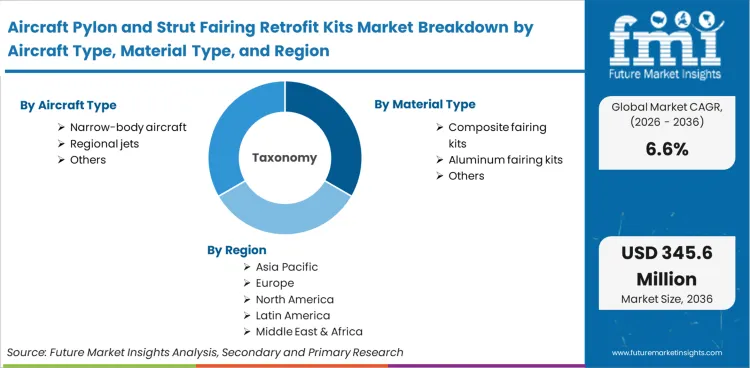
The aircraft pylon and strut fairing retrofit kits market was valued at USD 171.1 million in 2025. Sales are poised to cross USD 182.4 million in 2026 at a CAGR of 6.6% during forecast period. Revenue expansion propels cumulative valuation across the aircraft pylon fairing retrofit market to USD 345.6 million through 2036 as airlines extend legacy narrow-body lifecycles beyond original design limits.
Fleet engineers face mounting pressure from delayed next-generation aircraft deliveries, forcing unplanned life-extension protocols on mature airframes. Operators navigating aircraft fairing retrofit for aging fleets mitigate this exposure by ordering aircraft fairings designed for remediation rather than simple cosmetic replacement. Procurement directors cannot risk grounding highly utilized assets due to localized delamination near engine mounting points, making aircraft pylon fairing kits essential for continuous operation.
Summary of Aircraft Pylon and Strut Fairing Retrofit Kits Market
- Aircraft Pylon and Strut Fairing Retrofit Kits Market Definition:
- Engineered aerodynamic closures protecting engine mounting structures constitute this segment, reducing drag during post-production aircraft operations.
- Demand Drivers in the Market:
- Delayed fleet renewal schedules force airline technical directors to evaluate pylon fairing retrofit lead time constraints immediately.
- Stringent fuel-burn optimization targets compel lessor asset managers to authorize aircraft pylon drag reduction retrofit upgrades.
- High cycle-fatigue rates push MRO leads to order aircraft fairing retrofit kits ahead of mandated inspection intervals.
- Key Segments Analyzed in the FMI Report:
- Narrow-body aircraft is expected to hold 46.0% share in 2026, driven by narrow-body pylon fairing retrofit requirements during mid-life heavy maintenance.
- Composite fairing kits is projected to capture 58.0% share in 2026 due to superior strength-to-weight ratios optimizing fuel efficiency.
- Damage repair and replacement kits is estimated to account for 41.0% share in 2026 based on strict regulatory compliance mandates.
- OEM-authorized / Tier-1 retrofit channels is set to secure 52.0% share in 2026 as lessors demand OEM-approved pylon fairing retrofit kit tracing.
- Commercial airlines are anticipated to retain 49.0% share in 2026, managing airline MRO fairing kits amid fleet availability pressures.
- India: 8.4% compound growth, maintained by rapid domestic MRO infrastructure expansion.
- Analyst Opinion at FMI:
- Nikhil Kaitwade, Principal Analyst, Process Automation, at FMI, notes that "Generalist models assume operators replace fairings purely based on prescribed maintenance manuals. However, actual purchasing behavior revolves around leased-asset return conditions. Aircraft lessors dictate strict aerodynamic surface requirements before accepting returned airframes. Operators frequently purchase complete aerostructure aftermarket kits months ahead of lease expiration rather than attempting complex localized repairs. This dynamic creates predictable demand spikes tied entirely to lessor-driven aircraft retrofit demand rather than actual flight hour accumulation or physical component failure rates."
- Strategic Implications / Executive Takeaways:
- Airline procurement chiefs face critical supply crunches requiring advanced allocation agreements with aircraft fairing retrofit kit manufacturers.
- MRO facility managers must expand aviation aftermarket composite repairs capabilities to capture high-margin overhaul contracts.
- Component fabricators gain pricing power by bundling certification paperwork directly with physical hardware.
Once primary airframe manufacturers announce multi-year production backlogs, secondary component demand accelerates. Extended utilization rates accelerate fatigue on existing aerodynamic surfaces, prompting immediate aircraft pylon fairing replacement kits directives. Airlines pivot from reactive spot-buying to aggressive forward-allocation strategies to ensure certified aircraft repair kits remain available during heavy maintenance visits.
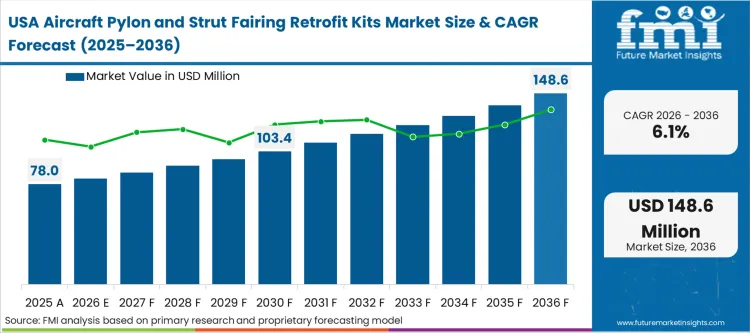
India expands at 8.4% as localized MRO capacity absorbs regional fleet maintenance volumes, accelerating the India aircraft pylon retrofit market. China tracks at 7.2% due to aggressive wide-body life extension programs. Singapore reaches 6.7% and United Arab Emirates hits 6.5% serving as transnational maintenance hubs. The United States advances at 6.1% with heavily penetrated domestic fleets. Germany hits 5.9% and France records 5.8% leaning on deep Tier-1 engineering capabilities. Operators facing distinct operational pressures dictate categorical divergence across global maintenance strategies.
Aircraft Pylon and Strut Fairing Retrofit Kits Market Key Takeaways
| Metric | Details |
|---|---|
| Industry Size (2026) | USD 182.4 million |
| Industry Value (2036) | USD 345.6 million |
| CAGR (2026 to 2036) | 6.6% |
Source: Future Market Insights (FMI) analysis, based on proprietary forecasting model and primary research
Aircraft Pylon and Strut Fairing Retrofit Kits Market Definition
Aircraft strut fairing retrofit kits market scope comprises engineered aerodynamic structures designed to enclose engine mounting hardware and wing-to-strut junctions during aftermarket replacement cycles. Equipment functions primarily to reduce aerodynamic drag while protecting critical engine bleed air and hydraulic routing from environmental degradation. Components must perfectly match original factory specifications to satisfy strict aviation safety agency mandates.
Aircraft Pylon and Strut Fairing Retrofit Kits Market Inclusions
Scope covers panel sets, integrated mounting hardware, vibration-damping seals, and associated qualification documentation required for installation. Systems classified as repairable composite leading edge modules and aerostructure retrofit kits for pylons fall within defined boundaries. Analysis evaluates nacelle and pylon fairing repair kits installed specifically during maintenance overhauls rather than initial aircraft assembly.
Aircraft Pylon and Strut Fairing Retrofit Kits Market Exclusions
Analysis excludes engine cowlings, primary wing box structures, and thrust reverser assemblies. Initial factory-installed fairings belong to original equipment manufacturing datasets. Superficial cosmetic decals and non-structural aircraft branding decal systems films remain outside measured parameters because they provide no aerodynamic drag-reduction properties. Routine touch-up paint applications fail to qualify under aircraft engine pylon fairing retrofit definitions.
Aircraft Pylon and Strut Fairing Retrofit Kits Market Research Methodology
- Primary Research: Fleet engineering directors sourcing aircraft pylon retrofit kit suppliers
- Desk Research: European Union Aviation Safety Agency airworthiness directives and aircraft lessor maintenance logs
- Market-Sizing and Forecasting: Annual heavy maintenance visit schedules calculating pylon fairing retrofit cost per aircraft
- Data Validation and Update Cycle: Independent aircraft leasing tear-down schedules and parts-harvesting metrics
Segmental Analysis
Aircraft Pylon and Strut Fairing Retrofit Kits Market Analysis by Aircraft Type
Operators managing legacy fleets face intense operational constraints during mid-life maintenance cycles. Narrow-body aircraft retains 46.0% share in 2026 as short-haul route networks drive high takeoff-and-landing cyclic fatigue. Fleet technical directors authorize extensive aerostructure components replacements to prevent micro-cracking from grounding highly utilized assets. FMI analysts note that consistent vibration around engine mounts forces premature replacement of skins long before overall airframe expiration. What analysts frequently overlook is that narrow-body asset transitions between operators trigger mandatory aesthetic and aerodynamic restorations; leasing companies refuse airframes displaying compromised fairing integrity. Airlines delaying these restorative upgrades face severe financial penalties during asset return negotiations.
- Initial defect identification: Line maintenance crews discover delamination during routine transit inspections. Fleet technical directors must immediately issue an RFQ for aircraft pylon fairing kits.
- Verification during overhaul: Heavy maintenance facilities conduct advanced non-destructive testing on exposed mounting structures. Mechanics identify hidden corrosion necessitating complete strut fairing replacement.
- Post-installation validation: Quality assurance inspectors verify aerodynamic seal tolerances. Airlines minimize aircraft fairing retrofit installation downtime by utilizing pre-certified retrofit packages.
Aircraft Pylon and Strut Fairing Retrofit Kits Market Analysis by Material Type
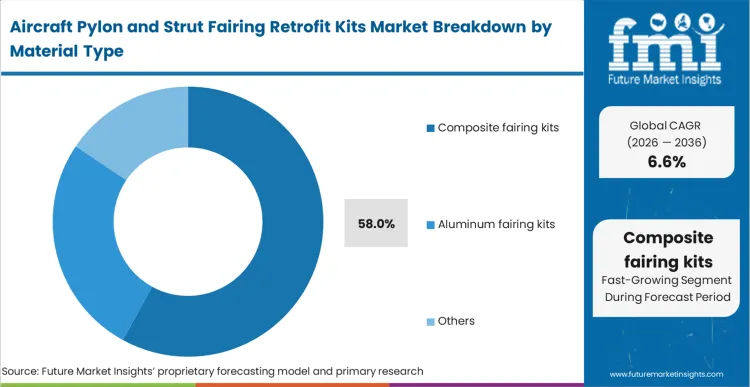
Weight reduction mandates strictly dictate material selection for modern aviation upgrades. Composite fairing kits commands 58.0% share in 2026, offering distinct fatigue resistance compared to legacy metallic options. FMI's analysis indicates composite airframes require specialized composite pylon fairing repair kits that many regional facilities cannot execute internally. Structural engineers specify full module replacement over complex localised patching to guarantee aerodynamic performance. General assumptions treat composites purely as weight-saving measures; practically, they eliminate localised corrosion tracking that plagues aluminium interfaces near engine exhaust paths. Procurement managers evaluating composite fairing repair vs replacement frequently absorb higher lifetime maintenance costs if they opt for cheaper metallic alternatives.
- Cost origin in procurement: Material buyers secure volumetric discounts on standardized composite layups. Volume purchasing lowers baseline component acquisition expenses.
- Hidden operational expenses: Specialized aerospace fasteners and specific torque application tools add unexpected overhead. MRO centers must invest heavily in technician retraining.
- Lifecycle cost revelation: Extended intervals between required inspections offset high initial purchase prices. Airlines capture long-term value through reduced aircraft downtime.
Aircraft Pylon and Strut Fairing Retrofit Kits Market Analysis by Retrofit Purpose
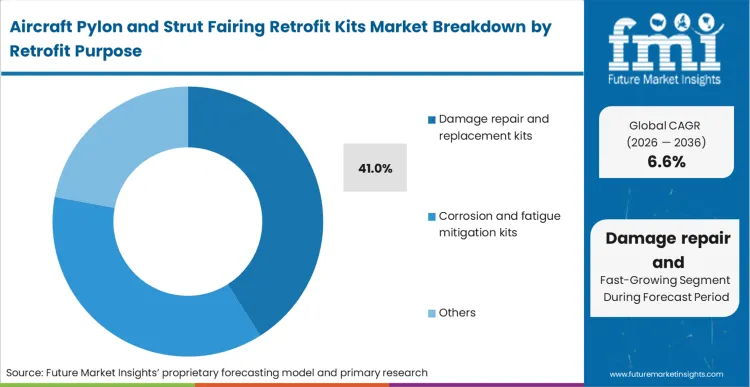
Regulatory compliance schedules leave operators zero flexibility regarding integrity. Damage repair and replacement kits hold 41.0% share in 2026, maintained by strict airworthiness directives. Maintenance directors constantly monitor aircraft nacelles for excessive wear requiring an aircraft pylon corrosion repair kit. According to FMI's estimates, routine ground-handling collisions contribute significantly to unplanned fairing replacements. While fuel-saving upgrades grab headlines, everyday ramp damage forces actual purchasing volume. Facilities attempting unauthorized patch repairs risk immediate grounding orders from safety regulators.
- Catastrophic failure prevention: Robust replacement modules prevent inflight panel separation. Safety inspectors mandate immediate grounding if limits are exceeded.
- Residual fatigue risk: Surrounding legacy hardware may still fail despite new fairing installation. Technicians must comprehensively evaluate entire strut assemblies.
- Full benefit capture: Operators must pair upgrades with updated bio-based aircraft coatings to maximize aerodynamic efficiency.
Aircraft Pylon and Strut Fairing Retrofit Kits Market Analysis by Installation Channel
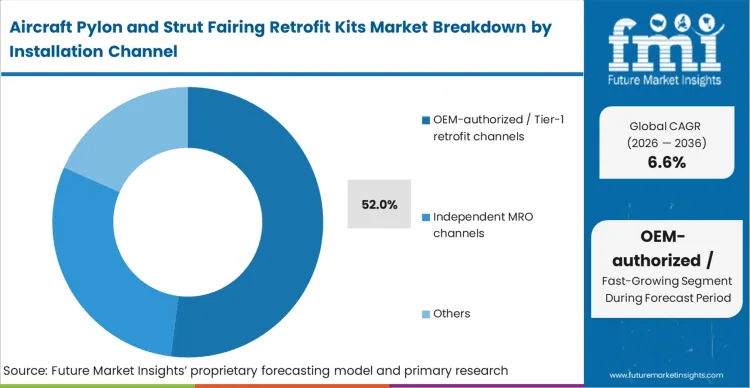
Asset preservation strategies heavily favor original equipment pathways. OEM-authorized / Tier-1 retrofit channels secure 52.0% share in 2026, providing guaranteed certification paperwork. Based on FMI's assessment, commercial aircraft MRO managers prefer direct factory support to avoid complex reverse-engineering approval processes. Lessor lease agreements mandate Tier-1 replacement parts to maintain maximum asset resale value. Independent shops lacking direct OEM data access face immense friction qualifying third-party fabricated structures. Procurement managers weighing OEM retrofit kits vs independent MRO repair kits recognize that utilizing unauthorized channels risks massive asset devaluation during eventual fleet sell-offs.
- Tier-1 early adoption: Flag carriers with direct factory service agreements implement upgrades immediately. Engineering teams leverage extensive OEM technical support.
- Follow-on regional operators: Mid-sized airlines adopt solutions after observing successful flag-carrier deployments. Maintenance departments require simplified installation guides.
- Late-stage budget carriers: Low-cost operators finally transition when legacy part supplies evaporate. Procurement teams scramble to secure remaining metallic-composite hybrid exterior components.
Aircraft Pylon and Strut Fairing Retrofit Kits Market Analysis by End user
Intense schedule reliability pressures dictate operator purchasing behaviours. Commercial airlines dominate with 49.0% share in 2026, executing continuous aircraft refurbishing cycles. FMI observes that high-utilisation routes accelerate component wear far beyond published predictive models. Technical procurement heads maintain emergency aircraft strut fairing replacement parts at key hub airports. Industry data obscures how deeply airlines rely on swapped modules to keep aircraft flying while damaged units undergo prolonged workshop repair. Operators lacking adequate spares inventory suffer severe passenger compensation penalties when flights cancel due to missing fairings.
- Performance beyond baseline: Factory-fresh fairings restore aerodynamic flow to original design specifications. Flight operations directors observe measurable fuel consumption improvements.
- Edge condition vulnerability: Extreme temperature variations stress mounting hardware beyond normal limits. Maintenance supervisors must conduct targeted inspections following severe weather encounters.
- Acceptability standards: Quality assurance protocols demand perfect alignment along aircraft exterior lighting interfaces. Technicians reject modules displaying even minor dimensional deviations.
Aircraft Pylon and Strut Fairing Retrofit Kits Market Drivers, Restraints, and Opportunities
Supply chain bottlenecks force airline procurement heads to stockpile critical aerodynamic structures rather than relying on just-in-time delivery. Delayed deliveries of next-generation aircraft compel operators to extend legacy airframe operational lives well past initial retirement dates. This dynamic requires aggressive reinforcement of engine mounting areas subject to extreme cyclic fatigue. Engineering directors acting proactively secure long-term component availability, while those relying on spot-market purchasing face severe grounding risks as available inventory vanishes.
Complex regulatory certification pathways delay widespread adoption of third-party fabricated composite replacements. Authorities demand exhaustive stress-testing data before designating a facility as an approved MRO for pylon fairing retrofit. This strict requirement limits competitive supply options and keeps pricing artificially high. Emerging fast-track approval programs attempt to ease this bottleneck; however, limited engineering talent at regulatory agencies continues slowing certification timelines.
Opportunities in the Aircraft Pylon and Strut Fairing Retrofit Kits Market
- Predictive maintenance integration: Digital health monitoring sensors embedded within composite fairings allow maintenance directors to schedule line maintenance retrofit kits for fairings precisely.
- Advanced surface treatments: Integration of ultra-low drag riblet aircraft coatings offers airlines compounding fuel-efficiency benefits during mandatory upgrades.
- Localized fabrication nodes: Tier-1 suppliers establishing regional composite molding facilities capture lucrative contracts from nearby international transit hubs.
Regional Analysis
According to the regional analysis, the Aircraft Pylon and Strut Fairing Retrofit Kits market is divided across more than 40 countries within North America, Latin America, Western Europe, Eastern Europe, Asia‑Pacific, and the Middle East & Africa.
.webp "Top Country Growth Comparison Aircraft Pylon And Strut Fairing Retrofit Kits Market Cagr (2026 2036)")
| Country | CAGR (2026 to 2036) |
|---|---|
| India | 8.4% |
| China | 7.2% |
| Singapore | 6.7% |
| United Arab Emirates | 6.5% |
| United States | 6.1% |
| Germany | 5.9% |
| France | 5.8% |
Source: Future Market Insights (FMI) analysis, based on proprietary forecasting model and primary research
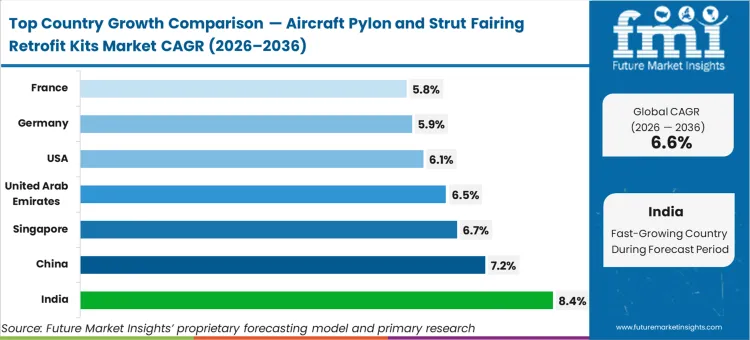
Asia Pacific Aircraft Pylon and Strut Fairing Retrofit Kits Market Analysis
Massive fleet expansion across emerging economies outpaces local repair capabilities, creating immense demand for modular replacement solutions. Engineering directors at rapidly growing carriers prioritize pre-fabricated kits over labor-intensive manual layups. FMI observes that high cyclic utilization on short-haul regional networks accelerates vibration-induced fatigue. A robust local MRO infrastructure absorbs transnational heavy maintenance visits, driving Asia Pacific aircraft fairing retrofit demand.
- India: Aggressive domestic aviation growth forces immediate investment in heavy maintenance capacity to prevent widespread fleet groundings. Currently, fleet engineering directors depend entirely on imported composite modules to execute overhauls, exposing airlines to severe supply chain bottlenecks. As volume expansion advances at 8.4%, this reliance becomes financially unsustainable. To mitigate offshore delays, qualified regional fabricators will eventually capture localized production contracts, fundamentally changing procurement patterns.
- China: Wide-body life extension programs now require extensive aerodynamic surface overhauls to keep aging airframes economically viable. To meet strict international emission targets, technical directors increasingly utilize aerospace lightweight materials during these mandatory refits. As volume of aircraft pylon and strut fairing retrofit kits market in China increases at 7.2% CAGR, domestic suppliers actively capture this localised demand. Consequently, these regional fabricators gain critical certification experience, eventually positioning their replacement modules favourably against established Western incumbents.
- Singapore: The aircraft pylon fairing market revenue in Singapore tracks at CAGR 6.7%. MRO providers leverage deep technical specialization rather than pure volume. Unmatched geographic positioning enables complete dominance as a premier transnational maintenance hub for overlapping Asian and European flight networks. Facility managers consistently execute complex retrofits, absorbing heavy overhaul volume for diverse international fleets. Operators utilizing these centralized hubs achieve categorical reductions in scheduled aircraft downtime during mandatory fairing replacements.
FMI's report includes detailed assessments of Japan, South Korea, and emerging Southeast Asian aviation markets. Supply chains prioritize regional distribution centers near major international airports.
Middle East and Africa Aircraft Pylon and Strut Fairing Retrofit Kits Market Analysis
Harsh environmental operating conditions systematically degrade aerodynamic surfaces faster than standard predictive models suggest. Maintenance directors managing large wide-body fleets combat constant sand erosion and extreme thermal cycling. FMI's analysis indicates these specific stressors force premature replacement of protective engine fairings. Facilities require specialized hydrophobic runway contaminant resistant coatings integrated into replacement kits.
- United Arab Emirates: Mega-carriers operating continuously out of extreme desert hubs face severely accelerated composite delamination issues due to constant thermal cycling and sand erosion. To combat this localized degradation, engineering teams strictly mandate reinforced environmental sealing on all incoming replacement hardware. As UAE market growth hits 6.5% CAGR, fleet technical leads move beyond standard OEM guidance, establishing customised reliability tracking protocols to prevent premature fairing failures across their wide-body assets.
FMI's report includes evaluation of Saudi Arabia, Qatar, and expanding African transit networks. Regional operators increasingly collaborate with Tier-1 suppliers to develop customized environmental defense packages.
North America Aircraft Pylon and Strut Fairing Retrofit Kits Market Analysis
Mature fleet demographics dictate a continuous cycle of life-extension programs defining the North America aircraft pylon retrofit market. Asset managers overseeing massive domestic networks focus heavily on maintaining lease-return compliance. Based on FMI's assessment, operators prioritize proven OEM-certified components to avoid regulatory scrutiny during heavy maintenance checks. Procurement teams leverage enormous purchasing power to secure long-term component supply agreements.
- United States: Massive installed bases of legacy narrow-body airframes now require constant attention to prevent fatigue-related groundings. Navigating tight capacity, maintenance vice presidents execute aggressive, rolling replacement schedules across hundreds of heavily utilised aircraft simultaneously. While the demand in the aircraft pylon fairing market revenue in Singapore grows at a CAGR of 6.1%, an unrelenting focus on dispatch reliability keeps this component replacement volume permanent, entirely insulating retrofit purchasing behaviour from broader economic cycles or passenger downturns.
- FMI's report includes analysis of Canadian regional operators and specialized freighter conversion facilities. Legacy passenger airframes undergoing cargo conversion consume massive volumes of fairing hardware.
Competitive Aligners for Market Players
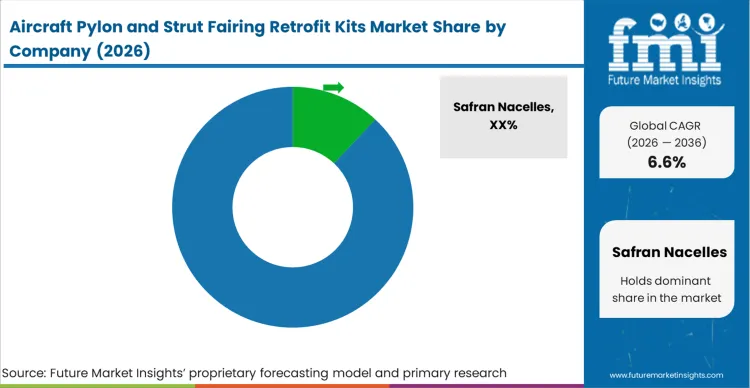
Factory-direct engineering data access fundamentally separates top-tier suppliers from independent fabricators. Safran Nacelles and Collins Aerospace dominate high-value wide-body platforms through exclusive intellectual property rights covering engine interface aerodynamics. FMI's assessment shows airline technical directors evaluating Safran vs Collins nacelle aftermarket support overwhelmingly prefer these incumbents to avoid immense aerospace lightning strike protection certification burdens associated with unapproved parts. Independent MRO facilities must secure expensive licensing agreements or risk losing lucrative heavy maintenance contracts.
Incumbents possess massive libraries of certified repair data and proprietary tooling profiles that challengers cannot easily replicate. Spirit AeroSystems leverages decades of primary manufacturing experience into aftermarket dominance. Regional challengers attempt to compete on raw material cost; however, missing substantiation reports render products useless for commercial passenger operations. Established suppliers further protect aircraft pylon retrofit kit pricing positions by bundling fairing kits with exclusive hardware and specialized composite airframe specialty fasteners.
Large aircraft leasing companies actively resist extreme vendor lock-in by encouraging alternative parts manufacturer approval programs. Asset managers fund engineering startups to develop identical aerodynamic structures, aiming to break pricing monopolies held by an incumbent aircraft pylon fairing repair services provider. Lessors exert immense pressure on regulatory agencies to streamline alternative certification pathways.
Key Players in Aircraft Pylon and Strut Fairing Retrofit Kits Market
- Safran Nacelles
- Collins Aerospace
- Spirit AeroSystems
- GKN Aerospace
- FACC AG
- Lufthansa Technik
- HAECO
Scope of the Report
| Metric | Value |
|---|---|
| Quantitative Units | USD 182.4 million to USD 345.6 million, at a CAGR of 6.6% |
| Market Definition | Aircraft Pylon and Strut Fairing Retrofit Kits consists of engineered aerodynamic closures protecting engine mounting structures and reducing drag. |
| Segmentation | By Aircraft type, Material type, Retrofit purpose, Installation channel, End user, and Region. |
| Regions Covered | North America, Latin America, Western Europe, Eastern Europe, Asia Pacific, Middle East and Africa |
| Countries Covered | United States, China, India, Germany, France, Singapore, United Arab Emirates |
| Key Companies Profiled | Safran Nacelles, Collins Aerospace, Spirit AeroSystems, GKN Aerospace, FACC AG, Lufthansa Technik, HAECO |
| Forecast Period | 2026 to 2036 |
| Approach | Annual heavy maintenance visit schedules and associated component replacement rates |
Source: Future Market Insights (FMI) analysis, based on proprietary forecasting model and primary research
Aircraft Pylon and Strut Fairing Retrofit Kits Market Analysis by Segments
By Aircraft type:
- Narrow-body aircraft
- Wide-body aircraft
- Regional jets
- Business jets
- Military transport aircraft
By Material type:
- Composite fairing kits
- Aluminum fairing kits
- Hybrid metallic-composite kits
By Retrofit purpose:
- Damage repair and replacement kits
- Drag-reduction / aerodynamic upgrade kits
- Corrosion and fatigue mitigation kits
- Noise and vibration reduction kits
By Installation channel:
- OEM-authorized / Tier-1 retrofit channels
- Independent MRO channels
- Airline engineering and maintenance departments
By End user:
- Commercial airlines
- Aircraft lessors
- MRO providers
- Defense operators
- Business aviation operators
By Region:
- North America
- Latin America
- Western Europe
- Eastern Europe
- Asia Pacific
- Middle East and Africa
Region:
- North America
- United States
- Canada
- Europe
- Germany
- United Kingdom
- France
- Italy
- Spain
- Asia Pacific
- China
- Japan
- South Korea
- Taiwan
- Singapore
- Latin America
- Brazil
- Mexico
- Argentina
- Middle East & Africa
- GCC Countries
- South Africa
Bibliography
- European Union Aviation Safety Agency. (2025, May 27). EASA AD No.: 2021-0177R2.
- Federal Aviation Administration. (2024, June 14). Transport Airplane Metallic and Composite Structures Working Group Recommendation Report Rev A.
- International Air Transport Association. (2025). Reviving the Commercial Aircraft Supply Chain.
- Lufthansa Technik. (2024, December 16). Ten years of collaboration with Collins Aerospace for nacelle support.
- Safran. (2025, April 10). Safran signs NacelleLife™ service agreement with Republic Airways for their Embraer 170 / 175 aircraft thrust reversers.
This bibliography is provided for reader reference. The full FMI report contains the complete reference list with primary source documentation.
This Report Addresses
- Technical constraints slowing composite material adoption during overhauls.
- Specific certification hurdles blocking third-party fabricators from entering aftermarket supply channels.
- Regional MRO capacity imbalances driving international heavy maintenance routing.
- Precise fleet demographic factors accelerating narrow-body aerodynamic component fatigue.
- Regulatory pressures forcing airlines to abandon localized patching strategies.
- Lessor return conditions dictating premature component replacements.
- Advanced material science impacts on legacy airframe lifecycles.
- Vendor consolidation risks facing major commercial operators.
Frequently Asked Questions
Explain the aircraft pylon fairing retrofit kits market?
Engineered aerodynamic closures protecting engine mounting structures constitute this segment, reducing drag during post-production aircraft operations. Operators replace these components during heavy maintenance to ensure integrity and compliance.
Who are the leading suppliers of aircraft pylon fairing retrofit kits?
Safran Nacelles, Collins Aerospace, Spirit AeroSystems, GKN Aerospace, FACC AG, Lufthansa Technik, and HAECO dominate procurement channels. Tier-1 suppliers maintain massive libraries of certified repair data that challengers cannot easily replicate.
How big is the aircraft pylon fairing retrofit kits market?
Demand reaches USD 345.6 million by 2036. Constant fleet aging guarantees repairs remain critical priorities.
What drives demand for aircraft strut fairing retrofit kits?
Delayed deliveries of next-generation aircraft compel operators to extend legacy airframe operational lives well past initial retirement dates. This dynamic requires aggressive reinforcement of engine mounting areas.
Which regions are growing fastest in aircraft pylon retrofit demand?
India expands at 8.4% and China tracks at 7.2%. Massive domestic fleet acquisitions overload existing maintenance infrastructure, forcing airlines to rapidly build internal composite repair capabilities.
Is pylon fairing retrofit demand tied to aging fleets?
Airlines cannot retire older airframes as originally planned. Extended operations force comprehensive overhauls previously considered uneconomical, tying retrofit volume directly to fleet age.
What is an aircraft pylon fairing retrofit kit?
Scope covers panel sets, integrated mounting hardware, vibration-damping seals, and associated qualification documentation required for installation during maintenance overhauls rather than initial aircraft assembly.
Why do airlines retrofit pylon fairings?
Short-haul operations produce extreme cyclic fatigue. Operators replace strut components frequently to ensure dispatch reliability and avoid immense passenger compensation penalties when flights cancel.
How often are aircraft pylon fairings replaced?
Replacement cycles align directly with heavy maintenance checks and lease return conditions. Operators frequently purchase complete modules months ahead of lease expiration to avoid financial penalties.
What materials are used in aircraft strut fairings?
Composite fairing kits command 58.0% share, offering distinct fatigue resistance compared to legacy metallic options. Aluminum fairing kits and hybrid metallic-composite kits serve operators seeking lower initial acquisition costs.
Are pylon fairing retrofit kits OEM approved?
OEM-authorized / Tier-1 retrofit channels secure 52.0% share because factory-direct parts carry unquestionable certification paperwork. Quality assurance managers refuse undocumented elements entirely.
Can composite fairings be repaired instead of replaced?
Facilities attempting unauthorized patch repairs risk immediate grounding orders from safety regulators. Engineers specify full module replacement over complex localized patching to guarantee aerodynamic performance.
What dictates pylon fairing retrofit cost per aircraft?
Material buyers secure volumetric discounts on standardized composite layups. However, specialized fasteners and specific torque application tools add unexpected overhead for MRO centers.
How do you evaluate pylon retrofit kits vs aerodynamic coatings?
Operators must pair upgrades with updated low-VOC exterior coating systems to maximize aerodynamic efficiency. Coatings provide compounding fuel-efficiency benefits during mandatory upgrades.
How do commercial airlines manage inventory shortages?
Technical procurement heads establish pooling agreements with allied carriers. Operators share critical components during emergency grounding events.
What role does United States play?
Massive legacy fleets dictate predictable heavy maintenance schedules. Domestic repair stations process enormous volumes of panels.
Why do corrosion mitigation kits matter?
Exposure to exhaust gases chemically degrades engine mounting hardware. Operators deploy specialized protective panels in high-risk zones.
How do business aviation operators differ from airlines?
Private operators prioritize aesthetic perfection over pure functional aerodynamics. Technicians replace fairings immediately upon noticing superficial degradation.
Why do MRO providers struggle with composite repair?
Complex autoclave curing processes require massive capital investments. Small facilities cannot justify equipment costs without guaranteed volume.
How do OEM policies restrict competition?
Manufacturers refuse to license engineering drawings to third-party shops. Independent fabricators face impossible reverse-engineering certification burdens.
What function do noise reduction kits serve?
Strict airport curfews punish operators exceeding acoustic limits. Advanced fairings alter exhaust airflow to reduce overall acoustic footprints.
Why do military transport aircraft upgrade slowly?
Defense procurement cycles stretch across decades. Base commanders prioritize immediate mission capability over incremental aerodynamic efficiency gains.
Preview the report firsthand - request a free sample
Get SampleGet the brochure for pricing and purchase details.
Get PDFTable of Content
- Executive Summary
- Global Market Outlook
- Demand-side Trends
- Supply-side Trends
- Technology Roadmap Analysis
- Analysis and Recommendations
- Market Overview
- Market Coverage / Taxonomy
- Market Definition / Scope / Limitations
- Research Methodology
- Chapter Orientation
- Analytical Lens and Working Hypotheses
- Market Structure, Signals, and Trend Drivers
- Benchmarking and Cross-market Comparability
- Market Sizing, Forecasting, and Opportunity Mapping
- Research Design and Evidence Framework
- Desk Research Programme (Secondary Evidence)
- Company Annual and Sustainability Reports
- Peer-reviewed Journals and Academic Literature
- Corporate Websites, Product Literature, and Technical Notes
- Earnings Decks and Investor Briefings
- Statutory Filings and Regulatory Disclosures
- Technical White Papers and Standards Notes
- Trade Journals, Industry Magazines, and Analyst Briefs
- Conference Proceedings, Webinars, and Seminar Materials
- Government Statistics Portals and Public Data Releases
- Press Releases and Reputable Media Coverage
- Specialist Newsletters and Curated Briefings
- Sector Databases and Reference Repositories
- FMI Internal Proprietary Databases and Historical Market Datasets
- Subscription Datasets and Paid Sources
- Social Channels, Communities, and Digital Listening Inputs
- Additional Desk Sources
- Expert Input and Fieldwork (Primary Evidence)
- Primary Modes
- Qualitative Interviews and Expert Elicitation
- Quantitative Surveys and Structured Data Capture
- Blended Approach
- Why Primary Evidence is Used
- Field Techniques
- Interviews
- Surveys
- Focus Groups
- Observational and In-context Research
- Social and Community Interactions
- Stakeholder Universe Engaged
- C-suite Leaders
- Board Members
- Presidents and Vice Presidents
- R&D and Innovation Heads
- Technical Specialists
- Domain Subject-matter Experts
- Scientists
- Physicians and Other Healthcare Professionals
- Governance, Ethics, and Data Stewardship
- Research Ethics
- Data Integrity and Handling
- Primary Modes
- Tooling, Models, and Reference Databases
- Desk Research Programme (Secondary Evidence)
- Data Engineering and Model Build
- Data Acquisition and Ingestion
- Cleaning, Normalisation, and Verification
- Synthesis, Triangulation, and Analysis
- Quality Assurance and Audit Trail
- Market Background
- Market Dynamics
- Drivers
- Restraints
- Opportunity
- Trends
- Scenario Forecast
- Demand in Optimistic Scenario
- Demand in Likely Scenario
- Demand in Conservative Scenario
- Opportunity Map Analysis
- Product Life Cycle Analysis
- Supply Chain Analysis
- Investment Feasibility Matrix
- Value Chain Analysis
- PESTLE and Porter’s Analysis
- Regulatory Landscape
- Regional Parent Market Outlook
- Production and Consumption Statistics
- Import and Export Statistics
- Market Dynamics
- Global Market Analysis 2021 to 2025 and Forecast, 2026 to 2036
- Historical Market Size Value (USD Million) Analysis, 2021 to 2025
- Current and Future Market Size Value (USD Million) Projections, 2026 to 2036
- Y-o-Y Growth Trend Analysis
- Absolute $ Opportunity Analysis
- Global Market Pricing Analysis 2021 to 2025 and Forecast 2026 to 2036
- Global Market Analysis 2021 to 2025 and Forecast 2026 to 2036, By Aircraft Type
- Introduction / Key Findings
- Historical Market Size Value (USD Million) Analysis By Aircraft Type , 2021 to 2025
- Current and Future Market Size Value (USD Million) Analysis and Forecast By Aircraft Type , 2026 to 2036
- Narrow-body aircraft
- Regional jets
- Others
- Narrow-body aircraft
- Y-o-Y Growth Trend Analysis By Aircraft Type , 2021 to 2025
- Absolute $ Opportunity Analysis By Aircraft Type , 2026 to 2036
- Global Market Analysis 2021 to 2025 and Forecast 2026 to 2036, By Material Type
- Introduction / Key Findings
- Historical Market Size Value (USD Million) Analysis By Material Type, 2021 to 2025
- Current and Future Market Size Value (USD Million) Analysis and Forecast By Material Type, 2026 to 2036
- Composite fairing kits
- Aluminum fairing kits
- Others
- Composite fairing kits
- Y-o-Y Growth Trend Analysis By Material Type, 2021 to 2025
- Absolute $ Opportunity Analysis By Material Type, 2026 to 2036
- Global Market Analysis 2021 to 2025 and Forecast 2026 to 2036, By Retrofit Purpose
- Introduction / Key Findings
- Historical Market Size Value (USD Million) Analysis By Retrofit Purpose, 2021 to 2025
- Current and Future Market Size Value (USD Million) Analysis and Forecast By Retrofit Purpose, 2026 to 2036
- Damage repair and replacement kits
- Corrosion and fatigue mitigation kits
- Others
- Damage repair and replacement kits
- Y-o-Y Growth Trend Analysis By Retrofit Purpose, 2021 to 2025
- Absolute $ Opportunity Analysis By Retrofit Purpose, 2026 to 2036
- Global Market Analysis 2021 to 2025 and Forecast 2026 to 2036, By Installation Channel
- Introduction / Key Findings
- Historical Market Size Value (USD Million) Analysis By Installation Channel, 2021 to 2025
- Current and Future Market Size Value (USD Million) Analysis and Forecast By Installation Channel, 2026 to 2036
- OEM-authorized / Tier-1 retrofit channels
- Independent MRO channels
- Others
- OEM-authorized / Tier-1 retrofit channels
- Y-o-Y Growth Trend Analysis By Installation Channel, 2021 to 2025
- Absolute $ Opportunity Analysis By Installation Channel, 2026 to 2036
- Global Market Analysis 2021 to 2025 and Forecast 2026 to 2036, By End User
- Introduction / Key Findings
- Historical Market Size Value (USD Million) Analysis By End User, 2021 to 2025
- Current and Future Market Size Value (USD Million) Analysis and Forecast By End User, 2026 to 2036
- Commercial airlines
- Aircraft lessors
- Others
- Commercial airlines
- Y-o-Y Growth Trend Analysis By End User, 2021 to 2025
- Absolute $ Opportunity Analysis By End User, 2026 to 2036
- Global Market Analysis 2021 to 2025 and Forecast 2026 to 2036, By Region
- Introduction
- Historical Market Size Value (USD Million) Analysis By Region, 2021 to 2025
- Current Market Size Value (USD Million) Analysis and Forecast By Region, 2026 to 2036
- North America
- Latin America
- Western Europe
- Eastern Europe
- East Asia
- South Asia and Pacific
- Middle East & Africa
- Market Attractiveness Analysis By Region
- North America Market Analysis 2021 to 2025 and Forecast 2026 to 2036, By Country
- Historical Market Size Value (USD Million) Trend Analysis By Market Taxonomy, 2021 to 2025
- Market Size Value (USD Million) Forecast By Market Taxonomy, 2026 to 2036
- By Country
- USA
- Canada
- Mexico
- By Aircraft Type
- By Material Type
- By Retrofit Purpose
- By Installation Channel
- By End User
- By Country
- Market Attractiveness Analysis
- By Country
- By Aircraft Type
- By Material Type
- By Retrofit Purpose
- By Installation Channel
- By End User
- Key Takeaways
- Latin America Market Analysis 2021 to 2025 and Forecast 2026 to 2036, By Country
- Historical Market Size Value (USD Million) Trend Analysis By Market Taxonomy, 2021 to 2025
- Market Size Value (USD Million) Forecast By Market Taxonomy, 2026 to 2036
- By Country
- Brazil
- Chile
- Rest of Latin America
- By Aircraft Type
- By Material Type
- By Retrofit Purpose
- By Installation Channel
- By End User
- By Country
- Market Attractiveness Analysis
- By Country
- By Aircraft Type
- By Material Type
- By Retrofit Purpose
- By Installation Channel
- By End User
- Key Takeaways
- Western Europe Market Analysis 2021 to 2025 and Forecast 2026 to 2036, By Country
- Historical Market Size Value (USD Million) Trend Analysis By Market Taxonomy, 2021 to 2025
- Market Size Value (USD Million) Forecast By Market Taxonomy, 2026 to 2036
- By Country
- Germany
- UK
- Italy
- Spain
- France
- Nordic
- BENELUX
- Rest of Western Europe
- By Aircraft Type
- By Material Type
- By Retrofit Purpose
- By Installation Channel
- By End User
- By Country
- Market Attractiveness Analysis
- By Country
- By Aircraft Type
- By Material Type
- By Retrofit Purpose
- By Installation Channel
- By End User
- Key Takeaways
- Eastern Europe Market Analysis 2021 to 2025 and Forecast 2026 to 2036, By Country
- Historical Market Size Value (USD Million) Trend Analysis By Market Taxonomy, 2021 to 2025
- Market Size Value (USD Million) Forecast By Market Taxonomy, 2026 to 2036
- By Country
- Russia
- Poland
- Hungary
- Balkan & Baltic
- Rest of Eastern Europe
- By Aircraft Type
- By Material Type
- By Retrofit Purpose
- By Installation Channel
- By End User
- By Country
- Market Attractiveness Analysis
- By Country
- By Aircraft Type
- By Material Type
- By Retrofit Purpose
- By Installation Channel
- By End User
- Key Takeaways
- East Asia Market Analysis 2021 to 2025 and Forecast 2026 to 2036, By Country
- Historical Market Size Value (USD Million) Trend Analysis By Market Taxonomy, 2021 to 2025
- Market Size Value (USD Million) Forecast By Market Taxonomy, 2026 to 2036
- By Country
- China
- Japan
- South Korea
- By Aircraft Type
- By Material Type
- By Retrofit Purpose
- By Installation Channel
- By End User
- By Country
- Market Attractiveness Analysis
- By Country
- By Aircraft Type
- By Material Type
- By Retrofit Purpose
- By Installation Channel
- By End User
- Key Takeaways
- South Asia and Pacific Market Analysis 2021 to 2025 and Forecast 2026 to 2036, By Country
- Historical Market Size Value (USD Million) Trend Analysis By Market Taxonomy, 2021 to 2025
- Market Size Value (USD Million) Forecast By Market Taxonomy, 2026 to 2036
- By Country
- India
- ASEAN
- Australia & New Zealand
- Rest of South Asia and Pacific
- By Aircraft Type
- By Material Type
- By Retrofit Purpose
- By Installation Channel
- By End User
- By Country
- Market Attractiveness Analysis
- By Country
- By Aircraft Type
- By Material Type
- By Retrofit Purpose
- By Installation Channel
- By End User
- Key Takeaways
- Middle East & Africa Market Analysis 2021 to 2025 and Forecast 2026 to 2036, By Country
- Historical Market Size Value (USD Million) Trend Analysis By Market Taxonomy, 2021 to 2025
- Market Size Value (USD Million) Forecast By Market Taxonomy, 2026 to 2036
- By Country
- Kingdom of Saudi Arabia
- Other GCC Countries
- Turkiye
- South Africa
- Other African Union
- Rest of Middle East & Africa
- By Aircraft Type
- By Material Type
- By Retrofit Purpose
- By Installation Channel
- By End User
- By Country
- Market Attractiveness Analysis
- By Country
- By Aircraft Type
- By Material Type
- By Retrofit Purpose
- By Installation Channel
- By End User
- Key Takeaways
- Key Countries Market Analysis
- USA
- Pricing Analysis
- Market Share Analysis, 2025
- By Aircraft Type
- By Material Type
- By Retrofit Purpose
- By Installation Channel
- By End User
- Canada
- Pricing Analysis
- Market Share Analysis, 2025
- By Aircraft Type
- By Material Type
- By Retrofit Purpose
- By Installation Channel
- By End User
- Mexico
- Pricing Analysis
- Market Share Analysis, 2025
- By Aircraft Type
- By Material Type
- By Retrofit Purpose
- By Installation Channel
- By End User
- Brazil
- Pricing Analysis
- Market Share Analysis, 2025
- By Aircraft Type
- By Material Type
- By Retrofit Purpose
- By Installation Channel
- By End User
- Chile
- Pricing Analysis
- Market Share Analysis, 2025
- By Aircraft Type
- By Material Type
- By Retrofit Purpose
- By Installation Channel
- By End User
- Germany
- Pricing Analysis
- Market Share Analysis, 2025
- By Aircraft Type
- By Material Type
- By Retrofit Purpose
- By Installation Channel
- By End User
- UK
- Pricing Analysis
- Market Share Analysis, 2025
- By Aircraft Type
- By Material Type
- By Retrofit Purpose
- By Installation Channel
- By End User
- Italy
- Pricing Analysis
- Market Share Analysis, 2025
- By Aircraft Type
- By Material Type
- By Retrofit Purpose
- By Installation Channel
- By End User
- Spain
- Pricing Analysis
- Market Share Analysis, 2025
- By Aircraft Type
- By Material Type
- By Retrofit Purpose
- By Installation Channel
- By End User
- France
- Pricing Analysis
- Market Share Analysis, 2025
- By Aircraft Type
- By Material Type
- By Retrofit Purpose
- By Installation Channel
- By End User
- India
- Pricing Analysis
- Market Share Analysis, 2025
- By Aircraft Type
- By Material Type
- By Retrofit Purpose
- By Installation Channel
- By End User
- ASEAN
- Pricing Analysis
- Market Share Analysis, 2025
- By Aircraft Type
- By Material Type
- By Retrofit Purpose
- By Installation Channel
- By End User
- Australia & New Zealand
- Pricing Analysis
- Market Share Analysis, 2025
- By Aircraft Type
- By Material Type
- By Retrofit Purpose
- By Installation Channel
- By End User
- China
- Pricing Analysis
- Market Share Analysis, 2025
- By Aircraft Type
- By Material Type
- By Retrofit Purpose
- By Installation Channel
- By End User
- Japan
- Pricing Analysis
- Market Share Analysis, 2025
- By Aircraft Type
- By Material Type
- By Retrofit Purpose
- By Installation Channel
- By End User
- South Korea
- Pricing Analysis
- Market Share Analysis, 2025
- By Aircraft Type
- By Material Type
- By Retrofit Purpose
- By Installation Channel
- By End User
- Russia
- Pricing Analysis
- Market Share Analysis, 2025
- By Aircraft Type
- By Material Type
- By Retrofit Purpose
- By Installation Channel
- By End User
- Poland
- Pricing Analysis
- Market Share Analysis, 2025
- By Aircraft Type
- By Material Type
- By Retrofit Purpose
- By Installation Channel
- By End User
- Hungary
- Pricing Analysis
- Market Share Analysis, 2025
- By Aircraft Type
- By Material Type
- By Retrofit Purpose
- By Installation Channel
- By End User
- Kingdom of Saudi Arabia
- Pricing Analysis
- Market Share Analysis, 2025
- By Aircraft Type
- By Material Type
- By Retrofit Purpose
- By Installation Channel
- By End User
- Turkiye
- Pricing Analysis
- Market Share Analysis, 2025
- By Aircraft Type
- By Material Type
- By Retrofit Purpose
- By Installation Channel
- By End User
- South Africa
- Pricing Analysis
- Market Share Analysis, 2025
- By Aircraft Type
- By Material Type
- By Retrofit Purpose
- By Installation Channel
- By End User
- USA
- Market Structure Analysis
- Competition Dashboard
- Competition Benchmarking
- Market Share Analysis of Top Players
- By Regional
- By Aircraft Type
- By Material Type
- By Retrofit Purpose
- By Installation Channel
- By End User
- Competition Analysis
- Competition Deep Dive
- Safran Nacelles
- Overview
- Product Portfolio
- Profitability by Market Segments (Product/Age /Sales Channel/Region)
- Sales Footprint
- Strategy Overview
- Marketing Strategy
- Product Strategy
- Channel Strategy
- Collins Aerospace
- Spirit AeroSystems
- GKN Aerospace
- FACC AG
- Safran Nacelles
- Competition Deep Dive
- Assumptions & Acronyms Used


