

- Market Size (2026)
- USD 1.2 Bn
- Forecast (2036)
- USD 2 Bn
- CAGR (2026 to 2036)
- 5.2%
Aircraft Storage, Preservation and Reactivation Services Market Size, Market Forecast and Outlook By FMI
Summary of the Aircraft Storage, Preservation and Reactivation Services Market
- Demand and Growth Drivers
- Aircraft transition activity supports demand for storage services as airlines and lessors manage lease return and redeployment timing.
- Preservation programs increase service use as parked aircraft need planned engine care and system protection.
- Reactivation work reinforces service demand as aircraft need inspection records before return to flight.
- Product and Segment View
- Arid sites lead the facility environment segment with 52.0% share in 2026, supported by low humidity storage conditions.
- Narrow-body aircraft hold aircraft type demand with 46.0% share in 2026, reflecting frequent lease events.
- Aircraft lessors lead customer type demand with 41.0% share in 2026, reflecting asset handback needs.
- Geography and Competitive Outlook
- India is expected to record a CAGR of 6.8% through 2036, supported by fleet additions and airport capacity expansion.
- China is projected to expand at 6.2% CAGR through 2036, as passenger traffic and airline activity increase.
- Companies combining storage capacity with reactivation capability are strengthening their position during the forecast period.
- Analyst Opinion
- Nikhil Kaitwade, Associate Vice President at FMI says, “Aircraft storage is moving from simple parking into planned asset protection services. Operators want climate-suited locations maintenance discipline, and release-ready records. Providers with reactivation skills can reduce delays, while integrated aircraft care records control and return-to-service planning improve handback readiness.”
- Aircraft Storage, Preservation and Reactivation Services Market Value Analysis
- The aircraft storage, preservation and reactivation services market is moving from emergency aircraft parking into structured transition support.
- Adoption increases aircraft lease return cycles and the need to protect asset value during downtime.
- The market benefits from deeper use of air transport MRO favor across stored aircraft programs.
- Demand is enhanced by the need for records which prove storage care and maintenance alignment.
- These records help aircraft owners reduce release delays and protect resale timing.
Key Takeaways, Market Size, and Forecast
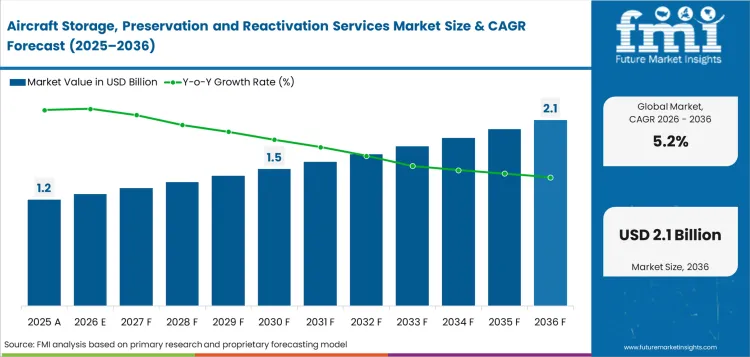
- The aircraft storage, preservation and reactivation services market was valued at USD 1.1 billion in 2025.
- By 2036, the Aircraft Storage, Preservation and Reactivation Services Market is expected to be worth USD 2 billion.
- From 2026 to 2036, the market is projected to expand at a CAGR of 5.2%.
- The market is projected to create an incremental opportunity of USD 0.75 billion between 2026 and 2036.
- In 2026, arid sites are expected to account for 52.0% of facility environment demand.
- India at 6.8% and China at 6.2% are two of the faster expanding country markets.
Strategic Pointers: Aircraft Storage, Preservation and Reactivation Services Market
Aircraft storage and reactivation services are moving toward integrated transition hubs because Boeing’s September 2025 Victorville overview cites an ideal-climate site with about 300 aircraft in storage and added capacity for transition work. ICAO’s 2025 airport-charges policy supports more disciplined pricing because long-term aircraft storage charges should reflect maximum take-off weight or aircraft dimensions and length of stay. Effective January 30 2026, FAA Order 8130.2L raises the value of certificate-ready records because it governs airworthiness certificates and special flight authorizations. EASA’s September 2025 Part-CAMO guidance strengthens the compliance angle because aircraft maintenance programmes can require agency-level approval when authority is delegated. IATA’s February 2025 battery and hydrogen aircraft concept paper points to a future storage niche where parking stands may need thermal ground support for electric aircraft and vent-line handling for liquid hydrogen aircraft.
Aircraft Storage, Preservation and Reactivation Services Market Definition
The aircraft storage, preservation and reactivation services market includes paid services used to park, protect and return aircraft to flying condition. These services cover short-term parking, long-term storage, engine preservation and reactivation checks. Scope includes aircraft held by airlines, lessors and asset traders during fleet transition. Aircraft manufacturing, aircraft leasing income and full dismantling revenue are outside the scope.
Aircraft Storage, Preservation and Reactivation Services Market Inclusions
Market scope encompasses all commercially traded aircraft storage, preservation, engine care, reactivation, handback support and transition services categorized by service type, aircraft type, customer type and region from 2026 to 2036.
Aircraft Storage, Preservation and Reactivation Services Market Exclusions
Scope does not include aircraft production, aircraft leasing revenue, passenger airport services, full aircraft recycling revenue or routine line maintenance unrelated to stored aircraft.
Aircraft Storage, Preservation and Reactivation Services Market Research Methodology
- Primary Research: FMI analysts talked to airlines, aircraft lessors, storage facility operators and MRO specialists in important markets.
- Desk Research: Combined data from aviation traffic statistics, facility service portfolios and aircraft maintenance requirements.
- Market sizing and forecasting: Added service use across aircraft storage volumes and reactivation programs from the bottom up.
- Data validation: Cross-checked every three months against fleet activity, storage capacity and commercial aircraft MRO service demand.
Why is the Aircraft Storage, Preservation and Reactivation Services Market Growing?
- Airlines are using planned storage to manage aircraft downtime before maintenance or operator change.
- Lessors need stronger preservation records as aircraft handback disputes can delay remarketing.
- Reactivation services are becoming important as aircraft need checks before flight release.
Aircraft storage demand is linked to fleet use and aircraft transition pressure. According to IATA, total full-year traffic in 2024 rose 10.4% compared with 2023, and traffic was 3.8% above 2019 levels. This means fewer aircraft stay idle for long periods, but more aircraft enter planned storage during lease change and maintenance timing gaps. Storage providers benefit when they protect aircraft condition and prepare release records before the next operator receives the aircraft.
Narrow-body aircraft create repeat storage and reactivation work through frequent operator changes. Boeing 737 aircraft flew 10 million flights in 2024, and Airbus A320 aircraft flew 7.9 million flights in the same year, as per IATA report. This operating base explains why narrow-body aircraft dominate storage activity during fleet rotation. Facilities with repeat task cards for common aircraft families can reduce release time after parking.
Market Segmentation Analysis
- Long term storage accounts for 38.0% of service type demand in 2026. Parked aircraft need detailed preservation work across engines, cabins, and exposed systems.
- Narrow body aircraft hold 46.0% of aircraft type demand in 2026, supported by frequent lease movement and short transition windows.
- Aircraft lessors represent 41.0% of customer type demand in 2026. Handback support often requires storage planning before repaint, inspection, or redeployment.
- Medium term storage contributes 44.0% of storage duration demand in 2026 since many aircraft moves sit between return timing and redeployment readiness.
- Arid sites lead facility environment demand with 52.0% share in 2026, helped by low humidity and reduced corrosion exposure.
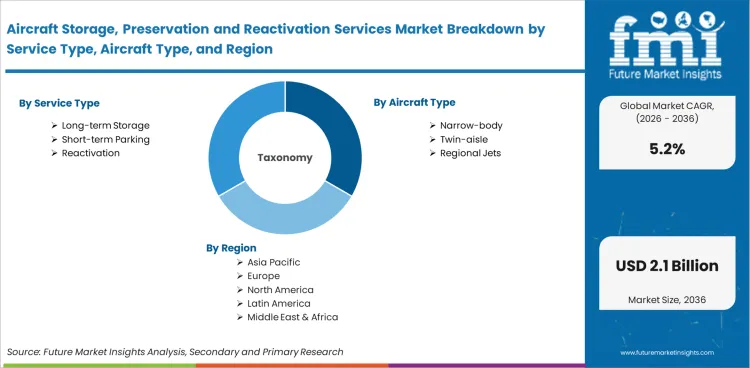
The market for aircraft storage, preservation and reactivation services is divided into five primary segment groups based on service type, aircraft type, customer type, storage duration and facility environment. Service type includes Long-term Storage, Short-term Parking, Reactivation, Engine Preservation and Part-out Support. Aircraft type includes Narrow-body Aircraft, Twin-aisle Aircraft, Regional Jets, Turboprops and Business Jets. Customer type includes Aircraft Lessors, Airlines, Cargo Operators, MRO Providers and Asset Traders. Storage duration includes Medium Term, Short Term, Long Term and Indefinite. Facility environment includes Arid Sites, Covered Sites, Airport Aprons and Mixed Sites.
Insights into the Long-term Storage Service Type Segment
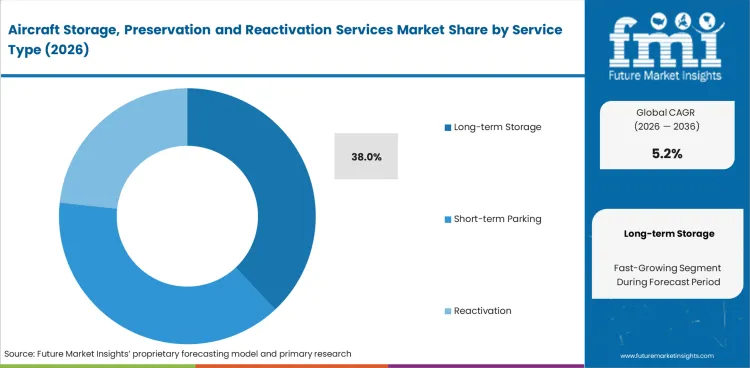
- Extended aircraft inactivity places long-term storage at the center of preservation planning. The segment is estimated to account for 38.0% of the service type segment in 2026 as owners seek controlled care beyond routine parking.
- Aircraft under long-term storage need engine preservation and system checks before release planning begins. Short-term parking carries lighter service needs, with extended storage adds inspection records and asset protection work.
Insights into the Narrow-body Aircraft Type Segment
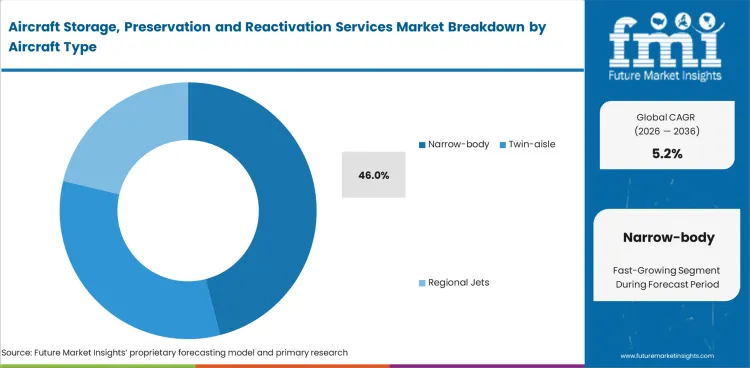
- Narrow-body aircraft are expected to account for 46.0% of the aircraft type segment in 2026 across lease transition and airline redeployment work. Frequent movement of single-aisle fleets keeps narrow-body aircraft ahead in storage demand.
- Storage providers see repeat work from common aircraft families used across short-haul networks. Regional jets and twin-aisle aircraft create demand with narrow-body platforms create steadier reactivation volume.
Insights into the Aircraft Lessors Customer Type Segment
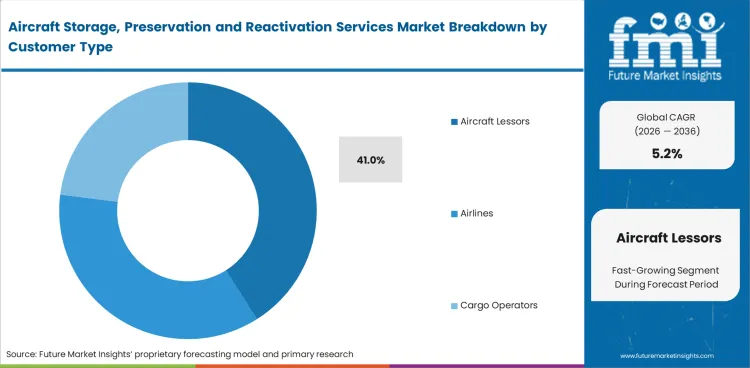
- In 2026, aircraft lessors are predicted to contribute 41.0% share of the customer type segment through handback and remarketing cycles. Aircraft lessors use storage services to protect asset value between operator changes.
- Lessor-owned aircraft often need neutral storage records before sale or placement with another airline. Preservation quality affects technical review outcomes and helps reduce friction during aircraft transfer.
Insights into the Medium Term Storage Duration Segment
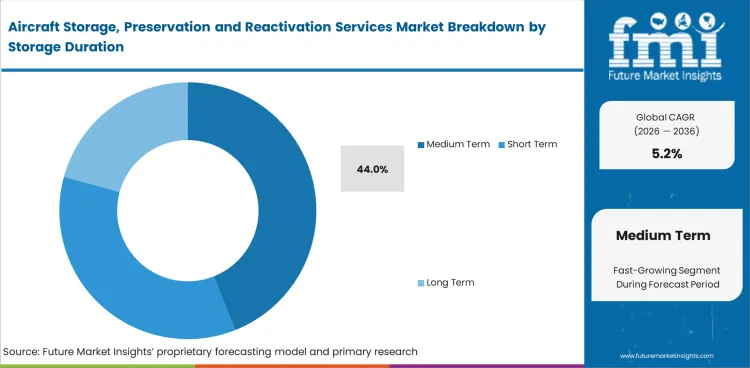
- Parking periods lasting several months create the strongest use case for medium term storage. The segment is forecast to hold 44.0% of storage duration demand in 2026 as owners manage maintenance slots and operator changes.
- Medium term storage balances cost control with enough technical care to improve aircraft release. Shorter parking periods need limited checks, though longer inactivity can raise preservation costs and inspection work.
Insights into the Arid Sites Facility Environment Segment
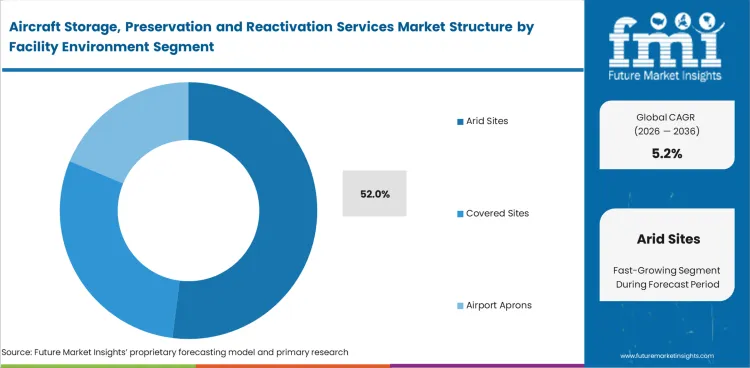
- Arid sites are projected to account for 52.0% of the facility environment segment in 2026 as owners seek lower corrosion exposure. Low-humidity storage locations carry a practical advantage for aircraft parked outdoors.
- Dry climate facilities help reduce inspection pressure during longer storage periods. Covered sites protect aircraft from direct exposure, with arid locations favor larger parking programs at controlled operating cost.
Aircraft Storage, Preservation and Reactivation Services Market Drivers, Restraints, and Opportunities
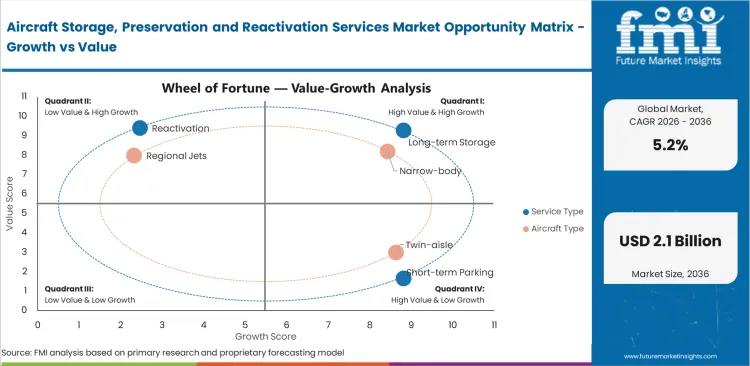
- Lease return pressure is creating structured demand for aircraft preservation records across lessor-owned aircraft.
- Skilled maintenance staff needs create pricing pressure for smaller storage providers.
- Digital maintenance records create opportunity through faster aircraft release and lower handback friction.
Aircraft storage, preservation and reactivation services keep expanding as airlines and lessors need controlled parking and release-ready aircraft during fleet transitions. Cost pressure and technician availability can slow reactivation work. Growth continues through arid storage sites and return-to-service support.
Repair Index Keeps Reactivation Quotes Firm
Aircraft storage contracts extend beyond parking space and depend heavily on reactivation requirements. A stored aircraft often needs maintenance checks and preservation removal before returning to service. Reactivation may include fluid servicing and corrosion review under approved technical procedures. The closest public price signal is the BLS/FRED aircraft repair and maintenance PPI, updated July 2025, which moved from 159.284 in February 2025 to 160.225 in June 2025, with May at 159.858, on an April 2009=100 seasonally adjusted basis. This 0.6% February-to-June rise is modest, it indicates reactivation labor-and-shop pricing with reset lower. Operators negotiating redelivery should expect providers to protect escalation clauses, especially where aircraft require catch-up maintenance after extended preservation.
Hangar and Labor Costs Resist Discounting
The storage-and-preservation price floor is being set less by spare parts inflation and more by labor availability and occupied airport/hangar real estate. Airlines for America’s March 2026 update reveals USA passenger airline pre-tax unit costs fell 1% year over year in January-September 2025 because fuel CASM dropped 12%, but labor CASM rose 5% and airport CASM rose 8%; the chart indicates airport landing fees and rents rising from 1.10 to 1.18 cents per available seat mile. Maintenance materials and repairs stayed at 0.95 cents, leaving providers with limited room to reduce storage-related service pricing. Operators may find better savings through lower labor hours or lower-cost airport locations. Bundling preservation with planned reactivation work can improve pricing control.
Analysis of Aircraft Storage, Preservation and Reactivation Services Market By Key Countries
.webp "Top Country Growth Comparison Aircraft Storage, Preservation And Reactivation Services Market Cagr (2026 2036)")
| Country | CAGR |
|---|---|
| India | 6.8% |
| China | 6.2% |
| USA | 5.4% |
| Australia | 4.9% |
| UK | 4.2% |
Source: Future Market Insights, 2026.
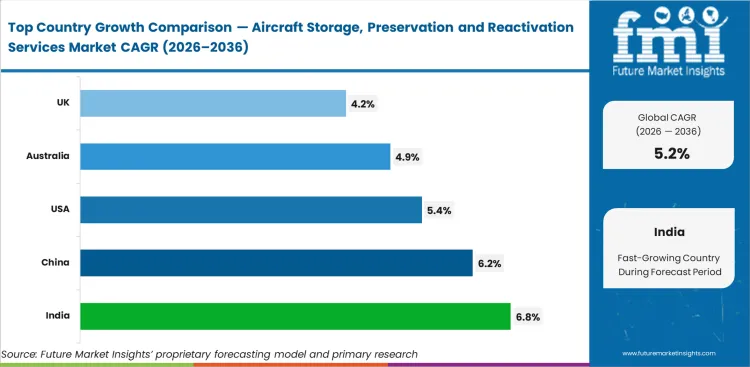
Aircraft Storage, Preservation and Reactivation Services Market CAGR Analysis By Country
- India leads the country outlook at 6.8% CAGR for 2026 to 2036. Airport capacity and airline fleet planning support storage demand.
- China records 6.2% CAGR during the same period, supported by elevated passenger activity and aircraft utilization across local carriers.
- Fleet scale and established aircraft transition activity place the USA at 5.4% CAGR between 2026 and 2036.
- Australia reaches 4.9% CAGR by 2036, helped by arid storage capacity and Asia Pacific aircraft parking demand.
- The UK holds a 4.2% CAGR outlook for 2026 to 2036. Its established aviation base supports controlled expansion across storage and MRO activity.
Demand for aircraft storage, preservation and reactivation services is forecast to rise at 5.2% CAGR from 2026 to 2036. Country-level analysis covers the major markets contributing to this forecast, with the key markets listed below.
Demand Outlook for Aircraft Storage, Preservation and Reactivation Services Market in India
Aircraft storage, preservation and reactivation services industry in India is projected to record a CAGR of 6.8% through 2036. India’s airports handled 412 million passengers in FY25, and passenger traffic is projected to increase to 665 million by FY31. Passenger growth increases demand for aircraft storage and reactivation services in India as airlines add aircraft and manage fleet rotation. Preservation services see higher demand during ongoing fleet expansion and operational adjustments. Local facilities can gain from operators needing parking and handback support near high-traffic airport clusters.
- Fleet additions increase demand for narrow-body storage and aircraft return-to-service checks.
- Airport expansion enhances parking and preservation needs near large airline networks.
- Indian carriers need service partners able to reduce aircraft downtime during transition work.
Sales Analysis of Aircraft Storage, Preservation and Reactivation Services Market in China
The aircraft storage, preservation and reactivation services sector in China is expected to expand at a CAGR of 6.2% during the assessment period. Passenger traffic supports demand for China aircraft storage and reactivation services as airlines manage aircraft availability and fleet timing. Service providers benefit from carriers seeking technical care during maintenance windows and operator changes.
- Strong passenger traffic increases demand for aircraft parking and controlled reactivation work.
- Local airline activity creates repeat need for narrow-body preservation and engine care.
- High aircraft utilization raises demand for planned storage during maintenance timing gaps.
Demand Outlook for Aircraft Storage, Preservation and Reactivation Services Market in the United States
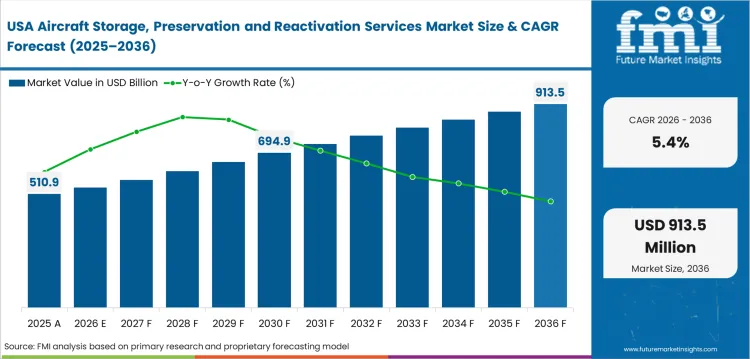
The USA aircraft storage, preservation and reactivation services industry is forecast to grow at a CAGR of 5.4% by 2036. FAA’s Air Traffic Organization provides service to over 44,000 flights and over 3 million airline passengers each day. The USA operating base supports aircraft storage, preservation and reactivation services across fleet transition and maintenance events. Storage facilities in dry-climate states gain from large parking areas and technical workforce access.
- Large airline fleets enhance demand for storage programs during aircraft rotation.
- Dry-climate storage locations help reduce corrosion exposure for parked aircraft.
- Mature MRO networks support reactivation work linked to aircraft refurbishing and release checks.
Opportunity Analysis of Aircraft Storage, Preservation and Reactivation Services Market in Australia
The aircraft storage, preservation and reactivation services segment in Australia is poised to advance at 4.9% CAGR over the forecast years. Australian domestic commercial aviation carried 5.41 million passengers in January 2026, including charter operations. Demand for Australia aircraft storage, preservation and reactivation services across domestic fleets and regional airport networks is enhanced through this activity. Arid storage locations create a practical advantage as aircraft owners seek lower corrosion exposure during parking periods.
- Alice Springs enables aircraft preservation with a dry climate and dedicated hardstand capacity.
- Regional airport activity boosts short- and medium-term parking demand across domestic fleets.
- Asia-Pacific aircraft operators use Australian storage as a practical option during fleet transition.
Future Outlook for Aircraft Storage, Preservation and Reactivation Services Market in the United Kingdom
The UK aircraft storage, preservation and reactivation services industry is expected to post 4.2% CAGR through 2036. UK airports handled 302 million passengers in 2025, up from 295 million passenger journeys in 2024. This leads to demand for UK aircraft storage and reactivation services as operators manage busy schedules and maintenance release needs. Preservation services also see increased demand during these current operational conditions. Service providers with fast records review and approved maintenance capability can assist aircraft owners during fleet changes.
- UK aviation activity creates demand for structured parking and return-to-service planning.
- Busy airports increase the need for off-airport storage linked to technical release work.
- Mature service bases promote demand across aerospace maintenance chemical use and aircraft inspection workflows.
Competitive Landscape and Strategic Positioning
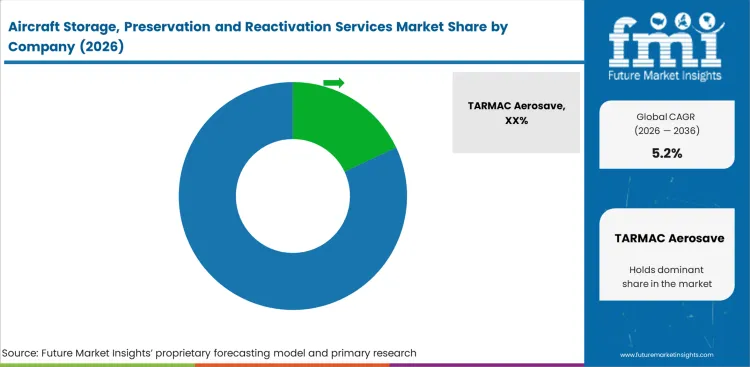
- TARMAC Aerosave is a leading provider through large storage capacity and aircraft maintenance support.
- Ascent Aviation Services and APAS operate using dry-climate storage bases and aircraft release capabilities.
- Specialist providers focus on lease transition and records control. They deliver aircraft-specific preservation planning.
TARMAC Aerosave has strong positioning through storage, maintenance and engine support across European sites. Ascent Aviation Services offers aircraft storage and reactivation support through its Arizona facility. APAS serves Asia-Pacific storage demand through dry-climate aircraft parking at Alice Springs. ecube and Vallair add transition services for aircraft handback and return-to-service planning. Barriers include land availability, skilled labor and approved maintenance capability. Buyers favor storage providers offering preservation records and reactivation support while reducing release uncertainty. Suppliers with broader technical coverage can reduce coordination work for aircraft owners.
Key Companies in the Aircraft Storage, Preservation and Reactivation Services Market
Key global companies leading the aircraft storage, preservation and reactivation services market include:
- TARMAC Aerosave, Ascent Aviation Services and APAS have strong storage infrastructure for aircraft preservation and parking.
- ecube, Vallair and AMROS Global serve aircraft owners through transition support and reactivation planning.
- AAR, Jet Aviation and FL Technics support stored aircraft through MRO coverage and release-ready service capability.
Competitive Benchmarking: Aircraft Storage, Preservation and Reactivation Services Market
| Company | Storage Capacity Depth | Reactivation Support | Records Control | Geographic Footprint |
|---|---|---|---|---|
| TARMAC Aerosave | High | High | Strong | Europe |
| Ascent Aviation Services | High | High | Strong | North America |
| APAS | High | Medium | Strong | Asia Pacific |
| ecube | Medium | High | Strong | Europe and North America |
| Vallair | Medium | High | Strong | Europe |
| AMROS Global | Medium | High | Strong | Global coordination |
| AAR | Medium | High | Strong | North America and global support |
| Jet Aviation | Medium | High | Strong | Global |
| FL Technics | Medium | High | Strong | Europe and Asia Pacific |
Source: Future Market Insights, 2026.
Key Developments in Aircraft Storage, Preservation and Reactivation Services Market
- March 2024, AAR broke ground on a Miami airframe MRO expansion with a 114,000 square-foot facility supporting three narrow-body maintenance bays.
- December 2025, Ascent Aviation Services opened two new 90,000-square-foot widebody maintenance hangars at Pinal Air Park in Marana, Arizona.
Key Players in the Aircraft Storage, Preservation and Reactivation Services Market
Major Global Players:
- TARMAC Aerosave
- Ascent Aviation Services
- Asia Pacific Aircraft Storage
- ecube
- Vallair
- AAR
- Jet Aviation
Specialist Players:
- FL Technics
- AMROS Global
- Marana Aerospace Solutions
Report Scope and Coverage
| Parameter | Details |
|---|---|
| Quantitative Units | USD 1.2 billion to USD 2 billion, at a CAGR of 5.2% |
| Market Definition | The aircraft storage, preservation and reactivation services market covers services used to park, protect and return aircraft to flying condition. |
| Regions Covered | North America, Latin America, Europe, East Asia, South Asia and Pacific, Middle East and Africa |
| Countries Covered | USA, UK, China, India, Australia, Germany, UAE, and 30 plus countries |
| Key Companies Profiled | TARMAC Aerosave, Ascent Aviation Services, APAS, ecube, Vallair, AAR, Jet Aviation, FL Technics, AMROS Global, Marana Aerospace Solutions |
| Forecast Period | 2026 to 2036 |
| Approach | Hybrid bottom-up and top-down methodology starting with service demand and verified aircraft transition patterns. |
Source: Future Market Insights, 2026.
Aircraft Storage, Preservation and Reactivation Services Market by Segments
Aircraft Storage, Preservation and Reactivation Services Market Segmented by Service Type:
- Long-term Storage
- Short-term Parking
- Reactivation
- Engine Preservation
- Part-out Support
Aircraft Storage, Preservation and Reactivation Services Market Segmented by Aircraft Type:
- Narrow-body Aircraft
- Twin-aisle Aircraft
- Regional Jets
- Turboprops
- Business Jets
Aircraft Storage, Preservation and Reactivation Services Market Segmented by Customer Type:
- Aircraft Lessors
- Airlines
- Cargo Operators
- MRO Providers
- Asset Traders
Aircraft Storage, Preservation and Reactivation Services Market Segmented by Storage Duration:
- Medium Term
- Short Term
- Long Term
- Indefinite
Aircraft Storage, Preservation and Reactivation Services Market Segmented by Facility Environment:
- Arid Sites
- Covered Sites
- Airport Aprons
- Mixed Sites
Aircraft Storage, Preservation and Reactivation Services Market by Region:
- North America
- USA
- Canada
- Mexico
- Latin America
- Brazil
- Chile
- Rest of Latin America
- Europe
- Germany
- UK
- Italy
- Spain
- France
- Rest of Europe
- East Asia
- China
- Japan
- South Korea
- South Asia and Pacific
- India
- ASEAN
- Australia & New Zealand
- Rest of South Asia and Pacific
- Middle East and Africa
- Saudi Arabia
- Other GCC Countries
- South Africa
- Rest of Middle East and Africa
Research Sources and Bibliography
- AAR CORP. (2024, March 27). AAR breaks ground on MRO facility expansion in Miami.
- Arizona Commerce Authority. (2025, December 8). Ascent Aviation Services Celebrates Grand Opening Of Two New Wide-Body Aircraft Hangars In Marana.
- USA Bureau of Labor Statistics. (2025). Producer Price Index by Commodity: Repair and Maintenance Services (Partial): Aircraft Repair and Maintenance [WPS554101]. Federal Reserve Bank of St. Louis.
- Airlines for America. (2026, March 13). The State of USA Commercial Aviation.
- International Air Transport Association. (2025, January 30). Global air passenger demand reaches record high in 2024. IATA.
- Press Information Bureau. (2026). WORLD BANK RANKS INDIA AMONG THE TOP FIVE COUNTRIES IN TERMS OF PRIVATE INVESTMENT IN INFRASTRUCTURE AMONG LOW- AND MIDDLE-INCOME ECONOMIES.
- The State Council of the People’s Republic of China. (2026, January 6). China’s civil aviation sector achieves steady growth in 2025.
- Bureau of Infrastructure and Transport Research Economics. (2026, April 7). Australian domestic aviation activity monthly publications. Australian Government.
- UK Civil Aviation Authority. (2026, February 24). UK aviation officially breaks records with over 300m passenger journeys in 2025. UK CAA.
This Report Answers
- What is the current and future size of the aircraft storage, preservation and reactivation services market?
- How fast is the aircraft storage, preservation and reactivation services market expected to expand between 2026 and 2036?
- Which facility environment is expected to lead the market by 2026?
- Which aircraft type is expected to account for the highest demand by 2026?
- What factors are driving demand for aircraft storage, preservation and reactivation services globally?
- How are lease transitions influencing demand for aircraft preservation services?
- Why are lessors an important demand base for aircraft storage services?
- How are arid sites creating an advantage for aircraft preservation programs?
- Which countries are projected to record faster expansion through 2036?
- What is driving market expansion in India and China?
- Who are the key companies active in the aircraft storage, preservation and reactivation services market?
- How does FMI estimate and validate the market forecast?
Frequently Asked Questions
What is the global market demand for Aircraft Storage, Preservation and Reactivation Services in 2026?
In 2026, the global market for aircraft storage, preservation and reactivation services is expected to be worth USD 1.2 billion.
How big will the market for Aircraft Storage, Preservation and Reactivation Services be in 2036?
By 2036, the market for aircraft storage, preservation and reactivation services is expected to be worth USD 2 billion.
How much is demand for Aircraft Storage, Preservation and Reactivation Services expected to expand between 2026 and 2036?
Between 2026 and 2036, demand for aircraft storage, preservation and reactivation services is expected to expand at a CAGR of 5.2%.
Which facility environment segment is likely to be the best seller globally by 2026?
Arid sites will make up 52.0% of the facility environment segment in 2026.
What is causing demand to rise in India?
The India aircraft storage, preservation and reactivation services market is projected to record 6.8% CAGR through 2036, supported by airport expansion and fleet planning.
What is causing demand to rise in China?
The China aircraft storage, preservation and reactivation services market is projected to expand at 6.2% CAGR through 2036, supported by high passenger traffic and airline activity.
What does this report mean by Aircraft Storage, Preservation and Reactivation Services Market definition?
The aircraft storage, preservation and reactivation services market includes paid services used to park, protect and return aircraft to flying condition.
How does FMI make the Aircraft Storage, Preservation and Reactivation Services forecast and check it?
Forecasting models use a hybrid bottom-up and top-down approach, starting with service demand and checking it against aircraft transition patterns.
Preview the report firsthand - request a free sample
Get SampleGet the brochure for pricing and purchase details.
Get PDFTable of Content
- Executive Summary
- Global Market Outlook
- Demand-side Trends
- Supply-side Trends
- Technology Roadmap Analysis
- Analysis and Recommendations
- Market Overview
- Market Coverage / Taxonomy
- Market Definition / Scope / Limitations
- Research Methodology
- Chapter Orientation
- Analytical Lens and Working Hypotheses
- Market Structure, Signals, and Trend Drivers
- Benchmarking and Cross-market Comparability
- Market Sizing, Forecasting, and Opportunity Mapping
- Research Design and Evidence Framework
- Desk Research Programme (Secondary Evidence)
- Company Annual and Sustainability Reports
- Peer-reviewed Journals and Academic Literature
- Corporate Websites, Product Literature, and Technical Notes
- Earnings Decks and Investor Briefings
- Statutory Filings and Regulatory Disclosures
- Technical White Papers and Standards Notes
- Trade Journals, Industry Magazines, and Analyst Briefs
- Conference Proceedings, Webinars, and Seminar Materials
- Government Statistics Portals and Public Data Releases
- Press Releases and Reputable Media Coverage
- Specialist Newsletters and Curated Briefings
- Sector Databases and Reference Repositories
- FMI Internal Proprietary Databases and Historical Market Datasets
- Subscription Datasets and Paid Sources
- Social Channels, Communities, and Digital Listening Inputs
- Additional Desk Sources
- Expert Input and Fieldwork (Primary Evidence)
- Primary Modes
- Qualitative Interviews and Expert Elicitation
- Quantitative Surveys and Structured Data Capture
- Blended Approach
- Why Primary Evidence is Used
- Field Techniques
- Interviews
- Surveys
- Focus Groups
- Observational and In-context Research
- Social and Community Interactions
- Stakeholder Universe Engaged
- C-suite Leaders
- Board Members
- Presidents and Vice Presidents
- R&D and Innovation Heads
- Technical Specialists
- Domain Subject-matter Experts
- Scientists
- Physicians and Other Healthcare Professionals
- Governance, Ethics, and Data Stewardship
- Research Ethics
- Data Integrity and Handling
- Primary Modes
- Tooling, Models, and Reference Databases
- Desk Research Programme (Secondary Evidence)
- Data Engineering and Model Build
- Data Acquisition and Ingestion
- Cleaning, Normalisation, and Verification
- Synthesis, Triangulation, and Analysis
- Quality Assurance and Audit Trail
- Market Background
- Market Dynamics
- Drivers
- Restraints
- Opportunity
- Trends
- Scenario Forecast
- Demand in Optimistic Scenario
- Demand in Likely Scenario
- Demand in Conservative Scenario
- Opportunity Map Analysis
- Product Life Cycle Analysis
- Supply Chain Analysis
- Investment Feasibility Matrix
- Value Chain Analysis
- PESTLE and Porter’s Analysis
- Regulatory Landscape
- Regional Parent Market Outlook
- Production and Consumption Statistics
- Import and Export Statistics
- Market Dynamics
- Global Market Analysis 2021 to 2025 and Forecast, 2026 to 2036
- Historical Market Size Value (USD Million) Analysis, 2021 to 2025
- Current and Future Market Size Value (USD Million) Projections, 2026 to 2036
- Y-o-Y Growth Trend Analysis
- Absolute $ Opportunity Analysis
- Global Market Pricing Analysis 2021 to 2025 and Forecast 2026 to 2036
- Global Market Analysis 2021 to 2025 and Forecast 2026 to 2036, By Service Type
- Introduction / Key Findings
- Historical Market Size Value (USD Million) Analysis By Service Type , 2021 to 2025
- Current and Future Market Size Value (USD Million) Analysis and Forecast By Service Type , 2026 to 2036
- Long-term Storage
- Short-term Parking
- Reactivation
- Long-term Storage
- Y-o-Y Growth Trend Analysis By Service Type , 2021 to 2025
- Absolute $ Opportunity Analysis By Service Type , 2026 to 2036
- Global Market Analysis 2021 to 2025 and Forecast 2026 to 2036, By Aircraft Type
- Introduction / Key Findings
- Historical Market Size Value (USD Million) Analysis By Aircraft Type, 2021 to 2025
- Current and Future Market Size Value (USD Million) Analysis and Forecast By Aircraft Type, 2026 to 2036
- Narrow-body
- Twin-aisle
- Regional Jets
- Narrow-body
- Y-o-Y Growth Trend Analysis By Aircraft Type, 2021 to 2025
- Absolute $ Opportunity Analysis By Aircraft Type, 2026 to 2036
- Global Market Analysis 2021 to 2025 and Forecast 2026 to 2036, By Customer Type
- Introduction / Key Findings
- Historical Market Size Value (USD Million) Analysis By Customer Type, 2021 to 2025
- Current and Future Market Size Value (USD Million) Analysis and Forecast By Customer Type, 2026 to 2036
- Aircraft Lessors
- Airlines
- Cargo Operators
- Aircraft Lessors
- Y-o-Y Growth Trend Analysis By Customer Type, 2021 to 2025
- Absolute $ Opportunity Analysis By Customer Type, 2026 to 2036
- Global Market Analysis 2021 to 2025 and Forecast 2026 to 2036, By Storage Duration
- Introduction / Key Findings
- Historical Market Size Value (USD Million) Analysis By Storage Duration, 2021 to 2025
- Current and Future Market Size Value (USD Million) Analysis and Forecast By Storage Duration, 2026 to 2036
- Medium Term
- Short Term
- Long Term
- Medium Term
- Y-o-Y Growth Trend Analysis By Storage Duration, 2021 to 2025
- Absolute $ Opportunity Analysis By Storage Duration, 2026 to 2036
- Global Market Analysis 2021 to 2025 and Forecast 2026 to 2036, By Facility Environment
- Introduction / Key Findings
- Historical Market Size Value (USD Million) Analysis By Facility Environment, 2021 to 2025
- Current and Future Market Size Value (USD Million) Analysis and Forecast By Facility Environment, 2026 to 2036
- Arid Sites
- Covered Sites
- Airport Aprons
- Arid Sites
- Y-o-Y Growth Trend Analysis By Facility Environment, 2021 to 2025
- Absolute $ Opportunity Analysis By Facility Environment, 2026 to 2036
- Global Market Analysis 2021 to 2025 and Forecast 2026 to 2036, By Region
- Introduction
- Historical Market Size Value (USD Million) Analysis By Region, 2021 to 2025
- Current Market Size Value (USD Million) Analysis and Forecast By Region, 2026 to 2036
- North America
- Latin America
- Western Europe
- Eastern Europe
- East Asia
- South Asia and Pacific
- Middle East & Africa
- Market Attractiveness Analysis By Region
- North America Market Analysis 2021 to 2025 and Forecast 2026 to 2036, By Country
- Historical Market Size Value (USD Million) Trend Analysis By Market Taxonomy, 2021 to 2025
- Market Size Value (USD Million) Forecast By Market Taxonomy, 2026 to 2036
- By Country
- USA
- Canada
- Mexico
- By Service Type
- By Aircraft Type
- By Customer Type
- By Storage Duration
- By Facility Environment
- By Country
- Market Attractiveness Analysis
- By Country
- By Service Type
- By Aircraft Type
- By Customer Type
- By Storage Duration
- By Facility Environment
- Key Takeaways
- Latin America Market Analysis 2021 to 2025 and Forecast 2026 to 2036, By Country
- Historical Market Size Value (USD Million) Trend Analysis By Market Taxonomy, 2021 to 2025
- Market Size Value (USD Million) Forecast By Market Taxonomy, 2026 to 2036
- By Country
- Brazil
- Chile
- Rest of Latin America
- By Service Type
- By Aircraft Type
- By Customer Type
- By Storage Duration
- By Facility Environment
- By Country
- Market Attractiveness Analysis
- By Country
- By Service Type
- By Aircraft Type
- By Customer Type
- By Storage Duration
- By Facility Environment
- Key Takeaways
- Western Europe Market Analysis 2021 to 2025 and Forecast 2026 to 2036, By Country
- Historical Market Size Value (USD Million) Trend Analysis By Market Taxonomy, 2021 to 2025
- Market Size Value (USD Million) Forecast By Market Taxonomy, 2026 to 2036
- By Country
- Germany
- UK
- Italy
- Spain
- France
- Nordic
- BENELUX
- Rest of Western Europe
- By Service Type
- By Aircraft Type
- By Customer Type
- By Storage Duration
- By Facility Environment
- By Country
- Market Attractiveness Analysis
- By Country
- By Service Type
- By Aircraft Type
- By Customer Type
- By Storage Duration
- By Facility Environment
- Key Takeaways
- Eastern Europe Market Analysis 2021 to 2025 and Forecast 2026 to 2036, By Country
- Historical Market Size Value (USD Million) Trend Analysis By Market Taxonomy, 2021 to 2025
- Market Size Value (USD Million) Forecast By Market Taxonomy, 2026 to 2036
- By Country
- Russia
- Poland
- Hungary
- Balkan & Baltic
- Rest of Eastern Europe
- By Service Type
- By Aircraft Type
- By Customer Type
- By Storage Duration
- By Facility Environment
- By Country
- Market Attractiveness Analysis
- By Country
- By Service Type
- By Aircraft Type
- By Customer Type
- By Storage Duration
- By Facility Environment
- Key Takeaways
- East Asia Market Analysis 2021 to 2025 and Forecast 2026 to 2036, By Country
- Historical Market Size Value (USD Million) Trend Analysis By Market Taxonomy, 2021 to 2025
- Market Size Value (USD Million) Forecast By Market Taxonomy, 2026 to 2036
- By Country
- China
- Japan
- South Korea
- By Service Type
- By Aircraft Type
- By Customer Type
- By Storage Duration
- By Facility Environment
- By Country
- Market Attractiveness Analysis
- By Country
- By Service Type
- By Aircraft Type
- By Customer Type
- By Storage Duration
- By Facility Environment
- Key Takeaways
- South Asia and Pacific Market Analysis 2021 to 2025 and Forecast 2026 to 2036, By Country
- Historical Market Size Value (USD Million) Trend Analysis By Market Taxonomy, 2021 to 2025
- Market Size Value (USD Million) Forecast By Market Taxonomy, 2026 to 2036
- By Country
- India
- ASEAN
- Australia & New Zealand
- Rest of South Asia and Pacific
- By Service Type
- By Aircraft Type
- By Customer Type
- By Storage Duration
- By Facility Environment
- By Country
- Market Attractiveness Analysis
- By Country
- By Service Type
- By Aircraft Type
- By Customer Type
- By Storage Duration
- By Facility Environment
- Key Takeaways
- Middle East & Africa Market Analysis 2021 to 2025 and Forecast 2026 to 2036, By Country
- Historical Market Size Value (USD Million) Trend Analysis By Market Taxonomy, 2021 to 2025
- Market Size Value (USD Million) Forecast By Market Taxonomy, 2026 to 2036
- By Country
- Kingdom of Saudi Arabia
- Other GCC Countries
- Turkiye
- South Africa
- Other African Union
- Rest of Middle East & Africa
- By Service Type
- By Aircraft Type
- By Customer Type
- By Storage Duration
- By Facility Environment
- By Country
- Market Attractiveness Analysis
- By Country
- By Service Type
- By Aircraft Type
- By Customer Type
- By Storage Duration
- By Facility Environment
- Key Takeaways
- Key Countries Market Analysis
- USA
- Pricing Analysis
- Market Share Analysis, 2025
- By Service Type
- By Aircraft Type
- By Customer Type
- By Storage Duration
- By Facility Environment
- Canada
- Pricing Analysis
- Market Share Analysis, 2025
- By Service Type
- By Aircraft Type
- By Customer Type
- By Storage Duration
- By Facility Environment
- Mexico
- Pricing Analysis
- Market Share Analysis, 2025
- By Service Type
- By Aircraft Type
- By Customer Type
- By Storage Duration
- By Facility Environment
- Brazil
- Pricing Analysis
- Market Share Analysis, 2025
- By Service Type
- By Aircraft Type
- By Customer Type
- By Storage Duration
- By Facility Environment
- Chile
- Pricing Analysis
- Market Share Analysis, 2025
- By Service Type
- By Aircraft Type
- By Customer Type
- By Storage Duration
- By Facility Environment
- Germany
- Pricing Analysis
- Market Share Analysis, 2025
- By Service Type
- By Aircraft Type
- By Customer Type
- By Storage Duration
- By Facility Environment
- UK
- Pricing Analysis
- Market Share Analysis, 2025
- By Service Type
- By Aircraft Type
- By Customer Type
- By Storage Duration
- By Facility Environment
- Italy
- Pricing Analysis
- Market Share Analysis, 2025
- By Service Type
- By Aircraft Type
- By Customer Type
- By Storage Duration
- By Facility Environment
- Spain
- Pricing Analysis
- Market Share Analysis, 2025
- By Service Type
- By Aircraft Type
- By Customer Type
- By Storage Duration
- By Facility Environment
- France
- Pricing Analysis
- Market Share Analysis, 2025
- By Service Type
- By Aircraft Type
- By Customer Type
- By Storage Duration
- By Facility Environment
- India
- Pricing Analysis
- Market Share Analysis, 2025
- By Service Type
- By Aircraft Type
- By Customer Type
- By Storage Duration
- By Facility Environment
- ASEAN
- Pricing Analysis
- Market Share Analysis, 2025
- By Service Type
- By Aircraft Type
- By Customer Type
- By Storage Duration
- By Facility Environment
- Australia & New Zealand
- Pricing Analysis
- Market Share Analysis, 2025
- By Service Type
- By Aircraft Type
- By Customer Type
- By Storage Duration
- By Facility Environment
- China
- Pricing Analysis
- Market Share Analysis, 2025
- By Service Type
- By Aircraft Type
- By Customer Type
- By Storage Duration
- By Facility Environment
- Japan
- Pricing Analysis
- Market Share Analysis, 2025
- By Service Type
- By Aircraft Type
- By Customer Type
- By Storage Duration
- By Facility Environment
- South Korea
- Pricing Analysis
- Market Share Analysis, 2025
- By Service Type
- By Aircraft Type
- By Customer Type
- By Storage Duration
- By Facility Environment
- Russia
- Pricing Analysis
- Market Share Analysis, 2025
- By Service Type
- By Aircraft Type
- By Customer Type
- By Storage Duration
- By Facility Environment
- Poland
- Pricing Analysis
- Market Share Analysis, 2025
- By Service Type
- By Aircraft Type
- By Customer Type
- By Storage Duration
- By Facility Environment
- Hungary
- Pricing Analysis
- Market Share Analysis, 2025
- By Service Type
- By Aircraft Type
- By Customer Type
- By Storage Duration
- By Facility Environment
- Kingdom of Saudi Arabia
- Pricing Analysis
- Market Share Analysis, 2025
- By Service Type
- By Aircraft Type
- By Customer Type
- By Storage Duration
- By Facility Environment
- Turkiye
- Pricing Analysis
- Market Share Analysis, 2025
- By Service Type
- By Aircraft Type
- By Customer Type
- By Storage Duration
- By Facility Environment
- South Africa
- Pricing Analysis
- Market Share Analysis, 2025
- By Service Type
- By Aircraft Type
- By Customer Type
- By Storage Duration
- By Facility Environment
- USA
- Market Structure Analysis
- Competition Dashboard
- Competition Benchmarking
- Market Share Analysis of Top Players
- By Regional
- By Service Type
- By Aircraft Type
- By Customer Type
- By Storage Duration
- By Facility Environment
- Competition Analysis
- Competition Deep Dive
- TARMAC Aerosave
- Overview
- Product Portfolio
- Profitability by Market Segments (Product/Age /Sales Channel/Region)
- Sales Footprint
- Strategy Overview
- Marketing Strategy
- Product Strategy
- Channel Strategy
- Ascent Aviation Services
- Asia Pacific Aircraft Storage
- ecube
- Vallair
- AAR
- Jet Aviation
- TARMAC Aerosave
- Competition Deep Dive
- Assumptions & Acronyms Used


