

- Industry Size (2026)
- USD 353.8 Mn
- Forecast (2036)
- USD 709.0 Mn
- CAGR (2026 to 2036)
- 7.2%
Out-of-Autoclave Composite Skin Panels for Regional and Business Jets Market Size, Market Forecast and Outlook By FMI
The out-of-autoclave composite skin panels for regional and business jets market was valued at USD 330 million in 2025. Sales are set to cross USD 353.8 million in 2026. This reflects a CAGR of 7.2% during the forecast period, and raises total market valuation to USD 709.0 million through 2036.
Summary of Out-of-Autoclave Composite Skin Panels for Regional and Business Jets Market
- The market is forecast to reach USD 709.0 million by 2036.
- The market is expected to grow at a CAGR of 8.6% from 2026 to 2036.
- The market was estimated at USD 330 million in 2025.
- The forecast period represents an incremental opportunity of USD 490 million.
- Resin infusion leads the manufacturing process segment with 38.6% share, driven by lower capex and scalability advantages.
- Fuselage skins dominate the panel type segment with 42.8% share, supported by large surface area and recurring demand.
- Carbon epoxy accounts for 56.4% share in the material segment due to established aerospace certification and performance reliability.
- Business jets lead the aircraft type segment with 70.2% share, reflecting higher value and growing deliveries.
- OEM fit dominates the program stage with 83.1% share, driven by strong dependence on line-fit production.
- Key companies in the market include Spirit AeroSystems, GKN Aerospace, FACC AG, Airbus Aerostructures, TRIUMPH, Daher, and Leonardo Aerostructures.
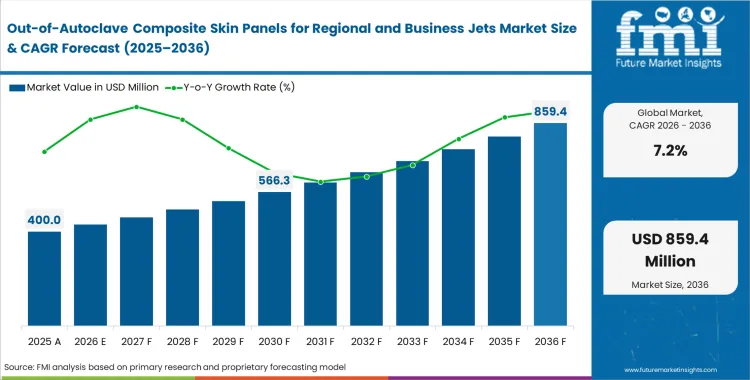
Out-of-Autoclave Composite Skin Panels for Regional and Business Jets Market Key Takeaways
| Metric | Details |
|---|---|
| Industry Size (2026) | USD 353.8 million |
| Industry Value (2036) | USD 709.0 million |
| CAGR (2026 to 2036) | 7.2% |
Source: Future Market Insights (FMI) analysis, based on proprietary forecasting model and primary research
Tier-1 aerostructures suppliers industrialize resin infusion and thermoplastic pressing. This breaks their reliance on capital-intensive autoclave curing cycles. New capabilities allow suppliers to expand their production capacity rapidly.
Aerospace procurement departments operate under strict capacity constraints. Sourcing external aerostructures for next-generation platforms presents a considerable challenge. Traditional autoclave curing creates an unavoidable production bottleneck, and this restricts output irrespective of facility size. Delaying a transition to Out-of-Autoclave (OOA) composite skin panels compels tier-1 suppliers into difficult choices. Suppliers must either decline new Original Equipment Manufacturer (OEM) volume or invest heavily in massive pressurized ovens. Expensive ovens erode margin profiles. Engineers validate metallic composite hybrid aircraft exterior components utilizing infusion and press-forming techniques. This achieves production rates exceeding pressurized curing capabilities.
A major business-jet airframer certifies aircraft OOA skin panels, and certification involves vacuum-bag-only prepreg or liquid resin infusion. Regional supply chains rapidly realign to that material qualification standard. This threshold moves economics from developmental prototyping into serialized production. Suppliers operating without validated lines immediately find exclusion from opportunities such as block-upgrade bidding. OEMs prioritize vendors capable of scaling panel output. Vendors must achieve this without requiring parallel autoclave investments, and this shift accelerates adoption across multiple aerospace manufacturing tiers.
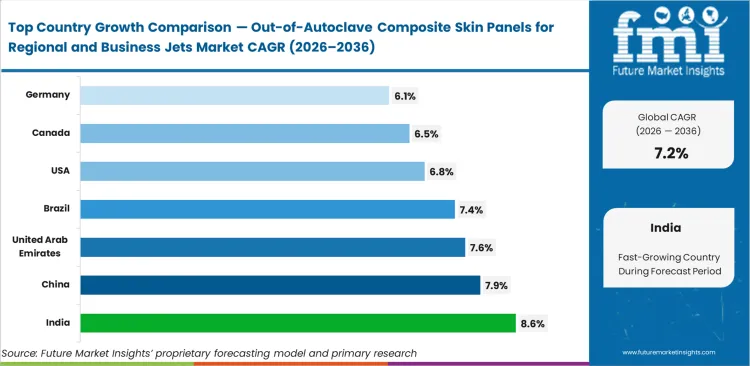
Aerospace suppliers are actively pulling production closer to home, accelerating demand across developing aviation hubs. Driven directly by this localized manufacturing expansion, India is expected to post an 8.6% CAGR during the assessment period. Following a similar domestic production mandate, China is projected to record a CAGR of 7.9%. This localized growth pattern extends to secondary aviation centers, pushing the United Arab Emirates to a 7.6% CAGR while Brazil advances at 7.4% through 2036.
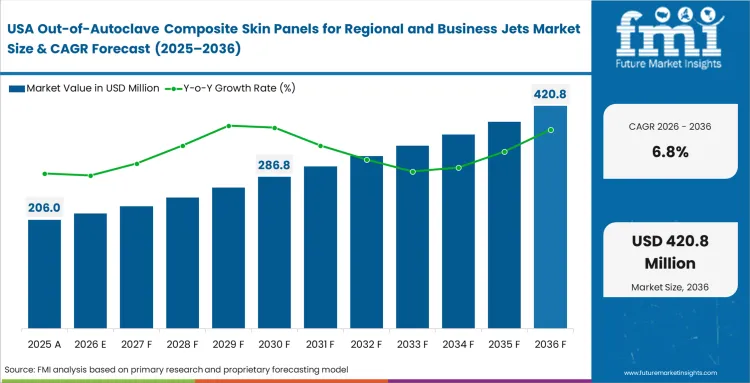
Mature geographies operate under entirely different capacity limits. Rather than building new production lines, facility directors in the United States and Canada must focus on maintaining massive existing installed bases. Operating within these established networks, the United States is set to expand at a 6.8% CAGR, while the market in Canada is anticipated to grow at 6.5% over the study period. European production centers face identical saturation limits. Germany is forecast to post a 6.1% CAGR, reflecting the strict operating reality of a highly advanced but fully mature aerostructures hub.
Segmental Analysis
Out-of-Autoclave Composite Skin Panels for Regional and Business Jets Market Analysis by Manufacturing Process
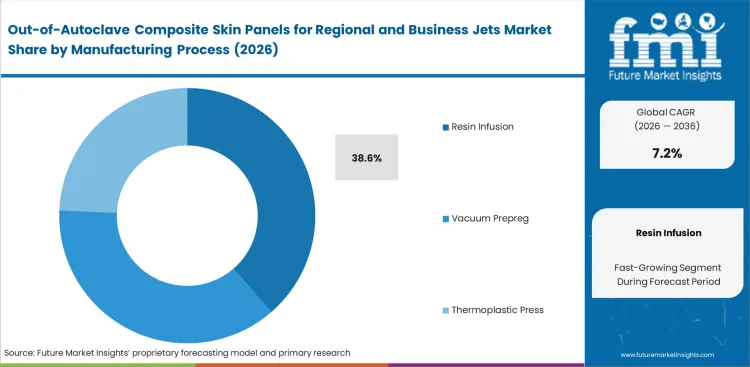
Outdated autoclave procedures fall short of required production throughput, hindering operations. Regional jet manufacturing output increases rapidly. The resin infusion segment is estimated to secure a 38.6% revenue share in 2026 driven by the capacity to manufacture large, intricate geometric structures, lower capital expenditure production solutions, and high demand for lower-capex production solutions. High demand for lower-capex production solutions supports this compound growth. Facilities avoid capital penalties associated with massive pressurized vessels. Manufacturing engineering leadership at tier-1 aerostructure firms rely on specific tools. Use of smart composite layup machines for aerospace pre-forms dry fiber. Resin is injected under precisely controlled vacuum conditions. Producing resin infusion aircraft skin panels reduces initial facility footprint costs.
- Initial equipment avoidance: Resin infusion bypasses multi-million-dollar pressurized curing ovens entirely. Facilities managers avoid massive capital expenditures. They still achieve acceptable aerospace-grade porosity levels on exterior components.
- Vacuum integrity validation: Tooling engineers must guarantee absolute vacuum seal perfection. They do this before resin injection begins. Microscopic leaks during infusion phases result in scrapped panels and catastrophic material waste.
- High-rate expansion: Suppliers successfully industrializing this process capture subsequent block-upgrade contracts. Operations departments leverage proven infusion capability to secure multi-year sourcing agreements. Business-jet OEMs seek reliable throughput from these partners.
Out-of-Autoclave Composite Skin Panels for Regional and Business Jets Market Analysis by Panel Type
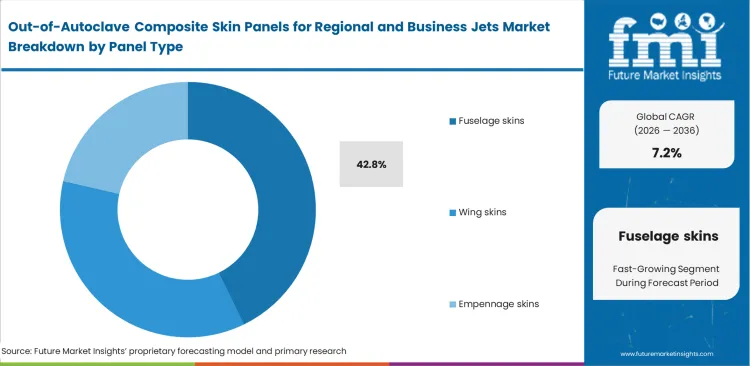
Alternative curing economics for airframers are determined by the continuous surface area required. These panels demand less intricate internal ply drops compared to highly stressed wing root skins. The fuselage skins segment, driven by massive curved real estate for business jet cabins and increasing orders for large-cabin executive jets, and the necessity to secure localized composite tooling, accounts for an estimated 42.8% revenue share in 2026. Procurement departments must ensure localized composite tooling is secured for regional jet composite fuselage panels. Failure to secure tooling creates immediate logistical challenges. Transporting uncured or oversized panels across international supply chains presents extreme difficulty.
- Procurement footprint savings: Large curved panels traditionally demand outsized shipping logistics if manufactured off-site. Procurement departments save millions in transport by sourcing fuselage skins from regional fabrication cells. These cells locate adjacent to final assembly lines.
- Hidden handling costs: Moving massive infused panels requires specialized lifting jigs to prevent micro-cracking before final assembly. Operations managers face unexpected capital costs for custom factory floor manipulation equipment.
- Lifecycle inspection burden: Airlines and private operators must continuously monitor expansive composite surfaces for barely visible impact damage. Maintenance departments bear long-term costs associated with specialized ultrasonic inspections across large fuselage areas.
Out-of-Autoclave Composite Skin Panels for Regional and Business Jets Market Analysis by Material System
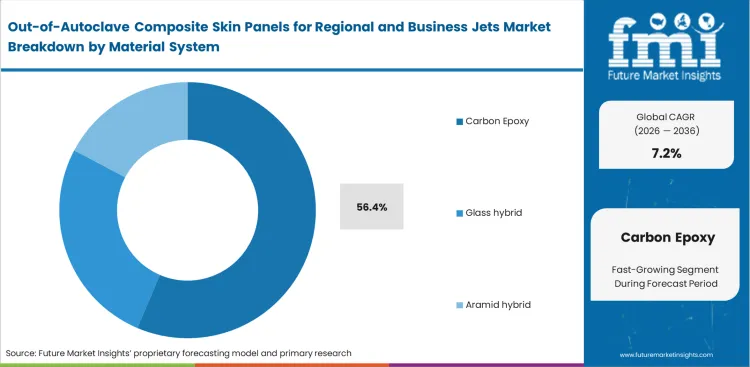
Specific chemistry dominance in aerospace applications stems from certification heritage. The carbon epoxy segment currently is set to command a 56.4% revenue share in 2026, due to accumulated flight-hour data, and required regulatory approvals. Predictable mechanical behavior under cyclic loading, established epoxy matrices satisfying strict aircraft composite panel certification requirements, and decades of accumulated flight-hour data drive this 56.4% share. Materials engineering departments heavily favor established epoxy matrices. Aerospace composite materials using pcr gain recent attention; however, carbon epoxy maintains the default qualification standard. Vacuum-cured epoxies exhibit fundamentally different behavior than pressurized counterparts during exotherm phases. This necessitates entirely new thermal profiling despite basic chemistries remaining similar.
- Catastrophic delamination prevention: Epoxy systems engineered specifically for vacuum-only curing contain proprietary toughening agents preventing inter-ply failure. Materials engineering departments avoid catastrophic in-flight compromises by strictly qualifying specialized formulations.
- Moisture ingress vulnerability: Vacuum-cured epoxies inherently battle higher void contents than pressurized variants. Maintenance managers rigorously apply specialized aerospace adhesives and sealants. This prevents microscopic water absorption from degrading laminates over twenty-year service lives.
- Strict qualification mandates: Regulatory bodies require exhaustive coupon testing before approving new resin formulations. Certification leads submit years of fatigue data to prove specific vacuum-cured epoxies match legacy autoclave performance standards.
Out-of-Autoclave Composite Skin Panels for Regional and Business Jets Market Analysis by Aircraft Type
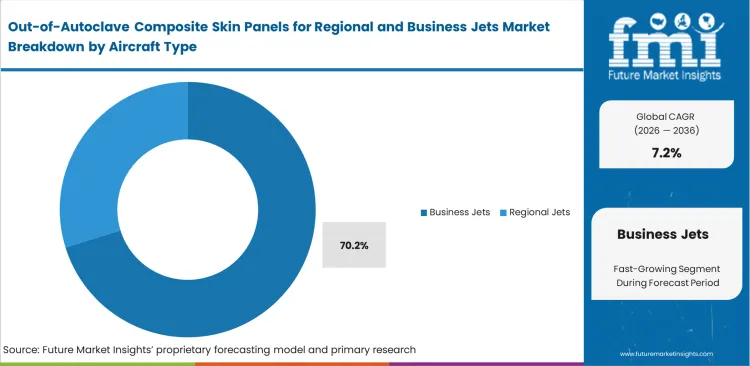
The business jets segment is estimated to secure a 70.2% revenue share in 2026, driven by increasing orders for ultra-long-range executive aircraft, and active encouragement of tier-1 vendors by executive aircraft supply chain managers. Original Equipment Manufacturers (OEMs) encounter significant pressure to reduce cabin weight while maintaining high profit margins. Executive aircraft supply chain managers actively encourage tier-1 vendors, favoring composite airframes produced using alternative processes. This approach sustains production without reliance on commercial airline component backlogs.
- Initial weight targets: Executive aircraft designers aggressively pursue weight reduction to maximize range and cabin luxury. Engineering leads specify advanced aerospace lightweight materials to strip hundreds of pounds from fuselages. They do this without compromising aerodynamic integrity.
- Production queue bypassing: Sourcing components cured outside traditional pressurized ovens allows executive OEMs to avoid competing with commercial giants. Supply chain managers ensure consistent delivery schedules by deliberately qualifying alternative fabrication routes.
- High-cycle fatigue validation: Regional carriers fly exponentially more pressurized cycles than privately owned jets. Certification departments face intense regulatory scrutiny. They must prove skins survive constant pressurization without propagating microscopic resin voids.
Out-of-Autoclave Composite Skin Panels for Regional and Business Jets Market Analysis by Program Stage
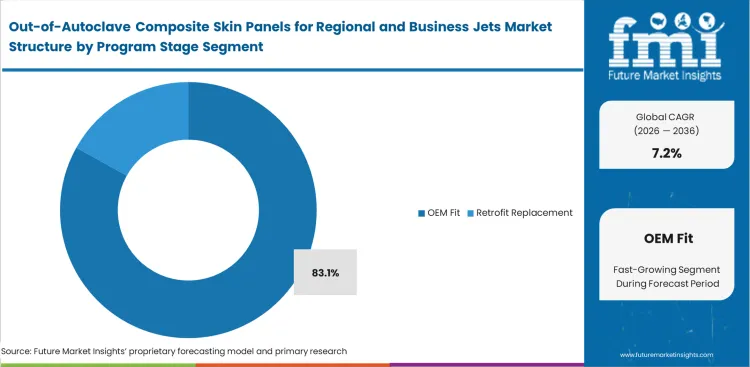
Strict aerospace certification mandates a heavy concentration of demand at the beginning of aircraft lifecycles. Surging line-fit production rates for new platforms, rigid certification requirements, and limited aftermarket substitution support this compound growth. The OEM fit segment anticipates accounting for an 83.1% revenue share in 2026 due to the impossibility of mixing different composite curing methods on primary airframes. Aircraft models achieve type certification using composite airframe specialty fasteners alongside specific skins. Substituting autoclave-cured panels for replacements creates a regulatory difficulty. Repair replacement composite skin panel aircraft applications remain artificially suppressed. Re-qualifying single aftermarket exterior panels often exceeds the revenue potential of entire repair contracts.
- First-mover specification: Securing positions on new aircraft platforms guarantees decades of recurring revenue. Business development departments at tier-1 suppliers focus engineering resources on line-fit contracts. They avoid chasing low-volume aircraft pylon and strut fairing retrofit kits replacements.
- Follow-on service lock-out: Independent repair facilities lack proprietary cure data required to fabricate matching exterior panels. MRO departments face strict limitations on repairs. They funnel replacement orders back to original manufacturers.
- End-of-life replacement barriers: Sourcing authentic specialized skins becomes increasingly expensive as regional jets age. Fleet management officers eventually retire aircraft early. Specialized exterior composite replacement costs ultimately destroy operating margins.
Out-of-Autoclave Composite Skin Panels for Regional and Business Jets Market Drivers, Restraints, and Opportunities
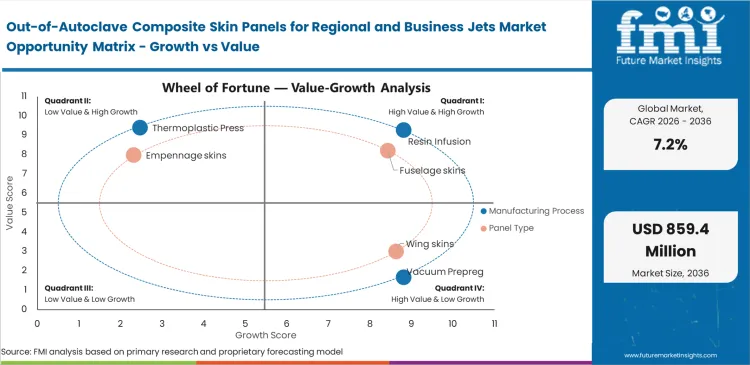
Production constraints within major aerostructure facilities necessitate corrective measures. Supply chain management actively seeks alternatives to autoclave curing. Postponing these transitions forces aerospace manufacturing organizations into difficult situations. Manufacturers either decline profitable block-upgrade agreements or invest millions in large pressurized ovens. These ovens require years for installation and certification. Business-jet Original Equipment Manufacturers (OEMs) currently face record backlogs. Procurement mandates Off-of-Autoclave (OOA) composite panel producers adopt carbon fiber composites utilizing resin infusion. This move aligns with demanding delivery schedules. Pressure from this action forces rapid industrialization across the supply base. A developmental prototyping methodology transforms into a baseline requirement for component bids.
Strict inspection standards for porosity and void content create significant operational impedance. This impedance slows implementation even during periods of high demand. Traditional non-destructive testing procedures were designed for highly predictable compaction. This compaction characterizes autoclave components. Quality assurance departments observe vacuum-cured and infused skins possess distinct microscopic void distributions. This observation results in massive false-positive rejection rates during initial production phases. Automated ultrasonic inspection systems require explicit recalibration for these specific microstructures.
Opportunities in the Out-of-Autoclave Composite Skin Panels for Regional and Business Jets Market
- Thermoplastic pressing integration: High-volume regional jet production demands cycle times measured in minutes. Manufacturing leads validating thermoplastic aircraft skin panels capture significant share over traditional thermoset suppliers. This method permits rapid stamping of components and dramatically accelerates overall factory throughput.
- Localized assembly proximity: Transporting massive composite components introduces severe logistical risks. Operations departments establish fabrication cells directly adjacent to OEM final assembly lines. Long-term sourcing agreements are attained by eliminating shipping costs. This proximity reduces potential transit damage significantly.
- Integrated lightning protection: Exterior skins must survive extreme atmospheric electrical strikes. Engineering teams embed aerospace lightning strike protection directly into resin matrices during infusion. This bypasses expensive secondary coating applications entirely. It streamlines the final finishing process and saves considerable labor hours per aircraft.
Regional Analysis
Based on regional analysis, the out-of-autoclave composite skin panels for regional and business jets market is segmented into North America, Europe, Asia Pacific, Latin America, and Middle East & Africa.
.webp "Top Country Growth Comparison Out Of Autoclave Composite Skin Panels For Regional And Business Jets Market Cagr (2026 2036)")
| Country | CAGR (2026 to 2036) |
|---|---|
| India | 8.6% |
| China | 7.9% |
| United Arab Emirates | 7.6% |
| Brazil | 7.4% |
| United States | 6.8% |
| Canada | 6.5% |
| Germany | 6.1% |
Source: Future Market Insights (FMI) analysis, based on proprietary forecasting model and primary research
North America Out-of-Autoclave Composite Skin Panels for Regional and Business Jets Market Analysis
Demand in North America is supported by deep tier-1 aerostructures supply chains, established Original Equipment Manufacturer (OEM) bases, and steady business jet deliveries. Manufacturing facilities in the region swiftly adopt alternative curing methods to manage increasing aircraft order backlogs. OEMs apply pressure on domestic suppliers to completely circumvent the limitations of autoclave bottlenecks.
- United States: The country sustains a stable demand baseline, predominantly driven by global business-jet deliveries. Procurement teams meticulously evaluate the balance between existing autoclave capital expenditures and the adoption of novel processes. Operations departments are seeking methodologies to enhance throughput without necessitating the expansion of substantial pressurized oven infrastructure. US is projected to register a CAGR of 6.8% over the forecast period driven by stable demand from global business-jet deliveries, a focus on balancing autoclave investment with new processes, and a drive to enhance throughput without expanding oven infrastructure. Established suppliers are leveraging considerable capital resources to validate thermoplastic pressing technologies.
- Canada: The country possesses notable business-jet manufacturing capabilities, primarily concentrated around Montreal. Canada revenue is poised to expand at a 6.5% CAGR during the forecast period, owing to significant business-jet manufacturing capabilities in Montreal, the pursuit of localized high-performance composites to lower costs, and a regional supplier advantage from proximity to major OEMs. Supply chain managers are actively pursuing localized high-performance composites to circumvent legacy capital expenditure requirements, thereby enabling competitive supply to domestic assembly lines. Proximity to major Original Equipment Manufacturers (OEMs) confers a distinct advantage upon regional suppliers implementing vacuum-only techniques.
Europe Out-of-Autoclave Composite Skin Panels for Regional and Business Jets Market Analysis
Europe experiences substantial backing from prominent aerospace research organizations and leading commercial aircraft manufacturers. Stringent environmental regulations, continually promoting lightweighting initiatives are supporting market growth. Regional contracting firms actively pursue bids for airframe components on commercial aircraft accommodating sub-150 seats, employing recently certified composite manufacturing techniques. The necessity for reduced manufacturing costs coupled with improved material performance contributes significantly to the adoption of these innovative Out-of-Autoclave solutions across the aerospace sector in Europe. The focus remains on enhancing structural integrity while achieving significant weight reduction.
- Germany: Germany represents a technologically advanced, albeit highly saturated, aerostructures hub. This mature market is characterized by a significant installed base of legacy autoclave equipment, which represents considerable sunk costs. The industry is actively balancing these legacy investments against the necessary adoption of new, more efficient composite manufacturing processes. Industry is estimated to expand at a 6.1% CAGR during the forecast period as procurement departments across the country are actively sourcing vacuum-capable prepregs to support regional assembly lines. The push towards scaling localized production cells fundamentally alters factory operations, allowing for greater autonomy and efficiency without reliance on imported heavy machinery. This dynamic interplay between maintaining existing infrastructure and integrating next-generation technologies positions the region for steady, albeit competitive, expansion.
Asia Pacific Out-of-Autoclave Composite Skin Panels for Regional and Business Jets Market Analysis
Expansion in state-backed aerospace manufacturing significantly drives the market growth. This robust and compounding growth trajectory is primarily fueled by a critical, strategic imperative to lessen the region’s reliance on often volatile and expensive foreign-sourced components and intellectual property. The current market dynamics strongly favor domestic production capabilities. This drive for self-sufficiency is a top priority for engineering leadership. A key strategy involves aggressive reverse-engineering efforts to master the technology and production processes of currently imported parts. Furthermore, there is an intense focus on the research, development, and qualification of alternative curing and manufacturing methodologies. This is crucial to ensure that all domestically produced components not only meet but often exceed stringent international aerodynamic and structural specifications, thereby maintaining a competitive edge and guaranteeing the highest levels of safety and performance for end-users worldwide. This comprehensive approach is essential for long-term sustainable growth and technological sovereignty in the global market.
- China: Domestic commercial aviation programs necessitate in-country manufacturing of composite exterior components in China. Such action shields supply chains from geopolitical trade restrictions. Procurement teams actively seek vacuum-capable prepregs supporting local regional jet assembly lines. China is set to experience a compound annual growth rate (CAGR) of 7.9% during the forecast period. Driving factors include mandates for localized production in commercial aviation, insulation of supply chains against geopolitical trade restrictions, active sourcing of vacuum-capable prepregs by procurement staff, support requirements for native regional jet assembly operations, and fundamental alteration of delivery timelines through production cell scaling.
- India: Greenfield aerostructures facilities in India are rapidly scaling to meet future sub-150-seat fleet demands without investing in pressurized ovens. Operations directors leverage lower-capex infusion routes to competitively enter global supply chains. The country is expected to register 8.6% CAGR during the forecast period, demonstrating strong momentum. Aggressive industrialization positions domestic contractors to win lucrative primary structure work away from capacity-constrained Western incumbents.
Middle East & Africa Out-of-Autoclave Composite Skin Panels for Regional and Business Jets Market Analysis
Disproportionately high concentrations of large-cabin executive jets drive specialized demand for structural maintenance and composite exterior upgrades. In FMI's view, MRO leadership at major hubs faces intense pressure to service premium aircraft without waiting for replacement panels to ship from overseas OEMs. This dynamic forces localized maintenance facilities to invest heavily in specialized repair capabilities and limited-run fabrication cells.
- United Arab Emirates: Dense populations of ultra-long-range business jets require immediate access to structural repair capabilities minimizing grounded time. Maintenance leadership mandates localized composite fabrication cells addressing exterior skin damage efficiently. Establishing specialized repair capabilities allows regional MROs to command premium servicing rates while dominating executive aircraft maintenance contracts across the peninsula. Expansion in UAE is estimated to record a CAGR of 7.6% through 2036. The increasing fleet age necessitates advanced composite repair techniques to extend the operational lifespan of high-value assets is one of the key factors driving revenue growth. The proliferation of new-generation composite-heavy aircraft models entering the regional fleet continuously elevates the baseline requirement for specialized MRO expertise is also driving UAE growth.
Competitive Aligners for Market Players
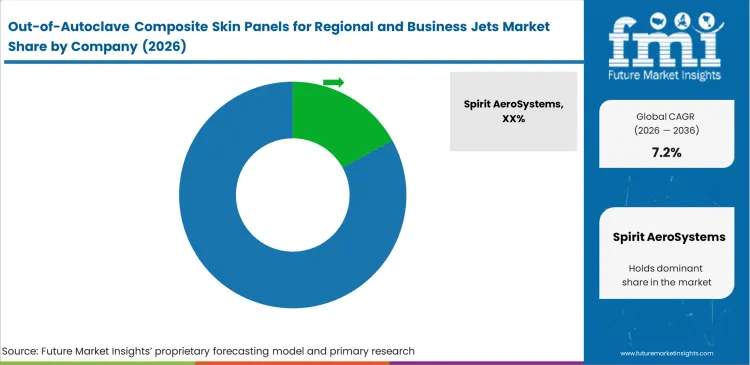
Tier-1 aerostructures competition fundamentally diverges from generic aerospace manufacturing. Barriers to entry involve certifying entirely new curing methodologies. Spirit AeroSystems, FACC AG, and Airbus Aerostructures heavily influence competitive baselines. They establish proprietary resin infusion and vacuum-bag-only thermal profiles. Smaller contractors cannot easily reverse-engineer these specific profiles. Procurement departments evaluate these tier-1 players strictly. They look at proven capacity to pass exhaustive EASA and FAA porosity inspections. They must do this without utilizing an autoclave. This reality severely limits viable bidders for next-generation business jet skin contracts. It shapes the OOA vs autoclave composite panels debate significantly.
Established incumbents possess massive libraries of validated fatigue data. Challengers cannot quickly replicate this extensive data. New entrants might purchase advanced infusion equipment or prepreg pre impregnated composite fibers. They lack ten years of cyclic loading test results. These results are required to prove specific processes match legacy strength requirements. Engineering leads at incumbent firms leverage this data moat. They maintain exclusive supplier status on high-margin regional jet platforms. Challengers must invest heavily in physical coupon testing. They must perform destructive evaluation before submitting credible bids to OEM procurement offices.
Large executive aircraft OEMs actively resist single-source vendor lock-in. They force competing tier-1 suppliers to standardize around shared material qualifications. Supply chain managers deliberately split wing and fuselage panel contracts across multiple companies. Companies like GKN Aerospace and Leonardo Aerostructures help maintain pricing leverage. One supplier might attempt to monopolize specific thermoplastic press-forming techniques. They might utilize glass prepreg variants to gain an edge. OEMs fund secondary suppliers' qualification processes ensuring competitive bidding. Shifts toward high-rate infusion and press-forming increasingly favor highly integrated suppliers. These suppliers integrate raw material weaving, resin injection, and automated ultrasonic inspection. They perform these operations under single roofs rather than simply consolidating pre-impregnated materials.
Key Players in Out-of-Autoclave Composite Skin Panels for Regional and Business Jets Market
- Spirit AeroSystems
- GKN Aerospace
- FACC AG
- Airbus Aerostructures
- TRIUMPH
- Daher
- Leonardo Aerostructures
Scope of the Report
| Metric | Value |
|---|---|
| Quantitative Units | USD 353.8 million to USD 709.0 million, at a CAGR of 7.2% |
| Market Definition | The out-of-autoclave composite skin panels for regional and business jets market comprises exterior aircraft surfaces manufactured using infusion, vacuum-only curing, or press forming. These components serve regional and executive platforms, optimizing production throughput while maintaining strict aerospace tolerances. |
| Segmentation | Manufacturing Process, Panel Type, Material System, Aircraft Type, Program Stage, and Region |
| Regions Covered | North America, Europe, Asia Pacific, Latin America, Middle East & Africa |
| Countries Covered | United States, Canada, Germany, United Kingdom, France, Italy, Spain, China, Japan, South Korea, Taiwan, Singapore, Brazil, Mexico, Argentina, GCC Countries, South Africa, Israel, Rest of Middle East & Africa |
| Key Companies Profiled | Spirit AeroSystems, GKN Aerospace, FACC AG, Airbus Aerostructures, TRIUMPH, Daher, Leonardo Aerostructures |
| Forecast Period | 2026 to 2036 |
| Approach | Baseline anchored to global business-jet delivery volumes and regional fleet expansion rates. |
Source: Future Market Insights (FMI) analysis, based on proprietary forecasting model and primary research
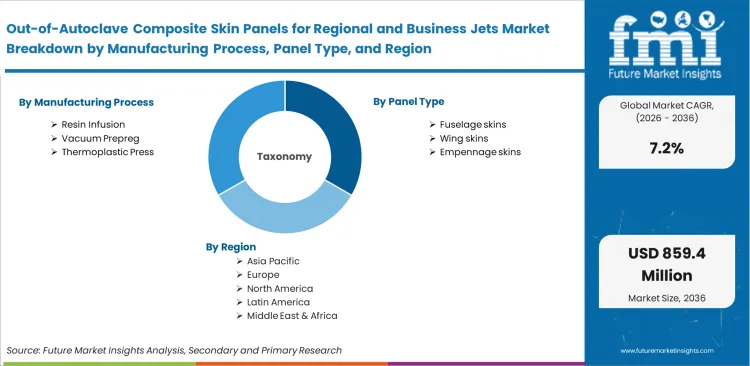
Out-of-Autoclave Composite Skin Panels for Regional and Business Jets Market Analysis by Segments
Manufacturing Process:
- Resin infusion
- Vacuum prepreg
- Thermoplastic press
- Compression molding
Panel Type:
- Fuselage skins
- Wing skins
- Empennage skins
- Access skins
Material System:
- Carbon epoxy
- Carbon thermoplastic
- Glass hybrid
- Aramid hybrid
Aircraft Type:
- Business jets
- Regional jets
Program Stage:
- OEM fit
- Retrofit replacement
- Repair panels
Region:
- North America
- United States
- Canada
- Europe
- Germany
- United Kingdom
- France
- Italy
- Spain
- Asia Pacific
- China
- Japan
- South Korea
- Taiwan
- Singapore
- Latin America
- Brazil
- Mexico
- Argentina
- Middle East & Africa
- GCC Countries
- South Africa
- Israel
- Rest of Middle East & Africa
Bibliography
- Federal Aviation Administration. (2024, June). Transport airplane metallic and composite structures working group recommendation report (Rev. A). USA Department of Transportation.
- National Aeronautics and Space Administration. (2024, October). Technology development for hi-rate composite aircraft manufacturing (HiCAM). NASA Technical Reports Server.
- European Union Aviation Safety Agency. (2025, February). Composite materials. EASA Rotorcraft Structures Workshop 2025.
- European Union Aviation Safety Agency. (2025, March). Advances in CMH-17 content for PMC
- Li, C. X., Hank, T. J., Kalfon-Cohen, E., Furtado, C., Lee, J., Cassady, S., Tucker, J., Kessler, S. S., & Wardle, B. L. (2024, May). Manufacturing autoclave-grade thermoset carbon fiber-reinforced polymer aerospace composites without an autoclave using nanoporous materials. ACS Applied Materials & Interfaces, 16(19), 25280-25293.
This Report Addresses
- The manner infusion and vacuum-cured prepregs bypass legacy autoclave production bottlenecks.
- The reason fuselage skins command largest surface area demand for specialized curing capabilities.
- The factor driving business-jet OEMs to aggressively adopt carbon epoxy external structures.
- The specific locations tier-1 suppliers face critical constraints in ultrasonic non-destructive inspection protocols.
- The specific regulatory mandates forcing exhaustive fatigue data collection for new resin formulations.
- The method localized aerostructure facilities secure global sub-150-seat fleet contracts.
- The reason MRO departments require immediate localized composite repair cells.
- The manner OEMs leverage multi-source bidding breaking proprietary thermoplastic pressing monopolies.
Frequently Asked Questions
How big is the out-of-autoclave composite skin panels market by 2036?
Total valuation is projected to reach USD 820 million by 2036. This out-of-autoclave composite aircraft panels forecast reflects sustained investment by tier-1 aero structures suppliers industrializing resin infusion and thermoplastic pressing breaking reliance on capital-intensive autoclave curing cycles.
What was the global valuation of this aerospace segment in 2025?
FMI assessed valuation at USD 330 million in 2025. This baseline captures external skin-panel structures produced with specialized routes, explicitly excluding full fuselage barrels, interior panels, and metallic skins.
What compound annual growth rate is expected through the forecast period?
Demand is set to expand at a 7.2% CAGR from 2026 to 2036. Rising composite intensity on newer regional and business aircraft supports this steady trajectory as OEMs demand lower-capex processing routes.
How are OOA composite aircraft panels manufactured?
Resin infusion holds leading share because it produces large complex geometries without capital penalties of massive pressurized vessels. Manufacturing engineering leads rely on this method to pre-form dry fiber before injecting resin under carefully controlled vacuum conditions.
What operational consequence do buyers face when selecting fuselage skins?
Procurement departments save millions in transport logistics sourcing massive fuselage skins from regional fabrication cells adjacent to final assembly lines. Shifting these sections to infusion allows wider bases of contractors bidding on work.
Why do carbon epoxy materials maintain their leading position?
Carbon epoxy leads because regulators demand decades of accumulated flight-hour data before approving primary structural components. Materials engineering departments favor established matrices because mechanical behavior under cyclic loading is highly predictable.
What advantage drives business jet adoption of these panels?
Executive aircraft designers aggressively pursue weight reduction maximizing range. Engineering leads specify advanced composite skins stripping hundreds of pounds from fuselages without compromising aerodynamic integrity or certification requirements.
Are OOA composite panels certified for aircraft use?
Once aircraft models achieve type certification using specific skins, substituting autoclave-cured panels for replacements becomes regulatory nightmares. Re-qualifying single aftermarket exterior panels often exceeds revenue potential for entire repair contracts.
What differentiates India's growth trajectory from other regions?
India is likely to advance at an 8.6% CAGR because domestic suppliers aggressively build capabilities capturing sub-150-seat fleet demand. Greenfield aerostructures facilities scale rapidly meeting future requirements without investing in legacy pressurized ovens.
How does the China aviation sector approach out-of-autoclave manufacturing?
China is set to progress at a 7.9% CAGR as state-backed aerospace expansion explicitly targets advanced composite integration. Engineering leads focus on reverse-engineering processes supporting native regional jet assembly lines without relying on imported heavy machinery.
Why is demand in the United Arab Emirates growing faster than mature Western markets?
The GCC Countries segment expands at a 7.6% CAGR due to disproportionately high density of large-cabin executive jets requiring structural maintenance. Maintenance departments mandate localized composite fabrication cells addressing exterior skin damage efficiently.
What friction prevents faster adoption of vacuum-cured composite skins?
Stringent porosity and void-content inspection standards create severe operational friction. Quality assurance departments find vacuum-cured skins present entirely different microscopic void distributions than autoclave components, leading to massive false-positive rejection rates.
Who are the top suppliers of OOA aircraft skin panels?
Established incumbents like Spirit AeroSystems, FACC AG, and Airbus Aerostructures possess massive libraries of validated fatigue data that challengers cannot quickly replicate. Engineering leads leverage proprietary thermal cure data maintaining exclusive supplier status on high-margin platforms.
What strategic mechanism do large OEMs use to prevent vendor lock-in?
Supply chain managers deliberately split wing and fuselage panel contracts across multiple suppliers maintaining pricing leverage. If one supplier attempts monopolizing specific techniques, OEMs fund secondary suppliers' qualification processes.
How does thermoplastic pressing alter the production timeline?
High-volume regional jet production requires cycle times measured in minutes rather than hours. Manufacturing leads validating thermoplastic stamping processes capture significant market share by exponentially increasing component throughput compared to traditional thermoset curing.
Why are interior cabin panels excluded from this specific scope?
Interior cabin panels face entirely different operational stresses and fire-retardancy qualification pathways than external aerodynamic skins. Production methods and integrity mandates place them outside specific boundaries of primary exterior aerostructures.
What role do smart layup machines play in infusion processes?
Manufacturing engineers use automated layup equipment precisely positioning dry carbon fiber before sealing vacuum bags. Automation is critical maintaining consistent fiber volume fractions and preventing dry spots during subsequent resin injection phases.
Preview the report firsthand - request a free sample
Get SampleGet the brochure for pricing and purchase details.
Get PDFTable of Content
- Executive Summary
- Global Market Outlook
- Demand-side Trends
- Supply-side Trends
- Technology Roadmap Analysis
- Analysis and Recommendations
- Market Overview
- Market Coverage / Taxonomy
- Market Definition / Scope / Limitations
- Research Methodology
- Chapter Orientation
- Analytical Lens and Working Hypotheses
- Market Structure, Signals, and Trend Drivers
- Benchmarking and Cross-market Comparability
- Market Sizing, Forecasting, and Opportunity Mapping
- Research Design and Evidence Framework
- Desk Research Programme (Secondary Evidence)
- Company Annual and Sustainability Reports
- Peer-reviewed Journals and Academic Literature
- Corporate Websites, Product Literature, and Technical Notes
- Earnings Decks and Investor Briefings
- Statutory Filings and Regulatory Disclosures
- Technical White Papers and Standards Notes
- Trade Journals, Industry Magazines, and Analyst Briefs
- Conference Proceedings, Webinars, and Seminar Materials
- Government Statistics Portals and Public Data Releases
- Press Releases and Reputable Media Coverage
- Specialist Newsletters and Curated Briefings
- Sector Databases and Reference Repositories
- FMI Internal Proprietary Databases and Historical Market Datasets
- Subscription Datasets and Paid Sources
- Social Channels, Communities, and Digital Listening Inputs
- Additional Desk Sources
- Expert Input and Fieldwork (Primary Evidence)
- Primary Modes
- Qualitative Interviews and Expert Elicitation
- Quantitative Surveys and Structured Data Capture
- Blended Approach
- Why Primary Evidence is Used
- Field Techniques
- Interviews
- Surveys
- Focus Groups
- Observational and In-context Research
- Social and Community Interactions
- Stakeholder Universe Engaged
- C-suite Leaders
- Board Members
- Presidents and Vice Presidents
- R&D and Innovation Heads
- Technical Specialists
- Domain Subject-matter Experts
- Scientists
- Physicians and Other Healthcare Professionals
- Governance, Ethics, and Data Stewardship
- Research Ethics
- Data Integrity and Handling
- Primary Modes
- Tooling, Models, and Reference Databases
- Desk Research Programme (Secondary Evidence)
- Data Engineering and Model Build
- Data Acquisition and Ingestion
- Cleaning, Normalisation, and Verification
- Synthesis, Triangulation, and Analysis
- Quality Assurance and Audit Trail
- Market Background
- Market Dynamics
- Drivers
- Restraints
- Opportunity
- Trends
- Scenario Forecast
- Demand in Optimistic Scenario
- Demand in Likely Scenario
- Demand in Conservative Scenario
- Opportunity Map Analysis
- Product Life Cycle Analysis
- Supply Chain Analysis
- Investment Feasibility Matrix
- Value Chain Analysis
- PESTLE and Porter’s Analysis
- Regulatory Landscape
- Regional Parent Market Outlook
- Production and Consumption Statistics
- Import and Export Statistics
- Market Dynamics
- Global Market Analysis 2021 to 2025 and Forecast, 2026 to 2036
- Historical Market Size Value (USD Million) Analysis, 2021 to 2025
- Current and Future Market Size Value (USD Million) Projections, 2026 to 2036
- Y-o-Y Growth Trend Analysis
- Absolute $ Opportunity Analysis
- Global Market Pricing Analysis 2021 to 2025 and Forecast 2026 to 2036
- Global Market Analysis 2021 to 2025 and Forecast 2026 to 2036, By Manufacturing Process
- Introduction / Key Findings
- Historical Market Size Value (USD Million) Analysis By Manufacturing Process , 2021 to 2025
- Current and Future Market Size Value (USD Million) Analysis and Forecast By Manufacturing Process , 2026 to 2036
- Resin Infusion
- Vacuum Prepreg
- Thermoplastic Press
- Resin Infusion
- Y-o-Y Growth Trend Analysis By Manufacturing Process , 2021 to 2025
- Absolute $ Opportunity Analysis By Manufacturing Process , 2026 to 2036
- Global Market Analysis 2021 to 2025 and Forecast 2026 to 2036, By Panel Type
- Introduction / Key Findings
- Historical Market Size Value (USD Million) Analysis By Panel Type, 2021 to 2025
- Current and Future Market Size Value (USD Million) Analysis and Forecast By Panel Type, 2026 to 2036
- Fuselage skins
- Wing skins
- Empennage skins
- Fuselage skins
- Y-o-Y Growth Trend Analysis By Panel Type, 2021 to 2025
- Absolute $ Opportunity Analysis By Panel Type, 2026 to 2036
- Global Market Analysis 2021 to 2025 and Forecast 2026 to 2036, By Material System
- Introduction / Key Findings
- Historical Market Size Value (USD Million) Analysis By Material System, 2021 to 2025
- Current and Future Market Size Value (USD Million) Analysis and Forecast By Material System, 2026 to 2036
- Carbon Epoxy
- Glass hybrid
- Aramid hybrid
- Carbon Epoxy
- Y-o-Y Growth Trend Analysis By Material System, 2021 to 2025
- Absolute $ Opportunity Analysis By Material System, 2026 to 2036
- Global Market Analysis 2021 to 2025 and Forecast 2026 to 2036, By Aircraft Type
- Introduction / Key Findings
- Historical Market Size Value (USD Million) Analysis By Aircraft Type, 2021 to 2025
- Current and Future Market Size Value (USD Million) Analysis and Forecast By Aircraft Type, 2026 to 2036
- Business Jets
- Regional Jets
- Business Jets
- Y-o-Y Growth Trend Analysis By Aircraft Type, 2021 to 2025
- Absolute $ Opportunity Analysis By Aircraft Type, 2026 to 2036
- Global Market Analysis 2021 to 2025 and Forecast 2026 to 2036, By Program Stage
- Introduction / Key Findings
- Historical Market Size Value (USD Million) Analysis By Program Stage, 2021 to 2025
- Current and Future Market Size Value (USD Million) Analysis and Forecast By Program Stage, 2026 to 2036
- OEM Fit
- Retrofit Replacement
- OEM Fit
- Y-o-Y Growth Trend Analysis By Program Stage, 2021 to 2025
- Absolute $ Opportunity Analysis By Program Stage, 2026 to 2036
- Global Market Analysis 2021 to 2025 and Forecast 2026 to 2036, By Region
- Introduction
- Historical Market Size Value (USD Million) Analysis By Region, 2021 to 2025
- Current Market Size Value (USD Million) Analysis and Forecast By Region, 2026 to 2036
- North America
- Latin America
- Western Europe
- Eastern Europe
- East Asia
- South Asia and Pacific
- Middle East & Africa
- Market Attractiveness Analysis By Region
- North America Market Analysis 2021 to 2025 and Forecast 2026 to 2036, By Country
- Historical Market Size Value (USD Million) Trend Analysis By Market Taxonomy, 2021 to 2025
- Market Size Value (USD Million) Forecast By Market Taxonomy, 2026 to 2036
- By Country
- USA
- Canada
- Mexico
- By Manufacturing Process
- By Panel Type
- By Material System
- By Aircraft Type
- By Program Stage
- By Country
- Market Attractiveness Analysis
- By Country
- By Manufacturing Process
- By Panel Type
- By Material System
- By Aircraft Type
- By Program Stage
- Key Takeaways
- Latin America Market Analysis 2021 to 2025 and Forecast 2026 to 2036, By Country
- Historical Market Size Value (USD Million) Trend Analysis By Market Taxonomy, 2021 to 2025
- Market Size Value (USD Million) Forecast By Market Taxonomy, 2026 to 2036
- By Country
- Brazil
- Chile
- Rest of Latin America
- By Manufacturing Process
- By Panel Type
- By Material System
- By Aircraft Type
- By Program Stage
- By Country
- Market Attractiveness Analysis
- By Country
- By Manufacturing Process
- By Panel Type
- By Material System
- By Aircraft Type
- By Program Stage
- Key Takeaways
- Western Europe Market Analysis 2021 to 2025 and Forecast 2026 to 2036, By Country
- Historical Market Size Value (USD Million) Trend Analysis By Market Taxonomy, 2021 to 2025
- Market Size Value (USD Million) Forecast By Market Taxonomy, 2026 to 2036
- By Country
- Germany
- UK
- Italy
- Spain
- France
- Nordic
- BENELUX
- Rest of Western Europe
- By Manufacturing Process
- By Panel Type
- By Material System
- By Aircraft Type
- By Program Stage
- By Country
- Market Attractiveness Analysis
- By Country
- By Manufacturing Process
- By Panel Type
- By Material System
- By Aircraft Type
- By Program Stage
- Key Takeaways
- Eastern Europe Market Analysis 2021 to 2025 and Forecast 2026 to 2036, By Country
- Historical Market Size Value (USD Million) Trend Analysis By Market Taxonomy, 2021 to 2025
- Market Size Value (USD Million) Forecast By Market Taxonomy, 2026 to 2036
- By Country
- Russia
- Poland
- Hungary
- Balkan & Baltic
- Rest of Eastern Europe
- By Manufacturing Process
- By Panel Type
- By Material System
- By Aircraft Type
- By Program Stage
- By Country
- Market Attractiveness Analysis
- By Country
- By Manufacturing Process
- By Panel Type
- By Material System
- By Aircraft Type
- By Program Stage
- Key Takeaways
- East Asia Market Analysis 2021 to 2025 and Forecast 2026 to 2036, By Country
- Historical Market Size Value (USD Million) Trend Analysis By Market Taxonomy, 2021 to 2025
- Market Size Value (USD Million) Forecast By Market Taxonomy, 2026 to 2036
- By Country
- China
- Japan
- South Korea
- By Manufacturing Process
- By Panel Type
- By Material System
- By Aircraft Type
- By Program Stage
- By Country
- Market Attractiveness Analysis
- By Country
- By Manufacturing Process
- By Panel Type
- By Material System
- By Aircraft Type
- By Program Stage
- Key Takeaways
- South Asia and Pacific Market Analysis 2021 to 2025 and Forecast 2026 to 2036, By Country
- Historical Market Size Value (USD Million) Trend Analysis By Market Taxonomy, 2021 to 2025
- Market Size Value (USD Million) Forecast By Market Taxonomy, 2026 to 2036
- By Country
- India
- ASEAN
- Australia & New Zealand
- Rest of South Asia and Pacific
- By Manufacturing Process
- By Panel Type
- By Material System
- By Aircraft Type
- By Program Stage
- By Country
- Market Attractiveness Analysis
- By Country
- By Manufacturing Process
- By Panel Type
- By Material System
- By Aircraft Type
- By Program Stage
- Key Takeaways
- Middle East & Africa Market Analysis 2021 to 2025 and Forecast 2026 to 2036, By Country
- Historical Market Size Value (USD Million) Trend Analysis By Market Taxonomy, 2021 to 2025
- Market Size Value (USD Million) Forecast By Market Taxonomy, 2026 to 2036
- By Country
- Kingdom of Saudi Arabia
- Other GCC Countries
- Turkiye
- South Africa
- Other African Union
- Rest of Middle East & Africa
- By Manufacturing Process
- By Panel Type
- By Material System
- By Aircraft Type
- By Program Stage
- By Country
- Market Attractiveness Analysis
- By Country
- By Manufacturing Process
- By Panel Type
- By Material System
- By Aircraft Type
- By Program Stage
- Key Takeaways
- Key Countries Market Analysis
- USA
- Pricing Analysis
- Market Share Analysis, 2025
- By Manufacturing Process
- By Panel Type
- By Material System
- By Aircraft Type
- By Program Stage
- Canada
- Pricing Analysis
- Market Share Analysis, 2025
- By Manufacturing Process
- By Panel Type
- By Material System
- By Aircraft Type
- By Program Stage
- Mexico
- Pricing Analysis
- Market Share Analysis, 2025
- By Manufacturing Process
- By Panel Type
- By Material System
- By Aircraft Type
- By Program Stage
- Brazil
- Pricing Analysis
- Market Share Analysis, 2025
- By Manufacturing Process
- By Panel Type
- By Material System
- By Aircraft Type
- By Program Stage
- Chile
- Pricing Analysis
- Market Share Analysis, 2025
- By Manufacturing Process
- By Panel Type
- By Material System
- By Aircraft Type
- By Program Stage
- Germany
- Pricing Analysis
- Market Share Analysis, 2025
- By Manufacturing Process
- By Panel Type
- By Material System
- By Aircraft Type
- By Program Stage
- UK
- Pricing Analysis
- Market Share Analysis, 2025
- By Manufacturing Process
- By Panel Type
- By Material System
- By Aircraft Type
- By Program Stage
- Italy
- Pricing Analysis
- Market Share Analysis, 2025
- By Manufacturing Process
- By Panel Type
- By Material System
- By Aircraft Type
- By Program Stage
- Spain
- Pricing Analysis
- Market Share Analysis, 2025
- By Manufacturing Process
- By Panel Type
- By Material System
- By Aircraft Type
- By Program Stage
- France
- Pricing Analysis
- Market Share Analysis, 2025
- By Manufacturing Process
- By Panel Type
- By Material System
- By Aircraft Type
- By Program Stage
- India
- Pricing Analysis
- Market Share Analysis, 2025
- By Manufacturing Process
- By Panel Type
- By Material System
- By Aircraft Type
- By Program Stage
- ASEAN
- Pricing Analysis
- Market Share Analysis, 2025
- By Manufacturing Process
- By Panel Type
- By Material System
- By Aircraft Type
- By Program Stage
- Australia & New Zealand
- Pricing Analysis
- Market Share Analysis, 2025
- By Manufacturing Process
- By Panel Type
- By Material System
- By Aircraft Type
- By Program Stage
- China
- Pricing Analysis
- Market Share Analysis, 2025
- By Manufacturing Process
- By Panel Type
- By Material System
- By Aircraft Type
- By Program Stage
- Japan
- Pricing Analysis
- Market Share Analysis, 2025
- By Manufacturing Process
- By Panel Type
- By Material System
- By Aircraft Type
- By Program Stage
- South Korea
- Pricing Analysis
- Market Share Analysis, 2025
- By Manufacturing Process
- By Panel Type
- By Material System
- By Aircraft Type
- By Program Stage
- Russia
- Pricing Analysis
- Market Share Analysis, 2025
- By Manufacturing Process
- By Panel Type
- By Material System
- By Aircraft Type
- By Program Stage
- Poland
- Pricing Analysis
- Market Share Analysis, 2025
- By Manufacturing Process
- By Panel Type
- By Material System
- By Aircraft Type
- By Program Stage
- Hungary
- Pricing Analysis
- Market Share Analysis, 2025
- By Manufacturing Process
- By Panel Type
- By Material System
- By Aircraft Type
- By Program Stage
- Kingdom of Saudi Arabia
- Pricing Analysis
- Market Share Analysis, 2025
- By Manufacturing Process
- By Panel Type
- By Material System
- By Aircraft Type
- By Program Stage
- Turkiye
- Pricing Analysis
- Market Share Analysis, 2025
- By Manufacturing Process
- By Panel Type
- By Material System
- By Aircraft Type
- By Program Stage
- South Africa
- Pricing Analysis
- Market Share Analysis, 2025
- By Manufacturing Process
- By Panel Type
- By Material System
- By Aircraft Type
- By Program Stage
- USA
- Market Structure Analysis
- Competition Dashboard
- Competition Benchmarking
- Market Share Analysis of Top Players
- By Region
- By Manufacturing Process
- By Panel Type
- By Material System
- By Aircraft Type
- By Program Stage
- Competition Analysis
- Competition Deep Dive
- Spirit AeroSystems
- Overview
- Product Portfolio
- Profitability by Market Segments (Product/Age /Sales Channel/Region)
- Sales Footprint
- Strategy Overview
- Marketing Strategy
- Product Strategy
- Channel Strategy
- GKN Aerospace
- FACC AG
- Airbus Aerostructures
- TRIUMPH
- Daher
- Leonardo Aerostructures
- Spirit AeroSystems
- Competition Deep Dive
- Assumptions & Acronyms Used


